

Relapse prediction in schizophrenia with smartphone digital phenotyping during COVID-19: a prospective, three-site, two-country, longitudinal study
Open accessThe DOI matches its Crossref record; 33 of the 33 references it cites were found in a registry or an index.
Abstract
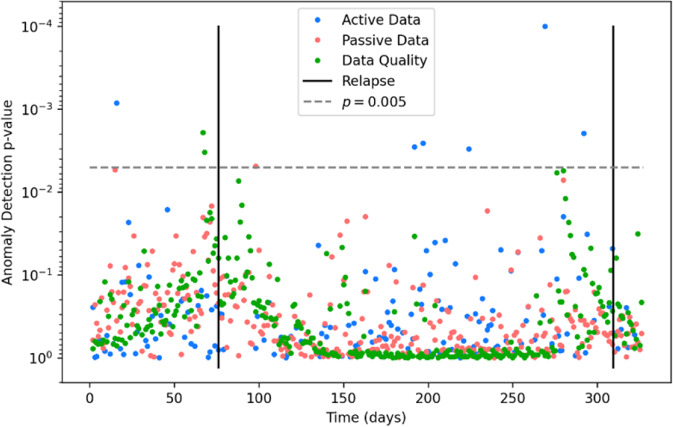
Smartphone technology provides us with a more convenient and less intrusive method of detecting changes in behavior and symptoms that typically precede schizophrenia relapse. To take advantage of the aforementioned, this study examines the feasibility of predicting schizophrenia relapse by identifying statistically significant anomalies in patient data gathered through mindLAMP, an open-source smartphone app. Participants, recruited in Boston, MA in the United States, and Bangalore and Bhopal in India, were invited to use mindLAMP for up to a year. The passive data (geolocation, accelerometer, and screen state), active data (surveys), and data quality metrics collected by the app were then retroactively fed into a relapse prediction model that utilizes anomaly detection. Overall, anomalies were 2.12 times more frequent in the month preceding a relapse and 2.78 times more frequent in the month preceding and following a relapse compared to intervals without relapses. The anomaly detection model incorporating passive data proved a better predictor of relapse than a naive model utilizing only survey data. These results demonstrate that relapse prediction models utilizing patient data gathered by a smartphone app can warn the clinician and patient of a potential schizophrenia relapse.
Overview
The claims and statistics of this paper haven’t been checked yet.
Free: it reads the open-access text and checks the first 5 claims that cite a source we can check. Create a free account to check every claim.
Integrity signals
Registry
Cites
Statistics
Figures
Verification
Claims the paper makes
The claims and statistics of this paper haven’t been checked yet.
Free: it reads the open-access text and checks the first 5 claims that cite a source we can check. Create a free account to check every claim.
Claims other papers make about this one
Each is checked against this paper’s own text: does it say what the citing paper says it does?
The source backs part of the claim, not all of it — or backs it for a different population, condition or comparison.
In the citing paper
“Digital phenotyping methods can also aid in relapse prediction by detecting changes in symptoms and behavioral patterns unique to each youth that may be associated with clinical deterioration [130].”
From Towards a youth mental health paradigm: a perspective and roadmap (2023) · cites this paper as [130]
Experimental — accuracy not yet measured
Self-check
Percentages, sums and reported differences re-computed from the paper’s own numbers.
The self-check needs the paper’s full text.
Citations
Cites
The PHQ-9: Validity of a brief depression severity measure
Kroenke, K., Spitzer, R. L., & Williams, J. B. W. (2001) · Journal of General Internal Medicine · doi:10.1046/j.1525-1497.2001.016009606.x · Cited by 44,910
The Pittsburgh Sleep Quality Index: a new instrument for psychiatric practice and research
Buysse, D. J., Reynolds, C. F., Monk, T. H., Berman, S. R., & Kupfer, D. J. (1989) · Psychiatry Research · doi:10.1016/0165-1781(89)90047-4 · Cited by 35,234
(1992) · PubMed · Cited by 33,716
The MOS 36-ltem Short-Form Health Survey (SF-36): I. Conceptual Framework and Item Selection
Ware, J. E., & Sherbourne, C. D. (1992) · Medical Care · doi:10.1097/00005650-199206000-00002 · Cited by 30,033
The Positive and Negative Syndrome Scale (PANSS) for schizophrenia.
Kay, S. R., Fiszbein, A., & Opler, L. A. (1987) · Schizophrenia Bulletin · doi:10.1093/schbul/13.2.261 · Cited by 21,378
Optimal Detection of Changepoints With a Linear Computational Cost
Killick, R., Fearnhead, P., & Eckley, I. A. (2012) · Journal of the American Statistical Association · doi:10.1080/01621459.2012.737745 · Cited by 2,548
Keefe, R. (2004) · Schizophrenia Research · doi:10.1016/j.schres.2003.09.011 · Cited by 1,573
Robinson, D., Woerner, M. G., Alvir, J. M. J., Bilder, R., Goldman, R., Geisler, S., Koreen, A., Sheitman, B., Chakos, M., Mayerhoff, D., et al. (1999) · Archives of General Psychiatry · doi:10.1001/archpsyc.56.3.241 · Cited by 1,327
Birchwood, M., Smith, J., Cochrane, R., Wetton, S., & Copestake, S. (1990) · British Journal of Psychiatry · doi:10.1192/bjp.157.6.853 · Cited by 1,157
Torous, J., Kiang, M. V., Lorme, J., & Onnela, J.-P. (2016) · JMIR Mental Health · doi:10.2196/mental.5165 · Cited by 758
Self-citationRelapse prediction in schizophrenia through digital phenotyping: a pilot study
Barnett, I., Torous, J., Staples, P., Sandoval, L., Keshavan, M., & Onnela, J.-P. (2018) · Neuropsychopharmacology · doi:10.1038/s41386-018-0030-z · Cited by 422
Self-citationRelapse in schizophrenia: costs, clinical outcomes and quality of life
Almond, S., Knapp, M., Francois, C., Toumi, M., & Brugha, T. (2004) · British Journal of Psychiatry · doi:10.1192/bjp.184.4.346 · Cited by 310
Just-in-the-Moment Adaptive Interventions (JITAI): A Meta-Analytical Review
Wang, L., & Miller, L. C. (2020) · Health Communication · doi:10.1080/10410236.2019.1652388 · Cited by 264
Wang, R., Aung, M. S. H., Abdullah, S., Brian, R., Campbell, A. T., Choudhury, T., Hauser, M., Kane, J., Merrill, M., Scherer, E. A., et al. (2016) · Proceedings of the 2016 ACM International Joint Conference on Pervasive and Ubiquitous Computing · doi:10.1145/2971648.2971740 · Cited by 257
Torous, J., Wisniewski, H., Bird, B., Carpenter, E., David, G., Elejalde, E., Fulford, D., Guimond, S., Hays, R., Henson, P., et al. (2019) · Journal of Technology in Behavioral Science · doi:10.1007/s41347-019-00095-w · Cited by 202
Self-citationTreatment strategies to prevent relapse and encourage remission.
Kane, J. M. (2007) · PubMed · Cited by 131
Matcham, F., Leightley, D., Siddi, S., Lamers, F., White, K. M., Annas, P., de Girolamo, G., Difrancesco, S., Haro, J. M., Horsfall, M., et al. (2022) · BMC Psychiatry · doi:10.1186/s12888-022-03753-1 · Cited by 110
Cameron, I. M., Cunningham, L., Crawford, J. R., Eagles, J. M., Eisen, S. V., Lawton, K., Naji, S. A., & Hamilton, R. J. (2007) · International Journal of Psychiatry in Clinical Practice · doi:10.1080/13651500600885531 · Cited by 109
Birnbaum, M. L., Ernala, S. K., Rizvi, A. F., Arenare, E., R. Van Meter, A., De Choudhury, M., & Kane, J. M. (2019) · npj Schizophrenia · doi:10.1038/s41537-019-0085-9 · Cited by 109 · cited 1×
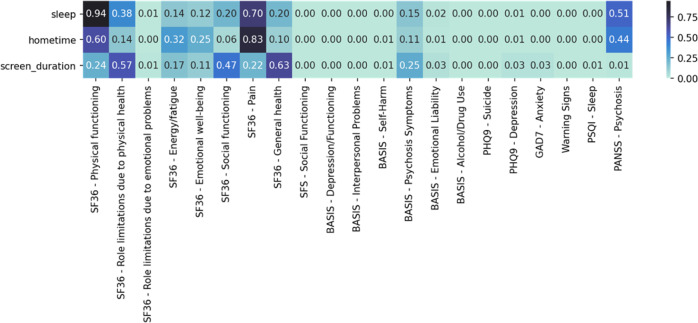
“These different feature groups were (1) symptoms, (2) sociability, (3) medication, (4) sleep, (5) hometime & screen duration, and (6) engagement.”
Generalized Anxiety Disorder 7
Spitzer, R. L., Kroenke, K., Williams, J. B. W., & Löwe, B. (2006) · PsycTESTS Dataset · doi:10.1037/t02591-000 · Cited by 97
Anomaly detection to predict relapse risk in schizophrenia
Henson, P., D’Mello, R., Vaidyam, A., Keshavan, M., & Torous, J. (2021) · Translational Psychiatry · doi:10.1038/s41398-020-01123-7 · Cited by 80
Self-citationGumley, A. I., Bradstreet, S., Ainsworth, J., Allan, S., Alvarez-Jimenez, M., Aucott, L., Birchwood, M., Briggs, A., Bucci, S., Cotton, S. M., et al. (2022) · The Lancet Psychiatry · doi:10.1016/s2215-0366(22)00103-1 · Cited by 71
Early signs of psychotic relapse in schizophrenia
J⊘rgensen, P. (1998) · British Journal of Psychiatry · doi:10.1192/bjp.172.4.327 · Cited by 57
Nickels, S., Edwards, M. D., Poole, S. F., Winter, D., Gronsbell, J., Rozenkrants, B., Miller, D. P., Fleck, M., McLean, A., Peterson, B., et al. (2021) · JMIR Mental Health · doi:10.2196/27589 · Cited by 55
Rodriguez-Villa, E., Rozatkar, A. R., Kumar, M., Patel, V., Bondre, A. P., Naik, S. S., Dutt, S., Mehta, U. M., Nagendra, S., Tugnawat, D. K., et al. (2021) · Cambridge Prisms Global Mental Health · doi:10.1017/gmh.2021.28 · Cited by 53
Self-citationA Clinician's View of the Data on Bipolar Disorder
Gardner, N. C. (2007) · The Journal of Clinical Psychiatry · doi:10.4088/jcp.1107e27 · Cited by 42
Liu, G., Henson, P., Keshavan, M. S., Onnela, J.-P. “., & Torous, J. B. (2019) · Schizophrenia Research Cognition · doi:10.1016/j.scog.2019.100144 · Cited by 40
Self-citationRodriguez-Villa, E., Mehta, U. M., Naslund, J. A., Tugnawat, D. K., Gupta, S., Thirtalli, J., Bhan, A., Patel, V., Chand, P., Rozatkar, A. R., et al. (2021) · BJPsych Open · doi:10.1192/bjo.2020.142 · Cited by 36
Self-citationKølbæk, P., Blicher, A. B., Buus, C. W., Feller, S., Holm, T., Dines, D. E., O’Leary, K. M., Sørensen, R. D., Opler, M. G., Correll, C. U., et al. (2018) · Nordic Journal of Psychiatry · doi:10.1080/08039488.2018.1492014 · Cited by 26
Schizophrenic delusions: the detection of warning signals
Jørgensen, P. (1998) · Schizophrenia Research · doi:10.1016/s0920-9964(98)00033-4 · Cited by 19
Strączkiewicz, M., Wisniewski, H., Carlson, K. W., Heidary, Z., Knights, J., Keshavan, M. S., Onnela, J.-P. “., & Torous, J. B. (2022) · Psychiatry Research · doi:10.1016/j.psychres.2022.114707 · Cited by 15
Self-citationDigital Health Around Clinical High Risk and First-Episode Psychosis
Henson, P., Wisniewski, H., Stromeyer, C., IV, & Torous, J. B. (2020) · Current Psychiatry Reports · doi:10.1007/s11920-020-01184-x · Cited by 12 · cited 2×
“These different feature groups were (1) symptoms, (2) sociability, (3) medication, (4) sleep, (5) hometime & screen duration, and (6) engagement.”
MethodSelf-citationRelapse prevention in schizophrenia
Jauhar, S., Laws, K. R., Fusar‐Poli, P., & McKenna, P. (2022) · The Lancet Psychiatry · doi:10.1016/s2215-0366(21)00501-0 · Cited by 12
Cited by
Torous, J., Linardon, J., Goldberg, S. B., Sun, S., Bell, I., Nicholas, J., Hassan, L., Hua, Y., Milton, A., & Firth, J. (2025) · World Psychiatry · doi:10.1002/wps.21299 · Cited by 323
Self-citationTowards a youth mental health paradigm: a perspective and roadmap
Uhlhaas, P. J., Davey, C. G., Mehta, U. M., Shah, J., Torous, J., Allen, N. B., Avenevoli, S., Bella-Awusah, T., Chanen, A., Chen, E. Y. H., et al. (2023) · Molecular Psychiatry · doi:10.1038/s41380-023-02202-z · Cited by 318
“Digital phenotyping methods can also aid in relapse prediction by detecting changes in symptoms and behavioral patterns unique to each youth that may be associated with clinical deterioration [130].”
MethodSelf-citationLeaning, I. E., Ikani, N., Savage, H. S., Leow, A., Beckmann, C. F., Ruhé, H. G., & Marquand, A. F. (2024) · Neuroscience & Biobehavioral Reviews · doi:10.1016/j.neubiorev.2024.105541 · Cited by 105
Rivelli, A. L., Fitzpatrick, V., Nelson, M., Laubmeier, K. K., Zeni, C. M., & Mylavarapu, S. (2024) · Schizophrenia · doi:10.1038/s41537-024-00448-2 · Cited by 46
Zaher, F., Diallo, M., Achim, A. M., Joober, R., Roy, M., Demers, M., Subramanian, P., Lavigne, K. M., Lepage, M., Gonzalez, D., et al. (2024) · Schizophrenia Research · doi:10.1016/j.schres.2024.02.036 · Cited by 32
Metadata
- Authors
- Cohen, A., Naslund, J. A., Chang, S., Nagendra, S., Bhan, A., Rozatkar, A., Thirthalli, J., Bondre, A., Tugnawat, D., Reddy, P. V., Dutt, S., Choudhary, S., Chand, P. K., Patel, V., Keshavan, M., Joshi, D., Mehta, U. M., & Torous, J.
- Affiliations
- Beth Israel Deaconess Medical Center (US)
- Harvard University (US)
- National Institute of Mental Health and Neurosciences (IN)
- Sangath (IN)
- All India Institute of Medical Sciences Bhopal (IN)
- Corresponding author
- Torous, John
- ORCID
- Venue
- Schizophrenia
- Published
- 2023-01-27
- Volume
- 9
- Issue
- 1
- Pages
- 6-6
- ISSN
- 2754-6993 (ISSN-L)
- PMC
- PMC9880926
- OpenAlex
- W4318219161
- Cited by
- 90
- References
- 33
- Citations by year
- 2026: 24 · 2025: 35 · 2024: 19 · 2023: 11
- FWCI
- 18.12
- Type
- journal article
- Language
- en
- Open access
- gold
- doi.org
- Licence
- cc-by
- creativecommons.org/licenses/by/4.0 (tdm)
- creativecommons.org/licenses/by/4.0 (vor)
- Locations
- Schizophrenia (publishedVersion, cc-by)
- PubMed Central (publishedVersion, cc-by)
- PubMed (publishedVersion)
- Funders
- Wellcome Trust (215843/Z/19/Z)
- Topics
- Health Sciences › Medicine › Psychiatry and Mental health › Schizophrenia research and treatment
- Social Sciences › Psychology › Applied Psychology › Digital Mental Health Interventions
- Social Sciences › Psychology › Experimental and Cognitive Psychology › Mental Health Research Topics
- Keywords
- recurrence prediction, anomaly detection, geolocation data, accelerometer data, COVID-19 pandemic, mental health monitoring
About these checks
Registry, retraction, Cites and statistics results are computed, not judged, with one exception: a printed reference that no index lists is read once by a model before it counts as a citation error. Claims are extracted by a model and kept only when their quote appears verbatim in the text; each cited source is then checked, with a model’s help, for whether it says what the claim relies on. Those verdicts can be wrong — read the claim’s quote and the cited source before relying on one.
Statistics and arithmetic are recomputed, not judged.
Confidence bands are shown only for fields calibrated on our annotated test set. None is calibrated yet, so no band is shown.
What counts as a claim ›How we measure confidence ›How we check this ›
Are you an author, or do you see a problem with this page? Request a review
Data sources
Bibliographic data: Semantic Scholar, OpenAlex, Crossref.
Contains information from the Semantic Scholar Academic Graph Datasets, made available under the ODC Attribution License (ODC-BY 1.0).
Semantic Scholar’s data is described in: Kinney, R., et al. (2023). The Semantic Scholar Open Data Platform. arXiv:2301.10140.
