

A qualitative systematic review on AI empowered self-regulated learning in higher education
Open accessThe DOI matches its Crossref record; 58 of the 58 references it cites were found in a registry or an index.
Abstract
This systematic review explores the burgeoning intersection of Artificial Intelligence (AI) applications and self-regulated learning (SRL) in higher education. Aiming to synthesize empirical studies, we employed a qualitative approach to scrutinize AI’s role in supporting SRL processes. Through a meticulous selection process adhering to PRISMA guidelines, we identified 14 distinct studies that leveraged AI applications, including chatbots, adaptive feedback systems, serious games, and e-textbooks, to support student autonomy. Our findings reveal a nuanced landscape where AI demonstrates potential in facilitating SRL’s forethought, performance, and reflection phases, yet also highlights whether the agency is human-centered or AI-centered leading to variations in the SRL model. This review underscores the imperative for balanced AI integration, ensuring technological advantages are harnessed without undermining student self-efficacy. The implications suggest a future where AI is a thoughtfully woven thread in the SRL fabric of higher education, calling for further research to optimize this synergy.
Overview
The claims and statistics of this paper haven’t been checked yet.
Free: it reads the open-access text and checks the first 5 claims that cite a source we can check. Create a free account to check every claim.
Integrity signals
Registry
Cites
Statistics
Figures
Verification
Claims the paper makes
The claims and statistics of this paper haven’t been checked yet.
Free: it reads the open-access text and checks the first 5 claims that cite a source we can check. Create a free account to check every claim.
Claims other papers make about this one
Each is checked against this paper’s own text: does it say what the citing paper says it does?
The cited source doesn’t support the claim as written.
In the citing paper
“Many current studies have lacked a sound theoretical foundation.”
From Enhancing School Students' Self-Regulated Learning through Generative AI Support: A Randomized Controlled Trial (2026) · cites this paper as Lan & Zhou, 2025
Checked by a reasoning model — may be wrong.
Experimental — accuracy not yet measuredThe source backs part of the claim, not all of it — or backs it for a different population, condition or comparison.
In the citing paper
“Within this evolving paradigm, there is a growing consensus that AI tools should be conceptualized not merely as corrective devices but as mediational instruments capable of scaffolding higher-order thinking, self-regulation, and learner agency (Lan & Zhou, 2025;Lee et al., 2024).”
From Generative AI, visual scaffolds, and metacognition in EFL writing (2026) · cites this paper as Lan & Zhou, 2025
Experimental — accuracy not yet measured
Self-check
Percentages, sums and reported differences re-computed from the paper’s own numbers.
The self-check needs the paper’s full text.
Citations
Cites
Preferred reporting items for systematic reviews and meta-analyses: the PRISMA Statement.
(2009) · PubMed Central · Cited by 44,859
Preferred reporting items for systematic reviews and meta-analyses: The PRISMA statement
Moher, D., Liberati, A., Tetzlaff, J., Altman, D. G., & the PRISMA Group* (2009) · Annals of Internal Medicine · doi:10.7326/0003-4819-151-4-200908180-00135 · Cited by 37,554
Liberati, A., Altman, D. G., Tetzlaff, J., Mulrow, C., Gøtzsche, P. C., Ioannidis, J. P. A., Clarke, M., Devereaux, P. J., Kleijnen, J., & Moher, D. (2009) · PLoS Medicine · doi:10.1371/journal.pmed.1000100 · Cited by 28,164
School Engagement: Potential of the Concept, State of the Evidence
Fredricks, J. A., Blumenfeld, P. C., & Paris, A. H. (2004) · Review of Educational Research · doi:10.3102/00346543074001059 · Cited by 12,581 · cited 1×
“Engagement theory Fredricks, Blumenfeld, and Paris 48 de fi ne student engagement as a meta-construct comprising three dimensions: behavioral, emotional, and cognitive.”
Liberati, A., Altman, D. G., Tetzlaff, J., Mulrow, C., Gøtzsche, P. C., Ioannidis, J. P. A., Clarke, M., Devereaux, P. J., Kleijnen, J., & Moher, D. (2009) · Annals of Internal Medicine · doi:10.7326/0003-4819-151-4-200908180-00136 · Cited by 10,349
Becoming a Self-Regulated Learner: An Overview
Zimmerman, B. J. (2002) · Theory Into Practice · doi:10.1207/s15430421tip4102_2 · Cited by 10,197 · cited 1×
“According to Zimmerman ’ s self-regulated learning model 50,51 , SRL comprises three primary phases: (i) the forethought phase, where students engage in pre-action thinking including goal setting, strategic planning, motivation,andbuildingself-ef fi cacy;(ii)theperformance phase, focused on…”
Alavi, M., & Leidner, D. E. (2001) · MIS Quarterly · doi:10.2307/3250961 · Cited by 10,176
Motivational and self-regulated learning components of classroom academic performance.
Pintrich, P. R., & De Groot, E. V. (1990) · Journal of Educational Psychology · doi:10.1037/0022-0663.82.1.33 · Cited by 8,332 · cited 1×
“Self-regulated learners are more likely to improve their academic achievements by selecting and controlling cognitive processes involved in learning 39 .”
Zawacki-Richter, O., Marín, V. I., Bond, M., & Gouverneur, F. (2019) · International Journal of Educational Technology in Higher Education · doi:10.1186/s41239-019-0171-0 · Cited by 7,242 · cited 2×
“…theories in guiding the development and implementation of AI tools for SRL. Predominantly, studies are anchored in classical frameworks such as Zimmerman ’ s SRL model or cognitive load theory, demonstrating these models ’ robustness and relevance in grounding new technological interventions 6,8 .”
Cognitive load theory, learning difficulty, and instructional design
Sweller, J. (1994) · Learning and Instruction · doi:10.1016/0959-4752(94)90003-5 · Cited by 5,426
Self-Efficacy: An Essential Motive to Learn
Zimmerman, B. J. (2000) · Contemporary Educational Psychology · doi:10.1006/ceps.1999.1016 · Cited by 4,294
Self-Regulated Learning and Academic Achievement: An Overview
Zimmerman, B. J. (1990) · Educational Psychologist · doi:10.1207/s15326985ep2501_2 · Cited by 3,687
Feedback and Self-Regulated Learning: A Theoretical Synthesis
Butler, D. L., & Winne, P. H. (1995) · Review of Educational Research · doi:10.3102/00346543065003245 · Cited by 3,334
Deci, E. L., & Ryan, R. M. (2012) · Handbook of Theories of Social Psychology: Volume 1 · doi:10.4135/9781446249215.n21 · Cited by 3,161
Stages of Small-Group Development Revisited
Tuckman, B. W., & Jensen, M. A. C. (1977) · Group & Organization Studies · doi:10.1177/105960117700200404 · Cited by 2,679
Cognitive Load Theory and Complex Learning: Recent Developments and Future Directions
van Merriënboer, J. J. G., & Sweller, J. (2005) · Educational Psychology Review · doi:10.1007/s10648-005-3951-0 · Cited by 2,206
Zhai, C., Wibowo, S., & Li, L. D. (2024) · Smart Learning Environments · doi:10.1186/s40561-024-00316-7 · Cited by 1,567
AI Tools in Society: Impacts on Cognitive Offloading and the Future of Critical Thinking
Gerlich, M. (2025) · Societies · doi:10.3390/soc15010006 · Cited by 1,248
AI Tools in Society: Impacts on Cognitive Offloading and the Future of Critical Thinking
Gerlich, M. (2025) · doi:10.2139/ssrn.5082524 · Cited by 1,238
A cognitive process theory of writing
Flower, L., & Hayes, J. R. (1981) · College Composition & Communication · doi:10.58680/ccc198115885 · Cited by 1,025
Training writing skills: a cognitive developmental perspective
Kellogg, R. T. (2008) · Journal of Writing Research · doi:10.17239/jowr-2008.01.01.1 · Cited by 868
Ouyang, F., Zheng, L., & Jiao, P. (2022) · Education and Information Technologies · doi:10.1007/s10639-022-10925-9 · Cited by 831
A capacity theory of writing: Working memory in composition
McCutchen, D. (1996) · Educational Psychology Review · doi:10.1007/bf01464076 · Cited by 654 · cited 1×
“Writing tasks utilize the limited capacity of working memory 42,43 , and if cognitive demands exceed this capacity, writing performance can suffer 44 .”
Cognitive effort during note taking
Piolat, A., Olive, T., & Kellogg, R. T. (2005) · Applied Cognitive Psychology · doi:10.1002/acp.1086 · Cited by 517 · cited 1×
“The cognitive process of writing, as outlined by Flower & Hayes 40 , involves intensive mental effort 41 required for tasks such as generating ideas, maintaining coherence, organizing content, and adapting it to fi t the intended audience or context.”
Artificial Intelligence for Student Assessment: A Systematic Review
González-Calatayud, V., Prendes-Espinosa, P., & Roig-Vila, R. (2021) · Applied Sciences · doi:10.3390/app11125467 · Cited by 503
Smiderle, R., Rigo, S. J., Marques, L. B., Peçanha de Miranda Coelho, J. A., & Jaques, P. A. (2020) · Smart Learning Environments · doi:10.1186/s40561-019-0098-x · Cited by 502
Human-AI collaboration patterns in AI-assisted academic writing
Nguyen, A., Hong, Y., Dang, B., & Huang, X. (2024) · Studies in Higher Education · doi:10.1080/03075079.2024.2323593 · Cited by 449
Knowledge, Processing, and Working Memory: Implications for a Theory of Writing
McCutchen, D. (2000) · Educational Psychologist · doi:10.1207/s15326985ep3501_3 · Cited by 426
Spaced Repetition Promotes Efficient and Effective Learning: Policy Implications for Instruction
Kang, S. H. K. (2016) · Policy Insights from the Behavioral and Brain Sciences · doi:10.1177/2372732215624708 · Cited by 408
Motivated Strategies for Learning Questionnaire
Pintrich, P. R., & De Groot, E. V. (2012) · PsycTESTS Dataset · doi:10.1037/t09161-000 · Cited by 399
Bozkurt, A., Karadeniz, A., Baneres, D., Guerrero-Roldán, A. E., & Rodríguez, M. E. (2021) · Sustainability · doi:10.3390/su13020800 · Cited by 362
Yin, J., Goh, T.-T., Yang, B., & Xiaobin, Y. (2021) · Journal of Educational Computing Research · doi:10.1177/0735633120952067 · Cited by 349
Dogan, M. E., Goru Dogan, T., & Bozkurt, A. (2023) · Applied Sciences · doi:10.3390/app13053056 · Cited by 335
Jin, S.-H., Im, K., Yoo, M., Roll, I., & Seo, K. (2023) · International Journal of Educational Technology in Higher Education · doi:10.1186/s41239-023-00406-5 · Cited by 332
Artificial intelligence and learning analytics in teacher education: A systematic review
Salas-Pilco, S., Xiao, K., & Hu, X. (2022) · Education Sciences · doi:10.3390/educsci12080569 · Cited by 326
A systematic review of ChatGPT use in K‐12 education
Zhang, P., & Tur, G. (2024) · European Journal of Education · doi:10.1111/ejed.12599 · Cited by 280 · cited 2×
“From a pedagogical aspect, integrating AI into complex educational systems requires careful consideration to avoid undermining academic integrity and ensuring high-quality outputs 5 .”
Fostering student engagement with feedback: An integrated approach
Zhang, Z. (., & Hyland, K. (2022) · Assessing Writing · doi:10.1016/j.asw.2021.100586 · Cited by 235
Affordances and challenges of artificial intelligence in K-12 education: a systematic review
Crompton, H., Jones, M. V., & Burke, D. (2024) · Journal of Research on Technology in Education · doi:10.1080/15391523.2022.2121344 · Cited by 213
Fidan, M., & Gencel, N. (2022) · Journal of Educational Computing Research · doi:10.1177/07356331221077901 · Cited by 186 · cited 1×
“Fidan & Gencel 30 The chatbot “ Bilge ” was designed theoretically to respond to pre-service teachersinthewayof elaborate andpersonalized feedback.”
Beauvais, C., Olive, T., & Passerault, J.-M. (2011) · Journal of Educational Psychology · doi:10.1037/a0022545 · Cited by 159 · cited 1×
“Effective management of writing activities is crucial for producing high-quality texts 46 .”
Afzaal, M., Nouri, J., Zia, A., Papapetrou, P., Fors, U., Wu, Y., Li, X., & Weegar, R. (2021) · Frontiers in Artificial Intelligence · doi:10.3389/frai.2021.723447 · Cited by 125 · cited 4×
“Afzaal et al. 29 Developing a data-driven feedback and intelligent action recommendation (DFIAR) dashboard based on the proposed explainable ML-based approach.”
InfluentialInformative Feedback and Explainable AI-Based Recommendations to Support Students’ Self-regulation
Afzaal, M., Zia, A., Nouri, J., & Fors, U. (2024) · Technology, Knowledge and Learning · doi:10.1007/s10758-023-09650-0 · Cited by 100
Eitel, A., Endres, T., & Renkl, A. (2020) · Educational Psychology Review · doi:10.1007/s10648-020-09559-5 · Cited by 97
The challenge of self-regulated learning in mathematics teachers' professional training
Kramarski, B., & Revach, T. (2009) · Educational Studies in Mathematics · doi:10.1007/s10649-009-9204-2 · Cited by 86
Al-Abdullatif, A. M., Al-Dokhny, A. A., & Drwish, A. M. (2023) · Frontiers in Psychology · doi:10.3389/fpsyg.2023.1129070 · Cited by 80 · cited 1×
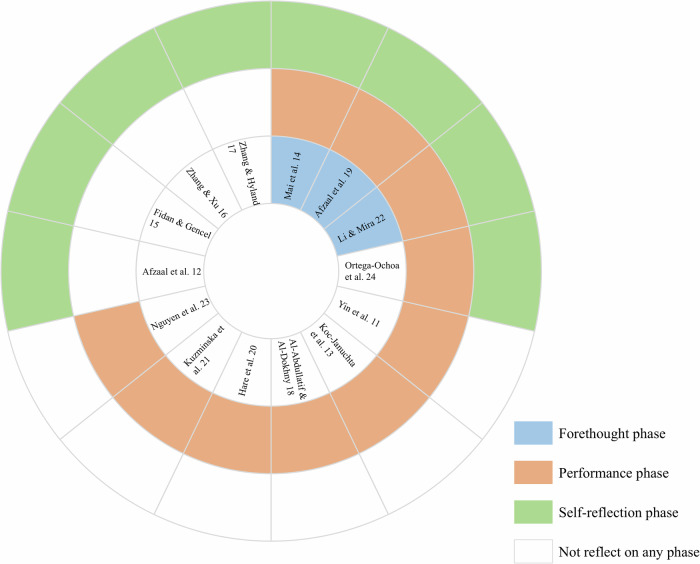
“…applications tend to support learners ’ strategies during the performance phase, e.g., Gridlock aids conceptual understanding and provides automated assessment 16 , Pigai offers collaborative feedback 17 , and Bashayer functions as a social AI assistant, delivering real-time feedback 18 .”
Koć-Januchta, M. M., Schönborn, K. J., Roehrig, C., Chaudhri, V. K., Tibell, L. A. E., & Heller, H. C. (2022) · International Journal of Educational Technology in Higher Education · doi:10.1186/s41239-021-00317-3 · Cited by 75
Long, L., & Kim, M. (2024) · Australasian Journal of Educational Technology · doi:10.14742/ajet.8821 · Cited by 69
Noguera, I., Albó, L., & Beardsley, M. (2022) · Australasian Journal of Educational Technology · doi:10.14742/ajet.7968 · Cited by 62
Ortega-Ochoa, E., Quiroga Pérez, J., Arguedas, M., Daradoumis, T., & Marquès Puig, J. M. (2024) · Internet of Things · doi:10.1016/j.iot.2024.101101 · Cited by 50
A systematic review of the evaluation in K-12 artificial intelligence education from 2013 to 2022
Kim, K., & Kwon, K. (2024) · Interactive Learning Environments · doi:10.1080/10494820.2024.2335499 · Cited by 44
Weather, Macroweather, and the Climate
Lovejoy, S. M. (2019) · Oxford University Press eBooks · doi:10.1093/oso/9780190864217.001.0001 · Cited by 43
Mai, V., Neef, C., & Richert, A. (2022) · Coaching | Theorie & Praxis · doi:10.1365/s40896-021-00063-3 · Cited by 33 · cited 3×
“Mai et al. 19 Examining the impact of different interaction methods employed by a coaching chatbot — speci fi cally, click-based versus writing-based interactions — on the working alliance formed betweenthechatbotandhumancoaches.”
InfluentialTerblanche, N. H. D. (2021) · Personnel Review · doi:10.1108/pr-07-2020-0540 · Cited by 25
Kuzminska, O. H., Pohrebniak, D., Mazorchuk, M. S., & Osadchyi, V. (2024) · Information Technologies and Learning Tools · doi:10.33407/itlt.v100i2.5602 · Cited by 25
Foundations for Human-AI teaming for self-regulated learning with explainable AI (XAI)
Kay, J. (2023) · Computers in Human Behavior · doi:10.1016/j.chb.2023.107848 · Cited by 21 · cited 1×
“…AI serves as a facilitator by enabling learners to collect and access their learning data, providing intelligent platforms or tools that learners can use, monitor, and control, and supporting self-regulation through decision-making information generated by these platforms and tools 14 .”
Delgado‐Gómez, D., González-Landero, F., Montes-Botella, C., Sújar, A., Bayona, S., & Martino, L. (2020) · Mathematics · doi:10.3390/math8122244 · Cited by 21
An Intelligent Serious Game for Digital Logic Education to Enhance Student Learning
Hare, R., Tang, Y. G., & Ferguson, S. L. (2024) · IEEE Transactions on Education · doi:10.1109/te.2024.3359001 · Cited by 20
Berninger-Schäfer, E. (2022) · Springer eBooks · doi:10.1007/978-3-658-39133-1 · Cited by 8
Research works printed but not linked: 3
- 3. Park, Y. & Doo, M. Y. Role of AI in blended learning: a systematic literature review. Int. Rev. Res. Open Distrib. Learn.25, 164–196 (2024).
- 37. Kalyuga, S. & Liu, T. C. Guest editorial: managing cognitive load in technology-based learning environments. J. Educ. Technol. Soc.18, 1–8 (2015).
- 60. Yew, E. H. & Goh, K. Problem-based learning: an overview of its process and impact on learning. Health Prof. Educ.2, 75–79 (2016).
Cited by
Developing generative AI literacies through self-regulated learning: A human-centered approach
Anders, A. D., & Speltz, E. D. (2025) · Computers and Education Artificial Intelligence · doi:10.1016/j.caeai.2025.100482 · Cited by 91
A focused review of artificial intelligence in education: Evolution and challenges
Acar, E., Deiri, Y., & Yiğit, M. F. (2025) · Journal of Interdisciplinary Research in Artificial Intelligence and Society · doi:10.20897/jirais/17640 · Cited by 32
Tan, X., Cheng, G., & Ling, M. H. (2025) · Computers and Education: Artificial Intelligence · doi:10.1016/j.caeai.2025.100461 · Cited by 27
Rivera, A. D. T., Peña, A. A. R., Torres, S. T. D., & Díaz-Torres, L. A. (2025) · Sustainability · doi:10.3390/su17198525 · Cited by 42
Luo, L., & Yusuf, A. (2026) · Assessment & Evaluation in Higher Education · doi:10.1080/02602938.2025.2548919 · Cited by 21
“AI-adaptive feedback aligns with this logic by offering real-time and personalized cues that encourage learners to self-assess their performance, engage in revisions, and plan subsequent writing actions (Lan and Zhou 2025).”
Metadata
- Authors
- Lan, M., & Zhou, X.
- Affiliations
- Zhejiang Normal University (CN)
- Corresponding author
- Lan, Min
- ORCID
- Lan, Min
- Venue
- npj Science of Learning
- Published
- 2025-05-03
- Volume
- 10
- Issue
- 1
- Pages
- 21-21
- ISSN
- 2056-7936 (ISSN-L)
- PMC
- PMC12049540
- OpenAlex
- W4410061905
- Cited by
- 159
- References
- 57
- Citations by year
- 2026: 137 · 2025: 22
- FWCI
- 24.19
- Type
- journal article
- Language
- en
- Open access
- gold
- doi.org
- Licence
- cc-by
- creativecommons.org/licenses/by/4.0 (tdm)
- creativecommons.org/licenses/by/4.0 (vor)
- Locations
- npj Science of Learning (publishedVersion, cc-by)
- PubMed Central (publishedVersion, cc-by)
- PubMed (publishedVersion)
- DOAJ (DOAJ: Directory of Open Access Journals) (submittedVersion, cc-by-sa)
- Topics
- Social Sciences › Education › Artificial Intelligence in Education
- Physical Sciences › Computer Science › Artificial Intelligence › Intelligent Tutoring Systems and Adaptive Learning
- Social Sciences › Psychology › Developmental and Educational Psychology › Innovative Teaching and Learning Methods
- Keywords
- artificial intelligence in education, student self-regulation, higher education, chatbots, serious games, digital textbooks, student independence, self-efficacy
About these checks
Registry, retraction, Cites and statistics results are computed, not judged, with one exception: a printed reference that no index lists is read once by a model before it counts as a citation error. Claims are extracted by a model and kept only when their quote appears verbatim in the text; each cited source is then checked, with a model’s help, for whether it says what the claim relies on. Those verdicts can be wrong — read the claim’s quote and the cited source before relying on one.
Statistics and arithmetic are recomputed, not judged.
Confidence bands are shown only for fields calibrated on our annotated test set. None is calibrated yet, so no band is shown.
What counts as a claim ›How we measure confidence ›How we check this ›
Are you an author, or do you see a problem with this page? Request a review
Data sources
Bibliographic data: Semantic Scholar, OpenAlex, Crossref.
Contains information from the Semantic Scholar Academic Graph Datasets, made available under the ODC Attribution License (ODC-BY 1.0).
Semantic Scholar’s data is described in: Kinney, R., et al. (2023). The Semantic Scholar Open Data Platform. arXiv:2301.10140.
