

The DOI matches its Crossref record; 35 of the 35 references it cites were found in a registry or an index.
Large socio-economic, geographic and demographic disparities exist in exposure to school closures
Open accessPublished version of a preprint
Abstract
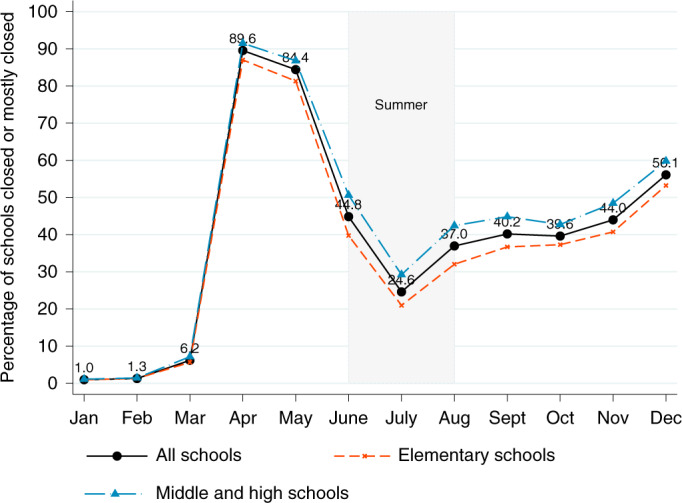
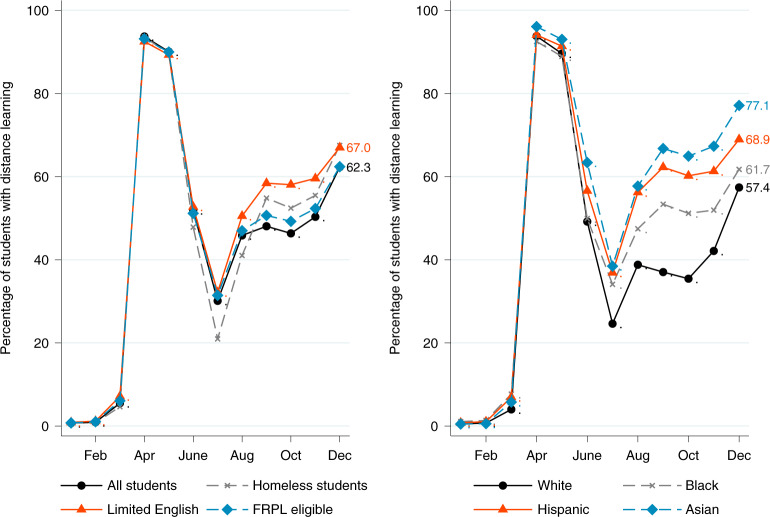
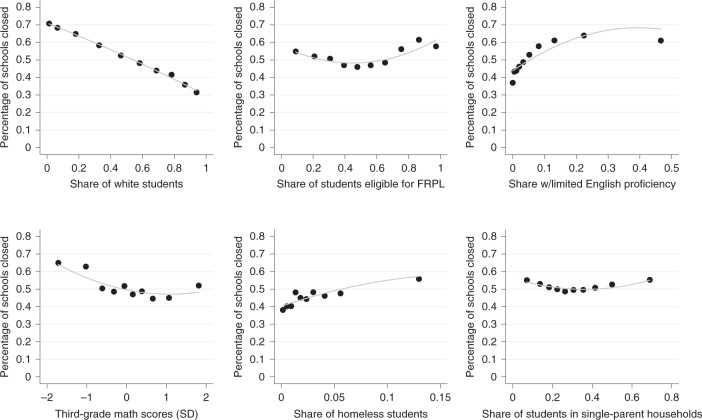
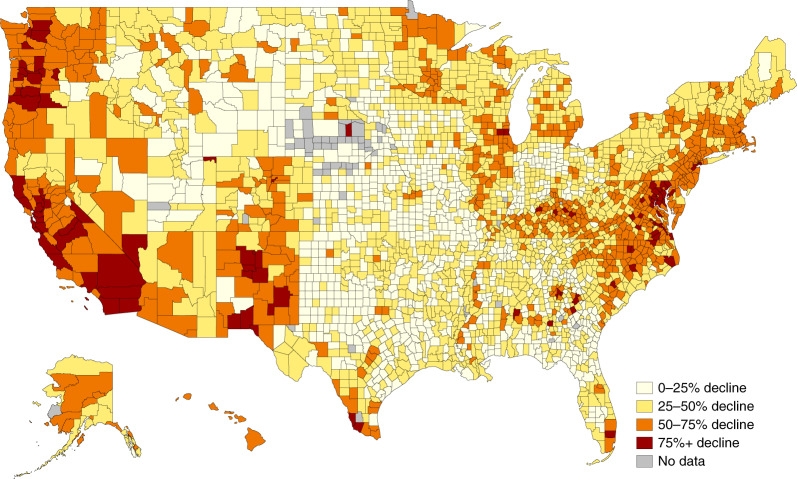
The coronovirus disease 2019 (COVID-19) pandemic has prompted many school districts to turn to distance or at-home learning. Studies are emerging on the negative effects of distance learning on educational performance, but less is known about the socio-economic, geographic and demographic characteristics of students exposed to distance learning. We introduce a U.S. School Closure and Distance Learning Database that tracks in-person visits across more than 100,000 schools throughout 2020. The database, which we make publicly accessible and update monthly, describes year-over-year change in in-person visits to each school throughout 2020 to estimate whether the school is engaged in distance learning. Our findings reveal that school closures from September to December 2020 were more common in schools with lower third-grade math scores and higher shares of students from racial/ethnic minorities, who experience homelessness, have limited English proficiency and are eligible for free/reduced-price school lunches. The findings portend rising inequalities in learning outcomes.
Overview
The claims and statistics of this paper haven’t been checked yet.
Run the check — free, no account needed. It reads the open-access text and checks the sources it cites.
Integrity signals
Registry
Cites
Statistics
Figures
Verification
Claims the paper makes
The claims and statistics of this paper haven’t been checked yet.
Run the check — free, no account needed. It reads the open-access text and checks the sources it cites.
Claims other papers make about this one
Each is checked against this paper’s own text: does it say what the citing paper says it does?
The cited source says what the claim attributes to it.
In the citing paper
“Our results show that learning loss was particularly pronounced for students from disadvantaged homes, confirming the fears held by many that school closures would cause socioeconomic gaps to widen (51 –55).”
From Learning loss due to school closures during the COVID-19 pandemic (2021) · cites this paper as [54]
The cited source says what the claim attributes to it.
In the citing paper
“Evidence from mobile phone locations (Parolin and Lee 2021) indicates that 9 out of 10 schools were closed in April 2020, falling to 40 percent in September but then rising again to 56 percent in December.”
From Educational Inequality* (2022) · cites this paper as Parolin and Lee 2021
The cited source says what the claim attributes to it.
In the citing paper
“Parolin and Lee (2021) show that school closures in the United States in the fall of 2020 were more common for students from ethnic minorities.”
From Educational Inequality* (2022) · cites this paper as Parolin and Lee (2021)
Self-check
Percentages, sums and reported differences re-computed from the paper’s own numbers.
The self-check needs the paper’s full text.
Citations
Cites
Learning loss due to school closures during the COVID-19 pandemic
Engzell, P., Frey, A., & Verhagen, M. D. (2021) · Proceedings of the National Academy of Sciences · doi:10.1073/pnas.2022376118 · Cited by 1,848
Learning loss due to school closures during the COVID-19 pandemic
Engzell, P., Frey, A., & Verhagen, M. D. (2020) · doi:10.31235/osf.io/ve4z7 · Cited by 1,739
Mobility network models of COVID-19 explain inequities and inform reopening
Chang, S., Pierson, E., Koh, P. W., Gerardin, J., Redbird, B., Grusky, D., & Leskovec, J. (2021) · Nature · doi:10.1038/s41586-020-2923-3 · Cited by 1,533
COVID-19, school closures, and child poverty: a social crisis in the making
Lancker, W. V., & Parolin, Z. (2020) · The Lancet Public Health · doi:10.1016/s2468-2667(20)30084-0 · Cited by 1,433
Self-citationAllcott, H., Boxell, L., Conway, J., Gentzkow, M., Thaler, M., & Yang, D. (2020) · Journal of Public Economics · doi:10.1016/j.jpubeco.2020.104254 · Cited by 999
Projecting the Potential Impact of COVID-19 School Closures on Academic Achievement
Kuhfeld, M., Soland, J., Tarasawa, B., Johnson, A., Ruzek, E., & Liu, J. (2020) · Educational Researcher · doi:10.3102/0013189x20965918 · Cited by 997
Fear, lockdown, and diversion: Comparing drivers of pandemic economic decline 2020
Goolsbee, A., & Syverson, C. (2021) · Journal of Public Economics · doi:10.1016/j.jpubeco.2020.104311 · Cited by 749
The Opportunity Atlas: Mapping the Childhood Roots of Social Mobility
Chetty, R., Friedman, J. N., Hendren, N., Jones, M. R., & Porter, S. R. (2018) · National Bureau of Economic Research · doi:10.3386/w25147 · Cited by 567
Giorgio, D. P., Federico, B., Costa, P., Karpiński, Z., & Mazza, J. (2020) · RePEc: Research Papers in Economics · doi:10.2760/126686 · Cited by 534
The Hispanic-White Achievement Gap in Math and Reading in the Elementary Grades
Reardon, S. F., & Galindo, C. (2009) · American Educational Research Journal · doi:10.3102/0002831209333184 · Cited by 511
Inequalities in Children's Experiences of Home Learning during the COVID‐19 Lockdown in England*
Andrew, A., Cattan, S., Dias, M. C., Farquharson, C., Kraftman, L., Krutikova, S., Phimister, A., & Sevilla, A. (2020) · Fiscal Studies · doi:10.1111/1475-5890.12240 · Cited by 488
Allcott, H., Boxell, L., Conway, J., Gentzkow, M. A., Thaler, M., & Yang, D. (2020) · National Bureau of Economic Research · doi:10.3386/w26946 · Cited by 406
The Widening Income Achievement Gap.
Reardon, S. F. (2013) · Educational leadership · Cited by 369
Shinn, M., Weitzman, B. C., Stojanovic, D., Knickman, J. R., Jiménez, L., Duchon, L. M., James, S., & Krantz, D. H. (1998) · American Journal of Public Health · doi:10.2105/ajph.88.11.1651 · Cited by 334
Kaffenberger, M. (2021) · International Journal of Educational Development · doi:10.1016/j.ijedudev.2020.102326 · Cited by 308
Inequality in learning opportunities during Covid-19: Evidence from library takeout
Jæger, M. M., & Blaabæk, E. H. (2020) · Research in Social Stratification and Mobility · doi:10.1016/j.rssm.2020.100524 · Cited by 276
Dave, D., Friedson, A., Matsuzawa, K., & Sabia, J. J. (2020) · Economic Inquiry · doi:10.1111/ecin.12944 · Cited by 269
COVID-19 and educational inequality: How school closures affect low- and high-achieving students
Grewenig, E., Lergetporer, P., Werner, K., Woessmann, L., & Zierow, L. (2021) · European Economic Review · doi:10.1016/j.euroecorev.2021.103920 · Cited by 260
When the Great Equalizer Shuts Down: Schools, Peers, and Parents in Pandemic TimesPreprint
Agostinelli, F., Doepke, M., Sorrenti, G., & Zilibotti, F. (2020) · SSRN Electronic Journal · doi:10.1016/j.jpubeco.2021.104574 · Cited by 252
Simonov, A., Sacher, S., Dubé, J., & Biswas, S. (2020) · National Bureau of Economic Research · doi:10.3386/w27237 · Cited by 238
Who graduates? Who doesn't?: A statistical portrait of public high school graduation, Class of 2001
Swanson, C. B. (2004) · PsycEXTRA Dataset · doi:10.1037/e723252011-001 · Cited by 226
Understanding the Impact of Homelessness on Children: Challenges and Future Research Directions
Buckner, J. C. (2008) · American Behavioral Scientist · doi:10.1177/0002764207311984 · Cited by 217
Which Workers Bear the Burden of Social Distancing?
Mongey, S., Pilossoph, L., & Weinberg, A. (2020) · National Bureau of Economic Research · doi:10.3386/w27085 · Cited by 214
Quillian, L. (2014) · Social Problems · doi:10.1525/sp.2014.12193 · Cited by 127
Fear, Lockdown, and Diversion: Comparing Drivers of Pandemic Economic Decline 2020
Goolsbee, A., & Syverson, C. (2020) · National Bureau of Economic Research · doi:10.3386/w27432 · Cited by 125
When the Great Equalizer Shuts Down: Schools, Peers, and Parents in Pandemic Times
Agostinelli, F., Doepke, M., Sorrenti, G., & Zilibotti, F. (2020) · doi:10.3386/w28264 · Cited by 97
Determinants of Behavior in Homeless and Low-income Housed Preschool Children
Bassuk, E. L., Weinreb, L., Dawson, R., Perloff, J. N., & Buckner, J. C. (1997) · PEDIATRICS · doi:10.1542/peds.100.1.92 · Cited by 96
Dave, D., Friedson, A., Matsuzawa, K., & Sabia, J. J. (2020) · National Bureau of Economic Research · doi:10.3386/w27091 · Cited by 95
Bayrakdar, S., & Güveli, A. (2020) · Open Access at Essex (University of Essex) · Cited by 89
Learning inequalities during the Covid-19 pandemic: how families cope with home-schooling
Pensiero, N., Kelly, A. E., & Bokhove, C. (2020) · ePrints Soton (University of Southampton) · doi:10.5258/soton/p0025 · Cited by 73
Kaffenberger, M. (2020) · doi:10.35489/bsg-rise-ri_2020/017 · Cited by 40
School closure and educational attainment: Evidence from a market-based system
Grau, N., Hojman, D. A., & Mizala, A. (2018) · Economics of Education Review · doi:10.1016/j.econedurev.2018.05.003 · Cited by 40
COVID-19 and Educational Inequality: How School Closures Affect Low- and High-Achieving StudentsPreprint
Grewenig, E., Lergetporer, P., Werner, K., Woessmann, L., & Zierow, L. (2020) · SSRN Electronic Journal · doi:10.2139/ssrn.3720405 · Cited by 40
Hannum, E. C., Liu, X., & Wang, F. (2020) · Economic Development and Cultural Change · doi:10.1086/711654 · Cited by 35
Learning inequality during the COVID-19 pandemicPreprint
Engzell, P., Frey, A., & Verhagen, M. D. (2020) · SocArXiv · doi:10.17605/osf.io/qtndg · Cited by 30
Cited by
Sorted by citations
Learning loss due to school closures during the COVID-19 pandemic
Engzell, P., Frey, A., & Verhagen, M. D. (2021) · Proceedings of the National Academy of Sciences · doi:10.1073/pnas.2022376118 · Cited by 1,848
A systematic review and meta-analysis of the evidence on learning during the COVID-19 pandemic
Betthäuser, B. A., Bach-Mortensen, A. M., & Engzell, P. (2023) · Nature Human Behaviour · doi:10.1038/s41562-022-01506-4 · Cited by 568
Goudeau, S., Sanrey, C., Stanczak, A., Manstead, A. S. R., & Darnon, C. (2021) · Nature Human Behaviour · doi:10.1038/s41562-021-01212-7 · Cited by 286
Learning loss due to school closures during the COVID-19 pandemic
Engzell, P., Frey, A., & Verhagen, M. D. (2020) · doi:10.31235/osf.io/ve4z7 · Cited by 1,739
Youth Suicide During the First Year of the COVID-19 Pandemic
Bridge, J., Ruch, D. A., Sheftall, A., Hahm, H., O'Keefe, V., Fontanella, C. A., Brock, G., Campo, J., & Horowitz, L. (2023) · Pediatrics · doi:10.1542/peds.2022-058375 · Cited by 171
Metadata
- Authors
- Parolin, Z., & Lee, E. K.
- Affiliations
- Bocconi University (IT)
- Columbia University (US)
- Corresponding author
- Parolin, Zachary
- Venue
- Nature Human Behaviour
- Published
- 2021-03-18
- Volume
- 5
- Issue
- 4
- Pages
- 522-528
- ISSN
- 2397-3374 (ISSN-L)
- PMC
- PMC8060162
- OpenAlex
- W3138870524
- Cited by
- 217
- References
- 35
- Citations by year
- 2026: 26 · 2025: 27 · 2024: 42 · 2023: 54 · 2022: 44 · 2021: 23
- FWCI
- 71.66
- Type
- journal article
- Language
- en
- Open access
- hybrid
- doi.org
- Locations
- Nature Human Behaviour (publishedVersion, cc-by)
- PubMed Central (publishedVersion, cc-by)
- PubMed (publishedVersion)
- RePEc: Research Papers in Economics (submittedVersion)
- Archivio istituzionale della Ricerca - Bocconi (submittedVersion)
- OSF Preprints (OSF Preprints) (submittedVersion, cc-by)
- OSF Preprints (OSF Preprints) (submittedVersion)
- Funders
- Bill and Melinda Gates Foundation (017972)
- Topics
- Social Sciences › Education › Education during COVID-19 pandemic
- Social Sciences › Education › School Choice and Performance
- Physical Sciences › Mathematics › Modeling and Simulation › COVID-19 epidemiological studies
- Keywords
- school closures, distance education, COVID-19 pandemic, educational inequality, socioeconomic disparities, racial and ethnic disparities, homelessness, limited English proficiency, learning outcomes
- MeSH terms
- Academic Performance, Limited English Proficiency, COVID-19, SARS-CoV-2, Adolescent, Child, Communicable Disease Control, Ethnicity, Ill-Housed Persons, Humans, Income, Minority Groups, Public Policy, Schools, Socioeconomic Factors, United States, Databases, Factual, Education, Distance
About these checks
Registry, retraction, Cites and statistics results are computed, not judged, with one exception: a printed reference that no index lists is read once by a model before it counts as a citation error. Claims are extracted by a model and kept only when their quote appears verbatim in the text; each cited source is then checked, with a model’s help, for whether it says what the claim relies on. Those verdicts can be wrong — read the claim’s quote and the cited source before relying on one.
Statistics and arithmetic are recomputed, not judged.
Confidence bands are shown only for fields calibrated on our annotated test set. None is calibrated yet, so no band is shown.
What counts as a claim ›How we measure confidence ›How we check this ›
Are you an author, or do you see a problem with this page? Request a review
