

Integrated photonic quantum technologies
Open accessThe DOI matches its Crossref record; 156 of the 158 references it cites were found in a registry or an index, and 2 are not checked yet; 103 of the 132 sources its claims cite were checked for support.
Abstract
Quantum technologies comprise an emerging class of devices capable of controlling superposition and entanglement of quantum states of light or matter, to realize fundamental performance advantages over ordinary classical machines. The technology of integrated quantum photonics has enabled the generation, processing and detection of quantum states of light at a steadily increasing scale and level of complexity, progressing from few-component circuitry occupying centimetre-scale footprints and operating on two photons, to programmable devices approaching 1,000 components occupying millimetre-scale footprints with integrated generation of multiphoton states. This Review summarizes the advances in integrated photonic quantum technologies and its demonstrated applications, including quantum communications, simulations of quantum chemical and physical systems, sampling algorithms, and linear-optic quantum information processing. This Review covers recent progress in integrated quantum photonics (IQP) technologies and their applications. The challenges and opportunities of realizing large-scale, monolithic IQP circuits for future quantum applications are discussed.
Verified 2026-11-22 · 2 references not checked yet
Overview
CoChat Summary
TL;DR
This review summarizes a decade of integrated quantum photonics (IQP), covering platforms, single-photon sources/detectors, circuits, and applications in quantum communications, information processing, Boson sampling, and simulation. It argues that IQP has scaled from few-component two-photon circuits to programmable silicon chips with hundreds of components, while identifying full integration and photon-number scaling as key challenges.
Key findings
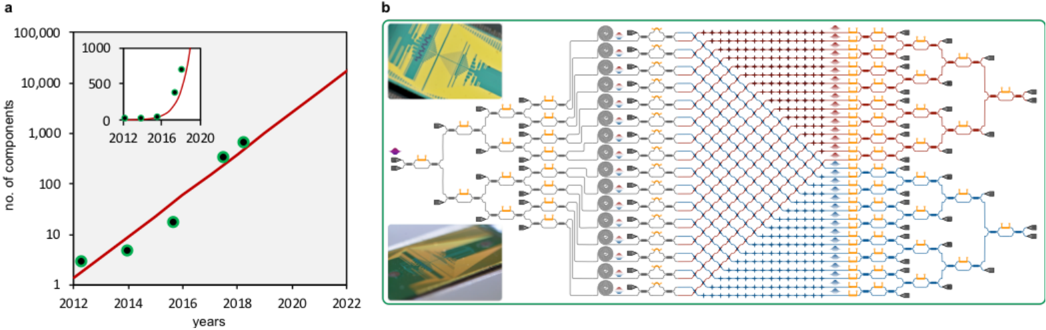
- IQP advanced from fixed circuits with few components operating on two photons to programmable circuitry approaching 1000 components with integrated multi-photon generation; a state-of-the-art Si device monolithically integrated 671 components (16 SFWM-SPSs, 93 TOPSs, 122 MMIs, 376 waveguide-crossers, 64 grating couplers) and verified up to 15×15 dimensional two-photon entangled states.
- Integrated QKD demonstrations include a chip-to-chip InP transmitter/SiOxNy receiver programmable for BB84 at 560 MHz, coherent-one-way at 860 MHz, and differential-phase-shift at 1.76 GHz; WDM-QKD doubled key rates to 1.11 Mbit/s over 20 km emulated fiber; Si-based transmitters achieved kbps–Mbps secret key rates and 1.0%–5.4% QBER.
- Key device benchmarks: Si-waveguide SNSPDs reached 91% detection efficiency, 18 ps jitter, and 50 Hz dark count; QD-SPSs produced 99.1% single-photon purity, 66% extraction efficiency, and 98.5% indistinguishability; two-photon interference visibilities were 100.1±0.4% in SiO2 and 100.0±0.4% in Si.
- Boson sampling was first demonstrated with n=3 photons, mainly in integrated photonics; the highest photon numbers used demultiplexed single QD-SPS photons, and the review states >20 photons are needed to challenge conventional computers and >50 to surpass supercomputers.
Methods
- Design: narrative review of integrated photonic quantum technologies, summarizing advances in materials, devices, functionality, and on-chip applications.
- Data/sample: published literature and milestone demonstrations from 2008 onward, including platforms (silica, Si, Si3N4, LN, GaAs, InP), sources, detectors, QKD, QIP, Boson sampling, and quantum simulation.
- Analysis: qualitative synthesis of experimental results and stated benchmarks; no primary experimental data or formal systematic-review methodology are reported.
Limitations
- Stated: a fully integrated quantum chip having sources, circuits, and detectors is yet to be realised; cryogenic operation for detectors and manipulation of photons at cryogenic temperature remain technical challenges.
- Stated: creating multiple identical QD-SPSs is difficult due to sample reproducibility; parametric SPSs produce photons nondeterministically with 5%–10% probability; full certification of Boson sampling is believed not possible.
- Evident from the text: as a review, it synthesizes prior work rather than presenting new experiments, and its performance numbers are drawn from cited demonstrations rather than a systematic meta-analysis.
Model-written summary. Check it against the paper before relying on it.
Integrity signals
Registry
Cites
Statistics
Figures

Verification
Claims the paper makes
28 Valid · 48 Not valid · 25 Not checked · 34 Own results and interpretations
Some cited sources support this claim and some don’t — read each source’s verdict below.
In the paper
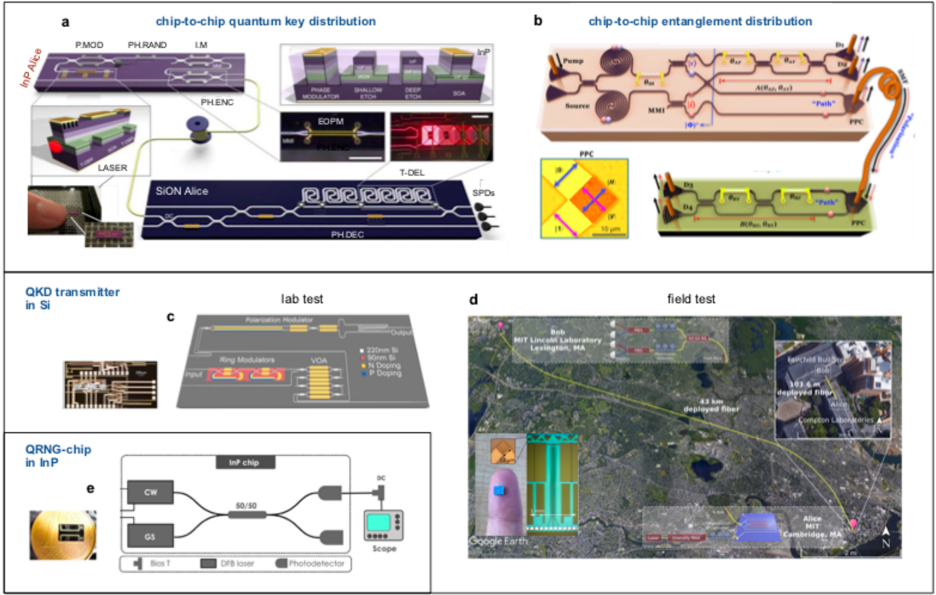
“For example, fully integrated QRNGs have been demonstrated in InP-chips ( Fig.3e ) [38, 74], in which random numbers were generated from the random phases of two-laser interference.”
What the sources say
- Partly supportedcites [38] 37. P. Sibson et al. Chip-based quantum key distribution. Nat. Commun. 8, 13984 (2017). sourceExperimental — accuracy not yet measured
The Results (Integrated photonic devices and Transmitter; page unavailable) describe a monolithically integrated InP chip with an on-chip laser, but it is a QKD transmitter, not a demonstrated QRNG. The Discussion says the receiver's passive basis choice removes the requirement for a QRNG; no passage describes generating random numbers from the phases of two interfering lasers. (LLM, conf=0.85)
- Disputedcites [74] 69. Y. Ding et al. High-dimensional quantum key distribution based on multicore fiber using silicon photonic integrated circuits. npj Quantum Information 3, 25 (2017). sourceExperimental — accuracy not yet measured
The Introduction describes a high-dimensional QKD demonstration using silicon photonic integrated circuits, not an InP-chip QRNG. The Experimental results say the experiment used FPGA-generated pseudorandom sequences for state and basis choices, rather than random phases from two-laser interference. Page numbers are unavailable in our copy. (LLM, conf=0.87)
Checked by a reasoning model — may be wrong.
boostedstates a cause- Asserted: passes — The authors put it forward as true.
- Checkable: passes — It can be checked against evidence.
- Load-bearing: unclear — It is unclear whether the paper’s conclusions depend on it.
- Based: passes — The paper gives a reason why it holds.
- Partly supported
At least one cited source doesn’t support this claim or points to a different paper, and none confirmed it — see the verdicts below.
In the paper
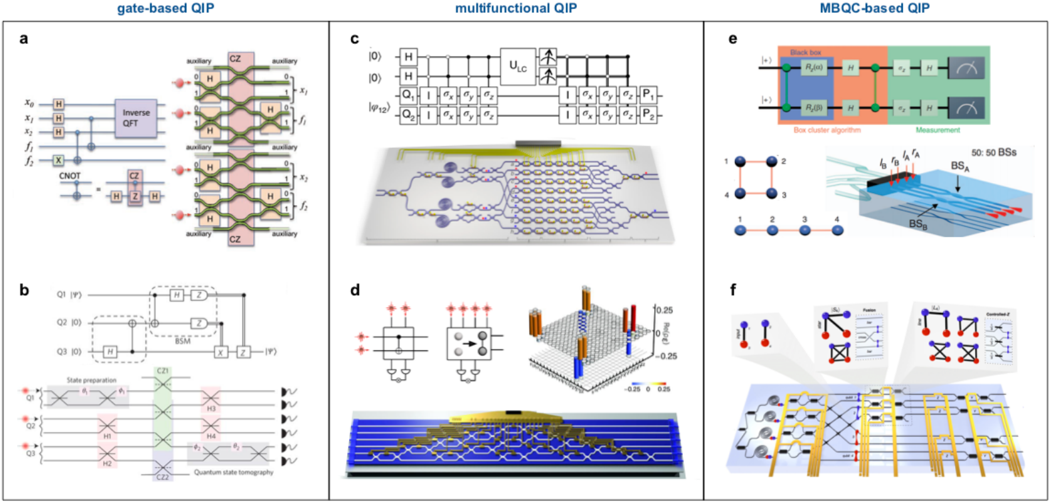
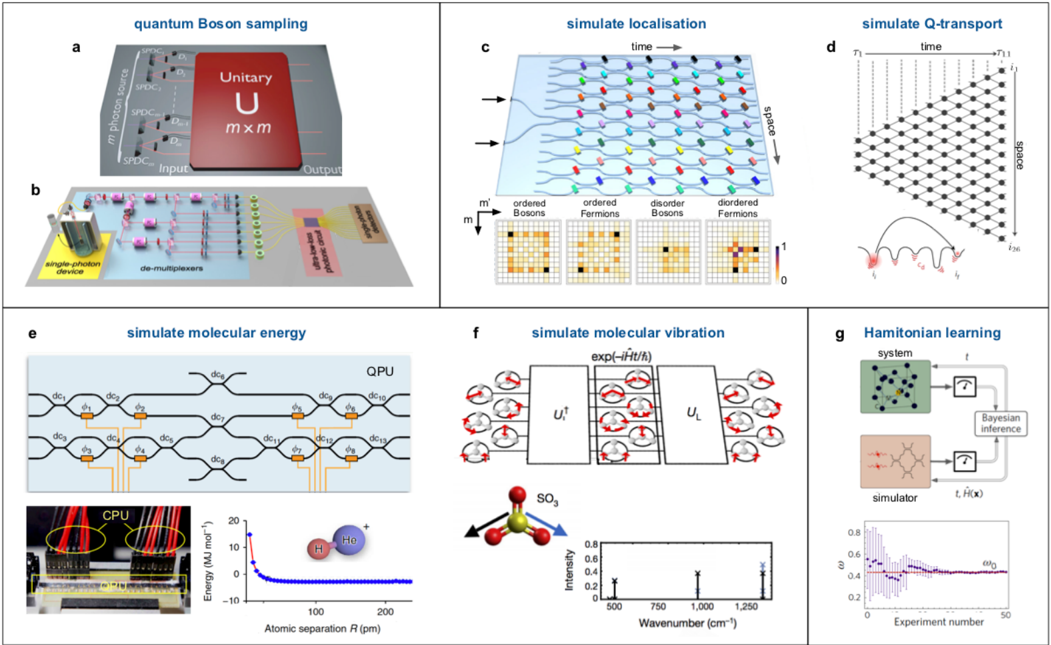
“The on-chip GMM of four-photon four-qubit graph states was demonstrated in a Si-chip ( Fig. 4f ) [87].”
What the sources say
- Disputedcites [87] 81. X. Qiang et al. Large-scale silicon quantum photonics implementing arbitrary two-qubit processing. Nat. Photon. 12, 534-539 (2018). sourceExperimental — accuracy not yet measured
The paper’s Abstract describes a silicon chip that generates two photonic qubits and performs two-qubit processing using only two photons. It does not report generating, manipulating and measuring four-photon four-qubit graph states; its stated demonstration uses a different number of photons and qubits. (LLM, conf=0.90)
Checked by a reasoning model — may be wrong.
boosted- Asserted: passes — The authors put it forward as true.
- Checkable: passes — It can be checked against evidence.
- Load-bearing: unclear — It is unclear whether the paper’s conclusions depend on it.
- Based: passes — The paper gives a reason why it holds.
- Disputed
At least one cited source doesn’t support this claim or points to a different paper, and none confirmed it — see the verdicts below.
In the paper
“The first on-chip GMM of four-qubit cluster state was realised in a laser-writing chip ( Fig.4e ), by manipulating both the polarisation and path DoFs of two photons [85].”
What the sources say
- Disputedcites [85] 79. A. Peruzzo et al. A variational eigenvalue solver on a photonic quantum processor. Nat. Commun. 5, 4213 (2013). sourceExperimental — accuracy not yet measured
The Results section (“Prototype demonstration”; page unavailable) describes a chip that prepares and measures two-qubit states encoded in photon paths, not a four-qubit cluster state encoded in both polarisation and path. Our copy does not establish the claimed first demonstration or laser-writing fabrication. (LLM, conf=0.88)
Checked by a reasoning model — may be wrong.
plainstates a cause- Asserted: passes — The authors put it forward as true.
- Checkable: passes — It can be checked against evidence.
- Load-bearing: unclear — It is unclear whether the paper’s conclusions depend on it.
- Based: passes — The paper gives a reason why it holds.
- Disputed
At least one cited source doesn’t support this claim or points to a different paper, and none confirmed it — see the verdicts below.
In the paper
“For example, the first GMM of entangled two-qubit states encoded in dual-paths were demonstrated in a Si-chip, with the inclusion of ring-resonator-based SFWM photon sources and circuits [84].”
What the sources say
- Disputedcites [84] 78. B. J. Metcalf et al. Quantum teleportation on a photonic chip. Nat. Photon. 8, 770-774 (2014). sourceExperimental — accuracy not yet measured
The main-experiment passage describes three photons from two parametric down-conversion sources coupled into a UV-written silica-on-silicon chip, not ring-resonator SFWM sources integrated on a silicon chip. Figure 1(c) does support dual-rail encoding and on-chip state preparation and tomography, but the claimed chip and photon-source technology contradict the paper’s description. (LLM, conf=0.88)
Checked by a reasoning model — may be wrong.
boosted- Asserted: passes — The authors put it forward as true.
- Checkable: passes — It can be checked against evidence.
- Load-bearing: unclear — It is unclear whether the paper’s conclusions depend on it.
- Based: passes — The paper gives a reason why it holds.
- Disputed
Some cited sources support this claim and some don’t — read each source’s verdict below.
In the paper
“In Fig.6 , we summarise the scaling of integrated quantum photonic circuits in silicon: from a single MZI adopted for the on-chip HOM-interference experiment in 2012 [24], to a state-of-the-art large-scale quantum photonic device having 671 components that was used for the GMM of multi-dimensional entanglement [44].”
What the sources say
- Disputedcites [24] 24. D. Bonneau et al. Quantum interference and manipulation of entanglement in silicon wire waveguide quantum circuits. New J. Phys. 14, 045003 (2012). sourceExperimental — accuracy not yet measured
Split into 2 atoms — 0 confirmed, 1 partially supported, 1 disputed, 0 misattributed, 0 unverifiable. Expand the claim to see per-atom verdicts.
Checked by a reasoning model — may be wrong.
- Partly supportedcites [44] 44. J. Wang et al. Multidimensional quantum entanglement with large-scale integrated optics. Science 360, 285-291 (2018). sourceExperimental — accuracy not yet measured
The opening summary (p. 1) says the silicon-photonics device generated, manipulated and measured multidimensional entanglement. It reports more than 550 components, however, and the components listed in Fig. 1 (p. 2) total 551; our copy does not support the attributed figure of 671. The 2012 single-MZI experiment is attached to a different citation in the citing sentence. (LLM, conf=0.88)
plainstates an association- Asserted: passes — The authors put it forward as true.
- Checkable: passes — It can be checked against evidence.
- Load-bearing: unclear — It is unclear whether the paper’s conclusions depend on it.
- Based: passes — The paper gives a reason why it holds.
- Disputed
67 more claims · 35 with their cited sources checked
Create a free account to see all 135 claims and to verify the 22 references still open.
- It may state two separate claims as one. 38
- Probably not a substantial claim. 34
Claims other papers make about this one
Each is checked against this paper’s own text: does it say what the citing paper says it does?
The source backs part of the claim, not all of it — or backs it for a different population, condition or comparison.
In the citing paper
“As an example, the timeline in figure 1 illustrates this rapid progression from few-component circuits enabling two-photon quantum interference in 2008 [5] to a decade later with devices combining more than 650 components capable of arbitrary and programmable two-qubit operations [6], enabling advances in foundational quantum mechanics, computing, communications, and metrology [7].”
From 2022 Roadmap on integrated quantum photonics (2022) · cites this paper as [7]
Experimental — accuracy not yet measuredThe source backs part of the claim, not all of it — or backs it for a different population, condition or comparison.
In the citing paper
“Thermo-optic tuning can be used as a drift-free method of bias control [16,468], but this requires tradeoffs in power dissipation and tuning bandwidth.”
From Integrated photonics on thin-film lithium niobate (2021) · cites this paper as [468]
Experimental — accuracy not yet measuredThe source backs part of the claim, not all of it — or backs it for a different population, condition or comparison.
In the citing paper
“Recent advances in the fabrication of quantum photonic integrated circuits (QPICs) have enabled the functionality of bench-top nonlinear sources to be scaled down to a single chip, with a dramatic improvement in the efficiency and stability [12][13][14][15].”
From Ultrabright Entangled-Photon-Pair Generation from anAlGaAs-On-Insulator Microring Resonator (2021) · cites this paper as [14]
Experimental — accuracy not yet measuredThe cited source says what the claim attributes to it.
In the citing paper
“As a result, it has been the material of choice for many early demonstrations of building blocks for photonic quantum computing and has seen rapid growth in the number of generated photons and integrated components over the last 10 years [7,24,25].”
From 2022 Roadmap on integrated quantum photonics (2022) · cites this paper as [7]
The cited source says what the claim attributes to it.
In the citing paper
“Silicon photonics has been pivotal for increasing the complexity and component-number of on-chip quantum circuitry and revealing the disruptive potential an engineered integrated approach can take for a quantum technology [7].”
From 2022 Roadmap on integrated quantum photonics (2022) · cites this paper as [7]
1 more claim about this paper
Create a free account to see every claim other papers make about this one.
Self-check
Percentages, sums and reported differences re-computed from the paper’s own numbers.
Each contradiction between two passages listed here was confirmed by an independent check.
Rated minor: it would not touch a result — a value no result rests on, a p-value that stays on the same side of the significance level, or a conflict that is clerical, resolved elsewhere in the paper, or outside its own findings.
In the paper
§ Box 2: integrated building blocks for operating photonic states · p. 9
“large-scale quantum circuits in Si with 670 components [44]”
§ Box 2: integrated building blocks for operating photonic states · p. 13
“This large-scale device monolithically integrates 16 SFMW-SPSs, 93 reconfigurable TOPSs, 122 MMIs, 376 waveguide-crossers and 64 grating couplers, in total 671 photonic components.”
Rated minor: it would not touch a result — a value no result rests on, a p-value that stays on the same side of the significance level, or a conflict that is clerical, resolved elsewhere in the paper, or outside its own findings.
In the paper
§ Introduction · p. 1
“In 2001, a theoretical breakthrough presented a scheme for universal quantum computation using photons in linear optics, in which photons interact non-deterministically via quantum interference and measurement-induced nonlinearities [9, 10]”
§ References · p. 14
“9. E. Knill, R. Laflamme & G. J. Milburn. A scheme for efficient quantum computation with linear optics. Nature 409, 46-52 (2000).”
Citations
Cites
Gisin, N., Ribordy, G., Tittel, W., & Zbinden, H. (2002) · Reviews of Modern Physics · doi:10.1103/revmodphys.74.145 · Cited by 8,515 · cited 4×
“do not require operation at mK temperatures or in high vacuum. The translation of quantum information science to real world technologies promises extreme advantages for certain tasks in communication [5], computation [6], and simulation [7]. However, implementing large instances of quantum algorithms or the deployment…”
InfluentialA scheme for efficient quantum computation with linear optics
Knill, E., Laflamme, R., & Milburn, G. J. (2001) · Nature · doi:10.1038/35051009 · Cited by 5,880
Experimental quantum teleportation
Bouwmeester, D., Pan, J.-W., Mattle, K., Eibl, M., Weinfurter, H., & Zeilinger, A. (1997) · Nature · doi:10.1038/37539 · Cited by 5,545 · cited 1×
“antum information processing. Introduction Pioneering investigations of quantum science, including tests of entanglement [1], generation of squeezed light [2], demonstrations of quantum teleportation [3], and loophole-free tests of Bell nonlocality [4], were possible because photons are excellent, low-noise carriers o…”
BackgroundBiamonte, J., Wittek, P., Pancotti, N., Rebentrost, P., Wiebe, N., & Lloyd, S. (2017) · Nature · doi:10.1038/nature23474 · Cited by 4,779
A variational eigenvalue solver on a photonic quantum processor
Peruzzo, A., McClean, J., Shadbolt, P., Yung, M.-H., Zhou, X.-Q., Love, P. J., Aspuru-Guzik, A., & O’Brien, J. L. (2014) · Nature Communications · doi:10.1038/ncomms5213 · Cited by 4,552 · cited 4×
“hysical process [40, 111]. Molecular simulation. Efficient simulation of molecular properties is fundamentally interesting in chemistry [7]. Quantum phase estimation [112] and variational eigensolver [79] were implemented in IQP chips to compute the ground-state energy of molecules (Fig.5e). An algorithm combining the…”
BackgroundMethodInfluentialRaussendorf, R., & Briegel, H. J. (2001) · Physical Review Letters · doi:10.1103/physrevlett.86.5188 · Cited by 4,477
Ladd, T. D., Jelezko, F., Laflamme, R., Nakamura, Y., Monroe, C., & O’Brien, J. L. (2010) · Nature · doi:10.1038/nature08812 · Cited by 3,592
Integrated lithium niobate electro-optic modulators operating at CMOS-compatible voltages
Wang, C., Zhang, M., Chen, X., Bertrand, M., Shams-Ansari, A., Chandrasekhar, S., Winzer, P., & Lončar, M. (2018) · Nature · doi:10.1038/s41586-018-0551-y · Cited by 2,593 · cited 2×
“elopment of multiplexed parametric SPSs [49, 50] and de-multiplexed QD-SPSs [56, 57]. They both require a network of fast and low-loss optical switches. Recent progress in thin-film LN-based switches [118] has shown a great promise for the multiplexed and de-multiplexed many-photon generation. These advanced systems a…”
BackgroundExperimental Test of Local Hidden-Variable Theories
Freedman, S. J., & Clauser, J. F. (1972) · Physical Review Letters · doi:10.1103/physrevlett.28.938 · Cited by 1,999 · cited 1×
“s of quantum physical and chemical systems, Boson sampling, and linear-optic quantum information processing. Introduction Pioneering investigations of quantum science, including tests of entanglement [1], generation of squeezed light [2], demonstrations of quantum teleportation [3], and loophole-free tests of Bell non…”
BackgroundGottesman, D., & Chuang, I. L. (1999) · Nature · doi:10.1038/46503 · Cited by 1,860
Research works printed but not linked: 1
- 99. S. Aaronson & A. Arkhipov. Boson sampling is far from uniform. Quantum Inf. Comput. 14, 1383-423 (2014).
Cited by
Items 1,501–1,600 of 1,640
Mode-dependent phase in waveguides supporting orbital angular momentum
Moura, J. V. S., Santos, L. M. S., de Oliveira, J. M., Rocha, J. C. A., Jesus‐Silva, A. J., Khoury, A. Z., & Fonseca, E. J. S. (2026) · APL Photonics · doi:10.1063/5.0292980
Unmasking Environmental Contaminants with Quantum-Enhanced Sensing
Brindha, P., Vanchinathan, K., Abinaya, M., Sharanyanivasini, J. S., & Devi, M. P. (2026) · Springer eBooks · doi:10.1007/978-3-032-15188-9_8
Pradananta, G., & Erdkhadifa, R. (2026) · AIP conference proceedings · doi:10.1063/5.0317717
Ultrahigh-Q chalcogenide micro-racetrack resonators
Lu, B., Erikson, J., Xu, B., Guo, S., Zohrabi, M., Gopinath, J. T., & Park, W. (2026) · Applied Physics Letters · doi:10.1063/5.0305459
Topological resilience of quantum coherence in Erdős–Rényi random graphs under edge dilution
Pan, W., Liu, H., & Zhang, K. (2026) · Physica A Statistical Mechanics and its Applications · doi:10.1016/j.physa.2026.131414
A Survey of Quantum Computing: Foundations, Challenges, and Emerging DirectionsPreprint
Hassan, M. R., Mahmoud, T. M., & Kaabouch, N. (2026) · TechRxiv · doi:10.36227/techrxiv.177223090.01125198/v1
Bragg gratings for tailoring four-wave mixing processes in waveguides
David, T. (2026) · Dépôt institutionnel de l'Université libre de Bruxelles (Université Libre de Bruxelles)
Hassan, J. (2025) · Tampere University Institutional Repository (Tampere University)
Efficient and broadband metalens based coupling architecture for silicon photonics chips
Cabanes, M., Sauvan, C., Roulliay, M., Mendizabal, L., & Sortais, Y. R. P. (2026) · Optics Express · doi:10.1364/oe.588083
Topological multimode entanglement on silicon photonics superlattices
Zakeri, M. J., & Blanco‐Redondo, A. (2026) · Integrated Optics: Devices, Materials, and Technologies · doi:10.1117/12.3079977
Recent Progress in on‐Demand Transfer‐Enabled Integration of Wavelength‐Scale Light Sources
Kim, H., Shin, D., Bae, G. E., Lee, G. H., Jung, H. Y., So, J., Kim, M., & No, Y.-S. (2026) · Nanophotonics · doi:10.1002/nap2.70033 · Cited by 1
Integration of a single photon source with a fibre-compatible photonic waveguide
Broussier, A., Muhammad, M. H., Rahbany, N., Hmima, A., Robineau, P., Vézy, C., Déturche, R., Kevorkian, A. P., Blaize, S., & Couteau, C. (2026) · npj Quantum Information · doi:10.1038/s41534-026-01209-y
SiN Based IIR Elliptic Half Band Filter at 193 THz with Low Insertion Loss and High Extinction Ratio
Hossain, M. S., Hasanuzzaman, G. K. M., Charalambous, G., & Tulon, M. T. M. (2025) · IEEE International Conference on Telecommunications and Photonics (ICTP) · doi:10.1109/ictp68765.2025.11415033
The Dirac sea of phase: unifying phase paradoxes and Talbot revivals in multimode waveguides
Korneev, N., Ramos-Prieto, I., & Moya-Cessa, H. M. (2026) · Physica Scripta · doi:10.1088/1402-4896/aead36
Villalba-Díez, J., Gonzalez-Marcos, A. P., Losada, J. C., & Ordieres-Meré, J. B. (2026) · Optical and Quantum Electronics · doi:10.1007/s11082-026-08741-3
Duan, J., Sun, Y., Sun, C., Gong, Y., Zhu, S. K., & Xu, P. (2026) · Laser & Photonics Review · doi:10.1002/lpor.202502621
Yang, B., Qin, Y., Chen, B. W., Wang, X., Zhou, W., Yang, T., Zhang, J., Ke, X., Zhou, M., Wang, C., et al. (2026) · Photonics Research · doi:10.1364/prj.590291
Spatial‐Wavelength Multiplexing Error‐Controlled Photonic Analog Computing System
Zhu, T., Zhu, B., Zhang, S., Li, K., Xianchen, 吴. W., Pi, Y., Yan, J., Chen, D., Guo, B., Xiao, X., et al. (2026) · Advanced Science · doi:10.1002/advs.202515689 · Cited by 1
Layer model for gate-based modular quantum computers
van den Brink, R. F. M., Boschero, J. C., & Amoretti, M. (2026) · Quantum Information Processing · doi:10.1007/s11128-026-05119-y
Prediction of V Si 2 − in SiC as promising color centers for qubits
Qian, T., Gong, X.-G., & Yang, J. (2026) · Physical review. B./Physical review. B · doi:10.1103/kg61-94hg · Cited by 1
Yu, J., Mohajan, J., Tokman, M. D., Stewart, J., Rice, A., Addamane, S., Malis, O., Rodríguez, A. W., Brener, I., Sarma, R., et al. (2026) · Advanced Functional Materials · doi:10.1002/adfm.78573
Huang, G.-Z., Chen, W., Zhang, G.-W., Wang, F., Wang, S., He, D.-Y., Yin, Z.-Q., An, J., Guo, G., & Han, Z.-F. (2026) · Optics Letters · doi:10.1364/ol.592502
Investigation of Optical Quantum States Using Probability Amplitude Generating Functions
Bogdanov, Y. I., Bogdanova, N. A., & Lukichev, V. F. (2025) · Russian Microelectronics · doi:10.1134/s1063739725601547
Ermishev, O. A., Болдышева, В. К., Garifullin, A. I., & Arslanov, N. M. (2025) · Russian Microelectronics · doi:10.1134/s1063739725602255
Quantum speedup from nonclassical polarization
Aßbrock, T., Sperling, J., & Ares, L. (2026) · Physical Review Research · doi:10.1103/mflc-2mzq
Quantum information processing with a multimode fibre
Leedumrongwatthanakun, S. (2019) · HAL · doi:10.70675/6e171a4cz051bz46cczaee4z55183ff5bb6b
Billard, M. (2021) · theses.fr (ABES) · doi:10.70675/e23e4032z393cz46ebzb61bzf6f60baf86e0 · Cited by 8
Integrated quantum photonics for quantum applications
Hua, X. (2021) · theses.fr (ABES) · doi:10.70675/3612f15az45a3z4f3dz80dez7fabf7aa55ae
Quantum-dot lasers on silicon : nonlinear properties, dynamics, and applications
Dong, B. (2021) · theses.fr (ABES) · doi:10.70675/02f50e71z4324z4375za91ez03b01f03de51
Automated design of photonic quantum circuits
Yao, Y. (2023) · theses.fr (ABES) · doi:10.70675/137f6c70zbc72z4cbdzb338z6722012d84e0
Photonic crystal sources of non-classical states of light
Chopin, A. (2024) · theses.fr (ABES) · doi:10.70675/a55ce71fzfbcfz49cezb62az649a87f74570
Noise, Dynamics and Squeezed Light in Quantum Dot and Interband Cascade Lasers
Zhao, S. (2023) · theses.fr (ABES) · doi:10.70675/f919b1fbz1e24z4600zaa92z57d940af9252
Exploring nonlinear dynamics and amplitude squeezing of quantum dot lasers
Ding, S. (2024) · theses.fr (ABES) · doi:10.70675/5650c2b5z0b02z430fza0e9ze1bd36b1a6d9
Multimodal one-dimensional photonic crystal cavities
Massaro, L. M. (2024) · theses.fr (ABES) · doi:10.70675/46de2813z6c84z42c7z92a3zf88c2d6d565d · Cited by 2
Cavity quantum electrodynamics with silicon color centers : from ensembles to a single photon source
Lefaucher, B. (2024) · theses.fr (ABES) · doi:10.70675/5e7a5659z9774z4830z9567z1f7b39f010dd
Integration of mid-infrared lasers on silicon photonic integrated circuits
Remis, A. (2023) · theses.fr (ABES) · doi:10.70675/90fb6aa4zb9ddz4e6dzb089z39085efd14d2 · Cited by 3
Tracking Correlations through Autonomous Collisional Models - Impact on Dynamics and Energetics
Prasad, S. P. (2024) · theses.fr (ABES) · doi:10.70675/11abdc63z0b89z483cza590z75d15a8c8210
Multi-photon quantum interference and entanglement
Pont, M. (2023) · theses.fr (ABES) · doi:10.70675/2058f3b5z6090z4b31z9a1dzca3a3d51dd4e · Cited by 2
Information quantique photonique haute fidélité : protocoles et contrôle de circuits universels
Fyrillas, A. (2025) · theses.fr (ABES) · doi:10.70675/656a19a5z3ac4z4455za9f5zd61798cfc0bb · Cited by 1
Generation and characterization of Gaussian and non-Gaussian states of light
Tripier-Mondancin, N. (2025) · theses.fr (ABES) · doi:10.70675/3971cd62z3efez43ffz9382zca0f72886fbc
Hou, C., Ge, Z., Li, Y., Xiong, B., Zhang, X. Q., Yuan, X., & Liu, C. (2026) · Applied Surface Science · doi:10.1016/j.apsusc.2026.166853
Yao, F. (2026) · npj Nanophotonics · doi:10.1038/s44310-026-00113-9
Gallium oxide: A potentially photonic material
Yang, Y., Chen, P., Cheng, Q., Long, Z., Yang, J., Cheng, Z., Zhang, Z., wang, X., Bai, S., Yang, Z., et al. (2026) · Journal of Vacuum Science & Technology A Vacuum Surfaces and Films · doi:10.1116/6.0005339
On-chip optical fiber-to-nanophotonic waveguide adiabatic coupler
Zhou, X., Chang, T.-H., Liu, E. Z., Prabandhakavi, S., & Hung, C.-L. (2026) · AIP Advances · doi:10.1063/5.0322573
Xu, G., Guo, Q., Jing, Y., Song, T., & Lai, Y. (2026) · Physical Review Applied · doi:10.1103/7fxd-ntk8
Particle and radiation sensors developed at INFN-CSN5
(2026) · Frontiers research topics · doi:10.3389/978-2-8325-7607-6
Atomically thin single-photon emitters
Munkhbat, B., Paralikis, A., Metuh, P., & Wyborski, P. (2026) · The Project Repository Journal · doi:10.54050/prj2624598
A Study on Dynamic Optimization Methods of Annealing Coefficients in Quantum Computing
Guixiang, J. I. N., Jin, Z., & MATSUKAWA, H. (2026) · Innovation and supply chain management · doi:10.14327/iscm.20.11
Disorder Tolerant on Chip Frequency Bin Entanglement with a Photonic Topological Splitter
Zaravashan, H., Gradoni, G., & Khalily, M. (2026) · International Workshop on Antenna Technology · doi:10.1109/iwat66946.2026.11501893
Optimising Spectral Purity and Brightness with Pump Pulse Shaping
Barrett, H., Samiullah, Z., Burridge, B. M., Barreto, J., & Faruque, I. I. (2026) · International Conference on Quantum Communications, Networking, and Computing (QCNC) · doi:10.1109/qcnc69040.2026.00106
Experimental qudit-assisted quantum operations by dimension expansion and partial measurement
Chi, Y., Pan, C., Lu, X. P., Zhu, Y., & Wang, F. (2026) · APL Photonics · doi:10.1063/5.0309870 · Cited by 1
ZHAO, Y., 秦正莲, Zhang, J., Li, H., Gao, H., Feng, J., 刘雅薇, Jiang, L., Zhang, C., Wen, W., et al. (2026) · Journal of the American Chemical Society · doi:10.1021/jacs.6c05529
Inverse-Designed Ultra-Compact On-Chip Broadband Bandpass Filter With High Extinction Ratio
Huang, J., Chen, Y., Lu, C., Wang, Y., Yang, J., & Qiang, X. (2026) · IEEE Photonics Technology Letters · doi:10.1109/lpt.2026.3693333
Opuh, J. I., Ovili, H. P., Ukpenusiowho, D., Nwachokor, S. C., Oshiokpu, I. E., & Obokparo, O. K. (2026) · International Journal of Innovative Science and Research Technology (IJISRT) · doi:10.38124/ijisrt/26apr1882
Low-Loss Photonic Modulator toward Future Quantum Information Processing
Guo, S., Lee, S., Juperi, S., Han, Y., Kim, M., Yang, Y., Gong, X., Yu, R., Leong, J., Zograf, G., et al. (2026) · ACS Nano · doi:10.1021/acsnano.6c02532
Experimental cross-dimensional programmable quantum gate teleportation
Chi, Y., Ding, H., Cheng, Y., Wang, G., Zheng, P., Wang, F., Pan, C., & Shao, C. (2026) · Optica Quantum · doi:10.1364/opticaq.591961
Large-Scale Twin-Field Quantum Key Distribution Networks Enabled by Integrated Photonics
Zheng, Y., Wang, H., Jia, X. F., Huang, J., Yuan, H., Chang, L., & Wang, J. (2026) · IEEE Silicon Photonics Conference (SiPhotonics) · doi:10.1109/siphotonics68911.2026.11520753
Self-citationTopological polarization beam splitter with polarization-selective edge states
Afzal, S., Kahloon, A., & Barzanjeh, S. (2026) · Communications Physics · doi:10.1038/s42005-026-02700-w
Karomi, I. B., & Almalky, N. (2026) · Physica Scripta · doi:10.1088/1402-4896/ae72cf
Polarization-Insensitive Multimode Waveguide Crossing via Subwavelength Holey Metamaterials
Xu, H., Ni, B., Wu, S., & Xiong, J. (2026) · IEEE Photonics Technology Letters · doi:10.1109/lpt.2026.3697306
Bürger, J., Cortese, E., Muzio, S. D., Sanvitto, D., Liberato, S. D., & Ballarini, D. (2026) · ACS Photonics · doi:10.1021/acsphotonics.6c01318
Priyanka, K., & Singh, R. R. (2026) · Physica Scripta · doi:10.1088/1402-4896/ae7482
Optimization of a metalens-based fiber-to-chip coupler for efficient and broadband coupling
Cabanes, M., Sauvan, C., Roulliay, M., Mendizabal, L., & Sortais, Y. R. P. (2026) · Integrated Photonics Platforms · doi:10.1117/12.3098709
Nonreciprocal entangled photon pairs via spatiotemporal modulation
Li, S., Wang, N., Yu, L., & Zhu, A. (2026) · APL Photonics · doi:10.1063/5.0319960
Counterintuitive causal structures in inter-chip photonic quantum computing
Wang, Y., Wang, Y., Wang, D., & Wu, J. (2026) · Optics Express · doi:10.1364/oe.589703
Exploration of localization physics with atomic, molecular, and optical platforms
Gao, J., Li, H., Zwiller, V., & Elshaari, A. W. (2026) · Journal of Physics Condensed Matter · doi:10.1088/1361-648x/ae6aee · Cited by 1
A theoretical model of low power microring for dual-pump squeezing-enabled photonics
Wu, T., Cai, Q., Hayden, B., & Heidari, E. (2026) · Reconfigurable Photonic Computing and Heterogeneous Architectures for AI and RF Defense Systems · doi:10.1117/12.3101335
Gómez-Robles, M., Castro-Simanca, F., Tchao, E., Domínguez-Serna, F. A., Hernández, W. D. L. C., Garay-Palmett, K., & Salas‐Montiel, R. (2026) · Nanotechnology · doi:10.1088/1361-6528/ae7b3c
Efficient circuit compression by multiqudit entangling gates in linear optical quantum computation
Tehri, A., & Singh, J. (2026) · Physical Review A · doi:10.1103/cx92-c6cm
Katsumi, R., Takada, K., Yatsui, T., Yasuda, T., & Yatsui, T. (2026) · Optics Express · doi:10.1364/oe.607976
Multi-stack InP/GaAsP quantum dot lasers on Si with high characteristic temperature
Gu, W., Zhao, B., Liu, X., & Lau, K. M. (2026) · Optics Letters · doi:10.1364/ol.604816
Pandharpatte, A. S., Singh, M., & Saxena, A. (2026) · Nanotechnology · doi:10.1088/1361-6528/ae7df7
Ghezelbash, M., & Majd, A. E. (2026) · arXiv (Cornell University) · doi:10.48550/arxiv.2606.21542
High-Efficiency SiN Optical Switch Based on Hybrid Waveguide
Shi, J., Huang, Y., He, L., Zhang, X., Gao, F., & Shum, P. P. (2026) · Journal of Lightwave Technology · doi:10.1109/jlt.2026.3706991
Scaling Nanophotonic Interferometric Biosensors toward Parallel Detection of Multiple Biomarkers
Alonso-Fernández, A., Ramirez‐Priego, P., Estévez, M. ‐., Fernández-Gavela, A., & Lechuga, L. M. (2026) · ACS Sensors · doi:10.1021/acssensors.6c01059
A tunable coincidence counter based on superconducting nanowire cryotrons
Liu, N., Zhao, Q., Huang, Y., Wang, L., Liu, Z., Deng, J., Yang, F., Ru, S., Zhen-guo, L., Pan, Y.-Y., et al. (2026) · Applied Physics Letters · doi:10.1063/5.0334034
Tunable quantum interference in free space with a liquid-crystal metagrating
Cardano, F., Colandrea, F. D., Dey, S., Colandrea, F. D., Cameron, P., Sephton, B., Schiano, C., Sephton, B., Schiano, C., Marrucci, L., et al. (2026) · Optica Quantum · doi:10.1364/opticaq.597375
Integrated transceiver chip for metropolitan WDM quantum key distributions
Zhou, Y., Zhou, Y., Zhang, H., Jiang, X., Guo, Y., Wang, Y., Zhou, C. H., Li, H., Lu, L., Zhou, L., et al. (2026) · Photonics Research · doi:10.1364/prj.590895
Engineering and Tuning of High Quality Hexagonal Boron Nitride Nanophotonic Resonators
Schaeper, O. C., Gale, A., Coste, N., Scognamiglio, D., Horder, J., Quard, H., & Aharonovich, I. (2026) · Small · doi:10.1002/smll.74395
Temperature response of SiV color center fluorescence in diamond
He, Z., Zhao, Y., Tan, X., Cheng, Y., Yang, Q., Wang, J., Qi, H., & Meng, D. (2026) · Journal of Crystal Growth · doi:10.1016/j.jcrysgro.2026.128738
Self-citationHasnaoui, H., Limongi, L., Giordani, T., Polacchi, B., Quaranta, A., Bernard, M., Sciarrino, F., & Lobino, M. (2026) · Applied Physics Reviews · doi:10.1063/5.0308063 · Cited by 2
Self-citationAdvances in Quantum Materials for Therapeutic Applications
Mahata, A. (2026) · Springer eBooks · doi:10.1007/978-3-032-19536-4_12
Betzold, S., & Höfling, S. (2026) · eLight · doi:10.1186/s43593-026-00134-z
Recent advancements in quantum machine learning applications: A review from smart grid viewpoint
Shaabani, M. H., Miri, S. P., Moghadasi, S. R., Arani, Z. D., Roknabadi, M. H. A., & Gharehpetian, G. B. (2026) · Applied Soft Computing · doi:10.1016/j.asoc.2026.115956 · Cited by 1
Higgins, A., Gears, S. W. A., Silverstone, J. W., & Balram, K. C. (2026) · Optics Letters · doi:10.1364/ol.606331
Deterministic quantum teleportation under coherent time evolution
Xin, X., Yu, H.-B., & Li, C. (2026) · Quantum Information Processing · doi:10.1007/s11128-026-05273-3
Park, U., Lee, J., Moon, S., Jeon, H., Kim, Y.-S., Jung, H., & Kwon, H. (2026) · Conference on Lasers and Electro-Optics · doi:10.1364/cleo_fs.2026.fm1a.5
Quantum‐Enhanced Distributed Fiber‐Optic Sensing: Current State and Future Perspectives
Afagwu, C. C., Gemeinhardt, H., & Sharma, J. (2026) · Quantum Engineering · doi:10.1155/que2/3022974
Direct characterization of quantum dynamics via generalized weak values
Xu, L., Pan, Y., Li, H., Wang, B., Zhang, A., Dong, Y., & Zhang, L. (2026) · Science Advances · doi:10.1126/sciadv.aeb7304
Zheng, 李. L., Hongjie, 梁. L., & Chao, 向. X. (2026) · Acta Optica Sinica · doi:10.3788/aos260826
Jingshu, 郭. G., Zhekai, 朱. Z., Xiang, H., Zheng, Y., Junhuan, 李. L., Leyi, 胡. H., Liu, L., Shi, Y., & Dai, D. (2026) · Acta Optica Sinica · doi:10.3788/aos260673
Optimizing path-polarization interconversion on a photonic circuit for secure quantum communication
Kim, K., Lim, K., Choi, B., Lee, W., You, J.-B., Ko, Y., Choe, J., Kim, M., Bang, J., Bae, J., et al. (2026) · EPJ Quantum Technology · doi:10.1140/epjqt/s40507-026-00542-7
Khalfet, N., & Krikidis, I. (2026) · IEEE Journal on Selected Areas in Communications · doi:10.1109/jsac.2026.3718832
An Introduction to Photonic Quantum Information Processing
Strömberg, T. (2026) · Springer theses · doi:10.1007/978-3-032-14267-2_2
Qudit W and Greenberger–Horne–Zeilinger states on a two-photon chip
Chi, Y., Ding, H., Wang, F., Pan, C., & Shao, C. (2026) · Light Science & Applications · doi:10.1038/s41377-026-02285-7
ALYA, 2. N. (2026) · Universitas Pasundan institutional repositories & scientific journals (Universitas Pasundan)
Metadata
- Authors
- Wang, J., Sciarrino, F., Laing, A., & Thompson, M. G.
- Affiliations
- Peking University (CN)
- Sapienza University of Rome (IT)
- University of Bristol (GB)
- Corresponding author
- Thompson, Mark G.
- Venue
- Nature Photonics
- Published
- 2019-10-21
- Volume
- 14
- Issue
- 5
- Pages
- 273-284
- ISSN
- 1749-4885 (ISSN-L)
- 1749-4893
- OpenAlex
- W2980980200
- Cited by
- 1,576
- References
- 139
- Citations by year
- 2026: 195 · 2025: 342 · 2024: 290 · 2023: 259 · 2022: 189 · 2021: 203 · 2020: 89 · 2019: 6
- FWCI
- 55.54
- Type
- journal article
- Language
- en
- Open access
- green
- arxiv.org
- Licence
- www.springer.com/tdm (tdm)
- www.springer.com/tdm (vor)
- Locations
- Nature Photonics (publishedVersion)
- arXiv (Cornell University) (submittedVersion)
- arXiv (Cornell University)
- Funders
- Engineering and Physical Sciences Research Council (EP/L024020/1, EP/N003470/1, EP/K033085/1)
- Topics
- Physical Sciences › Physics and Astronomy › Atomic and Molecular Physics, and Optics › Quantum Information and Cryptography
- Physical Sciences › Engineering › Electrical and Electronic Engineering › Photonic and Optical Devices
- Physical Sciences › Computer Science › Artificial Intelligence › Quantum Computing Algorithms and Architecture
- Keywords
- integrated quantum photonics, quantum technologies, quantum entanglement, multi-photon states, quantum communication, quantum simulation, sampling algorithms
About these checks
Registry, retraction, Cites and statistics results are computed, not judged, with one exception: a printed reference that no index lists is read once by a model before it counts as a citation error. Claims are extracted by a model and kept only when their quote appears verbatim in the text; each cited source is then checked, with a model’s help, for whether it says what the claim relies on. Those verdicts can be wrong — read the claim’s quote and the cited source before relying on one.
The claim verdicts this report counts are experimental: their accuracy is not yet measured.
A language model drew the claims from the paper on 2026-11-10, under version 3 of the claim definition (model deepseek-v4.1-flash, prompt extract-v3).
A second model labelled each claim on 2026-11-10 (model jev-1.13-20260917, definition revision gold-guideline-v0.2).
Cited sources are checked with a language model’s help (gpt-6-sol).
Statistics and arithmetic are recomputed, not judged.
Confidence bands are shown only for fields calibrated on our annotated test set. None is calibrated yet, so no band is shown.
What counts as a claim ›How we measure confidence ›How we check this ›
Are you an author, or do you see a problem with this page? Request a review
Data sources
Bibliographic data: Semantic Scholar, OpenAlex, Crossref.
Contains information from the Semantic Scholar Academic Graph Datasets, made available under the ODC Attribution License (ODC-BY 1.0).
Semantic Scholar’s data is described in: Kinney, R., et al. (2023). The Semantic Scholar Open Data Platform. arXiv:2301.10140.
