

Measuring human capital using global learning data
Open accessThe DOI matches its Crossref record; 37 of the 38 references it cites were found in a registry or an index.
Abstract
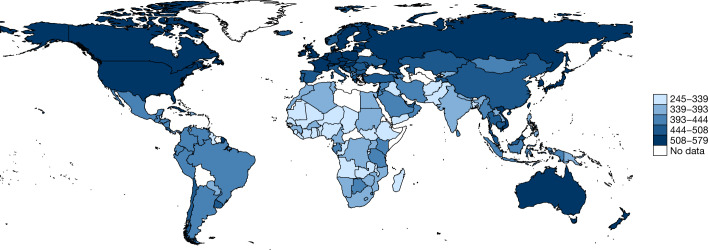
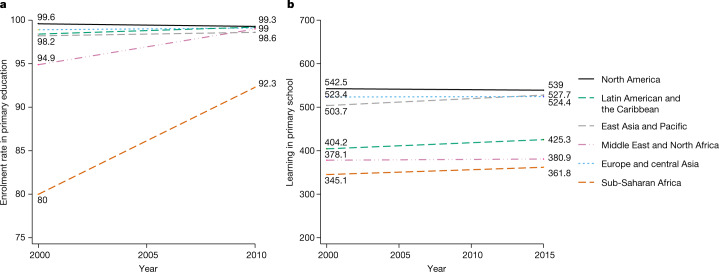
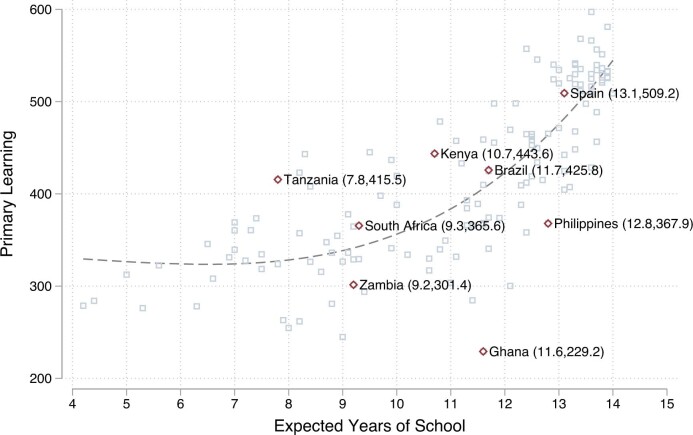
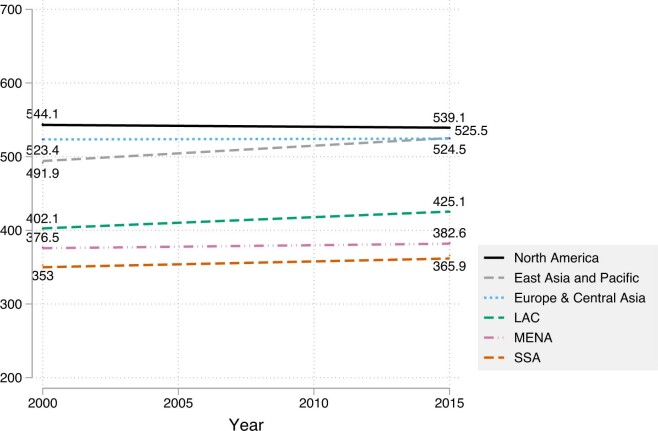
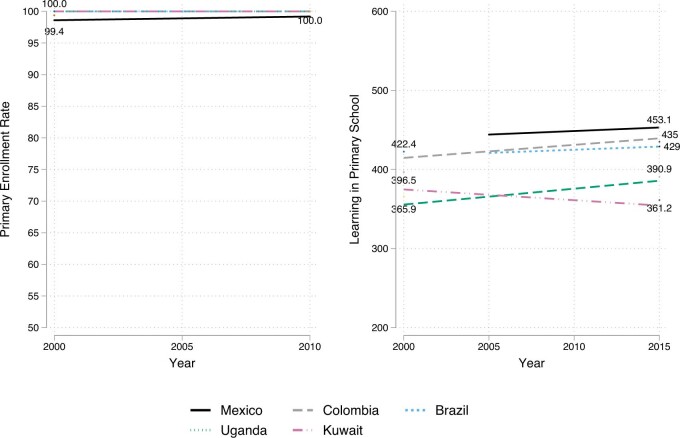
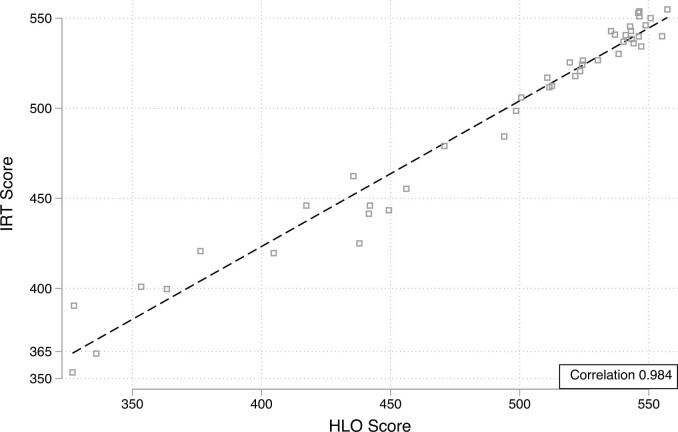
Human capital—that is, resources associated with the knowledge and skills of individuals—is a critical component of economic development 1,2 . Learning metrics that are comparable for countries globally are necessary to understand and track the formation of human capital. The increasing use of international achievement tests is an important step in this direction 3 . However, such tests are administered primarily in developed countries 4 , limiting our ability to analyse learning patterns in developing countries that may have the most to gain from the formation of human capital. Here we bridge this gap by constructing a globally comparable database of 164 countries from 2000 to 2017. The data represent 98% of the global population and developing economies comprise two-thirds of the included countries. Using this dataset, we show that global progress in learning—a priority Sustainable Development Goal—has been limited, despite increasing enrolment in primary and secondary education. Using an accounting exercise that includes a direct measure of schooling quality, we estimate that the role of human capital in explaining income differences across countries ranges from a fifth to half; this result has an intermediate position in the wide range of estimates provided in earlier papers in the literature 5–13 . Moreover, we show that average estimates mask considerable heterogeneity associated with income grouping across countries and regions. This heterogeneity highlights the importance of including countries at various stages of economic development when analysing the role of human capital in economic development. Finally, we show that our database provides a measure of human capital that is more closely associated with economic growth than current measures that are included in the Penn world tables version 9.0 14 and the human development index of the United Nations 15 .
Overview
The claims and statistics of this paper haven’t been checked yet.
Free: it reads the open-access text and checks the first 5 claims that cite a source we can check. Create a free account to check every claim.
Integrity signals
Registry
Cites
Statistics
Figures
Verification
Claims the paper makes
The claims and statistics of this paper haven’t been checked yet.
Free: it reads the open-access text and checks the first 5 claims that cite a source we can check. Create a free account to check every claim.
Claims other papers make about this one
Each is checked against this paper’s own text: does it say what the citing paper says it does?
The cited source says what the claim attributes to it.
In the citing paper
“Low-and middle-income countries were already struggling with a learning crisis before the pandemic.”
From A systematic review and meta-analysis of the evidence on learning during the COVID-19 pandemic (2023) · cites this paper as [30]
Self-check
Percentages, sums and reported differences re-computed from the paper’s own numbers.
The self-check needs the paper’s full text.
Citations
Cites
A Contribution to the Empirics of Economic Growth
Mankiw, N. G., Romer, D., & Weil, D. N. (1992) · The Quarterly Journal of Economics · doi:10.2307/2118477 · Cited by 15,119
An Inquiry into the Nature and Causes of the Wealth of Nations
Smith, A. (1776) · The Glasgow Edition of the Works and Correspondence of Adam Smith, Vol. 2: An Inquiry into the Nature and Causes of the Wealth of Nations, Vol. 1 · doi:10.1093/oseo/instance.00043218 · Cited by 11,757
Investment in Human Capital: A Theoretical Analysis
Becker, G. S. (1962) · Journal of Political Economy · doi:10.1086/258724 · Cited by 8,063
Why do Some Countries Produce So Much More Output Per Worker than Others?
Hall, R. E., & Jones, C. I. (1999) · The Quarterly Journal of Economics · doi:10.1162/003355399555954 · Cited by 7,879
The United Nations Development Programme
Oestreich, J. E. (2017) · Development and Human Rights · doi:10.1093/acprof:oso/9780190637347.003.0003 · Cited by 4,894
The Next Generation of the Penn World Table
Feenstra, R. C., Inklaar, R., & Timmer, M. P. (2015) · American Economic Review · doi:10.1257/aer.20130954 · Cited by 4,799
A new data set of educational attainment in the world, 1950–2010
Barro, R. J., & Lee, J. W. (2013) · Journal of Development Economics · doi:10.1016/j.jdeveco.2012.10.001 · Cited by 4,333
International data on educational attainment: updates and implications
Barro, R. J. (2001) · Oxford Economic Papers · doi:10.1093/oep/53.3.541 · Cited by 2,569
Schooling, Labor-Force Quality, and the Growth of Nations
Hanushek, E. A., & Kimko, D. D. (2000) · American Economic Review · doi:10.1257/aer.90.5.1184 · Cited by 2,164
Education for Growth: Why and for Whom?
Krueger, A. B., & Lindahl, M. (2001) · Journal of Economic Literature · doi:10.1257/jel.39.4.1101 · Cited by 2,060
Cited by
Items 201–300 of 326
Jules, T. D., & Salajan, F. D. (2026) · Comparative Education Review · doi:10.1086/739614 · Cited by 1
Pathways to EU decarbonization: the role of green investment and R&D activity
Kwilinski, A. S., Lyulyov, O. V., & Pimonenko, T. (2026) · Sustainability Science · doi:10.1007/s11625-026-01852-6 · Cited by 2
Forzy, T., Ramponi, F., Iversen, I., Durizzo, K., Kim, S., Gautam, P., Avallone, S., Memirie, S. T., Habtemichael, M., Getnet, F., et al. (2026) · Nature Health · doi:10.1038/s44360-026-00176-0 · Cited by 2
Social Reproduction in K-12: Life-long Effects on Middle-class Students
Guo, Z., Wu, Y., & Zhang, Y. (2021) · Advances in Social Science, Education and Humanities Research/Advances in social science, education and humanities research · doi:10.2991/assehr.k.211220.444 · Cited by 3
En búsqueda del aprendizaje perdido. Una fábula educativa en tiempos de pandemia
Eslava, É. (2022) · Cuadernos de Filosofía Latinoamericana · doi:10.15332/25005375.7513 · Cited by 1
Introduction to ISEE Assessment Working Group 1 - education in and for flourishing
Ergas, O., Gilead, T., & Singh, N. C. (2022) · UNESCO MGIEP eBooks · doi:10.56383/rvqu2646 · Cited by 2
Research on the influence of human capital on economic growth
Yu, X. (2022) · BCP Business & Management · doi:10.54691/bcpbm.v26i.2016 · Cited by 1
“Angrist (2021) explains Schultz’s finding with different outcomes of different education[10].”
BackgroundEfficiency Management of Human Capital with the Change of the Social and Economic System of Ukraine
Trusova, N. V. (2023) · Economic Affairs · doi:10.46852/0424-2513.2s.2023.9 · Cited by 1
Becker, D., Meisenberg, G., Dutton, E., Bakhiet, S. F. A., Alfayez, A. A., & Essa, Y. A. S. (2023) · Acta Psychologica · doi:10.1016/j.actpsy.2023.104015 · Cited by 1
Quality of Education and Economic Growth – Evidence from Southeast European Countries
Baltova, A., & Vutsova, A. (2024) · Economic Alternatives · doi:10.37075/ea.2024.1.06 · Cited by 1
Human Development Index of China and Economic Growth: Hindsight and Global Perspective
Shi, S. (2024) · Economy of Regions · doi:10.17059/ekon.reg.2024-1-6 · Cited by 1
Юдин, И. (2024) · Journal of Economic Sociology · doi:10.17323/1726-3247-2024-2-58-87 · Cited by 4
Education and Democracy in Sub-Saharan Africa
Grimmer, L. (2024) · The African Review · doi:10.1163/1821889x-bja10115 · Cited by 1
Huang, Y., Sun, N., Wang, F., & Dong, G. (2024) · Lecture notes in business information processing · doi:10.1007/978-3-031-60260-3_25 · Cited by 1
AN IMPROVED ENVIRONMENTAL MANAGEMENT MODEL FOR ASSURING ENERGY AND ECONOMIC PROSPERITY
Hai, N. T., & Duong, N. T. (2024) · Acta Innovations · doi:10.62441/actainnovations.51.9 · Cited by 1
SYSTEMATIC LITERATURE REVIEW: DAMPAK INVESTASI PENDIDIKAN TERHADAP KEMAJUAN EKONOMI
Rahmanto, A. A., Wijayanti, V. C., Rahmawati, D. R., Arninasari, A. N., & Indriayu, M. (2024) · Prima Magistra Jurnal Ilmiah Kependidikan · doi:10.37478/jpm.v5i2.3725 · Cited by 1
Sobiech, I., Chmura, R., Sawulski, J., & Mętrak, T. (2024) · Economics of Transition and Institutional Change · doi:10.1111/ecot.12430 · Cited by 5
Chekalovska, G., & Ivashkiv, I. (2024) · Economic Analysis · doi:10.35774/econa2024.04.557 · Cited by 1
El rol de la distribución de capital humano en el crecimiento económico: teoría y evidencia
Lozano, M. M. (2021) · Cited by 1
Londar, S., Melnyk, S., & Tereshchenko, H. (2022) · Educational Analytics of Ukraine · doi:10.32987/2617-8532-2022-2-5-22 · Cited by 1
Evidence on evidence-informed policy and practice
Gough, D., Sharples, J., & Maidment, C. (2022) · Educational research and innovation · doi:10.1787/5ee7de7c-en · Cited by 2
The social connections that shape economic prospects
Angrist, N., & Sacerdote, B. (2022) · Nature · doi:10.1038/d41586-022-01843-4 · Cited by 1
Self-citationNew Emphasis of School Assessment in a Changing World
Altan, M. (2023) · Asian Journal of Education and Social Studies · doi:10.9734/ajess/2023/v40i4882 · Cited by 1
Cognitive Ability and Economic Growth: How Much Happiness is Optimal?Preprint
Burhan, N. A. S., Sabri, M. F., & Rindermann, H. (2021) · SSRN Electronic Journal · doi:10.2139/ssrn.3801436 · Cited by 1
Decreasing per capita human capital growth in 166 countries from 1990 to 2020Preprint
Chen, S., Piao, X., Xie, J., & Managi, S. (2023) · Research Square · doi:10.21203/rs.3.rs-2594686/v1 · Cited by 1
Becker, D., Kiel, C., & Rindermann, H. (2023) · Qeios · doi:10.32388/yaegxv · Cited by 1
“The supplementary material also includes data from Lim et al. (2018) (LIMHC3, LIMYL3, LIMHS3, LIMEA3, LIMLE3) and Angrist et al. (2021) (TWBHLO), used to check the validity of National level of intelligence (see 2.1.1).”
BackgroundMethodInfluentialSchnepf, S. V., & Granato, S. (2023) · SSRN Electronic Journal · doi:10.2139/ssrn.4608787 · Cited by 1
Varieties of Political Indoctrination in Education and the Media (V-Indoc) CodebookPreprint
Neundorf, A., Nazrullaeva, E., Northmore‐Ball, K., Tertytchnaya, K., Kim, W., Benavot, A., Bromley, P., Knutsen, C. H., Lutscher, P., Marquardt, K. L., et al. (2024) · SSRN Electronic Journal · doi:10.2139/ssrn.4726306 · Cited by 1
Popov, D. (2024) · Journal of Economic Sociology · doi:10.17323/1726-3247-2024-2-148-159 · Cited by 1
National IQs and Socioeconomic DevelopmentPreprint
Jensen, S., & Kirkegaard, E. O. W. (2024) · PsyArXiv (OSF Preprints) · doi:10.31234/osf.io/bx86g · Cited by 2
Mississippi’s education miracle: A model for global literacy reform
Patrinos, H. A. (2025) · The Conversation · doi:10.64628/aai.npsdkwt7y · Cited by 2
Self-citationMuseums to strengthen young people’s resilience after the COVID-19 Juventocid
Vogt, M. T. (2021) · Tudásmenedzsment · doi:10.15170/tm.2021.22.k2.8
What Explains Boys' Educational Underachievement in the Kingdom of Saudi Arabia?
Elsayed, M., Clerkin, A., Pitsia, V., Aljabri, N., & Al-Harbi, K. (2022) · World Bank, Washington, DC eBooks · doi:10.1596/1813-9450-9896
Knowledge as a Public Good in the Internet Age
AKDOĞAN, D. A. (2022) · Advances in finance, accounting, and economics book series · doi:10.4018/978-1-7998-9083-6.ch006
Education Quality, Green Technology and the Economic Impact of Carbon PricingPreprint
Macdonald, K., & Patrinos, H. A. (2022) · SSRN Electronic Journal · doi:10.2139/ssrn.4126892
Self-citationPerspectives on education research
Bangs, J., Henry, M., Nagy, E. K., Prøitz, T. S., Schneider, M., Tseng, V., Damme, D. V., & Yurita, M. (2022) · Educational research and innovation · doi:10.1787/e83abf22-en · Cited by 1
Facilitating research use: Scary Barriers (and Super Mechanisms)
Torres, J. M. (2022) · Educational research and innovation · doi:10.1787/cd4e8487-en · Cited by 3
Individuals’ extrinsic and intrinsic incentives to produce education research
OECD (2022) · Educational research and innovation · doi:10.1787/a195b515-en
Levels of individuals’ activity reported by systems in research production.
OECD (2022) · Educational research and innovation · doi:10.1787/dc8ed027-en
Presence of mechanisms facilitating the use of educational research, 2021
OECD (2022) · Educational research and innovation · doi:10.1787/901c32b1-en
Size and strength of ministries’ networks
OECD (2022) · Educational research and innovation · doi:10.1787/267b1dd7-en
OECD (2022) · Educational research and innovation · doi:10.1787/e5bf3102-en
Overview of policy makers’ learning opportunities
OECD (2022) · Educational research and innovation · doi:10.1787/911001f0-en
Relevance of ministry connections to organisations active in facilitating research use in policy
OECD (2022) · Educational research and innovation · doi:10.1787/04374594-en
An Education Inequity IndexPreprint
Lichand, G., Perpétuo, M. E., & dos Santos, P. S. (2022) · SSRN Electronic Journal · doi:10.2139/ssrn.4250539 · Cited by 4
Eduación y crecimiento económico: considerando no linealidades en la ecuación de Mincer
Mahnic, P. (2022) · Económica · doi:10.24215/18521649e027
Impactos del evento Covid19 en el proceso de enseñanza - aprendizaje de la ingeniería en la UdeA
Valencia, J., & Quintero, N. A. M. (2022) · Encuentro Internacional de Educación en Ingeniería · doi:10.26507/paper.2185
Mutambara, E., & Cele Thanduxolo, J. (2023) · International Journal of Research in Business and Social Science (2147-4478) · doi:10.20525/ijrbs.v12i2.2377
IMPACT OF NATIONAL HUMAN CAPITAL ON POPULATION MIGRATION ACTIVITY
Kuzminska, N., & Кожемяченко, О. А. (2022) · Herald of Khmelnytskyi National University Economic sciences · doi:10.31891/2307-5740-2022-312-6(2)-47
The Impact of Human Capital on Digital Literacy Index
Halim, E., Fitriani, M., Kurniawan, Y., & Husni, H. S. (2023) · International Conference on Industrial Engineering and Operations Management (IEOM) · doi:10.46254/ap03.20220733 · Cited by 1
Benavot, A. (2023) · Springer eBooks · doi:10.1007/978-981-16-2327-1_2-1
The Relationship Between Human Capital Behaviors and Health Practice Ethics: An Exploratory Study
Wahhab, S. T. (2023) · INTERNATIONAL JOURNAL OF TRANSFORMATIONS IN BUSINESS MANAGEMENT · doi:10.37648/ijtbm.v13i03.004
Lopes, J. A. L., Martins, P. S., Oliveira, C. R., Ferreira, J., Oliveira, J. T., & Crato, N. (2023) · Revista de Psicodidáctica · doi:10.1016/j.psicod.2023.09.001 · Cited by 4
Benavot, A. (2023) · Springer eBooks · doi:10.1007/978-981-19-6887-7_2
Agomor, K. S., Krah, R. Y., William, A., & Jones, L. (2023) · Higher Education Research · doi:10.11648/j.her.20230803.11
Cognitive Ability as Both the Flynn Effect and Dysgenics
Boman, B. (2023) · SpringerBriefs in psychology · doi:10.1007/978-3-031-51636-8_6 · Cited by 1
Cele, T. J. C. (2022) · ResearchSpace (University of KwaZulu-Natal) · doi:10.29086/10413/22756
Towards a Sociological Understanding of Human Capital in a Fluid Society in a State of Crisis
Popov, D., & Shestakova, D. (2024) · Sociological Journal · doi:10.19181/socjour.2024.30.1.3 · Cited by 2
Illegal Wildlife Trade: Prospects for Economic Sociology
Ermolin, I. (2024) · Journal of Economic Sociology · doi:10.17323/1726-3247-2024-2-120-147
Вплив війни на соціально-економічні системи: безпековий аспект: колективна монографія
Висоцька, І. Б., Vysotska, I. B., Шевченко, Н. В., Пушак, Я. Я., Pushak, Y. Y., Вінічук, М. В., Копитко, М. І., Kopytko, M. I., Marchenko, O., Marchenko, O. M., et al. (2024) · doi:10.32782/2311-844x/2024-monograph
A humán tőke mérése és egy pénzbeli mérőszám tesztelése növekedési egyenletben
Balog, I. I. (2024) · SZIGMA Matematikai-közgazdasági folyóirat · doi:10.15170/szigma.54.1188 · Cited by 2
Homutiņins, A., Šipilova, V., & Aļeksejeva, L. (2024) · Academic Journal of Interdisciplinary Studies · doi:10.36941/ajis-2024-0063 · Cited by 4
“Researchers explain human capital effects on income differences through regional education quality (Angrist et al., 2021).”
BackgroundRindermann, H. (2024) · Discover Education · doi:10.1007/s44217-024-00135-5 · Cited by 3
“E These collections have used the LLECE results, which I have deleted.”
InfluentialRetractedHerman, A. C., Hofstra, B., Andersen, J. P., & Nielsen, M. W. (2024) · doi:10.31219/osf.io/pwvn6
Implementation of the Tangerang Cerdas Policy by the Tangerang City Government
Jaenudin, R. A. (2024) · International Journal of Science and Society · doi:10.54783/ijsoc.v6i2.1160
“Seeing the urgency of education which is increasingly needed to create the development of a nation, the Government has determined a policy for students to be obliged to take 12 years of education starting from primary education level to secondary education level (Angrist et al., 2021).”
BackgroundUnderstanding mathematical concepts using the mind mapping learning model for high school students
Jumri, R., Faras, H. R., & Ramadianti, W. (2024) · UNION Jurnal Ilmiah Pendidikan Matematika · doi:10.30738/union.v12i2.17516 · Cited by 2
“The development of human capital through education not only drives socio-economic growth but also enhances labor productivity, quality of life, and societal progress (Angrist et al., 2021).”
BackgroundEvolution of Urban Capital Network in China from the Perspective of Patent TransferPreprint
Gu, J., Lu, Q., & Lin, N. (2024) · Research Square · doi:10.21203/rs.3.rs-4452753/v1
Williams, D. G., & Coates, A. (2024) · Research Square · doi:10.21203/rs.3.rs-4893920/v1
The Pecuniary Costs of Early School Leaving and Poor Basic Cognitive and Non-Cognitive SkillsPreprint
Brunello, G., & Rocco, L. (2024) · SSRN Electronic Journal · doi:10.2139/ssrn.4962274 · Cited by 1
Paembonan, L., Yohan, & Nabir, R. (2024) · International Journal of Social Science and Business · doi:10.23887/ijssb.v8i1.72148 · Cited by 4
Mendoza, R. U., & Corpus, J. E. (2025) · SSRN Electronic Journal · doi:10.2139/ssrn.5140707
International student assessments measure cognitive abilityPreprint
Rindermann, H. (2025) · doi:10.31219/osf.io/9stby_v2
Becker, D., Kiel, C., & Rindermann, H. (2023) · Qeios · doi:10.32388/yaegxv.2
Natural selection and innovation-driven growth
Chu, A. C., Cozzi, G., Fan, H., & Hu, D. (2025) · Macroeconomic Dynamics · doi:10.1017/s1365100525000082
“Prior research by Angrist et al. (2021) has shown that overall student performance varies minimally over time, but signi(cid:133)cant di⁄erences persist across countries.”
Labor Markets in Developing Countries
Breza, E., & Kaur, S. (2025) · National Bureau of Economic Research · doi:10.3386/w33908 · Cited by 1
lu, L., & Han, X. (2025) · SSRN Electronic Journal · doi:10.2139/ssrn.5398296
Globale Bildungsdefizite: Wie fehlende Grundkompetenzen Entwicklungschancen hemmen
Gust, S., Hanushek, E. A., & Woessmann, L. (2025) · Springer eBooks · doi:10.1007/978-3-658-44698-7_47-1
Trends in international assessments and outcomes in adulthood
Stemper, S. (2025) · Economics of Education Review · doi:10.1016/j.econedurev.2025.102720
Mathematics achievement in Ghana: exploring multilevel factors using TIMSS 2011
Panyin, R., & Asamoah-Gyimah, K. (2026) · Large-scale Assessments in Education · doi:10.1186/s40536-026-00296-9
The impact of human capital investment on economic growth: A panel data analysis of MENA countries
Gaidi, K., Bentoumi, I., Amin, Y. S. A., Tayfor, A. E., & Ali, M. (2025) · International Journal of ADVANCED AND APPLIED SCIENCES · doi:10.21833/ijaas.2025.11.025
Piao, X., & Managi, S. (2022) · Figshare · doi:10.6084/m9.figshare.19289728
Elsayed, M., Clerkin, A., Pitsia, V., Aljabri, N., & Al-Harbi, K. (2024) · Figshare · doi:10.6084/m9.figshare.26555018
How Can Educational Development Help Invigorate the Country?
Huang, B., & Yun, R. (2025) · Educational research in China · doi:10.1007/978-981-96-7396-4_3
Evidence from global remote sensing data
Gianinazzi, V., Girard, V., Lehlali, M., & Porras Prado, M. (2024) · Portuguese National Funding Agency for Science, Research and Technology (RCAAP Project by FCT)
Learning-Adjusted Years of Schooling Worldwide
Altinok, N., & Diebolt, C. (2026) · Population economics · doi:10.1007/978-3-032-13277-2_3
The Price of Educational Inequality: Fifty Years of Education and Growth in France
Altinok, N., & Diebolt, C. (2026) · Population economics · doi:10.1007/978-3-032-13277-2_5
Mapping Educational Inequality Worldwide
Altinok, N., & Diebolt, C. (2026) · Population economics · doi:10.1007/978-3-032-13277-2_4
The Price of Progress: Access, Quality and Equity in the Turkish Education System
Altinok, N., & Diebolt, C. (2026) · Population economics · doi:10.1007/978-3-032-13277-2_6
Veintimilla, A. D. S., Veliz, L. D. C., Velasco, J. L. R., & Carpio, W. T. M. (2025) · Religación · doi:10.46652/rgn.v11i49.1577
Natural Resources and Education
Gylfason, Þ. (2026) · Springer eBooks · doi:10.1007/978-3-319-57365-6_477-1
English's significance: Exam performance by subject and future income in China
Jia, R., Li, H., Qin, Y., Wang, Q., & Wu, J. (2026) · Journal of Development Economics · doi:10.1016/j.jdeveco.2026.103756 · Cited by 3
Parents’ Views of Early Childhood Education: Predictors of Engagement in Ghana
Hatch, S. F., Gidra, A., Suntheimer, N. M., & Wolf, S. (2026) · Early Childhood Education Journal · doi:10.1007/s10643-026-02152-5
“However, slow improvements in children’s learning have led to continued concerns about ECE quality (Angrist et al., 2021 ).”
Higher education quality, income, and innovation: Cross-country evidence
Lee, H., & Lee, J. (2026) · Japan and the World Economy · doi:10.1016/j.japwor.2026.101357 · Cited by 2
“Studies such as those by Caselli (2005), Schoellman (2012), Kaarsen (2014), Hendricks and Schoellman (2018), Angrist et al. (2021), and Lee and Lee (2024) demonstrate the positive contribution of educational quality to national economic performance.”
Wulandari, E., Ghaluh, B. M., Suryaman, M., & Sari, E. S. (2026) · Current Issues in Language Planning · doi:10.1080/14664208.2026.2656057 · Cited by 3
Koirala, S. (2026) · International Journal of Educational Development · doi:10.1016/j.ijedudev.2026.103593
Climate change and human capital
Behrer, A. P., Park, R. J., & Zhang, Y. (2026) · Elsevier eBooks · doi:10.1016/bs.hesecc.2026.03.001
Two birds with one stone: balancing democratic reforms and economic efficiency to attract FDI
Patel, P. C. (2026) · Journal of Business Research · doi:10.1016/j.jbusres.2026.116221
Raheel, N., Crawford, M., Korochkina, M., & Rastle, K. (2024) · OSF Preprints (OSF Preprints)
Metadata
- Authors
- Angrist, N., Djankov, S., Goldberg, P. K., & Patrinos, H. A.
- Affiliations
- World Bank (US)
- Peterson Institute for International Economics (US)
- National Bureau of Economic Research (US)
- Corresponding author
- Angrist, Noam
- Venue
- Nature
- Published
- 2021-03-10
- Volume
- 592
- Issue
- 7854
- Pages
- 403-408
- ISSN
- 0028-0836 (ISSN-L)
- 1476-4687
- PMC
- PMC8046667
- OpenAlex
- W3135040737
- Semantic Scholar
- 75fae8a9912fe4a8a084321eec4f489258a1aaa3
- Cited by
- 328
- References
- 38
- Citations by year
- 2026: 47 · 2025: 49 · 2024: 80 · 2023: 69 · 2022: 65 · 2021: 14
- FWCI
- 43.52
- Type
- journal article
- Language
- en
- Open access
- hybrid
- doi.org
- Licence
- cc-by
- creativecommons.org/licenses/by/4.0 (tdm)
- creativecommons.org/licenses/by/4.0 (vor)
- Locations
- Nature (publishedVersion, cc-by)
- PubMed Central (publishedVersion, cc-by)
- PubMed (publishedVersion)
- London School of Economics and Political Science Research Online (London School of Economics and Political Science) (acceptedVersion)
- London School of Economics and Political Science Theses Online (London School of Economics and Political Science) (acceptedVersion)
- LSE Research Online Documents on Economics (submittedVersion)
- RePEc: Research Papers in Economics (submittedVersion)
- Funders
- United States Agency for International Development (FHI360)
- World Bank Group
- Topics
- Social Sciences › Economics, Econometrics and Finance › Economics and Econometrics › Economic Growth and Productivity
- Social Sciences › Economics, Econometrics and Finance › Economics and Econometrics › Economic Growth and Development
- Social Sciences › Development › Culture, Economy, and Development Studies
- Keywords
- human capital, learning metrics, developing countries, economic growth, educational quality, Sustainable Development Goal 4, human capital accounting, Human Development Index, Penn World Table
About these checks
Registry, retraction, Cites and statistics results are computed, not judged, with one exception: a printed reference that no index lists is read once by a model before it counts as a citation error. Claims are extracted by a model and kept only when their quote appears verbatim in the text; each cited source is then checked, with a model’s help, for whether it says what the claim relies on. Those verdicts can be wrong — read the claim’s quote and the cited source before relying on one.
Statistics and arithmetic are recomputed, not judged.
Confidence bands are shown only for fields calibrated on our annotated test set. None is calibrated yet, so no band is shown.
What counts as a claim ›How we measure confidence ›How we check this ›
Are you an author, or do you see a problem with this page? Request a review
Data sources
Bibliographic data: Semantic Scholar, OpenAlex, Crossref.
Contains information from the Semantic Scholar Academic Graph Datasets, made available under the ODC Attribution License (ODC-BY 1.0).
Semantic Scholar’s data is described in: Kinney, R., et al. (2023). The Semantic Scholar Open Data Platform. arXiv:2301.10140.
