

Highly accurate protein structure prediction for the human proteome
Open accessThe DOI matches its Crossref record; 77 of the 83 references it cites were found in a registry or an index; 18 of the 24 sources its claims cite were checked for support.
Abstract
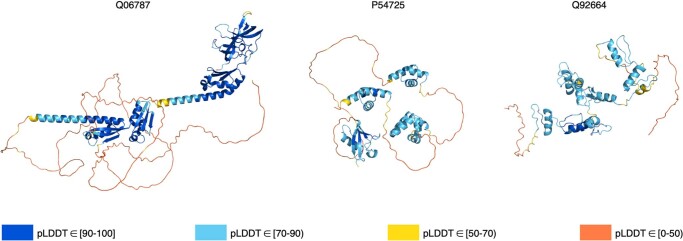
Protein structures can provide invaluable information, both for reasoning about biological processes and for enabling interventions such as structure-based drug development or targeted mutagenesis. After decades of effort, 17% of the total residues in human protein sequences are covered by an experimentally determined structure 1 . Here we markedly expand the structural coverage of the proteome by applying the state-of-the-art machine learning method, AlphaFold 2 , at a scale that covers almost the entire human proteome (98.5% of human proteins). The resulting dataset covers 58% of residues with a confident prediction, of which a subset (36% of all residues) have very high confidence. We introduce several metrics developed by building on the AlphaFold model and use them to interpret the dataset, identifying strong multi-domain predictions as well as regions that are likely to be disordered. Finally, we provide some case studies to illustrate how high-quality predictions could be used to generate biological hypotheses. We are making our predictions freely available to the community and anticipate that routine large-scale and high-accuracy structure prediction will become an important tool that will allow new questions to be addressed from a structural perspective.
Overview
CoChat Summary
TL;DR
AlphaFold2 was applied to 98.5% of human proteins, producing confident predictions for 58% of residues and very high confidence for 36% of all residues. The paper introduces pLDDT, pTM and an experimentally resolved head to interpret the dataset, presents case studies, and releases predictions freely.
Key findings
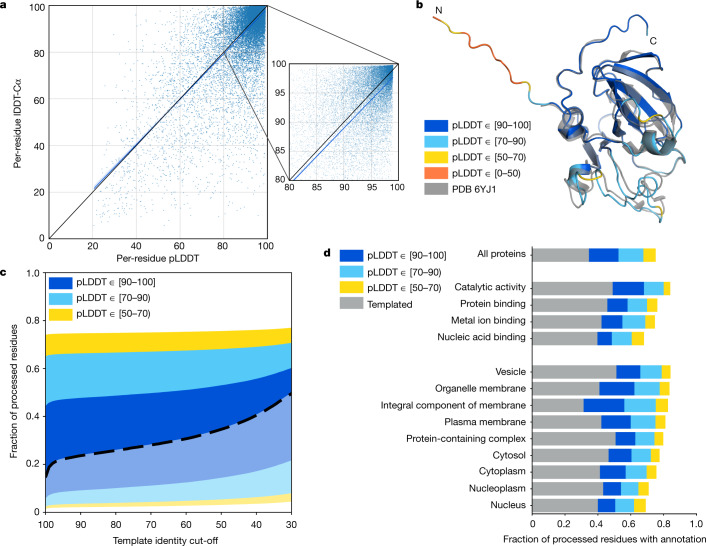
- The dataset covers 98.5% of human proteins with full-chain predictions, amounting to 10,537,122 residues (92.5% of residues); 58.0% of residues were predicted confidently (pLDDT > 70), and 35.7% of total residues fell in the highest accuracy band (pLDDT > 90), double the residues covered by experimental structures.
- At the per-protein level, 43.8% of proteins had a confident prediction on at least three quarters of their sequence, and 1,290 proteins contained a substantial region (>200 residues) with pLDDT ≥ 70 and no good template.
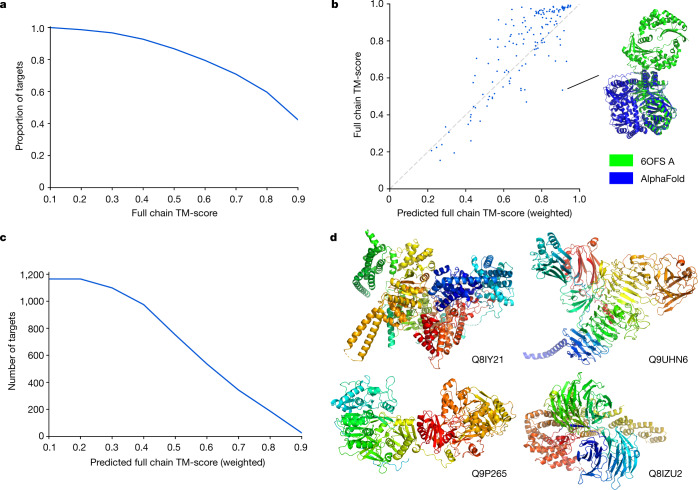
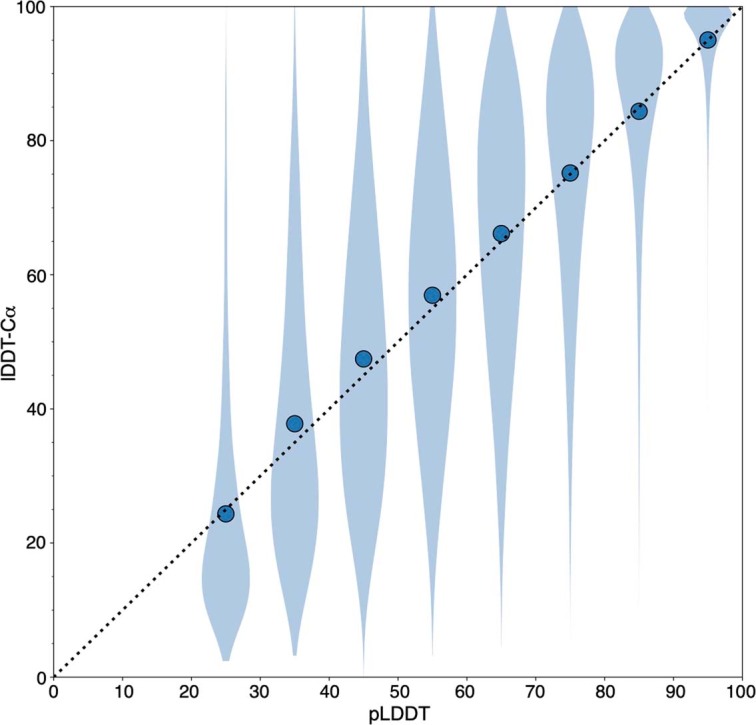
- On a held-out set of long PDB chains (n = 151), 70% of predictions had a TM-score > 0.7; pTM correlated with actual TM-score at Pearson’s r = 0.84, and among human proteins enriched for novel multidomain predictions, 187 had pTM > 0.8 and 343 had pTM > 0.7.
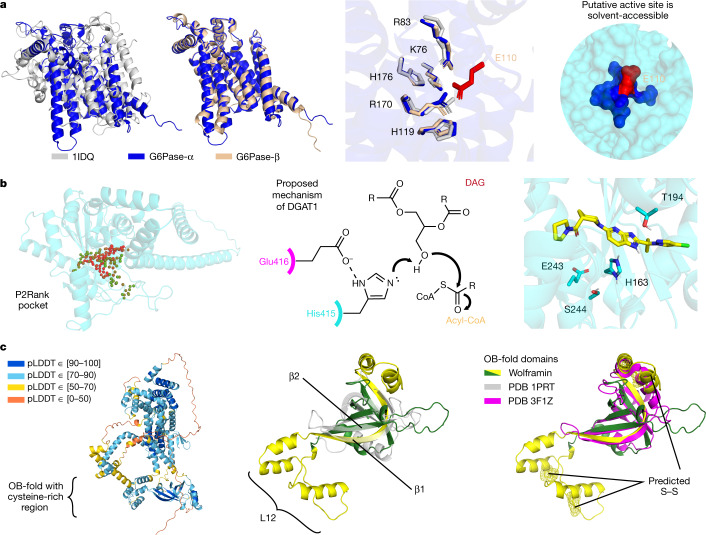
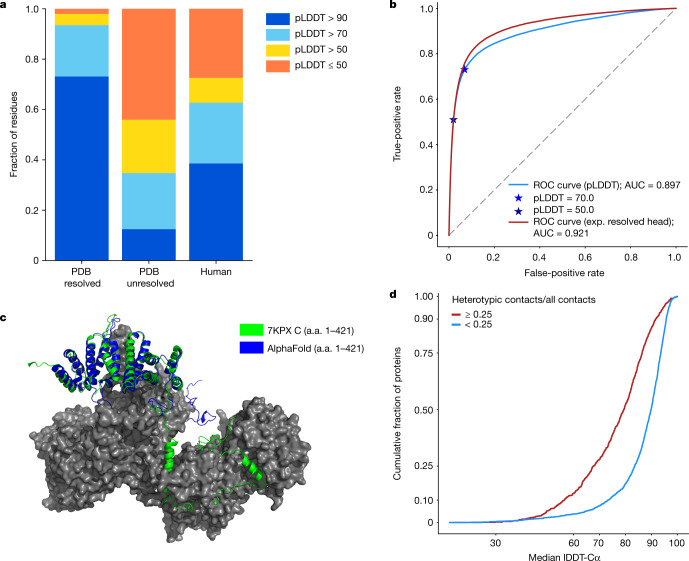
- pLDDT performed as a competitive disorder predictor on the CAID benchmark with AUC 0.897, while the experimentally resolved head achieved AUC 0.921; case studies proposed mechanistic hypotheses for G6Pase-α, DGAT2 and wolframin.
Methods
- AlphaFold2 was applied to the UniProt human reference proteome (release 2021_02), attempting all sequences of 16–2,700 amino acids and excluding residue codes B, J, O, U, Z or X; the pipeline used MSA construction, template search, inference with five models, model ranking by mean pLDDT, and constrained relaxation, with Reduced BFD and reduced ensembling.
- Evaluation used a recent PDB dataset of 12,494 chains, CAMEO targets from 21 March 2020 to 13 March 2021, and the CAID Disprot-PDB benchmark; metrics included pLDDT, pTM, the experimentally resolved head, TM-score, lDDT-Cα and AUC.
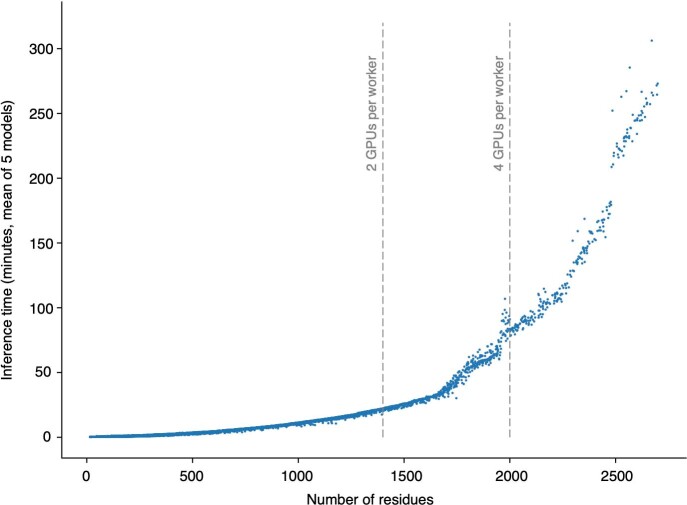
- Case-study analyses used PyMOL, P2Rank, AutoDockTools, AutoDock Vina and TM-align; inference for the human proteome used 930 GPU days, with an estimated 510 core days for other pipeline stages from scratch.
Limitations
- The paper states that low-confidence regions may reflect intrinsic disorder or regions structured only in complex, and that some proportion of proteins without confident predictions will be genuine failures where a fixed structure exists but AlphaFold does not predict it.
- The paper states that inter-domain accuracy is expected to be lower than within-domain accuracy, that some multidomain proteins may have mobile domains with no fixed packing, and that the case-study biological hypotheses require experimental confirmation.
- Evident from the text: predictions are single-chain and exclude sequences longer than 2,700 residues, so complex-dependent structure and larger proteins are not directly addressed.
Model-written summary. Check it against the paper before relying on it.
Integrity signals
Registry
Cites
Statistics
Figures
![Extended Data Fig. 7 Relationship between sequence length and run time for the non-inference stages of the pipeline. On the basis of 240 human protein sequences, chosen by stratified sampling from the length buckets: [16, 500), [500, 1,000), [1,000, 1,500), [1,500, 2,000), [2,000, 2,500) and [2,500, 2,700]. The relax plot shows five times more points, since five relaxed models are generated per protein. Coefficients for the quadratic lines of best fit were computed with Numpy polyfit.](https://figures.cochat.ai/paper-figures/c9bdcad64694429b95a292e248c7f05a/highly-accurate-protein-structure-prediction-for-the-human-proteome-figure-11.jpg)
Verification
Claims the paper makes
14 Valid · 1 Not valid · 5 Not checked · 44 Own results and interpretations
The cited sources support only part of this claim — read each source’s verdict below.
In the paper
“This system used a completely different model from our CASP13 entry31, and demonstrated a considerable improvement over previous methods in terms of providing routinely high accuracy29,30.”
§ Highly accurate protein structure prediction for the human proteome > Main
What the sources say
- Partly supportedcites [29] Kryshtafovych A Schwede T Topf M Fidelis K Moult J Critical assessment of methods of protein structure prediction (CASP)-round XIII Proteins 2019 87 1011 1020 10.1002/prot.25823 31589781 PMC6927249 sourceExperimental — accuracy not yet measured
The PROGRESS IN CASP13 section reports a dramatic improvement in model accuracy over earlier CASP rounds, and TEMPLATE FREE MODELING says DeepMind’s A7D group had the most accurate results overall. Those passages concern CASP13 methods, not the different system in the citing sentence; they do not establish that AlphaFold2 routinely achieved high accuracy. (LLM, conf=0.84)
- Supportedcites [30] Pereira, J. et al. High-accuracy protein structure prediction in CASP14. Proteins10.1002/prot.26171 (2021). 34218458 source
The Abstract reports a large leap in high accuracy due to AF2. The Conclusions say AF2 substantially outperformed its predecessor and produced the best models for 89 of 97 CASP14 targets, supporting both the improvement and its routine high accuracy. (LLM, conf=0.94)
boostedstates a cause- Asserted: passes — The authors put it forward as true.
- Checkable: passes — It can be checked against evidence.
- Load-bearing: passes — The paper’s conclusions depend on it.
- Based: passes — The paper gives a reason why it holds.
- Partly supported
Every source the paper cites for this claim was checked and supports it.
In the paper
“We note that the accuracy of AlphaFold was validated in CASP142, which focuses on challenging proteins that are dissimilar to structures already available in the PDB.”
§ Highly accurate protein structure prediction for the human proteome > Model confidence and added coverage
What the sources say
- Supportedcites [2] Jumper, J. et al. Highly accurate protein structure prediction with AlphaFold. Nature10.1038/s41586-021-03819-2 (2021). PMC8371605 34265844 source
The paper’s CASP14 assessment passage (section and page not provided in our copy) says AlphaFold was entered into CASP14, describes it as a blind accuracy assessment, and reports that AlphaFold’s structures were substantially more accurate than competing methods. This supports the attributed claim that its accuracy was validated in CASP14. (LLM, conf=0.94)
plain- Asserted: passes — The authors put it forward as true.
- Checkable: passes — It can be checked against evidence.
- Load-bearing: unclear — It is unclear whether the paper’s conclusions depend on it.
- Based: passes — The paper gives a reason why it holds.
- Supported
The cited sources support only part of this claim — read each source’s verdict below.
In the paper
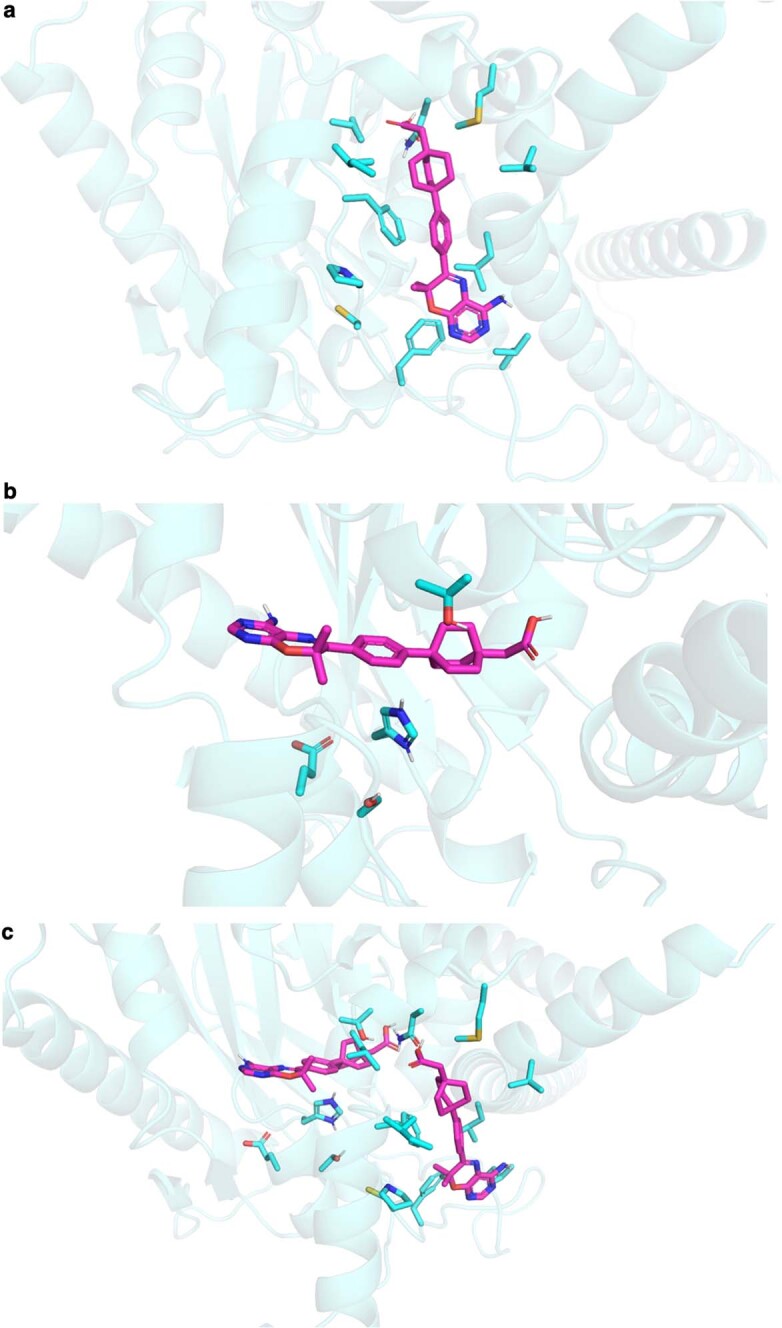
“Despite being the most similar chain, 3F1Z lacks the cysteines that are present in wolframin, which could form disulfide cross-links in the endoplasmic reticulum59.”
§ Highly accurate protein structure prediction for the human proteome > Highlighted predictions > Wolframin
What the sources say
- Partly supportedcites [59] Fass D Thorpe C Chemistry and enzymology of disulfide cross-linking in proteins Chem. Rev. 2018 118 1169 1198 10.1021/acs.chemrev.7b00123 28699750 PMC5808910 sourceExperimental — accuracy not yet measured
Section 2, “Which Proteins Contain Disulfides” (page unavailable), says that proteins in or passing through the ER can have cysteines positioned to form disulfide bonds. It does not address wolframin, 3F1Z, or whether their cysteine residues differ, so it supports only the general possibility of ER disulfide cross-linking. (LLM, conf=0.86)
hedged- Asserted: passes — The authors put it forward as true.
- Checkable: passes — It can be checked against evidence.
- Load-bearing: unclear — It is unclear whether the paper’s conclusions depend on it.
- Based: passes — The paper gives a reason why it holds.
- Partly supported
The sources with a verdict support this claim; the rest weren’t checked yet, have no full text we could read, or their verdicts aren’t rated yet.
In the paper
“Comparing our prediction for this region (median pLDDT of 86.0) to existing PDB chains using TM-align42,57 identified 3F1Z58 as the most similar known chain (TM-score of 0.472) (Fig. 3c, magenta).”
§ Highly accurate protein structure prediction for the human proteome > Highlighted predictions > Wolframin
What the sources say
- Not checked — no full text of the sourcecites [42] Zhang Y Skolnick J Scoring function for automated assessment of protein structure template quality Proteins 2004 57 702 710 10.1002/prot.20264 15476259 source
- Supportedcites [57] Zhang Y Skolnick J TM-align: a protein structure alignment algorithm based on the TM-score Nucleic Acids Res. 2005 33 2302 2309 10.1093/nar/gki524 15849316 PMC1084323 source
The citation is attached to “using TM-align,” identifying the method used by the citing authors, not attributing their 3F1Z match or TM-score to this source. The source’s Results (Benchmark test; page unavailable) describes TM-align as a tool for comparing protein structures and reporting TM-scores. (LLM, conf=0.93)
- Supportedcites [58] Das D The structure of KPN03535 (gi|152972051), a novel putative lipoprotein from Klebsiella pneumoniae, reveals an OB-fold Acta Crystallogr. F 2010 66 1254 1260 10.1107/S1744309109018168 PMC2954213 20944219 source
The citation is attached to 3F1Z, identifying the PDB chain used in the citing authors’ comparison. The source paper’s Materials and methods section states that its KPN03535 structure was deposited under accession code 3f1z; the pLDDT and TM-score describe the citing authors’ own analysis, not a result attributed to this source. (LLM, conf=0.93)
plainstates an association- Asserted: passes — The authors put it forward as true.
- Checkable: passes — It can be checked against evidence.
- Load-bearing: unclear — It is unclear whether the paper’s conclusions depend on it.
- Based: passes — The paper gives a reason why it holds.
Every source the paper cites for this claim was checked and supports it.
In the paper
“A recent evolutionary analysis suggested domains for wolframin, which our prediction largely supports55.”
§ Highly accurate protein structure prediction for the human proteome > Highlighted predictions > Wolframin
What the sources say
- Supportedcites [55] Schäffer DE Iyer LM Burroughs AM Aravind L Functional innovation in the evolution of the calcium-dependent system of the eukaryotic endoplasmic reticulum Front. Genet. 2020 11 34 10.3389/fgene.2020.00034 32117448 PMC7016017 source
The Results section, “Domain Architectural Anatomy and Functional Analysis of the Wolframin Protein,” reports the paper’s proposed domain assignments for wolframin, including Sel1-like repeats, an EF-hand region, and an OB-fold domain (Figure 4A). The citing authors’ statement that their own prediction largely supports those assignments is not a finding attributed to this source. (LLM, conf=0.93)
plainstates an association- Asserted: passes — The authors put it forward as true.
- Checkable: passes — It can be checked against evidence.
- Load-bearing: unclear — It is unclear whether the paper’s conclusions depend on it.
- Based: passes — The paper gives a reason why it holds.
- Supported
36 more claims · 4 with their cited sources checked
Create a free account to see all 64 claims and every source verdict.
- It may state two separate claims as one. 13
- Probably not a substantial claim. 12
Claims other papers make about this one
Each is checked against this paper’s own text: does it say what the citing paper says it does?
The source backs part of the claim, not all of it — or backs it for a different population, condition or comparison.
In the citing paper
“While AF2 performs exceptionally well on these types of folds on average”
From The power and pitfalls of AlphaFold2 for structure prediction beyond rigid globular proteins (2024) · cites this paper as [5]
Experimental — accuracy not yet measuredThe source backs part of the claim, not all of it — or backs it for a different population, condition or comparison.
In the citing paper
“For the majority of globular proteins, AF2 provides accurate, reliable models with high pLDDT (> 70) or low PAE values (< 5 Å) highlighting confidence in the prediction of the position of the atomic coordinates, which match experimentally determined native structures5,17,23,59”
From The power and pitfalls of AlphaFold2 for structure prediction beyond rigid globular proteins (2024) · cites this paper as [5]
Experimental — accuracy not yet measuredThe source backs part of the claim, not all of it — or backs it for a different population, condition or comparison.
In the citing paper
“The lower confidence bands appear to correlate well with backbone flexibility and intrinsic disorder (13) (Figure 2).”
From AlphaFold Protein Structure Database: massively expanding the structural coverage of protein-sequence space with high-accuracy models (2022) · cites this paper as [13]
Experimental — accuracy not yet measuredThe source backs part of the claim, not all of it — or backs it for a different population, condition or comparison.
In the citing paper
“One of the major insights leveraged by AlphaFold 1,2 comes from the use of evolutionary covariations that can be extracted from large-scale multiple sequence alignments.[49][50][51][52][53][54]”
From AlphaFold and Implications for Intrinsically Disordered Proteins (2021) · cites this paper as [2]
Experimental — accuracy not yet measuredThe source backs part of the claim, not all of it — or backs it for a different population, condition or comparison.
In the citing paper
“DeepMind’s AlphaFold2 success in sequence-based protein structure prediction,4 as well as the RoseTTAFold70 open-source counterpart, and the publicly available AlphaFold2 prediction of all human proteins203 are major steps that benefit the scientific community.”
From AlphaFold, Artificial Intelligence (AI), and Allostery (2022) · cites this paper as [203]
Experimental — accuracy not yet measured
16 more claims about this paper
Create a free account to see every claim other papers make about this one.
Citations
Cites
Highly accurate protein structure prediction with AlphaFold
Jumper, J., Evans, R., Pritzel, A., Green, T., Figurnov, M., Ronneberger, O., Tunyasuvunakool, K., Bates, R., Žídek, A., Potapenko, A., et al. (2021) · Nature · doi:10.1038/s41586-021-03819-2 · Cited by 43,764 · cited 1×
“[16, 500), [500, 1,000), [1,000, 1,500), [1,500, 2,000), [2,000, 2,500) and [2,500, 2,700].”
Self-citationGene Ontology: tool for the unification of biology
Ashburner, M., Ball, C. A., Blake, J. A., Botstein, D., Butler, H., Cherry, J. M., Davis, A. P., Dolinski, K., Dwight, S. S., Eppig, J. T., et al. (2000) · Nature Genetics · doi:10.1038/75556 · Cited by 43,206
Trott, O., & Olson, A. J. (2010) · Journal of Computational Chemistry · doi:10.1002/jcc.21334 · Cited by 38,412
AutoDock4 and AutoDockTools4: Automated docking with selective receptor flexibility
Morris, G. M., Huey, R., Lindstrom, W., Sanner, M. F., Belew, R. K., Goodsell, D. S., & Olson, A. J. (2009) · Journal of Computational Chemistry · doi:10.1002/jcc.21256 · Cited by 25,486
Initial sequencing and analysis of the human genome
International Human Genome Sequencing Consortium, Whitehead Institute for Biomedical Research, C. F. G. R., Lander, E. S., Linton, L. M., Birren, B., Nusbaum, C., Zody, M. C., Baldwin, J., Devon, K., Dewar, K., et al. (2001) · Nature · doi:10.1038/35057062 · Cited by 24,216
Self-citationThe sequence of the human genome
Venter, J. C., Adams, M. D., Myers, E. W., Li, P. W., Mural, R. J., Sutton, G. G., Smith, H. O., Yandell, M., Evans, C. A., Holt, R. A., et al. (2001) · Science · doi:10.1126/science.1058040 · Cited by 13,909
SWISS-MODEL: homology modelling of protein structures and complexes
Waterhouse, A., Bertoni, M., Bienert, S., Studer, G., Tauriello, G., Gumienny, R., Heer, F. T., de Beer, T. A. P., Rempfer, C., Bordoli, L., et al. (2018) · Nucleic Acids Research · doi:10.1093/nar/gky427 · Cited by 13,067
Pfam: The protein families database in 2021
Mistry, J., Chuguransky, S., Williams, L., Qureshi, M., Salazar, G. A., Sonnhammer, E. L. L., Tosatto, S. C. E., Paladin, L., Raj, S., Richardson, L. J., et al. (2021) · Nucleic Acids Research · doi:10.1093/nar/gkaa913 · Cited by 7,452
Self-citationUniProt: the universal protein knowledgebase in 2021
The UniProt Consortium, Bateman, A., Martin, M.-J., Orchard, S., Magrane, M., Agivetova, R., Ahmad, S., Alpi, E., Bowler-Barnett, E. H., Britto, R., et al. (2021) · Nucleic Acids Research · doi:10.1093/nar/gkaa1100 · Cited by 6,372
Self-citationThe Gene Ontology Resource: 20 years and still GOing strong
The Gene Ontology Consortium (2019) · Nucleic Acids Research · doi:10.1093/nar/gky1055 · Cited by 4,747
Cited by
Items 2,601–2,700 of 3,208
Structural Evolution of Trimeric Gamma-Type Retroviral Envelope ProteinsPreprint
Hötzel, I. (2023) · bioRxiv (Cold Spring Harbor Laboratory) · doi:10.1101/2023.10.07.561363 · Cited by 1
“In particular, AlphaFold2 (AF2) has been very successful in generating structural models of proteins with high confidence, including for proteins without structural precedent in the Protein Data Bank (PBD) (Jumper et al., 2021; Tunyasuvunakool et al., 2021).”
BackgroundThe actin-associated protein Kaptin modulates F-actin barbed-end dynamicsPreprint
Dutta, P., Maiti, I., Ghose, A., et al. (2023) · bioRxiv (Cold Spring Harbor Laboratory) · doi:10.1101/2023.10.30.564586 · Cited by 1
Ggnbp2 regulates synaptic development and autophagy in motor neuronsPreprint
Kerwin, S. K., Carrodus, N. L., Kewin, A. B., Lin, T., Qian, X., McRae, A. F., Yang, J., Collins, B. M., Wray, N. R., Garton, F. C., et al. (2023) · bioRxiv (Cold Spring Harbor Laboratory) · doi:10.1101/2023.11.03.565470 · Cited by 1
Tang, J., Zhang, Z., Zhan, J., & Zhou, Y. (2023) · bioRxiv (Cold Spring Harbor Laboratory) · doi:10.1101/2023.11.22.568372 · Cited by 1
“Although it was estimated that AlphaFold2 can cover about 98.5% of the human proteome, only 58% residues could be predicted with confidence, while mere 36% residues could be predicted with high confidence (3, 4).”
BackgroundInfluentialEdmunds, N. S., Genc, A. G., & McGuffin, L. J. (2023) · bioRxiv (Cold Spring Harbor Laboratory) · doi:10.1101/2023.12.15.571846 · Cited by 1
“Since the CASP14 success detailed above, AlphaFold2 has been used in a DeepMind-EMBL collaboration to create the AlphaFold Protein Structure Database https://alphafold.ebi.ac.uk (Tunyasuvunakool et al. , 2021).”
MethodEditorial: All good things come to an end
(2023) · Physiology News · doi:10.36866/pn.132.6 · Cited by 2
Zhu, C., Zhang, C., Shang, T., Zhang, C., Zhai, S., Su, Z., & Duan, H. (2023) · bioRxiv (Cold Spring Harbor Laboratory) · doi:10.1101/2023.12.26.573336 · Cited by 1
Structure‐Based Ultra‐Large Virtual Screenings
Gorgulla, C. (2024) · Wiley eBooks · doi:10.1002/9783527840748.ch19 · Cited by 3
FoldExplorer: Fast and Accurate Protein Structure Search with Sequence-Enhanced Graph EmbeddingPreprint
Shen, H., Liu, Y., Zhang, Y., & Zhou, Z. P. (2024) · Research Square · doi:10.21203/rs.3.rs-3831396/v1 · Cited by 2
Uncovering the BIN1-SH3 interactome underpinning centronuclear myopathyPreprint
Zámbó, B., Edelweiss, E. F., Morlet, B., Négroni, L., Pajkos, M., Dosztányi, Z., Østergaard, S., Travé, G., Laporte, J., & Gógl, G. (2024) · eLife · doi:10.7554/elife.95397.1 · Cited by 1
Protein fold classification using Graph Neural Network and Protein Topology Graph
Sayeed, S. D., Wolf, J. N., Koch, I., & Song, G. (2022) · doi:10.31274/td-20240329-608 · Cited by 2
Galaxysagittarius-Af: Predicting Targets for Drug-Like Compounds in the Extended Human 3d ProteomePreprint
Kwon, S., Jung, N., Yang, J., et al. (2024) · SSRN Electronic Journal · doi:10.2139/ssrn.4772705 · Cited by 1
Uncovering the BIN1-SH3 interactome underpinning centronuclear myopathyPreprint
Zámbó, B., Edelweiss, E. F., Morlet, B., Négroni, L., Pajkos, M., Dosztányi, Z., Østergaard, S., Travé, G., Laporte, J., & Gógl, G. (2024) · eLife · doi:10.7554/elife.95397.2 · Cited by 1
Murphy, D., Mesdaghi, S., Rodríguez, F. S., Simpkin, A. J., Elliott, L. G., & Rigden, D. J. (2024) · bioRxiv (Cold Spring Harbor Laboratory) · doi:10.1101/2024.04.13.589297 · Cited by 1
“The options “use_turbo” and “use_ptm” (pTM network) were unselected [33], mmseqs was used for the MSA generation step [87,88], with all other options and parameters the default.”
MethodGarg, R., Liu, Q., van Kessel, J., et al. (2024) · SSRN Electronic Journal · doi:10.2139/ssrn.4793115 · Cited by 1
Heparan sulphate binding controls in vivo half-life of the HpARI protein familyPreprint
Colomb, F., Jamwal, A., Ogunkanbi, A., et al. (2024) · bioRxiv (Cold Spring Harbor Laboratory) · doi:10.1101/2024.05.06.592731 · Cited by 1
“Full-length models of HpARI1-3 were built using Alphafold with crystal structure of HpARI2_CCP2/3 (PDB ID = 8Q5R) as a template (Tunyasuvunakool et al., 2021).”
MethodRaisinghani, N., Alshahrani, M., Gupta, G., Tian, H., Xiao, S., Tao, P., & Verkhivker, G. M. (2024) · bioRxiv (Cold Spring Harbor Laboratory) · doi:10.1101/2024.05.17.594786 · Cited by 2
Computational Tools for Structural Analysis of Proteins
Brezovský, J., Sethi, A., & Surpeta, B. (2024) · Elsevier eBooks · doi:10.1016/b978-0-323-95502-7.00089-0 · Cited by 1
Rhodes, J. L., Jacobs, J. L., Dennis, E. K., et al. (2024) · bioRxiv (Cold Spring Harbor Laboratory) · doi:10.1101/2024.06.18.599548 · Cited by 1
Uncovering the BIN1-SH3 interactome underpinning centronuclear myopathyPreprint
Zámbó, B., Edelweiss, E. F., Morlet, B., Négroni, L., Pajkos, M., Dosztányi, Z., Østergaard, S., Travé, G., Laporte, J., & Gógl, G. (2024) · eLife · doi:10.7554/elife.95397.3 · Cited by 4
Andrews, T. D., Lehmann, N., May, M., Goodall, L., Cho, E., & Chuah, A. (2024) · bioRxiv (Cold Spring Harbor Laboratory) · doi:10.1101/2024.07.14.603410 · Cited by 1
“We used the MAESTRO tool 16 to predict the stability effect, measured as DD G, of all single amino acid substitutions using structural models predicted by AlphaFold2 17 .”
MethodInfluentialGiese, A. P. J., Weng, W.-H., Kindt, K. S., Chang, H. H. V., Montgomery, J. S., Ratzan, E. M., Beirl, A. J., Rivera, R. A., Lotthammer, J. M., Walujkar, S., et al. (2024) · eLife · doi:10.7554/elife.89719.2 · Cited by 2
Decoding protein dynamicity in DNA ligase activity through deep learning-based structural ensemblesPreprint
Mishra, N., Callaghan, S., & Briney, B. S. (2024) · bioRxiv (Cold Spring Harbor Laboratory) · doi:10.1101/2024.11.07.622521 · Cited by 1
Biochemical and neurophysiological effects of deficiency of the mitochondrial import protein TIMM50Preprint
Paz, E., Jain, S., Gottfried, I., Staretz‐Chacham, O., Mahajnah, M. M., Bagchi, P., Seyfried, N. T., Ashery, U., & Azem, A. (2024) · eLife · doi:10.7554/elife.99914.2 · Cited by 1
Ferrillo, A., Tingley, J. P., King, M. L., Kidane, A., Bajwa, B., Xing, X., Johannessen, T., Lysberg, A., Mydland, L. T., Øverland, M., et al. (2024) · bioRxiv (Cold Spring Harbor Laboratory) · doi:10.1101/2024.12.17.628917 · Cited by 1
Zeng, W., Pan, L., Ji, B., Xu, L., & Peng, S. (2024) · bioRxiv (Cold Spring Harbor Laboratory) · doi:10.1101/2024.12.11.628078 · Cited by 1
Protein Structure Description with ρ, θ and ϕ : A Case Study with Caenopore-5Preprint
Li, W. (2025) · bioRxiv (Cold Spring Harbor Laboratory) · doi:10.1101/2025.01.08.631847 · Cited by 1
Wag31, a membrane tether, is crucial for lipid homeostasis in mycobacteriaPreprint
Kapoor, Y., Khurana, H., Chakraborty, A., Dutta, D., Priya, A., Singh, A., Kamat, S. S., Dhar, N., Pucadyil, T. J., & Nandicoori, V. K. (2025) · eLife · doi:10.7554/elife.104268.1 · Cited by 1
Hoi1 targets the yeast BLTP2 protein to ER-PM contact sites to regulate lipid homeostasisPreprint
Dziurdzik, S. K., Sridhar, V., Eng, H., Neuman, S. D., Yan, J., Davey, M., Taubert, S., Bashirullah, A., & Conibear, E. (2025) · bioRxiv (Cold Spring Harbor Laboratory) · doi:10.1101/2025.02.11.637747 · Cited by 1
Nguyen, T. V. T., Ly, N. Q., Le, N. T. P., Nguyen, H. D., & Ngo, K. X. (2025) · bioRxiv (Cold Spring Harbor Laboratory) · doi:10.1101/2025.02.26.640237 · Cited by 2
“…HS-AFM surface images into 3D atomic conformations using rigid or flexible fitting techniques [2-10], while AlphaFold 2 and 3 have revolutionized structure prediction from single conformations to complex assemblies involving proteins, nucleic acids, ligands, ions, and modified residues[11-14].”
An Artificial Intelligence Model for Translating Natural Language into Functional de Novo ProteinsPreprint
Riley, T. P., Parsa, M. S., Kalantari, P., Naderi, I., Azimian, K., Begloo, N., Matusovsky, O., Osher, E. L., Prabhakaran, D., Yadav, R., et al. (2025) · bioRxiv · doi:10.1101/2025.03.21.644400 · Cited by 1
Mechanism of USP21 autoinhibition and histone H2AK119 deubiquitinationPreprint
Rahman, S., Morgan, M. T., Hicks, C. W., Gwizdala, A., & Wolberger, C. (2025) · bioRxiv (Cold Spring Harbor Laboratory) · doi:10.1101/2025.04.17.649347 · Cited by 1
“For the analysis, we extracted the structure of H2AK119ub nucleosome alone 52 , the H2AK119ub-bound structures of SSX1 63 , DNMT3A 64 , PRC2 65 , RYBP-PRC1 66 , UbcH5b-PRC1 67 , PR-DUB 5 , USP16 6 , and USP21 (this study).”
Kim, S., Kim, H., Pelayo, J. P., Alvarez, S., Jang, G., Kim, J., Hoelscher, V. M., Calleja‐Pérez, B., Jung, H., Lee, J., et al. (2025) · medRxiv · doi:10.1101/2025.06.07.25328825 · Cited by 2
Interpretable Protein-DNA Interactions Captured by Structure-Sequence OptimizationPreprint
Zhang, Y., Silvernail, I., Lin, Z., & Lin, X. (2025) · eLife · doi:10.7554/elife.105565.2 · Cited by 1
Cryo-EM of cardiac AL-224L amyloid reveals shared features in λ6 light chain fibril foldsPreprint
Hicks, C. W., Prokaeva, T. B., Spencer, B., et al. (2025) · bioRxiv (Cold Spring Harbor Laboratory) · doi:10.1101/2025.06.25.661559 · Cited by 1
Abraham, J., Sagilkumar, A. C., Dhyani, H., et al. (2025) · bioRxiv (Cold Spring Harbor Laboratory) · doi:10.1101/2025.08.14.670243 · Cited by 1
“Since the crystal structure of DivIVA is not available, we processed the AlphaFold predicted structure of DivIVA to extract a nine amino acid containing peptide centered at Thr-201.”
InfluentialTranslation-driven temporal control for intertwined protein assemblyPreprint
Till, K., Šunderlíková, V., Tippmann, F., Jevtić, P., Bertolini, M., Fenzl, K., Schmitt, J. L., Katranidis, A., Bukau, B., Kramer, G., et al. (2025) · bioRxiv (Cold Spring Harbor Laboratory) · doi:10.1101/2025.08.25.672138 · Cited by 1
Liu, Y., Kang, B., & Cui, Q. (2025) · bioRxiv (Cold Spring Harbor Laboratory) · doi:10.1101/2025.09.28.679101 · Cited by 1
Tryptoline Stereoprobe Elaboration Identifies Inhibitors of the GRPEL1-HSPA9 Chaperone ComplexPreprint
Hayward, R. E., Berkeley, R. F., Gao, Z., Garhammer, M., Morizono, M. A., Njomen, E., Li, H., DeMeester, K. E., Cociorva, V., Herzik, M. A., et al. (2025) · bioRxiv (Cold Spring Harbor Laboratory) · doi:10.1101/2025.10.20.683548 · Cited by 1
Decoding the physicochemical basis of taxonomy preferences in protein design modelsPreprint
Dillon, L. B., Maiwald, A., & Crook, O. M. (2025) · bioRxiv (Cold Spring Harbor Laboratory) · doi:10.1101/2025.10.21.683350 · Cited by 2
“Membrane proteins comprise approximately 20-30% of proteomes [43] but represent less than 3% of PDB structures [44], and intrinsically disordered regions, which play crucial roles in signalling and regulation, remain poorly characterised [45–47].”
Reverse target screening identifies putative L-AAA targets in astrocyte-selective toxicityPreprint
Park, J. S., & Lee, S. J. (2025) · bioRxiv (Cold Spring Harbor Laboratory) · doi:10.1101/2025.10.21.683823 · Cited by 1
“Advances in deep learning–based protein structure prediction have substantially accelerated the discovery of small-molecule–protein interactions (8,9).”
Mohanty, D., Fichman, Y., Peláez‐Vico, M. Á., Myers, R. J., Sealander, M., Sinha, R., Morrow, J., Eckstein, R., Olson, K., Xu, C., et al. (2025) · bioRxiv (Cold Spring Harbor Laboratory) · doi:10.1101/2025.11.23.689998 · Cited by 1
“FASTA sequences and AlphaFold-predicted structures were retrieved from UniProt (UniProt Consortium, 2015) and the AlphaFold Database (Tunyasuvunakool et al. , 2021).”
Quantifying (de)Mixing of Disordered Proteins in Molecular Dynamics SimulationsPreprint
Morton, W., & Vácha, R. (2025) · bioRxiv (Cold Spring Harbor Laboratory) · doi:10.64898/2025.12.12.694022 · Cited by 2
“Of the human proteome’s 20,000+ proteins, between 50-75% contain IDRs, making the combinatorial space of potential partners staggeringly vast[10], [11].”
Chiduza, G. N., Sakata, K., Wolfe, H. G., Noor, F., & Menon, A. K. (2025) · bioRxiv (Cold Spring Harbor Laboratory) · doi:10.64898/2025.12.07.692794 · Cited by 1
Biomolecular condensation using de novo designed globular proteinsPreprint
Romanyuk, A. V., Kumar, R. T. P., Cross, S., et al. (2025) · bioRxiv (Cold Spring Harbor Laboratory) · doi:10.64898/2025.12.19.695468 · Cited by 1
Tiusanen, V., Patel, D., Xia, J., Xu, C., Datta, S., Yun, J. W., Cancellieri, S., Fei, L., Yilmaz, M., Pitkänen, E., et al. (2026) · bioRxiv (Cold Spring Harbor Laboratory) · doi:10.64898/2026.01.23.701252 · Cited by 1
Narayanasamy, A., Drake, Z. C., Turzo, S. B. A., Rolland, A. D., Prell, J. S., Wysocki, V. H., & Lindert, S. (2026) · bioRxiv (Cold Spring Harbor Laboratory) · doi:10.64898/2026.02.16.706193 · Cited by 1
Asbóth, A., Stirling, T., Méhi, O., Apjok, G., Klein-Sousa, V., Taylor, N. M. I., Mehdi, H. H., Papp, B., Ari, E. E., & Kintses, B. (2026) · bioRxiv (Cold Spring Harbor Laboratory) · doi:10.64898/2026.02.20.706991 · Cited by 1
Nonequivalence of Zfp423 premature termination codons in mice
(2025) · doi:10.1101/2025.05.30.656936 · Cited by 1
Protein Secondary Structure Patterns In Short-Range Cross-Link Atlas
Vetrano, A., Di Ianni, A., Di Fonte, N., Dell’Orletta, G., Reale, S., Daidone, I., & Iacobucci, C. (2025) · doi:10.1101/2025.04.03.647081 · Cited by 1
Monté, D., Lens, Z., Dewitte, F., Villeret, V., & Verger, A. (2023) · doi:10.1101/2023.11.30.569364 · Cited by 1
CIB2 function is distinct from Whirlin in the development of cochlear stereocilia staircase pattern
Giese, A. P. J., Parker, A., Rehman, S., Brown, S. D. M., Riazuddin, S., Vander Kooi, C. W., Bowl, M. R., & Ahmed, Z. M. (2024) · doi:10.1101/2024.07.30.605852 · Cited by 1
Marcuzzi, O., Calcaterra, F., Olivera, L. H., Arizmendi, A., Henry, M. R. J. M., Cardoso, D. C., Echeverri, A. M. L., Liron, J. P., Fernández, M. E., de Oliveira, D. A. A., et al. (2025) · doi:10.21203/rs.3.rs-6547904/v1 · Cited by 1
YAP1 and QSER1 are Key Modulators of Embryonic Signaling Pathways in the Mammalian Epiblast
Abraham, E., Roule, T., Douglas, A., Megill, E., Pericak, O. M., Howe, J. E., Choya-Foces, C., Garbincius, J. F., Cohen, H. M., Roig-Flórez, P., et al. (2025) · doi:10.1101/2025.06.16.659935 · Cited by 1
Templated trimerization of the phage L decoration protein on capsids
Woodbury, B. M., Newcomer, R. L., Alexandrescu, A. T., & Teschke, C. M. (2024) · doi:10.1101/2024.09.08.611893 · Cited by 1
Modeling Sequence-Space Exploration and Emergence of Epistatic Signals in Protein Evolution.
Bisardi, M., Rodriguez-Rivas, J., Zamponi, F., & Weigt, M. (2022) · Molecular Biology and Evolution · doi:10.1093/molbev/msab321
YAP1 and QSER1 are key modulators of embryonic signaling pathways in the mammalian epiblast
Abraham, E., Roule, T., Douglas, A., Megill, E., Pericak, O. M., Howe, J. E., Choya-Foces, C., Garbincius, J. F., Cohen, H. M., Roig-Flórez, P., et al. (2026) · EMBO Reports · doi:10.1038/s44319-026-00746-z · Cited by 1
Margelevičius, M. (2021) · bioRxiv (Cold Spring Harbor Laboratory) · doi:10.1101/2021.06.22.449457
“The output for a length-L target protein or its fragment is an L × L map whereby each cell is a probability distribution over 64 classes, which represent distances discretized into intervals of length 1 ˚A ( [0 , 2) , [2 , 3) , . . . , [63 , 64) , [64 , ∞ ) ).”
BackgroundRational Exploration of Fold Atlas for Human Solute Carrier Proteins
Xie, T., Chi, X., Huang, B., Ye, F., Zhou, Q., & Huang, J. (2021) · doi:10.1101/2021.08.21.457230
LyTS: A Lysosome Localized Complex of TMEM192 and STK11IPPreprint
Angarola, B. L., Frölich, F., & Ferguson, S. M. (2021) · bioRxiv (Cold Spring Harbor Laboratory) · doi:10.1101/2021.08.27.457973
Science News for Theological Study: Machine Learning Unravels the Protein Folding Knot
Davison, A. (2021) · Theology and Science · doi:10.1080/14746700.2021.1982246
Rational Exploration of Fold Atlas for Human Solute Carrier ProteinsPreprint
Xie, T., Chi, X., Huang, B., Ye, F., Zhou, Q., & Huang, J. (2021) · SSRN Electronic Journal · doi:10.2139/ssrn.3967674
Plant 'n' Seek: Can You Find the Winning Ticket?Preprint
Fischer, J., & Burkholz, R. (2021) · arXiv (Cornell University) · doi:10.48550/arxiv.2111.11153 · Cited by 6
“, 2021) or protein structure prediction (Tunyasuvunakool et al., 2021), the design of NN architectures for human solvable problems has already in the past provided important insights into NN properties, including universal approximation (Scarselli & Tsoi, 1998; Yarotsky, 2018) or the importance of algorithmic alignmen…”
BackgroundWITHDRAWN: GPCR Dock 2021: a blind docking competition in the post AlphaFold2 era
Zhao, S. (2021) · Artificial Intelligence in the Life Sciences · doi:10.1016/j.ailsci.2021.100024
RetractedPolitics, administration, and national development
Kim, K.-U. (1971) · ScholarSpace (University of Hawaii at Manoa) · Cited by 1
Carneiro, L. F. C. G. (2013) · Portuguese National Funding Agency for Science, Research and Technology (RCAAP Project by FCT) · Cited by 1
1492-1992: l'America da scoprire
Ottonello, P. P. (1992) · Filosofia oggi
Koulujen sanitaatiotilanne Tansaniassa : Dar es Salaamin ja Moshin alueilla
Partanen, L. (2013) · Theseus (Ammattikorkeakoulujen)
Rajagopalan, V., & Cao, H. (2021) · Advances in computational intelligence and robotics book series · doi:10.4018/978-1-7998-8455-2.ch004
Serrão, V. H. B., & Lee, J. E. (2021) · STAR Protocols · doi:10.1016/j.xpro.2021.100994
Xiong, Y., Zhou, J., An, K., Han, W., Wang, T., Ye, Z., & Wu, Y. (2021) · Frontiers in Bioscience-Landmark · doi:10.52586/5036
“With the unprecedented progress in protein structure prediction such as the recent AlphaFold, 58% of human proteome residues now have been confidently mapped with 3D conformations [64].”
BackgroundHarish, A. (2021) · OSF Preprints (OSF Preprints) · doi:10.31219/osf.io/hyknj · Cited by 1
Bisello, G., Kuśmierska, K., Verbeek, M. M., et al. (2022) · Research Square · doi:10.21203/rs.3.rs-1395907/v1
Simm, D. (2022) · eDiss (Georg-August-Universität Göttingen) · doi:10.53846/goediss-9118
Lovetrue, B., & Lovetrue, I. (2022) · medRxiv · doi:10.1101/2022.03.14.22272372 · Cited by 1
“Similarly, a clinical trial with available readout is given the ground-truth label failure if and only if (1) none of the efficacy primary endpoint(s) is met according to topline analyses or final data or deemed likely to be met according to interim analyses, or (2) the trial is terminated for non-recruitment or non-b…”
BackgroundAssessment of AlphaFold2 residue conformations for human proteinsPreprint
Bæk, K. T., & Kepp, K. P. (2022) · bioRxiv (Cold Spring Harbor Laboratory) · doi:10.1101/2022.01.28.478137
“AF2 produces an estimate of confidence for each residue, predicted lDDT-C α (pLDDT) based on the Local Distance Difference test, on a scale from 0 – 100, where 100 indicates the highest possible confidence (Mariani et al. , 2013; Jumper et al. , 2021; Tunyasuvunakool et al. , 2021).”
BackgroundMethodInfluentialMango, G., Osti, N., Udali, S., Vareschi, A., Malerba, G., Giorgetti, A., Pizzolo, F., Friso, S., Girelli, D., Olivieri, O., et al. (2022) · SSRN Electronic Journal · doi:10.2139/ssrn.4061448
Si, Y., & Yan, C. (2022) · SSRN Electronic Journal · doi:10.2139/ssrn.4000247
What AlphaFold teaches us about deep learning with prior knowledgePreprint
Landgrebe, J. (2022) · Research Square · doi:10.21203/rs.3.rs-1582914/v1 · Cited by 3
Exploring triosephosphate isomerase diversity in photosynthetic organisms
Jones, G. (2022) · Open Access Victoria University of Wellington | Te Herenga Waka (Figshare) · doi:10.26686/wgtn.19729840
Faculty Opinions recommendation of Highly accurate protein structure prediction with AlphaFold.
Arulanandam, A. J. (2021) · Faculty Opinions – Post-Publication Peer Review of the Biomedical Literature · doi:10.3410/f.740477161.793587548
Faculty Opinions recommendation of Highly accurate protein structure prediction with AlphaFold.
Chakraborty, S. (2021) · Faculty Opinions – Post-Publication Peer Review of the Biomedical Literature · doi:10.3410/f.740477161.793587538
ProteinGLUE multi-task benchmark suite for self-supervised protein modelingPreprint
Capel, H., Weiler, R., Dijkstra, M. J. J., et al. (2022) · Research Square · doi:10.21203/rs.3.rs-1181299/v1
rrQNet : Protein contact map quality estimation by deep evolutionary reconciliation
(2022) · doi:10.1002/prot.26394
Oncometabolites and their role in cancer
Gill, E. L., Patel, K., & Rakheja, D. (2022) · Elsevier eBooks · doi:10.1016/b978-0-12-824302-2.00003-5
Brown, D., Alcala, H., Oelschlaeger, P., & Andresen, B. T. (2022) · Advances in pharmacology · doi:10.1016/bs.apha.2022.04.001
Disentangling the Protein Order/Disorder Continuum Using a Sequence-Based Foldability ScorePreprint
Bruley, A., Bitard‐Feildel, T., Callebaut, I., & Duprat, É. (2022) · SSRN Electronic Journal · doi:10.2139/ssrn.4116299
Shirota, M., & Kinoshita, K. (2022) · Biophysics and Physicobiology · doi:10.2142/biophysico.bppb-v19.0023 · Cited by 1
Utilization of AlphaFold2 to Predict MFS Protein Conformations after Selective MutationPreprint
Xiao, Q., Xu, M., Wu, T., et al. (2021) · SSRN Electronic Journal · doi:10.2139/ssrn.3974794
A Unified-Field Theory of Genome Organization and Gene RegulationPreprint
Cook, P. R., & Marenduzzo, D. (2022) · SSRN Electronic Journal · doi:10.2139/ssrn.4178531
Design of extended metal-binding β-sandwiches from de novo immunoglobulin domainsPreprint
Roel‐Touris, J., Nadal, M., & Marcos, E. (2022) · bioRxiv (Cold Spring Harbor Laboratory) · doi:10.1101/2022.08.03.502643
Discovery of Novel Bilaterian Signaling Peptides Using Cone Snail ToxinsPreprint
Koch, T. L., Torres, J. P., Baskin, R. P., et al. (2022) · bioRxiv (Cold Spring Harbor Laboratory) · doi:10.1101/2022.08.05.502922
Structural basis for antagonism of the ubiquitin ligase BIRC6 by SMACPreprint
Dietz, L., Ellison, C. J., Riechmann, C., et al. (2022) · bioRxiv (Cold Spring Harbor Laboratory) · doi:10.1101/2022.08.30.505748
Balasco, N., Paladino, A., Graziano, G., D’Abramo, M., & Vitagliano, L. (2022) · Journal of Chemical Information and Modeling · doi:10.1021/acs.jcim.2c00727
Gunkel, P., Iino, H., Krull, S., & Cordes, V. C. (2022) · bioRxiv (Cold Spring Harbor Laboratory) · doi:10.1101/2022.09.10.507405
“…the ZC3HC1 structures that some of the recent neural network-based deep-learning programs allowed predicting computationally, with us eventually using DeepMind’s deep-learning program AlphaFold2 (Jumper et al, 2021; Tunyasuvunakool et al, 2021) and the ColabFold platform (Mirdita et al, 2021).”
BackgroundMethodInfluentialZhuo, Z., Wang, Q., Li, C., et al. (2022) · Research Square · doi:10.21203/rs.3.rs-2071325/v1
Linking research of biomedical datasets
Zhao, X.-J. G., & Cao, H. (2022) · Briefings in Bioinformatics · doi:10.1093/bib/bbac373
SARS-Cov-2 Variants: Biological and Mathematical Considerations for Nomenclature
Huang, J., Mi, Y., Li, J., & McLean, G. (2022) · Medical Research Archives · doi:10.18103/mra.v10i8.2939
Koizumi, A., Miyazawa, K., Ogata, M., et al. (2022) · bioRxiv (Cold Spring Harbor Laboratory) · doi:10.1101/2022.10.12.511150
Swan, A. H., Schindler, R. F. R., Savarese, M., et al. (2022) · bioRxiv (Cold Spring Harbor Laboratory) · doi:10.1101/2022.10.13.511879
Metadata
- Authors
- Tunyasuvunakool, K., Adler, J., Wu, Z., Green, T., Zielinski, M., Žídek, A., Bridgland, A., Cowie, A., Meyer, C., Laydon, A., Velankar, S., Kleywegt, G. J., Bateman, A., Evans, R., Pritzel, A., Figurnov, M., Ronneberger, O., Bates, R., Kohl, S. A. A., Potapenko, A., Ballard, A. J., Romera-Paredes, B., Nikolov, S., Jain, R., Clancy, E., Reiman, D., Petersen, S., Senior, A. W., Kavukcuoglu, K., Birney, E., Kohli, P., Jumper, J., & Hassabis, D.
- Affiliations
- Google DeepMind (United Kingdom) (GB)
- European Bioinformatics Institute (GB)
- Corresponding author
- Tunyasuvunakool, Kathryn
- Jumper, John
- Hassabis, Demis
- ORCID
- Tunyasuvunakool, Kathryn
- Adler, Jonas
- Wu, Zachary
- Green, Tim
- Žídek, Augustin
- Meyer, Clemens
- Laydon, Agata
- Velankar, Sameer
- Kleywegt, Gerard J.
- Bateman, Alex
- Evans, Richard
- Pritzel, Alexander
- Figurnov, Michael
- Ronneberger, Olaf
- Bates, Russ
- Kohl, Simon A. A.
- Potapenko, Anna
- Ballard, Andrew J.
- Nikolov, Stanislav
- Jain, Rishub
- Clancy, Ellen
- Reiman, David
- Petersen, Stig
- Senior, Andrew W.
- Birney, Ewan
- Kohli, Pushmeet
- Jumper, John
- Hassabis, Demis
- Venue
- Nature
- Published
- 2021-07-22
- Volume
- 596
- Issue
- 7873
- Pages
- 590-596
- ISSN
- 0028-0836 (ISSN-L)
- 1476-4687
- PMC
- PMC8387240
- OpenAlex
- W3183475563
- Semantic Scholar
- 1fb3ad9969245795f268636eff9a145337144718
- Cited by
- 3,025
- References
- 83
- Citations by year
- 2026: 346 · 2025: 517 · 2024: 580 · 2023: 701 · 2022: 692 · 2021: 181
- FWCI
- 169.53
- Type
- journal article
- Language
- en
- Open access
- hybrid
- doi.org
- Licence
- cc-by
- creativecommons.org/licenses/by/4.0 (tdm)
- creativecommons.org/licenses/by/4.0 (vor)
- Locations
- Nature (publishedVersion, cc-by)
- Europe PMC (PubMed Central) (publishedVersion, other-oa)
- PubMed Central (publishedVersion, cc-by)
- PubMed (publishedVersion)
- RePEc: Research Papers in Economics (submittedVersion)
- Funders
- European Bioinformatics Institute
- DeepMind
- Topics
- Life Sciences › Biochemistry, Genetics and Molecular Biology › Molecular Biology › Protein Structure and Dynamics
- Life Sciences › Biochemistry, Genetics and Molecular Biology › Molecular Biology › Machine Learning in Bioinformatics
- Life Sciences › Biochemistry, Genetics and Molecular Biology › Structural Biology › Enzyme Structure and Function
- Keywords
- protein structure prediction, human proteome, AlphaFold2, structural coverage, intrinsically disordered regions, multidomain proteins, protein structure database
- MeSH terms
- Deep Learning, Glucose-6-Phosphatase, Humans, Membrane Proteins, Models, Molecular, Protein Conformation, Reproducibility of Results, Protein Folding, Computational Biology, Proteome, Diacylglycerol O-Acyltransferase, Datasets as Topic
About these checks
Registry, retraction, Cites and statistics results are computed, not judged, with one exception: a printed reference that no index lists is read once by a model before it counts as a citation error. Claims are extracted by a model and kept only when their quote appears verbatim in the text; each cited source is then checked, with a model’s help, for whether it says what the claim relies on. Those verdicts can be wrong — read the claim’s quote and the cited source before relying on one.
The claim verdicts this report counts are experimental: their accuracy is not yet measured.
A language model drew the claims from the paper on 2026-10-10, under version 3 of the claim definition (model deepseek-v4.1-flash, prompt extract-v3).
A second model labelled each claim on 2026-10-10 (model jev-1.13-20260917, definition revision gold-guideline-v0.2).
Cited sources are checked with a language model’s help (gpt-6-sol).
Statistics and arithmetic are recomputed, not judged.
Confidence bands are shown only for fields calibrated on our annotated test set. None is calibrated yet, so no band is shown.
What counts as a claim ›How we measure confidence ›How we check this ›
Are you an author, or do you see a problem with this page? Request a review
Data sources
Bibliographic data: Semantic Scholar, OpenAlex, Crossref.
Contains information from the Semantic Scholar Academic Graph Datasets, made available under the ODC Attribution License (ODC-BY 1.0).
Semantic Scholar’s data is described in: Kinney, R., et al. (2023). The Semantic Scholar Open Data Platform. arXiv:2301.10140.
