

Highly accurate protein structure prediction for the human proteome
Open accessThe DOI matches its Crossref record; 77 of the 83 references it cites were found in a registry or an index; 18 of the 24 sources its claims cite were checked for support.
Abstract
Protein structures can provide invaluable information, both for reasoning about biological processes and for enabling interventions such as structure-based drug development or targeted mutagenesis. After decades of effort, 17% of the total residues in human protein sequences are covered by an experimentally determined structure 1 . Here we markedly expand the structural coverage of the proteome by applying the state-of-the-art machine learning method, AlphaFold 2 , at a scale that covers almost the entire human proteome (98.5% of human proteins). The resulting dataset covers 58% of residues with a confident prediction, of which a subset (36% of all residues) have very high confidence. We introduce several metrics developed by building on the AlphaFold model and use them to interpret the dataset, identifying strong multi-domain predictions as well as regions that are likely to be disordered. Finally, we provide some case studies to illustrate how high-quality predictions could be used to generate biological hypotheses. We are making our predictions freely available to the community and anticipate that routine large-scale and high-accuracy structure prediction will become an important tool that will allow new questions to be addressed from a structural perspective.
Overview
CoChat Summary
TL;DR
AlphaFold2 was applied to 98.5% of human proteins, producing confident predictions for 58% of residues and very high confidence for 36% of all residues. The paper introduces pLDDT, pTM and an experimentally resolved head to interpret the dataset, presents case studies, and releases predictions freely.
Key findings
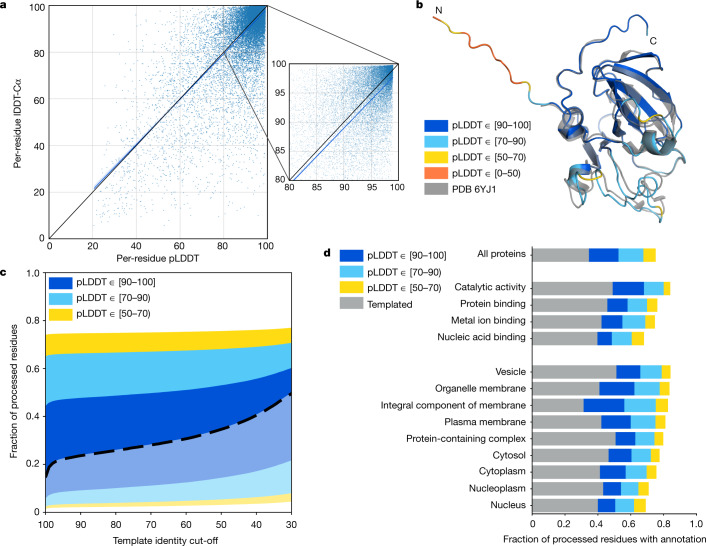
- The dataset covers 98.5% of human proteins with full-chain predictions, amounting to 10,537,122 residues (92.5% of residues); 58.0% of residues were predicted confidently (pLDDT > 70), and 35.7% of total residues fell in the highest accuracy band (pLDDT > 90), double the residues covered by experimental structures.
- At the per-protein level, 43.8% of proteins had a confident prediction on at least three quarters of their sequence, and 1,290 proteins contained a substantial region (>200 residues) with pLDDT ≥ 70 and no good template.
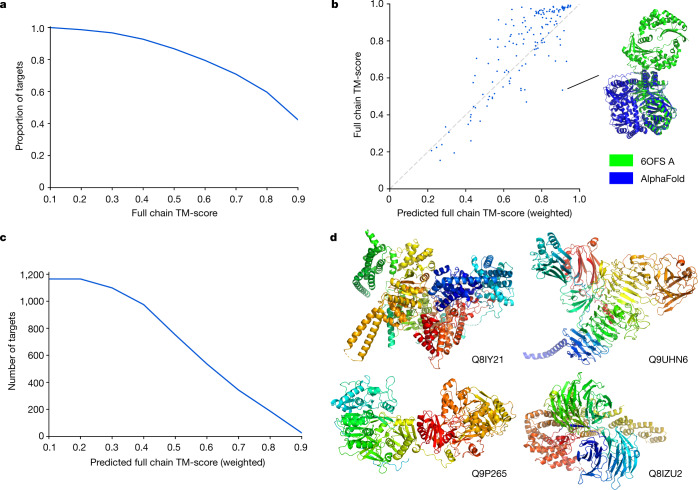
- On a held-out set of long PDB chains (n = 151), 70% of predictions had a TM-score > 0.7; pTM correlated with actual TM-score at Pearson’s r = 0.84, and among human proteins enriched for novel multidomain predictions, 187 had pTM > 0.8 and 343 had pTM > 0.7.
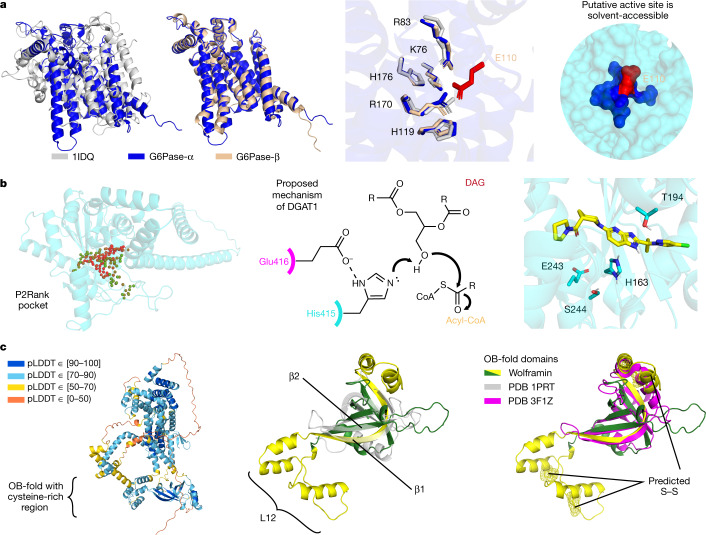
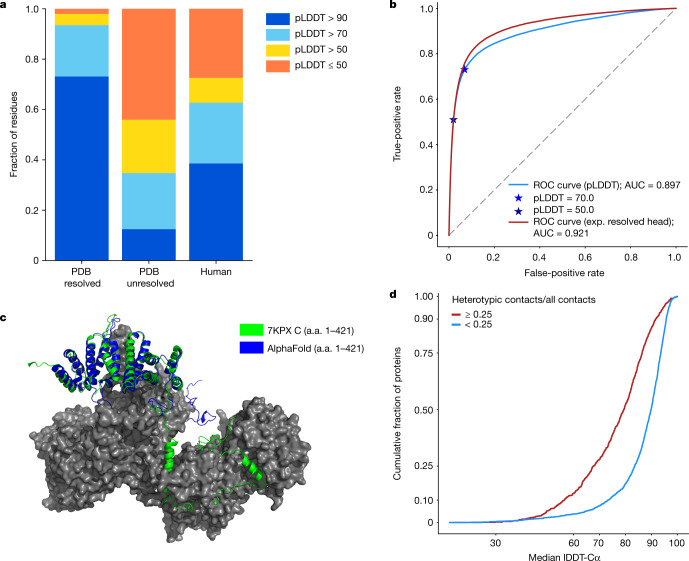
- pLDDT performed as a competitive disorder predictor on the CAID benchmark with AUC 0.897, while the experimentally resolved head achieved AUC 0.921; case studies proposed mechanistic hypotheses for G6Pase-α, DGAT2 and wolframin.
Methods
- AlphaFold2 was applied to the UniProt human reference proteome (release 2021_02), attempting all sequences of 16–2,700 amino acids and excluding residue codes B, J, O, U, Z or X; the pipeline used MSA construction, template search, inference with five models, model ranking by mean pLDDT, and constrained relaxation, with Reduced BFD and reduced ensembling.
- Evaluation used a recent PDB dataset of 12,494 chains, CAMEO targets from 21 March 2020 to 13 March 2021, and the CAID Disprot-PDB benchmark; metrics included pLDDT, pTM, the experimentally resolved head, TM-score, lDDT-Cα and AUC.
- Case-study analyses used PyMOL, P2Rank, AutoDockTools, AutoDock Vina and TM-align; inference for the human proteome used 930 GPU days, with an estimated 510 core days for other pipeline stages from scratch.
Limitations
- The paper states that low-confidence regions may reflect intrinsic disorder or regions structured only in complex, and that some proportion of proteins without confident predictions will be genuine failures where a fixed structure exists but AlphaFold does not predict it.
- The paper states that inter-domain accuracy is expected to be lower than within-domain accuracy, that some multidomain proteins may have mobile domains with no fixed packing, and that the case-study biological hypotheses require experimental confirmation.
- Evident from the text: predictions are single-chain and exclude sequences longer than 2,700 residues, so complex-dependent structure and larger proteins are not directly addressed.
Model-written summary. Check it against the paper before relying on it.
Integrity signals
Registry
Cites
Statistics
Figures
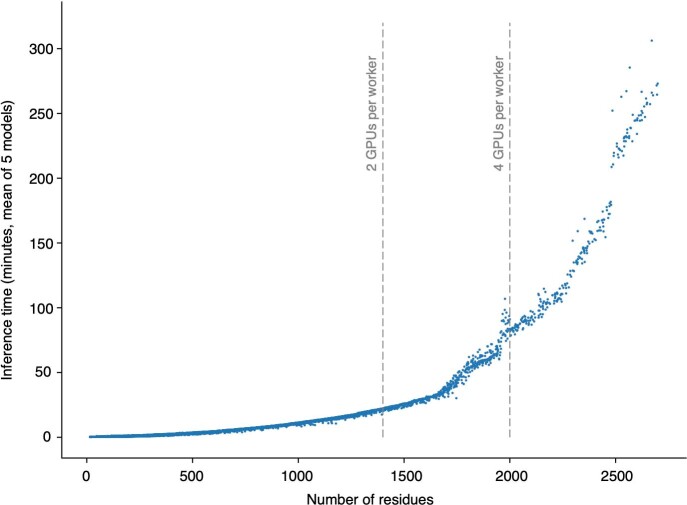
![Extended Data Fig. 7 Relationship between sequence length and run time for the non-inference stages of the pipeline. On the basis of 240 human protein sequences, chosen by stratified sampling from the length buckets: [16, 500), [500, 1,000), [1,000, 1,500), [1,500, 2,000), [2,000, 2,500) and [2,500, 2,700]. The relax plot shows five times more points, since five relaxed models are generated per protein. Coefficients for the quadratic lines of best fit were computed with Numpy polyfit.](https://figures.cochat.ai/paper-figures/c9bdcad64694429b95a292e248c7f05a/highly-accurate-protein-structure-prediction-for-the-human-proteome-figure-11.jpg)
Verification
Claims the paper makes
14 Valid · 1 Not valid · 5 Not checked · 44 Own results and interpretations
The cited sources support only part of this claim — read each source’s verdict below.
In the paper
“This system used a completely different model from our CASP13 entry31, and demonstrated a considerable improvement over previous methods in terms of providing routinely high accuracy29,30.”
§ Highly accurate protein structure prediction for the human proteome > Main
What the sources say
- Partly supportedcites [29] Kryshtafovych A Schwede T Topf M Fidelis K Moult J Critical assessment of methods of protein structure prediction (CASP)-round XIII Proteins 2019 87 1011 1020 10.1002/prot.25823 31589781 PMC6927249 sourceExperimental — accuracy not yet measured
The PROGRESS IN CASP13 section reports a dramatic improvement in model accuracy over earlier CASP rounds, and TEMPLATE FREE MODELING says DeepMind’s A7D group had the most accurate results overall. Those passages concern CASP13 methods, not the different system in the citing sentence; they do not establish that AlphaFold2 routinely achieved high accuracy. (LLM, conf=0.84)
- Supportedcites [30] Pereira, J. et al. High-accuracy protein structure prediction in CASP14. Proteins10.1002/prot.26171 (2021). 34218458 source
The Abstract reports a large leap in high accuracy due to AF2. The Conclusions say AF2 substantially outperformed its predecessor and produced the best models for 89 of 97 CASP14 targets, supporting both the improvement and its routine high accuracy. (LLM, conf=0.94)
boostedstates a cause- Asserted: passes — The authors put it forward as true.
- Checkable: passes — It can be checked against evidence.
- Load-bearing: passes — The paper’s conclusions depend on it.
- Based: passes — The paper gives a reason why it holds.
- Partly supported
Every source the paper cites for this claim was checked and supports it.
In the paper
“We note that the accuracy of AlphaFold was validated in CASP142, which focuses on challenging proteins that are dissimilar to structures already available in the PDB.”
§ Highly accurate protein structure prediction for the human proteome > Model confidence and added coverage
What the sources say
- Supportedcites [2] Jumper, J. et al. Highly accurate protein structure prediction with AlphaFold. Nature10.1038/s41586-021-03819-2 (2021). PMC8371605 34265844 source
The paper’s CASP14 assessment passage (section and page not provided in our copy) says AlphaFold was entered into CASP14, describes it as a blind accuracy assessment, and reports that AlphaFold’s structures were substantially more accurate than competing methods. This supports the attributed claim that its accuracy was validated in CASP14. (LLM, conf=0.94)
plain- Asserted: passes — The authors put it forward as true.
- Checkable: passes — It can be checked against evidence.
- Load-bearing: unclear — It is unclear whether the paper’s conclusions depend on it.
- Based: passes — The paper gives a reason why it holds.
- Supported
The cited sources support only part of this claim — read each source’s verdict below.
In the paper
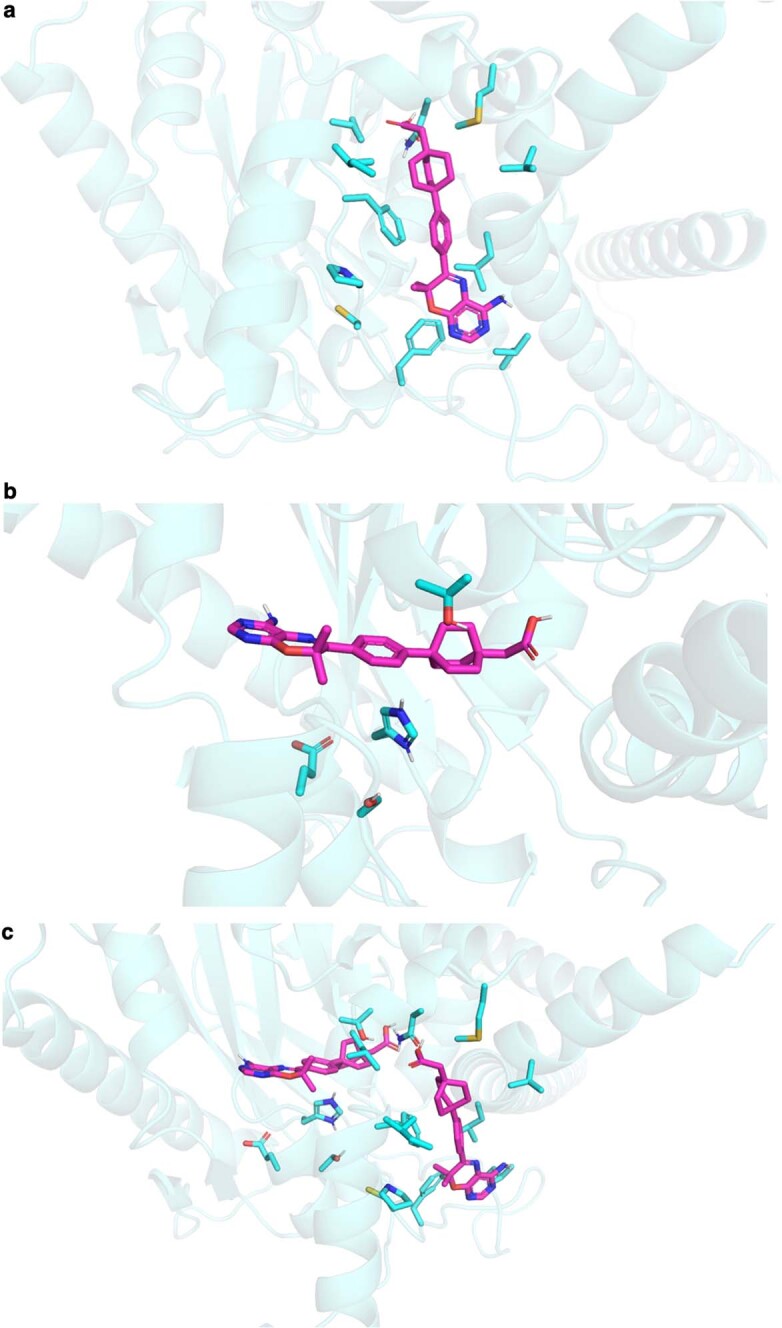
“Despite being the most similar chain, 3F1Z lacks the cysteines that are present in wolframin, which could form disulfide cross-links in the endoplasmic reticulum59.”
§ Highly accurate protein structure prediction for the human proteome > Highlighted predictions > Wolframin
What the sources say
- Partly supportedcites [59] Fass D Thorpe C Chemistry and enzymology of disulfide cross-linking in proteins Chem. Rev. 2018 118 1169 1198 10.1021/acs.chemrev.7b00123 28699750 PMC5808910 sourceExperimental — accuracy not yet measured
Section 2, “Which Proteins Contain Disulfides” (page unavailable), says that proteins in or passing through the ER can have cysteines positioned to form disulfide bonds. It does not address wolframin, 3F1Z, or whether their cysteine residues differ, so it supports only the general possibility of ER disulfide cross-linking. (LLM, conf=0.86)
hedged- Asserted: passes — The authors put it forward as true.
- Checkable: passes — It can be checked against evidence.
- Load-bearing: unclear — It is unclear whether the paper’s conclusions depend on it.
- Based: passes — The paper gives a reason why it holds.
- Partly supported
The sources with a verdict support this claim; the rest weren’t checked yet, have no full text we could read, or their verdicts aren’t rated yet.
In the paper
“Comparing our prediction for this region (median pLDDT of 86.0) to existing PDB chains using TM-align42,57 identified 3F1Z58 as the most similar known chain (TM-score of 0.472) (Fig. 3c, magenta).”
§ Highly accurate protein structure prediction for the human proteome > Highlighted predictions > Wolframin
What the sources say
- Not checked — no full text of the sourcecites [42] Zhang Y Skolnick J Scoring function for automated assessment of protein structure template quality Proteins 2004 57 702 710 10.1002/prot.20264 15476259 source
- Supportedcites [57] Zhang Y Skolnick J TM-align: a protein structure alignment algorithm based on the TM-score Nucleic Acids Res. 2005 33 2302 2309 10.1093/nar/gki524 15849316 PMC1084323 source
The citation is attached to “using TM-align,” identifying the method used by the citing authors, not attributing their 3F1Z match or TM-score to this source. The source’s Results (Benchmark test; page unavailable) describes TM-align as a tool for comparing protein structures and reporting TM-scores. (LLM, conf=0.93)
- Supportedcites [58] Das D The structure of KPN03535 (gi|152972051), a novel putative lipoprotein from Klebsiella pneumoniae, reveals an OB-fold Acta Crystallogr. F 2010 66 1254 1260 10.1107/S1744309109018168 PMC2954213 20944219 source
The citation is attached to 3F1Z, identifying the PDB chain used in the citing authors’ comparison. The source paper’s Materials and methods section states that its KPN03535 structure was deposited under accession code 3f1z; the pLDDT and TM-score describe the citing authors’ own analysis, not a result attributed to this source. (LLM, conf=0.93)
plainstates an association- Asserted: passes — The authors put it forward as true.
- Checkable: passes — It can be checked against evidence.
- Load-bearing: unclear — It is unclear whether the paper’s conclusions depend on it.
- Based: passes — The paper gives a reason why it holds.
Every source the paper cites for this claim was checked and supports it.
In the paper
“A recent evolutionary analysis suggested domains for wolframin, which our prediction largely supports55.”
§ Highly accurate protein structure prediction for the human proteome > Highlighted predictions > Wolframin
What the sources say
- Supportedcites [55] Schäffer DE Iyer LM Burroughs AM Aravind L Functional innovation in the evolution of the calcium-dependent system of the eukaryotic endoplasmic reticulum Front. Genet. 2020 11 34 10.3389/fgene.2020.00034 32117448 PMC7016017 source
The Results section, “Domain Architectural Anatomy and Functional Analysis of the Wolframin Protein,” reports the paper’s proposed domain assignments for wolframin, including Sel1-like repeats, an EF-hand region, and an OB-fold domain (Figure 4A). The citing authors’ statement that their own prediction largely supports those assignments is not a finding attributed to this source. (LLM, conf=0.93)
plainstates an association- Asserted: passes — The authors put it forward as true.
- Checkable: passes — It can be checked against evidence.
- Load-bearing: unclear — It is unclear whether the paper’s conclusions depend on it.
- Based: passes — The paper gives a reason why it holds.
- Supported
36 more claims · 4 with their cited sources checked
Create a free account to see all 64 claims and every source verdict.
- It may state two separate claims as one. 13
- Probably not a substantial claim. 12
Claims other papers make about this one
Each is checked against this paper’s own text: does it say what the citing paper says it does?
The source backs part of the claim, not all of it — or backs it for a different population, condition or comparison.
In the citing paper
“While AF2 performs exceptionally well on these types of folds on average”
From The power and pitfalls of AlphaFold2 for structure prediction beyond rigid globular proteins (2024) · cites this paper as [5]
Experimental — accuracy not yet measuredThe source backs part of the claim, not all of it — or backs it for a different population, condition or comparison.
In the citing paper
“For the majority of globular proteins, AF2 provides accurate, reliable models with high pLDDT (> 70) or low PAE values (< 5 Å) highlighting confidence in the prediction of the position of the atomic coordinates, which match experimentally determined native structures5,17,23,59”
From The power and pitfalls of AlphaFold2 for structure prediction beyond rigid globular proteins (2024) · cites this paper as [5]
Experimental — accuracy not yet measuredThe source backs part of the claim, not all of it — or backs it for a different population, condition or comparison.
In the citing paper
“The lower confidence bands appear to correlate well with backbone flexibility and intrinsic disorder (13) (Figure 2).”
From AlphaFold Protein Structure Database: massively expanding the structural coverage of protein-sequence space with high-accuracy models (2022) · cites this paper as [13]
Experimental — accuracy not yet measuredThe source backs part of the claim, not all of it — or backs it for a different population, condition or comparison.
In the citing paper
“One of the major insights leveraged by AlphaFold 1,2 comes from the use of evolutionary covariations that can be extracted from large-scale multiple sequence alignments.[49][50][51][52][53][54]”
From AlphaFold and Implications for Intrinsically Disordered Proteins (2021) · cites this paper as [2]
Experimental — accuracy not yet measuredThe source backs part of the claim, not all of it — or backs it for a different population, condition or comparison.
In the citing paper
“DeepMind’s AlphaFold2 success in sequence-based protein structure prediction,4 as well as the RoseTTAFold70 open-source counterpart, and the publicly available AlphaFold2 prediction of all human proteins203 are major steps that benefit the scientific community.”
From AlphaFold, Artificial Intelligence (AI), and Allostery (2022) · cites this paper as [203]
Experimental — accuracy not yet measured
16 more claims about this paper
Create a free account to see every claim other papers make about this one.
Citations
Cites
Highly accurate protein structure prediction with AlphaFold
Jumper, J., Evans, R., Pritzel, A., Green, T., Figurnov, M., Ronneberger, O., Tunyasuvunakool, K., Bates, R., Žídek, A., Potapenko, A., et al. (2021) · Nature · doi:10.1038/s41586-021-03819-2 · Cited by 43,764 · cited 1×
“[16, 500), [500, 1,000), [1,000, 1,500), [1,500, 2,000), [2,000, 2,500) and [2,500, 2,700].”
Self-citationGene Ontology: tool for the unification of biology
Ashburner, M., Ball, C. A., Blake, J. A., Botstein, D., Butler, H., Cherry, J. M., Davis, A. P., Dolinski, K., Dwight, S. S., Eppig, J. T., et al. (2000) · Nature Genetics · doi:10.1038/75556 · Cited by 43,206
Trott, O., & Olson, A. J. (2010) · Journal of Computational Chemistry · doi:10.1002/jcc.21334 · Cited by 38,412
AutoDock4 and AutoDockTools4: Automated docking with selective receptor flexibility
Morris, G. M., Huey, R., Lindstrom, W., Sanner, M. F., Belew, R. K., Goodsell, D. S., & Olson, A. J. (2009) · Journal of Computational Chemistry · doi:10.1002/jcc.21256 · Cited by 25,486
Initial sequencing and analysis of the human genome
International Human Genome Sequencing Consortium, Whitehead Institute for Biomedical Research, C. F. G. R., Lander, E. S., Linton, L. M., Birren, B., Nusbaum, C., Zody, M. C., Baldwin, J., Devon, K., Dewar, K., et al. (2001) · Nature · doi:10.1038/35057062 · Cited by 24,216
Self-citationThe sequence of the human genome
Venter, J. C., Adams, M. D., Myers, E. W., Li, P. W., Mural, R. J., Sutton, G. G., Smith, H. O., Yandell, M., Evans, C. A., Holt, R. A., et al. (2001) · Science · doi:10.1126/science.1058040 · Cited by 13,909
SWISS-MODEL: homology modelling of protein structures and complexes
Waterhouse, A., Bertoni, M., Bienert, S., Studer, G., Tauriello, G., Gumienny, R., Heer, F. T., de Beer, T. A. P., Rempfer, C., Bordoli, L., et al. (2018) · Nucleic Acids Research · doi:10.1093/nar/gky427 · Cited by 13,067
Pfam: The protein families database in 2021
Mistry, J., Chuguransky, S., Williams, L., Qureshi, M., Salazar, G. A., Sonnhammer, E. L. L., Tosatto, S. C. E., Paladin, L., Raj, S., Richardson, L. J., et al. (2021) · Nucleic Acids Research · doi:10.1093/nar/gkaa913 · Cited by 7,452
Self-citationUniProt: the universal protein knowledgebase in 2021
The UniProt Consortium, Bateman, A., Martin, M.-J., Orchard, S., Magrane, M., Agivetova, R., Ahmad, S., Alpi, E., Bowler-Barnett, E. H., Britto, R., et al. (2021) · Nucleic Acids Research · doi:10.1093/nar/gkaa1100 · Cited by 6,372
Self-citationThe Gene Ontology Resource: 20 years and still GOing strong
The Gene Ontology Consortium (2019) · Nucleic Acids Research · doi:10.1093/nar/gky1055 · Cited by 4,747
Cited by
Highly accurate protein structure prediction with AlphaFold
Jumper, J., Evans, R., Pritzel, A., Green, T., Figurnov, M., Ronneberger, O., Tunyasuvunakool, K., Bates, R., Žídek, A., Potapenko, A., et al. (2021) · Nature · doi:10.1038/s41586-021-03819-2 · Cited by 43,764
“This opens up the exciting possibility of predicting structures at the proteome-scale and beyond—in a companion paper 39 , we demonstrate the application of AlphaFold to the entire human proteome 39 .”
BackgroundSelf-citationColabFold - Making protein folding accessible to all
Mirdita, M., Schütze, K., Moriwaki, Y., Heo, L., Ovchinnikov, S., & Steinegger, M. (2021) · doi:10.1101/2021.08.15.456425 · Cited by 9,391
“Concurrently, Tunyasuvunakool et al. 9 developed an AlphaFold2 Jupyter Notebook for Google Colaboratory (referred to as AlphaFold-Colab), for which the input MSA is built by searching with HMMer against the UniProt Reference Clusters (UniRef90) and an eightfold-reduced environmental database.”
MethodVaradi, M., Anyango, S., Deshpande, M., Nair, S., Natassia, C., Yordanova, G., Yuan, D., Stroe, O., Wood, G., Laydon, A., et al. (2022) · Nucleic Acids Research · doi:10.1093/nar/gkab1061 · Cited by 7,850
“The methodology of AlphaFold and insights gained from the predictions for the complete human proteome have been described recently (9,13).”
BackgroundMethodInfluentialSelf-citationEvolutionary-scale prediction of atomic level protein structure with a language model
Lin, Z., Akin, H., Rao, R., Hie, B., Zhu, Z., Lu, W., Smetanin, N., Verkuil, R., Kabeli, O., Shmueli, Y., et al. (2022) · doi:10.1101/2022.07.20.500902 · Cited by 5,990
PROTAC targeted protein degraders: the past is prologue
Békés, M., Langley, D. R., & Crews, C. M. (2022) · Nature Reviews Drug Discovery · doi:10.1038/s41573-021-00371-6 · Cited by 3,395
Accurate proteome-wide missense variant effect prediction with AlphaMissense
Cheng, J., Novati, G., Pan, J., Bycroft, C., Žemgulytė, A., Applebaum, T., Pritzel, A., Wong, L. H., Zielinski, M., Sargeant, T., et al. (2023) · Science · doi:10.1126/science.adg7492 · Cited by 2,163
“AF has recently shown that highly accurate protein structures can be predicted at scale using protein sequences as input ( 21 , 25 ).”
BackgroundSelf-citationLiu, Y., Yang, X., Gan, J., Chen, S., Xiao, Z.-X., & Cao, Y. (2022) · Nucleic Acids Research · doi:10.1093/nar/gkac394 · Cited by 2,062
“Recently, there is an increasingly urgent need of blind docking for the reason that massive protein structures have been determined by AlphaFold2 (5) or RoseTTAFold (6), opening the opportunities to explore new target therapies (7,8).”
BackgroundArtificial intelligence: A powerful paradigm for scientific research
Xu, Y., Liu, X., Cao, X., Huang, C., Liu, E., Qian, S., Liu, X., Wu, Y., Dong, F., Qiu, C.-W., et al. (2021) · The Innovation · doi:10.1016/j.xinn.2021.100179 · Cited by 1,726
“132, It is even considered to be the second-largest breakthrough in lifesciencesafterthehumangenomeproject 133 andwillfacilitatedrugdevel-opment among other things.”
Computational approaches streamlining drug discovery
Sadybekov, A. V., & Katritch, V. (2023) · Nature · doi:10.1038/s41586-023-05905-z · Cited by 1,279
“99,100) or RosettaFold 101 3D models, which already show utility in many applications, including protein–protein and protein–peptide docking 102 .”
BackgroundHarnessing protein folding neural networks for peptide–protein docking
Tsaban, T., Varga, J. K., Avraham, O., Ben-Aharon, Z., Khramushin, A., & Schueler-Furman, O. (2022) · Nature Communications · doi:10.1038/s41467-021-27838-9 · Cited by 1,205
Harnessing protein folding neural networks for peptide-protein docking
(2021) · doi:10.1101/2021.08.01.454656 · Cited by 1,203
Targeting p53 pathways: mechanisms, structures, and advances in therapy
Wang, H., Guo, M., Wei, H., & Chen, Y. (2023) · Signal Transduction and Targeted Therapy · doi:10.1038/s41392-023-01347-1 · Cited by 1,016
Dali server: structural unification of protein families
Holm, L. (2022) · Nucleic Acids Research · doi:10.1093/nar/gkac387 · Cited by 935
“Lower confidence pLDDT bands correlate with disordered regions (10).”
Burley, S. K., Bhikadiya, C., Bi, C., Bittrich, S., Chao, H., Chen, L., Craig, P. A., Crichlow, G. V., Dalenberg, K., Duarte, J. M., et al. (2023) · Nucleic Acids Research · doi:10.1093/nar/gkac1077 · Cited by 887
“Of particular importance when evaluating CSMs for use in research and education are pLDDT (predicted local distance difference test) scores or confidence estimates generated by AlphaFold 2 (41,119,120).”
BackgroundProtGPT2 is a deep unsupervised language model for protein design
Ferruz, N., Schmidt, S., & Höcker, B. (2022) · Nature Communications · doi:10.1038/s41467-022-32007-7 · Cited by 795
“Thisscorehasbeenshowntocorrelate with order 43 : Low scores (pLDDT > 50) tend to appear in disordered regions, while excellent scores (pLDDT > 90) appear in ordered ones 43 .”
BackgroundA structural biology community assessment of AlphaFold2 applications
Akdel, M., Pires, D. E. V., Pardo, E. P., Jänes, J., Zalevsky, A. O., Mészáros, B., Bryant, P., Good, L. L., Laskowski, R. A., Pozzati, G., et al. (2022) · Nature Structural & Molecular Biology · doi:10.1038/s41594-022-00849-w · Cited by 675
Self-citationThe molecular basis for cellular function of intrinsically disordered protein regions
Holehouse, A. S., & Kragelund, B. B. (2024) · Nature Reviews Molecular Cell Biology · doi:10.1038/s41580-023-00673-0 · Cited by 696
“47,48) and trRosetta 49 implicates a region as being disordered (although the resulting structure predicted by these tools should not be taken as a faithful prediction of the ensemble properties 50 ).”
AlphaFold and Implications for Intrinsically Disordered Proteins
Ruff, K. M., & Pappu, R. V. (2021) · Journal of Molecular Biology · doi:10.1016/j.jmb.2021.167208 · Cited by 635
Zhou, Y., Zhang, Y., Lian, X., Li, F., Wang, C., Zhu, F., Qiu, Y., & Chen, Y. (2022) · Nucleic Acids Research · doi:10.1093/nar/gkab953 · Cited by 665
Sampling alternative conformational states of transporters and receptors with AlphaFold2
del Alamo, D., Sala, D., Mchaourab, H. S., & Meiler, J. (2022) · eLife · doi:10.7554/elife.75751 · Cited by 511
“A performance breakthrough was unveiled during CASP14 by AlphaFold2 (AF2) ( Jumper et al., 2021a ; Tunyasuvunakool et al., 2021 ; Pereira et al., 2021 ), which achieved remarkably accurate de novo structure prediction.”
AlphaFill: enriching AlphaFold models with ligands and cofactors
Hekkelman, M. L., de Vries, I., Joosten, R. P., & Perrakis, A. (2023) · Nature Methods · doi:10.1038/s41592-022-01685-y · Cited by 511
AlphaFill: enriching the AlphaFold models with ligands and co-factors
Hekkelman, M. L., de Vries, I., Joosten, R. P., & Perrakis, A. (2021) · doi:10.1101/2021.11.26.470110 · Cited by 511
Sampling the conformational landscapes of transporters and receptors with AlphaFold2
del Alamo, D., Sala, D., Mchaourab, H. S., & Meiler, J. (2021) · doi:10.1101/2021.11.22.469536 · Cited by 511
Scaffolding protein functional sites using deep learning
Wang, J., Lisanza, S., Juergens, D., Tischer, D., Watson, J. L., Castro, K. M., Ragotte, R., Saragovi, A., Milles, L. F., Baek, M., et al. (2022) · Science · doi:10.1126/science.abn2100 · Cited by 487
“S20; Table S3; Supplementary Text) (41), and our designed structures are predicted more confidently from their (single) sequences than most native proteins with known crystal structures, and on par with structurally validated de novo designed proteins (Fig.”
BackgroundDeep learning methods for designing proteins scaffolding functional sites
Wang, J., Lisanza, S., Juergens, D., Tischer, D., Anishchenko, I., Baek, M., Watson, J. L., Chun, J. H., Milles, L. F., Dauparas, J., et al. (2021) · doi:10.1101/2021.11.10.468128 · Cited by 487
BeStSel: webserver for secondary structure and fold prediction for protein CD spectroscopy
Micsonai, A., Moussong, É., Wien, F., Boros, E., Vadászi, H., Murvai, N., Lee, Y.-H., Molnár, T., Réfrégiers, M., Goto, Y., et al. (2022) · Nucleic Acids Research · doi:10.1093/nar/gkac345 · Cited by 455
“This is crucial for the experimental verification of MD simulation results or in silico models, such as AlphaFold2 (42) structures, making the structural comparison with the results of CD spectrum analysis possible.”
Ahdritz, G., Bouatta, N., Floristean, C., Kadyan, S., Xia, Q., Gerecke, W., O’Donnell, T. J., Berenberg, D., Fisk, I., Zanichelli, N., et al. (2024) · Nature Methods · doi:10.1038/s41592-024-02272-z · Cited by 439
“It has also been used to predict the structures of hundreds of millions of proteins 19–21 .”
(2022) · doi:10.1101/2022.11.20.517210 · Cited by 439
Using evolutionary data to make sense of macromolecules with a “face‐lifted” ConSurf
Yariv, B., Yariv, E., Kessel, A., Masrati, G., Chorin, A. B., Martz, E., Mayrose, I., Pupko, T., & Ben‐Tal, N. (2023) · Protein Science · doi:10.1002/pro.4582 · Cited by 428
“For queries from the AlphaFold database (Tunyasuvunakool et al. 2021) the scholar can provide the UniProt ID of the query in the box below “ Is there a known structure ” (Figure 1a).”
MethodTerwilliger, T. C., Liebschner, D., Croll, T. I., Williams, C. J., McCoy, A. J., Poon, B. K., Afonine, P. V., Oeffner, R. D., Richardson, J. S., Read, R. J., et al. (2024) · Nature Methods · doi:10.1038/s41592-023-02087-4 · Cited by 411
“Of course, many of the proteins in the human proteome that have low-confidence AlphaFold predictions are likely to contain regions that are intrinsically disordered 24,25 that would also often not be revealed by experimental methods.”
Terwilliger, T. C., Liebschner, D., Croll, T. I., Williams, C. J., McCoy, A. J., Poon, B. K., Afonine, P. V., Oeffner, R. D., Richardson, J. S., Read, R. J., et al. (2022) · doi:10.1101/2022.11.21.517405 · Cited by 411
Applying and improving AlphaFold at CASP14
Jumper, J., Evans, R., Pritzel, A., Green, T., Figurnov, M., Ronneberger, O., Tunyasuvunakool, K., Bates, R., Žídek, A., Potapenko, A., et al. (2021) · Proteins: Structure, Function, and Bioinformatics · doi:10.1002/prot.26257 · Cited by 395
“This makes it possible to create predictions at the same level of accuracy at larger scales without intervention, as demonstrated with proteome-scale predictions by Tunyasuvunakool et al.(21)”
ResultSelf-citationAlphaFold2 and the future of structural biology
Cramer, P. (2021) · Nature Structural & Molecular Biology · doi:10.1038/s41594-021-00650-1 · Cited by 364
On scientific understanding with artificial intelligence
Krenn, M., Pollice, R., Guo, S. Y., Aldeghi, M., Cervera-Lierta, A., Friederich, P., dos Passos Gomes, G., Häse, F., Jinich, A., Nigam, A., et al. (2022) · Nature Reviews Physics · doi:10.1038/s42254-022-00518-3 · Cited by 372
“[25] Kathryn Tunyasuvunakool, Jonas Adler, Zachary Wu, Tim Green, Michal Zielinski, Augustin Ž́ıdek, Alex Bridgland, Andrew Cowie, Clemens Meyer, Agata Laydon, et al.”
BackgroundClustering predicted structures at the scale of the known protein universe
Barrio-Hernandez, I., Yeo, J., Jänes, J., Mirdita, M., Gilchrist, C. L. M., Wein, T., Varadi, M., Velankar, S., Beltrao, P., & Steinegger, M. (2023) · Nature · doi:10.1038/s41586-023-06510-w · Cited by 362
“For example, protein family analysis of the initial release of about 365,000 structures 10,16 , covering the proteomes of humans and 20 model organisms, suggested that 92% of predicted domains within this set match existing domain superfamilies.”
BackgroundSelf-citationCurrent progress and open challenges for applying deep learning across the biosciences
Sapoval, N., Aghazadeh, A., Nute, M. G., Antunes, D. A., Balaji, A., Baraniuk, R., Barberan, C. J., Dannenfelser, R., Dun, C., Edrisi, M., et al. (2022) · Nature Communications · doi:10.1038/s41467-022-29268-7 · Cited by 359
“These areas provide a range of impact levels from major paradigm shifts (AlphaFold2) to DL applications in their infancy (phylogenetic inference); and collectively, they provide rich enough technical diversity to address the questions raised in this perspective.”
BackgroundMethodInfluentialAI-based structure prediction empowers integrative structural analysis of human nuclear pores
Mosalaganti, S., Obarska-Kosinska, A., Siggel, M., Taniguchi, R., Turoňová, B., Zimmerli, C. E., Buczak, K., Schmidt, F. H., Margiotta, E., Mackmull, M.-T., et al. (2022) · Science · doi:10.1126/science.abm9506 · Cited by 355
“The structures of all individual NUPs and selected subcomplexes were modeled using AlphaFold (26) or downloaded from AlphaFold Database (60).”
MethodArtificial intelligence reveals nuclear pore complexity
Mosalaganti, S., Obarska-Kosinska, A., Siggel, M., Turonova, B., Zimmerli, C. E., Buczak, K., Schmidt, F. H., Margiotta, E., Mackmull, M.-T., Hagen, W., et al. (2021) · doi:10.1101/2021.10.26.465776 · Cited by 355
Gerasimavicius, L., Livesey, B. J., & Marsh, J. A. (2022) · Nature Communications · doi:10.1038/s41467-022-31686-6 · Cited by 338
Can AlphaFold2 predict the impact of missense mutations on structure?
Buel, G. R., & Walters, K. J. (2022) · Nature Structural & Molecular Biology · doi:10.1038/s41594-021-00714-2 · Cited by 332
Using AlphaFold to predict the impact of single mutations on protein stability and function
Pak, M. A., Markhieva, K. A., Novikova, M. S., Petrov, D. S., Vorobyev, I. S., Maksimova, E. S., Kondrashov, F. A., & Ivankov, D. N. (2021) · doi:10.1101/2021.09.19.460937 · Cited by 322
Using AlphaFold to predict the impact of single mutations on protein stability and function
Pak, M. A., Markhieva, K. A., Novikova, M. S., Petrov, D. S., Vorobyev, I. S., Maksimova, E. S., Kondrashov, F. A., & Ivankov, D. N. (2023) · PLOS One · doi:10.1371/journal.pone.0282689 · Cited by 322
“Next, AlphaFold in collaboration with EMBL-EBI constructed the structure models for the whole protein sequence space [8].”
MethodCryo-EM structures of the active NLRP3 inflammasome disc
Xiao, L., Magupalli, V. G., & Wu, H. (2023) · Nature · doi:10.1038/s41586-022-05570-8 · Cited by 312
Protein Design: From the Aspect of Water Solubility and Stability
Qing, R., Hao, S., Smorodina, E., Jin, D., Zalevsky, A., & Zhang, S. (2022) · Chemical Reviews · doi:10.1021/acs.chemrev.1c00757 · Cited by 312
Deep generative molecular design reshapes drug discovery
Zeng, X., Wang, F., Luo, Y., Kang, S.-G., Tang, J., Lightstone, F. C., Fang, E. F., Cornell, W., Nussinov, R., & Cheng, F. (2022) · Cell Reports Medicine · doi:10.1016/j.xcrm.2022.100794 · Cited by 295
Benchmarking AlphaFold‐enabled molecular docking predictions for antibiotic discovery
Wong, F., Krishnan, A., Zheng, E. J., Stärk, H., Manson, A. L., Earl, A. M., Jaakkola, T., & Collins, J. J. (2022) · Molecular Systems Biology · doi:10.15252/msb.202211081 · Cited by 284
AlphaFold Protein Structure Database and 3D-Beacons: New Data and Capabilities
Fleming, J., Magana, P., Nair, S., Tsenkov, M., Bertoni, D., Pidruchna, I., Lima Afonso, M. Q., Midlik, A., Paramval, U., Žídek, A., et al. (2025) · Journal of Molecular Biology · doi:10.1016/j.jmb.2025.168967 · Cited by 276
Self-citationTubiana, J., Schneidman-Duhovny, D., & Wolfson, H. J. (2022) · Nature Methods · doi:10.1038/s41592-022-01490-7 · Cited by 274
Tubiana, J., Schneidman-Duhovny, D., & Wolfson, H. J. (2021) · doi:10.1101/2021.09.05.459013 · Cited by 274
Targeting protein modifications in metabolic diseases: molecular mechanisms and targeted therapies
Wu, X., Xu, M., Geng, M., Chen, S., Little, P. J., Xu, S., & Weng, J. (2023) · Signal Transduction and Targeted Therapy · doi:10.1038/s41392-023-01439-y · Cited by 272
“Fortunately, the enhanced accessibility of genomic sequencing data and the rapid development of detection approaches such as mass spectrometry (MS)-based proteomics, radioactive isotope labeling, peptide/protein array, immunoprecipitation and proximity ligation assay (PLA) have ended the long struggle and led to a gol…”
BackgroundThe AlphaFold Database of Protein Structures: A Biologist’s Guide
David, A., Islam, S., Tankhilevich, E., & Sternberg, M. J. E. (2022) · Journal of Molecular Biology · doi:10.1016/j.jmb.2021.167336 · Cited by 268
Protein structure predictions to atomic accuracy with AlphaFold
Jumper, J., & Hassabis, D. (2022) · Nature Methods · doi:10.1038/s41592-021-01362-6 · Cited by 265
Self-citationMetapredict: a fast, accurate, and easy-to-use predictor of consensus disorder and structure
Emenecker, R. J., Griffith, D., & Holehouse, A. S. (2021) · Biophysical Journal · doi:10.1016/j.bpj.2021.08.039 · Cited by 259
The transformational role of GPU computing and deep learning in drug discovery
Pandey, M., Fernandez, M., Gentile, F., Isayev, O., Tropsha, A., Stern, A. C., & Cherkasov, A. (2022) · Nature Machine Intelligence · doi:10.1038/s42256-022-00463-x · Cited by 255
AF2Complex predicts direct physical interactions in multimeric proteins with deep learning
Gao, M., Nakajima An, D., Parks, J. M., & Skolnick, J. (2022) · Nature Communications · doi:10.1038/s41467-022-29394-2 · Cited by 252
The Eukaryotic Linear Motif resource: 2022 release
Kumar, M., Michael, S., Alvarado-Valverde, J., Mészáros, B., Sámano-Sánchez, H., Zeke, A., Dobson, L., Lazar, T., Örd, M., Nagpal, A., et al. (2022) · Nucleic Acids Research · doi:10.1093/nar/gkab975 · Cited by 245
“In the coming years, the motif biology field and the ELM resource itself will need to tackle the challenge of integrating motif data as it becomes available from high-throughput motif discovery approaches (94–96), and the large volume of recently released and highly accurate protein structure prediction data (93) that…”
BackgroundSkolnick, J., Gao, M., Zhou, H., & Singh, S. (2021) · Journal of Chemical Information and Modeling · doi:10.1021/acs.jcim.1c01114 · Cited by 251
AlphaFold2 models indicate that protein sequence determines both structure and dynamics
Guo, H.-B., Perminov, A., Bekele, S., Kedziora, G., Farajollahi, S., Varaljay, V., Hinkle, K., Molinero, V., Meister, K., Hung, C., et al. (2022) · Scientific Reports · doi:10.1038/s41598-022-14382-9 · Cited by 248
“The pLDDT scores are listed in the B-factor column of the AF2 protein models in the AlphaFold database 4,46 .”
MethodIntrinsically Disordered Proteins: An Overview
Trivedi, R., & Nagarajaram, H. A. (2022) · International Journal of Molecular Sciences · doi:10.3390/ijms232214050 · Cited by 247
Li, C., Stražar, M., Mohamed, A. M. T., Pacheco, J. A., Walker, R. L., Lebar, T., Zhao, S., Lockart, J., Dame, A., Thurimella, K., et al. (2024) · Cell · doi:10.1016/j.cell.2024.03.014 · Cited by 246
Systematic identification of conditionally folded intrinsically disordered regions by AlphaFold2
Alderson, T. R., Pritišanac, I., Kolarić, Đ., Moses, A. M., & Forman-Kay, J. D. (2023) · Proceedings of the National Academy of Sciences · doi:10.1073/pnas.2304302120 · Cited by 240
“An inverse correlation between pLDDT scores and predicted disorder was previously noted (6), with pLDDT scores reported to perform well as a predictor of intrinsic disorder (6, 54).”
InfluentialSystematic identification of conditionally folded intrinsically disordered regions by AlphaFold2
(2022) · doi:10.1101/2022.02.18.481080 · Cited by 240
Genome modeling and design across all domains of life with Evo 2
Brixi, G., Durrant, M. G., Ku, J., Poli, M., Brockman, G., Chang, D., Gonzalez, G. A., King, S. H., Li, D. B., Merchant, A. T., et al. (2025) · bioRxiv (Cold Spring Harbor Laboratory) · doi:10.1101/2025.02.18.638918 · Cited by 215
AlphaPeptDeep: a modular deep learning framework to predict peptide properties for proteomics
Zeng, W.-F., Zhou, X.-X., Willems, S., Ammar, C., Wahle, M., Bludau, I., Voytik, E., Strauss, M. T., & Mann, M. (2022) · Nature Communications · doi:10.1038/s41467-022-34904-3 · Cited by 213
MatrisomeDB 2.0: 2023 updates to the ECM-protein knowledge database
Shao, X., Gomez, C. D., Kapoor, N., Considine, J. M., Grams, C., Gao, Y. (., & Naba, A. (2023) · Nucleic Acids Research · doi:10.1093/nar/gkac1009 · Cited by 212
“For unknown structures, AlphaFoldpredicted models were used (27,28).”
MethodGan, Z. Y., Callegari, S., Cobbold, S. A., Cotton, T. R., Mlodzianoski, M. J., Schubert, A. F., Geoghegan, N. D., Rogers, K. L., Leis, A., Dewson, G., et al. (2022) · Nature · doi:10.1038/s41586-021-04340-2 · Cited by 206
“The structure of Hs PINK1 as predicted by AlphaFold2 was obtained from the AlphaFold Protein Structure Database (https://alphafold.ebi. ac.uk/) 37,38 .”
How good are AlphaFold models for docking-based virtual screening?
Scardino, V., Di Filippo, J. I., & Cavasotto, C. N. (2023) · iScience · doi:10.1016/j.isci.2022.105920 · Cited by 207
“Even though low pLDDT regions (pLDDT 50) were suggested to have a high likelihood of being unstructured in isolation, or only structured as part of a complex, 28 this issue clearly deserves further analysis.”
BackgroundLearning functional properties of proteins with language models
Unsal, S., Atas, H., Albayrak, M., Turhan, K., Acar, A. C., & Doğan, T. (2022) · Nature Machine Intelligence · doi:10.1038/s42256-022-00457-9 · Cited by 202
“This is also evident from high performance deep learning-based protein structure predictors such as RoseTTAFold 14 and AlphaFold2 13 , which use multiple sequence alignments to dramatically enrich the sequence-based input.”
MethodBurley, S. K., Bhikadiya, C., Bi, C., Bittrich, S., Chen, L., Crichlow, G. V., Duarte, J. M., Dutta, S., Fayazi, M., Feng, Z., et al. (2022) · Protein Science · doi:10.1002/pro.4213 · Cited by 202
iPSC-based disease modeling and drug discovery in cardinal neurodegenerative disorders
Okano, H., & Morimoto, S. (2022) · Cell Stem Cell · doi:10.1016/j.stem.2022.01.007 · Cited by 202
Impact of protein conformational diversity on AlphaFold predictions
Saldaño, T., Escobedo, N., Marchetti, J., Zea, D. J., Mac Donagh, J., Velez Rueda, A. J., Gonik, E., Melani, A. G., Novomisky Nechcoff, J., Salas, M. N., et al. (2021) · doi:10.1101/2021.10.27.466189 · Cited by 196
“Far from disappointing, this observation was expected since a large set of redundant protein structures (conformers) would have been required during the neural network training processes [5] in order to predict conformational diversity.”
BackgroundImpact of protein conformational diversity on AlphaFold predictions
Saldaño, T., Escobedo, N., Marchetti, J., Zea, D. J., Mac Donagh, J., Velez Rueda, A. J., Gonik, E., García Melani, A., Novomisky Nechcoff, J., Salas, M. N., et al. (2022) · Bioinformatics · doi:10.1093/bioinformatics/btac202 · Cited by 196
High-throughput prediction of protein conformational distributions with subsampled AlphaFold2
Monteiro da Silva, G., Cui, J. Y., Dalgarno, D. C., Lisi, G. P., & Rubenstein, B. M. (2024) · Nature Communications · doi:10.1038/s41467-024-46715-9 · Cited by 196
“11 and 12) have shown that point mutations in the aforementioned histidine triad lead tosigni fi cant chemicalshift perturbations,similartothosecaused byreductionsinpH 40 ,hintingatincreasedoccupancyoftheopenstate or other unknown conformations.”
Age-dependent formation of TMEM106B amyloid filaments in human brains
Schweighauser, M., Arseni, D., Bacioglu, M., Huang, M., Lövestam, S., Shi, Y., Yang, Y., Zhang, W., Kotecha, A., Garringer, H. J., et al. (2022) · Nature · doi:10.1038/s41586-022-04650-z · Cited by 193
Structure of cytoplasmic ring of nuclear pore complex by integrative cryo-EM and AlphaFold
Fontana, P., Dong, Y., Pi, X., Tong, A. B., Hecksel, C. W., Wang, L., Fu, T.-M., Bustamante, C., & Wu, H. (2022) · Science · doi:10.1126/science.abm9326 · Cited by 195
“The AlphaFold structures in this study were mainly generated from the AlphaFold2 implementation in the ColabFold notebooks (49) running onGoogle Colaboratory (21, 22), using the default settings with Amber relaxation (msa_method=mmseqs2, homooligomer=1, pair_mode=unpaired, max_msa=512:1024, subsample_msa=True, num_rel…”
MethodAlphaFold2 fails to predict protein fold switching
Chakravarty, D., & Porter, L. L. (2022) · Protein Science · doi:10.1002/pro.4353 · Cited by 193
“2 7 Although AlphaFold2 can sometimes be used to predict alternative quaternary structures, 16,39 here we show that it consistently fails to predict the conformational diversity of proteins that assume multiple secondary structure configurations, known as fold switchers.”
BackgroundMethodInfluentialAlphaFold2 fails to predict protein fold switching
Chakravarty, D., & Porter, L. L. (2022) · doi:10.1101/2022.03.08.483439 · Cited by 193
AI revolutions in biology: The joys and perils of AlphaFold
Perrakis, A., & Sixma, T. K. (2021) · The EMBO Reports · doi:10.15252/embr.202154046 · Cited by 190
AlphaFold, Artificial Intelligence (AI), and Allostery
Nussinov, R., Zhang, M., Liu, Y., & Jang, H. (2022) · The Journal of Physical Chemistry B · doi:10.1021/acs.jpcb.2c04346 · Cited by 190
Deep learning for drug repurposing: Methods, databases, and applications
Pan, X., Lin, X., Cao, D., Zeng, X., Yu, P. S., He, L., Nussinov, R., & Cheng, F. (2022) · WIREs Computational Molecular Science · doi:10.1002/wcms.1597 · Cited by 188
“More recently, DeepMind further released the source code of AlphaFold2[75], and then their predicted 3D structures of human proteins are freely available to the community via a public database.[76]”
BackgroundExpanding PROTACtable genome universe of E3 ligases
Liu, Y., Yang, J., Wang, T., Luo, M., Chen, Y., Chen, C., Ronai, Z., Zhou, Y., Ruppin, E., & Han, L. (2023) · Nature Communications · doi:10.1038/s41467-023-42233-2 · Cited by 186
Sourcing thermotolerant poly(ethylene terephthalate) hydrolase scaffolds from natural diversity
Erickson, E., Gado, J. E., Avilán, L., Bratti, F., Brizendine, R. K., Cox, P. A., Gill, R., Graham, R., Kim, D.-J., König, G., et al. (2022) · Nature Communications · doi:10.1038/s41467-022-35237-x · Cited by 186
ELM—the Eukaryotic Linear Motif resource—2024 update
Kumar, M., Michael, S., Alvarado-Valverde, J., Zeke, A., Lazar, T., Glavina, J., Nagy-Kanta, E., Donagh, J. M., Kalman, Z. E., Pascarelli, S., et al. (2024) · Nucleic Acids Research · doi:10.1093/nar/gkad1058 · Cited by 181
“In addition, artificial intelligence approaches such as AlphaFold hold out the tantalising promise of playing a pivotal role in de novo computational prediction of new SLiM candidates together with their inter-acting protein domains ( 119 ,120 ).”
MethodAlphaFold heralds a data-driven revolution in biology and medicine
Thornton, J. M., Laskowski, R. A., & Borkakoti, N. (2021) · Nature Medicine · doi:10.1038/s41591-021-01533-0 · Cited by 185
Structure of a Janus kinase cytokine receptor complex reveals the basis for dimeric activation
Glassman, C. R., Tsutsumi, N., Saxton, R. A., Lupardus, P. J., Jude, K. M., & Garcia, K. C. (2022) · Science · doi:10.1126/science.abn8933 · Cited by 181
Evolutionary Computation for Expensive Optimization: A Survey
Li, J.-Y., Zhan, Z.-H., & Zhang, J. (2022) · Machine Intelligence Research · doi:10.1007/s11633-022-1317-4 · Cited by 178
“However, they are different in that the fitness inheritance is designed based on the individual relationship given by the evolutionary operator[3],”
BackgroundEnhancing preclinical drug discovery with artificial intelligence
Vijayan, R. S. K., Kihlberg, J., Cross, J. B., & Poongavanam, V. (2022) · Drug Discovery Today · doi:10.1016/j.drudis.2021.11.023 · Cited by 180
“54 Inspired by the idea and the success of AlphaFold2, an academic team led by David Baker also developed a three-track NN program dubbed RoseTTAFold.”
MethodOpportunities and challenges in design and optimization of protein function
Listov, D., Goverde, C. A., Correia, B. E., & Fleishman, S. J. (2024) · Nature Reviews Molecular Cell Biology · doi:10.1038/s41580-024-00718-y · Cited by 180
“This exciting development increases the number of proteins that can be computationally engineered from under 200,000 experimentally determined entries in the Protein Data Bank to the hundreds of millions of protein sequences in genomic data bases 84 .”
Advancing pharmacy and healthcare with virtual digital technologies
Trenfield, S. J., Awad, A., McCoubrey, L. E., Elbadawi, M., Goyanes, A., Gaisford, S., & Basit, A. W. (2022) · Advanced Drug Delivery Reviews · doi:10.1016/j.addr.2021.114098 · Cited by 178
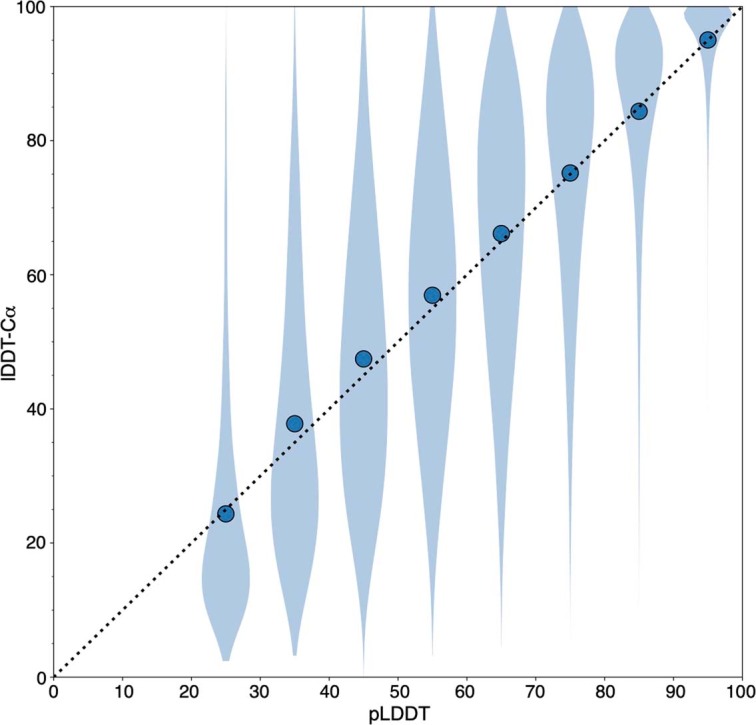
“(D) correlation between prediction confidence (pLDDT) and agreement with an experimentally validated structure (lDDT-Cα) for a subsample of proteins from the human proteome [83].”
BackgroundWhole genome sequencing in clinical practice
Bagger, F. O., Borgwardt, L., Jespersen, A. S., Hansen, A. R., Bertelsen, B., Kodama, M., & Nielsen, F. C. (2024) · BMC Medical Genomics · doi:10.1186/s12920-024-01795-w · Cited by 178
“With the rapid accumulation of AI-driven protein structures in the AlphaFold Protein Structure Database [82], many hoped that structural predictions could be used for assessment of Variants of Uncertain Significance (VUS).”
BackgroundHuman infection of avian influenza A H3N8 virus and the viral origins: a descriptive study
Yang, R., Sun, H., Gao, F., Luo, K., Huang, Z., Tong, Q., Song, H., Han, Q., Liu, J., Lan, Y., et al. (2022) · The Lancet Microbe · doi:10.1016/s2666-5247(22)00192-6 · Cited by 175
AlphaFold2: A Role for Disordered Protein/Region Prediction?
Wilson, C. J., Choy, W.-Y., & Karttunen, M. (2022) · International Journal of Molecular Sciences · doi:10.3390/ijms23094591 · Cited by 173
“[28], giving us a pLDDT-based predictor of disorder, where 1 is disordered and 0 is ordered.”
BackgroundMethodAlphaFold2: A role for disordered protein prediction?
(2021) · doi:10.1101/2021.09.27.461910 · Cited by 173
From Thalidomide to Rational Molecular Glue Design for Targeted Protein Degradation
Oleinikovas, V., Gainza, P., Ryckmans, T., Fasching, B., & Thomä, N. H. (2024) · Annual Review of Pharmacology and Toxicology · doi:10.1146/annurev-pharmtox-022123-104147 · Cited by 178
A bacterial phospholipid phosphatase inhibits host pyroptosis by hijacking ubiquitin
Chai, Q., Yu, S., Zhong, Y., Lu, Z., Qiu, C., Yu, Y., Zhang, X., Zhang, Y., Lei, Z., Qiang, L., et al. (2022) · Science · doi:10.1126/science.abq0132 · Cited by 169
DisProt in 2022: improved quality and accessibility of protein intrinsic disorder annotation
Quaglia, F., Mészáros, B., Salladini, E., Hatos, A., Pancsa, R., Chemes, L. B., Pajkos, M., Lazar, T., Peña-Díaz, S., Santos, J., et al. (2022) · Nucleic Acids Research · doi:10.1093/nar/gkab1082 · Cited by 163
“Whereas it remains to be confirmed if certain AlphaFold 2 metrics can be harnessed for disorder prediction (20), it is without doubt that these achievements will help us navigate further through the ‘dark proteome’ (22).”
BackgroundThe impact of AlphaFold2 one year on
Jones, D. T., & Thornton, J. M. (2022) · Nature Methods · doi:10.1038/s41592-021-01365-3 · Cited by 159
Improving peptide-protein docking with AlphaFold-Multimer using forced sampling
Johansson-Åkhe, I., & Wallner, B. (2022) · Frontiers in Bioinformatics · doi:10.3389/fbinf.2022.959160 · Cited by 162
“AlphaFold seems able to model the receptor protein regardless of the presence of any other binding chains or cofactors (Jumper et al., 2021; Tunyasuvunakool et al., 2021).”
BackgroundImproving Peptide-Protein Docking with AlphaFold-Multimer using Forced Sampling
Johansson-Åkhe, I., & Wallner, B. (2021) · doi:10.1101/2021.11.16.468810 · Cited by 162
Intrinsic Protein Disorder, Conditional Folding and AlphaFold2
(2022) · doi:10.1101/2022.03.03.482768 · Cited by 161
Metadata
- Authors
- Tunyasuvunakool, K., Adler, J., Wu, Z., Green, T., Zielinski, M., Žídek, A., Bridgland, A., Cowie, A., Meyer, C., Laydon, A., Velankar, S., Kleywegt, G. J., Bateman, A., Evans, R., Pritzel, A., Figurnov, M., Ronneberger, O., Bates, R., Kohl, S. A. A., Potapenko, A., Ballard, A. J., Romera-Paredes, B., Nikolov, S., Jain, R., Clancy, E., Reiman, D., Petersen, S., Senior, A. W., Kavukcuoglu, K., Birney, E., Kohli, P., Jumper, J., & Hassabis, D.
- Affiliations
- Google DeepMind (United Kingdom) (GB)
- European Bioinformatics Institute (GB)
- Corresponding author
- Tunyasuvunakool, Kathryn
- Jumper, John
- Hassabis, Demis
- ORCID
- Tunyasuvunakool, Kathryn
- Adler, Jonas
- Wu, Zachary
- Green, Tim
- Žídek, Augustin
- Meyer, Clemens
- Laydon, Agata
- Velankar, Sameer
- Kleywegt, Gerard J.
- Bateman, Alex
- Evans, Richard
- Pritzel, Alexander
- Figurnov, Michael
- Ronneberger, Olaf
- Bates, Russ
- Kohl, Simon A. A.
- Potapenko, Anna
- Ballard, Andrew J.
- Nikolov, Stanislav
- Jain, Rishub
- Clancy, Ellen
- Reiman, David
- Petersen, Stig
- Senior, Andrew W.
- Birney, Ewan
- Kohli, Pushmeet
- Jumper, John
- Hassabis, Demis
- Venue
- Nature
- Published
- 2021-07-22
- Volume
- 596
- Issue
- 7873
- Pages
- 590-596
- ISSN
- 0028-0836 (ISSN-L)
- 1476-4687
- PMC
- PMC8387240
- OpenAlex
- W3183475563
- Semantic Scholar
- 1fb3ad9969245795f268636eff9a145337144718
- Cited by
- 3,025
- References
- 83
- Citations by year
- 2026: 346 · 2025: 517 · 2024: 580 · 2023: 701 · 2022: 692 · 2021: 181
- FWCI
- 169.53
- Type
- journal article
- Language
- en
- Open access
- hybrid
- doi.org
- Licence
- cc-by
- creativecommons.org/licenses/by/4.0 (tdm)
- creativecommons.org/licenses/by/4.0 (vor)
- Locations
- Nature (publishedVersion, cc-by)
- Europe PMC (PubMed Central) (publishedVersion, other-oa)
- PubMed Central (publishedVersion, cc-by)
- PubMed (publishedVersion)
- RePEc: Research Papers in Economics (submittedVersion)
- Funders
- European Bioinformatics Institute
- DeepMind
- Topics
- Life Sciences › Biochemistry, Genetics and Molecular Biology › Molecular Biology › Protein Structure and Dynamics
- Life Sciences › Biochemistry, Genetics and Molecular Biology › Molecular Biology › Machine Learning in Bioinformatics
- Life Sciences › Biochemistry, Genetics and Molecular Biology › Structural Biology › Enzyme Structure and Function
- Keywords
- protein structure prediction, human proteome, AlphaFold2, structural coverage, intrinsically disordered regions, multidomain proteins, protein structure database
- MeSH terms
- Deep Learning, Glucose-6-Phosphatase, Humans, Membrane Proteins, Models, Molecular, Protein Conformation, Reproducibility of Results, Protein Folding, Computational Biology, Proteome, Diacylglycerol O-Acyltransferase, Datasets as Topic
About these checks
Registry, retraction, Cites and statistics results are computed, not judged, with one exception: a printed reference that no index lists is read once by a model before it counts as a citation error. Claims are extracted by a model and kept only when their quote appears verbatim in the text; each cited source is then checked, with a model’s help, for whether it says what the claim relies on. Those verdicts can be wrong — read the claim’s quote and the cited source before relying on one.
The claim verdicts this report counts are experimental: their accuracy is not yet measured.
A language model drew the claims from the paper on 2026-10-10, under version 3 of the claim definition (model deepseek-v4.1-flash, prompt extract-v3).
A second model labelled each claim on 2026-10-10 (model jev-1.13-20260917, definition revision gold-guideline-v0.2).
Cited sources are checked with a language model’s help (gpt-6-sol).
Statistics and arithmetic are recomputed, not judged.
Confidence bands are shown only for fields calibrated on our annotated test set. None is calibrated yet, so no band is shown.
What counts as a claim ›How we measure confidence ›How we check this ›
Are you an author, or do you see a problem with this page? Request a review
Data sources
Bibliographic data: Semantic Scholar, OpenAlex, Crossref.
Contains information from the Semantic Scholar Academic Graph Datasets, made available under the ODC Attribution License (ODC-BY 1.0).
Semantic Scholar’s data is described in: Kinney, R., et al. (2023). The Semantic Scholar Open Data Platform. arXiv:2301.10140.
