

A quantum processor based on coherent transport of entangled atom arrays
Open accessThe DOI matches its Crossref record; 82 of the 84 references it cites were found in a registry or an index.
Abstract
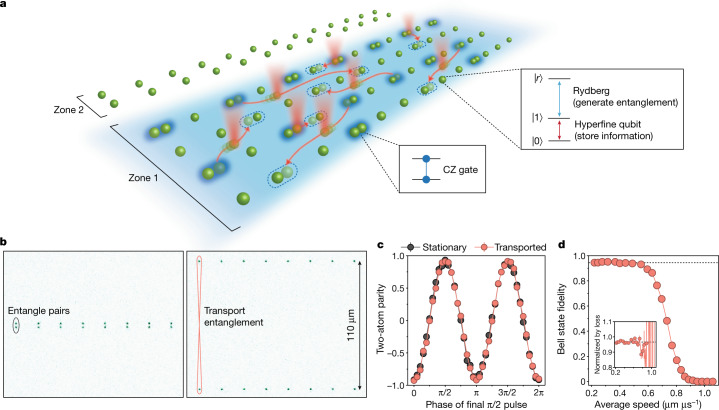
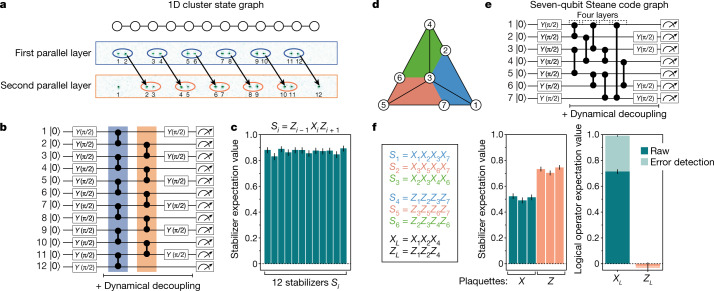
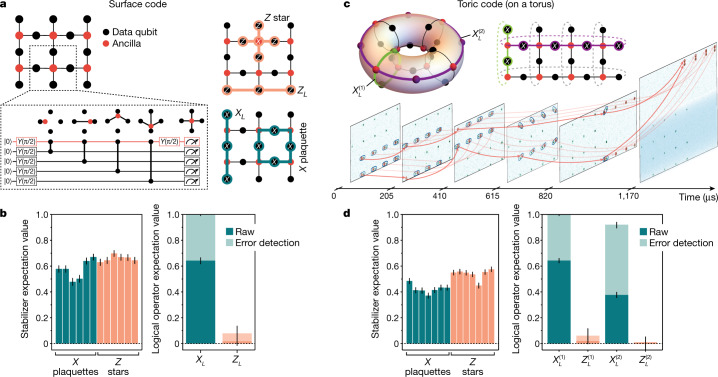
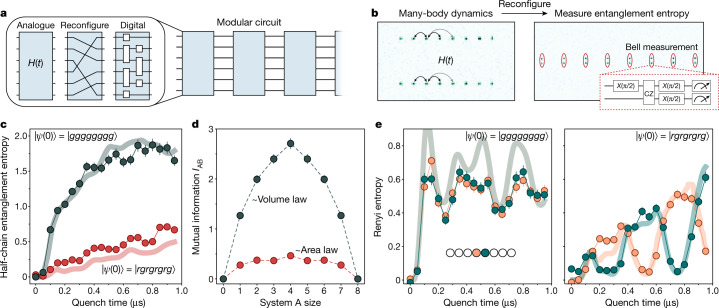
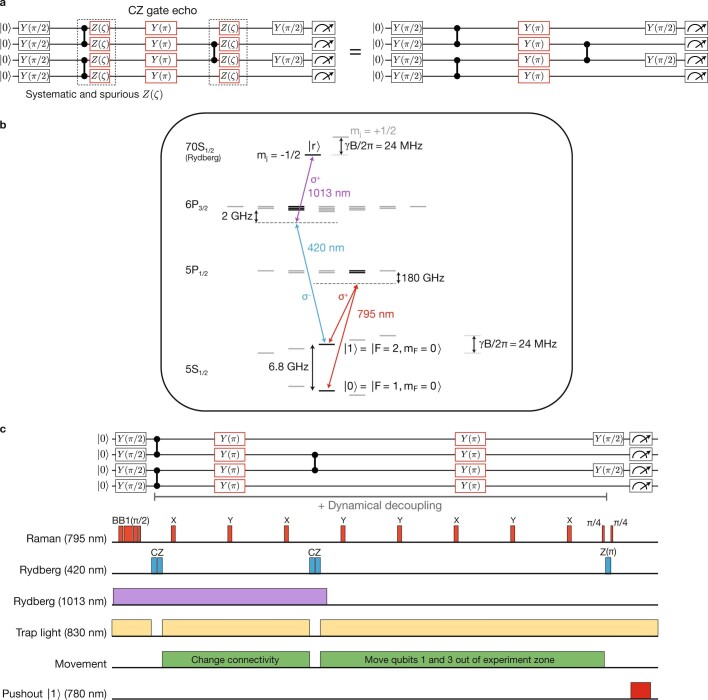
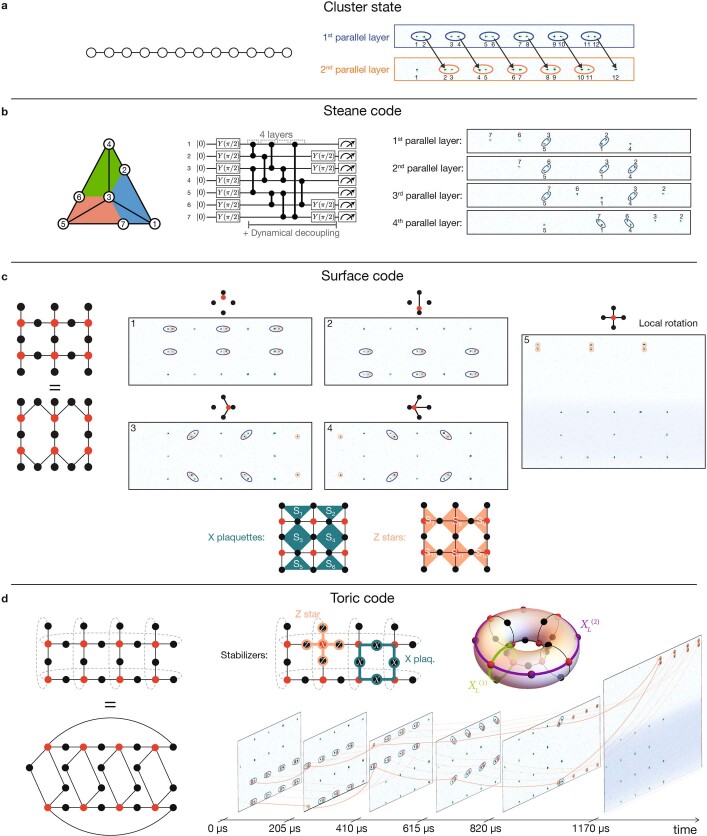
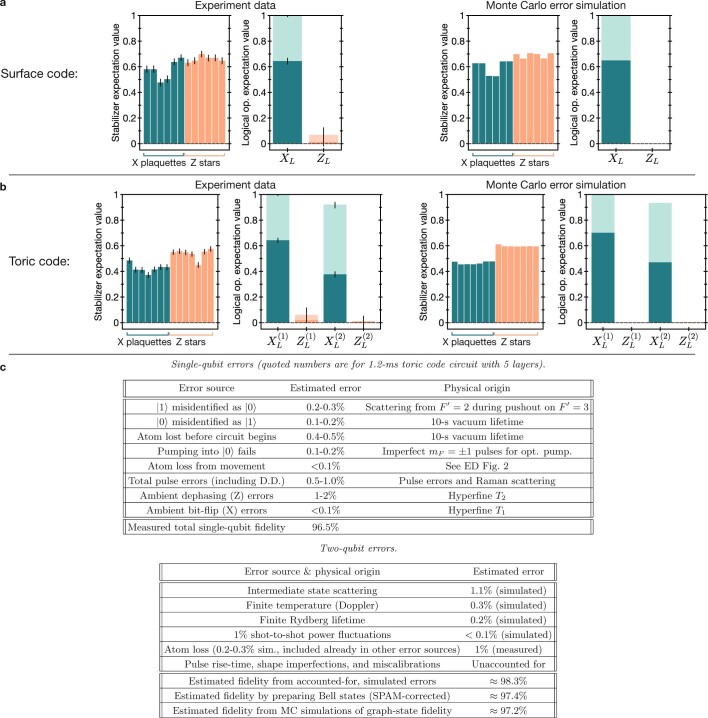
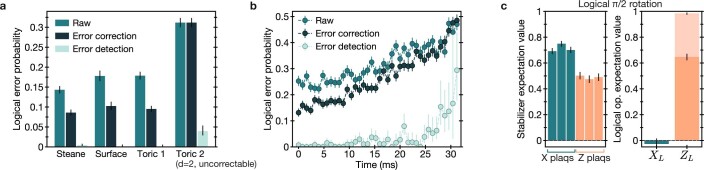
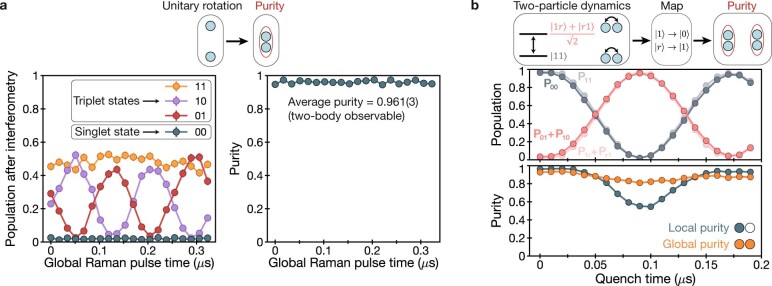
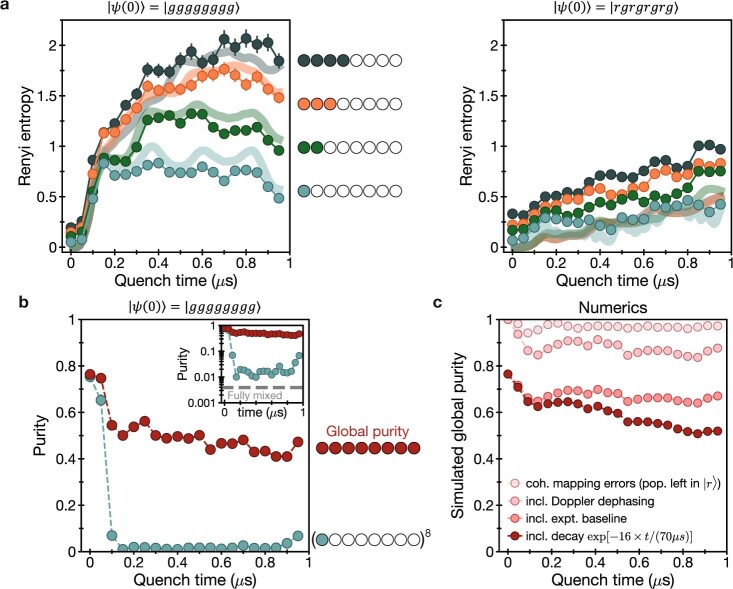
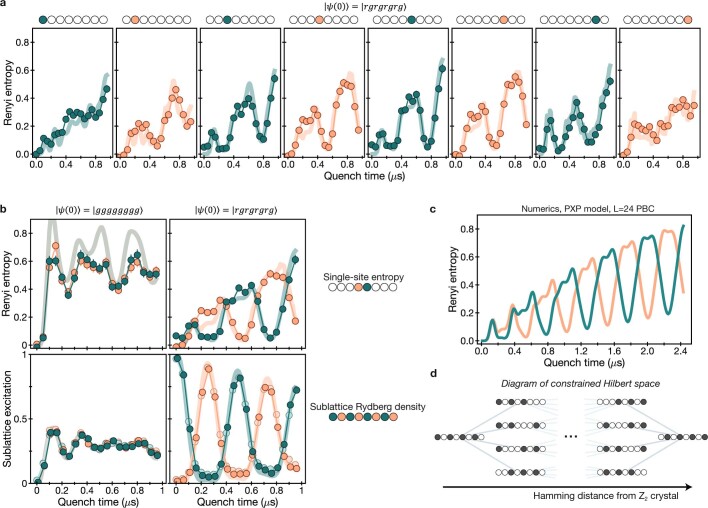
The ability to engineer parallel, programmable operations between desired qubits within a quantum processor is key for building scalable quantum information systems 1,2 . In most state-of-the-art approaches, qubits interact locally, constrained by the connectivity associated with their fixed spatial layout. Here we demonstrate a quantum processor with dynamic, non-local connectivity, in which entangled qubits are coherently transported in a highly parallel manner across two spatial dimensions, between layers of single- and two-qubit operations. Our approach makes use of neutral atom arrays trapped and transported by optical tweezers; hyperfine states are used for robust quantum information storage, and excitation into Rydberg states is used for entanglement generation 3–5 . We use this architecture to realize programmable generation of entangled graph states, such as cluster states and a seven-qubit Steane code state 6,7 . Furthermore, we shuttle entangled ancilla arrays to realize a surface code state with thirteen data and six ancillary qubits 8 and a toric code state on a torus with sixteen data and eight ancillary qubits 9 . Finally, we use this architecture to realize a hybrid analogue–digital evolution 2 and use it for measuring entanglement entropy in quantum simulations 10–12 , experimentally observing non-monotonic entanglement dynamics associated with quantum many-body scars 13,14 . Realizing a long-standing goal, these results provide a route towards scalable quantum processing and enable applications ranging from simulation to metrology.
Overview
The claims and statistics of this paper haven’t been checked yet.
Free: it reads the open-access text and checks the first 5 claims that cite a source we can check. Create a free account to check every claim.
Integrity signals
Registry
Cites
Statistics
Figures
Verification
Claims the paper makes
The claims and statistics of this paper haven’t been checked yet.
Free: it reads the open-access text and checks the first 5 claims that cite a source we can check. Create a free account to check every claim.
Claims other papers make about this one
Each is checked against this paper’s own text: does it say what the citing paper says it does?
The cited source doesn’t support the claim as written.
In the citing paper
“∼2 μs (π -pulse) [21]”
From Neutral atom quantum computing hardware: performance and end-user perspective (2023) · cites this paper as [21]
Checked by a reasoning model — may be wrong.
Experimental — accuracy not yet measuredThe source backs part of the claim, not all of it — or backs it for a different population, condition or comparison.
In the citing paper
“Using logical-level control and a zoned architecture in reconfigurable neutral-atom arrays7, our system combines high two-qubit gate fidelities8, arbitrary connectivity7,9, as well as fully programmable single-qubit rotations and mid-circuit readout10–15.”
From Logical quantum processor based on reconfigurable atom arrays (2024) · cites this paper as [7]
Experimental — accuracy not yet measuredThe source backs part of the claim, not all of it — or backs it for a different population, condition or comparison.
In the citing paper
“Mid-circuit readout is enabled by moving selected qubits about 100 μm away to a readout zone and illuminating with a focused imaging beam7,35, resulting in high-fidelity imaging, as well as negligible decoherence on stored qubits (Fig. 1c and Extended Data Fig. 3).”
From Logical quantum processor based on reconfigurable atom arrays (2024) · cites this paper as [7]
Experimental — accuracy not yet measuredThe source backs part of the claim, not all of it — or backs it for a different population, condition or comparison.
In the citing paper
“∼100 [20-23] (∼1000 for 2024 [44, 45])”
From Neutral atom quantum computing hardware: performance and end-user perspective (2023) · cites this paper as [21]
Experimental — accuracy not yet measured
18 more claims about this paper
Create a free account to see every claim other papers make about this one.
Self-check
Percentages, sums and reported differences re-computed from the paper’s own numbers.
The self-check needs the paper’s full text.
Citations
Cites
Quantum Computing in the NISQ era and beyond
Preskill, J. (2018) · Quantum · doi:10.22331/q-2018-08-06-79 · Cited by 8,830 · cited 2×
“The ability to engineer parallel, programmable operations between desired qubits within a quantum processor is central for building scalable quantum information systems [1, 2].”
Fault-tolerant quantum computation by anyons
Kitaev, A. Y. (2003) · Annals of Physics · doi:10.1016/s0003-4916(02)00018-0 · Cited by 7,238 · cited 5×
“Moreover, due to the topological properties of this graph, two independent logical qubits can be encoded with logical operators X (1) L , Z (1) L and X (2) L , Z (2) L that wrap around the entire torus along two topologically distinct directions [Kitaev 2003].”
InfluentialRaussendorf, R., & Briegel, H. J. (2001) · Physical Review Letters · doi:10.1103/physrevlett.86.5188 · Cited by 4,477 · cited 2×
“tion by mediating entanglement between physical qubits that never directly interact, followed by projective measurement of the ancilla array (performed simultaneously with the measurement of the data qubits), a form of measurement-based quantum computation [31, 36].”
Surface codes: Towards practical large-scale quantum computation
Fowler, A. G., Mariantoni, M., Martinis, J. M., & Cleland, A. N. (2012) · Physical Review A · doi:10.1103/physreva.86.032324 · Cited by 3,059 · cited 5×
“7%, beyond the surface code threshold [37, 66].”
InfluentialProbing many-body dynamics on a 51-atom quantum simulator
Bernien, H., Schwartz, S., Keesling, A., Levine, H., Omran, A., Pichler, H., Choi, S., Zibrov, A. S., Endres, M., Greiner, M., et al. (2017) · Nature · doi:10.1038/nature24622 · Cited by 2,460
Self-citationFast Quantum Gates for Neutral Atoms
Jaksch, D., Cirac, J. I., Zoller, P., Rolston, S. L., Côté, R., & Lukin, M. D. (2000) · Physical Review Letters · doi:10.1103/physrevlett.85.2208 · Cited by 1,540
Self-citationCoupling superconducting qubits via a cavity bus
Majer, J., Chow, J. M., Gambetta, J. M., Koch, J., Johnson, B. R., Schreier, J. A., Frunzio, L., Schuster, D. I., Houck, A. A., Wallraff, A., et al. (2007) · Nature · doi:10.1038/nature06184 · Cited by 1,368
Multiple-particle interference and quantum error correction
(1996) · Proceedings of the Royal Society of London. Series A: Mathematical, Physical and Engineering Sciences · doi:10.1098/rspa.1996.0136 · Cited by 1,284 · cited 1×
“Error correction for the Steane code is implemented with the Steane code decoder [34, 72] and is implemented with the minimum-weight-perfect-matching algorithm for the surface and toric codes [37].”
NMR techniques for quantum control and computation
Vandersypen, L. M. K., & Chuang, I. L. (2005) · Reviews of Modern Physics · doi:10.1103/revmodphys.76.1037 · Cited by 1,217
Measuring entanglement entropy in a quantum many-body system
Islam, R., Ma, R., Preiss, P. M., Eric Tai, M., Lukin, A., Rispoli, M., & Greiner, M. (2015) · Nature · doi:10.1038/nature15750 · Cited by 1,158 · cited 5×
“ferent states due to entanglement with the rest of the many-body system (and entanglement with the environment) [10, 11].”
InfluentialSelf-citation
Research works printed but not linked: 1
- Hein, M. et al. Entanglement in graph states and its applications. In Proc. International School of Physics “Enrico Fermi” (eds Casati, G. et al.) Vol. 162, 115–218 (IOS Press, 2006).
Cited by
Logical quantum processor based on reconfigurable atom arrays
Bluvstein, D., Evered, S. J., Geim, A. A., Li, S. H., Zhou, H., Manovitz, T., Ebadi, S., Cain, M., Kalinowski, M., Hangleiter, D., et al. (2024) · Nature · doi:10.1038/s41586-023-06927-3 · Cited by 1,119
“This process realizes a high-fidelity, fault-tolerant transversal CNOT in a single parallel step.”
BackgroundMethodInfluentialSelf-citationHigh-fidelity parallel entangling gates on a neutral atom quantum computer
Evered, S. J., Bluvstein, D., Kalinowski, M., Ebadi, S., Manovitz, T., Zhou, H., Li, S. H., Geim, A. A., Wang, T. T., Maskara, N., et al. (2023) · arXiv · doi:10.48550/arxiv.2304.05420 · Cited by 526
Self-citationHigh-fidelity parallel entangling gates on a neutral-atom quantum computer
Evered, S. J., Bluvstein, D., Kalinowski, M., Ebadi, S., Manovitz, T., Zhou, H., Li, S. H., Geim, A. A., Wang, T. T., Maskara, N., et al. (2023) · Nature · doi:10.1038/s41586-023-06481-y · Cited by 522
Self-citationMulti-qubit entanglement and algorithms on a neutral-atom quantum computer
Graham, T. M., Song, Y., Scott, J., Poole, C., Phuttitarn, L., Jooya, K., Eichler, P., Jiang, X., Marra, A., Grinkemeyer, B., et al. (2022) · Nature · doi:10.1038/s41586-022-04603-6 · Cited by 518
Quantum optimization of maximum independent set using Rydberg atom arrays
Ebadi, S., Keesling, A., Cain, M., Wang, T. T., Levine, H., Bluvstein, D., Semeghini, G., Omran, A., Liu, J.-G., Samajdar, R., et al. (2022) · Science · doi:10.1126/science.abo6587 · Cited by 430
Self-citationHigh-fidelity gates and mid-circuit erasure conversion in an atomic qubit
Ma, S., Liu, G., Peng, P., Zhang, B., Jandura, S., Claes, J., Burgers, A. P., Pupillo, G., Puri, S., & Thompson, J. D. (2023) · Nature · doi:10.1038/s41586-023-06438-1 · Cited by 228
“Neutral atoms in optical tweezer arrays are a rapidly developing field for quantum science 11 , including programmable quantum processors 1,2 and many-body simulators 12 .”
BackgroundQuantum many-body simulations on digital quantum computers: State-of-the-art and future challenges
Fauseweh, B. (2024) · Nature Communications · doi:10.1038/s41467-024-46402-9 · Cited by 152
“…processors with dynamic, non-local connectivity, enabling coherent transportation of entangled qubits across two dimensions and the ability to individually address single atoms, capable of executing quantum algorithms like quantum phase estimation (QPE) and producing entangled graph states 23,24 .”
Realizing spin squeezing with Rydberg interactions in an optical clock
Eckner, W. J., Oppong, N. D., Cao, A., Young, A. W., Milner, W. R., Robinson, J. M., Ye, J., & Kaufman, A. M. (2023) · Nature · doi:10.1038/s41586-023-06360-6 · Cited by 230
“Recently, a cavity-quantum-electrodynamics-based strontium lattice clock showed enhanced angular resolution below the SQL, along with a differential clock measurement between two transportable spin-squeezed ensembles with precision below the quantum-projection-noise limit at the 10 −17 level 30 .”
BackgroundMethodMid-circuit correction of correlated phase errors using an array of spectator qubits
Singh, K., Bradley, C. E., Anand, S., Ramesh, V., White, R., & Bernien, H. (2023) · Science · doi:10.1126/science.ade5337 · Cited by 119
Neutral atom quantum computing hardware: performance and end-user perspective
Wintersperger, K., Dommert, F., Ehmer, T., Hoursanov, A., Klepsch, J., Mauerer, W., Reuber, G., Strohm, T., Yin, M., & Luber, S. (2023) · EPJ Quantum Technology · doi:10.1140/epjqt/s40507-023-00190-1 · Cited by 117
“Prevalent examples include Rubidium ( 87 Rb) [20, 21], Caesium ( 133 Cs) [22] and Strontium ( 87 Sr) [23, 24].”
BackgroundMethodInfluentialMidcircuit Operations Using the omg Architecture in Neutral Atom Arrays
Lis, J. W., Senoo, A., McGrew, W. F., Rönchen, F., Jenkins, A., & Kaufman, A. M. (2023) · Physical Review X · doi:10.1103/physrevx.13.041035 · Cited by 113
“Neutral atom arrays possess many favorable features for quantum-information processing: single-site addressibility and readout, real-time adjustment qubit connectivity, and tunable-range Rydberg interactions [80 – 83].”
BackgroundMethodMulti-qubit gates and Schrödinger cat states in an optical clock
Cao, A., Eckner, W. J., Yelin, T. L., Young, A. W., Jandura, S., Yan, L., Kim, K., Pupillo, G., Ye, J., Oppong, N. D., et al. (2024) · Nature · doi:10.1038/s41586-024-07913-z · Cited by 185
“The former have emerged as one of the leading architectures for quantum information processing 24–26 , with advances in Rydberg-gate design 27,28 now enabling controlled-phase (CZ) gate fidelities as high as 0.995 (refs.”
InfluentialMid-Circuit Cavity Measurement in a Neutral Atom Array
Deist, E., Lu, Y.-H., Ho, J., Pasha, M. K., Zeiher, J., Yan, Z., & Stamper-Kurn, D. M. (2022) · Physical Review Letters · doi:10.1103/physrevlett.129.203602 · Cited by 94
Midcircuit Measurements on a Single-Species Neutral Alkali Atom Quantum Processor
Graham, T. M., Phuttitarn, L., Chinnarasu, R., Song, Y., Poole, C., Jooya, K., Scott, J., Scott, A., Eichler, P., & Saffman, M. (2023) · Physical Review X · doi:10.1103/physrevx.13.041051 · Cited by 81
Mid-circuit measurements on a single species neutral alkali atom quantum processor
Graham, T. M., Phuttitarn, L., Chinnarasu, R., Song, Y., Poole, C., Jooya, K., Scott, J., Scott, A., Eichler, P., & Saffman, M. (2023) · arXiv · doi:10.48550/arxiv.2303.10051 · Cited by 81
Midcircuit Qubit Measurement and Rearrangement in a Yb 171 Atomic Array
Norcia, M. A., Cairncross, W. B., Barnes, K., Battaglino, P., Brown, A., Brown, M. O., Cassella, K., Chen, C.-A., Coxe, R., Crow, D., et al. (2023) · Physical Review X · doi:10.1103/physrevx.13.041034 · Cited by 78
Universal quantum operations and ancilla-based read-out for tweezer clocks
Finkelstein, R., Tsai, R. B.-S., Sun, X., Scholl, P., Direkci, S., Gefen, T., Choi, J., Shaw, A. L., & Endres, M. (2024) · Nature · doi:10.1038/s41586-024-08005-8 · Cited by 142
“We further show optical coherence is preserved during qubit transport in tweezers, previously realized with hyperfine qubits 19,43 , enabling dynamical circuit re-configuration.”
Thermalization and criticality on an analogue–digital quantum simulator
Andersen, T. I., Astrakhantsev, N., Karamlou, A. H., Berndtsson, J., Motruk, J., Szasz, A., Gross, J. A., Schuckert, A., Westerhout, T., Zhang, Y., et al. (2025) · Nature · doi:10.1038/s41586-024-08460-3 · Cited by 180
“In this work, we present a hybrid analogue–digital 37,38 quantum simulator comprising 69 superconducting transmon qubits connected by tunable couplers in a two-dimensional (2D) lattice (Fig.”
Quantum coarsening and collective dynamics on a programmable simulator
Manovitz, T., Li, S. H., Ebadi, S., Samajdar, R., Geim, A. A., Evered, S. J., Bluvstein, D., Zhou, H., Köylüoğlu, N. U., Feldmeier, J., et al. (2025) · Nature · doi:10.1038/s41586-024-08353-5 · Cited by 156
“In contrast to traditional condensed-matter systems, programmable quantum simulators can directly access correlation functions of any order 40 as well as other important observables, such as the entanglement entropy 51,52 , using, for example, hybrid digital–analogue approaches 36,53 .”
Self-citationAn optical tweezer array of ultracold polyatomic molecules
Vilas, N. B., Robichaud, P., Hallas, C., Li, G. K., Anderegg, L., & Doyle, J. M. (2024) · Nature · doi:10.1038/s41586-024-07199-1 · Cited by 42
Bell Sampling from Quantum Circuits
Hangleiter, D., & Gullans, M. J. (2024) · Physical Review Letters · doi:10.1103/physrevlett.133.020601 · Cited by 28
“These include in particular ion traps [55] and Rydberg atoms in optical tweezers [56].”
BackgroundMachine learning on quantum experimental data toward solving quantum many-body problems
Kim, D., & Cho, G. (2023) · doi:10.21203/rs.3.rs-3674601/v1 · Cited by 21
Hierarchical memories: Simulating quantum LDPC codes with local gates
Pattison, C. A., Krishna, A., & Preskill, J. (2023) · arXiv · doi:10.48550/arxiv.2303.04798 · Cited by 20
A 98-qubit trapped-ion quantum computer with all-to-all connectivity
Ransford, A., Allman, M. S., Arkinstall, J., Campora, J. P., Cooper, S. F., Delaney, R. D., Dreiling, J. M., Estey, B., Figgatt, C., Hall, A., et al. (2026) · Nature · doi:10.1038/s41586-026-10676-4 · Cited by 16
“However, mobile qubit architectures, such as QCCD and optical tweezers 24,25 , can distribute resources more efficiently than stationary qubit architectures 26–28 , because qubits flow through the QPU like bits in a classical processor, with separated memory structures, data buses and logic units,…”
Helios: A 98-qubit trapped-ion quantum computer
Ransford, A., & Bohnet, J. (2025) · doi:10.21203/rs.3.rs-8130124/v1 · Cited by 16
Efficient fault-tolerant code switching via one-way transversal CNOT gates
Heußen, S., & Hilder, J. (2025) · Quantum · doi:10.22331/q-2025-09-03-1846 · Cited by 12
Circuit Decompositions and Scheduling for Neutral Atom Devices with Limited Local Addressability
Nottingham, N., Perlin, M. A., Shah, D., White, R., Bernien, H., Chong, F. T., & Baker, J. M. (2024) · IEEE International Conference on Quantum Computing and Engineering (QCE) · doi:10.1109/qce60285.2024.00105 · Cited by 37
“Error rates are chosen to reflect values from recent experimental work [14], [23], [25].”
InfluentialPosition Papers for the ASCR Workshop on Basic Research Needs in Quantum Computing and Networking
Lougovski, P., Parekh, O., Broz, J., Byrd, M., Chembo, Y. K., de Jong, W. A., Figueroa, E. V., Humble, T. S., Larson, J. M., Quiroz, G., et al. (2023) · OSTI OAI (U.S. Department of Energy Office of Scientific and Technical Information) · doi:10.2172/2283320 · Cited by 11
A Century Ago the Stern–Gerlach Experiment Ruled Unequivocally in Favor of Quantum Mechanics
Friedrich, B. (2023) · Israel Journal of Chemistry · doi:10.1002/ijch.202300047 · Cited by 8
Onset of Scrambling as a Dynamical Transition in Tunable-Range Quantum Circuits
Kuriyattil, S., Hashizume, T., Bentsen, G., & Daley, A. J. (2023) · PRX Quantum · doi:10.1103/prxquantum.4.030325 · Cited by 5
“Nonlocal couplings in the system are generated by a quasi-1D shuffling process employing optical tweezers that rearrange atomic positions [45, 47, 82–84].”
MethodLearning quantum symmetries with interactive quantum-classical variational algorithms
Lu, J. Z., Bravo, R. A., Hou, K., Dagnew, G. A., Yelin, S. F., & Najafi, K. (2024) · Journal of Physics A Mathematical and Theoretical · doi:10.1088/1751-8121/ad5ee0 · Cited by 6
“While recent advancement in Rydberg atom quantum computers have made long-range SWAPs a reality [38], in more general quantum hardware the SWAP gate must be decomposed into controlled-NOT gates as In practice, we find that only two bases, which need not be random, are required to capture the…”
Trapping and cooling of strontium atoms in 532 nm optical tweezers
Rönchen, F., Kree, T., Langerfeld, T. F., & Köhl, M. (2026) · SciPost Physics Core · doi:10.21468/scipostphyscore.9.3.047
Metadata
- Authors
- Bluvstein, D., Levine, H., Semeghini, G., Wang, T. T., Ebadi, S., Kalinowski, M., Keesling, A., Maskara, N., Pichler, H., Greiner, M., Vuletić, V., & Lukin, M. D.
- Affiliations
- Harvard University (US)
- Austrian Academy of Sciences (AT)
- Massachusetts Institute of Technology (US)
- Corresponding author
- Lukin, Mikhail D.
- ORCID
- Venue
- Nature
- Published
- 2022-04-20
- Volume
- 604
- Issue
- 7906
- Pages
- 451-456
- ISSN
- 0028-0836 (ISSN-L)
- 1476-4687
- PMC
- PMC9021024
- OpenAlex
- W4200629850
- Cited by
- 14
- References
- 80
- Citations by year
- 2026: 1 · 2025: 2 · 2024: 5 · 2023: 6
- FWCI
- 1.33
- Type
- journal article
- Language
- en
- Open access
- hybrid
- doi.org
- Licence
- cc-by
- creativecommons.org/licenses/by/4.0 (tdm)
- creativecommons.org/licenses/by/4.0 (vor)
- Locations
- Nature (publishedVersion, cc-by)
- PubMed Central (publishedVersion, cc-by)
- PubMed (publishedVersion)
- arXiv (Cornell University) (submittedVersion)
- RePEc: Research Papers in Economics (submittedVersion)
- DSpace@MIT (Massachusetts Institute of Technology) (submittedVersion, cc-by-nc)
- OSTI OAI (U.S. Department of Energy Office of Scientific and Technical Information) (submittedVersion)
- arXiv (Cornell University)
- Funders
- National Science Foundation (1745303, W911NF-20-1-0082)
- U.S. Department of Energy (DESC0021013, DESC0021110, 7568717)
- Hertz Foundation
- Defense Advanced Research Projects Agency (W911NF2010021)
- National Defense Science and Engineering Graduate
- Multidisciplinary University Research Initiative (W911NF2010082)
- Center for Ultracold Atoms, Massachusetts Institute of Technology
- Office of Naval Research
- Army Research Office (W911NF-21-1-, W911NF-20-1-0082, W911NF-21-1-0367, W911NF)
- Topics
- Physical Sciences › Physics and Astronomy › Atomic and Molecular Physics, and Optics › Cold Atom Physics and Bose-Einstein Condensates
- Physical Sciences › Physics and Astronomy › Atomic and Molecular Physics, and Optics › Quantum Information and Cryptography
- Physical Sciences › Computer Science › Artificial Intelligence › Quantum Computing Algorithms and Architecture
- Keywords
- quantum processors, coherent transport, optical tweezers, hyperfine qubits, cluster states, Steane code, surface code, toric code, entanglement entropy, quantum many-body scars, scalable quantum computing
About these checks
Registry, retraction, Cites and statistics results are computed, not judged, with one exception: a printed reference that no index lists is read once by a model before it counts as a citation error. Claims are extracted by a model and kept only when their quote appears verbatim in the text; each cited source is then checked, with a model’s help, for whether it says what the claim relies on. Those verdicts can be wrong — read the claim’s quote and the cited source before relying on one.
Statistics and arithmetic are recomputed, not judged.
Confidence bands are shown only for fields calibrated on our annotated test set. None is calibrated yet, so no band is shown.
What counts as a claim ›How we measure confidence ›How we check this ›
Are you an author, or do you see a problem with this page? Request a review
Data sources
Bibliographic data: Semantic Scholar, OpenAlex, Crossref.
Contains information from the Semantic Scholar Academic Graph Datasets, made available under the ODC Attribution License (ODC-BY 1.0).
Semantic Scholar’s data is described in: Kinney, R., et al. (2023). The Semantic Scholar Open Data Platform. arXiv:2301.10140.
