

A quantum processor based on coherent transport of entangled atom arrays
Open accessThe DOI matches its Crossref record; 82 of the 84 references it cites were found in a registry or an index.
Abstract
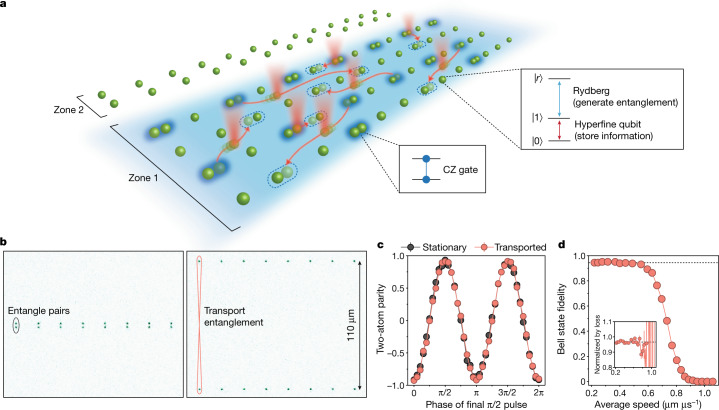
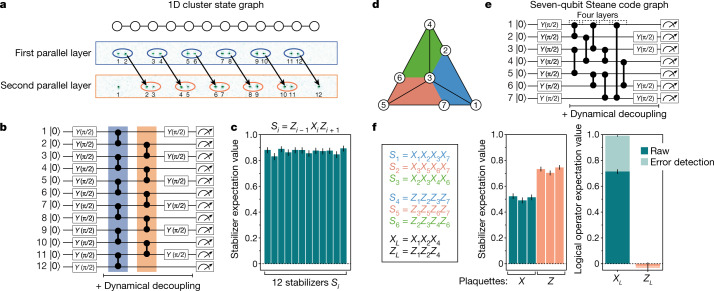
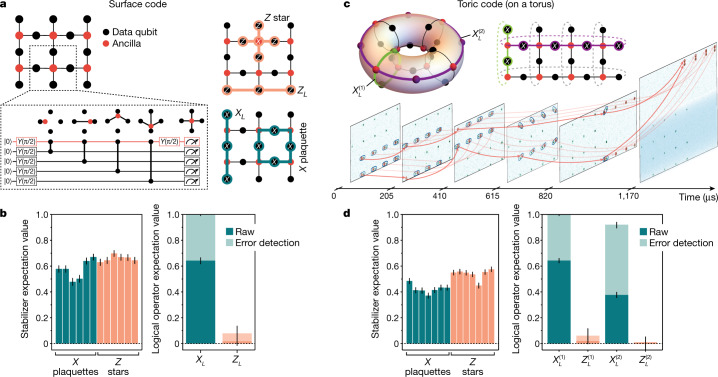
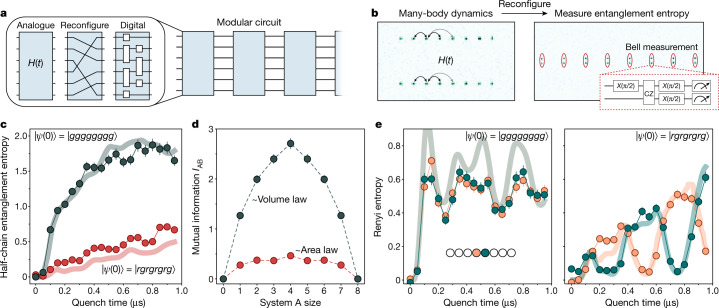
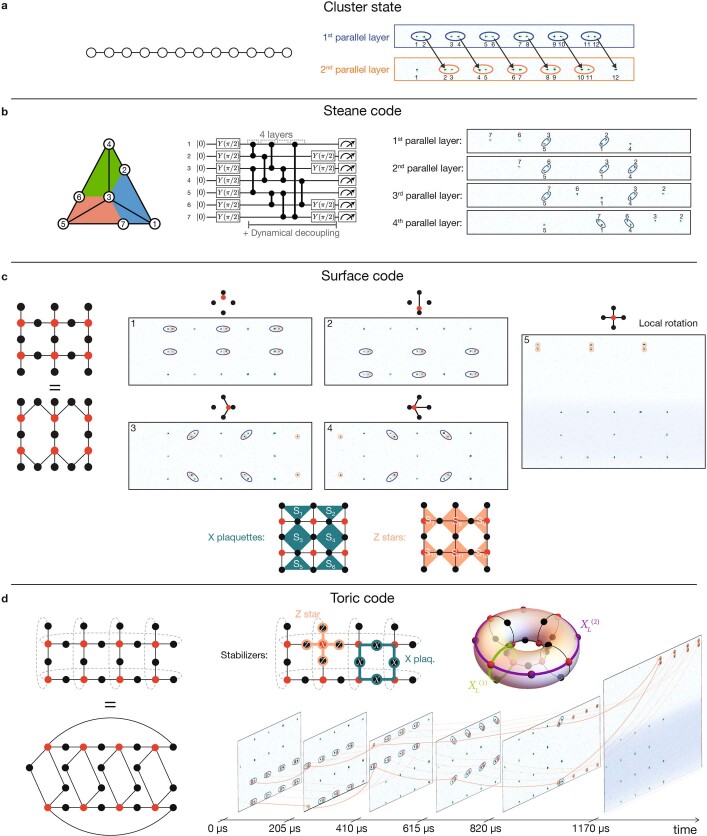
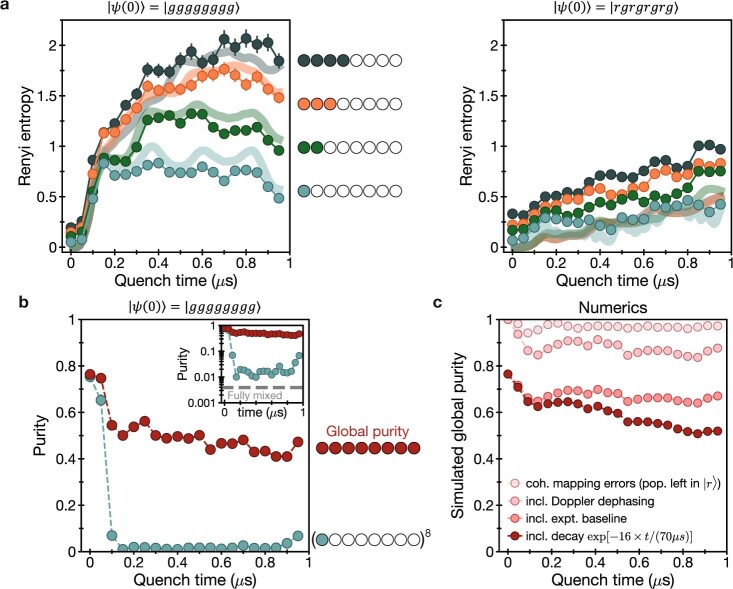
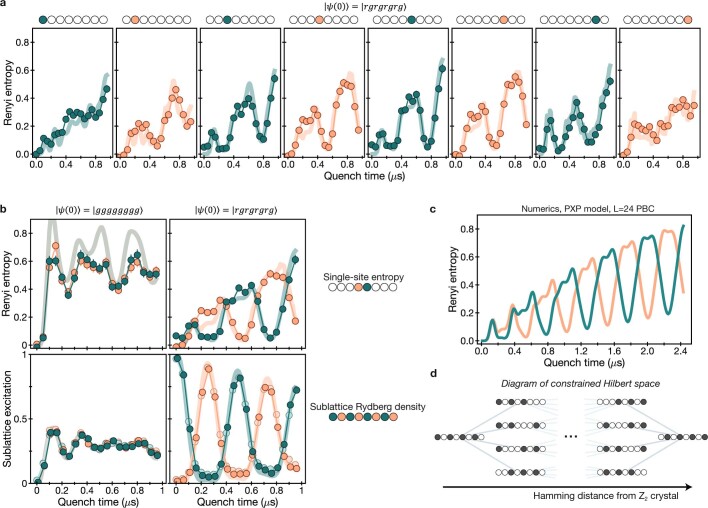
The ability to engineer parallel, programmable operations between desired qubits within a quantum processor is key for building scalable quantum information systems 1,2 . In most state-of-the-art approaches, qubits interact locally, constrained by the connectivity associated with their fixed spatial layout. Here we demonstrate a quantum processor with dynamic, non-local connectivity, in which entangled qubits are coherently transported in a highly parallel manner across two spatial dimensions, between layers of single- and two-qubit operations. Our approach makes use of neutral atom arrays trapped and transported by optical tweezers; hyperfine states are used for robust quantum information storage, and excitation into Rydberg states is used for entanglement generation 3–5 . We use this architecture to realize programmable generation of entangled graph states, such as cluster states and a seven-qubit Steane code state 6,7 . Furthermore, we shuttle entangled ancilla arrays to realize a surface code state with thirteen data and six ancillary qubits 8 and a toric code state on a torus with sixteen data and eight ancillary qubits 9 . Finally, we use this architecture to realize a hybrid analogue–digital evolution 2 and use it for measuring entanglement entropy in quantum simulations 10–12 , experimentally observing non-monotonic entanglement dynamics associated with quantum many-body scars 13,14 . Realizing a long-standing goal, these results provide a route towards scalable quantum processing and enable applications ranging from simulation to metrology.
Overview
The claims and statistics of this paper haven’t been checked yet.
Free: it reads the open-access text and checks the first 5 claims that cite a source we can check. Create a free account to check every claim.
Integrity signals
Registry
Cites
Statistics
Figures
Verification
Claims the paper makes
The claims and statistics of this paper haven’t been checked yet.
Free: it reads the open-access text and checks the first 5 claims that cite a source we can check. Create a free account to check every claim.
Claims other papers make about this one
Each is checked against this paper’s own text: does it say what the citing paper says it does?
The cited source doesn’t support the claim as written.
In the citing paper
“∼2 μs (π -pulse) [21]”
From Neutral atom quantum computing hardware: performance and end-user perspective (2023) · cites this paper as [21]
Checked by a reasoning model — may be wrong.
Experimental — accuracy not yet measuredThe source backs part of the claim, not all of it — or backs it for a different population, condition or comparison.
In the citing paper
“Using logical-level control and a zoned architecture in reconfigurable neutral-atom arrays7, our system combines high two-qubit gate fidelities8, arbitrary connectivity7,9, as well as fully programmable single-qubit rotations and mid-circuit readout10–15.”
From Logical quantum processor based on reconfigurable atom arrays (2024) · cites this paper as [7]
Experimental — accuracy not yet measuredThe source backs part of the claim, not all of it — or backs it for a different population, condition or comparison.
In the citing paper
“Mid-circuit readout is enabled by moving selected qubits about 100 μm away to a readout zone and illuminating with a focused imaging beam7,35, resulting in high-fidelity imaging, as well as negligible decoherence on stored qubits (Fig. 1c and Extended Data Fig. 3).”
From Logical quantum processor based on reconfigurable atom arrays (2024) · cites this paper as [7]
Experimental — accuracy not yet measuredThe source backs part of the claim, not all of it — or backs it for a different population, condition or comparison.
In the citing paper
“∼100 [20-23] (∼1000 for 2024 [44, 45])”
From Neutral atom quantum computing hardware: performance and end-user perspective (2023) · cites this paper as [21]
Experimental — accuracy not yet measured
18 more claims about this paper
Create a free account to see every claim other papers make about this one.
Self-check
Percentages, sums and reported differences re-computed from the paper’s own numbers.
The self-check needs the paper’s full text.
Citations
Cites
Quantum Computing in the NISQ era and beyond
Preskill, J. (2018) · Quantum · doi:10.22331/q-2018-08-06-79 · Cited by 8,830 · cited 2×
“The ability to engineer parallel, programmable operations between desired qubits within a quantum processor is central for building scalable quantum information systems [1, 2].”
Fault-tolerant quantum computation by anyons
Kitaev, A. Y. (2003) · Annals of Physics · doi:10.1016/s0003-4916(02)00018-0 · Cited by 7,238 · cited 5×
“Moreover, due to the topological properties of this graph, two independent logical qubits can be encoded with logical operators X (1) L , Z (1) L and X (2) L , Z (2) L that wrap around the entire torus along two topologically distinct directions [Kitaev 2003].”
InfluentialRaussendorf, R., & Briegel, H. J. (2001) · Physical Review Letters · doi:10.1103/physrevlett.86.5188 · Cited by 4,477 · cited 2×
“tion by mediating entanglement between physical qubits that never directly interact, followed by projective measurement of the ancilla array (performed simultaneously with the measurement of the data qubits), a form of measurement-based quantum computation [31, 36].”
Surface codes: Towards practical large-scale quantum computation
Fowler, A. G., Mariantoni, M., Martinis, J. M., & Cleland, A. N. (2012) · Physical Review A · doi:10.1103/physreva.86.032324 · Cited by 3,059 · cited 5×
“7%, beyond the surface code threshold [37, 66].”
InfluentialProbing many-body dynamics on a 51-atom quantum simulator
Bernien, H., Schwartz, S., Keesling, A., Levine, H., Omran, A., Pichler, H., Choi, S., Zibrov, A. S., Endres, M., Greiner, M., et al. (2017) · Nature · doi:10.1038/nature24622 · Cited by 2,460
Self-citationFast Quantum Gates for Neutral Atoms
Jaksch, D., Cirac, J. I., Zoller, P., Rolston, S. L., Côté, R., & Lukin, M. D. (2000) · Physical Review Letters · doi:10.1103/physrevlett.85.2208 · Cited by 1,540
Self-citationCoupling superconducting qubits via a cavity bus
Majer, J., Chow, J. M., Gambetta, J. M., Koch, J., Johnson, B. R., Schreier, J. A., Frunzio, L., Schuster, D. I., Houck, A. A., Wallraff, A., et al. (2007) · Nature · doi:10.1038/nature06184 · Cited by 1,368
Multiple-particle interference and quantum error correction
(1996) · Proceedings of the Royal Society of London. Series A: Mathematical, Physical and Engineering Sciences · doi:10.1098/rspa.1996.0136 · Cited by 1,284 · cited 1×
“Error correction for the Steane code is implemented with the Steane code decoder [34, 72] and is implemented with the minimum-weight-perfect-matching algorithm for the surface and toric codes [37].”
NMR techniques for quantum control and computation
Vandersypen, L. M. K., & Chuang, I. L. (2005) · Reviews of Modern Physics · doi:10.1103/revmodphys.76.1037 · Cited by 1,217
Measuring entanglement entropy in a quantum many-body system
Islam, R., Ma, R., Preiss, P. M., Eric Tai, M., Lukin, A., Rispoli, M., & Greiner, M. (2015) · Nature · doi:10.1038/nature15750 · Cited by 1,158 · cited 5×
“ferent states due to entanglement with the rest of the many-body system (and entanglement with the environment) [10, 11].”
InfluentialSelf-citationQuantum thermalization through entanglement in an isolated many-body system
Kaufman, A. M., Tai, M. E., Lukin, A., Rispoli, M., Schittko, R., Preiss, P. M., & Greiner, M. (2016) · Science · doi:10.1126/science.aaf6725 · Cited by 1,116 · cited 2×
“4c), a process corresponding to quantum thermalization [12].”
Self-citationMultiparticle Entanglement of Hot Trapped Ions
Mølmer, K., & Sørensen, A. (1999) · Physical Review Letters · doi:10.1103/physrevlett.82.1835 · Cited by 1,019
Quantum phases of matter on a 256-atom programmable quantum simulator
Ebadi, S., Wang, T. T., Levine, H., Keesling, A., Semeghini, G., Omran, A., Bluvstein, D., Samajdar, R., Pichler, H., Ho, W. W., et al. (2021) · Nature · doi:10.1038/s41586-021-03582-4 · Cited by 995 · cited 3×
“size through wavefront control using the phase profile on a spatial light modulator (SLM) [25].”
InfluentialSelf-citationQuantum Phases of Matter on a 256-Atom Programmable Quantum Simulator
Ebadi, S., Wang, T. T., Levine, H., Keesling, A., Semeghini, G., Omran, A., Bluvstein, D., Samajdar, R., Pichler, H., Ho, W. W., et al. (2020) · arXiv · doi:10.48550/arxiv.2012.12281 · Cited by 995 · cited 3×
“size through wavefront control using the phase profile on a spatial light modulator (SLM) [25].”
InfluentialSelf-citationWeak ergodicity breaking from quantum many-body scars
Turner, C. J., Michailidis, A. A., Abanin, D. A., Serbyn, M., & Papić, Z. (2018) · Nature Physics · doi:10.1038/s41567-018-0137-5 · Cited by 988 · cited 6×
“c, Numerical simulations of the single-site Renyi entropy on two adjacent sites in the idealized ‘PXP’ model of perfect nearest-neighbor blockade [14].”
InfluentialObservation of Rydberg blockade between two atoms
Urban, E., Johnson, T. A., Henage, T., Isenhower, L., Yavuz, D. D., Walker, T. G., & Saffman, M. (2009) · Nature Physics · doi:10.1038/nphys1178 · Cited by 974
Fault-Tolerant Quantum Computation with High Threshold in Two Dimensions
Raussendorf, R., & Harrington, J. (2007) · Physical Review Letters · doi:10.1103/physrevlett.98.190504 · Cited by 812 · cited 2×
“tion by mediating entanglement between physical qubits that never directly interact, followed by projective measurement of the ancilla array (performed simultaneously with the measurement of the data qubits), a form of measurement-based quantum computation [31, 36].”
Probing topological spin liquids on a programmable quantum simulator
Semeghini, G., Levine, H., Keesling, A., Ebadi, S., Wang, T. T., Bluvstein, D., Verresen, R., Pichler, H., Kalinowski, M., Samajdar, R., et al. (2021) · Science · doi:10.1126/science.abi8794 · Cited by 781
Self-citationTunable two-dimensional arrays of single Rydberg atoms for realizing quantum Ising models
Labuhn, H., Barredo, D., Ravets, S., de Léséleuc, S., Macrì, T., Lahaye, T., & Browaeys, A. (2016) · Nature · doi:10.1038/nature18274 · Cited by 778 · cited 2×
“erated by a spatial light modulator (SLM) [56].”
Quantum phases of matter on a 256-atom programmable quantum simulator
Ebadi, S., Wang, T. T., Levine, H., Keesling, A., Semeghini, G., Omran, A., Bluvstein, D., Samajdar, R., Pichler, H., Ho, W. W., et al. (2020) · RePEc: Research Papers in Economics · Cited by 765
Self-citationEntanglement of Two Individual Neutral Atoms Using Rydberg Blockade
Wilk, T., Gaëtan, A., Evellin, C., Wolters, J., Miroshnychenko, Y., Grangier, P., & Browaeys, A. (2010) · Physical Review Letters · doi:10.1103/physrevlett.104.010502 · Cited by 730 · cited 1×
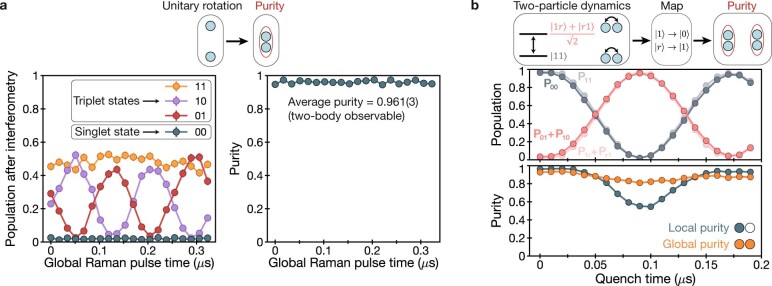
“Raman and Rydberg π pulses then map |1〉 → |0〉 and |r〉 → |1〉, transferring the entangled many-body state into the long-lived and non-interacting {|0〉 , |1〉} basis [41].”
New, compensated Carr-Purcell sequences
Gullion, T., Baker, D. B., & Conradi, M. S. (1990) · Journal of Magnetic Resonance (1969) · doi:10.1016/0022-2364(90)90331-3 · Cited by 724
Large-scale modular quantum-computer architecture with atomic memory and photonic interconnects
Monroe, C., Raussendorf, R., Ruthven, A., Brown, K. R., Maunz, P., Duan, L.-M., & Kim, J. (2014) · Physical Review A · doi:10.1103/physreva.89.022317 · Cited by 700
Realization of a multinode quantum network of remote solid-state qubits
Pompili, M., Hermans, S. L. N., Baier, S., Beukers, H. K. C., Humphreys, P. C., Schouten, R. N., Vermeulen, R. F. L., Tiggelman, M. J., dos Santos Martins, L., Dirkse, B., et al. (2021) · Science · doi:10.1126/science.abg1919 · Cited by 695
Lieb-Robinson Bounds and the Generation of Correlations and Topological Quantum Order
Bravyi, S., Hastings, M. B., & Verstraete, F. (2006) · Physical Review Letters · doi:10.1103/physrevlett.97.050401 · Cited by 664 · cited 1×
“In particular, we prepare topological surface code and toric code states [8, 9, 37, 38], whose states are more difficult to construct by direct CZ gates between physical qubits (requiring an extensive number of layers [8, 39]).”
Realizing topologically ordered states on a quantum processor
Satzinger, K. J., Liu, Y.-J., Smith, A., Knapp, C., Newman, M., Jones, C., Chen, Z., Quintana, C., Mi, X., Dunsworth, A., et al. (2021) · Science · doi:10.1126/science.abi8378 · Cited by 632 · cited 4×
“The Steane code, surface code, and toric code all have transversal single-qubit Clifford operations on the logical qubit [8, 34] (including in-software rotations of the lattice), which is a high-fidelity operation in our system since the transveral rotations are implemented in parallel with our global Raman laser and…”
InfluentialParallel Implementation of High-Fidelity Multiqubit Gates with Neutral Atoms
Levine, H., Keesling, A., Semeghini, G., Omran, A., Wang, T. T., Ebadi, S., Bernien, H., Greiner, M., Vuletić, V., Pichler, H., et al. (2019) · Physical Review Letters · doi:10.1103/physrevlett.123.170503 · Cited by 604 · cited 18×
“Figure 4 reports the measurement of entanglement properties of many-body scars following a rapid quench from the initial state |Z2⟩ ≡ |rgrg...⟩, initialized by applying local light shifts within one sublattice and performing a global Rydberg π pulses (Methods).”
InfluentialSelf-citationDemonstration of the trapped-ion quantum CCD computer architecture
Pino, J. M., Dreiling, J. M., Figgatt, C., Gaebler, J. P., Moses, S. A., Allman, M. S., Baldwin, C. H., Foss-Feig, M., Hayes, D., Mayer, K., et al. (2021) · Nature · doi:10.1038/s41586-021-03318-4 · Cited by 547
A scalable quantum computer with ions in an array of microtraps
Cirac, J. I., & Zoller, P. (2000) · Nature · doi:10.1038/35007021 · Cited by 516 · cited 2×
“The ability to engineer parallel, programmable operations between desired qubits within a quantum processor is central for building scalable quantum information systems [1, 2].”
Benchmarking an 11-qubit quantum computer
Wright, K., Beck, K. M., Debnath, S., Amini, J. M., Nam, Y., Grzesiak, N., Chen, J.-S., Pisenti, N. C., Chmielewski, M., Collins, C., et al. (2019) · Nature Communications · doi:10.1038/s41467-019-13534-2 · Cited by 506 · cited 1×
“upgrades can be additionally supplemented by more sophisticated local single-qubit control employing, for example, parallel Raman excitation through AOM arrays [16].”
Coherent Transport of Neutral Atoms in Spin-Dependent Optical Lattice Potentials
Mandel, O., Greiner, M., Widera, A., Rom, T., Hänsch, T. W., & Bloch, I. (2003) · Physical Review Letters · doi:10.1103/physrevlett.91.010407 · Cited by 477
Self-citationResolving the gravitational redshift across a millimetre-scale atomic sample
Bothwell, T., Kennedy, C. J., Aeppli, A., Kedar, D., Robinson, J. M., Oelker, E., Staron, A., & Ye, J. (2022) · Nature · doi:10.1038/s41586-021-04349-7 · Cited by 449
Data for "Realizing topologically ordered states on a quantum processor"
Satzinger, K. J. (2021) · Zenodo (CERN European Organization for Nuclear Research) · doi:10.5281/zenodo.5570481 · Cited by 423
Controlling quantum many-body dynamics in driven Rydberg atom arrays
Bluvstein, D., Omran, A., Levine, H., Keesling, A., Semeghini, G., Ebadi, S., Wang, T. T., Michailidis, A. A., Maskara, N., Ho, W. W., et al. (2021) · Science · doi:10.1126/science.abg2530 · Cited by 413 · cited 1×
“Characteristic of the scars from the |Z2〉 = |rgrgrgrg〉 state, the Rydberg excitation probability on the sublattices exhibits periodic oscillations [70].”
Self-citationQuantum computations on a topologically encoded qubit
Nigg, D., Müller, M., Martinez, E. A., Schindler, P., Hennrich, M., Monz, T., Martin-Delgado, M. A., & Blatt, R. (2014) · Science · doi:10.1126/science.1253742 · Cited by 400 · cited 2×
“We use this architecture to realize programmable generation of entangled graph states such as cluster states and a 7-qubit Steane code state [6, 7].”
Deterministic generation of a cluster state of entangled photons
Schwartz, I., Cogan, D., Schmidgall, E. R., Don, Y., Gantz, L., Kenneth, O., Lindner, N. H., & Gershoni, D. (2016) · Science · doi:10.1126/science.aah4758 · Cited by 396 · cited 1×
“of qubits with edges between neighbors [31, 32].”
Measuring Entanglement Growth in Quench Dynamics of Bosons in an Optical Lattice
Daley, A. J., Pichler, H., Schachenmayer, J., & Zoller, P. (2012) · Physical Review Letters · doi:10.1103/physrevlett.109.020505 · Cited by 393 · cited 4×
“ferent states due to entanglement with the rest of the many-body system (and entanglement with the environment) [10, 11].”
InfluentialSelf-citationExponential suppression of bit or phase errors with cyclic error correction
Google Quantum, A. I., Chen, Z., Satzinger, K. J., Atalaya, J., Korotkov, A. N., Dunsworth, A., Sank, D., Quintana, C., McEwen, M., Barends, R., et al. (2021) · Nature · doi:10.1038/s41586-021-03588-y · Cited by 393 · cited 1×
“7%, beyond the surface code threshold [37, 66].”
High-fidelity entanglement and detection of alkaline-earth Rydberg atoms
Madjarov, I. S., Covey, J. P., Shaw, A. L., Choi, J., Kale, A., Cooper, A., Pichler, H., Schkolnik, V., Williams, J. R., & Endres, M. (2020) · Nature Physics · doi:10.1038/s41567-020-0903-z · Cited by 374
Self-citationFault-tolerant control of an error-corrected qubit
Egan, L., Debroy, D. M., Noel, C., Risinger, A., Zhu, D., Biswas, D., Newman, M., Li, M., Brown, K. R., Cetina, M., et al. (2021) · Nature · doi:10.1038/s41586-021-03928-y · Cited by 348 · cited 1×
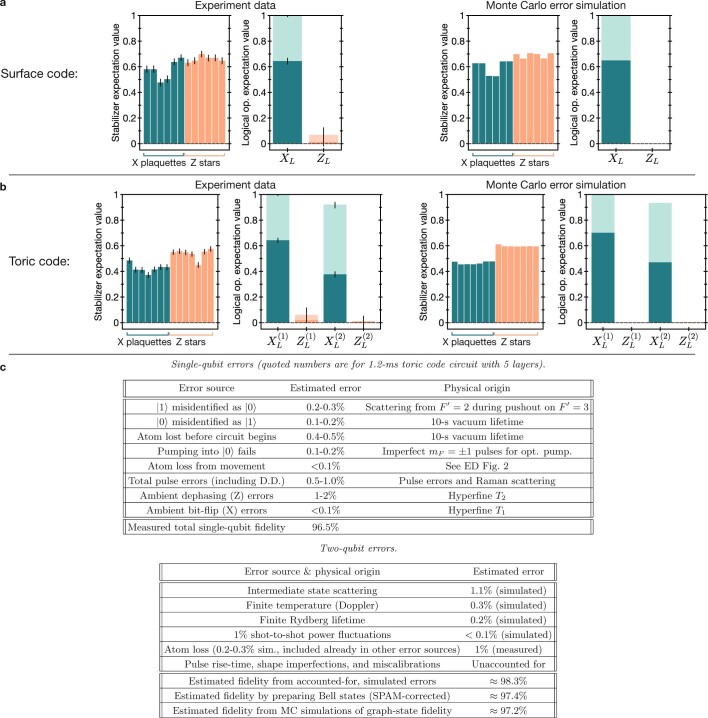
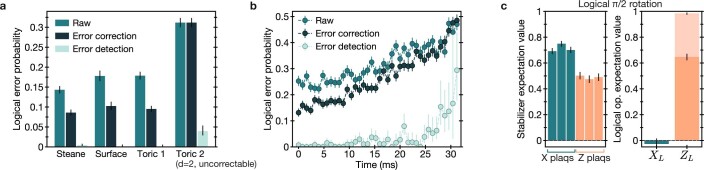
“we perform error detection by post-selecting on measurement outcomes where all measured stabilizers yield +1 [34, 35] (with 66(1)% probability of no detected errors).”
Ho, W. W., Choi, S., Pichler, H., & Lukin, M. D. (2019) · Physical Review Letters · doi:10.1103/physrevlett.122.040603 · Cited by 347
Self-citationWang, C., Harrington, J., & Preskill, J. (2003) · Annals of Physics · doi:10.1016/s0003-4916(02)00019-2 · Cited by 330 · cited 1×
“rays will allow efficient, parallel execution of transversal entangling gates between many logical qubits [37, 46].”
Quantum Low-Density Parity-Check Codes
Breuckmann, N. P., & Eberhardt, J. N. (2021) · PRX Quantum · doi:10.1103/prxquantum.2.040101 · Cited by 328
Controlling quantum many-body dynamics in driven Rydberg atom arraysPreprint
Bluvstein, D., Omran, A., Levine, H., Keesling, A., Semeghini, G., Ebadi, S., Wang, T., Michailidis, A., Maskara, N., Ho, W., et al. (2021) · DSpace@MIT (Massachusetts Institute of Technology) · Cited by 322
Self-citationBroadband, Narrowband, and Passband Composite Pulses for Use in Advanced NMR Experiments
Wimperis, S. (1994) · Journal of Magnetic Resonance, Series A · doi:10.1006/jmra.1994.1159 · Cited by 311
Realization of Real-Time Fault-Tolerant Quantum Error Correction
Ryan-Anderson, C., Bohnet, J. G., Lee, K., Gresh, D., Hankin, A., Gaebler, J. P., Francois, D., Chernoguzov, A., Lucchetti, D., Brown, N. C., et al. (2021) · Physical Review X · doi:10.1103/physrevx.11.041058 · Cited by 306
Entanglement detection in the stabilizer formalism
Tóth, G., & Gühne, O. (2005) · Physical Review A · doi:10.1103/physreva.72.022340 · Cited by 281 · cited 1×
“probe the resultant twelve-qubit cluster state we measure the stabilizer set {Si} = {Zi−1XiZi+1} through readout in two measurement settings, given by a local π/2 rotation on either the odd or even sublattice before projective measurement [33].”
Cooling a Single Atom in an Optical Tweezer to Its Quantum Ground State
Kaufman, A. M., Lester, B. J., & Regal, C. A. (2012) · Physical Review X · doi:10.1103/physrevx.2.041014 · Cited by 263 · cited 1×
“Two-qubit gate fidelity can be improved using higher Rydberg laser power or more efficient delivery methods, as well as more advanced atom cooling [43].”
Randomized Benchmarking of Single-Qubit Gates in a 2D Array of Neutral-Atom Qubits
Xia, T., Lichtman, M., Maller, K., Carr, A. W., Piotrowicz, M. J., Isenhower, L., & Saffman, M. (2015) · Physical Review Letters · doi:10.1103/physrevlett.114.100503 · Cited by 249 · cited 1×
“Randomized benchmarking [60] can be applied in future studies to further study single-qubit rotation fidelity.”
Souza, A. M., Álvarez, G. A., & Suter, D. (2012) · Philosophical Transactions of the Royal Society A: Mathematical, Physical and Engineering Sciences · doi:10.1098/rsta.2011.0355 · Cited by 230 · cited 1×
“interchange between two types of dynamical decoupling sequences: XY8 / XY16 sequences, composed of phasealternated individual π-pulses which are self-correcting for amplitude and detuning errors [28, 62], and CPMGtype dynamical decoupling sequences composed of robust BB1 pulses.”
Gauge color codes: optimal transversal gates and gauge fixing in topological stabilizer codes
Bombín, H. (2015) · New Journal of Physics · doi:10.1088/1367-2630/17/8/083002 · Cited by 217 · cited 1×
“In addition, these techniques also enable implementation of higher-dimensional or nonlocal error correcting codes with more favorable properties [Bombin2015a, Breuckmann2021].”
Coherent States and the Forced Quantum Oscillator
Carruthers, P., & Nieto, M. M. (1965) · American Journal of Physics · doi:10.1119/1.1971895 · Cited by 204 · cited 1×
“∆N is the same for all initial levels of the oscillator [65].”
Two-dimensional transport and transfer of a single atomic qubit in optical tweezers
Beugnon, J., Tuchendler, C., Marion, H., Gaëtan, A., Miroshnychenko, Y., Sortais, Y. R. P., Lance, A. M., Jones, M. P. A., Messin, G., Browaeys, A., et al. (2007) · Nature Physics · doi:10.1038/nphys698 · Cited by 189 · cited 4×
“The resulting parity oscillations indicate that two-atom entanglement is unaffected by the transport process [20, 29].”
InfluentialSurface Code Quantum Communication
Fowler, A. G., Wang, D. S., Hill, C. D., Ladd, T. D., Van Meter, R., & Hollenberg, L. C. L. (2010) · Physical Review Letters · doi:10.1103/physrevlett.104.180503 · Cited by 180 · cited 1×
“Finally, our approach can help facilitate quantum networking between separated arrays, paving the way toward large-scale quantum information systems [29, 54] and distributed quantum metrology [53, 55].”
Programmable interactions and emergent geometry in an array of atom clouds
Periwal, A., Cooper, E. S., Kunkel, P., Wienand, J. F., Davis, E. J., & Schleier-Smith, M. (2021) · Nature · doi:10.1038/s41586-021-04156-0 · Cited by 171
Interacting Fibonacci anyons in a Rydberg gas
Lesanovsky, I., & Katsura, H. (2012) · Physical Review A · doi:10.1103/physreva.86.041601 · Cited by 168 · cited 1×
“Underpinned by special, non-thermal eigenstates called quantum many-body scars [13, 14, 42], these states”
Errors in trapped-ion quantum gates due to spontaneous photon scattering
Ozeri, R., Itano, W. M., Blakestad, R. B., Britton, J., Chiaverini, J., Jost, J. D., Langer, C., Leibfried, D., Reichle, R., Seidelin, S., et al. (2007) · Physical Review A · doi:10.1103/physreva.75.042329 · Cited by 166
Structures of rhodopsin in complex with G-protein-coupled receptor kinase 1
Chen, Q., Plasencia, M., Li, Z., Mukherjee, S., Patra, D., Chen, C.-L., Klose, T., Yao, X.-Q., Kossiakoff, A. A., Chang, L., et al. (2021) · Nature · doi:10.1038/s41586-021-03721-x · Cited by 152
Differential clock comparisons with a multiplexed optical lattice clock
Zheng, X., Dolde, J., Lochab, V., Merriman, B. N., Li, H., & Kolkowitz, S. (2022) · Nature · doi:10.1038/s41586-021-04344-y · Cited by 150
Exponential Error Suppression for Near-Term Quantum Devices
Koczor, B. (2021) · Physical Review X · doi:10.1103/physrevx.11.031057 · Cited by 147 · cited 1×
“be extended to probing the entire entanglement spectrum [49], simulating wormhole creation [50], performing many-body purification [51], and engineering novel nonequilibrium states [52].”
Hardware-Efficient, Fault-Tolerant Quantum Computation with Rydberg Atoms
Cong, I., Levine, H., Keesling, A., Bluvstein, D., Wang, S.-T., & Lukin, M. D. (2022) · Physical Review X · doi:10.1103/physrevx.12.021049 · Cited by 144 · cited 2×
“Much like X and Z errors, it 12 can be handled in our system in a hardware-efficient manner with a comparable overhead using techniques such as those discussed in [Cong et al 2021].”
Self-citationOptimal transport of ultracold atoms in the non-adiabatic regime
Couvert, A., Kawalec, T., Reinaudi, G., & Guéry-Odelin, D. (2008) · Europhysics Letters (EPL) · doi:10.1209/0295-5075/83/13001 · Cited by 138
Entangling logical qubits with lattice surgery
Erhard, A., Poulsen Nautrup, H., Meth, M., Postler, L., Stricker, R., Stadler, M., Negnevitsky, V., Ringbauer, M., Schindler, P., Briegel, H. J., et al. (2021) · Nature · doi:10.1038/s41586-020-03079-6 · Cited by 134
An Introduction to Quantum Error Correction and Fault-Tolerant Quantum Computation
Gottesman, D. (2009) · arXiv · doi:10.48550/arxiv.0904.2557 · Cited by 129 · cited 3×
“The Steane code, surface code, and toric code all have transversal single-qubit Clifford operations on the logical qubit [8, 34] (including in-software rotations of the lattice), which is a high-fidelity operation in our system since the transveral rotations are implemented in parallel with our global Raman laser and…”
Entanglement transport and a nanophotonic interface for atoms in optical tweezers
Ðorđević, T., Samutpraphoot, P., Ocola, P. L., Bernien, H., Grinkemeyer, B., Dimitrova, I., Vuletić, V., & Lukin, M. D. (2021) · Science · doi:10.1126/science.abi9917 · Cited by 116
Self-citationMeasurement Protocol for the Entanglement Spectrum of Cold Atoms
Pichler, H., Zhu, G., Seif, A., Zoller, P., & Hafezi, M. (2016) · Physical Review X · doi:10.1103/physrevx.6.041033 · Cited by 114 · cited 1×
“be extended to probing the entire entanglement spectrum [49], simulating wormhole creation [50], performing many-body purification [51], and engineering novel nonequilibrium states [52].”
Self-citationTrapping Alkaline Earth Rydberg Atoms Optical Tweezer Arrays
Wilson, J. T., Saskin, S., Meng, Y., Ma, S., Dilip, R., Burgers, A. P., & Thompson, J. D. (2022) · Physical Review Letters · doi:10.1103/physrevlett.128.033201 · Cited by 109
Foliated Quantum Error-Correcting Codes
Bolt, A., Duclos-Cianci, G., Poulin, D., & Stace, T. M. (2016) · Physical Review Letters · doi:10.1103/physrevlett.117.070501 · Cited by 93 · cited 1×
“The graph state stabilizers now transform into the X-plaquettes, the Z-stars (with value ±1 for a measurement outcome of ±1 of the central ancilla), and the logical XL operator [36, 40].”
Entanglement of neutral-atom qubits with long ground-Rydberg coherence times
Picken, C. J., Legaie, R., McDonnell, K., & Pritchard, J. D. (2018) · Quantum Science and Technology · doi:10.1088/2058-9565/aaf019 · Cited by 92 · cited 1×
“To achieve this mapping, immediately following the Rydberg dynamics we apply a Raman π pulse to map |1〉 → |0〉, and then a subsequent Rydberg π-pulse to map |r〉 → |1〉 [71].”
Transport dynamics of single ions in segmented microstructured Paul trap arrays
Reichle, R., Leibfried, D., Blakestad, R. B., Britton, J., Jost, J. D., Knill, E., Langer, C., Ozeri, R., Seidelin, S., & Wineland, D. J. (2006) · Fortschritte der Physik · doi:10.1002/prop.200610326 · Cited by 89
Demonstration of the trapped-ion quantum CCD computer architecture
Pino, J. M., Dreiling, J., Figgatt, C., Gaebler, J., Moses, S. A., Allman, M. S., Baldwin, C. H., Foss‐Feig, M., Hayes, D., Mayer, K., et al. (2021) · RePEc: Research Papers in Economics · Cited by 87
Demonstration of Quantum Brachistochrones between Distant States of an Atom
Lam, M. R., Peter, N., Groh, T., Alt, W., Robens, C., Meschede, D., Negretti, A., Montangero, S., Calarco, T., & Alberti, A. (2021) · Physical Review X · doi:10.1103/physrevx.11.011035 · Cited by 84
Probing topological spin liquids on a programmable quantum simulator
Semeghini, G., Levine, H., Keesling, A., Ebadi, S., Wang, T., Bluvstein, D., Verresen, R., Pichler, H., Kalinowski, M., Samajdar, R., et al. (2022) · Quantum Computing, Communication, and Simulation II · doi:10.1117/12.2615077 · Cited by 84
Self-citationDispersive optical systems for scalable Raman driving of hyperfine qubits
Levine, H., Bluvstein, D., Keesling, A., Wang, T. T., Ebadi, S., Semeghini, G., Omran, A., Greiner, M., Vuletić, V., & Lukin, M. D. (2022) · Physical Review A · doi:10.1103/physreva.105.032618 · Cited by 66
Self-citationFault-Tolerant Operation of a Quantum Error-Correction Code
Egan, L., Debroy, D. M., Noel, C., Risinger, A., Zhu, D., Biswas, D., Newman, M., Li, M., Brown, K. R., Cetina, M., et al. (2020) · arXiv · doi:10.48550/arxiv.2009.11482 · Cited by 65
Stern–Gerlach detection of neutral-atom qubits in a state-dependent optical lattice
Wu, T.-Y., Kumar, A., Giraldo, F., & Weiss, D. S. (2019) · Nature Physics · doi:10.1038/s41567-019-0478-8 · Cited by 64
Yang, J., He, X., Guo, R., Xu, P., Wang, K., Sheng, C., Liu, M., Wang, J., Derevianko, A., & Zhan, M. (2016) · Physical Review Letters · doi:10.1103/physrevlett.117.123201 · Cited by 61 · cited 1×
“All of our transport sequences [20, 57, 58] are accompanied with dynamical decoupling sequences.”
Quantum Gravity in the Lab: Teleportation by Size and Traversable Wormholes
Brown, A. R., Gharibyan, H., Leichenauer, S., Lin, H. W., Nezami, S., Salton, G., Susskind, L., Swingle, B. G., & Walter, M. (2019) · arXiv (Cornell University) · doi:10.48550/arxiv.1911.06314 · Cited by 49
Coherent Transport of Atomic Quantum States in a Scalable Shift Register
Lengwenus, A., Kruse, J., Schlosser, M., Tichelmann, S., & Birkl, G. (2010) · Physical Review Letters · doi:10.1103/physrevlett.105.170502 · Cited by 45 · cited 1×
“All of our transport sequences [20, 57, 58] are accompanied with dynamical decoupling sequences.”
Deterministic Fast Scrambling with Neutral Atom Arrays
Hashizume, T., Bentsen, G. S., Weber, S., & Daley, A. J. (2021) · Physical Review Letters · doi:10.1103/physrevlett.126.200603 · Cited by 31 · cited 1×
“be extended to probing the entire entanglement spectrum [49], simulating wormhole creation [50], performing many-body purification [51], and engineering novel nonequilibrium states [52].”
Shea, M. E., Baker, P. M., Joseph, J. A., Kim, J., & Gauthier, D. J. (2020) · Physical Review A · doi:10.1103/physreva.102.053101 · Cited by 21
Long-lived Bell states in an array of optical clock qubits
Schine, N., Young, A., Eckner, W., Martin, M., & Kaufman, A. (2021) · doi:10.2172/2378047 · Cited by 8
High precision differential clock comparisons with a multiplexed optical lattice clockPreprint
Zheng, X., Dolde, J., Lochab, V., Merriman, B., Li, H., & Kolkowitz, S. (2021) · arXiv (Cornell University) · doi:10.48550/arxiv.2109.12237 · Cited by 5
Hardware-Efficient, Fault-Tolerant Quantum Computation with Rydberg AtomsPreprint
Cong, I., Levine, H., Keesling, A., et al. (2021) · arXiv (Cornell University) · doi:10.48550/arxiv.2105.13501 · Cited by 5 · cited 2×
“Much like X and Z errors, it 12 can be handled in our system in a hardware-efficient manner with a comparable overhead using techniques such as those discussed in [Cong et al 2021].”
Self-citation
Research works printed but not linked: 1
- Hein, M. et al. Entanglement in graph states and its applications. In Proc. International School of Physics “Enrico Fermi” (eds Casati, G. et al.) Vol. 162, 115–218 (IOS Press, 2006).
Cited by
Logical quantum processor based on reconfigurable atom arrays
Bluvstein, D., Evered, S. J., Geim, A. A., Li, S. H., Zhou, H., Manovitz, T., Ebadi, S., Cain, M., Kalinowski, M., Hangleiter, D., et al. (2024) · Nature · doi:10.1038/s41586-023-06927-3 · Cited by 1,119
“This process realizes a high-fidelity, fault-tolerant transversal CNOT in a single parallel step.”
BackgroundMethodInfluentialSelf-citationHigh-fidelity parallel entangling gates on a neutral atom quantum computer
Evered, S. J., Bluvstein, D., Kalinowski, M., Ebadi, S., Manovitz, T., Zhou, H., Li, S. H., Geim, A. A., Wang, T. T., Maskara, N., et al. (2023) · arXiv · doi:10.48550/arxiv.2304.05420 · Cited by 526
Self-citationHigh-fidelity parallel entangling gates on a neutral-atom quantum computer
Evered, S. J., Bluvstein, D., Kalinowski, M., Ebadi, S., Manovitz, T., Zhou, H., Li, S. H., Geim, A. A., Wang, T. T., Maskara, N., et al. (2023) · Nature · doi:10.1038/s41586-023-06481-y · Cited by 522
Self-citationMulti-qubit entanglement and algorithms on a neutral-atom quantum computer
Graham, T. M., Song, Y., Scott, J., Poole, C., Phuttitarn, L., Jooya, K., Eichler, P., Jiang, X., Marra, A., Grinkemeyer, B., et al. (2022) · Nature · doi:10.1038/s41586-022-04603-6 · Cited by 518
Quantum optimization of maximum independent set using Rydberg atom arrays
Ebadi, S., Keesling, A., Cain, M., Wang, T. T., Levine, H., Bluvstein, D., Semeghini, G., Omran, A., Liu, J.-G., Samajdar, R., et al. (2022) · Science · doi:10.1126/science.abo6587 · Cited by 430
Self-citation
Metadata
- Authors
- Bluvstein, D., Levine, H., Semeghini, G., Wang, T. T., Ebadi, S., Kalinowski, M., Keesling, A., Maskara, N., Pichler, H., Greiner, M., Vuletić, V., & Lukin, M. D.
- Affiliations
- Harvard University (US)
- Austrian Academy of Sciences (AT)
- Massachusetts Institute of Technology (US)
- Corresponding author
- Lukin, Mikhail D.
- ORCID
- Venue
- Nature
- Published
- 2022-04-20
- Volume
- 604
- Issue
- 7906
- Pages
- 451-456
- ISSN
- 0028-0836 (ISSN-L)
- 1476-4687
- PMC
- PMC9021024
- OpenAlex
- W4200629850
- Cited by
- 14
- References
- 80
- Citations by year
- 2026: 1 · 2025: 2 · 2024: 5 · 2023: 6
- FWCI
- 1.33
- Type
- journal article
- Language
- en
- Open access
- hybrid
- doi.org
- Licence
- cc-by
- creativecommons.org/licenses/by/4.0 (tdm)
- creativecommons.org/licenses/by/4.0 (vor)
- Locations
- Nature (publishedVersion, cc-by)
- PubMed Central (publishedVersion, cc-by)
- PubMed (publishedVersion)
- arXiv (Cornell University) (submittedVersion)
- RePEc: Research Papers in Economics (submittedVersion)
- DSpace@MIT (Massachusetts Institute of Technology) (submittedVersion, cc-by-nc)
- OSTI OAI (U.S. Department of Energy Office of Scientific and Technical Information) (submittedVersion)
- arXiv (Cornell University)
- Funders
- National Science Foundation (1745303, W911NF-20-1-0082)
- U.S. Department of Energy (DESC0021013, DESC0021110, 7568717)
- Hertz Foundation
- Defense Advanced Research Projects Agency (W911NF2010021)
- National Defense Science and Engineering Graduate
- Multidisciplinary University Research Initiative (W911NF2010082)
- Center for Ultracold Atoms, Massachusetts Institute of Technology
- Office of Naval Research
- Army Research Office (W911NF-21-1-, W911NF-20-1-0082, W911NF-21-1-0367, W911NF)
- Topics
- Physical Sciences › Physics and Astronomy › Atomic and Molecular Physics, and Optics › Cold Atom Physics and Bose-Einstein Condensates
- Physical Sciences › Physics and Astronomy › Atomic and Molecular Physics, and Optics › Quantum Information and Cryptography
- Physical Sciences › Computer Science › Artificial Intelligence › Quantum Computing Algorithms and Architecture
- Keywords
- quantum processors, coherent transport, optical tweezers, hyperfine qubits, cluster states, Steane code, surface code, toric code, entanglement entropy, quantum many-body scars, scalable quantum computing
About these checks
Registry, retraction, Cites and statistics results are computed, not judged, with one exception: a printed reference that no index lists is read once by a model before it counts as a citation error. Claims are extracted by a model and kept only when their quote appears verbatim in the text; each cited source is then checked, with a model’s help, for whether it says what the claim relies on. Those verdicts can be wrong — read the claim’s quote and the cited source before relying on one.
Statistics and arithmetic are recomputed, not judged.
Confidence bands are shown only for fields calibrated on our annotated test set. None is calibrated yet, so no band is shown.
What counts as a claim ›How we measure confidence ›How we check this ›
Are you an author, or do you see a problem with this page? Request a review
Data sources
Bibliographic data: Semantic Scholar, OpenAlex, Crossref.
Contains information from the Semantic Scholar Academic Graph Datasets, made available under the ODC Attribution License (ODC-BY 1.0).
Semantic Scholar’s data is described in: Kinney, R., et al. (2023). The Semantic Scholar Open Data Platform. arXiv:2301.10140.
