

Suppressing quantum errors by scaling a surface code logical qubit
Open accessThe DOI matches its Crossref record; 70 of the 70 references it cites were found in a registry or an index; 8 of the 13 sources its claims cite were checked for support.
Abstract
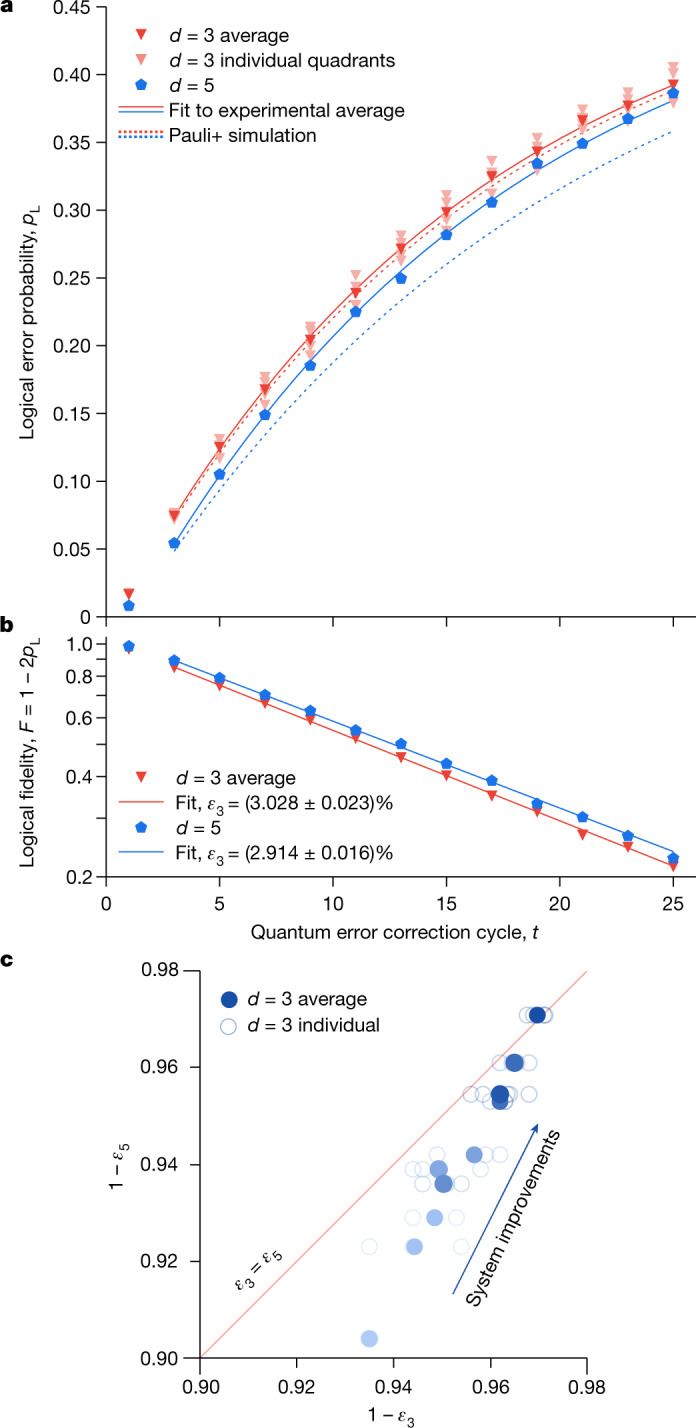
Practical quantum computing will require error rates well below those achievable with physical qubits. Quantum error correction 1,2 offers a path to algorithmically relevant error rates by encoding logical qubits within many physical qubits, for which increasing the number of physical qubits enhances protection against physical errors. However, introducing more qubits also increases the number of error sources, so the density of errors must be sufficiently low for logical performance to improve with increasing code size. Here we report the measurement of logical qubit performance scaling across several code sizes, and demonstrate that our system of superconducting qubits has sufficient performance to overcome the additional errors from increasing qubit number. We find that our distance-5 surface code logical qubit modestly outperforms an ensemble of distance-3 logical qubits on average, in terms of both logical error probability over 25 cycles and logical error per cycle ((2.914 ± 0.016)% compared to (3.028 ± 0.023)%). To investigate damaging, low-probability error sources, we run a distance-25 repetition code and observe a 1.7 × 10 −6 logical error per cycle floor set by a single high-energy event (1.6 × 10 −7 excluding this event). We accurately model our experiment, extracting error budgets that highlight the biggest challenges for future systems. These results mark an experimental demonstration in which quantum error correction begins to improve performance with increasing qubit number, illuminating the path to reaching the logical error rates required for computation.
Overview
CoChat Summary
TL;DR
Google Quantum AI reports a 72-qubit superconducting device running a distance-5 surface code logical qubit that modestly outperforms an ensemble of distance-3 logical qubits over 25 cycles. The result demonstrates that quantum error correction can begin to improve logical performance with increasing code size, while identifying leakage, stray interactions, and high-energy events as key remaining challenges.
Key findings
- The distance-5 surface code achieved a logical error per cycle of (2.914 ± 0.016)% versus (3.028 ± 0.023)% averaged over four distance-3 subgrids, a relative reduction of about 4% with the approximate maximum-likelihood decoder; with belief-matching decoding, the values were (3.056 ± 0.015)% versus (3.118 ± 0.025)%, about 2%.
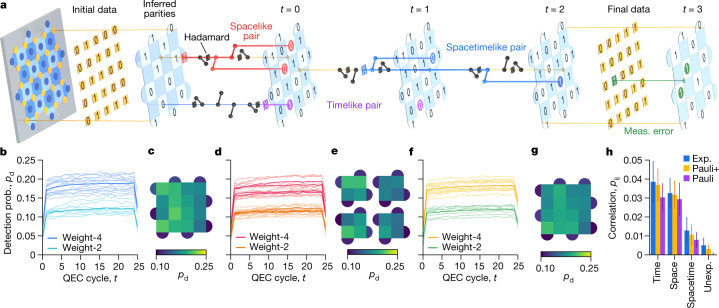
- Detection probabilities were similar across code distances: weight-4 stabilizers averaged 0.185 ± 0.018 for distance-5 and 0.175 ± 0.017 for distance-3; weight-2 stabilizers averaged 0.119 ± 0.012 and 0.115 ± 0.008, respectively.
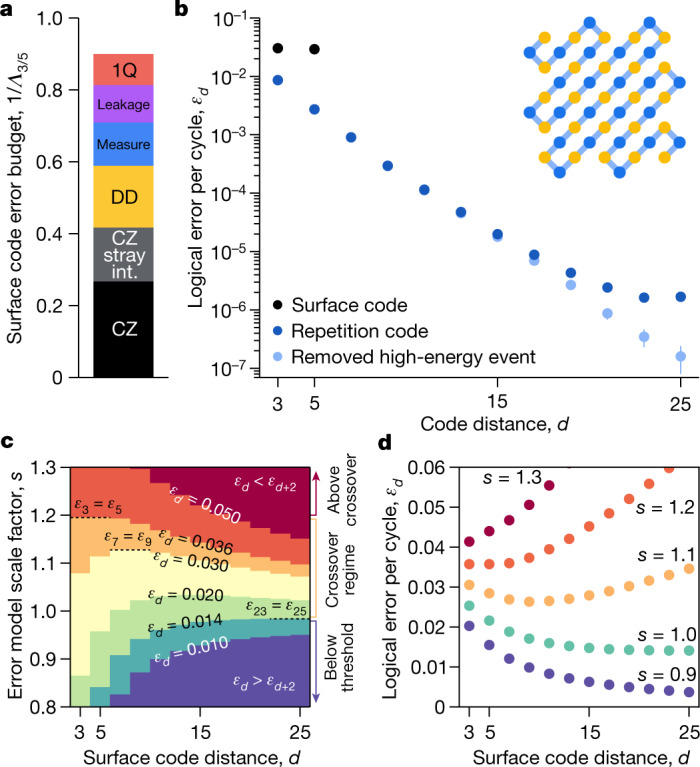
- A distance-25 repetition code reached (1.7 ± 0.3) × 10⁻⁶ logical error per cycle without post-selection; after removing one high-energy event (0.15% of trials), it reached (1.6 ± 0.8) × 10⁻⁷.
- Error budgets identify CZ gate error and data-qubit decoherence during measurement and reset as dominant contributors; the paper estimates component performance must improve by at least 20% to move below threshold.
Methods
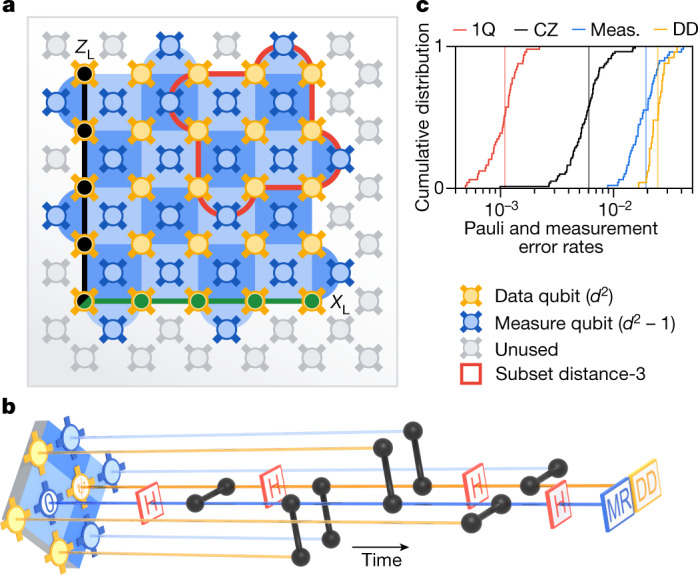
- Implemented the surface code on an expanded Sycamore device with 72 transmon qubits and 121 tunable couplers, mean T1 = 20 μs and T2,CPMG = 30 μs. The distance-5 code used a 49-qubit subset (25 data, 24 measure qubits) and was compared with the average of four distance-3 subgrids, each with nine data and eight measure qubits.
- Each experimental instance initialized a logical state, ran 25 cycles of error correction, and measured the final logical state; detection probabilities were measured over 50,000 instances. Decoding used belief-matching and tensor-network approximate maximum-likelihood decoders, with error hypergraphs derived from detection-event correlations.
- Logical fidelity F = 1 − 2pL was fit to an exponential decay starting at t = 3. Simulations included depolarizing, Pauli+, and Pauli-only models; the distance-25 repetition code was decoded with minimum-weight perfect matching.
Limitations
- The paper states that device inhomogeneity makes comparing distance-5 and distance-3 under identical noise difficult; the distance-5 logical error per cycle was slightly higher than two individual distance-3 codes, and leakage accumulation may cause distance-5 performance to degrade faster as logical error probability approaches 50%.
- The paper states that projections to future devices rely on simplified models and must be validated experimentally, and that leakage, stray interactions, and high-energy events such as cosmic-ray impacts must be mitigated.
- Evident from the text: the demonstration is modest, with only about 2–4% relative improvement over the distance-3 average, and the repetition-code floor was dominated by a single high-energy event; the repetition code also does not correct phase-flip errors and is not suitable for quantum algorithms.
Model-written summary. Check it against the paper before relying on it.
Integrity signals
Registry
Cites
Statistics
Figures
Verification
Claims the paper makes
6 Valid · 1 Not valid · 2 Not checked · 35 Own results and interpretations
The cited sources support only part of this claim — read each source’s verdict below.
In the paper
“This threshold behaviour can be subtle58, and there exists a crossover regime in which, owing to finite-size effects, increasing system size initially suppresses the logical error per cycle before later increasing it.”
§ Suppressing quantum errors by scaling a surface code logical qubit > Towards large-scale quantum error correction
What the sources say
- Partly supportedcites [58] Stephens AM Fault-tolerant thresholds for quantum error correction with the surface code Phys. Rev. A 2014 89 022321 sourceExperimental — accuracy not yet measured
In the Discussion (p. 8) Stephens does describe a subtle crossover: for two codes with d = n and d = n + 2 the logical error rates are equal per round of measurement at some p_n, yet over the d rounds actually required the larger code is more likely to fail, and in Fig. 6 the intersection of consecutive curves drifts downward (from above 0.01 to ~0.0095) with no consistent intersection even for large d. So the source supports a regime in which enlarging the code stops helping and can hurt, but it attributes this to defining the logical error rate per round of measurement rather than per d rounds (pp. 7-8), not to 'finite-size effects' — the paper's finite-size discussion (Methods, p. 3) concerns violations of the scaling ansatz for the smallest codes (d ≤ 7). The specific non-monotonic sequence claimed (increasing size first suppressing, then increasing, the logical error per cycle at fixed physical error rate) is nowhere stated as such, so that framing and causal attribution go beyond this source. (LLM, conf=0.66)
plainstates a cause- Asserted: passes — The authors put it forward as true.
- Checkable: passes — It can be checked against evidence.
- Load-bearing: passes — The paper’s conclusions depend on it.
- Based: passes — The paper gives a reason why it holds.
- Partly supported
The cited sources support only part of this claim — read each source’s verdict below.
In the paper
“We also remove certain Hadamard gates to implement the ZXXZ variant of the surface code44,45, which helps symmetrize the X- and Z-basis logical error rates.”
§ Suppressing quantum errors by scaling a surface code logical qubit > Surface codes with superconducting qubits
What the sources say
- Could not verifycites [44] Wen X-G Quantum orders in an exact soluble model Phys. Rev. Lett. 2003 90 016803 12570641 sourceExperimental — accuracy not yet measured
The model description (p. 1) gives a four-spin square-lattice Hamiltonian, and Physical properties (p. 4) discusses its topological ground-state degeneracy. Neither passage addresses a ZXXZ surface-code variant or X- and Z-basis logical error rates; further searches for those terms and Hadamard gates found no supporting passage. (LLM, conf=0.74)
- Partly supportedcites [45] Bonilla Ataides JP Tuckett DK Bartlett SD Flammia ST Brown BJ The XZZX surface code Nat. Commun. 2021 12 2172 33846318 PMC8042007 sourceExperimental — accuracy not yet measured
The Results describe the XZZX code as responding similarly to Pauli-X and Pauli-Z errors, and the Fig. 4 caption says their separate logical-error thresholds have a negligible discrepancy. The paper does not establish that the variant itself symmetrizes the X- and Z-basis logical error rates; it discusses choosing lattice dimensions to optimize logical failure rates under biased noise. (LLM, conf=0.79)
plainstates a cause- Asserted: passes — The authors put it forward as true.
- Checkable: passes — It can be checked against evidence.
- Load-bearing: unclear — It is unclear whether the paper’s conclusions depend on it.
- Based: passes — The paper gives a reason why it holds.
- Could not verify
Every source the paper cites for this claim was checked and supports it.
In the paper
“In principle, the logical performance of a distance-5 code should improve faster than that of a distance-3 code as physical error rates decrease33.”
§ Suppressing quantum errors by scaling a surface code logical qubit > Decoding and logical error probabilities
What the sources say
- Supportedcites [33] Fowler AG Mariantoni M Martinis JM Cleland AN Surface codes: towards practical large-scale quantum computation Phys. Rev. A 2012 86 032324 source
The paper's sub-threshold scaling statement in VII (p. 11) — 'For p < p_th, the logical error rate falls exponentially with d' — and the restatement in VII B (p. 14), 'larger values of d give lower logical error rates than do smaller d, as long as p is smaller than the threshold', cover the claim's direction. The mechanism is given explicitly in VII A (p. 11): the most likely misidentifications scale as p^{d_e} with d_e = (d+1)/2, illustrated on exactly the d = 5 array of Fig. 3 (two-error vs three-error events scaling p^2 vs p^3), so a distance-5 logical error rate falls as a higher power of p than a distance-3 one, i.e. improves faster as p decreases. Fig. 4 caption (p. 11) shows the same vanishing of P_L with increasing d for p < p_th = 0.57%; the paper plots d = 3, 7, 11, 25, 55 rather than a d = 5 curve, but the claim is hedged ('in principle... should') and follows from the stated scaling law. (LLM, conf=0.85)
hedgedstates a cause- Asserted: passes — The authors put it forward as true.
- Checkable: passes — It can be checked against evidence.
- Load-bearing: passes — The paper’s conclusions depend on it.
- Based: passes — The paper gives a reason why it holds.
- Supported
The sources with a verdict support this claim; the rest weren’t checked yet, have no full text we could read, or their verdicts aren’t rated yet.
In the paper
“Fortunately, quantum error correction can exponentially suppress the operational error rates in a quantum processor, at the expense of temporal and qubit overhead18,19.”
§ Suppressing quantum errors by scaling a surface code logical qubit > Main
What the sources say
- Not checked yetcites [18] Knill E Laflamme R Zurek WH Resilient quantum computation Science 1998 279 342 345 source
- Supportedcites [19] Aharonov, D. & Ben-Or, M. Fault-tolerant quantum computation with constant error rate. SIAM J. Comput.38, 1207–1282 (2008). source
The introduction (p. 6) states that reliability is obtained by applying the encoding scheme recursively, 'since the improvement is exponential in the number of levels', i.e. the effective noise rate is suppressed exponentially in the concatenation depth. The overhead side is stated in the Abstract ('The cost is polylogarithmic in space and time') and quantified in Theorems 10-11 (pp. 52, 56), where the simulated circuit Q' acts on n log^{c1}(v/ε) qubits for time t log^{c2}(v/ε) — i.e. extra qubits and extra time steps. Section 7.2/7.3 (pp. 47-48) confirms the mechanism is quantum error-correcting codes with concatenated blocks, so the attribution to 'quantum error correction' is accurate. (LLM, conf=0.88)
plainstates a cause- Asserted: passes — The authors put it forward as true.
- Checkable: passes — It can be checked against evidence.
- Load-bearing: passes — The paper’s conclusions depend on it.
- Based: passes — The paper gives a reason why it holds.
The sources with a verdict support this claim; the rest weren’t checked yet, have no full text we could read, or their verdicts aren’t rated yet.
In the paper
“We attribute this rise to data qubits leaking into non-computational excited states and anticipate that the inclusion of leakage-removal techniques on data qubits would help to mitigate this rise42,46–48.”
§ Suppressing quantum errors by scaling a surface code logical qubit > Error detectors
What the sources say
- Could not verifycites [42] Chen Z Exponential suppression of bit or phase errors with cyclic error correction Nature 2021 595 383 387 34262210 PMC8279951 sourceExperimental — accuracy not yet measured
Our copy of Chen et al. (2021, Nature) is a structural-biology paper on rhodopsin–GRK1 complexes (cryo-EM/MDFF refinement, Extended Data Table 2; phage-ELISA and RELION/cryoSPARC methods sections), and it contains nothing about qubits, leakage, or detection probabilities. Searches on 'qubit leakage non-computational excited state detection probability' and 'qubit quantum computing leakage removal detection probability' returned only unrelated GRK mutant tables, reference lists and EM-processing passages (Extended Data, References, Methods: EM data processing / Single-point phage ELISA). The paper makes no contrary statement and names no alternative source for the claim, so the attribution cannot be checked against this text. (LLM, conf=0.75)
- Not checked yetcites [46] Aliferis P Terhal BM Fault-tolerant quantum computation for local leakage faults Quantum Inf. Comput. 2007 7 139 156
- Not checked yetcites [47] Suchara, M., Cross, A. W. & Gambetta, J. M. Leakage suppression in the toric code. Proc. 2015 IEEE International Symposium on Information Theory (ISIT) 1119–1123 (2015). source
- Supportedcites [48] McEwen M Removing leakage-induced correlated errors in superconducting quantum error correction Nat. Commun. 2021 12 1761 33741936 PMC7979694 source
In Results > Injection of leakage, the paper reports that inserting leakage on a data qubit (Fig. 4b) produces 'an increase of detection events that slowly decays, now on both neighboring measure qubits', i.e. a rise in detection-event fraction traceable to population in the data qubit's non-computational levels; the Introduction and Fig. 3/Fig. 1b confirm gates and measurement populate those levels and that leakage may reside on data qubits. Results > Injection of leakage also states the reset protocol 'helps to decrease leakage in data qubits, thereby strongly suppressing time-correlated tails of detection events', supporting the causal attribution the citing sentence draws. The citing authors' own anticipation about adding leakage removal to data qubits is their extrapolation, not something the source contradicts. (LLM, conf=0.82)
plainstates a cause- Asserted: passes — The authors put it forward as true.
- Checkable: passes — It can be checked against evidence.
- Load-bearing: passes — The paper’s conclusions depend on it.
- Based: passes — The paper gives a reason why it holds.
- Could not verify
22 more claims · 1 with their cited sources checked
Create a free account to see all 44 claims and to verify the 5 references still open.
- It may state two separate claims as one. 13
- Probably not a substantial claim. 6
Claims other papers make about this one
Each is checked against this paper’s own text: does it say what the citing paper says it does?
The cited source doesn’t support the claim as written.
In the citing paper
“Some of these experiments are approaching26, or have surpassed28, the threshold at which scaling of the error-correcting code size leads to exponential improvements in the logical qubit error rate.”
From Hardware-efficient quantum error correction via concatenated bosonic qubits (2025) · cites this paper as [26]
Checked by a reasoning model — may be wrong.
Experimental — accuracy not yet measuredThe source backs part of the claim, not all of it — or backs it for a different population, condition or comparison.
In the citing paper
“Operating this logical processor with various types of encoding, we demonstrate improvement of a two-qubit logic gate by scaling surface-code6 distance from d = 3 to d = 7, preparation of colour-code qubits with break-even fidelities5, fault-tolerant creation of logical Greenberger–Horne–Zeilinger (GHZ) states and feedforward entanglement teleportation, as well as operation of 40 colour-code qubit”
From Logical quantum processor based on reconfigurable atom arrays (2024) · cites this paper as [6]
Experimental — accuracy not yet measuredThe source backs part of the claim, not all of it — or backs it for a different population, condition or comparison.
In the citing paper
“Recent experiments have achieved milestone demonstrations of two logical qubits and one entangling gate5,6 and explorations of new encodings25–28.”
From Logical quantum processor based on reconfigurable atom arrays (2024) · cites this paper as [6]
Experimental — accuracy not yet measuredThe source backs part of the claim, not all of it — or backs it for a different population, condition or comparison.
In the citing paper
“Recently, this property has been experimentally verified by reducing idling errors of a code6.”
From Logical quantum processor based on reconfigurable atom arrays (2024) · cites this paper as [6]
Experimental — accuracy not yet measuredThe cited source says what the claim attributes to it.
In the citing paper
“Although many platforms have demonstrated different features of quantum error correction14–20, no quantum processor has definitively shown below-threshold performance.”
From Quantum error correction below the surface code threshold (2025) · cites this paper as [17]
4 more claims about this paper
Create a free account to see every claim other papers make about this one.
Citations
Cites
Quantum supremacy using a programmable superconducting processor
Arute, F., Arya, K., Babbush, R., Bacon, D., Bardin, J. C., Barends, R., Biswas, R., Boixo, S., Brandao, F. G. S. L., Buell, D. A., et al. (2019) · Nature · doi:10.1038/s41586-019-1666-5 · Cited by 7,720 · cited 6×
“Single qubit gates are characterized using parallel randomized benchmarking[31], while CZ gates are characterized with parallel cross-entropy benchmarking (XEB)[32].”
InfluentialSelf-citationSimulating physics with computers
Feynman, R. P. (1982) · International Journal of Theoretical Physics · doi:10.1007/bf02650179 · Cited by 7,691 · cited 1×
“Since Feynman’s proposal to compute using quantum mechanics [3], many potential applications have emerged, including factoring [4], optimization [5], machine learning [6], quantum simulation [7], and quantum chemistry [8].”
Fault-tolerant quantum computation by anyons
Kitaev, A. Y. (2003) · Annals of Physics · doi:10.1016/s0003-4916(02)00018-0 · Cited by 7,238 · cited 1×
“Surface codes [26, 33–36] are a family of quantum error-correcting codes which encode a logical qubit into the joint entangled state of a d × d square of physical qubits, referred to as data qubit s.”
Self-citationBiamonte, J., Wittek, P., Pancotti, N., Rebentrost, P., Wiebe, N., & Lloyd, S. (2017) · Nature · doi:10.1038/nature23474 · Cited by 4,779 · cited 1×
“Since Feynman’s proposal to compute using quantum mechanics [3], many potential applications have emerged, including factoring [4], optimization [5], machine learning [6], quantum simulation [7], and quantum chemistry [8].”
Scheme for reducing decoherence in quantum computer memory
Shor, P. W. (1995) · Physical Review A · doi:10.1103/physreva.52.r2493 · Cited by 4,479
Polynomial-time algorithms for prime factorization and discrete logarithms on a quantum computer
Shor, P. W. (1999) · SIAM Review · doi:10.1137/s0036144598347011 · Cited by 3,904
Charge-insensitive qubit design derived from the Cooper pair box
Koch, J., Yu, T. M., Gambetta, J., Houck, A. A., Schuster, D. I., Majer, J., Blais, A., Devoret, M. H., Girvin, S. M., & Schoelkopf, R. J. (2007) · Physical Review A · doi:10.1103/physreva.76.042319 · Cited by 3,351 · cited 1×
“We implement the surface code on an expanded Sycamore device [32] with 72 transmon qubits [39] and 121 tunable couplers [40, 41].”
Lloyd, S. (1996) · Science · doi:10.1126/science.273.5278.1073 · Cited by 3,088 · cited 1×
“Since Feynman’s proposal to compute using quantum mechanics [3], many potential applications have emerged, including factoring [4], optimization [5], machine learning [6], quantum simulation [7], and quantum chemistry [8].”
Surface codes: Towards practical large-scale quantum computation
Fowler, A. G., Mariantoni, M., Martinis, J. M., & Cleland, A. N. (2012) · Physical Review A · doi:10.1103/physreva.86.032324 · Cited by 3,059
Self-citationA Quantum Adiabatic Evolution Algorithm Applied to Random Instances of an NP-Complete Problem
Farhi, E., Goldstone, J., Gutmann, S., Lapan, J., Lundgren, A., & Preda, D. (2001) · Science · doi:10.1126/science.1057726 · Cited by 2,056
Self-citation
Research works printed but not linked: 3
- Gottesman, D. Stabilizer Codes and Quantum Error Correction. PhD thesis, California Institute of Technology (1997).
- Neill, C. A Path towards Quantum Supremacy with Superconducting Qubits. PhD thesis, Univ. California Santa Barbara (2017).
- Aliferis P Terhal BM Fault-tolerant quantum computation for local leakage faults Quantum Inf. Comput. 2007 7 139 156
Cited by
Logical quantum processor based on reconfigurable atom arrays
Bluvstein, D., Evered, S. J., Geim, A. A., Li, S. H., Zhou, H., Manovitz, T., Ebadi, S., Cain, M., Kalinowski, M., Hangleiter, D., et al. (2024) · Nature · doi:10.1038/s41586-023-06927-3 · Cited by 1,119
“The AOD tweezers are mobile but have several constraints 7,69 .”
BackgroundMethodInfluentialQuantum error correction below the surface code threshold
Collaborators, G. Q. A. A., Acharya, R., Abanin, D. A., Aghababaie-Beni, L., Aleiner, I., Andersen, T. I., Ansmann, M., Arute, F., Arya, K., Asfaw, A., et al. (2025) · Nature · doi:10.1038/s41586-024-08449-y · Cited by 778
“[29], it was shown that data qubit leakage removal is instrumental to achieving the exponential suppression of logical errors with code distance when physical errors are well below the error threshold.”
InfluentialSelf-citationCai, Z., Babbush, R., Benjamin, S. C., Endo, S., Huggins, W. J., Li, Y., McClean, J. R., & O’Brien, T. E. (2023) · Reviews of Modern Physics · doi:10.1103/revmodphys.95.045005 · Cited by 591
Self-citationQuantum repeaters: From quantum networks to the quantum internet
Azuma, K., Economou, S. E., Elkouss, D., Hilaire, P., Jiang, L., Lo, H.-K., & Tzitrin, I. (2023) · Reviews of Modern Physics · doi:10.1103/revmodphys.95.045006 · Cited by 559
High-fidelity parallel entangling gates on a neutral atom quantum computer
Evered, S. J., Bluvstein, D., Kalinowski, M., Ebadi, S., Manovitz, T., Zhou, H., Li, S. H., Geim, A. A., Wang, T. T., Maskara, N., et al. (2023) · arXiv · doi:10.48550/arxiv.2304.05420 · Cited by 526
“This protocol has the advantage of populating atomic dark states which do not contain population in the intermediate state used for the two-photon excitation to the Rydberg state, thereby reducing spontaneous emission.”
BackgroundHigh-fidelity parallel entangling gates on a neutral-atom quantum computer
Evered, S. J., Bluvstein, D., Kalinowski, M., Ebadi, S., Manovitz, T., Zhou, H., Li, S. H., Geim, A. A., Wang, T. T., Maskara, N., et al. (2023) · Nature · doi:10.1038/s41586-023-06481-y · Cited by 522
“This protocol has the advantage of populating atomic dark states which do not contain population in the intermediate state used for the two-photon excitation to the Rydberg state, thereby reducing spontaneous emission.”
BackgroundHigh-threshold and low-overhead fault-tolerant quantum memory
Bravyi, S., Cross, A. W., Gambetta, J. M., Maslov, D., Rall, P., & Yoder, T. J. (2024) · Nature · doi:10.1038/s41586-024-07107-7 · Cited by 456
“Small examples of the surface code with a single logical qubit have already been demonstrated experimentally by several groups 24–28 .”
BackgroundA Race-Track Trapped-Ion Quantum Processor
Moses, S. A., Baldwin, C. H., Allman, M. S., Ancona, R., Ascarrunz, L., Barnes, C., Bartolotta, J., Bjork, B., Blanchard, P., Bohn, M., et al. (2023) · Physical Review X · doi:10.1103/physrevx.13.041052 · Cited by 391
“[97, 98], which use a fixed architecture and parallel syndrome measurements, making for a direct comparison of different distances.”
BackgroundSelf-citationPerspective on the Current State-of-the-Art of Quantum Computing for Drug Discovery Applications
Blunt, N. S., Camps, J., Crawford, O., Izsák, R., Leontica, S., Mirani, A., Moylett, A. E., Scivier, S. A., Sünderhauf, C., Schopf, P., et al. (2022) · Journal of Chemical Theory and Computation · doi:10.1021/acs.jctc.2c00574 · Cited by 192
Sparse blossom: correcting a million errors per core second with minimum-weight matching
Higgott, O., & Gidney, C. (2025) · Quantum · doi:10.22331/q-2025-01-20-1600 · Cited by 180
“7 with that of PyMatching v2 on experimental data, by running both decoders on the full dataset of Google’s recent experiment demonstrating the suppression of quantum errors by scaling a surface code logical qubit from distance 3 to distance 5 [AI23; Tea22].”
Self-citationBeating the break-even point with a discrete-variable-encoded logical qubit
Ni, Z., Li, S., Deng, X., Cai, Y., Zhang, L., Wang, W., Yang, Z.-B., Yu, H., Yan, F., Liu, S., et al. (2023) · Nature · doi:10.1038/s41586-023-05784-4 · Cited by 176
Scaling and networking a modular photonic quantum computer
Aghaee Rad, H., Ainsworth, T., Alexander, R. N., Altieri, B., Askarani, M. F., Baby, R., Banchi, L., Baragiola, B. Q., Bourassa, J. E., Chadwick, R. S., et al. (2025) · Nature · doi:10.1038/s41586-024-08406-9 · Cited by 178
Self-citationIBM quantum computers: evolution, performance, and future directions
AbuGhanem, M. (2025) · The Journal of Supercomputing · doi:10.1007/s11227-025-07047-7 · Cited by 343
Sparse Blossom: correcting a million errors per core second with minimum-weight matching
Higgott, O., & Gidney, C. (2023) · arXiv · doi:10.48550/arxiv.2303.15933 · Cited by 148
Self-citationHigh-Fidelity, Frequency-Flexible Two-Qubit Fluxonium Gates with a Transmon Coupler
Ding, L., Hays, M., Sung, Y., Kannan, B., An, J., Paolo, A. D., Karamlou, A. H., Hazard, T., Azar, K., Kim, D. K., et al. (2023) · Physical Review X · doi:10.1103/physrevx.13.031035 · Cited by 239
Drug design on quantum computers
(2024) · doi:10.1038/s41567-024-02411-5 · Cited by 132
“Major advancements in hardware and quantum algorithms have consistently brought down computational costs 40,60,89–95 .”
Self-citationMid-circuit correction of correlated phase errors using an array of spectator qubits
Singh, K., Bradley, C. E., Anand, S., Ramesh, V., White, R., & Bernien, H. (2023) · Science · doi:10.1126/science.ade5337 · Cited by 119
Encoding a magic state with beyond break-even fidelity
Gupta, R. S., Sundaresan, N., Alexander, T., Wood, C. J., Merkel, S. T., Healy, M. B., Hillenbrand, M., Jochym-O’Connor, T., Wootton, J. R., Yoder, T. J., et al. (2024) · Nature · doi:10.1038/s41586-023-06846-3 · Cited by 115
“To run large-scale algorithms on a quantum computer, error-correcting codes must be able to perform a fundamental set of operations, called logic gates, while isolating the encoded information from noise 1–8 .”
Midcircuit Operations Using the omg Architecture in Neutral Atom Arrays
Lis, J. W., Senoo, A., McGrew, W. F., Rönchen, F., Jenkins, A., & Kaufman, A. M. (2023) · Physical Review X · doi:10.1103/physrevx.13.041035 · Cited by 113
“Within the superconducting qubits and trapped-ion architectures, high-fidelity midcircuit measurement has facilitated state tele-portation, quantum error correction, and the generation of topologically ordered entangled states [17 – 22].”
BackgroundLearning high-accuracy error decoding for quantum processors
Bausch, J., Senior, A. W., Heras, F. J. H., Edlich, T., Davies, A., Newman, M., Jones, C., Satzinger, K., Niu, M. Y., Blackwell, S., et al. (2024) · Nature · doi:10.1038/s41586-024-08148-8 · Cited by 106
Self-citationHardware-efficient quantum error correction via concatenated bosonic qubits
Putterman, H., Noh, K., Hann, C. T., MacCabe, G. S., Aghaeimeibodi, S., Patel, R. N., Lee, M., Jones, W. M., Moradinejad, H., Rodriguez, R., et al. (2025) · Nature · doi:10.1038/s41586-025-08642-7 · Cited by 108
“Referee #2 (Remarks to the Author) The authors report on a quantum logical memory experiment, realizing a distance-5 repetition code of bosonic cat qubits, on a superconducting circuit architecture.”
Early Fault-Tolerant Quantum Computing
Katabarwa, A., Gratsea, K., Caesura, A., & Johnson, P. D. (2024) · PRX Quantum · doi:10.1103/prxquantum.5.020101 · Cited by 103
Stable quantum-correlated many-body states through engineered dissipation
Mi, X., Michailidis, A. A., Shabani, S., Miao, K. C., Klimov, P. V., Lloyd, J., Rosenberg, E. N., Acharya, R., Aleǐner, I. L., Andersen, T. I., et al. (2024) · Science · doi:10.1126/science.adh9932 · Cited by 197
Self-citationOvercoming leakage in quantum error correction
Miao, K. C., McEwen, M., Atalaya, J., Kafri, D., Pryadko, L. P., Bengtsson, A., Opremcak, A., Satzinger, K. J., Chen, Z., Klimov, P. V., et al. (2023) · Nature Physics · doi:10.1038/s41567-023-02226-w · Cited by 99
“Figure 1c illustrates the dynamics of leakage in a distance-3 surface code circuit.”
BackgroundInfluentialSelf-citationGanjam, S., Wang, Y., Lu, Y., Banerjee, A., Lei, C. U., Krayzman, L., Kisslinger, K., Zhou, C., Li, R., Jia, Y., et al. (2024) · Nature Communications · doi:10.1038/s41467-024-47857-6 · Cited by 93
Geometric and holonomic quantum computation
Zhang, J., Kyaw, T. H., Filipp, S., Kwek, L. C., Sjöqvist, E., & Tong, D. M. (2023) · Physics Reports · doi:10.1016/j.physrep.2023.07.004 · Cited by 148
Quantum Computing: Navigating the Future of Computation, Challenges, and Technological Breakthroughs
Memon, Q. A., Ahmad, M. A., & PECHT, M. G. (2024) · Quantum Reports · doi:10.3390/quantum6040039 · Cited by 157
Molecular nanomagnets: a viable path toward quantum information processing?
Chiesa, A., Santini, P. M., Garlatti, E., Luis, F., & Carretta, S. (2024) · Reports on Progress in Physics · doi:10.1088/1361-6633/ad1f81 · Cited by 106
A Modular Quantum Compilation Framework for Distributed Quantum Computing
Ferrari, D., Carretta, S., & Amoretti, M. (2023) · IEEE Transactions on Quantum Engineering · doi:10.1109/tqe.2023.3303935 · Cited by 115
“The assumed architectures are consistent with current superconducting quantum devices (such as those produced by IBM [46] and Google [47]), but also with other physical solutions, like NV centers [48] and trapped ions [49].”
BackgroundMidcircuit Measurements on a Single-Species Neutral Alkali Atom Quantum Processor
Graham, T. M., Phuttitarn, L., Chinnarasu, R., Song, Y., Poole, C., Jooya, K., Scott, J., Scott, A., Eichler, P., & Saffman, M. (2023) · Physical Review X · doi:10.1103/physrevx.13.041051 · Cited by 81
“Repetitive midcircuit measurements have been demonstrated on quantum processors that use trapped ion [2 – 5], superconducting [6 – 12], or spin [13] qubits.”
Mid-circuit measurements on a single species neutral alkali atom quantum processor
Graham, T. M., Phuttitarn, L., Chinnarasu, R., Song, Y., Poole, C., Jooya, K., Scott, J., Scott, A., Eichler, P., & Saffman, M. (2023) · arXiv · doi:10.48550/arxiv.2303.10051 · Cited by 81
“Repetitive midcircuit measurements have been demonstrated on quantum processors that use trapped ion [2 – 5], superconducting [6 – 12], or spin [13] qubits.”
Quantum control of a cat qubit with bit-flip times exceeding ten seconds
Réglade, U., Bocquet, A., Gautier, R., Cohen, J., Marquet, A., Albertinale, E., Pankratova, N., Hallén, M., Rautschke, F., Sellem, L.-A., et al. (2024) · Nature · doi:10.1038/s41586-024-07294-3 · Cited by 80
“A type of qubit known as a cat qubit is encoded in the manifold of metastable states of a quantum dynamical system, and thereby acquires continuous and autonomous protection against bit-flips.”
BackgroundParallel window decoding enables scalable fault tolerant quantum computation
Skoric, L., Browne, D. E., Barnes, K. M., Gillespie, N. I., & Campbell, E. T. (2023) · Nature Communications · doi:10.1038/s41467-023-42482-1 · Cited by 80
“Note that the additional space-time volume required for magic state distillation will depend only on the number of magic states produced and not on whether we use auto-corrected teleportation.”
BackgroundThe quantum internet: A synergy of quantum information technologies and 6G networks
Rozenman, G. G., Kundu, N. K., Liu, R., Zhang, L., Maslennikov, A., Reches, Y., & Youm, H. Y. (2023) · IET Quantum Communication · doi:10.1049/qtc2.12069 · Cited by 105
Quantum Error Correction with Metastable States of Trapped Ions Using Erasure Conversion
Kang, M., Campbell, W. C., & Brown, K. R. (2023) · PRX Quantum · doi:10.1103/prxquantum.4.020358 · Cited by 117
Towards quantum enhanced adversarial robustness in machine learning
West, M. T., Tsang, S.-L., Low, J. S., Hill, C. D., Leckie, C., Hollenberg, L. C. L., Erfani, S. M., & Usman, M. (2023) · Nature Machine Intelligence · doi:10.1038/s42256-023-00661-1 · Cited by 79
“Surface codes are one of the most promising algorithms for the implementation of fault-tolerant quantum operations [81], with very recent results indicating that quantum hardware is now approaching the capability to execute small-scale implementations of surface codes [82].”
BackgroundMidcircuit Qubit Measurement and Rearrangement in a Yb 171 Atomic Array
Norcia, M. A., Cairncross, W. B., Barnes, K., Battaglino, P., Brown, A., Brown, M. O., Cassella, K., Chen, C.-A., Coxe, R., Crow, D., et al. (2023) · Physical Review X · doi:10.1103/physrevx.13.041034 · Cited by 78
“Measurement-based quantum error correction — which involves repeated “mid-circuit” measurement of the an-cilla qubits — represents a promising approach to entropy removal [1–7].”
BackgroundImproved Decoding of Circuit Noise and Fragile Boundaries of Tailored Surface Codes
Higgott, O., Bohdanowicz, T. C., Kubica, A., Flammia, S. T., & Campbell, E. T. (2023) · Physical Review X · doi:10.1103/physrevx.13.031007 · Cited by 82
Self-citationAn elementary review on basic principles and developments of qubits for quantum computing
Chae, E., Choi, J., & Kim, J. (2024) · Nano Convergence · doi:10.1186/s40580-024-00418-5 · Cited by 120
One Hundred Second Bit-Flip Time in a Two-Photon Dissipative Oscillator
Berdou, C., Murani, A., Réglade, U., Smith, W. C., Villiers, M., Palomo, J., Rosticher, M., Denis, A., Morfin, P., Delbecq, M., et al. (2023) · PRX Quantum · doi:10.1103/prxquantum.4.020350 · Cited by 75
Khezri, M., Opremcak, A., Chen, Z., Miao, K. C., McEwen, M., Bengtsson, A., White, T., Naaman, O., Sank, D., Korotkov, A. N., et al. (2023) · Physical Review Applied · doi:10.1103/physrevapplied.20.054008 · Cited by 74
Self-citationDual-rail encoding with superconducting cavities
Teoh, J. D., Winkel, P., Babla, H. K., Chapman, B. J., Claes, J., de Graaf, S. J., Garmon, J. W. O., Kalfus, W. D., Lu, Y., Maiti, A., et al. (2023) · Proceedings of the National Academy of Sciences · doi:10.1073/pnas.2221736120 · Cited by 69
“While some of the performance levels of physical qubits are now approaching the theoretical thresholds that are required [15], when and how practical error correction might be achieved remains an outstanding question.”
BackgroundPurification-based quantum error mitigation of pair-correlated electron simulations
O’Brien, T. E., Anselmetti, G.-L., Gkritsis, F., Elfving, V. E., Polla, S., Huggins, W. J., Oumarou, O., Kechedzhi, K., Abanin, D. A., Acharya, R., et al. (2023) · Nature Physics · doi:10.1038/s41567-023-02240-y · Cited by 129
“With fault-tolerant quantum computing in its infancy 1 and many years from promised applications 2–6 , attention has focused on algorithms requiring only short-depth quantum circuits, such as the variational quantum eigensolver (VQE) 7,8 .”
BackgroundMethodSelf-citationUniversal quantum operations and ancilla-based read-out for tweezer clocks
Finkelstein, R., Tsai, R. B.-S., Sun, X., Scholl, P., Direkci, S., Gefen, T., Choi, J., Shaw, A. L., & Endres, M. (2024) · Nature · doi:10.1038/s41586-024-08005-8 · Cited by 142
Benchmarking and Fidelity Response Theory of High-Fidelity Rydberg Entangling Gates
Tsai, R. B.-S., Sun, X., Shaw, A. L., Finkelstein, R., & Endres, M. (2025) · PRX Quantum · doi:10.1103/prxquantum.6.010331 · Cited by 133
Benchmarking quantum computers
Proctor, T., Young, K., Baczewski, A. D., & Blume-Kohout, R. (2025) · Nature Reviews Physics · doi:10.1038/s42254-024-00796-z · Cited by 67
Machine learning for anomaly detection in particle physics
Belis, V., Odagiu, P., & Aarrestad, T. K. (2024) · Reviews in Physics · doi:10.1016/j.revip.2024.100091 · Cited by 138
“[101]; the diboson search limits are computed using the Heavy Vector Triplet [113] 𝑊 0 signal from Ref.”
BackgroundMethodDemonstration of Fault-Tolerant Steane Quantum Error Correction
Postler, L., Butt, F., Pogorelov, I., Marciniak, C. D., Heußen, S., Blatt, R., Schindler, P., Rispler, M., Müller, M., & Monz, T. (2024) · PRX Quantum · doi:10.1103/prxquantum.5.030326 · Cited by 66
Hyyppä, E., Vepsäläinen, A. P., Papič, M., Chan, C. F., Inel, S., Landra, A., Liu, W., Luus, J., Marxer, F., Ockeloen-Korppi, C. F., et al. (2024) · PRX Quantum · doi:10.1103/prxquantum.5.030353 · Cited by 125
“…promising platform for realizing large-scale quantum computers as they enable high-fidelity quantum logic gate operations in the nanosecond regime [1–6], potentially resulting in significantly faster computations compared to other state-of-the-art quantum computing platforms, such as neutral…”
InfluentialSelf-citationAutonomous quantum error correction and fault-tolerant quantum computation with squeezed cat qubits
Xu, Q., Zheng, G., Wang, Y.-X., Zoller, P., Clerk, A. A., & Jiang, L. (2023) · npj Quantum Information · doi:10.1038/s41534-023-00746-0 · Cited by 64
Advanced CMOS manufacturing of superconducting qubits on 300 mm wafers
Van Damme, J., Massar, S., Acharya, R., Ivanov, T., Perez Lozano, D., Canvel, Y., Demarets, M., Vangoidsenhoven, D., Hermans, Y., Lai, J. G., et al. (2024) · Nature · doi:10.1038/s41586-024-07941-9 · Cited by 63
Self-citationAssessment of the errors of high-fidelity two-qubit gates in silicon quantum dots
Tanttu, T., Lim, W. H., Huang, J. Y., Stuyck, N. D., Gilbert, W., Su, R. Y., Feng, M., Cifuentes, J. D., Seedhouse, A. E., Seritan, S., et al. (2024) · Nature Physics · doi:10.1038/s41567-024-02614-w · Cited by 96
“In the case of SiMOS quantum dot qubits 15 this is especially pronounced since the qubits are pressed against the amorphous Si/SiO 2 interface.”
Demonstrating a Long-Coherence Dual-Rail Erasure Qubit Using Tunable Transmons
Levine, H., Haim, A., Hung, J. S. C., Alidoust, N., Kalaee, M., DeLorenzo, L., Wollack, E. A., Arrangoiz-Arriola, P., Khalajhedayati, A., Sanil, R., et al. (2024) · Physical Review X · doi:10.1103/physrevx.14.011051 · Cited by 117
“While many physical qubit platforms have reached error rates below the surface code threshold [1–5], a major frontier challenge is to continue driving down error rates to reduce the overhead necessary to protect logical qubits.”
BackgroundReal-time decoding for fault-tolerant quantum computing: progress, challenges and outlook
Battistel, F., Chamberland, C., Johar, K., Overwater, R. W. J., Sebastiano, F., Skorić, L., Ueno, Y., & Usman, M. (2023) · Nano Futures · doi:10.1088/2399-1984/aceba6 · Cited by 168
“To date, all hardware demonstrations of QEC have fallen short of unambiguously achieving logical lifetimes better than physical lifetimes, though several come close [16, 20, 21, 23, 24, 56, 70].”
BackgroundDecoding algorithms for surface codes
deMarti iOlius, A., Fuentes, P., Orús, R., Crespo, P. M., & Etxezarreta Martinez, J. (2024) · Quantum · doi:10.22331/q-2024-10-10-1498 · Cited by 60
“The Google team in (Acharya et al., 2023) studied the tensor network decoding process in a distance-5 code for 25 syndrome extraction rounds by considering a Tanner graph between the syndrome elements and the circuit-level error mechanisms in a similar manner than the method used in (Higgott et…”
BackgroundMethodInfluentialOptimizing quantum gates towards the scale of logical qubits
Klimov, P. V., Bengtsson, A., Quintana, C., Bourassa, A., Hong, S., Dunsworth, A., Satzinger, K. J., Livingston, W. P., Sivak, V., Niu, M. Y., et al. (2024) · Nature Communications · doi:10.1038/s41467-024-46623-y · Cited by 97
Self-citationArchives of Quantum Computing: Research Progress and Challenges
Sood, V., & Chauhan, R. P. (2023) · Archives of Computational Methods in Engineering · doi:10.1007/s11831-023-09973-2 · Cited by 70
Cybersecurity in Critical Infrastructures: A Post-Quantum Cryptography Perspective
del Moral, J. O., iOlius, A. D., Vidal, G., Crespo, P. M., & Martinez, J. E. (2024) · arXiv · doi:10.48550/arxiv.2401.03780 · Cited by 57
Cybersecurity in Critical Infrastructures: A Post-Quantum Cryptography Perspective
del Moral, J. O., iOlius, A. D., Vidal, G., Crespo, P. M., & Martínez, J. E. (2024) · IEEE Internet of Things Journal · doi:10.1109/jiot.2024.3410702 · Cited by 95
“Nonetheless, the past years, QC has proven to be a rapidly evolving field with the achievement of milestones, such as the first experimental realizations of quantum advantage [9], [10], [11], [12], [13] or quantum error correction [14], [15].”
BackgroundSelf-citationSingle-shot quantum error correction with the three-dimensional subsystem toric code
Kubica, A., & Vasmer, M. (2022) · Nature Communications · doi:10.1038/s41467-022-33923-4 · Cited by 94
Radnaev, A. G., Chung, W. C., Cole, D. C., Mason, D., Ballance, T. G., Bedalov, M. J., Belknap, D. A., Berman, M. R., Blakely, M., Bloomfield, I. L., et al. (2025) · PRX Quantum · doi:10.1103/66s8-jj18 · Cited by 54
Experimental demonstration of logical magic state distillation
Rodriguez, P. S., Robinson, J. M., Jepsen, N., He, Z., Duckering, C., Zhao, C., Wu, K.-H., Campo, J., Bagnall, K. R., Kwon, M., et al. (2025) · Nature · doi:10.1038/s41586-025-09367-3 · Cited by 246
Universal control of a bosonic mode via drive-activated native cubic interactions
Eriksson, A. M., Sépulcre, T., Kervinen, M., Hillmann, T., Kudra, M., Dupouy, S., Lu, Y., Khanahmadi, M., Yang, J., Castillo-Moreno, C., et al. (2024) · Nature Communications · doi:10.1038/s41467-024-46507-1 · Cited by 104
“A mainstream approach to quantum computing is based on ensembles of coupled two-level systems 1,2 .”
Taking advantage of noise in quantum reservoir computing
Domingo, L., Carlo, G. G., & Borondo, F. (2023) · Scientific Reports · doi:10.1038/s41598-023-35461-5 · Cited by 105
Swiadek, F., Shillito, R., Magnard, P., Remm, A., Hellings, C., Lacroix, N., Ficheux, Q., Zanuz, D. C., Norris, G. J., Blais, A., et al. (2024) · PRX Quantum · doi:10.1103/prxquantum.5.040326 · Cited by 116
Kono, S., Pan, J., Chegnizadeh, M., Wang, X., Youssefi, A., Scigliuzzo, M., & Kippenberg, T. J. (2024) · Nature Communications · doi:10.1038/s41467-024-48230-3 · Cited by 50
Error per single-qubit gate below 10−4 in a superconducting qubit
Li, Z., Liu, P., Zhao, P., Mi, Z., Xu, H., Liang, X., Su, T., Sun, W., Xue, G., Zhang, J.-N., et al. (2023) · npj Quantum Information · doi:10.1038/s41534-023-00781-x · Cited by 105
Self-citationVisualizing dynamics of charges and strings in (2 + 1)D lattice gauge theories
Cochran, T. A., Jobst, B., Rosenberg, E. N., Lensky, Y. D., Gyawali, G., Eassa, N. M., Will, M., Szasz, A., Abanin, D. A., Acharya, R., et al. (2025) · Nature · doi:10.1038/s41586-025-08999-9 · Cited by 144
Self-citationFusion Blossom: Fast MWPM Decoders for QEC
Wu, Y., & Zhong, L. (2023) · 2023 IEEE International Conference on Quantum Computing and Engineering (QCE) · doi:10.1109/qce57702.2023.00107 · Cited by 47
“We emulate the stabilizer measurement cycle of 1 us, which is similar to that of state-of-the-art superconducting quantum hardware [27].”
MethodA series of fast-paced advances in Quantum Error Correction
Campbell, E. T. (2024) · Nature Reviews Physics · doi:10.1038/s42254-024-00706-3 · Cited by 82
Suppressing Counter-Rotating Errors for Fast Single-Qubit Gates with Fluxonium
Rower, D. A., Ding, L., Zhang, H., Hays, M., An, J., Harrington, P. M., Rosen, I. T., Gertler, J., Hazard, T., Niedzielski, B. M., et al. (2024) · PRX Quantum · doi:10.1103/prxquantum.5.040342 · Cited by 89
Measurement-Free Fault-Tolerant Quantum Error Correction in Near-Term Devices
Heußen, S., Locher, D. F., & Müller, M. (2024) · PRX Quantum · doi:10.1103/prxquantum.5.010333 · Cited by 62
Scalable Surface-Code Decoders with Parallelization in Time
Tan, X., Zhang, F., Chao, R., Shi, Y., & Chen, J. (2023) · PRX Quantum · doi:10.1103/prxquantum.4.040344 · Cited by 42
Effective quantum volume, fidelity and computational cost of noisy quantum processing experiments
Kechedzhi, K., Isakov, S. V., Mandrà, S., Villalonga, B., Mi, X., Boixo, S., & Smelyanskiy, V. (2024) · Future Generation Computer Systems · doi:10.1016/j.future.2023.12.002 · Cited by 42
Self-citationFault-tolerant connection of error-corrected qubits with noisy links
Ramette, J., Sinclair, J., Breuckmann, N. P., & Vuletić, V. (2024) · npj Quantum Information · doi:10.1038/s41534-024-00855-4 · Cited by 111
Quantum computing and chemistry
Weidman, J. D., Sajjan, M., Mikolas, C. A., Stewart, Z. J., Pollanen, J., Kais, S., & Wilson, A. K. (2024) · Cell Reports Physical Science · doi:10.1016/j.xcrp.2024.102105 · Cited by 71
Quantum computing for chemistry and physics applications from a Monte Carlo perspective
Mazzola, G. (2024) · The Journal of Chemical Physics · doi:10.1063/5.0173591 · Cited by 64
“31 Clearly, we are still in the infancy of fault-tolerant hardware, and it is not yet clear when a large-scale error-corrected machine, able to accommodate electronic structure calculations, will appear.”
BackgroundTemporal information processing induced by quantum noise
Kubota, T., Suzuki, Y., Kobayashi, S., Tran, Q. H., Yamamoto, N., & Nakajima, K. (2023) · Physical Review Research · doi:10.1103/physrevresearch.5.023057 · Cited by 69
Akahoshi, Y., Maruyama, K., Oshima, H., Sato, S., & Fujii, K. (2024) · PRX Quantum · doi:10.1103/prxquantum.5.010337 · Cited by 121
Beyond NISQ: The Megaquop Machine
Preskill, J. P. (2025) · ACM Transactions on Quantum Computing · doi:10.1145/3723153 · Cited by 151
Operator Relaxation and the Optimal Depth of Classical Shadows
Ippoliti, M., Li, Y., Rakovszky, T., & Khemani, V. (2023) · Physical Review Letters · doi:10.1103/physrevlett.130.230403 · Cited by 63
CMOS Integrated Circuits for the Quantum Information Sciences
Anders, J., Babaie, M., Bardin, J. C., Bashir, I., Billiot, G., Blokhina, E., Bonen, S., Charbon, E., Chiaverini, J., Chuang, I. L., et al. (2023) · IEEE Transactions on Quantum Engineering · doi:10.1109/tqe.2023.3290593 · Cited by 63
“While several experiments with scalable quantum error correction (QEC) codes have been recently reported [6], [7], [8], [9], QEC codes that sufficiently suppress errors with respect to code distance, as predicted by theory [10], are necessary for fault-tolerant quantum computing; today, state-of-the-art QEC codes are…”
BackgroundSelf-citationAutonomous Quantum Error Correction of Gottesman-Kitaev-Preskill States
Lachance-Quirion, D., Lemonde, M.-A., Simoneau, J. O., St-Jean, L., Lemieux, P., Turcotte, S., Wright, W., Lacroix, A., Fréchette-Viens, J., Shillito, R., et al. (2024) · Physical Review Letters · doi:10.1103/physrevlett.132.150607 · Cited by 92
Coherent-Error Threshold for Surface Codes from Majorana Delocalization
Venn, F., Behrends, J., & Béri, B. (2023) · Physical Review Letters · doi:10.1103/physrevlett.131.060603 · Cited by 77
Pishchimova, A. A., Smirnov, N. S., Ezenkova, D. A., Krivko, E. A., Zikiy, E. V., Moskalev, D. O., Ivanov, A. I., Korshakov, N. D., & Rodionov, I. A. (2023) · Scientific Reports · doi:10.1038/s41598-023-34051-9 · Cited by 39
Hyyppä, E., Kundu, S., Chan, C. F., Gunyhó, A., Hotari, J., Janzso, D., Júlíusson, K., Kiuru, O., Kotilahti, J., Landra, A., et al. (2022) · Nature Communications · doi:10.1038/s41467-022-34614-w · Cited by 60
Self-citationRobust and Deterministic Preparation of Bosonic Logical States in a Trapped Ion
Matsos, V. G., Valahu, C. H., Navickas, T., Rao, A. D., Millican, M. J., Kolesnikow, X. C., Biercuk, M. J., & Tan, T. R. (2024) · Physical Review Letters · doi:10.1103/physrevlett.133.050602 · Cited by 90
Erasure Detection of a Dual-Rail Qubit Encoded in a Double-Post Superconducting Cavity
Koottandavida, A., Tsioutsios, I., Kargioti, A., Smith, C. R., Joshi, V., Dai, W., Teoh, J. D., Curtis, J. C., Frunzio, L., Schoelkopf, R. J., et al. (2024) · Physical Review Letters · doi:10.1103/physrevlett.132.180601 · Cited by 65
State Preparation on Quantum Computers via Quantum Steering
Volya, D., & Mishra, P. (2024) · IEEE Transactions on Quantum Engineering · doi:10.1109/tqe.2024.3358193 · Cited by 56
“Furthermore, quantum error-correcting codes involve repeated measurements of ancilla qubits for error detection, a key part for realizing fault-tolerant quantum computer [34], [35].”
BackgroundQuantum Error Correction For Dummies
Chatterjee, A., Phalak, K., & Ghosh, S. (2023) · 2023 IEEE International Conference on Quantum Computing and Engineering (QCE) · doi:10.1109/qce57702.2023.00017 · Cited by 35
Universal distributed blind quantum computing with solid-state qubits
Wei, Y.-C., Stas, P.-J., Suleymanzade, A., Baranes, G., Machado, F., Huan, Y. Q., Knaut, C. M., Ding, S. W., Merz, M., Knall, E., et al. (2025) · Science · doi:10.1126/science.adu6894 · Cited by 84
A real-time, scalable, fast and resource-efficient decoder for a quantum computer
Barber, B., Barnes, K. M., Bialas, T., Buğdaycı, O., Campbell, E. T., Gillespie, N. I., Johar, K., Rajan, R., Richardson, A. W., Skorić, L., et al. (2025) · Nature Electronics · doi:10.1038/s41928-024-01319-5 · Cited by 131
Correlated Decoding of Logical Algorithms with Transversal Gates
Cain, M., Zhao, C., Zhou, H., Meister, N., Ataides, J. P. B., Jaffe, A., Bluvstein, D., & Lukin, M. D. (2024) · Physical Review Letters · doi:10.1103/physrevlett.133.240602 · Cited by 37
Rapid single-shot parity spin readout in a silicon double quantum dot with fidelity exceeding 99%
Takeda, K., Noiri, A., Nakajima, T., Camenzind, L. C., Kobayashi, T., Sammak, A., Scappucci, G., & Tarucha, S. (2024) · npj Quantum Information · doi:10.1038/s41534-024-00813-0 · Cited by 60
“This is particularly important for quantum error correction protocols, which rely on feedback quantum gates that are based on syndrome measurements [1,2].”
BackgroundBrady, A. J., Eickbusch, A., Singh, S., Wu, J., & Zhuang, Q. (2024) · Progress in Quantum Electronics · doi:10.1016/j.pquantelec.2023.100496 · Cited by 91
Implementing any Linear Combination of Unitaries on Intermediate-term Quantum Computers
Chakraborty, S. (2024) · Quantum · doi:10.22331/q-2024-10-10-1496 · Cited by 116
Quantum Error Correction Codes in Consumer Technology: Modeling and Analysis
Thakur, V. S., Kumar, A., Das, J., Dev, K., & Magarini, M. (2024) · IEEE Transactions on Consumer Electronics · doi:10.1109/tce.2024.3442472 · Cited by 37
Optical readout of a superconducting qubit using a piezo-optomechanical transducer
van Thiel, T. C., Weaver, M. J., Berto, F., Duivestein, P., Lemang, M., Schuurman, K. L., Žemlička, M., Hijazi, F., Bernasconi, A. C., Ferrer, C., et al. (2025) · Nature Physics · doi:10.1038/s41567-024-02742-3 · Cited by 71
“7 MHz, which is sufficiently large to facilitate state-of-the art qubit read-out at MHz repetition rates [2, 26].”
Josephson parametric amplifier with Chebyshev gain profile and high saturation
Kaufman, R., White, T., Dykman, M. I., Iorio, A., Sterling, G., Hong, S., Opremcak, A., Bengtsson, A., Faoro, L., Bardin, J. C., et al. (2023) · Physical Review Applied · doi:10.1103/physrevapplied.20.054058 · Cited by 45
Self-citationModel-Based Optimization of Superconducting Qubit Readout
Bengtsson, A., Opremcak, A., Khezri, M., Sank, D., Bourassa, A., Satzinger, K. J., Hong, S., Erickson, C., Lester, B., Miao, K. C., et al. (2024) · Physical Review Letters · doi:10.1103/physrevlett.132.100603 · Cited by 69
Self-citation
Metadata
- Authors
- Google Quantum, A. I., Acharya, R., Aleiner, I., Allen, R., Andersen, T. I., Ansmann, M., Arute, F., Arya, K., Asfaw, A., Atalaya, J., Babbush, R., Bacon, D., Bardin, J. C., Basso, J., Bengtsson, A., Boixo, S., Bortoli, G., Bourassa, A., Bovaird, J., Brill, L., Broughton, M., Buckley, B. B., Buell, D. A., Burger, T., Burkett, B., Bushnell, N., Chen, Y., Chen, Z., Chiaro, B., Cogan, J., Collins, R., Conner, P., Courtney, W., Crook, A. L., Curtin, B., Debroy, D. M., Del Toro Barba, A., Demura, S., Dunsworth, A., Eppens, D., Erickson, C., Faoro, L., Farhi, E., Fatemi, R., Flores Burgos, L., Forati, E., Fowler, A. G., Foxen, B., Giang, W., Gidney, C., Gilboa, D., Giustina, M., Grajales Dau, A., Gross, J. A., Habegger, S., Hamilton, M. C., Harrigan, M. P., Harrington, S. D., Higgott, O., Hilton, J., Hoffmann, M., Hong, S., Huang, T., Huff, A., Huggins, W. J., Ioffe, L. B., Isakov, S. V., Iveland, J., Jeffrey, E., Jiang, Z., Jones, C., Juhas, P., Kafri, D., Kechedzhi, K., Kelly, J., Khattar, T., Khezri, M., Kieferová, M., Kim, S., Kitaev, A., Klimov, P. V., Klots, A. R., Korotkov, A. N., Kostritsa, F., Kreikebaum, J. M., Landhuis, D., Laptev, P., Lau, K.-M., Laws, L., Lee, J., Lee, K., Lester, B. J., Lill, A., Liu, W., Locharla, A., Lucero, E., Malone, F. D., Marshall, J., Martin, O., McClean, J. R., McCourt, T., McEwen, M., Megrant, A., Meurer Costa, B., Mi, X., Miao, K. C., Mohseni, M., Montazeri, S., Morvan, A., Mount, E., Mruczkiewicz, W., Naaman, O., Neeley, M., Neill, C., Nersisyan, A., Neven, H., Newman, M., Ng, J. H., Nguyen, A., Nguyen, M., Niu, M. Y., O’Brien, T. E., Opremcak, A., Platt, J., Petukhov, A., Potter, R., Pryadko, L. P., Quintana, C., Roushan, P., Rubin, N. C., Saei, N., Sank, D., Sankaragomathi, K., Satzinger, K. J., Schurkus, H. F., Schuster, C., Shearn, M. J., Shorter, A., Shvarts, V., Skruzny, J., Smelyanskiy, V., Smith, W. C., Sterling, G., Strain, D., Szalay, M., Torres, A., Vidal, G., Villalonga, B., Vollgraff Heidweiller, C., White, T., Xing, C., Yao, Z. J., Yeh, P., Yoo, J., Young, G., Zalcman, A., Zhang, Y., & Zhu, N.
- Affiliations
- Google (United States) (US)
- University of Technology Sydney (AU)
- California Institute of Technology (US)
- University of California, Riverside (US)
- Ames Research Center (US)
- Corresponding author
- Neven, Hartmut
- ORCID
- Acharya, Rajeev
- Aleiner, Igor
- Allen, Richard
- Andersen, Trond I.
- Ansmann, Markus
- Arute, Frank
- Arya, Kunal
- Asfaw, Abraham
- Atalaya, Juan
- Babbush, Ryan
- Bacon, Dave
- Bardin, Joseph C.
- Basso, Joao
- Bengtsson, Andreas
- Boixo, Sergio
- Bortoli, Gina
- Bourassa, Alexandre
- Bovaird, Jenna
- Broughton, Michael
- Buckley, Bob B.
- Burger, Tim
- Burkett, Brian
- Bushnell, Nicholas
- Chen, Yu
- Chen, Zijun
- Chiaro, Ben
- Cogan, Josh
- Collins, Roberto
- Crook, Alexander L.
- Curtin, Ben
- Del Toro Barba, Alexander
- Demura, Sean
- Dunsworth, Andrew
- Eppens, Daniel
- Erickson, Catherine
- Farhi, Edward
- Fatemi, Reza
- Forati, Ebrahim
- Fowler, Austin G.
- Foxen, Brooks
- Giustina, Marissa
- Gross, Jonathan A.
- Habegger, Steve
- Harrigan, Matthew P.
- Harrington, Sean D.
- Higgott, Oscar
- Hoffmann, Markus
- Hong, Sabrina
- Huang, Trent
- Huggins, William J.
- Ioffe, Lev B.
- Iveland, Justin
- Jeffrey, Evan
- Juhas, Pavol
- Kafri, Dvir
- Kechedzhi, Kostyantyn
- Kelly, Julian
- Khattar, Tanuj
- Khezri, Mostafa
- Kieferová, Mária
- Kim, Seon
- Kitaev, Alexei
- Klimov, Paul V.
- Korotkov, Alexander N.
- Kreikebaum, John Mark
- Landhuis, David
- Lee, Joonho
- Lester, Brian J.
- Lill, Alexander
- Liu, Wayne
- Locharla, Aditya
- Lucero, Erik
- Malone, Fionn D.
- Marshall, Jeffrey
- Martin, Orion
- McClean, Jarrod R.
- McCourt, Trevor
- McEwen, Matt
- Megrant, Anthony
- Mi, Xiao
- Miao, Kevin C.
- Mohseni, Masoud
- Montazeri, Shirin
- Morvan, Alexis
- Mruczkiewicz, Wojciech
- Naaman, Ofer
- Neeley, Matthew
- Neill, Charles
- Nersisyan, Ani
- Neven, Hartmut
- Ng, Jiun How
- Niu, Murphy Yuezhen
- O’Brien, Thomas E.
- Platt, John
- Potter, Rebecca
- Pryadko, Leonid P.
- Quintana, Chris
- Roushan, Pedram
- Rubin, Nicholas C.
- Sank, Daniel
- Sankaragomathi, Kannan
- Satzinger, Kevin J.
- Schurkus, Henry F.
- Shearn, Michael J.
- Smelyanskiy, Vadim
- Sterling, George
- Szalay, Marco
- Villalonga, Benjamin
- Vollgraff Heidweiller, Catherine
- White, Theodore
- Xing, Cheng
- Yeh, Ping
- Yoo, Juhwan
- Zalcman, Adam
- Zhang, Yaxing
- Zhu, Ningfeng
- Venue
- Nature
- Published
- 2023-02-22
- Volume
- 614
- Issue
- 7949
- Pages
- 676-681
- ISSN
- 0028-0836 (ISSN-L)
- 1476-4687
- PMC
- PMC9946823
- OpenAlex
- W4321610982
- Semantic Scholar
- fa08c638941ee4f8aa4da8c33bb9720eb3d5aef3
- Cited by
- 1,103
- References
- 69
- Citations by year
- 2026: 222 · 2025: 418 · 2024: 290 · 2023: 160
- FWCI
- 102.62
- Type
- journal article
- Language
- en
- Open access
- hybrid
- doi.org
- Licence
- cc-by
- creativecommons.org/licenses/by/4.0 (tdm)
- creativecommons.org/licenses/by/4.0 (vor)
- Locations
- Nature (publishedVersion, cc-by)
- PubMed Central (publishedVersion, cc-by)
- PubMed (publishedVersion)
- arXiv (Cornell University) (submittedVersion)
- arXiv (Cornell University) (cc-by)
- Funders
- National Aeronautics and Space Administration (NNA16BD14C, SAA 403512)
- Canadian Institute for Advanced Research
- Ames Research Center (NNA16BD14C)
- University of California, Santa Barbara
- Topics
- Physical Sciences › Computer Science › Artificial Intelligence › Quantum Computing Algorithms and Architecture
- Physical Sciences › Physics and Astronomy › Atomic and Molecular Physics, and Optics › Quantum Information and Cryptography
- Physical Sciences › Physics and Astronomy › Atomic and Molecular Physics, and Optics › Quantum many-body systems
- Keywords
- surface code, logical qubits, quantum error correction, superconducting qubits, logical error rate, error budget, high-energy events, repetition codes
About these checks
Registry, retraction, Cites and statistics results are computed, not judged, with one exception: a printed reference that no index lists is read once by a model before it counts as a citation error. Claims are extracted by a model and kept only when their quote appears verbatim in the text; each cited source is then checked, with a model’s help, for whether it says what the claim relies on. Those verdicts can be wrong — read the claim’s quote and the cited source before relying on one.
The claim verdicts this report counts are experimental: their accuracy is not yet measured.
A language model drew the claims from the paper on 2026-09-29, under version 3 of the claim definition (model deepseek-v4.1-flash, prompt extract-v3).
A second model labelled each claim on 2026-09-29 (model jev-1.13-20260917, definition revision gold-guideline-v0.2).
Cited sources are checked with a language model’s help (qwen3.8-omni-flash and gpt-6-sol).
Statistics and arithmetic are recomputed, not judged.
Confidence bands are shown only for fields calibrated on our annotated test set. None is calibrated yet, so no band is shown.
What counts as a claim ›How we measure confidence ›How we check this ›
Are you an author, or do you see a problem with this page? Request a review
Data sources
Bibliographic data: Semantic Scholar, OpenAlex, Crossref.
Contains information from the Semantic Scholar Academic Graph Datasets, made available under the ODC Attribution License (ODC-BY 1.0).
Semantic Scholar’s data is described in: Kinney, R., et al. (2023). The Semantic Scholar Open Data Platform. arXiv:2301.10140.
