

The WHO estimates of excess mortality associated with the COVID-19 pandemic
Open accessPublished version of a preprint
The DOI matches its Crossref record; 21 of the 21 references it cites were found in a registry or an index; 9 of the 14 sources its claims cite were checked for support.
Abstract
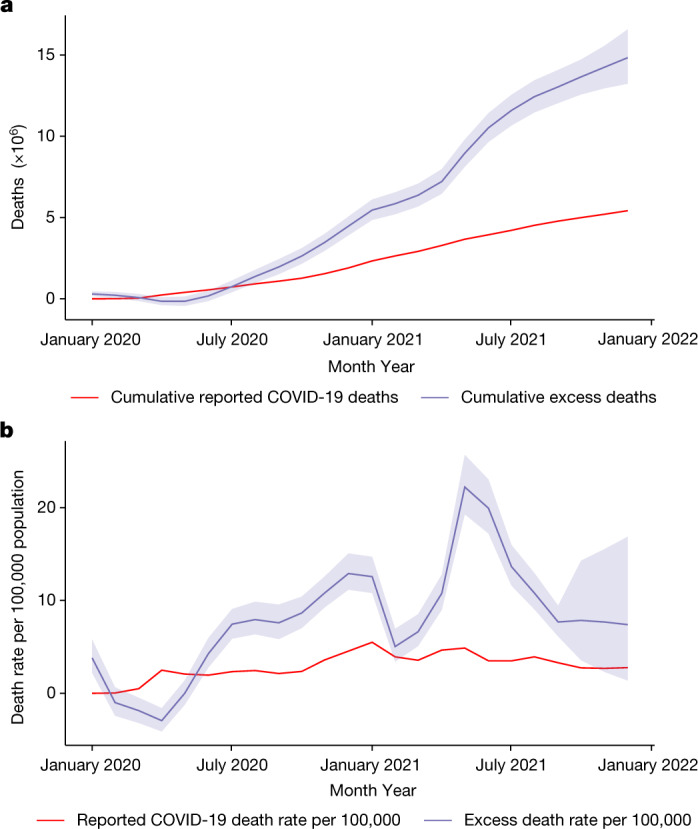
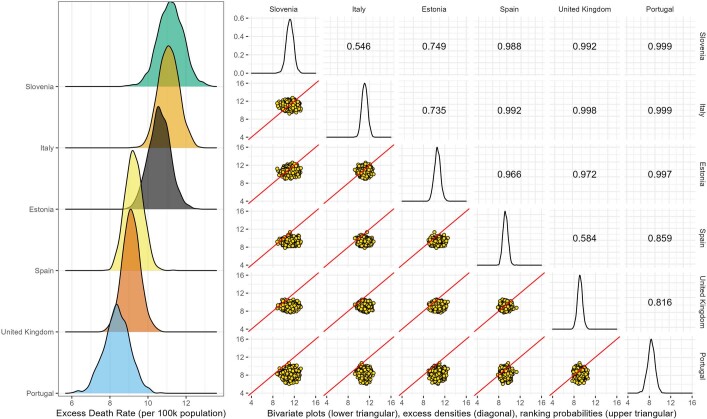
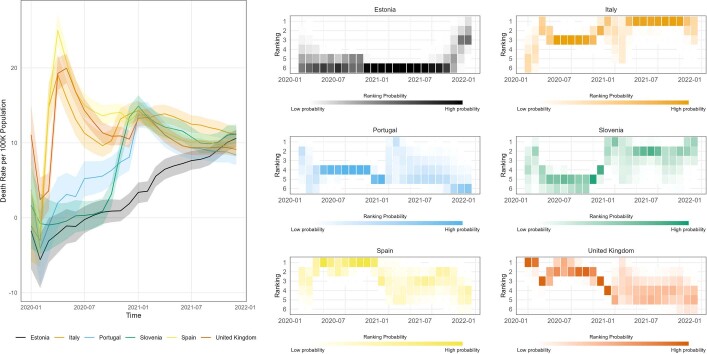
. Reported statistics on COVID-19 mortality are problematic for many countries owing to variations in testing access, differential diagnostic capacity and inconsistent certification of COVID-19 as cause of death. Beyond what is directly attributable to it, the pandemic has caused extensive collateral damage that has led to losses of lives and livelihoods. Here we report a comprehensive and consistent measurement of the impact of the COVID-19 pandemic by estimating excess deaths, by month, for 2020 and 2021. We predict the pandemic period all-cause deaths in locations lacking complete reported data using an overdispersed Poisson count framework that applies Bayesian inference techniques to quantify uncertainty. We estimate 14.83 million excess deaths globally, 2.74 times more deaths than the 5.42 million reported as due to COVID-19 for the period. There are wide variations in the excess death estimates across the six World Health Organization regions. We describe the data and methods used to generate these estimates and highlight the need for better reporting where gaps persist. We discuss various summary measures, and the hazards of ranking countries' epidemic responses.
Overview
CoChat Summary
TL;DR
WHO estimated global excess mortality from COVID-19 for January 2020–December 2021 at 14.83 million deaths, using a Bayesian Poisson framework to fill gaps where all-cause mortality data were incomplete. The estimate is 2.74 times the 5.42 million COVID-19 deaths reported to WHO for the same period.
Key findings
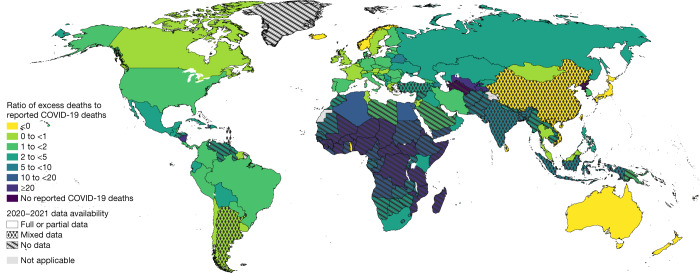
- Globally, the paper estimates 14.83 million excess deaths over 2020–2021 (95% UI 13.23–16.58 million), compared with 5.42 million reported COVID-19 deaths; the excess-to-reported ratio is 2.74 (UI 2.44–3.06).
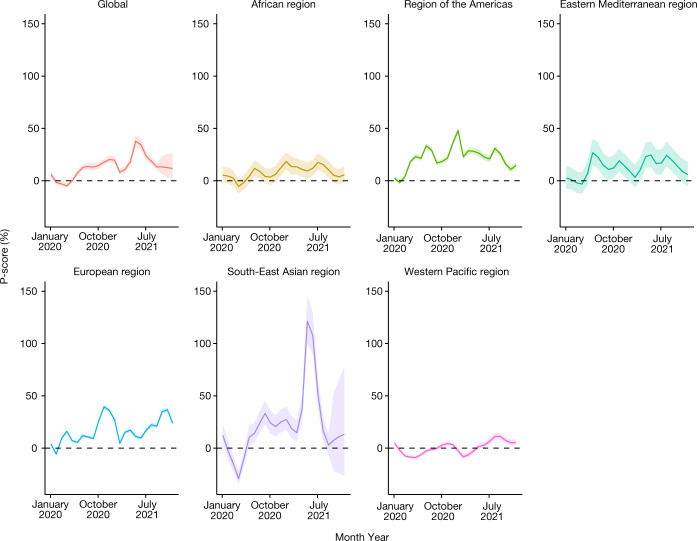
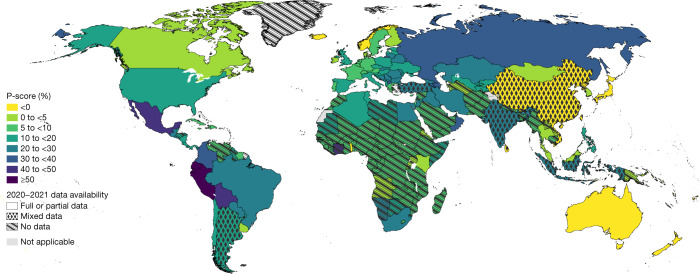
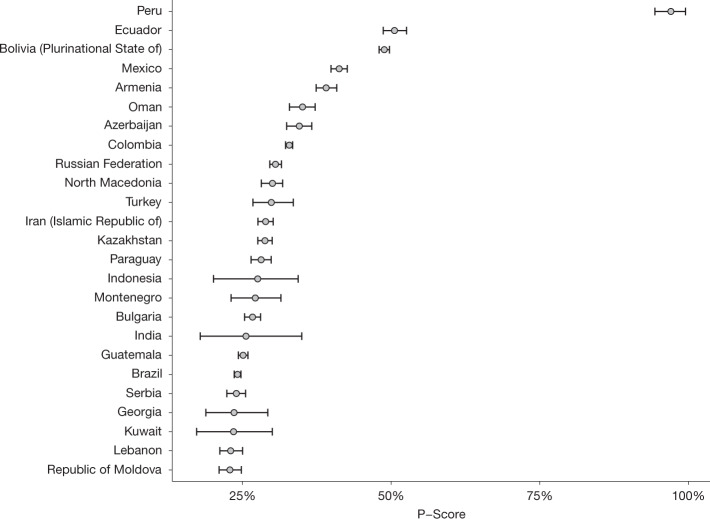
- Excess deaths were estimated at 4.47 million in 2020 and 10.36 million in 2021 globally; the global P-score increased from 7.97% in 2020 to 18.30% in 2021.
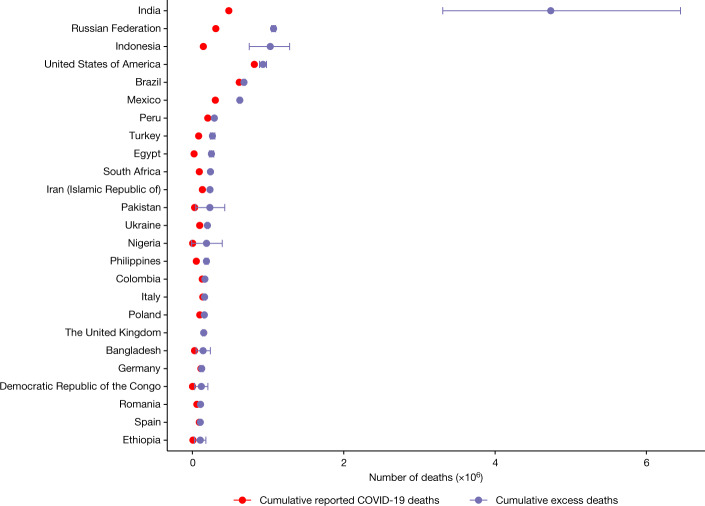
- The paper reports large country-level totals, including India: 4.74 million excess deaths (UI 3.31–6.45 million), Russian Federation: 1.07 million (UI 1.05–1.10 million), Indonesia: 1.03 million (UI 0.75–1.29 million), and the United States: 932,000 (UI 887,000–978,000).
- The 20 countries with the highest excess estimates account for 48.9% of the global population and over 80% of estimated global excess deaths for January 2020–December 2021.
Methods
- The study used a WHO-led, consultative modelling process: a Technical Advisory Group developed methods, WHO member states reviewed preliminary estimates, and feedback was used to update the final estimates.
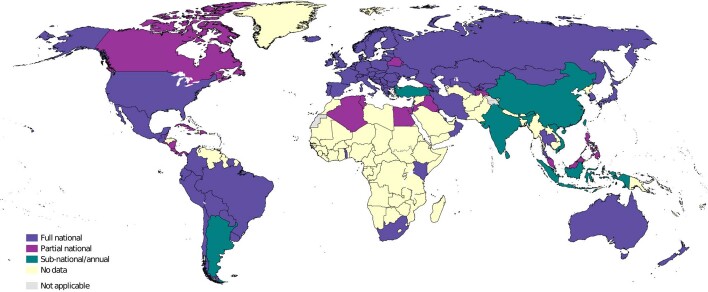
- The analysis used all-cause mortality (ACM) data from multiple sources; monthly national data were available for 100 countries (52%), while other locations had annual, subnational, or no data.
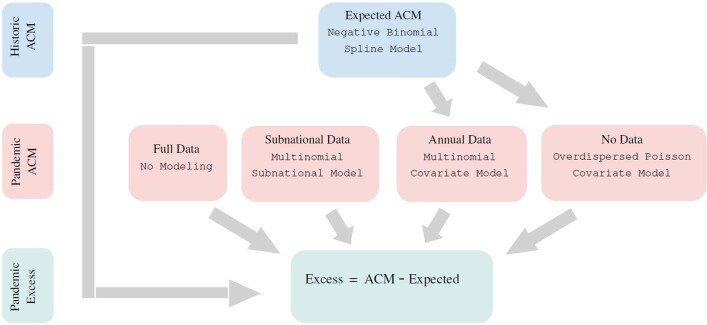
- Excess deaths were estimated with a Bayesian Poisson / negative binomial framework: historical ACM (often 2015–2019) was used to model expected deaths with spline-based seasonal and annual trends; where pandemic data were incomplete, a covariate-based log-linear model and, for some countries, subnational-to-national multinomial/proportionality models were used.
Limitations
- The paper states that the biggest limitation is data paucity: for almost half of WHO member states, ACM data during the pandemic were unavailable, so estimates relied on statistical models; the text says these countries should be interpreted with caution.
- The paper states that the counterfactual trend is sensitive to modelling assumptions, including the choice of spline models and how recent historical years are weighted; it notes splines can produce inappropriate extrapolations.
- The text makes evident that comparisons across countries/regions are difficult because countries differ in age structure, data completeness, and reporting quality; this is stated in the paper and means rankings can be misleading.
- The text makes evident that the paper cannot quantify how much excess mortality is directly COVID-19 versus indirect or non-COVID causes; the discussion explicitly says excess mortality combines these and cannot separate them.
Model-written summary. Check it against the paper before relying on it.
Integrity signals
Registry
Cites
Statistics
Figures
Verification
Claims the paper makes
8 Valid · 2 Not valid · 6 Not checked · 81 Own results and interpretations
Every source the paper cites for this claim was checked and supports it.
In the paper
“Reported statistics on COVID-19 mortality are problematic for many countries owing to variations in testing access, differential diagnostic capacity and inconsistent certification of COVID-19 as cause of death.”
- Also stated in: § Main · plain
“countries have differed in their application of standards for the certification of COVID-19 as the underlying cause-of-death2.”
§ The WHO estimates of excess mortality associated with the COVID-19 pandemic > Abstract
What the sources say
- Supportedcites [2] Riffe T Acosta E Data Resource Profile: COVerAGE-DB: a global demographic database of COVID-19 cases and deaths Int. J. Epidemiol. 2021 50 390 390f 10.1093/ije/dyab027 source
The Strengths and weaknesses section says COVID-19 death counts are likely underestimated for reasons also affecting case counts, including testing capacity and diagnostic-test accuracy. It also describes differences in whether suspected deaths are counted and evidence that COVID-19-related deaths are classified under other causes. Page numbers were not supplied in our copy. (LLM, conf=0.90)
plainstates a cause- Asserted: passes — The authors put it forward as true.
- Checkable: passes — It can be checked against evidence.
- Load-bearing: passes — The paper’s conclusions depend on it.
- Based: passes — The paper gives a reason why it holds.
- Also stated in: § Main · plain
Every source the paper cites for this claim was checked and supports it.
In the paper
“The measure overcomes the variation among countries in reporting and testing and the misclassification of the cause of death on death certificates7”
§ The WHO estimates of excess mortality associated with the COVID-19 pandemic > Main
What the sources say
- Supportedcites [7] Beaney T Excess mortality: the gold standard in measuring the impact of COVID-19 worldwide? J. Royal Soc. Med. 2020 113 329 334 10.1177/0141076820956802 PMC7488823 32910871 source
The Excess mortality section states that, because it encompasses deaths from all causes, excess mortality overcomes cross-country variation in COVID-19 reporting and testing and misclassification of causes on death certificates. This directly matches the attributed claim. (LLM, conf=0.95)
plainstates a cause- Asserted: passes — The authors put it forward as true.
- Checkable: passes — It can be checked against evidence.
- Load-bearing: passes — The paper’s conclusions depend on it.
- Based: passes — The paper gives a reason why it holds.
- Supported
Every source the paper cites for this claim was checked and supports it.
In the paper
“This surpasses the influenza pandemics of 1957, 1968 and 2009 (estimated at 0.04%, 0.03% and 0.005%, respectively)18.”
§ The WHO estimates of excess mortality associated with the COVID-19 pandemic > Discussion
What the sources say
- Supportedcites [18] Simonsen L Viboud C Mortality: a comprehensive look at the COVID-19 pandemic death toll. eLife 2021 10 e71974 10.7554/eLife.71974 34382937 PMC8360646 source
Table 1 (Abstract) gives a global per capita excess mortality rate of >0.08% for COVID-19, exceeding its estimates of 0.04%, 0.03%, and 0.005% for the 1957, 1968, and 2009 influenza pandemics, respectively. The paper describes the COVID-19 estimate using data available in 2020–2021. (LLM, conf=0.94)
plain- Asserted: passes — The authors put it forward as true.
- Checkable: passes — It can be checked against evidence.
- Load-bearing: unclear — It is unclear whether the paper’s conclusions depend on it.
- Based: passes — The paper gives a reason why it holds.
- Supported
Every source the paper cites for this claim was checked and supports it.
In the paper
“As another example, in the Africa region for which ACM data are most lacking, recent studies have highlighted the underestimation in the reported statistics20.”
§ The WHO estimates of excess mortality associated with the COVID-19 pandemic > Discussion
What the sources say
- Supportedcites [20] Cabore J. W. et al. COVID-19 in the 47 countries of the WHO African region: a modelling analysis of past trends and future patterns. Lancet Glob. Health10, e1099–e1114 (2022). PMC9159735 35659911 source
The Introduction states that reported infections and deaths underestimate the actual COVID-19 burden in the WHO African region. It also reports that, in countries with seroprevalence studies, reported infections represented only a small proportion of the estimated burden. Page numbers were not provided. (LLM, conf=0.94)
plainstates an association- Asserted: passes — The authors put it forward as true.
- Checkable: passes — It can be checked against evidence.
- Load-bearing: unclear — It is unclear whether the paper’s conclusions depend on it.
- Based: passes — The paper gives a reason why it holds.
- Supported
Every source the paper cites for this claim was checked and supports it.
In the paper
“The uncertainty in the expected predictions is well modelled by a gamma distribution, and the advantage of this choice is that it can be conveniently combined with a Poisson model to produce a negative binomial model with the log-linear mean given by equation (3).”
§ The WHO estimates of excess mortality associated with the COVID-19 pandemic > Methods > Model for countries without full pandemic data For almost half of the 194 WHO member states we do not have the ACM counts over the pandemic, and so must predict them using country characteristics. We choose a simple form for this prediction model, with mean2where is a relative rate parameter. If , then for country and at month the mortality is greater than expected, whereas if , then for country and at month the mortality is less than expected. We used time-invariant variables, (these are annual values from 2019). These were an indicator of high income and/or low or middle income, the cardiovascular mortality rate in 2019 and the diabetes prevalence rate in 2019. In addition, we used time-varying variables: a containment variable (it is calculated using all ordinal containment and closure policy indicators and health-system policy indicators, for further details see Hale et al.14), the square root of the reported COVID-19 death rate, temperature and the COVID-19 test positivity rate. We then build a log-linear model for the rate parameter:3where and denote relative rate parameters and are independent error contributions that pick up random variation unexplained by the log-linear regression function. The time-varying coefficients allow the associations to evolve during the pandemic. As we desire the evolution to be smooth in time, for these time-varying coefficients we use a random walk of order 2 (RW2) prior that encourages smooth estimates46. In equation (2) above, we have conditioned on known expected numbers. In reality, and as just described, these are modelled to give a distribution over plausible values. The uncertainty in the expected predictions is well modelled by a gamma distribution, and the advantage of this choice is that it can be conveniently combined with a Poisson model to produce a negative binomial model with the log-linear mean given by equation (3). Full details (including evidence of the accuracy of the gamma model) can be found in Knutson et al.15. This model was fitted to all countries with observed monthly ACM data over some portion of 2020–2021, using the integrated nested Laplace approximation method47, to obtain posterior distributions over the unknown parameters. The resultant posterior distribution reflects the uncertainty in the parameters (both in the expected numbers and the log-linear covariate model), and can be used to construct a predictive distribution for the ACM in countries with no data or partial data.
What the sources say
- Supportedcites Knutson et al.15 Knutson V., Aleshin-Guendel S., Karlinsky A., Msemburi W. & Wakefield J. Estimating country-specific excess mortality during the COVID-19 pandemic (2023). Ann. Appl. Stat. (in the press). PMC9812776 36517599 source
Section 3.3 (Modeling Uncertainty in the Expected Numbers) states they fit a gamma distribution by method of moments to the Monte Carlo samples of the expected numbers and 'approximate the distribution of the expected numbers as gamma, since this is conjugate to the Poisson, and so allows efficient inference with INLA ... using a negative binomial,' and the Supplementary Materials (Sec. 5, Gamma Expected Numbers; Fig. 5) report the gamma fits are accurate, with differences 'small in all cases' — supporting 'well modelled'. The model description bullet confirms the negative binomial component with known tau arises from the uncertainty in the expected numbers within the log-linear Poisson/negative-binomial formulation. The 'equation (3)' reference is the citing paper's own display, not attributed content. (LLM, conf=0.90)
boosted- Asserted: passes — The authors put it forward as true.
- Checkable: passes — It can be checked against evidence.
- Load-bearing: passes — The paper’s conclusions depend on it.
- Based: passes — The paper gives a reason why it holds.
- Supported
49 more claims
Create a free account to see all 97 claims and to verify the 2 references still open.
- Probably not a substantial claim. 19
- It may state two separate claims as one. 30
- The quote only partly states this claim. 2
Claims other papers make about this one
Each is checked against this paper’s own text: does it say what the citing paper says it does?
The source backs part of the claim, not all of it — or backs it for a different population, condition or comparison.
In the citing paper
“Our current estimate of global excess mortality during 2020 and 2021 is comparable to the WHO estimate of 14·9 million (95% UI 13·3–16·6) excess deaths,15 with our mean estimate falling within the uncertainty interval of the WHO estimate and vice versa.”
From Global age-sex-specific mortality, life expectancy, and population estimates in 204 countries and territories and 811 subnational locations, 1950–2021, and the impact of the COVID-19 pandemic: a comprehensive demographic analysis for the Global Burden of Disease Study 2021 (2024) · cites this paper as [15]
Experimental — accuracy not yet measuredThe cited source says what the claim attributes to it.
In the citing paper
“this total greatly exceeds global average increases of 8% in 2020 and 18% in 20214.”
From Attributed causes of excess mortality during the COVID-19 pandemic in a south Indian city (2023) · cites this paper as [4]
In the citing paper
“Other settings with >25% increases in mortality during the pandemic have included Russia and LMICs within Latin America, Eastern Europe, and central Asia1,4.”
From Attributed causes of excess mortality during the COVID-19 pandemic in a south Indian city (2023) · cites this paper as [4]
Citations
Cites
Vos, T., Lim, S. S., Abbafati, C., Abbas, K. M., Abbasi, M., Abbasifard, M., Abbasi-Kangevari, M., Abbastabar, H., Abd-Allah, F., Abdelalim, A., et al. (2020) · The Lancet · doi:10.1016/s0140-6736(20)30925-9 · Cited by 19,358
Generalized Additive Models: An Introduction with R
Wood, S. N. (2017) · doi:10.1201/9781315370279 · Cited by 13,852
Rue, H., Martino, S., & Chopin, N. (2009) · Journal of the Royal Statistical Society Series B: Statistical Methodology · doi:10.1111/j.1467-9868.2008.00700.x · Cited by 5,279
Wang, H., Paulson, K. R., Pease, S. A., Watson, S., Comfort, H., Zheng, P., Aravkin, A. Y., Bisignano, C., Barber, R. M., Alam, T., et al. (2022) · The Lancet · doi:10.1016/s0140-6736(21)02796-3 · Cited by 2,069
Rue, H., & Held, L. (2005) · Chapman & Hall/CRC eBooks · doi:10.1201/9780203492024 · Cited by 1,823
Guidelines for accurate and transparent health estimates reporting: the GATHER statement
Stevens, G. A., Alkema, L., Black, R. E., Boerma, J. T., Collins, G. S., Ezzati, M., Grove, J. T., Hogan, D. R., Hogan, M. C., Horton, R., et al. (2016) · The Lancet · doi:10.1016/s0140-6736(16)30388-9 · Cited by 1,798
Karlinsky, A., & Kobak, D. (2021) · eLife · doi:10.7554/elife.69336 · Cited by 772
Self-citationMurray, C. J., Lopez, A. D., Chin, B., Feehan, D., & Hill, K. H. (2006) · The Lancet · doi:10.1016/s0140-6736(06)69895-4 · Cited by 605
Islam, N., Shkolnikov, V. M., Acosta, R. J., Klimkin, I., Kawachi, I., Irizarry, R. A., Alicandro, G., Khunti, K., Yates, T., Jdanov, D. A., et al. (2021) · BMJ · doi:10.1136/bmj.n1137 · Cited by 468
Guidelines for accurate and transparent health estimates reporting: the GATHER statement
Stevens, G. A., Alkema, L., Black, R. E., Boerma, J. T., Collins, G. S., Ezzati, M., Grove, J. T., Hogan, D. R., Hogan, M. C., Horton, R., et al. (2016) · PLOS Medicine · doi:10.1371/journal.pmed.1002056 · Cited by 424
Research works printed but not linked: 2
- National Bureau of Statistics of China. China Statistical Yearbook 2021 (China Statistics Press, 2021).
- Hale, T. et al. Variation in Government Responses to COVID-19 Technical Report (Univ. Oxford, 2020).
Cited by
Items 901–1,000 of 1,067
Estimating all-cause excess mortality during COVID-19 pandemic in Serbia, 2020-2022
Medarević, A., & Vasić, M. (2025) · Demografija · doi:10.5937/demografija2522023m
Ferdowsian, H., & Halabi, S. (2025) · BMJ Global Health · doi:10.1136/bmjgh-2025-021304
Chen, Y., Zhu, W., Han, X., Chen, M., Li, X., Huang, H., Zhang, M., Wei, R., Zhang, H., Yang, C., et al. (2024) · Figshare · doi:10.6084/m9.figshare.26696391
Roy, A. V., Chan, M., Banadyga, L., He, S., Zhu, W., Chrétien, M., & Mbikay, M. (2024) · Figshare · doi:10.6084/m9.figshare.26673120
Chen, Y., Zhu, W., Han, X., Chen, M., Li, X., Huang, H., Zhang, M., Wei, R., Zhang, H., Yang, C., et al. (2024) · Figshare · doi:10.6084/m9.figshare.26696376
Gmanyami, J. M., Quentin, W., Lambert, O., Jarynowski, A., Belik, V., & Amuasi, J. H. (2024) · Figshare · doi:10.6084/m9.figshare.26736516
Chen, Y., Zhu, W., Han, X., Chen, M., Li, X., Huang, H., Zhang, M., Wei, R., Zhang, H., Yang, C., et al. (2024) · Figshare · doi:10.6084/m9.figshare.26696388
Roy, A. V., Chan, M., Banadyga, L., He, S., Zhu, W., Chrétien, M., & Mbikay, M. (2024) · Figshare · doi:10.6084/m9.figshare.26673117
Chen, Y., Zhu, W., Han, X., Chen, M., Li, X., Huang, H., Zhang, M., Wei, R., Zhang, H., Yang, C., et al. (2024) · Figshare · doi:10.6084/m9.figshare.26696382
Roy, A. V., Chan, M., Banadyga, L., He, S., Zhu, W., Chrétien, M., & Mbikay, M. (2024) · Figshare · doi:10.6084/m9.figshare.25067266
Roy, A. V., Chan, M., Banadyga, L., He, S., Zhu, W., Chrétien, M., & Mbikay, M. (2024) · Figshare · doi:10.6084/m9.figshare.25067334
Additional file 1 of Population age structure dependency of the excess mortality P-score
Ullrich-Kniffka, N., & Schöley, J. (2024) · Figshare · doi:10.6084/m9.figshare.27123992
Gmanyami, J. M., Quentin, W., Lambert, O., Jarynowski, A., Belik, V., & Amuasi, J. H. (2024) · Figshare · doi:10.6084/m9.figshare.26736513
Pohl, R., Stallmann, C., Marquardt, P., Bank, U., Färber, J., Scheibler, L., Heuft, H.-G., Kaasch, A. J., & Apfelbacher, C. (2024) · Figshare · doi:10.6084/m9.figshare.26754601
Ghafari, M., Hosseinpour, S., Rezaee-Zavareh, M. S., Dascalu, S., Rostamian, S., Aramesh, K., Madani, K., & Kordasti, S. (2024) · Figshare · doi:10.6084/m9.figshare.26638929
Chen, Y., Zhu, W., Han, X., Chen, M., Li, X., Huang, H., Zhang, M., Wei, R., Zhang, H., Yang, C., et al. (2024) · Figshare · doi:10.6084/m9.figshare.26696385
Liu, S., Anzai, A., & Nishiura, H. (2024) · Figshare · doi:10.6084/m9.figshare.24934201
Chen, Y., Zhu, W., Han, X., Chen, M., Li, X., Huang, H., Zhang, M., Wei, R., Zhang, H., Yang, C., et al. (2024) · Figshare · doi:10.6084/m9.figshare.26696379
Razimoghadam, M., Yaseri, M., Rezaee, M., Fazaeli, A., & Daroudi, R. (2024) · Figshare · doi:10.6084/m9.figshare.25150600
Gmanyami, J. M., Quentin, W., Lambert, O., Jarynowski, A., Belik, V., & Amuasi, J. H. (2024) · Figshare · doi:10.6084/m9.figshare.26736519
Chen, Y., Zhu, W., Han, X., Chen, M., Li, X., Huang, H., Zhang, M., Wei, R., Zhang, H., Yang, C., et al. (2024) · Figshare · doi:10.6084/m9.figshare.26696394
Roy, A. V., Chan, M., Banadyga, L., He, S., Zhu, W., Chrétien, M., & Mbikay, M. (2024) · Figshare · doi:10.6084/m9.figshare.26673114
Chen, Y., Zhu, W., Han, X., Chen, M., Li, X., Huang, H., Zhang, M., Wei, R., Zhang, H., Yang, C., et al. (2024) · Figshare · doi:10.6084/m9.figshare.25459546
Chen, Y., Zhu, W., Han, X., Chen, M., Li, X., Huang, H., Zhang, M., Wei, R., Zhang, H., Yang, C., et al. (2024) · Figshare · doi:10.6084/m9.figshare.25459675
Pohl, R., Stallmann, C., Marquardt, P., Bank, U., Färber, J., Scheibler, L., Heuft, H.-G., Kaasch, A. J., & Apfelbacher, C. (2024) · Figshare · doi:10.6084/m9.figshare.26754604
Ledesma, J. R., Papanicolas, I., Stoto, M. A., Chrysanthopoulou, S. A., Isaac, C. R., Lurie, M. N., & Nuzzo, J. B. (2024) · Figshare · doi:10.6084/m9.figshare.26734443
A Molecular Study of Covid-19 By Using ROF1b\N\E Gene in Wasit Province
Shallal, Z. S., & Al-Hachami, S. A. A. (2024) · Academic International Journal of Medical Sciences · doi:10.59675/m228
Potential and challenges for sustainable progress in human longevity.Preprint
Camarda, C. G., Grigoriev, P., & Bonnet, F. (2026) · OSF Preprints (OSF Preprints)
Beyond Lectures: Building the Future of Higher Education with Active Learning and Innovation
Nagpal, N., Rahmawati, Y., & Mardiah, A. (2025) · BENTHAM SCIENCE PUBLISHERS eBooks · doi:10.2174/9798898811297125060013
Song, J., Jun, H. W., Jeong, S., Park, S. J., Shin, H.-Y., Eun-Kyeong, J., Jung, J., Kim, G., & Park, S. M. (2025) · BMC Infectious Diseases · doi:10.1186/s12879-025-12089-6
“In the first two years of the COVID-19 pandemic (2020–2021), approximately 15 to 18 million excess deaths occurred [2, 3].”
Sichone, J., Sinkala, M., Munsaka, S. M., & Simuunza, M. C. (2025) · medRxiv · doi:10.64898/2025.12.25.25343016
Johansen, M. D., Ming, C. L. C., Hansbro, P. M., & Gentile, C. (2026) · Biofabrication · doi:10.1088/1758-5090/ae38d7 · Cited by 1
Temporal Evolution of the Impact of CKD on COVID-19 Outcomes
Barajas, J. D. G., Prieto-Magallanes, M. L., Romo-Alvarez, C., et al. (2026) · Kidney360 · doi:10.34067/kid.0000001133
“…and reduced vaccine ef fi cacy, resulting in higher viral loads and weaker protection against severe acute respiratory syndrome coronavirus 2, even postvaccination 36,37,41 Furthermore, CKD promotes a proin fl ammatory and prothrombotic state that exacerbates COVID-19's complications, such…”
Odunyemi, A., Sohrabi, H., & Alam, K. (2026) · BMC Health Services Research · doi:10.1186/s12913-026-14086-0 · Cited by 1
“Government-imposed MPRs were captured via two explanatory variables: [1] state-level lockdown type (total vs. partial, binary-coded based on policy reports); [2] Google Mobility data (percentage change in visits to grocery/pharmacy and retail/recreation sites, aggregated to classify states as…”
Léger, C., Boucher, V. G., Deslauriers, F., Gupta, S. K., Dialufuma, M. V., Vallis, M., Bacon, S., & Lavoie, K. (2026) · Journal of Occupational Health · doi:10.1093/joccuh/uiag002
Transcriptomic subtyping of COVID-19 reveals three distinct immune response profile
Qiao, F., Zhao, Y., Yao, K., Song, S., Zheng, L., Wang, Q., Hu, J., Lv, Y., Han, F., & Li, F. (2026) · Autoimmunity · doi:10.1080/08916934.2026.2618284
Trends in Stroke Mortality Among Adults in Southern Brazil: A Time Series Study (2000-2021)
de Souza, O. F., Farias-Santos, B. C. D. S., Silva, B. S., et al. (2026) · International Journal of Preventive Medicine · doi:10.4103/ijpvm.ijpvm_123_24
“[21] Thus, the decrease in the proportion of stroke deaths among adults in the Parana State may have occurred due to the proportional increase in COVID‑19 deaths.”
AlAani, K. M., Abdulla, L. A., Almajed, A., Mohroofi, A. D. M., Almutawa, A. E., Alnajdi, M. H., Alghawi, S. S., Alqallaf, S. M., & Alroomi, K. (2026) · Journal of Family Medicine and Primary Care · doi:10.4103/jfmpc.jfmpc_1799_25
“[2] Although studies showed that almost all countries were affected by the pandemic, including Gulf Cooperation Council countries, these countries reported less mortality and cases compared to the worldwide data.”
Bioelectromagnetism, influenza, and the COVID-19 pandemic: are there any links?
Martel, J. (2026) · Elsevier eBooks · doi:10.1016/b978-0-443-33018-6.00014-2
Shah, S. K. (2026) · Oxford University Press eBooks · doi:10.1093/9780197667927.002.0005
Lessons Learned About CHI Research Ethics
Shah, S. K. (2026) · Oxford University Press eBooks · doi:10.1093/9780197667927.003.0008
How Can the Ethics of CHI Research Help Advance Research Ethics?
Shah, S. K. (2026) · Oxford University Press eBooks · doi:10.1093/9780197667927.003.0007
Is CHI Research Ethically Unique?
Shah, S. K. (2026) · Oxford University Press eBooks · doi:10.1093/9780197667927.003.0003
The “Yuck Factor”: Is Controlled Human Infection Research Intuitively Unethical?
Shah, S. K. (2026) · Oxford University Press eBooks · doi:10.1093/9780197667927.003.0002
A Historical Overview of Challenge Studies: Promise and Peril
Shah, S. K. (2026) · Oxford University Press eBooks · doi:10.1093/9780197667927.003.0001
Ethical Guidance and Frameworks for CHI Models and Studies
Shah, S. K. (2026) · Oxford University Press eBooks · doi:10.1093/9780197667927.003.0004
Intentionally Infecting Humans: Is it Ethical?
Shah, S. K. (2026) · doi:10.1093/9780197667927.001.0001 · Cited by 2
CHI Research with Emerging Infectious Diseases
Shah, S. K. (2026) · Oxford University Press eBooks · doi:10.1093/9780197667927.003.0005
CHI Research with Newer Populations
Shah, S. K. (2026) · Oxford University Press eBooks · doi:10.1093/9780197667927.003.0006
Saleki, K., Shirzad, M., Mohammadkhani, S., Javanian, M., Oladnabi, M., & Azadmehr, A. (2026) · Biochemistry and Biophysics Reports · doi:10.1016/j.bbrep.2026.102505
“A recent report by World Health Organization (WHO) suggests that COVID-19 may have led to the death of more than 14 million individuals around the globe [2].”
Cornejo, R. C. (2026) · Latin American Politics and Society · doi:10.1017/lap.2025.10044
“Mexico is an especially interesting case given its high death toll from the coronavirus pandemic — measured by both excess and cumulative deaths (Our World in Data 2021; Msemburi et al. 2023) — and the elite rhetoric that actively downplayed the virus ’ s deadliness.”
Zarulli, V., Strozza, C., & Rizzi, S. (2026) · Journal of Public Health Research · doi:10.1177/22799036261423654
“23 In our analysis, we take a similar approach, focusing on the entire population, not just hospitalized individuals.”
Nilsson, A., Dietler, D., Bonander, C., et al. (2026) · Scandinavian Journal of Public Health · doi:10.1177/14034948261420643
“The COVID-19 pandemic has had substantial impacts on mortality and morbidity around the world, even after the implementation of vaccinations [1, 2].”
Daniel, L., Pramod, M., Ramamoorthy, K., et al. (2026) · TNOA Journal of Ophthalmic Science and Research · doi:10.4103/tjosr.tjosr_61_25
Kumar, P., Suraweera, W., Karlinsky, A., & Jha, P. (2026) · BMJ Open · doi:10.1136/bmjopen-2024-097857
Self-citationDomnich, A., & Pariani, E. (2026) · Expert Review of Molecular Diagnostics · doi:10.1080/14737159.2026.2638743
“…Health Organization (WHO) had reported over 7 million confirmed deaths from SARS-CoV-2 infection [1], but this number significantly underestimates the true mortality due to variations in testing access, diagnostic capacity, data collection, and death reporting standards, among other factors [2].”
Школьников, В. М., Тимонин, С. А., Jdanov, D. A., Medina-Jaudes, N., Islam, N., & Leon, D. A. (2026) · PLoS ONE · doi:10.1371/journal.pone.0344003 · Cited by 11
Mortality risk during the COVID-19 pandemic is shaped by human development
Nenoff, K., Habershon, S., Mahecha, M. D., Attinger, S., Teber, K., & Kraemer, G. (2026) · BMC Global and Public Health · doi:10.1186/s44263-026-00255-0
“Many excess mortality estimates have been published [1, 2, 7, 9].”
InfluentialA comparative nanomechanical study of antibody and nanobody binding to SARS-CoV-2 variants
Cofas‐Vargas, L. F., Olivos-Ramirez, G. E., Marrink, . J., & Poma, A. B. (2026) · Physical Chemistry Chemical Physics · doi:10.1039/d6cp00556j · Cited by 2
Álvarez-López, D. I., Ferreira-Guerrero, E., Salcido, M. Á. G., et al. (2026) · BIOtecnia · doi:10.18633/biotecnia.v28.2830
Okada, Y., & Nishiura, H. (2026) · PLoS Computational Biology · doi:10.1371/journal.pcbi.1013990
“The coronavirus disease 2019 (COVID-19) pandemic has caused extensive mortality since its emergence in 2019 in Wuhan, China [1–3].”
Kamradt‐Scott, A. (2026) · De Gruyter eBooks · doi:10.1515/9783111519869-028
Rich dynamics and data analysis of immune decline against SARS-CoV-2
Wang, Z., Jing, S., Xiang, H., et al. (2026) · Advances in Continuous and Discrete Models · doi:10.1186/s13662-026-04069-0
Songvut, P., Payoong, P., Okada, P. A., et al. (2026) · Frontiers in Pharmacology · doi:10.3389/fphar.2026.1781740
Kramer, M. R., Peterson, E. S., & Cooper, H. L. F. (2026) · medRxiv · doi:10.64898/2026.03.15.26348441
Mortality before and during the COVID-19 pandemic in Manhiça district, Southern Mozambique
Sacoor, C. N., Nhacolo, A., Muir, J. A., Jamisse, E. L., Barr, B. T., Nhacolo, A., Kabudula, C., Bashingwa, J. J. H., Augusto, O. J., Chaúque, A., et al. (2026) · Population Health Metrics · doi:10.1186/s12963-025-00449-y
Alam, S. S., Amee, N. E. J., Chowdhury, S., Hasan, M. M., Kabudula, C. W., Bashingwa, J. J. H., Sagar, M. S., Bhuiyan, M. A., Haq, M. Z., Barr, B. A. T., et al. (2026) · Population Health Metrics · doi:10.1186/s12963-025-00447-0 · Cited by 1
“The number of global excess deaths was estimated to be around 14.83 million, which is 2.74 times higher than the reported 5.42 million COVID-19 deaths during the same period [3–5].”
InfluentialVerhaegen, K. A., Paredis, M., Taeldeman, V., Demarest, S. S., Charafeddine, R., Bracke, P., Delaruelle, K., & Braekman, E. (2026) · BMC Public Health · doi:10.1186/s12889-026-26932-1
“It has been shown before that there was variation between countries in the severity of the COVID-19 crisis [63], the stringency of policies to tackle it [64, 65], and its effects on outcomes such as mental health [66].”
Paulson, K. R., Fuglstad, G., Li, Z., & Wakefield, J. C. (2026) · The Annals of Applied Statistics · doi:10.1214/25-aoas2100 · Cited by 2
Self-citationLou, J. J., & Hua, Z. (2026) · Language & Communication · doi:10.1016/j.langcom.2026.02.003
Self-powered and self-purifying building envelopes: Progress, challenges, and future perspectives
Qian, Y., Jie, J., Xu, S., et al. (2026) · Green Technology & Innovation · doi:10.65582/gti.2026.005
SUNG, M., Jang, H. J., Han, S., Won, S., Lee, B., & Kim, Y. S. (2026) · Acute and Critical Care · doi:10.4266/acc.003375
“Model selection was based on Bayesian information criterion, and no significant overdispersion was detected [9].”
Beyond COVID-19 Deaths: Cause-Specific Analysis of Excess Mortality in RussiaPreprint
Degtiareva, E., Тимонин, С. А., Tilstra, A. M., & Aburto, J. M. (2026) · medRxiv · doi:10.64898/2026.03.23.26349084
Xin, H., Ye, C., Yu, J., Fang, L., Lai, S., Du, Z., Zhang, L., Wang, Z., Cowling, B. J., Wu, P., et al. (2026) · Research Square · doi:10.21203/rs.3.rs-9045299/v1
Liao, Y., Wang, Y., Wang, Y., Ai, J., Kiat, L. B., Lim, D., Zhou, J., Wang, H., Wu, Y., Chia, P. Y., et al. (2026) · medRxiv · doi:10.64898/2026.04.03.26350141
Rakotondramanga, J. M. (2023) · theses.fr (ABES) · doi:10.70675/aae0cc9az3b0fz4ccdzb05az583a89448b7d
The mechanisms and consequences of SARS-CoV-2 induced cell-to-cell fusion
Bolland, W. (2024) · theses.fr (ABES) · doi:10.70675/37becb05zce46z4760z8c80zee5762b9dcea
Multivariate extensions for mortality modelling
Burg, A. (2025) · theses.fr (ABES) · doi:10.70675/7533defaz93dcz4857za874z5917bdc44103
Simple and easy to build mechanical ventilator for pandemic health crises in resource-limited areas
Farré, R., Salama, R., Rodríguez-Lázaro, M. A., Kiarostami, K., Fernández‐Barat, L., Oliveira, V. D. C., Torres, A., Farré, N., Dinh‐Xuan, A. T., Gozal, D., et al. (2026) · Frontiers in Public Health · doi:10.64898/2026.04.08.26350386
Sánchez-Boluarte, A., Talagadadeevi, T., Calderon, D. G., Garcia, P. J., Pfeiffer, J. T., & Wasserheit, J. N. (2026) · BMJ Public Health · doi:10.1136/bmjph-2025-003382
Brás, G. R. (2026) · Education + Training · doi:10.1108/et-09-2024-0422
Purdum, J. C., Dixon, B. C., Mims, T., & Dominick, A. (2026) · Disaster Prevention and Management An International Journal · doi:10.1108/dpm-09-2025-0285
Ríos, O. G. V., Contreras, R. M., Zuta-Arriola, N., Mejía, M. L. F., Mancha, V., Paredes-Román, C., Paredes-Román, H., Porras-Roque, M., Luque-Ramos, L., Sarapura, E. Z., et al. (2026) · COVID · doi:10.3390/covid6040070
Drones and fungal spores: comparisons of low-cost sampling methods
Bangay, R., Matsuki, A., & Tuno, N. (2026) · Aerobiologia · doi:10.1007/s10453-026-09912-1 · Cited by 2
Dlamini, M., Msolo, L., Nontongana, N., Ebomah, K. E., & Okoh, A. (2026) · Food and Environmnetal Virology · doi:10.1007/s12560-026-09688-0
“SARS-CoV-2 is the virus responsible for COVID-19 and over 6 million people have died as a result of COVID-19, which has had a devastating impact globally (Msemburi et al., 2023).”
Strumilienė, E. (2026) · Pulmonology and allergology · doi:10.15388/vu.thesis.908
da Silva, J. H. C. M., Paglino, E., Borges, G. M., et al. (2026) · Journal of Urban Health · doi:10.1007/s11524-026-01076-0
“These estimates are likely underestimated because in Brazil, as in many other countries, excess deaths during the pandemic exceeded COVID-19 deaths [44], with some analyses suggesting at least partial misattribution of COVID-19 deaths to other causes of death [45].”
The role of antibody-mediated immunity in shaping the seasonality of respiratory viruses
Tobin, R. J., McCaw, J. M., & Shearer, F. M. (2026) · Journal of Theoretical Biology · doi:10.1016/j.jtbi.2026.112477
“Further, the COVID-19 pandemic has highlighted the risks that a newly emergent respiratory virus can pose, with the disease having caused at least five million deaths by the end of 2021 (Msemburi et al. 2023).”
Manipulation of information in times of crisis: evidence from Covid excess mortality
Karlinsky, A., & Shayo, M. (2026) · Journal of Economic Growth · doi:10.1007/s10887-026-09266-w · Cited by 1
“…note that, given the importance of these data for health and public policy, we have made the (unadjusted) excess mortality data publicly available in real time, and they formed the basis for analysis and policy by the WHO and others (Msemburi et al., 2023 ; Wang et al., 2022; The Economist, 2021).”
Self-citationChanges in life expectancy and life span equality during the COVID-19 epidemic in 2020-22 in Japan
Okada, Y., & Nishiura, H. (2026) · PLoS ONE · doi:10.1371/journal.pone.0345579 · Cited by 2
“Global studies suggest that from January 1 st , 2020 to December 31 st , 2021, excess deaths worldwide were in the range of 14.9– 15.9 million, with a large proportion attributed to India and the United States [3,4].”
InfluentialHassan, H. A., Anžel, A., İlgen, B., Luchner, M., Schramowski, P., Blasse, A., Mayer, J. U., Ladewig, K., Hattab, G., & Sprang, M. (2026) · Trends in Genetics · doi:10.1016/j.tig.2026.04.001 · Cited by 5
Elections and (mis)reporting of COVID-19 mortality: a quasi-natural experiment
Kpeli, P. A., Schulze, G. G., & Zakharov, N. (2026) · Economics of Governance · doi:10.1007/s10101-026-00357-3
Five values for COVID-19 vaccine acceptance described by racial and ethnic minoritized caregivers
Jain, S., Dayal, R. R., Sikov, J., et al. (2026) · Vaccine X · doi:10.1016/j.jvacx.2026.100822
Complicated Grief Among People Who Lost Loved Ones to COVID-19 in Panama
Bósquez, E., Oviedo, D. C., Britton, G. B., Tratner, A. E., Rodríguez-Araña, S., & Mon, R. (2026) · COVID · doi:10.3390/covid6050079
“However, global excess mortality from 2020–2021 was 2.7 times higher than the number of reported COVID-19 deaths, suggesting that official reports or indirectly (e.g., via famine) attributable to COVID-19 [2].”
InfluentialPryce, T. M., Haygarth, E. J., Lacsina, A. S., Oorschot, R. D., & Raby, E. (2026) · Microbiology Spectrum · doi:10.1128/spectrum.00019-26
The Effect of the COVID-19 Pandemic on Work-from-Home Job Creation: Firm-level Evidence from Italy
maida, A., Bratti, M., Brunetti, I., Corvasce, A., & Ricci, A. (2026) · American Journal of Health Economics · doi:10.1086/742272
Jarończyk, M., & Walory, J. (2026) · International Journal of Molecular Sciences · doi:10.3390/ijms27104375
“In the period from 1 January 2020 to 31 December 2021, the countries with the highest excess mortality rates were Poland, India, the Russian Federation, Indonesia and the USA [2].”
Mattos, A. J. C., Mazon, F. J. N., dos Santos, L. F. T., Bianco, J., Monfardini, F., dos Santos, G. P., de Sousa, L. D., Sasse, M. M., Rizzo, L. V., Fonseca, H. A. R., et al. (2026) · Infectious Diseases and Therapy · doi:10.1007/s40121-026-01355-y
“Between 2020 and 2022, more than 349 million cases were confirmed worldwide, with approximately 5.6 million deaths [1, 2].”
Influential
Metadata
- Authors
- Msemburi, W., Karlinsky, A., Knutson, V., Aleshin-Guendel, S., Chatterji, S., & Wakefield, J.
- Affiliations
- World Health Organization (CH)
- Hebrew University of Jerusalem (IL)
- University of Washington (US)
- Corresponding author
- Msemburi, William
- Venue
- Nature
- Published
- 2022-12-14
- Volume
- 613
- Issue
- 7942
- Pages
- 130-137
- ISSN
- 0028-0836 (ISSN-L)
- 1476-4687
- PMC
- PMC9812776
- OpenAlex
- W4311472757
- Cited by
- 1,064
- References
- 17
- Citations by year
- 2026: 176 · 2025: 283 · 2024: 346 · 2023: 252 · 2022: 6
- FWCI
- 131.36
- Type
- journal article
- Language
- en
- Open access
- hybrid
- doi.org
- Licence
- cc-by
- creativecommons.org/licenses/by/4.0 (tdm)
- creativecommons.org/licenses/by/4.0 (vor)
- Locations
- Nature (publishedVersion, cc-by)
- Research Square (acceptedVersion, cc-by)
- PubMed Central (publishedVersion, cc-by)
- PubMed (publishedVersion)
- RePEc: Research Papers in Economics (submittedVersion)
- Funders
- World Health Organization
- Topics
- Physical Sciences › Mathematics › Modeling and Simulation › COVID-19 epidemiological studies
- Health Sciences › Medicine › Epidemiology › Data-Driven Disease Surveillance
- Social Sciences › Demography › Insurance, Mortality, Demography, Risk Management
- Keywords
- COVID-19 pandemic, excess mortality, all-cause mortality, underreporting of deaths, cause of death certification, Bayesian uncertainty quantification, WHO regions
- MeSH terms
- COVID-19, Bayes Theorem, Humans, World Health Organization, Poisson Distribution, Uncertainty, Pandemics
About these checks
Registry, retraction, Cites and statistics results are computed, not judged, with one exception: a printed reference that no index lists is read once by a model before it counts as a citation error. Claims are extracted by a model and kept only when their quote appears verbatim in the text; each cited source is then checked, with a model’s help, for whether it says what the claim relies on. Those verdicts can be wrong — read the claim’s quote and the cited source before relying on one.
The claim verdicts this report counts are experimental: their accuracy is not yet measured.
A language model drew the claims from the paper on 2026-10-10, under version 3 of the claim definition (model deepseek-v4.1-flash, prompt extract-v3).
A second model labelled each claim on 2026-10-10 (model jev-1.13-20260917, definition revision gold-guideline-v0.2).
Cited sources are checked with a language model’s help (gpt-6-sol and qwen3.8-omni-flash).
Statistics and arithmetic are recomputed, not judged.
Confidence bands are shown only for fields calibrated on our annotated test set. None is calibrated yet, so no band is shown.
What counts as a claim ›How we measure confidence ›How we check this ›
Are you an author, or do you see a problem with this page? Request a review
Data sources
Bibliographic data: Semantic Scholar, OpenAlex, Crossref.
Contains information from the Semantic Scholar Academic Graph Datasets, made available under the ODC Attribution License (ODC-BY 1.0).
Semantic Scholar’s data is described in: Kinney, R., et al. (2023). The Semantic Scholar Open Data Platform. arXiv:2301.10140.
