

The WHO estimates of excess mortality associated with the COVID-19 pandemic
Open accessPublished version of a preprint
The DOI matches its Crossref record; 21 of the 21 references it cites were found in a registry or an index; 9 of the 14 sources its claims cite were checked for support.
Abstract
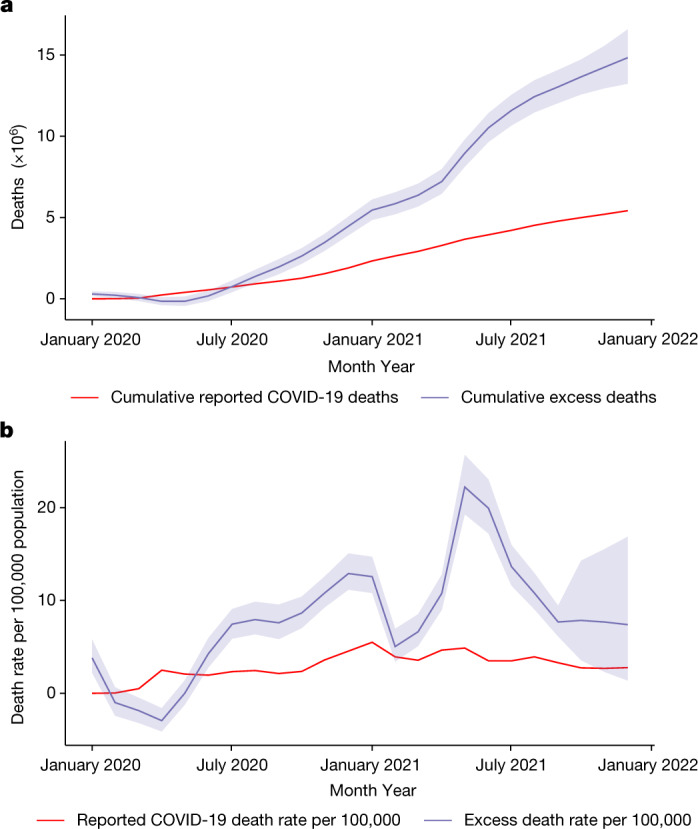
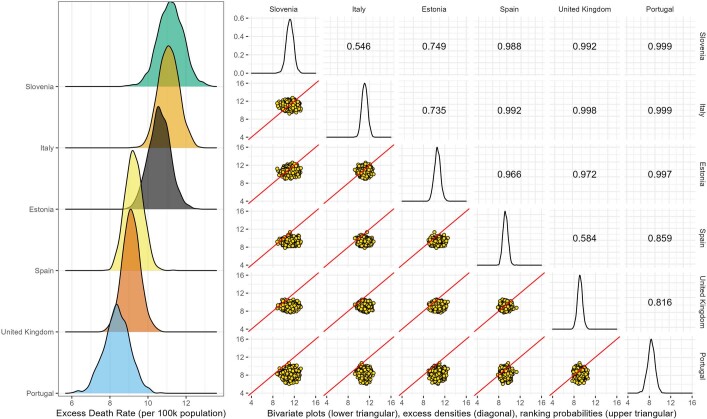
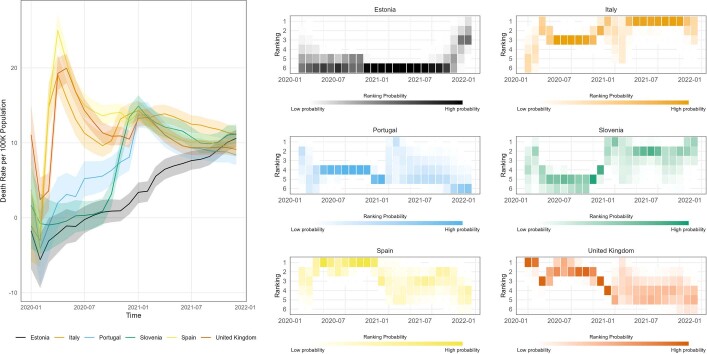
. Reported statistics on COVID-19 mortality are problematic for many countries owing to variations in testing access, differential diagnostic capacity and inconsistent certification of COVID-19 as cause of death. Beyond what is directly attributable to it, the pandemic has caused extensive collateral damage that has led to losses of lives and livelihoods. Here we report a comprehensive and consistent measurement of the impact of the COVID-19 pandemic by estimating excess deaths, by month, for 2020 and 2021. We predict the pandemic period all-cause deaths in locations lacking complete reported data using an overdispersed Poisson count framework that applies Bayesian inference techniques to quantify uncertainty. We estimate 14.83 million excess deaths globally, 2.74 times more deaths than the 5.42 million reported as due to COVID-19 for the period. There are wide variations in the excess death estimates across the six World Health Organization regions. We describe the data and methods used to generate these estimates and highlight the need for better reporting where gaps persist. We discuss various summary measures, and the hazards of ranking countries' epidemic responses.
Overview
CoChat Summary
TL;DR
WHO estimated global excess mortality from COVID-19 for January 2020–December 2021 at 14.83 million deaths, using a Bayesian Poisson framework to fill gaps where all-cause mortality data were incomplete. The estimate is 2.74 times the 5.42 million COVID-19 deaths reported to WHO for the same period.
Key findings
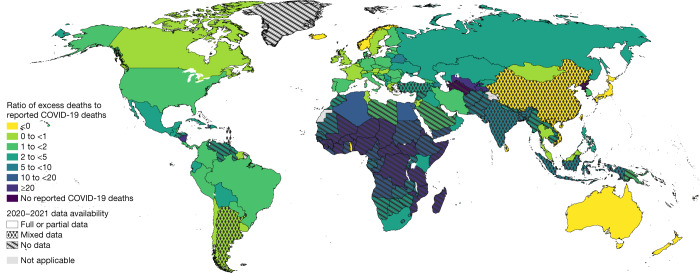
- Globally, the paper estimates 14.83 million excess deaths over 2020–2021 (95% UI 13.23–16.58 million), compared with 5.42 million reported COVID-19 deaths; the excess-to-reported ratio is 2.74 (UI 2.44–3.06).
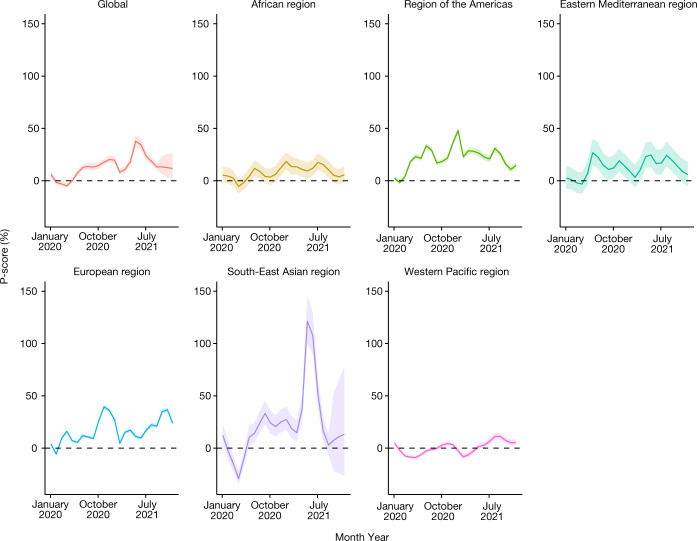
- Excess deaths were estimated at 4.47 million in 2020 and 10.36 million in 2021 globally; the global P-score increased from 7.97% in 2020 to 18.30% in 2021.
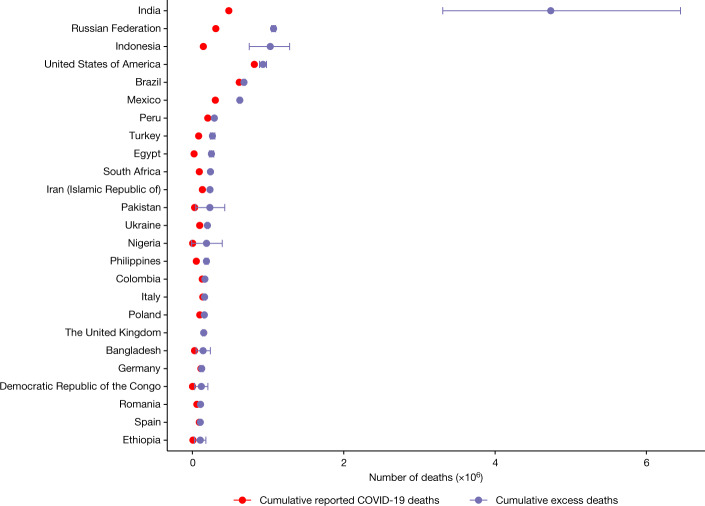
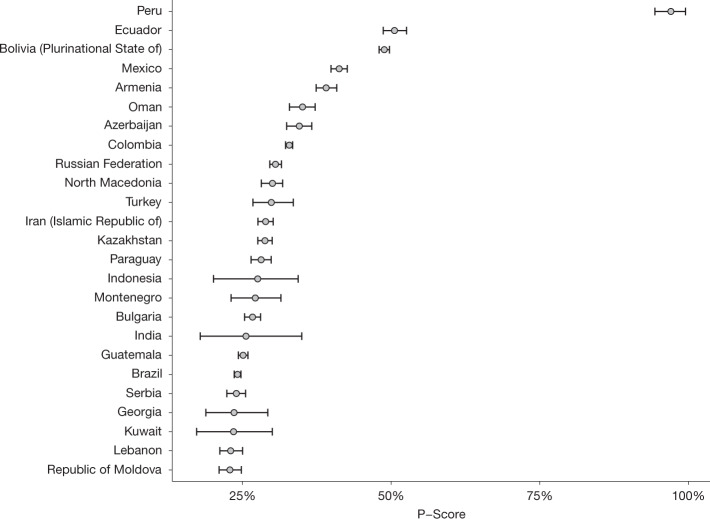
- The paper reports large country-level totals, including India: 4.74 million excess deaths (UI 3.31–6.45 million), Russian Federation: 1.07 million (UI 1.05–1.10 million), Indonesia: 1.03 million (UI 0.75–1.29 million), and the United States: 932,000 (UI 887,000–978,000).
- The 20 countries with the highest excess estimates account for 48.9% of the global population and over 80% of estimated global excess deaths for January 2020–December 2021.
Methods
- The study used a WHO-led, consultative modelling process: a Technical Advisory Group developed methods, WHO member states reviewed preliminary estimates, and feedback was used to update the final estimates.
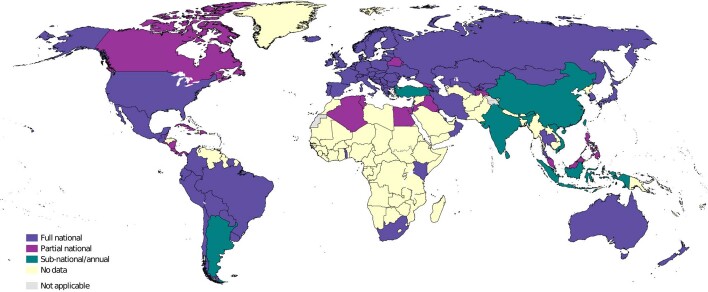
- The analysis used all-cause mortality (ACM) data from multiple sources; monthly national data were available for 100 countries (52%), while other locations had annual, subnational, or no data.
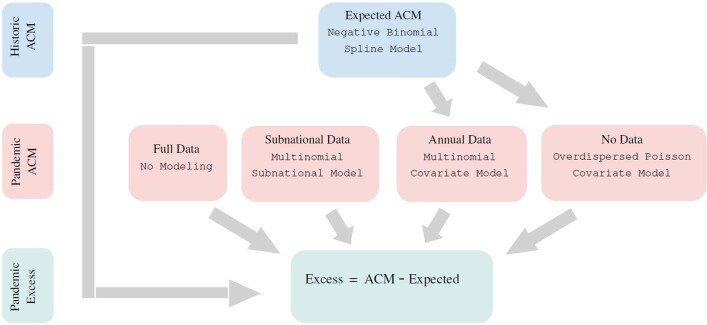
- Excess deaths were estimated with a Bayesian Poisson / negative binomial framework: historical ACM (often 2015–2019) was used to model expected deaths with spline-based seasonal and annual trends; where pandemic data were incomplete, a covariate-based log-linear model and, for some countries, subnational-to-national multinomial/proportionality models were used.
Limitations
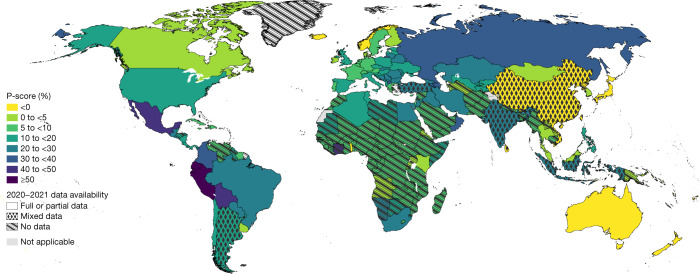
- The paper states that the biggest limitation is data paucity: for almost half of WHO member states, ACM data during the pandemic were unavailable, so estimates relied on statistical models; the text says these countries should be interpreted with caution.
- The paper states that the counterfactual trend is sensitive to modelling assumptions, including the choice of spline models and how recent historical years are weighted; it notes splines can produce inappropriate extrapolations.
- The text makes evident that comparisons across countries/regions are difficult because countries differ in age structure, data completeness, and reporting quality; this is stated in the paper and means rankings can be misleading.
- The text makes evident that the paper cannot quantify how much excess mortality is directly COVID-19 versus indirect or non-COVID causes; the discussion explicitly says excess mortality combines these and cannot separate them.
Model-written summary. Check it against the paper before relying on it.
Integrity signals
Registry
Cites
Statistics
Figures
Verification
Claims the paper makes
8 Valid · 2 Not valid · 6 Not checked · 81 Own results and interpretations
Every source the paper cites for this claim was checked and supports it.
In the paper
“Reported statistics on COVID-19 mortality are problematic for many countries owing to variations in testing access, differential diagnostic capacity and inconsistent certification of COVID-19 as cause of death.”
- Also stated in: § Main · plain
“countries have differed in their application of standards for the certification of COVID-19 as the underlying cause-of-death2.”
§ The WHO estimates of excess mortality associated with the COVID-19 pandemic > Abstract
What the sources say
- Supportedcites [2] Riffe T Acosta E Data Resource Profile: COVerAGE-DB: a global demographic database of COVID-19 cases and deaths Int. J. Epidemiol. 2021 50 390 390f 10.1093/ije/dyab027 source
The Strengths and weaknesses section says COVID-19 death counts are likely underestimated for reasons also affecting case counts, including testing capacity and diagnostic-test accuracy. It also describes differences in whether suspected deaths are counted and evidence that COVID-19-related deaths are classified under other causes. Page numbers were not supplied in our copy. (LLM, conf=0.90)
plainstates a cause- Asserted: passes — The authors put it forward as true.
- Checkable: passes — It can be checked against evidence.
- Load-bearing: passes — The paper’s conclusions depend on it.
- Based: passes — The paper gives a reason why it holds.
- Also stated in: § Main · plain
Every source the paper cites for this claim was checked and supports it.
In the paper
“The measure overcomes the variation among countries in reporting and testing and the misclassification of the cause of death on death certificates7”
§ The WHO estimates of excess mortality associated with the COVID-19 pandemic > Main
What the sources say
- Supportedcites [7] Beaney T Excess mortality: the gold standard in measuring the impact of COVID-19 worldwide? J. Royal Soc. Med. 2020 113 329 334 10.1177/0141076820956802 PMC7488823 32910871 source
The Excess mortality section states that, because it encompasses deaths from all causes, excess mortality overcomes cross-country variation in COVID-19 reporting and testing and misclassification of causes on death certificates. This directly matches the attributed claim. (LLM, conf=0.95)
plainstates a cause- Asserted: passes — The authors put it forward as true.
- Checkable: passes — It can be checked against evidence.
- Load-bearing: passes — The paper’s conclusions depend on it.
- Based: passes — The paper gives a reason why it holds.
- Supported
Every source the paper cites for this claim was checked and supports it.
In the paper
“This surpasses the influenza pandemics of 1957, 1968 and 2009 (estimated at 0.04%, 0.03% and 0.005%, respectively)18.”
§ The WHO estimates of excess mortality associated with the COVID-19 pandemic > Discussion
What the sources say
- Supportedcites [18] Simonsen L Viboud C Mortality: a comprehensive look at the COVID-19 pandemic death toll. eLife 2021 10 e71974 10.7554/eLife.71974 34382937 PMC8360646 source
Table 1 (Abstract) gives a global per capita excess mortality rate of >0.08% for COVID-19, exceeding its estimates of 0.04%, 0.03%, and 0.005% for the 1957, 1968, and 2009 influenza pandemics, respectively. The paper describes the COVID-19 estimate using data available in 2020–2021. (LLM, conf=0.94)
plain- Asserted: passes — The authors put it forward as true.
- Checkable: passes — It can be checked against evidence.
- Load-bearing: unclear — It is unclear whether the paper’s conclusions depend on it.
- Based: passes — The paper gives a reason why it holds.
- Supported
Every source the paper cites for this claim was checked and supports it.
In the paper
“As another example, in the Africa region for which ACM data are most lacking, recent studies have highlighted the underestimation in the reported statistics20.”
§ The WHO estimates of excess mortality associated with the COVID-19 pandemic > Discussion
What the sources say
- Supportedcites [20] Cabore J. W. et al. COVID-19 in the 47 countries of the WHO African region: a modelling analysis of past trends and future patterns. Lancet Glob. Health10, e1099–e1114 (2022). PMC9159735 35659911 source
The Introduction states that reported infections and deaths underestimate the actual COVID-19 burden in the WHO African region. It also reports that, in countries with seroprevalence studies, reported infections represented only a small proportion of the estimated burden. Page numbers were not provided. (LLM, conf=0.94)
plainstates an association- Asserted: passes — The authors put it forward as true.
- Checkable: passes — It can be checked against evidence.
- Load-bearing: unclear — It is unclear whether the paper’s conclusions depend on it.
- Based: passes — The paper gives a reason why it holds.
- Supported
Every source the paper cites for this claim was checked and supports it.
In the paper
“The uncertainty in the expected predictions is well modelled by a gamma distribution, and the advantage of this choice is that it can be conveniently combined with a Poisson model to produce a negative binomial model with the log-linear mean given by equation (3).”
§ The WHO estimates of excess mortality associated with the COVID-19 pandemic > Methods > Model for countries without full pandemic data For almost half of the 194 WHO member states we do not have the ACM counts over the pandemic, and so must predict them using country characteristics. We choose a simple form for this prediction model, with mean2where is a relative rate parameter. If , then for country and at month the mortality is greater than expected, whereas if , then for country and at month the mortality is less than expected. We used time-invariant variables, (these are annual values from 2019). These were an indicator of high income and/or low or middle income, the cardiovascular mortality rate in 2019 and the diabetes prevalence rate in 2019. In addition, we used time-varying variables: a containment variable (it is calculated using all ordinal containment and closure policy indicators and health-system policy indicators, for further details see Hale et al.14), the square root of the reported COVID-19 death rate, temperature and the COVID-19 test positivity rate. We then build a log-linear model for the rate parameter:3where and denote relative rate parameters and are independent error contributions that pick up random variation unexplained by the log-linear regression function. The time-varying coefficients allow the associations to evolve during the pandemic. As we desire the evolution to be smooth in time, for these time-varying coefficients we use a random walk of order 2 (RW2) prior that encourages smooth estimates46. In equation (2) above, we have conditioned on known expected numbers. In reality, and as just described, these are modelled to give a distribution over plausible values. The uncertainty in the expected predictions is well modelled by a gamma distribution, and the advantage of this choice is that it can be conveniently combined with a Poisson model to produce a negative binomial model with the log-linear mean given by equation (3). Full details (including evidence of the accuracy of the gamma model) can be found in Knutson et al.15. This model was fitted to all countries with observed monthly ACM data over some portion of 2020–2021, using the integrated nested Laplace approximation method47, to obtain posterior distributions over the unknown parameters. The resultant posterior distribution reflects the uncertainty in the parameters (both in the expected numbers and the log-linear covariate model), and can be used to construct a predictive distribution for the ACM in countries with no data or partial data.
What the sources say
- Supportedcites Knutson et al.15 Knutson V., Aleshin-Guendel S., Karlinsky A., Msemburi W. & Wakefield J. Estimating country-specific excess mortality during the COVID-19 pandemic (2023). Ann. Appl. Stat. (in the press). PMC9812776 36517599 source
Section 3.3 (Modeling Uncertainty in the Expected Numbers) states they fit a gamma distribution by method of moments to the Monte Carlo samples of the expected numbers and 'approximate the distribution of the expected numbers as gamma, since this is conjugate to the Poisson, and so allows efficient inference with INLA ... using a negative binomial,' and the Supplementary Materials (Sec. 5, Gamma Expected Numbers; Fig. 5) report the gamma fits are accurate, with differences 'small in all cases' — supporting 'well modelled'. The model description bullet confirms the negative binomial component with known tau arises from the uncertainty in the expected numbers within the log-linear Poisson/negative-binomial formulation. The 'equation (3)' reference is the citing paper's own display, not attributed content. (LLM, conf=0.90)
boosted- Asserted: passes — The authors put it forward as true.
- Checkable: passes — It can be checked against evidence.
- Load-bearing: passes — The paper’s conclusions depend on it.
- Based: passes — The paper gives a reason why it holds.
- Supported
49 more claims
Create a free account to see all 97 claims and to verify the 2 references still open.
- Probably not a substantial claim. 19
- It may state two separate claims as one. 30
- The quote only partly states this claim. 2
Claims other papers make about this one
Each is checked against this paper’s own text: does it say what the citing paper says it does?
The source backs part of the claim, not all of it — or backs it for a different population, condition or comparison.
In the citing paper
“Our current estimate of global excess mortality during 2020 and 2021 is comparable to the WHO estimate of 14·9 million (95% UI 13·3–16·6) excess deaths,15 with our mean estimate falling within the uncertainty interval of the WHO estimate and vice versa.”
From Global age-sex-specific mortality, life expectancy, and population estimates in 204 countries and territories and 811 subnational locations, 1950–2021, and the impact of the COVID-19 pandemic: a comprehensive demographic analysis for the Global Burden of Disease Study 2021 (2024) · cites this paper as [15]
Experimental — accuracy not yet measuredThe cited source says what the claim attributes to it.
In the citing paper
“this total greatly exceeds global average increases of 8% in 2020 and 18% in 20214.”
From Attributed causes of excess mortality during the COVID-19 pandemic in a south Indian city (2023) · cites this paper as [4]
In the citing paper
“Other settings with >25% increases in mortality during the pandemic have included Russia and LMICs within Latin America, Eastern Europe, and central Asia1,4.”
From Attributed causes of excess mortality during the COVID-19 pandemic in a south Indian city (2023) · cites this paper as [4]
Citations
Cites
Vos, T., Lim, S. S., Abbafati, C., Abbas, K. M., Abbasi, M., Abbasifard, M., Abbasi-Kangevari, M., Abbastabar, H., Abd-Allah, F., Abdelalim, A., et al. (2020) · The Lancet · doi:10.1016/s0140-6736(20)30925-9 · Cited by 19,358
Generalized Additive Models: An Introduction with R
Wood, S. N. (2017) · doi:10.1201/9781315370279 · Cited by 13,852
Rue, H., Martino, S., & Chopin, N. (2009) · Journal of the Royal Statistical Society Series B: Statistical Methodology · doi:10.1111/j.1467-9868.2008.00700.x · Cited by 5,279
Wang, H., Paulson, K. R., Pease, S. A., Watson, S., Comfort, H., Zheng, P., Aravkin, A. Y., Bisignano, C., Barber, R. M., Alam, T., et al. (2022) · The Lancet · doi:10.1016/s0140-6736(21)02796-3 · Cited by 2,069
Rue, H., & Held, L. (2005) · Chapman & Hall/CRC eBooks · doi:10.1201/9780203492024 · Cited by 1,823
Guidelines for accurate and transparent health estimates reporting: the GATHER statement
Stevens, G. A., Alkema, L., Black, R. E., Boerma, J. T., Collins, G. S., Ezzati, M., Grove, J. T., Hogan, D. R., Hogan, M. C., Horton, R., et al. (2016) · The Lancet · doi:10.1016/s0140-6736(16)30388-9 · Cited by 1,798
Karlinsky, A., & Kobak, D. (2021) · eLife · doi:10.7554/elife.69336 · Cited by 772
Self-citationMurray, C. J., Lopez, A. D., Chin, B., Feehan, D., & Hill, K. H. (2006) · The Lancet · doi:10.1016/s0140-6736(06)69895-4 · Cited by 605
Islam, N., Shkolnikov, V. M., Acosta, R. J., Klimkin, I., Kawachi, I., Irizarry, R. A., Alicandro, G., Khunti, K., Yates, T., Jdanov, D. A., et al. (2021) · BMJ · doi:10.1136/bmj.n1137 · Cited by 468
Guidelines for accurate and transparent health estimates reporting: the GATHER statement
Stevens, G. A., Alkema, L., Black, R. E., Boerma, J. T., Collins, G. S., Ezzati, M., Grove, J. T., Hogan, D. R., Hogan, M. C., Horton, R., et al. (2016) · PLOS Medicine · doi:10.1371/journal.pmed.1002056 · Cited by 424
Research works printed but not linked: 2
- National Bureau of Statistics of China. China Statistical Yearbook 2021 (China Statistics Press, 2021).
- Hale, T. et al. Variation in Government Responses to COVID-19 Technical Report (Univ. Oxford, 2020).
Cited by
Items 601–700 of 1,067
Dugot, M., Merzon, E., Ashkenazi, S., Vinker, S., Green, I., Golan‐Cohen, A., & Israel, A. (2023) · Antibiotics · doi:10.3390/antibiotics12030587 · Cited by 2
“A recent study concluded that the true number of fatal cases was three times higher [2].”
BackgroundMeng, M., Wu, Y., Sha, W., Zeng, R., Luo, D., Jiang, R., Wu, H., Zhuo, Z., Yang, Q., Li, J., et al. (2023) · Journal of Medical Virology · doi:10.1002/jmv.28720 · Cited by 3
“int/).(3) The most common symptoms of SARS‐CoV‐2 infection are fever, persistent dry cough, and shortness of breath.”
BackgroundBazghaleh, M., Abbasi, M. F., Bahonar, E., Ghomian, Z., Sadeghi, M., & Norouzadeh, R. (2023) · Annals of Military and Health Sciences Research · doi:10.5812/amh-134088 · Cited by 3
Kim, D., Swaminathan, S., Lee, Y., et al. (2023) · Clinical Journal of the American Society of Nephrology · doi:10.2215/cjn.0000000000000226 · Cited by 1
Bevölkerungsalterung unter Pandemiebedingungen
Schöley, J. (2023) · Wirtschaftsdienst · doi:10.2478/wd-2023-0038 · Cited by 1
Clinically Evaluated COVID-19 Drugs with Therapeutic Potential for Biological Warfare Agents
Dechtman, I.-D., Ankory, R., Sokolinsky, K., Krasner, E., Weiss, L., & Gal, Y. (2023) · Microorganisms · doi:10.3390/microorganisms11061577 · Cited by 1
COVID-19 Vaccine in Renal Transplant Recipients: A Bibliometric-Based Analysis of Trends
Wang, D., Zhou, C., Wang, C., Guo, S., Zhang, Y., Lv, H., & Zhou, F. (2023) · Transplantation Proceedings · doi:10.1016/j.transproceed.2023.06.013 · Cited by 1
India is failing the health data challenge
Malhotra, S. (2023) · BMJ · doi:10.1136/bmj.p1488 · Cited by 1
Speer, C., Töllner, M., Benning, L., Bartenschlager, M., Kim, H., Nußhag, C., Kälble, F., Reineke, M., Reichel, P., Schnitzler, P., et al. (2023) · Viruses · doi:10.3390/v15081778 · Cited by 1
“By early 2023, more than 750 million confirmed cases of COVID-19 have been reported to the World Health Organization (WHO) worldwide, including >6 million deaths [1,2].”
BackgroundCanossi, A., Panarese, A., Savino, V., Beato, T. D., & Pisani, F. (2023) · Current Transplantation Reports · doi:10.1007/s40472-023-00414-4 · Cited by 1
“This might be a somewhat cautious, conservative estimate: according to data released in December 2022 by the World Health Organization (WHO), indeed, deaths from Covid-19 could even be twice as high [2].”
Ni, X., Sun, B., Hu, Z., Cui, Q., Zhang, Z., & Zhang, H. (2023) · Frontiers in Public Health · doi:10.3389/fpubh.2023.1228564 · Cited by 2
Do we need coronavirus vaccination today?
Tikhomirova, K. K., & Михайловна, Х. С. (2023) · Journal Infectology · doi:10.22625/2072-6732-2023-15-3-5-14 · Cited by 2
Robust Global Trends during Pandemics: Analysing the Interplay of Biological and Social Processes
Dankulov, M. M., Tadić, B., & Melnik, R. (2023) · Dynamics · doi:10.3390/dynamics3040041 · Cited by 1
Cristelli, M. P., Fortaleza, C. M. C. B., PEREIRA, J. F. C. A., Taddeo, J. B., Viana, L. A., Requião‐Moura, L., Chow, C. Y. Z., Nakamura, M. R., Junior, H. T. S., & Medina-Pestana, J. O. (2023) · Transplant Infectious Disease · doi:10.1111/tid.14204 · Cited by 1
“5,9 Nevertheless, this trend resembled what was observed in other high-risk populations, such as specific groups of cancer patients.”
ResultPark, M., Hwang, J., Ahn, J. H., et al. (2023) · BMJ Open · doi:10.1136/bmjopen-2023-074381 · Cited by 1
Impactos de la COVID-19 en la salud mental de profesores en una universidad médica cubana
Masó, J. R. H., & Ferrer, R. L. (2023) · Revista Española de Educación Médica · doi:10.6018/edumed.591161 · Cited by 1
The SARS coronavirus accessory protein ORF3a rescues potassium conductance in yeast
Rosenbaum, J. C., & Carlson, A. E. (2024) · PubMed · doi:10.17912/micropub.biology.001129 · Cited by 1
Lattanzi, F. P., Gouvêa, M. I. F. D. S., Teixeira, M. D. L. B., Fuller, T. L., Sodré, M. C. M. P., Medeiros, A. F., Bressan, C. D. S., Salgueiro, M. D. M., Braga, C. M., Gouvea, M. B., et al. (2024) · AIDS Care · doi:10.1080/09540121.2024.2343590 · Cited by 1
“However, several characteristics of the participants were di ff erent during the COVID-19 pandemic.”
InfluentialA finance and health collaboration to counter pandemic threats
Hutubessy, R. C. W., Agarwal, R., & Aryaputri, E. S. (2024) · Bulletin of the World Health Organization · doi:10.2471/blt.23.291014 · Cited by 1
Svirsky, R., Rabbi, M. L., Hamad, R. A., et al. (2024) · Scientific Reports · doi:10.1038/s41598-024-61504-6 · Cited by 1
Huayta, O. A. V., Chura, A. C. J., Maydana, C. S., & García, A. M. (2024) · Informatics · doi:10.3390/informatics11020040 · Cited by 1
“The COVID-19 pandemic caused severe social, economic [1–3], and psychological problems around the world, with a huge loss of human life [4].”
BackgroundKim, E., Lee, W., & Cho, S. (2024) · Journal of Epidemiology & Community Health · doi:10.1136/jech-2023-221763 · Cited by 1
Al-Kindi, S. G., Shami, B., Janus, S. E., Hajjari, J., Mously, H., Badhwar, A., Chami, T., Chahine, N., Al-Jammal, M., Karnib, M., et al. (2024) · Current Problems in Cardiology · doi:10.1016/j.cpcardiol.2024.102763 · Cited by 2
Ramos, J. G. R., Laporte, L. R., de Souza, F. R., Neto, M. J. D. S., Ferreira, F., Amorim, Y. D. S., & de Andrade, L. F. (2024) · Journal of the American Medical Directors Association · doi:10.1016/j.jamda.2024.105220 · Cited by 1
High SARS-CoV-2 seroincidence but low excess COVID mortality in Sierra Leone in 2020–2022
Osman, A., Aimone, A., Ansumana, R., Bogoch, I. I., Gelband, H., Colwill, K., Gingras, A., Langlois, M., Carshon-Marsh, R., Swaray, I. B., et al. (2024) · PLOS Global Public Health · doi:10.1371/journal.pgph.0003411 · Cited by 2
“…(WHO), using data derived from other countries, estimated 1.25 million excess deaths in Africa (1 million outside of South Africa) during viral waves over the two years of 2020–2021, including nearly 8,000 [2] in Sierra Leone (with lower and upper bounds of 480 and 15,700 deaths, respectively) [2].”
InfluentialHartmann, C., Khan, R., Schöning, J., Richter, M., Willers, M., Pirr, S. M., Heckmann, J., Dirks, J., Morbach, H., Konrad, M., et al. (2024) · Frontiers in Immunology · doi:10.3389/fimmu.2024.1443665 · Cited by 4
“Considering the impact of the recent SARS-CoV-2 pandemic (65) or previous pandemics and epidemics due to IAV and RSV on human health (10, 66, 67), our knowledge about the ontogeny of immunity towards RVIs and the factors determining the developmental variability is little.”
BackgroundMpox (Monkeypox) or Money-Pox? Unjust Global Responses Toward Infectious Diseases
Su, Z., McDonnell, D., Bentley, B. L., Cheshmehzangi, A., Šegalo, S., da Veiga, C. P., & Xiang, Y. (2024) · Mayo Clinic Proceedings · doi:10.1016/j.mayocp.2024.06.008 · Cited by 1
Experiences of Nurses Diagnosed with COVID-19: A Qualitative Study
Mousavi, M. S., Rahzani, K., & Hekmatpou, D. (2024) · Journal of Caring Sciences · doi:10.34172/jcs.33414 · Cited by 1
Zhang, W., Mira, A., & Wit, E. C. (2024) · Journal of Applied Statistics · doi:10.1080/02664763.2024.2411608 · Cited by 1
“Focusing on its impacts on health and health systems, excess mortality due to the pandemic is under scrutiny as it provides an overall picture of the pandemic’s impact on human health, encompassing factors such as government interventions and disruptions to non-COVID care [30,40,41].”
The impact of the COVID-19 pandemic on mortality in Uruguay from 2020 to 2022
Torres, C., Rosas, V. P., Armas, G. D., & Paredes, M. (2024) · Demographic Research · doi:10.4054/demres.2024.51.29 · Cited by 3
Mandal, J., & Chanda, A. (2024) · Environment Development and Sustainability · doi:10.1007/s10668-024-05631-0 · Cited by 1
“The novel coronavirus disease 2019 pandemic (also referred to as the COVID-19 pandemic) has wreaked havoc throughout the world since the onset of 2020, leading to an estimated casualty of 5.4 million people (Msemburi et al., 2023).”
InfluentialImpact of SARS-CoV-2 on Oncogenesis: A Deep Dive into the COVID-19 and Cancer Nexus
Waqas, M., Bashir, R., Nohra, L., Adeyemo, S. F., Confidence, D., Tayyab, M., & Rahman, U. S. (2024) · Iranian Journal of Blood and Cancer · doi:10.61186/ijbc.16.3.55 · Cited by 2
Osaghae, E. O., Sirek, G., Roberson, T., Chandler, M. T., Childs, A., Crespo-Bosque, M., Curry, G., Dhand, A., Dollear, M., Eggleston, A., et al. (2025) · Frontiers in Public Health · doi:10.3389/fpubh.2024.1493331 · Cited by 2
Scaling COVID-19 rates with population size in the United States
Cruz, A. R., Enquist, B. J., & Burger, J. R. (2025) · Journal of The Royal Society Interface · doi:10.1098/rsif.2024.0839 · Cited by 2
“Recent scaling research on COVID-19 confirmed that early pandemic case growth rates scale superlinearly with city population size [14].”
Atarashi, Y., Kim, J., Irino, Y., Amano, M., Tsuchiya, K., Maeda, K., Terada, M., Iwamoto, N., Shimada, S., Mitsuya, H., et al. (2025) · Scientific Reports · doi:10.1038/s41598-025-94317-2 · Cited by 1
Bonnet, F., & Camarda, C. G. (2025) · Population and Development Review · doi:10.1111/padr.70007 · Cited by 1
“Countries like Italy, Spain, and the United Kingdom re-ported high death tolls (Msemburi et al. 2023).”
Testing an experimental vaccine during a public health emergency: Lessons from a Peruvian case
Lanata, C. F., Ochoa, T. J., Bancalari, E. M., Baylor, N. W., Edwards, K. M., Faden, R., Madhi, S. A., Nohynek, H., & Weijer, C. (2025) · Vaccine · doi:10.1016/j.vaccine.2025.127176 · Cited by 1
Dennis, A., Joseph, J. A., Greenwell, K., Miller, S., Vennik, J. L., Dennison, L., Holt, S., Bradbury, K. J., Geraghty, A. W. A., Little, P. S., et al. (2025) · PLoS ONE · doi:10.1371/journal.pone.0321314 · Cited by 1
“Participants felt this as they found the nasal spray easy to use: “It was just easy to do” (Participant 16), were used to using nasal sprays: “I’m quite au fait with using a nasal spray” (Participant 10), or they did not want to be in the lifestyle intervention: “Diet and advice doesn’t suit…”
InfluentialTime series analysis of impact of COVID-19 on infant and neonatal mortality in the United States
Zhang, Z., & Luo, J. (2025) · Pediatric Research · doi:10.1038/s41390-025-04054-5 · Cited by 3
“4,5 The impact of COVID-19 varied across age groups, with infants being less affected than adults but more affected than children and youths.”
Andrade, D. A., Ho-Palma, A. C., Valdivia-Carrera, C. A., Munguia, A., Leyns, C., Guitián, J., & Gonzales-Gustavson, E. A. (2025) · PLoS ONE · doi:10.1371/journal.pone.0327746 · Cited by 1
Body mass index and critical care outcomes in hospitalized COVID-19 patients—A national cohort study
BONILLA, Y., HIGH, D. P., ACOSTA-RULLAN, J., TABBA, J. N., Shalmiyev, R., NORRIS, T., Folds, A., Martinez, A., Heller, D., Diaz, R., et al. (2025) · PLoS ONE · doi:10.1371/journal.pone.0329779 · Cited by 4
“The COVID-19 infection, which emerged in late 2019 and expeditiously turned into a global pandemic [1], had disrupted healthcare systems and substantially increased morbidity and mortality, resulting in a reported excess mortality of tens of millions [2–5].”
Yoon, C.-S., Park, H.-Y., Park, H.-K., Lee, J.-K., Kho, B., Shin, H., Kwon, Y. S., Kim, Y., Lim, S.-C., & Kim, T.-O. (2025) · PLoS ONE · doi:10.1371/journal.pone.0329474 · Cited by 1
COVID ‐19 Vaccine‐Induced Severe Pneumonitis
Suzuki, T., Furuta, H., Naganawa, M., et al. (2025) · Respirology Case Reports · doi:10.1002/rcr2.70274 · Cited by 1
Sharma, C. K., & Swenden, W. (2026) · Publius The Journal of Federalism · doi:10.1093/publius/pjaf049 · Cited by 2
Panakadan, S., Gun, A., & Sarkar, S. (2022) · The Indian Journal of Medical Research · doi:10.4103/ijmr.ijmr_313_23 · Cited by 1
CT Image of Consolidation and Ground-Glass Opacification (GGO) of COVID-19 in Diabetic Patient
Ogura, K., Bando, H., Kato, Y., Yamashita, H., & Kato, Y. (2023) · Asploro Journal of Biomedical and Clinical Case Reports · doi:10.36502/2023/asjbccr.6299 · Cited by 1
“changes in COVID-19 have been detected over the years [7,8].”
BackgroundFrish, N., Israel, A., Ashkenazi, S., Vinker, S., Green, I., Golan‐Cohen, A., & Merzon, E. (2023) · Journal of Clinical Medicine · doi:10.3390/jcm12124054 · Cited by 1
“Moreover, it is plausible that the behavioral changes during the initial phases of the COVID-19 pandemic—in-home quarantines and social distancing [1,2]—affected eating habits and increased the risks of malabsorption, nutrient deficiencies, and vitamin D3 deficiency of some individuals after bariatric surgery, and thu…”
BackgroundNeuroimaging Clinics: Central Nervous System Infections
Victor, C. (2023) · Neurology Asia · doi:10.54029/2023nvm · Cited by 1
Destruição da natureza e discursos antiecológico no Brasil
de Oliveira, L. D., & Maciel, N. D. S. R. (2023) · Faculdade de Letras da Universidade do Porto eBooks · doi:10.21747/978-989-9082-88-5/ovea1 · Cited by 1
Svirsky, R., Rabbi, M. L., Hamad, R. A., et al. (2023) · Research Square · doi:10.21203/rs.3.rs-2459904/v1 · Cited by 1
Changes in SARS-CoV-2 seroprevalence and population immunity in Finland, 2020–2022Preprint
Solastie, A., Nieminen, T. A., Ekström, N., et al. (2023) · medRxiv · doi:10.1101/2023.02.17.23286042 · Cited by 1
Large and unequal life expectancy declines during the COVID-19 pandemic in India in 2020Preprint
Gupta, A., Hathi, P., Banaji, M., et al. (2023) · doi:10.31235/osf.io/8juds · Cited by 1
Brunckhorst, B., Kim, Y. S., & Cojocaru, A. (2023) · World Bank, Washington, DC eBooks · doi:10.1596/1813-9450-10585 · Cited by 1
War fatalities in Russia in 2022-2023 estimated via excess male mortalityPreprint
Kobak, D., Bessudnov, A., Ершов, А. В., Mikhailova, T., & Raksha, A. (2023) · doi:10.31235/osf.io/xcrme · Cited by 1
Age-Specific All-Cause Mortality Disparities by Race and Ethnicity During the COVID-19 PandemicPreprint
Faust, J. S., Renton, B., Bongiovanni, T., Chen, A. J., Sheares, K. D., Du, C., Essien, U. R., Fuentes‐Afflick, E., Haywood, T. T., Khera, R., et al. (2024) · medRxiv · doi:10.1101/2024.03.01.24303592 · Cited by 1
Meier, S., Strobl, E., & Elliott, R. (2024) · SSRN Electronic Journal · doi:10.2139/ssrn.4755404 · Cited by 1
Global Human Population Ended Self-Facilitation in the 1950sPreprint
Bradshaw, C. J. A., Judge, M. A., Blumstein, D. T., Ehrlich, P. R., Dasgupta, A., Wackernagel, M., Weeda, L. J. Z., & Souëf, P. N. L. (2024) · SSRN Electronic Journal · doi:10.2139/ssrn.4788003 · Cited by 1
Disentangling the relationship between cancer mortality and COVID-19 in the USPreprint
Hansen, C., Viboud, C. G., & Simonsen, L. (2024) · eLife · doi:10.7554/elife.93758.2 · Cited by 2
Modest versus significant excess mortality due to COVID-19 deaths in Europe – authors' reply
Pizzato, M., Gerli, A. G., Vecchia, C. L., & Alicandro, G. (2024) · The Lancet Regional Health - Europe · doi:10.1016/j.lanepe.2024.101061 · Cited by 1
Sieber, M., & Traulsen, A. (2024) · medRxiv · doi:10.1101/2024.12.17.24319104 · Cited by 1
Hoerger, M. P., Gerhart, J. I., Peyser, T., Pyke, N. M., Garg, N., Hall, C. J., Swartz, M. C., Swartz, M. D., Willette, S. A., Baker, C. N., et al. (2025) · Research Square · doi:10.21203/rs.3.rs-5786667/v1 · Cited by 2
Cornfeld, O., Niu, K., Neeman, O., et al. (2025) · medRxiv · doi:10.1101/2025.01.21.25320900 · Cited by 1
“The actual number of infections and fatalities has been far higher, e.g., total infections are unknown but likely in the billions, while extrapolation from subnational level reports of excess mortality suggest that > 20 million individuals died of COVID-19 from 2020-2022 [2, 3].”
Steyn, N., Unwin, H. J. T., Ponmattam, J., Villaveces, A., Martins, L., Sherr, L., Blenkinsop, A., Semenova, E., Stuart-Brown, A., Amaral, A. V. R., et al. (2025) · medRxiv · doi:10.1101/2025.01.31.25321479 · Cited by 1
Meyers, A. L., Dowty, J. G., Mahmood, K., Macrae, F., Rosty, C., Buchanan, D. D., & Jenkins, M. A. (2025) · medRxiv · doi:10.1101/2025.04.21.25326138 · Cited by 2
Will the Government Finally Acknowledge the Scale of India’s COVID-19 Tragedy?Preprint
Gupta, A., & Banaji, M. (2025) · SocArXiv (OSF Preprints) · doi:10.31235/osf.io/uzqyp_v1 · Cited by 1
Post-pandemic mortality patterns and COVID-19 burden considering multiple death causesPreprint
Riedmann, U., Levitt, M., Pilz, S., et al. (2025) · medRxiv · doi:10.1101/2025.09.01.25334892 · Cited by 1
“During the COVID-19 pandemic, most countries reported excess mortality compared to pre-pandemic years [1,2], with large differences across countries [3].”
Hohlfeld, J. M., Hammerschmidt, S. I., Kayser, T., et al. (2025) · medRxiv · doi:10.1101/2025.10.07.25337492 · Cited by 1
Ioannidis, J. P. A., & Levitt, M. (2026) · medRxiv · doi:10.64898/2026.08.14.26360482 · Cited by 1
Impacto de la COVID-19 en la salud mental en el Perú
Feijoo, J. F. R. (2023) · Revista Iberoamericana de Bioética · doi:10.14422/rib.i21.y2023.004 · Cited by 12
Variant Omicron, évolution vers l’avirulence ou compromis adaptatif ?
Garnotel, É. (2023) · Revue Francophone des Laboratoires · doi:10.1016/s1773-035x(23)00059-x
Momentos y eventos de la vacunación contra el Covid-19 en Chile
Basso, L. J. (2023) · Anales de la Universidad de Chile · doi:10.5354/0717-8883.2022.70411
Kulmala, M., Lintunen, A., Lappalainen, H., et al. (2023) · doi:10.5194/egusphere-2023-627-rc1
Holla, A. (2023) · World Bank, Washington, DC eBooks · doi:10.1596/978-1-4648-1901-8_ch1
Recovery and Resilience: From Human Development Programs to Systems
D’Souza, R., Sabarwal, S., Schady, N., Silva, J., & Chang, A. Y. (2023) · World Bank, Washington, DC eBooks · doi:10.1596/978-1-4648-1901-8_ch5
Lost Opportunities: The Protracted Effects of the Pandemic on Youth and Young Adults
Schady, N., & Silva, J. (2023) · World Bank, Washington, DC eBooks · doi:10.1596/978-1-4648-1901-8_ch4
Holla, A. (2023) · World Bank, Washington, DC eBooks · doi:10.1596/978-1-4648-1901-8_ch2 · Cited by 1
Human Capital Recovery: What Will It Take?
Holla, A., & Silva, J. (2023) · World Bank, Washington, DC eBooks · doi:10.1596/978-1-4648-1901-8_ch6
Schady, N., Holla, A., Sabarwal, S., Silva, J., & Chang, A. Y. (2023) · World Bank, Washington, DC eBooks · doi:10.1596/978-1-4648-1901-8_fm
GÜLSOY, K. Y., Ancın, B., & Orhan, S. (2023) · Journal of Health Sciences and Medicine · doi:10.32322/jhsm.1259519 · Cited by 1
The Asian Conference on Ethics, Religion & Philosophy 2023 Official Conference Proceedings
(2023) · Asian Conference on Ethics, Religion and Philosophy official conference proceedings · doi:10.22492/issn.2187-476x.2023 · Cited by 2
Mihajlovic, S., Kubat, J. T., Nikolić, D., et al. (2023) · Journal of Clinical Medicine · doi:10.3390/jcm12123902
“Wide variations and inconsistencies across the world in mortality rates associated with SARAS-CoV-2 have reported [13], and therefore any new evidence is a step forward in the fight against this disease.”
BackgroundCOVID-19 Pandemie: Schätzungen der WHO zu globaler Übersterblichkeit
(2023) · Das Gesundheitswesen · doi:10.1055/a-2037-3242
Kulmala, M., Lintunen, A., Lappalainen, H., et al. (2023) · doi:10.5194/egusphere-2023-627-rc2
Airport COVID-19 Testing of Travelers: An Island Destination Perspective
Hou, A. T., Pang, G. C., Mills, K. M., et al. (2023) · Current Infectious Disease Reports · doi:10.1007/s11908-023-00809-5
Bibliography, Chronic Poverty Report 5 - Pandemic Poverty
Shepherd, A., & Diwakar, V. (2023) · OpenDocs (Institute of Development Studies) · doi:10.19088/cpan.2023.022
Amin, M., Nosratabadi, M., Mohseni, S., et al. (2023) · Journal of Herbal Medicine · doi:10.1016/j.hermed.2023.100701
Trentini, F., Ciani, O., Vanni, E., et al. (2023) · Scientific Reports · doi:10.1038/s41598-023-39592-7
Khan, S. A., Ramzan, F., Rasheeq, T., et al. (2023) · The Professional Medical Journal · doi:10.29309/tpmj/2023.30.08.7595
Lower Urinary Tract Symptoms in a prospective cohort of COVID-19 survivorsPreprint
Gomes, C. M., Hisano, M., Souza, J. D., et al. (2023) · medRxiv · doi:10.1101/2023.08.01.23293500
Fountain‐Jones, N. M., Charleston, M., Flies, E. J., et al. (2023) · medRxiv · doi:10.1101/2023.08.06.23293729
PERFIL SOCIODEMOGRÁFICO DA MORTALIDADE POR COVID-19 EM IDOSOS DO ESTADO DE RORAIMA
dos Santos, E. S., & Bertelli, E. V. M. (2023) · Ambiente Gestão e Desenvolvimento · doi:10.24979/v31cwr18
Kokkonen, T. V. (2023) · doi:10.5194/egusphere-2023-627-ac1
Soares, S. R. S. (2023) · Digital Library of Theses and Dissertations (Universidade de São Paulo) · doi:10.11606/d.22.2023.tde-10082023-085021
Stroo, J., Lepolder, M., Murk, J., et al. (2023) · Vaccines · doi:10.3390/vaccines11091407
“74 times more SARS-CoV-2 deaths globally in 2020 and 2021 than reported [27].”
BackgroundMachado, F. V., da Silva, F. R., Silva, J. V. D., et al. (2023) · Cuadernos de Educación y Desarrollo · doi:10.55905/cuadv15n8-037
Sonnhoff, M. A., Graff, M., Paal, K., et al. (2023) · Strahlentherapie und Onkologie · doi:10.1007/s00066-023-02133-2
“In addition, we consider the excess mortality of the corona pandemic through the current population projection query [11].”
BackgroundSingh, M. S., Pyati, A., Rubi, R. D., et al. (2023) · SSRN Electronic Journal · doi:10.2139/ssrn.4569729
Alsrhani, A., Farhana, A., Khan, Y. S., et al. (2023) · Journal of Biomolecular Structure and Dynamics · doi:10.1080/07391102.2023.2257328
“The coronavirus disease 2019 (COVID-19) pandemic caused by the severe acute respiratory syndrome coronavirus 2 (SARS-CoV-2) has resulted in a significant global health crisis (Msemburi et al., 2023).”
Chen, X., Wang, Y., Huang, Y., Wang, Z., & Shen, C. (2023) · Systems · doi:10.3390/systems11100491 · Cited by 1
“The excess deaths related to COVID-19 reached 14.83 million during 2020 and 2021 [2].”
BackgroundInfluentialLives, Livelihoods and Government Support in the Wake of the Covid-19 Pandemic in Rural Bihar
Datt, G., Dutta, S., & Mishra, S. K. (2023) · India studies in business and economics · doi:10.1007/978-981-99-4906-9_3
Metadata
- Authors
- Msemburi, W., Karlinsky, A., Knutson, V., Aleshin-Guendel, S., Chatterji, S., & Wakefield, J.
- Affiliations
- World Health Organization (CH)
- Hebrew University of Jerusalem (IL)
- University of Washington (US)
- Corresponding author
- Msemburi, William
- Venue
- Nature
- Published
- 2022-12-14
- Volume
- 613
- Issue
- 7942
- Pages
- 130-137
- ISSN
- 0028-0836 (ISSN-L)
- 1476-4687
- PMC
- PMC9812776
- OpenAlex
- W4311472757
- Cited by
- 1,064
- References
- 17
- Citations by year
- 2026: 176 · 2025: 283 · 2024: 346 · 2023: 252 · 2022: 6
- FWCI
- 131.36
- Type
- journal article
- Language
- en
- Open access
- hybrid
- doi.org
- Licence
- cc-by
- creativecommons.org/licenses/by/4.0 (tdm)
- creativecommons.org/licenses/by/4.0 (vor)
- Locations
- Nature (publishedVersion, cc-by)
- Research Square (acceptedVersion, cc-by)
- PubMed Central (publishedVersion, cc-by)
- PubMed (publishedVersion)
- RePEc: Research Papers in Economics (submittedVersion)
- Funders
- World Health Organization
- Topics
- Physical Sciences › Mathematics › Modeling and Simulation › COVID-19 epidemiological studies
- Health Sciences › Medicine › Epidemiology › Data-Driven Disease Surveillance
- Social Sciences › Demography › Insurance, Mortality, Demography, Risk Management
- Keywords
- COVID-19 pandemic, excess mortality, all-cause mortality, underreporting of deaths, cause of death certification, Bayesian uncertainty quantification, WHO regions
- MeSH terms
- COVID-19, Bayes Theorem, Humans, World Health Organization, Poisson Distribution, Uncertainty, Pandemics
About these checks
Registry, retraction, Cites and statistics results are computed, not judged, with one exception: a printed reference that no index lists is read once by a model before it counts as a citation error. Claims are extracted by a model and kept only when their quote appears verbatim in the text; each cited source is then checked, with a model’s help, for whether it says what the claim relies on. Those verdicts can be wrong — read the claim’s quote and the cited source before relying on one.
The claim verdicts this report counts are experimental: their accuracy is not yet measured.
A language model drew the claims from the paper on 2026-10-10, under version 3 of the claim definition (model deepseek-v4.1-flash, prompt extract-v3).
A second model labelled each claim on 2026-10-10 (model jev-1.13-20260917, definition revision gold-guideline-v0.2).
Cited sources are checked with a language model’s help (gpt-6-sol and qwen3.8-omni-flash).
Statistics and arithmetic are recomputed, not judged.
Confidence bands are shown only for fields calibrated on our annotated test set. None is calibrated yet, so no band is shown.
What counts as a claim ›How we measure confidence ›How we check this ›
Are you an author, or do you see a problem with this page? Request a review
Data sources
Bibliographic data: Semantic Scholar, OpenAlex, Crossref.
Contains information from the Semantic Scholar Academic Graph Datasets, made available under the ODC Attribution License (ODC-BY 1.0).
Semantic Scholar’s data is described in: Kinney, R., et al. (2023). The Semantic Scholar Open Data Platform. arXiv:2301.10140.
