

The WHO estimates of excess mortality associated with the COVID-19 pandemic
Open accessPublished version of a preprint
The DOI matches its Crossref record; 21 of the 21 references it cites were found in a registry or an index; 9 of the 14 sources its claims cite were checked for support.
Abstract
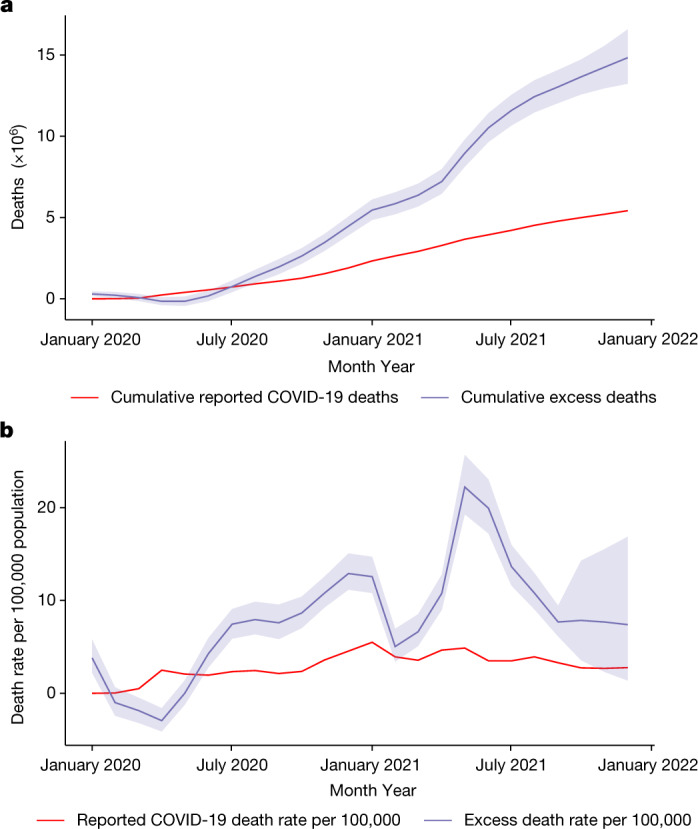
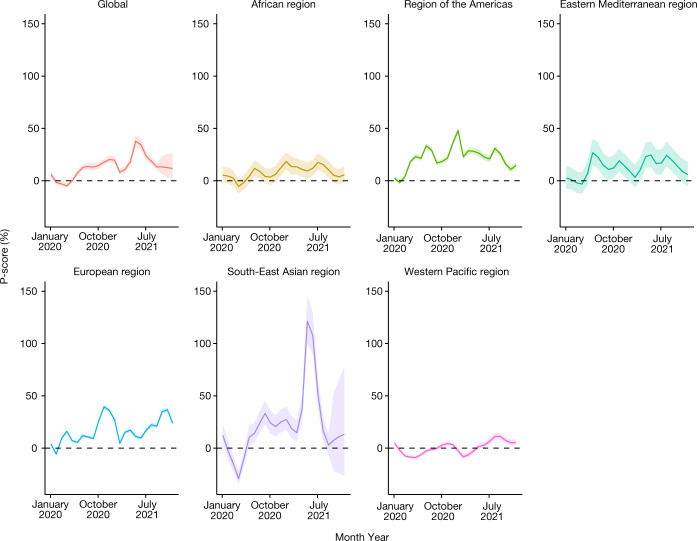
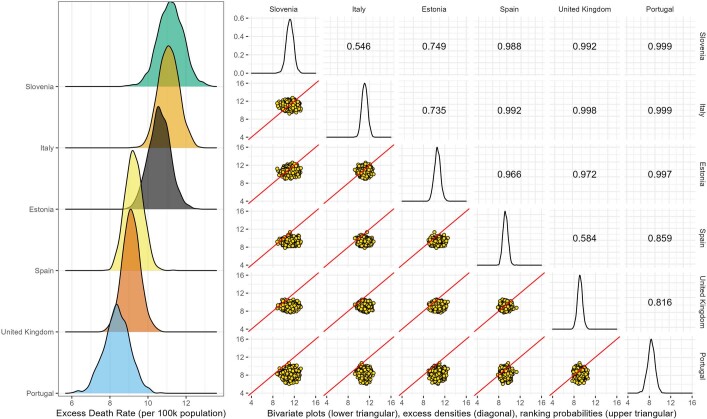
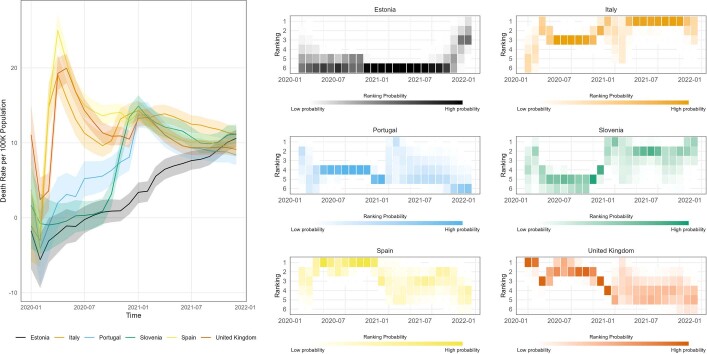
. Reported statistics on COVID-19 mortality are problematic for many countries owing to variations in testing access, differential diagnostic capacity and inconsistent certification of COVID-19 as cause of death. Beyond what is directly attributable to it, the pandemic has caused extensive collateral damage that has led to losses of lives and livelihoods. Here we report a comprehensive and consistent measurement of the impact of the COVID-19 pandemic by estimating excess deaths, by month, for 2020 and 2021. We predict the pandemic period all-cause deaths in locations lacking complete reported data using an overdispersed Poisson count framework that applies Bayesian inference techniques to quantify uncertainty. We estimate 14.83 million excess deaths globally, 2.74 times more deaths than the 5.42 million reported as due to COVID-19 for the period. There are wide variations in the excess death estimates across the six World Health Organization regions. We describe the data and methods used to generate these estimates and highlight the need for better reporting where gaps persist. We discuss various summary measures, and the hazards of ranking countries' epidemic responses.
Overview
CoChat Summary
TL;DR
WHO estimated global excess mortality from COVID-19 for January 2020–December 2021 at 14.83 million deaths, using a Bayesian Poisson framework to fill gaps where all-cause mortality data were incomplete. The estimate is 2.74 times the 5.42 million COVID-19 deaths reported to WHO for the same period.
Key findings
- Globally, the paper estimates 14.83 million excess deaths over 2020–2021 (95% UI 13.23–16.58 million), compared with 5.42 million reported COVID-19 deaths; the excess-to-reported ratio is 2.74 (UI 2.44–3.06).
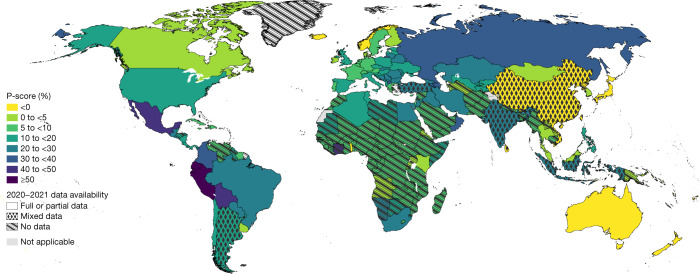
- Excess deaths were estimated at 4.47 million in 2020 and 10.36 million in 2021 globally; the global P-score increased from 7.97% in 2020 to 18.30% in 2021.
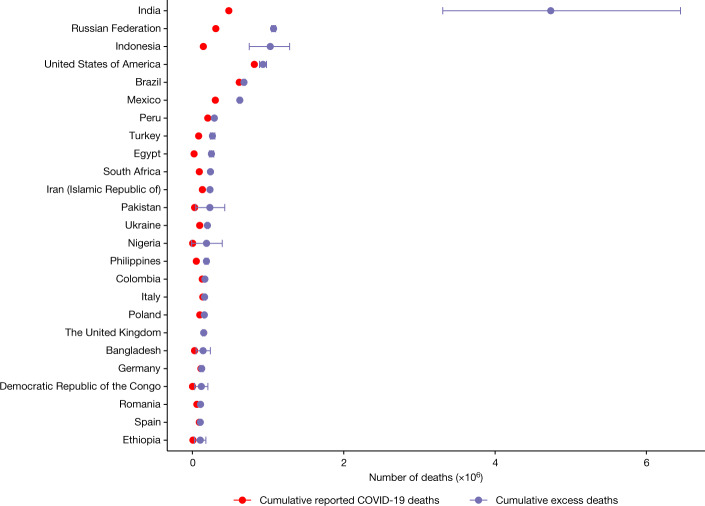
- The paper reports large country-level totals, including India: 4.74 million excess deaths (UI 3.31–6.45 million), Russian Federation: 1.07 million (UI 1.05–1.10 million), Indonesia: 1.03 million (UI 0.75–1.29 million), and the United States: 932,000 (UI 887,000–978,000).
- The 20 countries with the highest excess estimates account for 48.9% of the global population and over 80% of estimated global excess deaths for January 2020–December 2021.
Methods
- The study used a WHO-led, consultative modelling process: a Technical Advisory Group developed methods, WHO member states reviewed preliminary estimates, and feedback was used to update the final estimates.
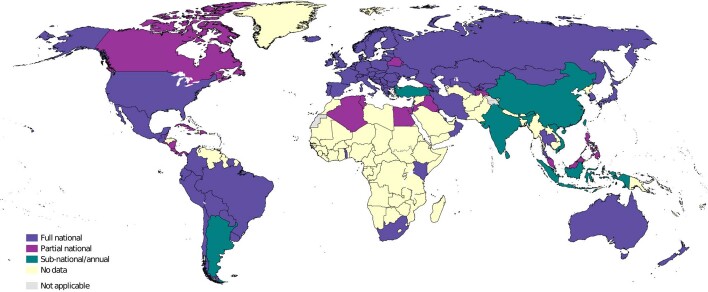
- The analysis used all-cause mortality (ACM) data from multiple sources; monthly national data were available for 100 countries (52%), while other locations had annual, subnational, or no data.
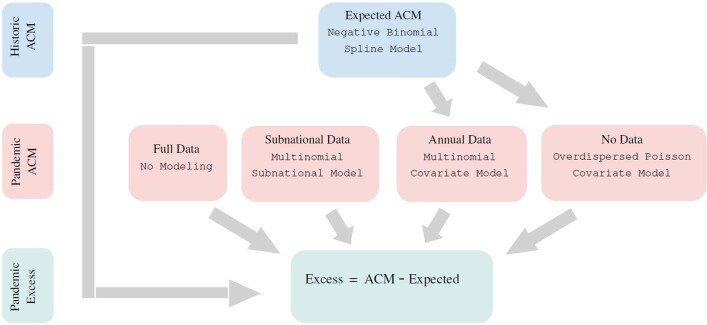
- Excess deaths were estimated with a Bayesian Poisson / negative binomial framework: historical ACM (often 2015–2019) was used to model expected deaths with spline-based seasonal and annual trends; where pandemic data were incomplete, a covariate-based log-linear model and, for some countries, subnational-to-national multinomial/proportionality models were used.
Limitations
- The paper states that the biggest limitation is data paucity: for almost half of WHO member states, ACM data during the pandemic were unavailable, so estimates relied on statistical models; the text says these countries should be interpreted with caution.
- The paper states that the counterfactual trend is sensitive to modelling assumptions, including the choice of spline models and how recent historical years are weighted; it notes splines can produce inappropriate extrapolations.
- The text makes evident that comparisons across countries/regions are difficult because countries differ in age structure, data completeness, and reporting quality; this is stated in the paper and means rankings can be misleading.
- The text makes evident that the paper cannot quantify how much excess mortality is directly COVID-19 versus indirect or non-COVID causes; the discussion explicitly says excess mortality combines these and cannot separate them.
Model-written summary. Check it against the paper before relying on it.
Integrity signals
Registry
Cites
Statistics
Figures
Verification
Claims the paper makes
8 Valid · 2 Not valid · 6 Not checked · 81 Own results and interpretations
Every source the paper cites for this claim was checked and supports it.
In the paper
“Reported statistics on COVID-19 mortality are problematic for many countries owing to variations in testing access, differential diagnostic capacity and inconsistent certification of COVID-19 as cause of death.”
- Also stated in: § Main · plain
“countries have differed in their application of standards for the certification of COVID-19 as the underlying cause-of-death2.”
§ The WHO estimates of excess mortality associated with the COVID-19 pandemic > Abstract
What the sources say
- Supportedcites [2] Riffe T Acosta E Data Resource Profile: COVerAGE-DB: a global demographic database of COVID-19 cases and deaths Int. J. Epidemiol. 2021 50 390 390f 10.1093/ije/dyab027 source
The Strengths and weaknesses section says COVID-19 death counts are likely underestimated for reasons also affecting case counts, including testing capacity and diagnostic-test accuracy. It also describes differences in whether suspected deaths are counted and evidence that COVID-19-related deaths are classified under other causes. Page numbers were not supplied in our copy. (LLM, conf=0.90)
plainstates a cause- Asserted: passes — The authors put it forward as true.
- Checkable: passes — It can be checked against evidence.
- Load-bearing: passes — The paper’s conclusions depend on it.
- Based: passes — The paper gives a reason why it holds.
- Also stated in: § Main · plain
Every source the paper cites for this claim was checked and supports it.
In the paper
“The measure overcomes the variation among countries in reporting and testing and the misclassification of the cause of death on death certificates7”
§ The WHO estimates of excess mortality associated with the COVID-19 pandemic > Main
What the sources say
- Supportedcites [7] Beaney T Excess mortality: the gold standard in measuring the impact of COVID-19 worldwide? J. Royal Soc. Med. 2020 113 329 334 10.1177/0141076820956802 PMC7488823 32910871 source
The Excess mortality section states that, because it encompasses deaths from all causes, excess mortality overcomes cross-country variation in COVID-19 reporting and testing and misclassification of causes on death certificates. This directly matches the attributed claim. (LLM, conf=0.95)
plainstates a cause- Asserted: passes — The authors put it forward as true.
- Checkable: passes — It can be checked against evidence.
- Load-bearing: passes — The paper’s conclusions depend on it.
- Based: passes — The paper gives a reason why it holds.
- Supported
Every source the paper cites for this claim was checked and supports it.
In the paper
“This surpasses the influenza pandemics of 1957, 1968 and 2009 (estimated at 0.04%, 0.03% and 0.005%, respectively)18.”
§ The WHO estimates of excess mortality associated with the COVID-19 pandemic > Discussion
What the sources say
- Supportedcites [18] Simonsen L Viboud C Mortality: a comprehensive look at the COVID-19 pandemic death toll. eLife 2021 10 e71974 10.7554/eLife.71974 34382937 PMC8360646 source
Table 1 (Abstract) gives a global per capita excess mortality rate of >0.08% for COVID-19, exceeding its estimates of 0.04%, 0.03%, and 0.005% for the 1957, 1968, and 2009 influenza pandemics, respectively. The paper describes the COVID-19 estimate using data available in 2020–2021. (LLM, conf=0.94)
plain- Asserted: passes — The authors put it forward as true.
- Checkable: passes — It can be checked against evidence.
- Load-bearing: unclear — It is unclear whether the paper’s conclusions depend on it.
- Based: passes — The paper gives a reason why it holds.
- Supported
Every source the paper cites for this claim was checked and supports it.
In the paper
“As another example, in the Africa region for which ACM data are most lacking, recent studies have highlighted the underestimation in the reported statistics20.”
§ The WHO estimates of excess mortality associated with the COVID-19 pandemic > Discussion
What the sources say
- Supportedcites [20] Cabore J. W. et al. COVID-19 in the 47 countries of the WHO African region: a modelling analysis of past trends and future patterns. Lancet Glob. Health10, e1099–e1114 (2022). PMC9159735 35659911 source
The Introduction states that reported infections and deaths underestimate the actual COVID-19 burden in the WHO African region. It also reports that, in countries with seroprevalence studies, reported infections represented only a small proportion of the estimated burden. Page numbers were not provided. (LLM, conf=0.94)
plainstates an association- Asserted: passes — The authors put it forward as true.
- Checkable: passes — It can be checked against evidence.
- Load-bearing: unclear — It is unclear whether the paper’s conclusions depend on it.
- Based: passes — The paper gives a reason why it holds.
- Supported
Every source the paper cites for this claim was checked and supports it.
In the paper
“The uncertainty in the expected predictions is well modelled by a gamma distribution, and the advantage of this choice is that it can be conveniently combined with a Poisson model to produce a negative binomial model with the log-linear mean given by equation (3).”
§ The WHO estimates of excess mortality associated with the COVID-19 pandemic > Methods > Model for countries without full pandemic data For almost half of the 194 WHO member states we do not have the ACM counts over the pandemic, and so must predict them using country characteristics. We choose a simple form for this prediction model, with mean2where is a relative rate parameter. If , then for country and at month the mortality is greater than expected, whereas if , then for country and at month the mortality is less than expected. We used time-invariant variables, (these are annual values from 2019). These were an indicator of high income and/or low or middle income, the cardiovascular mortality rate in 2019 and the diabetes prevalence rate in 2019. In addition, we used time-varying variables: a containment variable (it is calculated using all ordinal containment and closure policy indicators and health-system policy indicators, for further details see Hale et al.14), the square root of the reported COVID-19 death rate, temperature and the COVID-19 test positivity rate. We then build a log-linear model for the rate parameter:3where and denote relative rate parameters and are independent error contributions that pick up random variation unexplained by the log-linear regression function. The time-varying coefficients allow the associations to evolve during the pandemic. As we desire the evolution to be smooth in time, for these time-varying coefficients we use a random walk of order 2 (RW2) prior that encourages smooth estimates46. In equation (2) above, we have conditioned on known expected numbers. In reality, and as just described, these are modelled to give a distribution over plausible values. The uncertainty in the expected predictions is well modelled by a gamma distribution, and the advantage of this choice is that it can be conveniently combined with a Poisson model to produce a negative binomial model with the log-linear mean given by equation (3). Full details (including evidence of the accuracy of the gamma model) can be found in Knutson et al.15. This model was fitted to all countries with observed monthly ACM data over some portion of 2020–2021, using the integrated nested Laplace approximation method47, to obtain posterior distributions over the unknown parameters. The resultant posterior distribution reflects the uncertainty in the parameters (both in the expected numbers and the log-linear covariate model), and can be used to construct a predictive distribution for the ACM in countries with no data or partial data.
What the sources say
- Supportedcites Knutson et al.15 Knutson V., Aleshin-Guendel S., Karlinsky A., Msemburi W. & Wakefield J. Estimating country-specific excess mortality during the COVID-19 pandemic (2023). Ann. Appl. Stat. (in the press). PMC9812776 36517599 source
Section 3.3 (Modeling Uncertainty in the Expected Numbers) states they fit a gamma distribution by method of moments to the Monte Carlo samples of the expected numbers and 'approximate the distribution of the expected numbers as gamma, since this is conjugate to the Poisson, and so allows efficient inference with INLA ... using a negative binomial,' and the Supplementary Materials (Sec. 5, Gamma Expected Numbers; Fig. 5) report the gamma fits are accurate, with differences 'small in all cases' — supporting 'well modelled'. The model description bullet confirms the negative binomial component with known tau arises from the uncertainty in the expected numbers within the log-linear Poisson/negative-binomial formulation. The 'equation (3)' reference is the citing paper's own display, not attributed content. (LLM, conf=0.90)
boosted- Asserted: passes — The authors put it forward as true.
- Checkable: passes — It can be checked against evidence.
- Load-bearing: passes — The paper’s conclusions depend on it.
- Based: passes — The paper gives a reason why it holds.
- Supported
49 more claims
Create a free account to see all 97 claims and to verify the 2 references still open.
- Probably not a substantial claim. 19
- It may state two separate claims as one. 30
- The quote only partly states this claim. 2
Claims other papers make about this one
Each is checked against this paper’s own text: does it say what the citing paper says it does?
The source backs part of the claim, not all of it — or backs it for a different population, condition or comparison.
In the citing paper
“Our current estimate of global excess mortality during 2020 and 2021 is comparable to the WHO estimate of 14·9 million (95% UI 13·3–16·6) excess deaths,15 with our mean estimate falling within the uncertainty interval of the WHO estimate and vice versa.”
From Global age-sex-specific mortality, life expectancy, and population estimates in 204 countries and territories and 811 subnational locations, 1950–2021, and the impact of the COVID-19 pandemic: a comprehensive demographic analysis for the Global Burden of Disease Study 2021 (2024) · cites this paper as [15]
Experimental — accuracy not yet measuredThe cited source says what the claim attributes to it.
In the citing paper
“this total greatly exceeds global average increases of 8% in 2020 and 18% in 20214.”
From Attributed causes of excess mortality during the COVID-19 pandemic in a south Indian city (2023) · cites this paper as [4]
In the citing paper
“Other settings with >25% increases in mortality during the pandemic have included Russia and LMICs within Latin America, Eastern Europe, and central Asia1,4.”
From Attributed causes of excess mortality during the COVID-19 pandemic in a south Indian city (2023) · cites this paper as [4]
Citations
Cites
Vos, T., Lim, S. S., Abbafati, C., Abbas, K. M., Abbasi, M., Abbasifard, M., Abbasi-Kangevari, M., Abbastabar, H., Abd-Allah, F., Abdelalim, A., et al. (2020) · The Lancet · doi:10.1016/s0140-6736(20)30925-9 · Cited by 19,358
Generalized Additive Models: An Introduction with R
Wood, S. N. (2017) · doi:10.1201/9781315370279 · Cited by 13,852
Rue, H., Martino, S., & Chopin, N. (2009) · Journal of the Royal Statistical Society Series B: Statistical Methodology · doi:10.1111/j.1467-9868.2008.00700.x · Cited by 5,279
Wang, H., Paulson, K. R., Pease, S. A., Watson, S., Comfort, H., Zheng, P., Aravkin, A. Y., Bisignano, C., Barber, R. M., Alam, T., et al. (2022) · The Lancet · doi:10.1016/s0140-6736(21)02796-3 · Cited by 2,069
Rue, H., & Held, L. (2005) · Chapman & Hall/CRC eBooks · doi:10.1201/9780203492024 · Cited by 1,823
Guidelines for accurate and transparent health estimates reporting: the GATHER statement
Stevens, G. A., Alkema, L., Black, R. E., Boerma, J. T., Collins, G. S., Ezzati, M., Grove, J. T., Hogan, D. R., Hogan, M. C., Horton, R., et al. (2016) · The Lancet · doi:10.1016/s0140-6736(16)30388-9 · Cited by 1,798
Karlinsky, A., & Kobak, D. (2021) · eLife · doi:10.7554/elife.69336 · Cited by 772
Self-citationMurray, C. J., Lopez, A. D., Chin, B., Feehan, D., & Hill, K. H. (2006) · The Lancet · doi:10.1016/s0140-6736(06)69895-4 · Cited by 605
Islam, N., Shkolnikov, V. M., Acosta, R. J., Klimkin, I., Kawachi, I., Irizarry, R. A., Alicandro, G., Khunti, K., Yates, T., Jdanov, D. A., et al. (2021) · BMJ · doi:10.1136/bmj.n1137 · Cited by 468
Guidelines for accurate and transparent health estimates reporting: the GATHER statement
Stevens, G. A., Alkema, L., Black, R. E., Boerma, J. T., Collins, G. S., Ezzati, M., Grove, J. T., Hogan, D. R., Hogan, M. C., Horton, R., et al. (2016) · PLOS Medicine · doi:10.1371/journal.pmed.1002056 · Cited by 424
Research works printed but not linked: 2
- National Bureau of Statistics of China. China Statistical Yearbook 2021 (China Statistics Press, 2021).
- Hale, T. et al. Variation in Government Responses to COVID-19 Technical Report (Univ. Oxford, 2020).
Cited by
Items 101–200 of 1,067
Devarkar, S. C., Vetick, M. B., Balaji, S., Lomakin, I. B., Yang, L., Jin, D., Gilbert, W. V., Chen, S., & Xiong, Y. (2023) · Cell Reports · doi:10.1016/j.celrep.2023.113156 · Cited by 17
“These results suggest that the interaction between the CTD of MERS-CoV Nsp1 and the 40S ribosomal subunit is critical for its translation inhibition activity.”
Cao, X., Li, Y., Zi, Y., & Zhu, Y. (2023) · Frontiers in Public Health · doi:10.3389/fpubh.2023.1085451 · Cited by 16
Herrera, C. A., Báscolo, E., Uribe, M. V., Houghton, N., Bennett, S., Castro, M. C., Massuda, A., Bauhoff, S., Kain, M. K. C., Figueroa, J. P., et al. (2025) · The Lancet Regional Health - Americas · doi:10.1016/j.lana.2025.101240 · Cited by 38
“67 In contrast, a few examples demonstrate the importance of preparing and planning for shocks.”
Maughan‐Brown, B., Eyal, K. C., Njozela, L., & Buttenheim, A. M. (2023) · BMJ Global Health · doi:10.1136/bmjgh-2023-012433 · Cited by 16
Comparing methods to predict baseline mortality for excess mortality calculations
Ferenci, T. (2023) · BMC Medical Research Methodology · doi:10.1186/s12874-023-02061-w · Cited by 26
Fragment-based screening targeting an open form of the SARS-CoV-2 main protease binding pocket
Huang, C., Metz, A., Lange, R., Artico, N., Potot, C., Hazemann, J., Müller, M., dos Santos, M., Chambovey, A., Ritz, D., et al. (2024) · Acta Crystallographica Section D Structural Biology · doi:10.1107/s2059798324000329 · Cited by 18
Temporal Trends in 1-Year Cause-Specific Mortality After TAVR
Kolte, D. S., Marquis‐Gravel, G., Stebbins, A. S., Vekstein, A. M., Vemulapalli, S., & Elmariah, S. (2025) · JACC: Cardiovascular Interventions · doi:10.1016/j.jcin.2024.12.016 · Cited by 18
Kepp, K. P., Björk, J., Emilsson, L., & Lallukka, T. M. (2023) · SSM - Population Health · doi:10.1016/j.ssmph.2023.101377 · Cited by 19
“Also, the WHO study(Msemburi et al., 2023) confirmed that the Nordic countries had some of the lowest mortality impacts in Europe and documented a reverse excess mortality from 2020 to 2021 in Denmark and Finland vs. Sweden (referred to below as mortality reversal)(Aburto et al., 2022).”
InfluentialCOVID-19 increased existing gender mortality gaps in high-income more than middle-income countries
Beegle, K., Demombynes, G., de Walque, D., Gubbins, P., & Veillard, J. H. M. (2024) · International Journal of Infectious Diseases · doi:10.1016/j.ijid.2024.107167 · Cited by 17
“Population size may also factor into the wide variation in patterns in the sex ratio of excess deaths since smaller countries have worse P -scores (the ratio of excess deaths to expected deaths) [ 13 ].”
Sherman, A. C., Gray, G., Cao, B., To, K. K., Rouphael, N., Restrepo, A. M. H., Gordon, A. C., & Baden, L. R. (2025) · Nature Reviews Disease Primers · doi:10.1038/s41572-025-00662-x · Cited by 24
“Global excess mortality for COVID-19 in the first 2 years of the pandemic was estimated to be 14.83 million, 2.74 times higher than the 5.42 million deaths reported to be due to COVID-19 for the same period 11 .”
InfluentialGlobal Catastrophic Biological Risks in the Post-COVID-19 World: Time to Act Is Now
Kambouris, M. E. (2023) · OMICS A Journal of Integrative Biology · doi:10.1089/omi.2022.0178 · Cited by 18
Chioléro, A., Tancredi, S., & Ioannidis, J. P. A. (2023) · European Journal of Epidemiology · doi:10.1007/s10654-023-01049-6 · Cited by 17
“Nevertheless, data ingestion workflow remained problematic, and major inconsistencies across countries and settings continued, including, e.g., for death outcomes with intractable between countries differences in definitions, completeness, and over-or under-counting [8, 9].”
BackgroundSteinberg, J., Hughes, S., Hui, H., Allsop, M. J., Egger, S. J., David, M., Caruana, M., Coxeter, P., Carle, C., Onyeka, T. C., et al. (2023) · International Journal of Cancer · doi:10.1002/ijc.34798 · Cited by 18
Causal effects of closing businesses in a pandemic
Barrot, J.-N., Bonelli, M., Grassi, B., & Sauvagnat, J. (2024) · Journal of Financial Economics · doi:10.1016/j.jfineco.2024.103794 · Cited by 22
Large and unequal life expectancy declines during the COVID-19 pandemic in India in 2020
Gupta, A., Hathi, P., Banaji, M., Gupta, P., Kashyap, R., Paikra, V. K., Sharma, K., Somanchi, A., Sudharsanan, N., & Vyas, S. (2024) · Science Advances · doi:10.1126/sciadv.adk2070 · Cited by 22
“This study empirically estimates changes in period life expectancy at birth (hereafter, life expectancy) by sex and social group between 2019 and 2020 in India, where according to the WHO ( 11 ), one-third of global pandemic excess deaths are estimated to have occurred.”
BackgroundResultInfluentialEnhancing nursing competence in China: The interplay of resilience, mindfulness and social support
Yan, X., Yan, X., Jia, X., et al. (2024) · Nurse Education in Practice · doi:10.1016/j.nepr.2024.104087 · Cited by 14
Shan, D., Jin, W., Li, F., Yang, C., Zeng, Y., Xie, R., Zeng, Q., Chen, Y., Wang, H., Linehan, C., et al. (2025) · Med Research · doi:10.1002/mdr2.70023 · Cited by 17
Adimulam, T., Arumugam, T., Gokul, A., & Ramsuran, V. (2023) · International Journal of Molecular Sciences · doi:10.3390/ijms24108711 · Cited by 17
RESILIENCE, COPING, AND THE COVID-19 PANDEMIC ACROSS THE GLOBE – AN UPDATE: WHAT HAVE WE LEARNED?
Polizzi, C. P., McDonald, C. W., Sleight, F. G., & Lynn, S. J. (2023) · PubMed Central · doi:10.36131/cnfioritieditore20230411 · Cited by 14
Using mortuary and burial data to place COVID-19 in Lusaka, Zambia within a global context
Sheppard, R. J., Watson, O. J., Pieciak, R. C., Lungu, J., Kwenda, G., Moyo, C., Chanda, S. L., Barnsley, G., Brazeau, N. F., Gerard-Ursin, I. C. G., et al. (2023) · Nature Communications · doi:10.1038/s41467-023-39288-6 · Cited by 27
“To answer this, we place existing WHO excess mortality estimates during the pandemic in Zambia in a global context, explicitly accounting for the protective effect of its relatively young population.”
InfluentialRabarison, J. H., Rakotondramanga, J. M., Ratovoson, R., Masquelier, B., Rasoanomenjanahary, A., Dreyfus, A., Garchitorena, A., Rasambainarivo, F., Razanajatovo, N. H., Andriamandimby, S. F., et al. (2023) · BMJ Global Health · doi:10.1136/bmjgh-2023-011801 · Cited by 13
Munira, M. S., Okada, Y., & Nishiura, H. (2023) · PeerJ · doi:10.7717/peerj.15784 · Cited by 15
Ghafari, M., Hosseinpour, S., Zavareh, M. S. R., Dascalu, S., Rostamian, S., Aramesh, K., Madani, K., & Kordasti, S. Y. (2023) · BMC Medicine · doi:10.1186/s12916-023-03127-8 · Cited by 15
“…we believe our model provides a fast and simple framework for estimating ACDs for Iran and other countries with similar limitations using excess mortality data which is readily available for most countries around the world and does not greatly suffer from under-reporting biases [43, 44].”
BackgroundKumar, A., Dutt, M., Dehury, B., Martinez, G. S., Swan, C. L., Kelvin, A. A., Richardson, C. D., & Kelvin, D. J. (2023) · Journal of Biomolecular Structure and Dynamics · doi:10.1080/07391102.2023.2291165 · Cited by 13
“As of 19 April 2023, COVID-19, caused by the SARS-CoV-2 virus, has been responsible for more than 763 million confirmed cases globally, and it is estimated that over 20 million deaths have resulted from the disease (Msemburi et al., 2022; Van Noorden, 2022) (https://covid19. who.int/).”
Nilsson, A., Emilsson, L., Kepp, K. P., Knudsen, A. K., Forthun, I., Madsen, C., Björk, J., & Lallukka, T. M. (2024) · European Journal of Epidemiology · doi:10.1007/s10654-024-01154-0 · Cited by 18
“Globally, the first two years of the pandemic, 2020–2021, were estimated to have caused 15–18 million excess deaths [7, 8].”
BackgroundAdvancing CRISPR-Based Solutions for COVID-19 Diagnosis and Therapeutics
Hadi, R., Poddar, A., Sonnaila, S., Bhavaraju, V. S. M., & Agrawal, S. (2024) · Cells · doi:10.3390/cells13211794 · Cited by 17
“…the pandemic across countries, accounting for both direct COVID-19-related deaths and indirect e ff ects, such as healthcare disruptions and other pandemic-related challenges. for both direct COVID-19-related This fi gure was constructed using data adopted from [17] and created using Tableau v2024.”
MethodCOVID-19 vaccines and a perspective on Africa
Mantovani, A., Rescigno, M., Forni, G., Tognon, F., Putoto, G., Ictho, J., & Lochoro, P. (2023) · Trends in Immunology · doi:10.1016/j.it.2023.01.005 · Cited by 14
“8 million people is directly or indirectly due to the coronavirus disease 2019 (COVID-19) pandemic [1].”
BackgroundAge and sex adjustments are critical when comparing death rates
Islam, N., & Jdanov, D. A. (2023) · BMJ · doi:10.1136/bmj.p845 · Cited by 15
Kowall, B., & Stang, A. (2023) · Herz · doi:10.1007/s00059-023-05166-6 · Cited by 14
Mechanisms of Potential Therapeutic Utilization of Mesenchymal Stem Cells in COVID-19 Treatment
Fang, Y., Lao, P., Tang, L., Chen, J., Chen, Y., Sun, L., Tan, W., & Fan, X. (2023) · Cell Transplantation · doi:10.1177/09636897231184611 · Cited by 16
“These criteria include (1) MSCs must adhere to plastic surfaces when in culture; (2) MSCs must express specific surface markers, including CD73, CD90, and CD105, and must lack the expression of CD34, CD45, CD11b, CD19 or CD79α, and HLA-DR; and (3) MSCs must be capable of differentiating into osteoblasts, adipocytes, a…”
BackgroundImpact of COVID-19 on mortality in coastal Kenya: a longitudinal open cohort study
Otiende, M., Nyaguara, A., Bottomley, C., Walumbe, D., Mochamah, G., Amadi, D., Nyundo, C., Kagucia, E. W., Etyang, A. O., Adetifa, I., et al. (2023) · Nature Communications · doi:10.1038/s41467-023-42615-6 · Cited by 20
Harnessing antiviral RNAi therapeutics for pandemic viruses: SARS-CoV-2 and HIV
Bowden-Reid, E., Moles, E., Kelleher, A. D., & Ahlenstiel, C. (2025) · Drug Delivery and Translational Research · doi:10.1007/s13346-025-01788-x · Cited by 16
Fang, Y., Cai, L., Li, N., Bian, F., Zhang, D., He, N., Li, Z., Yan, H., & Zhao, Y. (2025) · Research · doi:10.34133/research.0839 · Cited by 15
Advancing biocompatible metal-organic frameworks in personalized biomedical applications
Yu, Z., Chivu, A., Dai, J., Patra, H. K., Zou, J., & Hu, Z. (2025) · Coordination Chemistry Reviews · doi:10.1016/j.ccr.2025.217262 · Cited by 21
Singh, A. K., Pathak, A. K., & Saini, G. (2025) · Scientific Reports · doi:10.1038/s41598-025-26663-0 · Cited by 15
“COVID-19, caused by the coronavirus, resulted in a global health crisis with an estimated 14 million excess deaths—2.74 times higher than officially reported—largely due to underreporting and data gaps in many countries 81,82 .”
InfluentialReputation management during a public health crisis: Overcompensating when all else fails
Castro, S. V., Bustos, E. O., & Gonzatti, D. S. (2023) · Public Administration Review · doi:10.1111/puar.13638 · Cited by 16
Nappi, F. (2023) · International Journal of Molecular Sciences · doi:10.3390/ijms25010047 · Cited by 14
“…2.74 times higher than There are signi fi cant variations in the estimates of excess deaths among the six regions of the World Health Organization [147]. the 5.42 million deaths reported as being due to COVID-19 during the same Since the COVID-19 outbreak and the frequent occurrence of…”
BackgroundInfluentialFeng, Y., Feng, Y., Fan, Y., & Ge, J. (2024) · Journal of Hazardous Materials · doi:10.1016/j.jhazmat.2024.135373 · Cited by 14
Rarani, M. A., Aghdash, S. A., Isfahani, H. M., & Mohseni, M. (2024) · BMC Public Health · doi:10.1186/s12889-024-19729-7 · Cited by 21
“The COVID-19 pandemic led to mass casualties and an economic crisis in many countries and, despite that the disease can be mild to very severe respiratory disease, caused huge death toll in many countries [6, 7].”
BackgroundLi, X., & Song, Y. (2024) · Journal of Medicinal Chemistry · doi:10.1021/acs.jmedchem.4c01749 · Cited by 11
Zhou, N., Tang, S., Bian, X., Parai, M. K., Krieger, I. V., Flores, A., Jaiswal, P. K., Bam, R., Wood, J. L., Shi, Z., et al. (2024) · Cell Reports · doi:10.1016/j.celrep.2024.114929 · Cited by 13
The immunopathogenesis of SARS-CoV-2 infection: Overview of lessons learned in the first 5 years
Yang, O. O. (2025) · The Journal of Immunology · doi:10.1093/jimmun/vkaf033 · Cited by 16
COVAX – Time to reconsider the strategy and its target
Bell, D., Brown, G. W., Oyibo, W. A., Ouédraogo, S., Tacheva, B., Barbaud, E., Kalk, A., Ridde, V., & Paul, É. (2023) · Health Policy OPEN · doi:10.1016/j.hpopen.2023.100096 · Cited by 16
“…global COVID ‐ 19 vaccine equity ’ through mass vaccination [9 ‐ 11], pointing notably to the higher case fatality rate of COVID ‐ 19 in LMICs [12] as well as to the relatively high burden of COVID ‐ 19 in terms of excess death in LMICs, particularly in South ‐ East Asia and Latin America [13].”
BackgroundSerum Pentraxin 3 as Promising Biomarker for the Long-Lasting Inflammatory Response of COVID-19
Capra, A. P., Crupi, L., Pantò, G., Repici, A., Calapai, F., Squeri, R., Ardizzone, A., & Esposito, E. (2023) · International Journal of Molecular Sciences · doi:10.3390/ijms241814195 · Cited by 14
“After an incubation period of around six days, the disease may become symptomatic in the affected patient, with an extremely wide degree of severity [2,3].”
BackgroundThe Gut Microbiome in Enteric Viral Infections: Underlying Mechanisms and Therapeutic Approaches
Borrego-Ruiz, A., & Borrego, J. J. (2025) · Microorganisms · doi:10.3390/microorganisms13102247 · Cited by 14
Ryan, B. J., Kako, M., Fink, R., Şimşek, P., Barach, P. R., Acosta, J., Bhatia, S., Brickhouse, M., Fendt, M. W., Fontenot, A., et al. (2023) · Disaster Medicine and Public Health Preparedness · doi:10.1017/dmp.2023.136 · Cited by 13
“56 The recommendations from this study provide a path for public health systems and their leaders to become more flexible, agile, and resilient.”
BackgroundMarinetti, I., Jdanov, D. A., Grigoriev, P., Klüsener, S., & Janssen, F. (2023) · PLoS ONE · doi:10.1371/journal.pone.0295763 · Cited by 10
“At the end of 2021, more than 5 million deaths attributable to COVID-19 have been estimated around the world [1].”
BackgroundThe crosstalk between SUMOylation and immune system in host-pathogen interactions
Zhu, G., Tong, N., Zhu, Y., Wang, L., & Wang, Q. (2024) · Critical Reviews in Microbiology · doi:10.1080/1040841x.2024.2339259 · Cited by 13
Reeves, J. M., Spencer, L., Tsai, L.-L., Baillie, A., Han, Y., Leung, R. W. M., Bishop, J. A., Troy, L. K., Corte, T. J., Teoh, A. K. Y., et al. (2024) · Physical Therapy · doi:10.1093/ptj/pzae080 · Cited by 10
Excess Death Rates by State During the COVID-19 Pandemic: United States, 2020‒2023
Woolf, S. H., Lee, J. H., Chapman, D. A., Sabo, R., & Zimmerman, E. B. (2024) · American Journal of Public Health · doi:10.2105/ajph.2024.307731 · Cited by 13
Karunarathna, S. C., Lu, W., Patabendige, N. M., Zhao, C., & Hapuarachchi, K. K. (2024) · New Zealand Journal of Botany · doi:10.1080/0028825x.2024.2384453 · Cited by 18
Estimating Excess Mortality During the COVID-19 Pandemic Between 2020–2022 in Korea
Jang, M., Kim, S., Choi, S., Ryu, B., Choi, S. Y., Choi, S., An, M., & Kim, S.-S. (2024) · Journal of Korean Medical Science · doi:10.3346/jkms.2024.39.e267 · Cited by 12
“5 Several articles have reported that South Korea responded to the initial COVID-19 pandemic by implementing strong interventional policies such as contact tracing, testing, and treatment.”
BackgroundHellman, U., Rosendal, E., Lehrstrand, J., Henriksson, J., Björsell, T., Wennemo, A., Hahn, M., Österberg, B., Dorofte, L., Nilsson, E., et al. (2024) · mBio · doi:10.1128/mbio.01303-24 · Cited by 12
Galmiche, S., Coustaury, C., Charniga, K., Grant, R., Cauchemez, S., Fontanet, A. L., The Western European Covid-19 Excess Mortality Working Group, Autran, B., Barnbrook, M., Barros, H., et al. (2024) · BMC Global and Public Health · doi:10.1186/s44263-024-00103-z · Cited by 18
“We chose a longer reference period to estimate the expected mortality during pandemic years (10 years instead of the often-used 5 years) [3, 4, 9].”
Comparison of COVID-19 Vaccine-Associated Myocarditis and Viral Myocarditis Pathology
Hamedi, K. R., Loftus, G., Traylor, L. B., Goodwin, R. L., & Arce, S. (2023) · Vaccines · doi:10.3390/vaccines11020362 · Cited by 14
Lestari, S. W., Restiansyah, G., Yunihastuti, E., et al. (2023) · Asian Journal of Andrology · doi:10.4103/aja202310 · Cited by 11
Школьников, В. М., Тимонин, С. А., Jdanov, D. A., et al. (2023) · medRxiv · doi:10.1101/2023.11.08.23298275 · Cited by 11
Impact of the COVID-19 pandemic on Ukrainian mortality, 2020–2021
Mehta, N. K., Honchar, I., Doroshenko, O., Pak, K., Daniuk, M., & Polikarchuk, P. (2023) · PLoS ONE · doi:10.1371/journal.pone.0285950 · Cited by 13
“Prior estimates have only been at the national level and have ranged from approximately 178,000 to 198,000 for 2020–2021 [2, 3, 17].”
BackgroundA Simulation Framework for Modeling the Within-Patient Evolutionary Dynamics of SARS-CoV-2
Terbot, J. W., Cooper, B. S., Good, J. M., & Jensen, J. D. (2023) · Genome Biology and Evolution · doi:10.1093/gbe/evad204 · Cited by 10
Geopolitical determinants of mental health and global health inequities
Valsraj, K. M., Moura, H. F., Anantapong, K., Ventriglio, A., Persaud, A., Tribe, R., Pemberton, M., Poulter, D., & Bhugra, D. (2024) · Industrial Psychiatry Journal · doi:10.4103/ipj.ipj_32_24 · Cited by 11
“[3] This is a poignant reminder of the pervasive inequities that plagued every crucial aspect of the global response.”
The effect of adaptive capacity on resilience to the COVID-19 pandemic: A cross-country analysis
Khadka, A. (2024) · Jàmbá Journal of Disaster Risk Studies · doi:10.4102/jamba.v16i1.1697 · Cited by 22
Population age structure dependency of the excess mortality P-score
Ullrich-Kniffka, N., & Schöley, J. (2024) · Population Health Metrics · doi:10.1186/s12963-024-00346-w · Cited by 11
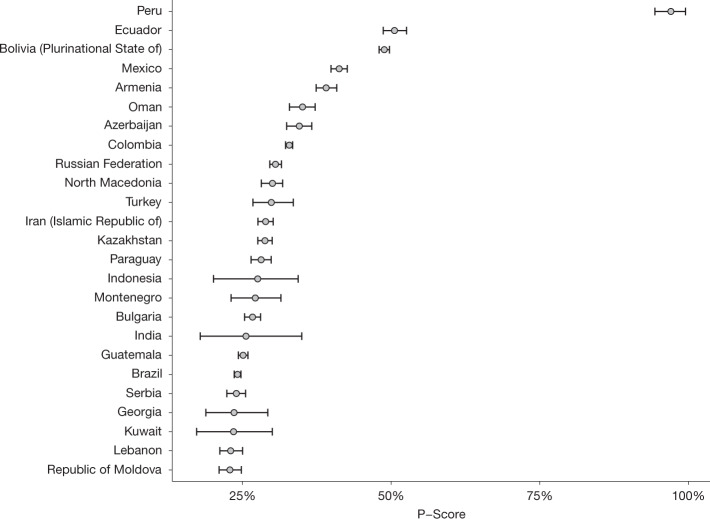
“The P-score has been widely Page 2 of 9 Ullrich‑Kniffka and Schöley Population Health Metrics (2024) 22:25 used to estimate levels of excess mortality during the COVID-19 pandemic [1, 2, 4–16].”
MethodChen, Z., Tian, Y., Liu, J., Ran, J., Sun, S., Zhao, S. G., Ge, Y., Martínez, L., Chen, X., & Cao, P. (2024) · American Journal of Epidemiology · doi:10.1093/aje/kwae411 · Cited by 13
Lessons for medical countermeasure development from unforeseen outbreaks
Mura, M., Trignol, A., Dault, E. L., & Tournier, J. (2025) · Emerging Microbes & Infections · doi:10.1080/22221751.2025.2471035 · Cited by 10
“…records cite approximately 5.42 million direct deaths attributed to the virus during the 2020–2021 period, the World Health Organization (WHO) has ventured an alarming estimate of 14.83 million excess deaths worldwide – highlighting the complexity of assessing the pandemic’s full impact [3].”
InfluentialThe role of mortality surveillance in pandemic preparedness and response
Rao, C., de Savigny, D., Atuheire, E. B., Dolan, S., Muñoz, D. C., Fat, D. M., Ebonwu, J., Sharan, M., Ofosu, A. A., Bradshaw, D., et al. (2025) · Bulletin of the World Health Organization · doi:10.2471/blt.24.292423 · Cited by 16
“3,53,54 Death registration systems are dysfunctional in most countries in the African region, where mortality statistics are compiled from fragmented and uncoordinated collection from multiple sources.”
SARS-CoV-2 epidemiology, kinetics, and evolution: A narrative review
Alizon, S., & Sofonea, M. T. (2025) · Virulence · doi:10.1080/21505594.2025.2480633 · Cited by 16
“This could not be monitored in real-time because of a substantial under-reporting, which was estimated, using excess mortality, up to 20-fold in some countries [96,97].”
The short-term association between environmental variables and mortality: evidence from Europe
Robben, J., Antonio, K., & Kleinow, T. (2025) · Journal of the Royal Statistical Society Series A (Statistics in Society) · doi:10.1093/jrsssa/qnaf052 · Cited by 24
“…baseline for a specific week w in year t and region r , we calculate the excess death proportion or the so-called ‘P-score’ (Sch¨oley, 2021; Msemburi et al., 2023), defined as: EDP t,w , ˆ b ( r ) t,w , and ˆ d ( r ) t,w represent, respectively, the observed deaths, the deaths estimated by…”
BackgroundEspinosa, O., Ramos, J., Rojas-Botero, M. L., & Fernández-Niño, J. A. (2023) · PLOS Global Public Health · doi:10.1371/journal.pgph.0002172 · Cited by 10
“For example, in other previous comparisons it has been found that countries like Colombia showed a specific mortality rate that converges with the excess mortality rate, in contrast to other countries like India that did not participate in this study [32].”
ResultSimon, S., John, S., Lisonkova, S., Razaz, N., Muraca, G. M., Boutin, A., Bedaiwy, M. A., Brandt, J. S., Ananth, C. V., & Joseph, K. S. (2023) · Obstetrics and Gynecology · doi:10.1097/aog.0000000000005412 · Cited by 14
Ribeiro, B., Vázquez‐López, A., Vazquez‐Pufleau, M., Llamosí, M., Sempere, J., Yuste, J., Domenech, M., Wang, D., Vilatela, J. J., LLorca, J., et al. (2023) · Materials Chemistry and Physics · doi:10.1016/j.matchemphys.2023.128684 · Cited by 11
Menezes-Filho, N. A., Komatsu, B. K., & Villares, L. (2023) · PLoS ONE · doi:10.1371/journal.pone.0295572 · Cited by 13
The COVID-19 pandemic and Bitcoin: Perspective from investor attention
Wan, J., Wu, Y., & Zhu, P. (2023) · Frontiers in Public Health · doi:10.3389/fpubh.2023.1147838 · Cited by 12
“This paper selects GARCH (1, 1) to estimate Bitcoin volatility since GARCH (1, 1) has been widely used in existing literature for its superiority over more complex models (96, 97).”
BackgroundMethodInfluentialOviedo, D. C., Tratner, A. E., Pinzón, M. S., Rodríguez-Araña, S., Pauli-Quirós, E., Chavarría, C., Rodríguez, C. P., & Britton, G. B. (2023) · Frontiers in Psychology · doi:10.3389/fpsyg.2023.1235935 · Cited by 12
“At the height of the pandemic (i.e., January 2020 to December 2021) there were an estimated 14.83 million excess deaths worldwide (Msemburi et al., 2023).”
BackgroundInfluentialMa, Y., Zhao, Y., & Ma, Y. (2024) · Scientific Reports · doi:10.1038/s41598-024-56208-w · Cited by 12
Song, K., Xue, W., Li, X., Chang, Y., & Liu, M. (2024) · Analytical Chemistry · doi:10.1021/acs.analchem.4c01607 · Cited by 10
Molnupiravir Use Among Patients with COVID-19 in Real-World Settings: A Systematic Literature Review
DiBello, J. R., Raziano, V. T., Liu, X., Puenpatom, A., Peebles, K., Khan, N. F., & Hill, D. D. (2024) · Infectious Diseases and Therapy · doi:10.1007/s40121-024-00976-5 · Cited by 9
“…both cases and deaths are likely under-reported; wastewater surveillance data suggest that clinical detection underestimates global cases 2-to 19-fold [5] and global excess mortality data suggest that the true COVID-19 mortality rate may be up to 2.7-fold higher than stated in official figures [6].”
BackgroundInfluentialLedesma, J. R., Papanicolas, I., Stoto, M. A., Chrysanthopoulou, S. A., Isaac, C. R., Lurie, M. N., & Nuzzo, J. B. (2024) · Population Health Metrics · doi:10.1186/s12963-024-00333-1 · Cited by 12
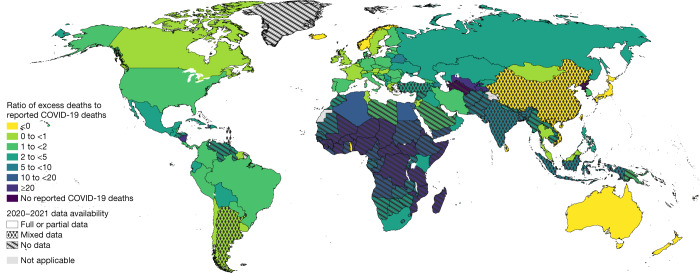
“For mortality completeness rates, we derived ratios of excess mortality to reported COVID-19 mortality, a metric previously to illustrate differences in capacities to diagnose COVID-19 mortality [2, 22–24].”
MethodBarragán-Hernández, W. A., López-Campos, Ó., Aalhus, J. L., & Prieto, N. (2024) · Meat Science · doi:10.1016/j.meatsci.2024.109643 · Cited by 9
Zhou, H.-Y., Li, Y., Li, J., Meng, J., & Wu, A. (2024) · The Innovation Medicine · doi:10.59717/j.xinn-med.2024.100091 · Cited by 19
Ferreira‐da‐Silva, R., Lobo, M. F., Pereira, A. M., Morato, M., Polónia, J. J., & Ribeiro‐Vaz, I. (2025) · Frontiers in Medicine · doi:10.3389/fmed.2025.1501921 · Cited by 17
Theorizing forgotten crisis publics: COVID long haulers’ information marginalization
Liu, B. F., Shi, D., Jean, B. S., Behre, J., & Downey, M. (2025) · Public Relations Review · doi:10.1016/j.pubrev.2025.102556 · Cited by 9
Devanathan, G., Chua, P. L., Nomura, S., Ng, C. F. S., Hossain, N., Eguchi, A., & Hashizume, M. (2025) · BMJ Public Health · doi:10.1136/bmjph-2024-002357 · Cited by 12
Fawole, A., Boyer, B., Shahid, M., Bharali, I., McAdams, D., & Yamey, G. (2025) · Vaccine · doi:10.1016/j.vaccine.2025.127377 · Cited by 10
Steep sustainability challenges in transboundary basins worldwide
Zhou, Y., Di, Y., Huang, X., Fu, S., Qi, X., He, C., & Destouni, G. (2025) · Environmental Science and Ecotechnology · doi:10.1016/j.ese.2025.100611 · Cited by 14
“For example, in 2019, a crisis emerged — the COVID-19 pandemic — that resulted in substantial excess mortality worldwide, with approximately 14.83 million deaths recorded between 2020 and 2021 [72].”
InfluentialPeters, L. E. R., Charnley, G. E. C., Roberts, S. L., & Kelman, I. (2025) · Global Health Action · doi:10.1080/16549716.2025.2562380 · Cited by 12
“This is likely to be a gross underestimate, with 14.83 million excess deaths statistically modelled [6].”
InfluentialMcCabe, R., Whittaker, C., Sheppard, R. J., Abdelmagid, N., Ahmed, A., Alabdeen, I. Z., Brazeau, N. F., Ahmed, A. E., Bin-Ghouth, A. S., Hamlet, A., et al. (2023) · Science Advances · doi:10.1126/sciadv.adg7676 · Cited by 9
“Last, excess mortality published by the WHO (9) yielded similar magnitudes to those estimated by our analyses in Aden and Khartoum.”
BackgroundResult“Traduttore, Traditore” One More Time: Happy Well-Being Index
Akande, A., & Akande, T. (2023) · Springer eBooks · doi:10.1007/978-3-031-17203-8_39 · Cited by 9
Mussino, E., Drefahl, S., Wallace, M., Billingsley, S., Aradhya, S., & Andersson, G. (2024) · Demographic Research · doi:10.4054/demres.2024.50.1 · Cited by 14
“The impact of COVID-19 on death rates can be measured not only through causes of death specifically related to COVID-19 but also through total excess mortality (Islam et al. 2021; Msemburi et al. 2023).”
BackgroundSGS: SqueezeNet-guided Gaussian-kernel SVM for COVID-19 Diagnosis
Shi, F., Wang, J., & Govindaraj, V. (2024) · Mobile Networks and Applications · doi:10.1007/s11036-023-02288-3 · Cited by 11
Razimoghadam, M., Yaseri, M., Rezaee, M., Fazaeli, A., & Daroudi, R. (2024) · BMC Public Health · doi:10.1186/s12889-024-17819-0 · Cited by 13
“Moreover, the number of additional deaths reported in Iran was 1.76 times higher than the number of deaths associated with COVID-19 [64].”
InfluentialСмирнова, М. И., Samorodskaya, I. V., & Drapkina, O. M. (2024) · Russian Journal of Preventive Medicine · doi:10.17116/profmed20242704182 · Cited by 9
Atanasov, V. A., Barreto, N., Whittle, J., Meurer, J., Weston, B. W., Luo, Q., Yuan, A. Y., Franchi, L., Zhang, R., & Black, B. S. (2023) · Vaccines · doi:10.3390/vaccines11050971 · Cited by 12
“It is conceptually similar to a “p-value”, which is sometimes computed for all-cause excess mortality (P = excess mortality as a percentage of expected mortality) [42,43].”
BackgroundLeyns, C., Willems, S. J. T., Powell, R. A., Camacho, V., Fábrega, R., Maeseneer, J. D., Rawaf, S., Mangtani, P., & El-Osta, A. A. R. (2023) · International Journal for Equity in Health · doi:10.1186/s12939-023-02032-z · Cited by 12
“(From: The WHO estimates of excess mortality associated with the COVID-19 pandemic) [4] included.”
BackgroundInfluentialDisentangling the relationship between cancer mortality and COVID-19 in the US
Hansen, C., Viboud, C. G., & Simonsen, L. (2024) · eLife · doi:10.7554/elife.93758 · Cited by 15
Zaha, D. C., Ilea, C. D. N., Dorobanțu, F. R., Pantiș, C., Pop, N. O., Dascal, D. G., Dorobanțu, C. D., & Manole, F. (2024) · Antibiotics · doi:10.3390/antibiotics13060477 · Cited by 9
“When compared with the pre-pandemic period, the mortality rate of nearly 8.04% during the pandemic showed an increasing rate, as international statistics and other studies have shown [32–34].”
ResultInfluentialBreaking the Chain: Protease Inhibitors as Game Changers in Respiratory Viruses Management
Papaneophytou, C. P. (2024) · International Journal of Molecular Sciences · doi:10.3390/ijms25158105 · Cited by 8
“The rapid growth of COVID-19 cases has resulted in a rising death toll and significant disruption to the global economy [146].”
BackgroundFeng, J., Shen, C., Tian, S., Chen, X., Zhou, F., Zhou, M., Zhu, B., Li, X., & Ding, Z. (2024) · Fitoterapia · doi:10.1016/j.fitote.2024.106175 · Cited by 11
The Impact of the COVID ‐19 Pandemic on the Sex Ratio at Birth in Ireland
Masukume, G., Non, A. L., Cleaver, P., & Grech, V. (2024) · American Journal of Human Biology · doi:10.1002/ajhb.24159 · Cited by 9
Wakefield, J. C., & Knutson, V. (2024) · Annual Review of Statistics and Its Application · doi:10.1146/annurev-statistics-112723-034236 · Cited by 11
Self-citationThe labour market effects of cash transfers to the unemployed: Evidence from South Africa
Bhorat, H. I., & Köhler, T. (2024) · World Development · doi:10.1016/j.worlddev.2024.106889 · Cited by 15
Metadata
- Authors
- Msemburi, W., Karlinsky, A., Knutson, V., Aleshin-Guendel, S., Chatterji, S., & Wakefield, J.
- Affiliations
- World Health Organization (CH)
- Hebrew University of Jerusalem (IL)
- University of Washington (US)
- Corresponding author
- Msemburi, William
- Venue
- Nature
- Published
- 2022-12-14
- Volume
- 613
- Issue
- 7942
- Pages
- 130-137
- ISSN
- 0028-0836 (ISSN-L)
- 1476-4687
- PMC
- PMC9812776
- OpenAlex
- W4311472757
- Cited by
- 1,064
- References
- 17
- Citations by year
- 2026: 176 · 2025: 283 · 2024: 346 · 2023: 252 · 2022: 6
- FWCI
- 131.36
- Type
- journal article
- Language
- en
- Open access
- hybrid
- doi.org
- Licence
- cc-by
- creativecommons.org/licenses/by/4.0 (tdm)
- creativecommons.org/licenses/by/4.0 (vor)
- Locations
- Nature (publishedVersion, cc-by)
- Research Square (acceptedVersion, cc-by)
- PubMed Central (publishedVersion, cc-by)
- PubMed (publishedVersion)
- RePEc: Research Papers in Economics (submittedVersion)
- Funders
- World Health Organization
- Topics
- Physical Sciences › Mathematics › Modeling and Simulation › COVID-19 epidemiological studies
- Health Sciences › Medicine › Epidemiology › Data-Driven Disease Surveillance
- Social Sciences › Demography › Insurance, Mortality, Demography, Risk Management
- Keywords
- COVID-19 pandemic, excess mortality, all-cause mortality, underreporting of deaths, cause of death certification, Bayesian uncertainty quantification, WHO regions
- MeSH terms
- COVID-19, Bayes Theorem, Humans, World Health Organization, Poisson Distribution, Uncertainty, Pandemics
About these checks
Registry, retraction, Cites and statistics results are computed, not judged, with one exception: a printed reference that no index lists is read once by a model before it counts as a citation error. Claims are extracted by a model and kept only when their quote appears verbatim in the text; each cited source is then checked, with a model’s help, for whether it says what the claim relies on. Those verdicts can be wrong — read the claim’s quote and the cited source before relying on one.
The claim verdicts this report counts are experimental: their accuracy is not yet measured.
A language model drew the claims from the paper on 2026-10-10, under version 3 of the claim definition (model deepseek-v4.1-flash, prompt extract-v3).
A second model labelled each claim on 2026-10-10 (model jev-1.13-20260917, definition revision gold-guideline-v0.2).
Cited sources are checked with a language model’s help (gpt-6-sol and qwen3.8-omni-flash).
Statistics and arithmetic are recomputed, not judged.
Confidence bands are shown only for fields calibrated on our annotated test set. None is calibrated yet, so no band is shown.
What counts as a claim ›How we measure confidence ›How we check this ›
Are you an author, or do you see a problem with this page? Request a review
Data sources
Bibliographic data: Semantic Scholar, OpenAlex, Crossref.
Contains information from the Semantic Scholar Academic Graph Datasets, made available under the ODC Attribution License (ODC-BY 1.0).
Semantic Scholar’s data is described in: Kinney, R., et al. (2023). The Semantic Scholar Open Data Platform. arXiv:2301.10140.
