

The WHO estimates of excess mortality associated with the COVID-19 pandemic
Open accessPublished version of a preprint
The DOI matches its Crossref record; 21 of the 21 references it cites were found in a registry or an index; 9 of the 14 sources its claims cite were checked for support.
Abstract
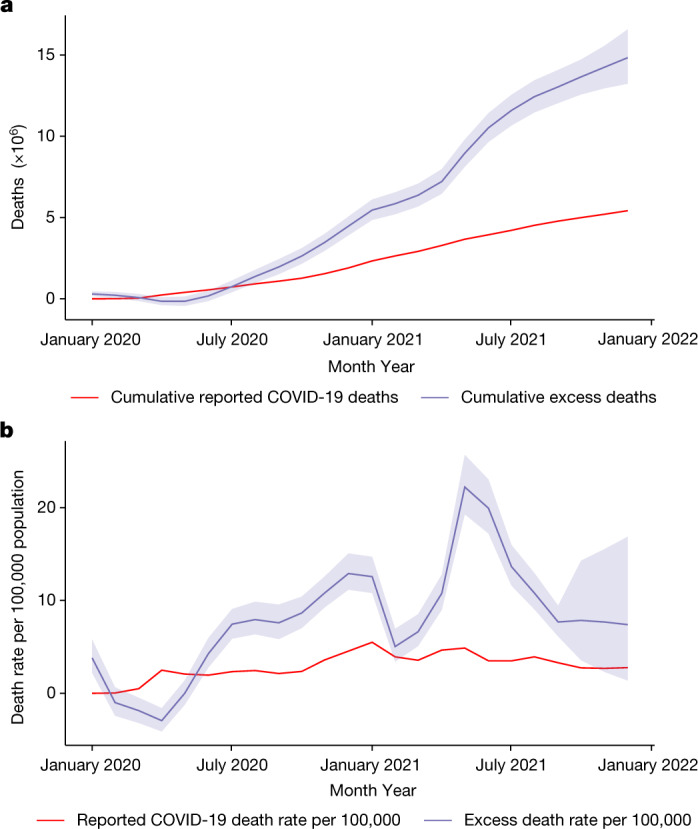
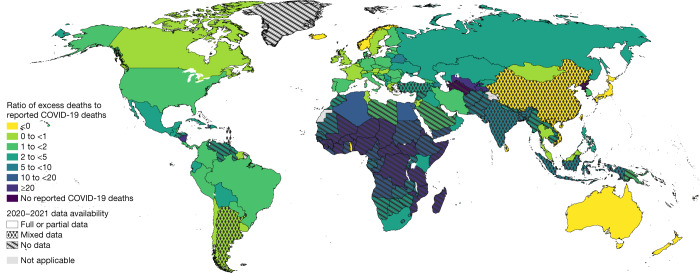
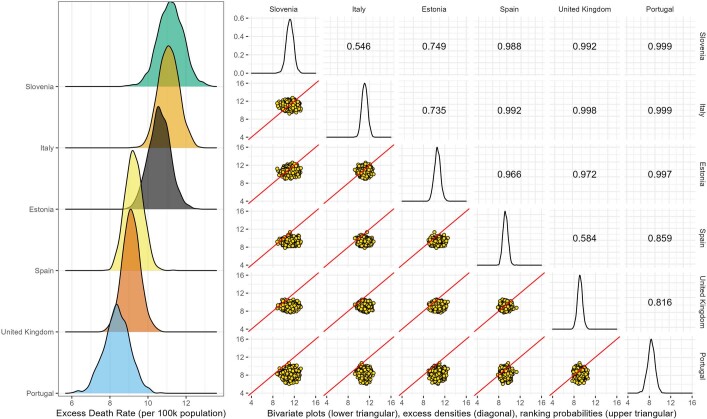
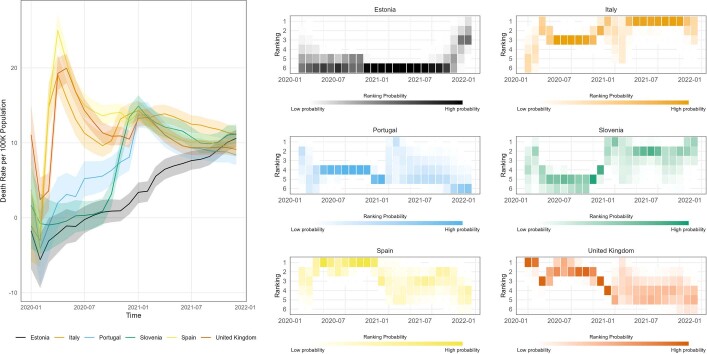
. Reported statistics on COVID-19 mortality are problematic for many countries owing to variations in testing access, differential diagnostic capacity and inconsistent certification of COVID-19 as cause of death. Beyond what is directly attributable to it, the pandemic has caused extensive collateral damage that has led to losses of lives and livelihoods. Here we report a comprehensive and consistent measurement of the impact of the COVID-19 pandemic by estimating excess deaths, by month, for 2020 and 2021. We predict the pandemic period all-cause deaths in locations lacking complete reported data using an overdispersed Poisson count framework that applies Bayesian inference techniques to quantify uncertainty. We estimate 14.83 million excess deaths globally, 2.74 times more deaths than the 5.42 million reported as due to COVID-19 for the period. There are wide variations in the excess death estimates across the six World Health Organization regions. We describe the data and methods used to generate these estimates and highlight the need for better reporting where gaps persist. We discuss various summary measures, and the hazards of ranking countries' epidemic responses.
Overview
CoChat Summary
TL;DR
WHO estimated global excess mortality from COVID-19 for January 2020–December 2021 at 14.83 million deaths, using a Bayesian Poisson framework to fill gaps where all-cause mortality data were incomplete. The estimate is 2.74 times the 5.42 million COVID-19 deaths reported to WHO for the same period.
Key findings
- Globally, the paper estimates 14.83 million excess deaths over 2020–2021 (95% UI 13.23–16.58 million), compared with 5.42 million reported COVID-19 deaths; the excess-to-reported ratio is 2.74 (UI 2.44–3.06).
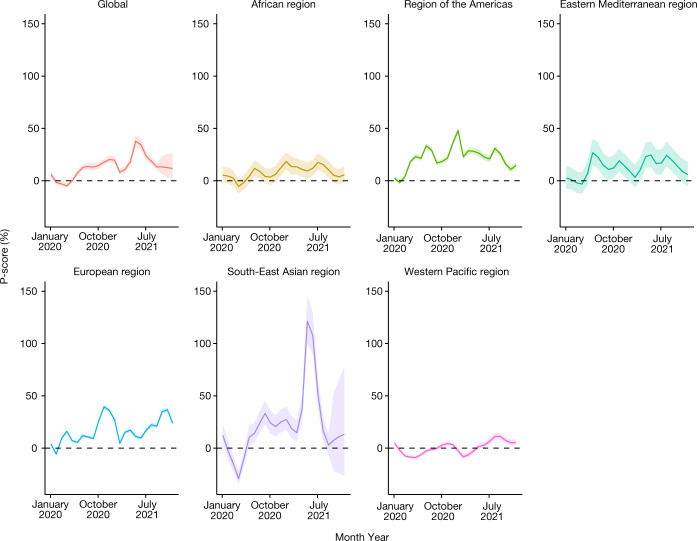
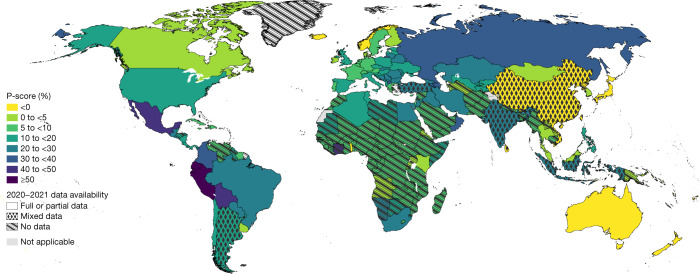
- Excess deaths were estimated at 4.47 million in 2020 and 10.36 million in 2021 globally; the global P-score increased from 7.97% in 2020 to 18.30% in 2021.
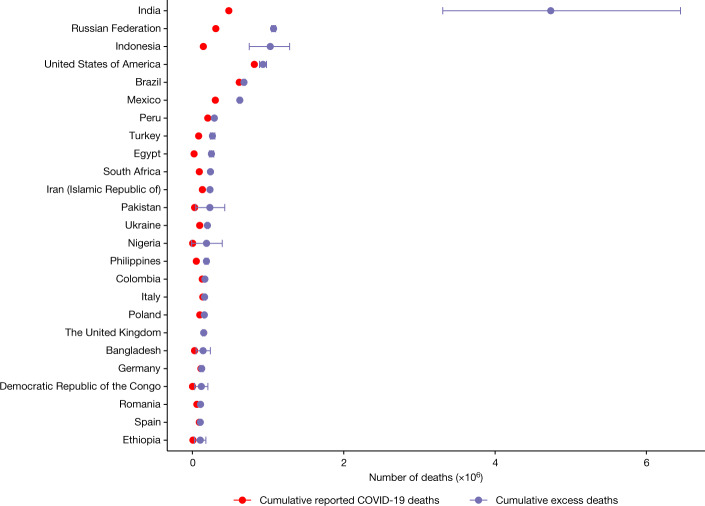
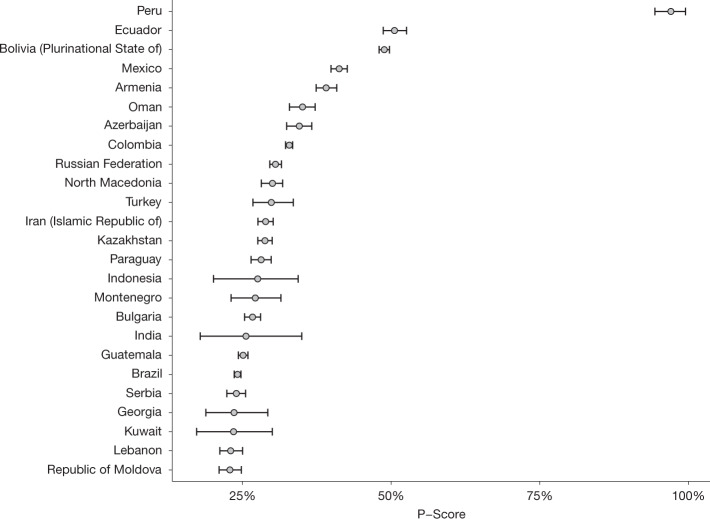
- The paper reports large country-level totals, including India: 4.74 million excess deaths (UI 3.31–6.45 million), Russian Federation: 1.07 million (UI 1.05–1.10 million), Indonesia: 1.03 million (UI 0.75–1.29 million), and the United States: 932,000 (UI 887,000–978,000).
- The 20 countries with the highest excess estimates account for 48.9% of the global population and over 80% of estimated global excess deaths for January 2020–December 2021.
Methods
- The study used a WHO-led, consultative modelling process: a Technical Advisory Group developed methods, WHO member states reviewed preliminary estimates, and feedback was used to update the final estimates.
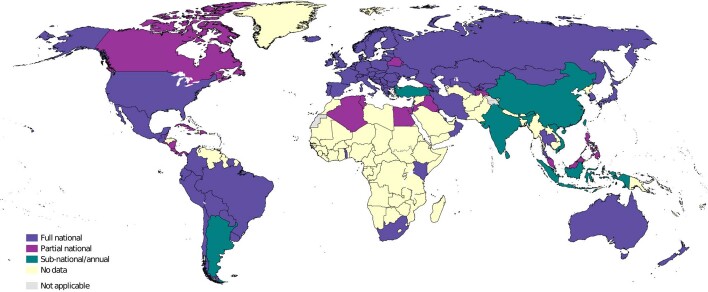
- The analysis used all-cause mortality (ACM) data from multiple sources; monthly national data were available for 100 countries (52%), while other locations had annual, subnational, or no data.
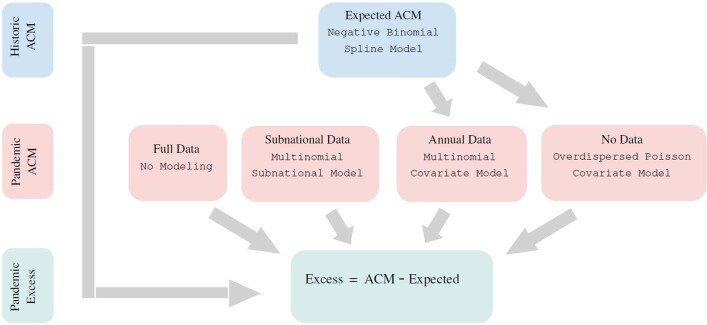
- Excess deaths were estimated with a Bayesian Poisson / negative binomial framework: historical ACM (often 2015–2019) was used to model expected deaths with spline-based seasonal and annual trends; where pandemic data were incomplete, a covariate-based log-linear model and, for some countries, subnational-to-national multinomial/proportionality models were used.
Limitations
- The paper states that the biggest limitation is data paucity: for almost half of WHO member states, ACM data during the pandemic were unavailable, so estimates relied on statistical models; the text says these countries should be interpreted with caution.
- The paper states that the counterfactual trend is sensitive to modelling assumptions, including the choice of spline models and how recent historical years are weighted; it notes splines can produce inappropriate extrapolations.
- The text makes evident that comparisons across countries/regions are difficult because countries differ in age structure, data completeness, and reporting quality; this is stated in the paper and means rankings can be misleading.
- The text makes evident that the paper cannot quantify how much excess mortality is directly COVID-19 versus indirect or non-COVID causes; the discussion explicitly says excess mortality combines these and cannot separate them.
Model-written summary. Check it against the paper before relying on it.
Integrity signals
Registry
Cites
Statistics
Figures
Verification
Claims the paper makes
8 Valid · 2 Not valid · 6 Not checked · 81 Own results and interpretations
Every source the paper cites for this claim was checked and supports it.
In the paper
“Reported statistics on COVID-19 mortality are problematic for many countries owing to variations in testing access, differential diagnostic capacity and inconsistent certification of COVID-19 as cause of death.”
- Also stated in: § Main · plain
“countries have differed in their application of standards for the certification of COVID-19 as the underlying cause-of-death2.”
§ The WHO estimates of excess mortality associated with the COVID-19 pandemic > Abstract
What the sources say
- Supportedcites [2] Riffe T Acosta E Data Resource Profile: COVerAGE-DB: a global demographic database of COVID-19 cases and deaths Int. J. Epidemiol. 2021 50 390 390f 10.1093/ije/dyab027 source
The Strengths and weaknesses section says COVID-19 death counts are likely underestimated for reasons also affecting case counts, including testing capacity and diagnostic-test accuracy. It also describes differences in whether suspected deaths are counted and evidence that COVID-19-related deaths are classified under other causes. Page numbers were not supplied in our copy. (LLM, conf=0.90)
plainstates a cause- Asserted: passes — The authors put it forward as true.
- Checkable: passes — It can be checked against evidence.
- Load-bearing: passes — The paper’s conclusions depend on it.
- Based: passes — The paper gives a reason why it holds.
- Also stated in: § Main · plain
Every source the paper cites for this claim was checked and supports it.
In the paper
“The measure overcomes the variation among countries in reporting and testing and the misclassification of the cause of death on death certificates7”
§ The WHO estimates of excess mortality associated with the COVID-19 pandemic > Main
What the sources say
- Supportedcites [7] Beaney T Excess mortality: the gold standard in measuring the impact of COVID-19 worldwide? J. Royal Soc. Med. 2020 113 329 334 10.1177/0141076820956802 PMC7488823 32910871 source
The Excess mortality section states that, because it encompasses deaths from all causes, excess mortality overcomes cross-country variation in COVID-19 reporting and testing and misclassification of causes on death certificates. This directly matches the attributed claim. (LLM, conf=0.95)
plainstates a cause- Asserted: passes — The authors put it forward as true.
- Checkable: passes — It can be checked against evidence.
- Load-bearing: passes — The paper’s conclusions depend on it.
- Based: passes — The paper gives a reason why it holds.
- Supported
Every source the paper cites for this claim was checked and supports it.
In the paper
“This surpasses the influenza pandemics of 1957, 1968 and 2009 (estimated at 0.04%, 0.03% and 0.005%, respectively)18.”
§ The WHO estimates of excess mortality associated with the COVID-19 pandemic > Discussion
What the sources say
- Supportedcites [18] Simonsen L Viboud C Mortality: a comprehensive look at the COVID-19 pandemic death toll. eLife 2021 10 e71974 10.7554/eLife.71974 34382937 PMC8360646 source
Table 1 (Abstract) gives a global per capita excess mortality rate of >0.08% for COVID-19, exceeding its estimates of 0.04%, 0.03%, and 0.005% for the 1957, 1968, and 2009 influenza pandemics, respectively. The paper describes the COVID-19 estimate using data available in 2020–2021. (LLM, conf=0.94)
plain- Asserted: passes — The authors put it forward as true.
- Checkable: passes — It can be checked against evidence.
- Load-bearing: unclear — It is unclear whether the paper’s conclusions depend on it.
- Based: passes — The paper gives a reason why it holds.
- Supported
Every source the paper cites for this claim was checked and supports it.
In the paper
“As another example, in the Africa region for which ACM data are most lacking, recent studies have highlighted the underestimation in the reported statistics20.”
§ The WHO estimates of excess mortality associated with the COVID-19 pandemic > Discussion
What the sources say
- Supportedcites [20] Cabore J. W. et al. COVID-19 in the 47 countries of the WHO African region: a modelling analysis of past trends and future patterns. Lancet Glob. Health10, e1099–e1114 (2022). PMC9159735 35659911 source
The Introduction states that reported infections and deaths underestimate the actual COVID-19 burden in the WHO African region. It also reports that, in countries with seroprevalence studies, reported infections represented only a small proportion of the estimated burden. Page numbers were not provided. (LLM, conf=0.94)
plainstates an association- Asserted: passes — The authors put it forward as true.
- Checkable: passes — It can be checked against evidence.
- Load-bearing: unclear — It is unclear whether the paper’s conclusions depend on it.
- Based: passes — The paper gives a reason why it holds.
- Supported
Every source the paper cites for this claim was checked and supports it.
In the paper
“The uncertainty in the expected predictions is well modelled by a gamma distribution, and the advantage of this choice is that it can be conveniently combined with a Poisson model to produce a negative binomial model with the log-linear mean given by equation (3).”
§ The WHO estimates of excess mortality associated with the COVID-19 pandemic > Methods > Model for countries without full pandemic data For almost half of the 194 WHO member states we do not have the ACM counts over the pandemic, and so must predict them using country characteristics. We choose a simple form for this prediction model, with mean2where is a relative rate parameter. If , then for country and at month the mortality is greater than expected, whereas if , then for country and at month the mortality is less than expected. We used time-invariant variables, (these are annual values from 2019). These were an indicator of high income and/or low or middle income, the cardiovascular mortality rate in 2019 and the diabetes prevalence rate in 2019. In addition, we used time-varying variables: a containment variable (it is calculated using all ordinal containment and closure policy indicators and health-system policy indicators, for further details see Hale et al.14), the square root of the reported COVID-19 death rate, temperature and the COVID-19 test positivity rate. We then build a log-linear model for the rate parameter:3where and denote relative rate parameters and are independent error contributions that pick up random variation unexplained by the log-linear regression function. The time-varying coefficients allow the associations to evolve during the pandemic. As we desire the evolution to be smooth in time, for these time-varying coefficients we use a random walk of order 2 (RW2) prior that encourages smooth estimates46. In equation (2) above, we have conditioned on known expected numbers. In reality, and as just described, these are modelled to give a distribution over plausible values. The uncertainty in the expected predictions is well modelled by a gamma distribution, and the advantage of this choice is that it can be conveniently combined with a Poisson model to produce a negative binomial model with the log-linear mean given by equation (3). Full details (including evidence of the accuracy of the gamma model) can be found in Knutson et al.15. This model was fitted to all countries with observed monthly ACM data over some portion of 2020–2021, using the integrated nested Laplace approximation method47, to obtain posterior distributions over the unknown parameters. The resultant posterior distribution reflects the uncertainty in the parameters (both in the expected numbers and the log-linear covariate model), and can be used to construct a predictive distribution for the ACM in countries with no data or partial data.
What the sources say
- Supportedcites Knutson et al.15 Knutson V., Aleshin-Guendel S., Karlinsky A., Msemburi W. & Wakefield J. Estimating country-specific excess mortality during the COVID-19 pandemic (2023). Ann. Appl. Stat. (in the press). PMC9812776 36517599 source
Section 3.3 (Modeling Uncertainty in the Expected Numbers) states they fit a gamma distribution by method of moments to the Monte Carlo samples of the expected numbers and 'approximate the distribution of the expected numbers as gamma, since this is conjugate to the Poisson, and so allows efficient inference with INLA ... using a negative binomial,' and the Supplementary Materials (Sec. 5, Gamma Expected Numbers; Fig. 5) report the gamma fits are accurate, with differences 'small in all cases' — supporting 'well modelled'. The model description bullet confirms the negative binomial component with known tau arises from the uncertainty in the expected numbers within the log-linear Poisson/negative-binomial formulation. The 'equation (3)' reference is the citing paper's own display, not attributed content. (LLM, conf=0.90)
boosted- Asserted: passes — The authors put it forward as true.
- Checkable: passes — It can be checked against evidence.
- Load-bearing: passes — The paper’s conclusions depend on it.
- Based: passes — The paper gives a reason why it holds.
- Supported
49 more claims
Create a free account to see all 97 claims and to verify the 2 references still open.
- Probably not a substantial claim. 19
- It may state two separate claims as one. 30
- The quote only partly states this claim. 2
Claims other papers make about this one
Each is checked against this paper’s own text: does it say what the citing paper says it does?
The source backs part of the claim, not all of it — or backs it for a different population, condition or comparison.
In the citing paper
“Our current estimate of global excess mortality during 2020 and 2021 is comparable to the WHO estimate of 14·9 million (95% UI 13·3–16·6) excess deaths,15 with our mean estimate falling within the uncertainty interval of the WHO estimate and vice versa.”
From Global age-sex-specific mortality, life expectancy, and population estimates in 204 countries and territories and 811 subnational locations, 1950–2021, and the impact of the COVID-19 pandemic: a comprehensive demographic analysis for the Global Burden of Disease Study 2021 (2024) · cites this paper as [15]
Experimental — accuracy not yet measuredThe cited source says what the claim attributes to it.
In the citing paper
“this total greatly exceeds global average increases of 8% in 2020 and 18% in 20214.”
From Attributed causes of excess mortality during the COVID-19 pandemic in a south Indian city (2023) · cites this paper as [4]
In the citing paper
“Other settings with >25% increases in mortality during the pandemic have included Russia and LMICs within Latin America, Eastern Europe, and central Asia1,4.”
From Attributed causes of excess mortality during the COVID-19 pandemic in a south Indian city (2023) · cites this paper as [4]
Citations
Cites
Vos, T., Lim, S. S., Abbafati, C., Abbas, K. M., Abbasi, M., Abbasifard, M., Abbasi-Kangevari, M., Abbastabar, H., Abd-Allah, F., Abdelalim, A., et al. (2020) · The Lancet · doi:10.1016/s0140-6736(20)30925-9 · Cited by 19,358
Generalized Additive Models: An Introduction with R
Wood, S. N. (2017) · doi:10.1201/9781315370279 · Cited by 13,852
Rue, H., Martino, S., & Chopin, N. (2009) · Journal of the Royal Statistical Society Series B: Statistical Methodology · doi:10.1111/j.1467-9868.2008.00700.x · Cited by 5,279
Wang, H., Paulson, K. R., Pease, S. A., Watson, S., Comfort, H., Zheng, P., Aravkin, A. Y., Bisignano, C., Barber, R. M., Alam, T., et al. (2022) · The Lancet · doi:10.1016/s0140-6736(21)02796-3 · Cited by 2,069
Rue, H., & Held, L. (2005) · Chapman & Hall/CRC eBooks · doi:10.1201/9780203492024 · Cited by 1,823
Guidelines for accurate and transparent health estimates reporting: the GATHER statement
Stevens, G. A., Alkema, L., Black, R. E., Boerma, J. T., Collins, G. S., Ezzati, M., Grove, J. T., Hogan, D. R., Hogan, M. C., Horton, R., et al. (2016) · The Lancet · doi:10.1016/s0140-6736(16)30388-9 · Cited by 1,798
Karlinsky, A., & Kobak, D. (2021) · eLife · doi:10.7554/elife.69336 · Cited by 772
Self-citationMurray, C. J., Lopez, A. D., Chin, B., Feehan, D., & Hill, K. H. (2006) · The Lancet · doi:10.1016/s0140-6736(06)69895-4 · Cited by 605
Islam, N., Shkolnikov, V. M., Acosta, R. J., Klimkin, I., Kawachi, I., Irizarry, R. A., Alicandro, G., Khunti, K., Yates, T., Jdanov, D. A., et al. (2021) · BMJ · doi:10.1136/bmj.n1137 · Cited by 468
Guidelines for accurate and transparent health estimates reporting: the GATHER statement
Stevens, G. A., Alkema, L., Black, R. E., Boerma, J. T., Collins, G. S., Ezzati, M., Grove, J. T., Hogan, D. R., Hogan, M. C., Horton, R., et al. (2016) · PLOS Medicine · doi:10.1371/journal.pmed.1002056 · Cited by 424
Research works printed but not linked: 2
- National Bureau of Statistics of China. China Statistical Yearbook 2021 (China Statistics Press, 2021).
- Hale, T. et al. Variation in Government Responses to COVID-19 Technical Report (Univ. Oxford, 2020).
Cited by
Items 501–600 of 1,067
Facilitating and restraining virus infection using cell-attachable soluble viral receptors
Zhang, H., Wang, Z., Nguyen, H. T. T., Pontelli, M. C., Qi, W., Rao, L., Liu, Z., Whelan, S. P. J., & Zhu, J. (2024) · Proceedings of the National Academy of Sciences · doi:10.1073/pnas.2414583121 · Cited by 3
Islam, N., López, F. J. G., Jdanov, D. A., Royo‐Bordonada, M. Á., Khunti, K., Lewington, S., Lacey, B., White, M., Morris, E. J. A., & Zunzunegui, M. V. (2024) · Gaceta Sanitaria · doi:10.1016/j.gaceta.2024.102424 · Cited by 6
Coronaviruses: Pandemic SARS-CoV-2
Cowling, B. J., & Wong, S. (2024) · Springer eBooks · doi:10.1007/978-1-4939-9544-8_68-1 · Cited by 2
Egelkrout, E. M., Maj, M. A., Manjarín, R., et al. (2024) · Viruses · doi:10.3390/v17010007 · Cited by 2
Clinging to Certainty: Mental Health Anthropologies and Dualisms in Post-Pandemic Britain
Lloyd, C. E. M. (2025) · Journal of Disability & Religion · doi:10.1080/23312521.2024.2441429 · Cited by 2
“Although COVID-19 is no longer a global pandemic, there have been nearly 7 million deaths, as well as over 768 million confirmed cases and the administration of over 13 billion vaccines (Msemburi et al., 2023).”
Miyata, Y., Yamaguchi, R., Yamamoto, T., et al. (2025) · Journal of Pharmaceutical Health Care and Sciences · doi:10.1186/s40780-025-00411-y · Cited by 2
Azevedo, F. M., Rocha, A. R. D. F., de Morais, N. D. S., Ribeiro, S. A. V., Priore, S. E., Rodrigues, J. M., & Franceschini, S. D. C. C. (2025) · Archives of Medical Research · doi:10.1016/j.arcmed.2025.103184 · Cited by 2
What Is Next for COVID-19 Vaccination?
Trilla, A., Trilla, G., Aldea, M., & Vilella, A. (2025) · Seminars in Respiratory and Critical Care Medicine · doi:10.1055/a-2531-1211 · Cited by 2
Estimation of trajectory of COVID-19 vaccines effectiveness against infection
Jiang, J., Lam, K. F., Lau, E. H. Y., Yin, G., Lin, Y., & Cowling, B. J. (2025) · Vaccine · doi:10.1016/j.vaccine.2025.127067 · Cited by 2
Han, K., & Kim, S. J. (2025) · Scientific Reports · doi:10.1038/s41598-025-97660-6 · Cited by 5
Non-O1, Non-O139 Vibrio cholerae Bacteremic Skin Infection with Multiple Skin Necrosis: Case Report
Alomar, A. I., Elhadi, N., Yamani, L. Z., Allahham, R., Alghamdi, R., Alhabib, I., Diab, A., Mahmoud, N., Aldossary, B. H., Almejhim, M., et al. (2025) · Tropical Medicine and Infectious Disease · doi:10.3390/tropicalmed10040110 · Cited by 3
“…as septicemia contaminated [ virulence factors ( tox R), outer some cases, V. toxin ( ctx A) and At the beginning of 2020, the world witnessed the spread of SARS-CoV-2 as it spread into a global pandemic that led to over 40 million cases and over 2 million deaths worldwide by November 2020 [39].”
Espínola, N., Loudet, C., Luxardo, R., Moreno, C., Kyaw, M. H., Spinardi, J., Mendoza, C. F., Carballo, C. M., Dantas, A. C., Abalos, M. G., et al. (2025) · International Journal of Environmental Research and Public Health · doi:10.3390/ijerph22050669 · Cited by 2
“The WHO defines excess mortality due to COVID-19 as the difference between the number of observed deaths from all causes during a given period and the number of expected deaths from the same period, based on historical data from recent years [18].”
Yu, L., Lin, S., Shen, Z. M., & Zhang, J. (2025) · Health Care Management Science · doi:10.1007/s10729-025-09703-z · Cited by 2
“Msemburi et al. [10] report that excess deaths in 2020 and 2021 are respectively 2.4 and 3.1 times higher than the number of deaths of COVID-19 patients.”
InfluentialAI Models for Accurate Bacterial Pneumonia Diagnosis in Chest X-ray Images
Aydin, C., KIZILKAYA, H., Şahin, M. E., & Ulutaş, H. (2025) · Bozok Tıp Dergisi · doi:10.16919/bozoktip.1593097 · Cited by 2
Ramgi, P., Siribié, M., Rakotozandrindrainy, N., Bule, O., Shrivastava, H., Chambule, L., Park, E. L., Fernando, C. V., Boque, J., Macuiana, R., et al. (2025) · Clinical Infectious Diseases · doi:10.1093/cid/ciaf130 · Cited by 2
“–5].”
Rapley, B. (2025) · International Journal of Vaccine Theory Practice and Research · doi:10.56098/hqjnk479 · Cited by 2
Konstantinoudis, G., Hauser, A., & Riou, J. (2025) · Spatial and Spatio-temporal Epidemiology · doi:10.1016/j.sste.2025.100760 · Cited by 5
Mortality following recovery from COVID-19 hospitalization: A long-term cohort study
Ahmad, W. A., Sagy, Y. W., Battat, E., Arbel, R., & Lavie, G. (2025) · International Journal of Infectious Diseases · doi:10.1016/j.ijid.2025.108223 · Cited by 2
Missing data mean we’ll probably never know how many people died of COVID
(2022) · Nature · doi:10.1038/d41586-022-04422-9 · Cited by 2
Schady, N., Holla, A., Sabarwal, S., Silva, J., & Chang, A. Y. (2023) · World Bank, Washington, DC eBooks · doi:10.1596/978-1-4648-1901-8_es · Cited by 2
Bounce Forward Better: Geriatric and Gerontological Research in the Post-pandemic Future
Noh, J.-H., Arai, H., Auyeung, T. W., Cesari, M., Frontera, W. R., Ga, H., Jung, H., Lim, W. S., & Lim, J. (2022) · Annals of Geriatric Medicine and Research · doi:10.4235/agmr.22.0157 · Cited by 2
Joni, S. S., Gerami, R., Pashaei, F., Ebrahiminik, H., & Karimy, M. (2023) · European Journal of Translational Myology · doi:10.4081/ejtm.2023.11571 · Cited by 2
Walkowiak, M. P., Walkowiak, D., & Walkowiak, J. (2023) · Frontiers in Public Health · doi:10.3389/fpubh.2023.1221964 · Cited by 2
“However, when the WHO assessed the actual COVID-19 mortality rates, these countries stood out as outliers and it was suggested that the effectiveness of specific policies should not be solely evaluated based on this type of rankings, as other factors including compliance and local culture played a significant role in…”
BackgroundSoff, G. A., Levell, N. J., Parish, L. C., et al. (2023) · Clinics in Dermatology · doi:10.1016/j.clindermatol.2023.09.013 · Cited by 2
Carmichael, D., Prichett, L. M., Kumra, T., Zeng, Y., Young, A. S., Yolken, R. H., & Severance, E. G. (2023) · Biomarkers in Neuropsychiatry · doi:10.1016/j.bionps.2023.100080 · Cited by 5
Rubinstein, A., Filippini, F., Santoro, A., Osornio, A. L., Bardach, A., Navarro, E., Cejas, C., Bauhoff, S., Augustovski, F., Pichón-Rivière, A., et al. (2023) · Health Affairs · doi:10.1377/hlthaff.2023.00706 · Cited by 4
Lozano, R., Montoya, A., Razo, C., Schumacher, A. E., Confort, H., Pease, S. A., Jones, D. P., Watson, S., & Naghavi, M. (2023) · Gaceta Médica de México · doi:10.24875/gmm.23000420 · Cited by 7
Çelik, M., Ceylan, M. R., Koyuncu, İ., Dinçer, N. G., & Alkan, S. (2023) · Iberoamerican Journal of Medicine · doi:10.53986/ibjm.2024.0001 · Cited by 3
The close association of micronutrients with COVID-19
Zhang, A., Yin, Y., Tian, J., Wang, X., Yue, Z., Pei, L., Liu, L., Li, Q., Jia, M., Wang, H., et al. (2024) · Heliyon · doi:10.1016/j.heliyon.2024.e28629 · Cited by 2
“Most studies focused on the increase in the number of cases and deaths, the clinical characteristics and pathogenesis of COVID-19, and the treatment of infected patients [3,4].”
BackgroundXu, Z., Zhang, H., Tian, J., Ku, X., Wei, R., Hou, J., Zhang, C., Yang, F., Zou, X., Yang, L., et al. (2024) · Acta Biochimica et Biophysica Sinica · doi:10.3724/abbs.2024127 · Cited by 3
“Severe acute respiratory syndrome coronavirus-2 (SARS-CoV-2), which is responsible for the novel coronavirus disease 2019 (COVID-19), posed a pandemic threat to global public health during 2019–2023 [10].”
BackgroundŠvitek, L., Zlosa, M., Grubišić, B., et al. (2024) · Acta Microbiologica Hellenica · doi:10.3390/amh69040021 · Cited by 2
“Before the World Health Organization declared an end to the global COVID-19 emergency in May 2023, the disease had caused an estimated 15 million excess deaths in 2020 and 2021 alone [3].”
Klein, D. J., Yang, L., Kerr, C. C., Fowler, G., & Cohen, J. A. (2023) · medRxiv · doi:10.1101/2023.03.15.23287285 · Cited by 1
“Considering recommendations described in the WHO COVID-19 Vaccine Prioritization Roadmap (33) depend on historical vaccine coverage, we selected archetypal settings representing a diversity of vaccine histories.”
BackgroundChou, F.-C. B., Chen, Y.-C. C., Kuo, Y.-S. A., et al. (2023) · doi:10.31234/osf.io/46dvn · Cited by 2
Musango, L., Mandrosovololona, V., Fidiniaina, R. M., et al. (2023) · Research Square · doi:10.21203/rs.3.rs-2996128/v1 · Cited by 2
Liu, L. (2023) · medRxiv · doi:10.1101/2023.06.09.23291035 · Cited by 2
“By the end of 2021, global excess deaths were estimated to be 14.83 million, although only 5.42 million deaths were attributed to Covid-19 (Msemburi et al., 2023).”
BackgroundInfluentialNilsson, A., Emilsson, L., Kepp, K. P., et al. (2024) · Research Square · doi:10.21203/rs.3.rs-3832255/v1 · Cited by 2
Pennini, V. A., Santoro, A., Esteban, S., Volij, C., & Rubistein, A. (2024) · medRxiv · doi:10.1101/2024.05.31.24308276 · Cited by 2
Slurink, I. A. L., de Boer, A. R., Bonten, M. J. M., et al. (2024) · medRxiv · doi:10.1101/2024.12.11.24318790 · Cited by 2
Netsey, E. K., Naandam, S. M., Asante, J., Kuukua, A. E., Yadem, A. C., Owusu, G., Shaffer, J. G., Srivastav, S. K., Doumbia, S., Owusu‐Dabo, E., et al. (2025) · doi:10.2196/preprints.73637 · Cited by 2
Small Area Estimation for Demographic Analysis
Sutton, A., & Almquist, Z. W. (2023) · IntechOpen eBooks · doi:10.5772/intechopen.1001842 · Cited by 1
The pandemic experience and the post-pandemic world prospects
Therborn, G. (2023) · Thesis Eleven · doi:10.1177/07255136231188176 · Cited by 1
Australia's public health achievements and population health gains
Dickson, M., Jones, C., Slevin, T. J., et al. (2023) · The Lancet Public Health · doi:10.1016/s2468-2667(23)00150-0 · Cited by 1
Post-COVID-Versorgung braucht Rehabilitation
Bethge, M. (2023) · Die Rehabilitation · doi:10.1055/a-2201-9371 · Cited by 1
“Die weltweite Übersterblichkeit in den ersten zwei Jahren der Pandemie wird sogar zwei-bis dreimal höher geschätzt, teilweise bedingt durch überlastete Gesundheitssysteme [2].”
BackgroundPerspectives for Better Health: prepare for the Exiting Severe Phase of the COVID-19 pandemic
Miraj, S. S. A., & Ali, S. A. (2023) · Journal of Medical Science · doi:10.20883/medical.e932 · Cited by 1
Measuring the impact of COVID-19 in Italy and a global perspective
Alicandro, G., Gerli, A. G., & Vecchia, C. L. (2023) · Journal of Health Inequalities · doi:10.5114/jhi.2023.133421 · Cited by 1
IMT-LUSS: A Novel Inception Meets Transformer-based Lung Ultrasound Scoring Model in Pneumonia
Liu, Y., Xing, W., He, C., Li, W., Chen, J., & Zhao, M. (2023) · IEEE International Conference on Bioinformatics and Biomedicine (BIBM) · doi:10.1109/bibm58861.2023.10385766 · Cited by 1
“Meanwhile, during the outbreak of COVID-19, it caused direct and indirect deaths of 14.83 million individuals in 2020 and 2021 [4].”
BackgroundInfluentialCovid-19 Mortality Shock: Demographic and Economic Losses in Moldova
Kozlov, V., Pahomii, I., Гагауз, О. Е., & Šmit, J. (2024) · Comparative Southeast European Studies · doi:10.1515/soeu-2023-0063 · Cited by 3
Mitura, K. M., Celiński, D., Snarska, J., et al. (2024) · Journal of Clinical Medicine · doi:10.3390/jcm13123552 · Cited by 1
“At the same time, according to the WHO, there was an increase in deaths worldwide in 2020 and 2021, amounting to 7.97% and 18.30%, respectively, as compared to what would have been expected if the pandemic had not occurred [33].”
BackgroundInfluentialMorgan, T., Pilimatalawwe, D., Morgan, K., Duschinsky, R., Gott, M., & Wiles, J. L. (2024) · Health Risk & Society · doi:10.1080/13698575.2024.2372097 · Cited by 1
“…‘go hard and go early’ approach has been described as one of the most risk averse public health responses internationally but also one of the most humane (Mazey & Richardson, 2020), with only 21 deaths in the first year of the pandemic amongst a population of 5 million (Msemburi et al., 2023).”
Bárrios, H., Nunes, J. P. L., Teixeira, J. P. A., & Rêgo, G. (2024) · Healthcare · doi:10.3390/healthcare12161573 · Cited by 1
“The proportion of excess mortality attributed directly to COVID-19 is open to some debate due to variable levels of underreporting, more significant in some settings and countries than others, namely, home deaths and countries with less strict and available diagnoses of COVID-19 infection [41,54].”
BackgroundSenthinathan, A., Tadrous, M., Hussain, S., Ahmad, A., Chu, C., Craven, B. C., Jaglal, S. B., Moineddin, R., Cadel, L., Noonan, V. K., et al. (2024) · Healthcare · doi:10.3390/healthcare12192002 · Cited by 1
State of the Art and Emerging Technologies in Vaccine Design for Respiratory Pathogens
Ridelfi, M., Pierleoni, G., Fonseca, V. Z. G., Batani, G., Rappuoli, R., & Sala, C. (2025) · Seminars in Respiratory and Critical Care Medicine · doi:10.1055/a-2500-1878 · Cited by 1
“6 The disease has resurged in recent decades, even in highly vaccinated countries, especially after the 1990s when acellular pertussis (aP) vaccines replaced whole-cell pertussis vaccines (wPV).”
Sanmarchi, F., Capodici, A., Golinelli, D., Lenzi, J., Zamparini, M., Toth, F., de Girolamo, G., & Stoto, M. A. (2025) · Population Health Metrics · doi:10.1186/s12963-025-00370-4 · Cited by 1
“The EM approach, used by the World Health Organization [13], the Institute for Health Metrics and Evaluation [14], and many countries [15–20], has been widely employed to assess the global impact of COVID-19.”
The Predictive Value of Soluble Fms-Like Tyrosine Kinase-1 for Prognosis in COVID-19 Patients
Lai, C., Wang, Y., Shi, F., et al. (2025) · Journal of Inflammation Research · doi:10.2147/jir.s504751 · Cited by 1
Hillcoat, A., Jeon, E. D., Shrestha, M., Jha, S. C., Kang, J. H., Rich-Edwards, J. W., & Denckla, C. A. (2025) · American Journal of Epidemiology · doi:10.1093/aje/kwaf056
Shibli, H., Kuodi, P., Dror, A. A., Zayyad, H., Wertheim, O., Jabal, K. A., Nazzal, S., Glikman, D., & Edelstein, M. L. (2025) · BMC Public Health · doi:10.1186/s12889-025-22426-8 · Cited by 1
“Despite these measures, the morbidity and mortality attributable to the pandemic are unprecedented [5], and their consequences extend beyond immediate health implications, impacting economic structures and employment markets [6, 7].”
Evolution into chaos – Implications of the trade-off between transmissibility and immune evasion
Sayyar, G., Garab, Á., & Röst, G. (2025) · Infectious Disease Modelling · doi:10.1016/j.idm.2025.04.003 · Cited by 1
Lo, A., Griffin, G., Byambadash, H. T., et al. (2025) · International Journal of Environmental Research and Public Health · doi:10.3390/ijerph22040627 · Cited by 1
“Global excess mortality between 1 January 2020 and 31 December 2021 alone was estimated at 14.73 million deaths [1].”
InfluentialRomano, C. J., Tsukuda, T. N., Zhao, R., et al. (2025) · Public Health Reports · doi:10.1177/00333549251314409 · Cited by 1
O’Callaghan, M. E., Casey, M., Pearl, D., Hickey, O., Fosse, A., Sigurðsson, S. E., Savage, D. W., Vehviläinen-Julkunen, K. M., Bykachev, K., Parviainen, A., et al. (2025) · Health Informatics Journal · doi:10.1177/14604582251315588 · Cited by 2
Sluiskes, M. H., Koster, E. A. S., Goeman, J. J., Rodríguez‐Girondo, M., Putter, H., & de Wreede, L. C. (2025) · BMC Medical Research Methodology · doi:10.1186/s12874-025-02579-1 · Cited by 3
“For example, when comparing excess mortality during the Covid-19 pandemic between different countries, a popular alternative metric is the so-called “P-score”: the ratio of the excess deaths to the expected deaths, expressed as a percentage [36, 37].”
Jäckle, S., & Timmis, J. K. (2025) · BMC Public Health · doi:10.1186/s12889-025-23279-x · Cited by 2
“The COVID-19 pandemic caused by the SARS-CoV-2 strain (and multiple mutations thereof), directly or indirectly resulted in an estimated 15 million deaths world-wide in 2020 and 2021 [4], and the total economic costs have been projected to reach a cumulative 13.8 trillion USD by the end of 2024 [5].”
InfluentialKitson, G., Byford, M., Cass, L., Howat, D. W., Köhn, B., Bisquera, A., Catchpole, A. P., Noulin, N., & Thomson, D. (2025) · Infectious Diseases and Therapy · doi:10.1007/s40121-025-01179-2 · Cited by 2
“…have included numerous pandemics caused by influenza viruses this century and last [6], as well as the recent severe acute respiratory syndrome coronavirus 2 (SARS-CoV-2) pandemic, which has had a devastating global impact in terms of mortality, morbidity and disruption to everyday life [7, 8].”
All-cause excess mortality associated with the Lāhainā, Maui fires
Nakatsuka, M., Taparra, K., Renton, B., Chen, A. J., Chen, J., Krumholz, H. M., & Faust, J. S. (2025) · Frontiers in Climate · doi:10.3389/fclim.2025.1611198 · Cited by 2
“All-cause excess mortality, a well-established metric to quantify the impact of natural or human-influenced disasters, is vital to assess population-level effects, gage disaster response efforts, and provide context for future disaster prevention (Msemburi et al., 2023).”
Remote Patient Monitoring to Support Rapid Discharge-Wearables
Rowland, B., Sunkara, P., Hicks, M. H., & Khanna, A. K. (2025) · Advances in Anesthesia · doi:10.1016/j.aan.2025.07.010 · Cited by 1
What is the nature of life expectation’s time series? A way to model its dynamics across the time
Piscitelli, A., Franchetti, G., & Politano, M. (2025) · Quality & Quantity · doi:10.1007/s11135-025-02328-y · Cited by 1
“However, the onset of the pandemic introduces a notable increase in mortality, as discussed in Bryan et al. (2021); Miller et al. (2021); Msemburi et al. (2023); Shang et al. (2022).”
Contreras, A., McIver, W. J., Brown, T. P., Ji, C., Booth, S. J., Fothergill, R. T., Perkins, G. D., & Couper, K. (2025) · Resuscitation · doi:10.1016/j.resuscitation.2025.110823 · Cited by 2
He, G., Li, S., & Quan, Y. (2025) · Journal of Population Economics · doi:10.1007/s00148-025-01122-2 · Cited by 1
“We rescale the estimated coefficients to get the standard P -scores that are commonly used in the epidemiological literature (Msemburi et al. 2023) and label them under the point estimates in Fig.”
InfluentialRising to the ultrasensitive rapid diagnostic challenge with buoyant-analyte-magnetic (BAM) assays
Wang, C., Satterfield, E., Livi, C. B., Dean, D., & Anker, J. N. (2025) · npj Biosensing · doi:10.1038/s44328-025-00054-x · Cited by 1
“This is especially true during outbreaks and pandemics, which can have severe mortality 1 ,morbidity,social,andeconomicrepercussions.”
Tleshova, U. (2025) · Moravian Geographical Reports · doi:10.2478/mgr-2025-0014 · Cited by 1
The Macroeconomic Implications of COVID-19 Economic Crisis Worldwide
Mateen, Q. G., Raghav, S., Kumar, S., Raghav, A., Kumar, V., & Khanna, P. (2025) · Springer eBooks · doi:10.1007/978-981-95-1196-9_7 · Cited by 1
Gómez, J., Sánchez-Rodríguez, I., López, J. S., García-Pina, R., Cabrera-Castro, N., Moreno-Diaz, I., Corbalán‐Fernández, A. M., Sola-Roca, A., Cobos, E. M. D. L., Sánchez-Montesinos, M. C., et al. (2025) · BMJ Public Health · doi:10.1136/bmjph-2025-002774 · Cited by 1
Meyers, A. L., Dowty, J. G., Mahmood, K., Macrae, F. A., Rosty, C., Buchanan, D. D., & Jenkins, M. A. (2025) · The Lancet Regional Health - Western Pacific · doi:10.1016/j.lanwpc.2025.101728 · Cited by 4
Klein, P. P. F., Crone, L., & Struijs, J. N. (2025) · BMJ Open · doi:10.1136/bmjopen-2025-101803 · Cited by 1
Co-Evolution of Behavior Change and Infectious Disease Transmission Dynamics: A Modelling Review
Li, T., & Xiao, Y. (2025) · CSIAM transactions on life sciences. · doi:10.4208/csiam-ls.so-2025-0005 · Cited by 3
“Most recently, the COVID-19 pandemic caused more than 10 million deaths globally [52], triggered massive economic expenditures, surged unemployment rates, and severely disrupted social stability [9].”
Lin, Y.-F., Fang, S.-Y., Huang, S., & Wu, E. (2025) · BMC Pediatrics · doi:10.1186/s12887-025-06315-y · Cited by 2
Morales-Jadán, D., Muslin, C., Viteri-Dávila, C., Vélez-Páez, J. L., Irigoyen-Mogro, E., Kyriakidis, N. C., García-Bereguiain, M. Á., & Rivera-Olivero, I. A. (2025) · Frontiers in Public Health · doi:10.3389/fpubh.2025.1664521 · Cited by 1
“The World Health Organization (WHO) estimates that global excess mortality attributable to the COVID-19 pandemic reached 14.83 million deaths from January 2020 to December 2021, 2.74 times higher than the 5.42 million officially reported COVID-19 deaths for the same period (12).”
InfluentialA Social Media Campaign to Promote COVID-19 Vaccination: Cost-Effectiveness Analysis
Long, M. W., Bingenheimer, J. B., Ndiaye, K., Donati, D., Rao, N., Akaba, S., Agha, S., & Evans, W. D. (2025) · JMIR Public Health and Surveillance · doi:10.2196/84540 · Cited by 3
“The COVID-19 pandemic led to the death of 15 to 20 million people worldwide up to 2021 [1,2].”
Shen, N., Wang, X., Zhang, H., Xiong, L., & Tang, G. (2025) · Habitat International · doi:10.1016/j.habitatint.2025.103697 · Cited by 1
Prosun, T. A., Zhang, S., Wu, J., Chen, Y., Zhao, J., Yang, H., Dovom, H. A., Hai, F. I., & Jiang, G. (2025) · Journal of environmental chemical engineering · doi:10.1016/j.jece.2025.120800 · Cited by 1
Ge, C., Wang, Z., Zhao, Z., Zhang, X., Yu, X., Chen, M., Liu, K., Lin, L., Li, D., Jin, N., et al. (2025) · Acta Pharmaceutica Sinica B · doi:10.1016/j.apsb.2025.12.020 · Cited by 1
Mentias, A. G., Keshvani, N., Desai, M. Y., Fonarow, G. C., Teerlink, J. R., Thibodeau, J. T., Vest, A. R., & Pandey, A. (2025) · Journal of Cardiac Failure · doi:10.1016/j.cardfail.2025.12.006 · Cited by 1
Gül, N. N., Taheri, S., de Leeuw, S., & Kian, R. (2025) · Social Science & Medicine · doi:10.1016/j.socscimed.2025.118918 · Cited by 1
Simon‐Friedt, B., Koumans, E. H. A., Feehan, A. K., Trick, W. E., Draper, C., Denson, J. L., Nagavedu, K., Weiner, M., Rasmussen, S. A., Block, J. P., et al. (2026) · Medical Care · doi:10.1097/mlr.0000000000002221 · Cited by 3
Gopcsa, L., Petrik, B. R., Szabó, B. G., Réti, M., Andrikovics, H., Bobek, I., Bekő, G., Bogyó, J., Ceglédi, A., Dobos, K., et al. (2026) · GeroScience · doi:10.1007/s11357-025-02050-5 · Cited by 1
“Coronavirus disease 2019 (COVID-19), caused by severe acute respiratory syndrome coronavirus 2 (SARS-CoV-2), has had an extraordinary global impact, resulting in substantial morbidity and mortality [1].”
Nørgaard, S. K., Nielsen, J. O., Schjørring, C. B., Kalnæs, A. S., Richter, L., Chalupka, A., Braeye, T., Mekogo, S. N., Athanasiadou, M., Lytras, T., et al. (2026) · Nature Communications · doi:10.1038/s41467-025-67981-1 · Cited by 5
Niewiadomski, P., Wojtasik, J., & Łyszczarz, B. (2026) · Frontiers in Public Health · doi:10.3389/fpubh.2025.1720864 · Cited by 1
“The concept attracts interest as COVID-19 mortality statistics have proven to be an unreliable measure of the true pandemic death toll (9, 10).”
Slurink, I. A. L., de Boer, A. R., Bonten, M. J. M., Sturkenboom, M., & Bruijning-Verhagen, P. C. J. L. (2026) · European Journal of Epidemiology · doi:10.1007/s10654-025-01334-6 · Cited by 5
Infectious disease outbreak controllability: biological, social and public health factors
Thompson, R. N., Bansal, S., Clapham, H., Dyson, L., Gutierrez, M. A., Hadley, L., Hart, W. S., Heesterbeek, H., Hollingsworth, T. D., House, T., et al. (2026) · Proceedings of the Royal Society B Biological Sciences · doi:10.1098/rspb.2025.2848 · Cited by 7
Nichols, E., Dey, S., Khobragade, P. Y., Banerjee, J., Adar, S. D., Chien, S., Gross, A. L., Petrosyan, S., Crimmins, E. M., Dey, A., et al. (2026) · The Journals of Gerontology Series A · doi:10.1093/gerona/glag026 · Cited by 4
Kim, T. (2026) · Journal of Korean Medical Science · doi:10.3346/jkms.2026.41.e72 · Cited by 2
Gasmi, M., Torabinasab, K., Williams‐Hooker, R., Marsigliante, S., & Muscella, A. (2026) · Physiological Reports · doi:10.14814/phy2.70682 · Cited by 4
“…2020 and led to over 15 million deaths globally, disproportionately affecting older adults with pre-existing conditions (Blagosklonny, 2020; Chakraborty et al., 2021; Chen, Wu, et al., 2020; Chen, Zhou, et al., 2020; Gold, 2020; Ioannidis et al., 2021; Msemburi et al., 2023; Wu & McGoogan, 2020).”
Scalable Skewed Bayesian Inference for Latent Gaussian Models Using INLA and Variational Bayes
Dutta, S., van Niekerk, J., & Rue, H. (2026) · Journal of Computational and Graphical Statistics · doi:10.1080/10618600.2026.2628274 · Cited by 7
“The development of the R-INLA package have enabled scientist to construct complex models and infer them using INLA, see Konstantinoudis et al. [10], van de Schoot et al. [20], Msemburi et al. [14], Bhatt et al. [2] for some recent works using LGMs and INLA.”
Xiao, H., Bai, G., Liu, F., Cui, Y., & Unger, J. M. (2026) · PLoS Medicine · doi:10.1371/journal.pmed.1004672 · Cited by 5
“Although excess mortality in China remained low during the first two years of the pandemic [30,43], the abrupt termination of the Zero-COVID policy was followed by a sharp surge in all-cause mortality, particularly among individuals aged 65 years and older [26].”
Huth, D., Germer, S., Witthöft, M., & Bräscher, A. (2026) · Current Psychology · doi:10.1007/s12144-026-09360-7 · Cited by 1
Hughes, A., Barnard, S., Bauer‐Staeb, C., Holleyman, R. J., Dunn, S., Fryers, P., Newton, J. N., Fitzpatrick, J., Burton, P., & Goldblatt, P. (2026) · PLoS ONE · doi:10.1371/journal.pone.0348575 · Cited by 11
“The SARS-CoV-2 (COVID-19) pandemic caused prolonged periods of excess mortality across many countries globally [1–3].”
Jäckle, S., & Timmis, J. K. (2026) · Statistics Politics and Policy · doi:10.1515/spp-2025-0049 · Cited by 1
“In 2020 and 2021 alone, the COVID-19 pandemic caused an estimated 15 million deaths globally (Msemburi et al. 2023).”
Spatiotemporal distribution of SARS-CoV-2 vaccines and vaccine-related proteins in mice and humans
Heinrich, F., Lücke, J., Zhang, S., Sabihi, M., Bernreuther, C., Giersch, K., Allweiss, L., Hartmann, K., Thies, E., Lange, P., et al. (2026) · Scientific Reports · doi:10.1038/s41598-026-47568-6 · Cited by 1
Palacios-Barahona, U., & Combariza, J. F. (2026) · Orphanet Journal of Rare Diseases · doi:10.1186/s13023-026-04475-3 · Cited by 1
Bladh, O., Pongrácz, T., Aguilera, K., Berkell, M., Marking, U. W., Greilert‐Norin, N., Rihani, A., Alm, J. J., Krammer, F., Åberg, M., et al. (2026) · EBioMedicine · doi:10.1016/j.ebiom.2026.106359 · Cited by 3
“10,11 In addition to placing vulnerable populations at risk for severe disease and death, ongoing viral circulation fuels viral mutations, potentially leading to enhanced transmissibility and/or increased virulence.”
Metadata
- Authors
- Msemburi, W., Karlinsky, A., Knutson, V., Aleshin-Guendel, S., Chatterji, S., & Wakefield, J.
- Affiliations
- World Health Organization (CH)
- Hebrew University of Jerusalem (IL)
- University of Washington (US)
- Corresponding author
- Msemburi, William
- Venue
- Nature
- Published
- 2022-12-14
- Volume
- 613
- Issue
- 7942
- Pages
- 130-137
- ISSN
- 0028-0836 (ISSN-L)
- 1476-4687
- PMC
- PMC9812776
- OpenAlex
- W4311472757
- Cited by
- 1,064
- References
- 17
- Citations by year
- 2026: 176 · 2025: 283 · 2024: 346 · 2023: 252 · 2022: 6
- FWCI
- 131.36
- Type
- journal article
- Language
- en
- Open access
- hybrid
- doi.org
- Licence
- cc-by
- creativecommons.org/licenses/by/4.0 (tdm)
- creativecommons.org/licenses/by/4.0 (vor)
- Locations
- Nature (publishedVersion, cc-by)
- Research Square (acceptedVersion, cc-by)
- PubMed Central (publishedVersion, cc-by)
- PubMed (publishedVersion)
- RePEc: Research Papers in Economics (submittedVersion)
- Funders
- World Health Organization
- Topics
- Physical Sciences › Mathematics › Modeling and Simulation › COVID-19 epidemiological studies
- Health Sciences › Medicine › Epidemiology › Data-Driven Disease Surveillance
- Social Sciences › Demography › Insurance, Mortality, Demography, Risk Management
- Keywords
- COVID-19 pandemic, excess mortality, all-cause mortality, underreporting of deaths, cause of death certification, Bayesian uncertainty quantification, WHO regions
- MeSH terms
- COVID-19, Bayes Theorem, Humans, World Health Organization, Poisson Distribution, Uncertainty, Pandemics
About these checks
Registry, retraction, Cites and statistics results are computed, not judged, with one exception: a printed reference that no index lists is read once by a model before it counts as a citation error. Claims are extracted by a model and kept only when their quote appears verbatim in the text; each cited source is then checked, with a model’s help, for whether it says what the claim relies on. Those verdicts can be wrong — read the claim’s quote and the cited source before relying on one.
The claim verdicts this report counts are experimental: their accuracy is not yet measured.
A language model drew the claims from the paper on 2026-10-10, under version 3 of the claim definition (model deepseek-v4.1-flash, prompt extract-v3).
A second model labelled each claim on 2026-10-10 (model jev-1.13-20260917, definition revision gold-guideline-v0.2).
Cited sources are checked with a language model’s help (gpt-6-sol and qwen3.8-omni-flash).
Statistics and arithmetic are recomputed, not judged.
Confidence bands are shown only for fields calibrated on our annotated test set. None is calibrated yet, so no band is shown.
What counts as a claim ›How we measure confidence ›How we check this ›
Are you an author, or do you see a problem with this page? Request a review
Data sources
Bibliographic data: Semantic Scholar, OpenAlex, Crossref.
Contains information from the Semantic Scholar Academic Graph Datasets, made available under the ODC Attribution License (ODC-BY 1.0).
Semantic Scholar’s data is described in: Kinney, R., et al. (2023). The Semantic Scholar Open Data Platform. arXiv:2301.10140.
