

De novo design of protein structure and function with RFdiffusion
Open accessPublished version of a preprint
The DOI matches its Crossref record; 70 of the 70 references it cites were found in a registry or an index; 34 of the 40 sources its claims cite were checked for support.
Abstract
There has been considerable recent progress in designing new proteins using deep-learning methods 1–9 . Despite this progress, a general deep-learning framework for protein design that enables solution of a wide range of design challenges, including de novo binder design and design of higher-order symmetric architectures, has yet to be described. Diffusion models 10,11 have had considerable success in image and language generative modelling but limited success when applied to protein modelling, probably due to the complexity of protein backbone geometry and sequence–structure relationships. Here we show that by fine-tuning the RoseTTAFold structure prediction network on protein structure denoising tasks, we obtain a generative model of protein backbones that achieves outstanding performance on unconditional and topology-constrained protein monomer design, protein binder design, symmetric oligomer design, enzyme active site scaffolding and symmetric motif scaffolding for therapeutic and metal-binding protein design. We demonstrate the power and generality of the method, called RoseTTAFold diffusion (RFdiffusion), by experimentally characterizing the structures and functions of hundreds of designed symmetric assemblies, metal-binding proteins and protein binders. The accuracy of RFdiffusion is confirmed by the cryogenic electron microscopy structure of a designed binder in complex with influenza haemagglutinin that is nearly identical to the design model. In a manner analogous to networks that produce images from user-specified inputs, RFdiffusion enables the design of diverse functional proteins from simple molecular specifications.
Overview
CoChat Summary
TL;DR
RFdiffusion fine-tunes the RoseTTAFold structure-prediction network as a denoising diffusion model to generate protein backbones for unconditional monomers, symmetric oligomers, functional-motif scaffolds, and de novo binders. The method solves 23 of 25 motif-scaffolding benchmark problems and yields experimentally validated binders, metal-binding assemblies, and a cryo-EM structure matching its design model at 0.63 Å.
Key findings
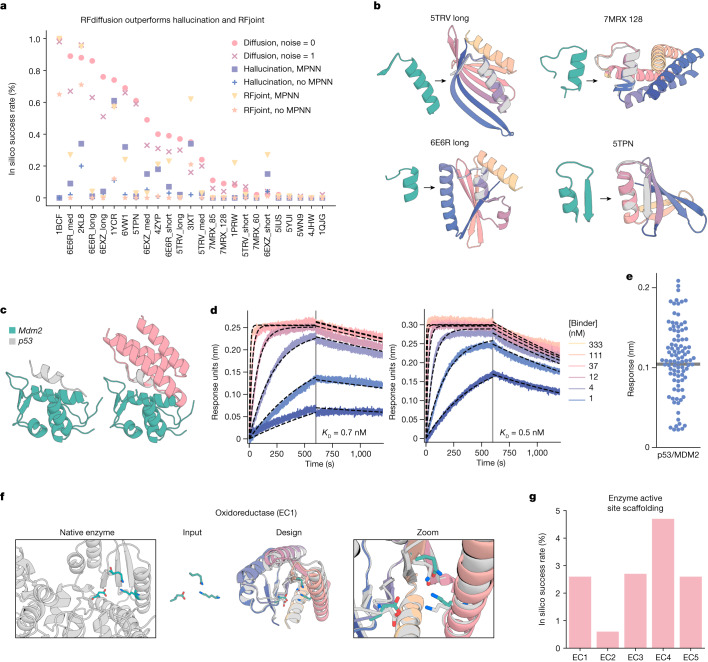
- RFdiffusion solves 23 of 25 motif-scaffolding benchmark problems, compared with 15 for Hallucination and 19 for RFjoint Inpainting; for 19 of 23 solved problems, its success fraction exceeds both baselines.
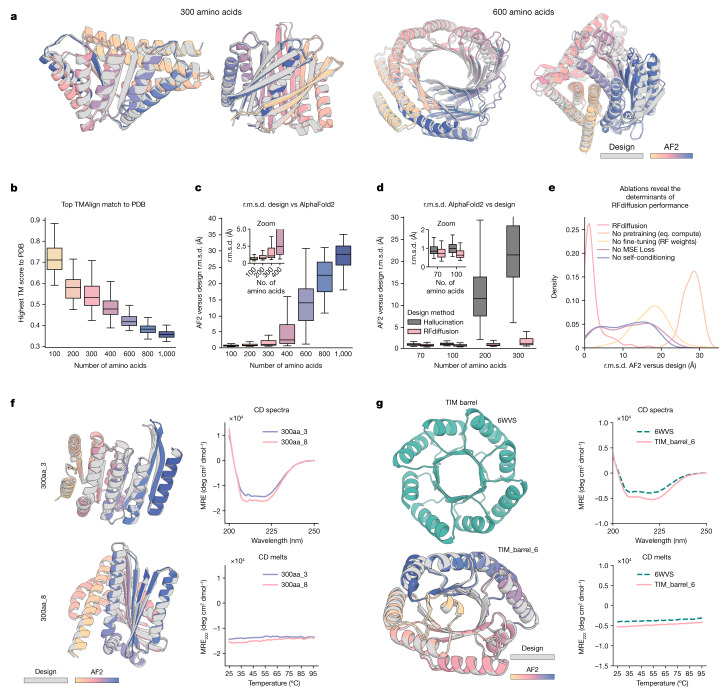
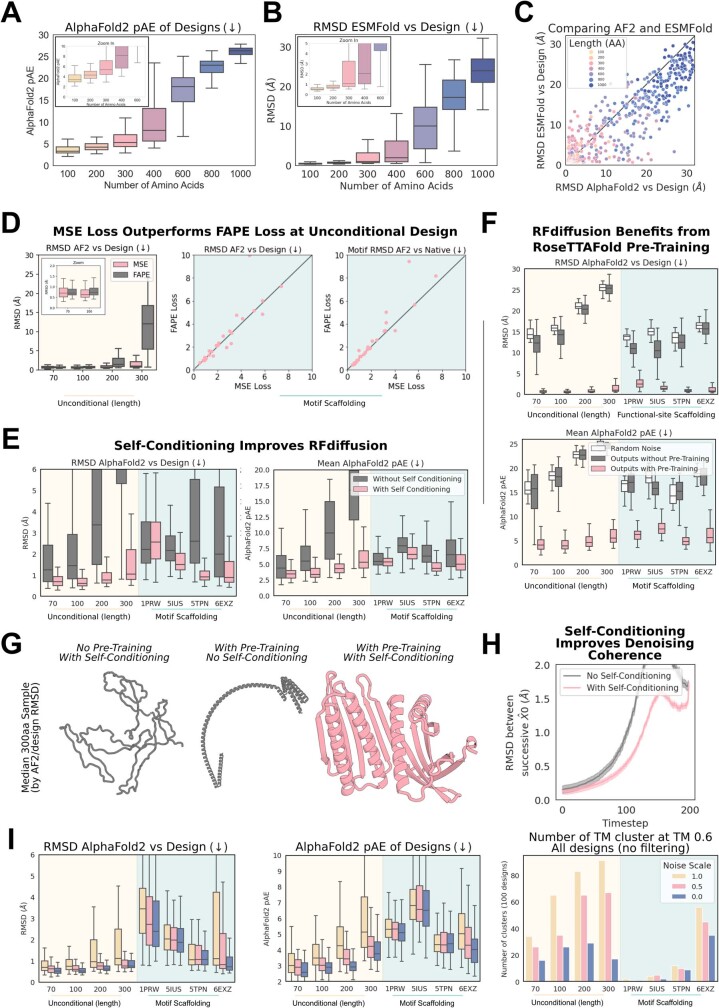
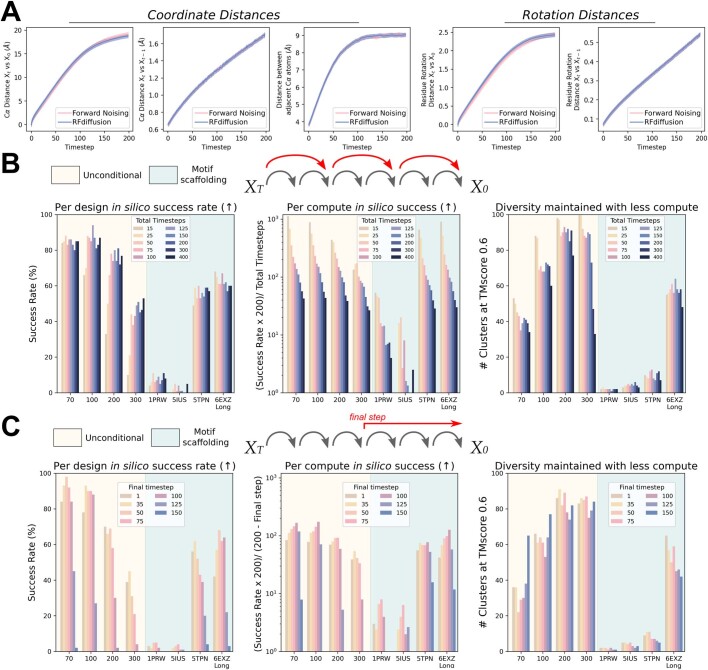
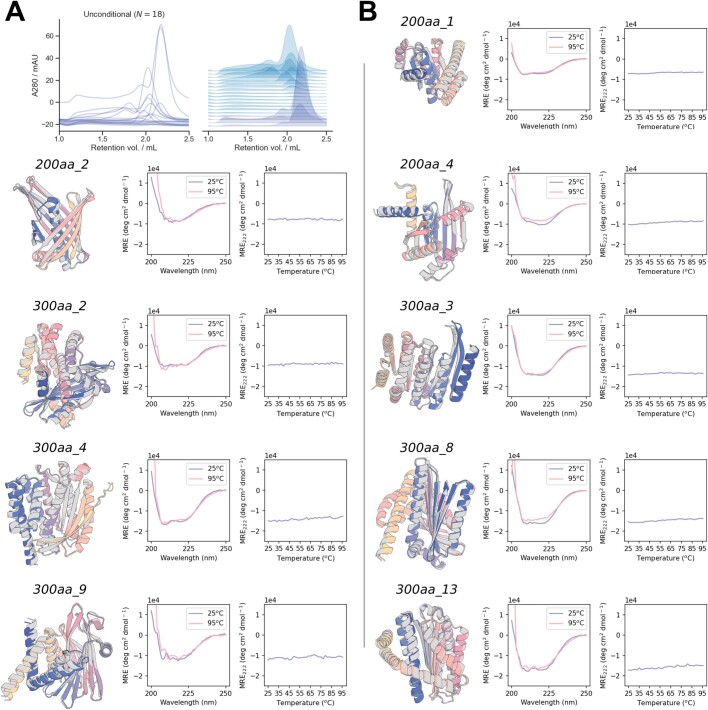
- It generates unconditional monomers up to 600 residues and outperforms RF Hallucination on in silico success (n = 400 designs per condition, z = 9.5, P = 1.6 × 10⁻²¹); a 100-residue protein can be generated in as little as 11 s versus about 8.5 min for RF Hallucination.
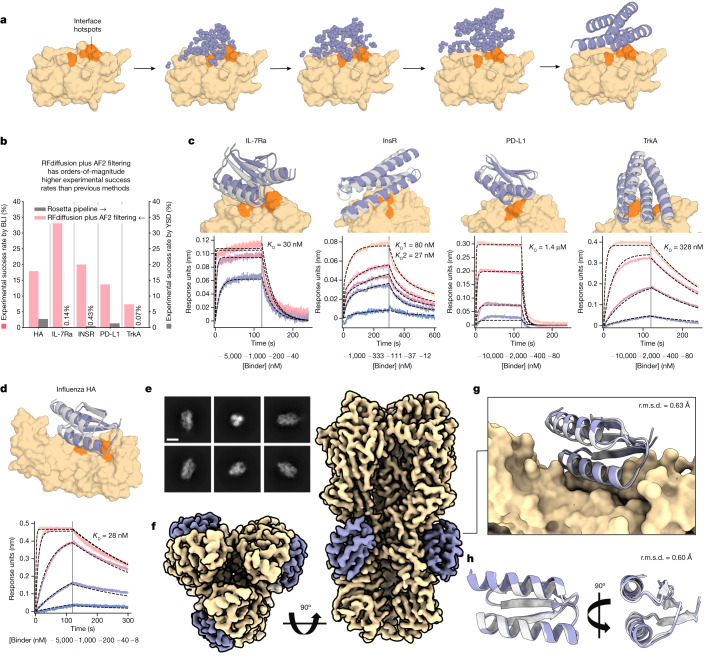
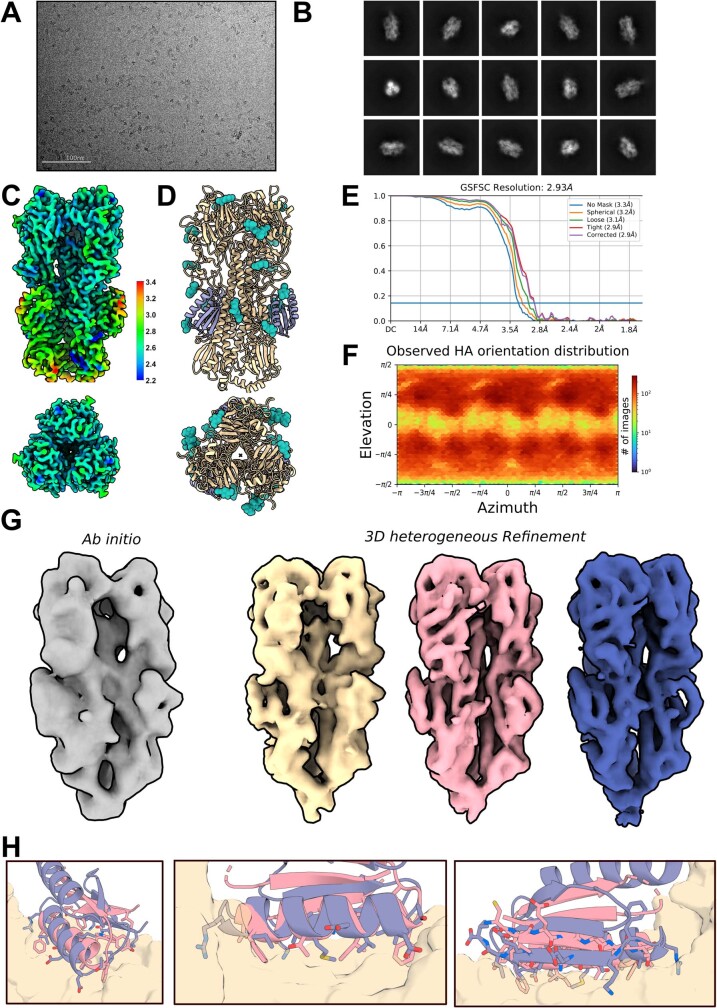
- For binder design against five targets, the overall experimental success rate was 19%, roughly two orders of magnitude above the previous Rosetta-based method; the highest-affinity HA binder, HA_20, bound with KD = 28 nM, and its cryo-EM complex structure matched the design model at 0.63 Å.
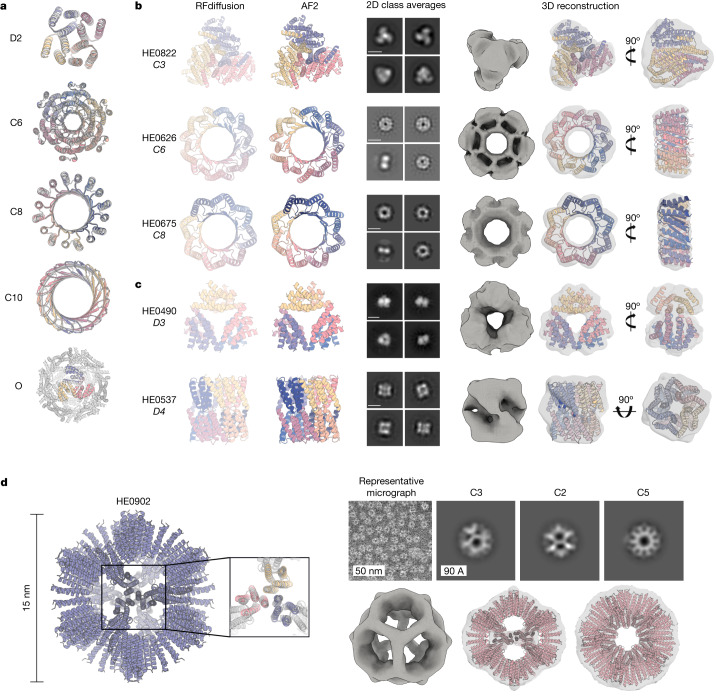
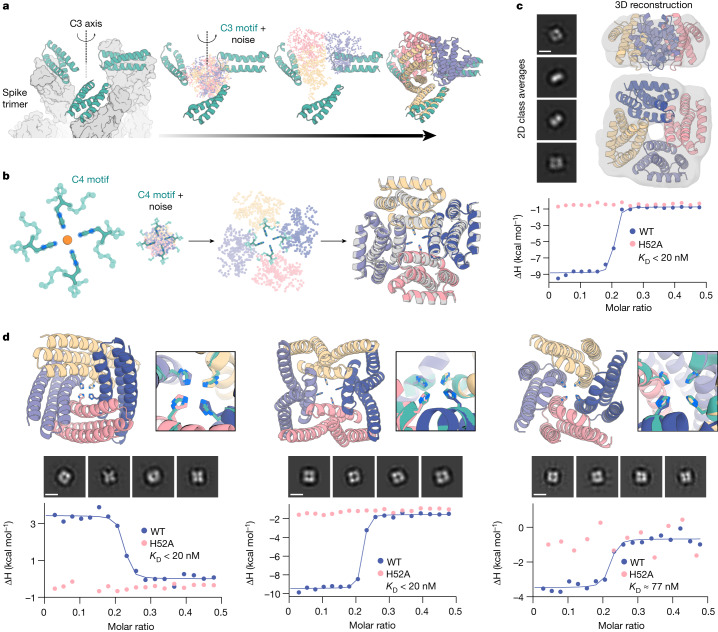
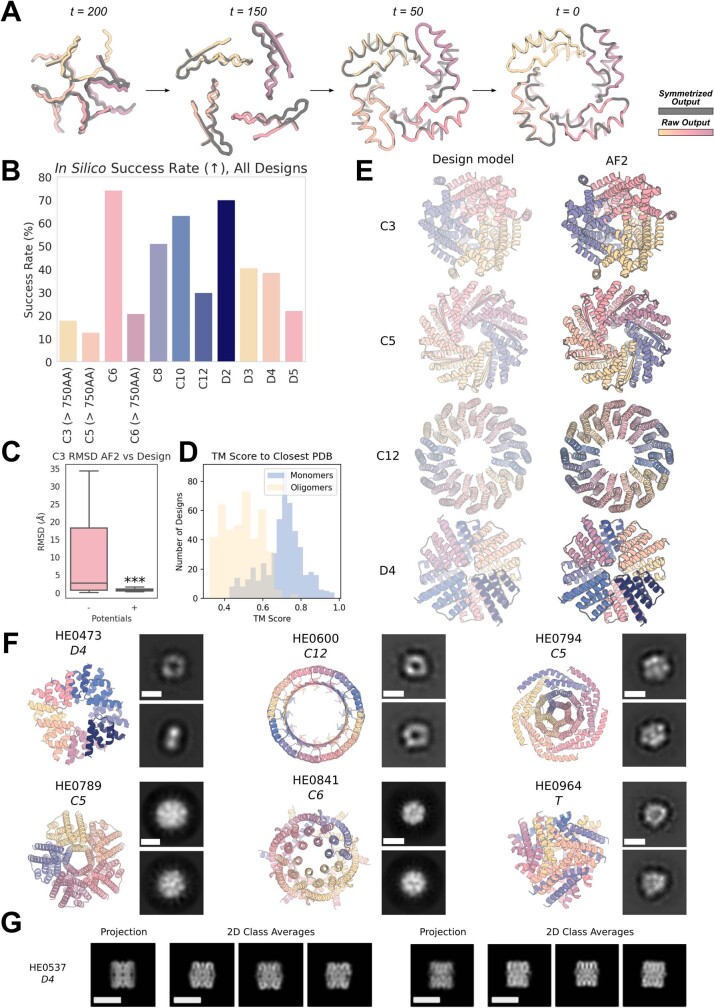
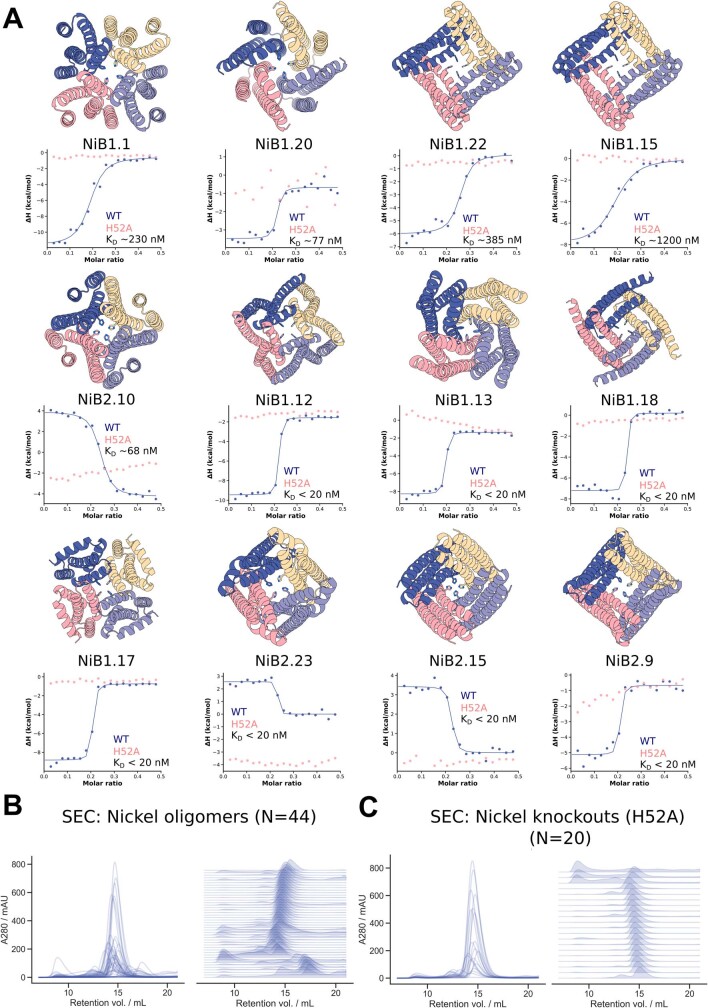
- Symmetric and functional designs were experimentally validated: at least 87 of 608 oligomer designs had SEC oligomerization states closely consistent with design models; 18 of 36 tested Ni²⁺-binding designs bound with dissociation constants from low nanomolar to low micromolar; MDM2 binders reached 0.5 and 0.7 nM versus 600 nM for the native p53 peptide.
Methods
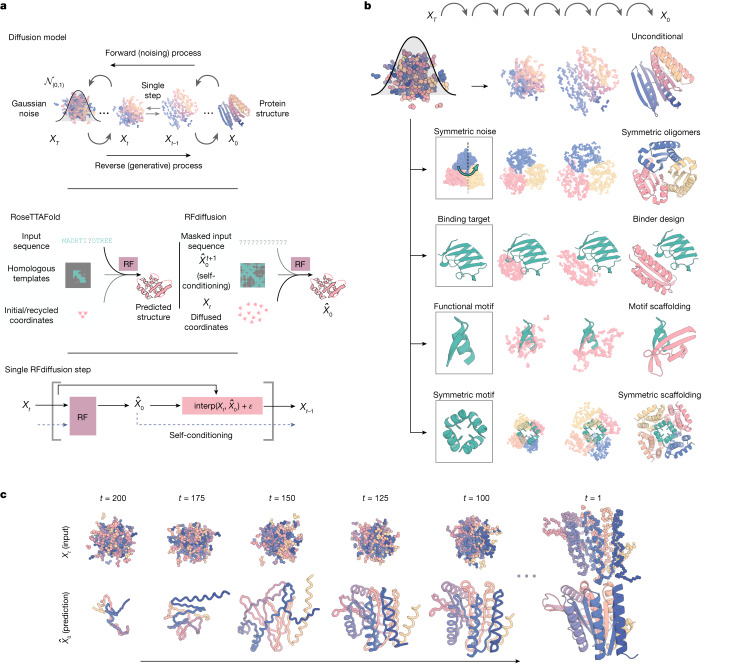
- RFdiffusion uses the RoseTTAFold frame representation (Cα coordinate plus N-Cα-C rigid orientation per residue), trains by noising PDB structures for up to 200 steps, and minimizes mean-squared error between frame predictions and true structures; self-conditioning and fine-tuning from pretrained RF weights improved performance.
- For sequence design, ProteinMPNN was used to design sequences encoding RFdiffusion backbones, typically sampling eight sequences per design; in silico success was validated with AlphaFold2 using mean pAE < 5, global backbone r.m.s.d. < 2 Å, and scaffolded-site backbone r.m.s.d. < 1 Å.
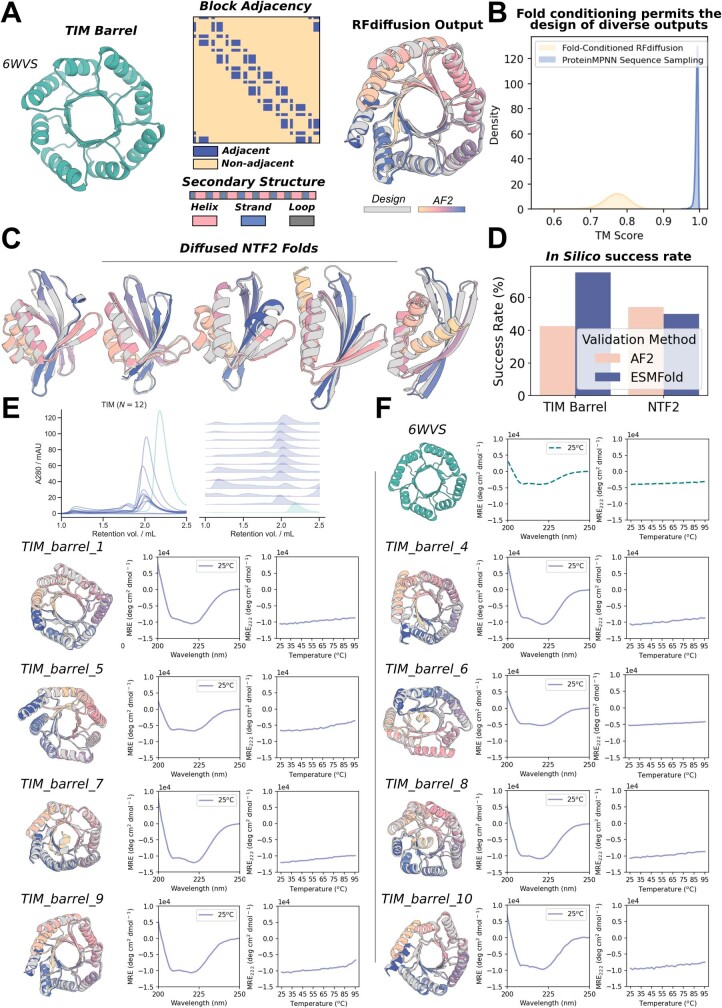
- Experimental characterization included circular dichroism, size-exclusion chromatography, negative-stain EM, cryo-EM, biolayer interferometry, and isothermal titration calorimetry across designed monomers, oligomers, metal-binding proteins, and binders.
Limitations
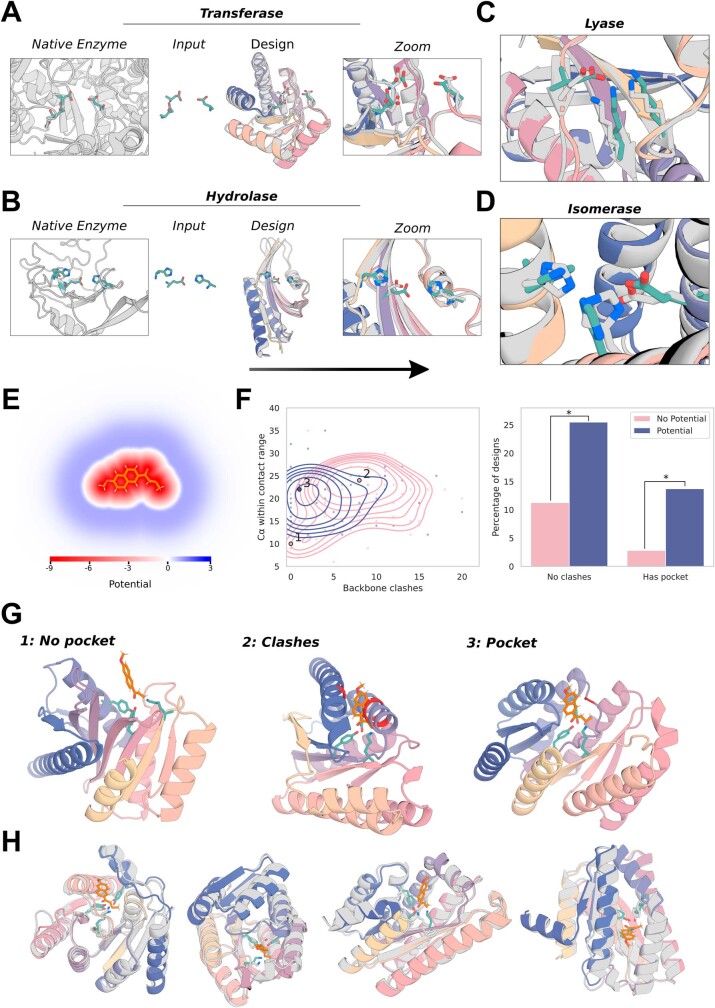
- The paper states that RFdiffusion cannot explicitly model bound small molecules at present, though it can implicitly model substrates with an external potential; it also states that further studies are required to assess success rates on more polar target sites and sites without native binding partners, and that proteome-wide specificity remains to be fully characterized.
- The paper notes that very large proteins are difficult to validate in silico because they are probably beyond single-sequence prediction capabilities of AF2 and ESMFold, and that some binder designs had insufficient material to permit screening at 10 μM.
- Evident from the text: many conclusions rely on the AF2-based in silico success metric, experimental validation was performed on subsets of designs rather than all generated designs, and the authors did not extensively explore simultaneous structure-and-sequence design within RFdiffusion.
Model-written summary. Check it against the paper before relying on it.
Integrity signals
Registry
Cites
Statistics
Figures
Verification
Claims the paper makes
17 Valid · 4 Not valid · 3 Not checked · 113 Own results and interpretations
Some cited sources support this claim and some don’t — read each source’s verdict below.
In the paper
“Recent work has adapted DDPMs for protein monomer design by conditioning on small protein ‘motifs’5,9 or on secondary structure and block-adjacency (‘fold’) information8.”
§ De novo design of protein structure and function with RFdiffusion > Main
What the sources say
- Supportedcites [5] Trippe, B. L. et al. Diffusion probabilistic modeling of protein backbones in 3D for the motif-scaffolding problem. in The EleventhInternational Conference on Learning Representations (2023). source
The Introduction (p. 1) describes ProtDiff as a diffusion probabilistic model for protein backbones and SMCDiff as its motif-conditioned sampling procedure. The Discussion (p. 9) confirms that the procedure generates scaffolds conditioned on a motif. The secondary-structure and block-adjacency clause is attached to a different citation, so it is not attributed to this source. (LLM, conf=0.93)
- Disputedcites [9] Luo, S. et al. Antigen-specific antibody design and optimization with diffusion-based generative models. in Adv. Neural Information Processing Systems Vol. 35 (eds Koyejo, S. et al) 9754–9767 (Curran Associates, 2022). sourceExperimental — accuracy not yet measured
Section 3.1 (page unavailable) says the paper designs antibody CDRs given an antigen structure and antibody framework, not protein monomers conditioned on small motifs. The Generative Model section likewise describes a diffusion model conditioned on the antigen and antibody framework; it does not describe secondary-structure or block-adjacency conditioning. (LLM, conf=0.87)
Checked by a reasoning model — may be wrong.
- Supportedcites [8] Anand, N. & Achim, T. Protein structure and sequence generation with equivariant denoising diffusion probabilistic models. Preprint at 10.48550/arXiv.2205.15019 (2022). source
Citation 8 is attached to the secondary-structure and block-adjacency (‘fold’) conditioning, not to the motif examples cited separately. Section 2.4 (p. 5) defines those constraints, and Section 3 (p. 6) states that the diffusion model conditions on their encoded output to generate protein structures. (LLM, conf=0.94)
plain- Asserted: passes — The authors put it forward as true.
- Checkable: passes — It can be checked against evidence.
- Load-bearing: unclear — It is unclear whether the paper’s conclusions depend on it.
- Based: passes — The paper gives a reason why it holds.
- Supported
The cited sources support only part of this claim — read each source’s verdict below.
In the paper
“Self-conditioning within RFdiffusion notably improved performance on in silico benchmarks encompassing both conditional and unconditional protein design tasks (Fig. 2e and Extended Data Fig. 1e).”
§ De novo design of protein structure and function with RFdiffusion > Main
What the sources say
- Partly supportedcites [25] Chen, T., Zhang, R. & Hinton, G. Analog bits: generating discrete data using diffusion models with self-conditioning. in The Eleventh International Conference on Learning Representations (2023). sourceExperimental — accuracy not yet measured
The Discrete Image Generation section (pp. 6–7) reports that self-conditioning improved results for image diffusion models. It does not report RFdiffusion results or in silico benchmarks for conditional and unconditional protein design, so the claimed improvement in that setting is not supported by this source. (LLM, conf=0.86)
plainstates a cause- Asserted: passes — The authors put it forward as true.
- Checkable: passes — It can be checked against evidence.
- Load-bearing: passes — The paper’s conclusions depend on it.
- Based: passes — The paper gives a reason why it holds.
- Partly supported
The cited sources support only part of this claim — read each source’s verdict below.
In the paper
“Experimental characterization showed that the method can scaffold a wide range of protein functional motifs with atomic accuracy19”
§ De novo design of protein structure and function with RFdiffusion > Main
What the sources say
- Partly supportedcites [4] Wang J Scaffolding protein functional sites using deep learning Science 2022 377 387 394 10.1126/science.abn2100 35862514 PMC9621694 sourceExperimental — accuracy not yet measured
The 'Generalized functional motif scaffolding' section reports designs spanning a wide range of motifs and says their activities were assessed experimentally. But its sub-angstrom motif accuracy is based on AlphaFold predictions, not experimental structural measurements; the sentence overstates what the experimental characterization established. (LLM, conf=0.88)
- Partly supportedcites [19] Watson, J. L., Bera, A., Juergens, D., Wang, J. & Baker, D. X-ray crystallographic validation of design from this paper. Science377, 387–394 (2022). sourceExperimental — accuracy not yet measured
The section “Generalized functional motif scaffolding by missing information recovery” (page unavailable) reports designs spanning a wide range of motifs, with motif RMSD typically below 1 Å in AlphaFold predictions. It separately reports experimental tests of the designs’ activities; those tests do not establish atomic structural accuracy. The paper also attributes the broad set of designs to both inpainting and constrained hallucination, rather than RFjoint inpainting alone. (LLM, conf=0.87)
plainstates a cause- Asserted: passes — The authors put it forward as true.
- Checkable: passes — It can be checked against evidence.
- Load-bearing: passes — The paper’s conclusions depend on it.
- Based: passes — The paper gives a reason why it holds.
- Partly supported
The cited sources support only part of this claim — read each source’s verdict below.
In the paper
“we established an in silico benchmark test (Supplementary Table 9) comprising 25 motif-scaffolding design problems addressed in six recent publications encompassing several design methodologies4,5,29,38–40”
§ De novo design of protein structure and function with RFdiffusion > Functional-motif scaffolding
What the sources say
- Could not verifycites [4] Wang J Scaffolding protein functional sites using deep learning Science 2022 377 387 394 10.1126/science.abn2100 35862514 PMC9621694 sourceExperimental — accuracy not yet measured
The 'Generalized functional motif scaffolding by missing information recovery' section describes in silico evaluation of the paper’s own designs, but does not describe establishing a benchmark of 25 problems drawn from six publications. Searches for the benchmark, the numbers, and Supplementary Table 9 found no passage in our copy that verifies those details. (LLM, conf=0.74)
- Supportedcites [5] Trippe, B. L. et al. Diffusion probabilistic modeling of protein backbones in 3D for the motif-scaffolding problem. in The EleventhInternational Conference on Learning Representations (2023). source
Section 5.2 (p. 7) reports motif-scaffolding tests using motifs from proteins 6exz and 5trv; Appendix H.1 (p. 24) describes another target, 5tpn. This supports citing the paper as one of the publications that addressed motif-scaffolding design problems. The citing authors describe the 25-problem benchmark as their own, not as something established by this source. (LLM, conf=0.88)
- Supportedcites [29] Lee, J. S. & Kim, P. M. ProteinSGM: Score-based generative modeling for de novo protein design. Preprint at bioRxiv10.1101/2022.07.13.499967 (2022). source
The citation identifies one of the publications whose design methodology informed the citing authors’ benchmark; it does not attribute the establishment of the 25-problem benchmark to ProteinSGM. In “Conditional generation” (page unavailable), ProteinSGM presents scaffold-inpainting design cases, including generation of scaffolds around the barstar functional site. (LLM, conf=0.88)
- Supportedcites [38] Sesterhenn F De novo protein design enables the precise induction of RSV-neutralizing antibodies Science 2020 368 eaay5051 10.1126/science.aay5051 32409444 PMC7391827 source
The citation identifies this paper as one of the motif-scaffolding publications used to assemble the citing authors’ benchmark; the benchmark’s size and establishment are the citing authors’ own statements. The Results section (page unavailable) describes TopoBuilder as a protocol for designing protein topologies around functional motifs, so the paper fits that role. (LLM, conf=0.88)
- Not checked — no full text of the sourcecites [39] Yang C Bottom-up de novo design of functional proteins with complex structural features Nat. Chem. Biol. 2021 17 492 500 10.1038/s41589-020-00699-x 33398169 source
- Partly supportedcites [40] Glasgow A Engineered ACE2 receptor traps potently neutralize SARS-CoV-2 Proc. Natl Acad. Sci. USA 2020 117 28046 28055 10.1073/pnas.2016093117 33093202 PMC7668070 sourceExperimental — accuracy not yet measured
The Results and Materials and Methods describe computational redesign of the ACE2–spike binding interface, so this is a publication addressing a protein-design problem. Our copy does not describe that work as motif scaffolding. The benchmark of 25 problems is the citing authors’ own work, not a finding attributed to this source. (LLM, conf=0.78)
plain- Asserted: passes — The authors put it forward as true.
- Checkable: passes — It can be checked against evidence.
- Load-bearing: passes — The paper’s conclusions depend on it.
- Based: passes — The paper gives a reason why it holds.
- Could not verify
Every source the paper cites for this claim was checked and supports it.
In the paper
“Vázquez Torres et al. demonstrate the ability of RFdiffusion to design picomolar affinity binders to flexible helical peptides54”
§ De novo design of protein structure and function with RFdiffusion > Discussion
What the sources say
- Supportedcites [54] Torres, S. V. et al. De novo design of high-affinity protein binders to bioactive helical peptides. Preprint at bioRxiv10.1101/2022.12.10.519862 (2022). source
The Peptide binder design with RFdiffusion section reports de novo RFdiffusion binders to the helical peptides Bim and PTH, with an estimated affinity of ~100 pM for Bim and an upper bound of 500 pM for PTH. The Main section explains that peptide targets are often partially or entirely unstructured in isolation, supporting the description of them as flexible. (LLM, conf=0.94)
boostedstates a cause- Asserted: passes — The authors put it forward as true.
- Checkable: passes — It can be checked against evidence.
- Load-bearing: unclear — It is unclear whether the paper’s conclusions depend on it.
- Based: passes — The paper gives a reason why it holds.
- Supported
82 more claims · 7 with their cited sources checked
Create a free account to see all 137 claims and every source verdict.
- It may state two separate claims as one. 48
- Probably not a substantial claim. 3
- The quote only partly states this claim. 1
Claims other papers make about this one
Each is checked against this paper’s own text: does it say what the citing paper says it does?
The source backs part of the claim, not all of it — or backs it for a different population, condition or comparison.
In the citing paper
“We also use Evo to generate genome-scale sequences with plausible high-level architecture more than1 megabase (Mb) in length, a scale that is orders of magnitude greater than previous methods (10, 13, 14).”
From Sequence modeling and design from molecular to genome scale with Evo (2024) · cites this paper as [10]
Experimental — accuracy not yet measured
Self-check
Percentages, sums and reported differences re-computed from the paper’s own numbers.
Each contradiction between two passages listed here was confirmed by an independent check.
Rated minor: it would not touch a result — a value no result rests on, a p-value that stays on the same side of the significance level, or a conflict that is clerical, resolved elsewhere in the paper, or outside its own findings.
In the paper
§ De novo design of protein structure and function with RFdiffusion > Functional-motif scaffolding
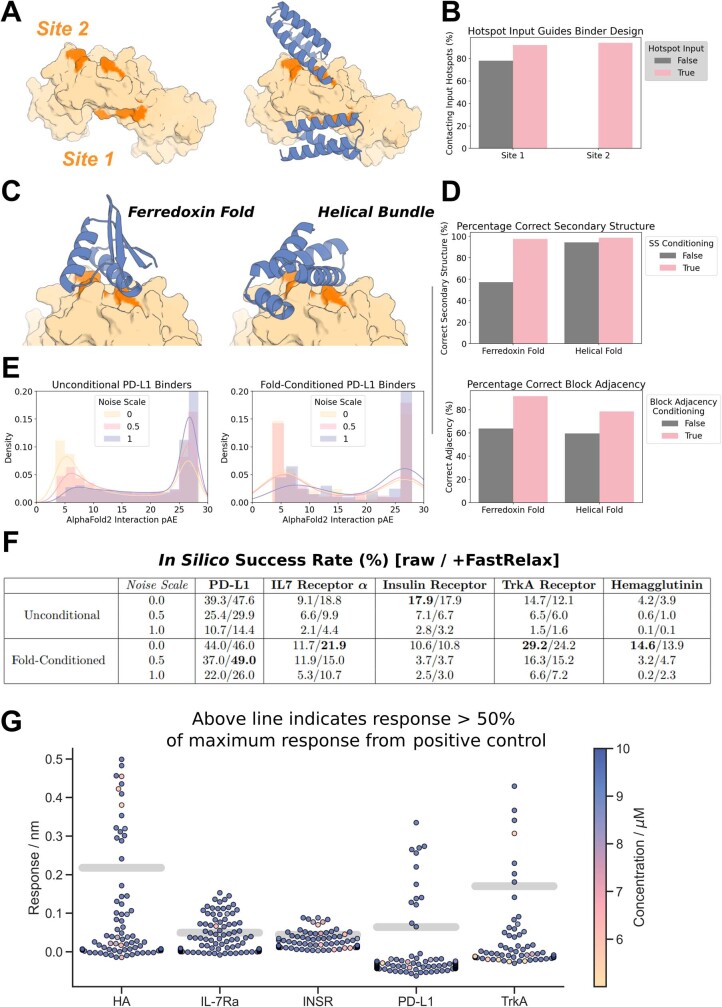
“e, Out of 95 designs, 55 showed binding to MDM2 (more than 50% of maximum response).”
§ De novo design of protein structure and function with RFdiffusion > Functional-motif scaffolding
“The overall success rate was quite high: out of the 96 designs, 55 showed some detectable binding at 10 μM (Fig. 4e and Supplementary Fig. 10h).”
Citations
Cites
Highly accurate protein structure prediction with AlphaFold
Jumper, J., Evans, R., Pritzel, A., Green, T., Figurnov, M., Ronneberger, O., Tunyasuvunakool, K., Bates, R., Žídek, A., Potapenko, A., et al. (2021) · Nature · doi:10.1038/s41586-021-03819-2 · Cited by 43,764
Berman, H. M. (2000) · Nucleic Acids Research · doi:10.1093/nar/28.1.235 · Cited by 40,196
Denoising Diffusion Probabilistic Models
Ho, J., Jain, A., & Abbeel, P. (2020) · arXiv · doi:10.48550/arxiv.2006.11239 · Cited by 8,712
Evolutionary-scale prediction of atomic level protein structure with a language model
Lin, Z., Akin, H., Rao, R., Hie, B., Zhu, Z., Lu, W., Smetanin, N., Verkuil, R., Kabeli, O., Shmueli, Y., et al. (2022) · doi:10.1101/2022.07.20.500902 · Cited by 5,990
Accurate prediction of protein structures and interactions using a 3-track network
Baek, M., DiMaio, F., Anishchenko, I., Dauparas, J., Ovchinnikov, S., Lee, G. R., Wang, J., Cong, Q., Kinch, L. N., Schaeffer, R. D., et al. (2021) · doi:10.1101/2021.06.14.448402 · Cited by 5,549
Self-citationDeep Unsupervised Learning using Nonequilibrium Thermodynamics
Sohl-Dickstein, J., Weiss, E. A., Maheswaranathan, N., & Ganguli, S. (2015) · arXiv · doi:10.48550/arxiv.1503.03585 · Cited by 2,637
Zero-shot text-to-image generation
Ramesh, A., Pavlov, M., Goh, G., Gray, S., Voss, C., Radford, A., Chen, M., & Sutskever, I. (2021) · arXiv · doi:10.48550/arxiv.2102.12092 · Cited by 2,417
THEORY OF PROTEIN FOLDING: The Energy Landscape Perspective
Onuchic, J. N., Luthey-Schulten, Z., & Wolynes, P. G. (1997) · Annual Review of Physical Chemistry · doi:10.1146/annurev.physchem.48.1.545 · Cited by 2,210
Robust deep learning–based protein sequence design using ProteinMPNN
Dauparas, J., Anishchenko, I., Bennett, N., Bai, H., Ragotte, R. J., Milles, L. F., Wicky, B. I. M., Courbet, A., de Haas, R. J., Bethel, N., et al. (2022) · Science · doi:10.1126/science.add2187 · Cited by 2,210 · cited 6×
“We explored two different strategies for training RFdiffusion: (1) in a manner akin to ‘canonical’ diffusion models, with predictions at each timestep independent of predictions at previous timesteps (as in previous work(5,8,9,16)), and (2) with self-conditioning(25), in which the model can condition on previous predi…”
InfluentialSelf-citationStructure of the MDM2 Oncoprotein Bound to the p53 Tumor Suppressor Transactivation Domain
Kussie, P. H., Gorina, S., Marechal, V., Elenbaas, B., Moreau, J., Levine, A. J., & Pavletich, N. P. (1996) · Science · doi:10.1126/science.274.5289.948 · Cited by 2,206
Research works printed but not linked: 1
- Watson, J. L., Bera, A., Juergens, D., Wang, J. & Baker, D. X-ray crystallographic validation of design from this paper. Science377, 387–394 (2022). · DOI · Paper page
Cited by
Items 2,101–2,200 of 2,479
Srinivas, P., Adebomi, V., Markiewicz, S. M., Wang, K., Chac, D., Lindenauer, K., Huber, N., Tao, Z., Luong, P., Rettie, S., et al. (2026) · bioRxiv (Cold Spring Harbor Laboratory) · doi:10.64898/2026.06.22.733822
Precision fermentation of terpenes: tackling bottlenecks at enzyme, pathway, and bioprocess levels
Scipion, C. P. M., Lin, F., & Chen, X. (2026) · Critical Insights in Biotechnology · doi:10.1080/29932238.2026.2684112
Editorial: Advances in protein structure biology – use of AI and beyond
Pal, A., Filippidi, E., & Dey, S. (2026) · Frontiers in Molecular Biosciences · doi:10.3389/fmolb.2026.1903318
Computational Redesign of an Antifreeze Protein Using Deep LearningPreprint
Calia, C. N., Altunc, A. J., Eufemio, R. J., Alvarado, B. O., Huynh, J. D., Oh, E., Burkart, M. D., Meister, K., & Paesani, F. (2026) · bioRxiv (Cold Spring Harbor Laboratory) · doi:10.64898/2026.06.21.733612
Begum, A., Manisha, R. L., & Sudhakar, M. (2026) · International Journal of Research and Review · doi:10.52403/ijrr.20260610
BoltzProt-1: Towards Efficient De Novo Binder Design with Good DevelopabilityPreprint
Uçar, T., Bates, J., Fu, Y., Shi, W., Stark, H., Nava, D., Cavalleri, L., Wohlwend, J., Corso, G., & Passaro, S. (2026) · bioRxiv (Cold Spring Harbor Laboratory) · doi:10.64898/2026.06.23.733997 · Cited by 1
“Computational binder design is emerging as an increasingly viable path toward accelerated therapeutic discovery, with several models succeeding on diverse targets [Watson et al., 2023, Bennett et al., 2024, Stark et al., 2025, Zhang et al., 2025].”
Limitations of Biological Risk Evaluation for Llms and Autonomous Science
Lin, A., Bartoldson, B. R., Bonheyo, G. T., Goldhahn, R., Kalikhura, B., Klunder, G. L., Mayer, B. P., Maupin, C. M., Munikoti, S., Oakdale, J. S., et al. (2026) · IEEE Security and Privacy Workshops (SPW) · doi:10.1109/spw72489.2026.00022
“For example, a benchmark generated in 2020 may be unable to evaluate the risks presented by protein design tools such as RFdiffusion [25], which was published in 2023.”
Enhancing Biosecurity Incident Response by Predicting Unknown Genetic Circuit Logic
Mo, W., Vaiana, C. A., & Myers, C. J. (2026) · IEEE Security and Privacy Workshops (SPW) · doi:10.1109/spw72489.2026.00021
“…between predictive and generative AI, for example the landmark generative tool RFDiffusion being an adaptation of the predictive RoseTTAFold [11], suggests that predictive AI, properly guided by deterministic algorithms on regulatory elements, could be extremely valuable in…”
Targeting Systems, Not Pathogens: Adapting Cybersecurity Threat Modeling for Modern Biosecurity
Diggans, J., Flyangolts, K., & Puzis, R. (2026) · IEEE Security and Privacy Workshops (SPW) · doi:10.1109/spw72489.2026.00024
“The biosecurity community’s historical focus on physical containment of known pathogenic agents [1] is being rapidly outpaced by the capability to digitally design and synthesize novel biological functions [2].”
Di, H., Shi, D., Sun, Y., Niu, Y., Zhao, B., Cao, P., & Xu, Y. (2026) · Chemical Engineering Journal · doi:10.1016/j.cej.2026.178898
Coluzza, I. (2026) · Elsevier eBooks · doi:10.1016/b978-0-323-99507-8.00090-1
AI-enabled rhodopsin design for blue-light enhanced bacterial growthPreprint
Saeed, H., Lewis, M., Fujiwara, T., Huang, J., Konno, M., Kaho, M. O. R. I., Yoshizawa, S., Inoue, K., Pan, T., Wang, Y., et al. (2026) · bioRxiv (Cold Spring Harbor Laboratory) · doi:10.64898/2026.06.29.735265
Deshmukh, A., Desai, S. A., Patel, V. P., Pund, H., & Kawade, M. (2026) · International Immunopharmacology · doi:10.1016/j.intimp.2026.117082
Function-guided design of active enzymesPreprint
Hu, M., Wu, L., Yang, Y., Li, F., & Zhu, L. (2026) · bioRxiv (Cold Spring Harbor Laboratory) · doi:10.64898/2026.06.27.735025
OpenGerminal: an open-source implementation of the Germinal antibody design pipelinePreprint
Han, B., & Li, S. (2026) · bioRxiv (Cold Spring Harbor Laboratory) · doi:10.64898/2026.06.25.734527
AI-Driven Design Platforms of Next-Generation Antibody Therapeutics
Wang, Y., Saba, A., Ran, Y., Shehzadi, K., Zhang, Q., Jianhua, L., & Yu, M. (2026) · Topics in Current Chemistry · doi:10.1007/s41061-026-00554-y
Artificial Intelligence for Discovery in Life Sciences
Chanda, S., Rizzoli, S. O., & Shaib, A. (2026) · Bioconjugate Chemistry · doi:10.1021/acs.bioconjchem.6c00230 · Cited by 1
Targeting the Undruggable: Deep Learning-Driven Design of Peptide Therapeutics in Cancer
Nguyen, H. T. N., Le, B. H. N., Van, N. T. H., Tran, T. T. T., & Nguyen, T. M. (2026) · Pharmaceuticals · doi:10.3390/ph19070998
“…of this capability was recorded for the MDM2 p53 complex, where the target context scaffolding method helped increase the average buried surface area by 31%, thereby elevating the binding affinity to picomolar levels and making it over 1000 times stronger than the natural peptide [85].”
InfluentialPan, Y., Kang, S., An, D. N., Yu, Y., DiMaio, F., & Gu, L. (2026) · bioRxiv (Cold Spring Harbor Laboratory) · doi:10.64898/2026.07.01.735888
Self-citationAhmed, T., & Alam, K. T. (2026) · Elsevier eBooks · doi:10.1016/b978-0-443-33639-3.00023-4
Expanding all-α-helical protein space through rational computational designPreprint
Albanese, K. I., Chubb, J. J., Gutierrez-Rus, L. I., Leng, X., Kurgan, K. W., Mylemans, B., Ożga, K., Petrenas, R., Romanyuk, A. V., Acevedo‐Jake, A. M., et al. (2026) · bioRxiv (Cold Spring Harbor Laboratory) · doi:10.64898/2026.07.03.736327
Beyond the structure-function paradigm: A comprehensive review of intrinsically disordered proteins
Harake, S. N. A., Btadini, S., Qadri, A. H., Harb, F., & Faheem, I. (2026) · Biochemistry and Biophysics Reports · doi:10.1016/j.bbrep.2026.102706 · Cited by 4
“…side, the de novo design pipeline comprising RFdiffusion, ProteinMPNN, and AlphaFold now reliably yields high-affinity binders to selected targets [221,222], while dedicated systems such as AlphaProteo report correspondingly high experimental success rates [223]; AlphaFold3, for its part, extends…”
The Future Direction of Medicine
spring, W. (2026) · Octopus · doi:10.57874/y0hf-j627
Automating De Novo Protein Design via LLM-Based Multi-agent Systems
Abdelaziz, K., Pester, A., Andres, F., & Mostafa, N. A. (2026) · Lecture notes in electrical engineering · doi:10.1007/978-3-032-20235-2_2
Wang, H., Hua, T., Wang, M., Meng, B., Zhang, Y., Jiang, C., Gao, Y., Yang, H., & Bo, J. (2026) · Advanced Science · doi:10.1002/advs.76202 · Cited by 1
“Methods such as RFdiffusion, ProteinMPNN, and AlphaFold-based structure prediction now allow rational design of proteins that directly target protein–protein interaction interfaces with atomic-level precision [ 20–22 ].”
Rybak, J. A., & Barrera, F. N. (2026) · Chemical Reviews · doi:10.1021/acs.chemrev.6c00122
Computational design of blue melanin by motif‐scaffolding a pentapeptide‐repeat protein
Lee, D. S., Park, B., Salgado, S., Dolgin, J., & Kaplan, D. L. (2026) · Protein Science · doi:10.1002/pro.70718
AI agents in drug discovery: A review of evolution, applications, and future directions
Das, S., Ferdaus, M. M., & Dam, T. (2026) · Computer Methods and Programs in Biomedicine · doi:10.1016/j.cmpb.2026.109539 · Cited by 2
Tomita, N., & Chikenji, G. (2026) · Protein Science · doi:10.1002/pro.70717
Bakam, V. M., Mérindol, N., Germain, H., & Desgagné‐Penix, I. (2026) · Phytochemistry Reviews · doi:10.1007/s11101-026-10286-y
An, X., Li, F., Xia, C., Li, Y., Li, H., & Xie, F. (2026) · In Silico Pharmacology · doi:10.1007/s40203-026-00701-9 · Cited by 1
“This enables the direct generation of novel, non-natural functional molecules within a sequence space as vast as 10⁶⁰ (Watson et al. 2023 ).”
De novo design of selective kinase modulatorsPreprint
Bauer, M. S., Kumar, S., Donald-Paladino, M. S., Li, D., Klupt, K. A., Glögl, M., Fernández‐Escamilla, A. M., Schlichthaerle, T., Muratspahić, E., Wang, X., et al. (2026) · bioRxiv (Cold Spring Harbor Laboratory) · doi:10.64898/2026.07.10.737808
Self-citationWang, X., & Bhattacharya, D. (2026) · Journal of Chemical Information and Modeling · doi:10.1021/acs.jcim.6c00988 · Cited by 1
Selective miniprotein inhibitors of Aurora-A kinase designed using interaction-motif scaffoldingPreprint
Miles, J. A., Schiffrin, B., Holder, J. W., Wallis, E. J., Manfield, I. W., Burnap, S. A., Struwe, W. B., Gergely, F. V., & Bayliss, R. W. (2026) · bioRxiv (Cold Spring Harbor Laboratory) · doi:10.64898/2026.07.12.737516
De Novo Synthesis in Cancer Immunotherapy: Applications and Prospects
Yang, J., Wu, Y., & Luo, J. (2026) · MedComm · doi:10.1002/mco2.70847
“RFdiffu-sion [ 30 ] represents a methodological improvement by employing diffusion models and generative denoising algorithms to sculpt complex protein topologies from noise.”
InfluentialFolding and Oligomerization of CLC Channels and Transporters
Robertson, J. (2026) · Chemical Reviews · doi:10.1021/acs.chemrev.6c00294
Protein Design and Synthetic Biology
Wipat, A., & Hallinan, J. S. (2026) · Springer eBooks · doi:10.1007/978-3-032-11023-7_5
(2026) · Nature Computational Science · doi:10.1038/s43588-026-01031-8
PathFold: Predicting the Entire Protein Folding Pathway from Protein Sequence AlonePreprint
Zhang, Z., Ibtehaz, N., Kagaya, Y., Xu, Z., Punuru, P. D., & Kihara, D. (2026) · bioRxiv (Cold Spring Harbor Laboratory) · doi:10.64898/2026.08.26.747321 · Cited by 1
Optical Generative Models for Novel Image Generation
Chen, S., Li, Y., Wang, Y., Chen, H., & Özcan, A. (2026) · Conference on Lasers and Electro-Optics · doi:10.1364/cleo_si.2026.sm1e.1
State-selective inhibition of alpha-synuclein aggregation by de novo oligomer-binding proteinsPreprint
Zhang, Y., Han, H. L., Ortigosa-Pascual, L., Miles, U. Z., Wei, J., Berkowicz, L. E., Snow, F., Tu, D., Meisl, G., Sansaria, S., et al. (2026) · bioRxiv (Cold Spring Harbor Laboratory) · doi:10.64898/2026.07.13.738012 · Cited by 1
“In this work we design de novo protein binders against aggregation prone motifs within the α Syn NAC domain using the RFdiffusion/ProteinMPNN pipeline( 17 ).”
InfluentialFarrag, M. A. (2026) · Vector-Borne and Zoonotic Diseases · doi:10.1177/15303667261469037
“…work by utilizing the mechanistic component ( e.g. , an SEIR model) to capture the fundamental biological processes of viral infection and transmission while employing ML or Bayesian approaches to dynamically estimate time-varying parameters (Delli Compagni et al., 2022; Watson et al., 2023).”
Next-Generation Food Enzymology: From Metagenomic Discovery to AI-Driven Biocatalyst Design
Schwartz, M., Ladeira, R., Neiers, F., Nicolaı̈, A., Hocquet, D., & Loupiac, C. (2026) · Journal of Agricultural and Food Chemistry · doi:10.1021/acs.jafc.6c04349
Generative inverse design of base-isolated structures using conditional variational autoencoders
Li, J., Wang, S., He, S., & Zhang, R. (2026) · Structures · doi:10.1016/j.istruc.2026.112540
CatIF-RL: Activity-Oriented Enzyme Sequence Design by Steered Inverse Protein Folding
Li, Y., Xiong, J., Zhang, Y., Cai, T., Fu, C., Li, S., Xu, W., Lyu, R., Chen, Z., Guo, Z., et al. (2026) · Journal of Chemical Information and Modeling · doi:10.1021/acs.jcim.6c01587 · Cited by 1
Cascade Catalysis for CO2 Upgrading to Long-Chain Products
Wang, Y., Kuang, M., & Zheng, G. (2026) · ACS Central Science · doi:10.1021/acscentsci.5c02358
Huang, W., Zhang, L., Zhang, X., Liu, J., Gao, C., Liu, K., & Liu, L. (2026) · Chemical Engineering Journal · doi:10.1016/j.cej.2026.183709
Zhao, W., Pan, X., Yang, W., LIU, Z., Wei, X., Lin, A., Tang, B., Zhang, L., Xiao, M., Zeng, Q., et al. (2026) · Probiotics and Antimicrobial Proteins · doi:10.1007/s12602-026-11131-6
De Novo Design of Protein Nanopores: From Minimal Peptides to AI-Driven Design
Vorobieva, A. A., Samanta, R., & Thillo, T. V. (2026) · Chemical Reviews · doi:10.1021/acs.chemrev.5c00990
AI protein design: constructing superstable proteins via maximized hydrogen bonding
张, 文. (2026) · Scientia Sinica Chimica · doi:10.1360/ssc-2026-0063
Wang, T. (2026) · SSRN Electronic Journal · doi:10.2139/ssrn.7008958
Ensembles of in silico structures enable T cell peptide-MHC binding predictionPreprint
Lyudovyk, O., Levine, J., Pathil, M., Martis, S., Streltsov, A., Sethna, Z. M., Elhanati, Y., Balachandran, V., Morris, Q., & Greenbaum, B. D. (2026) · bioRxiv (Cold Spring Harbor Laboratory) · doi:10.64898/2026.07.14.738340 · Cited by 2
From Prediction to Discovery: A Review of Scientific Discovery with Foundation ModelsPreprint
Wang, T. (2026) · SSRN Electronic Journal · doi:10.2139/ssrn.7008878
Gaughan, C. L. (2026) · mAbs · doi:10.1080/19420862.2026.2703349
“New tools include RFdiffusion, 1 Chai-1/Chai-2, 2,3 and a rapidly expanding ecosystem of generative and structure-prediction methods.”
Kumar, R., Muthuramalingam, P., Tiwari, S., Gupta, J., Gupta, R., Agarwal, P., Yadav, H., Kumar, N., Rawat, J. M., Ravi, K., et al. (2026) · Computational and Structural Biotechnology Journal · doi:10.34133/csbj.0199
“In addition, ProteinMPNN and RFdiffusion [ 76 ] have significantly expanded the capabilities of rational immunogen engineering.”
De Novo Design of Protein Switches with Diffusion-Based Ensemble SamplingPreprint
Omidi, A., He, J., Bui, J. M., Gsponer, J., & Syed, S. (2026) · bioRxiv (Cold Spring Harbor Laboratory) · doi:10.64898/2026.07.20.739027
“In contrast, existing protein design pipelines are implicitly biased toward sequences with a single dominant free-energy minimum [Watson et al., 2023, Ingraham et al., 2023, Geffner et al., 2025, Lin et al., 2024, Yim et al., 2023, Zambaldi et al., 2024, Team et al., 2025, Stark et al., 2025].”
Anonymous, & Zhang, X. (2026) · Physical Review A · doi:10.1103/93x9-y3y9
Ahn, W., Son, M.-J., Kim, J.-R., Go, S.-R., Kang, J. Y., Park, J., Lee, Y., Lee, S. H., Kim, J., Jung, J., et al. (2026) · bioRxiv (Cold Spring Harbor Laboratory) · doi:10.64898/2026.07.20.739581
De novo design of proteinaceous binders targeting the LEDGF PWWP domain
Vantieghem, T., Delepine, J., Noppen, S., Beelen, S., Drexler, M., Holková, J., Houser, J., Veverka, V., Schols, D., & Strelkov, S. V. (2026) · Protein Science · doi:10.1002/pro.70726
“Remarkably, this workflow yielded validated binders without the need for down-stream experimental selection technologies such as phage display, which are typically required in de novo protein binder studies (Watson et al., 2023; Zou et al., 2025).”
InfluentialApplications of artificial intelligence in infectious diseases
Barua, K., & Dasgupta, S. B. (2026) · Elsevier eBooks · doi:10.1016/b978-0-443-43934-6.00005-5
Artificial intelligence-assisted drug designing, toxicity assessment, and biodelivery
Mitra, P., Bhaduri, S., Das, D., & Haldar, D. K. (2026) · Elsevier eBooks · doi:10.1016/b978-0-443-43934-6.00032-8
Deep learning as a bridge between sequencing-derived biological data and functional interpretation
Hong, H., Liu, L., Liao, W., Zhao, J., Liu, Y., He, X., Li, J., He, R., Jin, Y., Sha, L., et al. (2026) · Discover Artificial Intelligence · doi:10.1007/s44163-026-01739-6
“Concurrently, geometric diffusion models, exemplified by RFdiffusion [73], operate directly in 3D coordinate space to design novel backbones and binders with high structural validity, effectively closing the loop from proteomic analysis to functional protein design.”
AI-driven discovery of multifunctional peptides: From sequence space to therapeutics
Liang, Z., Hao, Y., & Chen, J. (2026) · Biotechnology Advances · doi:10.1016/j.biotechadv.2026.108987
Embodied intelligence in biosensors: From biological inspiration to AI integration
Zhuang, L., Wan, H., Kong, L., Yu, B., Wang, X., Wu, J., Xue, Y., Chen, C., Liu, M., Jiang, N., et al. (2026) · Matter · doi:10.1016/j.matt.2026.102941
Nicotiana benthamiana: From model plant to biofactory chassis
Wang, X., Xie, X., Chen, G., Huang, Y., Zhang, J., & Cao, P. (2026) · Model Organisms Research · doi:10.1016/j.mores.2026.100011
Agentic and Generative AI for Drug Discovery
Silberg, J., Eckmann, P., Boen, J., & Zou, J. (2026) · Circulation · doi:10.1161/circulationaha.126.080880
Carbonara: a SAXS-guided seeding framework for exploring protein solution-state dynamicsPreprint
Mckeown, J. J. C., Brown, C., Bale, A., Fisher, H., Rambo, R. P., Essex, J. W., Degiacomi, M. T., & Prior, C. B. (2026) · bioRxiv (Cold Spring Harbor Laboratory) · doi:10.64898/2026.07.25.740665
Lu, L., Liu, J., Li, Y., & Cai, J. (2026) · Stem Cell Research & Therapy · doi:10.1186/s13287-026-05153-8
“RFdiffusion-based design has further enabled the de o generation of target-specific protein binders, and structure prediction tools such as Alpha-Fold2, ESMFold, and AlphaFold3 can support structural assessment of protein folding, interaction interfaces, and candidate fusion constructs [193–196].”
Kato, S. E., Ndudzo, A., Bayiga, S. O., Brenda, N., Serwaa, C., Baluku, E., Mang’anda, H., Peter, J. J., Shamirah, K., Perez, M., et al. (2026) · Frontiers in Bioengineering and Biotechnology · doi:10.3389/fbioe.2026.1820001
Zhang, Z., Cao, R., Sun, J., Chen, L., Xiang, L., Shen, Z., Lv, B., Qin, L., & Li, C. (2026) · Chinese Journal of Chemical Engineering · doi:10.1016/j.cjche.2026.07.004
MGS-HCT enables resistance gene discovery and functional sequence design in forest trees
Guan, X., Wei, Z., Wang, L., Zhi, D., & Chen, W. (2026) · BMC Biotechnology · doi:10.1186/s12896-026-01205-2
“RFdiffusion introduced diffusion models to protein structure design, achieving the de novo generation of functional proteins [44].”
Design, build and test of a targeted synthetic protein strategy
Yallapragada, V. V. B., Shukla, A., Devoy, C., & Tangney, M. (2026) · Frontiers in Bioengineering and Biotechnology · doi:10.3389/fbioe.2026.1798496
“The interchangeability of the targeting domain allowed for the rapid adaptation of the platform for various applications in diagnostics and therapy (Watson et al., 2023).”
Escaping our own biases: AI, scientific reasoning, and discovery in molecular biology
Costa, T. R. D., & Penadés, J. R. (2026) · Molecular Cell · doi:10.1016/j.molcel.2026.07.002 · Cited by 1
The Role of Hypothermia and Cryo-Nanomedicine in Precision Oncology
Ashiq, B., Khan, A., Di, H., Sattar, M., & Xiaolian, N. (2026) · IGI Global eBooks · doi:10.4018/979-8-3373-9848-8.ch011
Belloch-Molina, C., da Silva, F. V. S., Morrissey, J. P., & Sousa-Gallagher, M. J. (2026) · Biotechnology Advances · doi:10.1016/j.biotechadv.2026.109001
Jiang, Q., Guan, J., Yu, D., Singh, P., Pelekos, G., Lo, E. C. M., & Wang, J. (2026) · Antibody Therapeutics · doi:10.1093/abt/tbag039 · Cited by 1
Self-citationQ-Tag: watermarking quantum circuit generative models
Yang, Y., Long, Y., Fang, H., Chen, Z., Li, Z., Zhang, W., & guo, G. (2026) · Science China Information Sciences · doi:10.1007/s11432-025-5016-2
“Recently, a quantum circuit generation model [6] has been proposed to retrain the diffusion model by encoding a large quantum circuit data set.”
A New Paradigm: Agentic AI for Scientific Discovery
Taktakidze, A. (2026) · Longevity Horizon · doi:10.65649/ukh4n33x · Cited by 1
“Watson et al. (2023) demonstrated RFdiffusion, a diffusion model for de novo protein design that achieved experimental validation rates far exceeding previous methods.”
Li, W., Cadet, X. F., Medina-Ortiz, D., Davari, M. D., Sowdhamini, R., Bessafi, M., Damour, C., Li, Y., Miranville, A., de Brevern, A. G., et al. (2026) · International Journal of Molecular Sciences · doi:10.3390/ijms27167151 · Cited by 1
“These include the generation of protein sequences, inverse folding, the generation of backbones, motif scaffolding, the generation of all-atom complexes and conformational ensemble sampling [13–17].”
Yoon, H., Han, R., Kim, J.-W., & Lee, Y. (2026) · Briefings in Bioinformatics · doi:10.1093/bib/bbag421 · Cited by 1
“RFdiffusion [ 128, 129] repurposes the denoising capacity of RoseTTAFold [ 44] to iteratively transform noise into plausible backbones consistent with user-defined constraints such as interface geometry, motif placement, or symmetry.”
Quaternionic response geometry for proteins: toward a noncommutative theory of ordered deformations
Chen, X., Kam, C., Li, Y., Medina-Ortiz, D., Damour, C., Chabriat, J. P., Miranville, A., Bessafi, M., & Cadet, F. (2026) · Theory in Biosciences · doi:10.1007/s12064-026-00494-7
“Structure-prediction and protein-design approaches, including AlphaFold (Jumper et al. 2021), AlphaFold 3 (Abramson et al. 2024 ), RFdiffusion (Watson et al. 2023), and ProteinMPNN (Dauparas et al. 2022), have transformed biomolecular structure inference and design.”
Fu, Y., Guo, Z., & Wang, H. (2026) · Veterinary Sciences · doi:10.3390/vetsci13080778
Cotton insect resistance and integrated pest management: current research and future directions
Xu, X., Zhou, L., Wang, P., Fu, J., Liu, X., Guo, W., Su, X., Cheng, H., & Guo, H. (2026) · Journal of Cotton Research · doi:10.1186/s42397-026-00274-0
“At the frontier of rational target design, generative artificial intelligence (GenAI), including diffusion models (DMs) and protein language models (PLMs), can now design functional protein binders de novo under structural constraints (Watson et al. 2023; Rifat et al. 2026).”
Marrogi, E., Nichols, A. L., Lester, H. A., & Muthusamy, A. K. (2026) · bioRxiv (Cold Spring Harbor Laboratory) · doi:10.64898/2026.08.04.742673
“Protein engineering is increasingly informed by computational models that predict protein structure, generate sequences constrained to specified backbones, and design new folds or binding interfaces towards novel functions 1–4 .”
Hu, R.-E., & Ng, I. (2026) · Chemical Engineering Journal · doi:10.1016/j.cej.2026.180351
Rabinowitz, S., Nigam, P., Santolla, N., & Ford, C. T. (2026) · bioRxiv (Cold Spring Harbor Laboratory) · doi:10.64898/2026.08.03.742168 · Cited by 1
Men, C., Xiong, Z., Duan, Q., Cheng, J., Luo, X., Yang, B., Li, Y., Yan, C., Wang, Y., Ye, Y., et al. (2026) · Journal of Nanobiotechnology · doi:10.1186/s12951-026-04898-x
“Peptide binders targeting DPP4 were generated as previously described [20].”
InfluentialSchulze, M., Opdensteinen, P., Albert, S., Gabriel, N., Demeter, C. M., Buyel, J. F., & Nausch, H. (2026) · New Biotechnology · doi:10.1016/j.nbt.2026.08.002
Teixeira, A. A. R., Zhu, H., Kothiwal, D., Cao, R., & Mills, A. A. (2026) · Nucleic Acids Research · doi:10.64898/2026.07.30.741735
Alavi, S. M. A., Borgonovo, F., Pourghazi, F., Tande, A. J., Berbari, E. F., & O’Horo, J. C. (2026) · Clinical Microbiology and Infection · doi:10.1016/j.cmi.2026.07.052 · Cited by 1
Priti, K., Chandra, H., & Sagar, K. (2026) · Archives of Microbiology · doi:10.1007/s00203-026-05074-3 · Cited by 2
“In recent years, transformer-based PLM models, such as AlphaFold, ProteinMPNN, and RFdiffusion (Sagar et al. 2026; Jumper et al. 2021; Dauparas et al. 2022; Lin et al. 2023 ; Watson et al. 2023), have also bolstered the use of AI tools in enzyme discovery and design.”
From VAEs to Diffusion and LLMs: Modern Generative Models for Molecular Discovery
Guo, K., Shen, Y., Hwang, J., Huang, Y., Gao, C., Isayev, O., Wiest, O., Wang, W. W., & Zhang, X. (2026) · ACM SIGKDD Conference on Knowledge Discovery and Data Mining (KDD) · doi:10.1145/3770855.3816464
Sun, Y.-D., Song, L.-J., Liu, B., Cheng, C.-Y., Zhang, L., Zhang, J.-P., & Zhang, X.-B. (2026) · The CRISPR Journal · doi:10.1177/25731599261470587
TCRTSdesign: End-to-End Co-Design of Antigen-Specific TCR Sequences and Structures
Xiao, Y., Zhao, Y. S., Wu, F., Qin, C., Lv, T., He, B., Liu, X., & Yao, J. (2026) · ACM SIGKDD Conference on Knowledge Discovery and Data Mining (KDD) · doi:10.1145/3770855.3818991
Uncertainty-Calibrated Diffusion for Reliable 3D Molecular Graph Generation
Wan, F., Qu, J., & Liu, Y. (2026) · ACM SIGKDD Conference on Knowledge Discovery and Data Mining (KDD) · doi:10.1145/3770855.3817764
Generative Artificial Intelligence and Diffusion models in Drug Discovery: A Critical Review
Mishra, D., & Dalmia, G. (2026) · Engineering Applications of Artificial Intelligence · doi:10.1016/j.engappai.2026.115827
PRIME: A Pretrained Representation-Induced Model for 3D Molecules in De Novo Binder Design
Tian, Z., Jiale, Z., Wang, R., Song, Y., Tang, Z., Lv, T., Wu, Z., & Zheng, Y. (2026) · ACM SIGKDD Conference on Knowledge Discovery and Data Mining (KDD) · doi:10.1145/3770855.3818887 · Cited by 1
Safety first: input screening for protein design toolsPreprint
Palmer, P., Teran, N. A., Wheeler, N. E., & Yassif, J. M. (2026) · bioRxiv (Cold Spring Harbor Laboratory) · doi:10.64898/2026.08.04.740855 · Cited by 1
“Most accept the target protein structure as input (AlphaProteo, 4 BindCraft, 5 BoltzGen, 6 Chai-2, 7 RFantibody, 9 RFdiffusion 10 ), though some, such as EvoBind2, 8 require only the target sequence.”
Engineered caspases directly rewire mutant Ras to cell deathPreprint
Moeller, L., Lu, A. C., Ho, K., Zhang, E., & Elowitz, M. B. (2026) · bioRxiv (Cold Spring Harbor Laboratory) · doi:10.64898/2026.08.06.743376
“The generality of the platform to other intracellular targets, while conceptually straightforward, was not tested here and will depend on the availability of selective binders, which will benefit from recent improvements in computational binder design 48–51 .”
Metadata
- Authors
- Watson, J. L., Juergens, D., Bennett, N. R., Trippe, B. L., Yim, J., Eisenach, H. E., Ahern, W., Borst, A. J., Ragotte, R. J., Milles, L. F., Wicky, B. I. M., Hanikel, N., Pellock, S. J., Courbet, A., Sheffler, W., Wang, J., Venkatesh, P., Sappington, I., Torres, S. V., Lauko, A., De Bortoli, V., Mathieu, E., Ovchinnikov, S., Barzilay, R., Jaakkola, T. S., DiMaio, F., Baek, M., & Baker, D.
- Affiliations
- University of Washington (US)
- Centre National de la Recherche Scientifique (FR)
- Harvard University (US)
- Massachusetts Institute of Technology (US)
- Seoul National University (KR)
- Howard Hughes Medical Institute (US)
- Corresponding author
- Baker, David
- ORCID
- Watson, Joseph L.
- Juergens, David
- Bennett, Nathaniel R.
- Trippe, Brian L.
- Yim, Jason
- Eisenach, Helen E.
- Ahern, Woody
- Borst, Andrew J.
- Ragotte, Robert J.
- Milles, Lukas F.
- Wicky, Basile I. M.
- Hanikel, Nikita
- Pellock, Samuel J.
- Courbet, Alexis
- Sheffler, William
- Wang, Jue
- Venkatesh, Preetham
- Sappington, Isaac
- Torres, Susana Vázquez
- Lauko, Anna
- Ovchinnikov, Sergey
- Barzilay, Regina
- Jaakkola, Tommi S.
- DiMaio, Frank
- Baek, Minkyung
- Baker, David
- Venue
- Nature
- Published
- 2023-07-11
- Volume
- 620
- Issue
- 7976
- Pages
- 1089-1100
- ISSN
- 0028-0836 (ISSN-L)
- 1476-4687
- PMC
- PMC10468394
- OpenAlex
- W4383957026
- Semantic Scholar
- eb8c0df75993c1c19c51cde9345e45fc260f661c
- Cited by
- 3,506
- References
- 57
- Citations by year
- 2026: 1710 · 2025: 1040 · 2024: 591 · 2023: 160
- FWCI
- 234.58
- Type
- journal article
- Language
- en
- Open access
- hybrid
- doi.org
- Licence
- cc-by
- creativecommons.org/licenses/by/4.0 (tdm)
- creativecommons.org/licenses/by/4.0 (vor)
- Locations
- Nature (publishedVersion, cc-by)
- bioRxiv (Cold Spring Harbor Laboratory) (submittedVersion, cc-by-nd)
- PubMed Central (publishedVersion, cc-by)
- PubMed (publishedVersion)
- RePEc: Research Papers in Economics (submittedVersion)
- Apollo (University of Cambridge) (submittedVersion, cc-by)
- Funders
- National Science Foundation (HDTRA1-19-1-0003, 1918839)
- Howard Hughes Medical Institute
- U.S. Department of Energy (DESC0018940)
- Bill and Melinda Gates Foundation (INV-010680)
- Washington Research Foundation
- Amgen
- Sanofi
- Washington State University
- Open Philanthropy Project
- Defense Advanced Research Projects Agency
- Defense Threat Reduction Agency (HDTRA1-19-1-0003)
- Office of Science (DE-SC0018940 MOD03, DESC0018940)
- Engineering and Physical Sciences Research Council (EP/T005386/1)
- National Institute on Aging (U19AG065156)
- National Institute of General Medical Sciences (T32GM007250, T32GM008268, T32GM152319)
- Topics
- Life Sciences › Biochemistry, Genetics and Molecular Biology › Molecular Biology › Protein Structure and Dynamics
- Life Sciences › Biochemistry, Genetics and Molecular Biology › Molecular Biology › Machine Learning in Bioinformatics
- Life Sciences › Biochemistry, Genetics and Molecular Biology › Structural Biology › Enzyme Structure and Function
- Keywords
- protein design, de novo protein design, diffusion models, RoseTTAFold, protein binder design, metal-binding proteins, protein backbone, influenza haemagglutinin, therapeutic proteins
- MeSH terms
- Deep Learning, Protein Binding, Proteins, Hemagglutinin Glycoproteins, Influenza Virus, Catalytic Domain, Cryoelectron Microscopy
About these checks
Registry, retraction, Cites and statistics results are computed, not judged, with one exception: a printed reference that no index lists is read once by a model before it counts as a citation error. Claims are extracted by a model and kept only when their quote appears verbatim in the text; each cited source is then checked, with a model’s help, for whether it says what the claim relies on. Those verdicts can be wrong — read the claim’s quote and the cited source before relying on one.
The claim verdicts this report counts are experimental: their accuracy is not yet measured.
A language model drew the claims from the paper on 2026-10-05, under version 3 of the claim definition (model deepseek-v4.1-flash, prompt extract-v3).
A second model labelled each claim on 2026-10-05 (model jev-1.13-20260917, definition revision gold-guideline-v0.2).
Cited sources are checked with a language model’s help (gpt-6-sol).
Statistics and arithmetic are recomputed, not judged.
Confidence bands are shown only for fields calibrated on our annotated test set. None is calibrated yet, so no band is shown.
What counts as a claim ›How we measure confidence ›How we check this ›
Are you an author, or do you see a problem with this page? Request a review
Data sources
Bibliographic data: Semantic Scholar, OpenAlex, Crossref.
Contains information from the Semantic Scholar Academic Graph Datasets, made available under the ODC Attribution License (ODC-BY 1.0).
Semantic Scholar’s data is described in: Kinney, R., et al. (2023). The Semantic Scholar Open Data Platform. arXiv:2301.10140.
