

Encoding a magic state with beyond break-even fidelity
Open accessPublished version of a preprint
The DOI matches its Crossref record; 72 of the 72 references it cites were found in a registry or an index.
Abstract
To run large-scale algorithms on a quantum computer, error-correcting codes must be able to perform a fundamental set of operations, called logic gates, while isolating the encoded information from noise 1–8 . We can complete a universal set of logic gates by producing special resources called magic states 9–11 . It is therefore important to produce high-fidelity magic states to conduct algorithms while introducing a minimal amount of noise to the computation. Here we propose and implement a scheme to prepare a magic state on a superconducting qubit array using error correction. We find that our scheme produces better magic states than those that can be prepared using the individual qubits of the device. This demonstrates a fundamental principle of fault-tolerant quantum computing 12 , namely, that we can use error correction to improve the quality of logic gates with noisy qubits. Moreover, we show that the yield of magic states can be increased using adaptive circuits, in which the circuit elements are changed depending on the outcome of mid-circuit measurements. This demonstrates an essential capability needed for many error-correction subroutines. We believe that our prototype will be invaluable in the future as it can reduce the number of physical qubits needed to produce high-fidelity magic states in large-scale quantum-computing architectures.
Overview
The claims and statistics of this paper haven’t been checked yet.
Free: it reads the open-access text and checks the first 5 claims that cite a source we can check. Create a free account to check every claim.
Integrity signals
Registry
Cites
Statistics
Figures
Verification
Claims the paper makes
The claims and statistics of this paper haven’t been checked yet.
Free: it reads the open-access text and checks the first 5 claims that cite a source we can check. Create a free account to check every claim.
Claims other papers make about this one
Each is checked against this paper’s own text: does it say what the citing paper says it does?
The check wasn’t confident either way, so it gives no verdict — never disputed.
In the citing paper
“Although many platforms have demonstrated different features of quantum error correction14–20, no quantum processor has definitively shown below-threshold performance.”
From Quantum error correction below the surface code threshold (2025) · cites this paper as [19]
Experimental — accuracy not yet measured
Self-check
Percentages, sums and reported differences re-computed from the paper’s own numbers.
The self-check needs the paper’s full text.
Citations
Cites
Fault-tolerant quantum computation by anyons
Kitaev, A. Y. (2003) · Annals of Physics · doi:10.1016/s0003-4916(02)00018-0 · Cited by 7,238
Surface codes: Towards practical large-scale quantum computation
Fowler, A. G., Mariantoni, M., Martinis, J. M., & Cleland, A. N. (2012) · Physical Review A · doi:10.1103/physreva.86.032324 · Cited by 3,059 · cited 1×
“We distil magic states to complete a universal set of fault-tolerant logic gates that is needed for large-scale quantum computing with low-density parity-check code architectures 13–18 .”
Universal quantum computation with ideal Clifford gates and noisy ancillas
Bravyi, S., & Kitaev, A. (2005) · Physical Review A · doi:10.1103/physreva.71.022316 · Cited by 1,525
Quantum computing with realistically noisy devices
Knill, E. (2005) · Nature · doi:10.1038/nature03350 · Cited by 1,184
Suppressing quantum errors by scaling a surface code logical qubit
Google Quantum, A. I., Acharya, R., Aleiner, I., Allen, R., Andersen, T. I., Ansmann, M., Arute, F., Arya, K., Asfaw, A., Atalaya, J., et al. (2023) · Nature · doi:10.1038/s41586-022-05434-1 · Cited by 1,103 · cited 1×
“To run large-scale algorithms on a quantum computer, error-correcting codes must be able to perform a fundamental set of operations, called logic gates, while isolating the encoded information from noise 1–8 .”
Deterministic quantum teleportation of atomic qubits
Barrett, M. D., Chiaverini, J., Schaetz, T., Britton, J., Itano, W. M., Jost, J. D., Knill, E., Langer, C., Leibfried, D., Ozeri, R., et al. (2004) · Nature · doi:10.1038/nature02608 · Cited by 975
Extending the lifetime of a quantum bit with error correction in superconducting circuits
Ofek, N., Petrenko, A., Heeres, R., Reinhold, P., Leghtas, Z., Vlastakis, B., Liu, Y., Frunzio, L., Girvin, S. M., Jiang, L., et al. (2016) · Nature · doi:10.1038/nature18949 · Cited by 941
Deterministic quantum teleportation with atoms
Riebe, M., Häffner, H., Roos, C. F., Hänsel, W., Benhelm, J., Lancaster, G. P. T., Körber, T. W., Becher, C., Schmidt-Kaler, F., James, D. F. V., et al. (2004) · Nature · doi:10.1038/nature02570 · Cited by 925
Fault-tolerant quantum computation
Shor, P. W. (2002) · Proceedings of 37th Conference on Foundations of Computer Science · doi:10.1109/sfcs.1996.548464 · Cited by 892
How to factor 2048 bit RSA integers in 8 hours using 20 million noisy qubits
Gidney, C., & Ekerå, M. (2021) · Quantum · doi:10.22331/q-2021-04-15-433 · Cited by 830
Topological Quantum Distillation
Bombin, H., & Martin-Delgado, M. A. (2006) · Physical Review Letters · doi:10.1103/physrevlett.97.180501 · Cited by 700
Topological fault-tolerance in cluster state quantum computation
Raussendorf, R., Harrington, J., & Goyal, K. (2007) · New Journal of Physics · doi:10.1088/1367-2630/9/6/199 · Cited by 617
Surface code quantum computing by lattice surgery
Horsman, D., Fowler, A. G., Devitt, S., & Meter, R. V. (2012) · New Journal of Physics · doi:10.1088/1367-2630/14/12/123011 · Cited by 598
Real-time quantum error correction beyond break-even
Sivak, V. V., Eickbusch, A., Royer, B., Singh, S., Tsioutsios, I., Ganjam, S., Miano, A., Brock, B. L., Ding, A. Z., Frunzio, L., et al. (2023) · Nature · doi:10.1038/s41586-023-05782-6 · Cited by 407
A fault-tolerant one-way quantum computer
Raussendorf, R., Harrington, J., & Goyal, K. (2006) · Annals of Physics · doi:10.1016/j.aop.2006.01.012 · Cited by 397 · cited 2×
“One way to reduce the cost is to improve the fidelity of input states 11,19–26 , such that magic states can be distilled with less resource-intensive circuits.”
Fault-tolerant control of an error-corrected qubit
Egan, L., Debroy, D. M., Noel, C., Risinger, A., Zhu, D., Biswas, D., Newman, M., Li, M., Brown, K. R., Cetina, M., et al. (2021) · Nature · doi:10.1038/s41586-021-03928-y · Cited by 348 · cited 1×
“3,7.”
Surface code quantum computing with error rates over 1%
Wang, D. S., Fowler, A. G., & Hollenberg, L. C. L. (2011) · Physical Review A · doi:10.1103/physreva.83.020302 · Cited by 343
Repeated quantum error detection in a surface code
Andersen, C. K., Remm, A., Lazar, S., Krinner, S., Lacroix, N., Norris, G. J., Gabureac, M., Eichler, C., & Wallraff, A. (2020) · Nature Physics · doi:10.1038/s41567-020-0920-y · Cited by 337
Realization of Real-Time Fault-Tolerant Quantum Error Correction
Ryan-Anderson, C., Bohnet, J. G., Lee, K., Gresh, D., Hankin, A., Gaebler, J. P., Francois, D., Chernoguzov, A., Lucchetti, D., Brown, N. C., et al. (2021) · Physical Review X · doi:10.1103/physrevx.11.041058 · Cited by 306 · cited 5×
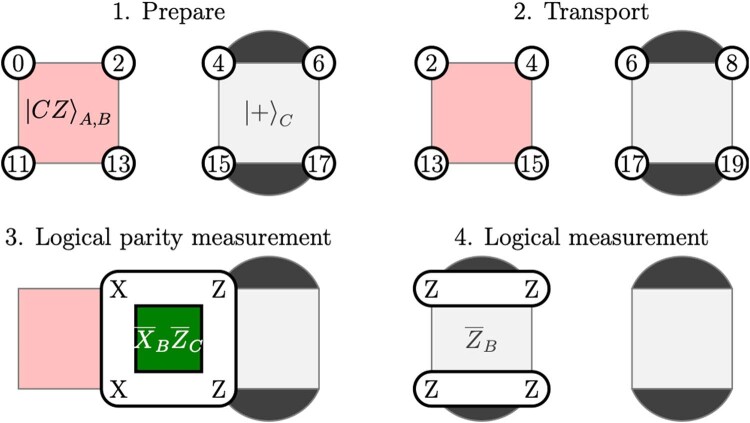
“We have three logical qubits indexed A , B and C , where, initially, A and B are encoded on the [[4, 2, 2]] code and C is encoded on the [[4, 1, 2]] code.”
InfluentialDeterministic quantum teleportation with feed-forward in a solid state system
Steffen, L., Salathe, Y., Oppliger, M., Kurpiers, P., Baur, M., Lang, C., Eichler, C., Puebla-Hellmann, G., Fedorov, A., & Wallraff, A. (2013) · Nature · doi:10.1038/nature12422 · Cited by 301
Demonstration of fault-tolerant universal quantum gate operations
Postler, L., Heuβen, S., Pogorelov, I., Rispler, M., Feldker, T., Meth, M., Marciniak, C. D., Stricker, R., Ringbauer, M., Blatt, R., et al. (2022) · Nature · doi:10.1038/s41586-022-04721-1 · Cited by 287 · cited 1×
“3,7.”
Building a Fault-Tolerant Quantum Computer Using Concatenated Cat Codes
Chamberland, C., Noh, K., Arrangoiz-Arriola, P., Campbell, E. T., Hann, C. T., Iverson, J., Putterman, H., Bohdanowicz, T. C., Flammia, S. T., Keller, A., et al. (2022) · PRX Quantum · doi:10.1103/prxquantum.3.010329 · Cited by 281 · cited 5×
“We explain how our encoded magic state can be used in large-scale quantum-computing architectures 11,28 in the section ‘Using CZ states in large-scale quantum-computing archi-tectures’.”
InfluentialOpenQASM 3: A Broader and Deeper Quantum Assembly Language
Cross, A., Javadi-Abhari, A., Alexander, T., De Beaudrap, N., Bishop, L. S., Heidel, S., Ryan, C. A., Sivarajah, P., Smolin, J., Gambetta, J. M., et al. (2022) · ACM Transactions on Quantum Computing · doi:10.1145/3505636 · Cited by 248
Self-citationRepeated quantum error correction on a continuously encoded qubit by real-time feedback
Cramer, J., Kalb, N., Rol, M. A., Hensen, B., Blok, M. S., Markham, M., Twitchen, D. J., Hanson, R., & Taminiau, T. H. (2016) · Nature Communications · doi:10.1038/ncomms11526 · Cited by 247
Universal Fault-Tolerant Quantum Computation with Only Transversal Gates and Error Correction
Paetznick, A., & Reichardt, B. W. (2013) · Physical Review Letters · doi:10.1103/physrevlett.111.090505 · Cited by 242
Experimental Demonstration of Fault-Tolerant State Preparation with Superconducting Qubits
Takita, M., Cross, A. W., Córcoles, A. D., Chow, J. M., & Gambetta, J. M. (2017) · Physical Review Letters · doi:10.1103/physrevlett.119.180501 · Cited by 228
Self-citationTopological and Subsystem Codes on Low-Degree Graphs with Flag Qubits
Chamberland, C., Zhu, G., Yoder, T. J., Hertzberg, J. B., & Cross, A. W. (2020) · Physical Review X · doi:10.1103/physrevx.10.011022 · Cited by 223 · cited 1×
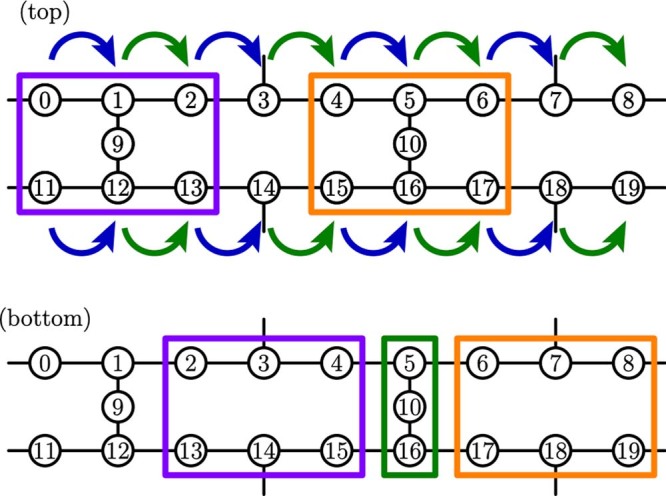
“Here we propose and implement an error-suppressed encoding circuit to prepare a state that is input to magic-state distillation using a heavy-hexagonal lattice of superconducting qubits 4,5,27 .”
Self-citationQuantum Error Correction with Only Two Extra Qubits
Chao, R., & Reichardt, B. W. (2018) · Physical Review Letters · doi:10.1103/physrevlett.121.050502 · Cited by 221
Magic State Distillation: Not as Costly as You Think
Litinski, D. (2019) · Quantum · doi:10.22331/q-2019-12-02-205 · Cited by 220
Gauge color codes: optimal transversal gates and gauge fixing in topological stabilizer codes
Bombín, H. (2015) · New Journal of Physics · doi:10.1088/1367-2630/17/8/083002 · Cited by 217
Feedback Control of a Solid-State Qubit Using High-Fidelity Projective Measurement
Ristè, D., Bultink, C. C., Lehnert, K. W., & DiCarlo, L. (2012) · Physical Review Letters · doi:10.1103/physrevlett.109.240502 · Cited by 195
Exploiting Dynamic Quantum Circuits in a Quantum Algorithm with Superconducting Qubits
Córcoles, A. D., Takita, M., Inoue, K., Lekuch, S., Minev, Z. K., Chow, J. M., & Gambetta, J. M. (2021) · Physical Review Letters · doi:10.1103/physrevlett.127.100501 · Cited by 162
Self-citationFault-Tolerant Conversion between the Steane and Reed-Muller Quantum Codes
Anderson, J. T., Duclos-Cianci, G., & Poulin, D. (2014) · Physical Review Letters · doi:10.1103/physrevlett.113.080501 · Cited by 161
Flag fault-tolerant error correction with arbitrary distance codes
Chamberland, C., & Beverland, M. E. (2018) · Quantum · doi:10.22331/q-2018-02-08-53 · Cited by 159
Fault-Tolerant Logical Gates in the IBM Quantum Experience
Harper, R., & Flammia, S. T. (2019) · Physical Review Letters · doi:10.1103/physrevlett.122.080504 · Cited by 127 · cited 6×
“We define a stabilizer operator U , with respect to state ∣ ψ (cid:31) , as an operator for which the action is trivial on its respective state, that is, .”
InfluentialSundaresan, N., Yoder, T. J., Kim, Y., Li, M., Chen, E. H., Harper, G., Thorbeck, T., Cross, A. W., Córcoles, A. D., & Takita, M. (2023) · Nature Communications · doi:10.1038/s41467-023-38247-5 · Cited by 108 · cited 1×
“Here we propose and implement an error-suppressed encoding circuit to prepare a state that is input to magic-state distillation using a heavy-hexagonal lattice of superconducting qubits 4,5,27 .”
Self-citationQuantum measurements and gates by code deformation
Bombin, H., & Martin-Delgado, M. A. (2009) · Journal of Physics A: Mathematical and Theoretical · doi:10.1088/1751-8113/42/9/095302 · Cited by 107
Triangular color codes on trivalent graphs with flag qubits
Chamberland, C., Kubica, A., Yoder, T. J., & Zhu, G. (2020) · New Journal of Physics · doi:10.1088/1367-2630/ab68fd · Cited by 105
Self-citationSalathé, Y., Kurpiers, P., Karg, T. M., Lang, C., Andersen, C. K., Akın, A., Krinner, S., Eichler, C., & Wallraff, A. J. (2018) · Physical Review Applied · doi:10.1103/physrevapplied.9.034011 · Cited by 103
Low-overhead fault-tolerant quantum computing using long-range connectivity
Cohen, L. Z., Kim, I. H., Bartlett, S. D., & Brown, B. J. (2022) · Science Advances · doi:10.1126/sciadv.abn1717 · Cited by 98 · cited 1×
“We distil magic states to complete a universal set of fault-tolerant logic gates that is needed for large-scale quantum computing with low-density parity-check code architectures 13–18 .”
Self-citationUniversal fault-tolerant measurement-based quantum computation
Brown, B. J., & Roberts, S. (2020) · Physical Review Research · doi:10.1103/physrevresearch.2.033305 · Cited by 89
Self-citationA magic state’s fidelity can be superior to the operations that created it
Li, Y. (2015) · New Journal of Physics · doi:10.1088/1367-2630/17/2/023037 · Cited by 88
Andersen, C. K., Remm, A., Lazar, S., Krinner, S., Heinsoo, J., Besse, J.-C., Gabureac, M., Wallraff, A., & Eichler, C. (2019) · npj Quantum Information · doi:10.1038/s41534-019-0185-4 · Cited by 88
Fault-tolerant magic state preparation with flag qubits
Chamberland, C., & Cross, A. W. (2019) · Quantum · doi:10.22331/q-2019-05-20-143 · Cited by 83
Self-citationBeverland, M. E., Kubica, A., & Svore, K. M. (2021) · PRX Quantum · doi:10.1103/prxquantum.2.020341 · Cited by 82
Error Mitigation for Universal Gates on Encoded Qubits
Piveteau, C., Sutter, D., Bravyi, S., Gambetta, J. M., & Temme, K. (2021) · Physical Review Letters · doi:10.1103/physrevlett.127.200505 · Cited by 81
A fault-tolerant non-Clifford gate for the surface code in two dimensions
Brown, B. J. (2020) · Science Advances · doi:10.1126/sciadv.aay4929 · Cited by 77
Self-citationQiskit Experiments: A Python package to characterize and calibrate quantum computers
Kanazawa, N., Egger, D. J., Ben‐Haim, Y., Zhang, H., Shanks, W., Aleksandrowicz, G., & Wood, C. J. (2023) · The Journal of Open Source Software · doi:10.21105/joss.05329 · Cited by 74
Self-citationToward fault-tolerant quantum computation without concatenation
Dennis, E. (2001) · Physical Review A · doi:10.1103/physreva.63.052314 · Cited by 72 · cited 1×
“We explain how our encoded magic state can be used in large-scale quantum-computing architectures 11,28 in the section ‘Using CZ states in large-scale quantum-computing archi-tectures’.”
Chamberland, C., & Noh, K. (2020) · npj Quantum Information · doi:10.1038/s41534-020-00319-5 · Cited by 71
Calibrated Decoders for Experimental Quantum Error Correction
Chen, E. H., Yoder, T. J., Kim, Y., Sundaresan, N., Srinivasan, S., Li, M., Córcoles, A. D., Cross, A. W., & Takita, M. (2022) · Physical Review Letters · doi:10.1103/physrevlett.128.110504 · Cited by 71 · cited 3×
“Here we propose and implement an error-suppressed encoding circuit to prepare a state that is input to magic-state distillation using a heavy-hexagonal lattice of superconducting qubits 4,5,27 .”
Self-citationFault-Tolerant Postselection for Low-Overhead Magic State Preparation
Bombín, H., Pant, M., Roberts, S., & Seetharam, K. (2024) · PRX Quantum · doi:10.1103/prxquantum.5.010302 · Cited by 70
Dimensional jump in quantum error correction
Bombín, H. (2016) · New Journal of Physics · doi:10.1088/1367-2630/18/4/043038 · Cited by 67
Fault-Tolerant Operation of a Quantum Error-Correction Code
Egan, L., Debroy, D. M., Noel, C., Risinger, A., Zhu, D., Biswas, D., Newman, M., Li, M., Brown, K. R., Cetina, M., et al. (2020) · arXiv · doi:10.48550/arxiv.2009.11482 · Cited by 65
Code deformation and lattice surgery are gauge fixing
Vuillot, C., Lao, L., Criger, B., García Almudéver, C., Bertels, K., & Terhal, B. M. (2019) · New Journal of Physics · doi:10.1088/1367-2630/ab0199 · Cited by 56
Webster, M. A., Brown, B. J., & Bartlett, S. D. (2022) · Quantum · doi:10.22331/q-2022-09-22-815 · Cited by 56
Self-citationMagic state injection on the rotated surface code
Lao, L., & Criger, B. (2022) · ACM International Conference on Computing Frontiers (CF) · doi:10.1145/3528416.3530237 · Cited by 52
Benchmarking near-term devices with quantum error correction
Wootton, J. R. (2020) · Quantum Science and Technology · doi:10.1088/2058-9565/aba038 · Cited by 50
Self-citationA non-commuting stabilizer formalism
Ni, X., Buerschaper, O., & den Nest, M. V. (2015) · Journal of Mathematical Physics · doi:10.1063/1.4920923 · Cited by 47
Cleaner magic states with hook injectionPreprint
Gidney, C. (2023) · arXiv (Cornell University) · doi:10.48550/arxiv.2302.12292 · Cited by 41 · cited 2×
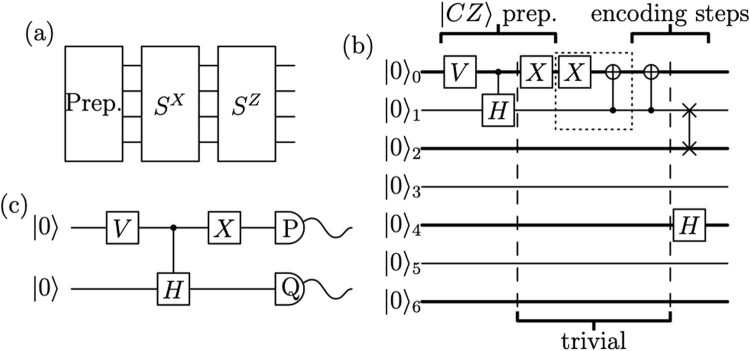
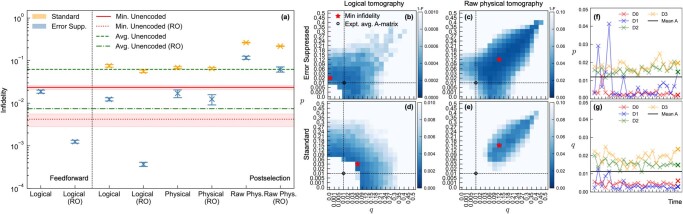
“We compare our error-suppressed magic-state preparation scheme to a standard scheme for encoding a two-qubit magic state, as well as a circuit that prepares the magic state on two physical qubits.”
Fault-tolerant interface between quantum memories and quantum processors
Poulsen Nautrup, H., Friis, N., & Briegel, H. J. (2017) · Nature Communications · doi:10.1038/s41467-017-01418-2 · Cited by 40
Implementing Fault-tolerant Entangling Gates on the Five-qubit Code and the Color Code
Ryan-Anderson, C., Brown, N. C., Allman, M. S., Arkin, B., Asa-Attuah, G., Baldwin, C., Berg, J., Bohnet, J. G., Braxton, S., Burdick, N., et al. (2022) · arXiv · doi:10.48550/arxiv.2208.01863 · Cited by 38 · cited 1×
“More recently, there have been quantum error correction demonstrations using real-time control in various systems [2, 6, 72, 73].”
BackgroundError Mitigation and Quantum-Assisted Simulation in the Error Corrected Regime
Lostaglio, M., & Ciani, A. (2021) · Physical Review Letters · doi:10.1103/physrevlett.127.200506 · Cited by 35
High-fidelity magic-state preparation with a biased-noise architecture
Singh, S., Darmawan, A. S., Brown, B. J., & Puri, S. (2022) · Physical Review A · doi:10.1103/physreva.105.052410 · Cited by 34
Self-citationQuantum computing by color-code lattice surgery
Landahl, A. J., & Ryan-Anderson, C. (2014) · arXiv (Cornell University) · doi:10.48550/arxiv.1407.5103 · Cited by 32 · cited 1×
“We inject a state into a larger code [11, 19–26, 43, 53] using a code deformation [19, 48, 54].”
MethodShutty, N., & Chamberland, C. (2022) · Physical Review Applied · doi:10.1103/physrevapplied.18.014072 · Cited by 23
Fault-tolerant interface between quantum memories and quantum processors
Nautrup, H. P., Friis, N., & Briegel, H. J. (2017) · RePEc: Research Papers in Economics · Cited by 20
Low-overhead quantum computing with the color code
Thomsen, F., Kesselring, M. S., Bartlett, S. D., & Brown, B. J. (2024) · Physical Review Research · doi:10.1103/physrevresearch.6.043125 · Cited by 15 · cited 2×
“We propose several tomographical experiments to interrogate the preparation of the magic state, including a complete set of fault-tolerant projective logical Pauli measurements that can also tolerate the occurrence of a single error during readout.”
Self-citationA Non-Commuting Stabilizer Formalism
Ni, X., Buerschaper, O., & den Nest, M. V. (2015) · MPG.PuRe (Max Planck Society) · Cited by 15
Syndrome-Derived Error Rates as a Benchmark of Quantum HardwarePreprint
Wootton, J. R. (2022) · arXiv · doi:10.48550/arxiv.2207.00553 · Cited by 6
Self-citationAnyon Condensation and the Color CodePreprint
Kesselring, M. S., de la Fuente, J. C. M., Thomsen, F., Eisert, J., Bartlett, S. D., & Brown, B. J. (2022) · arXiv (Cornell University) · doi:10.17169/refubium-43259 · Cited by 6
Self-citationMagic-state distillation with the four-qubit code
Meier, A. M., Eastin, B., & Knill, E. (2012) · arXiv · doi:10.48550/arxiv.1204.4221 · Cited by 2
Research works printed but not linked: 4
- Gottesman D Fault-tolerant quantum computation with constant overhead Quantum Info. Comput. 2014 14 1338 1372
- Yoder TJ Takagi R Chuang IL Universal fault-tolerant gates on concatenated stabilizer codes Phys. Rev. X 2016 6 031039
- Brown BJ Laubscher K Kesselring MS Wootton JR Poking holes and cutting corners to achieve Clifford gates with the surface code Phys. Rev. X 2017 7 021029
- Gottesman, D. Stabilizer Codes and Quantum Error Correction. PhD thesis, California Institute of Technology (1997).
Cited by
Quantum error correction below the surface code threshold
Collaborators, G. Q. A. A., Acharya, R., Abanin, D. A., Aghababaie-Beni, L., Aleiner, I., Andersen, T. I., Ansmann, M., Arute, F., Arya, K., Asfaw, A., et al. (2025) · Nature · doi:10.1038/s41586-024-08449-y · Cited by 778
“[18] and PyMatching [19].”
IBM quantum computers: evolution, performance, and future directions
AbuGhanem, M. (2025) · The Journal of Supercomputing · doi:10.1007/s11227-025-07047-7 · Cited by 343
Experimental demonstration of logical magic state distillation
Rodriguez, P. S., Robinson, J. M., Jepsen, N., He, Z., Duckering, C., Zhao, C., Wu, K.-H., Campo, J., Bagnall, K. R., Kwon, M., et al. (2025) · Nature · doi:10.1038/s41586-025-09367-3 · Cited by 246
“This includes magic state preparation based on unitary encoding [25] and stabilizer measurement projection [26], as well as the further use of flagged verification schemes and error detection/correction to achieve fault tolerance against any single physical error [25, 27].”
InfluentialJavadi-Abhari, A., Treinish, M., Krsulich, K., Wood, C. J., Lishman, J., Gacon, J., Martiel, S., Nation, P. D., Bishop, L. S., Cross, A. W., et al. (2024) · arXiv (Cornell University) · doi:10.48550/arxiv.2405.08810 · Cited by 208
“It was also used in a demonstration of fault-tolerant magic state preparation beyond break-even fidelity [42], and in a number of utility-scale papers comprised of up to 133-qubits and O (10 4 ) two-qubit entangling gates [21, 30, 39, 40, 59, 64, 65, 72, 78, 81, 82, 100, 101, 104].”
MethodSelf-citationBenchmarking quantum computers
Proctor, T., Young, K., Baczewski, A. D., & Blume-Kohout, R. (2025) · Nature Reviews Physics · doi:10.1038/s42254-024-00796-z · Cited by 67
“Quantum computations can be rendered tolerant to errors by using redundantly encoded logical qubits, which are protected by using fault-tolerant quantum error correction (QEC) techniques 4,16,19–21 .”
Metadata
- Authors
- Gupta, R. S., Sundaresan, N., Alexander, T., Wood, C. J., Merkel, S. T., Healy, M. B., Hillenbrand, M., Jochym-O’Connor, T., Wootton, J. R., Yoder, T. J., Cross, A. W., Takita, M., & Brown, B. J.
- Affiliations
- IBM Research - Almaden (US)
- IBM Research - Thomas J. Watson Research Center (US)
- IBM (Germany) (DE)
- IBM Research - Zurich (CH)
- Corresponding author
- Brown, Benjamin J.
- ORCID
- Venue
- Nature
- Published
- 2024-01-10
- Volume
- 625
- Issue
- 7994
- Pages
- 259-263
- ISSN
- 0028-0836 (ISSN-L)
- 1476-4687
- PMC
- PMC10781628
- OpenAlex
- W4390707737
- Cited by
- 115
- References
- 71
- Citations by year
- 2026: 28 · 2025: 59 · 2024: 27
- FWCI
- 16.79
- Type
- journal article
- Language
- en
- Open access
- hybrid
- doi.org
- Licence
- cc-by
- creativecommons.org/licenses/by/4.0 (tdm)
- creativecommons.org/licenses/by/4.0 (vor)
- Locations
- Nature (publishedVersion, cc-by)
- Research Square (acceptedVersion, cc-by)
- PubMed Central (publishedVersion, cc-by)
- PubMed (publishedVersion)
- arXiv (Cornell University) (submittedVersion, other-oa)
- RePEc: Research Papers in Economics (submittedVersion)
- arXiv (Cornell University)
- Funders
- National Science Foundation
- Schweizerischer Nationalfonds zur Förderung der Wissenschaftlichen Forschung (51NF40, 180604)
- Intelligence Advanced Research Projects Activity (W911NF-16-1-0114)
- Army Research Office (W911NF-21-1-, W911NF-21-1-0002, W911NF-16-1-0114, W911NF-16-1-, W911NF)
- Topics
- Physical Sciences › Computer Science › Artificial Intelligence › Quantum Computing Algorithms and Architecture
- Physical Sciences › Physics and Astronomy › Atomic and Molecular Physics, and Optics › Quantum Information and Cryptography
- Physical Sciences › Physics and Astronomy › Atomic and Molecular Physics, and Optics › Quantum many-body systems
- Keywords
- magic state distillation, superconducting qubits, fault-tolerant quantum computing, error correction, adaptive circuits, mid-circuit measurement, universal quantum gates
About these checks
Registry, retraction, Cites and statistics results are computed, not judged, with one exception: a printed reference that no index lists is read once by a model before it counts as a citation error. Claims are extracted by a model and kept only when their quote appears verbatim in the text; each cited source is then checked, with a model’s help, for whether it says what the claim relies on. Those verdicts can be wrong — read the claim’s quote and the cited source before relying on one.
Statistics and arithmetic are recomputed, not judged.
Confidence bands are shown only for fields calibrated on our annotated test set. None is calibrated yet, so no band is shown.
What counts as a claim ›How we measure confidence ›How we check this ›
Are you an author, or do you see a problem with this page? Request a review
Data sources
Bibliographic data: Semantic Scholar, OpenAlex, Crossref.
Contains information from the Semantic Scholar Academic Graph Datasets, made available under the ODC Attribution License (ODC-BY 1.0).
Semantic Scholar’s data is described in: Kinney, R., et al. (2023). The Semantic Scholar Open Data Platform. arXiv:2301.10140.
