

A population code for spatial representation in the zebrafish telencephalon
Open accessThe DOI matches its Crossref record; 61 of the 61 references it cites were found in a registry or an index; 28 of the 43 sources its claims cite were checked for support.
Abstract
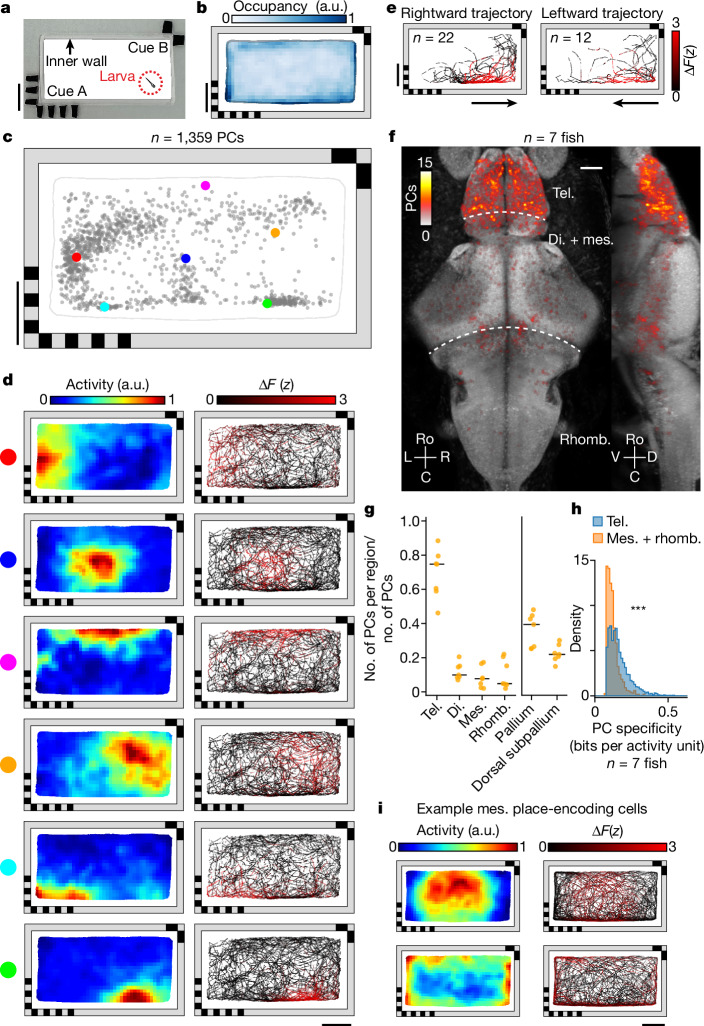
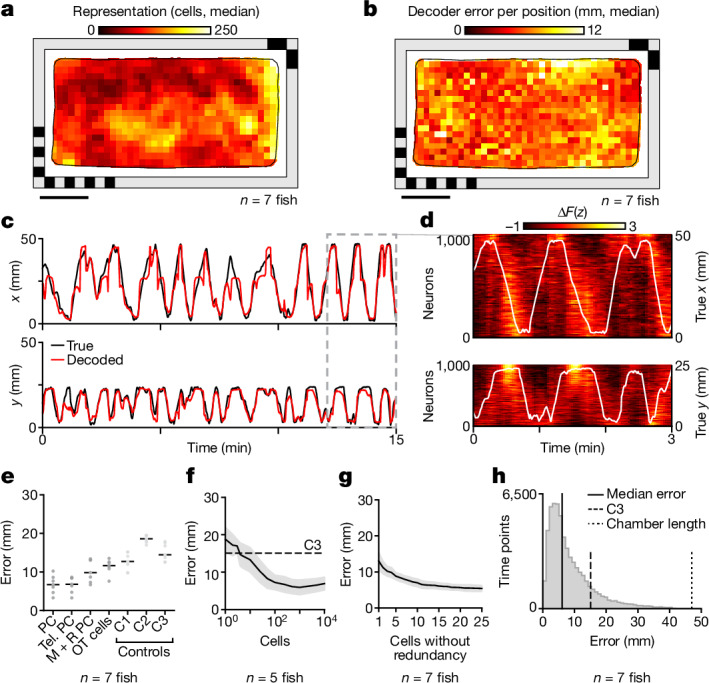
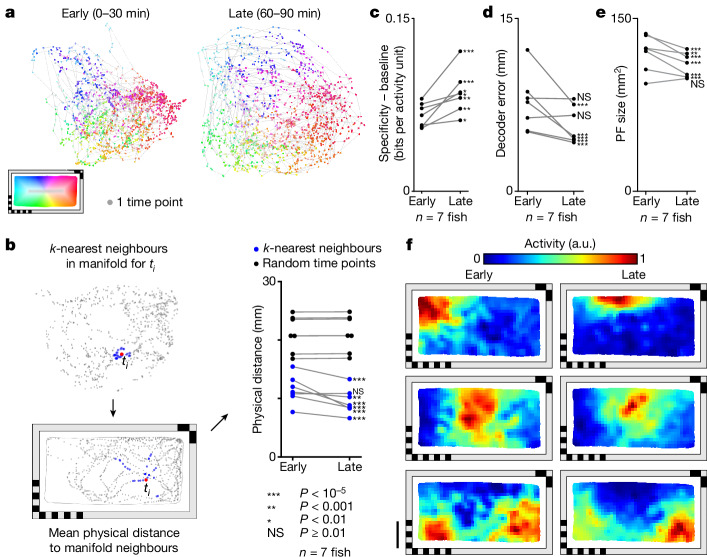
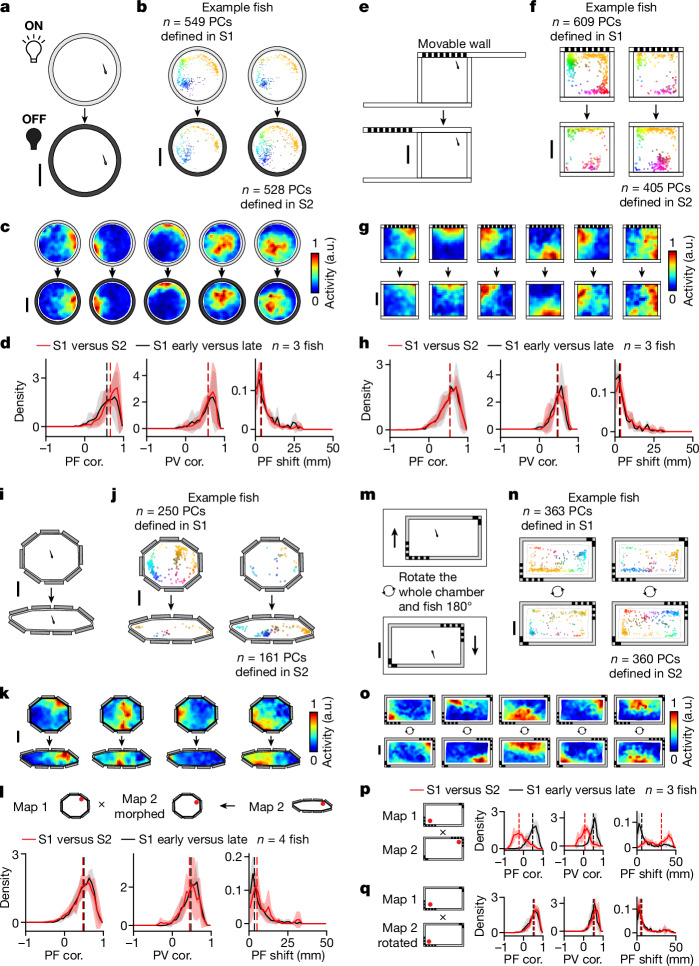
Abstract Spatial learning in teleost fish requires an intact telencephalon 1 , a brain region that contains putative analogues to components of the mammalian limbic system (for example, hippocampus) 2–4 . However, cells fundamental to spatial cognition in mammals—for example, place cells (PCs) 5,6 —have yet to be established in any fish species. In this study, using tracking microscopy to record brain-wide calcium activity in freely swimming larval zebrafish 7 , we compute the spatial information content 8 of each neuron across the brain. Strikingly, in every recorded animal, cells with the highest spatial specificity were enriched in the zebrafish telencephalon. These PCs form a population code of space from which we can decode the animal’s spatial location across time. By continuous recording of population-level activity, we found that the activity manifold of PCs refines and untangles over time. Through systematic manipulation of allothetic and idiothetic cues, we demonstrate that zebrafish PCs integrate multiple sources of information and can flexibly remap to form distinct spatial maps. Using analysis of neighbourhood distance between PCs across environments, we found evidence for a weakly preconfigured network in the telencephalon. The discovery of zebrafish PCs represents a step forward in our understanding of spatial cognition across species and the functional role of the early vertebrate telencephalon.
Overview
CoChat Summary
## TL;DR
Using brain-wide calcium imaging in freely swimming larval zebrafish, the authors identify spatially tuned neurons in the telencephalon that behave like place cells and together form a population code for location. They show this code can decode position, refines over time, integrates self-motion and visual cues, and remaps across environments.
## Key findings
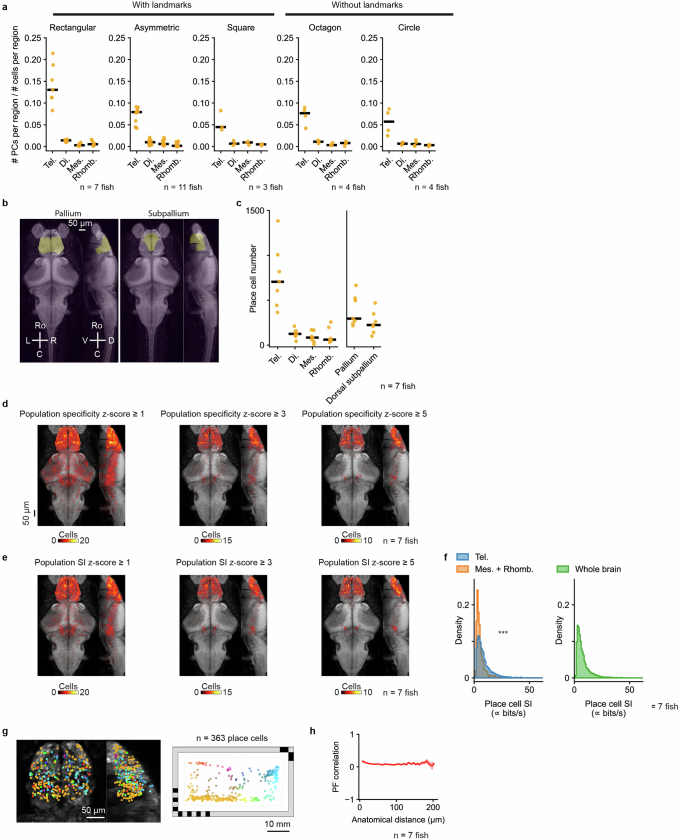
- In every recorded animal, the telencephalon contained the highest number and fraction of place cells, with 69 ± 14% of PCs there even though telencephalic neurons were only 8 ± 1% of recorded neurons on average.
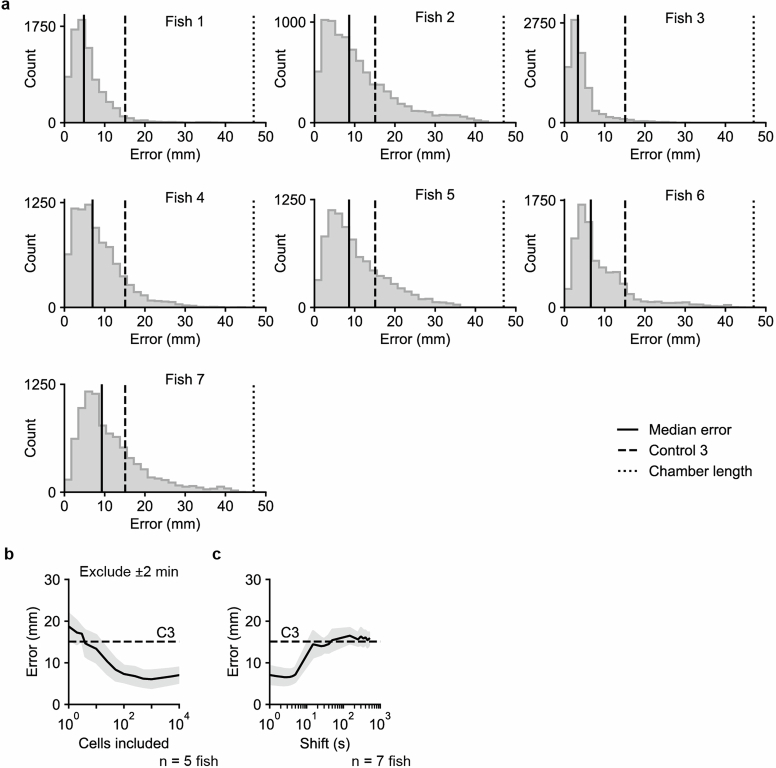
- A linear decoder using telencephalic PCs predicted position with 6.82 ± 2.05 mm median ± s.d. error; using the top 1,000 cells across the whole brain gave 6.69 ± 2.34 mm, while a minimal set of 25 PCs achieved 5.41 ± 0.81 mm mean ± s.d. error.
- Across a 90 min session, the spatial activity manifold became more “untangled,” with neighbourhood distance decreasing significantly in 6 of 7 animals (P < 10−3), alongside increased spatial specificity (P < 0.01 for 7/7) and decreased decoding error (P < 10−5 for 5/7).
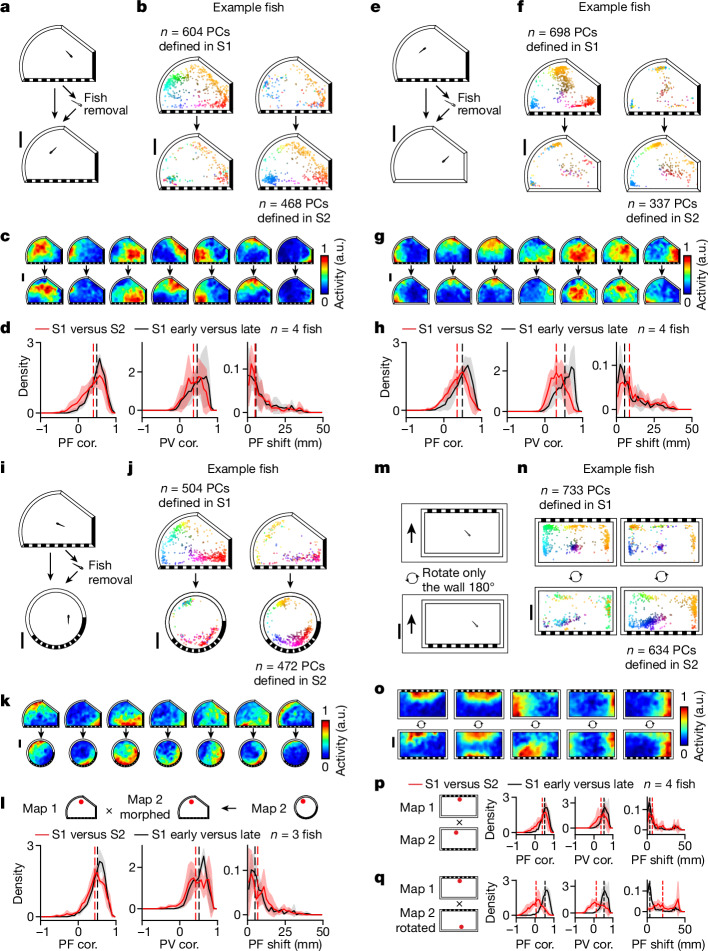
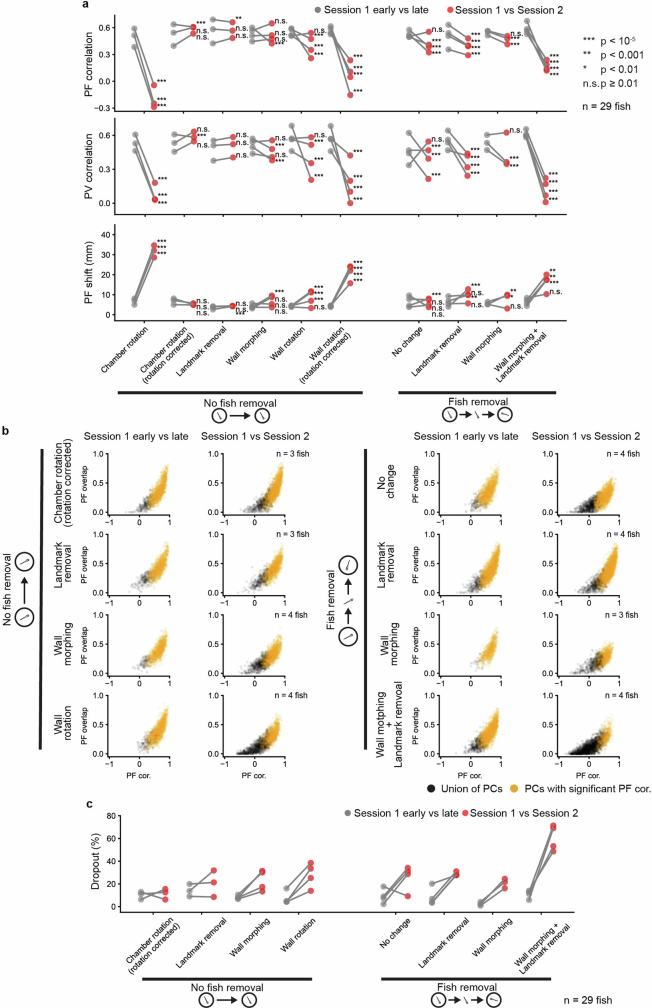
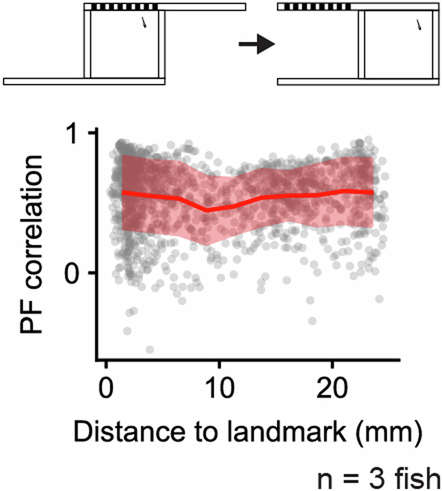
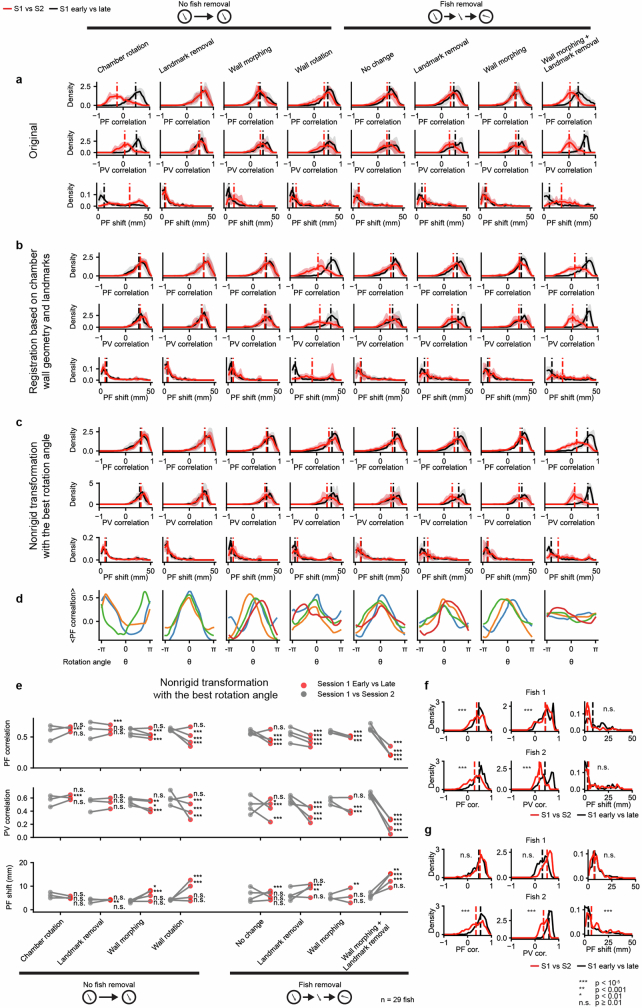
- Place-field stability survived changes in illumination, landmark removal, and boundary morphing, with reported PF correlations of 0.66, 0.54, and 0.44 (or 0.40, 0.35, 0.44 in the interruption-of-path-integration recovery experiments, depending on manipulation), indicating both idiothetic and allocentric inputs contribute.
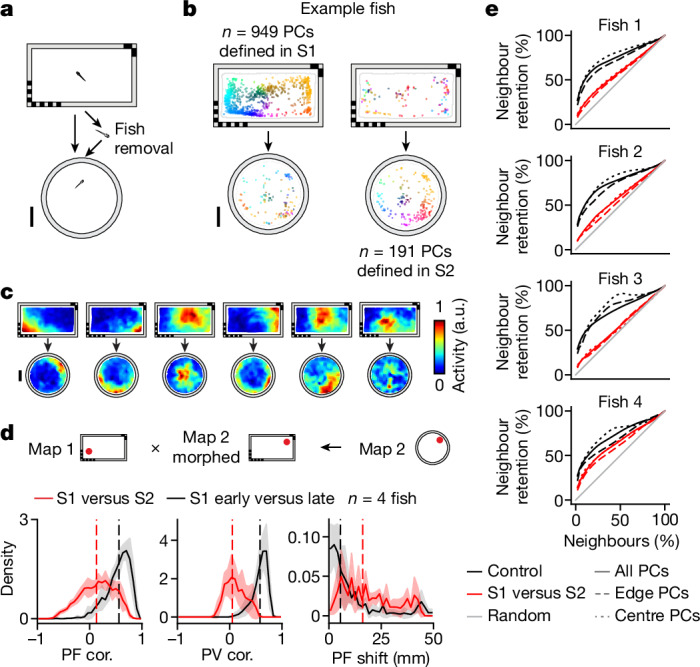
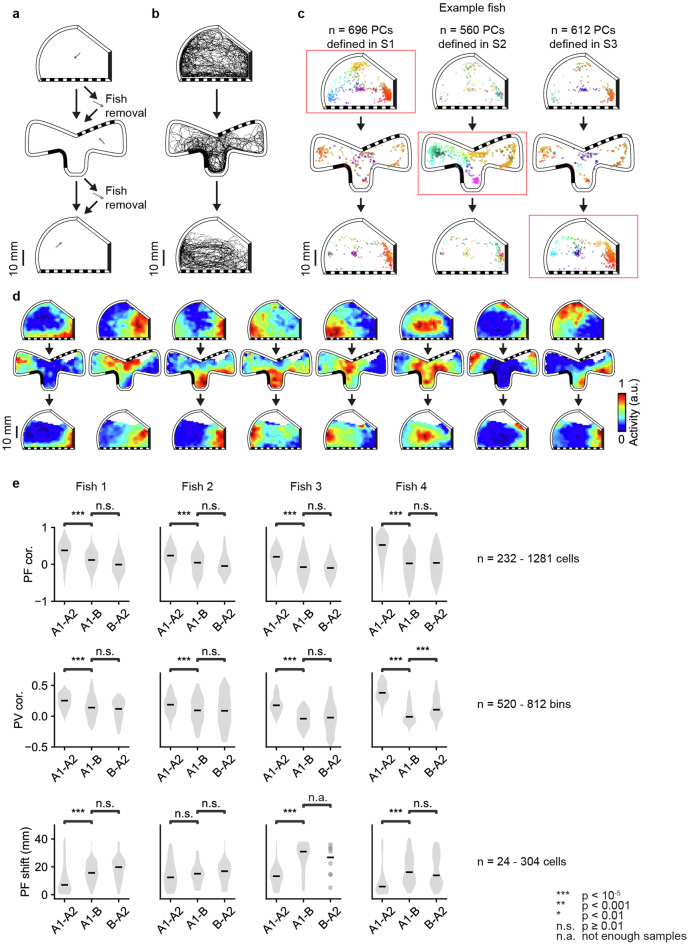
- When chamber geometry and landmarks were made completely distinct and path integration was interrupted, spatial maps remapped strongly: PF correlation 0.13 and PV correlation 0.05, compared with within-session controls of 0.56 and 0.58.
- Neighbourhood relationships between PCs were partially maintained across remapping: retention was significantly below within-session controls (P < 10−5, four of four fish) but still above random chance (P < 10−5, four of four fish), suggesting weak preconfiguration.
## Methods
- Freely swimming larval zebrafish expressing pan-neuronal GCaMP indicators were imaged with tracking microscopy in custom chambers; recordings used brain-wide calcium imaging at 2 volumes/s, with individual sessions lasting 45–100 min and an exploration session of 90 min in the main paradigm.
- Neurons were extracted with constrained non-negative matrix factorization, place cells were defined by spatial specificity criteria based on shuffled null distributions, and analyses used spatial activity maps, decoder-based position prediction, Isomap embeddings, and PF/PV correlation metrics.
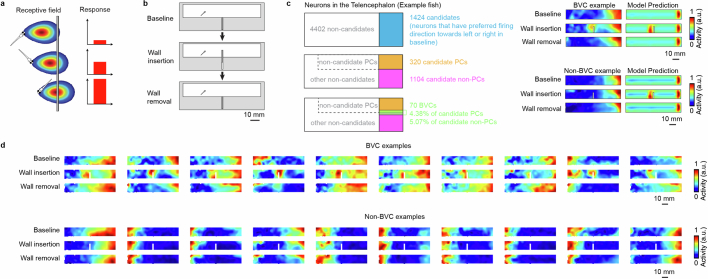
- Manipulations included light-to-dark transitions, landmark removal, wall insertion/removal, chamber morphing, whole-chamber rotation, wall-only rotation, and ABA/novel-environment remapping to separate idiothetic from allocentric contributions.
## Limitations
- The paper states that further research is needed to determine how fully zebrafish PCs are analogous to mammalian PCs, including their storage capacity and stability across multiple environments, developmental stages, and days/weeks.
- It also notes that the work primarily focused on exposure to an initially new environment, so broader generalization is not yet tested.
- Evident from the text: the study is performed in larval zebrafish under tether-free imaging in custom chambers, so the findings may not directly generalize to adult fish or natural habitats (inferred from the experimental design, not explicitly framed as a limitation).
Model-written summary. Check it against the paper before relying on it.
Integrity signals
Registry
Cites
Statistics
Figures

Verification
Claims the paper makes
15 Valid · 0 Not valid · 5 Not checked · 97 Own results and interpretations
The cited sources support only part of this claim — read each source’s verdict below.
In the paper
“cells fundamental to spatial cognition in mammals—for example, place cells (PCs)5,6—have yet to be established in any fish species”
- Also stated in: § Main · hedged
“particularly given the lack of clear functional evidence for PCs20–23.”
§ A population code for spatial representation in the zebrafish telencephalon > Abstract
What the sources say
- Partly supportedcites [20] Cohen, L., Vinepinsky, E., Donchin, O. & Segev, R. Boundary vector cells in the goldfish central telencephalon encode spatial information. PLoS Biol. 21, e3001747 (2023). 37097992 PMC10128963 sourceExperimental — accuracy not yet measured
The Introduction says that no activity in a specific place field was found in goldfish, while noting that place cells are established in mammals. It does not establish their absence in every fish species; the paper also reports other spatially modulated cells in goldfish. (LLM, conf=0.85)
- Supportedcites [21] Vinepinsky, E. et al. Representation of edges, head direction, and swimming kinematics in the brain of freely-navigating fish. Sci. Rep. 10, 14762 (2020). 32901058 PMC7479115 source
The Discussion reports that the authors found no apparent place cells in their goldfish recordings. It describes earlier fish findings as preliminary evidence of spatial tuning and says future studies will assess whether place cells exist in the goldfish pallium, supporting the claim that they had not been established in fish. (LLM, conf=0.88)
- Not checked — no full text of the sourcecites [22] Canfield, J. G. & Mizumori, S. J. Y. Methods for chronic neural recording in the telencephalon of freely behaving fish. J. Neurosci. Methods 133, 127–134 (2004). 14757353 source
- Partly supportedcites [23] Fotowat, H., Lee, C., Jun, J. J. & Maler, L. Neural activity in a hippocampus-like region of the teleost pallium is associated with active sensing and navigation. eLife 8, e44119 (2019). 30942169 PMC6469930 sourceExperimental — accuracy not yet measured
The Discussion says that classic mammalian-like spatially tuned neurons may not yet have been sampled in the teleost pallium, and that the recorded DDi cells are not exact matches for place cells. This supports the narrower point that place cells were not established in the teleosts discussed, but the paper does not establish the claim for every fish species. (LLM, conf=0.83)
plain- Asserted: passes — The authors put it forward as true.
- Checkable: passes — It can be checked against evidence.
- Load-bearing: passes — The paper’s conclusions depend on it.
- Based: passes — The paper gives a reason why it holds.
- Rests on an assumption not shown here.
- Also stated in: § Main · hedged
The cited sources support only part of this claim — read each source’s verdict below.
In the paper
“Using analysis of neighbourhood distance between PCs across environments, we found evidence for a weakly preconfigured network in the telencephalon.”
§ A population code for spatial representation in the zebrafish telencephalon > Abstract
What the sources say
- Partly supportedcites [30] Huszár, R., Zhang, Y., Blockus, H. & Buzsáki, G. Preconfigured dynamics in the hippocampus are guided by embryonic birthdate and rate of neurogenesis. Nat. Neurosci. 25, 1201–1212 (2022). 35995878 PMC10807234 sourceExperimental — accuracy not yet measured
The Discussion reports evidence for preconfigured activity patterns in hippocampal circuits, and the Results find that correlations between certain hippocampal neurons persist across changing environments. The paper's finding is specific to the hippocampus; it does not establish a preconfigured network across the telencephalon more broadly. No page numbers are available in our copy. (LLM, conf=0.82)
- Could not verifycites [31] Kinsky, N. R., Sullivan, D. W., Mau, W., Hasselmo, M. E. & Eichenbaum, H. B. Hippocampal place fields maintain a coherent and flexible map across long timescales. Curr. Biol. 28, 3578–3588 (2018). 30393037 PMC6331214 sourceExperimental — accuracy not yet measured
The Results section, “Coherent Maps Generalize Across Different Environments” (page unavailable), reports coherent hippocampal place-field maps across arenas, but does not describe a weakly preconfigured network. Searches for “weakly preconfigured network in the telencephalon” and “neighbourhood distance between PCs across environments” found no passage addressing that specific finding or analysis. (LLM, conf=0.75)
plain- Asserted: passes — The authors put it forward as true.
- Checkable: passes — It can be checked against evidence.
- Load-bearing: passes — The paper’s conclusions depend on it.
- Based: passes — The paper gives a reason why it holds.
- Partly supported
The sources with a verdict support this claim; the rest weren’t checked yet, have no full text we could read, or their verdicts aren’t rated yet.
In the paper
“Notably, PCs have been comprehensively identified only in the hippocampus of birds16 and mammals5,17.”
§ A population code for spatial representation in the zebrafish telencephalon > Main
What the sources say
- Supportedcites [16] Payne, H. L., Lynch, G. F. & Aronov, D. Neural representations of space in the hippocampus of a food-caching bird. Science 373, 343–348 (2021). 34437154 PMC8503942 source
The paper’s discussion says that earlier studies of non-mammalian hippocampi had not reported neurons resembling classic place cells, while this study found them in birds. It also describes place cells already observed in mammals. Together, those passages support the claim about where place cells had been clearly identified; the paper does not claim they cannot exist elsewhere. (LLM, conf=0.87)
- Not checked — no full text of the sourcecites [5] O’Keefe, J. & Dostrovsky, J. The hippocampus as a spatial map. Preliminary evidence from unit activity in the freely-moving rat. Brain Res. 34, 171–175 (1971). 5124915 source
- Not checked — no full text of the sourcecites [17] Ulanovsky, N. & Moss, C. F. Hippocampal cellular and network activity in freely moving echolocating bats. Nat. Neurosci. 10, 224–233 (2007). 17220886 source
plain- Asserted: passes — The authors put it forward as true.
- Checkable: passes — It can be checked against evidence.
- Load-bearing: passes — The paper’s conclusions depend on it.
- Based: passes — The paper gives a reason why it holds.
- Supported
The cited sources support only part of this claim — read each source’s verdict below.
In the paper
“they may be more functionally analogous to the high density of PCs observed near boundaries in juvenile rodents46,47.”
§ A population code for spatial representation in the zebrafish telencephalon > Discussion
What the sources say
- Supportedcites [46] Tan, H. M., Wills, T. J. & Cacucci, F. The development of spatial and memory circuits in the rat. Wiley Interdiscip. Rev. Cogn. Sci. 8, e1424 (2017). 27943643 source
The place-cell development discussion (p. 6) reports that spatial representations in pre-weanling rats are denser close to environmental boundaries. This supports the juvenile-rodent observation attributed to the source; the proposed analogy to larval zebrafish is the citing authors’ own suggestion. (LLM, conf=0.94)
- Partly supportedcites [47] Wills, T. J., Cacucci, F., Burgess, N. & O’Keefe, J. Development of the hippocampal cognitive map in preweanling rats. Science 328, 1573–1576 (2010). 20558720 PMC3543985 sourceExperimental — accuracy not yet measured
The paper’s main text (indexed under Abstract; page unavailable) reports place cells in preweanling rats and suggests that boundary-vector cells could provide input to them. It does not report a high density of place cells with firing fields near environmental boundaries; its finding of more directional cells near a border concerns a brain-region border, not enclosure boundaries. (LLM, conf=0.78)
hedgedstates an association- Asserted: passes — The authors put it forward as true.
- Checkable: passes — It can be checked against evidence.
- Load-bearing: unclear — It is unclear whether the paper’s conclusions depend on it.
- Based: passes — The paper gives a reason why it holds.
- Supported
Every source the paper cites for this claim was checked and supports it.
In the paper
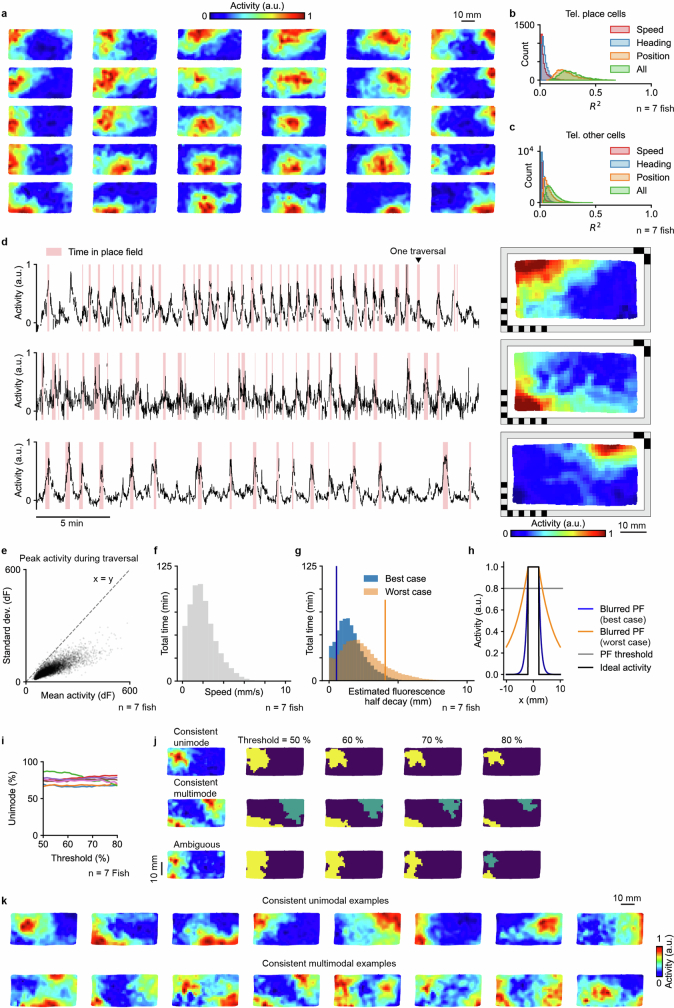
“Based on the behavioural data (Extended Data Fig. 1f) and calcium indicator kinetics, which both depend on firing rate54, we estimate the radius of the PFs to be spatially blurred by 0.17–1.31 mm.”
§ A population code for spatial representation in the zebrafish telencephalon > Methods > Image analysis
What the sources say
- Supportedcites [54] Chen, T.-W. et al. Ultrasensitive fluorescent proteins for imaging neuronal activity. Nature 499, 295–300 (2013). 23868258 PMC3777791 source
Citation 54 is attached to calcium-indicator kinetics, not to the citing authors’ own estimate of place-field blurring. In ‘Imaging neuronal populations in the mouse visual cortex’ (page unavailable), the source reports how GCaMP6 kinetics affect the ability to resolve spikes at different intervals. It does not provide the 0.17–1.31 mm estimate, but that estimate is not attributed to this source. (LLM, conf=0.88)
hedgedstates a cause- Asserted: passes — The authors put it forward as true.
- Checkable: passes — It can be checked against evidence.
- Load-bearing: unclear — It is unclear whether the paper’s conclusions depend on it.
- Based: passes — The paper gives a reason why it holds.
- Supported
51 more claims
Create a free account to see all 117 claims and to verify the 3 references still open.
- Probably not a substantial claim. 31
- It may state two separate claims as one. 35
- The quote only partly states this claim. 1
Citations
Cites
Scikit-learn: Machine Learning in Python
Pedregosa, F., Varoquaux, G., Gramfort, A., Michel, V., Thirion, B., Grisel, O., Blondel, M., Müller, A., Nothman, J., Louppe, G., et al. (2012) · arXiv · doi:10.48550/arxiv.1201.0490 · Cited by 71,016
A Global Geometric Framework for Nonlinear Dimensionality Reduction
Tenenbaum, J. B., Silva, V. D., & Langford, J. C. (2000) · Science · doi:10.1126/science.290.5500.2319 · Cited by 13,585 · cited 5×
“1f) and calcium indicator kinetics, which both depend on firing rate 54 , we estimate the radius of the PFs to be spatially blurred by 0.17–1.31 mm. Isomap and quantification.”
InfluentialUltrasensitive fluorescent proteins for imaging neuronal activity
Chen, T.-W., Wardill, T. J., Sun, Y., Pulver, S. R., Renninger, S. L., Baohan, A., Schreiter, E. R., Kerr, R. A., Orger, M. B., Jayaraman, V., et al. (2013) · Nature · doi:10.1038/nature12354 · Cited by 6,474 · cited 2×
“54.”
InfluentialThe hippocampus as a spatial map. Preliminary evidence from unit activity in the freely-moving rat
O'Keefe, J., & Dostrovsky, J. (1971) · Brain Research · doi:10.1016/0006-8993(71)90358-1 · Cited by 6,151 · cited 4×
“Over half a century of research in mammals has uncovered key computational building blocks of spatial cognition, beginning with the seminal discovery of place cells (PCs) 5 .”
InfluentialJulia: A Fresh Approach to Numerical Computing
Bezanson, J., Edelman, A., Karpinski, S., & Shah, V. B. (2017) · SIAM Review · doi:10.1137/141000671 · Cited by 5,440
Path integration and the neural basis of the 'cognitive map'
McNaughton, B. L., Battaglia, F. P., Jensen, O., Moser, E. I., & Moser, M.-B. (2006) · Nature Reviews Neuroscience · doi:10.1038/nrn1932 · Cited by 2,024 · cited 2×
“First, to demonstrate that zebrafish PCs potentially integrate multiple sources of sensory information 13,14 , we adapted some of the classic mammalian paradigms for manipulation of idiothetic or allothetic information to larval zebrafish (for example, transition from light to dark, manipulation of…”
A molecular timescale for vertebrate evolution
Kumar, S., & Hedges, S. B. (1998) · Nature · doi:10.1038/31927 · Cited by 1,936 · cited 1×
“In teleost fish, which shared a common ancestor with mammals around 450 million years ago 18 , the location or even existence of the hippocampus is an area of active debate 2,19 , particularly given the lack of clear functional evidence for PCs 20–23 .”
Place Cells, Grid Cells, and the Brain's Spatial Representation System
Moser, E. I., Kropff, E., & Moser, M.-B. (2008) · Annual Review of Neuroscience · doi:10.1146/annurev.neuro.31.061307.090723 · Cited by 1,934
The effects of changes in the environment on the spatial firing of hippocampal complex-spike cells
Muller, R., & Kubie, J. (1987) · The Journal of Neuroscience · doi:10.1523/jneurosci.07-07-01951.1987 · Cited by 1,581 · cited 1×
“PCs demonstrate the potential for significant remapping across distinct environments Mammalian PCs are notable for their representational flexibility 10,40,41 , while other spatial cells exhibit more coherent shifts across environments 42–44 .”
Whole-brain functional imaging at cellular resolution using light-sheet microscopy
Ahrens, M. B., Orger, M. B., Robson, D. N., Li, J. M., & Keller, P. J. (2013) · Nature Methods · doi:10.1038/nmeth.2434 · Cited by 1,392
Self-citation
Research works printed but not linked: 1
- Skaggs, W. E., Mcnaughton, B. L., Gothard, K. M. & Markus, E. J. Information theoretic approach to deciphering the hippocampal code. In Advances in Neural Information Processing System5 (eds. Hanson, S. J., Cowan, J. D. & Giles, C. J.) 1030–1037 (Morgan Kaufmann, 1993).
Cited by
Neural circuits for goal-directed navigation across species
Basu, J., & Nagel, K. I. (2024) · Trends in Neurosciences · doi:10.1016/j.tins.2024.09.005 · Cited by 40
Anneser, L., Satou, C., Hotz, H.-R., & Friedrich, R. W. (2023) · Current Biology · doi:10.1016/j.cub.2023.12.003 · Cited by 43
Structural and genetic determinants of zebrafish functional brain networks
Légaré, A., Lemieux, M., Boily, V., Poulin, S., Légaré, A., Desrosiers, P., & Koninck, P. D. (2025) · Science Advances · doi:10.1126/sciadv.adv7576 · Cited by 19
“However, many functions are housed within the zebrafish telencephalon, such as social interactions ( 89 ), learning ( 90 ), and spatial navigation ( 91 ) Accordingly the forebrain FC gradient may reflect a putative transmodal connectivity axis of the zebrafish brain.”
Multisensory coding of self-motion and its contribution to navigation
Mao, D., & Gu, Y. (2025) · Nature reviews. Neuroscience · doi:10.1038/s41583-025-00970-x · Cited by 60
“However, when the conflict between the two cues is too large, the landmark cues are usually discarded and the brain instead relies on the self-motion cue 187,192 , in a manner consistent with the Bayesian causal inference model 193 (Box 1).”
Neural and sensory basis of homing behaviour in the invasive cane toad, Rhinella marina
Shaykevich, D. A., Pareja-Mejía, D., Golde, C. L., Pašukonis, A., & O’Connell, L. A. (2025) · Proceedings of the Royal Society B Biological Sciences · doi:10.1098/rspb.2025.0045 · Cited by 10
“In fish [7,8], reptiles [9] and amphibians [10–13], laboratory studies suggest that neural structures are homologous to the hippocampus support spatial behaviours.”
Algorithmic dissection of optic flow memory in larval zebrafish
Tanaka, R., & Portugues, R. (2025) · Current Biology · doi:10.1016/j.cub.2025.08.047 · Cited by 6
Fish welfare in a changing world: New developments and current challenges
Rey Planellas, S., Saraiva, J. L., Gonçalves‐de‐Freitas, E., Arechavala‐Lopez, P., Bovenkerk, B., Breen, M., Cooke, S. J., Føre, M., Northwood, L., Stien, L. H., et al. (2026) · Journal of Fish Biology · doi:10.1111/jfb.70423 · Cited by 4
“Importantly, the recent discovery of ‘ place cells ’ in the zebrafish ( Danio rerio ) telencephalic pallium (Yang et al., 2024) further indicates that the intimate hippocampal mechanisms for spatial navigation and relational memory are similar across fish, birds and mammals, suggesting an ancient…”
Olfactory bulb tracks breathing rhythms and place in freely behaving micePreprint
Sterrett, S. C., Findley, T. M., Rafilson, S. E., Brown, M. A., Weible, A. P., Marsden, R., Tarvin, T., Wehr, M., Murray, J. M., Fairhall, A. L., et al. (2025) · eLife · doi:10.7554/elife.105088.1 · Cited by 4
Hierarchical sensory processing in zebrafish thalamocortical-like circuits
Trinh, A.-T., Ostenrath, A. M., del Castillo-Berges, I., Cachin, F., Koç, M., Kraus, S., Serneels, B., Kawakami, K., & Yaksi, E. (2026) · Science · doi:10.1126/science.aec2171 · Cited by 5
Mapping spatial memory in teleosts: a new Frontier in neural logging techniques
TAKAHASHI, S. Y., Sawatani, F., Ide, K., ABE, T. K., Kitagawa, T., & Makiguchi, Y. (2024) · Frontiers in Physiology · doi:10.3389/fphys.2024.1499058 · Cited by 4
Distinct distributed neural dynamics predict pallium-dependent social approach
Lifshitz, I., Prag, A., Livneh, N., Moshkovitz, M., Karmi, A., & Avitan, L. (2026) · Nature Communications · doi:10.1038/s41467-026-71666-8 · Cited by 6
Behavioral strategies and neural mechanisms underlying short-range navigation in teleost fish
Sibeaux, A., de Perera, T. B., Mueller, T., & Segev, R. (2025) · Current Opinion in Behavioral Sciences · doi:10.1016/j.cobeha.2025.101588 · Cited by 4
Neural and sensory basis of homing behavior in the invasive cane toad, Rhinella marinaPreprint
Shaykevich, D. A., Pareja-Mejía, D., Golde, C. L., Pašukonis, A., & O’Connell, L. A. (2024) · bioRxiv (Cold Spring Harbor Laboratory) · doi:10.1101/2024.06.25.600658 · Cited by 2
Algorithmic dissection of optic flow memory in larval zebrafishPreprint
Tanaka, R., & Portugues, R. (2025) · bioRxiv (Cold Spring Harbor Laboratory) · doi:10.1101/2025.04.15.648832 · Cited by 2
“In lightofthesefindings, itseemsunlikelythatthemedullar and olivaryneurons causally connected tothe historyde-pendent OMR [14] are truly encoding the animals’ position similar to the head direction [18] and place cells [26] found elsewhere in the larval zebrafish brain.”
Modeling diseases of aging in larval zebrafish, a paradoxical yet powerful strategy
Özcan, G. G., & Rihel, J. (2026) · Genetics · doi:10.1093/genetics/iyag027 · Cited by 1
“…development of tracking microscopy that can record whole-brain calcium imaging data from freely swimming larvae (Robson and Li 2024), promises to expand the possible applications even further, as in the recent demonstration of place cells in the larval zebrafish telencephalon (Yang et al. 2024).”
Sy, S. K. H., Chan, D. C. W., Zhang, J. J., Lyu, J., Feng, C., Wang, K., Mok, V., Wong, K. K. Y., Mu, Y., Hu, Y., et al. (2024) · bioRxiv (Cold Spring Harbor Laboratory) · doi:10.1101/2024.10.27.620486 · Cited by 1
Olfactory bulb tracks breathing rhythms and place in freely behaving micePreprint
Sterrett, S. C., Findley, T. M., Rafilson, S. E., Brown, M. A., Weible, A. P., Marsden, R., Tarvin, T., Wehr, M., Murray, J. M., Fairhall, A. L., et al. (2024) · bioRxiv (Cold Spring Harbor Laboratory) · doi:10.1101/2024.11.06.622362 · Cited by 3
“…null distribution formed by circular shifting the position time series 1000 times, and expressed the selectivity as the Significance of Spatial Information (SSI; Stefanini et al., 2020; C. Yang et al., 2024), defined as the number of standard deviations of the real data from the null distribution.”
Olfactory bulb tracks breathing rhythms and place in freely behaving micePreprint
Sterrett, S. C., Findley, T. M., Rafilson, S. E., Brown, M. A., Weible, A. P., Marsden, R., Tarvin, T., Wehr, M., Murray, J. M., Fairhall, A. L., et al. (2025) · eLife · doi:10.7554/elife.105088 · Cited by 3
Sy, S. K. H., Chan, D. C. W., Zhang, J. J., Lyu, J., Feng, C., Wang, K., Mok, V., Wong, K. K. Y., Mu, Y., Hu, Y., et al. (2026) · eLife · doi:10.7554/elife.109494.1 · Cited by 2
‘Place cells’ help guide freely swimming zebrafish larvae
Montanari, S. (2024) · The Transmitter · doi:10.53053/cbfx3143
Spatial representation: How fish know their place
Cho, F. S., & Giocomo, L. M. (2024) · Current Biology · doi:10.1016/j.cub.2024.09.038
Waves of innovation and collaboration: Zebrafish research converges in Kyoto
Kaneko, T. (2025) · Development Growth & Differentiation · doi:10.1111/dgd.70008
Magnetoreception - The mechanisms, molecules and circuits
Balay, S. D., Kapuruge, T. N., Denton, A. T., & Keays, D. A. (2025) · Elsevier eBooks · doi:10.1016/b978-0-443-29068-8.00139-2
Trinh, A., Ostenrath, A. M., del Castillo, I., Kraus, S., Cachin, F., Serneels, B., Kawakami, K., & Yaksi, E. (2025) · bioRxiv (Cold Spring Harbor Laboratory) · doi:10.1101/2025.09.15.675867
Hillman, C., Petracco, G., Fontana, B. D., Scaia, M. F., Vecchia, E. D., Wetton, J. H., Norton, W., Parker, M. O., & Reichmann, F. (2025) · Neurobiology of Disease · doi:10.1016/j.nbd.2025.107251 · Cited by 1
Adult Zebrafish Engage in Path Integration-like Behavior When Exploring a Novel EnvironmentPreprint
Sanghera, B. S., Shraybman, P., & Kanwal, J. S. (2026) · bioRxiv (Cold Spring Harbor Laboratory) · doi:10.64898/2025.12.31.697215
“…physiologic or anatomic evidence yet of the generation or existence of a map or some type of spatial representation of space, though place cells were recently reported in the telencephalon,and head direction cells in the brainstem, in larval zebrafish (Petrucco et al., 2023; Yang et al., 2024).”
InfluentialSy, S. K. H., Chan, D. C. W., Zhang, J. J., Lyu, J., Feng, C., Wang, K., Mok, V., Wong, K. K. Y., Mu, Y., Hu, Y., et al. (2026) · eLife · doi:10.7554/elife.109494
Guo, S.-Y., Zhang, Y., Chen, X.-H., Zhang, Y.-W., Cao, B., SHI-CHANG, Z., & Xia, D.-Z. (2026) · Journal of Ethnopharmacology · doi:10.1016/j.jep.2026.121472 · Cited by 1
Neuroactive Pollution Disrupts Cognition in Fish by Causing Sex-Specific Effects on Spatial Learning
Manera, J. L., Moore, E. R., Martin, J. M., Bertram, M. G., & Wong, B. B. M. (2026) · Environmental Science & Technology · doi:10.1021/acs.est.6c00552 · Cited by 2
Universal Principles of Navigation across Species and Spatial Scales
Wirth, S., Cheng, K., Fleischmann, P. N., Lohmann, K. J., Milford, M. J., Mouritsen, H., Pritchard, D. J., Robira, B., Ulanovsky, N., & Wan, K. Y. (2026) · Springer eBooks · doi:10.1007/978-3-032-20563-6_4 · Cited by 2
Cohen, L., Cohen-Duwek, H., & Tsur, E. E. (2026) · iScience · doi:10.1016/j.isci.2026.115824
“Particularly, Yang et al. (2024) 21 demonstrated a population-level code for spatial location in ll OPEN ACCESS the zebrafish telencephalon, revealing distributed neural activity patterns that correlate with the animal’s position in the environment.”
InfluentialA multi-region flexible neural interface for behavioral state decoding in freely moving mice
Tian, Y., Li, G., Su, H., Jiang, L., Luo, Y., Yang, Y., Huang, L., Li, J., Jin, S., Chen, P., et al. (2026) · Microsystems & Nanoengineering · doi:10.1038/s41378-026-01258-5 · Cited by 1
Self-citationYokoi, S., Mochizuki-Koike, R., Yamashiro, K., Nakagawa, S., Ikegaya, Y., & Matsumoto, N. (2026) · Scientific Reports · doi:10.1038/s41598-026-51830-2
MARINER: a surround visual stimulator for vision research in aquatic animalsPreprint
Hladnik, T. C., Burkhardt, D.-S., Zhang, Y., Weygoldt, P., Wendt, A., Solak, B., Thiele, T. R., & Arrenberg, A. B. (2026) · bioRxiv (Cold Spring Harbor Laboratory) · doi:10.64898/2026.06.09.731119 · Cited by 2
Evolution and Reorganization of the Hierarchical Brain-wide Neuronal Network Through Anesthesia
Chen, H.-J., Zhao, M.-T., Lv, Z.-F., Hao, J., Du, W., & Shang, C. (2026) · Neuroscience Bulletin · doi:10.1007/s12264-026-01717-z
Metadata
- Authors
- Yang, C., Mammen, L., Kim, B., Li, M., Robson, D. N., & Li, J. M.
- Affiliations
- Max Planck Institute for Biological Cybernetics (DE)
- Cornell University (US)
- Chinese Academy of Sciences (CN)
- Corresponding author
- Robson, Drew N.
- Li, Jennifer M.
- Venue
- Nature
- Published
- 2024-08-28
- Volume
- 634
- Issue
- 8033
- Pages
- 397-406
- ISSN
- 0028-0836 (ISSN-L)
- 1476-4687
- PMC
- PMC11464381
- OpenAlex
- W4401947288
- Semantic Scholar
- 8799dff34bbaf59c0574d1bf0437be3f482b10a6
- Cited by
- 38
- References
- 55
- Citations by year
- 2026: 18 · 2025: 12 · 2024: 7
- FWCI
- 8.96
- Type
- journal article
- Language
- en
- Update notices
- correction (2024-09-13)
- Open access
- hybrid
- doi.org
- Licence
- cc-by
- creativecommons.org/licenses/by/4.0 (tdm)
- creativecommons.org/licenses/by/4.0 (vor)
- Locations
- Nature (publishedVersion, cc-by)
- PubMed Central (publishedVersion, cc-by)
- PubMed (publishedVersion)
- RePEc: Research Papers in Economics (submittedVersion)
- Topics
- Life Sciences › Neuroscience › Cognitive Neuroscience › Memory and Neural Mechanisms
- Life Sciences › Biochemistry, Genetics and Molecular Biology › Cell Biology › Zebrafish Biomedical Research Applications
- Life Sciences › Neuroscience › Cognitive Neuroscience › Neural dynamics and brain function
- Keywords
- place cells, spatial representation, spatial learning, population coding, spatial maps, spatial cognition, zebrafish larvae, neural decoding
- MeSH terms
- Animals, Calcium, Cues, Larva, Microscopy, Neurons, Swimming, Telencephalon, Zebrafish, Spatial Learning
About these checks
Registry, retraction, Cites and statistics results are computed, not judged, with one exception: a printed reference that no index lists is read once by a model before it counts as a citation error. Claims are extracted by a model and kept only when their quote appears verbatim in the text; each cited source is then checked, with a model’s help, for whether it says what the claim relies on. Those verdicts can be wrong — read the claim’s quote and the cited source before relying on one.
The claim verdicts this report counts are experimental: their accuracy is not yet measured.
A language model drew the claims from the paper on 2026-10-10, under version 3 of the claim definition (model deepseek-v4.1-flash, prompt extract-v3).
A second model labelled each claim on 2026-10-10 (model jev-1.13-20260917, definition revision gold-guideline-v0.2).
Cited sources are checked with a language model’s help (gpt-6-sol).
Statistics and arithmetic are recomputed, not judged.
Confidence bands are shown only for fields calibrated on our annotated test set. None is calibrated yet, so no band is shown.
What counts as a claim ›How we measure confidence ›How we check this ›
Are you an author, or do you see a problem with this page? Request a review
Data sources
Bibliographic data: Semantic Scholar, OpenAlex, Crossref.
Contains information from the Semantic Scholar Academic Graph Datasets, made available under the ODC Attribution License (ODC-BY 1.0).
Semantic Scholar’s data is described in: Kinney, R., et al. (2023). The Semantic Scholar Open Data Platform. arXiv:2301.10140.
