

A population code for spatial representation in the zebrafish telencephalon
Open accessThe DOI matches its Crossref record; 61 of the 61 references it cites were found in a registry or an index; 28 of the 43 sources its claims cite were checked for support.
Abstract
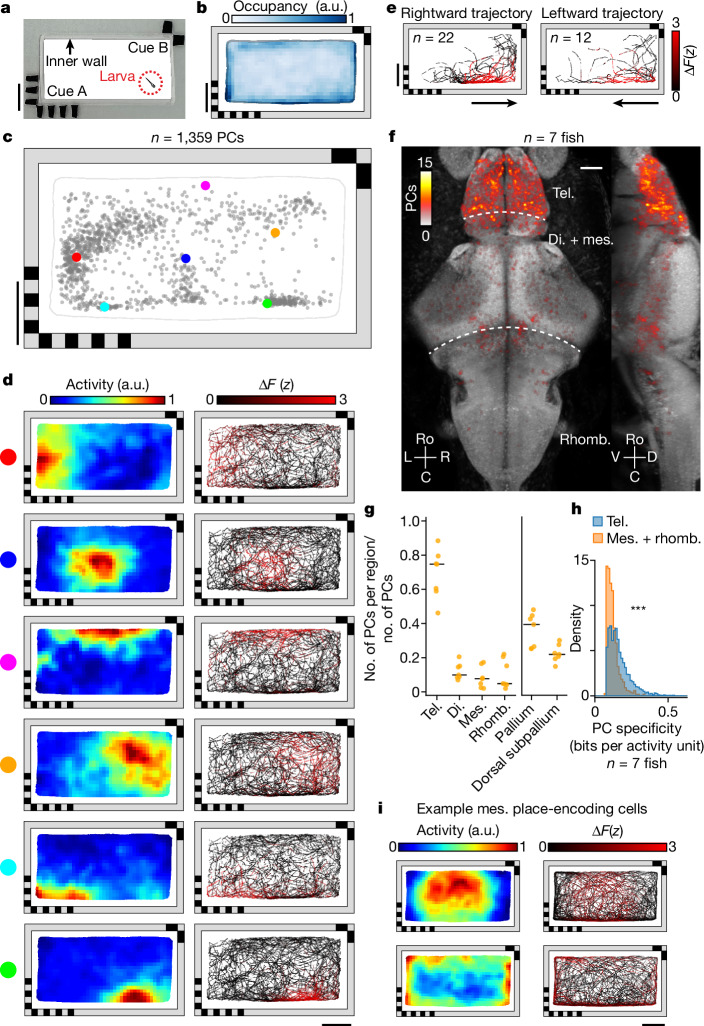
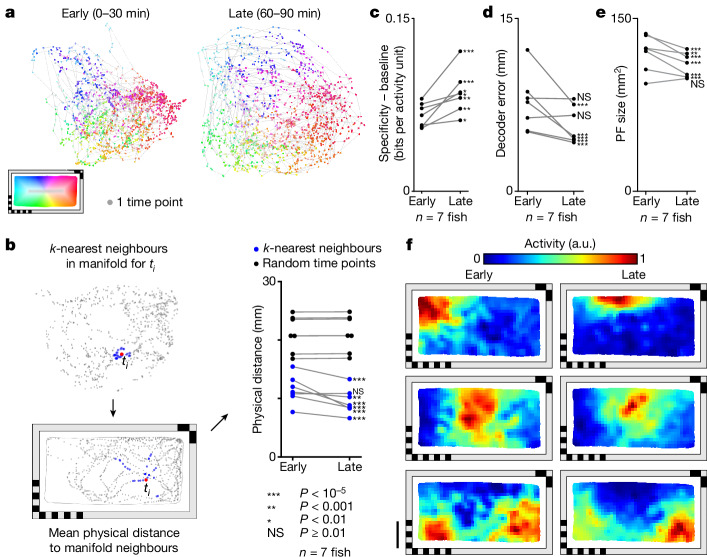
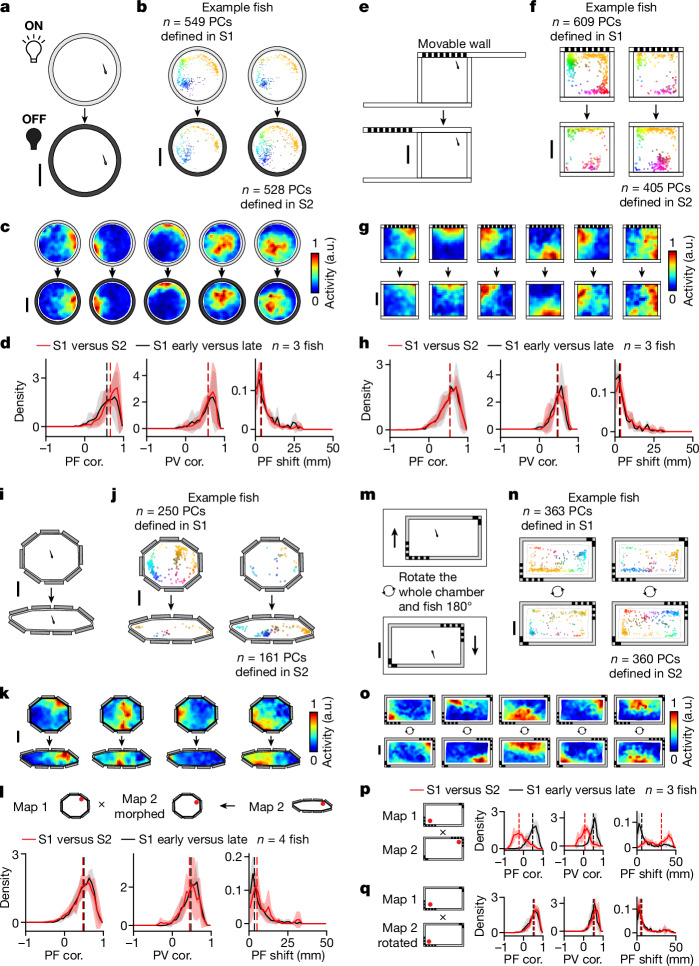
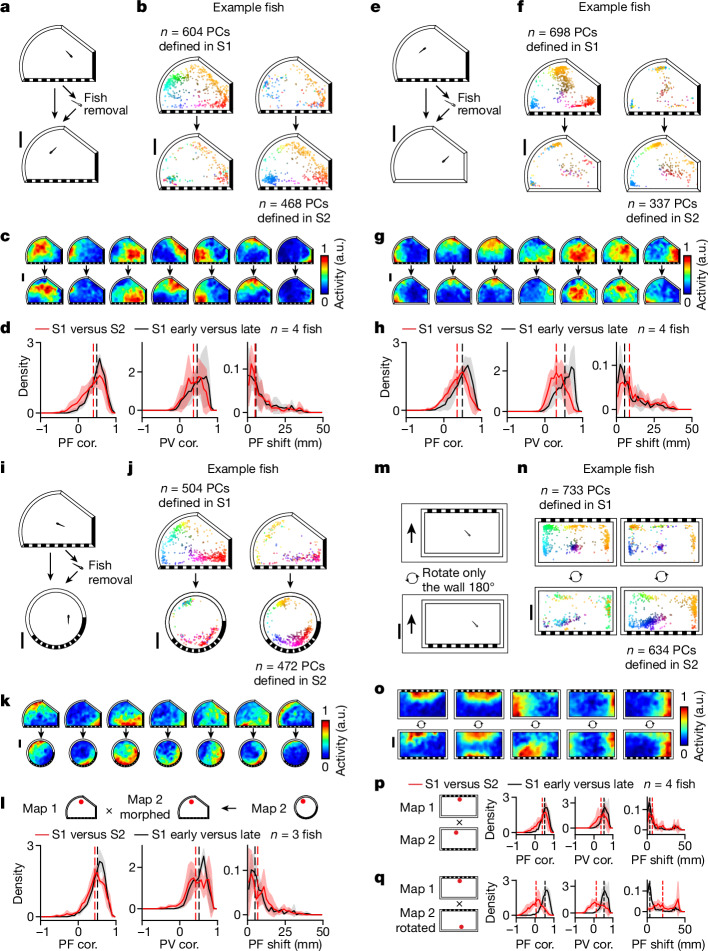
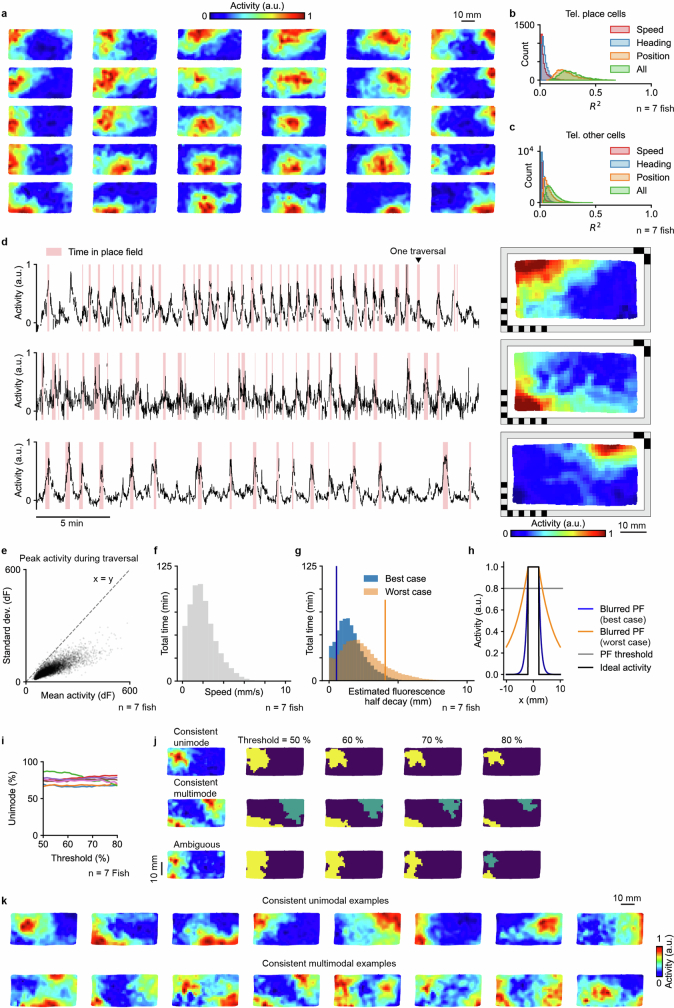
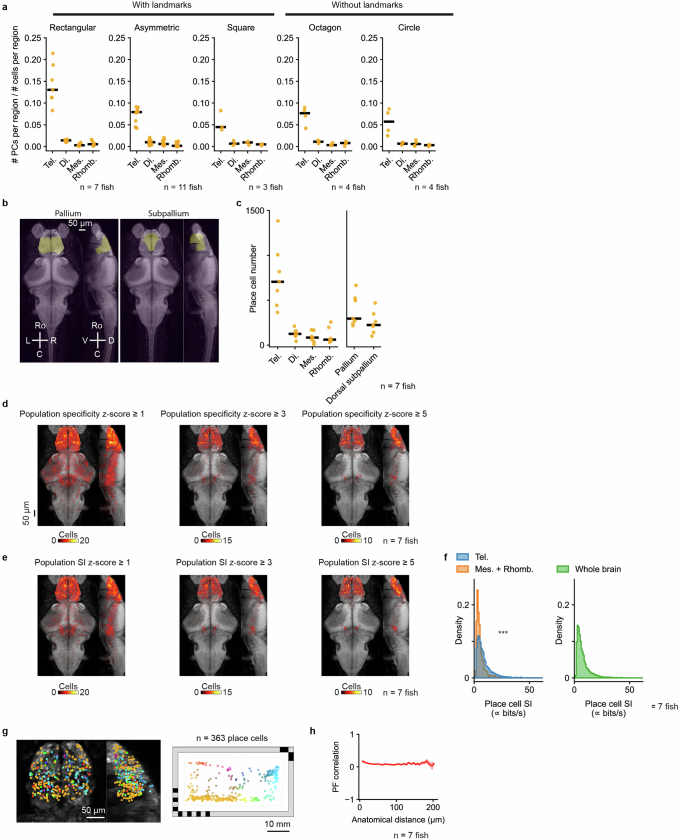
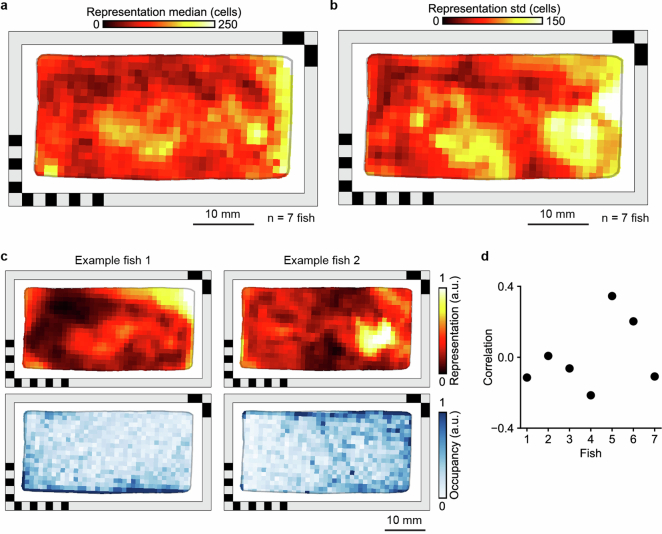
Abstract Spatial learning in teleost fish requires an intact telencephalon 1 , a brain region that contains putative analogues to components of the mammalian limbic system (for example, hippocampus) 2–4 . However, cells fundamental to spatial cognition in mammals—for example, place cells (PCs) 5,6 —have yet to be established in any fish species. In this study, using tracking microscopy to record brain-wide calcium activity in freely swimming larval zebrafish 7 , we compute the spatial information content 8 of each neuron across the brain. Strikingly, in every recorded animal, cells with the highest spatial specificity were enriched in the zebrafish telencephalon. These PCs form a population code of space from which we can decode the animal’s spatial location across time. By continuous recording of population-level activity, we found that the activity manifold of PCs refines and untangles over time. Through systematic manipulation of allothetic and idiothetic cues, we demonstrate that zebrafish PCs integrate multiple sources of information and can flexibly remap to form distinct spatial maps. Using analysis of neighbourhood distance between PCs across environments, we found evidence for a weakly preconfigured network in the telencephalon. The discovery of zebrafish PCs represents a step forward in our understanding of spatial cognition across species and the functional role of the early vertebrate telencephalon.
Overview
CoChat Summary
## TL;DR
Using brain-wide calcium imaging in freely swimming larval zebrafish, the authors identify spatially tuned neurons in the telencephalon that behave like place cells and together form a population code for location. They show this code can decode position, refines over time, integrates self-motion and visual cues, and remaps across environments.
## Key findings
- In every recorded animal, the telencephalon contained the highest number and fraction of place cells, with 69 ± 14% of PCs there even though telencephalic neurons were only 8 ± 1% of recorded neurons on average.
- A linear decoder using telencephalic PCs predicted position with 6.82 ± 2.05 mm median ± s.d. error; using the top 1,000 cells across the whole brain gave 6.69 ± 2.34 mm, while a minimal set of 25 PCs achieved 5.41 ± 0.81 mm mean ± s.d. error.
- Across a 90 min session, the spatial activity manifold became more “untangled,” with neighbourhood distance decreasing significantly in 6 of 7 animals (P < 10−3), alongside increased spatial specificity (P < 0.01 for 7/7) and decreased decoding error (P < 10−5 for 5/7).
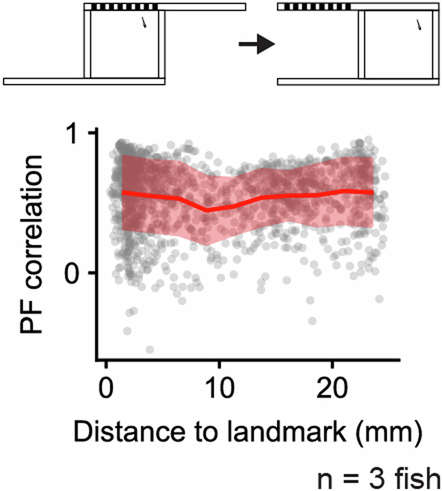
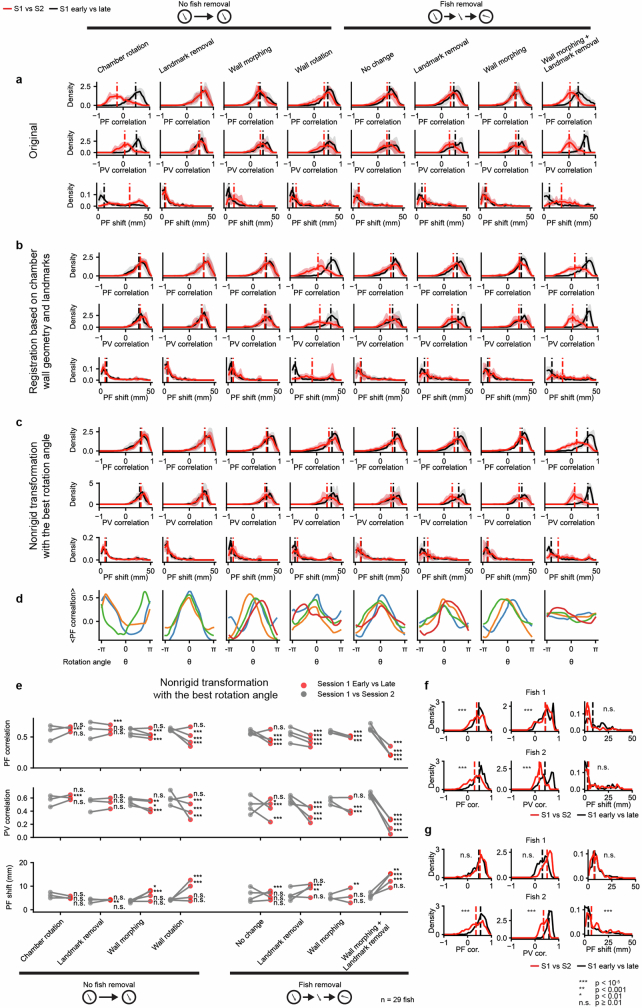
- Place-field stability survived changes in illumination, landmark removal, and boundary morphing, with reported PF correlations of 0.66, 0.54, and 0.44 (or 0.40, 0.35, 0.44 in the interruption-of-path-integration recovery experiments, depending on manipulation), indicating both idiothetic and allocentric inputs contribute.
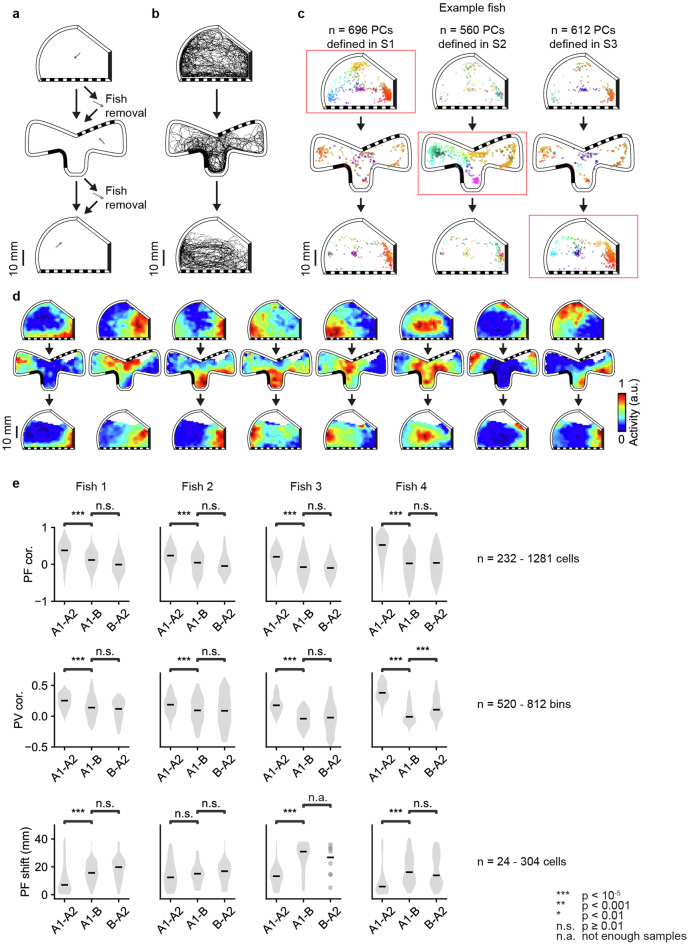
- When chamber geometry and landmarks were made completely distinct and path integration was interrupted, spatial maps remapped strongly: PF correlation 0.13 and PV correlation 0.05, compared with within-session controls of 0.56 and 0.58.
- Neighbourhood relationships between PCs were partially maintained across remapping: retention was significantly below within-session controls (P < 10−5, four of four fish) but still above random chance (P < 10−5, four of four fish), suggesting weak preconfiguration.
## Methods
- Freely swimming larval zebrafish expressing pan-neuronal GCaMP indicators were imaged with tracking microscopy in custom chambers; recordings used brain-wide calcium imaging at 2 volumes/s, with individual sessions lasting 45–100 min and an exploration session of 90 min in the main paradigm.
- Neurons were extracted with constrained non-negative matrix factorization, place cells were defined by spatial specificity criteria based on shuffled null distributions, and analyses used spatial activity maps, decoder-based position prediction, Isomap embeddings, and PF/PV correlation metrics.
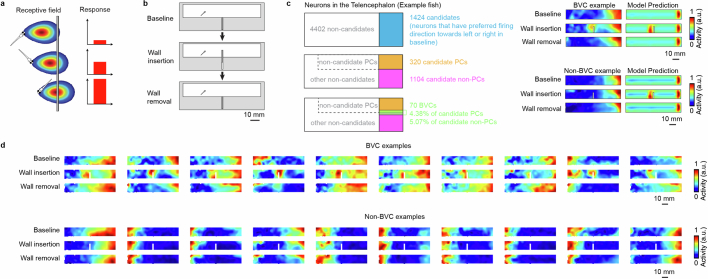
- Manipulations included light-to-dark transitions, landmark removal, wall insertion/removal, chamber morphing, whole-chamber rotation, wall-only rotation, and ABA/novel-environment remapping to separate idiothetic from allocentric contributions.
## Limitations
- The paper states that further research is needed to determine how fully zebrafish PCs are analogous to mammalian PCs, including their storage capacity and stability across multiple environments, developmental stages, and days/weeks.
- It also notes that the work primarily focused on exposure to an initially new environment, so broader generalization is not yet tested.
- Evident from the text: the study is performed in larval zebrafish under tether-free imaging in custom chambers, so the findings may not directly generalize to adult fish or natural habitats (inferred from the experimental design, not explicitly framed as a limitation).
Model-written summary. Check it against the paper before relying on it.
Integrity signals
Registry
Cites
Statistics
Figures





Verification
Claims the paper makes
15 Valid · 0 Not valid · 5 Not checked · 97 Own results and interpretations
The cited sources support only part of this claim — read each source’s verdict below.
In the paper
“cells fundamental to spatial cognition in mammals—for example, place cells (PCs)5,6—have yet to be established in any fish species”
- Also stated in: § Main · hedged
“particularly given the lack of clear functional evidence for PCs20–23.”
§ A population code for spatial representation in the zebrafish telencephalon > Abstract
What the sources say
- Partly supportedcites [20] Cohen, L., Vinepinsky, E., Donchin, O. & Segev, R. Boundary vector cells in the goldfish central telencephalon encode spatial information. PLoS Biol. 21, e3001747 (2023). sourceExperimental — accuracy not yet measured
The Introduction says that no activity in a specific place field was found in goldfish, while noting that place cells are established in mammals. It does not establish their absence in every fish species; the paper also reports other spatially modulated cells in goldfish. (LLM, conf=0.85)
- Supportedcites [21] Vinepinsky, E. et al. Representation of edges, head direction, and swimming kinematics in the brain of freely-navigating fish. Sci. Rep. 10, 14762 (2020). source
The Discussion reports that the authors found no apparent place cells in their goldfish recordings. It describes earlier fish findings as preliminary evidence of spatial tuning and says future studies will assess whether place cells exist in the goldfish pallium, supporting the claim that they had not been established in fish. (LLM, conf=0.88)
- Not checked — no full text of the sourcecites [22] Canfield, J. G. & Mizumori, S. J. Y. Methods for chronic neural recording in the telencephalon of freely behaving fish. J. Neurosci. Methods 133, 127–134 (2004). source
- Partly supportedcites [23] Fotowat, H., Lee, C., Jun, J. J. & Maler, L. Neural activity in a hippocampus-like region of the teleost pallium is associated with active sensing and navigation. eLife 8, e44119 (2019). sourceExperimental — accuracy not yet measured
The Discussion says that classic mammalian-like spatially tuned neurons may not yet have been sampled in the teleost pallium, and that the recorded DDi cells are not exact matches for place cells. This supports the narrower point that place cells were not established in the teleosts discussed, but the paper does not establish the claim for every fish species. (LLM, conf=0.83)
plain- Asserted: passes — The authors put it forward as true.
- Checkable: passes — It can be checked against evidence.
- Load-bearing: passes — The paper’s conclusions depend on it.
- Based: passes — The paper gives a reason why it holds.
- Rests on an assumption not shown here.
- Also stated in: § Main · hedged
The cited sources support only part of this claim — read each source’s verdict below.
In the paper
“Using analysis of neighbourhood distance between PCs across environments, we found evidence for a weakly preconfigured network in the telencephalon.”
§ A population code for spatial representation in the zebrafish telencephalon > Abstract
What the sources say
- Partly supportedcites [30] Huszár, R., Zhang, Y., Blockus, H. & Buzsáki, G. Preconfigured dynamics in the hippocampus are guided by embryonic birthdate and rate of neurogenesis. Nat. Neurosci. 25, 1201–1212 (2022). sourceExperimental — accuracy not yet measured
The Discussion reports evidence for preconfigured activity patterns in hippocampal circuits, and the Results find that correlations between certain hippocampal neurons persist across changing environments. The paper's finding is specific to the hippocampus; it does not establish a preconfigured network across the telencephalon more broadly. No page numbers are available in our copy. (LLM, conf=0.82)
- Could not verifycites [31] Kinsky, N. R., Sullivan, D. W., Mau, W., Hasselmo, M. E. & Eichenbaum, H. B. Hippocampal place fields maintain a coherent and flexible map across long timescales. Curr. Biol. 28, 3578–3588 (2018). sourceExperimental — accuracy not yet measured
The Results section, “Coherent Maps Generalize Across Different Environments” (page unavailable), reports coherent hippocampal place-field maps across arenas, but does not describe a weakly preconfigured network. Searches for “weakly preconfigured network in the telencephalon” and “neighbourhood distance between PCs across environments” found no passage addressing that specific finding or analysis. (LLM, conf=0.75)
plain- Asserted: passes — The authors put it forward as true.
- Checkable: passes — It can be checked against evidence.
- Load-bearing: passes — The paper’s conclusions depend on it.
- Based: passes — The paper gives a reason why it holds.
- Partly supported
The sources with a verdict support this claim; the rest weren’t checked yet, have no full text we could read, or their verdicts aren’t rated yet.
In the paper
“Notably, PCs have been comprehensively identified only in the hippocampus of birds16 and mammals5,17.”
§ A population code for spatial representation in the zebrafish telencephalon > Main
What the sources say
- Supportedcites [16] Payne, H. L., Lynch, G. F. & Aronov, D. Neural representations of space in the hippocampus of a food-caching bird. Science 373, 343–348 (2021). source
The paper’s discussion says that earlier studies of non-mammalian hippocampi had not reported neurons resembling classic place cells, while this study found them in birds. It also describes place cells already observed in mammals. Together, those passages support the claim about where place cells had been clearly identified; the paper does not claim they cannot exist elsewhere. (LLM, conf=0.87)
- Not checked — no full text of the sourcecites [5] O’Keefe, J. & Dostrovsky, J. The hippocampus as a spatial map. Preliminary evidence from unit activity in the freely-moving rat. Brain Res. 34, 171–175 (1971). source
- Not checked — no full text of the sourcecites [17] Ulanovsky, N. & Moss, C. F. Hippocampal cellular and network activity in freely moving echolocating bats. Nat. Neurosci. 10, 224–233 (2007). source
plain- Asserted: passes — The authors put it forward as true.
- Checkable: passes — It can be checked against evidence.
- Load-bearing: passes — The paper’s conclusions depend on it.
- Based: passes — The paper gives a reason why it holds.
- Supported
The cited sources support only part of this claim — read each source’s verdict below.
In the paper
“they may be more functionally analogous to the high density of PCs observed near boundaries in juvenile rodents46,47.”
§ A population code for spatial representation in the zebrafish telencephalon > Discussion
What the sources say
- Supportedcites [46] Tan, H. M., Wills, T. J. & Cacucci, F. The development of spatial and memory circuits in the rat. Wiley Interdiscip. Rev. Cogn. Sci. 8, e1424 (2017). source
The place-cell development discussion (p. 6) reports that spatial representations in pre-weanling rats are denser close to environmental boundaries. This supports the juvenile-rodent observation attributed to the source; the proposed analogy to larval zebrafish is the citing authors’ own suggestion. (LLM, conf=0.94)
- Partly supportedcites [47] Wills, T. J., Cacucci, F., Burgess, N. & O’Keefe, J. Development of the hippocampal cognitive map in preweanling rats. Science 328, 1573–1576 (2010). sourceExperimental — accuracy not yet measured
The paper’s main text (indexed under Abstract; page unavailable) reports place cells in preweanling rats and suggests that boundary-vector cells could provide input to them. It does not report a high density of place cells with firing fields near environmental boundaries; its finding of more directional cells near a border concerns a brain-region border, not enclosure boundaries. (LLM, conf=0.78)
hedgedstates an association- Asserted: passes — The authors put it forward as true.
- Checkable: passes — It can be checked against evidence.
- Load-bearing: unclear — It is unclear whether the paper’s conclusions depend on it.
- Based: passes — The paper gives a reason why it holds.
- Supported
Every source the paper cites for this claim was checked and supports it.
In the paper
“Based on the behavioural data (Extended Data Fig. 1f) and calcium indicator kinetics, which both depend on firing rate54, we estimate the radius of the PFs to be spatially blurred by 0.17–1.31 mm.”
§ A population code for spatial representation in the zebrafish telencephalon > Methods > Image analysis
What the sources say
- Supportedcites [54] Chen, T.-W. et al. Ultrasensitive fluorescent proteins for imaging neuronal activity. Nature 499, 295–300 (2013). source
Citation 54 is attached to calcium-indicator kinetics, not to the citing authors’ own estimate of place-field blurring. In ‘Imaging neuronal populations in the mouse visual cortex’ (page unavailable), the source reports how GCaMP6 kinetics affect the ability to resolve spikes at different intervals. It does not provide the 0.17–1.31 mm estimate, but that estimate is not attributed to this source. (LLM, conf=0.88)
hedgedstates a cause- Asserted: passes — The authors put it forward as true.
- Checkable: passes — It can be checked against evidence.
- Load-bearing: unclear — It is unclear whether the paper’s conclusions depend on it.
- Based: passes — The paper gives a reason why it holds.
- Supported
51 more claims
Create a free account to see all 117 claims and to verify the 3 references still open.
- Probably not a substantial claim. 31
- It may state two separate claims as one. 35
- The quote only partly states this claim. 1
Citations
Cites
Scikit-learn: Machine Learning in Python
Pedregosa, F., Varoquaux, G., Gramfort, A., Michel, V., Thirion, B., Grisel, O., Blondel, M., Müller, A., Nothman, J., Louppe, G., et al. (2012) · arXiv · doi:10.48550/arxiv.1201.0490 · Cited by 71,016
A Global Geometric Framework for Nonlinear Dimensionality Reduction
Tenenbaum, J. B., Silva, V. D., & Langford, J. C. (2000) · Science · doi:10.1126/science.290.5500.2319 · Cited by 13,585 · cited 5×
“1f) and calcium indicator kinetics, which both depend on firing rate 54 , we estimate the radius of the PFs to be spatially blurred by 0.17–1.31 mm. Isomap and quantification.”
InfluentialUltrasensitive fluorescent proteins for imaging neuronal activity
Chen, T.-W., Wardill, T. J., Sun, Y., Pulver, S. R., Renninger, S. L., Baohan, A., Schreiter, E. R., Kerr, R. A., Orger, M. B., Jayaraman, V., et al. (2013) · Nature · doi:10.1038/nature12354 · Cited by 6,474 · cited 2×
“54.”
InfluentialThe hippocampus as a spatial map. Preliminary evidence from unit activity in the freely-moving rat
O'Keefe, J., & Dostrovsky, J. (1971) · Brain Research · doi:10.1016/0006-8993(71)90358-1 · Cited by 6,151 · cited 4×
“Over half a century of research in mammals has uncovered key computational building blocks of spatial cognition, beginning with the seminal discovery of place cells (PCs) 5 .”
InfluentialJulia: A Fresh Approach to Numerical Computing
Bezanson, J., Edelman, A., Karpinski, S., & Shah, V. B. (2017) · SIAM Review · doi:10.1137/141000671 · Cited by 5,440
Path integration and the neural basis of the 'cognitive map'
McNaughton, B. L., Battaglia, F. P., Jensen, O., Moser, E. I., & Moser, M.-B. (2006) · Nature Reviews Neuroscience · doi:10.1038/nrn1932 · Cited by 2,024 · cited 2×
“First, to demonstrate that zebrafish PCs potentially integrate multiple sources of sensory information 13,14 , we adapted some of the classic mammalian paradigms for manipulation of idiothetic or allothetic information to larval zebrafish (for example, transition from light to dark, manipulation of…”
A molecular timescale for vertebrate evolution
Kumar, S., & Hedges, S. B. (1998) · Nature · doi:10.1038/31927 · Cited by 1,936 · cited 1×
“In teleost fish, which shared a common ancestor with mammals around 450 million years ago 18 , the location or even existence of the hippocampus is an area of active debate 2,19 , particularly given the lack of clear functional evidence for PCs 20–23 .”
Place Cells, Grid Cells, and the Brain's Spatial Representation System
Moser, E. I., Kropff, E., & Moser, M.-B. (2008) · Annual Review of Neuroscience · doi:10.1146/annurev.neuro.31.061307.090723 · Cited by 1,934
The effects of changes in the environment on the spatial firing of hippocampal complex-spike cells
Muller, R., & Kubie, J. (1987) · The Journal of Neuroscience · doi:10.1523/jneurosci.07-07-01951.1987 · Cited by 1,581 · cited 1×
“PCs demonstrate the potential for significant remapping across distinct environments Mammalian PCs are notable for their representational flexibility 10,40,41 , while other spatial cells exhibit more coherent shifts across environments 42–44 .”
Whole-brain functional imaging at cellular resolution using light-sheet microscopy
Ahrens, M. B., Orger, M. B., Robson, D. N., Li, J. M., & Keller, P. J. (2013) · Nature Methods · doi:10.1038/nmeth.2434 · Cited by 1,392
Self-citationRepresentation of Geometric Borders in the Entorhinal Cortex
Solstad, T., Boccara, C. N., Kropff, E., Moser, M.-B., & Moser, E. I. (2008) · Science · doi:10.1126/science.1166466 · Cited by 1,213 · cited 1×
“BVCs are defined by two unique functional signatures 33–35 : (1) each BVC fires at a preferred allo-centric heading and distance to a boundary, and (2) when a border at a given BVC’s preferred heading is duplicated, its PF will also duplicate (Extended Data Fig.”
A purely geometric module in the rat's spatial representation
Cheng, K. (1986) · Cognition · doi:10.1016/0010-0277(86)90041-7 · Cited by 1,169
Geometric determinants of the place fields of hippocampal neurons
O'Keefe, J., & Burgess, N. (1996) · Nature · doi:10.1038/381425a0 · Cited by 1,166 · cited 1×
“Animals generate an internal map of their environment through spatial exploration 6 , integrating multiple sources of information including landmarks, geometry and self-motion 9–15 .”
McNaughton, B. L., Barnes, C. A., & O'Keefe, J. (1983) · Experimental Brain Research · doi:10.1007/bf00237147 · Cited by 1,071
Boundary Vector Cells in the Subiculum of the Hippocampal Formation
Lever, C., Burton, S., Jeewajee, A., O'Keefe, J., & Burgess, N. (2009) · The Journal of Neuroscience · doi:10.1523/jneurosci.1319-09.2009 · Cited by 753
Hippocampal remapping and grid realignment in entorhinal cortex
Fyhn, M., Hafting, T., Treves, A., Moser, M.-B., & Moser, E. I. (2007) · Nature · doi:10.1038/nature05601 · Cited by 749
Zhang, K., Ginzburg, I., McNaughton, B. L., & Sejnowski, T. J. (1998) · Journal of Neurophysiology · doi:10.1152/jn.1998.79.2.1017 · Cited by 741 · cited 1×
“36 is a linear decoder with no free parameters that predicts the animal’s position at each individual time point by a linear combination of the spatial activity maps, weighted with the activity of the corresponding place-encoding cell.”
Brain-wide neuronal dynamics during motor adaptation in zebrafish
Ahrens, M. B., Li, J. M., Orger, M. B., Robson, D. N., Schier, A. F., Engert, F., & Portugues, R. (2012) · Nature · doi:10.1038/nature11057 · Cited by 729
Self-citationDevelopment of the Hippocampal Cognitive Map in Preweanling Rats
Wills, T. J., Cacucci, F., Burgess, N., & O'Keefe, J. (2010) · Science · doi:10.1126/science.1188224 · Cited by 616 · cited 1×
“Although a significant number of larval zebrafish PCs have spatial tuning near boundaries, they may be more functionally analogous to the high density of PCs observed near boundaries in juvenile rodents 46,47 .”
Place cells, head direction cells, and the learning of landmark stability
Knierim, J., Kudrimoti, H., & McNaughton, B. (1995) · The Journal of Neuroscience · doi:10.1523/jneurosci.15-03-01648.1995 · Cited by 608
Whole-brain activity mapping onto a zebrafish brain atlas
Randlett, O., Wee, C. L., Naumann, E. A., Nnaemeka, O., Schoppik, D., Fitzgerald, J. E., Portugues, R., Lacoste, A. M. B., Riegler, C., Engert, F., et al. (2015) · Nature Methods · doi:10.1038/nmeth.3581 · Cited by 528 · cited 2×
“Following projection of the location of PCs from all fish to the same reference fish 52 , we accumulated all PCs into a three-dimensional histogram representing how many PCs were detected in each three-dimensional bin within the reference volume.”
Long-term plasticity in hippocampal place-cell representation of environmental geometry
Lever, C., Wills, T., Cacucci, F., Burgess, N., & O'Keefe, J. (2002) · Nature · doi:10.1038/416090a · Cited by 465 · cited 1×
“Next we asked whether the retention of spatial tuning properties can be explained by the interaction of idiothetic cues and boundary conditions, as previously observed in mammals 38 .”
The Boundary Vector Cell Model of Place Cell Firing and Spatial Memory
Barry, C., Lever, C., Hayman, R., Hartley, T., Burton, S., O'Keefe, J., Jeffery, K., & Burgess, Ν. (2006) · Reviews in the Neurosciences · doi:10.1515/revneuro.2006.17.1-2.71 · Cited by 401 · cited 2×
“To search for cells whose firing properties follow the BVC model 34 we fitted a BVC model (see below) to candidate neurons in the telencephalon.”
A Dedicated Population for Reward Coding in the Hippocampus
Gauthier, J. L., & Tank, D. W. (2018) · Neuron · doi:10.1016/j.neuron.2018.06.008 · Cited by 394 · cited 1×
“The criteria we use are similar to those in the existing literature in both mammals and birds, for both electrophysiological and calcium imaging data 16,53 .”
Rohlfing, T., & Maurer, C. R. (2003) · IEEE Transactions on Information Technology in Biomedicine · doi:10.1109/titb.2003.808506 · Cited by 373 · cited 1×
“We use the Computational Morphometry Toolkit (CMTK) 51 to register each animal to a common reference fish.”
How vision and movement combine in the hippocampal place code
Chen, G., King, J. A., Burgess, N., & O'Keefe, J. (2013) · Proceedings of the National Academy of Sciences · doi:10.1073/pnas.1215834110 · Cited by 336
Place cells in the hippocampus: Eleven maps for eleven rooms
Alme, C. B., Miao, C., Jezek, K., Treves, A., Moser, E. I., & Moser, M.-B. (2014) · Proceedings of the National Academy of Sciences · doi:10.1073/pnas.1421056111 · Cited by 296 · cited 2×
“PCs demonstrate the potential for significant remapping across distinct environments Mammalian PCs are notable for their representational flexibility 10,40,41 , while other spatial cells exhibit more coherent shifts across environments 42–44 .”
Skaggs, W. E., & McNaughton, B. L. (1998) · The Journal of Neuroscience · doi:10.1523/jneurosci.18-20-08455.1998 · Cited by 287 · cited 1×
“Second, it is not yet entirely conclusive that all goldfish neurons with border activity are functionally closer to BVCs than PCs, because some PCs can also exhibit PF duplications in parallel compartments 48–50 .”
Hippocampal cellular and network activity in freely moving echolocating bats
Ulanovsky, N., & Moss, C. F. (2007) · Nature Neuroscience · doi:10.1038/nn1829 · Cited by 283 · cited 1×
“Notably, PCs have been comprehensively identified only in the hippocampus of birds 16 and mammals 5,17 .”
Internal state dynamics shape brainwide activity and foraging behaviour
Marques, J. C., Li, M., Schaak, D., Robson, D. N., & Li, J. M. (2020) · Nature · doi:10.1038/s41586-019-1858-z · Cited by 243 · cited 2×
“Extraction of neural activity by NMF. Non-negative matrix factorization (NMF) separates each cell into two components—a spatial footprint and a time-varying activity component—as described in our previous study 27 .”
Self-citationNeural control and modulation of swimming speed in the larval zebrafish
Severi, K. E., Portugues, R., Marques, J. C., O’Malley, D. M., Orger, M. B., & Engert, F. (2014) · Neuron · doi:10.1016/j.neuron.2014.06.032 · Cited by 239 · cited 1×
“In contrast to head direction cells and speed cells, which are both enriched in the fish rhombencephalon 7,28,29 , cells that encode spatial position (that is, PCs) are enriched in the fish telencephalon.”
Pan-neuronal calcium imaging with cellular resolution in freely swimming zebrafish
Kim, D. H., Kim, J., Marques, J. C., Grama, A., Hildebrand, D. G. C., Gu, W., Li, J. M., & Robson, D. N. (2017) · Nature Methods · doi:10.1038/nmeth.4429 · Cited by 228
Self-citationVisuomotor Transformations Underlying Hunting Behavior in Zebrafish
Bianco, I. H., & Engert, F. (2015) · Current Biology · doi:10.1016/j.cub.2015.01.042 · Cited by 217
Effective Extensible Programming: Unleashing Julia on GPUs
Besard, T., Foket, C., & De Sutter, B. (2019) · IEEE Transactions on Parallel and Distributed Systems · doi:10.1109/tpds.2018.2872064 · Cited by 207
Hippocampal remapping as hidden state inference
Sanders, H., Wilson, M. A., & Gershman, S. J. (2020) · eLife · doi:10.7554/elife.51140 · Cited by 163
Neural representations of space in the hippocampus of a food-caching bird
Payne, H. L., Lynch, G. F., & Aronov, D. (2021) · Science · doi:10.1126/science.abg2009 · Cited by 163 · cited 3×
“…and avian species suggests either that the neural architecture needed to generate PCs evolved following the emergence of land vertebrates 5,16 or that PCs in species such as teleost fish have not yet been discovered, potentially due to methodological limitations (for example, sparse…”
Yoganarasimha, D., Yu, X., & Knierim, J. J. (2006) · The Journal of Neuroscience · doi:10.1523/jneurosci.3885-05.2006 · Cited by 149
Salas, C., Rodríguez, F., Vargas, J. P., Durán, E., & Torres, B. (1996) · Behavioral Neuroscience · doi:10.1037/0735-7044.110.5.965 · Cited by 142
Place Field Repetition and Purely Local Remapping in a Multicompartment Environment
Spiers, H. J., Hayman, R. M. A., Jovalekic, A., Marozzi, E., & Jeffery, K. J. (2015) · Cerebral Cortex · doi:10.1093/cercor/bht198 · Cited by 138 · cited 1×
“Second, it is not yet entirely conclusive that all goldfish neurons with border activity are functionally closer to BVCs than PCs, because some PCs can also exhibit PF duplications in parallel compartments 48–50 .”
Neural dynamics and architecture of the heading direction circuit in zebrafish
Petrucco, L., Lavian, H., Wu, Y. K., Svara, F., Štih, V., & Portugues, R. (2023) · Nature Neuroscience · doi:10.1038/s41593-023-01308-5 · Cited by 133
The cognitive map as a hippocampus
O'Keefe, J., & Nadel, L. (1979) · Behavioral and Brain Sciences · doi:10.1017/s0140525x00064256 · Cited by 125
The Forebrain of Actinopterygians Revisited
Nieuwenhuys, R. (2009) · Brain, Behavior and Evolution · doi:10.1159/000225622 · Cited by 118 · cited 2×
“In teleost fish, which shared a common ancestor with mammals around 450 million years ago 18 , the location or even existence of the hippocampus is an area of active debate 2,19 , particularly given the lack of clear functional evidence for PCs 20–23 .”
The development of spatial and memory circuits in the rat
Tan, H. M., Wills, T. J., & Cacucci, F. (2017) · WIREs Cognitive Science · doi:10.1002/wcs.1424 · Cited by 113 · cited 1×
“Although a significant number of larval zebrafish PCs have spatial tuning near boundaries, they may be more functionally analogous to the high density of PCs observed near boundaries in juvenile rodents 46,47 .”
Sharif, F., Tayebi, B., Buzsáki, G., Royer, S., & Fernandez-Ruiz, A. (2021) · Neuron · doi:10.1016/j.neuron.2020.10.034 · Cited by 111
Hippocampal Place Fields Maintain a Coherent and Flexible Map across Long Timescales
Kinsky, N. R., Sullivan, D. W., Mau, W., Hasselmo, M. E., & Eichenbaum, H. B. (2018) · Current Biology · doi:10.1016/j.cub.2018.09.037 · Cited by 105 · cited 4×
“Through an extensive series of environmental manipulations, we find that zebrafish PCs potentially integrate both allothetic and idi-othetic information, flexibly remap to generate distinct spatial maps and exhibit some degree of preconfiguration 30,31 .”
InfluentialPreconfigured dynamics in the hippocampus are guided by embryonic birthdate and rate of neurogenesis
Huszár, R., Zhang, Y., Blockus, H., & Buzsáki, G. (2022) · Nature Neuroscience · doi:10.1038/s41593-022-01138-x · Cited by 104 · cited 2×
“Through an extensive series of environmental manipulations, we find that zebrafish PCs potentially integrate both allothetic and idi-othetic information, flexibly remap to generate distinct spatial maps and exhibit some degree of preconfiguration 30,31 .”
Savelli, F., & Knierim, J. J. (2019) · Journal of Experimental Biology · doi:10.1242/jeb.188912 · Cited by 93 · cited 3×
“First, to demonstrate that zebrafish PCs potentially integrate multiple sources of sensory information 13,14 , we adapted some of the classic mammalian paradigms for manipulation of idiothetic or allothetic information to larval zebrafish (for example, transition from light to dark, manipulation of…”
Vinepinsky, E., Cohen, L., Perchik, S., Ben-Shahar, O., Donchin, O., & Segev, R. (2020) · Scientific Reports · doi:10.1038/s41598-020-71217-1 · Cited by 87
Evolution of the Chordate Telencephalon
Briscoe, S. D., & Ragsdale, C. W. (2019) · Current Biology · doi:10.1016/j.cub.2019.05.026 · Cited by 75 · cited 2×
“In teleost fish, which shared a common ancestor with mammals around 450 million years ago 18 , the location or even existence of the hippocampus is an area of active debate 2,19 , particularly given the lack of clear functional evidence for PCs 20–23 .”
Place field repetition and spatial learning in a multicompartment environment
Grieves, R. M., Jenkins, B. W., Harland, B. C., Wood, E. R., & Dudchenko, P. A. (2016) · Hippocampus · doi:10.1002/hipo.22496 · Cited by 72
Fotowat, H., Lee, C., Jun, J. J., & Maler, L. (2019) · eLife · doi:10.7554/elife.44119 · Cited by 69 · cited 1×
“In teleost fish, which shared a common ancestor with mammals around 450 million years ago 18 , the location or even existence of the hippocampus is an area of active debate 2,19 , particularly given the lack of clear functional evidence for PCs 20–23 .”
Methods for chronic neural recording in the telencephalon of freely behaving fish
Canfield, J. G., & Mizumori, S. J. Y. (2004) · Journal of Neuroscience Methods · doi:10.1016/j.jneumeth.2003.10.011 · Cited by 61
Spatial Cognition in Teleost Fish: Strategies and Mechanisms
Rodríguez, F., Quintero, B., Amores, L., Madrid, D., Salas-Peña, C., & Salas, C. (2021) · Animals · doi:10.3390/ani11082271 · Cited by 59 · cited 4×
“For Supplementary Video 2 we fit an Isomap manifold to the final 30 min of imaging S1 (before chamber rotation; Fig.”
InfluentialNavigation by environmental geometry: The use of zebrafish as a model
Lee, S. A., Vallortigara, G., Flore, M., Spelke, E., & Sovrano, V. A. (2013) · Journal of Experimental Biology · doi:10.1242/jeb.088625 · Cited by 53 · cited 1×
“Animals generate an internal map of their environment through spatial exploration 6 , integrating multiple sources of information including landmarks, geometry and self-motion 9–15 .”
Zebrafish Exploit Visual Cues and Geometric Relationships to Form a Spatial Memory
Yashina, K., Tejero-Cantero, Á., Herz, A., & Baier, H. (2019) · iScience · doi:10.1016/j.isci.2019.07.013 · Cited by 47
A single-cell transcriptome atlas of the maturing zebrafish telencephalon
Pandey, S., Moyer, A. J., & Thyme, S. B. (2023) · Genome Research · doi:10.1101/gr.277278.122 · Cited by 44 · cited 1×
“%) of cells in the telencephalon, a region hypothesized to contain the functional analogue of the mammalian hippocampus 1–3 , 19 .”
Boundary vector cells in the goldfish central telencephalon encode spatial information
Cohen, L., Vinepinsky, E., Donchin, O., & Segev, R. (2023) · PLOS Biology · doi:10.1371/journal.pbio.3001747 · Cited by 37
Muessig, L., Ribeiro Rodrigues, F., Bjerknes, T. L., Towse, B. W., Barry, C., Burgess, N., Moser, E. I., Moser, M.-B., Cacucci, F., & Wills, T. J. (2024) · Nature Communications · doi:10.1038/s41467-024-45098-1 · Cited by 23
Tanimoto, Y., Kakinuma, H., Aoki, R., Shiraki, T., Higashijima, S.-I., & Okamoto, H. (2024) · Cell Reports · doi:10.1016/j.celrep.2024.113916 · Cited by 16 · cited 1×
“Spatial learning in teleost fish requires an intact telencephalon 1 , a brain region that contains putative analogues to components of the mammalian limbic system (for example, hippocampus) 2–4 .”
Neural dynamics and architecture of the heading direction circuit in a vertebrate brainPreprint
Petrucco, L., Lavian, H., Wu, Y. K., Svara, F., Štih, V., & Portugues, R. (2022) · bioRxiv (Cold Spring Harbor Laboratory) · doi:10.1101/2022.04.27.489672 · Cited by 13 · cited 1×
“In contrast to head direction cells and speed cells, which are both enriched in the fish rhombencephalon 7,28,29 , cells that encode spatial position (that is, PCs) are enriched in the fish telencephalon.”
A Generalized Linear Model of a Navigation Network
Vinepinsky, E., Perchik, S., & Segev, R. (2020) · Frontiers in Neural Circuits · doi:10.3389/fncir.2020.00056 · Cited by 12 · cited 1×
“This is a much simpler model compared with previous work using a generalized linear model 56 .”
Research works printed but not linked: 1
- Skaggs, W. E., Mcnaughton, B. L., Gothard, K. M. & Markus, E. J. Information theoretic approach to deciphering the hippocampal code. In Advances in Neural Information Processing System 5 (eds. Hanson, S. J., Cowan, J. D. & Giles, C. J.) 1030–1037 (Morgan Kaufmann, 1993) .
Cited by
Neural circuits for goal-directed navigation across species
Basu, J., & Nagel, K. I. (2024) · Trends in Neurosciences · doi:10.1016/j.tins.2024.09.005 · Cited by 40
Anneser, L., Satou, C., Hotz, H.-R., & Friedrich, R. W. (2023) · Current Biology · doi:10.1016/j.cub.2023.12.003 · Cited by 42
Structural and genetic determinants of zebrafish functional brain networks
Légaré, A., Lemieux, M., Boily, V., Poulin, S., Légaré, A., Desrosiers, P., & Koninck, P. D. (2025) · Science Advances · doi:10.1126/sciadv.adv7576 · Cited by 19
“However, many functions are housed within the zebrafish telencephalon, such as social interactions ( 89 ), learning ( 90 ), and spatial navigation ( 91 ) Accordingly the forebrain FC gradient may reflect a putative transmodal connectivity axis of the zebrafish brain.”
Multisensory coding of self-motion and its contribution to navigation
Mao, D., & Gu, Y. (2025) · Nature reviews. Neuroscience · doi:10.1038/s41583-025-00970-x · Cited by 60
“However, when the conflict between the two cues is too large, the landmark cues are usually discarded and the brain instead relies on the self-motion cue 187,192 , in a manner consistent with the Bayesian causal inference model 193 (Box 1).”
Neural and sensory basis of homing behaviour in the invasive cane toad, Rhinella marina
Shaykevich, D. A., Pareja-Mejía, D., Golde, C. L., Pašukonis, A., & O’Connell, L. A. (2025) · Proceedings of the Royal Society B Biological Sciences · doi:10.1098/rspb.2025.0045 · Cited by 10
“In fish [7,8], reptiles [9] and amphibians [10–13], laboratory studies suggest that neural structures are homologous to the hippocampus support spatial behaviours.”
Metadata
- Authors
- Yang, C., Mammen, L., Kim, B., Li, M., Robson, D. N., & Li, J. M.
- Affiliations
- Max Planck Institute for Biological Cybernetics (DE)
- Cornell University (US)
- Chinese Academy of Sciences (CN)
- Corresponding author
- Robson, Drew N.
- Li, Jennifer M.
- Venue
- Nature
- Published
- 2024-08-28
- Volume
- 634
- Issue
- 8033
- Pages
- 397-406
- ISSN
- 0028-0836 (ISSN-L)
- 1476-4687
- PMC
- PMC11464381
- OpenAlex
- W4401947288
- Semantic Scholar
- 8799dff34bbaf59c0574d1bf0437be3f482b10a6
- Cited by
- 38
- References
- 55
- Citations by year
- 2026: 18 · 2025: 12 · 2024: 7
- FWCI
- 8.96
- Type
- journal article
- Language
- en
- Update notices
- correction (2024-09-13)
- Open access
- hybrid
- doi.org
- Licence
- cc-by
- creativecommons.org/licenses/by/4.0 (tdm)
- creativecommons.org/licenses/by/4.0 (vor)
- Locations
- Nature (publishedVersion, cc-by)
- PubMed Central (publishedVersion, cc-by)
- PubMed (publishedVersion)
- RePEc: Research Papers in Economics (submittedVersion)
- Topics
- Life Sciences › Neuroscience › Cognitive Neuroscience › Memory and Neural Mechanisms
- Life Sciences › Biochemistry, Genetics and Molecular Biology › Cell Biology › Zebrafish Biomedical Research Applications
- Life Sciences › Neuroscience › Cognitive Neuroscience › Neural dynamics and brain function
- Keywords
- place cells, spatial representation, spatial learning, population coding, spatial maps, spatial cognition, zebrafish larvae, neural decoding
- MeSH terms
- Animals, Calcium, Cues, Larva, Microscopy, Neurons, Swimming, Telencephalon, Zebrafish, Spatial Learning
About these checks
Registry, retraction, Cites and statistics results are computed, not judged, with one exception: a printed reference that no index lists is read once by a model before it counts as a citation error. Claims are extracted by a model and kept only when their quote appears verbatim in the text; each cited source is then checked, with a model’s help, for whether it says what the claim relies on. Those verdicts can be wrong — read the claim’s quote and the cited source before relying on one.
The claim verdicts this report counts are experimental: their accuracy is not yet measured.
A language model drew the claims from the paper on 2026-10-10, under version 3 of the claim definition (model deepseek-v4.1-flash, prompt extract-v3).
A second model labelled each claim on 2026-10-10 (model jev-1.13-20260917, definition revision gold-guideline-v0.2).
Cited sources are checked with a language model’s help (gpt-6-sol).
Statistics and arithmetic are recomputed, not judged.
Confidence bands are shown only for fields calibrated on our annotated test set. None is calibrated yet, so no band is shown.
What counts as a claim ›How we measure confidence ›How we check this ›
Are you an author, or do you see a problem with this page? Request a review
Data sources
Bibliographic data: Semantic Scholar, OpenAlex, Crossref.
Contains information from the Semantic Scholar Academic Graph Datasets, made available under the ODC Attribution License (ODC-BY 1.0).
Semantic Scholar’s data is described in: Kinney, R., et al. (2023). The Semantic Scholar Open Data Platform. arXiv:2301.10140.
