

Quantum error correction of qudits beyond break-even
Open accessThe DOI matches its Crossref record; 66 of the 69 references it cites were found in a registry or an index; 16 of the 28 sources its claims cite were checked for support.
Abstract
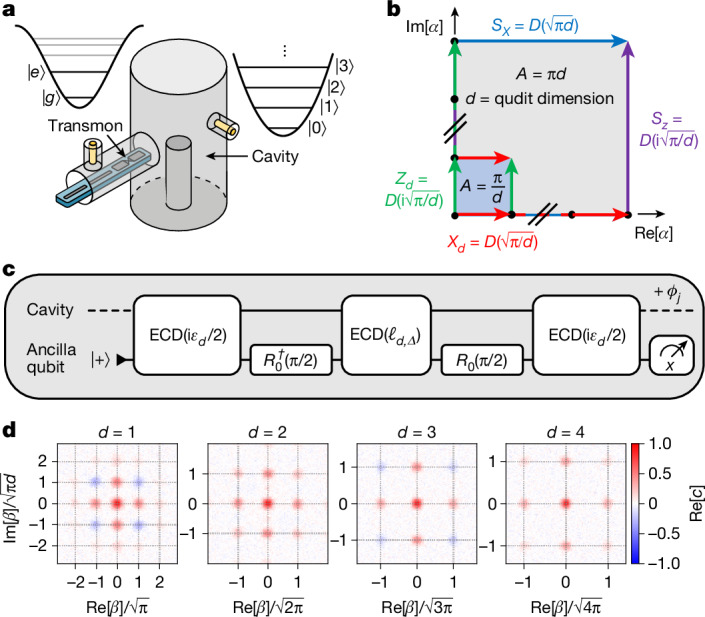
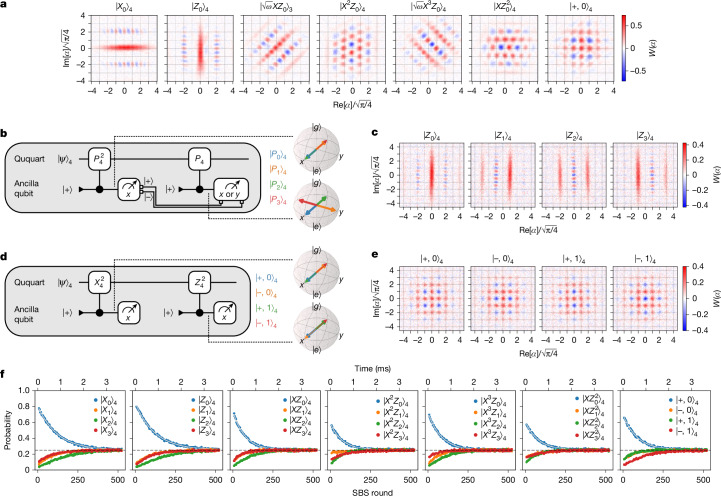
Hilbert space dimension is a key resource for quantum information processing1,2. Not only is a large overall Hilbert space an essential requirement for quantum error correction, but a large local Hilbert space can also be advantageous for realizing gates and algorithms more efficiently3–7. As a result, there has been considerable experimental effort in recent years to develop quantum computing platforms using qudits (d-dimensional quantum systems with d > 2) as the fundamental unit of quantum information8–19. Just as with qubits, quantum error correction of these qudits will be necessary in the long run, but so far, error correction of logical qudits has not been demonstrated experimentally. Here we report the experimental realization of an error-corrected logical qutrit (d = 3) and ququart (d = 4), which was achieved with the Gottesman–Kitaev–Preskill bosonic code20. Using a reinforcement learning agent21,22, we optimized the Gottesman–Kitaev–Preskill qutrit (ququart) as a ternary (quaternary) quantum memory and achieved beyond break-even error correction with a gain of 1.82 ± 0.03 (1.87 ± 0.03). This work represents a novel way of leveraging the large Hilbert space of a harmonic oscillator to realize hardware-efficient quantum error correction. Quantum error correction of a logical qutrit and ququart were experimentally realized beyond the break-even point with the Gottesman–Kitaev–Preskill bosonic code.
Overview
CoChat Summary
## TL;DR
The paper reports the experimental realization of error-corrected logical qudits beyond the qubit case: a logical qutrit and ququart encoded in a GKP bosonic code. Using reinforcement learning to optimize the error-correction protocol, the authors achieved beyond break-even quantum-memory performance with gains of 1.82 ± 0.03 for the qutrit and 1.87 ± 0.03 for the ququart.
## Key findings
- The experiment demonstrated experimental error correction of logical qudits with d > 2, specifically a logical qutrit (d = 3) and ququart (d = 4).
- The optimized logical qutrit outperformed the best physical qutrit in the system by a factor of 1.82 ± 0.03, and the optimized logical ququart outperformed the best physical ququart by 1.87 ± 0.03.
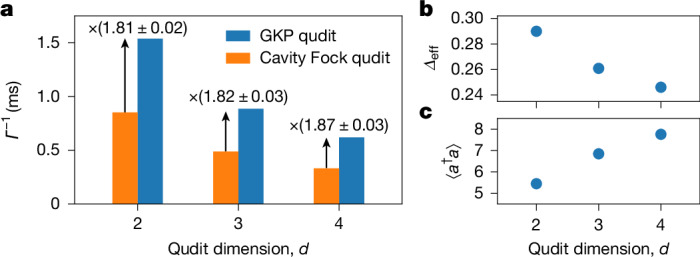
- The authors report that the QEC gain stayed roughly constant at about 1.8 as the logical GKP qudit dimension increased from 2 to 4.
- For the ququart, the paper says the QEC gain was “well beyond the break-even point,” and for the qutrit it says the gain was “well beyond the break-even point.”
## Methods
- Experimental platform: a tantalum transmon dispersively coupled to a three-dimensional superconducting microwave cavity; the cavity hosted the oscillator modes used for the logical GKP states.
- Code and protocol: the authors used the single-mode square GKP code and adapted the small-big-small (SBS) autonomous stabilization protocol; they optimized protocol parameters with a reinforcement learning agent.
- Evaluation: they prepared representative eigenstates, applied the optimized QEC protocol for varying numbers of rounds, measured output probabilities in generalized Pauli bases, and fit exponential decay to obtain effective decay rates and QEC gain.
## Limitations
- The paper states that the logical measurements and generalized controlled-Pauli gates were designed for the ideal code and “incur infidelity” when applied to the finite-energy code.
- The paper states that the optimized GKP qudits had more energy and thus were expected to suffer increased photon loss and dephasing as d increased; the discussion identifies cavity dephasing as the dominant source of logical error.
- Evident from the text: the work demonstrates only single-system memory error correction; the paper does not report full-scale multi-qudit computation or entangling-gate demonstrations here.
Model-written summary. Check it against the paper before relying on it.
Integrity signals
Registry
Cites
Statistics
Figures
Verification
Claims the paper makes
8 Valid · 1 Not valid · 5 Not checked · 26 Own results and interpretations
Some cited sources support this claim and some don’t — read each source’s verdict below.
In the paper
“Using a reinforcement learning agent21,22, we optimized the Gottesman–Kitaev–Preskill qutrit (ququart) as a ternary (quaternary) quantum memory and achieved beyond break-even error correction with a gain of 1.82 ± 0.03 (1.87 ± 0.03).”
- Also stated in: § Main · plain
“Our optimized GKP qutrit (ququart) lived longer, on average, than the best physical qutrit (ququart) available in our system by a factor of 1.82 ± 0.03 (1.87 ± 0.03), making this one of only a handful of experiments to beat the break-even point of QEC for quantum memories22,28–30.”
§ Quantum error correction of qudits beyond break-even > Abstract
What the sources say
- Supportedcites [21] Sivak, V. et al. Model-free quantum control with reinforcement learning. Phys. Rev. X 12, 011059 (2022). source
The citation is attached to “Using a reinforcement learning agent,” not to the citing authors’ reported qutrit gain. In “Preparation of stabilizer states” (page unavailable), the source describes training an agent to prepare a GKP state, supporting the cited method. The gain of 1.82 ± 0.03 is presented as the citing authors’ own result. (LLM, conf=0.90)
- Disputedcites [22] Sivak, V. V. et al. Real-time quantum error correction beyond break-even. Nature 616, 50–55 (2023). 36949196 sourceExperimental — accuracy not yet measured
Our copy of Sivak et al. (2023) reports a GKP encoding of a logical QUBIT, not a qutrit or ququart: the abstract/Methods state 'gain G = 2.27 ± 0.07 using the Gottesman-Kitaev-Preskill (GKP) encoding of a logical qubit into grid states of an oscillator', and the section OBSERVING QEC BEYOND BREAK-EVEN states 'the highest achieved gain is G = Γ{01}/ΓGKP = 2.27 ± 0.07, confidently beyond break-even'. The only 1.82 ± 0.03-type figure in the paper is a lifetime, not a gain: Γ_GKP = (1.82 ms)−1 derived from T_X = T_Z = 2.20 ± 0.03 ms and T_Y = 1.36 ± 0.03 ms (and p_X = p_Z = (1.81 ± 0.04) × 10−3 per cycle). Searches for 'qutrit', 'ququart', 'ternary/quaternary' and for gains of 1.82 or 1.87 returned no such content in our copy, so the cited beyond-break-even magnitude and encoding dimension are contrary to what this paper says. (LLM, conf=0.78)
Checked by a reasoning model — may be wrong.
plainstates a cause- Asserted: passes — The authors put it forward as true.
- Checkable: passes — It can be checked against evidence.
- Load-bearing: passes — The paper’s conclusions depend on it.
- Based: passes — The paper gives a reason why it holds.
- Rests on an assumption not shown here.
- Also stated in: § Main · plain
The cited sources support only part of this claim — read each source’s verdict below.
In the paper
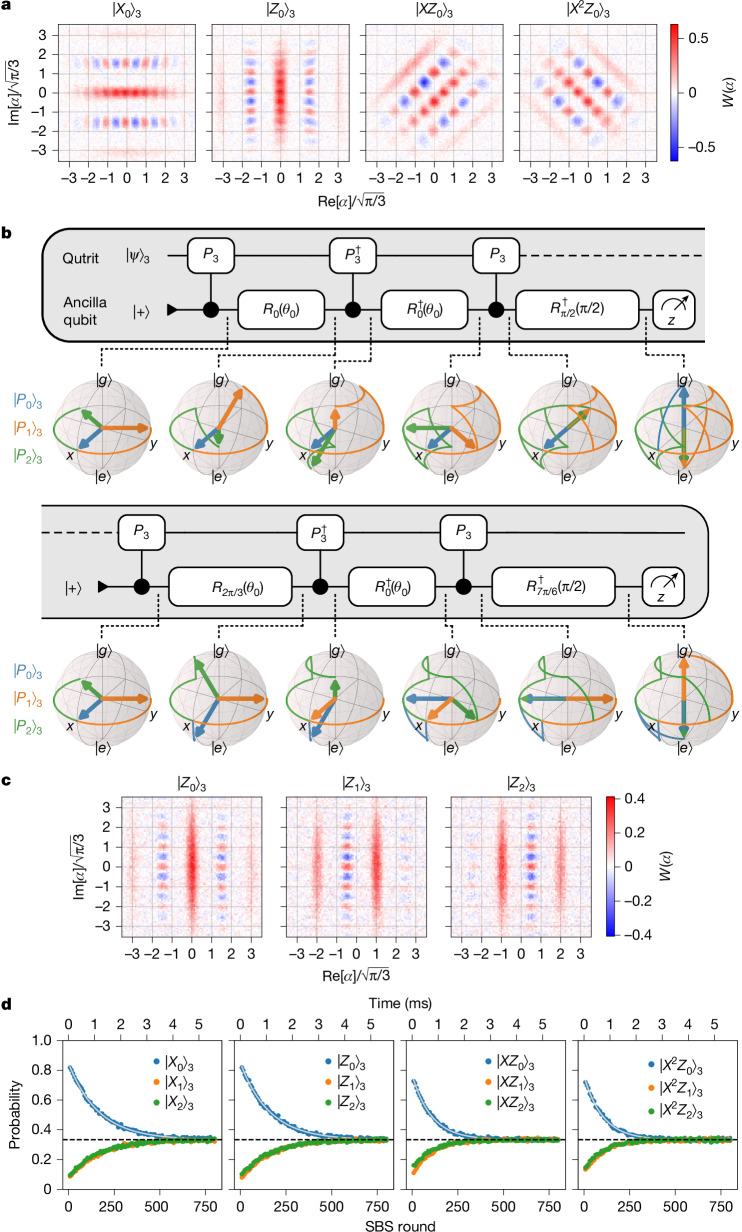
“As with the GKP qubit22,33, we found longer lifetimes for the ‘Cartesian’ eigenstates of X3 and Z3 than for the remaining ‘diagonal’ eigenstates, as the latter were more susceptible to both cavity photon-loss errors and ancilla bit-flip errors33.”
§ Quantum error correction of qudits beyond break-even > Logical qutrit beyond break-even
What the sources say
- Partly supportedcites [22] Sivak, V. V. et al. Real-time quantum error correction beyond break-even. Nature 616, 50–55 (2023). 36949196 sourceExperimental — accuracy not yet measured
The lifetime ordering is squarely supported: 'OBSERVING QEC BEYOND BREAK-EVEN' and the Abstract report logical Pauli eigenstate lifetimes T_X = T_Z = 2.20 ± 0.03 ms versus T_Y = 1.36 ± 0.03 ms, i.e. the two Cartesian eigenstates outlive the remaining (Y, 'diagonal') one. The ancilla bit-flip part of the mechanism is also supported: Section S4 I ('Sensitivity to ancilla errors') gives dγ_Y/dγ_t1 = 0.25 against dγ_Z/dγ_t1 = 0.17 (γ_X behaving identically to γ_Z), so the diagonal eigenstate is the more bit-flip-sensitive one, and that section argues ancilla bit flips generate logical errors via the big conditional displacement and via readout-misclassification rotations. What our copy does not state is that the diagonal eigenstate's shorter lifetime arises from greater susceptibility to cavity photon loss: photon loss (oscillator relaxation, Section S2 E; the a†-like error space of Section S4 H) is treated as a general error mechanism feeding the logical Pauli channel, with no passage singling out the Y/diagonal eigenstate as more exposed to it. Also note the 'Cartesian'/'diagonal' labels are the citing paper's own framing, not the source's terminology. (LLM, conf=0.70)
- Supportedcites [33] Campagne-Ibarcq, P. et al. Quantum error correction of a qubit encoded in grid states of an oscillator. Nature 584, 368–372 (2020). 32814889 source
The citation supports the sentence’s comparison with a GKP qubit, not the citing authors’ qutrit result. Section IV (p. 3) reports longer lifetimes for the square-code qubit’s X and Z eigenstates than for Y, and attributes Y’s shorter lifetime partly to photon dissipation. The supplement’s “Bit-flips of the transmon” section (p. 24) likewise gives a shorter bit-flip-limited lifetime for Y than for X and Z. (LLM, conf=0.91)
plainstates an association- Asserted: passes — The authors put it forward as true.
- Checkable: passes — It can be checked against evidence.
- Load-bearing: unclear — It is unclear whether the paper’s conclusions depend on it.
- Based: passes — The paper gives a reason why it holds.
- Partly supported
Every source the paper cites for this claim was checked and supports it.
In the paper
“Here we report the experimental realization of an error-corrected logical qutrit (d = 3) and ququart (d = 4), which was achieved with the Gottesman–Kitaev–Preskill bosonic code20.”
- Also stated in: § Main · boosted
“In this work we experimentally demonstrate QEC of logical qudits with d > 2, using the Gottesman–Kitaev–Preskill (GKP) bosonic code20 to realize a logical qutrit (d = 3) and ququart (d = 4) encoded in grid states of an oscillator.”
- Also stated in: § Discussion · boosted
“In summary, we have demonstrated QEC of logical qudits with d > 2, which represents a milestone achievement in the development of qudits for useful quantum technologies.”
§ Quantum error correction of qudits beyond break-even > Abstract
What the sources say
- Supportedcites [20] Gottesman, D., Kitaev, A. & Preskill, J. Encoding a qubit in an oscillator. Phys. Rev. A 64, 012310 (2001). source
The citation in the citing sentence identifies the Gottesman–Kitaev–Preskill code used in the citing authors’ own experiment; it does not attribute the experimental realization to this source. The Introduction (p. 1) describes the source’s error-correcting codes for finite-dimensional states encoded in oscillators, supporting that identification. (LLM, conf=0.93)
boostedstates a cause- Asserted: passes — The authors put it forward as true.
- Checkable: passes — It can be checked against evidence.
- Load-bearing: passes — The paper’s conclusions depend on it.
- Based: passes — The paper gives a reason why it holds.
- Also stated in: § Main · boosted
The cited sources support only part of this claim — read each source’s verdict below.
In the paper
“Using a reinforcement learning agent21,22, we optimized the Gottesman–Kitaev–Preskill qutrit (ququart) as a ternary (quaternary) quantum memory and achieved beyond break-even error correction with a gain of 1.82 ± 0.03 (1.87 ± 0.03).”
- Also stated in: § Main · plain
“Our optimized GKP qutrit (ququart) lived longer, on average, than the best physical qutrit (ququart) available in our system by a factor of 1.82 ± 0.03 (1.87 ± 0.03), making this one of only a handful of experiments to beat the break-even point of QEC for quantum memories22,28–30.”
§ Quantum error correction of qudits beyond break-even > Abstract
What the sources say
- Partly supportedcites [21] Sivak, V. et al. Model-free quantum control with reinforcement learning. Phys. Rev. X 12, 011059 (2022). sourceExperimental — accuracy not yet measured
Section B, “Preparation of stabilizer states” (page unavailable), describes training a reinforcement-learning agent to prepare a GKP grid state. It does not report an optimized GKP ququart memory, beyond break-even error correction, or a gain of 1.87 ± 0.03. (LLM, conf=0.86)
- Not checked yetcites [22] Sivak, V. V. et al. Real-time quantum error correction beyond break-even. Nature 616, 50–55 (2023). 36949196 source
Checked before — its earlier verdict is held back until a new check runs.
plainstates a cause- Asserted: passes — The authors put it forward as true.
- Checkable: passes — It can be checked against evidence.
- Load-bearing: passes — The paper’s conclusions depend on it.
- Based: passes — The paper gives a reason why it holds.
- Rests on an assumption not shown here.
- Also stated in: § Main · plain
The cited sources support only part of this claim — read each source’s verdict below.
In the paper
“As our cavity dephasing was primarily due to the thermal population nth = 2.2 ± 0.1% of the transmon40, the lifetimes of our logical GKP qudits could be substantially improved by either reducing nth or using an ancilla that can be actively decoupled from the cavity when not in use49,50.”
§ Quantum error correction of qudits beyond break-even > Discussion
What the sources say
- Partly supportedcites [40] Reagor, M. et al. Quantum memory with millisecond coherence in circuit QED. Phys. Rev. B 94, 014506 (2016). sourceExperimental — accuracy not yet measured
Quantum Memory Characterization (pp. 4–5) finds that thermal excitation of the transmon accounts for the measured cavity dephasing. But the paper estimates its transmon’s equilibrium excited-state population at approximately 0.8%, not 2.2 ± 0.1%; it does not establish the quoted value for the citing authors’ cavity. (LLM, conf=0.88)
plainstates a cause- Asserted: passes — The authors put it forward as true.
- Checkable: passes — It can be checked against evidence.
- Load-bearing: passes — The paper’s conclusions depend on it.
- Based: passes — The paper gives a reason why it holds.
- Partly supported
15 more claims · 2 with their cited sources checked
Create a free account to see all 40 claims and to verify the 10 references still open.
- It may state two separate claims as one. 13
- Probably not a substantial claim. 10
- The quote only partly states this claim. 2
Citations
Cites
Encoding a qubit in an oscillator
Gottesman, D., Kitaev, A., & Preskill, J. (2001) · Physical Review A · doi:10.1103/physreva.64.012310 · Cited by 1,532 · cited 4×
“With smaller Δ , we expect the lifetime of our GKP qudits to decrease, as having more energy amplifies the rate of oscillator photon loss, and having information stored further out in phase space amplifies the effects of oscillator dephasing.”
InfluentialOn-chip generation of high-dimensional entangled quantum states and their coherent control
Kues, M., Reimer, C., Roztocki, P., Cortés, L. R., Sciara, S., Wetzel, B., Zhang, Y., Cino, A., Chu, S. T., Little, B. E., et al. (2017) · Nature · doi:10.1038/nature22986 · Cited by 1,177 · cited 1×
“…considerable experimental effort has been spent in recent years on developing qudit-based platforms for quantum computing, using donor spins in silicon 8 , ultracold atoms and molecules 9,10 , optical photons 11,12 , superconducting circuits 13–15 , trapped ions 16,17 , and vacancy centers 18,19 .”
Extending the lifetime of a quantum bit with error correction in superconducting circuits
Ofek, N., Petrenko, A., Heeres, R., Reinhold, P., Leghtas, Z., Vlastakis, B., Liu, Y., Frunzio, L., Girvin, S. M., Jiang, L., et al. (2016) · Nature · doi:10.1038/nature18949 · Cited by 941 · cited 4×
“Our optimized GKP qutrit (ququart) lived longer, on average, than the best physical qutrit (ququart) available in our system by a factor of 1.82 ± 0.03 (1.87 ± 0.03), making this one of only a handful of experiments to beat the break-even point of QEC for quantum memories 22,28–30 .”
InfluentialSelf-citationMultidimensional quantum entanglement with large-scale integrated optics
Wang, J., Paesani, S., Ding, Y., Santagati, R., Skrzypczyk, P., Salavrakos, A., Tura, J., Augusiak, R., Mančinska, L., Bacco, D., et al. (2018) · Science · doi:10.1126/science.aar7053 · Cited by 816
Negativity of the Wigner function as an indicator of non-classicality
Kenfack, A., & yczkowski, K. (2004) · Journal of Optics B: Quantum and Semiclassical Optics · doi:10.1088/1464-4266/6/10/003 · Cited by 779 · cited 1×
“However, it is interesting to note that the states ρ d mix for odd d have regions of Wigner negativity (Supplementary Information section II-B) and are, therefore, non-classical 46 .”
Quantum error correction below the surface code threshold
Collaborators, G. Q. A. A., Acharya, R., Abanin, D. A., Aghababaie-Beni, L., Aleiner, I., Andersen, T. I., Ansmann, M., Arute, F., Arya, K., Asfaw, A., et al. (2025) · Nature · doi:10.1038/s41586-024-08449-y · Cited by 778 · cited 2×
“Our optimized GKP qutrit (ququart) lived longer, on average, than the best physical qutrit (ququart) available in our system by a factor of 1.82 ± 0.03 (1.87 ± 0.03), making this one of only a handful of experiments to beat the break-even point of QEC for quantum memories 22,28–30 .”
InfluentialSelf-citationSchwinger, J. (1960) · Proceedings of the National Academy of Sciences · doi:10.1073/pnas.46.4.570 · Cited by 776
Stabilizer Codes and Quantum Error Correction
Gottesman, D. (1997) · arXiv · doi:10.48550/arxiv.quant-ph/9705052 · Cited by 753
A simple formula for the average gate fidelity of a quantum dynamical operation
Nielsen, M. A. (2002) · Physics Letters A · doi:10.1016/s0375-9601(02)01272-0 · Cited by 725 · cited 1×
“To characterize the performance of our logical qudits as quantum memories and establish the concept of QEC gain for qudits, we followed previous work 22 and used the average channel fidelity F E I ( , ) d , which quantifies how well a channel E realizes the identity I (ref.”
Place, A. P. M., Rodgers, L. V. H., Mundada, P., Smitham, B. M., Fitzpatrick, M., Leng, Z., Premkumar, A., Bryon, J., Vrajitoarea, A., Sussman, S., et al. (2021) · Nature Communications · doi:10.1038/s41467-021-22030-5 · Cited by 563 · cited 1×
“22 and consists of a tantalum transmon 38,39 dispersively coupled to a three-dimensional superconducting microwave cavity 40 , as shown in Fig.”
Qudits and High-Dimensional Quantum Computing
Wang, Y., Hu, Z., Sanders, B. C., & Kais, S. (2020) · Frontiers in Physics · doi:10.3389/fphy.2020.589504 · Cited by 478
Quantum error correction of a qubit encoded in grid states of an oscillator
Campagne-Ibarcq, P., Eickbusch, A., Touzard, S., Zalys-Geller, E., Frattini, N. E., Sivak, V. V., Reinhold, P., Puri, S., Shankar, S., Schoelkopf, R. J., et al. (2020) · Nature · doi:10.1038/s41586-020-2603-3 · Cited by 459
Self-citationReal-time quantum error correction beyond break-even
Sivak, V. V., Eickbusch, A., Royer, B., Singh, S., Tsioutsios, I., Ganjam, S., Miano, A., Brock, B. L., Ding, A. Z., Frunzio, L., et al. (2023) · Nature · doi:10.1038/s41586-023-05782-6 · Cited by 407 · cited 9×
“4a. Note that the gain G 2 = 1.81 ± 0.02 that we achieved with the GKP qubit is less than the gain of 2.3 previously reported using the same device 22 , which was due to changes in both the device and the experimental conditions (see Supplementary Information section IV-C for details).”
InfluentialSelf-citationEncoding a qubit in a trapped-ion mechanical oscillator
Flühmann, C., Nguyen, T. L., Marinelli, M., Negnevitsky, V., Mehta, K., & Home, J. P. (2019) · Nature · doi:10.1038/s41586-019-0960-6 · Cited by 394 · cited 2×
“This experiment represents a novel way of leveraging the large Hilbert space of an oscillator and builds on previous realizations of GKP qubits 22,31–36 and bosonic codes 28,29,37 .”
Implementation of a Toffoli gate with superconducting circuits
Fedorov, A., Steffen, L., Baur, M., da Silva, M. P., & Wallraff, A. (2012) · Nature · doi:10.1038/nature10713 · Cited by 386
Quantum memory with millisecond coherence in circuit QED
Reagor, M., Pfaff, W., Axline, C., Heeres, R. W., Ofek, N., Sliwa, K., Holland, E., Wang, C., Blumoff, J., Chou, K., et al. (2016) · Physical Review B · doi:10.1103/physrevb.94.014506 · Cited by 376 · cited 2×
“We then evaluated the optimal QEC protocol by preparing each eigenstate | P n ⟩ 3 for each P P ∈ 3 3 , implementing the optimized QEC protocol for a variable number of rounds, and measuring the final state in the P 3 basis.”
Self-citationA universal qudit quantum processor with trapped ions
Ringbauer, M., Meth, M., Postler, L., Stricker, R., Blatt, R., Schindler, P., & Monz, T. (2022) · Nature Physics · doi:10.1038/s41567-022-01658-0 · Cited by 351 · cited 1×
“…considerable experimental effort has been spent in recent years on developing qudit-based platforms for quantum computing, using donor spins in silicon 8 , ultracold atoms and molecules 9,10 , optical photons 11,12 , superconducting circuits 13–15 , trapped ions 16,17 , and vacancy centers 18,19 .”
Efficient Toffoli gates using qudits
Ralph, T. C., Resch, K. J., & Gilchrist, A. (2007) · Physical Review A · doi:10.1103/physreva.75.022313 · Cited by 293
A programmable qudit-based quantum processor
Chi, Y., Huang, J., Zhang, Z., Mao, J., Zhou, Z., Chen, X., Zhai, C., Bao, J., Dai, T., Yuan, H., et al. (2022) · Nature Communications · doi:10.1038/s41467-022-28767-x · Cited by 273 · cited 1×
“…considerable experimental effort has been spent in recent years on developing qudit-based platforms for quantum computing, using donor spins in silicon 8 , ultracold atoms and molecules 9,10 , optical photons 11,12 , superconducting circuits 13–15 , trapped ions 16,17 , and vacancy centers 18,19 .”
Simulating two-dimensional lattice gauge theories on a qudit quantum computer
Meth, M., Zhang, J., Haase, J. F., Edmunds, C., Postler, L., Jena, A., Steiner, A., Dellantonio, L., Blatt, R., Zoller, P., et al. (2025) · Nature Physics · doi:10.1038/s41567-025-02797-w · Cited by 185
Enhanced Fault-Tolerant Quantum Computing ind-Level Systems
Campbell, E. T. (2014) · Physical Review Letters · doi:10.1103/physrevlett.113.230501 · Cited by 184
Beating the break-even point with a discrete-variable-encoded logical qubit
Ni, Z., Li, S., Deng, X., Cai, Y., Zhang, L., Wang, W., Yang, Z.-B., Yu, H., Yan, F., Liu, S., et al. (2023) · Nature · doi:10.1038/s41586-023-05784-4 · Cited by 176
Fast universal control of an oscillator with weak dispersive coupling to a qubit
Eickbusch, A., Sivak, V., Ding, A. Z., Elder, S. S., Jha, S. R., Venkatraman, J., Royer, B., Girvin, S. M., Schoelkopf, R. J., & Devoret, M. H. (2022) · Nature Physics · doi:10.1038/s41567-022-01776-9 · Cited by 173 · cited 2×
“To prepare the eigenstates | P n ⟩ 3 , we used interleaved sequences of ECD gates and transmon rotations, which enable universal control of the oscillator mode in the cavity 48 .”
InfluentialSelf-citationFault-tolerant detection of a quantum error
Rosenblum, S., Reinhold, P., Mirrahimi, M., Jiang, L., Frunzio, L., & Schoelkopf, R. J. (2018) · Science · doi:10.1126/science.aat3996 · Cited by 167
Self-citationMagic-State Distillation in All Prime Dimensions Using Quantum Reed-Muller Codes
Campbell, E. T., Anwar, H., & Browne, D. E. (2012) · Physical Review X · doi:10.1103/physrevx.2.041021 · Cited by 164
Sawaya, N. P. D., Menke, T., Kyaw, T. H., Johri, S., Aspuru-Guzik, A., & Guerreschi, G. G. (2020) · npj Quantum Information · doi:10.1038/s41534-020-0278-0 · Cited by 163 · cited 1×
“On the other hand, embracing these qudits could enable more efficient distillation of magic states 24,25 , synthesis of gates 3,4 , compilation of algorithms 5–7 , and simulation of high-dimensional quantum systems 26,27 .”
Logical states for fault-tolerant quantum computation with propagating light
Konno, S., Asavanant, W., Hanamura, F., Nagayoshi, H., Fukui, K., Sakaguchi, A., Ide, R., China, F., Yabuno, M., Miki, S., et al. (2024) · Science · doi:10.1126/science.adk7560 · Cited by 160
Protecting a bosonic qubit with autonomous quantum error correction
Gertler, J. M., Baker, B., Li, J., Shirol, S., Koch, J., & Wang, C. (2021) · Nature · doi:10.1038/s41586-021-03257-0 · Cited by 156
Error correction of a logical grid state qubit by dissipative pumping
de Neeve, B., Nguyen, T.-L., Behrle, T., & Home, J. P. (2022) · Nature Physics · doi:10.1038/s41567-021-01487-7 · Cited by 152 · cited 3×
“To stabilize the finite-energy GKP qudit manifold, we adapted the small-big-small (SBS) protocol 43 , realizes an engineered dissipation onto the finite-energy GKP qudit manifold that removes the entropy associated with physical errors in the oscillator before they can accumulate into logical errors (Supplementary Inf…”
Towards scalable bosonic quantum error correction
Terhal, B. M., Conrad, J., & Vuillot, C. (2020) · Quantum Science and Technology · doi:10.1088/2058-9565/ab98a5 · Cited by 146 · cited 1×
“Such a concatenation requires entangling gates, which for GKP qudits can be realized with the same operations used for entangling GKP qubits 20,53–55 .”
Quantum Control of the Hyperfine Spin of a Cs Atom Ensemble
Chaudhury, S., Merkel, S., Herr, T., Silberfarb, A., Deutsch, I. H., & Jessen, P. S. (2007) · Physical Review Letters · doi:10.1103/physrevlett.99.163002 · Cited by 139
Quantum Error Correction with the Gottesman-Kitaev-Preskill Code
Grimsmo, A. L., & Puri, S. (2021) · PRX Quantum · doi:10.1103/prxquantum.2.020101 · Cited by 132
Model-Free Quantum Control with Reinforcement Learning
Sivak, V. V., Eickbusch, A., Liu, H., Royer, B., Tsioutsios, I., & Devoret, M. H. (2022) · Physical Review X · doi:10.1103/physrevx.12.011059 · Cited by 130 · cited 4×
“With these techniques, we used a reinforcement learning agent 21 to optimize the logical GKP qutrit as a ternary quantum memory following the method in ref.”
InfluentialSelf-citationAsymptotic improvements to quantum circuits via qutrits
Gokhale, P., Baker, J. M., Duckering, C., Brown, N. C., Brown, K. R., & Chong, F. T. (2019) · Proceedings of the 46th International Symposium on Computer Architecture · doi:10.1145/3307650.3322253 · Cited by 120 · cited 1×
“Using equation (3) with our measured rates γ P n , we obtained Γ = (886±3 μs) 3GKP”
Encoding a qubit in a trapped-ion mechanical oscillator
Flühmann, C., Nguyen, T. L., Marinelli, M., Negnevitsky, V., Mehta, K. K., & Home, J. (2019) · RePEc: Research Papers in Economics · Cited by 120
Excitation and coherent control of spin qudit modes in silicon carbide at room temperature
Soltamov, V. A., Kasper, C., Poshakinskiy, A. V., Anisimov, A. N., Mokhov, E. N., Sperlich, A., Tarasenko, S. A., Baranov, P. G., Astakhov, G. V., & Dyakonov, V. (2019) · Nature Communications · doi:10.1038/s41467-019-09429-x · Cited by 118
Protecting a bosonic qubit with autonomous quantum error correction
Gertler, J., Baker, B., Li, J., Shirol, S., Koch, J., & Wang, C. (2021) · RePEc: Research Papers in Economics · Cited by 115
Factoring with qutrits: Shor's algorithm on ternary and metaplectic quantum architectures
Bocharov, A., Roetteler, M., & Svore, K. M. (2017) · Physical Review A · doi:10.1103/physreva.96.012306 · Cited by 114
Towards scalable bosonic quantum error correction
Terhal, B. M., Conrad, J., & Vuillot, C. (2020) · HZB Repository (Helmholtz-Zentrum Berlin für Materialien und Energie GmbH (HZB)) · doi:10.17169/refubium-30061 · Cited by 114
Characterization of High-Dimensional Entangled Systems via Mutually Unbiased Measurements
Giovannini, D., Romero, J., Leach, J., Dudley, A., Forbes, A., & Padgett, M. J. (2013) · Physical Review Letters · doi:10.1103/physrevlett.110.143601 · Cited by 112
Climbing Mount Scalable: Physical Resource Requirements for a Scalable Quantum Computer
Blume-Kohout, R., Caves, C. M., & Deutsch, I. H. (2002) · Foundations of Physics · doi:10.1023/a:1021471621587 · Cited by 100
Ganjam, S., Wang, Y., Lu, Y., Banerjee, A., Lei, C. U., Krayzman, L., Kisslinger, K., Zhou, C., Li, R., Jia, Y., et al. (2024) · Nature Communications · doi:10.1038/s41467-024-47857-6 · Cited by 93 · cited 1×
“22 and consists of a tantalum transmon 38,39 dispersively coupled to a three-dimensional superconducting microwave cavity 40 , as shown in Fig.”
Self-citationMaximizing the Hilbert Space for a Finite Number of Distinguishable Quantum States
Greentree, A. D., Schirmer, S. G., Green, F., Hollenberg, L. C. L., Hamilton, A. R., & Clark, R. G. (2004) · Physical Review Letters · doi:10.1103/physrevlett.92.097901 · Cited by 93
Autonomous Quantum Error Correction of Gottesman-Kitaev-Preskill States
Lachance-Quirion, D., Lemonde, M.-A., Simoneau, J. O., St-Jean, L., Lemieux, P., Turcotte, S., Wright, W., Lacroix, A., Fréchette-Viens, J., Shillito, R., et al. (2024) · Physical Review Letters · doi:10.1103/physrevlett.132.150607 · Cited by 92
Stabilization of Finite-Energy Gottesman-Kitaev-Preskill States
Royer, B., Singh, S., & Girvin, S. M. (2020) · Physical Review Letters · doi:10.1103/physrevlett.125.260509 · Cited by 88
Self-citationDirect Characteristic-Function Tomography of Quantum States of the Trapped-Ion Motional Oscillator
Flühmann, C., & Home, J. P. (2020) · Physical Review Letters · doi:10.1103/physrevlett.125.043602 · Cited by 81
Scalable algorithm simplification using quantum AND logic
Chu, J., He, X., Zhou, Y., Yuan, J., Zhang, L., Guo, Q., Hai, Y.-J., Han, Z., Hu, C.-K., Huang, W., et al. (2022) · Nature Physics · doi:10.1038/s41567-022-01813-7 · Cited by 72
Climbing mount scalable: Physical resource requirements for a scalable quantum computer
Blume-Kohout, R., Caves, C. M., & Deutsch, I. (2002) · Cited by 70
Designing Codes around Interactions: The Case of a Spin
Gross, J. A. (2021) · Physical Review Letters · doi:10.1103/physrevlett.127.010504 · Cited by 63
Sustained State-Independent Quantum Contextual Correlations from a Single Ion
Leupold, F. M., Malinowski, M., Zhang, C., Negnevitsky, V., Alonso, J., Home, J. P., & Cabello, A. (2018) · Physical Review Letters · doi:10.1103/physrevlett.120.180401 · Cited by 60
Quantum control of an oscillator with a Kerr-cat qubit
Ding, A. Z., Brock, B. L., Eickbusch, A., Koottandavida, A., Frattini, N., Cortiñas, R. G., Joshi, V. R., de Graaf, S. J., Chapman, B. J., Ganjam, S., et al. (2025) · Nature Communications · doi:10.1038/s41467-025-60352-w · Cited by 57
Self-citationFernández de Fuentes, I., Botzem, T., Johnson, M. A. I., Vaartjes, A., Asaad, S., Mourik, V., Hudson, F. E., Itoh, K. M., Johnson, B. C., Jakob, A. M., et al. (2024) · Nature Communications · doi:10.1038/s41467-024-45368-y · Cited by 46 · cited 2×
“…considerable experimental effort has been spent in recent years on developing qudit-based platforms for quantum computing, using donor spins in silicon 8 , ultracold atoms and molecules 9,10 , optical photons 11,12 , superconducting circuits 13–15 , trapped ions 16,17 , and vacancy centers 18,19 .”
An optical tweezer array of ultracold polyatomic molecules
Vilas, N. B., Robichaud, P., Hallas, C., Li, G. K., Anderegg, L., & Doyle, J. M. (2024) · Nature · doi:10.1038/s41586-024-07199-1 · Cited by 42 · cited 1×
“…considerable experimental effort has been spent in recent years on developing qudit-based platforms for quantum computing, using donor spins in silicon 8 , ultracold atoms and molecules 9,10 , optical photons 11,12 , superconducting circuits 13–15 , trapped ions 16,17 , and vacancy centers 18,19 .”
Quantum stabilizer codes embedding qubits into qudits
Cafaro, C., Maiolini, F., & Mancini, S. (2012) · Physical Review A · doi:10.1103/physreva.86.022308 · Cited by 40 · cited 1×
“By embedding a logical qubit within a bosonic logical qudit 20,56–58 , multiple layers of error correction can be implemented inside a single oscillator.”
Error-corrected quantum repeaters with Gottesman-Kitaev-Preskill qudits
Schmidt, F., Miller, D., & van Loock, P. (2024) · Physical Review A · doi:10.1103/physreva.109.042427 · Cited by 33
Empowering a qudit-based quantum processor by traversing the dual bosonic ladder
Nguyen, L. B., Goss, N., Siva, K., Kim, Y., Younis, E., Qing, B., Hashim, A., Santiago, D. I., & Siddiqi, I. (2024) · Nature Communications · doi:10.1038/s41467-024-51434-2 · Cited by 31 · cited 1×
“…considerable experimental effort has been spent in recent years on developing qudit-based platforms for quantum computing, using donor spins in silicon 8 , ultracold atoms and molecules 9,10 , optical photons 11,12 , superconducting circuits 13–15 , trapped ions 16,17 , and vacancy centers 18,19 .”
High- E J / E C transmon qudits with up to 12 levels
Wang, Z., Parker, R. W., Champion, E., & Blok, M. S. (2025) · Physical Review Applied · doi:10.1103/physrevapplied.23.034046 · Cited by 29 · cited 8×
“Crucially, the goal of achieving quantum advantage at scale relies on the ability to manipulate an exponentially large Hilbert space with subexponentially many operations.”
InfluentialPassive Environment-Assisted Quantum Communication with GKP States
Wang, Z., & Jiang, L. (2025) · Physical Review X · doi:10.1103/physrevx.15.021003 · Cited by 21
Adambukulam, C., Johnson, B. C., Morello, A., & Laucht, A. (2024) · Physical Review Letters · doi:10.1103/physrevlett.132.060603 · Cited by 20
Schmidt, F., & van Loock, P. (2022) · Physical Review A · doi:10.1103/physreva.105.042427 · Cited by 20
Hardware-efficient error-correcting codes for large nuclear spins
Gross, J. A., Godfrin, C., Blais, A., & Dupont-Ferrier, E. (2024) · Physical Review Applied · doi:10.1103/physrevapplied.22.014006 · Cited by 16
Two-Qubit Operations for Finite-Energy Gottesman-Kitaev-Preskill Encodings
Rojkov, I., Röggla, P. M., Wagener, M., Fontboté-Schmidt, M., Welte, S., Home, J., & Reiter, F. (2024) · Physical Review Letters · doi:10.1103/physrevlett.133.100601 · Cited by 12
Synthetic High Angular Momentum Spin Dynamics in a Microwave Oscillator
Roy, S., Senanian, A., Wang, C. S., Wetherbee, O. C., Zhang, L., Cole, B., Larson, C. P., Yelton, E., Arora, K., McMahon, P. L., et al. (2025) · Physical Review X · doi:10.1103/physrevx.15.021009 · Cited by 9
Quantum Control of an Oscillator with a Kerr-cat QubitPreprint
Ding, A. Z., Brock, B. L., Eickbusch, A., et al. (2024) · arXiv (Cornell University) · doi:10.48550/arxiv.2407.10940 · Cited by 1
Self-citationData for "Quantum Error Correction of Qudits Beyond Break-even"
Brock, B. L., Singh, S., Eickbusch, A., Sivak, V., Ding, A. Z., Frunzio, L., Girvin, S. M., & Devoret, M. (2025) · Zenodo (CERN European Organization for Nuclear Research) · doi:10.5281/zenodo.15009817 · Cited by 1
Self-citation
Cited by
Quantum Machine Learning in Drug Discovery: Applications in Academia and Pharmaceutical Industries
Smaldone, A. M., Shee, Y., Kyro, G. W., Xu, C., Vu, N. P., Dutta, R., Farag, M. H., Galda, A., Kumar, S., Kyoseva, E. S., et al. (2025) · Chemical Reviews · doi:10.1021/acs.chemrev.4c00678 · Cited by 90
Quantum Technologies for Beyond 5G and 6G Networks: Applications, Opportunities, and Challenges
Zeydan, E., de Alwis, C., Khan, R., Türk, Y., Aydeger, A., Gadekallu, T. R., & Liyanage, M. (2025) · IEEE Open Journal of the Communications Society · doi:10.1109/ojcoms.2025.3591842 · Cited by 65
Liu, Y., Singh, S., Smith, K. C., Crane, E., Martyn, J. M., Eickbusch, A., Schuckert, A., Li, R. D., Sinanan-Singh, J., Soley, M. B., et al. (2026) · PRX Quantum · doi:10.1103/4rf7-9tfx · Cited by 171
Self-citationAdvancements in superconducting quantum computing
Jiang, Y.-Y., Deng, C., Fan, H., Li, B.-Y., Sun, L., Tan, X., Wang, W., Xue, G., Yan, F., Yu, H., et al. (2025) · National Science Review · doi:10.1093/nsr/nwaf246 · Cited by 85
A Perspective on Quantum Computing Applications in Quantum Chemistry Using 25–100 Logical Qubits
Alexeev, Y., Batista, V. S., Bauman, N. P., Bertels, L. W., Claudino, D., Dutta, R., Gagliardi, L., Godwin, S., Govind, N., Head‐Gordon, M., et al. (2025) · Journal of Chemical Theory and Computation · doi:10.1021/acs.jctc.5c01038 · Cited by 53
Metadata
- Authors
- Brock, B. L., Singh, S., Eickbusch, A., Sivak, V. V., Ding, A. Z., Frunzio, L., Girvin, S. M., & Devoret, M. H.
- Affiliations
- Yale University (US)
- Google (United States) (US)
- University of California, Santa Barbara (US)
- Corresponding author
- Brock, Benjamin L.
- Devoret, Michel H.
- ORCID
- Venue
- Nature
- Published
- 2025-05-14
- Volume
- 641
- Issue
- 8063
- Pages
- 612-618
- ISSN
- 0028-0836 (ISSN-L)
- 1476-4687
- PMC
- PMC12078179
- OpenAlex
- W4410362117
- Cited by
- 64
- References
- 69
- Citations by year
- 2026: 38 · 2025: 26
- FWCI
- 25.47
- Type
- journal article
- Language
- en
- Open access
- hybrid
- doi.org
- Licence
- cc-by-nc-nd
- creativecommons.org/licenses/by-nc-nd/4.0 (tdm)
- creativecommons.org/licenses/by-nc-nd/4.0 (vor)
- Locations
- Nature (publishedVersion, cc-by-nc-nd)
- PubMed Central (publishedVersion, cc-by-nc-nd)
- PubMed (publishedVersion)
- arXiv (Cornell University) (submittedVersion)
- RePEc: Research Papers in Economics (submittedVersion)
- arXiv (Cornell University)
- Funders
- U.S. Department of Energy (DE‐SC0012704, SC0012704.)
- Yale University
- Office of Science (DE-SC-0012704, SC0012704)
- Air Force Office of Scientific Research (FA9550-, FA9550-19-1-0399)
- Army Research Office (W911-NF-23-1-0051, W911NF)
- Topics
- Physical Sciences › Computer Science › Artificial Intelligence › Quantum Computing Algorithms and Architecture
- Physical Sciences › Physics and Astronomy › Atomic and Molecular Physics, and Optics › Quantum Information and Cryptography
- Physical Sciences › Physics and Astronomy › Atomic and Molecular Physics, and Optics › Quantum Mechanics and Applications
- Keywords
- quantum error correction, qudits, qutrits, ququarts, Gottesman-Kitaev-Preskill code, bosonic codes, harmonic oscillator, reinforcement learning optimization, quantum memory
About these checks
Registry, retraction, Cites and statistics results are computed, not judged, with one exception: a printed reference that no index lists is read once by a model before it counts as a citation error. Claims are extracted by a model and kept only when their quote appears verbatim in the text; each cited source is then checked, with a model’s help, for whether it says what the claim relies on. Those verdicts can be wrong — read the claim’s quote and the cited source before relying on one.
The claim verdicts this report counts are experimental: their accuracy is not yet measured.
A language model drew the claims from the paper on 2026-10-10, under version 3 of the claim definition (model deepseek-v4.1-flash, prompt extract-v3).
A second model labelled each claim on 2026-10-10 (model jev-1.13-20260917, definition revision gold-guideline-v0.2).
Cited sources are checked with a language model’s help (gpt-6-sol and qwen3.8-omni-flash).
Statistics and arithmetic are recomputed, not judged.
Confidence bands are shown only for fields calibrated on our annotated test set. None is calibrated yet, so no band is shown.
What counts as a claim ›How we measure confidence ›How we check this ›
Are you an author, or do you see a problem with this page? Request a review
Data sources
Bibliographic data: Semantic Scholar, OpenAlex, Crossref.
Contains information from the Semantic Scholar Academic Graph Datasets, made available under the ODC Attribution License (ODC-BY 1.0).
Semantic Scholar’s data is described in: Kinney, R., et al. (2023). The Semantic Scholar Open Data Platform. arXiv:2301.10140.
