

Nanopore sequencing and the Shasta toolkit enable efficient de novo assembly of eleven human genomes
Open accessPublished version of a preprint
The DOI matches its Crossref record; 78 of the 78 references it cites were found in a registry or an index.
Abstract
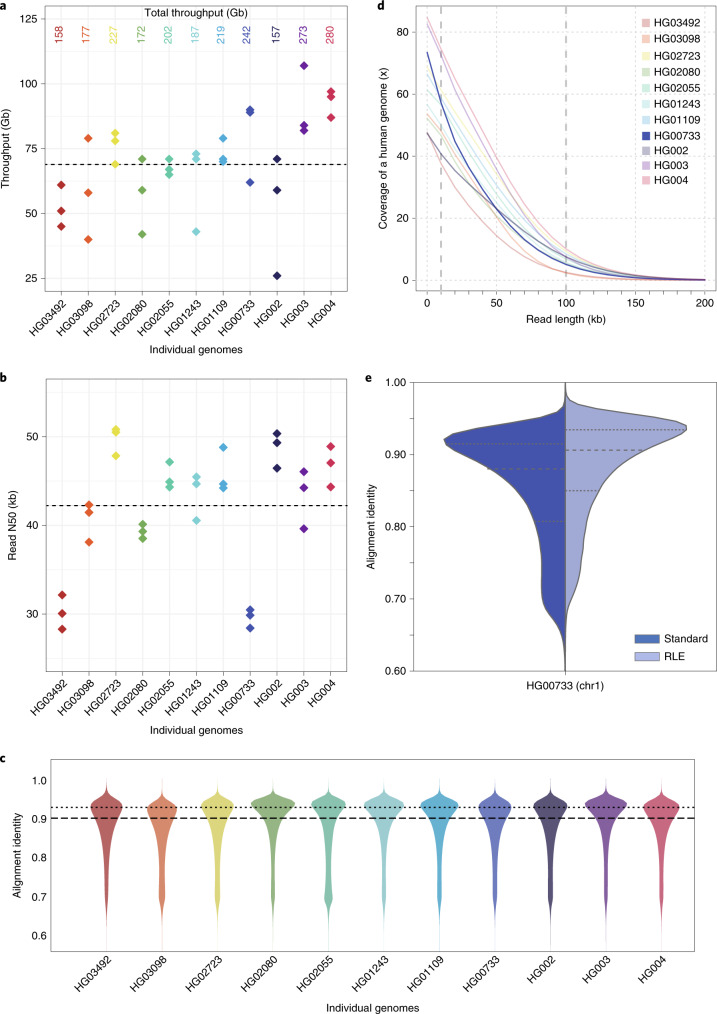
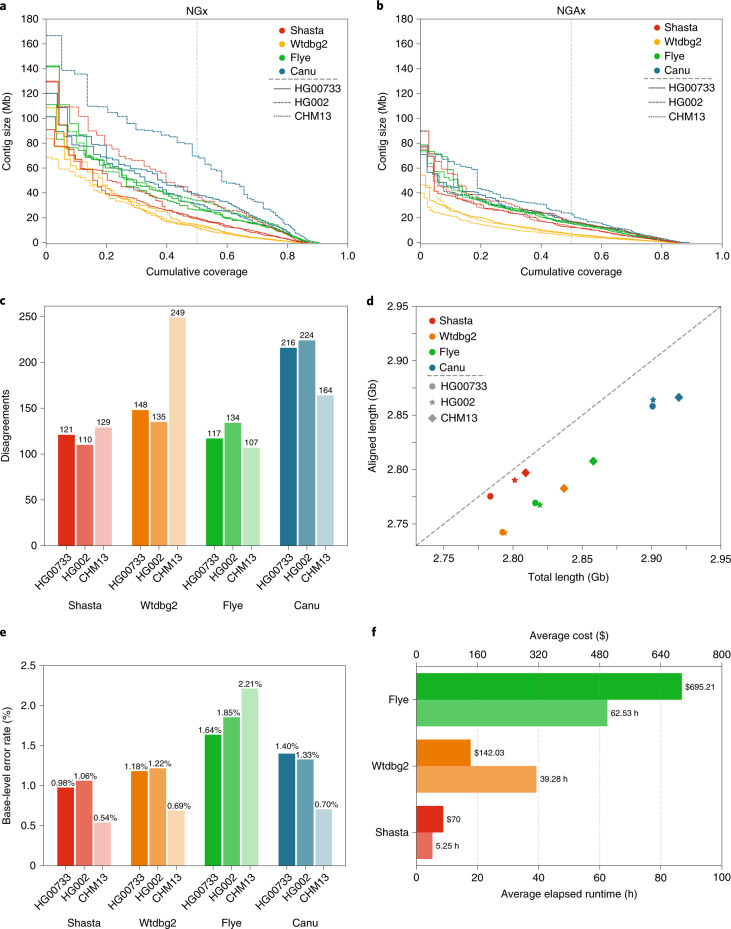
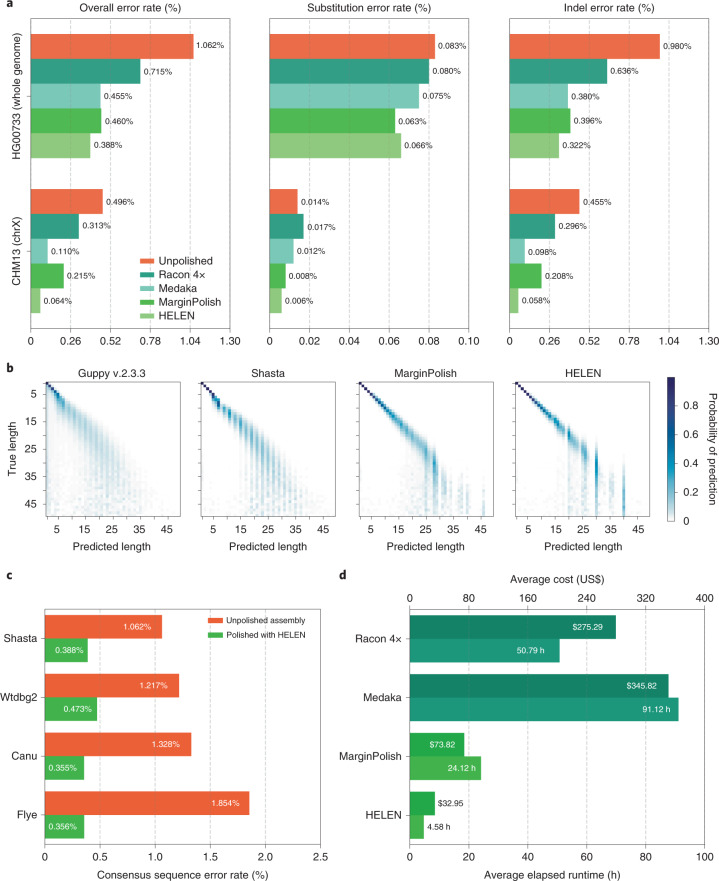
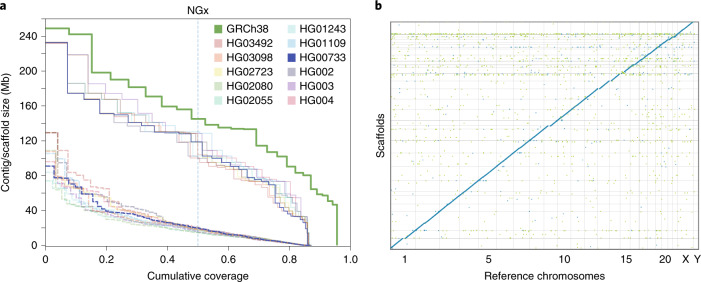
De novo assembly of a human genome using nanopore long-read sequences has been reported, but it used more than 150,000 CPU hours and weeks of wall-clock time. To enable rapid human genome assembly, we present Shasta, a de novo long-read assembler, and polishing algorithms named MarginPolish and HELEN. Using a single PromethION nanopore sequencer and our toolkit, we assembled 11 highly contiguous human genomes de novo in 9 d. We achieved roughly 63× coverage, 42-kb read N50 values and 6.5× coverage in reads >100 kb using three flow cells per sample. Shasta produced a complete haploid human genome assembly in under 6 h on a single commercial compute node. MarginPolish and HELEN polished haploid assemblies to more than 99.9% identity (Phred quality score QV = 30) with nanopore reads alone. Addition of proximity-ligation sequencing enabled near chromosome-level scaffolds for all 11 genomes. We compare our assembly performance to existing methods for diploid, haploid and trio-binned human samples and report superior accuracy and speed.
Overview
The claims and statistics of this paper haven’t been checked yet.
Free: it reads the open-access text and checks the first 5 claims that cite a source we can check. Create a free account to check every claim.
Integrity signals
Registry
Cites
Statistics
Figures

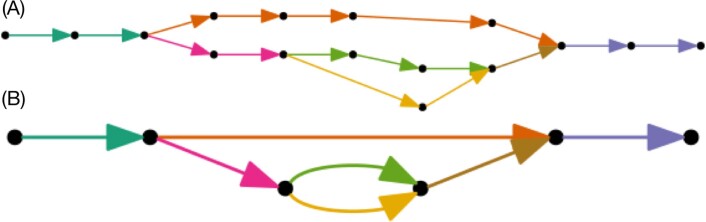
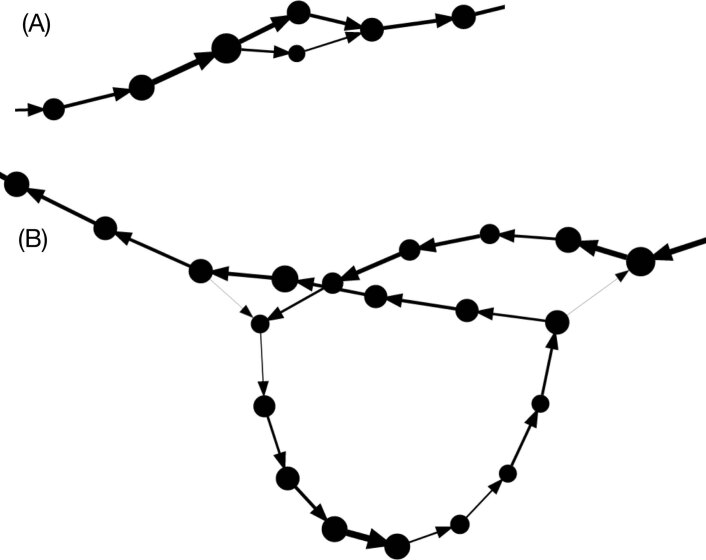
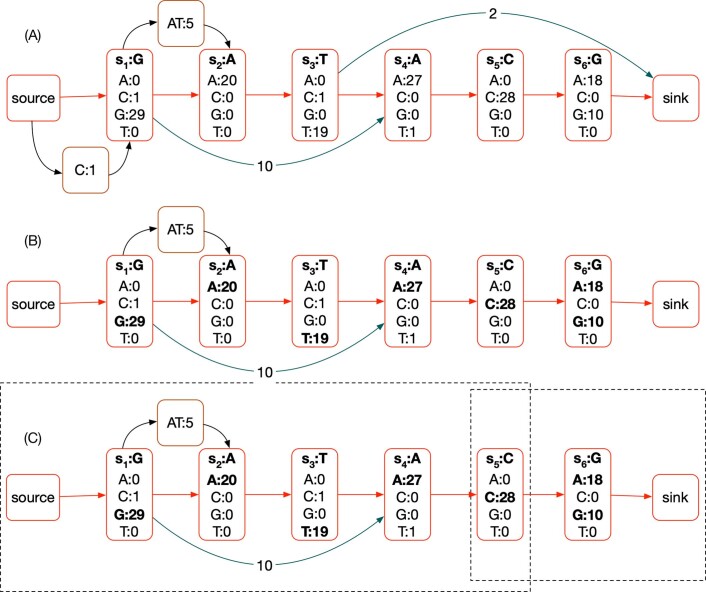
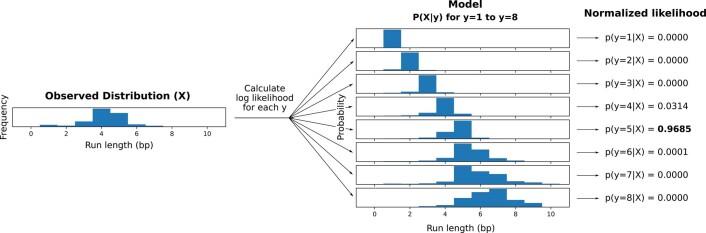
Verification
Claims the paper makes
The claims and statistics of this paper haven’t been checked yet.
Free: it reads the open-access text and checks the first 5 claims that cite a source we can check. Create a free account to check every claim.
Claims other papers make about this one
Each is checked against this paper’s own text: does it say what the citing paper says it does?
The source backs part of the claim, not all of it — or backs it for a different population, condition or comparison.
In the citing paper
“This provides a large set of fully phased human genome assemblies and outperforms earlier efforts on many levels of assembly quality5,16,60.”
From A draft human pangenome reference. (2023) · cites this paper as [16]
Experimental — accuracy not yet measuredThe source backs part of the claim, not all of it — or backs it for a different population, condition or comparison.
In the citing paper
“Similarly driven by technology improvements, sequencing efforts will increasingly produce multiple, phased de novo assemblies from different individuals in a population41.”
From Progressive Cactus is a multiple-genome aligner for the thousand-genome era (2020) · cites this paper as [41]
Experimental — accuracy not yet measuredThe cited source says what the claim attributes to it.
In the citing paper
“These assemblies include 29 samples with long and linked read sequencing data generated entirely by the HPRC and 18 samples sequenced by other efforts16–18.”
From A draft human pangenome reference. (2023) · cites this paper as [16]
The cited source says what the claim attributes to it.
In the citing paper
“These technological advancements also led to a new generation of genome alignment and assembly algorithms leveraging the new data types (84–89).”
From Topological Approaches in Animal Comparative Genomics (2026) · cites this paper as [86]
Self-check
Percentages, sums and reported differences re-computed from the paper’s own numbers.
The self-check needs the paper’s full text.
Citations
Cites
The Genome Analysis Toolkit: A MapReduce framework for analyzing next-generation DNA sequencing data
McKenna, A., Hanna, M., Banks, E., Sivachenko, A., Cibulskis, K., Kernytsky, A., Garimella, K., Altshuler, D., Gabriel, S., Daly, M., et al. (2010) · Genome Research · doi:10.1101/gr.107524.110 · Cited by 27,895
A global reference for human genetic variation
The 1000 Genomes Project Consortium, authors, C., Auton, A., Abecasis, G. R., Steering committee, Altshuler, D. M., Durbin, R. M., Abecasis, G. R., Bentley, D. R., Chakravarti, A., et al. (2015) · Nature · doi:10.1038/nature15393 · Cited by 18,247 · cited 1×
“To do this, we created a list of all low-passage lymphoblastoid cell lines that are part of a trio available from the 1,000 Genomes Project collection 54 (we selected trios to allow future addition of pedigree information, and low-passage line to minimize acquired variation).”
Self-citationMinimap2: Pairwise alignment for nucleotide sequences
Li, H. (2018) · Bioinformatics · doi:10.1093/bioinformatics/bty191 · Cited by 14,807
BUSCO: assessing genome assembly and annotation completeness with single-copy orthologs
Simão, F. A., Waterhouse, R. M., Ioannidis, P., Kriventseva, E. V., & Zdobnov, E. M. (2015) · Bioinformatics · doi:10.1093/bioinformatics/btv351 · Cited by 13,344
(2017) · Cited by 11,625
Walker, B. J., Abeel, T., Shea, T., Priest, M., Abouelliel, A., Sakthikumar, S., Cuomo, C. A., Zeng, Q., Wortman, J., Young, S. K., et al. (2014) · PLoS ONE · doi:10.1371/journal.pone.0112963 · Cited by 9,197
Double-slit photoelectron interference in strong-field ionization of the neon dimer
Kunitski, M., Eicke, N., Huber, P., Köhler, J., Zeller, S., Voigtsberger, J., Schlott, N., Henrichs, K., Sann, H., Trinter, F., et al. (2019) · Nature Communications · doi:10.1038/s41467-018-07882-8 · Cited by 8,162
Double-slit photoelectron interference in strong-field ionization of the neon dimer
Kunitski, M., Eicke, N., Huber, P., Köhler, J., Zeller, S., Voigtsberger, J., Schlott, N., Henrichs, K., Sann, H., Trinter, F., et al. (2019) · Institutional Repository of Leibniz Universität Hannover (Leibniz Universität Hannover) · doi:10.15488/5174 · Cited by 8,161
An integrated map of genetic variation from 1,092 human genomes
The 1000 Genomes Project Consortium (2012) · Nature · doi:10.1038/nature11632 · Cited by 7,711
Self-citationCanu: scalable and accurate long-read assembly via adaptive k -mer weighting and repeat separation
Koren, S., Walenz, B. P., Berlin, K., Miller, J. R., Bergman, N. H., & Phillippy, A. M. (2017) · Genome Research · doi:10.1101/gr.215087.116 · Cited by 7,304
Self-citation
Research works printed but not linked: 1
- Vollger MR Improved assembly and variant detection of a haploid human genome using single-molecule, high-fidelity long reads Ann. Hum. Genet. 2020 84 125 140 31711268 PMC7015760 · DOI · Paper page
Cited by
Items 101–200 of 570
Deeplasmid: deep learning accurately separates plasmids from bacterial chromosomes
Andreopoulos, W., Geller, A. M., Lucke, M., Balewski, J. T., Clum, A., Ivanova, N., & Levy, A. (2021) · Nucleic Acids Research · doi:10.1093/nar/gkab1115 · Cited by 55
A chromosome-level genome assembly of the oriental river prawn, Macrobrachium nipponense
Jin, S., Bian, C., Jiang, S., Han, K., Xiong, Y., Zhang, W., Shi, C., Qiao, H., Gao, Z., Li, R., et al. (2021) · GigaScience · doi:10.1093/gigascience/giaa160 · Cited by 63
“0 [7] with 200 minimal component size (‘--ReadGraph.”
BackgroundMood and hormonal changes during late pregnancy and puerperium.
Asher, I., Kaplan, B., Modai, I., Neri, A., Valevski, A., & Weizman, A. (1995) · PubMed · Cited by 63
Inference of phylogenetic trees directly from raw sequencing reads using Read2Tree
Dylus, D. V., Altenhoff, A., Majidian, S., Sedlazeck, F. J., & Dessimoz, C. (2023) · Nature Biotechnology · doi:10.1038/s41587-023-01753-4 · Cited by 56
“This was in part possible due to sequencing technology advancements over long reads 16,18 , but also due to innovations in assembly algorithms 41,42 with a bootstrap below 100.”
Self-citationGenome-wide detection of imprinted differentially methylated regions using nanopore sequencing
Akbari, V., Garant, J., O’Neill, K., Pandoh, P. K., Moore, R. A., Marra, M. A., Hirst, M., & Jones, S. J. M. (2022) · eLife · doi:10.7554/elife.77898 · Cited by 59
Benchmarking Oxford Nanopore read assemblers for high-quality molluscan genomes
Sun, J., Li, R., Chen, C., Sigwart, J. D., & Kocot, K. M. (2021) · Philosophical Transactions of the Royal Society B Biological Sciences · doi:10.1098/rstb.2020.0160 · Cited by 54
MicroPIPE: validating an end-to-end workflow for high-quality complete bacterial genome construction
Murigneux, V., Roberts, L. W., Forde, B. M., Phan, M., Nhu, N. T. K., Irwin, A., Harris, P. N. A., Paterson, D. L., Schembri, M. A., Whiley, D. M., et al. (2021) · BMC Genomics · doi:10.1186/s12864-021-07767-z · Cited by 55
CRISPR-based enrichment strategies for targeted sequencing
Schultzhaus, Z. S., Wang, Z., & Stenger, D. A. (2020) · Biotechnology Advances · doi:10.1016/j.biotechadv.2020.107672 · Cited by 65
Applications and potentials of nanopore sequencing in the (epi)genome and (epi)transcriptome era
Xie, S., Leung, A. W.-S., Zheng, Z., Zhang, D., Xiao, C., Luo, R., Luo, M., & Zhang, S. (2021) · The Innovation · doi:10.1016/j.xinn.2021.100153 · Cited by 56
Application of Nanopore Sequencing in the Diagnosis and Treatment of Pulmonary Infections
Chen, J., & Xu, F. (2023) · Molecular Diagnosis & Therapy · doi:10.1007/s40291-023-00669-8 · Cited by 54
“For read assembly, other tools, such as GoldRush [38] and Shasta [39], can offer effective solutions, while gene prediction and annotation, crucial parts of nanopore sequencing data processing, can be conducted rapidly and accurately by tools like Prokka [40].”
MethodThe string decomposition problem and its applications to centromere analysis and assembly
Dvorkina, T., Bzikadze, A. V., & Pevzner, P. A. (2020) · Bioinformatics · doi:10.1093/bioinformatics/btaa454 · Cited by 57
Wu, C., Deng, C. H., Hilario, E., Albert, N. W., Lafferty, D. J., Grierson, E. R. P., Plunkett, B. J., Elborough, C., Saei, A., Günther, C. S., et al. (2021) · Molecular Ecology Resources · doi:10.1111/1755-0998.13467 · Cited by 52
Accelerating Minimap2 for Accurate Long Read Alignment on GPUs
Sadasivan, H., Maric, M., Dawson, E. T., Iyer, V., Israeli, J., & Narayanasamy, S. (2023) · Journal of Biotechnology and Biomedicine · doi:10.26502/jbb.2642-91280067 · Cited by 46
Haplotype diversity and sequence heterogeneity of human telomeres
Grigorev, K. A., Foox, J., Bezdan, D., Butler, D., Luxton, J. J., Reed, J., McKenna, M. J., Taylor, L. E., George, K. A., Meydan, C., et al. (2021) · Genome Research · doi:10.1101/gr.274639.120 · Cited by 55
“Also, long-range maps of telomeric sequence variation in the human genome are still incomplete or preliminary (Shafin et al. 2020) or have only been completed for”
Backgroundphasebook: haplotype-aware de novo assembly of diploid genomes from long reads
Luo, X. L., Kang, X., & Schönhuth, A. (2021) · Genome biology · doi:10.1186/s13059-021-02512-x · Cited by 52
Accelerated nanopore basecalling with SLOW5 data format
Samarakoon, H., Ferguson, J. M., Gamaarachchi, H., & Deveson, I. W. (2023) · Bioinformatics · doi:10.1093/bioinformatics/btad352 · Cited by 43
PRINCESS: comprehensive detection of haplotype resolved SNVs, SVs, and methylation
Mahmoud, M., Doddapaneni, H., Timp, W., & Sedlazeck, F. J. (2021) · Genome biology · doi:10.1186/s13059-021-02486-w · Cited by 50
Self-citationFast-bonito: A faster deep learning based basecaller for nanopore sequencing
Xu, Z., Mai, Y., Liu, D., He, W., Lin, X., Xu, C., Zhang, L., Meng, X., Mafofo, J., Zaher, W. A., et al. (2021) · Artificial Intelligence in the Life Sciences · doi:10.1016/j.ailsci.2021.100011 · Cited by 63
A draft genome of grass pea ( Lathyrus sativus ), a resilient diploid legumePreprint
Emmrich, P. M. F., Sarkar, A., Njaci, I., Kaithakottil, G., Ellis, N., Moore, C., Edwards, A., Heavens, D., Waite, D., Cheema, J., et al. (2020) · bioRxiv (Cold Spring Harbor Laboratory) · doi:10.1101/2020.04.24.058164 · Cited by 50
Genome Sequencing of Fiber Flax Cultivar Atlant Using Oxford Nanopore and Illumina Platforms
Dmitriev, A. A., Pushkova, E. N., Novakovskiy, R. O., Beniaminov, A. D., Rozhmina, T. A., Zhuchenko, A. A., Bolsheva, N. L., Muravenko, O. V., Povkhova, L. V., Dvorianinova, E. M., et al. (2021) · Frontiers in Genetics · doi:10.3389/fgene.2020.590282 · Cited by 41
Harvey, W. T., Ebert, P., Ebler, J., Audano, P. A., Munson, K. M., Hoekzema, K., Porubskỳ, D., Beck, C. R., Marschall, T., Garimella, K. V., et al. (2023) · Genome Research · doi:10.1101/gr.278070.123 · Cited by 47
“6 tool (Kolmogorov et al. 2019; Shafin et al. 2020) with default parameters (preset “ ont ” ).”
Self-citationHigh-Quality Genome Assembly of Fusarium oxysporum f. sp. lini
Krasnov, G. S., Pushkova, E. N., Novakovskiy, R. O., Kudryavtseva, L. P., Rozhmina, T. A., Dvorianinova, E. M., Povkhova, L. V., Kudryavtseva, A. V., Dmitriev, A. A., & Melnikova, N. V. (2020) · Frontiers in Genetics · doi:10.3389/fgene.2020.00959 · Cited by 44
State-of-the-art genome inference in the human MHC
Dilthey, A. (2020) · The International Journal of Biochemistry & Cell Biology · doi:10.1016/j.biocel.2020.105882 · Cited by 45
Using de novo assembly to identify structural variation of eight complex immune system gene regions
Zhang, J., Roberts, H., Cruz, D. F. S., Cutler, A. J., Brown, A., Whalley, J. P., Mielczarek, O., Buck, D., Lockstone, H. E., Xella, B., et al. (2021) · PLoS Computational Biology · doi:10.1371/journal.pcbi.1009254 · Cited by 46
“Relevant publications are: T2T 2021 [32], Chin 2016 [49], Koren 2018 [67], Nurk 2020 [31], Miga 2020 [29], Shafin 2020 [68], Kolmogorov [69], Garg 2021 [16], Ebert 2021 [17].”
Application of long-read sequencing to the detection of structural variants in human cancer genomes
Sakamoto, Y., Zaha, S., Suzuki, Y., Seki, M., & Suzuki, A. (2021) · Computational and Structural Biotechnology Journal · doi:10.1016/j.csbj.2021.07.030 · Cited by 46
“The Shasta toolkit enabled the de novo assembly of human genomes with an efficient use of computational resources [19].”
BackgroundMethodInfluentialChromatin loops are an ancestral hallmark of the animal regulatory genome
Kim, I. V., Navarrete, C., Grau‐Bové, X., Iglesias, M., Elek, A., Zolotarov, G., Bykov, N. S., Montgomery, S. A., Księżopolska, E., Cañas-Armenteros, D., et al. (2025) · Nature · doi:10.1038/s41586-025-08960-w · Cited by 49
EndHiC: assemble large contigs into chromosome-level scaffolds using the Hi-C links from contig ends
Wang, S., Wang, H., Jiang, F., Wang, A., Liu, H., Zhao, H., Yang, B., Xu, D., Zhang, Y., & Fan, W. (2022) · BMC Bioinformatics · doi:10.1186/s12859-022-05087-x · Cited by 44
“To evaluate the performance of EndHiC on the ONT data, an ONT-assembled human (CHM13) genome by Shasta was used [2, 20].”
MethodSu, J., Zheng, Z., Ahmed, S. S., Lam, T., & Luo, R. (2022) · Briefings in Bioinformatics · doi:10.1093/bib/bbac301 · Cited by 42
“We obtained the ONT sequencing data from the Human Pangenome Reference Consortium (HPRC) [22], with high coverage in three samples, HG002 (~432x), HG003 (~85x), and HG004 (~88x), which were base-called via Guppy4.”
MethodBenchmarking genome assembly methods on metagenomic sequencing data
Zhang, Z., Yang, C., Veldsman, W. P., Fang, X., & Zhang, L. (2023) · Briefings in Bioinformatics · doi:10.1093/bib/bbad087 · Cited by 46
De novo diploid genome assembly using long noisy reads
Nie, F., Ni, P., Huang, N., Zhang, J., Wang, Z., Xiao, C., Luo, F., & Wang, J. (2024) · Nature Communications · doi:10.1038/s41467-024-47349-7 · Cited by 44
Strainy: phasing and assembly of strain haplotypes from long-read metagenome sequencing
Kazantseva, E., Donmez, A., Frolova, M. S., Pop, M., & Kolmogorov, M. (2024) · Nature Methods · doi:10.1038/s41592-024-02424-1 · Cited by 40
“…PacBio reads was 700 Mb and read N50 length was 6.1 kb, while Nanopore read length was 1.2 Gb with a read N50 length of ~5.5 kb. Note that, while these mock datasets have bacterial strains in relatively equal proportions, below we also explore additional metagenomes with uneven strain composition.”
InfluentialLong-read sequencing to understand genome biology and cell function
Kraft, F., & Kurth, I. (2020) · The International Journal of Biochemistry & Cell Biology · doi:10.1016/j.biocel.2020.105799 · Cited by 43
Potential of Whole-Genome Sequencing-Based Pharmacogenetic Profiling
Caspar, S. M., Schneider, T., Stoll, P., Meienberg, J., & Mátyás, G. (2021) · Pharmacogenomics · doi:10.2217/pgs-2020-0155 · Cited by 48
Rausch, T., Snajder, R., Léger, A., Simovic-Lorenz, M., Giurgiu, M., Villacorta, L., Henssen, A. G., Fröhling, S., Stegle, O., Birney, E., et al. (2023) · Cell Genomics · doi:10.1016/j.xgen.2023.100281 · Cited by 45
Edwards, A., Njaci, I., Sarkar, A., Jiang, Z., Kaithakottil, G., Moore, C., Cheema, J., Stevenson, C. E. M., Rejzek, M., Novák, P., et al. (2023) · Nature Communications · doi:10.1038/s41467-023-36503-2 · Cited by 40
ntJoin: Fast and lightweight assembly-guided scaffolding using minimizer graphs
Coombe, L., Nikolić, V., Chu, J., Birol, İ., & Warren, R. L. (2020) · Bioinformatics · doi:10.1093/bioinformatics/btaa253 · Cited by 46
Strainline: full-length de novo viral haplotype reconstruction from noisy long reads
Luo, X., Kang, X., & Schönhuth, A. (2022) · Genome biology · doi:10.1186/s13059-021-02587-6 · Cited by 38
Genomic variant benchmark: if you cannot measure it, you cannot improve it
Majidian, S., Agustinho, D. P., Chin, C.-S., Sedlazeck, F. J., & Mahmoud, M. (2023) · Genome biology · doi:10.1186/s13059-023-03061-1 · Cited by 38
“Some methods use both ONT and HiFi [113] or only ONT [114, 115], while others use HiFi reads solely [42] and still manage to provide a diploid assembly encompassing both haplotypes [33, 113, 116].”
MethodSelf-citationAllio, R., Tilak, M., Scornavacca, C., Avenant, N. L., Kitchener, A. C., Corre, E., Nabholz, B., & Delsuc, F. (2021) · eLife · doi:10.7554/elife.63167 · Cited by 41
Frampton, S., Smith, R., Ferson, L., Gibson, J., Hollox, E. J., Cragg, M. S., & Strefford, J. C. (2024) · Immunological Reviews · doi:10.1111/imr.13401 · Cited by 48
Comprehensive assessment of 11 de novo HiFi assemblers on complex eukaryotic genomes and metagenomes
Yu, W., Luo, H., Yang, J., Zhang, S., Jiang, H., Zhao, X., Hui, X., Sun, D., Li, L., Wei, X.-Q., et al. (2024) · Genome Research · doi:10.1101/gr.278232.123 · Cited by 42
“Shasta was designed for the assembly of human genome with Oxford Nanopore reads, but the developers have recently added a HiFi-mode (Shafin et al. 2020).”
MethodLeveraging the power of long reads for targeted sequencing
Iyer, S. V., Goodwin, S., & McCombie, W. R. (2024) · Genome Research · doi:10.1101/gr.279168.124 · Cited by 40
Chen, Z., Erickson, D. L., & Meng, J. (2020) · International Journal of Molecular Sciences · doi:10.3390/ijms21239161 · Cited by 37
“Shasta with a high computational efficiency uses a run-length representation of the long-read sequences [16], which makes the assembly more resilient to errors in the homopolymer repeat counts commonly found in Oxford Nanopore long reads.”
BackgroundYoshida, M., Tanabe, T., Akiyoshi, H., & Kawamukai, M. (2022) · Scientific Reports · doi:10.1038/s41598-022-08511-7 · Cited by 34
Akbari, V., Hanlon, V. C. T., O’Neill, K., Lefebvre, L., Schrader, K. A., Lansdorp, P. M., & Jones, S. J. M. (2022) · Cell Genomics · doi:10.1016/j.xgen.2022.100233 · Cited by 42
An Extensive Sequence Dataset of Gold-Standard Samples for Benchmarking and DevelopmentPreprint
Baid, G., Nattestad, M., Kolesnikov, A., Goel, S., Yang, H. H., Chang, P.-C., & Carroll, A. W. (2020) · bioRxiv (Cold Spring Harbor Laboratory) · doi:10.1101/2020.12.11.422022 · Cited by 39
Gustafson, J. A., Gibson, S. B., Damaraju, N., Zalusky, M. P., Hoekzema, K., Twesigomwe, D., Yang, L., Snead, A. A., Richmond, P. A., Coster, W. D., et al. (2024) · medRxiv · doi:10.1101/2024.03.05.24303792 · Cited by 36
“The same statistics were calculated for the published small variant calls from Illumina short-read data for two samples (HG00733 and HG02723).”
BackgroundMethodInfluentialSelf-citationMethods for Proteogenomics Data Analysis, Challenges, and Scalability Bottlenecks: A Survey
Tariq, M. U., Haseeb, M., Aledhari, M., Razzak, R., Parizi, R. M., & Saeed, F. (2020) · IEEE Access · doi:10.1109/access.2020.3047588 · Cited by 39
“5 Today, a draft human assembly can be done under $100 [75] and the entire process takes about 6 hours to complete.”
BackgroundDecoil: Reconstructing Extrachromosomal DNA Structural Heterogeneity from Long-Read Sequencing Data
Giurgiu, M., Wittstruck, N., Rodríguez-Fos, E., González, R. C., Brückner, L., Szymansky, A., Helmsauer, K., Hartebrodt, A., Euskirchen, P., Koche, R. P., et al. (2024) · Genome Research · doi:10.1101/gr.279123.124 · Cited by 38
Wang, J., Chen, K., Ren, Q., Zhang, Y., Liu, J., Wang, G., Liu, A., Li, Y., Liu, G., Luo, J., et al. (2021) · Frontiers in Cellular and Infection Microbiology · doi:10.3389/fcimb.2021.696669 · Cited by 42
Zhang, L., He, J. G., Tan, P., Gong, Z., Qian, S., Miao, Y., Zhang, H., Tu, G., Chen, Q., Zhong, Q., et al. (2022) · Communications Biology · doi:10.1038/s42003-022-03176-4 · Cited by 33
Structural Variant Detection from Long-Read Sequencing Data with cuteSV
Jiang, T., Liu, S., Cao, S., & Wang, Y. (2022) · Methods in molecular biology · doi:10.1007/978-1-0716-2293-3_9 · Cited by 37
Single-cell and long-read sequencing to enhance modelling of splicing and cell-fate determination
Wu, S., & Schmitz, U. (2023) · Computational and Structural Biotechnology Journal · doi:10.1016/j.csbj.2023.03.023 · Cited by 31
Moulin, S., Frail, S., Braukmann, T., Doenier, J., Steele-Ogus, M. C., Marks, J. C., Mills, M. M., & Yeh, E. (2024) · ISME Communications · doi:10.1093/ismeco/ycae055 · Cited by 34
Genomic architecture of 5S rDNA cluster and its variations within and between species
Ding, Q., Li, R., Ren, X., Chan, L.-Y., Ho, V. W. S., Xie, D., Ye, P., & Zhao, Z. (2022) · BMC Genomics · doi:10.1186/s12864-022-08476-x · Cited by 35
De novo assembly of plant complete genomes
Zhou, Y., Zhang, J., Xiong, X., Cheng, Z., & Chen, F. (2022) · Tropical Plants · doi:10.48130/tp-2022-0007 · Cited by 33
Manley, B. F., Lotharukpong, J. S., Barrera‐Redondo, J., Llewellyn, T., Yildirir, G., Sperschneider, J., Corradi, N., Paszkowski, U., Miska, E. A., & Dallaire, A. (2023) · G3 Genes Genomes Genetics · doi:10.1093/g3journal/jkad077 · Cited by 35
“Subsequent polishing of this trimmed assembly was carried out using the PEPPER-Margin-DeepVariant pipeline as described in (Shafin et al., 2021; Shafin et al., 2020).”
MethodLinear time complexity de novo long read genome assembly with GoldRush
Wong, J., Coombe, L., Nikolić, V., Zhang, E. R., Nip, K. M., Sidhu, P., Warren, R. L., & Birol, İ. (2023) · Nature Communications · doi:10.1038/s41467-023-38716-x · Cited by 39
Podsiadłowski, L., Tunström, K., Espeland, M., & Wheat, C. W. (2021) · Genome Biology and Evolution · doi:10.1093/gbe/evab122 · Cited by 30
Local read haplotagging enables accurate long-read small variant calling
Kolesnikov, A., Cook, D. E., Nattestad, M., Brambrink, L., McNulty, B., Gorzynski, J. E., Goenka, S. D., Ashley, E. A., Jain, M., Miga, K. H., et al. (2024) · Nature Communications · doi:10.1038/s41467-024-50079-5 · Cited by 33
Self-citationA reference-quality, fully annotated genome from a Puerto Rican individual
Zimin, A. V., Shumate, A., Shinder, I., Heinz, J., Puiu, D., Pertea, M., & Salzberg, S. L. (2021) · Genetics · doi:10.1093/genetics/iyab227 · Cited by 27
Goussarov, G., Mysara, M., Vandamme, P. A. R., & Houdt, R. V. (2022) · MicrobiologyOpen · doi:10.1002/mbo3.1298 · Cited by 28
“Other OLC assemblers, such as Shasta (Shafin et al., 2020), RedBean/WTDBG2 (Ruan & Li, 2020) and MetaFlye (Kolmogorov et al., 2020), are faster than CANU, but also less accurate for metagenome analysis (Wick & Holt, 2019).”
BackgroundRepeat and haplotype aware error correction in nanopore sequencing reads with DeChat
Liu, Y., Li, Y., Chen, E., Xu, J., Zhang, W., Zeng, X., & Luo, X. (2024) · Communications Biology · doi:10.1038/s42003-024-07376-y · Cited by 30
Recent advances and challenges in de novo genome assembly
Yang, Y., Du, W., Li, Y., Lei, J., & Pan, W. (2025) · Genomics Communications · doi:10.48130/gcomm-0025-0015 · Cited by 37
Nanopore direct RNA sequencing detects DUX4-activated repeats and isoforms in human muscle cells
Mitsuhashi, S., Nakagawa, S., Sasaki‐Honda, M., Sakurai, H., Frith, M. C., & Mitsuhashi, H. (2021) · Human Molecular Genetics · doi:10.1093/hmg/ddab063 · Cited by 31
Evaluation of Germline Structural Variant Calling Methods for Nanopore Sequencing Data
Bolognini, D., & Magi, A. (2021) · Frontiers in Genetics · doi:10.3389/fgene.2021.761791 · Cited by 28
Genomic structural variation: A complex but important driver of human evolution
Soto, D. C., Uribe‐Salazar, J. M., Shew, C. J., Sekar, A., McGinty, S. P., & Dennis, M. Y. (2023) · American Journal of Biological Anthropology · doi:10.1002/ajpa.24713 · Cited by 26
Hologenome analysis reveals independent evolution to chemosymbiosis by deep-sea bivalves
Guo, Y., Meng, L., Wang, M., Zhong, Z., Li, D., Zhang, Y., Li, H., Zhang, H., Seim, I., Li, Y., et al. (2023) · BMC Biology · doi:10.1186/s12915-023-01551-z · Cited by 30
“4.0 with a PacBio-CLR configure file (minReadLength = 10000, maxAlignmentCount = 50, consensusCaller = Modal) [95].”
InfluentialMohamed, M., Sabot, F., Varoqui, M., Mugat, B., Audouin, K., Pélisson, A., Fiston-Lavier, A.-S., & Chambeyron, S. (2023) · Genome biology · doi:10.1186/s13059-023-02911-2 · Cited by 32
“We used Flye [40], Shasta [41], and Wtdbg2 [42] followed by Racon [43] polishing steps and a scaffolding by RaGOO [44] (“Methods”).”
MethodInfluentialResolving complex structural variants via nanopore sequencing
Romagnoli, S., Bartalucci, N., & Vannucchi, A. M. (2023) · Frontiers in Genetics · doi:10.3389/fgene.2023.1213917 · Cited by 33
“For NanoSV variants, the genotype is assigned based on Bayesian likelihood (Cretu Stancu et al., 2017). de Coster et al. evaluated the aligners LAST, NGMLR, and minimap2 in combination with the SV callers NanoSV, SVIM, pbsv, and Sniffles to regrade precision, recall, and F-measure (harmonic mean of precision and recal…”
MethodInfluentialMachine learning empowered next generation DNA sequencing: perspective and prospectus
Mittal, S., Jena, M. K., & Pathak, B. (2024) · Chemical Science · doi:10.1039/d4sc01714e · Cited by 25
Saud, Z., Kortsinoglou, A. M., Kouvelis, V. N., & Butt, T. M. (2021) · BMC Genomics · doi:10.1186/s12864-021-07390-y · Cited by 26
Generation of an isoform-level transcriptome atlas of macrophage activation
Vollmers, A. C., Mekonen, H. E., Campos, S., Carpenter, S. B., & Vollmers, C. (2021) · Journal of Biological Chemistry · doi:10.1016/j.jbc.2021.100784 · Cited by 34
“94% (Q32) which matches the current state-of-the-art for ONT-only consensus accuracy (24) (Fig.”
BackgroundBruijnesteijn, J., van der Wiel, M. K. H., de Groot, N. G., & Bontrop, R. E. (2021) · Frontiers in Immunology · doi:10.3389/fimmu.2021.722181 · Cited by 28
Faulk, C. D. (2022) · Nucleic Acids Research · doi:10.1093/nar/gkac510 · Cited by 24
“Progress towards faster, equally accurate assemblers such as Shasta (8), combined with falling prices of high memory computers will make human scale assemblies available even to small scale laboratories in the near future.”
BackgroundMethodInfluentialKim, J., & Kim, C. (2022) · STAR Protocols · doi:10.1016/j.xpro.2022.101506 · Cited by 30
Comparing assembly strategies for third-generation sequencing technologies across different genomes
Espinosa, E., Bautista, R., Fernandez, I., Jiménez, R. L., Zapata, E. L., & Plata, Ó. (2023) · Genomics · doi:10.1016/j.ygeno.2023.110700 · Cited by 28
Liu, Z., Xie, Z., & Li, M. (2024) · Genome biology · doi:10.1186/s13059-024-03324-5 · Cited by 30
“For the analysis of real data reads, we utilized the HG002 family pedigree data (HG002 [son], HG003 [father], HG004 [mother]) comprising ONT, CLR, and CCS technologies sourced from the NCBI Ashkenazim Trio dataset [54].”
MethodA single-molecule nanopore sequencing platformPreprint
Zhang, J., Zhang, Y., Wang, L., Guo, F., Yun, Q., Zeng, T., Xu, Y., Yu, L., Cheng, L., Wu, W., et al. (2024) · bioRxiv (Cold Spring Harbor Laboratory) · doi:10.1101/2024.08.19.608720 · Cited by 34
“The haplotype-resolved whole-genome de novo assembly for HG002 was generated using the Shasta assembler [14].”
MethodInfluentialHuang, N., Nie, F., Ni, P., Luo, F., Gao, X., & Wang, J. (2021) · Bioinformatics · doi:10.1093/bioinformatics/btab354 · Cited by 26
Plant Genome Sequencing: Modern Technologies and Novel Opportunities for Breeding
Dmitriev, A. A., Pushkova, E. N., & Melnikova, N. V. (2022) · Molecular Biology · doi:10.1134/s0026893322040045 · Cited by 24
“It should also be taken into account that the computing resource requirements of assemblers differ significantly, for example, one of the first assemblers, Canu, which has proven itself, including in the assembly of plant genomes, needs significant power, and hours to process data, while later applications (Flye, Shas…”
BackgroundFrancis, W. R., Eitel, M., Vargas, S., García‐Escudero, C. A., Conci, N., Deister, F., Mah, J. L., Guiglielmoni, N., Krebs, S., Blum, H., et al. (2023) · Royal Society Open Science · doi:10.1098/rsos.230423 · Cited by 26
“A total of seven different assemblers were included in the pipeline: FLYE [69], CANU [70], WTDBG2 [71], MINIASM [72], SHASTA [73], RA and RAVEN [74].”
MethodRead trimming has minimal effect on bacterial SNP-calling accuracy
Bush, S. J. (2020) · Microbial Genomics · doi:10.1099/mgen.0.000434 · Cited by 29
“Many long- read workflows do not explicitly require trimmed input, for example in an evaluation of structuralvariantcalling pipelines using Nanopore reads [41], or with the Shasta toolkit for de novo Nanopore read assembly [42].”
MethodGenomicsBench: A Benchmark Suite for Genomics
Subramaniyan, A. K., Gu, Y., Dunn, T., Paul, S., Md, V., Misra, S., Blaauw, D. T., Narayanasamy, S., & Das, R. (2021) · IEEE International Symposium on Performance Analysis of Systems and Software (ISPASS) · doi:10.1109/ispass51385.2021.00012 · Cited by 32
“Basecalling is performed using Guppy [19], ONT’s proprietary basecaller, and also accounts for ∼ 30% of overall time [23].”
BackgroundMethodInfluentialTelomere-to-telomere genome assembly of asparaginase-producing Trichoderma simmonsii
Chung, D., Kwon, Y. M., & Yang, Y. (2021) · BMC Genomics · doi:10.1186/s12864-021-08162-4 · Cited by 26
“3.dev-5,492,204), followed by HELEN [25].”
MethodInfluentialKhrenova, M. G., Panova, T. V., Rodin, V. A., Kryakvin, M. A., Lukianov, D. A., Osterman, I. А., & Zvereva, M. I. (2022) · International Journal of Molecular Sciences · doi:10.3390/ijms23158569 · Cited by 24
“Several programs were used to assemble genomes de novo: Shasta [23], Canu [24], Necat [25] and Flye [26,27].”
BackgroundMethodInfluentialPhased nanopore assembly with Shasta and modular graph phasing with GFAse
Lorig-Roach, R., Meredith, M., Monlong, J., Jain, M., Olsen, H. E., McNulty, B., Porubskỳ, D., Montague, T. G., Lucas, J., Condon, C., et al. (2024) · Genome Research · doi:10.1101/gr.278268.123 · Cited by 27
Self-citationThirunavukarasu, D., Cheng, L. Y., Song, P., Chen, S. X., Borad, M. J., Kwong, L. N., James, P. L., Turner, D., & Zhang, D. Y. (2021) · Genome biology · doi:10.1186/s13059-021-02449-1 · Cited by 26
Schell, T., Greve, C., & Podsiadłowski, L. (2025) · Frontiers in Zoology · doi:10.1186/s12983-025-00561-7 · Cited by 27
“There are a number of long-read assembly tools for error-prone reads such as older ONT data, including Canu [138], Racon [81], Minimap2/Miniasm [139, 140], Flye [134], Shasta [141], wtdbg2 [135], NECAT [142], smartdenovo [143], GoldRush [144], Nextdenovo [145], and spades [146].”
Genome assembly of the popular Korean soybean cultivar Hwangkeum
Kim, M., Lee, T., Baek, J.-H., Kim, J. H., Kim, C., & Jeong, S. (2021) · G3 Genes Genomes Genetics · doi:10.1093/g3journal/jkab272 · Cited by 25
Chang, J., Marczuk‐Rojas, J. P., Waterman, C., Garcia-Llanos, A., Chen, S., Ma, X., Hulse‐Kemp, A. M., Deynze, A. V., de Peer, Y. V., & Carretero‐Paulet, L. (2022) · The Plant Genome · doi:10.1002/tpg2.20238 · Cited by 22
VeChat: correcting errors in long reads using variation graphs
Luo, X. L., Kang, X., & Schönhuth, A. (2022) · Nature Communications · doi:10.1038/s41467-022-34381-8 · Cited by 27
Bruijnesteijn, J. (2022) · HLA · doi:10.1111/tan.14957 · Cited by 23
The genomics and evolution of inter-sexual mimicry and female-limited polymorphisms in damselflies
Willink, B., Tunström, K., Nilén, S., Chikhi, R., Lemane, T., Takahashi, M., Takahashi, Y., SVENSSON, E. I., & Wheat, C. W. (2023) · Nature Ecology & Evolution · doi:10.1038/s41559-023-02243-1 · Cited by 21
vcfdist: accurately benchmarking phased small variant calls in human genomes
Dunn, T., & Narayanasamy, S. (2023) · Nature Communications · doi:10.1038/s41467-023-43876-x · Cited by 25
“Their feedback and suggestions have been incredibly helpful towards improving our manuscript.”
Prodanov, T., & Bansal, V. (2020) · Nucleic Acids Research · doi:10.1093/nar/gkaa829 · Cited by 22
“The throughput and read lengths for these third-generation sequencing technologies continue to improve; as a result, these technologies are increasingly being used to sequence human genomes (12,13).”
BackgroundThe Future of Livestock Management: A Review of Real-Time Portable Sequencing Applied to Livestock
Lamb, H. J., Hayes, B. J., Nguyen, L. T., & Ross, E. M. (2020) · Genes · doi:10.3390/genes11121478 · Cited by 28
A Hitchhiker's Guide to long-read genomic analysis
Mahmoud, M., Agustinho, D. P., & Sedlazeck, F. J. (2025) · Genome Research · doi:10.1101/gr.279975.124 · Cited by 27
“Several long-read assembly tools have emerged, such as Canu (Koren et al. 2017), Flye (Kolmogorov et al. 2019), Hifiasm (Cheng et al. 2021), and Shasta (Shafin et al. 2020).”
Self-citationCarbon nanopores for DNA sequencing: a review on nanopore materials
Xu, J., Jiang, X., & Yang, N. (2023) · Chemical Communications · doi:10.1039/d2cc06517g · Cited by 20
Chen, L., Li, B., Chen, B., Li, C., Zhou, Z., Zhou, T., Yang, W., & Xu, P. (2021) · Molecular Ecology Resources · doi:10.1111/1755-0998.13365 · Cited by 20
Metadata
- Authors
- Shafin, K., Pesout, T., Lorig-Roach, R., Haukness, M., Olsen, H. E., Bosworth, C., Armstrong, J., Tigyi, K., Maurer, N., Koren, S., Sedlazeck, F. J., Marschall, T., Mayes, S., Costa, V., Zook, J. M., Liu, K. J., Kilburn, D., Sorensen, M., Munson, K. M., Vollger, M. R., Monlong, J., Garrison, E., Eichler, E. E., Salama, S., Haussler, D., Green, R. E., Akeson, M., Phillippy, A., Miga, K. H., Carnevali, P., Jain, M., & Paten, B.
- Affiliations
- University of California, Santa Cruz (US)
- Howard Hughes Medical Institute (US)
- National Institutes of Health (US)
- Baylor College of Medicine (US)
- Max Planck Institute for Informatics (DE)
- Oxford Nanopore Technologies (United Kingdom) (GB)
- National Institute of Standards and Technology (US)
- Circulomics (United States) (US)
- University of Washington (US)
- Chan Zuckerberg Initiative (United States) (US)
- Corresponding author
- Carnevali, Paolo
- Jain, Miten
- Paten, Benedict
- ORCID
- Shafin, Kishwar
- Pesout, Trevor
- Lorig-Roach, Ryan
- Haukness, Marina
- Olsen, Hugh E.
- Bosworth, Colleen
- Armstrong, Joel
- Maurer, Nicholas
- Koren, Sergey
- Sedlazeck, Fritz J.
- Marschall, Tobias
- Zook, Justin M.
- Liu, Kelvin J.
- Kilburn, Duncan
- Sorensen, Melanie
- Munson, Katy M.
- Vollger, Mitchell R.
- Monlong, Jean
- Garrison, Erik
- Eichler, Evan E.
- Salama, Sofie
- Haussler, David
- Green, Richard E.
- Akeson, Mark
- Phillippy, Adam
- Miga, Karen H.
- Jain, Miten
- Paten, Benedict
- Venue
- Nature Biotechnology
- Published
- 2020-05-04
- Volume
- 38
- Issue
- 9
- Pages
- 1044-1053
- ISSN
- 0733-222X (ISSN-L)
- 1087-0156
- 1546-1696
- PMC
- PMC7483855
- OpenAlex
- W3022783334
- Semantic Scholar
- f9d407ce133ec096ab4321e6d98e8f0081f5bdcc
- Cited by
- 567
- References
- 74
- Citations by year
- 2026: 44 · 2025: 62 · 2024: 117 · 2023: 91 · 2022: 89 · 2021: 115 · 2020: 44
- FWCI
- 27.90
- Type
- journal article
- Language
- en
- Open access
- hybrid
- doi.org
- Licence
- cc-by
- creativecommons.org/licenses/by/4.0 (tdm)
- creativecommons.org/licenses/by/4.0 (vor)
- Locations
- Nature Biotechnology (publishedVersion, cc-by)
- bioRxiv (Cold Spring Harbor Laboratory) (acceptedVersion, cc-by)
- PubMed Central (publishedVersion, cc-by)
- PubMed (publishedVersion)
- HAL (submittedVersion)
- eScholarship (California Digital Library) (submittedVersion)
- MPG.PuRe (Max Planck Society) (submittedVersion, other-oa)
- Funders
- U.S. Department of Health & Human Services | NIH | National Heart, Lung, and Blood Institute (1U01HL137183)
- U.S. Department of Health & Human Services | National Institutes of Health (5U54HG007990, 5T32HG008345-04, 1U01HL137183, R01HG010053)
- U.S. Department of Health & Human Services | NIH | National Human Genome Research Institute (3U24HG009084-03S1, 2U41HG007234)
- Topics
- Life Sciences › Biochemistry, Genetics and Molecular Biology › Molecular Biology › Genomics and Phylogenetic Studies
- Life Sciences › Biochemistry, Genetics and Molecular Biology › Genetics › Genomic variations and chromosomal abnormalities
- Physical Sciences › Mathematics › Theoretical Computer Science › Algorithms and Data Compression
- Keywords
- nanopore sequencing, de novo genome assembly, Helen, human genome assembly, haploid genome assembly, long-read sequencing, chromosome-level scaffolding, assembly polishing
- MeSH terms
- Deep Learning, Nanopore Sequencing, Algorithms, Chromosomes, Human, Haploidy, HLA Antigens, Humans, Genome, Human, Sequence Analysis, DNA, Benchmarking, Genomics, High-Throughput Nucleotide Sequencing
About these checks
Registry, retraction, Cites and statistics results are computed, not judged, with one exception: a printed reference that no index lists is read once by a model before it counts as a citation error. Claims are extracted by a model and kept only when their quote appears verbatim in the text; each cited source is then checked, with a model’s help, for whether it says what the claim relies on. Those verdicts can be wrong — read the claim’s quote and the cited source before relying on one.
Statistics and arithmetic are recomputed, not judged.
Confidence bands are shown only for fields calibrated on our annotated test set. None is calibrated yet, so no band is shown.
What counts as a claim ›How we measure confidence ›How we check this ›
Are you an author, or do you see a problem with this page? Request a review
Data sources
Bibliographic data: Semantic Scholar, OpenAlex, Crossref.
Contains information from the Semantic Scholar Academic Graph Datasets, made available under the ODC Attribution License (ODC-BY 1.0).
Semantic Scholar’s data is described in: Kinney, R., et al. (2023). The Semantic Scholar Open Data Platform. arXiv:2301.10140.
