

Nanopore sequencing and the Shasta toolkit enable efficient de novo assembly of eleven human genomes
Open accessPublished version of a preprint
The DOI matches its Crossref record; 78 of the 78 references it cites were found in a registry or an index.
Abstract
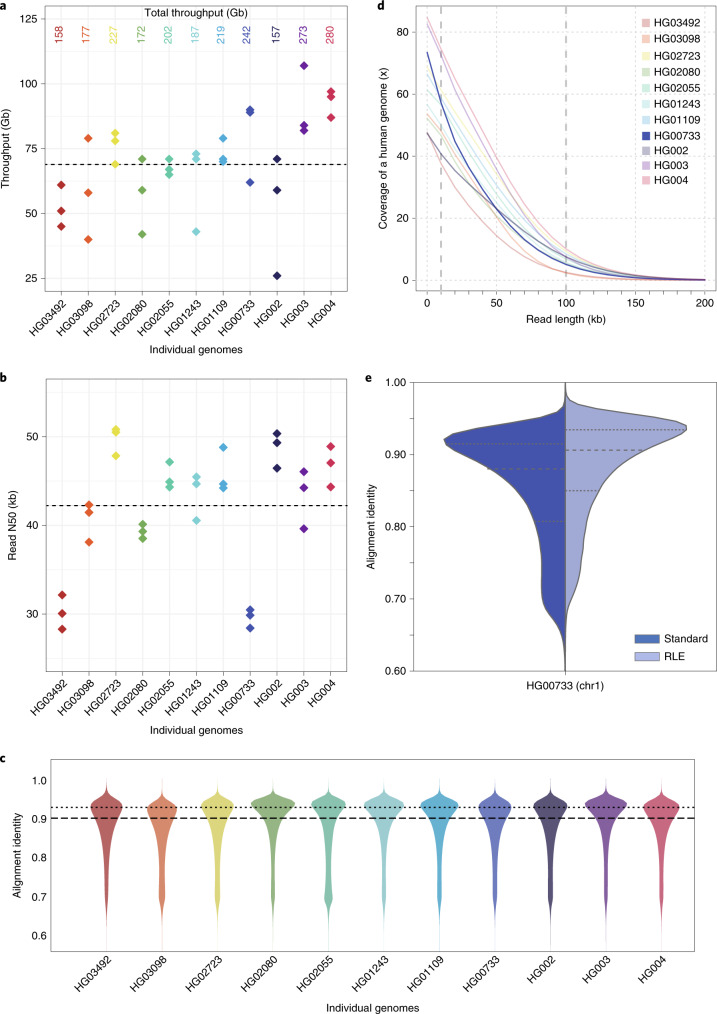
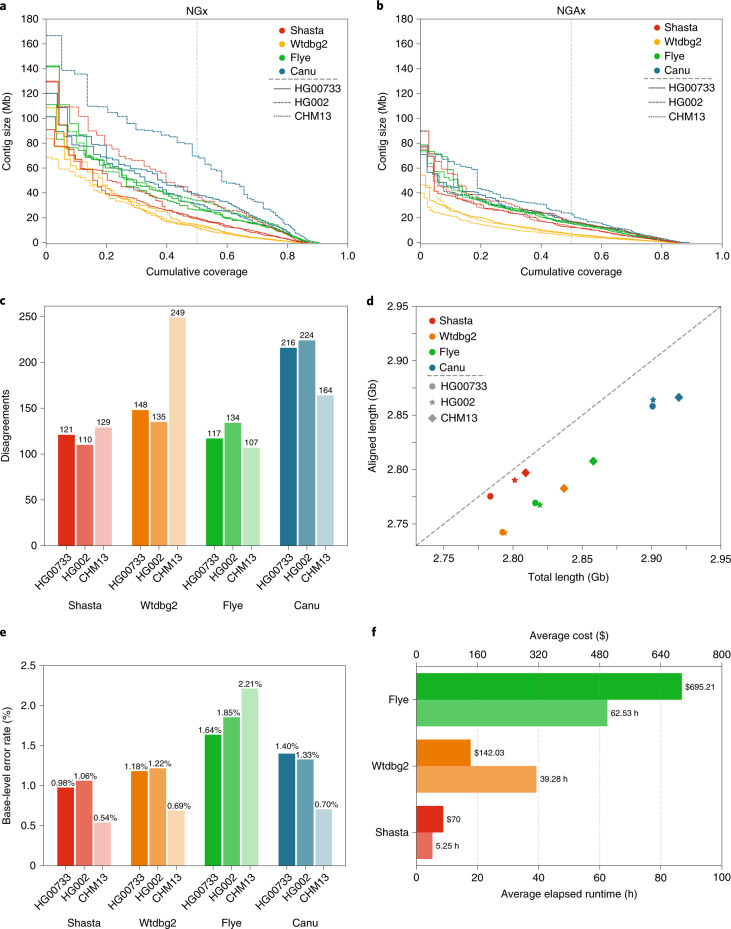
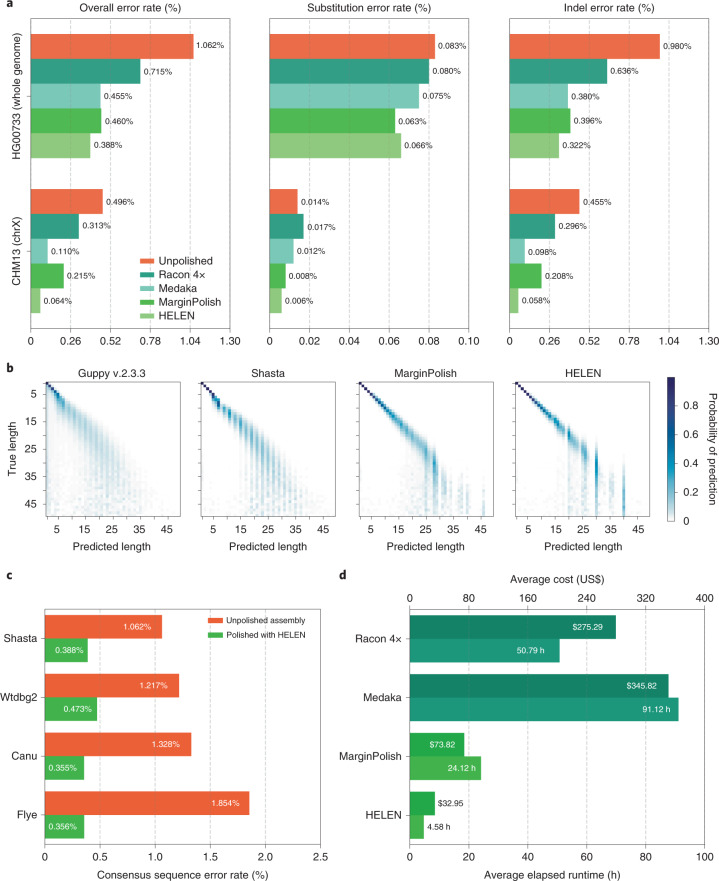
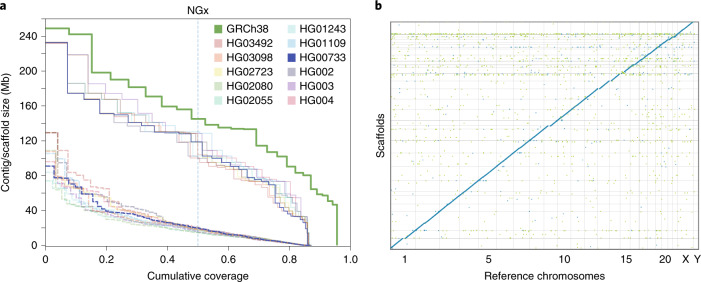
De novo assembly of a human genome using nanopore long-read sequences has been reported, but it used more than 150,000 CPU hours and weeks of wall-clock time. To enable rapid human genome assembly, we present Shasta, a de novo long-read assembler, and polishing algorithms named MarginPolish and HELEN. Using a single PromethION nanopore sequencer and our toolkit, we assembled 11 highly contiguous human genomes de novo in 9 d. We achieved roughly 63× coverage, 42-kb read N50 values and 6.5× coverage in reads >100 kb using three flow cells per sample. Shasta produced a complete haploid human genome assembly in under 6 h on a single commercial compute node. MarginPolish and HELEN polished haploid assemblies to more than 99.9% identity (Phred quality score QV = 30) with nanopore reads alone. Addition of proximity-ligation sequencing enabled near chromosome-level scaffolds for all 11 genomes. We compare our assembly performance to existing methods for diploid, haploid and trio-binned human samples and report superior accuracy and speed.
Overview
The claims and statistics of this paper haven’t been checked yet.
Free: it reads the open-access text and checks the first 5 claims that cite a source we can check. Create a free account to check every claim.
Integrity signals
Registry
Cites
Statistics
Figures

Verification
Claims the paper makes
The claims and statistics of this paper haven’t been checked yet.
Free: it reads the open-access text and checks the first 5 claims that cite a source we can check. Create a free account to check every claim.
Claims other papers make about this one
Each is checked against this paper’s own text: does it say what the citing paper says it does?
The source backs part of the claim, not all of it — or backs it for a different population, condition or comparison.
In the citing paper
“This provides a large set of fully phased human genome assemblies and outperforms earlier efforts on many levels of assembly quality5,16,60.”
From A draft human pangenome reference. (2023) · cites this paper as [16]
Experimental — accuracy not yet measuredThe source backs part of the claim, not all of it — or backs it for a different population, condition or comparison.
In the citing paper
“Similarly driven by technology improvements, sequencing efforts will increasingly produce multiple, phased de novo assemblies from different individuals in a population41.”
From Progressive Cactus is a multiple-genome aligner for the thousand-genome era (2020) · cites this paper as [41]
Experimental — accuracy not yet measuredThe cited source says what the claim attributes to it.
In the citing paper
“These assemblies include 29 samples with long and linked read sequencing data generated entirely by the HPRC and 18 samples sequenced by other efforts16–18.”
From A draft human pangenome reference. (2023) · cites this paper as [16]
The cited source says what the claim attributes to it.
In the citing paper
“These technological advancements also led to a new generation of genome alignment and assembly algorithms leveraging the new data types (84–89).”
From Topological Approaches in Animal Comparative Genomics (2026) · cites this paper as [86]
Self-check
Percentages, sums and reported differences re-computed from the paper’s own numbers.
The self-check needs the paper’s full text.
Citations
Cites
The Genome Analysis Toolkit: A MapReduce framework for analyzing next-generation DNA sequencing data
McKenna, A., Hanna, M., Banks, E., Sivachenko, A., Cibulskis, K., Kernytsky, A., Garimella, K., Altshuler, D., Gabriel, S., Daly, M., et al. (2010) · Genome Research · doi:10.1101/gr.107524.110 · Cited by 27,895
A global reference for human genetic variation
The 1000 Genomes Project Consortium, authors, C., Auton, A., Abecasis, G. R., Steering committee, Altshuler, D. M., Durbin, R. M., Abecasis, G. R., Bentley, D. R., Chakravarti, A., et al. (2015) · Nature · doi:10.1038/nature15393 · Cited by 18,247 · cited 1×
“To do this, we created a list of all low-passage lymphoblastoid cell lines that are part of a trio available from the 1,000 Genomes Project collection 54 (we selected trios to allow future addition of pedigree information, and low-passage line to minimize acquired variation).”
Self-citationMinimap2: Pairwise alignment for nucleotide sequences
Li, H. (2018) · Bioinformatics · doi:10.1093/bioinformatics/bty191 · Cited by 14,807
BUSCO: assessing genome assembly and annotation completeness with single-copy orthologs
Simão, F. A., Waterhouse, R. M., Ioannidis, P., Kriventseva, E. V., & Zdobnov, E. M. (2015) · Bioinformatics · doi:10.1093/bioinformatics/btv351 · Cited by 13,344
(2017) · Cited by 11,625
Walker, B. J., Abeel, T., Shea, T., Priest, M., Abouelliel, A., Sakthikumar, S., Cuomo, C. A., Zeng, Q., Wortman, J., Young, S. K., et al. (2014) · PLoS ONE · doi:10.1371/journal.pone.0112963 · Cited by 9,197
Double-slit photoelectron interference in strong-field ionization of the neon dimer
Kunitski, M., Eicke, N., Huber, P., Köhler, J., Zeller, S., Voigtsberger, J., Schlott, N., Henrichs, K., Sann, H., Trinter, F., et al. (2019) · Nature Communications · doi:10.1038/s41467-018-07882-8 · Cited by 8,162
Double-slit photoelectron interference in strong-field ionization of the neon dimer
Kunitski, M., Eicke, N., Huber, P., Köhler, J., Zeller, S., Voigtsberger, J., Schlott, N., Henrichs, K., Sann, H., Trinter, F., et al. (2019) · Institutional Repository of Leibniz Universität Hannover (Leibniz Universität Hannover) · doi:10.15488/5174 · Cited by 8,161
An integrated map of genetic variation from 1,092 human genomes
The 1000 Genomes Project Consortium (2012) · Nature · doi:10.1038/nature11632 · Cited by 7,711
Self-citationCanu: scalable and accurate long-read assembly via adaptive k -mer weighting and repeat separation
Koren, S., Walenz, B. P., Berlin, K., Miller, J. R., Bergman, N. H., & Phillippy, A. M. (2017) · Genome Research · doi:10.1101/gr.215087.116 · Cited by 7,304
Self-citation
Research works printed but not linked: 1
- Vollger MR Improved assembly and variant detection of a haploid human genome using single-molecule, high-fidelity long reads Ann. Hum. Genet. 2020 84 125 140 31711268 PMC7015760 · DOI · Paper page
Cited by
Items 201–300 of 570
A Chromosome-level genome assembly of giant river prawn (Macrobrachium rosenbergii)
Zheng, Y., Guo, G., Lv, Y., Gao, Q., Zhou, D., Zhang, L., Tu, G., Weng, S., Li, C., He, J., et al. (2024) · Scientific Data · doi:10.1038/s41597-024-03804-0 · Cited by 23
“4.0) 25 , respectively.”
InfluentialMeredith, M., Daida, K., Moller, A., Jerez, P. Á., Negi, S., Malik, L., Genner, R. M., Zheng, X., Gibson, S. B., Mastoras, M., et al. (2024) · bioRxiv (Cold Spring Harbor Laboratory) · doi:10.1101/2024.12.16.628723 · Cited by 22
Self-citationLeitner, K., Motheramgari, K., Borth, N., & Marx, N. (2023) · Biotechnology and Bioengineering · doi:10.1002/bit.28382 · Cited by 21
“0) (Shafin et al., 2020) with default settings was used to create assemblies for both recombinant cell lines, since flye (v2.”
MethodInfluentialChen, Z., Grim, C. J., Ramachandran, P., & Meng, J. (2024) · Microbiology Spectrum · doi:10.1128/spectrum.00117-24 · Cited by 18
The Immersive Graph Genome Explorer: Navigating Genomics in Immersive Virtual Reality
Kuznetsov, M., Elor, A., Kurniawan, S., Bosworth, C. M., Rosen, Y., Heyer, N., Teodorescu, M., Paten, B., & Haussler, D. H. (2021) · SeGAH ... IEEE ... International Conference on Serious Games and Applications for Health/IEEE International Conference on Serious Games and Applications for Health · doi:10.1109/segah52098.2021.9551857 · Cited by 22
Self-citationGenomic prediction using low-coverage portable Nanopore sequencing
Lamb, H. J., Hayes, B. J., Randhawa, I. A. S., Nguyen, L. T., & Ross, E. M. (2021) · PLoS ONE · doi:10.1371/journal.pone.0261274 · Cited by 21
“The proposed 2022 release of ONT’s shoebox sized PromethION P2 [30] could see portable sequencing flow cell yields increase 23-fold [31], through the increased density of pores on PromethION flow cells.”
BackgroundBenchmarking of long-read assemblers for prokaryote whole genome sequencing
Wick, R. R., & Holt, K. E. (2020) · F1000Research · doi:10.12688/f1000research.21782.3 · Cited by 18
Fully resolved assembly of Cryptosporidium parvum
Menon, V. K., Okhuysen, P. C., Chappell, C. L., Mahmoud, M., Mahmoud, M., Meng, Q., Doddapaneni, H., Vee, V., Han, Y., Salvi, S., et al. (2022) · GigaScience · doi:10.1093/gigascience/giac010 · Cited by 18
“Furthermore, the variety of de novo assembly methods (e.g., Canu [Canu, RRID:SCR_015880] [22], Flye [Flye, RRID:SCR_017016] [23],Shasta [24],Falcon [25]) makes it harder to choose the best representation.”
Self-citationBiSCoT: improving large eukaryotic genome assemblies with optical maps
Istace, B., Belser, C., & Aury, J. (2020) · PeerJ · doi:10.7717/peerj.10150 · Cited by 18
Improving the time and space complexity of the WFA algorithm and generalizing its scoringPreprint
Eizenga, J. M., & Paten, B. (2022) · bioRxiv (Cold Spring Harbor Laboratory) · doi:10.1101/2022.01.12.476087 · Cited by 24
“Moreover, such sequences are now routinely produced by increasingly long sequencing reads (>1 Mbp) (Jain et al. , 2018) and the increasingly contiguous genome assemblies (>10 Mbp) that these long reads have enabled (Cheng et al. , 2021; Shafin et al. , 2020).”
BackgroundSelf-citationHighly accurate assembly polishing with DeepPolisher
Mastoras, M., Asri, M., Brambrink, L., Hebbar, P., Kolesnikov, A., Cook, D. E., Nattestad, M., Lucas, J., Won, S. T., Chang, P.-C., et al. (2025) · Genome Research · doi:10.1101/gr.280149.124 · Cited by 23
Self-citationMusic of metagenomics—a review of its applications, analysis pipeline, and associated tools
Wajid, B., Anwar, F., Wajid, I., Nisar, H., Meraj, S., Zafar, A., AlShawaqfeh, M. K., Ekti, A. R., Khatoon, A., & Suchodolski, J. S. (2021) · Functional & Integrative Genomics · doi:10.1007/s10142-021-00810-y · Cited by 17
A deep dive into genome assemblies of non-vertebrate animals
Guiglielmoni, N., Rivera‐Vicéns, R. E., Koszul, R., & Flot, J. (2022) · Peer Community Journal · doi:10.24072/pcjournal.128 · Cited by 17
Local genetic adaptation to habitat in wild chimpanzees
Ostridge, H. J., Fontsere, C., Lizano, E., Soto, D. C., Schmidt, J. M., Saxena, V., Álvarez-Estapé, M., Barratt, C. D., Gratton, P., Bocksberger, G., et al. (2025) · Science · doi:10.1126/science.adn7954 · Cited by 22
TT-Mars: structural variants assessment based on haplotype-resolved assemblies
Yang, J., & Chaisson, M. (2022) · Genome biology · doi:10.1186/s13059-022-02666-2 · Cited by 17
Flack, N., Drown, M. K., Walls, C., Pratte, J., McLain, A. T., & Faulk, C. D. (2023) · NAR Genomics and Bioinformatics · doi:10.1093/nargab/lqad033 · Cited by 19
“com/Nextomics/NextDenovo), Shasta (32), and Raven (33).”
Gunter, H. M., Youlten, S. E., Madala, B. S., Reis, A. L. M., Stevanovski, I., Wong, T., Kummerfield, S., Deveson, I. W., Santini, N. S., Marcellin, E., et al. (2022) · Nature Communications · doi:10.1038/s41467-022-34028-8 · Cited by 17
“These tools often employ a range of machine learning and homology-based methods to model and mitigate systematic errors 19,37,38 .”
Long amplicon HiFi sequencing for mitochondrial DNA genomes
Cai, Z., Hu, J., Yin, T., Wang, D., Shen, Q., Ma, C., Ou, D., Xu, M., Shi, X., Li, Q., et al. (2023) · Molecular Ecology Resources · doi:10.1111/1755-0998.13765 · Cited by 15
Dodge, T. O., Kim, B. Y., Baczenas, J. J., Banerjee, S. M., Gunn, T. R., Donny, A. E., Given, L. A., Rice, A., Cox, S. K. H., Weinstein, M. L., et al. (2024) · Current Biology · doi:10.1016/j.cub.2024.08.053 · Cited by 17
Prins, B. P., Leitsalu, L., Pärna, K., Fischer, K., Metspalu, A., Haller, T., & Snieder, H. (2021) · Journal of Personalized Medicine · doi:10.3390/jpm11050358 · Cited by 19
“One such technique is nanopore or ‘strand sequencing’ which allow sequencing of longer reads and faster phasing of genomes [52].”
MethodDuet: SNP-assisted structural variant calling and phasing using Oxford nanopore sequencing
Zhou, Y., Leung, A. W.-S., Ahmed, S. S., Lam, T., & Luo, R. (2022) · BMC Bioinformatics · doi:10.1186/s12859-022-05025-x · Cited by 17
“The benchmarking was on HG001, HG002, and HG00733, three standard human samples from the Human PanGenomics Project [25], with available high-confidence haplotype-resolved SV truth sets from HGSVC2 [18].”
BackgroundDixon, K., Shen, Y., O’Neill, K., Mungall, K. L., Chan, S., Bilobram, S., Zhang, W., Bezeau, M., Sharma, A., Fok, A. K., et al. (2023) · European Journal of Human Genetics · doi:10.1038/s41431-023-01284-1 · Cited by 15
“Single nucleotide variant (SNV) and small insertion and deletion (indel) calling and phasing were performed using an established pipeline [7].”
MethodKoo, H., Lee, G.-W., Ko, S.-R., Go, S., Kwon, S., Kim, Y., & Shin, A.-Y. (2023) · Scientific Data · doi:10.1038/s41597-023-02631-z · Cited by 17
Mabs, a suite of tools for gene-informed genome assembly
Schelkunov, M. I. (2023) · BMC Bioinformatics · doi:10.1186/s12859-023-05499-3 · Cited by 17
“The most prominent example that I have seen is Shasta [20], with Shasta 0.10.0 having 116 parameters that may affect the produced assembly.”
BackgroundInfluentialWu, Z., Li, T., Jiang, Z., Zheng, J., Gu, Y., Liu, Y., Liu, Y., & Xie, Z. (2024) · Nucleic Acids Research · doi:10.1093/nar/gkae086 · Cited by 18
“To further assess the assembly disagreement counts, as reported by QUAST, which mainly include instances of lo-cal misassembly and inconsistency, we employed the estimation methods proposed by Shafin et al. ( 23 ).”
MethodResultSVHunter: long-read-based structural variation detection through the transformer model
Gao, R., Hu, H. K., Jiang, Z., Cao, S., Wang, G., Zhao, Y., & Jiang, T. (2025) · Briefings in Bioinformatics · doi:10.1093/bib/bbaf203 · Cited by 16
“[41–43] To comprehensively assess SVHunter’s SV detection capabilities across different reference genomes, we used CHM13 ( Complete Hydatidiform Mole 13 ) sample PacBio CLR 36 × data and conducted two sets of alignment experiments: (i) aligning the data to the GRCh38 reference genome, and (ii)…”
Genome Assembly and Sex-Determining Region of Male and Female Populus × sibirica
Melnikova, N. V., Pushkova, E. N., Dvorianinova, E. M., Beniaminov, A. D., Novakovskiy, R. O., Povkhova, L. V., Bolsheva, N. L., Snezhkina, A. V., Kudryavtseva, A. V., Krasnov, G. S., et al. (2021) · Frontiers in Plant Science · doi:10.3389/fpls.2021.625416 · Cited by 17
Optimizing experimental design for genome sequencing and assembly with Oxford Nanopore Technologies
Sutton, J. M., Millwood, J. D., McCormack, A. C., & Fierst, J. L. (2021) · Gigabyte · doi:10.46471/gigabyte.27 · Cited by 14
“outperforms Canu while being much faster and using fewer computational resources [13, 46], 356”
BackgroundGeometric deep learning framework for de novo genome assembly
Vrček, L., Bresson, X., Laurent, T., Schmitz, M., Kawaguchi, K., & Šikić, M. (2024) · Genome Research · doi:10.1101/gr.279307.124 · Cited by 17
“Although the idea seems far-fetched at first, both assemblers follow the same sequence alignment principles and construct the graphs in the same fashion, only from the different underlying data.”
Fast and accurate mapping of long reads to complete genome assemblies with VerityMap
Bzikadze, A. V., Mikheenko, A., & Pevzner, P. A. (2022) · Genome Research · doi:10.1101/gr.276871.122 · Cited by 21
Advances in forensic genetics: Exploring the potential of long read sequencing
Ferreira, M. R., Carratto, T. M. T., Recalde, T. S. F., Bonadio, R. S., Jain, M., de Oliveira, S. F., Castelli, E. C., & Mendes‐Junior, C. T. (2024) · Forensic Science International Genetics · doi:10.1016/j.fsigen.2024.103156 · Cited by 17
Self-citationBrink, D. P., Mierke, F., Norbeck, J., Siewers, V., & Andlid, T. A. (2023) · Microbial Cell Factories · doi:10.1186/s12934-023-02175-2 · Cited by 14
“6.0; [68]).”
InfluentialUnterman, I., Avrahami, D., Katsman, E., Triche, T. J., Gläser, B., & Berman, B. P. (2024) · Genome biology · doi:10.1186/s13059-024-03275-x · Cited by 18
“Sequencing technologies from Oxford Nanopore and Pacific Biosciences sequence DNA methylation natively from tissues with fragments in the 5–20-kb range [34], which should translate to higher accuracy for read-aware approaches like CelFiE-ISH if longer markers are selected.”
MethodHorz, J. M., Wolff, K., Friedhoff, R., & Pucker, B. (2026) · BMC Genomics · doi:10.1186/s12864-026-12889-3 · Cited by 17
Isolating Linum usitatissimum L. Nuclear DNA Enabled Assembling High-Quality Genome
Dvorianinova, E. M., Bolsheva, N. L., Pushkova, E. N., Rozhmina, T. A., Zhuchenko, A. A., Novakovskiy, R. O., Povkhova, L. V., Sigova, E. A., Zhernova, D. A., Borkhert, E. V., et al. (2022) · International Journal of Molecular Sciences · doi:10.3390/ijms232113244 · Cited by 15
CulebrONT: a streamlined long reads multi-assembler pipeline for prokaryotic and eukaryotic genomes
Orjuela, J., Comte, A., Ravel, S., Charriat, F., Vi, T., Sabot, F., & Cunnac, S. (2022) · Peer Community Journal · doi:10.24072/pcjournal.153 · Cited by 15
Otsuki, A., Okamura, Y., Ishida, N., Tadaka, S., Takayama, J., Kumada, K., Kawashima, J., Taguchi, K., Minegishi, N., Kuriyama, S., et al. (2022) · Communications Biology · doi:10.1038/s42003-022-03953-1 · Cited by 16
Palmer, W. J., Jacygrad, E., Sagayaradj, S., Cavanaugh, K., Han, R., Bertier, L. D., Beede, B., Kafkas, S., Golino, D., Preece, J. E., et al. (2022) · G3 Genes Genomes Genetics · doi:10.1093/g3journal/jkac317 · Cited by 13
Nanopore Sequencing Technology as an Emerging Tool for Diversity Studies of Plant Organellar Genomes
Sawicki, J., Krawczyk, K., Paukszto, Ł., Maździarz, M. A., Kurzyński, M., Szablińska‐Piernik, J., & Szczecińska, M. (2024) · Diversity · doi:10.3390/d16030173 · Cited by 16
De-novo Assembly of Limnospira fusiformis Using Ultra-Long Reads
Hicks, M., Tran-Dao, T.-K., Mulroney, L., & Bernick, D. L. (2021) · Frontiers in Microbiology · doi:10.3389/fmicb.2021.657995 · Cited by 12
Abdel‐Glil, M. Y., Solle, J., Wibberg, D., Neubauer, H., & Sprague, L. (2024) · Scientific Data · doi:10.1038/s41597-024-03818-8 · Cited by 12
CGC1, a new reference genome for Caenorhabditis elegans
Ichikawa, K., Shoura, M. J., Artiles, K. L., Jeong, D., Owa, C., Kobayashi, H., Suzuki, Y., Kanamori, M., Toyoshima, Y., Iino, Y., et al. (2025) · Genome Research · doi:10.1101/gr.280274.124 · Cited by 16
Goussarov, G., Mysara, M., Cleenwerck, I., Claesen, J., Leys, N., Vandamme, P. A. R., & Houdt, R. V. (2024) · Microbiology · doi:10.1099/mic.0.001469 · Cited by 16
“4.4-a) [33], WTDBG v2.”
InfluentialBackenstose, N. J. C., MacGuigan, D. J., Osborne, C. A., Bernal, M. A., Thomas, E. K., Normandeau, É., Yule, D. L., Stott, W., Ackiss, A. S., Albert, V. A., et al. (2024) · Communications Biology · doi:10.1038/s42003-024-06503-z · Cited by 13
Cookbook for plant genome sequences
de Oliveira, J. A. V. S., Choudhary, N., Meckoni, S. N., Nowak, M. S., Hagedorn, M., & Pucker, B. (2026) · BMC Genomics · doi:10.1186/s12864-026-12623-z · Cited by 14
“Current state-of-the-art long-read assemblers include Shasta [104], NextDenovo [99], Verkko2 [105], and Hifiasm [101].”
Mierke, F., Brink, D. P., Norbeck, J., Siewers, V., & Andlid, T. A. (2023) · Fungal Genetics and Biology · doi:10.1016/j.fgb.2023.103783 · Cited by 13
Haplotype-resolved assemblies and variant benchmark of a Chinese Quartet
Jia, P., Dong, L., Yang, X., Wang, B., Bush, S. J., Wang, T., Lin, J., Wang, S., Zhao, X., Xu, T., et al. (2023) · Genome biology · doi:10.1186/s13059-023-03116-3 · Cited by 16
“8.3-b1695) and shasta [45] (v0.”
MethodInfluentialMartín, S., Lesny, P., Glenner, H., Hecht, J., Vilcinskas, A., Bartolomaeus, T., & Podsiadłowski, L. (2022) · Genome Biology and Evolution · doi:10.1093/gbe/evac149 · Cited by 13
Cartney, A. M. M., Hilario, E., Choi, S., Guhlin, J. G., Prebble, J. M., Houliston, G. J., Buckley, T. R., & Chagné, D. (2021) · Molecular Ecology Resources · doi:10.1111/1755-0998.13406 · Cited by 13
Accelerating Minimap2 for accurate long read alignment on GPUsPreprint
Sadasivan, H., Maric, M., Dawson, E. T., Iyer, V., Israeli, J., & Narayanasamy, S. (2022) · Research Square · doi:10.21203/rs.3.rs-1523696/v2 · Cited by 11
Gao, S., Jia, Y., Guo, H., Xu, T., Wang, B., Bush, S. J., Wan, S., Zhang, Y., Yang, X., & Ye, K. (2024) · Cell Genomics · doi:10.1016/j.xgen.2024.100626 · Cited by 14
Trinh, J., Schaake, S., Gabbert, C., Lüth, T., Cowley, S. A., Fienemann, A., Ullrich, K. K., Klein, C., & Seibler, P. (2024) · BMC Genomics · doi:10.1186/s12864-024-10902-1 · Cited by 11
“Therefore, it might be helpful to complement the SV detection from long-read data with other approaches like de novo assembly or coverage quantification-based methods [21, 39].”
BackgroundMicrofluidic purification of genomic DNA
Wang, J., Butler, J. E., & Ladd, A. J. C. (2025) · Proceedings of the National Academy of Sciences · doi:10.1073/pnas.2417757122 · Cited by 10
Nanopore adaptive sampling to identify the NLR gene family in melon (Cucumis melo L.)
Belinchon-Moreno, J., Berard, A., Canaguier, A., Chovelon, V., Cruaud, C., Engelen, S., Feriche-Linares, R., Clainche, I. L., Marande, W., Rittener-Ruff, V., et al. (2025) · BMC Genomics · doi:10.1186/s12864-025-11295-5 · Cited by 12
“We tested a set of assemblers tailored for ONT sequencing data, including Canu [43], Flye [44], Shasta [45], Necat [46], Raven [47] and SMARTdenovo [48], for assembling the NAS reads (data not shown).”
Houmenou, C. T., Sokhna, C., Fenollar, F., & Mediannikov, O. (2025) · Infection Genetics and Evolution · doi:10.1016/j.meegid.2025.105859 · Cited by 12
Meyer, D., Göettsch, W., Spangenberg, J., Stieber, B., Krautwurst, S., Hölzer, M., Brandt, C., Linde, J., zu Siederdissen, C. H., Srivastava, A., et al. (2026) · Nucleic Acids Research · doi:10.1093/nar/gkag023 · Cited by 16
“Alternative tools, such as Shasta ( https:// github.com/ paoloshasta/ shasta ) [ 89 ], have been shown to perform faster, while NextDen-ovo ( https:// github.com/ Nextomics/ NextDenovo ) [ 90 ] can generate longer contigs, particularly in the case of mollusks [ 91 ].”
Optimized sample selection for cost-efficient long-read population sequencing
Ranallo-Benavidez, T. R., Lemmon, Z. H., Soyk, S., Aganezov, S. S., Salerno, W. J., McCoy, R. C., Lippman, Z. B., Schatz, M. C., & Sedlazeck, F. J. (2021) · Genome Research · doi:10.1101/gr.264879.120 · Cited by 14
“study of 11 human genomes and 100 tomato genomes sequenced with long reads (Alonge et al. 2020; Shafin et al. 2020).”
BackgroundMethodSelf-citationA near complete genome assembly of the East Friesian sheep genome
You, X., Fang, Q., Chen, C., Cao, J., Fu, S., Zhang, T., Wang, S., He, X., He, J., Zhou, Y., et al. (2024) · Scientific Data · doi:10.1038/s41597-024-03581-w · Cited by 14
“25 .”
de Visser, M. C., France, J., Paulouskaya, O., Brown, T., Fahrbach, M., van der Ploeg, C., & Wielstra, B. (2024) · bioRxiv (Cold Spring Harbor Laboratory) · doi:10.1101/2024.10.25.620277 · Cited by 14
“Only heterokaryotypic (1A1B) individuals survive the balanced lethal system, while homokaryotypic individuals (1A1A and 1B1B) experience developmental arrest 19, 23, 24, 25 .”
A brain microbiome in salmonids at homeostasis
Mani, A., Henn, C., Couch, C. E., Patel, S., Lieke, T., Chan, J. T. H., Korytář, T., & Salinas, I. (2024) · Science Advances · doi:10.1126/sciadv.ado0277 · Cited by 9
“De novo genome assembly for each sample was performed in Shasta version 0.11.1 ( 108 ).”
MethodInfluentialDetecting transposable elements in long-read genomes using sTELLeR
Sæther, K. B., & Eisfeldt, J. (2024) · Bioinformatics · doi:10.1093/bioinformatics/btae686 · Cited by 12
Chisompola, D., Luwaya, E. L., Nzobokela, J., Mwansa, P., & Chakulya, M. (2026) · Frontiers in Microbiology · doi:10.3389/fmicb.2025.1717859 · Cited by 16
“…nanopores embedded in membranes to directly read native DNA or RNA molecules as they translocate through the pore, generating reads of virtually unlimited length, routinely exceeding 100 kilobases (kb) and occasionally surpassing 1 megabase (Mb) (Moustakli et al., 2025; Shafin et al., 2020).”
Micronuclear ecDNA constrains tumor cell fitness and is associated with favorable patient survival
Brückner, L., Xu, R., Tang, J., Gnanasekar, A., Herrmann, A., Wong, I. T.-L., Zhang, S., Tu, F., Pilon, M., Kukalev, A., et al. (2026) · Nature Genetics · doi:10.1038/s41588-026-02782-w · Cited by 10
Coverage-preserving sparsification of overlap graphs for long-read assembly
Jain, C. (2023) · Bioinformatics · doi:10.1093/bioinformatics/btad124 · Cited by 12
“Long-read sequencing technologies have shown the greatest promise in achieving high-quality hap26 loid and diploid genome assemblies [1,3,8,11,21,23,27,28].”
BackgroundCastellano, K. R., Batta‐Lona, P. G., Bucklin, A., & O'Neill, R. J. W. (2023) · Scientific Reports · doi:10.1038/s41598-023-47429-6 · Cited by 12
Constructing telomere-to-telomere diploid genome by polishing haploid nanopore-based assembly
Darian, J. C., Kundu, R., Rajaby, R., & Sung, W.-K. K. (2024) · Nature Methods · doi:10.1038/s41592-023-02141-1 · Cited by 12
“16, compared with Supplementary Fig.”
Sexual dimorphism in the tardigrade Paramacrobiotus metropolitanus transcriptome
Sugiura, K., Yoshida, Y., Hayashi, K., Arakawa, K., Kunieda, T., & Matsumoto, M. (2024) · Zoological Letters · doi:10.1186/s40851-024-00233-0 · Cited by 10
“11.1 [57], Flye v2.”
InfluentialminiSNV: accurate and fast single nucleotide variant calling from nanopore sequencing data
Cui, M., Liu, Y., Yu, X., Guo, H., Jiang, T., Wang, Y., & Liu, B. (2024) · Briefings in Bioinformatics · doi:10.1093/bib/bbae473 · Cited by 10
“ONT is a nanopore-based and high-throughput sequencing platform that can generate reads greater than 100 kb [11, 12], which can easily span and map to repetitive genomic regions.”
BackgroundMitsuhashi, S., Frith, M. C., & Matsumoto, N. (2021) · BMC Medical Genomics · doi:10.1186/s12920-020-00853-3 · Cited by 13
Oresegun, D. R., Thorpe, P., Benavente, E. D., Campino, S. G., Muh, F., Moon, R. W., Clark, T. G., & Cox‐Singh, J. (2022) · Frontiers in Genetics · doi:10.3389/fgene.2022.855052 · Cited by 12
Assessing de novo parasite genomes assembled using only Oxford Nanopore Technologies MinION data
Herzog, K. S., Wu, R., Hawdon, J. M., Nejsum, P. L., & Fauver, J. R. (2024) · iScience · doi:10.1016/j.isci.2024.110614 · Cited by 9
Muñoz‐Barrera, A., Rubio‐Rodríguez, L. A., Jáspez, D., Corrales, A., Marcelino-Rodríguez, I., Ortiz, L., Mendoza, P., Lorenzo-Salazar, J. M., González‐Montelongo, R., & Flores, C. (2025) · Computational and Structural Biotechnology Journal · doi:10.1016/j.csbj.2025.07.020 · Cited by 11
“9.0) [28], Flye (v2.”
InfluentialLong-read sequencing for bacterial plasmid analysis: a brief overview
van Almsick, V. F., Sobkowiak, A., & Schwierzeck, V. (2026) · FEMS Microbiology Letters · doi:10.1093/femsle/fnag014 · Cited by 13
Yam, J., Bogema, D. R., Micallef, M. L., Djordjevic, S. P., & Jenkins, C. (2022) · Pathogens · doi:10.3390/pathogens11070801 · Cited by 8
de Almeida, F. M., de Campos, T. A., & Pappas, G. J., Jr. (2023) · F1000Research · doi:10.12688/f1000research.139488.1 · Cited by 10
“On the other hand, when only using long-reads, it uses one or more of the following assemblers: Unicycler, Canu (Koren et al., 2017), Flye (Kolmogorov et al., 2019), Raven (Vaser and Š iki ć , 2021), Shasta (Shafin et al., 2020), and Wtdbg2 (Ruan and Li, 2019).”
MethodHybrid-hybrid correction of errors in long reads with HERO
Kang, X., Xu, J., Luo, X. L., & Schönhuth, A. (2023) · Genome biology · doi:10.1186/s13059-023-03112-7 · Cited by 11
“TGS reads also support the accurate identification of complex structural variants [6], and they are the foundation for enhanced haplotype phasing [7], structural variant calling [8] and the assembly of (complex) genomes [9].”
BackgroundMethodSelective Capture and Manipulation of DNA through Double Charged Nanopores
Lin, X., Chen, H., Wu, G., Zhao, J., Zhang, Y., Sha, J., & Si, W. (2024) · The Journal of Physical Chemistry Letters · doi:10.1021/acs.jpclett.4c00672 · Cited by 8
Hu, H. K., Gao, R., Gao, W., Gao, B., Jiang, Z., Zhou, M., Wang, G., & Jiang, T. (2024) · Briefings in Bioinformatics · doi:10.1093/bib/bbae336 · Cited by 9
Luo, C., Liu, Y. H., & Zhou, X. (2024) · Nature Communications · doi:10.1038/s41467-024-51282-0 · Cited by 9
“We selected hi fi asm and Flye as the default assemblers for various long-read datasets after evaluating several upstream long-read assemblers, including hi fi asm 26 , Flye 27 , Peregrine 40 , wtdbg2 41 , IPA 42 , HiCanu 43 , and Shasta 44 .”
InfluentialLi, Y., Liu, X., Chen, C., Qiu, J., Kocot, K. M., & Sun, J. (2026) · Molecular Ecology Resources · doi:10.1111/1755-0998.70116 · Cited by 9
“The raw data will go through a simple, coarse assembly using a de novo assembler, such as MEGAHIT (Li et al. 2015) for genomic data (i.e., NGS), Trinity (Haas et al. 2013) for transcriptome data (i.e., RNA), hifiasm (Cheng et al. 2021) for HiFi and Shasta (Shafin et al. 2020) for nanopore reads (i.e., ONT), after qual…”
InfluentialCritical length in long-read resequencing
Coster, W. D., Stražišar, M., & Rijk, P. D. (2020) · NAR Genomics and Bioinformatics · doi:10.1093/nargab/lqz027 · Cited by 8
CSA: A high-throughput chromosome-scale assembly pipeline for vertebrate genomes
Kuhl, H., Li, L., Wuertz, S., Stöck, M., Liang, X., & Klopp, C. (2020) · GigaScience · doi:10.1093/gigascience/giaa034 · Cited by 9
Nanopore quality score resolution can be reduced with little effect on downstream analysis
Rivara-Espasandín, M., Balestrazzi, L., y Álvarez, G. D., Ochoa, I., Seroussi, G., Smircich, P., Sotelo-Silveira, J. R., & Martín, Á. (2022) · Bioinformatics Advances · doi:10.1093/bioadv/vbac054 · Cited by 8
Lee, H., Min, J. W., Mun, S., & Han, K. (2022) · Life · doi:10.3390/life12101583 · Cited by 10
Targeted MinION sequencing of transgenes
Boutigny, A.-L., Fioriti, F., & Rolland, M. (2020) · Scientific Reports · doi:10.1038/s41598-020-71614-6 · Cited by 8
Liu, Z., Zheng, J., Li, H., Fang, K., Wang, S., He, J. G., Zhou, D., Weng, S., Chi, M., Gu, Z., et al. (2024) · BMC Genomics · doi:10.1186/s12864-024-10673-9 · Cited by 13
“The C. quadricarinatus genome was assembled into contigs with Nanopore reads using Shasta and WTDBG2, respectively [23, 24].”
MethodInfluentialΠαπαδόπουλος, Ν., Kulkarni, S., Baranyi, C., Fromm, B., Setton, E. V. W., Sharma, P. P., Wanninger, A., & Brenneis, G. (2025) · BMC Biology · doi:10.1186/s12915-025-02276-x · Cited by 8
“11.1 [111], and Verkko v2.”
InfluentialGet ready for short tandem repeats analysis using long reads-the challenges and the state of the art
Chaushevska, M., Alapont-Celaya, K., Schack, A. K., Krych, Ł., Garrido-Navas, M. C., Krithara, A., & Madjarov, G. (2025) · Frontiers in Genetics · doi:10.3389/fgene.2025.1610026 · Cited by 11
Boosting variant-calling performance with multi-platform sequencing data using Clair3-MP
Yu, H., Zheng, Z., Su, J., Lam, T., & Luo, R. (2023) · BMC Bioinformatics · doi:10.1186/s12859-023-05434-6 · Cited by 8
“The ONT sequencing data was obtained from the Human Pangenome Reference Consortium (HPRC) [16] with r9.”
MethodBenchmarking multi-platform sequencing technologies for human genome assembly
Wang, J., Veldsman, W. P., Fang, X., Huang, Y., Xie, X., Lü, A., & Zhang, L. (2023) · Briefings in Bioinformatics · doi:10.1093/bib/bbad300 · Cited by 7
Chey, Y. C. J., Corbett, M. A., Arudkumar, J., Piltz, S., Thomas, P. Q., & Adikusuma, F. (2024) · BMC Biology · doi:10.1186/s12915-024-02008-7 · Cited by 7
“Nanopore sequence reads were assembled de novo using Shasta v 0.11.1 [33] using the Nanopore-May2022 model adjusting the minimum length of input reads to 5 kb.”
MethodInfluentialLiu, L., Zhang, J., Wood, S., Newell, F., Leonard, C., Koufariotis, L. T., Nones, K., Dalley, A. J., Chittoory, H., Bashirzadeh, F., et al. (2024) · BMC Genomics · doi:10.1186/s12864-024-10792-3 · Cited by 8
“The provided control panel was previously generated by aligning 30 × Nanopore sequencing data from the Human Pangenome Reference Consortium (HPRC) to the GRCh38 reference genome with minimap2 version 2.24 [48].”
MethodInfluentialA personalized multi‐platform assessment of somatic mosaicism in the human frontal cortex
Zhou, W., Mumm, C., Gan, Y., Switzenberg, J. A., Wang, J., Oliveira, P. D., Kathuria, K., Losh, S. J., McDonald, T. L., Bessell, B., et al. (2025) · Alzheimer s & Dementia · doi:10.1002/alz70855_103962 · Cited by 9
GapPredict – A Language Model for Resolving Gaps in Draft Genome Assemblies
Chen, E., Chu, J., Zhang, J. J., Warren, R. L., & Birol, İ. (2021) · IEEE Transactions on Computational Biology and Bioinformatics · doi:10.1109/tcbb.2021.3109557 · Cited by 8
“model could be used to predict any set of gaps for the assembly in parallel, similar in idea to HELEN [17].”
BackgroundMethodInfluentialWalker, K., Kalra, D., Lowdon, R. F., Chen, G., Molik, D. C., Soto, D. C., Dabbaghie, F., Khleifat, A. A., Mahmoud, M., Paulin, L. F., et al. (2022) · F1000Research · doi:10.12688/f1000research.110194.1 · Cited by 8
Self-citationLi, J. X., Coombe, L., Wong, J., Birol, İ., & Warren, R. L. (2022) · Current Protocols · doi:10.1002/cpz1.442 · Cited by 7
“We illustrate the steps with an E. coli strain NDM5 dataset consisting of a long-read Shasta (Shafin et al., 2020) assembly generated from ONT MinION reads and paired-end Illumina MiSeq reads for assembly finishing.”
MethodAccuVIR: an ACCUrate VIRal genome assembly tool for third-generation sequencing data
Yu, R., Cai, D., & Sun, Y. (2022) · Bioinformatics · doi:10.1093/bioinformatics/btac827 · Cited by 7
Klußmeier, A., Putke, K., Klasberg, S., Kohler, M., Sauter, J., Schefzyk, D., Schöfl, G., Massalski, C., Schäfer, G., Schmidt, A. H., et al. (2023) · Frontiers in Immunology · doi:10.3389/fimmu.2023.1297589 · Cited by 9
Fatima, N., Petri, A., Gyllensten, U. B., Feuk, L., & Ameur, A. (2020) · Genes · doi:10.3390/genes11121444 · Cited by 8
BlockPolish: accurate polishing of long-read assembly via block divide-and-conquer
Huang, N., Nie, F., Ni, P., Gao, X., Luo, F., & Wang, J. (2021) · Briefings in Bioinformatics · doi:10.1093/bib/bbab405 · Cited by 6
“The latest assemblers such as Flye [14], Wtdbg2 [15] and Shasta [16] avoid the error correction step, and directly assemble from erroneous raw reads and finally use a polishing workflow to increase the accuracy.”
BackgroundMethod
Metadata
- Authors
- Shafin, K., Pesout, T., Lorig-Roach, R., Haukness, M., Olsen, H. E., Bosworth, C., Armstrong, J., Tigyi, K., Maurer, N., Koren, S., Sedlazeck, F. J., Marschall, T., Mayes, S., Costa, V., Zook, J. M., Liu, K. J., Kilburn, D., Sorensen, M., Munson, K. M., Vollger, M. R., Monlong, J., Garrison, E., Eichler, E. E., Salama, S., Haussler, D., Green, R. E., Akeson, M., Phillippy, A., Miga, K. H., Carnevali, P., Jain, M., & Paten, B.
- Affiliations
- University of California, Santa Cruz (US)
- Howard Hughes Medical Institute (US)
- National Institutes of Health (US)
- Baylor College of Medicine (US)
- Max Planck Institute for Informatics (DE)
- Oxford Nanopore Technologies (United Kingdom) (GB)
- National Institute of Standards and Technology (US)
- Circulomics (United States) (US)
- University of Washington (US)
- Chan Zuckerberg Initiative (United States) (US)
- Corresponding author
- Carnevali, Paolo
- Jain, Miten
- Paten, Benedict
- ORCID
- Shafin, Kishwar
- Pesout, Trevor
- Lorig-Roach, Ryan
- Haukness, Marina
- Olsen, Hugh E.
- Bosworth, Colleen
- Armstrong, Joel
- Maurer, Nicholas
- Koren, Sergey
- Sedlazeck, Fritz J.
- Marschall, Tobias
- Zook, Justin M.
- Liu, Kelvin J.
- Kilburn, Duncan
- Sorensen, Melanie
- Munson, Katy M.
- Vollger, Mitchell R.
- Monlong, Jean
- Garrison, Erik
- Eichler, Evan E.
- Salama, Sofie
- Haussler, David
- Green, Richard E.
- Akeson, Mark
- Phillippy, Adam
- Miga, Karen H.
- Jain, Miten
- Paten, Benedict
- Venue
- Nature Biotechnology
- Published
- 2020-05-04
- Volume
- 38
- Issue
- 9
- Pages
- 1044-1053
- ISSN
- 0733-222X (ISSN-L)
- 1087-0156
- 1546-1696
- PMC
- PMC7483855
- OpenAlex
- W3022783334
- Semantic Scholar
- f9d407ce133ec096ab4321e6d98e8f0081f5bdcc
- Cited by
- 567
- References
- 74
- Citations by year
- 2026: 44 · 2025: 62 · 2024: 117 · 2023: 91 · 2022: 89 · 2021: 115 · 2020: 44
- FWCI
- 27.90
- Type
- journal article
- Language
- en
- Open access
- hybrid
- doi.org
- Licence
- cc-by
- creativecommons.org/licenses/by/4.0 (tdm)
- creativecommons.org/licenses/by/4.0 (vor)
- Locations
- Nature Biotechnology (publishedVersion, cc-by)
- bioRxiv (Cold Spring Harbor Laboratory) (acceptedVersion, cc-by)
- PubMed Central (publishedVersion, cc-by)
- PubMed (publishedVersion)
- HAL (submittedVersion)
- eScholarship (California Digital Library) (submittedVersion)
- MPG.PuRe (Max Planck Society) (submittedVersion, other-oa)
- Funders
- U.S. Department of Health & Human Services | NIH | National Heart, Lung, and Blood Institute (1U01HL137183)
- U.S. Department of Health & Human Services | National Institutes of Health (5U54HG007990, 5T32HG008345-04, 1U01HL137183, R01HG010053)
- U.S. Department of Health & Human Services | NIH | National Human Genome Research Institute (3U24HG009084-03S1, 2U41HG007234)
- Topics
- Life Sciences › Biochemistry, Genetics and Molecular Biology › Molecular Biology › Genomics and Phylogenetic Studies
- Life Sciences › Biochemistry, Genetics and Molecular Biology › Genetics › Genomic variations and chromosomal abnormalities
- Physical Sciences › Mathematics › Theoretical Computer Science › Algorithms and Data Compression
- Keywords
- nanopore sequencing, de novo genome assembly, Helen, human genome assembly, haploid genome assembly, long-read sequencing, chromosome-level scaffolding, assembly polishing
- MeSH terms
- Deep Learning, Nanopore Sequencing, Algorithms, Chromosomes, Human, Haploidy, HLA Antigens, Humans, Genome, Human, Sequence Analysis, DNA, Benchmarking, Genomics, High-Throughput Nucleotide Sequencing
About these checks
Registry, retraction, Cites and statistics results are computed, not judged, with one exception: a printed reference that no index lists is read once by a model before it counts as a citation error. Claims are extracted by a model and kept only when their quote appears verbatim in the text; each cited source is then checked, with a model’s help, for whether it says what the claim relies on. Those verdicts can be wrong — read the claim’s quote and the cited source before relying on one.
Statistics and arithmetic are recomputed, not judged.
Confidence bands are shown only for fields calibrated on our annotated test set. None is calibrated yet, so no band is shown.
What counts as a claim ›How we measure confidence ›How we check this ›
Are you an author, or do you see a problem with this page? Request a review
Data sources
Bibliographic data: Semantic Scholar, OpenAlex, Crossref.
Contains information from the Semantic Scholar Academic Graph Datasets, made available under the ODC Attribution License (ODC-BY 1.0).
Semantic Scholar’s data is described in: Kinney, R., et al. (2023). The Semantic Scholar Open Data Platform. arXiv:2301.10140.
