

Nanopore sequencing and the Shasta toolkit enable efficient de novo assembly of eleven human genomes
Open accessPublished version of a preprint
The DOI matches its Crossref record; 78 of the 78 references it cites were found in a registry or an index.
Abstract
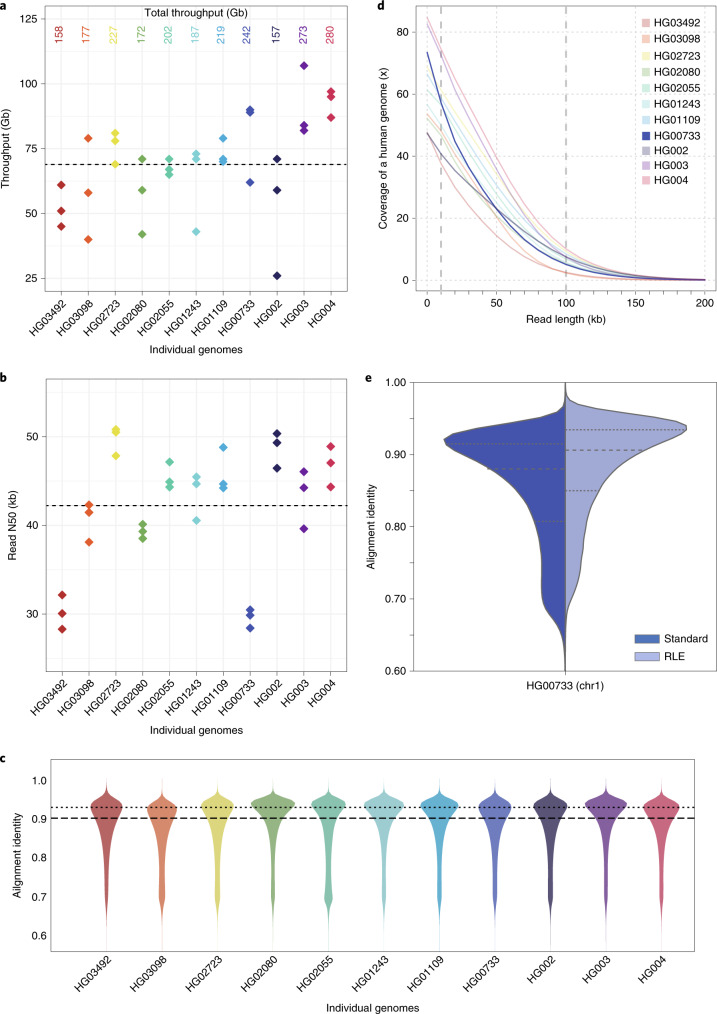
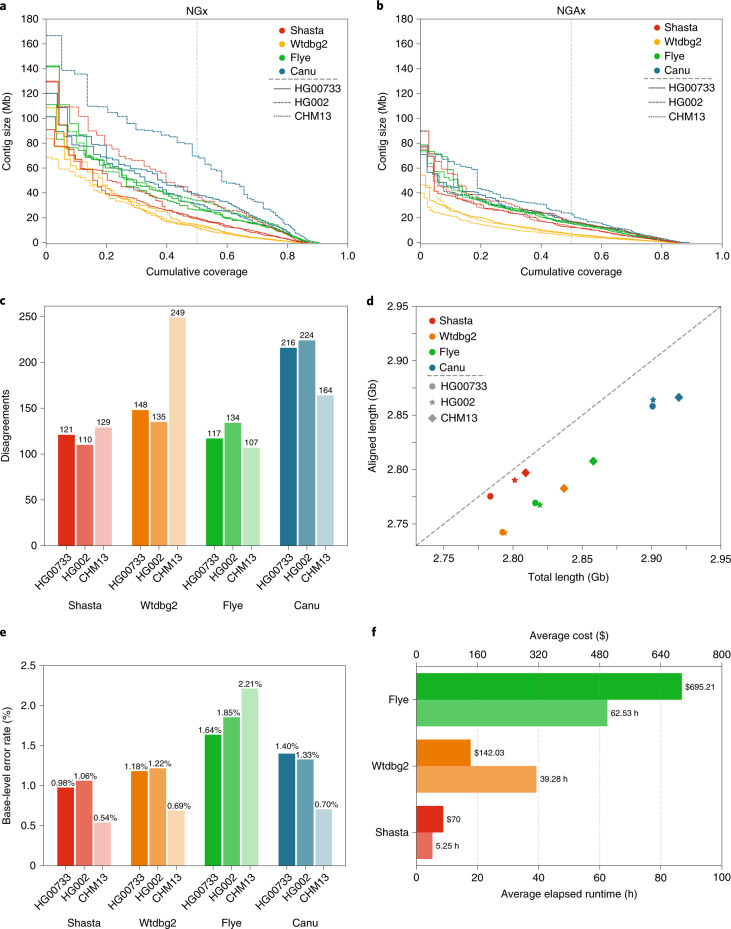
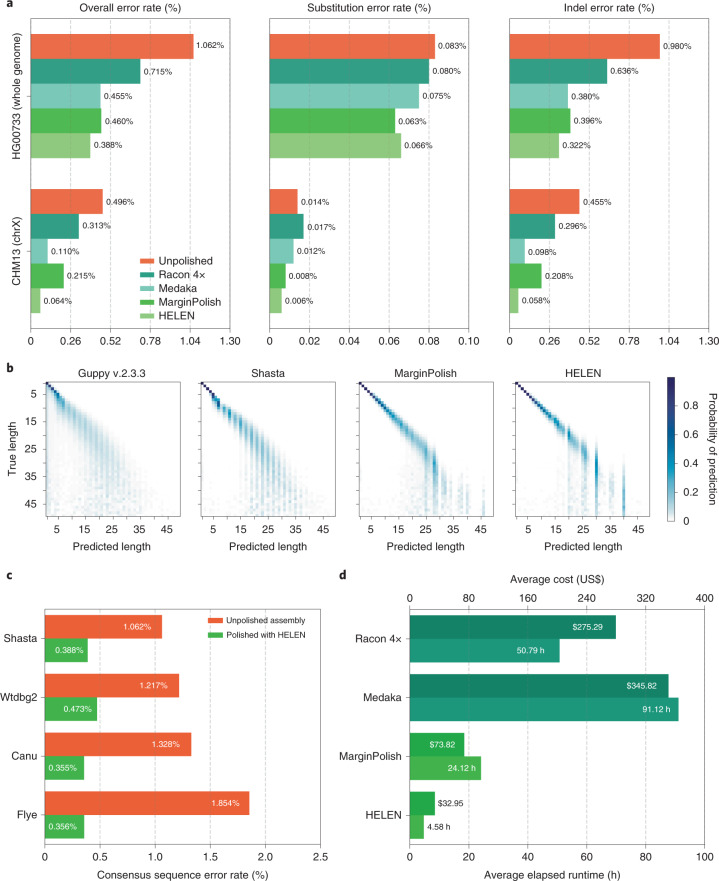
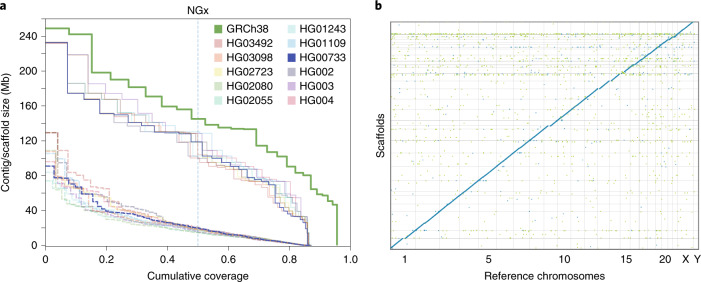
De novo assembly of a human genome using nanopore long-read sequences has been reported, but it used more than 150,000 CPU hours and weeks of wall-clock time. To enable rapid human genome assembly, we present Shasta, a de novo long-read assembler, and polishing algorithms named MarginPolish and HELEN. Using a single PromethION nanopore sequencer and our toolkit, we assembled 11 highly contiguous human genomes de novo in 9 d. We achieved roughly 63× coverage, 42-kb read N50 values and 6.5× coverage in reads >100 kb using three flow cells per sample. Shasta produced a complete haploid human genome assembly in under 6 h on a single commercial compute node. MarginPolish and HELEN polished haploid assemblies to more than 99.9% identity (Phred quality score QV = 30) with nanopore reads alone. Addition of proximity-ligation sequencing enabled near chromosome-level scaffolds for all 11 genomes. We compare our assembly performance to existing methods for diploid, haploid and trio-binned human samples and report superior accuracy and speed.
Overview
The claims and statistics of this paper haven’t been checked yet.
Free: it reads the open-access text and checks the first 5 claims that cite a source we can check. Create a free account to check every claim.
Integrity signals
Registry
Cites
Statistics
Figures

Verification
Claims the paper makes
The claims and statistics of this paper haven’t been checked yet.
Free: it reads the open-access text and checks the first 5 claims that cite a source we can check. Create a free account to check every claim.
Claims other papers make about this one
Each is checked against this paper’s own text: does it say what the citing paper says it does?
The source backs part of the claim, not all of it — or backs it for a different population, condition or comparison.
In the citing paper
“This provides a large set of fully phased human genome assemblies and outperforms earlier efforts on many levels of assembly quality5,16,60.”
From A draft human pangenome reference. (2023) · cites this paper as [16]
Experimental — accuracy not yet measuredThe source backs part of the claim, not all of it — or backs it for a different population, condition or comparison.
In the citing paper
“Similarly driven by technology improvements, sequencing efforts will increasingly produce multiple, phased de novo assemblies from different individuals in a population41.”
From Progressive Cactus is a multiple-genome aligner for the thousand-genome era (2020) · cites this paper as [41]
Experimental — accuracy not yet measuredThe cited source says what the claim attributes to it.
In the citing paper
“These assemblies include 29 samples with long and linked read sequencing data generated entirely by the HPRC and 18 samples sequenced by other efforts16–18.”
From A draft human pangenome reference. (2023) · cites this paper as [16]
The cited source says what the claim attributes to it.
In the citing paper
“These technological advancements also led to a new generation of genome alignment and assembly algorithms leveraging the new data types (84–89).”
From Topological Approaches in Animal Comparative Genomics (2026) · cites this paper as [86]
Self-check
Percentages, sums and reported differences re-computed from the paper’s own numbers.
The self-check needs the paper’s full text.
Citations
Cites
The Genome Analysis Toolkit: A MapReduce framework for analyzing next-generation DNA sequencing data
McKenna, A., Hanna, M., Banks, E., Sivachenko, A., Cibulskis, K., Kernytsky, A., Garimella, K., Altshuler, D., Gabriel, S., Daly, M., et al. (2010) · Genome Research · doi:10.1101/gr.107524.110 · Cited by 27,895
A global reference for human genetic variation
The 1000 Genomes Project Consortium, authors, C., Auton, A., Abecasis, G. R., Steering committee, Altshuler, D. M., Durbin, R. M., Abecasis, G. R., Bentley, D. R., Chakravarti, A., et al. (2015) · Nature · doi:10.1038/nature15393 · Cited by 18,247 · cited 1×
“To do this, we created a list of all low-passage lymphoblastoid cell lines that are part of a trio available from the 1,000 Genomes Project collection 54 (we selected trios to allow future addition of pedigree information, and low-passage line to minimize acquired variation).”
Self-citationMinimap2: Pairwise alignment for nucleotide sequences
Li, H. (2018) · Bioinformatics · doi:10.1093/bioinformatics/bty191 · Cited by 14,807
BUSCO: assessing genome assembly and annotation completeness with single-copy orthologs
Simão, F. A., Waterhouse, R. M., Ioannidis, P., Kriventseva, E. V., & Zdobnov, E. M. (2015) · Bioinformatics · doi:10.1093/bioinformatics/btv351 · Cited by 13,344
(2017) · Cited by 11,625
Walker, B. J., Abeel, T., Shea, T., Priest, M., Abouelliel, A., Sakthikumar, S., Cuomo, C. A., Zeng, Q., Wortman, J., Young, S. K., et al. (2014) · PLoS ONE · doi:10.1371/journal.pone.0112963 · Cited by 9,197
Double-slit photoelectron interference in strong-field ionization of the neon dimer
Kunitski, M., Eicke, N., Huber, P., Köhler, J., Zeller, S., Voigtsberger, J., Schlott, N., Henrichs, K., Sann, H., Trinter, F., et al. (2019) · Nature Communications · doi:10.1038/s41467-018-07882-8 · Cited by 8,162
Double-slit photoelectron interference in strong-field ionization of the neon dimer
Kunitski, M., Eicke, N., Huber, P., Köhler, J., Zeller, S., Voigtsberger, J., Schlott, N., Henrichs, K., Sann, H., Trinter, F., et al. (2019) · Institutional Repository of Leibniz Universität Hannover (Leibniz Universität Hannover) · doi:10.15488/5174 · Cited by 8,161
An integrated map of genetic variation from 1,092 human genomes
The 1000 Genomes Project Consortium (2012) · Nature · doi:10.1038/nature11632 · Cited by 7,711
Self-citationCanu: scalable and accurate long-read assembly via adaptive k -mer weighting and repeat separation
Koren, S., Walenz, B. P., Berlin, K., Miller, J. R., Bergman, N. H., & Phillippy, A. M. (2017) · Genome Research · doi:10.1101/gr.215087.116 · Cited by 7,304
Self-citation
Research works printed but not linked: 1
- Vollger MR Improved assembly and variant detection of a haploid human genome using single-molecule, high-fidelity long reads Ann. Hum. Genet. 2020 84 125 140 31711268 PMC7015760 · DOI · Paper page
Cited by
Items 401–500 of 570
Kumar, M. S., Bhat, M. K., Soman, K. P., Stanley, J., Pourmand, N., Suravajhala, P., & Babu, T. G. S. (2025) · Biotechnology Reports · doi:10.1016/j.btre.2025.e00931 · Cited by 1
Moosman, O. W., Kelley, J. L., & Bogan, S. N. (2025) · Heredity · doi:10.1038/s41437-025-00803-8 · Cited by 1
Handler, D., & Brennecke, J. (2026) · Genome biology · doi:10.1186/s13059-026-04113-y · Cited by 3
“Filtered reads were assembled with Shasta using custom settings (see associated code deposition) [62].”
Bioinformatics for human long-read whole-genome sequencing
Zheng, X., Sanio, P., Luo, R., Li, H., & Sedlazeck, F. J. (2026) · Nature Reviews Methods Primers · doi:10.1038/s43586-026-00519-x · Cited by 2
“Other frameworks, including Flye 107 and Shasta 108 , remain useful for ONT-centred or speed-focused assembly workflows.”
Self-citationChallenges in the detection and assembly of virus integration structures in human genomes
Deng, X., Du, X., Gensterblum‐Miller, E., Currie, J., Majchrowski, B. K., Lialios, P., Bhangale, A. D., Spector, M. E., Boyle, A. P., Brenner, J. C., et al. (2026) · Frontiers in Oncology · doi:10.3389/fonc.2026.1925720 · Cited by 1
LT1, an ONT long-read-based assembly scaffolded with Hi-C data and polished with short reads
Kim, H.-S., Blažytė, A., Jeon, S., Yoon, C., Kim, Y., Kim, C., Bolser, D. M., Ahn, J.-H., Edwards, J. S., & Bhak, J. (2022) · Gigabyte · doi:10.46471/gigabyte.51 · Cited by 1
MSIM: A Highly Parallel Near-Memory Accelerator for MinHash Sketch
Sinha, A., Mai, J.-Y., & Lai, B.-C. C. (2022) · IEEE International System-on-Chip Conference (SOCC) · doi:10.1109/socc56010.2022.9908115 · Cited by 1
Barakat, S. M. M. A., Sallehuddin, R. S., Yuhaniz, S. S., Khairuddin, R. F. R., & Mahmood, Y. (2023) · PeerJ Computer Science · doi:10.7717/peerj-cs.1180 · Cited by 1
“However, the natural high error rate of up to 15% of long reads impacts the accuracy of the assembly requiring higher computational complexity correction processes when processing large datasets (Shafin et al., 2020; Liao et al., 2021).”
BackgroundKim, H.-S., Blažytė, A., Jeon, S., Yoon, C., Kim, Y., Kim, C., Bolser, D. M., Ahn, J.-H., Edwards, J. S., & Bhak, J. (2021) · bioRxiv (Cold Spring Harbor Laboratory) · doi:10.1101/2021.04.05.438426 · Cited by 1
Analysis of the complete genome sequence for Halococcus dombrowskii ATCC BAA-364 TPreprint
Lim, S. W., Maurais, E. G., Farwell, A. C., Barber, N., Olsen, A. J., Shalygina, K. F., Omeragic, M., Fedorov, E. A., & MacLea, K. S. (2022) · bioRxiv (Cold Spring Harbor Laboratory) · doi:10.1101/2022.08.16.504008 · Cited by 1
“1.3 (30), Raven v.1.7.0 (31), and finally Shasta v.0.8.0 (32).”
MethodInfluentialExhaustive benchmarking of de novo assembly methods for eukaryotic genomesPreprint
Southwood, D., Rane, R., Lee, S. F., Oakeshott, J. G., & Ranganathan, S. (2023) · bioRxiv (Cold Spring Harbor Laboratory) · doi:10.1101/2023.04.18.537422 · Cited by 1
“Miniasm [42] and Shasta [43] forgo both error correction and final consensus calls to produce rapid assembly.”
BackgroundXie, D., Lin, X., Wang, Z., Zeng, T., Pi, X., Wang, H., Zhu, G., Wu, X., Li, Y., Deng, Y., et al. (2023) · bioRxiv (Cold Spring Harbor Laboratory) · doi:10.1101/2023.10.07.561149 · Cited by 1
“First, the INS-supported reads for each somatic INS were extracted based on the record of Sniffles and were assembled using Shasta (version 0.5.1) [32] with the following parameters: Reads.minReadLength (1000) MinHash.minHashIterationCount (60) MinHash.minFrequency (2) Align.minAlignedMarkerCount (100) MarkerGraph.min…”
MethodInfluentialHuman assemblies evaluated in the hifiasm paper
Cheng, H., Concepcion, G. T., Feng, X., Zhang, H., & Li, H. (2020) · Zenodo (CERN European Organization for Nuclear Research) · doi:10.5281/zenodo.4393630 · Cited by 1
Friedhoff, R., Wittstock, U., & Pucker, B. (2024) · bioRxiv (Cold Spring Harbor Laboratory) · doi:10.1101/2024.11.01.621629 · Cited by 1
Phylogenomics of crabs provides insights into their origin and evolutionPreprint
Wang, Z., Tang, B., Li, Y., Wang, G., Liu, H., Liu, Q., Sun, Y., Lü, X., Han, G., Zhang, H., et al. (2025) · Research Square · doi:10.21203/rs.3.rs-5612812/v1 · Cited by 1
Genome sequence of the blue flowering Centaurea cyanusPreprint
Dassow, C. M., Friedhoff, R., & Pucker, B. (2025) · bioRxiv (Cold Spring Harbor Laboratory) · doi:10.1101/2025.01.31.635922 · Cited by 1
Birbes, C., Dréau, A., Denis Milan, A., Iampietro, C., Gaspin, C., Donnadieu, C., Zytnicki, M., & Klopp, C. (2025) · bioRxiv (Cold Spring Harbor Laboratory) · doi:10.1101/2025.02.14.638238 · Cited by 1
Compressed inverted indexes for scalable sequence similarityPreprint
Ingels, F., Vandamme, L., Girard, M., Agret, C., Cazaux, B., & Limasset, A. (2025) · bioRxiv (Cold Spring Harbor Laboratory) · doi:10.1101/2025.11.21.689685 · Cited by 1
“…algorithms specialized for top-K retrieval rather than dense distance matrices [46]; overlap-centric accelerations for read–read detection under tight neighborhood assumptions [43]; and GPU implementation [47] encompassing both partition-wise construction and merge-style inverted comparison.”
Lineage-wide evolution of 3D genome organisation and centromeres in brown algaePreprint
Liu, P., Craig, R. J., Avdievich, E., Haas, F. B., Liu, C., & Coelho, S. M. (2025) · bioRxiv (Cold Spring Harbor Laboratory) · doi:10.64898/2025.12.07.692804 · Cited by 1
Genome sequence of Tacca chantrieri reveals the genetic basis of floral pigmentationPreprint
de Oliveira, J. A. V. S., & Pucker, B. (2026) · bioRxiv (Cold Spring Harbor Laboratory) · doi:10.64898/2026.03.17.712415 · Cited by 1
aaKomp: Alignment-free amino acid k -mer matching for genome completeness assessment at scalePreprint
Wong, J., Coombe, L., Warren, R. L., & Birol, İ. (2026) · bioRxiv (Cold Spring Harbor Laboratory) · doi:10.64898/2026.03.19.713078 · Cited by 1
Efficient and accurate near telomere-to-telomere haplotype reconstruction of diploid genomesPreprint
Liu, Y., Li, Y., Xu, J., 谈中正, Zhang, W., Wang, L., Xu, L., Luo, J., Zeng, X., Schönhuth, A., et al. (2026) · bioRxiv (Cold Spring Harbor Laboratory) · doi:10.64898/2026.05.20.726711 · Cited by 1
“…by the advances delivered by third-generation sequencing, seminal methods put emphasis on how to deal with the noise inherent to long reads by employing primary consensus strategies [15–17], which were later followed by haplotype-aware assemblers designed to resolve allelic variations [18, 19].”
Suzuki, Y., Ichikawa, K., Inoue, Y., Owa, C., Kobayashi, H., Morikami, K., Nakamura, R., Ikeda, T., Fujie, M., Kawamitsu, M., et al. (2026) · Genome Research · doi:10.1101/gr.281813.125 · Cited by 1
“…long-read technologies, Pacific Biosciences (PacBio) HiFi sequencing (Wenger et al. 2019) and Oxford Nanopore Technologies (ONT) ultralong sequencing (Shafin et al. 2020), we reconstruct a complete genome of the Hd-rR strain, as well as near-complete genomes of the HNI and HSOK strains.”
Microfluidic delivery of cutting enzymes for fragmentation of surface-adsorbed DNA moleculesPreprint
Budassi, J., Cho, N., Valle, A. D., & Sokolov, J. C. (2021) · bioRxiv (Cold Spring Harbor Laboratory) · doi:10.1101/2021.03.31.437857
Optimizing experimental design for genome sequencing and assembly with Oxford Nanopore TechnologiesPreprint
Sutton, J. M., Millwood, J. D., McCormack, A. C., & Fierst, J. L. (2020) · bioRxiv (Cold Spring Harbor Laboratory) · doi:10.1101/2020.05.05.079327
Shriner, D., Adeyemo, A., & Rotimi, C. N. (2020) · medRxiv · doi:10.1101/2020.09.25.20201780
AsmMix: A pipeline for high quality diploid de novo assemblyPreprint
Wu, P., Liu, C., Wang, O., Zhao, X., Chen, F., Cheng, X., & Zhu, H. (2021) · bioRxiv (Cold Spring Harbor Laboratory) · doi:10.1101/2021.01.15.426893
“[5, 6, 7]and high cost.”
Structural variation in genomes and its role in disease
Vlaar, J. M. (2021) · Utrecht University Repository (Utrecht University) · doi:10.33540/902
KIR gene complexity in primates: A genetic arsenal equipped to arm and control a killer
Bruijnesteijn, J. (2021) · Utrecht University Repository (Utrecht University) · doi:10.33540/866
Oresegun, D. R., Thorpe, P., Benavente, E. D., Campino, S. G., Muh, F., Moon, R. W., Clark, T. G., & Cox‐Singh, J. (2021) · London School of Hygiene & Tropical Medicine · doi:10.5281/zenodo.5598263
SLOW5: a new file format enables massive acceleration of nanopore sequencing data analysisPreprint
Gamaarachchi, H., Samarakoon, H., Jenner, S. P., Ferguson, J. M., Amos, T. G., Hammond, J. W., Saadat, H., Smith, M. A., Parameswaran, S., & Deveson, I. W. (2021) · bioRxiv (Cold Spring Harbor Laboratory) · doi:10.1101/2021.06.29.450255
Pedroso-Roussado, C., Guppy, F. M., Brissett, N. C., Bowler, L. D., & Inácio, J. (2022) · bioRxiv (Cold Spring Harbor Laboratory) · doi:10.1101/2022.12.09.519725
Microfluidic delivery of cutting enzymes for fragmentation of surface-adsorbed DNA molecules
Budassi, J., Cho, N., Valle, A. D., & Sokolov, J. C. (2023) · PLoS ONE · doi:10.1371/journal.pone.0250054
A Workflow for Genome Assembly and Annotation of Hāpuku (Polyprion oxygeneios)
Roberts, B. (2024) · Open Access Victoria University of Wellington | Te Herenga Waka (Figshare) · doi:10.26686/wgtn.25405450
Gardner, C., Chen, J., Hadfield, C., Lu, Z., DeBruin, D., Zhan, Y., Donlin, M. J., Lin, Z., & Ahn, T.-H. (2024) · bioRxiv (Cold Spring Harbor Laboratory) · doi:10.1101/2024.03.17.585453
“We experimented with haplotype-aware assembly methods such as Flye (with haplotype preservation enabled) (Kolmogorov et al. 2019), Shasta (Shafin et al. 2020), Phasebook (Luo et al. 2021), and CanuTrio (which organizes reads into haplotype-specific bins before assembly) (Koren et al. 2017).”
MethodAhsan, M. U., Liu, Q., Li, F., & Wang, K. (2021) · Figshare · doi:10.6084/m9.figshare.16575780
Additional file 1 of Haplotype-resolved assemblies and variant benchmark of a Chinese Quartet
Jia, P., Dong, L., Yang, X., Wang, B., Bush, S. J., Wang, T., Lin, J., Wang, S., Zhao, X., Xu, T., et al. (2023) · Figshare · doi:10.6084/m9.figshare.24741805
Ahsan, M. U., Liu, Q., Li, F., & Wang, K. (2021) · Figshare · doi:10.6084/m9.figshare.16575783
Use of Genome Sequencing for Improved Pig Breeding
Derks, M. F. L., & Groenen, M. A. M. (2022) · CABI biotechnology series. · doi:10.1079/9781789247848.0006
Bioinformatics Tools and Resources for Plant Transcriptomics
Charles, S., & Lopus, M. (2024) · Wiley eBooks · doi:10.1002/9781394209965.ch10
Myers, K. S., Place, M., Gasch, A. P., Noguera, D. R., & Donohue, T. J. (2024) · Microbiology Resource Announcements · doi:10.1128/mra.00356-24
Introduction to microbial genomics
Hashem, A. M., Awad, M., & Abdullah, H. (2024) · Elsevier eBooks · doi:10.1016/b978-0-443-18866-4.00001-8
Leveraging HBM2 for Accelerating k-mer Counting with oneAPI on FPGAs
Lucas, O. P., & George, A. D. (2024) · International Conference on Field Programmable Logic and Applications (FPL) · doi:10.1109/fpl64840.2024.00022 · Cited by 1
“While sequencing has become more accessible, whole-genome sequencing has remained computationally intensive, with a de novo human genome taking days to compute and costing thousands of dollars [8]–[10].”
BackgroundStrategies for Studying the Microbiome of Fermented Foods
Vale, A. D. S., Wiele, N., Manzoki, M. C., Maske, B. L., Molina-Aulestia, D. T., Viesser, J. A., Soccol, C. R., & Pereira, G. V. D. M. (2024) · Springer eBooks · doi:10.1007/978-3-031-72000-0_8
Fast sequence to graph alignment based on graph folding
Deng, Y., Kang, J., Liu, Z., Zhu, X. M., & Quan, W. (2024) · IEEE International Conference on Bioinformatics and Biomedicine (BIBM) · doi:10.1109/bibm62325.2024.10822090
“Recent advancements in long-read sequencing technologies and assembly methods have facilitated the proliferation of genomic data sequencing [1], allowing for the attainment or surpassing of reference genome quality [2].”
Izopet, J., & Kamar, N. (2023) · ClinMicroNow · doi:10.1002/9781683670438.mcm0094
Decoding the blueprint: an overview of genome sequencing, assembly, and annotation
Singh, K. (2025) · Elsevier eBooks · doi:10.1016/b978-0-443-31550-3.00008-1
Variations and Polymorphisms: The Human Pangenome Project
Pandey, S., Gambhir, S., Singh, V. K., & Bhardwaj, A. (2025) · Elsevier eBooks · doi:10.1016/b978-0-323-95502-7.00184-6
Pre-assembly NGS correction of ONT reads achieves HiFi-level assembly quality
Mozheiko, E., Yi, H., Lu, A., Kong, H., Hou, Y., Zhou, Y., & Gao, H. Y. (2025) · Genome · doi:10.1139/gen-2024-0132
Chen, P.-P., Zhong, Z., Jin, W.-X., Sun, J., & Sun, S. (2025) · Scientific Data · doi:10.1038/s41597-025-05136-z · Cited by 1
Zhang, J., Miao, C., Qiu, T., He, J., Cao, W., Lin, W., Xia, X., He, L., Yang, C., Sun, Y., et al. (2026) · GigaScience · doi:10.1093/gigascience/giag048
“To demonstrate the practical utility of Fedrann within end-to-end overlap-layout-consensus (OLC) frameworks, we developed an integrated assembly pipeline by modifying the Shasta assembler [ 6 ].”
InfluentialCharacterizing Nucleic Acid‐, Gene‐, and Cell‐Based Therapeutics with Sequencing Technologies
Bennett, H. M., Byrne, A., Stephenson, W., & Modrusan, Z. D. (2025) · Wiley eBooks · doi:10.1002/9781394236145.ch15
Efficient DNA Fragment Assembly Based on Discrete Slime Mould Algorithm
Si, S., Cao, B., Shao, Q., Sun, L., Zheng, Y., Wang, B., & Zheng, P. (2025) · Lecture notes in computer science · doi:10.1007/978-981-96-8298-0_20
Methods for Chromosome-Scale Haplotype Reconstruction
Garg, S. (2025) · Methods in molecular biology · doi:10.1007/978-1-0716-4702-8_2
Genome Assembly, Polishing, and Analysis of the Chytrid Batrachochytrium salamandrivorans
Wacker, T., Studholme, D. J., & Farrer, R. A. (2025) · Methods in molecular biology · doi:10.1007/978-1-0716-4702-8_9
The genome of the holothuroid Parastichopus tremulus
Meisal, R., & Christophersen, G. (2025) · Genome · doi:10.1139/gen-2025-0015
Peng, W., Zhang, L., Tang, B., Liang, J., Liu, Z., Ye, L., Yuan, Y., Wang, Y., Tan, R., Lin, N., et al. (2025) · Genome biology · doi:10.1186/s13059-025-03730-3
“To systematically investigate and compare the conversion performance of SDFA and other tools, 1100 VCF files (totaling 79.23 GB) were produced based on 10 public individuals [33–39] (details in Additional file 1: Note S1).”
InfluentialSeymen, N., Santos, R., Lakshmanan, R., Topp, S. D., Al‐Chalabi, A., Khleifat, A. A., Breen, G. D., Dobson, R., Quinn, J. P., Karimi, M. M., et al. (2025) · bioRxiv (Cold Spring Harbor Laboratory) · doi:10.1101/2025.09.29.679192 · Cited by 1
Pioneering real-time genomic analysis by in-memory computing
Zhu, K., & Lanza, M. (2025) · Nature Computational Science · doi:10.1038/s43588-025-00883-w
Liu, J., Zhou, H., Zhang, C., Yang, W., Wu, R., Wang, X., Zhang, H., Chen, Z., Zhu, J., Qin, C., et al. (2025) · Research Square · doi:10.21203/rs.3.rs-7689121/v1
Girona, E. L., Kirk, C. M., Deng, C. H., Švara, A., Khan, A., Bus, V. G. M., Chagné, D., & Volz, R. (2025) · Journal of Experimental Botany · doi:10.1093/jxb/eraf504
Huang, Y.-T., Liu, P.-Y., & Shih, P.-W. (2021) · Figshare · doi:10.6084/m9.figshare.14355223
Additional file 2 of Accurate long-read de novo assembly evaluation with Inspector
Chen, Y., Zhang, Y., Wang, A. Y., Gao, M., & Chong, Z. (2021) · Figshare · doi:10.6084/m9.figshare.17010157
Luo, X., Kang, X., & Schönhuth, A. (2022) · Figshare · doi:10.6084/m9.figshare.18849306
Additional file 3 of Accurate long-read de novo assembly evaluation with Inspector
Chen, Y., Zhang, Y., Wang, A. Y., Gao, M., & Chong, Z. (2021) · Figshare · doi:10.6084/m9.figshare.17010160
Holley, G., Beyter, D., Ingimundardóttir, H., Møller, P. L., Kristmundsdóttir, S., Eggertsson, H. P., & Halldorsson, B. V. (2021) · Figshare · doi:10.6084/m9.figshare.13550014
Ahsan, M. U., Liu, Q., Fang, L., & Wang, K. (2021) · Figshare · doi:10.6084/m9.figshare.16575777
Huang, Y.-T., Liu, P.-Y., & Shih, P.-W. (2021) · Figshare · doi:10.6084/m9.figshare.14355220
Luo, X., Kang, X., & Schönhuth, A. (2022) · Figshare · doi:10.6084/m9.figshare.18849300
Additional file 1 of A survey of mapping algorithms in the long-reads era
Sahlin, K., Baudeau, T., Cazaux, B., & Marchet, C. (2024) · Figshare · doi:10.6084/m9.figshare.26593343
Liu, Z., Xie, Z., & Li, M. (2024) · Figshare · doi:10.6084/m9.figshare.26749286
Unterman, I., Avrahami, D., Katsman, E., Tim Jr., T., Glaser, B., & Berman, B. P. (2024) · Figshare · doi:10.6084/m9.figshare.26731822
Unterman, I., Avrahami, D., Katsman, E., Tim Jr., T., Glaser, B., & Berman, B. P. (2024) · Figshare · doi:10.6084/m9.figshare.26731819
Hu, J., Wang, Z., Sun, Z., Hu, B., Ayoola, A. O., Liang, F., Li, J., Sandoval, J. R., Cooper, D. N., Ye, K., et al. (2024) · Figshare · doi:10.6084/m9.figshare.26712815
Sugiura, K., Yoshida, Y., Hayashi, K., Arakawa, K., Kunieda, T., & Matsumoto, M. (2024) · Figshare · doi:10.6084/m9.figshare.26736960
Thirunavukarasu, D., Cheng, L. Y., Song, P., Chen, S. X., Borad, M. J., Kwong, L., James, P. L., Turner, D. J., & Zhang, D. Y. (2021) · Figshare · doi:10.6084/m9.figshare.16572030
Additional file 4 of Haplotype-resolved assemblies and variant benchmark of a Chinese Quartet
Jia, P., Dong, L., Yang, X., Wang, B., Bush, S. J., Wang, T., Lin, J., Wang, S., Zhao, X., Xu, T., et al. (2024) · Figshare · doi:10.6084/m9.figshare.26649177
Mohamed, M., Sabot, F., Varoqui, M., Mugat, B., Audouin, K., Pélisson, A., Fiston-Lavier, A.-S., & Chambeyron, S. (2023) · Figshare · doi:10.6084/m9.figshare.22623683
Chung, D., Kwon, Y. M., & Yang, Y. (2021) · Figshare · doi:10.6084/m9.figshare.17037393
Ahsan, M. U., Liu, Q., Fang, L., & Wang, K. (2021) · Figshare · doi:10.6084/m9.figshare.16575786
Unterman, I., Avrahami, D., Katsman, E., Tim Jr., T., Glaser, B., & Berman, B. P. (2024) · Figshare · doi:10.6084/m9.figshare.26011787
Guiglielmoni, N., Houtain, A., Derzelle, A., Doninck, K. V., & Flot, J. (2021) · Figshare · doi:10.6084/m9.figshare.14738339
Chung, D., Kwon, Y. M., & Yang, Y. (2021) · Figshare · doi:10.6084/m9.figshare.17037390
Sugiura, K., Yoshida, Y., Hayashi, K., Arakawa, K., Kunieda, T., & Matsumoto, M. (2024) · Figshare · doi:10.6084/m9.figshare.26736963
Additional file 3 of Haplotype-resolved assemblies and variant benchmark of a Chinese Quartet
Jia, P., Dong, L., Yang, X., Wang, B., Bush, S. J., Wang, T., Lin, J., Wang, S., Zhao, X., Xu, T., et al. (2024) · Figshare · doi:10.6084/m9.figshare.26649174
Liu, Z., Xie, Z., & Li, M. (2024) · Figshare · doi:10.6084/m9.figshare.26308976
Additional file 2 of Hybrid-hybrid correction of errors in long reads with HERO
Kang, X., Xu, J., Luo, X., & Schönhuth, A. (2024) · Figshare · doi:10.6084/m9.figshare.24715522
Sugiura, K., Yoshida, Y., Hayashi, K., Arakawa, K., Kunieda, T., & Matsumoto, M. (2024) · Figshare · doi:10.6084/m9.figshare.26736969
Adam, E., Ranjan, D., & Riethman, H. C. (2024) · Figshare · doi:10.6084/m9.figshare.26555267
Sugiura, K., Yoshida, Y., Hayashi, K., Arakawa, K., Kunieda, T., & Matsumoto, M. (2024) · Figshare · doi:10.6084/m9.figshare.26736975
Hu, J., Wang, Z., Sun, Z., Hu, B., Ayoola, A. O., Liang, F., Li, J., Sandoval, J. R., Cooper, D. N., Ye, K., et al. (2024) · Figshare · doi:10.6084/m9.figshare.25706181
Liu, Z., Xie, Z., & Li, M. (2024) · Figshare · doi:10.6084/m9.figshare.26749292
Additional file 2 of A survey of mapping algorithms in the long-reads era
Sahlin, K., Baudeau, T., Cazaux, B., & Marchet, C. (2024) · Figshare · doi:10.6084/m9.figshare.26593346
Sugiura, K., Yoshida, Y., Hayashi, K., Arakawa, K., Kunieda, T., & Matsumoto, M. (2024) · Figshare · doi:10.6084/m9.figshare.26074113
Mahmoud, M., Doddapaneni, H., Timp, W., & Sedlazeck, F. J. (2021) · Figshare · doi:10.6084/m9.figshare.16620996
Self-citationSilvestre-Ryan, J., & Holmes, I. (2021) · Figshare · doi:10.6084/m9.figshare.13612256
Metadata
- Authors
- Shafin, K., Pesout, T., Lorig-Roach, R., Haukness, M., Olsen, H. E., Bosworth, C., Armstrong, J., Tigyi, K., Maurer, N., Koren, S., Sedlazeck, F. J., Marschall, T., Mayes, S., Costa, V., Zook, J. M., Liu, K. J., Kilburn, D., Sorensen, M., Munson, K. M., Vollger, M. R., Monlong, J., Garrison, E., Eichler, E. E., Salama, S., Haussler, D., Green, R. E., Akeson, M., Phillippy, A., Miga, K. H., Carnevali, P., Jain, M., & Paten, B.
- Affiliations
- University of California, Santa Cruz (US)
- Howard Hughes Medical Institute (US)
- National Institutes of Health (US)
- Baylor College of Medicine (US)
- Max Planck Institute for Informatics (DE)
- Oxford Nanopore Technologies (United Kingdom) (GB)
- National Institute of Standards and Technology (US)
- Circulomics (United States) (US)
- University of Washington (US)
- Chan Zuckerberg Initiative (United States) (US)
- Corresponding author
- Carnevali, Paolo
- Jain, Miten
- Paten, Benedict
- ORCID
- Shafin, Kishwar
- Pesout, Trevor
- Lorig-Roach, Ryan
- Haukness, Marina
- Olsen, Hugh E.
- Bosworth, Colleen
- Armstrong, Joel
- Maurer, Nicholas
- Koren, Sergey
- Sedlazeck, Fritz J.
- Marschall, Tobias
- Zook, Justin M.
- Liu, Kelvin J.
- Kilburn, Duncan
- Sorensen, Melanie
- Munson, Katy M.
- Vollger, Mitchell R.
- Monlong, Jean
- Garrison, Erik
- Eichler, Evan E.
- Salama, Sofie
- Haussler, David
- Green, Richard E.
- Akeson, Mark
- Phillippy, Adam
- Miga, Karen H.
- Jain, Miten
- Paten, Benedict
- Venue
- Nature Biotechnology
- Published
- 2020-05-04
- Volume
- 38
- Issue
- 9
- Pages
- 1044-1053
- ISSN
- 0733-222X (ISSN-L)
- 1087-0156
- 1546-1696
- PMC
- PMC7483855
- OpenAlex
- W3022783334
- Semantic Scholar
- f9d407ce133ec096ab4321e6d98e8f0081f5bdcc
- Cited by
- 567
- References
- 74
- Citations by year
- 2026: 44 · 2025: 62 · 2024: 117 · 2023: 91 · 2022: 89 · 2021: 115 · 2020: 44
- FWCI
- 27.90
- Type
- journal article
- Language
- en
- Open access
- hybrid
- doi.org
- Licence
- cc-by
- creativecommons.org/licenses/by/4.0 (tdm)
- creativecommons.org/licenses/by/4.0 (vor)
- Locations
- Nature Biotechnology (publishedVersion, cc-by)
- bioRxiv (Cold Spring Harbor Laboratory) (acceptedVersion, cc-by)
- PubMed Central (publishedVersion, cc-by)
- PubMed (publishedVersion)
- HAL (submittedVersion)
- eScholarship (California Digital Library) (submittedVersion)
- MPG.PuRe (Max Planck Society) (submittedVersion, other-oa)
- Funders
- U.S. Department of Health & Human Services | NIH | National Heart, Lung, and Blood Institute (1U01HL137183)
- U.S. Department of Health & Human Services | National Institutes of Health (5U54HG007990, 5T32HG008345-04, 1U01HL137183, R01HG010053)
- U.S. Department of Health & Human Services | NIH | National Human Genome Research Institute (3U24HG009084-03S1, 2U41HG007234)
- Topics
- Life Sciences › Biochemistry, Genetics and Molecular Biology › Molecular Biology › Genomics and Phylogenetic Studies
- Life Sciences › Biochemistry, Genetics and Molecular Biology › Genetics › Genomic variations and chromosomal abnormalities
- Physical Sciences › Mathematics › Theoretical Computer Science › Algorithms and Data Compression
- Keywords
- nanopore sequencing, de novo genome assembly, Helen, human genome assembly, haploid genome assembly, long-read sequencing, chromosome-level scaffolding, assembly polishing
- MeSH terms
- Deep Learning, Nanopore Sequencing, Algorithms, Chromosomes, Human, Haploidy, HLA Antigens, Humans, Genome, Human, Sequence Analysis, DNA, Benchmarking, Genomics, High-Throughput Nucleotide Sequencing
About these checks
Registry, retraction, Cites and statistics results are computed, not judged, with one exception: a printed reference that no index lists is read once by a model before it counts as a citation error. Claims are extracted by a model and kept only when their quote appears verbatim in the text; each cited source is then checked, with a model’s help, for whether it says what the claim relies on. Those verdicts can be wrong — read the claim’s quote and the cited source before relying on one.
Statistics and arithmetic are recomputed, not judged.
Confidence bands are shown only for fields calibrated on our annotated test set. None is calibrated yet, so no band is shown.
What counts as a claim ›How we measure confidence ›How we check this ›
Are you an author, or do you see a problem with this page? Request a review
Data sources
Bibliographic data: Semantic Scholar, OpenAlex, Crossref.
Contains information from the Semantic Scholar Academic Graph Datasets, made available under the ODC Attribution License (ODC-BY 1.0).
Semantic Scholar’s data is described in: Kinney, R., et al. (2023). The Semantic Scholar Open Data Platform. arXiv:2301.10140.
