

Nanopore sequencing and the Shasta toolkit enable efficient de novo assembly of eleven human genomes
Open accessPublished version of a preprint
The DOI matches its Crossref record; 78 of the 78 references it cites were found in a registry or an index.
Abstract
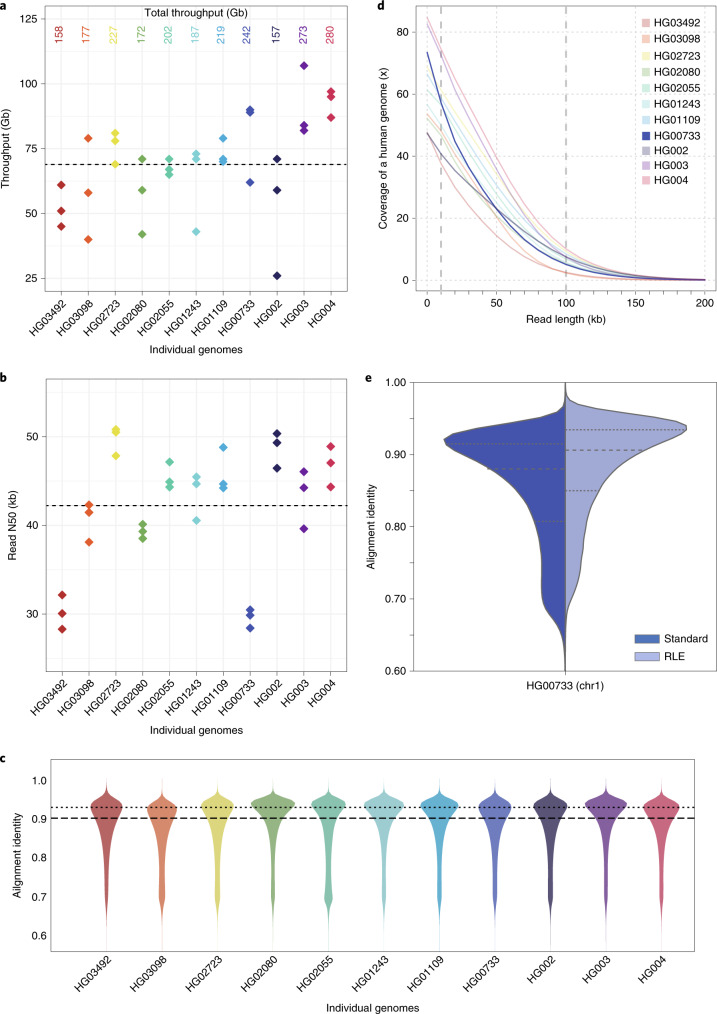
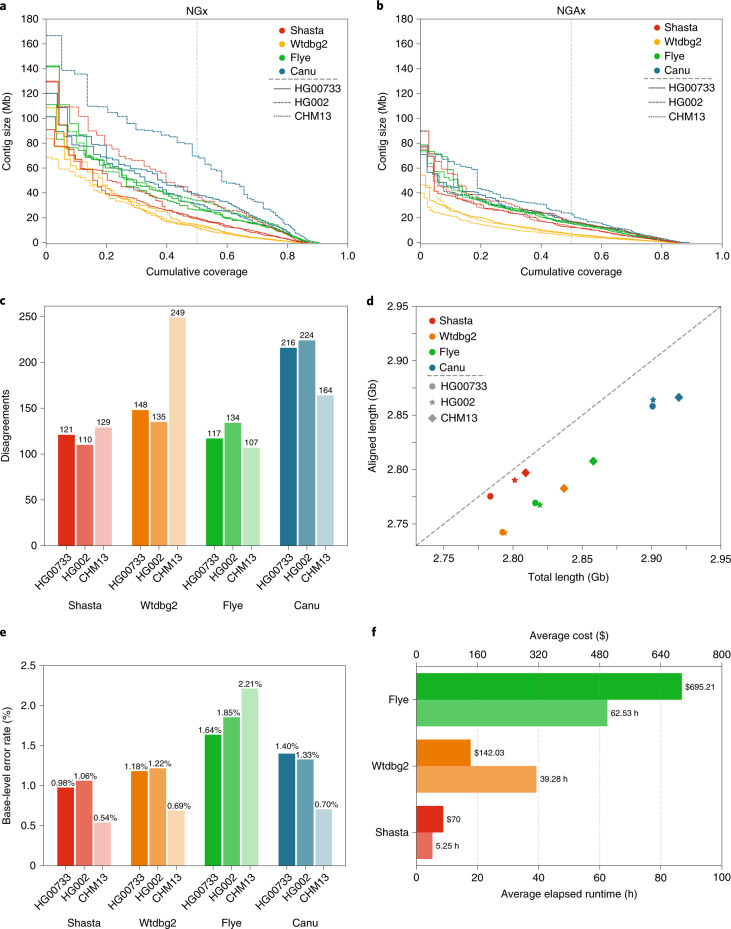
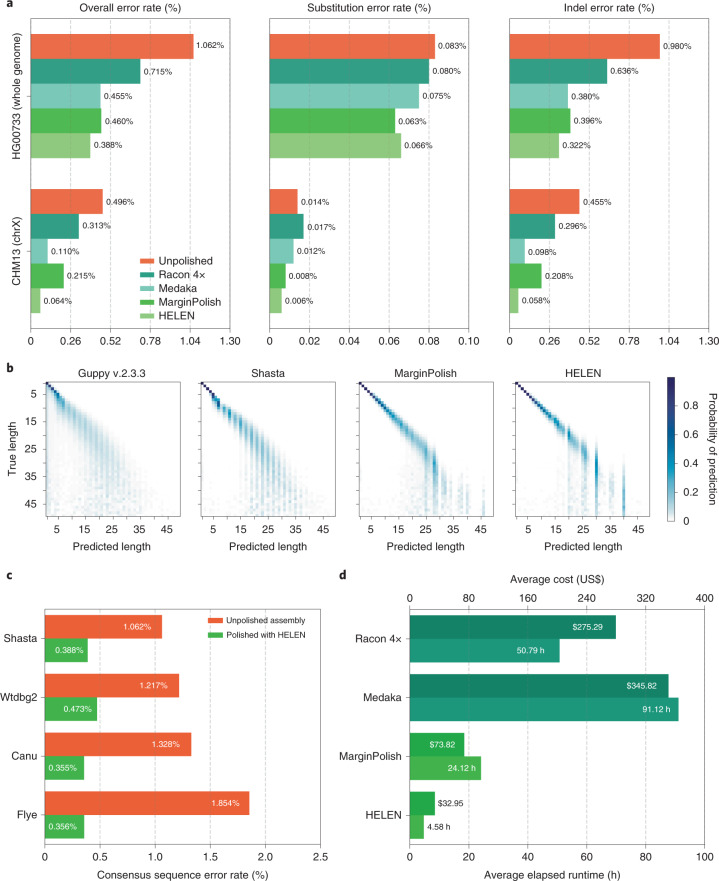
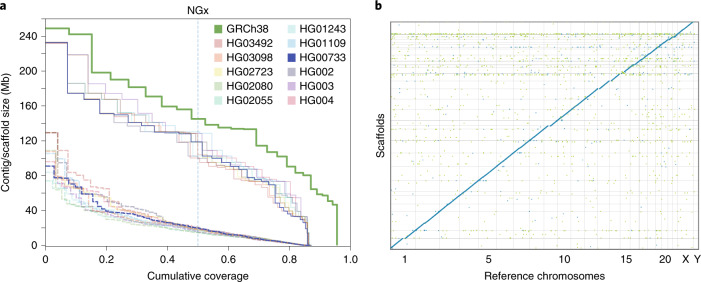
De novo assembly of a human genome using nanopore long-read sequences has been reported, but it used more than 150,000 CPU hours and weeks of wall-clock time. To enable rapid human genome assembly, we present Shasta, a de novo long-read assembler, and polishing algorithms named MarginPolish and HELEN. Using a single PromethION nanopore sequencer and our toolkit, we assembled 11 highly contiguous human genomes de novo in 9 d. We achieved roughly 63× coverage, 42-kb read N50 values and 6.5× coverage in reads >100 kb using three flow cells per sample. Shasta produced a complete haploid human genome assembly in under 6 h on a single commercial compute node. MarginPolish and HELEN polished haploid assemblies to more than 99.9% identity (Phred quality score QV = 30) with nanopore reads alone. Addition of proximity-ligation sequencing enabled near chromosome-level scaffolds for all 11 genomes. We compare our assembly performance to existing methods for diploid, haploid and trio-binned human samples and report superior accuracy and speed.
Overview
The claims and statistics of this paper haven’t been checked yet.
Free: it reads the open-access text and checks the first 5 claims that cite a source we can check. Create a free account to check every claim.
Integrity signals
Registry
Cites
Statistics
Figures

Verification
Claims the paper makes
The claims and statistics of this paper haven’t been checked yet.
Free: it reads the open-access text and checks the first 5 claims that cite a source we can check. Create a free account to check every claim.
Claims other papers make about this one
Each is checked against this paper’s own text: does it say what the citing paper says it does?
The source backs part of the claim, not all of it — or backs it for a different population, condition or comparison.
In the citing paper
“This provides a large set of fully phased human genome assemblies and outperforms earlier efforts on many levels of assembly quality5,16,60.”
From A draft human pangenome reference. (2023) · cites this paper as [16]
Experimental — accuracy not yet measuredThe source backs part of the claim, not all of it — or backs it for a different population, condition or comparison.
In the citing paper
“Similarly driven by technology improvements, sequencing efforts will increasingly produce multiple, phased de novo assemblies from different individuals in a population41.”
From Progressive Cactus is a multiple-genome aligner for the thousand-genome era (2020) · cites this paper as [41]
Experimental — accuracy not yet measuredThe cited source says what the claim attributes to it.
In the citing paper
“These assemblies include 29 samples with long and linked read sequencing data generated entirely by the HPRC and 18 samples sequenced by other efforts16–18.”
From A draft human pangenome reference. (2023) · cites this paper as [16]
The cited source says what the claim attributes to it.
In the citing paper
“These technological advancements also led to a new generation of genome alignment and assembly algorithms leveraging the new data types (84–89).”
From Topological Approaches in Animal Comparative Genomics (2026) · cites this paper as [86]
Self-check
Percentages, sums and reported differences re-computed from the paper’s own numbers.
The self-check needs the paper’s full text.
Citations
Cites
The Genome Analysis Toolkit: A MapReduce framework for analyzing next-generation DNA sequencing data
McKenna, A., Hanna, M., Banks, E., Sivachenko, A., Cibulskis, K., Kernytsky, A., Garimella, K., Altshuler, D., Gabriel, S., Daly, M., et al. (2010) · Genome Research · doi:10.1101/gr.107524.110 · Cited by 27,895
A global reference for human genetic variation
The 1000 Genomes Project Consortium, authors, C., Auton, A., Abecasis, G. R., Steering committee, Altshuler, D. M., Durbin, R. M., Abecasis, G. R., Bentley, D. R., Chakravarti, A., et al. (2015) · Nature · doi:10.1038/nature15393 · Cited by 18,247 · cited 1×
“To do this, we created a list of all low-passage lymphoblastoid cell lines that are part of a trio available from the 1,000 Genomes Project collection 54 (we selected trios to allow future addition of pedigree information, and low-passage line to minimize acquired variation).”
Self-citationMinimap2: Pairwise alignment for nucleotide sequences
Li, H. (2018) · Bioinformatics · doi:10.1093/bioinformatics/bty191 · Cited by 14,807
BUSCO: assessing genome assembly and annotation completeness with single-copy orthologs
Simão, F. A., Waterhouse, R. M., Ioannidis, P., Kriventseva, E. V., & Zdobnov, E. M. (2015) · Bioinformatics · doi:10.1093/bioinformatics/btv351 · Cited by 13,344
(2017) · Cited by 11,625
Walker, B. J., Abeel, T., Shea, T., Priest, M., Abouelliel, A., Sakthikumar, S., Cuomo, C. A., Zeng, Q., Wortman, J., Young, S. K., et al. (2014) · PLoS ONE · doi:10.1371/journal.pone.0112963 · Cited by 9,197
Double-slit photoelectron interference in strong-field ionization of the neon dimer
Kunitski, M., Eicke, N., Huber, P., Köhler, J., Zeller, S., Voigtsberger, J., Schlott, N., Henrichs, K., Sann, H., Trinter, F., et al. (2019) · Nature Communications · doi:10.1038/s41467-018-07882-8 · Cited by 8,162
Double-slit photoelectron interference in strong-field ionization of the neon dimer
Kunitski, M., Eicke, N., Huber, P., Köhler, J., Zeller, S., Voigtsberger, J., Schlott, N., Henrichs, K., Sann, H., Trinter, F., et al. (2019) · Institutional Repository of Leibniz Universität Hannover (Leibniz Universität Hannover) · doi:10.15488/5174 · Cited by 8,161
An integrated map of genetic variation from 1,092 human genomes
The 1000 Genomes Project Consortium (2012) · Nature · doi:10.1038/nature11632 · Cited by 7,711
Self-citationCanu: scalable and accurate long-read assembly via adaptive k -mer weighting and repeat separation
Koren, S., Walenz, B. P., Berlin, K., Miller, J. R., Bergman, N. H., & Phillippy, A. M. (2017) · Genome Research · doi:10.1101/gr.215087.116 · Cited by 7,304
Self-citation
Research works printed but not linked: 1
- Vollger MR Improved assembly and variant detection of a haploid human genome using single-molecule, high-fidelity long reads Ann. Hum. Genet. 2020 84 125 140 31711268 PMC7015760 · DOI · Paper page
Cited by
Items 301–400 of 570
Minio, A., Figueroa-Balderas, R. E., Cohen, S. P., Ali, S. S., Carriel, D., Britto, D. S., Stack, C., Baruah, I. K., Marelli, J., Cantù, D., et al. (2023) · G3 Genes Genomes Genetics · doi:10.1093/g3journal/jkad125 · Cited by 8
“0.3.0, Shafin et al. 2020), Flye (ver.”
InfluentialBashar, S., Kothakota, N. J., & Jena, B. R. (2024) · Current Forensic Science · doi:10.2174/0126664844274727231218061037 · Cited by 6
An effective strategy for assembling the sex-limited chromosome
Wang, X., Lü, H., Liu, Q., Li, A., Zhou, H., Zhang, Y. E., Zhu, T., & Ruan, J. (2024) · GigaScience · doi:10.1093/gigascience/giae015 · Cited by 8
Comparative Evolutionary Genomics in Insects
Feldmeyer, B., Bornberg‐Bauer, E., Dohmen, E., Fouks, B., Heckenhauer, J., Huylmans, A. K., Jones, A. R. C., Stolle, E., & Harrison, M. C. (2024) · Methods in molecular biology · doi:10.1007/978-1-0716-3838-5_16 · Cited by 7
Cholsaktrakool, P., Kawang, K., Sangpiromapichai, N., Thongsuk, P., Anuntakarun, S., Kunadirek, P., Chuaypen, N., Nilgate, S., Kueakulpattana, N., Rirerm, U., et al. (2025) · iScience · doi:10.1016/j.isci.2025.112962 · Cited by 8
Sex-biased Migration and Demographic History of the Big European Firefly Lampyris noctiluca
Catalán, A., Gygax, D., Candolin, U., Tusso, S., Duchen, P., & Höhna, S. (2025) · Molecular Biology and Evolution · doi:10.1093/molbev/msaf123 · Cited by 8
“From the four explored assembly strategies (MaSuRCa, Flye, Canu and Shasta) (Zimin et al. 2013; Kolmogorov et al. 2019; Shafin et al. 2020), the hybrid approach with MaSuRCA gave the best results (supplementary table S1, Supplementary Material online).”
Eizenga, J. M., Lorig-Roach, R., Meredith, M., & Paten, B. (2021) · Lecture notes in computer science · doi:10.1007/978-3-030-80049-9_15 · Cited by 8
Self-citationDecoil: Reconstructing Extrachromosomal DNA Structural Heterogeneity from Long-Read Sequencing Data
Giurgiu, M., Wittstruck, N., Rodríguez-Fos, E., González, R. C., Brückner, L., Szymansky, A., Helmsauer, K., Hartebrodt, A., Euskirchen, P., Koche, R. P., et al. (2024) · Lecture notes in computer science · doi:10.1007/978-1-0716-3989-4_41 · Cited by 6
Functional Annotation – How to Tackle the Bottleneck in Plant GenomicsPreprint
Pucker, B. (2024) · Preprints.org · doi:10.20944/preprints202402.0645.v1 · Cited by 7
Nowak, M. S., Harder, B., Meckoni, S. N., Friedhoff, R., Wolff, K., & Pucker, B. (2024) · bioRxiv (Cold Spring Harbor Laboratory) · doi:10.1101/2024.06.15.599162 · Cited by 9
Data literacy in genome research
Wolff, K., Friedhoff, R., Schwarzer, F., & Pucker, B. (2023) · Berichte aus der medizinischen Informatik und Bioinformatik/Journal of integrative bioinformatics · doi:10.1515/jib-2023-0033 · Cited by 5
“Frequently, Shasta [31] was deployed due to its short run time and low computational costs.”
BackgroundRepun: an accurate small variant representation unification method for multiple sequencing platforms
Zheng, Z., Ren, Y., Chen, L., Wong, A. O. K., Li, S., Yu, X., Lam, T., & Luo, R. (2024) · Briefings in Bioinformatics · doi:10.1093/bib/bbae613 · Cited by 7
“Figure 4a and Table 3a illustrate the performance achieved by Repun,particularly since Guppy 3.2.4, with precision performance in the GIAB HG002 sample [16] exceeding 99.9%.”
InfluentialGenomic map of the functionally extinct northern white rhinoceros ( Ceratotherium simum cottoni )
Wang, G., Korody, M. L., Brändl, B., Toro, C. J. H., Rohrandt, C., Hong, K., Pang, A. W. C., Lee, J., Migliorelli, G., Stanke, M., et al. (2025) · Proceedings of the National Academy of Sciences · doi:10.1073/pnas.2401207122 · Cited by 9
“Contiguous sequences (contigs) were first assembled from ONT long reads using the Shasta assembler (25), followed by three sequential rounds of scaffolding using 10XG linked reads, OGM, and Hi -”
High temporal resolution Nanopore sequencing dataset of SARS-CoV-2 and host cell RNAs
Tombácz, D., Dörmő, Á., Gulyás, G. M., Csabai, Z., Prazsák, I., Kakuk, B., Harangozó, Á., Jankovics, I., Denes, B. S., & Boldogkői, Z. (2022) · GigaScience · doi:10.1093/gigascience/giac094 · Cited by 6
“0) [34] using all viral reads longer than 20,000 bps (shasta –Reads.”
MethodAssembly-free discovery of human novel sequences using long reads
Li, Q., Yan, B., Lam, T., & Luo, R. (2022) · DNA Research · doi:10.1093/dnares/dsac039 · Cited by 6
Muñoz‐Barrera, A., Rubio‐Rodríguez, L. A., Usera, A. D.-D., Jáspez, D., Lorenzo-Salazar, J. M., González‐Montelongo, R., García‐Olivares, V., & Flores, C. (2022) · Life · doi:10.3390/life12111939 · Cited by 9
Winter, M. R., Taranto, A. P., Yimer, H. Z., Blundell, A. C., Siddique, S., Williamson, V. M., & Lunt, D. H. (2024) · PLoS ONE · doi:10.1371/journal.pone.0302506 · Cited by 5
LazyB: fast and cheap genome assembly
Gatter, T., von Löhneysen, S., Fallmann, J., Drozdova, P. B., Hartmann, T., & Stadler, P. F. (2021) · Algorithms for Molecular Biology · doi:10.1186/s13015-021-00186-5 · Cited by 5
Chin, H.-L. L., Huynh, S., Ashkani, J., Castaldo, M. P., Dixon, K., Selby, K. A., Shen, Y., Wright, M., Boerkoel, C. F., Hendson, G., et al. (2021) · American Journal of Medical Genetics Part A · doi:10.1002/ajmg.a.62578 · Cited by 5
Carpinteyro-Ponce, J., & Machado, C. A. (2024) · Genome Biology and Evolution · doi:10.1093/gbe/evae047 · Cited by 5
“With the recent emergence of long-read sequencing it is now possible to generate highly contiguous de-novo genome assemblies with fewer computational resources (Chakraborty et al. 2016; Jain et al. 2018; Wenger et al. 2019; Hon et al. 2020; Logsdon et al. 2020; Shafin et al. 2020; Nurk et al. 2022).”
BackgroundPoszewiecka, B., Gogolewski, K., Karolak, J. A., Stankiewicz, P., & Gambin, A. (2023) · Genome biology · doi:10.1186/s13059-023-03022-8 · Cited by 5
“Thus far, a number of general purpose assemblers have been developed, e.g. FALCON [9], Miniasm [10], Canu [11], Flye [12], Wtdbg2 [13], Shasta [14], and HiCanu [15].”
MethodSequali: efficient and comprehensive quality control of short- and long-read sequencing data
Vorderman, R. H. P. (2024) · Bioinformatics Advances · doi:10.1093/bioadv/vbaf010 · Cited by 4
A detailed guide to assessing genome assembly based on long-read sequencing data using Inspector
Guo, Y. P., Song, Y., Jiang, L., Chen, Y., Ceccarelli, M., Gao, M., & Chong, Z. (2025) · Nature Protocols · doi:10.1038/s41596-025-01149-5 · Cited by 6
Restoring flowcell type and basecaller configuration from FASTQ files of nanopore sequencing data
Mencius, J., Chen, W., Zheng, Y., An, T., Yu, Y., Sun, K., Feng, H., & Feng, Z. (2025) · Nature Communications · doi:10.1038/s41467-025-59378-x · Cited by 4
Iza-Arteaga, M. L., Lira‐Ruan, V., Balcázar‐López, E., Folch‐Mallol, J. L., & Sánchez‐Reyes, A. (2025) · Frontiers in Microbiology · doi:10.3389/fmicb.2025.1714079 · Cited by 4
“8.0 (Shafin et al., 2020), Flye v2.”
InfluentialSagar, K., Priti, K., & Chandra, H. (2026) · Journal of Microbiological Methods · doi:10.1016/j.mimet.2026.107390 · Cited by 5
Reference Genome Sequence of Flax
You, F. M., Moumen, I., Khan, N., & Cloutier, S. (2023) · Compendium of plant genomes · doi:10.1007/978-3-031-16061-5_1 · Cited by 4
Lee, W., Chan, B. K. K., Kim, J., Ju, S., & Kim, S. (2023) · Molecular Ecology Resources · doi:10.1111/1755-0998.13895 · Cited by 4
“4.0 (Shafin et al., 2020) and Wtdbg2 v2.”
InfluentialA novel Enterococcus faecalis bacteriophage Ef212: biological and genomic features
Güçlü, A. Ü., & Yalçın, S. (2024) · International Microbiology · doi:10.1007/s10123-024-00547-1 · Cited by 4
“Raw reads were paired and trimmed and de novo assembled using Shasta 0.4.0 (Shafin et al. 2020).”
InfluentialYu, P., Fulton, J. C., Carmona, S. L., David, D. M. B., Barrero, L. S., Huguet‐Tapia, J. C., Brawner, J. T., & Suárez, M. S. (2022) · Microbiology Resource Announcements · doi:10.1128/mra.00980-21 · Cited by 4
Bologa, A. M., Stoica, I., Rațiu, A. C., Constantin, N. D., & Ecovoiu, A. A. (2022) · International Journal of Molecular Sciences · doi:10.3390/ijms232314892 · Cited by 4
“Some de novo sequence assemblers, such as Flye [4] and Shasta [5] start by generating the assembly of uncorrected reads and then refine the genome assembly.”
BackgroundPérez‐Quintero, Á. L., Rodriguez‐R, L. M., Cuesta-Morrondo, S., Hakalová, E., Betancurt-Anzola, D., Valera, L. C. C., Cárdenas, L. A. C., Matiz-Céron, L., Jacobs, J. M., Román-Reyna, V., et al. (2023) · Phytopathology · doi:10.1094/phyto-12-22-0477-sc · Cited by 4
Seq’ing identity and function in a repeat-derived noncoding RNA world
O'Neill, R. J. W. (2020) · Chromosome Research · doi:10.1007/s10577-020-09628-z · Cited by 4
Physlr: Next-Generation Physical Maps
Afshinfard, A., Jackman, S. D., Wong, J., Coombe, L., Chu, J., Nikolić, V., Dilek, G., Malkoç, Y., Warren, R. L., & Birol, İ. (2022) · DNA · doi:10.3390/dna2020009 · Cited by 5
“We used Shasta [39] assemblies of the ONT data and Falcon [40] assemblies of the PacBio data, available from Genome in a Bottle (GIAB).”
MethodDistributed-Memory Parallel Contig Generation for De Novo Long-Read Genome Assembly
Guidi, G., Raulet, G., Rokhsar, D. S., Oliker, L., Yelick, K., & Buluç, A. (2022) · Proceedings of the International Conference on Parallel Processing · doi:10.1145/3545008.3545050 · Cited by 5
“The Shasta assembler [40] also uses a similar procedure by creating an undirected graph where each vertex is an oriented read”
MethodAnalysis of Tandem Repeat Expansions Using Long DNA Reads
Mitsuhashi, S., & Frith, M. C. (2023) · Methods in molecular biology · doi:10.1007/978-1-0716-2996-3_11 · Cited by 4
SRY: An Effective Method for Sorting Long Reads of Sex-limited ChromosomePreprint
Wang, X., Liu, Q., Li, A., & Ruan, J. (2020) · bioRxiv (Cold Spring Harbor Laboratory) · doi:10.1101/2020.05.25.115592 · Cited by 4
“To assess the assembling completeness of Y chromosome with and without specific markers, we compared the resulting assembly from SRY, trio binning and WGA using a father-mother-offspring trio dataset 13 .”
MethodThe human ribosomal RNA gene is composed of highly homogenized tandem clustersPreprint
Hori, Y., Shimamoto, A., & Kobayashi, T. (2021) · bioRxiv (Cold Spring Harbor Laboratory) · doi:10.1101/2021.06.02.446762 · Cited by 4
Wang, G., Brändl, B., Rohrandt, C., Hong, K., Pang, A. W. C., Lee, J., Lewin, H. A., Migliorelli, G., Stanke, M., Schwab, R. M., et al. (2021) · bioRxiv (Cold Spring Harbor Laboratory) · doi:10.1101/2021.12.11.472206 · Cited by 4
“Contiguous sequences (contigs) were first assembled using the Shasta assembler [14] and ONT long reads.”
MethodGardner, C., Chen, J., Hadfield, C., Lu, Z., DeBruin, D., Zhan, Y., Donlin, M. J., Ahn, T.-H., & Lin, Z. (2024) · Genome Research · doi:10.1101/gr.279364.124 · Cited by 4
“We experimented with haplotype-aware assembly methods such as Flye (with haplotype preservation enabled) (Kolmogorov et al. 2019), Shasta (Shafin et al. 2020), Phasebook (Luo et al. 2021), and CanuTrio (which organizes reads into haplotype-specific bins before assembly) (Koren et al. 2017).”
Theobroma cacao genome sequence reveals insights into flavonoid biosynthesisPreprint
Recinos, M. F. M., Winnier, S., Lagerhausen, K., Ajayi, B., Wolff, K., Friedhoff, R., Dassow, C. M., Choudhary, N., de Oliveira, J. A. V. S., & Pucker, B. (2024) · bioRxiv (Cold Spring Harbor Laboratory) · doi:10.1101/2024.11.23.624982 · Cited by 4
“14.0 (Shafin et al. 2020).”
InfluentialKasianova, A. M., Mityukov, V., German, D. A., Kasianov, A. S., Penin, A. A., & Logacheva, M. D. (2025) · Genome Biology and Evolution · doi:10.1093/gbe/evaf009 · Cited by 3
Toscano, E., Sepe, L., Maggio, F. D., Nunziato, M., Boccia, A. S., Cimmino, E., Scialla, A., Salvatore, F., & Paolella, G. (2025) · Animals · doi:10.3390/ani15203014 · Cited by 4
“Shasta [32], version 0.11.1, was used for the de novo assembly steps using the configuration file Nanopore-May2022 and after filtering the input sequences on the basis of their length to discard reads shorter than 500 bases.”
InfluentialSegmentally Duplicated Regulatory Elements Undergo Human-Specific Rewiring
Weaver, S., & Lowe, C. B. (2026) · Molecular Biology and Evolution · doi:10.1093/molbev/msag140 · Cited by 3
Zahm, A. M., Cranney, C., Gormick, A. N., Rondem, K. E., Schmitz, B., Himes, S. R., & English, J. G. (2025) · Nucleic Acids Research · doi:10.1093/nar/gkaf1304 · Cited by 3
2Pipe starts with a question: matching you with the correct pipeline for MAG reconstruction
Yepes-García, J., & Falquet, L. (2026) · mSystems · doi:10.1128/msystems.00844-25 · Cited by 4
Wood, D. P., Vatanparast, M., Galanti, D., Catherine, G., Wheeler, K., Curran, E. V., Yant, L. J., Whittet, R., Nichols, R. A., Buggs, R. J. A., et al. (2026) · Nature Communications · doi:10.1038/s41467-026-77194-9 · Cited by 5
“These included mapping the ONT reads to the reference haploid genome and calling SVs using Snif fl es2 62 and cuteSV 63 , de novo assembling the ONT reads with Flye 64 , Shasta 65 or nextDenovo 66 and calling SVs from contigs mapped against the reference using svim-asm 67 , and the combination of read mapping and assem…”
InfluentialViRAL: Vision Transformer Based Accelerator for ReAL Time Lineage Assignment of Viral Pathogens
Jahshan, Z., Garzón, E., & Yavits, L. (2024) · IEEE Access · doi:10.1109/access.2024.3367801 · Cited by 4
“MinHash is used in many tasks in computational biology, including genome assembly [40], [41], metagenomic gene clustering [42], [43] and genomic distance estimation [44].”
MethodMuthye, V., Leon‐Coria, A., Liu, H., Goater, C. P., Finney, C. A. M., & Wasmuth, J. D. (2024) · Genome Biology and Evolution · doi:10.1093/gbe/evae220 · Cited by 4
“We generated assemblies from the unmapped reads using three different assembly software (Kolmogorov et al. 2019; Ruan and Li 2020; Shafin et al. 2020): 1.”
Madireddy, I. (2022) · PubMed Central · doi:10.17912/micropub.biology.000654 · Cited by 3
“This assembly resulted in a 16,516 base pair mitochondrial genome (Shafin et al., 2020).”
BackgroundFinding Rearrangements in Nanopore DNA Reads with LAST and dnarrange
Frith, M. C., & Mitsuhashi, S. (2022) · Methods in molecular biology · doi:10.1007/978-1-0716-2996-3_12 · Cited by 3
Andrievskaia, O., Garceac, A., Lloyd, D., Savic, M., & Duceppe, M. (2023) · Microbiology Resource Announcements · doi:10.1128/mra.01213-22 · Cited by 3
Andrievskaia, O., Shury, T. K., Garceac, A., Lloyd, D., Arnold, K., & Duceppe, M. (2023) · Microbiology Resource Announcements · doi:10.1128/mra.00097-23 · Cited by 3
SpLitteR: diploid genome assembly using TELL-Seq linked-reads and assembly graphs
Tolstoganov, I., Chen, Z., Pevzner, P. A., & Korobeynikov, A. (2024) · PeerJ · doi:10.7717/peerj.18050 · Cited by 3
Tick genomics through a Nanopore: a low-cost approach for tick genomics
Meiring, C., Eygelaar, M., Fourie, J., & Labuschagné, M. (2025) · BMC Genomics · doi:10.1186/s12864-025-11733-4 · Cited by 4
Graph Theoretical Strategies in De Novo Assembly
Behizadi, K., Jafarzadeh, N., & Iranmanesh, A. (2022) · IEEE Access · doi:10.1109/access.2022.3144113 · Cited by 4
“A recently published assembly tool [75] uses Run-Length-Encoding (RLE) [25] as a representation of sequences.”
BackgroundMethodClavijo, F., Barrera, C., Benčič, A., Croce, V., Jacobs, J. M., Bernal, A., Koebnik, R., & Román-Reyna, V. (2022) · Phytopathology · doi:10.1094/phyto-01-22-0025-a · Cited by 5
Adam, E., Ranjan, D., & Riethman, H. C. (2022) · BMC Bioinformatics · doi:10.1186/s12859-022-05081-3 · Cited by 5
“The SHASTA assembler [16] is used to compute Nanopore-only assemblies.”
High-fidelity gut metagenome: A new insight of identification of fuctional probiotics
Wang, Y., Gao, P., Li, C., Lu, Y., Zhang, Y., Zhou, Y., & Kong, S. (2024) · Journal of Integrative Agriculture · doi:10.1016/j.jia.2024.05.011 · Cited by 4
Maptcha: an efficient parallel workflow for hybrid genome scaffolding
Bhowmik, O., Rahman, T., & Kalyanaraman, A. (2024) · BMC Bioinformatics · doi:10.1186/s12859-024-05878-4 · Cited by 3
“Many long read assembly tools also perform error correction by representing long reads through condensed and specialized k-mers, such as minimizers [47] and minhashes [52].”
BackgroundMethodTDFPS-Designer: an efficient toolkit for barcode design and selection in nanopore sequencing
Qi, J., Li, Z., Zhang, Y., Li, G., Gao, X., & Han, R. (2024) · Genome biology · doi:10.1186/s13059-024-03423-3 · Cited by 3
Current Progress in Phased Genome Assembly from Long-Read DNA Sequencing Data
Díaz-Riaño, J., & Duitama, J. (2025) · Methods in molecular biology · doi:10.1007/978-1-0716-4702-8_4 · Cited by 3
Quantitative detection of DNA methylation from nanopore sequencing data without raw signals
Feng, Z., Zhang, C., Jin, S., Niu, J., & Feng, H. (2025) · GigaScience · doi:10.1093/gigascience/giaf113 · Cited by 2
“4.1 flowcell (a part of sample HG01109 was used as the training data and excluded from evaluation) [ 31 ].”
InfluentialDark and camouflaged genomic regions remain challenging in CHM13
Wadsworth, M. E., Page, M. L., Heberle, B. A., Miller, J. B., Steely, C. J., & Ebbert, M. (2026) · Scientific Reports · doi:10.1038/s41598-025-28283-0 · Cited by 4
“On the other hand, other groups have shown that, since ONT per base errors are mostly random, the higher error rate is be dramatically decreased when using consensus sequences 58–60 .”
Multiomic profiling links L1 retrotransposition to genomic instability and ecDNA in bladder cancer
Pribus, S. J., Osredek, I., Otoničar, J., Simovic-Lorenz, M., Giovenino, C., Rademacher, A., Wille, S. J., Battioni, C. B., Scherer, M., Manzano-Sanchez, S., et al. (2026) · Nature Communications · doi:10.1038/s41467-026-75399-6 · Cited by 2
Recombination map construction method using ONT sequence
Chen, Z., Xie, L., Tang, X., & Zhang, Z. (2022) · MethodsX · doi:10.1016/j.mex.2022.101969 · Cited by 3
“Previous research has demonstrated that homopolymer compression can reduce machine-induced sequencing errors without altering the alignment of filtered reads to the compressed reference genome [8] .”
BackgroundRecovery and Analysis of Long-Read Metagenome-Assembled Genomes
Arumugam, K., Bessarab, I. N., Haryono, M., & Williams, R. B. H. (2023) · Methods in molecular biology · doi:10.1007/978-1-0716-3072-3_12 · Cited by 2
Artificial Intelligence and Machine Learning in Clinical Research and Patient Remediation
Mishra, M., Dubey, V., Hackett, T. A., & Kashyap, M. K. (2023) · Springer eBooks · doi:10.1007/978-981-99-6472-7_3 · Cited by 2
Gatins, R., Arias, C. F., Sánchez, C., Bernardi, G., & León, L. F. D. (2024) · Gigabyte · doi:10.46471/gigabyte.115 · Cited by 3
Real-time raw signal genomic analysis using fully integrated memristor hardware
He, P., Wang, S., Mao, R., Jiang, M., Siegel, S., Pedretti, G., Ignowski, J., Strachan, J. P., Luo, R., & Li, C. (2025) · Nature Computational Science · doi:10.1038/s43588-025-00867-w · Cited by 4
“Here, to overcome this, we present a memristor-based hardware– software codesign that processes raw sequencer signals directly in analog memory, combining the two separated steps.”
Filippo, E. D., Chahine, E., Legendre--Despas, J., Snirc, A., Labat, A., Michel, P., Grognet, P., Christophe, V. G., Levert, E., Lalanne, C., et al. (2025) · Molecular Biology and Evolution · doi:10.1093/molbev/msaf325 · Cited by 3
García‐Olivares, V., Muñoz‐Barrera, A., Rubio‐Rodríguez, L. A., Jáspez, D., Usera, A. D.-D., Íñigo-Campos, A., Veeramah, K. R., Alonso, S., Thomas, M., Lorenzo-Salazar, J. M., et al. (2023) · Computational and Structural Biotechnology Journal · doi:10.1016/j.csbj.2023.09.012 · Cited by 3
“This sample was processed as described elsewhere and sequenced on a PromethION platform [28].”
MethodPhan, M., Gomes, M. A., Stinnett, V., Morsberger, L. A., Hoppman, N. L., Pearce, K. E., Smith, K., Phan, B., Jiang, L., & Zou, Y. S. (2024) · Biomedicines · doi:10.3390/biomedicines12030598 · Cited by 2
Phasing nanopore genome assembly by integrating heterozygous variations and Hi-C data
Zhang, J., Nie, F., Luo, F., & Wang, J. (2024) · Bioinformatics · doi:10.1093/bioinformatics/btae712 · Cited by 2
“Presently, Diphase operates with the primary/alternate assembly format and Shasta output, which led us to compare it with FALCON-Phase and GFAse, as FALCON-Phase supports the primary/alternate assembly format and GFAse operates with assembly graph.”
InfluentialBellott, D. W., Cho, T.-J., Jackson, E. K., Skaletsky, H., Hughes, J. F., & Page, D. C. (2022) · PLoS ONE · doi:10.1371/journal.pone.0269692 · Cited by 2
SVCollector: Optimized sample selection for cost-efficient long-read population sequencingPreprint
Ranallo-Benavidez, T. R., Lemmon, Z. H., Soyk, S., Aganezov, S. S., Salerno, W. J., McCoy, R. C., Lippman, Z. B., Schatz, M. C., & Sedlazeck, F. J. (2020) · bioRxiv (Cold Spring Harbor Laboratory) · doi:10.1101/2020.08.06.240390 · Cited by 2
“Indeed, SVCollector has already been applied to larger sequencing projects such as a detailed study of 11 human genomes and 100 tomato genomes sequenced with long reads (Shafin et al. 2020; Alonge et al. 2020).”
MethodSelf-citationScheben, A., Ramos, O. M., Kramer, M., Goodwin, S., Oppenheim, S. J., Becker, D. J., Schatz, M. C., Simmons, N. B., Siepel, A. C., & McCombie, W. R. (2020) · Cold Spring Harbor Laboratory Institutional Repository (Cold Spring Harbor Laboratory) · doi:10.1101/2020.09.09.290502 · Cited by 2
Accelerating Minimap2 for accurate long read alignment on GPUsPreprint
Sadasivan, H., Maric, M., Dawson, E., Iyer, V., Israeli, J., & Narayanasamy, S. (2022) · Research Square · doi:10.21203/rs.3.rs-1523696/v1 · Cited by 2
Pyro: A Comprehensive Pipeline for Eukaryotic Genome AssemblyPreprint
Southwood, D., Rane, R., Lee, S. F., Oakeshott, J. G., & Ranganathan, S. (2023) · bioRxiv (Cold Spring Harbor Laboratory) · doi:10.1101/2023.04.18.537425 · Cited by 2
Yu, W., Luo, H., Yang, J., Zhang, S., Jiang, H., Zhao, X., Hui, X., Sun, D., Li, L., Wei, X.-Q., et al. (2023) · bioRxiv (Cold Spring Harbor Laboratory) · doi:10.1101/2023.06.29.546998 · Cited by 2
“88 Shasta was designed for the assembly of human genome with Oxford Nanopore reads, but the 89 developers have recently added a HiFi-mode (21).”
BackgroundTiong, R. H. Y., Dacanay, J., Uchida, A., Desai, A. S., Kalsi, N., Tong, C., & Kim, H. L. (2023) · bioRxiv (Cold Spring Harbor Laboratory) · doi:10.1101/2023.12.28.573525 · Cited by 2
“The long reads generated from ONT sequencing was used to create the de novo genome assembly with Shasta 0.11.1 (Shafin et al., 2020), a de novo long-read assembler.”
MethodInfluentialAGAPduplicons associate with structural diversity at Chromosome 10q11.22
Fornezza, S., Delvecchio, V. S., Harvey, W. T., Dishuck, P. C., Eichler, E. E., & Giannuzzi, G. (2024) · Genome Research · doi:10.1101/gr.279454.124 · Cited by 3
“We analyzed available sequences of the HG002 and HG00733 genomes that were obtained by using the High Fidelity (HiFi) PacificBiosciences(PacBio)and/orNano-pore long-read sequencing technologies and the Hifiasm, HiCanu, and/or Shasta tools (Shafin et al. 2020; Cheng et al. 2021).”
Self-citationIzopet, J., & Kamar, N. (2023) · ClinMicroNow · doi:10.1002/9781683674849.mcm0094 · Cited by 2
An updated reference genome of Barbatula barbatula (Linnaeus, 1758)
Laczkó, L., Nagy, N. A., Nagy, Á., Maroda, Á., & Sály, P. (2025) · Scientific Data · doi:10.1038/s41597-025-04469-z · Cited by 2
Telomere-to-telomere gapless genome assembly of Triplophysa yaopeizhii
Ma, L., Zeng, X., Wang, J., Xiong, H., Yu, Y., Liu, H., Yang, Q., Yang, R., & Yang, X. (2025) · Scientific Data · doi:10.1038/s41597-025-04943-8 · Cited by 3
“After purification, the ONT ultra-long sequencing library was prepared by adding base A of the DNA fragments, followed by adapter ligation using the SQK-LSK109 kit (Oxford Nanopore Technologies, Oxford, UK) 24 .”
López‐Delgado, J., Carr, I., Paradiso, C., Gratton, P., Colosimo, G., van den Burg, M. P., Debrot, A. O., Sevilla, C. R., Isa, M. N. M., Bayliss, R. W., et al. (2025) · bioRxiv (Cold Spring Harbor Laboratory) · doi:10.1101/2025.04.13.648612 · Cited by 3
Phylogenomics and comparative genomics in ant-eating mammals
Allio, R. (2021) · theses.fr (ABES) · doi:10.70675/0b3fded9z0768z4976z9f7cz8b7e4a9f1114 · Cited by 3
Rubus armeniacus genome sequence reveals the secrets of blackberry anthocyanin biosynthesisPreprint
Wolff, K., Nowak, M. S., Thoben, C., Beuerle, T., & Pucker, B. (2026) · bioRxiv (Cold Spring Harbor Laboratory) · doi:10.64898/2026.05.05.723051 · Cited by 2
“14.0 (Shafin et al., 2020), Hifiasm v0.”
InfluentialTopological Approaches in Animal Comparative Genomics
Schultz, D. T., & Simakov, O. (2026) · Annual Review of Animal Biosciences · doi:10.1146/annurev-animal-030424-084541 · Cited by 1
Role of Genomics in Neonatal Care and Research—A Narrative Review
Kar, S. S., Dube, R., George, B. T., & Jhancy, M. (2024) · OBM Genetics · doi:10.21926/obm.genet.2404276 · Cited by 1
xRead: a coverage-guided approach for scalable construction of read overlapping graph
Kong, T., Wang, Y., & Liu, B. (2025) · GigaScience · doi:10.1093/gigascience/giaf007 · Cited by 1
“Shasta [18] uses randomly selects k-mers (seeds), finds”
BackgroundThoben, C., Pucker, B., Winter, S., Econopouly, B. F., & Sheat, S. (2025) · G3 Genes Genomes Genetics · doi:10.1093/g3journal/jkaf083 · Cited by 2
Hong, P., Yu, S., Tzeng, H., Lin, Y.-H., Wang, C., Lai, C., & Chou, S. (2025) · Current Research in Parasitology and Vector-Borne Diseases · doi:10.1016/j.crpvbd.2025.100313 · Cited by 1
“…adjust sequencing parameters during runs without prior library modification allows the targeted enrichment of low-abundance lineages, which is critical for comprehensive detection of the pathogens (Petersen et al., 2019; Shafin et al., 2020; Wang et al., 2021; De Meulenaere et al., 2024).”
Applications of Long-Read Sequencing Technology in Clinical Genomics
Sathyanarayana, S. H., Deharvengt, S. J., Huang, G., Barney, R. E., Shah, P. S., & Lefferts, J. A. (2022) · Advances in Molecular Pathology · doi:10.1016/j.yamp.2022.07.004 · Cited by 1
Protocol for preparing Drosophila genomic DNA to create chromosome-level de novo genome assemblies
Sperling, A. L., Fabian, D. K., Garrison, E. P., & Glover, D. M. (2024) · STAR Protocols · doi:10.1016/j.xpro.2024.102974 · Cited by 1
Self-citationLeaf: an ultrafast filter for population-scale long-read SV detection
Pan, C., & Reinert, K. (2024) · Genome biology · doi:10.1186/s13059-024-03297-5 · Cited by 1
Zhang, B., Tan, T., Smith, D. D. N., Duceppe, M., Rudra, B., Gupta, R. S., & Ogunremi, D. (2024) · Microbiology Resource Announcements · doi:10.1128/mra.00153-24 · Cited by 1
Lee, H., Niida, H., Sung, S.-H., & Lee, J. (2024) · Nucleic Acids Research · doi:10.1093/nar/gkae842 · Cited by 1
Smith, G. J., van Alen, T. A., van Kessel, M. A. H. J., & Lücker, S. (2024) · PeerJ · doi:10.7717/peerj.18132 · Cited by 2
“…et al., 2022 ; Kundu, Casey & Sung, 2019 ; Shafin et al., 2021 ; Oxford Nanopore Technologies, 2023c ; Huang, Liu & Shih, 2021 ; Ruan & Li, 2020 ; Shafin et al., 2020 ; Vaser & Šikić, 2021 ; Chen et al., 2021 ; Hu et al., 2023 ; Pagès-Gallego & De Ridder, 2023 ; Konishi et al., 2021 ; Xu et al.,…”
Ejaz, K., Zakria, M., Zhang, P., Huguet‐Tapia, J. C., Arif, M. F., White, F. F., & Yasmin, S. (2025) · Frontiers in Microbiology · doi:10.3389/fmicb.2025.1560969 · Cited by 2
Metadata
- Authors
- Shafin, K., Pesout, T., Lorig-Roach, R., Haukness, M., Olsen, H. E., Bosworth, C., Armstrong, J., Tigyi, K., Maurer, N., Koren, S., Sedlazeck, F. J., Marschall, T., Mayes, S., Costa, V., Zook, J. M., Liu, K. J., Kilburn, D., Sorensen, M., Munson, K. M., Vollger, M. R., Monlong, J., Garrison, E., Eichler, E. E., Salama, S., Haussler, D., Green, R. E., Akeson, M., Phillippy, A., Miga, K. H., Carnevali, P., Jain, M., & Paten, B.
- Affiliations
- University of California, Santa Cruz (US)
- Howard Hughes Medical Institute (US)
- National Institutes of Health (US)
- Baylor College of Medicine (US)
- Max Planck Institute for Informatics (DE)
- Oxford Nanopore Technologies (United Kingdom) (GB)
- National Institute of Standards and Technology (US)
- Circulomics (United States) (US)
- University of Washington (US)
- Chan Zuckerberg Initiative (United States) (US)
- Corresponding author
- Carnevali, Paolo
- Jain, Miten
- Paten, Benedict
- ORCID
- Shafin, Kishwar
- Pesout, Trevor
- Lorig-Roach, Ryan
- Haukness, Marina
- Olsen, Hugh E.
- Bosworth, Colleen
- Armstrong, Joel
- Maurer, Nicholas
- Koren, Sergey
- Sedlazeck, Fritz J.
- Marschall, Tobias
- Zook, Justin M.
- Liu, Kelvin J.
- Kilburn, Duncan
- Sorensen, Melanie
- Munson, Katy M.
- Vollger, Mitchell R.
- Monlong, Jean
- Garrison, Erik
- Eichler, Evan E.
- Salama, Sofie
- Haussler, David
- Green, Richard E.
- Akeson, Mark
- Phillippy, Adam
- Miga, Karen H.
- Jain, Miten
- Paten, Benedict
- Venue
- Nature Biotechnology
- Published
- 2020-05-04
- Volume
- 38
- Issue
- 9
- Pages
- 1044-1053
- ISSN
- 0733-222X (ISSN-L)
- 1087-0156
- 1546-1696
- PMC
- PMC7483855
- OpenAlex
- W3022783334
- Semantic Scholar
- f9d407ce133ec096ab4321e6d98e8f0081f5bdcc
- Cited by
- 567
- References
- 74
- Citations by year
- 2026: 44 · 2025: 62 · 2024: 117 · 2023: 91 · 2022: 89 · 2021: 115 · 2020: 44
- FWCI
- 27.90
- Type
- journal article
- Language
- en
- Open access
- hybrid
- doi.org
- Licence
- cc-by
- creativecommons.org/licenses/by/4.0 (tdm)
- creativecommons.org/licenses/by/4.0 (vor)
- Locations
- Nature Biotechnology (publishedVersion, cc-by)
- bioRxiv (Cold Spring Harbor Laboratory) (acceptedVersion, cc-by)
- PubMed Central (publishedVersion, cc-by)
- PubMed (publishedVersion)
- HAL (submittedVersion)
- eScholarship (California Digital Library) (submittedVersion)
- MPG.PuRe (Max Planck Society) (submittedVersion, other-oa)
- Funders
- U.S. Department of Health & Human Services | NIH | National Heart, Lung, and Blood Institute (1U01HL137183)
- U.S. Department of Health & Human Services | National Institutes of Health (5U54HG007990, 5T32HG008345-04, 1U01HL137183, R01HG010053)
- U.S. Department of Health & Human Services | NIH | National Human Genome Research Institute (3U24HG009084-03S1, 2U41HG007234)
- Topics
- Life Sciences › Biochemistry, Genetics and Molecular Biology › Molecular Biology › Genomics and Phylogenetic Studies
- Life Sciences › Biochemistry, Genetics and Molecular Biology › Genetics › Genomic variations and chromosomal abnormalities
- Physical Sciences › Mathematics › Theoretical Computer Science › Algorithms and Data Compression
- Keywords
- nanopore sequencing, de novo genome assembly, Helen, human genome assembly, haploid genome assembly, long-read sequencing, chromosome-level scaffolding, assembly polishing
- MeSH terms
- Deep Learning, Nanopore Sequencing, Algorithms, Chromosomes, Human, Haploidy, HLA Antigens, Humans, Genome, Human, Sequence Analysis, DNA, Benchmarking, Genomics, High-Throughput Nucleotide Sequencing
About these checks
Registry, retraction, Cites and statistics results are computed, not judged, with one exception: a printed reference that no index lists is read once by a model before it counts as a citation error. Claims are extracted by a model and kept only when their quote appears verbatim in the text; each cited source is then checked, with a model’s help, for whether it says what the claim relies on. Those verdicts can be wrong — read the claim’s quote and the cited source before relying on one.
Statistics and arithmetic are recomputed, not judged.
Confidence bands are shown only for fields calibrated on our annotated test set. None is calibrated yet, so no band is shown.
What counts as a claim ›How we measure confidence ›How we check this ›
Are you an author, or do you see a problem with this page? Request a review
Data sources
Bibliographic data: Semantic Scholar, OpenAlex, Crossref.
Contains information from the Semantic Scholar Academic Graph Datasets, made available under the ODC Attribution License (ODC-BY 1.0).
Semantic Scholar’s data is described in: Kinney, R., et al. (2023). The Semantic Scholar Open Data Platform. arXiv:2301.10140.
