

Modeling COVID-19 scenarios for the United States
Open accessPublished version of a preprint
The DOI matches its Crossref record; 59 of the 59 references it cites were found in a registry or an index.
Abstract
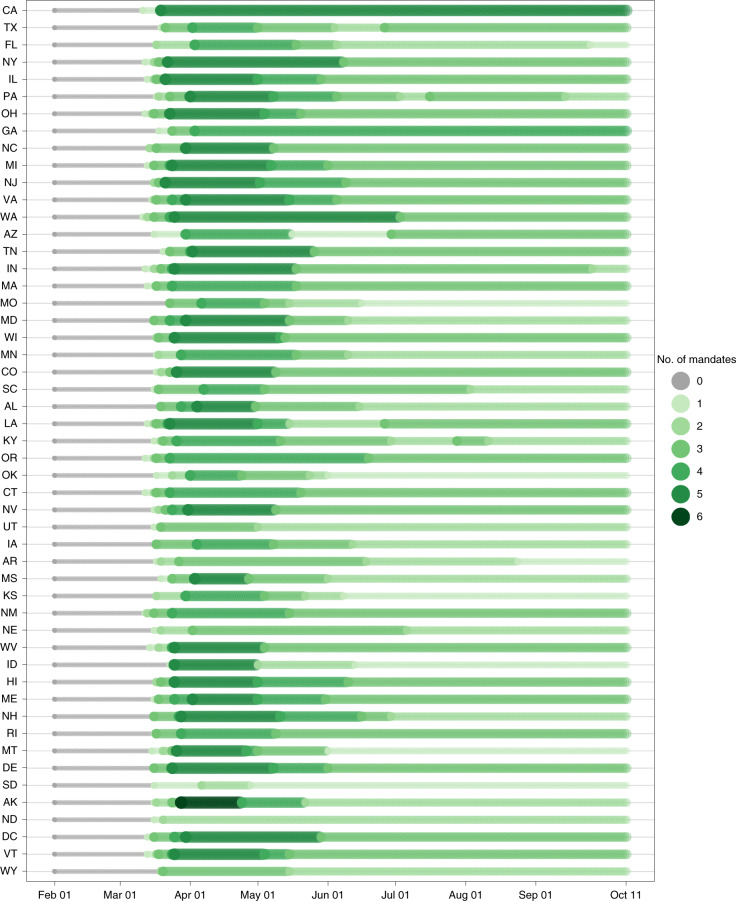
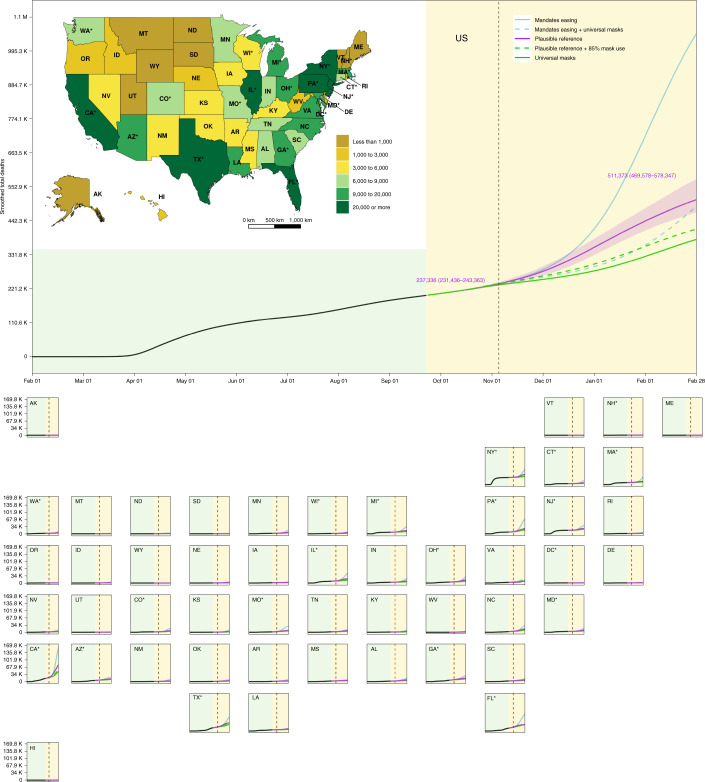
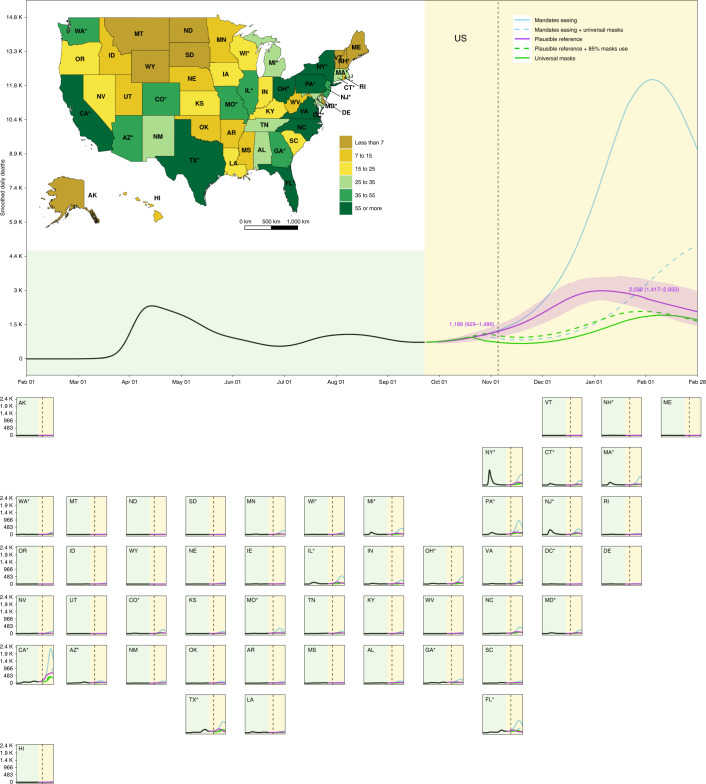
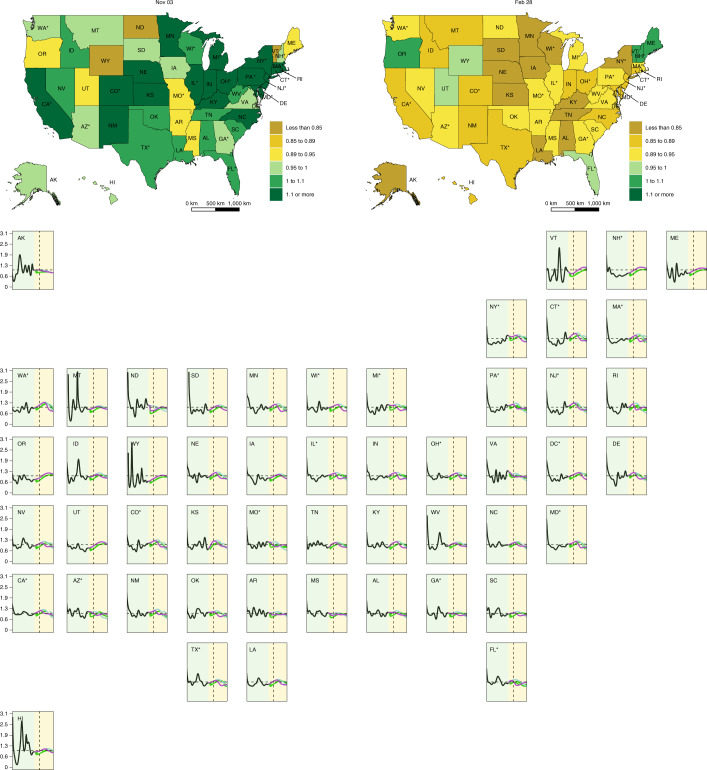
We use COVID-19 case and mortality data from 1 February 2020 to 21 September 2020 and a deterministic SEIR (susceptible, exposed, infectious and recovered) compartmental framework to model possible trajectories of severe acute respiratory syndrome coronavirus 2 (SARS-CoV-2) infections and the effects of non-pharmaceutical interventions in the United States at the state level from 22 September 2020 through 28 February 2021. Using this SEIR model, and projections of critical driving covariates (pneumonia seasonality, mobility, testing rates and mask use per capita), we assessed scenarios of social distancing mandates and levels of mask use. Projections of current non-pharmaceutical intervention strategies by state—with social distancing mandates reinstated when a threshold of 8 deaths per million population is exceeded (reference scenario)—suggest that, cumulatively, 511,373 (469,578–578,347) lives could be lost to COVID-19 across the United States by 28 February 2021. We find that achieving universal mask use (95% mask use in public) could be sufficient to ameliorate the worst effects of epidemic resurgences in many states. Universal mask use could save an additional 129,574 (85,284–170,867) lives from September 22, 2020 through the end of February 2021, or an additional 95,814 (60,731–133,077) lives assuming a lesser adoption of mask wearing (85%), when compared to the reference scenario.
Overview
The claims and statistics of this paper haven’t been checked yet.
Free: it reads the open-access text and checks the first 5 claims that cite a source we can check. Create a free account to check every claim.
Integrity signals
Registry
Cites
Statistics
Figures
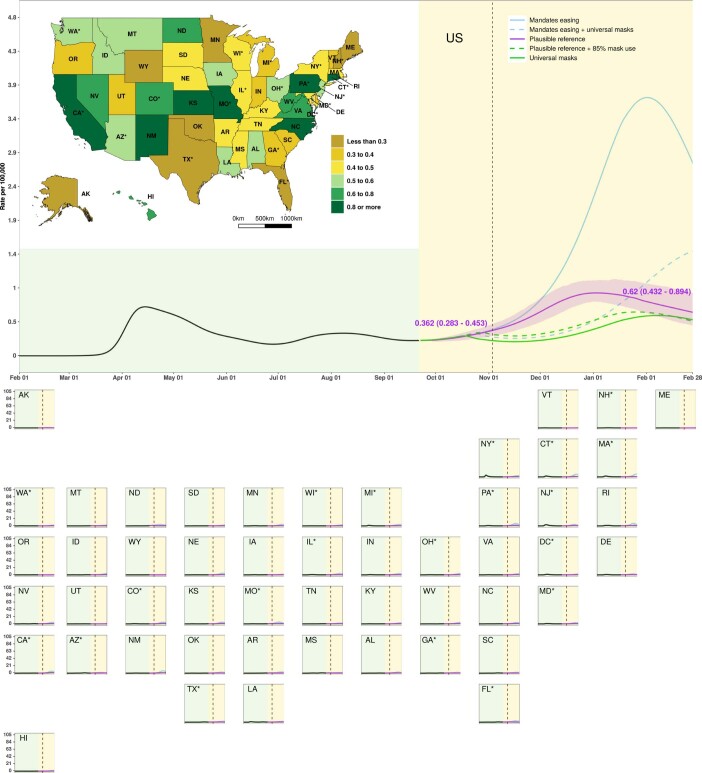
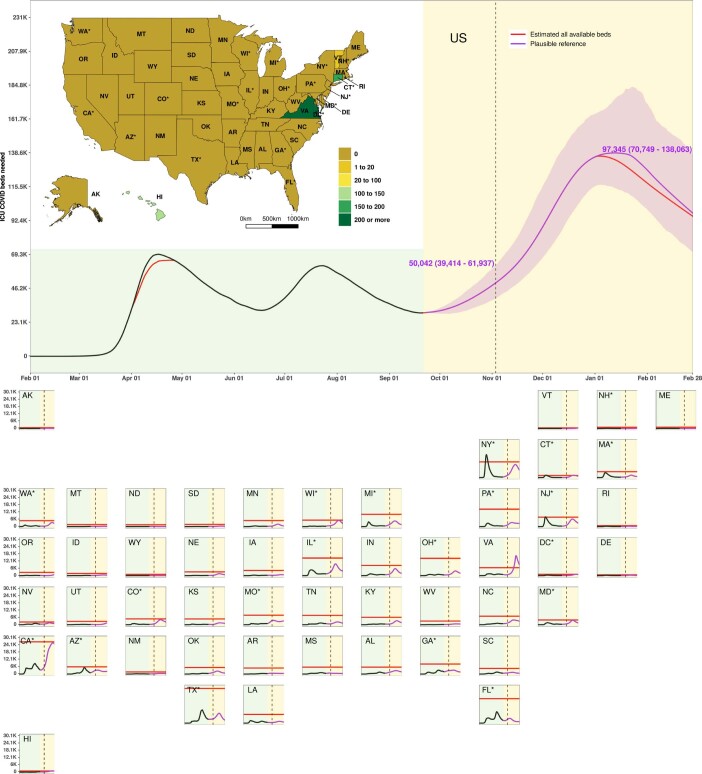
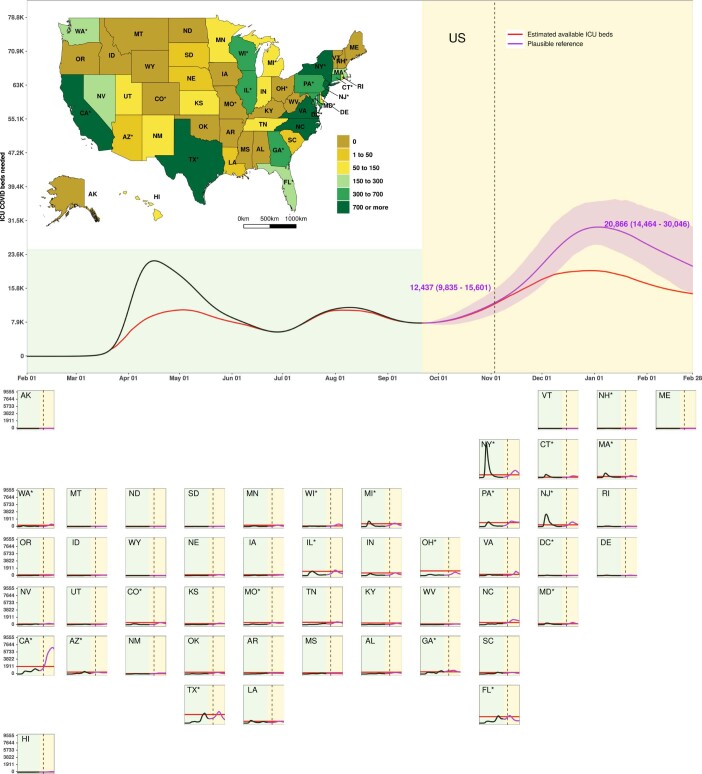
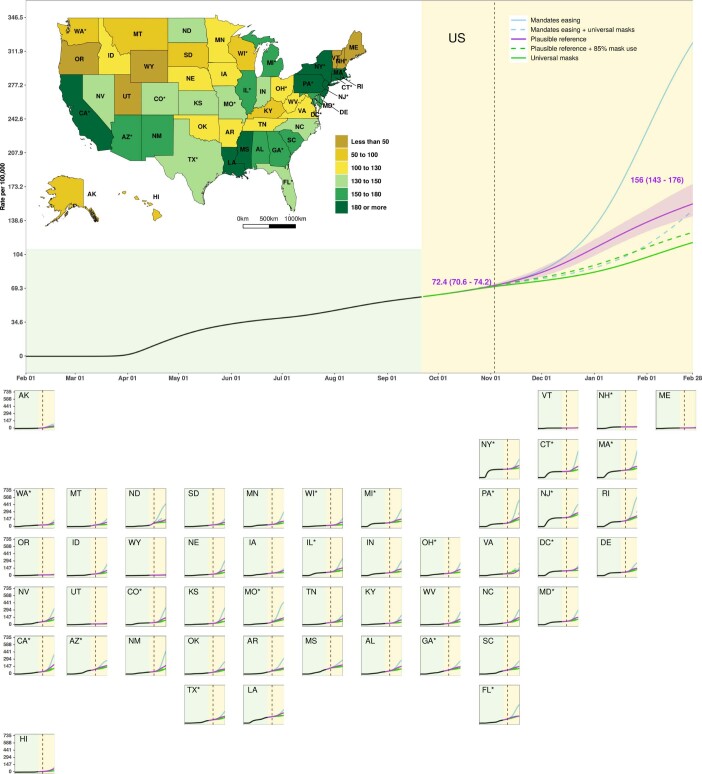
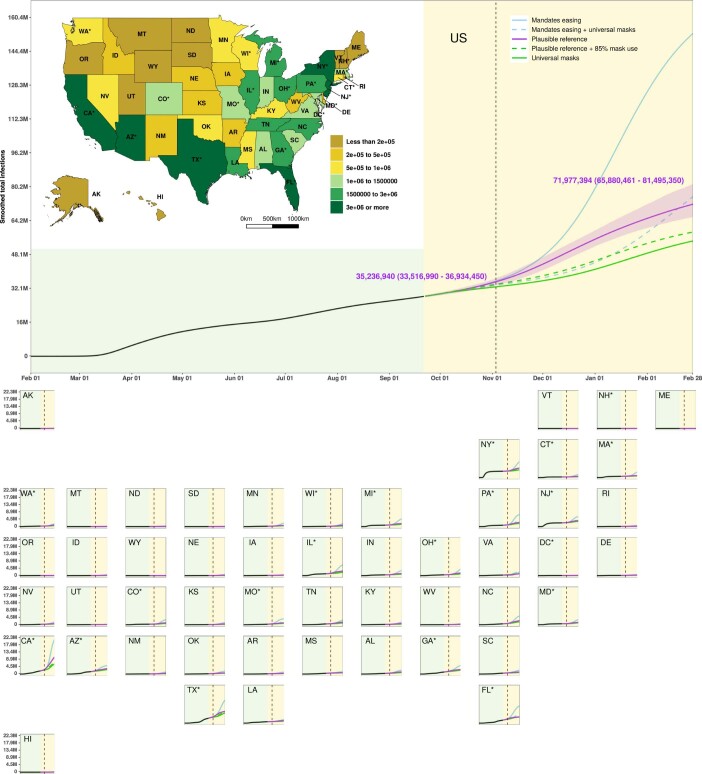
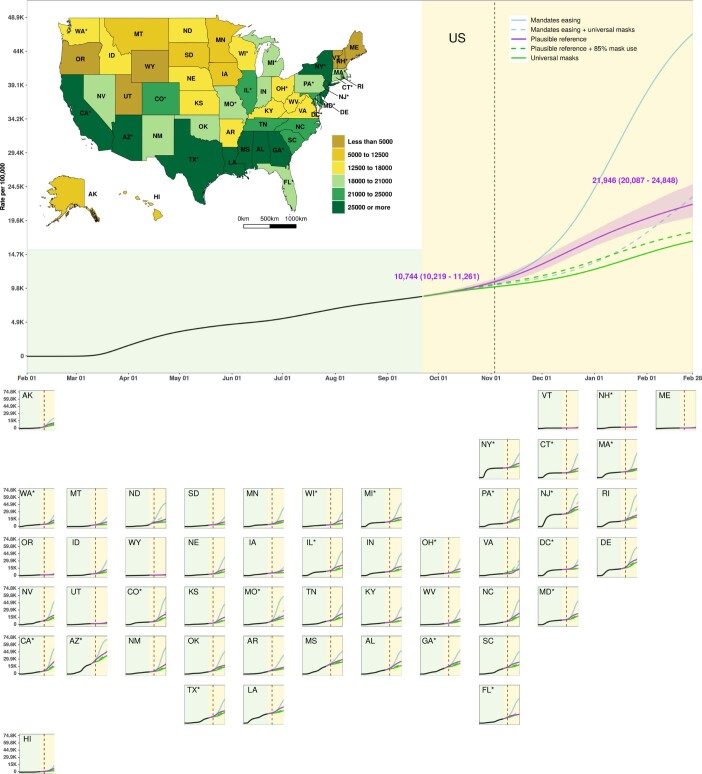
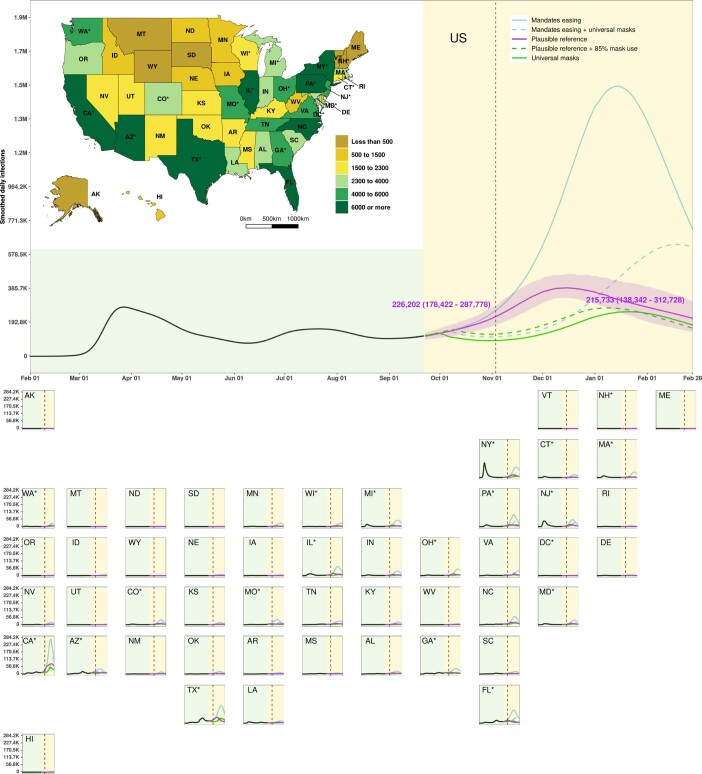
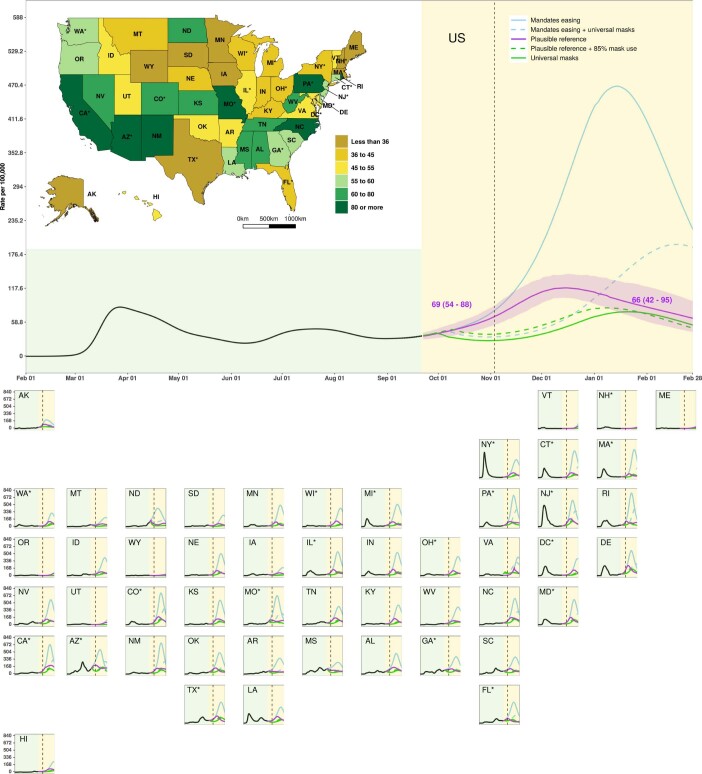
Verification
Claims the paper makes
The claims and statistics of this paper haven’t been checked yet.
Free: it reads the open-access text and checks the first 5 claims that cite a source we can check. Create a free account to check every claim.
Claims other papers make about this one
Each is checked against this paper’s own text: does it say what the citing paper says it does?
The source backs part of the claim, not all of it — or backs it for a different population, condition or comparison.
In the citing paper
“Ultimately, we considered three novel indicators of the COVID-19 pandemic: decreasing human mobility,13 estimated total (as opposed to reported) daily SARS-CoV-2 infection rate, and estimated daily excess mortality rate during the pandemic (including excess deaths occurring during the pandemic where COVID-19 was not reported as the underlying cause of death).5, 13”
From Global prevalence and burden of depressive and anxiety disorders in 204 countries and territories in 2020 due to the COVID-19 pandemic (2021) · cites this paper as [13]
Experimental — accuracy not yet measuredThe source backs part of the claim, not all of it — or backs it for a different population, condition or comparison.
In the citing paper
“The estimation of human mobility, daily SARS-CoV-2 infection rate, and daily excess mortality rate was done by the Institute for Health Metrics and Evaluation (IHME) COVID-19 Forecasting Team and is described in detail elsewhere.13”
From Global prevalence and burden of depressive and anxiety disorders in 204 countries and territories in 2020 due to the COVID-19 pandemic (2021) · cites this paper as [13]
Experimental — accuracy not yet measuredThe cited source says what the claim attributes to it.
In the citing paper
“This variation can be explained by a combination of factors including policies enacted by governments to encourage mask use and reduce social interaction,48, 49, 50 presence of escape variants, testing and contact tracing capacity,51, 52 previous exposure to other coronaviruses,53 baseline patterns of social interaction, and more.”
From Estimating global, regional, and national daily and cumulative infections with SARS-CoV-2 through Nov 14, 2021: a statistical analysis (2022) · cites this paper as [50]
Self-check
Percentages, sums and reported differences re-computed from the paper’s own numbers.
The self-check needs the paper’s full text.
Citations
Cites
Vos, T., Lim, S. S., Abbafati, C., Abbas, K. M., Abbasi, M., Abbasifard, M., Abbasi-Kangevari, M., Abbastabar, H., Abd-Allah, F., Abdelalim, A., et al. (2020) · The Lancet · doi:10.1016/s0140-6736(20)30925-9 · Cited by 19,358
Self-citationMurray, C. J. L., Aravkin, A. Y., Zheng, P., Abbafati, C., Abbas, K. M., Abbasi-Kangevari, M., Abd-Allah, F., Abdelalim, A., Abdollahi, M., Abdollahpour, I., et al. (2020) · The Lancet · doi:10.1016/s0140-6736(20)30752-2 · Cited by 9,854
Self-citationRemdesivir for the Treatment of Covid-19 — Final Report
Beigel, J. H., Tomashek, K. M., Dodd, L. E., Mehta, A. K., Zingman, B. S., Kalil, A. C., Hohmann, E., Chu, H. Y., Luetkemeyer, A., Kline, S., et al. (2020) · New England Journal of Medicine · doi:10.1056/nejmoa2007764 · Cited by 7,267
First case of 2019 novel coronavirus in the United States
Holshue, M. L., DeBolt, C., Lindquist, S., Lofy, K. H., Wiesman, J., Bruce, H., Spitters, C., Ericson, K., Wilkerson, S., Tural, A., et al. (2020) · New England Journal of Medicine · doi:10.1056/nejmoa2001191 · Cited by 6,030
Lauer, S. A., Grantz, K. H., Bi, Q., Jones, F. K., Zheng, Q., Meredith, H. R., Azman, A. S., Reich, N. G., & Lessler, J. (2020) · Annals of Internal Medicine · doi:10.7326/m20-0504 · Cited by 5,970
The proximal origin of SARS-CoV-2
Andersen, K. G., Rambaut, A., Lipkin, W. I., Holmes, E. C., & Garry, R. F. (2020) · Nature Medicine · doi:10.1038/s41591-020-0820-9 · Cited by 5,081
Chu, D. K., Akl, E. A., Duda, S., Solo, K., Yaacoub, S., Schünemann, H. J., Chu, D. K., Akl, E. A., El-harakeh, A., Bognanni, A., et al. (2020) · The Lancet · doi:10.1016/s0140-6736(20)31142-9 · Cited by 3,843
How will country-based mitigation measures influence the course of the COVID-19 epidemic?
Anderson, R. M., Heesterbeek, H., Klinkenberg, D., & Hollingsworth, T. D. (2020) · The Lancet · doi:10.1016/s0140-6736(20)30567-5 · Cited by 3,648
Wang, Y., Zhang, D., Du, G., Du, R., Zhao, J., Jin, Y., Fu, S., Gao, L., Cheng, Z., Lu, Q., et al. (2020) · The Lancet · doi:10.1016/s0140-6736(20)31022-9 · Cited by 3,440
Estimating the effects of non-pharmaceutical interventions on COVID-19 in Europe
Flaxman, S., Mishra, S., Gandy, A., Unwin, H. J. T., Mellan, T. A., Coupland, H., Whittaker, C., Zhu, H., Berah, T., Eaton, J. W., et al. (2020) · Nature · doi:10.1038/s41586-020-2405-7 · Cited by 3,350
Research works printed but not linked: 4
- 4. Horton, R. The COVID-19 Catastrophe: What's Gone Wrong and How to Stop it Happening Again. (John Wiley & Sons, 2020).
- 39. Henry M Jackson School of International Studies, university of Washington, Seattle, WA, uSA. 13 Policy and Epidemiology Group, Queensland Centre for Mental Health research, Brisbane, Queensland, Australia. 14 These authors contributed equally: robert C reiner Jr., ryan M Barber. ✉ e-mail: sihay@uw.edu coronavirusdisease2019/what-you-should-know/current-situation-in-hawaii/; Illinois cases and deaths from https://dph.illinois.gov/covid19/covid19-statistics; Indiana cases and deaths from https://www.coronavirus.in.gov/2393.htm; Kentucky cases and deaths from https://govstatus.egov.com/kycovid19; Maryland cases and deaths from https://coronavirus.maryland.gov/; Nebraska cases and deaths from http://dhhs.ne.gov/Pages/Coronavirus.aspx; New York cases and deaths from https://github.com/nychealth/coronavirus-data and https:// covid19tracker.health.ny.gov/views/NYS-COVID19-Tracker/NYSDOHCOVID-19 Tracker-Map?%3Aembed=yes&%3Atoolbar=no&%3Atabs=n; North Carolina cases and deaths from https://covid19.ncdhhs.gov/dashboard; and Washington cases, hospitalizations and deaths from https://www.doh.wa.gov/Emergencies/ COVID19/DataDashboard. The timing of mandate implementation for each state was derived from a preprint study 43 and supplemented with ad hoc additional resources available at http://ghdx.healthdata.org/record/ihme-data/ united-states-covid-19-scenarios-2020-2021. The mobility covariate was constructed using data from Google Community Mobility Reports (https://www. google.com/covid19/mobility/); Facebook Data for Good Disease Prevention Maps (https://dataforgood.fb.com/tools/disease-prevention-maps/; with access coordinated via diseaseprevmaps@fb.com); SafeGraph Shelter in Place Index (https://www.safegraph.com/dashboard/covid19-shelter-in-place?s=US& d=09-13-2020&t=counties&m=index; with access coordinated through the SafeGraph COVID-19 Data Consortium via https://www.safegraph.com/covid-19- data-consortium/); and Descartes Labs (https://github.com/descarteslabs/ DL-COVID-19). The testing covariate was constructed using data from the COVID Tracking Project (https://covidtracking.com/data/api/). State-level datasets for the testing covariate were replaced in Washington, using https:// www.doh.wa.gov/Emergencies/COVID19/DataDashboard. Mask-use data were obtained from Premise COVID-19 Global Impact Survey (https://www.premise. com/the-dos-and-donts-of-conducting-surveys-during-covid-19/; with access coordinated through info@premise.com); the Facebook (COVID) Symptom Survey (with access coordinated through University of Maryland Joint Program in Survey Methodology via admin-C19survey-fb@umd.edu); and the YouGov COVID-19 Behavioural Tracker Survey (https://github.com/YouGov-Data/ covid-19-tracker). Pneumonia seasonality estimates, particulate matter air pollution estimates, lower respiratory infection country-specific mortality rate estimates and smoking estimates were generated by the Global Burden of Disease study (http://ghdx.healthdata.org/record/ihme-data/united-states-covid- 19-scenarios-2020-2021/). Altitude was sourced from the National Oceanic and Atmospheric Administration National Centers for Environmental Information Global Land One-km Base Elevation Project (https://www.ngdc.noaa.gov/mgg/ topo/globe.html) and population data were obtained from WorldPop Population Counts (https://www.worldpop.org/project/list/). These sources are further detailed in the Supplementary Information 44-51 . Source data are provided with this paper. references
- 43. GBD 2019 Population and Fertility Collaborators. Global, regional and national age-sex-specific fertility, mortality and population estimates, 1950-2019: a comprehensive demographic analysis for the global burden of disease study 2019. The Lancet (in press).
- 52. GBD 2019 Diseases and injuries Collaborators. Global burden of 369 diseases and injuries, 1990-2019: a systematic analysis for the Global Burden of Disease Study 2019. The Lancet (in press).
Cited by
Items 301–400 of 554
A Relaxation Approach to Feature Selection for Linear Mixed Effects Models
Sholokhov, A., Burke, J. V., Santomauro, D. F., Zheng, P., & Aravkin, A. Y. (2023) · Journal of Computational and Graphical Statistics · doi:10.1080/10618600.2023.2231496 · Cited by 10
“…with insufficient data to resolve each group independently, making them fundamental tools for regression analysis in population health sciences (Reiner et al. 2020; Murray et al. 2020), meta-analysis (DerSimonian and Laird 1986; Zheng et al. 2021), life sciences, and as well as in many others…”
MethodSelf-citationJudson, T. J., Zhang, S., Lindan, C., Boothroyd, D. B., Grumbach, K., Bollyky, J., Sample, H. A., Huang, B., Desai, M., Gonzales, R., et al. (2023) · Annals of Epidemiology · doi:10.1016/j.annepidem.2023.07.009 · Cited by 5
Castonguay, F. M., Barnes, A., Jeon, S., Fornoff, J., Adhikari, B. B., Fischer, L. S., Greening, B., Hassan, A. O., Kahn, E. B., Kang, G. J., et al. (2024) · BMC Public Health · doi:10.1186/s12889-024-18203-8 · Cited by 5
Estimating worldwide costs of premature mortalities caused by COVID-19
da Silva, J. A. T., & Tsigaris, P. (2021) · Journal of Health Research · doi:10.1108/jhr-09-2020-0406 · Cited by 5
Inter-Cluster Transmission Control Using Graph Modal Barriers
Zhang, L., Sadler, B. M., Blum, R. S., & Bhattacharya, S. (2021) · IEEE Transactions on Signal and Information Processing over Networks · doi:10.1109/tsipn.2021.3071219 · Cited by 5
“In the context of the recent COVID19 pandemic, [20] and [27] developed agent-based pandemic simulations and predictions for Europe and the United States, respectively.”
Horng, S., O’Donoghue, A. L., Dechen, T., Rabesa, M., Shammout, A., Markson, L. J., Jegadeesan, V., Tandon, M., & Stevens, J. P. (2021) · JAMA Network Open · doi:10.1001/jamanetworkopen.2021.13782 · Cited by 5
Al‐Hadeethi, Y., Ramley, I. F. E., & Sayyed, M. I. (2021) · Scientific Reports · doi:10.1038/s41598-021-00687-8 · Cited by 5
“(6-12), including two sets of population rates as independent variables.”
BackgroundInfluentialCampos, M., Sempere, J. M., Galán, J. C., Moyá, A., Lloréns, C., de-los-Angeles, C., Baquero‐Artigao, F., Cantón, R., & Baquero, F. (2021) · microLife · doi:10.1093/femsml/uqab011 · Cited by 6
Quinn, G. A., Connolly, R., ÓhAiseadha, C. O., & Hynds, P. D. (2021) · OSF Preprints (OSF Preprints) · doi:10.31219/osf.io/s9z2p · Cited by 5
Advancing Real-time Pandemic Forecasting Using Large Language Models: A COVID-19 Case StudyPreprint
Yang, H. F., Du, H., Zhao, J., Zhao, Y., Xu, S., Lin, X., Chen, Y., & Gardner, L. (2024) · Research Square · doi:10.21203/rs.3.rs-4244182/v1 · Cited by 8
Data Analysis Using a Coupled System of Ornstein–Uhlenbeck Equations Driven by Lévy Processes
Mariani, M. C., Asante, P. K., Kubin, W., & Tweneboah, O. K. (2022) · Axioms · doi:10.3390/axioms11040160 · Cited by 4
An SIR‐based Bayesian framework for COVID‐19 infection estimation
Wu, H., Stephens, D. A., & Moodie, E. E. M. (2024) · Canadian Journal of Statistics · doi:10.1002/cjs.11817 · Cited by 5
Optimizing Pharmaceutical and Non-pharmaceutical Interventions During Epidemics
Kulkarni, N., Qiao, C., & Vereshchaka, A. (2022) · Lecture notes in computer science · doi:10.1007/978-3-031-17114-7_22 · Cited by 4
Outbreak-size distributions under fluctuating rates
Hindes, J., Mier-y-Terán-Romero, L., Schwartz, I. B., & Assaf, M. (2023) · Physical Review Research · doi:10.1103/physrevresearch.5.043264 · Cited by 4
Moore, S. M., Cavany, S., Perkins, T. A., & España, G. (2024) · Epidemics · doi:10.1016/j.epidem.2024.100759 · Cited by 4
Liu, D., & Sopasakis, A. (2024) · Heliyon · doi:10.1016/j.heliyon.2024.e38276 · Cited by 7
“3∕14 ), the infectious period (14 days) and 𝑛 𝑒 , the expected number of susceptible walkers that an infected walker meets per day [59].”
BackgroundModeling, Inference, and Prediction in Mobility-Based Compartmental Models for Epidemiology
Jiang, N., Chu, W., & Li, Y. (2025) · SIAM Journal on Applied Mathematics · doi:10.1137/24m1691557 · Cited by 7
Binns, C. W. (2021) · Asia Pacific Journal of Public Health · doi:10.1177/1010539520986736 · Cited by 4
Solís, P., Dasarathy, G., Turaga, P. K., Drake, A. J., Vora, K. J., Sajja, A., Raaman, A., Praharaj, S., & Lattus, R. (2021) · Geographical Review · doi:10.1080/00167428.2021.1947139 · Cited by 4
Joyosemito, I. S., & Nasir, N. M. (2021) · Jurnal Pengabdian kepada Masyarakat UBJ · doi:10.31599/jabdimas.v4i1.455 · Cited by 4
Welsch, D. M. (2021) · The B E Journal of Economic Analysis & Policy · doi:10.1515/bejeap-2021-0157 · Cited by 4
Bandyopadhyay, A., Schips, M., Mitra, T., Khailaie, S., Binder, S. C., & Meyer‐Hermann, M. (2022) · Communications Medicine · doi:10.1038/s43856-022-00139-y · Cited by 4
Wu, S. X., & Wu, X. Y. (2022) · Frontiers in Public Health · doi:10.3389/fpubh.2022.990400 · Cited by 5
The Interplay between COVID-19 and the Economy in Canada
Albani, V., Grasselli, M. R., Pang, W., & Zubelli, J. P. (2022) · Journal of risk and financial management · doi:10.3390/jrfm15100476 · Cited by 4
“During the first outbreak of COVID-19, several catastrophic predictions (regarding the number of deaths and hospital occupations) have emerged worldwide (Ioannidis et al. 2020).”
BackgroundManiamfu, P., & Kameyama, K. (2023) · IEEE International Colloquium on Signal Processing & Its Applications (CSPA) · doi:10.1109/cspa57446.2023.10087773 · Cited by 4
“Since the outbreak of COVID-19 in China, predicting the trends of the disease became one of the central themes in research as it contributes to the effective decision-making process and directs the allocation of medical resources [13-19].”
BackgroundHua, L., Wang, Y., Mo, B., Guo, Z., Wang, Y., Su, Z., Huang, M., Chen, H., Ma, X., Xie, J., et al. (2023) · Frontiers in Public Health · doi:10.3389/fpubh.2023.1163428 · Cited by 7
Buch, D. A., Johndrow, J. E., & Dunson, D. B. (2023) · Biometrics · doi:10.1111/biom.13901 · Cited by 4
Measuring the worldwide spread of COVID-19 using a comprehensive modeling method
Zhou, X., Ma, X., Gao, S., Ma, Y., Gao, J., Jiang, H., Zhu, W., Hong, N., Long, Y., & Su, L. (2023) · BMC Medical Informatics and Decision Making · doi:10.1186/s12911-023-02213-4 · Cited by 4
“For example, the Institute for Health Metrics and Evaluation (IHME) COVID-19 Forecasting Team modeled five COVID-19 scenarios for the United States using SEIR models [15].”
MethodFighting Against COVID-19 Requires Wearing a Face Mask by Not Some but All
Yilmazkuday, H. (2020) · Transportation Research Interdisciplinary Perspectives · doi:10.1016/j.trip.2024.101292 · Cited by 4
Robust Pandemic Control Synthesis with Formal Specifications: A Case Study on COVID-19 Pandemic
Xu, Z., & Duan, X. (2021) · IEEE Conference on Decision and Control (CDC) · doi:10.1109/cdc45484.2021.9683197 · Cited by 4
Mathematical Modelling of the COVID-19 Epidemic in Northern Ireland in 2020
Hall, P. A., Kiss, G., Kuhn, T. E., Moutari, S., Patterson, E., & Smith, E. (2021) · Open Journal of Modelling and Simulation · doi:10.4236/ojmsi.2021.92006 · Cited by 6
Mit Kontaktdaten gegen die Pandemie: Zur Ethik von Corona Warn-Apps
van Basshuysen, P., & White, L. (2021) · Ethik in der Medizin · doi:10.1007/s00481-021-00629-y · Cited by 3
You, X., Gu, J., Xu, D. R., Huang, S., Xue, H., Hao, C., Ruan, Y., Sylvia, S., Liao, J., Cai, Y., et al. (2021) · BMJ Open · doi:10.1136/bmjopen-2020-048449 · Cited by 3
Investigation of recurrent networks LSTM in the problem of Covid-19 forecasting
Zaychenko, Y. P., Zaichenko, H., & Hamidov, G. (2021) · IEEE International Conference on Computer Sciences and Information Technologies (CSIT) · doi:10.1109/csit52700.2021.9648696 · Cited by 4
Hadiwibowo, J. C., Halim, S., Yahya, B. N., Agustin, K., & Sahputra, I. H. (2021) · East Indonesia Conference on Computer and Information Technology (EIConCIT) · doi:10.1109/eiconcit50028.2021.9431889 · Cited by 4
“The other study proposed a susceptible-exposed-infected-removed (SEIR) model to capture the dynamic behavior of outbreaks on a regional level [8] and to model possible trajectories of Covid-19 infections and the effects of non-pharmaceutical interventions in the United States [9].”
BackgroundA Statistical Model to Assess Risk for Supporting COVID-19 Quarantine Decisions
Jäckle, S., Röger, E., Dicken, V., Geisler, B., Schumacher, J., & Westphal, M. (2021) · International Journal of Environmental Research and Public Health · doi:10.3390/ijerph18179166 · Cited by 4
Estimating the super-spreading rate at workplaces using bluetooth technologyPreprint
Vázquez, A., Staebler, M., Khanin, A., Lichte, D., & Brucherseifer, E. (2021) · medRxiv · doi:10.1101/2021.03.04.21252550 · Cited by 5
Yin, L., Zhang, H., Li, Y., Liu, K., Chen, T., Luo, W. P., Lai, S., Li, Y., Tang, X., Li, N., et al. (2021) · SSRN Electronic Journal · doi:10.2139/ssrn.3765491 · Cited by 7
The Limits to Learning a Diffusion Model
Baek, J., Farias, V. F., Georgescu, A., Levi, R., Peng, T., Sinha, D., Wilde, J., & Zheng, A. (2025) · Management Science · doi:10.1287/mnsc.2022.02953 · Cited by 3
Multiscale heterogeneous optimal lockdown control for COVID-19 using geographic information
Neary, C., Cubuktepe, M., Lauffer, N. T., Jin, X., Phillips, A. J., Xu, Z., Tong, D., & Topcu, U. (2022) · Scientific Reports · doi:10.1038/s41598-022-07692-5 · Cited by 3
Abdulkadhim, M. M., Mohsen, A. A., Al-Husseiny, H. F., Hattaf, K., & Zeb, A. (2024) · Iraqi Journal of Science · doi:10.24996/ijs.2024.65.5.23 · Cited by 4
“Many researchers tried to explain the fast diffusion of this virus and to predict how different containment techniques may obstruct it [28,29,30].”
BackgroundTrending on the use of Google mobility data in COVID-19 mathematical models
Deng, Y., Lin, H., He, D., & Zhao, Y. (2024) · Advances in Continuous and Discrete Models · doi:10.1186/s13662-024-03816-5 · Cited by 5
Chakraborty, C., Bhattacharya, M., Chatterjee, S., Lee, S., Bhattacharya, P., Ohimain, E. I., Wen, Z., Das, A., Rai, A., Abdelhameed, A. S., et al. (2025) · Folia Microbiologica · doi:10.1007/s12223-025-01299-9 · Cited by 7
“These data might act as dynamic transmission models’ inputs, which further attempt to describe the circumstances leading to herd immunity (Team 2021).”
Stevanović, A., & Santric-Milicevic, M. M. (2021) · Srpski medicinski casopis Lekarske komore · doi:10.5937/smclk2-33796 · Cited by 4
Calibrating COVID-19 community transmission risk levels to reflect infection prevalence
Chiu, W. A., & Ndeffo-Mbah, M. L. (2022) · Epidemics · doi:10.1016/j.epidem.2022.100646 · Cited by 3
The Design and Utilisation of PanSim, a Portable Pandemic Simulator
Keömley-Horváth, B. M., Horváth, G., Polcz, P., Siklósi, B., Tornai, K., Juhász, J., Szederkényi, G., Cserey, G., Csikász‐Nagy, A., & Reguly, I. Z. (2022) · doi:10.1109/ciw-ius56691.2022.00006 · Cited by 3
“Traditionally these models use ordinary differential equations with stochastic forcing [10], [14].”
BackgroundModeling the spread of COVID-19 in spatio-temporal context
Indika, S. H. S., Diawara, N., Jeng, H. A., Giles, B. D., & Gamage, D. S. K. (2023) · Mathematical Biosciences & Engineering · doi:10.3934/mbe.2023466 · Cited by 3
A Study of Data-Driven Methods for Adaptive Forecasting of COVID-19 Cases
Stylianides, C., Malialis, K., & Kolios, P. (2023) · Lecture notes in computer science · doi:10.1007/978-3-031-44207-0_6 · Cited by 5
Bhatia, S., Parag, K. V., Wardle, J., Nash, R. K., Imai, N., van Elsland, S. L., Lassmann, B., Brownstein, J. S., Desai, A. N., Herringer, M., et al. (2023) · PLoS ONE · doi:10.1371/journal.pone.0286199 · Cited by 6
Analysis of a Modified SEIRS Compartmental Model for COVID-19
Anjapuli, L. S. S., Patel, B., Banavar, M. K., Tepedelenlioğlu, C., Spanias, A., & Schuckers, S. (2023) · Asilomar Conference on Signals, Systems and Computers (ACSSC) · doi:10.1109/ieeeconf59524.2023.10477067 · Cited by 4
“The SEIR model and its variations have been used in research for many diseases [13], [14], [15], [16], [11], [17], [18], [19], [20], but it does not capture the reinfections of COVID-19 that occurs due to loss of immunity of the individuals in 965 979-8-3503-2574-4/23/$31.00 ©2023 IEEE Asilomar…”
MethodInfluentialPassive and active field theories for disease spreading
Vrugt, M. T., Jeggle, J., & Wittkowski, R. (2024) · Journal of Physics A Mathematical and Theoretical · doi:10.1088/1751-8121/ad4c31 · Cited by 3
COVID-19 related chemosensory changes in individuals with self-reported obesity
Bhutani, S., Coppin, G., Veldhuizen, M. G., Parma, V., & Joseph, P. V. (2022) · Rhinology Journal · doi:10.4193/rhin21.351 · Cited by 4
Characterizing pandemic waves: A latent class analysis of COVID-19 spread across US counties
Uddin, M. Y. S., & Rafiq, R. (2022) · Pattern Recognition Letters · doi:10.1016/j.patrec.2022.08.017 · Cited by 4
Media Pembelajaran Matematika Menggunakan Kinemater Dimasa Pademi Covid-19
Yeni, H., & Mudinillah, A. (2021) · NIZHAMIYAH · doi:10.30821/niz.v11i2.1251 · Cited by 3
Phuong, J., Hyland, S. L., Mooney, S. J., Long, D. R., Takeda, K., Vavilala, M. S., & O'Hara, K. P. (2021) · PLoS ONE · doi:10.1371/journal.pone.0258339 · Cited by 3
Deploying Health Care Providers During the COVID-19 Pandemic
Shander, A., Mesrobian, J. R., Weiss, J., & Javidroozi, M. (2021) · Disaster Medicine and Public Health Preparedness · doi:10.1017/dmp.2021.116 · Cited by 4
Behavioral epidemiology: Vaccine hesitancy, sunscreen hesitancy, and smoking cessation
Kantor, J. (2020) · JAAD International · doi:10.1016/j.jdin.2020.10.008 · Cited by 3
Yin, L., Zhang, H., Li, Y., Liu, K., Chen, T., Luo, W. P., Lai, S., Li, Y., Tang, X., Li, N., et al. (2021) · SSRN Electronic Journal · doi:10.2139/ssrn.3750214 · Cited by 3
Bhatia, S., Parag, K. V., Wardle, J., Imai, N., van Elsland, S. L., Lassmann, B., Cuomo-Dannenburg, G., Jauneikaite, E., Unwin, H. J. T., Riley, S., et al. (2021) · Research Square · doi:10.21203/rs.3.rs-799162/v1 · Cited by 6
Kim, S., Kim, M., Lee, S., & Lee, Y. J. (2021) · Research Square · doi:10.21203/rs.3.rs-725714/v1 · Cited by 3
Oodally, A., Hammami, P., Reilhac, A., de Lamérie, G. G., Opatowski, L., & Temime, L. (2021) · medRxiv · doi:10.1101/2021.09.09.21262609 · Cited by 4
Responsiveness to risk explains large variation in COVID-19 mortality across countriesPreprint
Lim, T. Y., & Rahmandad, H. (2020) · medRxiv · doi:10.1101/2020.12.11.20247924 · Cited by 3
Raman, G., & Peng, J. C. (2020) · Research Square · doi:10.21203/rs.3.rs-130437/v1 · Cited by 3
The Benefits and Costs of U.S. Employer COVID-19 Vaccine Mandates
Ferranna, M., Robinson, L., Cadarette, D., Eber, M., & Bloom, D. E. (2022) · National Bureau of Economic Research · doi:10.3386/w30339 · Cited by 4
SARS-CoV-2 Delta and Omicron community transmission networks as added value to contact tracing
Murray, J. M., Murray, D. D., Schvoerer, É., & Akand, E. H. (2024) · Journal of Infection · doi:10.1016/j.jinf.2024.01.004 · Cited by 2
Alves, C. L., Kuhnert, K., Rodrigues, F. A., & Moeckel, M. (2025) · Biology Methods and Protocols · doi:10.1093/biomethods/bpaf039 · Cited by 3
Advancements in Epidemic Transmission Suppression: A Comprehensive Survey
Tong, L., Zhang, S., Sun, H., Cai, Y., Zhang, J., Qian, W., Zhang, Q., He, Q., Chen, J., & Li, J. (2025) · IEEE Transactions on Network Science and Engineering · doi:10.1109/tnse.2025.3579136 · Cited by 3
“The suppression of epidemic transmission has consistently been at the core of epidemiological attention, as it aids in reducing the risk of infection, conserving medical resources, maintaining social stability, and promoting economic recovery [9], [10], [11].”
Self-citationAravamuthan, S. R., Reyes, J. F. M., Yandell, B. S., & Döpfer, D. (2023) · BMC Public Health · doi:10.1186/s12889-023-15160-6 · Cited by 3
A data-driven Markov process for infectious disease transmission
Wang, C., & Mustafa, S. (2023) · PLoS ONE · doi:10.1371/journal.pone.0289897 · Cited by 3
Bao, S., & Hu, Z. (2023) · Nonlinear Dynamics · doi:10.1007/s11071-023-08914-9 · Cited by 2
“Following the IHME COVID-19 forecasting team [20], a four compartment model to study the potential impact of the use of face masks to curtail the spread of the COVID-19 pandemic was studied.”
MethodEvaluation of phase-adjusted interventions for COVID-19 using an improved SEIR model
Jiang, H., Gu, Z., Liu, H., Huang, J., Wang, Z., Xiong, Y., Tong, Y., Yin, J., Jiang, F. Y., Chen, Y., et al. (2023) · Epidemiology and Infection · doi:10.1017/s0950268823001796 · Cited by 2
Quantitative Study on American COVID-19 Epidemic Predictions and Scenario Simulations
Sun, J., Qi, J., Yan, Z., Li, Y., Liang, J., & Wu, S. (2024) · ISPRS International Journal of Geo-Information · doi:10.3390/ijgi13010031 · Cited by 6
Leveraging Deep Learning to Improve COVID-19 Forecasting Using Wastewater Viral Load
Fazli, M., & Shakeri, H. (2023) · IEEE International Conference on Big Data (BigData) · doi:10.1109/bigdata59044.2023.10386828 · Cited by 2
“Compartmental models are the most common models for infectious diseases and have been applied to COVID-19 since the beginning of the outbreak [15], [16].”
BackgroundButail, S., Bhattacharya, A., & Porfiri, M. (2024) · Chaos An Interdisciplinary Journal of Nonlinear Science · doi:10.1063/5.0156338 · Cited by 3
A study of the attenuation stage of a global infectious disease
Sun, T., Jin, B., Wu, Y., & Bao, J. (2024) · Frontiers in Public Health · doi:10.3389/fpubh.2024.1379481 · Cited by 2
“In recent years, modified SEIR or SIR models have also been proposed and applied to COVID-19 outbreak analysis in China (15–18) and other regions (19, 20).”
MethodWang, L., Zhang, K., Xu, L., & Wang, J. (2024) · PNAS Nexus · doi:10.1093/pnasnexus/pgae237 · Cited by 5
Self-citationLin, T.-Y., Yen, A. M., Chen, S. L., Hsu, C.-Y., Lai, C.-C., Luh, D., Yeh, Y., & Chen, T. H.-H. (2024) · JMIR Public Health and Surveillance · doi:10.2196/54861 · Cited by 2
25 Models in the COVID-19 Pandemic
Imai, N., Baguelin, M., & Ferguson, N. M. (2024) · Springer eBooks · doi:10.1007/978-3-031-48408-7_37 · Cited by 2
Fractional and fractal extensions of epidemiological models
Gabrick, E. C., Lenzi, E. K., & Batista, A. M. (2025) · Elsevier eBooks · doi:10.1016/b978-0-44-328814-2.00008-4 · Cited by 2
The interaction between population age structure and policy interventions on the spread of COVID-19
Yin, H., Liu, Z., & Kammen, D. M. (2025) · Infectious Disease Modelling · doi:10.1016/j.idm.2025.03.003 · Cited by 4
“Moreover, it's worth noting that this study primarily focuses on social distancing strategies, and as a result, we did not explore the effects of wearing face masks or vaccination (Reiner et al., 2020).”
The Importance of Asymptomatic Coronavirus Disease-19 Patients: Never Trust a “Silent Customer”
Turabián, J. L. (2020) · Journal of Community and Preventive Medicine · doi:10.33309/2638-7719.030205 · Cited by 2
“4 Journal of Community and Preventive Medicine • Vol 3 • Issue 2 • 2020 measures will continue to some extent until scientists find an effective treatment or vaccine, and possibly also for a certain time afterwards.[33,34]”
BackgroundWood, R. M., & Hall, I. (2021) · Journal of the Operational Research Society · doi:10.1080/01605682.2021.1960909 · Cited by 2
Estimating the Level of Asymptomatic COVID-19 Infections in Northern Ireland in 2020
Hall, P. A., Kiss, G., Kuhn, T. E., Moutari, S., Patterson, E., & Smith, E. (2022) · Open Journal of Modelling and Simulation · doi:10.4236/ojmsi.2022.102011 · Cited by 2
Self, S. C. W., Huang, R., Amin, S., Ewing, J. A., Rudisill, C., & McLain, A. C. (2022) · PLoS ONE · doi:10.1371/journal.pone.0260595 · Cited by 2
Hu, H., Xiong, S., Zhang, X., Liu, S., Gu, L., Zhu, Y., Xiang, D., & Skitmore, M. (2023) · Heliyon · doi:10.1016/j.heliyon.2023.e14533 · Cited by 4
Al‐Bazi, A., Madi, F., Abu-Monshar, A., Eliya, Y., Adediran, T. V., & Khudir, K. A. (2023) · International Journal of Healthcare Management · doi:10.1080/20479700.2023.2189555 · Cited by 4
“At the action levels (S1 – E3), it has been concluded that the highest rates of Safe customers were achieved by applying actions S1 and S2, where Mask and Social Distance are mandatory, which agrees with COVID T.I. et al. (2020) fi ndings [14].”
MethodTowards course of disease based epidemiological modelling: motivation and computational optimization
Wu, Y.-H., & Nordling, T. E. M. (2023) · IEEE Annual International Computer Software and Applications Conference (COMPSAC) · doi:10.1109/compsac57700.2023.00035 · Cited by 2
Longitudinal Sequencing and Variant Detection of SARS-CoV-2 across Southern California Wastewater
Rothman, J. A., Saghir, A., Zimmer-Faust, A. G., Langlois, K., Raygoza, K., Steele, J. A., Griffith, J. F., & Whiteson, K. (2024) · Applied Microbiology · doi:10.3390/applmicrobiol4020044 · Cited by 5
Emergence of the reproduction matrix in epidemic forecasting
Gorji, H., Stauffer, N., & Lunati, I. (2024) · Journal of The Royal Society Interface · doi:10.1098/rsif.2024.0124 · Cited by 1
Spatio-temporal analysis of COVID-19 lockdown effect to survive in the US counties using ANN
Jalali, R., & Etemadfard, H. (2024) · Scientific Reports · doi:10.1038/s41598-024-70415-5 · Cited by 3
Long COVID: epidemiology and clinical impact
Soriano, J. B., Ledo, P. R., & Ancochea, J. (2024) · European Respiratory Society eBooks · doi:10.1183/2312508x.10021323 · Cited by 3
Wong, J. H. C. (2021) · Springer eBooks · doi:10.1007/978-981-16-2430-8_7 · Cited by 2
Plate, R. C., & Jenkins, A. C. (2022) · Frontiers in Psychology · doi:10.3389/fpsyg.2021.756549 · Cited by 3
Estimating Excess Mortality Associated with COVID-19 Pandemic: A 151 Cross-countries StudyPreprint
Malouche, D., & Romdhane, H. B. (2020) · SSRN Electronic Journal · doi:10.2139/ssrn.3731481 · Cited by 2
Decline in mitigation readiness facilitated second waves of SARS-CoV-2Preprint
Wirtz, K. (2021) · medRxiv · doi:10.1101/2021.02.10.21251523 · Cited by 2
Circadian immunity, sunrise time and the seasonality of respiratory infectionsPreprint
Mo, Z., Scheben, A., Steinberg, J. I., Siepel, A. C., & Martienssen, R. A. (2021) · medRxiv · doi:10.1101/2021.03.29.21254556 · Cited by 2
Visani, G. M., Lee, A. H., Nguyen, C., Kent, D. M., Wong, J. B., Cohen, J. T., & Hughes, M. C. (2021) · arXiv (Cornell University) · doi:10.48550/arxiv.2105.00773 · Cited by 5
“…forecasts for hospital resource use (total bed usage, ventilator usage, etc.) is described in Section 8 of the Supplementary Information (IHME COVID19 Forecasting Team, 2020) released alongside their published research article on overall forecasting in the United States (Reiner et al., 2021).”
BackgroundMethodInfluentialSoto‐Ferrari, M., Carrasco‐Pena, A., & Prieto, D. (2023) · Research Square · doi:10.21203/rs.3.rs-2848576/v1 · Cited by 2
Quiner, C. A., Jones, K., & Bobashev, G. (2022) · Infectious Disease Modelling · doi:10.1016/j.idm.2022.08.002 · Cited by 1
“While significant focus is placed on the estimate of infectious individuals for these models (Institute for Health Metrics and Evaluation, 2021; Kissler et al., 2020; Reiner et al., 2021; Ritchie et al., 2020; Russell et al., 2020), less effort is placed on estimating the susceptible population (Bobashev et al.”
A Nurse‐Led Education Program to Improve COVID‐19 Prevention Knowledge Among Adolescent Students
Cuesta‐Zigorraga, A., Arrue, M., & Labaka, A. (2023) · Journal of School Health · doi:10.1111/josh.13392 · Cited by 1
Metadata
- Authors
- IHME COVID-19 Forecasting Team, Reiner, R. C., Barber, R. M., Collins, J. K., Zheng, P., Adolph, C., Albright, J., Antony, C. M., Aravkin, A. Y., Bachmeier, S. D., Bang-Jensen, B., Bannick, M. S., Bloom, S., Carter, A., Castro, E., Causey, K., Chakrabarti, S., Charlson, F. J., Cogen, R. M., Combs, E., Dai, X., Dangel, W. J., Earl, L., Ewald, S. B., Ezalarab, M., Ferrari, A. J., Flaxman, A., Frostad, J. J., Fullman, N., Gakidou, E., Gallagher, J., Glenn, S. D., Goosmann, E. A., He, J., Henry, N. J., Hulland, E. N., Hurst, B., Johanns, C., Kendrick, P. J., Khemani, A., Larson, S. L., Lazzar-Atwood, A., LeGrand, K. E., Lescinsky, H., Lindstrom, A., Linebarger, E., Lozano, R., Ma, R., Månsson, J., Magistro, B., Herrera, A. M. M., Marczak, L. B., Miller-Petrie, M. K., Mokdad, A. H., Morgan, J. D., Naik, P., Odell, C. M., O’Halloran, J. K., Osgood-Zimmerman, A. E., Ostroff, S. M., Pasovic, M., Penberthy, L., Phipps, G., Pigott, D. M., Pollock, I., Ramshaw, R. E., Redford, S. B., Reinke, G., Rolfe, S., Santomauro, D. F., Shackleton, J. R., Shaw, D. H., Sheena, B. S., Sholokhov, A., Sorensen, R. J. D., Sparks, G., Spurlock, E. E., Subart, M. L., Syailendrawati, R., Torre, A. E., Troeger, C. E., Vos, T., Watson, A., Watson, S., Wiens, K. E., Woyczynski, L., Xu, L., Zhang, J., Hay, S. I., Lim, S. S., & Murray, C. J. L.
- Affiliations
- University of Washington (US)
- The University of Queensland (AU)
- ORCID
- Reiner, Robert C.
- Barber, Ryan M.
- Collins, James K.
- Adolph, Christopher
- Albright, James
- Aravkin, Aleksandr Y.
- Bang-Jensen, Bree
- Bannick, Marlena S.
- Carter, Austin
- Causey, Kate
- Chakrabarti, Suman
- Charlson, Fiona J.
- Dai, Xiaochen
- Ewald, Samuel B.
- Ferrari, Alize J.
- Flaxman, Abraham
- Fullman, Nancy
- Gakidou, Emmanuela
- Glenn, Scott D.
- Goosmann, Erik A.
- He, Jiawei
- Henry, Nathaniel J.
- Hulland, Erin N.
- Kendrick, Parkes J.
- LeGrand, Kate E.
- Lindstrom, Akiaja
- Lozano, Rafael
- Ma, Rui
- Magistro, Beatrice
- Herrera, Ana M. Mantilla
- Marczak, Laurie B.
- Miller-Petrie, Molly K.
- Mokdad, Ali H.
- Naik, Paulami
- Osgood-Zimmerman, Aaron E.
- Pasovic, Maja
- Pigott, David M.
- Ramshaw, Rebecca E.
- Reinke, Grace
- Santomauro, Damian Francesco
- Sheena, Brittney S.
- Sholokhov, Aleksei
- Sorensen, Reed J. D.
- Spurlock, Emma Elizabeth
- Vos, Theo
- Wiens, Kirsten E.
- Hay, Simon I.
- Lim, Stephen S.
- Murray, Christopher J. L.
- Venue
- Nature Medicine
- Published
- 2020-10-23
- Volume
- 27
- Issue
- 1
- Pages
- 94-105
- ISSN
- 1078-8956 (ISSN-L)
- 1546-170X
- PMC
- PMC7806509
- OpenAlex
- W3093610264
- Cited by
- 556
- References
- 56
- Citations by year
- 2026: 17 · 2025: 25 · 2024: 61 · 2023: 84 · 2022: 134 · 2021: 210 · 2020: 25
- FWCI
- 18.01
- Type
- journal article
- Language
- en
- Update notices
- correction (2020-11-27)
- Open access
- hybrid
- doi.org
- Licence
- cc-by
- creativecommons.org/licenses/by/4.0 (tdm)
- creativecommons.org/licenses/by/4.0 (vor)
- Locations
- Nature Medicine (publishedVersion, cc-by)
- medRxiv (acceptedVersion, cc-by)
- Europe PMC (PubMed Central) (publishedVersion, other-oa)
- PubMed Central (publishedVersion, cc-by)
- PubMed (publishedVersion)
- LSHTM Research Online (London School of Hygiene and Tropical Medicine) (acceptedVersion)
- Funders
- National Science Foundation (2031096)
- Bill and Melinda Gates Foundation
- Institute for Health Metrics and Evaluation
- Topics
- Physical Sciences › Mathematics › Modeling and Simulation › COVID-19 epidemiological studies
- Physical Sciences › Mathematics › Applied Mathematics › Mathematical and Theoretical Epidemiology and Ecology Models
- Social Sciences › Sociology and Political Science › COVID-19 Prevention and Impact
- Keywords
- COVID-19 pandemic, SARS-CoV-2, SEIR model, epidemic projection, non-pharmaceutical interventions, masking, mortality, mobility, testing rates, epidemic resurgence, United States
- MeSH terms
- Physical Distancing, COVID-19, SARS-CoV-2, Health Policy, Humans, Models, Biological, Travel, United States, Epidemics
About these checks
Registry, retraction, Cites and statistics results are computed, not judged, with one exception: a printed reference that no index lists is read once by a model before it counts as a citation error. Claims are extracted by a model and kept only when their quote appears verbatim in the text; each cited source is then checked, with a model’s help, for whether it says what the claim relies on. Those verdicts can be wrong — read the claim’s quote and the cited source before relying on one.
Statistics and arithmetic are recomputed, not judged.
Confidence bands are shown only for fields calibrated on our annotated test set. None is calibrated yet, so no band is shown.
What counts as a claim ›How we measure confidence ›How we check this ›
Are you an author, or do you see a problem with this page? Request a review
Data sources
Bibliographic data: Semantic Scholar, OpenAlex, Crossref.
Contains information from the Semantic Scholar Academic Graph Datasets, made available under the ODC Attribution License (ODC-BY 1.0).
Semantic Scholar’s data is described in: Kinney, R., et al. (2023). The Semantic Scholar Open Data Platform. arXiv:2301.10140.
