

Modeling COVID-19 scenarios for the United States
Open accessPublished version of a preprint
The DOI matches its Crossref record; 59 of the 59 references it cites were found in a registry or an index.
Abstract
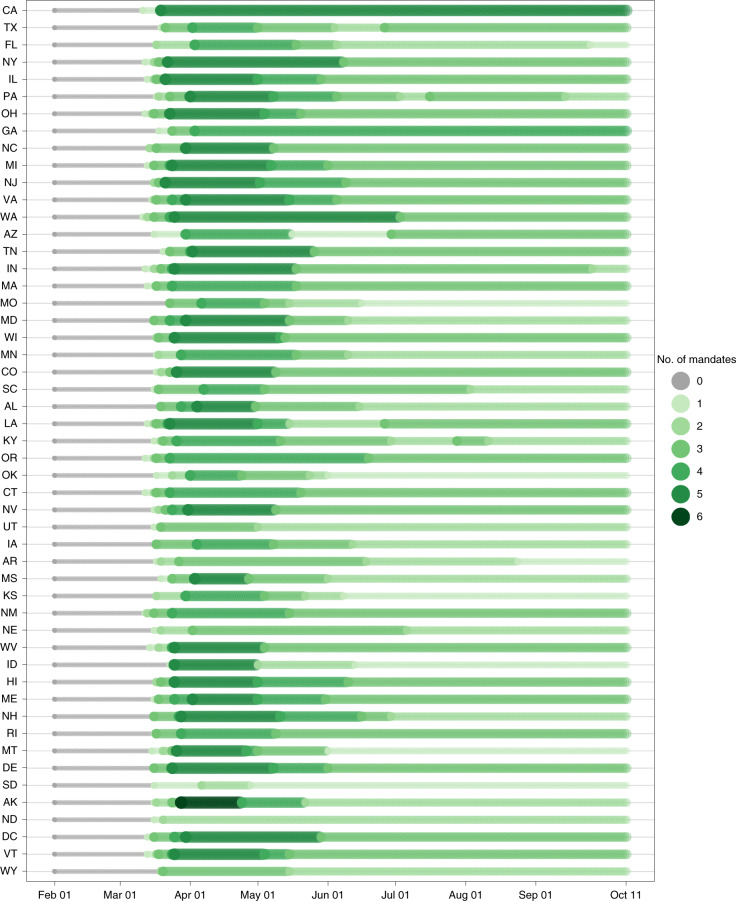
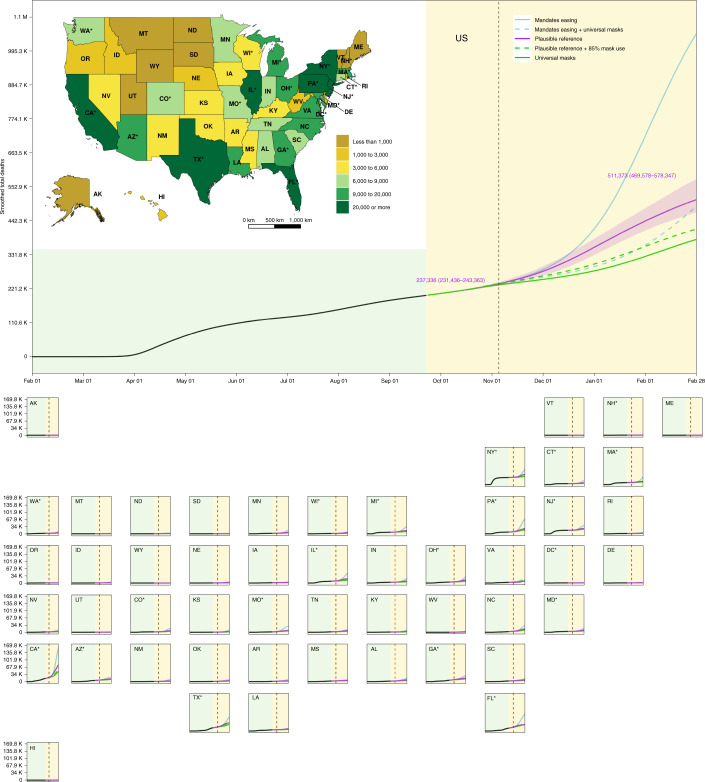
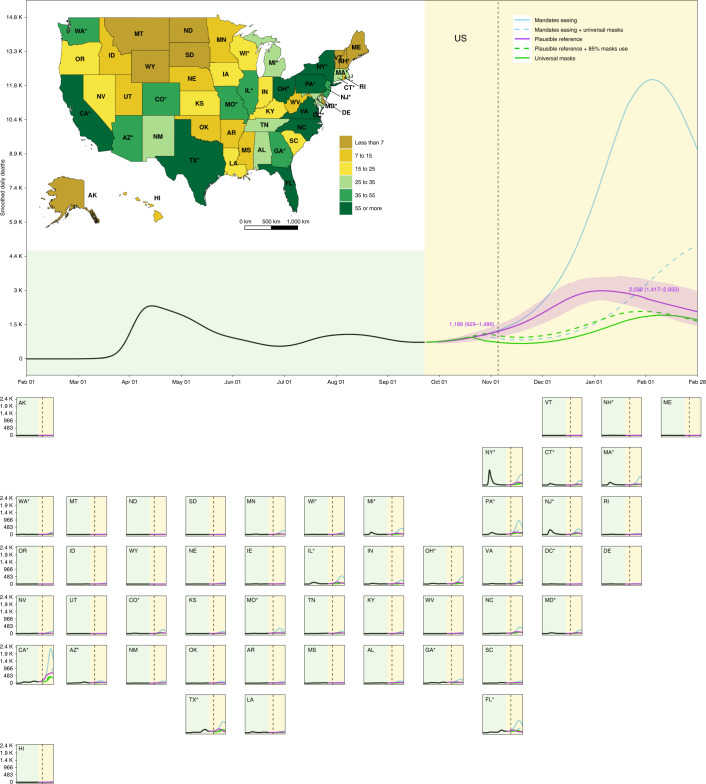
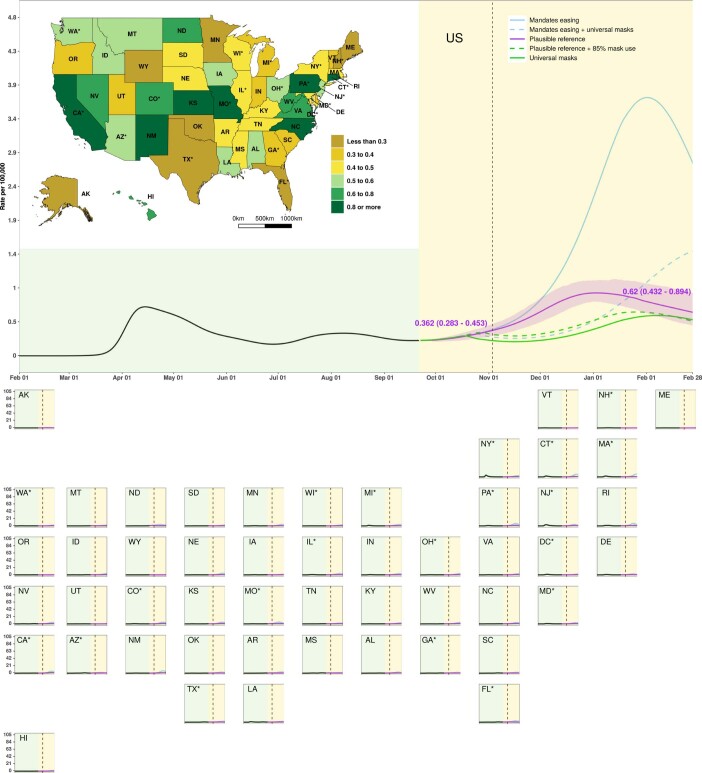
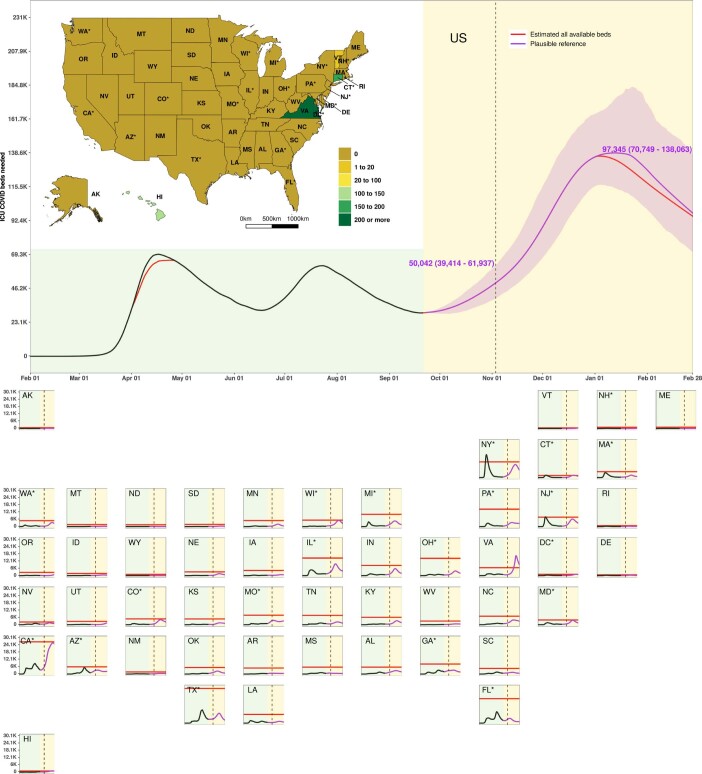
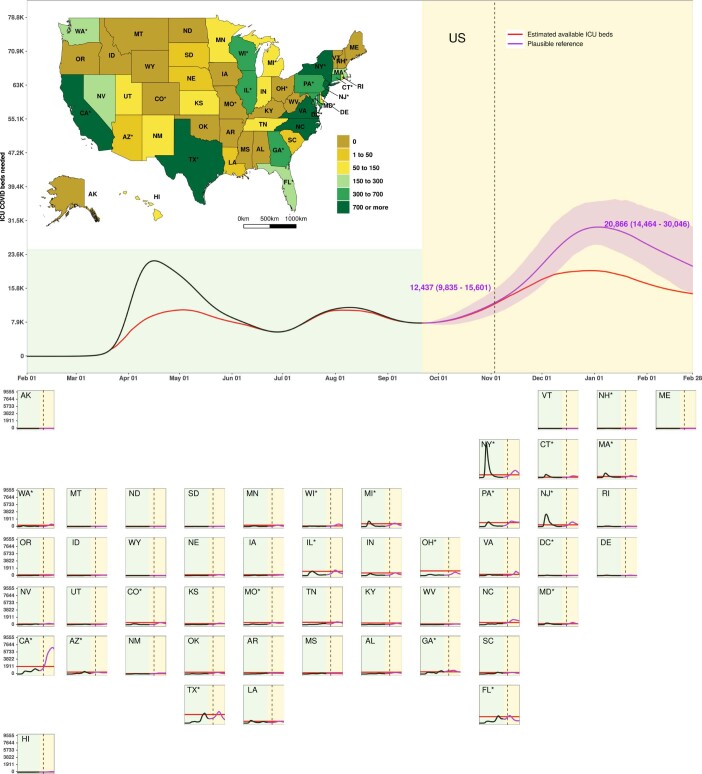
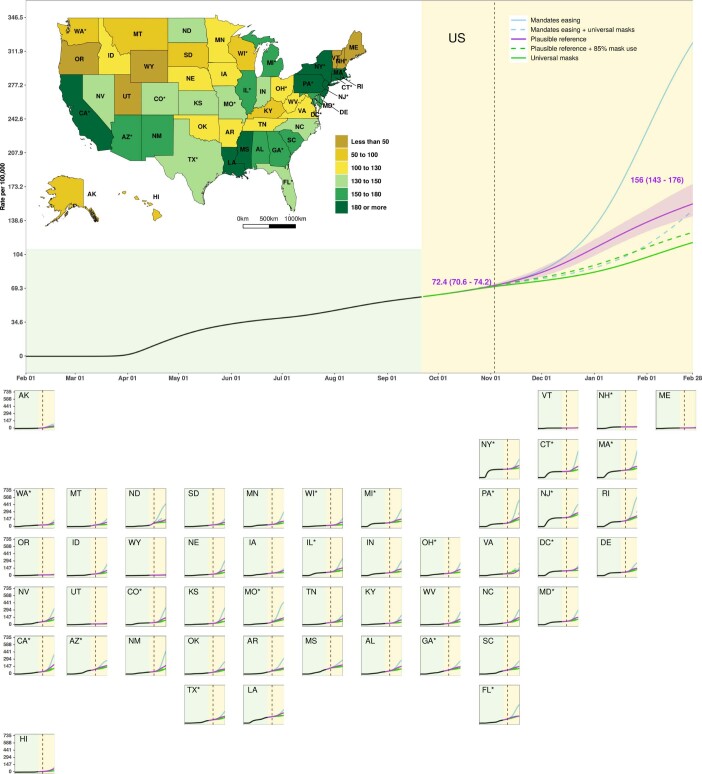
We use COVID-19 case and mortality data from 1 February 2020 to 21 September 2020 and a deterministic SEIR (susceptible, exposed, infectious and recovered) compartmental framework to model possible trajectories of severe acute respiratory syndrome coronavirus 2 (SARS-CoV-2) infections and the effects of non-pharmaceutical interventions in the United States at the state level from 22 September 2020 through 28 February 2021. Using this SEIR model, and projections of critical driving covariates (pneumonia seasonality, mobility, testing rates and mask use per capita), we assessed scenarios of social distancing mandates and levels of mask use. Projections of current non-pharmaceutical intervention strategies by state—with social distancing mandates reinstated when a threshold of 8 deaths per million population is exceeded (reference scenario)—suggest that, cumulatively, 511,373 (469,578–578,347) lives could be lost to COVID-19 across the United States by 28 February 2021. We find that achieving universal mask use (95% mask use in public) could be sufficient to ameliorate the worst effects of epidemic resurgences in many states. Universal mask use could save an additional 129,574 (85,284–170,867) lives from September 22, 2020 through the end of February 2021, or an additional 95,814 (60,731–133,077) lives assuming a lesser adoption of mask wearing (85%), when compared to the reference scenario.
Overview
The claims and statistics of this paper haven’t been checked yet.
Free: it reads the open-access text and checks the first 5 claims that cite a source we can check. Create a free account to check every claim.
Integrity signals
Registry
Cites
Statistics
Figures
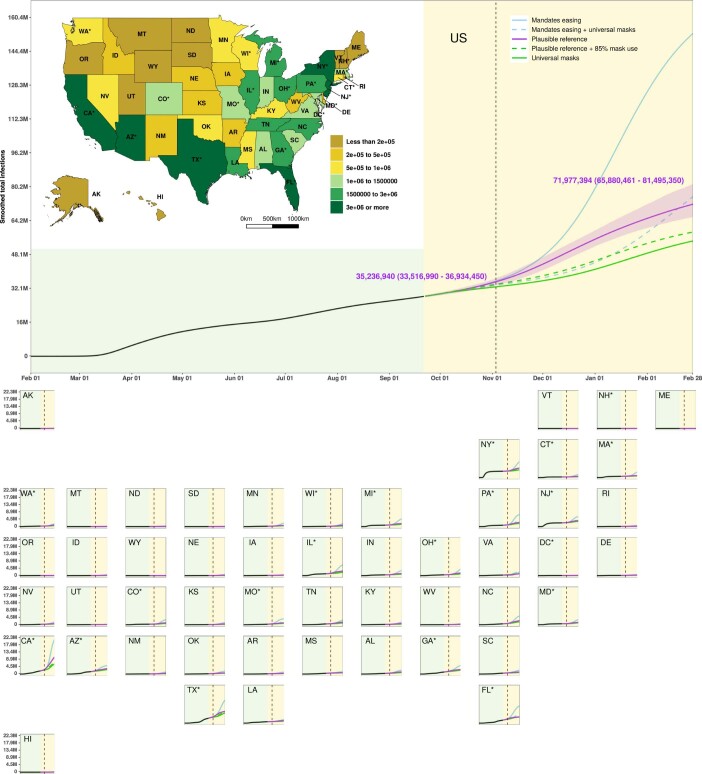
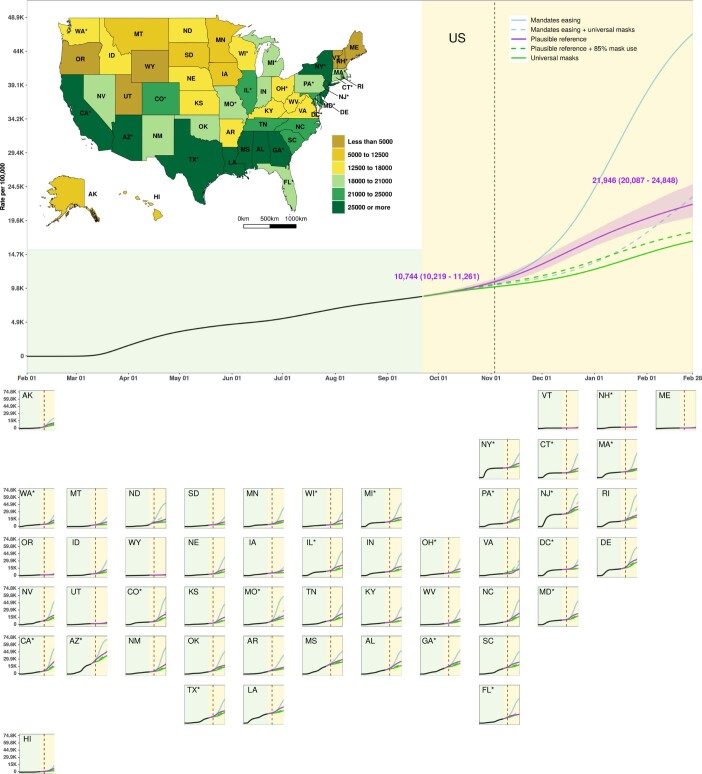
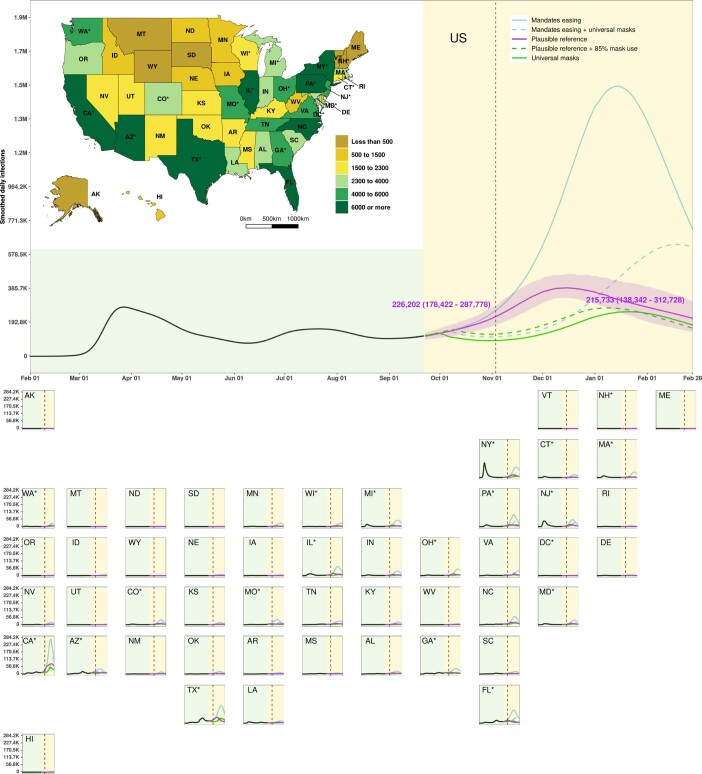
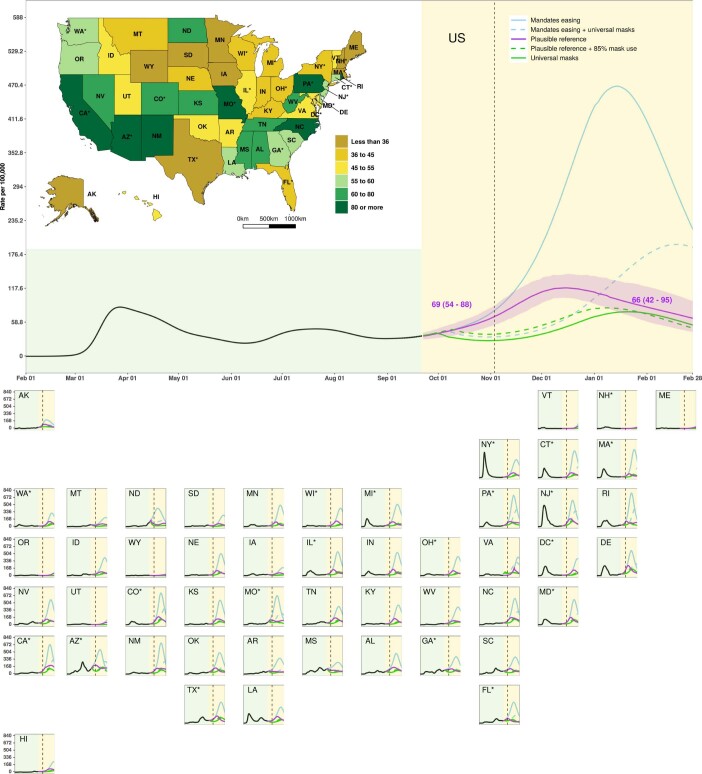
Verification
Claims the paper makes
The claims and statistics of this paper haven’t been checked yet.
Free: it reads the open-access text and checks the first 5 claims that cite a source we can check. Create a free account to check every claim.
Claims other papers make about this one
Each is checked against this paper’s own text: does it say what the citing paper says it does?
The source backs part of the claim, not all of it — or backs it for a different population, condition or comparison.
In the citing paper
“Ultimately, we considered three novel indicators of the COVID-19 pandemic: decreasing human mobility,13 estimated total (as opposed to reported) daily SARS-CoV-2 infection rate, and estimated daily excess mortality rate during the pandemic (including excess deaths occurring during the pandemic where COVID-19 was not reported as the underlying cause of death).5, 13”
From Global prevalence and burden of depressive and anxiety disorders in 204 countries and territories in 2020 due to the COVID-19 pandemic (2021) · cites this paper as [13]
Experimental — accuracy not yet measuredThe source backs part of the claim, not all of it — or backs it for a different population, condition or comparison.
In the citing paper
“The estimation of human mobility, daily SARS-CoV-2 infection rate, and daily excess mortality rate was done by the Institute for Health Metrics and Evaluation (IHME) COVID-19 Forecasting Team and is described in detail elsewhere.13”
From Global prevalence and burden of depressive and anxiety disorders in 204 countries and territories in 2020 due to the COVID-19 pandemic (2021) · cites this paper as [13]
Experimental — accuracy not yet measuredThe cited source says what the claim attributes to it.
In the citing paper
“This variation can be explained by a combination of factors including policies enacted by governments to encourage mask use and reduce social interaction,48, 49, 50 presence of escape variants, testing and contact tracing capacity,51, 52 previous exposure to other coronaviruses,53 baseline patterns of social interaction, and more.”
From Estimating global, regional, and national daily and cumulative infections with SARS-CoV-2 through Nov 14, 2021: a statistical analysis (2022) · cites this paper as [50]
Self-check
Percentages, sums and reported differences re-computed from the paper’s own numbers.
The self-check needs the paper’s full text.
Citations
Cites
Vos, T., Lim, S. S., Abbafati, C., Abbas, K. M., Abbasi, M., Abbasifard, M., Abbasi-Kangevari, M., Abbastabar, H., Abd-Allah, F., Abdelalim, A., et al. (2020) · The Lancet · doi:10.1016/s0140-6736(20)30925-9 · Cited by 19,358
Self-citationMurray, C. J. L., Aravkin, A. Y., Zheng, P., Abbafati, C., Abbas, K. M., Abbasi-Kangevari, M., Abd-Allah, F., Abdelalim, A., Abdollahi, M., Abdollahpour, I., et al. (2020) · The Lancet · doi:10.1016/s0140-6736(20)30752-2 · Cited by 9,854
Self-citationRemdesivir for the Treatment of Covid-19 — Final Report
Beigel, J. H., Tomashek, K. M., Dodd, L. E., Mehta, A. K., Zingman, B. S., Kalil, A. C., Hohmann, E., Chu, H. Y., Luetkemeyer, A., Kline, S., et al. (2020) · New England Journal of Medicine · doi:10.1056/nejmoa2007764 · Cited by 7,267
First case of 2019 novel coronavirus in the United States
Holshue, M. L., DeBolt, C., Lindquist, S., Lofy, K. H., Wiesman, J., Bruce, H., Spitters, C., Ericson, K., Wilkerson, S., Tural, A., et al. (2020) · New England Journal of Medicine · doi:10.1056/nejmoa2001191 · Cited by 6,030
Lauer, S. A., Grantz, K. H., Bi, Q., Jones, F. K., Zheng, Q., Meredith, H. R., Azman, A. S., Reich, N. G., & Lessler, J. (2020) · Annals of Internal Medicine · doi:10.7326/m20-0504 · Cited by 5,970
The proximal origin of SARS-CoV-2
Andersen, K. G., Rambaut, A., Lipkin, W. I., Holmes, E. C., & Garry, R. F. (2020) · Nature Medicine · doi:10.1038/s41591-020-0820-9 · Cited by 5,081
Chu, D. K., Akl, E. A., Duda, S., Solo, K., Yaacoub, S., Schünemann, H. J., Chu, D. K., Akl, E. A., El-harakeh, A., Bognanni, A., et al. (2020) · The Lancet · doi:10.1016/s0140-6736(20)31142-9 · Cited by 3,843
How will country-based mitigation measures influence the course of the COVID-19 epidemic?
Anderson, R. M., Heesterbeek, H., Klinkenberg, D., & Hollingsworth, T. D. (2020) · The Lancet · doi:10.1016/s0140-6736(20)30567-5 · Cited by 3,648
Wang, Y., Zhang, D., Du, G., Du, R., Zhao, J., Jin, Y., Fu, S., Gao, L., Cheng, Z., Lu, Q., et al. (2020) · The Lancet · doi:10.1016/s0140-6736(20)31022-9 · Cited by 3,440
Estimating the effects of non-pharmaceutical interventions on COVID-19 in Europe
Flaxman, S., Mishra, S., Gandy, A., Unwin, H. J. T., Mellan, T. A., Coupland, H., Whittaker, C., Zhu, H., Berah, T., Eaton, J. W., et al. (2020) · Nature · doi:10.1038/s41586-020-2405-7 · Cited by 3,350
Research works printed but not linked: 4
- 4. Horton, R. The COVID-19 Catastrophe: What's Gone Wrong and How to Stop it Happening Again. (John Wiley & Sons, 2020).
- 39. Henry M Jackson School of International Studies, university of Washington, Seattle, WA, uSA. 13 Policy and Epidemiology Group, Queensland Centre for Mental Health research, Brisbane, Queensland, Australia. 14 These authors contributed equally: robert C reiner Jr., ryan M Barber. ✉ e-mail: sihay@uw.edu coronavirusdisease2019/what-you-should-know/current-situation-in-hawaii/; Illinois cases and deaths from https://dph.illinois.gov/covid19/covid19-statistics; Indiana cases and deaths from https://www.coronavirus.in.gov/2393.htm; Kentucky cases and deaths from https://govstatus.egov.com/kycovid19; Maryland cases and deaths from https://coronavirus.maryland.gov/; Nebraska cases and deaths from http://dhhs.ne.gov/Pages/Coronavirus.aspx; New York cases and deaths from https://github.com/nychealth/coronavirus-data and https:// covid19tracker.health.ny.gov/views/NYS-COVID19-Tracker/NYSDOHCOVID-19 Tracker-Map?%3Aembed=yes&%3Atoolbar=no&%3Atabs=n; North Carolina cases and deaths from https://covid19.ncdhhs.gov/dashboard; and Washington cases, hospitalizations and deaths from https://www.doh.wa.gov/Emergencies/ COVID19/DataDashboard. The timing of mandate implementation for each state was derived from a preprint study 43 and supplemented with ad hoc additional resources available at http://ghdx.healthdata.org/record/ihme-data/ united-states-covid-19-scenarios-2020-2021. The mobility covariate was constructed using data from Google Community Mobility Reports (https://www. google.com/covid19/mobility/); Facebook Data for Good Disease Prevention Maps (https://dataforgood.fb.com/tools/disease-prevention-maps/; with access coordinated via diseaseprevmaps@fb.com); SafeGraph Shelter in Place Index (https://www.safegraph.com/dashboard/covid19-shelter-in-place?s=US& d=09-13-2020&t=counties&m=index; with access coordinated through the SafeGraph COVID-19 Data Consortium via https://www.safegraph.com/covid-19- data-consortium/); and Descartes Labs (https://github.com/descarteslabs/ DL-COVID-19). The testing covariate was constructed using data from the COVID Tracking Project (https://covidtracking.com/data/api/). State-level datasets for the testing covariate were replaced in Washington, using https:// www.doh.wa.gov/Emergencies/COVID19/DataDashboard. Mask-use data were obtained from Premise COVID-19 Global Impact Survey (https://www.premise. com/the-dos-and-donts-of-conducting-surveys-during-covid-19/; with access coordinated through info@premise.com); the Facebook (COVID) Symptom Survey (with access coordinated through University of Maryland Joint Program in Survey Methodology via admin-C19survey-fb@umd.edu); and the YouGov COVID-19 Behavioural Tracker Survey (https://github.com/YouGov-Data/ covid-19-tracker). Pneumonia seasonality estimates, particulate matter air pollution estimates, lower respiratory infection country-specific mortality rate estimates and smoking estimates were generated by the Global Burden of Disease study (http://ghdx.healthdata.org/record/ihme-data/united-states-covid- 19-scenarios-2020-2021/). Altitude was sourced from the National Oceanic and Atmospheric Administration National Centers for Environmental Information Global Land One-km Base Elevation Project (https://www.ngdc.noaa.gov/mgg/ topo/globe.html) and population data were obtained from WorldPop Population Counts (https://www.worldpop.org/project/list/). These sources are further detailed in the Supplementary Information 44-51 . Source data are provided with this paper. references
- 43. GBD 2019 Population and Fertility Collaborators. Global, regional and national age-sex-specific fertility, mortality and population estimates, 1950-2019: a comprehensive demographic analysis for the global burden of disease study 2019. The Lancet (in press).
- 52. GBD 2019 Diseases and injuries Collaborators. Global burden of 369 diseases and injuries, 1990-2019: a systematic analysis for the Global Burden of Disease Study 2019. The Lancet (in press).
Cited by
Santomauro, D. F., Mantilla Herrera, A. M., Shadid, J., Zheng, P., Ashbaugh, C., Pigott, D. M., Abbafati, C., Adolph, C., Amlag, J. O., Aravkin, A. Y., et al. (2021) · The Lancet · doi:10.1016/s0140-6736(21)02143-7 · Cited by 5,444
Self-citationThe Global Burden of Disease Study at 30 years
Murray, C. J. L. (2022) · Nature Medicine · doi:10.1038/s41591-022-01990-1 · Cited by 856
Self-citationCovasim: An agent-based model of COVID-19 dynamics and interventions
Kerr, C. C., Stuart, R. M., Mistry, D., Abeysuriya, R. G., Rosenfeld, K., Hart, G. R., Núñez, R. C., Cohen, J. A., Selvaraj, P., Hagedorn, B., et al. (2021) · PLOS Computational Biology · doi:10.1371/journal.pcbi.1009149 · Cited by 685
Non-pharmaceutical interventions during the COVID-19 pandemic: A review
Perra, N. (2021) · Physics Reports · doi:10.1016/j.physrep.2021.02.001 · Cited by 531
Naghavi, M., Kyu, H. H., A, B., Aalipour, M. A., Aalruz, H., Ababneh, H. S., Abafita, B. J., Abaraogu, U. O., Abbafati, C., Abbasi, M., et al. (2025) · The Lancet · doi:10.1016/s0140-6736(25)01917-8 · Cited by 595
Bollyky, T. J., Hulland, E. N., Barber, R. M., Collins, J. K., Kiernan, S., Moses, M., Pigott, D. M., Reiner Jr, R. C., Sorensen, R. J. D., Abbafati, C., et al. (2022) · The Lancet · doi:10.1016/s0140-6736(22)00172-6 · Cited by 477
“…the most extreme country-specific reduction in mobility observed at any point in 2020 or 2021, relative to a pre-pandemic baseline that was based on a composite metric extracted from smartphone data, 34 and the maximum achieved vaccine coverage (at least one dose) as of Sept 30, 2021.”
Self-citationCausey, K., Fullman, N., Sorensen, R. J. D., Galles, N. C., Zheng, P., Aravkin, A., Danovaro-Holliday, M. C., Martinez-Piedra, R., Sodha, S. V., Velandia-González, M. P., et al. (2021) · The Lancet · doi:10.1016/s0140-6736(21)01337-4 · Cited by 450
Self-citationLessons learned 1 year after SARS-CoV-2 emergence leading to COVID-19 pandemic
To, K. K.-W., Sridhar, S., Chiu, K. H.-Y., Hung, D. L.-L., Li, X., Hung, I. F.-N., Tam, A. R., Chung, T. W.-H., Chan, J. F.-W., Zhang, A. J.-X., et al. (2021) · Emerging Microbes & Infections · doi:10.1080/22221751.2021.1898291 · Cited by 344
Self-citationAge groups that sustain resurging COVID-19 epidemics in the United States
Monod, M., Blenkinsop, A., Xi, X., Hebert, D., Bershan, S., Tietze, S., Baguelin, M., Bradley, V. C., Chen, Y., Coupland, H., et al. (2021) · Science · doi:10.1126/science.abe8372 · Cited by 331
(2022) · The Lancet · doi:10.1016/s0140-6736(21)02867-1 · Cited by 306
“We sourced age-specific mortality data primarily through the COVerAGE-DB database of COVID-19 cases and deaths by age, 8,19 with additional supplementation via national and state ministry of health dashboards where identified.”
Barber, R. M., Sorensen, R. J. D., Pigott, D. M., Bisignano, C., Carter, A., Amlag, J. O., Collins, J. K., Abbafati, C., Adolph, C., Allorant, A., et al. (2022) · The Lancet · doi:10.1016/s0140-6736(22)00484-6 · Cited by 298
“…can be explained by a combination of factors including policies enacted by governments to encourage mask use and reduce social interaction, 48–50 presence of escape variants, testing and contact tracing capacity, 51,52 previous exposure to other coronaviruses, 53 baseline patterns of social…”
Self-citationSawik, T. (2022) · Omega · doi:10.1016/j.omega.2022.102596 · Cited by 221
Association of social distancing and face mask use with risk of COVID-19
Kwon, S., Joshi, A. D., Lo, C.-H., Drew, D. A., Nguyen, L. H., Guo, C.-G., Ma, W., Mehta, R. S., Shebl, F. M., Warner, E. T., et al. (2021) · Nature Communications · doi:10.1038/s41467-021-24115-7 · Cited by 206
Government responses and COVID-19 deaths: Global evidence across multiple pandemic waves
Hale, T., Angrist, N., Hale, A. J., Kira, B., Majumdar, S., Petherick, A., Phillips, T., Sridhar, D., Thompson, R. N., Webster, S., et al. (2021) · PLOS ONE · doi:10.1371/journal.pone.0253116 · Cited by 174
Micah, A. E., Cogswell, I. E., Cunningham, B., Ezoe, S., Harle, A. C., Maddison, E. R., McCracken, D., Nomura, S., Simpson, K. E., Stutzman, H. N., et al. (2021) · The Lancet · doi:10.1016/s0140-6736(21)01258-7 · Cited by 162
Self-citationRoth, G. A., Emmons-Bell, S., Alger, H. M., Bradley, S. M., Das, S. R., de Lemos, J. A., Gakidou, E., Elkind, M. S. V., Hay, S., Hall, J. L., et al. (2021) · JAMA Network Open · doi:10.1001/jamanetworkopen.2021.8828 · Cited by 145
Self-citationControlling COVID-19 via test-trace-quarantine
Kerr, C. C., Mistry, D., Stuart, R. M., Rosenfeld, K., Hart, G. R., Núñez, R. C., Cohen, J. A., Selvaraj, P., Abeysuriya, R., Jastrzębski, M., et al. (2021) · Nature Communications · doi:10.1038/s41467-021-23276-9 · Cited by 155
Hou, X. H., Gao, S., Li, Q., Kang, Y., Chen, N., Chen, K., Rao, J., Ellenberg, J. S., & Patz, J. A. (2021) · Proceedings of the National Academy of Sciences · doi:10.1073/pnas.2020524118 · Cited by 153
Huang, B., Wang, J., Jixuan Cai, 蔡., Yao, S., Chan, P. K. S., Tam, T., Hong, Y., Ruktanonchai, C. W., Carioli, A., Floyd, J., et al. (2021) · Nature Human Behaviour · doi:10.1038/s41562-021-01063-2 · Cited by 158
Syrowatka, A., Kuznetsova, M., Alsubai, A., Beckman, A. L., Bain, P. A., Craig, K. J. T., Hu, J., Jackson, G. P., Rhee, K., & Bates, D. W. (2021) · npj Digital Medicine · doi:10.1038/s41746-021-00459-8 · Cited by 130
Zheng, Z., Pitzer, V. E., Shapiro, E. D., Bont, L., & Weinberger, D. M. (2021) · JAMA Network Open · doi:10.1001/jamanetworkopen.2021.41779 · Cited by 129
Evaluating the effects of shelter-in-place policies during the COVID-19 pandemic
Berry, C. R., Fowler, A., Glazer, T., Handel-Meyer, S., & Macmillen, A. (2021) · Proceedings of the National Academy of Sciences · doi:10.1073/pnas.2019706118 · Cited by 121
Predictive performance of international COVID-19 mortality forecasting models
Friedman, J., Liu, P., Troeger, C. E., Carter, A., Reiner, R. C., Barber, R. M., Collins, J., Lim, S. S., Pigott, D. M., Vos, T., et al. (2021) · Nature Communications · doi:10.1038/s41467-021-22457-w · Cited by 118
“This model, referred to as the IHME-MS SEIR model, is the basis for recently published work on US State level scenarios of COVID-249 19 projections in the fall and winter of 2020/2021 23 and was still in use at the time of this publication.”
MethodSelf-citationDynamics of COVID-19 under social distancing measures are driven by transmission network structure
Nande, A., Adlam, B., Sheen, J. K., Levy, M. Z., & Hill, A. L. (2021) · PLoS Computational Biology · doi:10.1371/journal.pcbi.1008684 · Cited by 121
Friedman, J., Beletsky, L., & Schriger, D. L. (2021) · JAMA Psychiatry · doi:10.1001/jamapsychiatry.2020.4218 · Cited by 109
COVID-19 second wave mortality in Europe and the United States
James, N., Menzies, M., & Radchenko, P. (2021) · Chaos An Interdisciplinary Journal of Nonlinear Science · doi:10.1063/5.0041569 · Cited by 104
The importance of non-pharmaceutical interventions during the COVID-19 vaccine rollout
Gozzi, N., Bajardi, P., & Perra, N. (2021) · PLoS Computational Biology · doi:10.1371/journal.pcbi.1009346 · Cited by 99
Li, J.-Y., Deng, X., Zhan, Z., Yu, L., Tan, K. C., Lai, K., & Zhang, J. (2022) · IEEE Transactions on Intelligent Transportation Systems · doi:10.1109/tits.2022.3180760 · Cited by 84
Self-citationMasks and Face Coverings for the Lay Public: A Narrative Update
Czypionka, T., Greenhalgh, T., Bassler, D., & Bryant, M. B. (2021) · Annals of Internal Medicine · doi:10.7326/m20-6625 · Cited by 82
The effect of COVID-19 on the economy: Evidence from an early adopter of localized lockdowns
Asahi, K., Undurraga, E. A., Valdés, R., & Wagner, R. A. (2021) · Journal of Global Health · doi:10.7189/jogh.10.05002 · Cited by 101
A model and predictions for COVID-19 considering population behavior and vaccination
Usherwood, T., LaJoie, Z., & Srivastava, V. (2021) · Scientific Reports · doi:10.1038/s41598-021-91514-7 · Cited by 74
Anti-science kills: from Soviet embrace of pseudoscience to accelerated attacks on US biomedicine.
Hotez, P. J. (2021) · PLOS Biology · doi:10.1371/journal.pbio.3001068 · Cited by 73
“Their estimates indicate that more than 510,000 Americans could lose their lives by February 28, 2021 [1], representing more than a doubling of the current estimates of 220,000 deaths (although not all groups agree with these estimates).”
BackgroundMethodSpinelli, M. A., Glidden, D. V., Gennatas, E. D., Bielecki, M., Beyrer, C., Rutherford, G. W., Chambers, H. F. “., Goosby, E., & Gandhi, M. (2021) · The Lancet Infectious Diseases · doi:10.1016/s1473-3099(20)30982-8 · Cited by 83
Rothman, J. A., Loveless, T. B., Kapcia, J., Adams, E. D., Steele, J. A., Zimmer-Faust, A. G., Langlois, K., Wanless, D., Griffith, M., Mao, L., et al. (2021) · Applied and Environmental Microbiology · doi:10.1128/aem.01448-21 · Cited by 80
Multiple COVID-19 Waves and Vaccination Effectiveness in the United States
Lin, L., Zhao, Y., Chen, B., & He, D. (2022) · International Journal of Environmental Research and Public Health · doi:10.3390/ijerph19042282 · Cited by 66
Compartmental structures used in modeling COVID-19: a scoping review
Kong, L., Duan, M., Shi, J., Hong, J., Chang, Z., & Zhang, Z. (2022) · Infectious Diseases of Poverty · doi:10.1186/s40249-022-01001-y · Cited by 77
COVID-19 media fatigue: predictors of decreasing interest and avoidance of COVID-19–related news
Bunevičienė, I., Bunevičius, R., Bagdonas, Š., & Bunevičius, A. (2021) · Public Health · doi:10.1016/j.puhe.2021.05.024 · Cited by 64
Enhancing Long-term Forecasting: Learning from COVID-19 Models
Rahmandad, H., Xu, R., & Ghaffarzadegan, N. (2021) · PLoS Computational Biology · doi:10.1371/journal.pcbi.1010100 · Cited by 58
Predictive performance of international COVID-19 mortality forecasting modelsPreprint
Friedman, J., Liu, P. Y., Troeger, C. E., Carter, A., Reiner, R. C., Barber, R. M., Collins, J., Lim, S. S., Pigott, D., Vos, T., et al. (2020) · medRxiv · doi:10.1101/2020.07.13.20151233 · Cited by 82
Self-citationImpact of a New SARS-CoV-2 Variant on the Population: A Mathematical Modeling Approach
González‐Parra, G., Martínez‐Rodríguez, D., & Villanueva, R. J. (2021) · Mathematical and Computational Applications · doi:10.3390/mca26020025 · Cited by 59
Lucas, B., Vahedi, B., & Karimzadeh, M. (2022) · International Journal of Data Science and Analytics · doi:10.1007/s41060-021-00295-9 · Cited by 67
“For COVID-19 modeling, an exposed category is useful to represent the population who are in proximity to someone with the disease, but are not yet showing symptoms due to the incubation period of the virus [41,47].”
An, B., Porcher, S., Tang, S., & Kim, E. E. (2021) · Public Administration Review · doi:10.1111/puar.13426 · Cited by 58
“Studies have assessed the efficacies of individual mandates (e.g., Betsch et al. 2020; Cheng et al. 2020; Dehning et al. 2020; Ferguson et al. 2020; IHME COVID-19 Forecasting Team 2021; Schlosser et al. 2020; Xu et al. 2020).”
Chakrabarti, S., Hamlet, L. C., Kaminsky, J., & Subramanian, S. V. (2021) · JAMA Network Open · doi:10.1001/jamanetworkopen.2021.7373 · Cited by 56
Self-citationAn evaluation of prospective COVID-19 modelling studies in the USA: from data to science translation
Nixon, K., Jindal, S., Parker, F., Reich, N. G., Ghobadi, K., Lee, E. C., Truelove, S., & Gardner, L. (2022) · The Lancet Digital Health · doi:10.1016/s2589-7500(22)00148-0 · Cited by 60
Empirical examples demonstrate how relational thinking might enrich science and practice
Eyster, H. N., Satterfield, T. A., & Chan, K. M. A. (2023) · People and Nature · doi:10.1002/pan3.10453 · Cited by 63
Healthcare Operations and Black Swan Event for COVID-19 Pandemic: A Predictive Analytics
Devarajan, J. P., Arunmozhi, M., & Sreedharan, V. R. (2021) · IEEE Transactions on Engineering Management · doi:10.1109/tem.2021.3076603 · Cited by 58
Sharara, N., Endo, N., Duvallet, C., Ghaeli, N., Matus, M. G., Heussner, J., Olesen, S. W., Alm, E. J., Chai, P. R., & Erickson, T. B. (2021) · PLOS Global Public Health · doi:10.1371/journal.pgph.0000061 · Cited by 48
Schuppert, A., Polotzek, K., Schmitt, J. M., Busse, R., Karschau, J., & Karagiannidis, C. (2021) · The Lancet Regional Health - Europe · doi:10.1016/j.lanepe.2021.100151 · Cited by 57
“…on exponential growth [9-13], whereas linear growth is driven by diffusive spreading throughout parts of SCNs with low connectivity [8,14,15] Hence, shutdown measures prohibiting primarily nodes with high connectivity in SCNs may show poor effectiveness in reducing diffusive spreading [15-17].”
Yin, L., Zhang, H., Li, Y., Liu, K., Chen, T., Luo, W. P., Lai, S., Li, Y., Tang, X., Li, N., et al. (2021) · Journal of The Royal Society Interface · doi:10.1098/rsif.2021.0112 · Cited by 54
“However, compliance with mask wearing cannot be guaranteed and the effectiveness of mask wearing varies with mask type and contact setting [14,17].”
BackgroundPerformance of early warning signals for disease re-emergence: A case study on COVID-19 data
Proverbio, D., Kemp, F., Magni, S., & Gonçalves, J. M. (2022) · PLoS Computational Biology · doi:10.1371/journal.pcbi.1009958 · Cited by 49
Epidemiology, not geopolitics, should guide COVID-19 vaccine donations
Bollyky, T. J., Murray, C. J. L., & Reiner, R. C. (2021) · The Lancet · doi:10.1016/s0140-6736(21)01323-4 · Cited by 45
Self-citationArtificial intelligence for COVID-19: battling the pandemic with computational intelligence
Xu, Z., Su, C., Xiao, Y., & Wang, F. (2021) · Intelligent Medicine · doi:10.1016/j.imed.2021.09.001 · Cited by 54
Vahedi, B., Karimzadeh, M., & Zoraghein, H. (2021) · Nature Communications · doi:10.1038/s41467-021-26742-6 · Cited by 57
“Researchers have used a variety of methods, including time-series autoregressive models 17 – 19 , machine-learning techniques 20 – 22 , epidemiologic models such as the SIR model and its variants 23,24 , and combinations of these methods 25 for forecasting COVID-19 incidence rates.”
MethodStolerman, L. M., Clemente, L., Poirier, C., Parag, K. V., Majumder, A., Masyn, S., Resch, B., & Santillana, M. (2023) · Science Advances · doi:10.1126/sciadv.abq0199 · Cited by 50
Takeuchi, H., & Kawashima, R. (2023) · Viruses · doi:10.3390/v15010223 · Cited by 49
Review on the COVID-19 pandemic prevention and control system based on AI
Yi, J., Zhang, H., Mao, J., Chen, Y., Zhong, H., & Wang, Y. (2022) · Engineering Applications of Artificial Intelligence · doi:10.1016/j.engappai.2022.105184 · Cited by 53
Zeng, C., Zhang, J., Li, Z., Sun, X., Olatosi, B., Weissman, S., & Li, X. (2021) · Journal of Medical Internet Research · doi:10.2196/27045 · Cited by 42
Self-citationNeural parameter calibration for large-scale multiagent models
Gaskin, T., Pavliotis, G. A., & Girolami, M. (2023) · Proceedings of the National Academy of Sciences · doi:10.1073/pnas.2216415120 · Cited by 60
Kühn, M. J., Abele, D., Mitra, T., Koslow, W., Abedi, M., Rack, K., Siggel, M., Khailaie, S., Klitz, M., Binder, S. C., et al. (2021) · Mathematical Biosciences · doi:10.1016/j.mbs.2021.108648 · Cited by 59
“While counter-strategies like face masks [88,70,25] or adapted air flows [8], or both [21,20] are studied, it is reasonable to assume that they cannot fully waive the risk of indoor infections.”
Kemp, F., Proverbio, D., Aalto, A., Mombaerts, L., d’Hérouël, A. F., Husch, A., Ley, C., Gonçalves, J. M., Skupin, A., & Magni, S. (2021) · Journal of Theoretical Biology · doi:10.1016/j.jtbi.2021.110874 · Cited by 49
Lessons for preparedness and reasons for concern from the early COVID-19 epidemic in Iran
Ghafari, M., Hejazi, B., Karshenas, A., Dascalu, S., Kadvidar, A., Khosravi, M. A., Abbasalipour, M., Heydari, M., Zeinali, S., Ferretti, L., et al. (2021) · Epidemics · doi:10.1016/j.epidem.2021.100472 · Cited by 39
Arentz, M., Ma, J., Zheng, P., Vos, T., Murray, C. J. L., & Kyu, H. H. (2022) · BMC Infectious Diseases · doi:10.1186/s12879-022-07078-y · Cited by 46
“To better understand which independent variables correlated with subnational trends in TB case notification gaps, we utilized the IHME’s estimates of control measures for India from the COVID-19 modeling strategy [13].”
MethodSelf-citationA prospective evaluation of AI-augmented epidemiology to forecast COVID-19 in the USA and Japan
Arık, S. Ö., Shor, J., Sinha, R., Yoon, J., Ledsam, J. R., Le, L. T., Dusenberry, M. W., Yoder, N. C., Popendorf, K., Epshteyn, A., et al. (2021) · npj Digital Medicine · doi:10.1038/s41746-021-00511-7 · Cited by 45
One year of modeling and forecasting COVID-19 transmission to support policymakers in Connecticut
Morozova, O., Li, Z. R., & Crawford, F. W. (2021) · Scientific Reports · doi:10.1038/s41598-021-99590-5 · Cited by 37
A survey of COVID-19 in public transportation: Transmission risk, mitigation and prevention
Liu, X., Kortoçi, P., Motlagh, N. H., Nurmi, P., & Tarkoma, S. (2022) · Multimodal Transportation · doi:10.1016/j.multra.2022.100030 · Cited by 38
Genomic Surveillance of COVID-19 Variants With Language Models and Machine Learning
Nagpal, S., Pal, R., Ashima, A., Tyagi, A., Tripathi, S., Nagori, A., Ahmad, S., Mishra, H. P., Malhotra, R., Kutum, R., et al. (2022) · Frontiers in Genetics · doi:10.3389/fgene.2022.858252 · Cited by 37
Resilient supply chain to a global pandemic
Salama, M., & McGarvey, R. G. (2021) · International Journal of Production Research · doi:10.1080/00207543.2021.1946726 · Cited by 41
Otunuga, O. M. (2021) · Results in Physics · doi:10.1016/j.rinp.2021.104664 · Cited by 35
Discovering spatiotemporal patterns of COVID-19 pandemic in South Korea
Kim, S., Kim, M., Lee, S., & Lee, Y. J. (2021) · Scientific Reports · doi:10.1038/s41598-021-03487-2 · Cited by 46
Bisanzio, D., Reithinger, R., Alqunaibet, A., Almudarra, S., Alsukait, R. F., Dong, D., Zhang, Y., El-Saharty, S., & Herbst, C. H. (2022) · BMC Medicine · doi:10.1186/s12916-022-02232-4 · Cited by 34
“June 21, 2020 the population adhered to recommended norms [25].”
How epidemiology has shaped the COVID pandemic
(2021) · Nature · doi:10.1038/d41586-021-00183-z · Cited by 49
Estadilla, C. D. S., Uyheng, J., de Lara-Tuprio, E. P., Teng, T. R. Y., Macalalag, J. M. R., & Estuar, M. R. J. E. (2021) · Infectious Diseases of Poverty · doi:10.1186/s40249-021-00886-5 · Cited by 41
Thakur, N., & Han, C. Y. (2021) · Big Data and Cognitive Computing · doi:10.3390/bdcc5030042 · Cited by 40
Jewell, S., Futoma, J., Hannah, L. A., Miller, A. C., Foti, N. J., & Fox, E. B. (2021) · npj Digital Medicine · doi:10.1038/s41746-021-00523-3 · Cited by 36
“Although these regression models do not allow us to simulate counterfactual scenarios as is possible with compartmental models 21,25,33,35 , such models are restrictive and subject to misspeci fi cation.”
BackgroundMethodThe impact of bioactive textiles on human skin microbiota
Oliveira, C. S., & Tavaria, F. K. (2023) · European Journal of Pharmaceutics and Biopharmaceutics · doi:10.1016/j.ejpb.2023.05.004 · Cited by 39
Characterizing partisan political narrative frameworks about COVID-19 on Twitter
Jing, E., & Ahn, Y. (2021) · EPJ Data Science · doi:10.1140/epjds/s13688-021-00308-4 · Cited by 48
“IHME COVID-19 forecasting team (2020) Modeling COVID-19 scenarios for the United States.”
BackgroundEvaluation of health system resilience in 60 countries based on their responses to COVID-19
Zhao, L., Jin, Y., Zhou, L., Yang, P., Qian, Y. P., Huang, X., & Min, M. (2023) · Frontiers in Public Health · doi:10.3389/fpubh.2022.1081068 · Cited by 43
Madlock‐Brown, C., Wilkens, K., Weiskopf, N. G., Cesare, N., Bhattacharyya, S., Riches, N. O., Espinoza, J., Dorr, D. A., Goetz, K., Phuong, J., et al. (2022) · BMC Public Health · doi:10.1186/s12889-022-13168-y · Cited by 34
Four Stylized Facts about COVID-19
Atkeson, A. G., Kopecky, K., & Zha, T. A. (2020) · National Bureau of Economic Research · doi:10.3386/w27719 · Cited by 59
Rapid review of COVID-19 epidemic estimation studies for Iran
Pourmalek, F., Hemami, M. R., Janani, L., & Moradi‐Lakeh, M. (2021) · BMC Public Health · doi:10.1186/s12889-021-10183-3 · Cited by 33
“The three other international studies have at least one publication each (as of 2020-10-29): IHME, peer-review published [30], pre-print [31-33]; Imperial College, peer-review published [34], and Srivastava, pre-print [35].”
BackgroundNaeim, A., Baxter-King, R., Wenger, N. S., Stanton, A. L., Sepucha, K., & Vavreck, L. (2021) · JMIR Public Health and Surveillance · doi:10.2196/24277 · Cited by 34
Analysis of Key Factors of a SARS-CoV-2 Vaccination Program: A Mathematical Modeling Approach
Martínez‐Rodríguez, D., González‐Parra, G., & Villanueva, R. J. (2021) · Epidemiologia · doi:10.3390/epidemiologia2020012 · Cited by 34
Forecasting COVID-19 cases based on a parameter-varying stochastic SIR model
Hespanha, J. P., Chinchilla, R., Costa, R. R., Erdal, M. K., & Yang, G. (2021) · Annual Reviews in Control · doi:10.1016/j.arcontrol.2021.03.008 · Cited by 36
“As in Beretta et al. (1998), Ji and Jiang (2014) and Tornatore et al. (2005), our paper considers additive stochastic perturbations, whose variances are estimated from data.”
BackgroundInfluentialNot My Pandemic: Solution Aversion and the Polarized Public Perception of COVID-19
Chu, H., Yang, J. Z., & Liu, S. (2021) · Science Communication · doi:10.1177/10755470211022020 · Cited by 35
COVID-19 forecasting using new viral variants and vaccination effectiveness models
Rashed, E. A., Kodera, S., & Hirata, A. (2022) · Computers in Biology and Medicine · doi:10.1016/j.compbiomed.2022.105986 · Cited by 34
Mathematical Modeling of COVID-19 Dynamics under Two Vaccination Doses and Delay Effects
Sepulveda, G., Arenas, A. J., & González‐Parra, G. (2023) · Mathematics · doi:10.3390/math11020369 · Cited by 31
A Conceptual Model for Geo-Online Exploratory Data Visualization: The Case of the COVID-19 Pandemic
Bernasconi, A., & Grandi, S. (2021) · Information · doi:10.3390/info12020069 · Cited by 32
Kodera, S., Rashed, E. A., & Hirata, A. (2022) · Vaccines · doi:10.3390/vaccines10030430 · Cited by 33
Usage of Compartmental Models in Predicting COVID-19 Outbreaks
Zhang, P., Feng, K., Gong, Y., Lee, J., Lomonaco, S., & Zhao, L. Y. (2022) · The AAPS Journal · doi:10.1208/s12248-022-00743-9 · Cited by 35
“The model established by the IHME COVID-19 Forecasting Team incorporates real-world datasets as the covariates in a mixed effect model, instead of using a self-defined function (49).”
MethodDu, H., Dong, E., Badr, H. S., Petrone, M. E., Grubaugh, N. D., & Gardner, L. (2023) · EBioMedicine · doi:10.1016/j.ebiom.2023.104482 · Cited by 30
High throughput diagnostics and dynamic risk assessment of SARS-CoV-2 variants of concern
Gravagnuolo, A. M., Faqih, L., Cronshaw, C., Wynn, J., Burglin, L., Klapper, P. E., & Wigglesworth, M. J. (2021) · EBioMedicine · doi:10.1016/j.ebiom.2021.103540 · Cited by 33
“…risks by: sustaining a systematic and robust vaccination campaign [12,25 (cid:1) 29]; helping to monitor the level of hospitalization [30,31], and identifying critical strains in hospitals [16,32]; modulating social measures from the basic mandatory face mask to a more drastic lockdown [33].”
Spatiotemporal modeling of first and second wave outbreak dynamics of COVID-19 in Germany
Lippold, D., Kergaßner, A., Burkhardt, C., Kergaßner, M., Loos, J., Nistler, S., Steinmann, P., Budday, D., & Budday, S. (2021) · Biomechanics and Modeling in Mechanobiology · doi:10.1007/s10237-021-01520-x · Cited by 28
Real-Time Infectious Disease Modeling to Inform Emergency Public Health Decision Making
Bershteyn, A., Kim, H., & Braithwaite, R. S. (2022) · Annual Review of Public Health · doi:10.1146/annurev-publhealth-052220-093319 · Cited by 31
Microsimulation based quantitative analysis of COVID-19 management strategies
Reguly, I. Z., Csercsik, D., Juhász, J., Tornai, K., Bujtár, Z., Horváth, G., Keömley-Horváth, B. M., Kós, T., Cserey, G., Iván, K., et al. (2022) · PLoS Computational Biology · doi:10.1371/journal.pcbi.1009693 · Cited by 29
Xia, Y., Ma, H., Buckeridge, D. L., Brisson, M., Sander, B., Chan, A. K., Verma, A. D., Ganser, I., Kronfli, N., Mishra, S., et al. (2022) · International Journal of Infectious Diseases · doi:10.1016/j.ijid.2022.04.048 · Cited by 37
Mueller, A. S., Diefendorf, S., Abrutyn, S. B., Beardall, K. A., Millar, K., O’Reilly, L. M., Steinberg, H., & Watkins, J. T. (2021) · Journal of Adolescent Health · doi:10.1016/j.jadohealth.2020.12.123 · Cited by 26
State lockdown policies, mental health symptoms, and using substances
Das, A., Singh, P., & Bruckner, T. A. (2021) · Addictive Behaviors · doi:10.1016/j.addbeh.2021.107084 · Cited by 27
Pan, Y., Zhang, L., Unwin, H. J. T., & Skibniewski, M. J. (2021) · Sustainable Cities and Society · doi:10.1016/j.scs.2021.103508 · Cited by 27
“To be specific, the US reported the first case on Jan 20, 2020, and the epidemic has spread rapidly throughout all 50 states by March 17, 2020 (IHME COVID-19 Fore-casting Team, 2020; Unwin et al., 2020).”
Pfaff, H., & Schmitt, J. M. (2021) · Frontiers in Public Health · doi:10.3389/fpubh.2021.727427 · Cited by 30
Global stability and optimal control for a COVID-19 model with vaccination and isolation delays
Song, H., Wang, R., Liu, S., Jin, Z., & He, D. (2022) · Results in Physics · doi:10.1016/j.rinp.2022.106011 · Cited by 30
Metadata
- Authors
- IHME COVID-19 Forecasting Team, Reiner, R. C., Barber, R. M., Collins, J. K., Zheng, P., Adolph, C., Albright, J., Antony, C. M., Aravkin, A. Y., Bachmeier, S. D., Bang-Jensen, B., Bannick, M. S., Bloom, S., Carter, A., Castro, E., Causey, K., Chakrabarti, S., Charlson, F. J., Cogen, R. M., Combs, E., Dai, X., Dangel, W. J., Earl, L., Ewald, S. B., Ezalarab, M., Ferrari, A. J., Flaxman, A., Frostad, J. J., Fullman, N., Gakidou, E., Gallagher, J., Glenn, S. D., Goosmann, E. A., He, J., Henry, N. J., Hulland, E. N., Hurst, B., Johanns, C., Kendrick, P. J., Khemani, A., Larson, S. L., Lazzar-Atwood, A., LeGrand, K. E., Lescinsky, H., Lindstrom, A., Linebarger, E., Lozano, R., Ma, R., Månsson, J., Magistro, B., Herrera, A. M. M., Marczak, L. B., Miller-Petrie, M. K., Mokdad, A. H., Morgan, J. D., Naik, P., Odell, C. M., O’Halloran, J. K., Osgood-Zimmerman, A. E., Ostroff, S. M., Pasovic, M., Penberthy, L., Phipps, G., Pigott, D. M., Pollock, I., Ramshaw, R. E., Redford, S. B., Reinke, G., Rolfe, S., Santomauro, D. F., Shackleton, J. R., Shaw, D. H., Sheena, B. S., Sholokhov, A., Sorensen, R. J. D., Sparks, G., Spurlock, E. E., Subart, M. L., Syailendrawati, R., Torre, A. E., Troeger, C. E., Vos, T., Watson, A., Watson, S., Wiens, K. E., Woyczynski, L., Xu, L., Zhang, J., Hay, S. I., Lim, S. S., & Murray, C. J. L.
- Affiliations
- University of Washington (US)
- The University of Queensland (AU)
- ORCID
- Reiner, Robert C.
- Barber, Ryan M.
- Collins, James K.
- Adolph, Christopher
- Albright, James
- Aravkin, Aleksandr Y.
- Bang-Jensen, Bree
- Bannick, Marlena S.
- Carter, Austin
- Causey, Kate
- Chakrabarti, Suman
- Charlson, Fiona J.
- Dai, Xiaochen
- Ewald, Samuel B.
- Ferrari, Alize J.
- Flaxman, Abraham
- Fullman, Nancy
- Gakidou, Emmanuela
- Glenn, Scott D.
- Goosmann, Erik A.
- He, Jiawei
- Henry, Nathaniel J.
- Hulland, Erin N.
- Kendrick, Parkes J.
- LeGrand, Kate E.
- Lindstrom, Akiaja
- Lozano, Rafael
- Ma, Rui
- Magistro, Beatrice
- Herrera, Ana M. Mantilla
- Marczak, Laurie B.
- Miller-Petrie, Molly K.
- Mokdad, Ali H.
- Naik, Paulami
- Osgood-Zimmerman, Aaron E.
- Pasovic, Maja
- Pigott, David M.
- Ramshaw, Rebecca E.
- Reinke, Grace
- Santomauro, Damian Francesco
- Sheena, Brittney S.
- Sholokhov, Aleksei
- Sorensen, Reed J. D.
- Spurlock, Emma Elizabeth
- Vos, Theo
- Wiens, Kirsten E.
- Hay, Simon I.
- Lim, Stephen S.
- Murray, Christopher J. L.
- Venue
- Nature Medicine
- Published
- 2020-10-23
- Volume
- 27
- Issue
- 1
- Pages
- 94-105
- ISSN
- 1078-8956 (ISSN-L)
- 1546-170X
- PMC
- PMC7806509
- OpenAlex
- W3093610264
- Cited by
- 556
- References
- 56
- Citations by year
- 2026: 17 · 2025: 25 · 2024: 61 · 2023: 84 · 2022: 134 · 2021: 210 · 2020: 25
- FWCI
- 18.01
- Type
- journal article
- Language
- en
- Update notices
- correction (2020-11-27)
- Open access
- hybrid
- doi.org
- Licence
- cc-by
- creativecommons.org/licenses/by/4.0 (tdm)
- creativecommons.org/licenses/by/4.0 (vor)
- Locations
- Nature Medicine (publishedVersion, cc-by)
- medRxiv (acceptedVersion, cc-by)
- Europe PMC (PubMed Central) (publishedVersion, other-oa)
- PubMed Central (publishedVersion, cc-by)
- PubMed (publishedVersion)
- LSHTM Research Online (London School of Hygiene and Tropical Medicine) (acceptedVersion)
- Funders
- National Science Foundation (2031096)
- Bill and Melinda Gates Foundation
- Institute for Health Metrics and Evaluation
- Topics
- Physical Sciences › Mathematics › Modeling and Simulation › COVID-19 epidemiological studies
- Physical Sciences › Mathematics › Applied Mathematics › Mathematical and Theoretical Epidemiology and Ecology Models
- Social Sciences › Sociology and Political Science › COVID-19 Prevention and Impact
- Keywords
- COVID-19 pandemic, SARS-CoV-2, SEIR model, epidemic projection, non-pharmaceutical interventions, masking, mortality, mobility, testing rates, epidemic resurgence, United States
- MeSH terms
- Physical Distancing, COVID-19, SARS-CoV-2, Health Policy, Humans, Models, Biological, Travel, United States, Epidemics
About these checks
Registry, retraction, Cites and statistics results are computed, not judged, with one exception: a printed reference that no index lists is read once by a model before it counts as a citation error. Claims are extracted by a model and kept only when their quote appears verbatim in the text; each cited source is then checked, with a model’s help, for whether it says what the claim relies on. Those verdicts can be wrong — read the claim’s quote and the cited source before relying on one.
Statistics and arithmetic are recomputed, not judged.
Confidence bands are shown only for fields calibrated on our annotated test set. None is calibrated yet, so no band is shown.
What counts as a claim ›How we measure confidence ›How we check this ›
Are you an author, or do you see a problem with this page? Request a review
Data sources
Bibliographic data: Semantic Scholar, OpenAlex, Crossref.
Contains information from the Semantic Scholar Academic Graph Datasets, made available under the ODC Attribution License (ODC-BY 1.0).
Semantic Scholar’s data is described in: Kinney, R., et al. (2023). The Semantic Scholar Open Data Platform. arXiv:2301.10140.
