

Modeling COVID-19 scenarios for the United States
Open accessPublished version of a preprint
The DOI matches its Crossref record; 59 of the 59 references it cites were found in a registry or an index.
Abstract
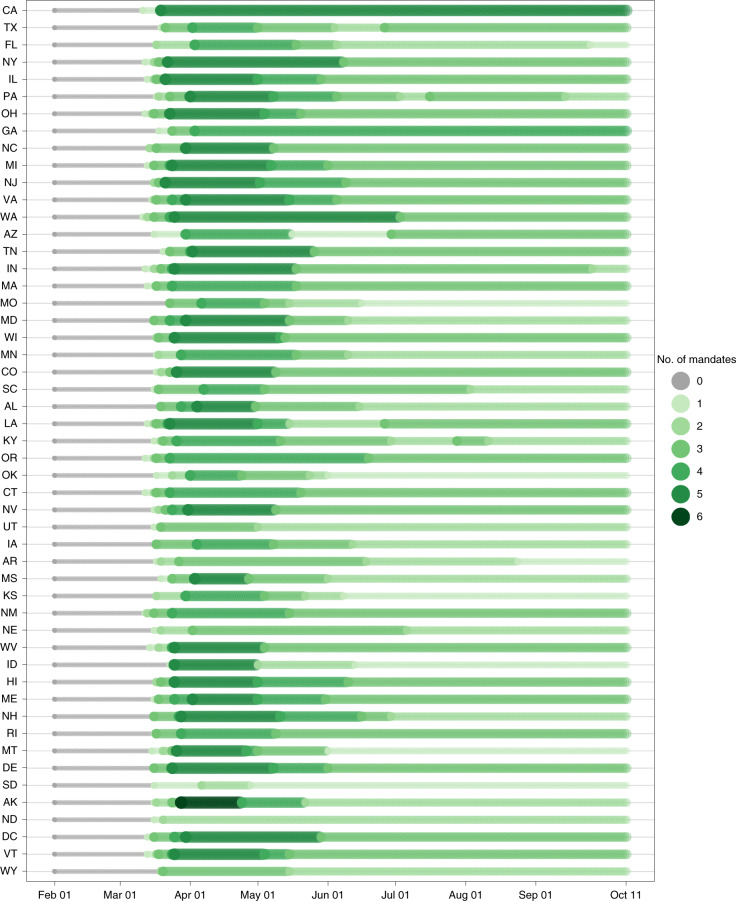
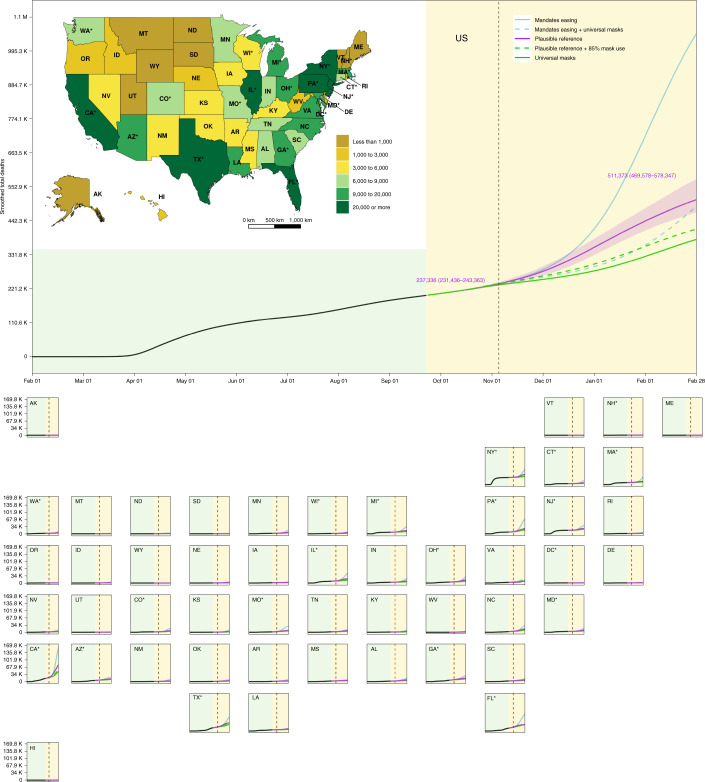
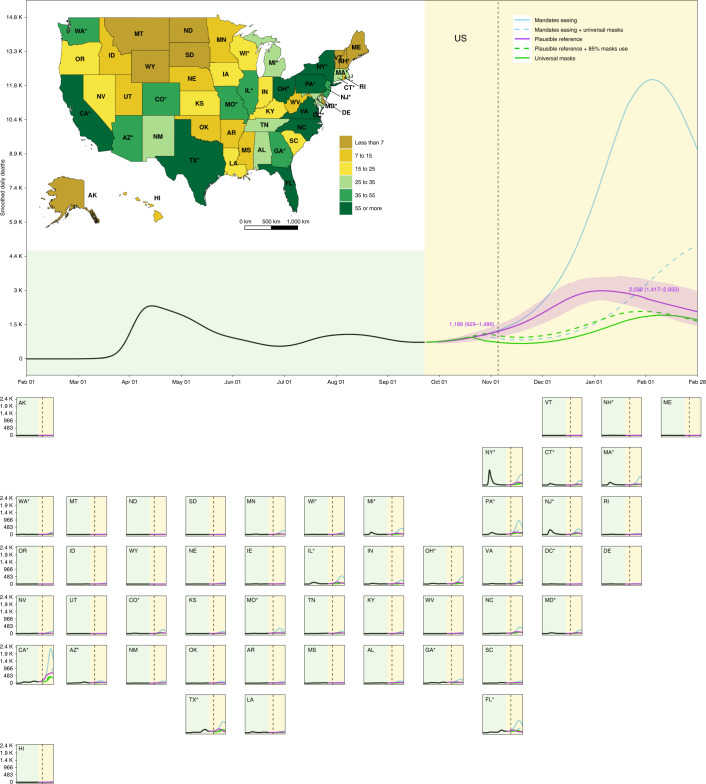
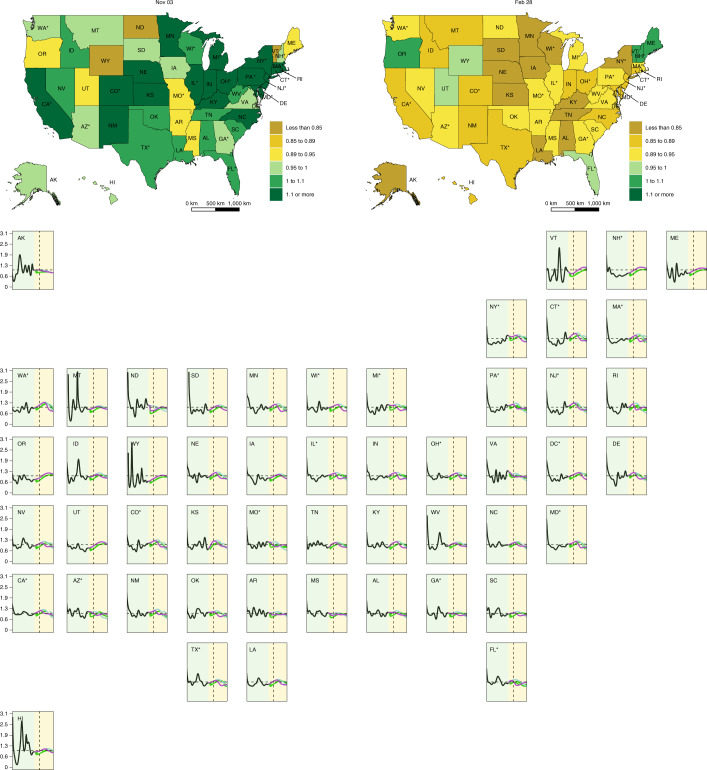
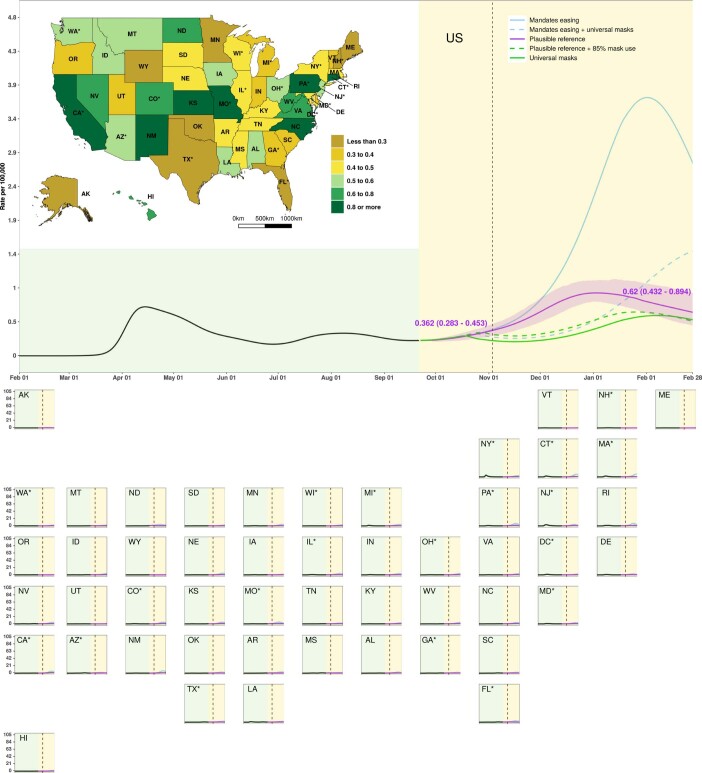
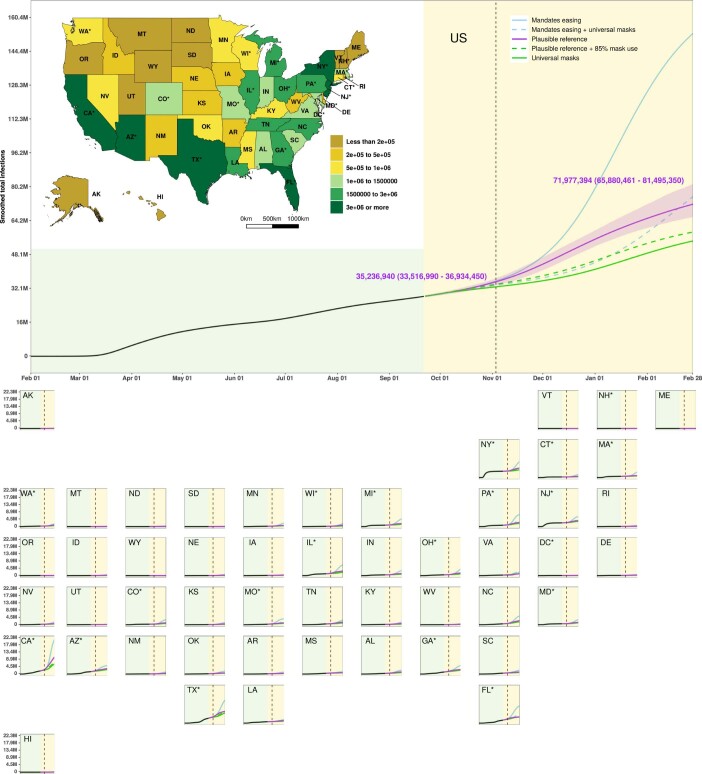
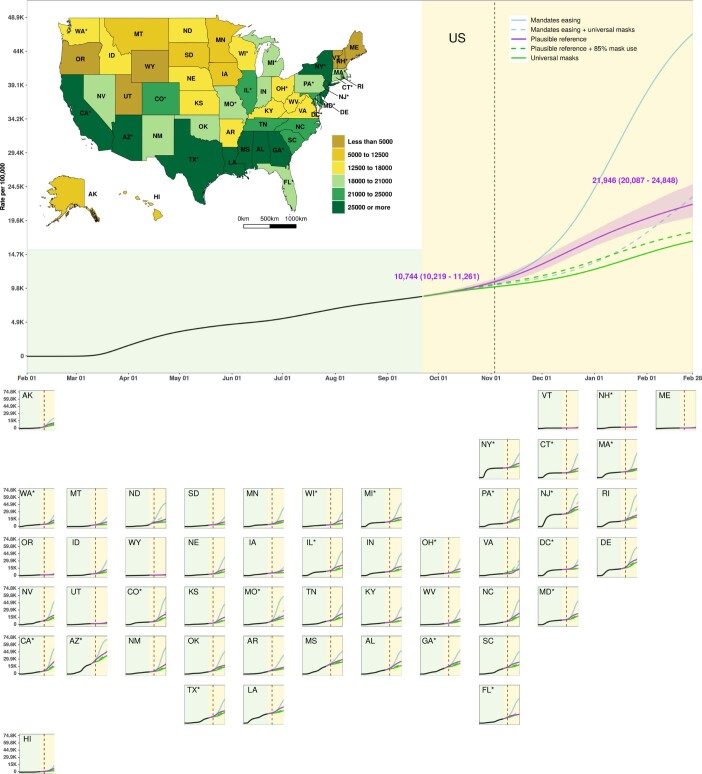
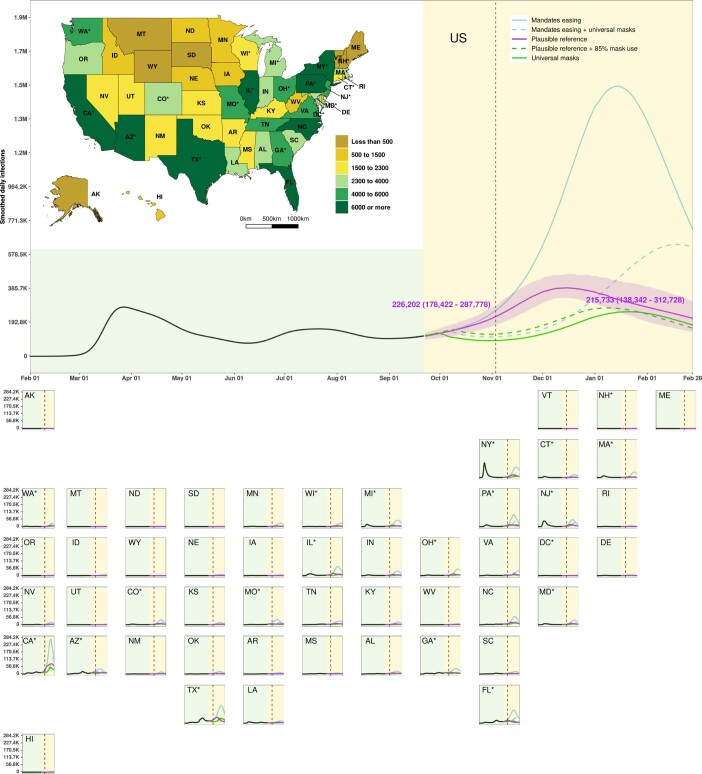
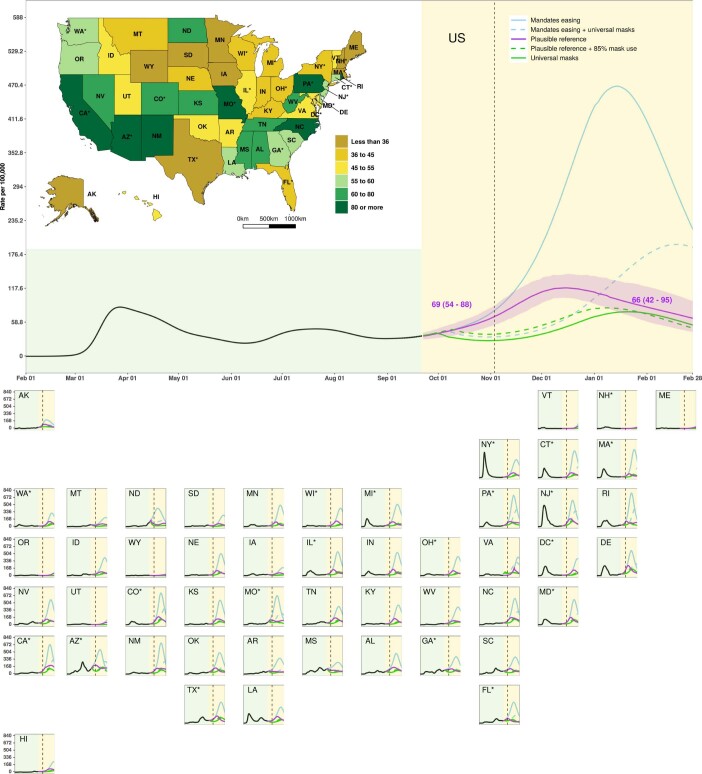
We use COVID-19 case and mortality data from 1 February 2020 to 21 September 2020 and a deterministic SEIR (susceptible, exposed, infectious and recovered) compartmental framework to model possible trajectories of severe acute respiratory syndrome coronavirus 2 (SARS-CoV-2) infections and the effects of non-pharmaceutical interventions in the United States at the state level from 22 September 2020 through 28 February 2021. Using this SEIR model, and projections of critical driving covariates (pneumonia seasonality, mobility, testing rates and mask use per capita), we assessed scenarios of social distancing mandates and levels of mask use. Projections of current non-pharmaceutical intervention strategies by state—with social distancing mandates reinstated when a threshold of 8 deaths per million population is exceeded (reference scenario)—suggest that, cumulatively, 511,373 (469,578–578,347) lives could be lost to COVID-19 across the United States by 28 February 2021. We find that achieving universal mask use (95% mask use in public) could be sufficient to ameliorate the worst effects of epidemic resurgences in many states. Universal mask use could save an additional 129,574 (85,284–170,867) lives from September 22, 2020 through the end of February 2021, or an additional 95,814 (60,731–133,077) lives assuming a lesser adoption of mask wearing (85%), when compared to the reference scenario.
Overview
The claims and statistics of this paper haven’t been checked yet.
Free: it reads the open-access text and checks the first 5 claims that cite a source we can check. Create a free account to check every claim.
Integrity signals
Registry
Cites
Statistics
Figures
Verification
Claims the paper makes
The claims and statistics of this paper haven’t been checked yet.
Free: it reads the open-access text and checks the first 5 claims that cite a source we can check. Create a free account to check every claim.
Claims other papers make about this one
Each is checked against this paper’s own text: does it say what the citing paper says it does?
The source backs part of the claim, not all of it — or backs it for a different population, condition or comparison.
In the citing paper
“Ultimately, we considered three novel indicators of the COVID-19 pandemic: decreasing human mobility,13 estimated total (as opposed to reported) daily SARS-CoV-2 infection rate, and estimated daily excess mortality rate during the pandemic (including excess deaths occurring during the pandemic where COVID-19 was not reported as the underlying cause of death).5, 13”
From Global prevalence and burden of depressive and anxiety disorders in 204 countries and territories in 2020 due to the COVID-19 pandemic (2021) · cites this paper as [13]
Experimental — accuracy not yet measuredThe source backs part of the claim, not all of it — or backs it for a different population, condition or comparison.
In the citing paper
“The estimation of human mobility, daily SARS-CoV-2 infection rate, and daily excess mortality rate was done by the Institute for Health Metrics and Evaluation (IHME) COVID-19 Forecasting Team and is described in detail elsewhere.13”
From Global prevalence and burden of depressive and anxiety disorders in 204 countries and territories in 2020 due to the COVID-19 pandemic (2021) · cites this paper as [13]
Experimental — accuracy not yet measuredThe cited source says what the claim attributes to it.
In the citing paper
“This variation can be explained by a combination of factors including policies enacted by governments to encourage mask use and reduce social interaction,48, 49, 50 presence of escape variants, testing and contact tracing capacity,51, 52 previous exposure to other coronaviruses,53 baseline patterns of social interaction, and more.”
From Estimating global, regional, and national daily and cumulative infections with SARS-CoV-2 through Nov 14, 2021: a statistical analysis (2022) · cites this paper as [50]
Self-check
Percentages, sums and reported differences re-computed from the paper’s own numbers.
The self-check needs the paper’s full text.
Citations
Cites
Vos, T., Lim, S. S., Abbafati, C., Abbas, K. M., Abbasi, M., Abbasifard, M., Abbasi-Kangevari, M., Abbastabar, H., Abd-Allah, F., Abdelalim, A., et al. (2020) · The Lancet · doi:10.1016/s0140-6736(20)30925-9 · Cited by 19,358
Self-citationMurray, C. J. L., Aravkin, A. Y., Zheng, P., Abbafati, C., Abbas, K. M., Abbasi-Kangevari, M., Abd-Allah, F., Abdelalim, A., Abdollahi, M., Abdollahpour, I., et al. (2020) · The Lancet · doi:10.1016/s0140-6736(20)30752-2 · Cited by 9,854
Self-citationRemdesivir for the Treatment of Covid-19 — Final Report
Beigel, J. H., Tomashek, K. M., Dodd, L. E., Mehta, A. K., Zingman, B. S., Kalil, A. C., Hohmann, E., Chu, H. Y., Luetkemeyer, A., Kline, S., et al. (2020) · New England Journal of Medicine · doi:10.1056/nejmoa2007764 · Cited by 7,267
First case of 2019 novel coronavirus in the United States
Holshue, M. L., DeBolt, C., Lindquist, S., Lofy, K. H., Wiesman, J., Bruce, H., Spitters, C., Ericson, K., Wilkerson, S., Tural, A., et al. (2020) · New England Journal of Medicine · doi:10.1056/nejmoa2001191 · Cited by 6,030
Lauer, S. A., Grantz, K. H., Bi, Q., Jones, F. K., Zheng, Q., Meredith, H. R., Azman, A. S., Reich, N. G., & Lessler, J. (2020) · Annals of Internal Medicine · doi:10.7326/m20-0504 · Cited by 5,970
The proximal origin of SARS-CoV-2
Andersen, K. G., Rambaut, A., Lipkin, W. I., Holmes, E. C., & Garry, R. F. (2020) · Nature Medicine · doi:10.1038/s41591-020-0820-9 · Cited by 5,081
Chu, D. K., Akl, E. A., Duda, S., Solo, K., Yaacoub, S., Schünemann, H. J., Chu, D. K., Akl, E. A., El-harakeh, A., Bognanni, A., et al. (2020) · The Lancet · doi:10.1016/s0140-6736(20)31142-9 · Cited by 3,843
How will country-based mitigation measures influence the course of the COVID-19 epidemic?
Anderson, R. M., Heesterbeek, H., Klinkenberg, D., & Hollingsworth, T. D. (2020) · The Lancet · doi:10.1016/s0140-6736(20)30567-5 · Cited by 3,648
Wang, Y., Zhang, D., Du, G., Du, R., Zhao, J., Jin, Y., Fu, S., Gao, L., Cheng, Z., Lu, Q., et al. (2020) · The Lancet · doi:10.1016/s0140-6736(20)31022-9 · Cited by 3,440
Estimating the effects of non-pharmaceutical interventions on COVID-19 in Europe
Flaxman, S., Mishra, S., Gandy, A., Unwin, H. J. T., Mellan, T. A., Coupland, H., Whittaker, C., Zhu, H., Berah, T., Eaton, J. W., et al. (2020) · Nature · doi:10.1038/s41586-020-2405-7 · Cited by 3,350
Research works printed but not linked: 4
- 4. Horton, R. The COVID-19 Catastrophe: What's Gone Wrong and How to Stop it Happening Again. (John Wiley & Sons, 2020).
- 39. Henry M Jackson School of International Studies, university of Washington, Seattle, WA, uSA. 13 Policy and Epidemiology Group, Queensland Centre for Mental Health research, Brisbane, Queensland, Australia. 14 These authors contributed equally: robert C reiner Jr., ryan M Barber. ✉ e-mail: sihay@uw.edu coronavirusdisease2019/what-you-should-know/current-situation-in-hawaii/; Illinois cases and deaths from https://dph.illinois.gov/covid19/covid19-statistics; Indiana cases and deaths from https://www.coronavirus.in.gov/2393.htm; Kentucky cases and deaths from https://govstatus.egov.com/kycovid19; Maryland cases and deaths from https://coronavirus.maryland.gov/; Nebraska cases and deaths from http://dhhs.ne.gov/Pages/Coronavirus.aspx; New York cases and deaths from https://github.com/nychealth/coronavirus-data and https:// covid19tracker.health.ny.gov/views/NYS-COVID19-Tracker/NYSDOHCOVID-19 Tracker-Map?%3Aembed=yes&%3Atoolbar=no&%3Atabs=n; North Carolina cases and deaths from https://covid19.ncdhhs.gov/dashboard; and Washington cases, hospitalizations and deaths from https://www.doh.wa.gov/Emergencies/ COVID19/DataDashboard. The timing of mandate implementation for each state was derived from a preprint study 43 and supplemented with ad hoc additional resources available at http://ghdx.healthdata.org/record/ihme-data/ united-states-covid-19-scenarios-2020-2021. The mobility covariate was constructed using data from Google Community Mobility Reports (https://www. google.com/covid19/mobility/); Facebook Data for Good Disease Prevention Maps (https://dataforgood.fb.com/tools/disease-prevention-maps/; with access coordinated via diseaseprevmaps@fb.com); SafeGraph Shelter in Place Index (https://www.safegraph.com/dashboard/covid19-shelter-in-place?s=US& d=09-13-2020&t=counties&m=index; with access coordinated through the SafeGraph COVID-19 Data Consortium via https://www.safegraph.com/covid-19- data-consortium/); and Descartes Labs (https://github.com/descarteslabs/ DL-COVID-19). The testing covariate was constructed using data from the COVID Tracking Project (https://covidtracking.com/data/api/). State-level datasets for the testing covariate were replaced in Washington, using https:// www.doh.wa.gov/Emergencies/COVID19/DataDashboard. Mask-use data were obtained from Premise COVID-19 Global Impact Survey (https://www.premise. com/the-dos-and-donts-of-conducting-surveys-during-covid-19/; with access coordinated through info@premise.com); the Facebook (COVID) Symptom Survey (with access coordinated through University of Maryland Joint Program in Survey Methodology via admin-C19survey-fb@umd.edu); and the YouGov COVID-19 Behavioural Tracker Survey (https://github.com/YouGov-Data/ covid-19-tracker). Pneumonia seasonality estimates, particulate matter air pollution estimates, lower respiratory infection country-specific mortality rate estimates and smoking estimates were generated by the Global Burden of Disease study (http://ghdx.healthdata.org/record/ihme-data/united-states-covid- 19-scenarios-2020-2021/). Altitude was sourced from the National Oceanic and Atmospheric Administration National Centers for Environmental Information Global Land One-km Base Elevation Project (https://www.ngdc.noaa.gov/mgg/ topo/globe.html) and population data were obtained from WorldPop Population Counts (https://www.worldpop.org/project/list/). These sources are further detailed in the Supplementary Information 44-51 . Source data are provided with this paper. references
- 43. GBD 2019 Population and Fertility Collaborators. Global, regional and national age-sex-specific fertility, mortality and population estimates, 1950-2019: a comprehensive demographic analysis for the global burden of disease study 2019. The Lancet (in press).
- 52. GBD 2019 Diseases and injuries Collaborators. Global burden of 369 diseases and injuries, 1990-2019: a systematic analysis for the Global Burden of Disease Study 2019. The Lancet (in press).
Cited by
Items 501–554 of 554
Silva, T. S., Ciarelli, P. M., Montalvão, J., & Salles, E. O. T. (2023) · Journal of Health Informatics · doi:10.59681/2175-4411.v15.iespecial.2023.1089
Utilization of the VivaVideo Application During Covid-19
Qian, S., Thomas, D., Samir, K., & Jie, L. (2023) · Journal International Inspire Education Technology · doi:10.55849/jiiet.v2i1.245
Dynamic Modeling and Forecasting of Epidemics Incorporating Age and Vaccination Status
Kulkarni, N., Qiao, C., & Vereshchaka, A. (2023) · Lecture notes in computer science · doi:10.1007/978-3-031-43129-6_26
Yin, Z., Xiao, H., McDonald, S., Brusić, V., & Qiu, T. (2023) · Journal of Medical Virology · doi:10.1002/jmv.29301 · Cited by 2
Harnessing Moral Cognition to Save Lives
Landy, J. F., & Perry, A. D. (2023) · doi:10.1093/oso/9780197615133.003.0034
Griffin, D., & Mangum, A. J. (2024) · CODEE Journal · doi:10.5642/codee.hrxa6019
COVID-19 incidence estimates and forecast by metaprediction for the Comunidad de Madrid *
Martínez, A. C., Muñoz-Organero, M., Moriña, D., Gómez‐Barroso, D., & Singh, D. E. (2023) · IEEE International Conference on Bioinformatics and Biomedicine (BIBM) · doi:10.1109/bibm58861.2023.10385648
“Reiner et al [17] use a deterministic SEIR framework to model the propagation of the virus and the effect of NPIs (social distancing mandates and mask use) until Spring of 2021.”
BackgroundMethodHoi, A. G., N’Tcha, L. K., Duguay, C., Accrombessi, M., Akinro, B., Feng, C. X., Labonté, R., Protopopoff, N., Akogbeto, M. C., & Kulkarni, M. A. (2024) · PLOS Global Public Health · doi:10.1371/journal.pgph.0002197 · Cited by 1
Arehart, C. H., Arehart, J. H., David, M. Z., D’Amico, B., Sozzi, E., Dukić, V., & Pomponi, F. (2023) · Springer eBooks · doi:10.1007/978-3-030-93954-0_2-1
Noera, G. (2023) · American Journal of Biomedical Science & Research · doi:10.34297/ajbsr.2023.20.002672
de Wilde, D., Rohner, N., & Rohner, C. (2024) · Elsevier eBooks · doi:10.1016/b978-0-443-13681-8.00013-8
Dynamics Analysis of a COVID-19 Transmission Model Incorporating Vaccination and Failure
赵, 勇. (2024) · Advances in Applied Mathematics · doi:10.12677/aam.2024.135222
Will the substitution policy resolve the shortage of personal protection equipment?
Chen, J., Chen, L., & Chen, Y. (2024) · Naval Research Logistics (NRL) · doi:10.1002/nav.22203
Sun, D., Yuan, K., & Yin, G. (2024) · Physica Scripta · doi:10.1088/1402-4896/ad5ca5 · Cited by 1
Perspective Chapter: EnsembleDashVis Views and Volunteers – A Retrospective and Early History
Wang, Q., Borgo, R., & Laramee, R. S. (2024) · IntechOpen eBooks · doi:10.5772/intechopen.115029
Mejia, C. R., Ascarza, G., Álvarez-Risco, A., Misayauri, J., Arias-Chávez, D., Vilela-Estrada, M. A., Serna-Alarcón, V., Requena-Pastorelli, T., Ubillús, M., Del-Aguila-Arcentales, S., et al. (2024) · BMC Public Health · doi:10.1186/s12889-024-20568-9 · Cited by 1
“After that, it began to spread throughout Asia [2], passing through Europe [3], reaching America [4], and covering all the territories known to humanity [5].”
COVID-19 Reproduction Numbers and Long COVID Prevalences in California State PrisonsPreprint
Worden, L., Wannier, R., Archer, H., Blumberg, S., Kwan, A. T., Sears, D., & Porco, T. C. (2024) · medRxiv · doi:10.1101/2024.12.14.24319022
Significant Driving Factors in the Evolution of the COVID-19 Epidemic
Sun, J., Chen, X., & Zhang, L. (2024) · Sustainability · doi:10.3390/su17010110 · Cited by 1
Integrating Metaheuristics and Machine Learning for Wellbeing Management
AlSenani, S., & Bouktif, S. (2024) · Wiley eBooks · doi:10.1002/9781394287024.ch12
CovSyn: an agent-based model for synthesizing COVID-19 course of disease and contact tracing dataPreprint
Wu, Y.-H., & Nordling, T. E. M. (2025) · medRxiv · doi:10.1101/2025.05.17.25327820 · Cited by 1
Manchel, A., Erdemir, A., Mulugeta, L., Ku, J. P., Rego, B. V., Horner, M., Lytton, W. W., Myers, J. G., & Vadigepalli, R. (2025) · PLoS ONE · doi:10.1371/journal.pone.0313711 · Cited by 1
“We applied the Ten Rules and the rubric to evaluate the M&S practices of several COVID-19 modeling studies with versions released early in the pandemic and available at the time of this study: MIT model [19], IHME model [20,21], CU model [22], NE model [23], ICL model [24], UPenn model [25].”
Theoretical foundations and application of the varying coefficient SEIR model
Sun, T., & Jin, B. (2025) · JUSTC · doi:10.52396/justc-2025-0014
COVID-19 Mitigation Policies, Politics, and Structural Vulnerability in the United States
Stone, L. C., Boursaw, B., Wasif, U., & Zhu, Y. (2025) · Health Education & Behavior · doi:10.1177/10901981251346814 · Cited by 1
HAL-Net: A Historical Analogy Learning Network for Adaptive and Interpretable Pandemic Forecasting
Zhang, C., & Ji, D. (2025) · Expert Systems with Applications · doi:10.1016/j.eswa.2025.130038 · Cited by 2
Combining data assimilation of states and parameters for more precise infectious disease prediction
Hao, Z., Hu, S., Huang, J., Hu, J., Zhang, Z., Zhang, J., Yan, W., & Li, H. (2025) · One Health · doi:10.1016/j.onehlt.2025.101266
Self-citationLarge deviations in non-Markovian stochastic epidemics
Shmunik, M., & Assaf, M. (2026) · Physical Review Research · doi:10.1103/bswp-wrfc
Estadilla, C. D. S., Uyheng, J., de Lara-Tuprio, E. P., Teng, T. R. Y., Macalalag, J. M. R., & Estuar, M. R. J. E. (2021) · Figshare · doi:10.6084/m9.figshare.15139541
Additional file 3 of Compartmental structures used in modeling COVID-19: a scoping review
Kong, L., Duan, M., Shi, J., Hong, J., Chang, Z., & Zhang, Z. (2022) · Figshare · doi:10.6084/m9.figshare.20115744
Castonguay, F. M., Barnes, A., Jeon, S., Fornoff, J., Adhikari, B. B., Fischer, L. S., Greening, B., Hassan, A. O., Kahn, E. B., Kang, G. J., et al. (2024) · Figshare · doi:10.6084/m9.figshare.25596387
Bisanzio, D., Reithinger, R., Alqunaibet, A., Almudarra, S., Alsukait, R. F., Dong, D., Zhang, Y., El-Saharty, S., & Herbst, C. H. (2022) · Figshare · doi:10.6084/m9.figshare.19129144
Zhou, X., Ma, X., Gao, S., Ma, Y., Gao, J., Jiang, H., Zhu, W., Hong, N., Long, Y., & Su, L. (2023) · Figshare · doi:10.6084/m9.figshare.24151326
Additional file 2 of Compartmental structures used in modeling COVID-19: a scoping review
Kong, L., Duan, M., Shi, J., Hong, J., Chang, Z., & Zhang, Z. (2022) · Figshare · doi:10.6084/m9.figshare.20115741
Arentz, M., Ma, J., Zheng, P., Vos, T., Murray, C. J. L., & Kyu, H. H. (2022) · Figshare · doi:10.6084/m9.figshare.19085197
Self-citationAdditional file 5 of Compartmental structures used in modeling COVID-19: a scoping review
Kong, L., Duan, M., Shi, J., Hong, J., Chang, Z., & Zhang, Z. (2022) · Figshare · doi:10.6084/m9.figshare.20115750
Madlock‐Brown, C., Wilkens, K., Weiskopf, N. G., Cesare, N., Bhattacharyya, S., Riches, N. O., Espinoza, J., Dorr, D., Goetz, K., Phuong, J., et al. (2022) · Figshare · doi:10.6084/m9.figshare.19603432
Additional file 4 of Compartmental structures used in modeling COVID-19: a scoping review
Kong, L., Duan, M., Shi, J., Hong, J., Chang, Z., & Zhang, Z. (2022) · Figshare · doi:10.6084/m9.figshare.20115747
Additional file 1 of Compartmental structures used in modeling COVID-19: a scoping review
Kong, L., Duan, M., Shi, J., Hong, J., Chang, Z., & Zhang, Z. (2022) · Figshare · doi:10.6084/m9.figshare.20115738
Jing, E., & Ahn, Y. (2021) · Figshare · doi:10.6084/m9.figshare.16909797
Arentz, M., Ma, J., Zheng, P., Vos, T., Murray, C. J. L., & Kyu, H. H. (2022) · Figshare · doi:10.6084/m9.figshare.19085194
Self-citationJuga, M. L., & Nyabadza, F. (2026) · Science Progress · doi:10.1177/00368504251395189
From wastewater to infection estimates: Incident COVID-19 infections during Omicron in the U.S.
Lobay, R., Srivastava, A., & McDonald, D. J. (2026) · Epidemics · doi:10.1016/j.epidem.2026.100889
Forecasting Local Surges in COVID-19 Hospitalizations through Adaptive Decision Tree Classifiers
Murray‐Watson, R. E., Guaracha, X., Bilinski, A., & Yaesoubi, R. (2026) · Medical Decision Making · doi:10.1177/0272989x251408845
Arenas, A. J., Cogollo, M. R., & González‐Parra, G. (2026) · Nonlinear Dynamics · doi:10.1007/s11071-026-12363-5
Zhang, X., Lin, L., Xia, K., Feng, Y., Zhang, Q., & Wang, S. (2026) · IEEE International Conference on Acoustics Speech and Signal Processing · doi:10.1109/icassp55912.2026.11462086
Shan, D. (2026) · Research Square · doi:10.21203/rs.3.rs-9724901/v1
BLIDE: Bayesian Learning of Infectious Disease Emerging in COVID-19 Studies
Adhikary, A. C., Liu, Z., Das, A., Liu, R., & Huang, C. (2026) · Stats · doi:10.3390/stats9030054
Du, L., Fan, M., & Lin, Y. (2026) · Frontiers in Public Health · doi:10.3389/fpubh.2026.1831818
“For major public health emergencies, Reiner et al. (22) used a deterministic SEIR framework to model possible trajectories of COVID-19 infections in the United States and to assess the effects of non-pharmaceutical interventions.”
Chen, S. S., Guo, X. S., Liu, Z., Lin, Z. B., & Chen, J. (2026) · Mathematics · doi:10.3390/math14142642
“To support vaccine allocation, healthcare resource scheduling, and early warning in high-risk areas, constructing an accurate and stable multi-regional infectious disease transmission forecasting model has become a key issue in intelligent public health decision making [6,7].”
Multi-scale Modeling of Spatio-Temporal COVID-19 Mortality: County and State Level in the US
Lawson, A., Fan, S., Neelon, B., & Chowell, G. (2026) · Spatial Demography · doi:10.1007/s40980-026-00167-5
Neural-network learning and identifiability for mobility-based SEAIR epidemic models
Wang, W. (2026) · Nonlinear Analysis Real World Applications · doi:10.1016/j.nonrwa.2026.104747
Guaracha, X., & Yaesoubi, R. (2026) · Epidemics · doi:10.1016/j.epidem.2026.100947
Metadata
- Authors
- IHME COVID-19 Forecasting Team, Reiner, R. C., Barber, R. M., Collins, J. K., Zheng, P., Adolph, C., Albright, J., Antony, C. M., Aravkin, A. Y., Bachmeier, S. D., Bang-Jensen, B., Bannick, M. S., Bloom, S., Carter, A., Castro, E., Causey, K., Chakrabarti, S., Charlson, F. J., Cogen, R. M., Combs, E., Dai, X., Dangel, W. J., Earl, L., Ewald, S. B., Ezalarab, M., Ferrari, A. J., Flaxman, A., Frostad, J. J., Fullman, N., Gakidou, E., Gallagher, J., Glenn, S. D., Goosmann, E. A., He, J., Henry, N. J., Hulland, E. N., Hurst, B., Johanns, C., Kendrick, P. J., Khemani, A., Larson, S. L., Lazzar-Atwood, A., LeGrand, K. E., Lescinsky, H., Lindstrom, A., Linebarger, E., Lozano, R., Ma, R., Månsson, J., Magistro, B., Herrera, A. M. M., Marczak, L. B., Miller-Petrie, M. K., Mokdad, A. H., Morgan, J. D., Naik, P., Odell, C. M., O’Halloran, J. K., Osgood-Zimmerman, A. E., Ostroff, S. M., Pasovic, M., Penberthy, L., Phipps, G., Pigott, D. M., Pollock, I., Ramshaw, R. E., Redford, S. B., Reinke, G., Rolfe, S., Santomauro, D. F., Shackleton, J. R., Shaw, D. H., Sheena, B. S., Sholokhov, A., Sorensen, R. J. D., Sparks, G., Spurlock, E. E., Subart, M. L., Syailendrawati, R., Torre, A. E., Troeger, C. E., Vos, T., Watson, A., Watson, S., Wiens, K. E., Woyczynski, L., Xu, L., Zhang, J., Hay, S. I., Lim, S. S., & Murray, C. J. L.
- Affiliations
- University of Washington (US)
- The University of Queensland (AU)
- ORCID
- Reiner, Robert C.
- Barber, Ryan M.
- Collins, James K.
- Adolph, Christopher
- Albright, James
- Aravkin, Aleksandr Y.
- Bang-Jensen, Bree
- Bannick, Marlena S.
- Carter, Austin
- Causey, Kate
- Chakrabarti, Suman
- Charlson, Fiona J.
- Dai, Xiaochen
- Ewald, Samuel B.
- Ferrari, Alize J.
- Flaxman, Abraham
- Fullman, Nancy
- Gakidou, Emmanuela
- Glenn, Scott D.
- Goosmann, Erik A.
- He, Jiawei
- Henry, Nathaniel J.
- Hulland, Erin N.
- Kendrick, Parkes J.
- LeGrand, Kate E.
- Lindstrom, Akiaja
- Lozano, Rafael
- Ma, Rui
- Magistro, Beatrice
- Herrera, Ana M. Mantilla
- Marczak, Laurie B.
- Miller-Petrie, Molly K.
- Mokdad, Ali H.
- Naik, Paulami
- Osgood-Zimmerman, Aaron E.
- Pasovic, Maja
- Pigott, David M.
- Ramshaw, Rebecca E.
- Reinke, Grace
- Santomauro, Damian Francesco
- Sheena, Brittney S.
- Sholokhov, Aleksei
- Sorensen, Reed J. D.
- Spurlock, Emma Elizabeth
- Vos, Theo
- Wiens, Kirsten E.
- Hay, Simon I.
- Lim, Stephen S.
- Murray, Christopher J. L.
- Venue
- Nature Medicine
- Published
- 2020-10-23
- Volume
- 27
- Issue
- 1
- Pages
- 94-105
- ISSN
- 1078-8956 (ISSN-L)
- 1546-170X
- PMC
- PMC7806509
- OpenAlex
- W3093610264
- Cited by
- 556
- References
- 56
- Citations by year
- 2026: 17 · 2025: 25 · 2024: 61 · 2023: 84 · 2022: 134 · 2021: 210 · 2020: 25
- FWCI
- 18.01
- Type
- journal article
- Language
- en
- Update notices
- correction (2020-11-27)
- Open access
- hybrid
- doi.org
- Licence
- cc-by
- creativecommons.org/licenses/by/4.0 (tdm)
- creativecommons.org/licenses/by/4.0 (vor)
- Locations
- Nature Medicine (publishedVersion, cc-by)
- medRxiv (acceptedVersion, cc-by)
- Europe PMC (PubMed Central) (publishedVersion, other-oa)
- PubMed Central (publishedVersion, cc-by)
- PubMed (publishedVersion)
- LSHTM Research Online (London School of Hygiene and Tropical Medicine) (acceptedVersion)
- Funders
- National Science Foundation (2031096)
- Bill and Melinda Gates Foundation
- Institute for Health Metrics and Evaluation
- Topics
- Physical Sciences › Mathematics › Modeling and Simulation › COVID-19 epidemiological studies
- Physical Sciences › Mathematics › Applied Mathematics › Mathematical and Theoretical Epidemiology and Ecology Models
- Social Sciences › Sociology and Political Science › COVID-19 Prevention and Impact
- Keywords
- COVID-19 pandemic, SARS-CoV-2, SEIR model, epidemic projection, non-pharmaceutical interventions, masking, mortality, mobility, testing rates, epidemic resurgence, United States
- MeSH terms
- Physical Distancing, COVID-19, SARS-CoV-2, Health Policy, Humans, Models, Biological, Travel, United States, Epidemics
About these checks
Registry, retraction, Cites and statistics results are computed, not judged, with one exception: a printed reference that no index lists is read once by a model before it counts as a citation error. Claims are extracted by a model and kept only when their quote appears verbatim in the text; each cited source is then checked, with a model’s help, for whether it says what the claim relies on. Those verdicts can be wrong — read the claim’s quote and the cited source before relying on one.
Statistics and arithmetic are recomputed, not judged.
Confidence bands are shown only for fields calibrated on our annotated test set. None is calibrated yet, so no band is shown.
What counts as a claim ›How we measure confidence ›How we check this ›
Are you an author, or do you see a problem with this page? Request a review
Data sources
Bibliographic data: Semantic Scholar, OpenAlex, Crossref.
Contains information from the Semantic Scholar Academic Graph Datasets, made available under the ODC Attribution License (ODC-BY 1.0).
Semantic Scholar’s data is described in: Kinney, R., et al. (2023). The Semantic Scholar Open Data Platform. arXiv:2301.10140.
