

Modeling COVID-19 scenarios for the United States
Open accessPublished version of a preprint
The DOI matches its Crossref record; 59 of the 59 references it cites were found in a registry or an index.
Abstract
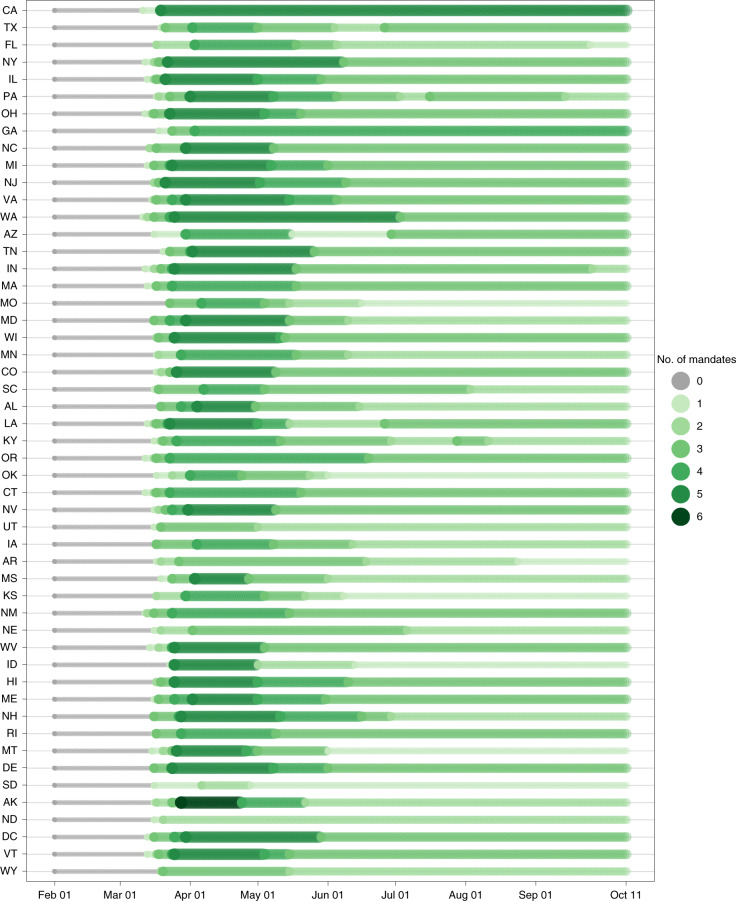
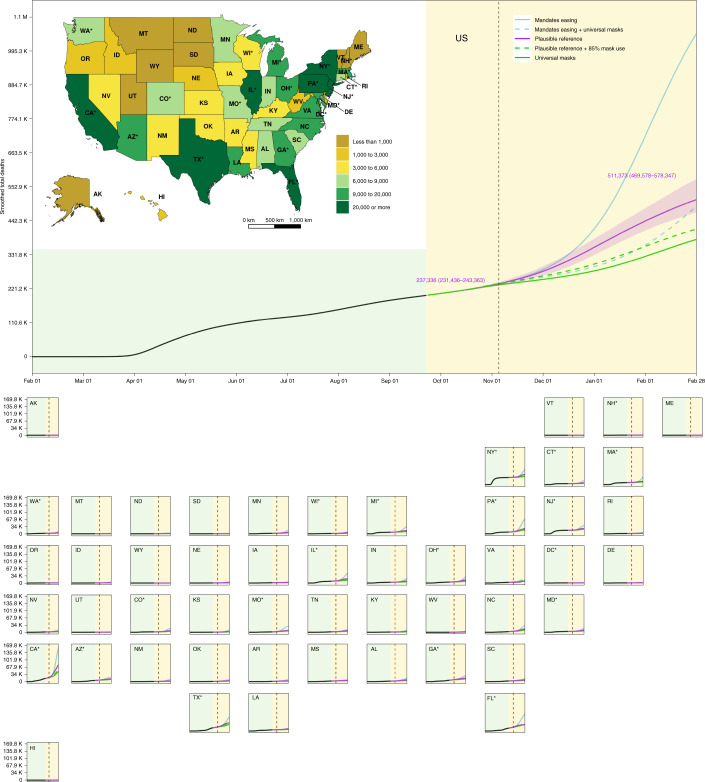
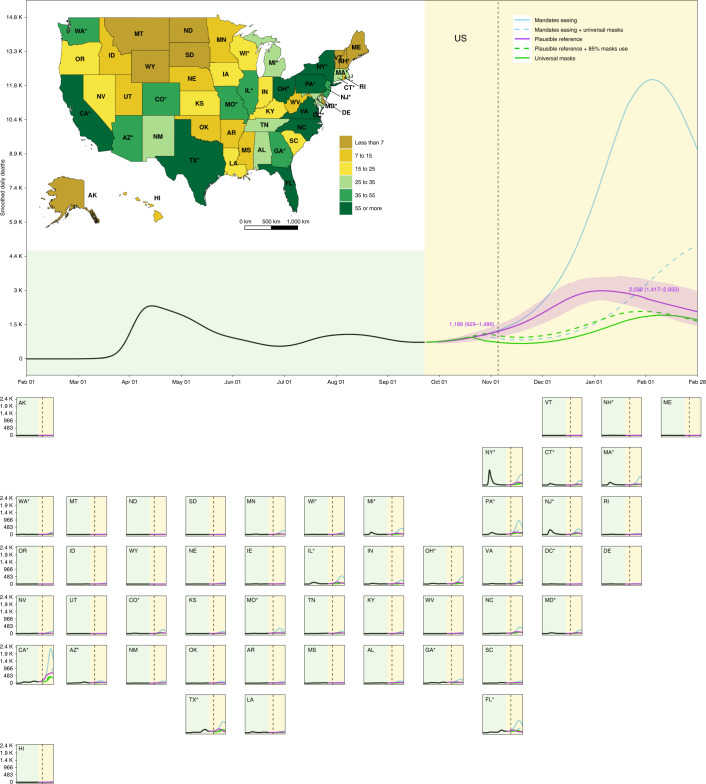
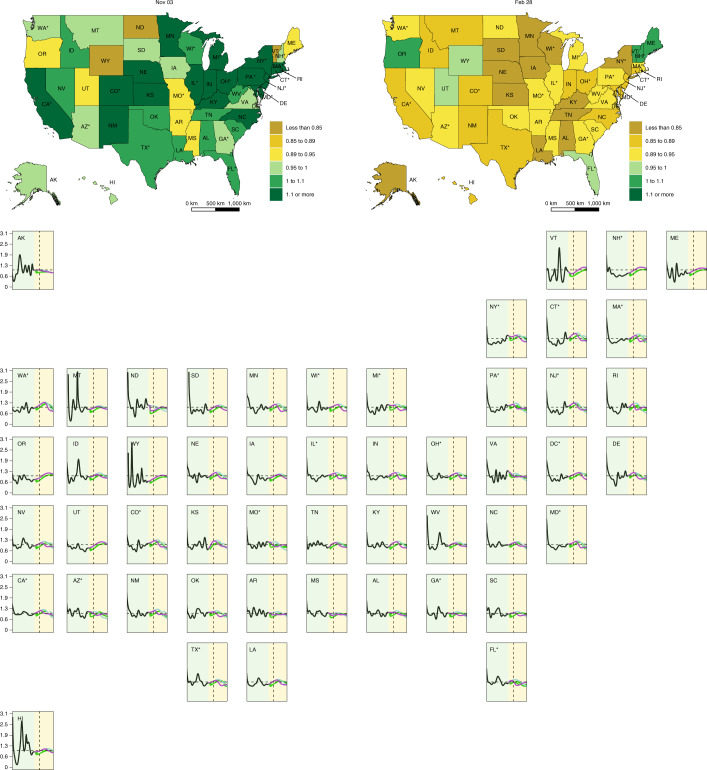
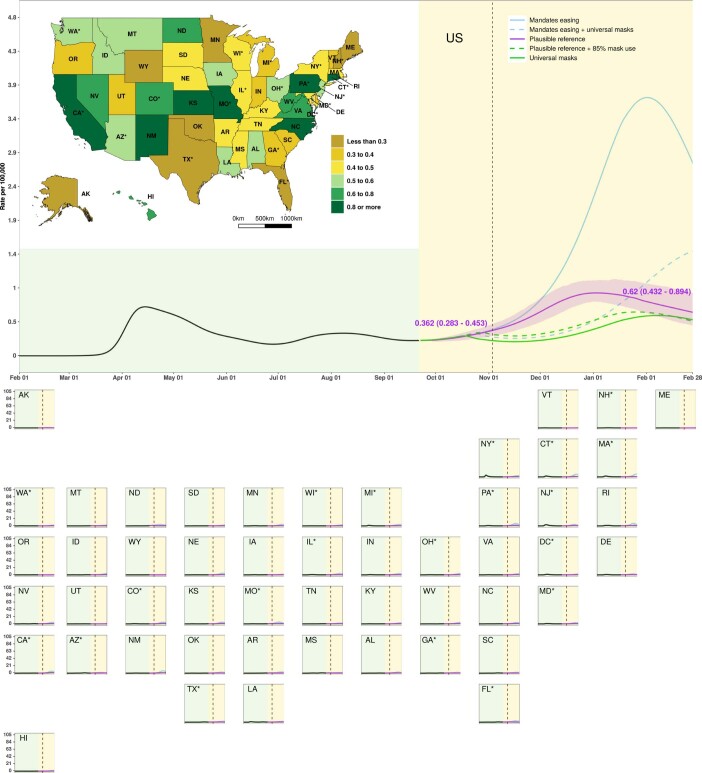
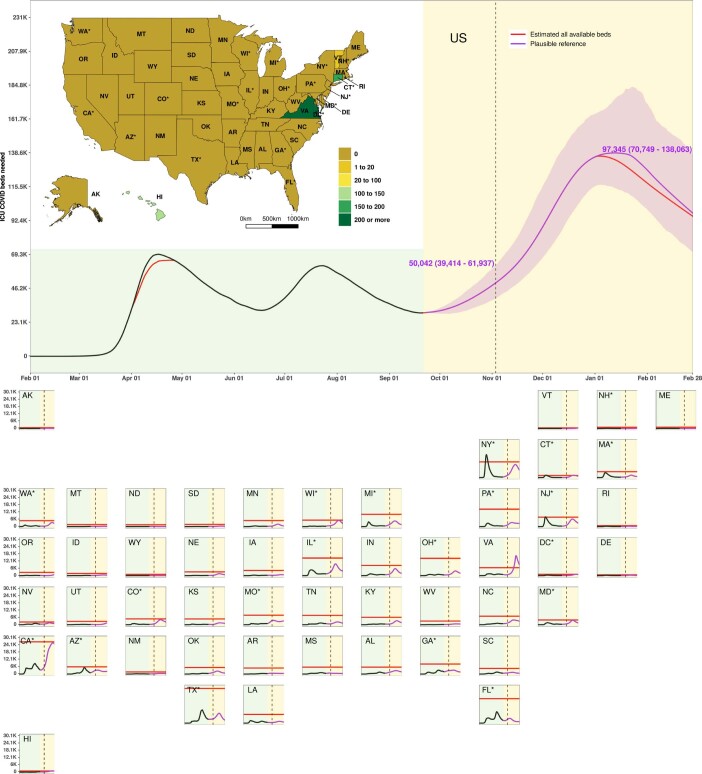
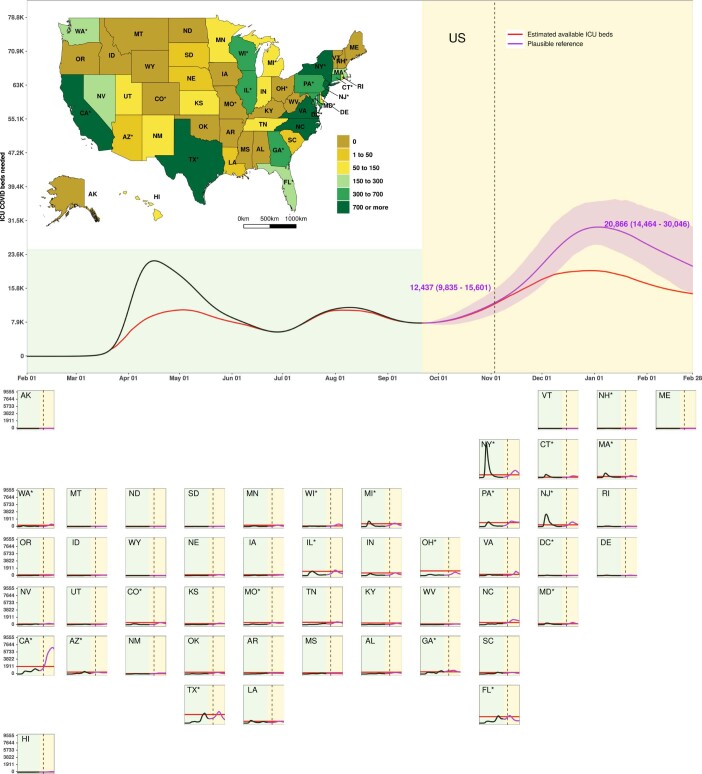
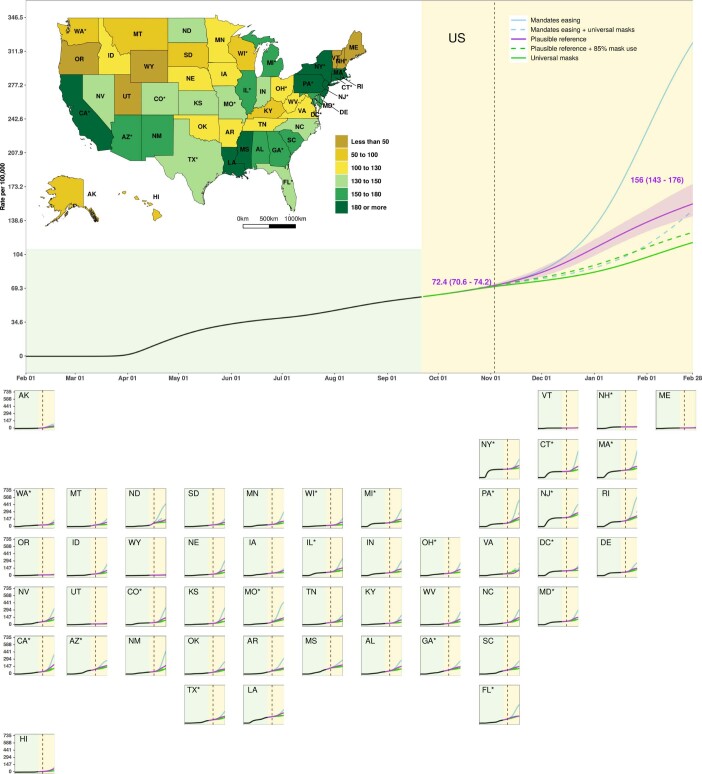
We use COVID-19 case and mortality data from 1 February 2020 to 21 September 2020 and a deterministic SEIR (susceptible, exposed, infectious and recovered) compartmental framework to model possible trajectories of severe acute respiratory syndrome coronavirus 2 (SARS-CoV-2) infections and the effects of non-pharmaceutical interventions in the United States at the state level from 22 September 2020 through 28 February 2021. Using this SEIR model, and projections of critical driving covariates (pneumonia seasonality, mobility, testing rates and mask use per capita), we assessed scenarios of social distancing mandates and levels of mask use. Projections of current non-pharmaceutical intervention strategies by state—with social distancing mandates reinstated when a threshold of 8 deaths per million population is exceeded (reference scenario)—suggest that, cumulatively, 511,373 (469,578–578,347) lives could be lost to COVID-19 across the United States by 28 February 2021. We find that achieving universal mask use (95% mask use in public) could be sufficient to ameliorate the worst effects of epidemic resurgences in many states. Universal mask use could save an additional 129,574 (85,284–170,867) lives from September 22, 2020 through the end of February 2021, or an additional 95,814 (60,731–133,077) lives assuming a lesser adoption of mask wearing (85%), when compared to the reference scenario.
Overview
The claims and statistics of this paper haven’t been checked yet.
Free: it reads the open-access text and checks the first 5 claims that cite a source we can check. Create a free account to check every claim.
Integrity signals
Registry
Cites
Statistics
Figures
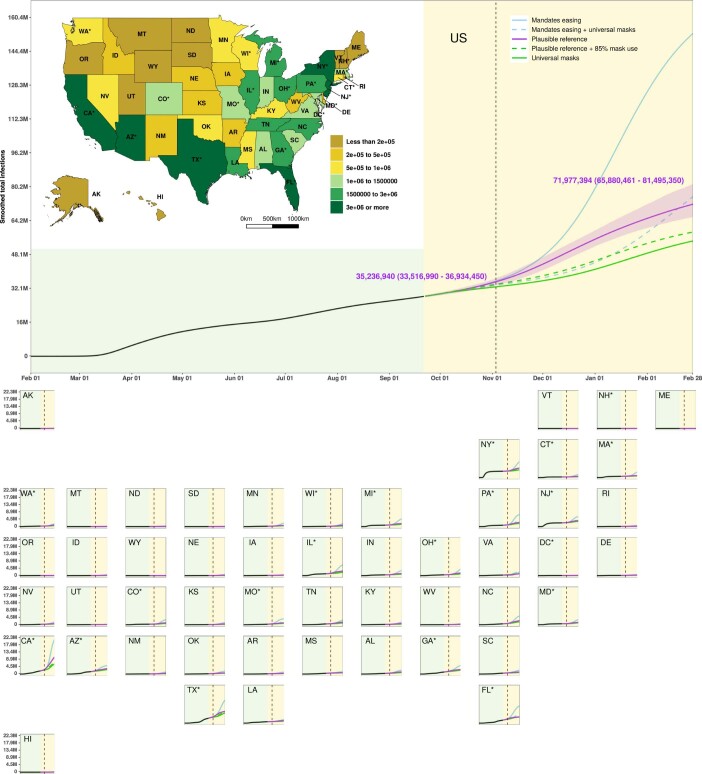
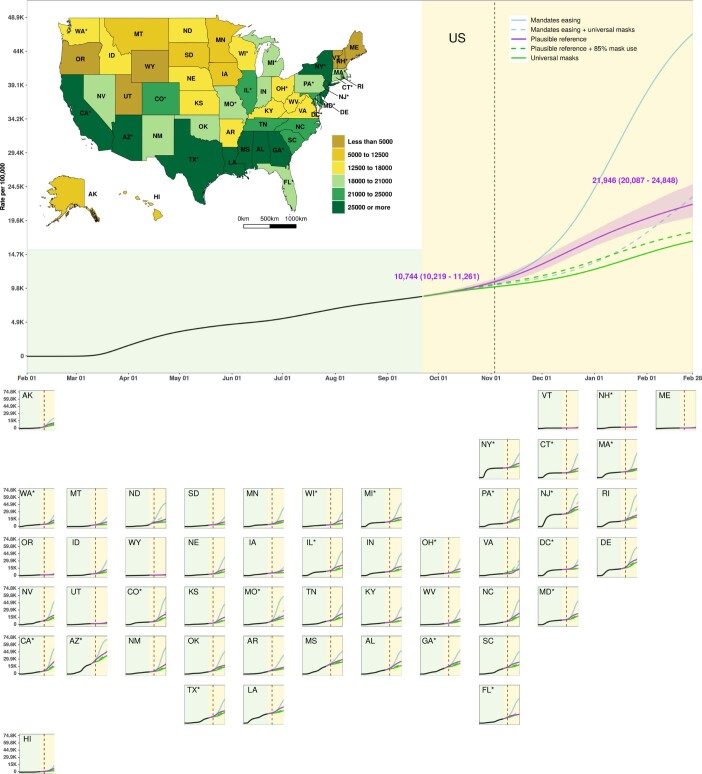
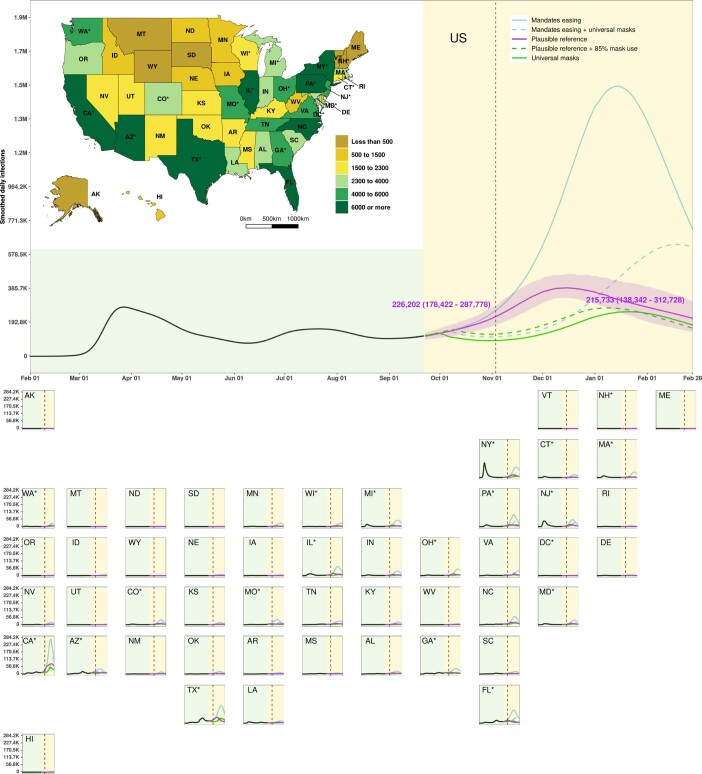
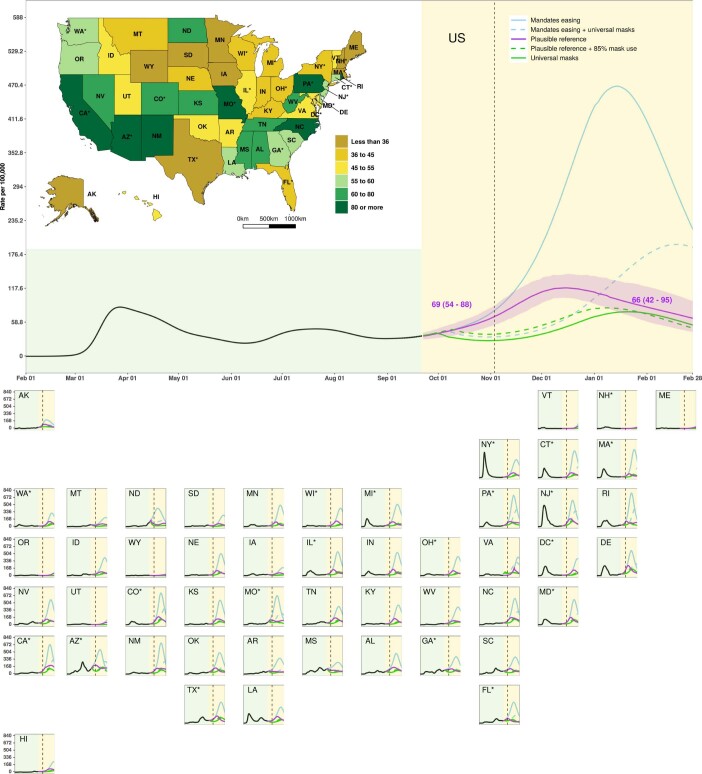
Verification
Claims the paper makes
The claims and statistics of this paper haven’t been checked yet.
Free: it reads the open-access text and checks the first 5 claims that cite a source we can check. Create a free account to check every claim.
Claims other papers make about this one
Each is checked against this paper’s own text: does it say what the citing paper says it does?
The source backs part of the claim, not all of it — or backs it for a different population, condition or comparison.
In the citing paper
“Ultimately, we considered three novel indicators of the COVID-19 pandemic: decreasing human mobility,13 estimated total (as opposed to reported) daily SARS-CoV-2 infection rate, and estimated daily excess mortality rate during the pandemic (including excess deaths occurring during the pandemic where COVID-19 was not reported as the underlying cause of death).5, 13”
From Global prevalence and burden of depressive and anxiety disorders in 204 countries and territories in 2020 due to the COVID-19 pandemic (2021) · cites this paper as [13]
Experimental — accuracy not yet measuredThe source backs part of the claim, not all of it — or backs it for a different population, condition or comparison.
In the citing paper
“The estimation of human mobility, daily SARS-CoV-2 infection rate, and daily excess mortality rate was done by the Institute for Health Metrics and Evaluation (IHME) COVID-19 Forecasting Team and is described in detail elsewhere.13”
From Global prevalence and burden of depressive and anxiety disorders in 204 countries and territories in 2020 due to the COVID-19 pandemic (2021) · cites this paper as [13]
Experimental — accuracy not yet measuredThe cited source says what the claim attributes to it.
In the citing paper
“This variation can be explained by a combination of factors including policies enacted by governments to encourage mask use and reduce social interaction,48, 49, 50 presence of escape variants, testing and contact tracing capacity,51, 52 previous exposure to other coronaviruses,53 baseline patterns of social interaction, and more.”
From Estimating global, regional, and national daily and cumulative infections with SARS-CoV-2 through Nov 14, 2021: a statistical analysis (2022) · cites this paper as [50]
Self-check
Percentages, sums and reported differences re-computed from the paper’s own numbers.
The self-check needs the paper’s full text.
Citations
Cites
Vos, T., Lim, S. S., Abbafati, C., Abbas, K. M., Abbasi, M., Abbasifard, M., Abbasi-Kangevari, M., Abbastabar, H., Abd-Allah, F., Abdelalim, A., et al. (2020) · The Lancet · doi:10.1016/s0140-6736(20)30925-9 · Cited by 19,358
Self-citationMurray, C. J. L., Aravkin, A. Y., Zheng, P., Abbafati, C., Abbas, K. M., Abbasi-Kangevari, M., Abd-Allah, F., Abdelalim, A., Abdollahi, M., Abdollahpour, I., et al. (2020) · The Lancet · doi:10.1016/s0140-6736(20)30752-2 · Cited by 9,854
Self-citationRemdesivir for the Treatment of Covid-19 — Final Report
Beigel, J. H., Tomashek, K. M., Dodd, L. E., Mehta, A. K., Zingman, B. S., Kalil, A. C., Hohmann, E., Chu, H. Y., Luetkemeyer, A., Kline, S., et al. (2020) · New England Journal of Medicine · doi:10.1056/nejmoa2007764 · Cited by 7,267
First case of 2019 novel coronavirus in the United States
Holshue, M. L., DeBolt, C., Lindquist, S., Lofy, K. H., Wiesman, J., Bruce, H., Spitters, C., Ericson, K., Wilkerson, S., Tural, A., et al. (2020) · New England Journal of Medicine · doi:10.1056/nejmoa2001191 · Cited by 6,030
Lauer, S. A., Grantz, K. H., Bi, Q., Jones, F. K., Zheng, Q., Meredith, H. R., Azman, A. S., Reich, N. G., & Lessler, J. (2020) · Annals of Internal Medicine · doi:10.7326/m20-0504 · Cited by 5,970
The proximal origin of SARS-CoV-2
Andersen, K. G., Rambaut, A., Lipkin, W. I., Holmes, E. C., & Garry, R. F. (2020) · Nature Medicine · doi:10.1038/s41591-020-0820-9 · Cited by 5,081
Chu, D. K., Akl, E. A., Duda, S., Solo, K., Yaacoub, S., Schünemann, H. J., Chu, D. K., Akl, E. A., El-harakeh, A., Bognanni, A., et al. (2020) · The Lancet · doi:10.1016/s0140-6736(20)31142-9 · Cited by 3,843
How will country-based mitigation measures influence the course of the COVID-19 epidemic?
Anderson, R. M., Heesterbeek, H., Klinkenberg, D., & Hollingsworth, T. D. (2020) · The Lancet · doi:10.1016/s0140-6736(20)30567-5 · Cited by 3,648
Wang, Y., Zhang, D., Du, G., Du, R., Zhao, J., Jin, Y., Fu, S., Gao, L., Cheng, Z., Lu, Q., et al. (2020) · The Lancet · doi:10.1016/s0140-6736(20)31022-9 · Cited by 3,440
Estimating the effects of non-pharmaceutical interventions on COVID-19 in Europe
Flaxman, S., Mishra, S., Gandy, A., Unwin, H. J. T., Mellan, T. A., Coupland, H., Whittaker, C., Zhu, H., Berah, T., Eaton, J. W., et al. (2020) · Nature · doi:10.1038/s41586-020-2405-7 · Cited by 3,350
Research works printed but not linked: 4
- 4. Horton, R. The COVID-19 Catastrophe: What's Gone Wrong and How to Stop it Happening Again. (John Wiley & Sons, 2020).
- 39. Henry M Jackson School of International Studies, university of Washington, Seattle, WA, uSA. 13 Policy and Epidemiology Group, Queensland Centre for Mental Health research, Brisbane, Queensland, Australia. 14 These authors contributed equally: robert C reiner Jr., ryan M Barber. ✉ e-mail: sihay@uw.edu coronavirusdisease2019/what-you-should-know/current-situation-in-hawaii/; Illinois cases and deaths from https://dph.illinois.gov/covid19/covid19-statistics; Indiana cases and deaths from https://www.coronavirus.in.gov/2393.htm; Kentucky cases and deaths from https://govstatus.egov.com/kycovid19; Maryland cases and deaths from https://coronavirus.maryland.gov/; Nebraska cases and deaths from http://dhhs.ne.gov/Pages/Coronavirus.aspx; New York cases and deaths from https://github.com/nychealth/coronavirus-data and https:// covid19tracker.health.ny.gov/views/NYS-COVID19-Tracker/NYSDOHCOVID-19 Tracker-Map?%3Aembed=yes&%3Atoolbar=no&%3Atabs=n; North Carolina cases and deaths from https://covid19.ncdhhs.gov/dashboard; and Washington cases, hospitalizations and deaths from https://www.doh.wa.gov/Emergencies/ COVID19/DataDashboard. The timing of mandate implementation for each state was derived from a preprint study 43 and supplemented with ad hoc additional resources available at http://ghdx.healthdata.org/record/ihme-data/ united-states-covid-19-scenarios-2020-2021. The mobility covariate was constructed using data from Google Community Mobility Reports (https://www. google.com/covid19/mobility/); Facebook Data for Good Disease Prevention Maps (https://dataforgood.fb.com/tools/disease-prevention-maps/; with access coordinated via diseaseprevmaps@fb.com); SafeGraph Shelter in Place Index (https://www.safegraph.com/dashboard/covid19-shelter-in-place?s=US& d=09-13-2020&t=counties&m=index; with access coordinated through the SafeGraph COVID-19 Data Consortium via https://www.safegraph.com/covid-19- data-consortium/); and Descartes Labs (https://github.com/descarteslabs/ DL-COVID-19). The testing covariate was constructed using data from the COVID Tracking Project (https://covidtracking.com/data/api/). State-level datasets for the testing covariate were replaced in Washington, using https:// www.doh.wa.gov/Emergencies/COVID19/DataDashboard. Mask-use data were obtained from Premise COVID-19 Global Impact Survey (https://www.premise. com/the-dos-and-donts-of-conducting-surveys-during-covid-19/; with access coordinated through info@premise.com); the Facebook (COVID) Symptom Survey (with access coordinated through University of Maryland Joint Program in Survey Methodology via admin-C19survey-fb@umd.edu); and the YouGov COVID-19 Behavioural Tracker Survey (https://github.com/YouGov-Data/ covid-19-tracker). Pneumonia seasonality estimates, particulate matter air pollution estimates, lower respiratory infection country-specific mortality rate estimates and smoking estimates were generated by the Global Burden of Disease study (http://ghdx.healthdata.org/record/ihme-data/united-states-covid- 19-scenarios-2020-2021/). Altitude was sourced from the National Oceanic and Atmospheric Administration National Centers for Environmental Information Global Land One-km Base Elevation Project (https://www.ngdc.noaa.gov/mgg/ topo/globe.html) and population data were obtained from WorldPop Population Counts (https://www.worldpop.org/project/list/). These sources are further detailed in the Supplementary Information 44-51 . Source data are provided with this paper. references
- 43. GBD 2019 Population and Fertility Collaborators. Global, regional and national age-sex-specific fertility, mortality and population estimates, 1950-2019: a comprehensive demographic analysis for the global burden of disease study 2019. The Lancet (in press).
- 52. GBD 2019 Diseases and injuries Collaborators. Global burden of 369 diseases and injuries, 1990-2019: a systematic analysis for the Global Burden of Disease Study 2019. The Lancet (in press).
Cited by
Items 401–500 of 554
Supply Chain Resilience Under Ripple Effect
Sawik, T. J. (2024) · International series in management science/operations research/International series in operations research & management science · doi:10.1007/978-3-031-57927-1_4 · Cited by 1
Predictors of seropositivity to SARS-CoV-2 among employees at a large urban medical center
Kupferwasser, D., Flores, E. A., Merino, P., Tran, D. P., Liu, H., Huang, Y., Bolaris, M., Nguyen, M. H., Gonzales, M. C., Silva, W. D., et al. (2024) · BMC Public Health · doi:10.1186/s12889-024-20274-6 · Cited by 1
“These results are consistent with previous studies showing the effectiveness of community-based masking in preventing the spread of COVID-19 [26, 27].”
ResultOgbunugafor, C. B. (2024) · Virus Evolution · doi:10.1093/ve/veae109 · Cited by 1
Tripathy, J. P., Lakshmi, P. V. M., Anand, T., & Deshmukh, P. R. (2024) · Annals of Global Health · doi:10.5334/aogh.4606 · Cited by 1
Leveraging large language models for pandemic preparedness
Dixit, N. M. (2025) · Nature Computational Science · doi:10.1038/s43588-025-00805-w · Cited by 1
Alahakoon, P., Taylor, P., & McCaw, J. M. (2025) · Journal of Theoretical Biology · doi:10.1016/j.jtbi.2025.112248 · Cited by 1
Cao, Z., Han, W., Zhang, X., Zhang, C., Zeng, J., Chen, Y., Long, H., Chen, J., & Du, X. (2025) · Journal of Medical Internet Research · doi:10.2196/79745 · Cited by 2
“Existing literature has extensively explored the effects of nonpharmaceutical interventions (NPIs), vaccination strategies, population mobility, and the strategic allocation of health care resources in curtailing the pandemic’s impact [8-14].”
Connolly, C., Steinbach, S., Vo, M., & Wan, X. (2026) · Journal of Economic Surveys · doi:10.1111/joes.70047 · Cited by 4
Jiang, L., Liu, D., & Yu, Y. (2026) · Organization Science · doi:10.1287/orsc.2024.18656 · Cited by 1
A Multilevel Biosensor-Based Epidemic Simulation Model for COVID-19
Balkus, S. V., Fang, H., Rumbut, J., Moormann, A. M., & Boyer, E. W. (2021) · IEEE Internet of Things Journal · doi:10.1109/jiot.2021.3127804 · Cited by 1
A Tale of Two Doses: Model Identification and Optimal Vaccination for COVID-19
Chinchilla, R., Yang, G., Erdal, M. K., Costa, R. R., & Hespanha, J. P. (2021) · IEEE Conference on Decision and Control (CDC) · doi:10.1109/cdc45484.2021.9683311 · Cited by 3
Hai-Jew, S. (2022) · Advances in human resources management and organizational development book series · doi:10.4018/978-1-7998-8346-3.ch002 · Cited by 1
Hartsock, J. A., Head, K. J., Kasting, M. L., Sturm, L. A., & Zimet, G. D. (2022) · Transportation Research Interdisciplinary Perspectives · doi:10.1016/j.trip.2022.100577 · Cited by 1
Xu, T., & Cui, Y. (2022) · Advances in experimental medicine and biology · doi:10.1007/5584_2022_750 · Cited by 1
A Multi-SCALE Community Network-Based SEIQR Model to Evaluate the Dynamic NPIs of COVID-19
Liu, C., Zhao, S., & Deng, H. (2023) · Healthcare · doi:10.3390/healthcare11101467 · Cited by 1
“Any such modeling study has many limitations [43].”
BackgroundImpact of Lifting Mask Mandates on COVID-19 Incidence and Mortality in Portugal: An Ecological Study
Torres, A. R., Silva, S. P., Kislaya, I., Nunes, B., Barreto, M., Machado, A., & Torres, A. P. (2023) · Acta Médica Portuguesa · doi:10.20344/amp.18974 · Cited by 2
Kim, J. E., Choi, H., Lee, M., & Lee, C. H. (2023) · Frontiers in Public Health · doi:10.3389/fpubh.2023.1166528 · Cited by 1
Zhou, X., Zhang, X., Santi, P., & Ratti, C. (2023) · Frontiers in Public Health · doi:10.3389/fpubh.2023.1198973 · Cited by 4
Boarding school strategy in Learning Tahfidz Al-Qur'an in Generation 4.0 Era
Amril Huda, M., Rudiamon, S., Firman, F., & Maja, G. (2023) · Journal International Inspire Education Technology · doi:10.55849/jiiet.v2i3.246 · Cited by 1
Stability of Covid-19 Dynamics: A Case Study of Nigeria
Aloke, S. N., Nwaeze, E., & Omenyi, L. (2023) · Britain International of Exact Sciences (BIoEx) Journal · doi:10.33258/bioex.v5i3.982 · Cited by 1
Detailed parallel social modeling for the analysis of COVID-19 spread
Martínez, A. C., Carretero, J., & Singh, D. E. (2024) · The Journal of Supercomputing · doi:10.1007/s11227-023-05881-1 · Cited by 2
“Reiner et al. [23] use a deterministic SEIR framework to model the propagation of the virus and the effect of NPIs (social distancing mandates and mask use) until Spring of 2021.”
Advance Monitoring of COVID-19 Incidence Based on Taxi Mobility: The Infection Ratio Measure
Aguilar–Ruiz, J. S., Ruíz, R., & Giráldez, R. (2024) · Healthcare · doi:10.3390/healthcare12050517 · Cited by 2
“For example, Figure 3 shows estimates from the Institute for Health Metrics and Evaluation (IHME) model [52] for the year 2020 for New York State.”
MethodWang, R., Li, Y., Wu, D., Zou, Y., Tang, M., Guan, S., Liu, Y., Jin, Z., Pelinovsky, E. N., Kirillin, M., et al. (2024) · Physica A Statistical Mechanics and its Applications · doi:10.1016/j.physa.2024.129852 · Cited by 1
Mobile phones and their use to study dynamics of the COVID-19 pandemic
Berke, A., & Larson, K. (2024) · Elsevier eBooks · doi:10.1016/b978-0-323-95646-8.00049-4 · Cited by 2
Insights from the COVID-19 Pandemic: A Survey of Data Mining and Beyond
Afyouni, I., Hashim, I., Aghbari, Z. A., Elsaka, T., Almahmoud, M. H., & Abualigah, L. (2024) · Applied Spatial Analysis and Policy · doi:10.1007/s12061-024-09588-5 · Cited by 4
Optimal design of vaccination policies: A case study for Newfoundland and Labrador
Khoshbakhtian, F., Validi, H., Ventresca, M., & Aleman, D. M. (2024) · Operations Research Letters · doi:10.1016/j.orl.2024.107140 · Cited by 1
Scalable Distributed Reproduction Numbers of Network Epidemics With Differential Privacy
Chen, B., She, B., Hawkins, C., Paré, P. E., & Hale, M. (2025) · IEEE Open Journal of Control Systems · doi:10.1109/ojcsys.2025.3575305 · Cited by 5
“Recall from Definition 14 that the central authority is permitted only to read outputs from the central aggregators.”
Comparing COVID-19 Among some Highly Affected States in the United States of America
Sabillon, C. M., Guzman, C. I., Guzman, C. I., & Kibria, B. M. G. (2021) · Journal of Biostatistics and Epidemiology · doi:10.18502/jbe.v6i3.5102 · Cited by 1
Divergent Attitudes Regarding the Benefits of Face Masks in Aviation Colleges and Universities
Dattel, A. R., Lubner, M. E., Gao, P., & Xie, H. (2021) · Collegiate Aviation Review International · doi:10.22488/okstate.22.100225 · Cited by 1
“The pandemic has also resulted in severe societal, economic, and political disruptions globally and domestically (Reiner et al., 2021).”
Mosaic: Modeling Safety Index in Crowd by Detecting Face Masks against COVID-19 and Beyond
Almalki, K. J., Mohzary, M., Choi, B., Song, S., & Chen, Y. (2021) · IEEE International Smart Cities Conference (ISC2) · doi:10.1109/isc253183.2021.9562953 · Cited by 1
Covid-19 Models and Model Fitting
Lie, B. (2022) · Linköping electronic conference proceedings · doi:10.3384/ecp21185489 · Cited by 1
Turabián, J. L. (2021) · Epidemiology International Journal · doi:10.23880/eij-16000s1-017
Risk-Driven Responses to COVID-19 Eliminate the Tradeoff between Lives and LivelihoodsPreprint
Rahmandad, H., & Lim, T. Y. (2020) · SSRN Electronic Journal · doi:10.2139/ssrn.3747254 · Cited by 2
Revealing the Transmission Dynamics of COVID-19: A Bayesian Framework for Rt EstimationPreprint
Yang, X., Wang, S., Xing, Y., Li, L., Xu, R. Y. D., Friston, K. J., & Guo, Y. (2021) · Research Square · doi:10.21203/rs.3.rs-137557/v1 · Cited by 1
Kantor, J. (2021) · Journal of the American Academy of Dermatology · doi:10.1016/j.jaad.2020.12.015
Integrated vaccination and physical distancing interventions to prevent future COVID-19 wavesPreprint
Huang, B., Wang, J., Jixuan Cai, 蔡., Yao, S., Chan, P. K. S., Tam, T., Hong, Y., Ruktanonchai, C. W., Carioli, A., Floyd, J., et al. (2021) · Research Square · doi:10.21203/rs.3.rs-208740/v1 · Cited by 1
COVID-19 Related Chemosensory Changes in Individuals with Self-Reported ObesityPreprint
Bhutani, S., Coppin, G., Veldhuizen, M. G., Parma, V., & Joseph, P. V. (2021) · PubMed · doi:10.34944/dspace/7024 · Cited by 1
Forecasting COVID-19 Counts At A Single Hospital: A Hierarchical Bayesian ApproachPreprint
Lee, A. H., Lymperopoulos, P., Cohen, J. T., Wong, J. B., & Hughes, M. C. (2021) · arXiv (Cornell University) · doi:10.48550/arxiv.2104.09327 · Cited by 1
High Mortality among Older Patients Hospitalized with COVID-19 during the First Pandemic WavePreprint
Kempker, R. R., Rebolledo, P. A., Rollin, F. G., Gurbani, S. S., Schechter, M. C., Wilhoite, D., Bogard, S. N., Watkins, S., Duggal, A., John, N., et al. (2022) · medRxiv · doi:10.1101/2022.06.16.22276514 · Cited by 1
A Deep Learning Approach to Forecast Short-Term COVID-19 Cases and Deaths in the USPreprint
Du, H., Dong, E., Badr, H. S., Petrone, M. E., Grubaugh, N. D., & Gardner, L. (2022) · medRxiv · doi:10.1101/2022.08.23.22279132 · Cited by 4
Suppression, delayed containment, or no intervention: optimal strategies for pandemic controlPreprint
Holden, S., Rø, G., & Hjort, I. (2024) · medRxiv · doi:10.1101/2024.12.04.24318460 · Cited by 1
UTLDR: an agent-based framework for modeling infectious diseases and public interventions
Rossetti, G., Milli, L., Citraro, S., & Morini, V. (2021) · Journal of Intelligent Information Systems · doi:10.1007/s10844-021-00649-6
“During 2020, researchers from several fields (as well as the broad population) approached the rudiments of epidemic modeling, searching for a better understanding of the continuously evolving situation and trying at the same time to come out with their prediction for the future (Estrada 2020; COVID et al. 2020; Naik e…”
BackgroundInfluentialA Geotemporal Clustering Model for COVID-19 ProjectionPreprint
Keskin, N. B., Xu, M., & Song, J.-S. J. (2020) · SSRN Electronic Journal · doi:10.2139/ssrn.3686506
Stone, N. E., Jaramillo, S. A., Jones, A. N., Vazquez, A. J., Martz, M., Versluis, L. M., Raniere, M. O., Nunnally, H. E., Zarn, K. E., Nottingham, R. D., et al. (2020) · bioRxiv (Cold Spring Harbor Laboratory) · doi:10.1101/2020.11.12.380394
Winters, J. M. (2020) · medRxiv · doi:10.1101/2020.12.01.20242263 · Cited by 1
Shumway, S., Hopper, J. D., Tolman, E., Ferguson, D. G., Hubble, G., Patterson, D., & Jensen, J. L. (2020) · doi:10.31235/osf.io/9nzr7
Brookstein, D. S. (2020) · CommonHealth · doi:10.15367/ch.v1i3.421
Akman, T., Köse, E., & Tuncer, N. (2021) · medRxiv · doi:10.1101/2021.02.04.21251176
Pandemic Economics and the Transformation of Health PolicyPreprint
Chen, X., & Fan, A. (2021) · SSRN Electronic Journal · doi:10.2139/ssrn.3775966
Emerging Trends and Research on Hydroxychloroquine Treatment in Diseases From 1991 to 2020Preprint
Kong, L., Wang, Y.-N., & Zhang, W. (2021) · Research Square · doi:10.21203/rs.3.rs-227203/v1
Shoukat, A., Galvani, A. P., & Fitzpatrick, M. C. (2021) · medRxiv · doi:10.1101/2021.03.31.21254646
Modeling and Analysis in Support of Organizational Decisions During the COVID-19 Pandemic
Evangelista, P. F., Clark, N., Dabkowski, M. F., & Kloo, I. (2021) · Industrial and Systems Engineering Review · doi:10.37266/iser.2021v9i1.pp2-14
Selvakumar, K. (2021) · Research Square · doi:10.21203/rs.3.rs-501782/v1
Biased belief updating in causal reasoning about COVID-19Preprint
Gugerty, L. J., Shreeves, M., & Dumessa, N. (2021) · PsyArXiv (OSF Preprints) · doi:10.31234/osf.io/bfw76
Government Policies During Lockdown
Sood, P., Malhotra, M., & Nijjer, S. (2021) · Advances in human services and public health (AHSPH) book series · doi:10.4018/978-1-7998-7495-9.ch002
Evaluating Public Masking Mandates on COVID-19 Growth Rates in U.S. States
Wong, K.-Y. (2021) · Scholarworks (University of Massachusetts Amherst) · doi:10.7275/22030457.0 · Cited by 1
“Using a deterministic SEIR framework and adjusting for covariates such as seasonal trend for pneumonia related deaths and mobility, the IHME COVID-19 Forecasting Team also examined the timing of interventions by projecting COVID-19 cases and mortality across the US from September 2020 through the end February 2021 [26…”
MethodJoaquin, M. E., & Greitens, T. J. (2021) · Springer eBooks · doi:10.1007/978-3-030-80564-7_2
Modeling Pandemic Response for Populations Equipped with Contact-Chain Capable Wearable Devices
Fryer, J., & Garcia, P. (2021) · Annual Modeling and Simulation Conference (ANNSIM) · doi:10.23919/annsim52504.2021.9552132
Characterizing Partisan Political Narrative Frameworks about COVID-19 on TwitterPreprint
Jing, E., & Ahn, Y. (2021) · arXiv (Cornell University) · doi:10.48550/arxiv.2103.06960
“IHME COVID-19 forecasting team (2020) Modeling COVID-19 scenarios for the United States.”
BackgroundRelationship between Outcomes of COVID19, its Susceptibility and Blood Groups
Khan, P., Muhammadzai, H. Z. U., Zahid, S., Abedin, M. S. U., Memon, R. A., & Shaikh, A. R. (2021) · American Journal of Infectious Diseases · doi:10.3844/ajidsp.2021.133.137
A ‘COVID Compass’ for navigating the pandemic
Oliver, B. J., Schmidt, P. N., Tomlin, S. C., Kraft, S. A., Fisher, E. S., & Nelson, E. C. (2021) · International Journal for Quality in Health Care · doi:10.1093/intqhc/mzab053
BuSha, B. F. (2021) · Annual International Conference of the IEEE Engineering in Medicine and Biology Society (EMBC) · doi:10.1109/embc46164.2021.9629986
Gurshaney, S., Alvarez, A. M., Ezhakunnel, K., Manalo, A., Huynh, T.-H., Le, N.-T., Lupu, D. S., Gardell, S. J., & Nguyen, H. D. (2021) · bioRxiv (Cold Spring Harbor Laboratory) · doi:10.1101/2021.12.06.471421
Vorhersagen sind schwer, vor allem die Zukunft betreffend: Kurzzeitprognosen in der Pandemie
Bracher, J., Wolffram, D., Gneiting, T., & Schienle, M. (2021) · Mitteilungen der Deutschen Mathematiker-Vereinigung · doi:10.1515/dmvm-2021-0073
(2021) · Mitteilungen der Deutschen Mathematiker-Vereinigung · doi:10.1515/dmvm-2021-0092
Meer, E. A., Nguyen, B. J., Choi, D., O’Brien, J. M., Addis, V., & Tapino, P. J. (2022) · Indian Journal of Ophthalmology · doi:10.4103/ijo.ijo_1211_21
“A Nature Medicine study found that if 95% of Americans correctly wore masks, the lives of more than 40,000 individuals could be saved.[1] Furthermore, widespread utilization of face masks combined with social distancing has been shown to increase the odds of controlling SARS‐CoV‐2 transmission.”
BackgroundAribowo, D., Desmira, D., & Ekawati, R. (2021) · Abditeknika Jurnal Pengabdian Masyarakat · doi:10.31294/abditeknika.v1i2.553
Voegel, C. J. (2022) · Indiana Health Law Review · doi:10.18060/26092 · Cited by 1
Elliya, R., Pribadi, T., & Widyawati, F. D. (2022) · doi:10.35912/icophmeds.v1i1.19
Single- and Multi-Carrier Systems Affected by Impulsive Noise: Covid-19 View
Rožić, N., Banelli, P., & Marušić, A. (2022) · IEEE Access · doi:10.1109/access.2022.3155460
“For example, authors in [34] consider Covid-19 cases and mortality data from Feb. to Sept. 2020 and a deterministic SEIR compartmental framework to model possible trajectories of severely acute respiratory syndrome coron-avirus 2 (SARS-CoV-2) infections to predict the course of the epidemic and to…”
BackgroundScitovski, R., Sabo, K., & Ungar, Š. (2022) · Scientific Reports · doi:10.1038/s41598-022-08795-9
Pourmalek, F. (2022) · BMC Research Notes · doi:10.1186/s13104-022-06020-4
Kilaru, S. C., Chelluri, P. E., Chenimilla, N. P., Krishna, R., Dasari, P. K., Momim, K., Syed, U., Thummanapally, K. R., Toutireddy, N. R., & Tippani, R. (2022) · International Journal of Research in Medical Sciences · doi:10.18203/2320-6012.ijrms20220278
Lie, B. (2022) · Linköping electronic conference proceedings · doi:10.3384/ecp21185497
The Impact of Non-pharmaceutical Interventions on COVID-19 Infections and Deaths
Amuedo‐Dorantes, C., Kaushal, N., & Muchow, A. N. (2022) · Springer eBooks · doi:10.1007/978-3-319-57365-6_330-1
Evaluation of Virucidal Activity of Residual Quaternary Ammonium-treated Surfaces on SARS-CoV-2Preprint
Caschera, A., McAuley, J., Kim, Y., Purcell, D. F. J., Rymenants, J., & Foucher, D. A. (2021) · ChemRxiv · doi:10.26434/chemrxiv.14555796
Modeling the Determinants of COVID-19 Mortalities in South-East Asia
Rema, V., & Sikdar, K. (2022) · Asian Pacific Journal of Health Sciences · doi:10.21276/apjhs.2022.9.1.37
Shingleton, J., Finnie, T., Gent, N., & Bennett, E. (2022) · Epidemiology and Infection · doi:10.1017/s0950268821002776
Varón, J., & Hussaini, N. (2022) · Current Respiratory Medicine Reviews · doi:10.2174/1573398x1801220518103551
Lai, H., Tao, Y., Shen, M., Li, R., Zou, M., Zhang, L., & Zhang, L. (2022) · Pathogens · doi:10.3390/pathogens11050576
“In accordance with the methods of another study [45], for some inconsistencies between Johns Hopkins University data and state-level reporting, we have manually supplemented and corrected this dataset and adjusted for reporting-day biases according to the NY Times website [4] to improve the accuracy of our analysis.”
Methodten Have, H. (2022) · Advancing global bioethics · doi:10.1007/978-3-030-91491-2_5
Predicting the Disease Severity of Virus Infection
Qi, X., Shen, L., Chen, J., Shi, M., & Shen, B. (2022) · Advances in experimental medicine and biology · doi:10.1007/978-981-16-8969-7_6
Alves, F. I. A. B., Oliveira, J. D. S., Guedes, F. Y. D. A., & de Carvalho, B. S. (2022) · SINERGIA - Revista do Instituto de Ciências Econômicas Administrativas e Contábeis · doi:10.17648/2236-7608-v26n2-13566
Yadav, S. K., Kumar, V., & Akhter, Y. (2022) · Current Microbiology · doi:10.1007/s00284-022-02985-4 · Cited by 1
An Agent-Based Model for Localized COVID-19 Transmission Dynamics and Intervention Impacts
Starr, J., Kain, M., & Bhatia, S. K. (2022) · Proceedings of the World Congress on New Technologies · doi:10.11159/icbb22.024
Evaluating the Impact of COVID-19 on Transportation Infrastructure Funding in the United States
Gao, L., Lu, P., Qiao, F., Li, Q., Zhang, Y., & Ren, Y. (2022) · ASCE International Conference on Transportation and Development (ICTD) · doi:10.1061/9780784484364.012
Shan, S., Zhao, F., Sun, M., Li, Y., & Yang, Y. (2022) · International Journal of Environmental Research and Public Health · doi:10.3390/ijerph192316222
Rothman, J. A., Saghir, A., Zimmer-Faust, A., Langlois, K., Raygoza, K., Steele, J. A., Griffith, J. F., & Whiteson, K. (2023) · medRxiv · doi:10.1101/2023.04.14.23288559 · Cited by 3
TATLIPINAR, H., & KAVAL, M. (2023) · Research Square · doi:10.21203/rs.3.rs-2780972/v1
Salichos, L., Warrell, J., Cevasco, H., Chung, A., & Gerstein, M. (2023) · Scientific Reports · doi:10.1038/s41598-023-34959-2
Fine-grained parallel social modelling for analyzing COVID-19 propagation
Martínez, A. C., Isabel, Á. A., Carretero, J., & Singh, D. E. (2023) · Euromicro International Conference on Parallel, Distributed and Network-Based Processing (PDP) · doi:10.1109/pdp59025.2023.00026
“Reiner et al [22] use a deterministic SEIR framework to model the propagation of the virus and the effect of NPIs (social distancing mandates and mask use) until Spring of 2021.”
MethodKAVAL, M., & TATLIPINAR, H. (2023) · Research Square · doi:10.21203/rs.3.rs-2780972/v2
Kimathi, A. E., Muthuri, G. G., & Ngari, C. G. (2023) · Journal of Advances in Mathematics and Computer Science · doi:10.9734/jamcs/2023/v38i81797
Metadata
- Authors
- IHME COVID-19 Forecasting Team, Reiner, R. C., Barber, R. M., Collins, J. K., Zheng, P., Adolph, C., Albright, J., Antony, C. M., Aravkin, A. Y., Bachmeier, S. D., Bang-Jensen, B., Bannick, M. S., Bloom, S., Carter, A., Castro, E., Causey, K., Chakrabarti, S., Charlson, F. J., Cogen, R. M., Combs, E., Dai, X., Dangel, W. J., Earl, L., Ewald, S. B., Ezalarab, M., Ferrari, A. J., Flaxman, A., Frostad, J. J., Fullman, N., Gakidou, E., Gallagher, J., Glenn, S. D., Goosmann, E. A., He, J., Henry, N. J., Hulland, E. N., Hurst, B., Johanns, C., Kendrick, P. J., Khemani, A., Larson, S. L., Lazzar-Atwood, A., LeGrand, K. E., Lescinsky, H., Lindstrom, A., Linebarger, E., Lozano, R., Ma, R., Månsson, J., Magistro, B., Herrera, A. M. M., Marczak, L. B., Miller-Petrie, M. K., Mokdad, A. H., Morgan, J. D., Naik, P., Odell, C. M., O’Halloran, J. K., Osgood-Zimmerman, A. E., Ostroff, S. M., Pasovic, M., Penberthy, L., Phipps, G., Pigott, D. M., Pollock, I., Ramshaw, R. E., Redford, S. B., Reinke, G., Rolfe, S., Santomauro, D. F., Shackleton, J. R., Shaw, D. H., Sheena, B. S., Sholokhov, A., Sorensen, R. J. D., Sparks, G., Spurlock, E. E., Subart, M. L., Syailendrawati, R., Torre, A. E., Troeger, C. E., Vos, T., Watson, A., Watson, S., Wiens, K. E., Woyczynski, L., Xu, L., Zhang, J., Hay, S. I., Lim, S. S., & Murray, C. J. L.
- Affiliations
- University of Washington (US)
- The University of Queensland (AU)
- ORCID
- Reiner, Robert C.
- Barber, Ryan M.
- Collins, James K.
- Adolph, Christopher
- Albright, James
- Aravkin, Aleksandr Y.
- Bang-Jensen, Bree
- Bannick, Marlena S.
- Carter, Austin
- Causey, Kate
- Chakrabarti, Suman
- Charlson, Fiona J.
- Dai, Xiaochen
- Ewald, Samuel B.
- Ferrari, Alize J.
- Flaxman, Abraham
- Fullman, Nancy
- Gakidou, Emmanuela
- Glenn, Scott D.
- Goosmann, Erik A.
- He, Jiawei
- Henry, Nathaniel J.
- Hulland, Erin N.
- Kendrick, Parkes J.
- LeGrand, Kate E.
- Lindstrom, Akiaja
- Lozano, Rafael
- Ma, Rui
- Magistro, Beatrice
- Herrera, Ana M. Mantilla
- Marczak, Laurie B.
- Miller-Petrie, Molly K.
- Mokdad, Ali H.
- Naik, Paulami
- Osgood-Zimmerman, Aaron E.
- Pasovic, Maja
- Pigott, David M.
- Ramshaw, Rebecca E.
- Reinke, Grace
- Santomauro, Damian Francesco
- Sheena, Brittney S.
- Sholokhov, Aleksei
- Sorensen, Reed J. D.
- Spurlock, Emma Elizabeth
- Vos, Theo
- Wiens, Kirsten E.
- Hay, Simon I.
- Lim, Stephen S.
- Murray, Christopher J. L.
- Venue
- Nature Medicine
- Published
- 2020-10-23
- Volume
- 27
- Issue
- 1
- Pages
- 94-105
- ISSN
- 1078-8956 (ISSN-L)
- 1546-170X
- PMC
- PMC7806509
- OpenAlex
- W3093610264
- Cited by
- 556
- References
- 56
- Citations by year
- 2026: 17 · 2025: 25 · 2024: 61 · 2023: 84 · 2022: 134 · 2021: 210 · 2020: 25
- FWCI
- 18.01
- Type
- journal article
- Language
- en
- Update notices
- correction (2020-11-27)
- Open access
- hybrid
- doi.org
- Licence
- cc-by
- creativecommons.org/licenses/by/4.0 (tdm)
- creativecommons.org/licenses/by/4.0 (vor)
- Locations
- Nature Medicine (publishedVersion, cc-by)
- medRxiv (acceptedVersion, cc-by)
- Europe PMC (PubMed Central) (publishedVersion, other-oa)
- PubMed Central (publishedVersion, cc-by)
- PubMed (publishedVersion)
- LSHTM Research Online (London School of Hygiene and Tropical Medicine) (acceptedVersion)
- Funders
- National Science Foundation (2031096)
- Bill and Melinda Gates Foundation
- Institute for Health Metrics and Evaluation
- Topics
- Physical Sciences › Mathematics › Modeling and Simulation › COVID-19 epidemiological studies
- Physical Sciences › Mathematics › Applied Mathematics › Mathematical and Theoretical Epidemiology and Ecology Models
- Social Sciences › Sociology and Political Science › COVID-19 Prevention and Impact
- Keywords
- COVID-19 pandemic, SARS-CoV-2, SEIR model, epidemic projection, non-pharmaceutical interventions, masking, mortality, mobility, testing rates, epidemic resurgence, United States
- MeSH terms
- Physical Distancing, COVID-19, SARS-CoV-2, Health Policy, Humans, Models, Biological, Travel, United States, Epidemics
About these checks
Registry, retraction, Cites and statistics results are computed, not judged, with one exception: a printed reference that no index lists is read once by a model before it counts as a citation error. Claims are extracted by a model and kept only when their quote appears verbatim in the text; each cited source is then checked, with a model’s help, for whether it says what the claim relies on. Those verdicts can be wrong — read the claim’s quote and the cited source before relying on one.
Statistics and arithmetic are recomputed, not judged.
Confidence bands are shown only for fields calibrated on our annotated test set. None is calibrated yet, so no band is shown.
What counts as a claim ›How we measure confidence ›How we check this ›
Are you an author, or do you see a problem with this page? Request a review
Data sources
Bibliographic data: Semantic Scholar, OpenAlex, Crossref.
Contains information from the Semantic Scholar Academic Graph Datasets, made available under the ODC Attribution License (ODC-BY 1.0).
Semantic Scholar’s data is described in: Kinney, R., et al. (2023). The Semantic Scholar Open Data Platform. arXiv:2301.10140.
