

Underdiagnosis bias of artificial intelligence algorithms applied to chest radiographs in under-served patient populations
Open accessPublished version of a preprint
The DOI matches its Crossref record; 49 of the 49 references it cites were found in a registry or an index; 7 of the 34 sources its claims cite were checked for support.
Abstract
Artificial intelligence (AI) systems have increasingly achieved expert-level performance in medical imaging applications. However, there is growing concern that such AI systems may reflect and amplify human bias, and reduce the quality of their performance in historically under-served populations such as female patients, Black patients, or patients of low socioeconomic status. Such biases are especially troubling in the context of underdiagnosis, whereby the AI algorithm would inaccurately label an individual with a disease as healthy, potentially delaying access to care. Here, we examine algorithmic underdiagnosis in chest X-ray pathology classification across three large chest X-ray datasets, as well as one multi-source dataset. We find that classifiers produced using state-of-the-art computer vision techniques consistently and selectively underdiagnosed under-served patient populations and that the underdiagnosis rate was higher for intersectional under-served subpopulations, for example, Hispanic female patients. Deployment of AI systems using medical imaging for disease diagnosis with such biases risks exacerbation of existing care biases and can potentially lead to unequal access to medical treatment, thereby raising ethical concerns for the use of these models in the clinic.
Overview
CoChat Summary
TL;DR
This study evaluates algorithmic underdiagnosis bias in chest X-ray classifiers across three large public datasets and a combined multi-source dataset. It finds that models consistently and selectively underdiagnose under-served subpopulations, especially intersectional groups, raising concerns for clinical deployment and triage.
Key findings
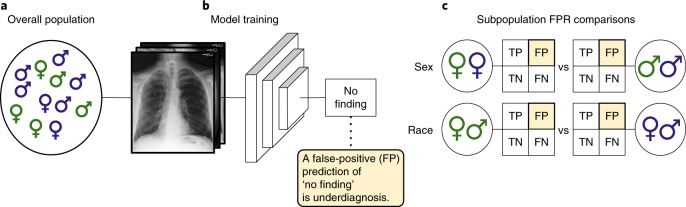
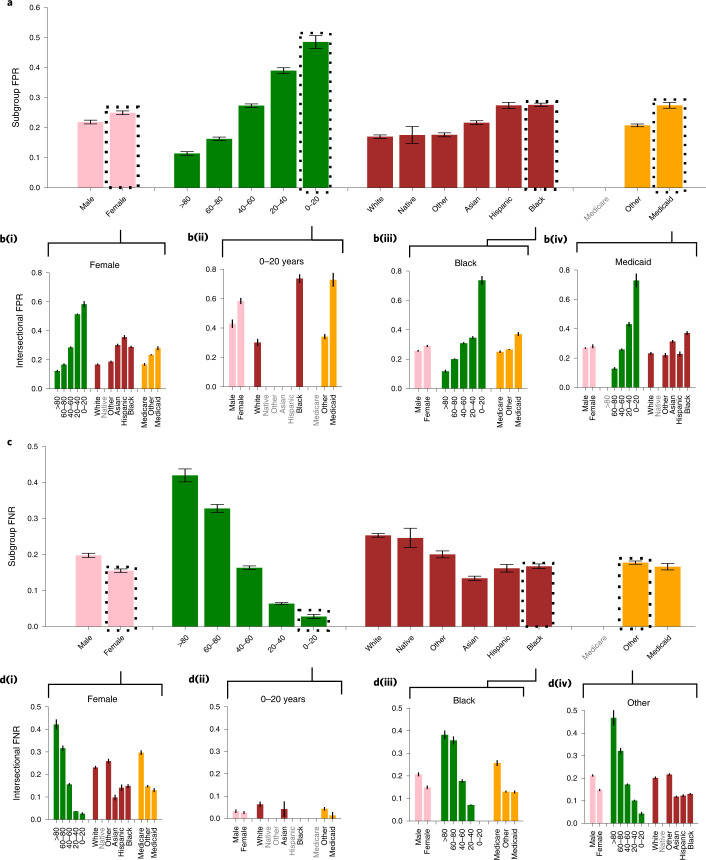
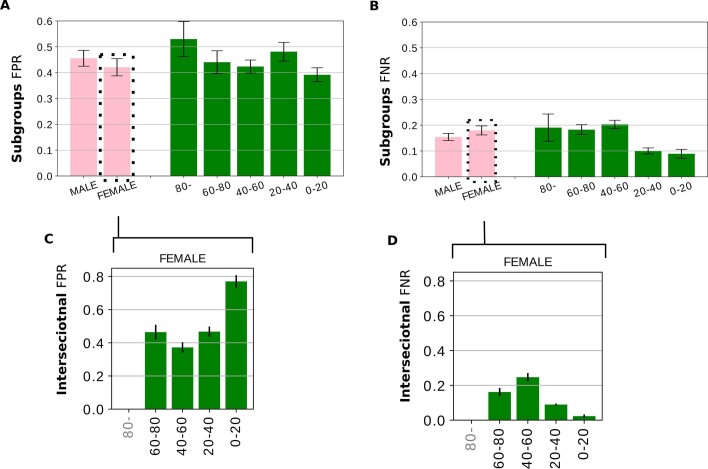
- Underdiagnosis rate, defined as the false-positive rate (FPR) for the “no finding” label, differed across all considered subpopulations. Female patients, patients under 20 years old, Black patients, Hispanic patients, and patients with Medicaid insurance had higher algorithmic underdiagnosis rates in the MIMIC-CXR dataset.
- Intersectional subgroups often had compounded bias. For example, Hispanic female patients had a higher underdiagnosis rate than white female patients, and patients aged 0–20 years who were female, Black, or had Medicaid insurance had the largest underdiagnosis rates.
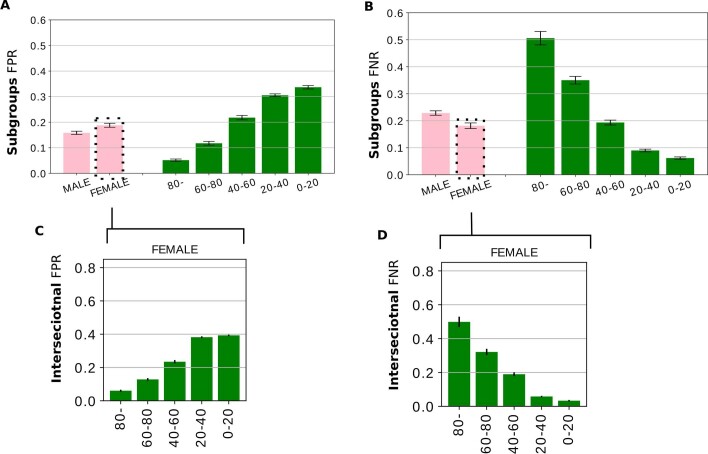
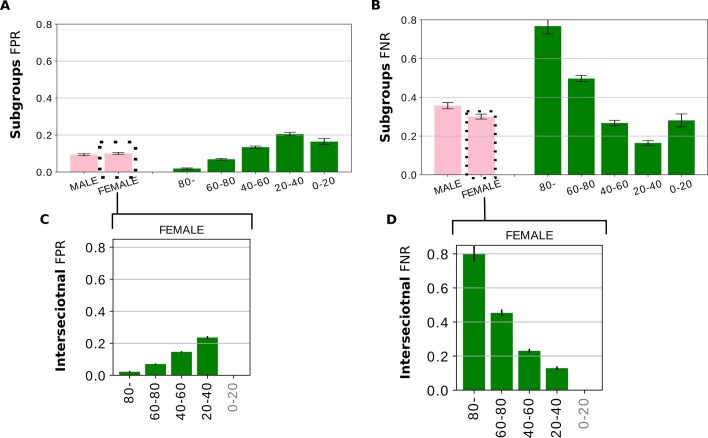
- FPR and false-negative rate (FNR) for “no finding” showed an inverse relationship across under-served subgroups, consistent with selective algorithmic underdiagnosis rather than undirected noise. This pattern held across datasets except for age >80 years and 0–20 years in the NIH dataset, possibly due to small sample sizes or dataset selection bias.
- Dataset sizes and model AUCs: MIMIC-CXR (371,858 images from 65,079 patients; AUC 0.834 ± 0.001), CheXpert (223,648 images from 64,740 patients; AUC 0.805 ± 0.001), ChestX-ray14/NIH (112,120 images from 30,805 patients; AUC 0.835 ± 0.002), and ALL (707,626 images from 129,819 patients; AUC 0.859 ± 0.001).
Methods
- Retrospective analysis of three public chest X-ray datasets—MIMIC-CXR, CheXpert, and ChestX-ray14 (NIH)—plus a multi-source ALL dataset combining them on shared labels. Subgroups included race/ethnicity, socioeconomic status via insurance type, sex, and age, with intersectional identities also examined.
- A 121-layer DenseNet initialized with ImageNet weights was trained on 256 × 256 images to predict diagnostic labels, including the “no finding” label. Train-validation-test splits were fixed, no patient was shared across splits, and results were averaged over five models with different random seeds.
- Fairness metrics were binarized: underdiagnosis rate as FPR for “no finding,” overdiagnosis as FNR for “no finding,” and false discovery rate (FDR) for “no finding.” A single threshold maximizing F1 score was selected for all groups; protected attributes were not used in model training or testing.
Limitations
- The paper states that prediction labels are extracted from clinical records and are therefore not unbiased ground truth; the labels may already contain the same bias the model then amplifies, a form of bias amplification. It also notes that automatic NLP-based labelers have not been audited across subpopulations and could be a large source of bias.
- The paper states that race and ethnicity are partially social constructs with unclear boundaries, and self-reported race/ethnicity may vary by age, socioeconomic level, or acculturation. Insurance type is described as an imperfect proxy for socioeconomic status.
- The paper states that post-hoc threshold adjustments for equal FNR and FPR have flaws: small intersectional groups make accurate thresholds difficult, the number of thresholds grows exponentially with protected attributes, and equalizing metrics may require randomization or worsening performance for some subgroups. The text also makes evident that the NIH dataset may have less diverse samples and small subgroup sizes, and that MIMIC-CXR lacks race/ethnicity and insurance data for around ~100,000 X-rays.
Model-written summary. Check it against the paper before relying on it.
Integrity signals
Registry
Cites
Statistics
Figures
Verification
Claims the paper makes
4 Valid · 1 Not valid · 16 Not checked · 53 Own results and interpretations
The cited sources support only part of this claim — read each source’s verdict below.
In the paper
“We note that some of our observed differences in underdiagnosis have been established in other areas in clinical care, such as underdiagnosis of female patients 9,10 , Black patients 5,8,9 and patients with a low socioeconomic status 36 .”
What the sources say
- Not checked yetcites [9] Mamary, A. J. et al. Race and gender disparities are evident in COPD underdiagnoses across all severities of measured airflow obstruction. Chronic Obstr. Pulm. Dis. 5, 177-184 (2018).
- Not checked yetcites [10] Sun, T. Y., Bear Don't Walk, O. J. IV, Chen, J. L., Reyes Nieva, H. & Elhadad, N. Exploring gender disparities in time to diagnosis. In Machine Learning for Health (ML4H) at NeurIPS 2020 (eds Alsentzer, E. et al.) abstr. https://arxiv. org/abs/2011.06100 (2020).
- Partly supportedcites [5] Obermeyer, Z., Powers, B., Vogeli, C. & Mullainathan, S. Dissecting racial bias in an algorithm used to manage the health of populations. Science 366, 447-453 (2019). sourceExperimental — accuracy not yet measured
Our copy supports only the racial element, and at a different level of specificity: it documents that at a given algorithm risk score Black patients carry significantly more illness burden (26.3% more chronic illnesses at the 97th percentile; more-severe hypertension, diabetes, renal failure and anemia; Health disparities conditional on risk score, pp. 3-4) and that less is spent on them conditional on need (Mechanism of bias, p. 5) — i.e. under-recognition of illness in an algorithmic/cost sense, not clinical underdiagnosis. Nothing in our copy addresses underdiagnosis of female patients (sex/gender appears only in the introduction's examples of ad delivery, facial recognition and hiring algorithms, p. 2, and as the descriptive statistic that the sample was 63% female, p. 2), and socioeconomic status appears only as barriers to accessing care that lower spending (Mechanism of bias, p. 5), not as established underdiagnosis. The female-patient and low-SES parts of the claim are therefore unsupported by this source. (LLM, conf=0.70)
- Partly supportedcites [8] Vyas, D. A., Eisenstein, L. G. & Jones, D. S. Hidden in plain sight: reconsidering the use of race correction in clinical algorithms. N. Engl. J. Med. 383, 874-882 (2020). sourceExperimental — accuracy not yet measured
Vyas et al. (2020) support only the Black-patient strand, and even there at a different level of specificity: the introduction states that 'many of these race-adjusted algorithms guide decisions in ways that may direct more attention or resources to white patients than to members of racial and ethnic minorities,' and the Cardiology section notes the AHA Get with the Guidelines score 'could direct care away from black patients' — i.e., a hedged equity concern about algorithms diverting care/resources, not an established rate of underdiagnosis. Our copy contains nothing on underdiagnosis of female patients (women appear only in Table 1 references on breast-density and bone-density tools) and nothing on underdiagnosis of low-socioeconomic-status patients; the only SES material is the quoted Society of Thoracic Surgeons concern that 'inclusion of SES factors in risk models may adjust away disparities in quality of care' (Assessment). The female-patient and low-SES parts of the attributed claim are therefore unsupported by this source. (LLM, conf=0.78)
- Partly supportedcites [36] Gianfrancesco, M. A., Tamang, S., Yazdany, J. & Schmajuk, G. Potential biases in machine learning algorithms using electronic health record data. JAMA Intern. Med. 178, 1544-1547 (2018). sourceExperimental — accuracy not yet measured
Our copy of Gianfrancesco et al. supports parts of the claim but not all of it: the Misclassification and Measurement Error section states that 'women may be less likely to receive lipid-lowering medications and in-hospital procedures, as well as optimal care at discharge, compared with men' and that patients 'may be differentially incorrectly diagnosed based on sociodemographic factors,' and the Missing Data section states that 'patients with low socioeconomic status may receive fewer diagnostic tests and medications for chronic diseases and have limited access to health care' and 'may only be identified if their disease becomes more severe' — hedged disparities in care/detection for women and low-SES patients, not established underdiagnosis. The part the source does not support is underdiagnosis of Black patients: the only Black/African-ancestry diagnostic-error passage (Sample Size and Underestimation) reports that 'patients with African and unspecified ancestry have been diagnosed with pathogenic genetic variants that were actually benign but misclassified,' i.e. genetic over-diagnosis credited to another study (Manrai et al., N Engl J Med 2016), not underdiagnosis. (LLM, conf=0.75)
boostedstates an association- Asserted: passes — The authors put it forward as true.
- Checkable: passes — It can be checked against evidence.
- Load-bearing: passes — The paper’s conclusions depend on it.
- Based: passes — The paper gives a reason why it holds.
- Rests on an assumption not shown here.
The cited sources support only part of this claim — read each source’s verdict below.
In the paper
“The choice of these subgroups is motivated by the clear history, in both traditional medicine and AI algorithms, of bias for subgroups on these axes 6,8,10,11 .”
What the sources say
- Partly supportedcites [6] Larrazabal, A. J. et al. Gender imbalance in medical imaging datasets produces biased classifiers for computer-aided diagnosis. Proc. Natl Acad. Sci. USA 117, 12592-12594 (2020). sourceExperimental — accuracy not yet measured
The Abstract says AI systems can inherit or amplify gender and racial bias, and Results and Discussion reports lower classifier performance for underrepresented genders. The paper does not establish a history of bias across socioeconomic status or age, or across all four axes in traditional medicine. The supplied passages have no page numbers. (LLM, conf=0.86)
- Partly supportedcites [8] Vyas, D. A., Eisenstein, L. G. & Jones, D. S. Hidden in plain sight: reconsidering the use of race correction in clinical algorithms. N. Engl. J. Med. 383, 874-882 (2020). sourceExperimental — accuracy not yet measured
The opening section describes race-based clinical algorithms that may direct more resources to white patients, and the Assessment section gives an example of racial bias in medical AI. The paper discusses socioeconomic status as relevant to these inequities, but the cited passages do not establish a history of bias across all four named axes: race, socioeconomic status, sex, and age. No page numbers are available in our copy. (LLM, conf=0.86)
- Not checked yetcites [10] Sun, T. Y., Bear Don't Walk, O. J. IV, Chen, J. L., Reyes Nieva, H. & Elhadad, N. Exploring gender disparities in time to diagnosis. In Machine Learning for Health (ML4H) at NeurIPS 2020 (eds Alsentzer, E. et al.) abstr. https://arxiv. org/abs/2011.06100 (2020).
- Not checked yetcites [11] Spencer, C. S., Gaskin, D. J. & Roberts, E. T. The quality of care delivered to patients within the same hospital varies by insurance type. Health Aff. (Milwood) 32, 1731-1739 (2013). source
boostedstates an association- Asserted: passes — The authors put it forward as true.
- Checkable: passes — It can be checked against evidence.
- Load-bearing: passes — The paper’s conclusions depend on it.
- Based: passes — The paper gives a reason why it holds.
- Partly supported
A result the paper reports from its own data — it cites no other source for it, so there is none to check. The quote shows it is in the paper.
In the paper
“The false-negative rate (FNR) for no finding (Fig. 2c) and FPR (Fig. 2a) show an inverse relationship across different under-served subgroups in the CXR dataset.”
plainstates an association- Asserted: passes — The authors put it forward as true.
- Checkable: passes — It can be checked against evidence.
- Load-bearing: passes — The paper’s conclusions depend on it.
- Based: passes — The paper gives a reason why it holds.
- Rests on an assumption not shown here.
A result the paper reports from its own data — it cites no other source for it, so there is none to check. The quote shows it is in the paper.
In the paper
“We observe that patients who belong to two under-served subgroups have a larger underdiagnosis rate.”
plainstates an association- Asserted: passes — The authors put it forward as true.
- Checkable: passes — It can be checked against evidence.
- Load-bearing: passes — The paper’s conclusions depend on it.
- Based: passes — The paper gives a reason why it holds.
- Rests on an assumption not shown here.
A result the paper reports from its own data — it cites no other source for it, so there is none to check. The quote shows it is in the paper.
In the paper
“We observe, across three large-scale datasets and a combined multi-source dataset, which under-served subpopulations are consistently at significant risk of algorithmic underdiagnosis.”
plainstates an association- Asserted: passes — The authors put it forward as true.
- Checkable: passes — It can be checked against evidence.
- Load-bearing: passes — The paper’s conclusions depend on it.
- Based: passes — The paper gives a reason why it holds.
- Rests on an assumption not shown here.
24 more claims
Create a free account to see all 74 claims and to verify the 27 references still open.
- Probably not a substantial claim. 29
- It may state two separate claims as one. 32
Claims other papers make about this one
Each is checked against this paper’s own text: does it say what the citing paper says it does?
The source backs part of the claim, not all of it — or backs it for a different population, condition or comparison.
In the citing paper
“Model trained on less and/or missing data leads to underestimation and underdiagnosis [49,127].”
From Artificial intelligence bias in medical system designs: a systematic review (2023) · cites this paper as [127]
Experimental — accuracy not yet measuredThe source backs part of the claim, not all of it — or backs it for a different population, condition or comparison.
In the citing paper
“The imbalanced data will result in specialized privileges to a specific group in the medical diagnosis [127].”
From Artificial intelligence bias in medical system designs: a systematic review (2023) · cites this paper as [127]
Experimental — accuracy not yet measuredThe source backs part of the claim, not all of it — or backs it for a different population, condition or comparison.
In the citing paper
“The majority of the studies have neglected kinship (more than 95%) and insurance (90%) attributes which are essential to identify socioeconomic status of the patient to prevent the underdiagnosis [127].”
From Artificial intelligence bias in medical system designs: a systematic review (2023) · cites this paper as [127]
Experimental — accuracy not yet measuredThe source backs part of the claim, not all of it — or backs it for a different population, condition or comparison.
In the citing paper
“In imaging, Seyyed-Kalantari et al 59 found that contemporary deep-learning classifiers applied to chest radiographs systematically failed to identify abnormalities in patients from historically marginalized groups including female patients, Black patients, and those of lower socioeconomic status with the most pronounced disparities at the intersections of these categories.”
From Artificial Intelligence in Oncology: Practical Applications Across Clinical Care, Scholarship, and Translation. (2026) · cites this paper as [59]
Experimental — accuracy not yet measuredThe source backs part of the claim, not all of it — or backs it for a different population, condition or comparison.
In the citing paper
“On the other hand, AI systems can also suffer from bias, compounding existing inequities in socioeconomic status, race, ethnicity, religion, gender, disability, or sexual orientation.”
From Bias in AI-based models for medical applications: challenges and mitigation strategies (2023) · cites this paper as [6]
Experimental — accuracy not yet measured
6 more claims about this paper
Create a free account to see every claim other papers make about this one.
Self-check
Percentages, sums and reported differences re-computed from the paper’s own numbers.
Each contradiction between two passages listed here was confirmed by an independent check.
Rated minor: it would not touch a result — a value no result rests on, a p-value that stays on the same side of the significance level, or a conflict that is clerical, resolved elsewhere in the paper, or outside its own findings.
In the paper
§ Dataset collection and inclusion criteria.
“FDR (or, equivalently, positive predictive value (PPV)) is a common metric used to evaluate the performance of classifiers.”
§ Dataset collection and inclusion criteria.
“FDRs i,j = P [ Y = 0|si,j, Ŷ = 1 ](3”
Rated minor: it would not touch a result — a value no result rests on, a p-value that stays on the same side of the significance level, or a conflict that is clerical, resolved elsewhere in the paper, or outside its own findings.
In the paper
“MIMIC-CXR (CXR, 371,858 images from 65,079 patients) 26 , CheXpert (CXP, 223,648 images from 64,740 patients) 27 , ChestX-ray14 (NIH, 112,120 images from 30,805 patients) 28 , and a multi-source combination of all three (ALL, 707,626 images from 129,819 patients) on shared labels.”
Reported 129819 · recomputed 160624
Citations
Cites
ImageNet Large Scale Visual Recognition Challenge
Russakovsky, O., Deng, J., Su, H., Krause, J., Satheesh, S., Ma, S., Huang, Z., Karpathy, A., Khosla, A., Bernstein, M., et al. (2015) · International Journal of Computer Vision · doi:10.1007/s11263-015-0816-y · Cited by 39,380
Goldberger, A. L., Amaral, L. A. N., Glass, L., Hausdorff, J. M., Ivanov, P. C., Mark, R. G., Mietus, J. E., Moody, G. B., Peng, C.-K., & Stanley, H. E. (2000) · Circulation · doi:10.1161/01.cir.101.23.e215 · Cited by 14,809
Dissecting racial bias in an algorithm used to manage the health of populations
Obermeyer, Z., Powers, B., Vogeli, C., & Mullainathan, S. (2019) · Science · doi:10.1126/science.aax2342 · Cited by 7,137 · cited 1×
“We note that some of our observed differences in underdiagnosis have been established in other areas in clinical care, such as under-diagnosis of female patients 9,10 , Black patients 5,8,9 and patients with a low socioeconomic status 36 .”
BackgroundWang, X., Peng, Y., Lu, L., Lu, Z., Bagheri, M., & Summers, R. M. (2017) · 2017 IEEE Conference on Computer Vision and Pattern Recognition (CVPR) · doi:10.1109/cvpr.2017.369 · Cited by 4,616 · cited 5×
“Fourth, despite the fact that we do not have the same disease prevalence between subgroups based on real data 26–28 , and our choice of fairness metrics does not directly involve prevalence between subgroups, we stress that equal underdiagnosis rates between sub-groups of age, sex and…”
BackgroundMethodInfluential(2018) · Cited by 3,510
Dwork, C., Hardt, M., Pitassi, T., Reingold, O., & Zemel, R. (2012) · Proceedings of the 3rd Innovations in Theoretical Computer Science Conference · doi:10.1145/2090236.2090255 · Cited by 3,501
Implementing Machine Learning in Health Care — Addressing Ethical Challenges
Char, D. S., Shah, N. H., & Magnus, D. (2018) · New England Journal of Medicine · doi:10.1056/nejmp1714229 · Cited by 1,857
MIMIC-CXR, a de-identified publicly available database of chest radiographs with free-text reports
Johnson, A. E. W., Pollard, T. J., Berkowitz, S. J., Greenbaum, N. R., Lungren, M. P., Deng, C.-Y., Mark, R. G., & Horng, S. (2019) · Scientific Data · doi:10.1038/s41597-019-0322-0 · Cited by 1,816 · cited 5×
“Fourth, despite the fact that we do not have the same disease prevalence between subgroups based on real data 26–28 , and our choice of fairness metrics does not directly involve prevalence between subgroups, we stress that equal underdiagnosis rates between sub-groups of age, sex and…”
BackgroundMethodInfluentialHidden in Plain Sight — Reconsidering the Use of Race Correction in Clinical Algorithms
Vyas, D. A., Eisenstein, L. G., & Jones, D. S. (2020) · New England Journal of Medicine · doi:10.1056/nejmms2004740 · Cited by 1,731 · cited 2×
“We note that some of our observed differences in underdiagnosis have been established in other areas in clinical care, such as under-diagnosis of female patients 9,10 , Black patients 5,8,9 and patients with a low socioeconomic status 36 .”
BackgroundA New, Evidence-based Estimate of Patient Harms Associated with Hospital Care
James, J. T. (2013) · Journal of Patient Safety · doi:10.1097/pts.0b013e3182948a69 · Cited by 1,399 · cited 1×
“Moreover, developers, practitioners and the clinical staff need to take into account biases such as the underdiagnosis of under-served populations in the AI-based medical decision-making algorithms and its harmful effect 17,18 on patients.”
Background
Research works printed but not linked: 3
- Cohen, J. P., Hashir, M., Brooks, R. & Bertrand, H. On the limits of cross-domain generalization in automated X-ray prediction. Proc. Mach. Learn. Res. 121, 136-155 (2020).
- Hardt, M., Price, E. & Srebro, N. Equality of opportunity in supervised learning. In Advances in Neural Information Processing Systems 29 (NIPS 2016) (eds Lee, D. et al.) 3315-3323.
- Johnson, A. et al. MIMIC-IV (version 0.4). PhysioNet https://doi.org/ 10.13026/a3wn-hq05 (2020). · DOI
Cited by
Items 601–700 of 989
Toma, M., & YUSUPOV, D. (2026) · Bioengineering · doi:10.3390/bioengineering13091034 · Cited by 1
Dzokoto, S. K., Marrah, S. A., Computer, S. T. R., Arhin, K. M., Dzokoto, F. K., Nawaz, S., & Arisiya, E. (2026) · Journal of Scientific Reports · doi:10.58970/jsr.1238 · Cited by 1
BAYDİLİ, I., Taşçı, B., Taşçı, G., Doğan, Ş., & Tuncer, T. (2026) · Bioengineering · doi:10.3390/bioengineering13101175 · Cited by 1
Frost, E. K., O’Shaughnessy, P., Steel, D. G., Braunack‐Mayer, A., Aquino, Y. S. J., & Carter, S. M. (2023) · BMJ Health & Care Informatics · doi:10.1136/bmjhci-2022-100714 · Cited by 2
“Similarly, Seyyed-Kalantari et al , 8 using data from the USA, found that women, people aged under 20, those with lower socioeconomic status and black or Hispanic-identifying people were less likely to be diagnosed correctly by a chest radiograph algorithm.”
Dammu, P. P. S., Feng, Y., & Shah, C. S. (2023) · International Joint Conference on Artificial Intelligence · doi:10.24963/ijcai.2023/659 · Cited by 2
AI’s Diversity Problem in Radiology: Addressing Algorithm Bias
Reeves, K. (2024) · Applied Radiology · doi:10.37549/ar2952 · Cited by 1
Deep learning: Integrating artificial intelligence into the sonography curriculum
Stoodley, P. W., Oomens, D., & Robinson, C. (2024) · Sonography · doi:10.1002/sono.12450 · Cited by 1
MCRAGE: Synthetic Healthcare Data for Fairness
Fikes, C., Behal, K., Chen, J., & Xiao, S. (2024) · SIAM Undergraduate Research Online · doi:10.1137/23s1611282 · Cited by 1
Using Artificial Intelligence to Address Health Disparities: Challenges and Solutions
Merrill, K. (2024) · Oxford University Press eBooks · doi:10.1093/oxfordhb/9780197744345.013.25 · Cited by 3
DeepRepViz: Identifying Potential Confounders in Deep Learning Model Predictions
Rane, R. P., Kim, J., Umesha, A., Stark, D., Schulz, M.-A., & Ritter, K. (2024) · Lecture notes in computer science · doi:10.1007/978-3-031-72117-5_18 · Cited by 4
“Several studies routinely report such confounders affecting their model predictions [9, 1, 22, 26] [3, 4].”
BackgroundLiao, W., & Voldman, J. (2024) · PLOS Digital Health · doi:10.1371/journal.pdig.0000640 · Cited by 2
“However, as the “fairness through awareness” framework suggests, we cannot assume sensitive information has been expunged from a dataset [36].”
Sax, D. R., Huang, J., Mark, D. G., Rana, J. S., Solomon, M. S., Norris, R. P., & Reed, M. (2025) · JACC Heart Failure · doi:10.1016/j.jchf.2025.01.018 · Cited by 1
ZOHAIB, S., & Farooq, R. K. (2024) · Pakistan Journal of Medical and Health Sciences · doi:10.53350/pjmhs0202418103 · Cited by 2
Underdiagnosis Bias Mitigation With Expert Foundation Model’s Representation
Bahre, G. H., Hamidi, H., Sellergren, A., Quarta, A., Celi, L. A., Calimeri, F., & Seyyed-Kalantari, L. (2025) · IEEE Access · doi:10.1109/access.2025.3582754 · Cited by 3
Self-citationEthical, Regulatory, and Practical Challenges in Artificial Intelligence-Driven Chest Imaging
de Lima, J. B. C., Griffin, I., Gemmell, J. S., Davis, K., Amanamba, U., Zanjani, N. A., Siyanaki, M. R. H., Mohammed, T.-L. H., Benos, T., Rodrigues, R. S., et al. (2025) · Seminars in Roentgenology · doi:10.1053/j.ro.2025.06.003 · Cited by 2
Tian, Y., Wang, S., Zhang, R., Chen, Z., Jiang, Y., Li, C., Zhu, X., Yan, F., Hu, Q., Wang, X., et al. (2025) · IEEE/CVF International Conference on Computer Vision (ICCV) · doi:10.1109/iccv51701.2025.01917 · Cited by 10
“In the era of digital medicine, large-scale medical images, such as X-rays and fundus photographs [6], are routinely processed by AI-based diagnostic models [28, 87, 106, 119, 121] to aid clinical decision-making.”
Analysis of Potential Biases on Mammography Datasets for Deep Learning Model Development
Gerbolés, B. Z., López‐Linares, K., García, M. J., Rebescher, K. M., Lalaguna, I., Marco, E. A., Álvarez, M. B. C., Garcia, J., Ledesma‐Carbayo, M. J., & Macía, I. (2022) · Lecture notes in computer science · doi:10.1007/978-3-031-17721-7_7 · Cited by 2
Cycle-GANs Generated Difference Maps to Interpret Race Prediction from Medical Images
Rathi, L., Nebbia, G., Chang, K., Kumar, S., Gupta, A., Ahmed, S. R., Patel, J., Clark, C., Veturi, Y. A., Coyner, A. S., et al. (2024) · Lecture notes in computer science · doi:10.1007/978-3-031-72787-0_13 · Cited by 1
Glocker, B., & Winzeck, S. (2021) · arXiv (Cornell University) · Cited by 2
Sex-based differences in nuclear medicine imaging and therapy
Slart, R. H. J. A., de Geus‐Oei, L., Stevens, J., Elsinga, P., Ivashchenko, O., & Erba, P. A. (2023) · European Journal of Nuclear Medicine and Molecular Imaging · doi:10.1007/s00259-023-06113-7 · Cited by 2
“Multiple studies [17, 18] have clearly shown that training deep learning or machine learning models based on sex- or race-unbalanced datasets often leads to unintentional, but even greater, discrepancies between these groups.”
BackgroundWang, R., Erus, G., Chaudhari, P., & Davatzikos, C. A. (2023) · PubMed Central · doi:10.48550/arxiv.2308.03175 · Cited by 10
Gulamali, F. F., Sawant, A. S., Liharska, L. E., Horowitz, C. R., Chan, L., Kovatch, P., Hofer, I. S., Singh, K., Richardson, L. D., Mensah, E., et al. (2023) · medRxiv · doi:10.1101/2023.11.06.23298164 · Cited by 1
Informative Artifacts in AI-Assisted Care
Azizi, Z., Vedelli, J. K. H., & Anand, K. J. S. (2023) · New England Journal of Medicine · doi:10.1056/nejmc2311525 · Cited by 1
Denoising diffusion model for increased performance of detecting structural heart diseasePreprint
Streiffer, C., Levin, M. G., Witschey, W. R. T., & Anyanwu, E. C. (2024) · medRxiv · doi:10.1101/2024.11.21.24317662 · Cited by 3
Kobayashi, Y., Zhang, H., Singh, H., Gichoya, J. W., & Joshi, S. D. (2024) · medRxiv · doi:10.1101/2024.12.16.24319063 · Cited by 4
“While chest radiography-based AI diagnostic algorithms may match specialist performance 8 , with clear potential for real-world deployment 9 , there is consistent evidence of population-level performance disparity, particularly underdiagnosis among underrepresented groups in public datasets 5 .”
InfluentialSelf-citationKelhini, F. K. (2025) · SSRN Electronic Journal · doi:10.2139/ssrn.5217663 · Cited by 2
Navigating Bias and Ensuring Fairness in Federated Learning
Vajrobol, V., Aggarwal, N., Baranwal, P., Saxena, G. J., Pundir, A., & Singh, S. (2025) · Wiley eBooks · doi:10.1002/9781394271382.ch11 · Cited by 1
Arnaout, R. (2025) · Circulation · doi:10.1161/circulationaha.125.074167 · Cited by 1
Strengthening Tuberculosis-Diabetes Mellitus Programme in Indonesia
author, & Saraswati, L. D. (2025) · Queensland University of Technology · doi:10.5204/thesis.eprints.259942 · Cited by 1
Do, J., Guggilla, N., Suresh, V., & Kothari, R. P. (2025) · medRxiv · doi:10.1101/2025.11.21.25340008 · Cited by 1
Ökonomie der Diagnosesicherheit
Slawomirski, L., Kelly, D., Bienassis, K. D., Kallas, K.-A., & Klazinga, N. (2025) · OECD health working papers · doi:10.1787/ced786a8-de · Cited by 1
Farquhar, H. L. (2026) · medRxiv · doi:10.64898/2026.01.20.26344495 · Cited by 1
Farquhar, H. (2026) · medRxiv · doi:10.64898/2026.01.25.26344809 · Cited by 1
Advancing multimodal neuroimaging: Explainable and responsible AI for early dementia detection
Arco, J. E., Alizadehsani, R., Atzmueller, M., Barakova, E., Bloch, L., Bologna, G., Bonomini, P., Cho, S.-B., Cortes, J. M., Elazab, A., et al. (2026) · NeuroImage · doi:10.1016/j.neuroimage.2026.122142 · Cited by 1
Pino, P., Parra, D., Dunstan, J., & Besa, C. (2022) · SSRN Electronic Journal · doi:10.2139/ssrn.4052411 · Cited by 1
Whitney, H. M., Li, H., Drukker, K., Reeve, M. D., & Giger, M. L. (2023) · SPIE Medical Imaging: Image Perception, Observer Performance, and Technology Assessment · doi:10.1117/12.2654076
“At the same time, recent studies have raised questions about the potential for chest radiography (CXR) AI models being able to distinguish patients by demographic subgroups that are unrelated to the specific clinical task on which the AI was developed(3) (explicit discrimination) or to have poor performance for some d…”
BackgroundA Data-driven Approach to Revamp the ACO Risk Adjustment ModelPreprint
Park, Y., Buchan, K., Piconne, J., & Sim, B. (2023) · Research Square · doi:10.21203/rs.3.rs-2827550/v1
A Data-driven Approach to Revamp the ACO Risk Adjustment ModelPreprint
Park, Y., Buchan, K., Piconne, J., & Sim, B. (2023) · Research Square · doi:10.21203/rs.3.rs-2827550/v2
A Data-driven Approach to Revamp the ACO Risk Adjustment ModelPreprint
Park, Y., Buchan, K., Piconne, J., & Sim, B. (2023) · Research Square · doi:10.21203/rs.3.rs-2827550/v3
Stanley, E. A. M., Forkert, N. D., & MacEachern, S. J. (2023) · Developments in neuroethics and bioethics · doi:10.1016/bs.dnb.2023.05.002
AI-Assisted Tool for Early Diagnosis and Prevention of Colorectal Cancer in Africa
Ibnauf, B., Ezz, M. A. A., Aziz, A. A., Elgazzar, K., & Siam, M. (2023) · International Joint Conference on Artificial Intelligence · doi:10.24963/ijcai.2023/706
Artificial intelligence in respiratory medicine
Gonem, S. (2023) · Elsevier eBooks · doi:10.1016/b978-0-443-15688-5.00027-9
Finding Spurious Correlations with Function-Semantic Contrast Analysis
Bykov, K., Kopf, L., & Höhne, M. (2023) · Communications in computer and information science · doi:10.1007/978-3-031-44067-0_28 · Cited by 7
Artificial Intelligence, or Artifact Intelligence? Most AI Is Not Ready for PracticePreprint
Muennig, P. A., & Pirazzi, C. (2023) · Qeios · doi:10.32388/2h71qz
Artificial Intelligence, or Artifact Intelligence? Most AI Is Not Ready for PracticePreprint
Muennig, P. A., & Pirazzi, C. (2023) · Qeios · doi:10.32388/2h71qz.2
Learning Analytics und Diskriminierung
Rzepka, N., Simbeck, K., & Pinkwart, N. (2023) · Digitale Gesellschaft · doi:10.1515/9783839465820-013 · Cited by 1
Ma, D., & Qin, J. (2024) · International Conference on Science, Engineering and Technology Practices for Sustainable Development (ICSETPSD) · doi:10.4108/eai.17-11-2023.2342789
Pursuing Social Good: An Overview of Short- and Long-Term Fairness in Classification
Metevier, B. (2023) · ACM SIGCAS Computers and Society · doi:10.1145/3656021.3656022
Yuan, M., Bardhan, I. R., & Wen, W. (2026) · Management Science · doi:10.1287/mnsc.2024.05617 · Cited by 1
Ortegón, J. D. C., Serrano, S., & Cortes, D. R. (2024) · European Urology · doi:10.1016/j.eururo.2024.02.033
A Critical Study of Artificial Intelligence in Healthcare: Prospects and Perils
Bueno, T. (2024) · Canadian Journal for the Academic Mind · doi:10.25071/2817-5344/79 · Cited by 5
Qin, G. (2024) · International Conference on Data Science and Information System (ICDSIS) · doi:10.1109/icdsis61070.2024.10594480
“Seyyed-Kalantari L believes that artificial intelligence systems have been mature enough to be used in medical imaging [8].”
BackgroundThe patient perspective on big data and its use in clinical care
Tai, K., Babu, C., Kim, Y. E., Subramanian, T., & Rameau, A. (2024) · Elsevier eBooks · doi:10.1016/b978-0-443-10520-3.00004-6
When to Use Demographic Data in Healthcare Models: A Bias-Responsible Approach
Zeleke, S., Berger-Wolf, T. Y., & Ning, X. (2024) · IEEE Conference on Artificial Intelligence (CAI) · doi:10.1109/cai59869.2024.00276
Jiang, J. (2024) · International Conference on Energy, Power and Electrical Technology (ICEPET) · doi:10.1109/icepet61938.2024.10626675
“Seyyed-Kalantari et al. proposed using artificial intelligence algorithms to solve some tracking problems [6].”
MethodA Highly Secure and Accurate System for COVID-19 Diagnosis from Chest X-Ray Images
Nguyen, T. T., Chen, T., Philippi, I., Phan, Q. B., Kudo, S., Huda, S., & Nogami, Y. (2024) · IEEE International Midwest Symposium on Circuits and Systems (MWSCAS) · doi:10.1109/mwscas60917.2024.10658795
“Moreover, the implementation of AI may amplify these biases within the database, potentially hindering future AI training [1].”
BackgroundAdvancing Equitable AI in Radiology through Contrastive Learning
Johnson, P. M. (2024) · Radiology Artificial Intelligence · doi:10.1148/ryai.240530 · Cited by 1
AI Fairness in Medical Imaging: Controlling for Disease Severity
Mukherjee, P., & Summers, R. M. (2024) · Lecture notes in computer science · doi:10.1007/978-3-031-72787-0_3 · Cited by 1
Assessing the Impact of Sociotechnical Harms in AI-Based Medical Image Analysis
Stanley, E. A. M., Souza, R., Winder, A. J., Wilms, M., Pike, G. B., Dagasso, G., Nielsen, C., MacEachern, S. J., & Forkert, N. D. (2024) · Lecture notes in computer science · doi:10.1007/978-3-031-72787-0_16 · Cited by 3
Uncovering Demographic Bias in Natural Language Processing Tools for Radiology
Cai, W. (2024) · Radiology · doi:10.1148/radiol.242723
Advancing prostate cancer diagnosis and treatment through pathomics and artificial intelligence
Booven, D. J. V., Chen, C., Gupta, A. J., Firdaus, F., & Arora, H. (2024) · Elsevier eBooks · doi:10.1016/b978-0-443-22132-3.00004-6
Wojtkiewicz, A. M., Piekarska, M. M., Mamcarz, A., & Śliż, D. (2024) · Folia Cardiologica · doi:10.5603/fc.98299
A cautionary tale on the cost-effectiveness of collaborative AI in real-world medical applications
Cremonesi, F., Lucia, I., Goh, V., Ourselin, S., Antonelli, M., & Lorenzi, M. (2026) · Scientific Reports · doi:10.1038/s41598-026-70599-y
Lin, Z. (2024) · Sustainable civil infrastructures · doi:10.1007/978-3-031-78276-3_80
King, A. P., & Lee, T. (2025) · Elsevier eBooks · doi:10.1016/b978-0-44-323761-4.00022-5 · Cited by 1
Challenges as a framework for trustworthy AI
Antonelli, M., Farahani, K., Sudre, C. H., Cardoso, M. J., Maier‐Hein, L., & Reinke, A. (2025) · Elsevier eBooks · doi:10.1016/b978-0-44-323761-4.00020-1
Leveraging AI for Real-Time Depression Detection in Healthcare Systems; a Systematic Review
Khan, M., & Sherani, A. M. K. (2025) · Global Journal of Emerging AI and Computing · doi:10.70445/gjeac.1.1.2025.25-33 · Cited by 8
A generalist model for enhancing brain MRIs
Balbastre, Y., & Fischl, B. R. (2025) · Nature Biomedical Engineering · doi:10.1038/s41551-024-01320-5
Intelligent Algorithm Based Interactive Optimization Charging Strategy for Vehicle Network
Chen, W., Ye, Q., Cai, Y., Han, L., Jiang, Z., & Zhang, C. (2024) · International Conference on Computational Intelligence and Communication Networks (CICN) · doi:10.1109/cicn63059.2024.10847527
“Eventually, when the termination condition is satisfied and the fitness is no longer significantly improved, the algorithm stops iterating and outputs the currently found optimal charging strategy [13-14] .”
Advances in AI-Enhanced Biomedical Imaging for Cancer Immunology
Yim, W. W., Wee, F. Y. T., Ho, Z. Y., Feng, X., Zhang, M., Lee, S., Zlobec, I., Yeong, J. P.-S., & Lau, M. C. (2024) · World Scientific Annual Review of Cancer Immunology · doi:10.1142/s2972389224300044 · Cited by 1
Application of Personal Information Privacy Protection Based on Artificial Intelligence Algorithms
Mu, X. (2025) · Lecture notes in electrical engineering · doi:10.1007/978-981-96-2794-3_37
Mitigating Spurious Correlations in Preclinical Alzheimer's Disease Detection via Pretraining
Gui, L., & Zhang, W. (2024) · International Congress on Image and Signal Processing (CISP) · doi:10.1109/cisp-bmei64163.2024.10906245
Balancing Innovation and Safety in Digital Healthcare
Sharma, S., Singh, M. P., & Pradhan, K. B. (2025) · Global Clinical Engineering Journal · doi:10.31354/globalce.v7i1.262
Multi-factor debiasing for correlating confounders for fair diagnostic model
Joshi, V., Correa, R., Das, A., Gichoya, J. W., & Banerjee, I. (2025) · SPIE Medical Imaging: Image Processing · doi:10.1117/12.3047316 · Cited by 1
“3 Seyyed et al. 4 observed that a deep learning models which is trained to classify different disease classes from a chest X-ray, show performance disparity for different genders which implies that gender can also serve as a spurious marker for disease labels.”
The Process of Building Color Extraction is Optimized with K-means Clustering Algorithm
Liu, J., & Chen, J. (2025) · Lecture notes in networks and systems · doi:10.1007/978-3-031-88287-6_24
Use of intelligent algorithm recommendation for college students healthy social mentality in China
Wang, X., Zhang, L., & Rasool, Z. (2025) · Current Psychology · doi:10.1007/s12144-025-07851-7
“According to Seyyed-Kalantari et al. (2021 ), users’ conviction is upheld, which is a crucial motivator for the formation of a positive social mindset.”
Jiang, J., Liu, X., & Wang, W. (2025) · SSRN Electronic Journal · doi:10.2139/ssrn.5251805 · Cited by 1
Modern Physics in Medicine: From Quantum Mechanics to Medical Imaging
Abboud, H. A. M., Rahim, A. M. F. A., Jabir, H. A. M., Ali, A. A. H. A., Sharrad, G. A. T., & Bard, W. K. H. (2025) · Bright Sky Publications eBooks · doi:10.62906/bs.book.359
Race against the Machine Learning Courses
Deshpande, R., Mlombwa, D., Celi, L. A., Gallifant, J., & D’Couto, H. T. (2026) · ACM Transactions on Intelligent Systems and Technology · doi:10.1145/3737650
“AI-based chest X-ray models underdiagnosed pneumonia in minority, under-insured, and intersectional underserved groups across multiple datasets used [13].”
Veeran, K. V., & Xavier, S. (2025) · International Journal For Multidisciplinary Research · doi:10.36948/ijfmr.2025.v07i03.46749
“Seyyed-Kalantari et al. (2021) note that AI is auto-generating ethics problems by causing unfairness in healthcare and hiring.”
Health equity in cardio-oncology
Cousin, L., Sutton, A. L., Arega, E., Nolan, T. S., & Yang, E. H. (2025) · Elsevier eBooks · doi:10.1016/b978-0-443-29829-5.00002-5
Zhang, H., & Li, X. (2025) · International Conference on Distributed Computing and Electrical Circuits and Electronics (ICDCECE) · doi:10.1109/icdcece65353.2025.11035303
“Seyyed-Kalantari et al. [8] focused on the potential underestimation bias of artificial intelligence algorithms applied to chest radiography in underserved patient populations and explored the factors that lead to the bias.”
Self-citationWeber, T., Ingrisch, M., Bischl, B., & Rügamer, D. (2025) · Lecture notes in computer science · doi:10.1007/978-981-96-8183-9_9 · Cited by 3
Claucich, E., Hooker, S., Milone, D. H., Ferrante, E., & Echeveste, R. (2025) · ACM Conference on Fairness, Accountability, and Transparency (FAccT) · doi:10.1145/3715275.3732200 · Cited by 5
“…groups, the authors focus on target classes rather than following the standard practice in the fairness community of analyzing group fairness by protected attributes—i.e. [30, 31], characteristics of the population such as gender or age, which are not the target labels for classification.”
Computer Network Security Assessment Strategy Based on Intelligent Algorithm
Li, B., Li, H., & Ping, D. (2025) · Lecture notes in electrical engineering · doi:10.1007/978-981-96-7999-7_23
Zhu, X., & He, Y. J. (2025) · International Conference on Data Science and Information System (ICDSIS) · doi:10.1109/icdsis65355.2025.11070869
“In data types 7 and 14, the stability of the Bayesian model reaches the highest values of 99.6% and 99.7%, while the performance of the decision tree in these data types is inferior, especially in data types 1 and 12, where the stability of the decision tree is only 97.5% and 97.7%.”
InfluentialNetwork Learning Optimization Strategies Driven by Intelligent Algorithms
Niu, L. (2025) · International Conference on Data Science and Information System (ICDSIS) · doi:10.1109/icdsis65355.2025.11070846
“Seyyed-Kalantari et al. [7] studied and analyzed the performance of artificial intelligence algorithms in chest X-ray diagnosis.”
Bahre, G. H., Hamidi, H., Sellergren, A., Celi, L. A., Calimeri, F., & Seyyed-Kalantari, L. (2025) · IEEE International Conference on Healthcare Informatics (ICHI) · doi:10.1109/ichi64645.2025.00102
“These findings match prior vulnerable groups detected in the healthcare system [8]– [11] and in the medical image domain [1], [4] and reflect existing societal biases.”
Self-citationToward Healthcare (Social) Justice: On the Value of Biases in Healthcare AI
Tiribelli, S. (2025) · The International Library of Bioethics · doi:10.1007/978-3-031-94690-5_3
Artificial Intelligence in Healthcare:Legal and Ethical Point of View
Elkhateeb, S. A. (2025) · Zagazig Journal of Forensic Medicine · doi:10.21608/zjfm.2025.346016.1209
Responsible Artificial Intelligence for Healthcare: Trends, Challenges, and Opportunities
Baker, S., & Ahn, E. (2025) · Springer eBooks · doi:10.1007/978-3-031-88024-7_1
Martinovich, V. (2025) · Salud Colectiva · doi:10.18294/sc.2025.5658
“…personas por su orientación política (9) , por ser parte de poblaciones históricamente desatendi - das o subrepresentadas en términos sanitarios (8,10,79,80) , o pueden “agravar las desigualdades existentes en cuanto a estatus socioeconómico, raza, origen étnico, religión, género, discapacidad u…”
From Data to Decisions: Enhancing AI Adoption in Healthcare Through Transparent Explanations
Hassan, A. H., & bin Sulaiman, R. (2025) · Lecture notes in networks and systems · doi:10.1007/978-981-96-5217-4_13
Predicting Patient Self-reported Race From Skin Histological Images with Deep Learning
Chen, S., Verma, R., Clare, K., Jegminat, J., Alleva, E., Huang, K., Veremis, B. M., Fuchs, T. J., & Campanella, G. S. V. (2025) · Lecture notes in computer science · doi:10.1007/978-3-032-05870-6_11 · Cited by 1
“Bias and disparities in Machine Learning (ML)-based biomedical and healthcare applications have been widely studied by stratifying model performance across demographic groups [1].”
meval: A Statistical Toolbox for Fine-Grained Model Performance Analysis
Sutariya, D., & Petersen, E. (2025) · Lecture notes in computer science · doi:10.1007/978-3-032-05870-6_19 · Cited by 1
“…by randomly sampling 35 positive instances for each of the 11 labels for each of the top-5 race groups, resulting in a total test-set size of 1,757 For specificity, the threshold was chosen as in [37] to maximize the geometric mean of sensitivity and specificity. ns : not significant ( p > 0 .”
Ly, C. O., & McIntosh, C. (2025) · Biomedical Physics & Engineering Express · doi:10.1088/2057-1976/ae08bb
Autonomous medical diagnosis: How to balance accuracy and accountability?
Gaur, L., & Abraham, A. (2025) · Elsevier eBooks · doi:10.1016/b978-0-443-33124-4.00007-2
Ethical concerns of generative AI in healthcare applications
Gaur, L., & Abraham, A. (2025) · Elsevier eBooks · doi:10.1016/b978-0-443-33124-4.00009-6
Rodriguez, A. B., Remeserio, B., Engelmann, J., Gago, L., & Rebolledo, J. V. (2025) · Lecture notes in computer science · doi:10.1007/978-3-032-05559-0_32 · Cited by 1
Silva, A. P. D., & Prabagar, K. (2025) · Artificial Intelligence in Gastroenterology · doi:10.35712/aig.v6.i2.110109
Metadata
- Authors
- Seyyed-Kalantari, L., Zhang, H., McDermott, M. B. A., Chen, I. Y., & Ghassemi, M.
- Affiliations
- University of Toronto (CA)
- Massachusetts Institute of Technology (US)
- Vector Institute (CA)
- Corresponding author
- Seyyed-Kalantari, Laleh
- Venue
- Nature Medicine
- Published
- 2021-12
- Volume
- 27
- Issue
- 12
- Pages
- 2176-2182
- ISSN
- 1078-8956 (ISSN-L)
- 1546-170X
- PMC
- PMC8674135
- OpenAlex
- W4200191097
- Cited by
- 928
- References
- 47
- Citations by year
- 2026: 298 · 2025: 239 · 2024: 199 · 2023: 146 · 2022: 42 · 2021: 4
- FWCI
- 27.63
- Type
- journal article
- Language
- en
- Open access
- hybrid
- doi.org
- Licence
- cc-by
- creativecommons.org/licenses/by/4.0 (tdm)
- creativecommons.org/licenses/by/4.0 (vor, 9 d)
- Locations
- Nature Medicine (publishedVersion, cc-by)
- Research Square (acceptedVersion, cc-by)
- PubMed Central (publishedVersion, cc-by)
- PubMed (publishedVersion)
- Funders
- Microsoft Research
- Canadian Institute for Advanced Research
- Natural Sciences and Engineering Research Council of Canada (PDF-516984)
- Topics
- Health Sciences › Medicine › Health Informatics › Artificial Intelligence in Healthcare and Education
- Physical Sciences › Computer Science › Artificial Intelligence › Ethics and Social Impacts of AI
- Health Sciences › Medicine › Radiology, Nuclear Medicine and Imaging › COVID-19 diagnosis using AI
- Keywords
- algorithmic bias, underdiagnosis, chest X-ray classification, artificial intelligence in medical imaging, underserved populations, health disparities, algorithmic fairness, health care access, Black patients, Hispanic patients, female patients, low socioeconomic status
- MeSH terms
- Adolescent, Algorithms, Artificial Intelligence, Child, Child, Preschool, Female, Humans, Infant, Infant, Newborn, Male, Radiography, Thoracic, Vulnerable Populations, Young Adult, Datasets as Topic
About these checks
Registry, retraction, Cites and statistics results are computed, not judged, with one exception: a printed reference that no index lists is read once by a model before it counts as a citation error. Claims are extracted by a model and kept only when their quote appears verbatim in the text; each cited source is then checked, with a model’s help, for whether it says what the claim relies on. Those verdicts can be wrong — read the claim’s quote and the cited source before relying on one.
The claim verdicts this report counts are experimental: their accuracy is not yet measured.
A language model drew the claims from the paper on 2026-10-04, under version 3 of the claim definition (model deepseek-v4.1-flash, prompt extract-v3).
A second model labelled each claim on 2026-10-04 (model jev-1.13-20260917, definition revision gold-guideline-v0.2).
Cited sources are checked with a language model’s help (qwen3.8-omni-flash and gpt-6-sol).
Statistics and arithmetic are recomputed, not judged.
Confidence bands are shown only for fields calibrated on our annotated test set. None is calibrated yet, so no band is shown.
What counts as a claim ›How we measure confidence ›How we check this ›
Are you an author, or do you see a problem with this page? Request a review
Data sources
Bibliographic data: Semantic Scholar, OpenAlex, Crossref.
Contains information from the Semantic Scholar Academic Graph Datasets, made available under the ODC Attribution License (ODC-BY 1.0).
Semantic Scholar’s data is described in: Kinney, R., et al. (2023). The Semantic Scholar Open Data Platform. arXiv:2301.10140.
