

Underdiagnosis bias of artificial intelligence algorithms applied to chest radiographs in under-served patient populations
Open accessPublished version of a preprint
The DOI matches its Crossref record; 49 of the 49 references it cites were found in a registry or an index; 7 of the 34 sources its claims cite were checked for support.
Abstract
Artificial intelligence (AI) systems have increasingly achieved expert-level performance in medical imaging applications. However, there is growing concern that such AI systems may reflect and amplify human bias, and reduce the quality of their performance in historically under-served populations such as female patients, Black patients, or patients of low socioeconomic status. Such biases are especially troubling in the context of underdiagnosis, whereby the AI algorithm would inaccurately label an individual with a disease as healthy, potentially delaying access to care. Here, we examine algorithmic underdiagnosis in chest X-ray pathology classification across three large chest X-ray datasets, as well as one multi-source dataset. We find that classifiers produced using state-of-the-art computer vision techniques consistently and selectively underdiagnosed under-served patient populations and that the underdiagnosis rate was higher for intersectional under-served subpopulations, for example, Hispanic female patients. Deployment of AI systems using medical imaging for disease diagnosis with such biases risks exacerbation of existing care biases and can potentially lead to unequal access to medical treatment, thereby raising ethical concerns for the use of these models in the clinic.
Overview
CoChat Summary
TL;DR
This study evaluates algorithmic underdiagnosis bias in chest X-ray classifiers across three large public datasets and a combined multi-source dataset. It finds that models consistently and selectively underdiagnose under-served subpopulations, especially intersectional groups, raising concerns for clinical deployment and triage.
Key findings
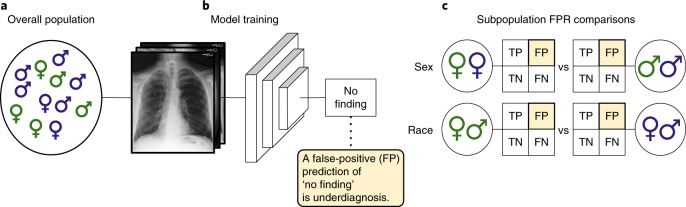
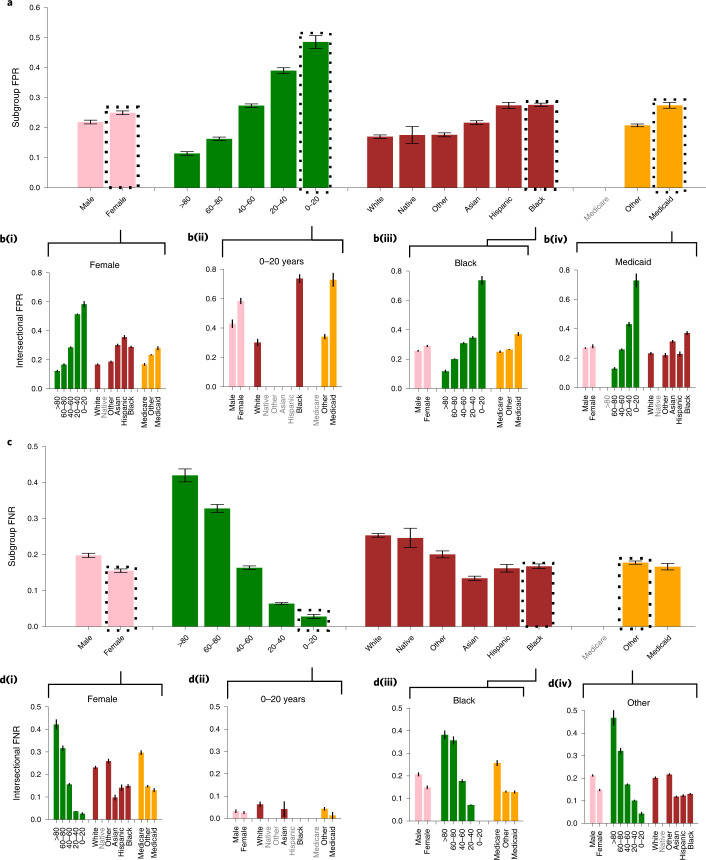
- Underdiagnosis rate, defined as the false-positive rate (FPR) for the “no finding” label, differed across all considered subpopulations. Female patients, patients under 20 years old, Black patients, Hispanic patients, and patients with Medicaid insurance had higher algorithmic underdiagnosis rates in the MIMIC-CXR dataset.
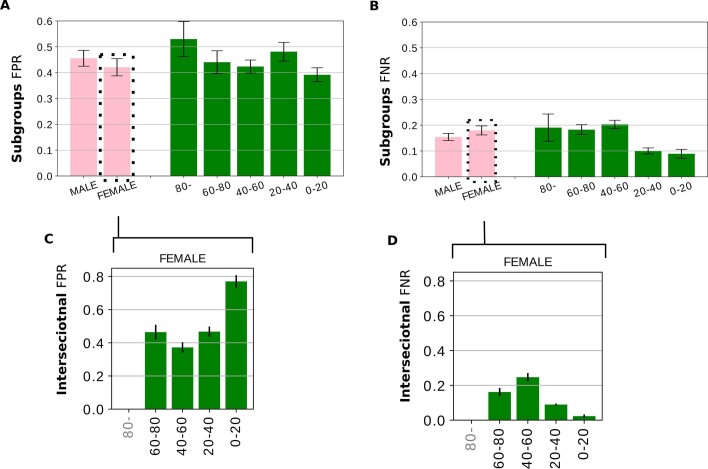
- Intersectional subgroups often had compounded bias. For example, Hispanic female patients had a higher underdiagnosis rate than white female patients, and patients aged 0–20 years who were female, Black, or had Medicaid insurance had the largest underdiagnosis rates.
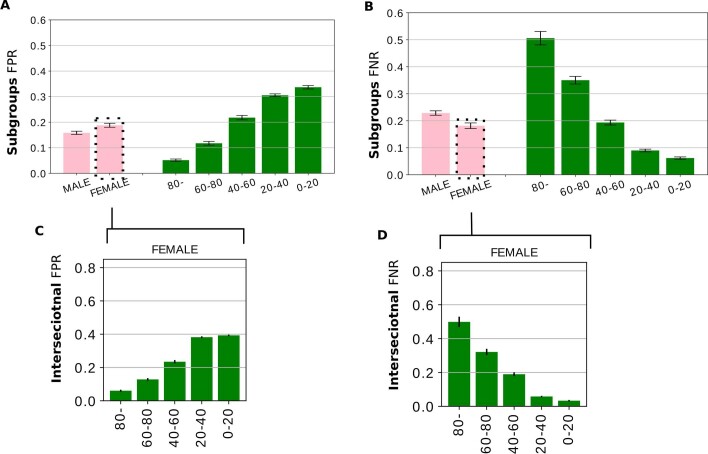
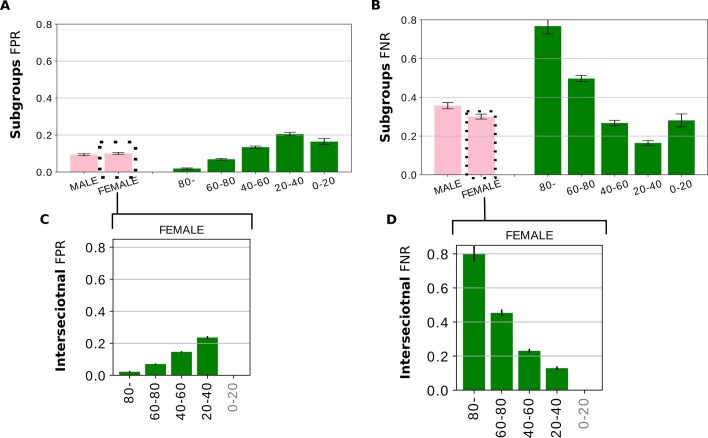
- FPR and false-negative rate (FNR) for “no finding” showed an inverse relationship across under-served subgroups, consistent with selective algorithmic underdiagnosis rather than undirected noise. This pattern held across datasets except for age >80 years and 0–20 years in the NIH dataset, possibly due to small sample sizes or dataset selection bias.
- Dataset sizes and model AUCs: MIMIC-CXR (371,858 images from 65,079 patients; AUC 0.834 ± 0.001), CheXpert (223,648 images from 64,740 patients; AUC 0.805 ± 0.001), ChestX-ray14/NIH (112,120 images from 30,805 patients; AUC 0.835 ± 0.002), and ALL (707,626 images from 129,819 patients; AUC 0.859 ± 0.001).
Methods
- Retrospective analysis of three public chest X-ray datasets—MIMIC-CXR, CheXpert, and ChestX-ray14 (NIH)—plus a multi-source ALL dataset combining them on shared labels. Subgroups included race/ethnicity, socioeconomic status via insurance type, sex, and age, with intersectional identities also examined.
- A 121-layer DenseNet initialized with ImageNet weights was trained on 256 × 256 images to predict diagnostic labels, including the “no finding” label. Train-validation-test splits were fixed, no patient was shared across splits, and results were averaged over five models with different random seeds.
- Fairness metrics were binarized: underdiagnosis rate as FPR for “no finding,” overdiagnosis as FNR for “no finding,” and false discovery rate (FDR) for “no finding.” A single threshold maximizing F1 score was selected for all groups; protected attributes were not used in model training or testing.
Limitations
- The paper states that prediction labels are extracted from clinical records and are therefore not unbiased ground truth; the labels may already contain the same bias the model then amplifies, a form of bias amplification. It also notes that automatic NLP-based labelers have not been audited across subpopulations and could be a large source of bias.
- The paper states that race and ethnicity are partially social constructs with unclear boundaries, and self-reported race/ethnicity may vary by age, socioeconomic level, or acculturation. Insurance type is described as an imperfect proxy for socioeconomic status.
- The paper states that post-hoc threshold adjustments for equal FNR and FPR have flaws: small intersectional groups make accurate thresholds difficult, the number of thresholds grows exponentially with protected attributes, and equalizing metrics may require randomization or worsening performance for some subgroups. The text also makes evident that the NIH dataset may have less diverse samples and small subgroup sizes, and that MIMIC-CXR lacks race/ethnicity and insurance data for around ~100,000 X-rays.
Model-written summary. Check it against the paper before relying on it.
Integrity signals
Registry
Cites
Statistics
Figures
Verification
Claims the paper makes
4 Valid · 1 Not valid · 16 Not checked · 53 Own results and interpretations
The cited sources support only part of this claim — read each source’s verdict below.
In the paper
“We note that some of our observed differences in underdiagnosis have been established in other areas in clinical care, such as underdiagnosis of female patients 9,10 , Black patients 5,8,9 and patients with a low socioeconomic status 36 .”
What the sources say
- Not checked yetcites [9] Mamary, A. J. et al. Race and gender disparities are evident in COPD underdiagnoses across all severities of measured airflow obstruction. Chronic Obstr. Pulm. Dis. 5, 177-184 (2018).
- Not checked yetcites [10] Sun, T. Y., Bear Don't Walk, O. J. IV, Chen, J. L., Reyes Nieva, H. & Elhadad, N. Exploring gender disparities in time to diagnosis. In Machine Learning for Health (ML4H) at NeurIPS 2020 (eds Alsentzer, E. et al.) abstr. https://arxiv. org/abs/2011.06100 (2020).
- Partly supportedcites [5] Obermeyer, Z., Powers, B., Vogeli, C. & Mullainathan, S. Dissecting racial bias in an algorithm used to manage the health of populations. Science 366, 447-453 (2019). sourceExperimental — accuracy not yet measured
Our copy supports only the racial element, and at a different level of specificity: it documents that at a given algorithm risk score Black patients carry significantly more illness burden (26.3% more chronic illnesses at the 97th percentile; more-severe hypertension, diabetes, renal failure and anemia; Health disparities conditional on risk score, pp. 3-4) and that less is spent on them conditional on need (Mechanism of bias, p. 5) — i.e. under-recognition of illness in an algorithmic/cost sense, not clinical underdiagnosis. Nothing in our copy addresses underdiagnosis of female patients (sex/gender appears only in the introduction's examples of ad delivery, facial recognition and hiring algorithms, p. 2, and as the descriptive statistic that the sample was 63% female, p. 2), and socioeconomic status appears only as barriers to accessing care that lower spending (Mechanism of bias, p. 5), not as established underdiagnosis. The female-patient and low-SES parts of the claim are therefore unsupported by this source. (LLM, conf=0.70)
- Partly supportedcites [8] Vyas, D. A., Eisenstein, L. G. & Jones, D. S. Hidden in plain sight: reconsidering the use of race correction in clinical algorithms. N. Engl. J. Med. 383, 874-882 (2020). sourceExperimental — accuracy not yet measured
Vyas et al. (2020) support only the Black-patient strand, and even there at a different level of specificity: the introduction states that 'many of these race-adjusted algorithms guide decisions in ways that may direct more attention or resources to white patients than to members of racial and ethnic minorities,' and the Cardiology section notes the AHA Get with the Guidelines score 'could direct care away from black patients' — i.e., a hedged equity concern about algorithms diverting care/resources, not an established rate of underdiagnosis. Our copy contains nothing on underdiagnosis of female patients (women appear only in Table 1 references on breast-density and bone-density tools) and nothing on underdiagnosis of low-socioeconomic-status patients; the only SES material is the quoted Society of Thoracic Surgeons concern that 'inclusion of SES factors in risk models may adjust away disparities in quality of care' (Assessment). The female-patient and low-SES parts of the attributed claim are therefore unsupported by this source. (LLM, conf=0.78)
- Partly supportedcites [36] Gianfrancesco, M. A., Tamang, S., Yazdany, J. & Schmajuk, G. Potential biases in machine learning algorithms using electronic health record data. JAMA Intern. Med. 178, 1544-1547 (2018). sourceExperimental — accuracy not yet measured
Our copy of Gianfrancesco et al. supports parts of the claim but not all of it: the Misclassification and Measurement Error section states that 'women may be less likely to receive lipid-lowering medications and in-hospital procedures, as well as optimal care at discharge, compared with men' and that patients 'may be differentially incorrectly diagnosed based on sociodemographic factors,' and the Missing Data section states that 'patients with low socioeconomic status may receive fewer diagnostic tests and medications for chronic diseases and have limited access to health care' and 'may only be identified if their disease becomes more severe' — hedged disparities in care/detection for women and low-SES patients, not established underdiagnosis. The part the source does not support is underdiagnosis of Black patients: the only Black/African-ancestry diagnostic-error passage (Sample Size and Underestimation) reports that 'patients with African and unspecified ancestry have been diagnosed with pathogenic genetic variants that were actually benign but misclassified,' i.e. genetic over-diagnosis credited to another study (Manrai et al., N Engl J Med 2016), not underdiagnosis. (LLM, conf=0.75)
boostedstates an association- Asserted: passes — The authors put it forward as true.
- Checkable: passes — It can be checked against evidence.
- Load-bearing: passes — The paper’s conclusions depend on it.
- Based: passes — The paper gives a reason why it holds.
- Rests on an assumption not shown here.
The cited sources support only part of this claim — read each source’s verdict below.
In the paper
“The choice of these subgroups is motivated by the clear history, in both traditional medicine and AI algorithms, of bias for subgroups on these axes 6,8,10,11 .”
What the sources say
- Partly supportedcites [6] Larrazabal, A. J. et al. Gender imbalance in medical imaging datasets produces biased classifiers for computer-aided diagnosis. Proc. Natl Acad. Sci. USA 117, 12592-12594 (2020). sourceExperimental — accuracy not yet measured
The Abstract says AI systems can inherit or amplify gender and racial bias, and Results and Discussion reports lower classifier performance for underrepresented genders. The paper does not establish a history of bias across socioeconomic status or age, or across all four axes in traditional medicine. The supplied passages have no page numbers. (LLM, conf=0.86)
- Partly supportedcites [8] Vyas, D. A., Eisenstein, L. G. & Jones, D. S. Hidden in plain sight: reconsidering the use of race correction in clinical algorithms. N. Engl. J. Med. 383, 874-882 (2020). sourceExperimental — accuracy not yet measured
The opening section describes race-based clinical algorithms that may direct more resources to white patients, and the Assessment section gives an example of racial bias in medical AI. The paper discusses socioeconomic status as relevant to these inequities, but the cited passages do not establish a history of bias across all four named axes: race, socioeconomic status, sex, and age. No page numbers are available in our copy. (LLM, conf=0.86)
- Not checked yetcites [10] Sun, T. Y., Bear Don't Walk, O. J. IV, Chen, J. L., Reyes Nieva, H. & Elhadad, N. Exploring gender disparities in time to diagnosis. In Machine Learning for Health (ML4H) at NeurIPS 2020 (eds Alsentzer, E. et al.) abstr. https://arxiv. org/abs/2011.06100 (2020).
- Not checked yetcites [11] Spencer, C. S., Gaskin, D. J. & Roberts, E. T. The quality of care delivered to patients within the same hospital varies by insurance type. Health Aff. (Milwood) 32, 1731-1739 (2013). source
boostedstates an association- Asserted: passes — The authors put it forward as true.
- Checkable: passes — It can be checked against evidence.
- Load-bearing: passes — The paper’s conclusions depend on it.
- Based: passes — The paper gives a reason why it holds.
- Partly supported
A result the paper reports from its own data — it cites no other source for it, so there is none to check. The quote shows it is in the paper.
In the paper
“The false-negative rate (FNR) for no finding (Fig. 2c) and FPR (Fig. 2a) show an inverse relationship across different under-served subgroups in the CXR dataset.”
plainstates an association- Asserted: passes — The authors put it forward as true.
- Checkable: passes — It can be checked against evidence.
- Load-bearing: passes — The paper’s conclusions depend on it.
- Based: passes — The paper gives a reason why it holds.
- Rests on an assumption not shown here.
A result the paper reports from its own data — it cites no other source for it, so there is none to check. The quote shows it is in the paper.
In the paper
“We observe that patients who belong to two under-served subgroups have a larger underdiagnosis rate.”
plainstates an association- Asserted: passes — The authors put it forward as true.
- Checkable: passes — It can be checked against evidence.
- Load-bearing: passes — The paper’s conclusions depend on it.
- Based: passes — The paper gives a reason why it holds.
- Rests on an assumption not shown here.
A result the paper reports from its own data — it cites no other source for it, so there is none to check. The quote shows it is in the paper.
In the paper
“We observe, across three large-scale datasets and a combined multi-source dataset, which under-served subpopulations are consistently at significant risk of algorithmic underdiagnosis.”
plainstates an association- Asserted: passes — The authors put it forward as true.
- Checkable: passes — It can be checked against evidence.
- Load-bearing: passes — The paper’s conclusions depend on it.
- Based: passes — The paper gives a reason why it holds.
- Rests on an assumption not shown here.
24 more claims
Create a free account to see all 74 claims and to verify the 27 references still open.
- Probably not a substantial claim. 29
- It may state two separate claims as one. 32
Claims other papers make about this one
Each is checked against this paper’s own text: does it say what the citing paper says it does?
The source backs part of the claim, not all of it — or backs it for a different population, condition or comparison.
In the citing paper
“Model trained on less and/or missing data leads to underestimation and underdiagnosis [49,127].”
From Artificial intelligence bias in medical system designs: a systematic review (2023) · cites this paper as [127]
Experimental — accuracy not yet measuredThe source backs part of the claim, not all of it — or backs it for a different population, condition or comparison.
In the citing paper
“The imbalanced data will result in specialized privileges to a specific group in the medical diagnosis [127].”
From Artificial intelligence bias in medical system designs: a systematic review (2023) · cites this paper as [127]
Experimental — accuracy not yet measuredThe source backs part of the claim, not all of it — or backs it for a different population, condition or comparison.
In the citing paper
“The majority of the studies have neglected kinship (more than 95%) and insurance (90%) attributes which are essential to identify socioeconomic status of the patient to prevent the underdiagnosis [127].”
From Artificial intelligence bias in medical system designs: a systematic review (2023) · cites this paper as [127]
Experimental — accuracy not yet measuredThe source backs part of the claim, not all of it — or backs it for a different population, condition or comparison.
In the citing paper
“In imaging, Seyyed-Kalantari et al 59 found that contemporary deep-learning classifiers applied to chest radiographs systematically failed to identify abnormalities in patients from historically marginalized groups including female patients, Black patients, and those of lower socioeconomic status with the most pronounced disparities at the intersections of these categories.”
From Artificial Intelligence in Oncology: Practical Applications Across Clinical Care, Scholarship, and Translation. (2026) · cites this paper as [59]
Experimental — accuracy not yet measuredThe source backs part of the claim, not all of it — or backs it for a different population, condition or comparison.
In the citing paper
“On the other hand, AI systems can also suffer from bias, compounding existing inequities in socioeconomic status, race, ethnicity, religion, gender, disability, or sexual orientation.”
From Bias in AI-based models for medical applications: challenges and mitigation strategies (2023) · cites this paper as [6]
Experimental — accuracy not yet measured
6 more claims about this paper
Create a free account to see every claim other papers make about this one.
Self-check
Percentages, sums and reported differences re-computed from the paper’s own numbers.
Each contradiction between two passages listed here was confirmed by an independent check.
Rated minor: it would not touch a result — a value no result rests on, a p-value that stays on the same side of the significance level, or a conflict that is clerical, resolved elsewhere in the paper, or outside its own findings.
In the paper
§ Dataset collection and inclusion criteria.
“FDR (or, equivalently, positive predictive value (PPV)) is a common metric used to evaluate the performance of classifiers.”
§ Dataset collection and inclusion criteria.
“FDRs i,j = P [ Y = 0|si,j, Ŷ = 1 ](3”
Rated minor: it would not touch a result — a value no result rests on, a p-value that stays on the same side of the significance level, or a conflict that is clerical, resolved elsewhere in the paper, or outside its own findings.
In the paper
“MIMIC-CXR (CXR, 371,858 images from 65,079 patients) 26 , CheXpert (CXP, 223,648 images from 64,740 patients) 27 , ChestX-ray14 (NIH, 112,120 images from 30,805 patients) 28 , and a multi-source combination of all three (ALL, 707,626 images from 129,819 patients) on shared labels.”
Reported 129819 · recomputed 160624
Citations
Cites
ImageNet Large Scale Visual Recognition Challenge
Russakovsky, O., Deng, J., Su, H., Krause, J., Satheesh, S., Ma, S., Huang, Z., Karpathy, A., Khosla, A., Bernstein, M., et al. (2015) · International Journal of Computer Vision · doi:10.1007/s11263-015-0816-y · Cited by 39,380
Goldberger, A. L., Amaral, L. A. N., Glass, L., Hausdorff, J. M., Ivanov, P. C., Mark, R. G., Mietus, J. E., Moody, G. B., Peng, C.-K., & Stanley, H. E. (2000) · Circulation · doi:10.1161/01.cir.101.23.e215 · Cited by 14,809
Dissecting racial bias in an algorithm used to manage the health of populations
Obermeyer, Z., Powers, B., Vogeli, C., & Mullainathan, S. (2019) · Science · doi:10.1126/science.aax2342 · Cited by 7,137 · cited 1×
“We note that some of our observed differences in underdiagnosis have been established in other areas in clinical care, such as under-diagnosis of female patients 9,10 , Black patients 5,8,9 and patients with a low socioeconomic status 36 .”
BackgroundWang, X., Peng, Y., Lu, L., Lu, Z., Bagheri, M., & Summers, R. M. (2017) · 2017 IEEE Conference on Computer Vision and Pattern Recognition (CVPR) · doi:10.1109/cvpr.2017.369 · Cited by 4,616 · cited 5×
“Fourth, despite the fact that we do not have the same disease prevalence between subgroups based on real data 26–28 , and our choice of fairness metrics does not directly involve prevalence between subgroups, we stress that equal underdiagnosis rates between sub-groups of age, sex and…”
BackgroundMethodInfluential(2018) · Cited by 3,510
Dwork, C., Hardt, M., Pitassi, T., Reingold, O., & Zemel, R. (2012) · Proceedings of the 3rd Innovations in Theoretical Computer Science Conference · doi:10.1145/2090236.2090255 · Cited by 3,501
Implementing Machine Learning in Health Care — Addressing Ethical Challenges
Char, D. S., Shah, N. H., & Magnus, D. (2018) · New England Journal of Medicine · doi:10.1056/nejmp1714229 · Cited by 1,857
MIMIC-CXR, a de-identified publicly available database of chest radiographs with free-text reports
Johnson, A. E. W., Pollard, T. J., Berkowitz, S. J., Greenbaum, N. R., Lungren, M. P., Deng, C.-Y., Mark, R. G., & Horng, S. (2019) · Scientific Data · doi:10.1038/s41597-019-0322-0 · Cited by 1,816 · cited 5×
“Fourth, despite the fact that we do not have the same disease prevalence between subgroups based on real data 26–28 , and our choice of fairness metrics does not directly involve prevalence between subgroups, we stress that equal underdiagnosis rates between sub-groups of age, sex and…”
BackgroundMethodInfluentialHidden in Plain Sight — Reconsidering the Use of Race Correction in Clinical Algorithms
Vyas, D. A., Eisenstein, L. G., & Jones, D. S. (2020) · New England Journal of Medicine · doi:10.1056/nejmms2004740 · Cited by 1,731 · cited 2×
“We note that some of our observed differences in underdiagnosis have been established in other areas in clinical care, such as under-diagnosis of female patients 9,10 , Black patients 5,8,9 and patients with a low socioeconomic status 36 .”
BackgroundA New, Evidence-based Estimate of Patient Harms Associated with Hospital Care
James, J. T. (2013) · Journal of Patient Safety · doi:10.1097/pts.0b013e3182948a69 · Cited by 1,399 · cited 1×
“Moreover, developers, practitioners and the clinical staff need to take into account biases such as the underdiagnosis of under-served populations in the AI-based medical decision-making algorithms and its harmful effect 17,18 on patients.”
Background
Research works printed but not linked: 3
- Cohen, J. P., Hashir, M., Brooks, R. & Bertrand, H. On the limits of cross-domain generalization in automated X-ray prediction. Proc. Mach. Learn. Res. 121, 136-155 (2020).
- Hardt, M., Price, E. & Srebro, N. Equality of opportunity in supervised learning. In Advances in Neural Information Processing Systems 29 (NIPS 2016) (eds Lee, D. et al.) 3315-3323.
- Johnson, A. et al. MIMIC-IV (version 0.4). PhysioNet https://doi.org/ 10.13026/a3wn-hq05 (2020). · DOI
Cited by
Moons, K. G. M., Damen, J. A. A., Kaul, T., Hooft, L., Andaur Navarro, C., Dhiman, P., Beam, A. L., Van Calster, B., Celi, L. A., Denaxas, S., et al. (2025) · BMJ · doi:10.1136/bmj-2024-082505 · Cited by 1,069
Self-citationAlgorithmic fairness in artificial intelligence for medicine and healthcare
Chen, R. J., Wang, J. J., Williamson, D. F. K., Chen, T. Y., Lipkova, J., Lu, M. Y., Sahai, S., & Mahmood, F. (2023) · Nature Biomedical Engineering · doi:10.1038/s41551-023-01056-8 · Cited by 750
“…Institutes of Health (NIH) ChestX-ray 15 ) underdiagnose underserved populations; that is, the likelihood is greater of the algorithms incorrectly predicting ‘no symptomatic conditions (findings)’ for female patients, Black patients, Hispanic patients and patients with Medicaid insurance 11 .”
BackgroundInfluentialAI recognition of patient race in medical imaging: a modelling study
Gichoya, J. W., Banerjee, I., Bhimireddy, A. R., Burns, J. L., Celi, L. A., Chen, L.-C., Correa, R., Dullerud, N., Ghassemi, M., Huang, S.-C., et al. (2022) · The Lancet Digital Health · doi:10.1016/s2589-7500(22)00063-2 · Cited by 611
“9 Importantly, if used, such models would lead to more patients who are Black and female being incorrectly identified as healthy compared with patients who are White and male.”
Self-citationThe current and future state of AI interpretation of medical images
Rajpurkar, P., & Lungren, M. P. (2023) · New England Journal of Medicine · doi:10.1056/nejmra2301725 · Cited by 443
Esmaeilzadeh, P. (2024) · Artificial Intelligence in Medicine · doi:10.1016/j.artmed.2024.102861 · Cited by 377
Bias in AI-based models for medical applications: challenges and mitigation strategies
Mittermaier, M., Raza, M. M., & Kvedar, J. C. (2023) · npj Digital Medicine · doi:10.1038/s41746-023-00858-z · Cited by 372
“Bias is usually de fi ned as a difference in performance between sub-groups for a predictive task 6,7 .”
Artificial intelligence for digital and computational pathology
Song, A. H., Jaume, G., Williamson, D. F. K., Lu, M. Y., Vaidya, A., Miller, T. R., & Mahmood, F. (2023) · Nature Reviews Bioengineering · doi:10.1038/s44222-023-00096-8 · Cited by 356
“P a t c h i m p o r t a n c e”
BackgroundA multinational study on the factors influencing university students’ attitudes and usage of ChatGPT
Abdaljaleel, M., Barakat, M., Alsanafi, M., Salim, N. A., Abazid, H., Malaeb, D., Mohammed, A. H., Hassan, B. A. R., Wayyes, A. M., Farhan, S. S., et al. (2024) · Scientific Reports · doi:10.1038/s41598-024-52549-8 · Cited by 291
“Similarly, multiple later studies confirmed this concern of generating inaccurate content in specific topics (e.g., Radiology, Microbiology) 77–79 .”
BackgroundHan, R., Acosta, J. N., Shakeri, Z., Ioannidis, J. P. A., Topol, E. J., & Rajpurkar, P. (2024) · The Lancet Digital Health · doi:10.1016/s2589-7500(24)00047-5 · Cited by 336
“6,7 10 To provide a clearer understanding of the AI landscape in health care, this scoping review aims to examine the state of RCTs for AI algorithms being used in clinical practice.”
BackgroundShaping the future of healthcare: ethical clinical challenges and pathways to trustworthy AI
Goktas, P., & Grzybowski, A. (2025) · Journal of Clinical Medicine · doi:10.3390/jcm14051605 · Cited by 336
“This might include forming partnerships with patient advocacy groups, community health organizations, and underrepresented populations to co-design data collection strategies and validate AI performance in clinical settings [58,59].”
Ethical and legal considerations in healthcare AI: innovation and policy for safe and fair use
Pham, T. (2025) · Royal Society Open Science · doi:10.1098/rsos.241873 · Cited by 261
“For instance, a diagnostic tool trained predominantly on data from White patients may perform poorly when applied to patients of other races or ethnicities, resulting in misdiagnoses [84].”
Towards Accurate Differential Diagnosis with Large Language Models
McDuff, D., Schaekermann, M., Tu, T., Palepu, A., Wang, A., Garrison, J., Singhal, K., Sharma, Y., Azizi, S., Kulkarni, K., et al. (2023) · arXiv · doi:10.48550/arxiv.2312.00164 · Cited by 311
Towards accurate differential diagnosis with large language models
McDuff, D., Schaekermann, M., Tu, T., Palepu, A., Wang, A., Garrison, J., Singhal, K., Sharma, Y., Azizi, S., Kulkarni, K., et al. (2025) · Nature · doi:10.1038/s41586-025-08869-4 · Cited by 311
Abdaljaleel, M., Barakat, M., Alsanafi, M., Salim, N. A., Abazid, H., Malaeb, D., Mohammed, A. H., Hassan, B. A. R., Wayyes, A. M., Farhan, S. S., et al. (2023) · doi:10.20944/preprints202309.1541.v1 · Cited by 296
The limits of fair medical imaging AI in real-world generalization
Yang, Y., Zhang, H., Gichoya, J. W., Katabi, D., & Ghassemi, M. (2024) · Nature Medicine · doi:10.1038/s41591-024-03113-4 · Cited by 285
“Our approach follows previous work that achieves state-of-the-art performance in these tasks 8,12 using empirical risk minimization (ERM) 34 .”
InfluentialSelf-citationData drift in medical machine learning: implications and potential remedies
Sahiner, B., Chen, W., Samala, R. K., & Petrick, N. (2023) · The British Journal of Radiology · doi:10.1259/bjr.20220878 · Cited by 279
AI pitfalls and what not to do: mitigating bias in AI
Gichoya, J. W., Thomas, K., Celi, L. A., Safdar, N., Banerjee, I., Banja, J. D., Seyyed-Kalantari, L., Trivedi, H., & Purkayastha, S. (2023) · The British Journal of Radiology · doi:10.1259/bjr.20230023 · Cited by 277
Self-citationTimmons, A. C., Duong, J. B., Simo Fiallo, N., Lee, T., Vo, H. P. Q., Ahle, M. W., Comer, J. S., Brewer, L. C., Frazier, S. L., & Chaspari, T. (2023) · Perspectives on Psychological Science · doi:10.1177/17456916221134490 · Cited by 263
Artificial Intelligence in Breast Cancer Diagnosis and Personalized Medicine
Ahn, J. S., Shin, S., Yang, S.-A., Park, E. K., Kim, K. H., Cho, S. I., Ock, C.-Y., & Kim, S. (2023) · Journal of Breast Cancer · doi:10.4048/jbc.2023.26.e45 · Cited by 221
“This situation can potentially exacerbate health disparities [183,184].”
BackgroundCestonaro, C., Delicati, A., Marcante, B., Caenazzo, L., & Tozzo, P. (2023) · Frontiers in Medicine · doi:10.3389/fmed.2023.1305756 · Cited by 231
Harishbhai Tilala, M., Kumar Chenchala, P., Choppadandi, A., Kaur, J., Naguri, S., Saoji, R., & Devaguptapu, B. (2024) · Cureus · doi:10.7759/cureus.62443 · Cited by 198
“Similarly, predictive models that rely on socioeconomic factors may inadvertently perpetuate disparities in access to care or resource allocation, further exacerbating health inequalities [25,26].”
BackgroundAI-enabled organoids: Construction, analysis, and application
Bai, L., Wu, Y., Li, G., Zhang, W., Zhang, H., & Su, J. (2024) · Bioactive Materials · doi:10.1016/j.bioactmat.2023.09.005 · Cited by 207
“It also acts as a decision-support tool for clinicians, particularly in image-based specialties like radiology [99, 100].”
Self-citationAddressing fairness in artificial intelligence for medical imaging
Ricci Lara, M. A., Echeveste, R., & Ferrante, E. (2022) · Nature Communications · doi:10.1038/s41467-022-32186-3 · Cited by 204
Alderman, J. E., Palmer, J., Laws, E., McCradden, M. D., Ordish, J., Ghassemi, M., Pfohl, S. R., Rostamzadeh, N., Cole-Lewis, H., Glocker, B., et al. (2025) · The Lancet Digital Health · doi:10.1016/s2589-7500(24)00224-3 · Cited by 170
Self-citationYelne, S., Chaudhary, M., Dod, K., Sayyad, A., & Sharma, R. (2023) · Cureus · doi:10.7759/cureus.49252 · Cited by 190
Medical artificial intelligence ethics: A systematic review of empirical studies
Tang, L., Li, J., & Fantus, S. (2023) · DIGITAL HEALTH · doi:10.1177/20552076231186064 · Cited by 176
Deep Learning in Breast Cancer Imaging: A Decade of Progress and Future Directions
Luo, L., Wang, X., Lin, Y., Ma, X., Tan, A., Chan, R., Vardhanabhuti, V., Chu, C. W., Cheng, K.-T. T., & Chen, H. (2024) · IEEE Reviews in Biomedical Engineering · doi:10.1109/rbme.2024.3357877 · Cited by 230
Koçak, B., Ponsiglione, A., Stanzione, A., Bluethgen, C., Santinha, J., Ugga, L., Huisman, M., Klontzas, M. E., Cannella, R., & Cuocolo, R. (2024) · Diagnostic and Interventional Radiology · doi:10.4274/dir.2024.242854 · Cited by 168
Generative models improve fairness of medical classifiers under distribution shifts
Ktena, I., Wiles, O., Albuquerque, I., Rebuffi, S.-A., Tanno, R., Roy, A. G., Azizi, S., Belgrave, D., Kohli, P., Cemgil, T., et al. (2024) · Nature Medicine · doi:10.1038/s41591-024-02838-6 · Cited by 165
“In a similar vein, Seyyed-Kalantari et al. 13 further explored how differences in age, race or ethnicity, and insurance type (as a proxy of socioeconomic status) are manifested in the performance of a classifier operating on chest radiographs.”
Where Medical Statistics Meets Artificial Intelligence
Hunter, D. J., & Holmes, C. (2023) · New England Journal of Medicine · doi:10.1056/nejmra2212850 · Cited by 160
Generative models improve fairness of medical classifiers under distribution shifts
Wiles, O., Albuquerque, I., Rebuffi, S.-A., Tanno, R., Roy, A. G., Azizi, S., Belgrave, D., Kohli, P., Cemgil, T., Karthikesalingam, A., et al. (2023) · doi:10.21203/rs.3.rs-2976332/v1 · Cited by 165
Deep learning-aided decision support for diagnosis of skin disease across skin tones
Groh, M., Badri, O., Daneshjou, R., Koochek, A., Harris, C., Soenksen, L. R., Doraiswamy, P. M., & Picard, R. (2024) · Nature Medicine · doi:10.1038/s41591-023-02728-3 · Cited by 160
An adversarial training framework for mitigating algorithmic biases in clinical machine learning
Yang, J., Soltan, A. A. S., Eyre, D. W., Yang, Y., & Clifton, D. A. (2023) · npj Digital Medicine · doi:10.1038/s41746-023-00805-y · Cited by 159
“This is particularly harmful in sensitive domains such as healthcare because: (1) a biased model can lead to inaccurate predictions for critical and, potentially, lifealtering decisions; (2) a bias against a particular group can result in those patients receiving poorer care compared to those in other groups; and (3)…”
BackgroundHumans inherit artificial intelligence biases
Vicente, L., & Matute, H. (2023) · Scientific Reports · doi:10.1038/s41598-023-42384-8 · Cited by 158
Patient reported outcome assessment must be inclusive and equitable
Calvert, M., Rivera, S. C., Retzer, A., Hughes, S., Campbell, L. A., Molony-Oates, B., Aiyegbusi, O. L., Stover, A. M., Wilson, R., McMullan, C., et al. (2022) · Nature Medicine · doi:10.1038/s41591-022-01781-8 · Cited by 163
Medical Artificial Intelligence and Human Values
Yu, K.-H., Healey, E., Leong, T.-Y., Kohane, I. S., & Manrai, A. K. (2024) · New England Journal of Medicine · doi:10.1056/nejmra2214183 · Cited by 149
Drukker, K., Chen, W., Gichoya, J. W., Gruszauskas, N. P., Kalpathy-Cramer, J., Koyejo, S., Myers, K. J., Sá, R. C., Sahiner, B., Whitney, H. M., et al. (2023) · Journal of Medical Imaging · doi:10.1117/1.jmi.10.6.061104 · Cited by 149
“53 It can be measured by evaluating the trained AI/ML model on different subpopulations or by training it with data with different prevalence.”
BackgroundHe, K., Mao, R., Lin, Q., Ruan, Y., Lan, X., Feng, M., & Cambria, E. (2025) · Information Fusion · doi:10.1016/j.inffus.2025.102963 · Cited by 147
Yang, J., Soltan, A. A. S., Eyre, D. W., & Clifton, D. A. (2023) · Nature Machine Intelligence · doi:10.1038/s42256-023-00697-3 · Cited by 140
“These biases hinder a model’s ability to accurately capture the relationship between features and the target outcome, resulting in poor generalization across subgroups and unfair decision-making 1–5 .”
BackgroundMethodInfluentialMa, J., Zhang, Y., Gu, S., Ge, C., Mae, S., Young, A., Zhu, C., Yang, X., Meng, K., Huang, Z., et al. (2024) · The Lancet Digital Health · doi:10.1016/s2589-7500(24)00154-7 · Cited by 251
Deep learning for accelerated and robust MRI reconstruction
Heckel, R., Jacob, M., Chaudhari, A. S., Perlman, O., & Shimron, E. (2024) · Magnetic Resonance Materials in Physics Biology and Medicine · doi:10.1007/s10334-024-01173-8 · Cited by 225
“This training can lead to algorithmic failure for under-served populations [301, 302] or rare conditions [300].”
BackgroundConsidering Biased Data as Informative Artifacts in AI-Assisted Health Care
Ferryman, K., Mackintosh, M., & Ghassemi, M. (2023) · New England Journal of Medicine · doi:10.1056/nejmra2214964 · Cited by 130
Self-citationUnderstanding and Mitigating Bias in Imaging Artificial Intelligence
Tejani, A. S., Ng, Y. S., Xi, Y., & Rayan, J. C. (2024) · RadioGraphics · doi:10.1148/rg.230067 · Cited by 138
“Shortcuts” Causing Bias in Radiology Artificial Intelligence: Causes, Evaluation, and Mitigation
Banerjee, I., Bhattacharjee, K., Burns, J. L., Trivedi, H., Purkayastha, S., Seyyed-Kalantari, L., Patel, B. N., Shiradkar, R., & Gichoya, J. (2023) · Journal of the American College of Radiology · doi:10.1016/j.jacr.2023.06.025 · Cited by 122
Self-citationMultimodal generative AI for medical image interpretation
Rao, V. M., Hla, M., Moor, M., Adithan, S., Kwak, S., Topol, E. J., & Rajpurkar, P. (2025) · Nature · doi:10.1038/s41586-025-08675-y · Cited by 182
“…are predominantly based on data from people of European descent 121 , and, therefore, models may generate lower quality drafts for minority populations; this disparity could result in compromised care for underserved communities if physicians rely too much on model outputs in such cases 122 .”
Haghayegh, F., Norouziazad, A., Haghani, E., Feygin, A. A., Rahimi, R. H., Ghavamabadi, H. A., Sadighbayan, D., Madhoun, F., Papagelis, M., Felfeli, T., et al. (2024) · Advanced Science · doi:10.1002/advs.202400595 · Cited by 172
Demographic bias in misdiagnosis by computational pathology models
Vaidya, A. J., Chen, R. J., Williamson, D. F. K., Song, A. H., Jaume, G., Yang, Y., Hartvigsen, T., Dyer, E. C., Lu, M. Y., Lipková, J., et al. (2024) · Nature Medicine · doi:10.1038/s41591-024-02885-z · Cited by 180
Generalizability of FDA-Approved AI-Enabled Medical Devices for Clinical Use
Windecker, D., Baj, G., Shiri, I., Kazaj, P. M., Kaesmacher, J., Gräni, C., & Siontis, G. C. M. (2025) · JAMA Network Open · doi:10.1001/jamanetworkopen.2025.8052 · Cited by 143
Saad, M. B., Hong, L., Aminu, M., Vokes, N. I., Chen, P., Salehjahromi, M., Qin, K., Sujit, S. J., Lu, X., Young, E., et al. (2023) · The Lancet Digital Health · doi:10.1016/s2589-7500(23)00082-1 · Cited by 121
“In contrast to the reduced performance of artificial intelligence models in historically under-served populations, 29 we observed consistent performance of the proposed imaging model in subgroups as stratified by race or ethnicity, age, or sex.”
Marko, J. G. O., Neagu, D. C., & Anand, P. B. (2025) · BMC Medical Informatics and Decision Making · doi:10.1186/s12911-025-02884-1 · Cited by 156
“A notable concern is the misapplication of algorithms that mistak-enly treat race as a biological factor rather than a social construct, leading to biased clinical decisions [98, 99].”
Foundation Models in Radiology: What, How, Why, and Why Not
Paschali, M., Chen, Z., Blankemeier, L., Varma, M., Youssef, A., Blüthgen, C., Langlotz, C. P., Gatidis, S., & Chaudhari, A. S. (2025) · Radiology · doi:10.1148/radiol.240597 · Cited by 168
Applications of generative adversarial networks in neuroimaging and clinical neuroscience
Wang, R., Bashyam, V., Yang, Z., Yu, F., Tassopoulou, V., Chintapalli, S. S., Skampardoni, I., Sreepada, L. P., Sahoo, D., Nikita, K. S., et al. (2023) · NeuroImage · doi:10.1016/j.neuroimage.2023.119898 · Cited by 135
“These models can amplify the bias in data and lead to undesirable performances towards underrepresented groups, such as females and African Americans ( Larrazabal et al., 2020 ; Seyyed-Kalantari et al., 2021 ; Wang et al., 2022 b).”
Advancing algorithmic bias management capabilities in AI-driven marketing analytics research
Akter, S., Sultana, S., Mariani, M. M., Wamba, S. F., Spanaki, K., & Dwivedi, Y. K. (2023) · Industrial Marketing Management · doi:10.1016/j.indmarman.2023.08.013 · Cited by 138
Ly, C. O., Unnikrishnan, B., Tadic, T., Patel, T., Duhamel, J., Kandel, S., Moayedi, Y., Brudno, M., Hope, A. J., Ross, H. J., et al. (2024) · npj Digital Medicine · doi:10.1038/s41746-024-01118-4 · Cited by 175
Detecting shortcut learning for fair medical AI using shortcut testing
Brown, A., Tomasev, N., Freyberg, J., Liu, Y., Karthikesalingam, A., & Schrouff, J. (2023) · Nature Communications · doi:10.1038/s41467-023-39902-7 · Cited by 105
El Arab, R. A., Abu-Mahfouz, M. S., Abuadas, F. H., Alzghoul, H., Almari, M., Ghannam, A., & Seweid, M. M. (2025) · Healthcare · doi:10.3390/healthcare13070701 · Cited by 108
“For instance, algorithms applied to medical diagnostics, such as chest radiographs, have demonstrated higher rates of underdiagnosis among underserved groups, including racial minorities and women, reflecting systemic inequities [17].”
Algorithmic bias in public health AI: a silent threat to equity in low-resource settings
Joseph, J. (2025) · Frontiers in Public Health · doi:10.3389/fpubh.2025.1643180 · Cited by 146
Srivastav, S., Chandrakar, R., Gupta, S., Babhulkar, V., Agrawal, S., Jaiswal, A., Prasad, R., & Wanjari, M. B. (2023) · Cureus · doi:10.7759/cureus.41435 · Cited by 103
“This can be achieved by developing explainable AI techniques, allowing healthcare professionals to comprehend how the algorithm arrives at its diagnoses and treatment recommendations [23-24].”
BackgroundA Comprehensive Survey of Foundation Models in Medicine
Khan, W., Leem, S., See, K. B., Wong, J. K., Zhang, S., & Fang, R. (2025) · IEEE Reviews in Biomedical Engineering · doi:10.1109/rbme.2025.3531360 · Cited by 218
“Another issue arises from the legal responsibility of model creators in cases when a model generates harmful responses, especially in healthcare [274].”
Föllmer, B., Williams, M. C., Dey, D., Arbab‐Zadeh, A., Maurovich‐Horvat, P., Volleberg, R. H. J. A., Rueckert, D., Schnabel, J. A., Newby, D. E., Dweck, M. R., et al. (2023) · Nature Reviews Cardiology · doi:10.1038/s41569-023-00900-3 · Cited by 125
Using AI to measure Parkinson’s disease severity at home
Islam, M. S., Rahman, W., Abdelkader, A., Lee, S., Yang, P. T., Purks, J. L., Adams, J. L., Schneider, R. B., Dorsey, E. R., & Hoque, M. E. (2023) · npj Digital Medicine · doi:10.1038/s41746-023-00905-9 · Cited by 123
“Many AI algorithms tend to underdiagnose underserved groups 15 , and it is critical to evaluate and report the model performance across age, ethnicity, and sex subgroups.”
Paladugu, P., Ong, J., Nelson, N. G., Kamran, S. A., Waisberg, E., Zaman, N., Kumar, R., DIAS, R. D., Lee, A. G., & Tavakkoli, A. (2023) · Annals of Biomedical Engineering · doi:10.1007/s10439-023-03304-z · Cited by 114
“, Black, Latino, Asian and other racial/ethnic groups) [6].”
Importance of sample size on the quality and utility of AI-based prediction models for healthcare
Riley, R. D., Ensor, J., Snell, K. I. E., Archer, L., Whittle, R., Dhiman, P., Alderman, J. E., Liu, X., Kirton, L., Manson-Whitton, J., et al. (2025) · The Lancet Digital Health · doi:10.1016/j.landig.2025.01.013 · Cited by 162
Mitigating the impact of biased artificial intelligence in emergency decision-making
Adam, H., Balagopalan, A., Alsentzer, E., Christia, F., & Ghassemi, M. (2022) · Communications Medicine · doi:10.1038/s43856-022-00214-4 · Cited by 81
Self-citationRisk of Bias in Chest Radiography Deep Learning Foundation Models
Glocker, B., Jones, C., Roschewitz, M., & Winzeck, S. (2023) · Radiology Artificial Intelligence · doi:10.1148/ryai.230060 · Cited by 143
“We inspect the generated features of this proprietary model for the presence of biases that could potentially lead to disparate performance across patient subgroups (15,16).”
BackgroundMethodResultInfluentialDetecting and Remediating Harmful Data Shifts for the Responsible Deployment of Clinical AI Models
Subasri, V., Krishnan, A., Kore, A., Dhalla, A., Pandya, D., Wang, B., Malkin, D., Razak, F., Verma, A. A., Goldenberg, A., et al. (2025) · JAMA Network Open · doi:10.1001/jamanetworkopen.2025.13685 · Cited by 87
Algorithmic encoding of protected characteristics in chest X-ray disease detection models
Glocker, B., Jones, C., Bernhardt, M., & Winzeck, S. (2023) · eBioMedicine · doi:10.1016/j.ebiom.2023.104467 · Cited by 77
A causal perspective on dataset bias in machine learning for medical imaging
Jones, C., Castro, D. C., Ribeiro, F. D. S., Oktay, O., McCradden, M. D., & Glocker, B. (2024) · Nature Machine Intelligence · doi:10.1038/s42256-024-00797-8 · Cited by 151
Osonuga, A., Osonuga, A. A., Fidelis, S. C., Osonuga, G. C., Juckes, J., & Olawade, D. B. (2025) · International Journal of Medical Informatics · doi:10.1016/j.ijmedinf.2025.106051 · Cited by 110
Machine Learning and Bias in Medical Imaging: Opportunities and Challenges
Vrudhula, A., Kwan, A. C., Ouyang, D., & Cheng, S. C. (2024) · Circulation Cardiovascular Imaging · doi:10.1161/circimaging.123.015495 · Cited by 106
“61,62 Similarly, algorithms relying on binary categories of sex or algorithms trained on data sets where transgender and gender-diverse patients are underrepresented can result in gender bias, even as sex-related bias is addressed.”
BackgroundWang, R., Chaudhari, P., & Davatzikos, C. (2023) · Proceedings of the National Academy of Sciences · doi:10.1073/pnas.2211613120 · Cited by 78
A translational perspective towards clinical AI fairness
Liu, M., Ning, Y., Teixayavong, S., Mertens, M., Xu, J., Ting, D. S. W., Cheng, L. T.-E., Ong, J. C. L., Teo, Z. L., Tan, T. F., et al. (2023) · npj Digital Medicine · doi:10.1038/s41746-023-00918-4 · Cited by 82
“These considerations include factors that may induce over-treatment (over-diagnosis) or under-treatment (under-diag-nosis) 21,51 , confounders for treatment effects 52 , patients ’ implicit considerations of interests such as end-of-life care preferences, clinicians ’ /patients ’ prejudice towards…”
Tackling bias in AI health datasets through the STANDING TOGETHER initiative
Ganapathi, S., Palmer, J., Alderman, J. E., Calvert, M., Espinoza, C., Gath, J., Ghassemi, M., Heller, K., Mckay, F., Karthikesalingam, A., et al. (2022) · Nature Medicine · doi:10.1038/s41591-022-01987-w · Cited by 82
Self-citationAddressing fairness issues in deep learning-based medical image analysis: a systematic review
Xu, Z., Li, J., Yao, Q., Li, H., Zhao, M., & Zhou, S. K. (2024) · npj Digital Medicine · doi:10.1038/s41746-024-01276-5 · Cited by 129
“However, this form of definition does have shortcomings, as it can only deal with correlations rather than causation, leading to challenges in understanding how fairness statistics are derived and attributing responsibility [26].”
BackgroundHas multimodal learning delivered universal intelligence in healthcare? A comprehensive survey
Lin, Q., Zhu, Y., Mei, X., Huang, L., Ma, J., He, K., Peng, Z., Cambria, E., & Feng, M. (2024) · Information Fusion · doi:10.1016/j.inffus.2024.102795 · Cited by 117
Understanding Biases and Disparities in Radiology AI Datasets: A Review
Tripathi, S., Gabriel, K., Dheer, S., Parajuli, A., Augustin, A. I., Elahi, A., Awan, O., & Dako, F. (2023) · Journal of the American College of Radiology · doi:10.1016/j.jacr.2023.06.015 · Cited by 75
Ahmed, F., Naz, N. S., Khan, S., Rehman, A. U., Ismael, W. M., & Khan, M. A. (2026) · BMC Medical Imaging · doi:10.1186/s12880-025-02118-w · Cited by 104
“Data bias worsens inequality because diagnostic algorithms trained on underrepresented groups may fail other groups [117].”
Gender biases within Artificial Intelligence and ChatGPT: Evidence, Sources of Biases and Solutions
Ho, J. Q. H., Hartanto, A., Koh, A., & Majeed, N. M. (2025) · Computers in Human Behavior Artificial Humans · doi:10.1016/j.chbah.2025.100145 · Cited by 112
Simon, B. D., Ozyoruk, K. B., Gelikman, D. G., Harmon, S. A., & Türkbey, B. (2024) · Diagnostic and Interventional Radiology · doi:10.4274/dir.2024.242631 · Cited by 73
“Although there are examples of papers identifying or discussing bias, 90-93 few propose analytical frameworks to address or measure bias in AI.”
BackgroundArtificial intelligence in liver cancer — new tools for research and patient management
Caldéraro, J., Žigutytė, L., Truhn, D., Jaffe, A., & Kather, J. N. (2024) · Nature Reviews Gastroenterology & Hepatology · doi:10.1038/s41575-024-00919-y · Cited by 80
“Also, AI models tend to perpetuate bias in medical data and might perform worse in under-served patient populations 128 .”
Anderson, P. G., Tarder-Stoll, H., Alpaslan, M., Keathley, N., Levin, D. L., Venkatesh, S., Bartel, E., Sicular, S., Howell, S., Lindsey, R. V., et al. (2024) · Scientific Reports · doi:10.1038/s41598-024-76608-2 · Cited by 101
“Prior work with AI systems for radiography have relied on labels extracted retrospectively from radiology reports using NLP techniques 36,62–64 , which can result in inaccuracies 65–67 .”
MethodHe, K., Mao, R., Lin, Q., Ruan, Y., Lan, X., Feng, M., & Cambria, E. (2024) · doi:10.2139/ssrn.4809363 · Cited by 69
Singh, H., Mhasawade, V., & Chunara, R. (2022) · PLOS Digital Health · doi:10.1371/journal.pdig.0000023 · Cited by 103
How AI May Transform Musculoskeletal Imaging
Guermazi, A., Omoumi, P., Tordjman, M., Fritz, J. M., Kijowski, R., Regnard, N.-E., Carrino, J. A., Kahn, C. E., Knöll, F., Rueckert, D., et al. (2024) · Radiology · doi:10.1148/radiol.230764 · Cited by 80
Daneshvar, N., Pandita, D., Erickson, S. M., Sulmasy, L. S., & DeCamp, M. W. (2024) · Annals of Internal Medicine · doi:10.7326/m24-0146 · Cited by 80
Demographic bias of expert-level vision-language foundation models in medical imaging
Yang, Y., Liu, Y., Liu, X., Gulhane, A., Mastrodicasa, D., Wu, W., Wang, E. J., Sahani, D. V., & Patel, S. (2025) · Science Advances · doi:10.1126/sciadv.adq0305 · Cited by 127
“Existing literature has revealed that chest X-ray classifiers trained to predict the presence of disease systematically underdiagnosed Black patients 12,14 , potentially leading to incorrect triage decisions and delayed medical treatment.”
InfluentialLi, Y., Wang, H., & Luo, Y. (2022) · Circulation: Heart Failure · doi:10.1161/circheartfailure.122.009473 · Cited by 64
“46%) Electrocardiography QRS Duration (10-300), ms 114.”
The Algorithmic Divide: A Systematic Review on AI-Driven Racial Disparities in Healthcare
Haider, S. A., Borna, S., Gomez-Cabello, C. A., Pressman, S. M., Haider, C. R., & Forte, A. J. (2024) · Journal of Racial and Ethnic Health Disparities · doi:10.1007/s40615-024-02237-0 · Cited by 94
“In medical datasets, Seyyed-Kalantari et al. analyzed AI chest X-ray algorithms across three datasets (n = 707,626 images), revealing systematic underdiagnosis bias defined by false positive rates (FPR) for “no findings” [52].”
Artificial intelligence bias in medical system designs: a systematic review
Kumar, A., Aelgani, V., Vohra, R., Gupta, S. K., Bhagawati, M., Paul, S., Saba, L., Suri, N., Khanna, N. N., Laird, J. R., et al. (2023) · Multimedia Tools and Applications · doi:10.1007/s11042-023-16029-x · Cited by 65
Synthetically enhanced: unveiling synthetic data's potential in medical imaging research
Khosravi, B., Li, F., Dapamede, T., Rouzrokh, P., Gamble, C. U., Trivedi, H., Wyles, C. C., Sellergren, A., Purkayastha, S., Erickson, B. J., et al. (2024) · EBioMedicine · doi:10.1016/j.ebiom.2024.105174 · Cited by 96
From Machine Learning to Patient Outcomes: A Comprehensive Review of AI in Pancreatic Cancer
Tripathi, S., Tabari, A., Mansur, A., Dabbara, H., Bridge, C. P., & Daye, D. (2024) · Diagnostics · doi:10.3390/diagnostics14020174 · Cited by 76
Toward Clinical Generative AI: Conceptual Framework
Bragazzi, N. L., & Garbarino, S. (2024) · JMIR AI · doi:10.2196/55957 · Cited by 57
“It is essential that AI-generated advice aligns with current medical standards and best practices in addition to adhering to ethical standards, respecting patient autonomy, and ensuring equitable treatment [17,18].”
BackgroundAquino, Y. S. J., Carter, S. M., Houssami, N., Braunack-Mayer, A., Win, K. T., Degeling, C., Wang, L., & Rogers, W. A. (2025) · Journal of Medical Ethics · doi:10.1136/jme-2022-108850 · Cited by 62
“14 15 Similar problems of biased results have been demonstrated in AI systems used for radiography-based disease diagnosis 15 and health resource allocations.”
Establishing and evaluating trustworthy AI: overview and research challenges
Kowald, D., Scher, S., Pammer-Schindler, V., Müllner, P., Waxnegger, K., Demelius, L., Fessl, A., Toller, M., Mendoza Estrada, I. G., Šimić, I., et al. (2024) · Frontiers in Big Data · doi:10.3389/fdata.2024.1467222 · Cited by 59
Elakkiya, R., Chandra, H., Pears, N. E., Subramaniyaswamy, V., & Kotecha, K. V. (2024) · Biomedical Signal Processing and Control · doi:10.1016/j.bspc.2024.107268 · Cited by 66
Kaur, D., Hughes, J. W., Rogers, A. J., Kang, G., Narayan, S. M., Ashley, E. A., & Perez, M. V. (2024) · Circulation: Heart Failure · doi:10.1161/circheartfailure.123.010879 · Cited by 58
Assessing Biases in Medical Decisions via Clinician and AI Chatbot Responses to Patient Vignettes
Kim, J., Cai, Z. R., Chen, M. L., Simard, J. F., & Linos, E. (2023) · JAMA Network Open · doi:10.1001/jamanetworkopen.2023.38050 · Cited by 59
Preserving fairness and diagnostic accuracy in private large-scale AI models for medical imaging
Arasteh, S. T., Ziller, A., Kuhl, C. K., Makowski, M. R., Nebelung, S., Braren, R., Rueckert, D., Truhn, D., & Kaissis, G. A. (2024) · Communications Medicine · doi:10.1038/s43856-024-00462-6 · Cited by 70
Artificial intelligence-enhanced echocardiography in cardiovascular disease management
Myhre, P. L., Grenne, B. L., Asch, F. M., Delgado, V., Khera, R., Lafitte, S., Lang, R. M., Pellikka, P. A., Sengupta, P. P., Vemulapalli, S., et al. (2025) · Nature Reviews Cardiology · doi:10.1038/s41569-025-01197-0 · Cited by 81
“Such biases can arise from under-representation of certain demographics, age groups or disease stages in training data-sets, limiting the generalizability and potentially affecting diagnostic accuracy in diverse patient populations 117,118 .”
Artificial intelligence in cancer: applications, challenges, and future perspectives
Cheng, H., & Shi, S.-S. (2025) · Molecular Cancer · doi:10.1186/s12943-025-02450-3 · Cited by 78
Metadata
- Authors
- Seyyed-Kalantari, L., Zhang, H., McDermott, M. B. A., Chen, I. Y., & Ghassemi, M.
- Affiliations
- University of Toronto (CA)
- Massachusetts Institute of Technology (US)
- Vector Institute (CA)
- Corresponding author
- Seyyed-Kalantari, Laleh
- Venue
- Nature Medicine
- Published
- 2021-12
- Volume
- 27
- Issue
- 12
- Pages
- 2176-2182
- ISSN
- 1078-8956 (ISSN-L)
- 1546-170X
- PMC
- PMC8674135
- OpenAlex
- W4200191097
- Cited by
- 928
- References
- 47
- Citations by year
- 2026: 298 · 2025: 239 · 2024: 199 · 2023: 146 · 2022: 42 · 2021: 4
- FWCI
- 27.63
- Type
- journal article
- Language
- en
- Open access
- hybrid
- doi.org
- Licence
- cc-by
- creativecommons.org/licenses/by/4.0 (tdm)
- creativecommons.org/licenses/by/4.0 (vor, 9 d)
- Locations
- Nature Medicine (publishedVersion, cc-by)
- Research Square (acceptedVersion, cc-by)
- PubMed Central (publishedVersion, cc-by)
- PubMed (publishedVersion)
- Funders
- Microsoft Research
- Canadian Institute for Advanced Research
- Natural Sciences and Engineering Research Council of Canada (PDF-516984)
- Topics
- Health Sciences › Medicine › Health Informatics › Artificial Intelligence in Healthcare and Education
- Physical Sciences › Computer Science › Artificial Intelligence › Ethics and Social Impacts of AI
- Health Sciences › Medicine › Radiology, Nuclear Medicine and Imaging › COVID-19 diagnosis using AI
- Keywords
- algorithmic bias, underdiagnosis, chest X-ray classification, artificial intelligence in medical imaging, underserved populations, health disparities, algorithmic fairness, health care access, Black patients, Hispanic patients, female patients, low socioeconomic status
- MeSH terms
- Adolescent, Algorithms, Artificial Intelligence, Child, Child, Preschool, Female, Humans, Infant, Infant, Newborn, Male, Radiography, Thoracic, Vulnerable Populations, Young Adult, Datasets as Topic
About these checks
Registry, retraction, Cites and statistics results are computed, not judged, with one exception: a printed reference that no index lists is read once by a model before it counts as a citation error. Claims are extracted by a model and kept only when their quote appears verbatim in the text; each cited source is then checked, with a model’s help, for whether it says what the claim relies on. Those verdicts can be wrong — read the claim’s quote and the cited source before relying on one.
The claim verdicts this report counts are experimental: their accuracy is not yet measured.
A language model drew the claims from the paper on 2026-10-04, under version 3 of the claim definition (model deepseek-v4.1-flash, prompt extract-v3).
A second model labelled each claim on 2026-10-04 (model jev-1.13-20260917, definition revision gold-guideline-v0.2).
Cited sources are checked with a language model’s help (qwen3.8-omni-flash and gpt-6-sol).
Statistics and arithmetic are recomputed, not judged.
Confidence bands are shown only for fields calibrated on our annotated test set. None is calibrated yet, so no band is shown.
What counts as a claim ›How we measure confidence ›How we check this ›
Are you an author, or do you see a problem with this page? Request a review
Data sources
Bibliographic data: Semantic Scholar, OpenAlex, Crossref.
Contains information from the Semantic Scholar Academic Graph Datasets, made available under the ODC Attribution License (ODC-BY 1.0).
Semantic Scholar’s data is described in: Kinney, R., et al. (2023). The Semantic Scholar Open Data Platform. arXiv:2301.10140.
