

Underdiagnosis bias of artificial intelligence algorithms applied to chest radiographs in under-served patient populations
Open accessPublished version of a preprint
The DOI matches its Crossref record; 49 of the 49 references it cites were found in a registry or an index; 7 of the 34 sources its claims cite were checked for support.
Abstract
Artificial intelligence (AI) systems have increasingly achieved expert-level performance in medical imaging applications. However, there is growing concern that such AI systems may reflect and amplify human bias, and reduce the quality of their performance in historically under-served populations such as female patients, Black patients, or patients of low socioeconomic status. Such biases are especially troubling in the context of underdiagnosis, whereby the AI algorithm would inaccurately label an individual with a disease as healthy, potentially delaying access to care. Here, we examine algorithmic underdiagnosis in chest X-ray pathology classification across three large chest X-ray datasets, as well as one multi-source dataset. We find that classifiers produced using state-of-the-art computer vision techniques consistently and selectively underdiagnosed under-served patient populations and that the underdiagnosis rate was higher for intersectional under-served subpopulations, for example, Hispanic female patients. Deployment of AI systems using medical imaging for disease diagnosis with such biases risks exacerbation of existing care biases and can potentially lead to unequal access to medical treatment, thereby raising ethical concerns for the use of these models in the clinic.
Overview
CoChat Summary
TL;DR
This study evaluates algorithmic underdiagnosis bias in chest X-ray classifiers across three large public datasets and a combined multi-source dataset. It finds that models consistently and selectively underdiagnose under-served subpopulations, especially intersectional groups, raising concerns for clinical deployment and triage.
Key findings
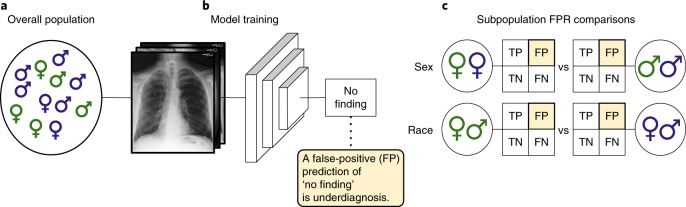
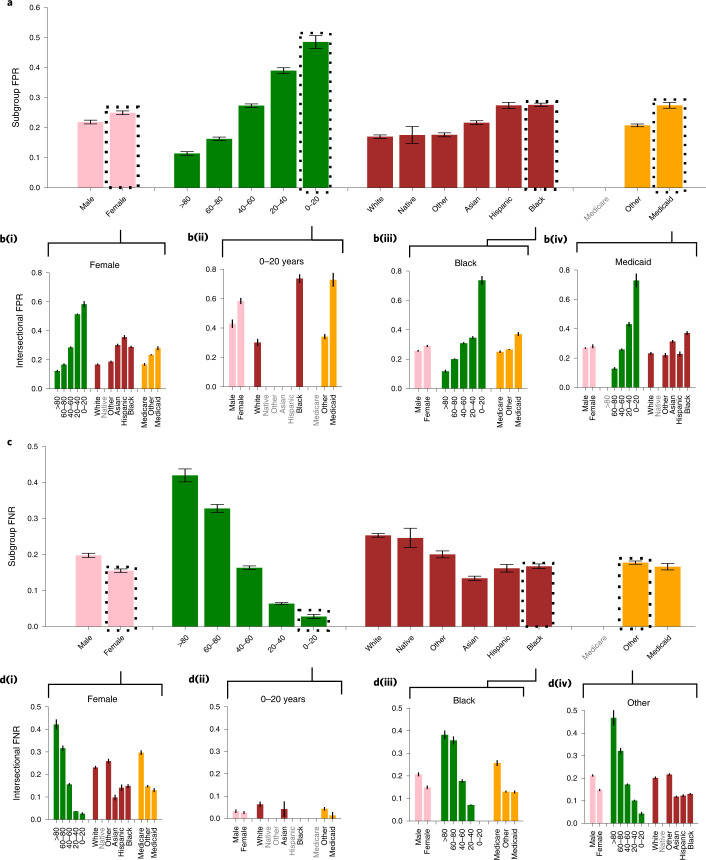
- Underdiagnosis rate, defined as the false-positive rate (FPR) for the “no finding” label, differed across all considered subpopulations. Female patients, patients under 20 years old, Black patients, Hispanic patients, and patients with Medicaid insurance had higher algorithmic underdiagnosis rates in the MIMIC-CXR dataset.
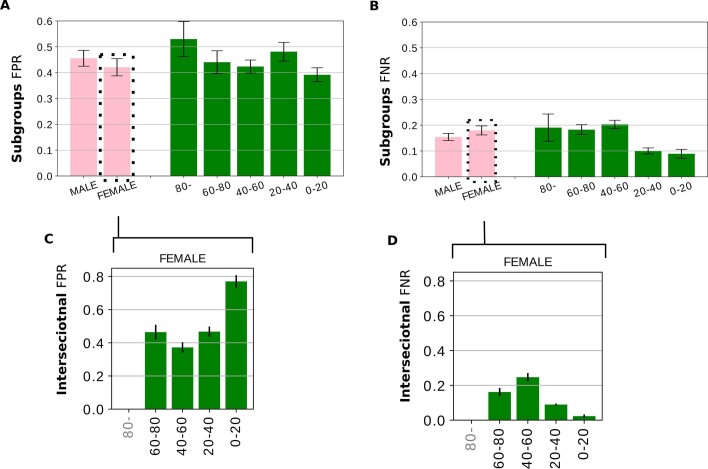
- Intersectional subgroups often had compounded bias. For example, Hispanic female patients had a higher underdiagnosis rate than white female patients, and patients aged 0–20 years who were female, Black, or had Medicaid insurance had the largest underdiagnosis rates.
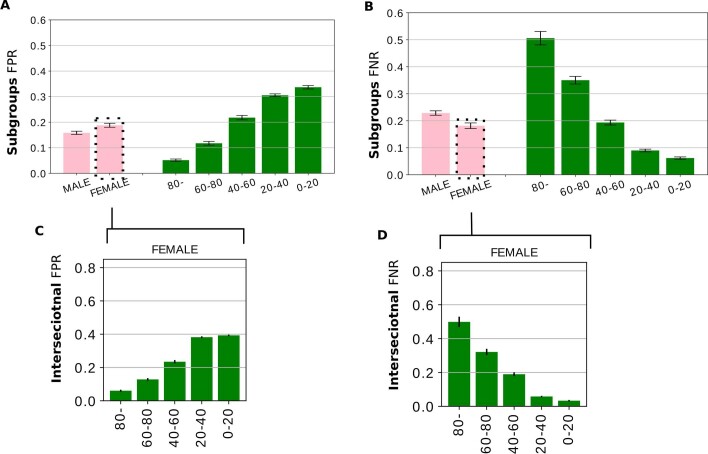
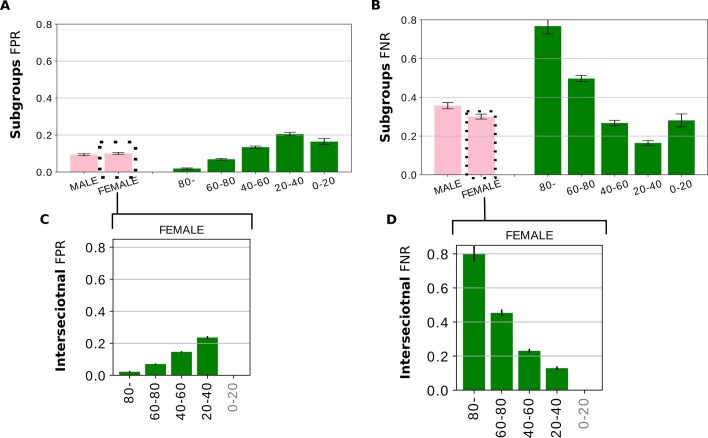
- FPR and false-negative rate (FNR) for “no finding” showed an inverse relationship across under-served subgroups, consistent with selective algorithmic underdiagnosis rather than undirected noise. This pattern held across datasets except for age >80 years and 0–20 years in the NIH dataset, possibly due to small sample sizes or dataset selection bias.
- Dataset sizes and model AUCs: MIMIC-CXR (371,858 images from 65,079 patients; AUC 0.834 ± 0.001), CheXpert (223,648 images from 64,740 patients; AUC 0.805 ± 0.001), ChestX-ray14/NIH (112,120 images from 30,805 patients; AUC 0.835 ± 0.002), and ALL (707,626 images from 129,819 patients; AUC 0.859 ± 0.001).
Methods
- Retrospective analysis of three public chest X-ray datasets—MIMIC-CXR, CheXpert, and ChestX-ray14 (NIH)—plus a multi-source ALL dataset combining them on shared labels. Subgroups included race/ethnicity, socioeconomic status via insurance type, sex, and age, with intersectional identities also examined.
- A 121-layer DenseNet initialized with ImageNet weights was trained on 256 × 256 images to predict diagnostic labels, including the “no finding” label. Train-validation-test splits were fixed, no patient was shared across splits, and results were averaged over five models with different random seeds.
- Fairness metrics were binarized: underdiagnosis rate as FPR for “no finding,” overdiagnosis as FNR for “no finding,” and false discovery rate (FDR) for “no finding.” A single threshold maximizing F1 score was selected for all groups; protected attributes were not used in model training or testing.
Limitations
- The paper states that prediction labels are extracted from clinical records and are therefore not unbiased ground truth; the labels may already contain the same bias the model then amplifies, a form of bias amplification. It also notes that automatic NLP-based labelers have not been audited across subpopulations and could be a large source of bias.
- The paper states that race and ethnicity are partially social constructs with unclear boundaries, and self-reported race/ethnicity may vary by age, socioeconomic level, or acculturation. Insurance type is described as an imperfect proxy for socioeconomic status.
- The paper states that post-hoc threshold adjustments for equal FNR and FPR have flaws: small intersectional groups make accurate thresholds difficult, the number of thresholds grows exponentially with protected attributes, and equalizing metrics may require randomization or worsening performance for some subgroups. The text also makes evident that the NIH dataset may have less diverse samples and small subgroup sizes, and that MIMIC-CXR lacks race/ethnicity and insurance data for around ~100,000 X-rays.
Model-written summary. Check it against the paper before relying on it.
Integrity signals
Registry
Cites
Statistics
Figures
Verification
Claims the paper makes
4 Valid · 1 Not valid · 16 Not checked · 53 Own results and interpretations
The cited sources support only part of this claim — read each source’s verdict below.
In the paper
“We note that some of our observed differences in underdiagnosis have been established in other areas in clinical care, such as underdiagnosis of female patients 9,10 , Black patients 5,8,9 and patients with a low socioeconomic status 36 .”
What the sources say
- Not checked yetcites [9] Mamary, A. J. et al. Race and gender disparities are evident in COPD underdiagnoses across all severities of measured airflow obstruction. Chronic Obstr. Pulm. Dis. 5, 177-184 (2018).
- Not checked yetcites [10] Sun, T. Y., Bear Don't Walk, O. J. IV, Chen, J. L., Reyes Nieva, H. & Elhadad, N. Exploring gender disparities in time to diagnosis. In Machine Learning for Health (ML4H) at NeurIPS 2020 (eds Alsentzer, E. et al.) abstr. https://arxiv. org/abs/2011.06100 (2020).
- Partly supportedcites [5] Obermeyer, Z., Powers, B., Vogeli, C. & Mullainathan, S. Dissecting racial bias in an algorithm used to manage the health of populations. Science 366, 447-453 (2019). sourceExperimental — accuracy not yet measured
Our copy supports only the racial element, and at a different level of specificity: it documents that at a given algorithm risk score Black patients carry significantly more illness burden (26.3% more chronic illnesses at the 97th percentile; more-severe hypertension, diabetes, renal failure and anemia; Health disparities conditional on risk score, pp. 3-4) and that less is spent on them conditional on need (Mechanism of bias, p. 5) — i.e. under-recognition of illness in an algorithmic/cost sense, not clinical underdiagnosis. Nothing in our copy addresses underdiagnosis of female patients (sex/gender appears only in the introduction's examples of ad delivery, facial recognition and hiring algorithms, p. 2, and as the descriptive statistic that the sample was 63% female, p. 2), and socioeconomic status appears only as barriers to accessing care that lower spending (Mechanism of bias, p. 5), not as established underdiagnosis. The female-patient and low-SES parts of the claim are therefore unsupported by this source. (LLM, conf=0.70)
- Partly supportedcites [8] Vyas, D. A., Eisenstein, L. G. & Jones, D. S. Hidden in plain sight: reconsidering the use of race correction in clinical algorithms. N. Engl. J. Med. 383, 874-882 (2020). sourceExperimental — accuracy not yet measured
Vyas et al. (2020) support only the Black-patient strand, and even there at a different level of specificity: the introduction states that 'many of these race-adjusted algorithms guide decisions in ways that may direct more attention or resources to white patients than to members of racial and ethnic minorities,' and the Cardiology section notes the AHA Get with the Guidelines score 'could direct care away from black patients' — i.e., a hedged equity concern about algorithms diverting care/resources, not an established rate of underdiagnosis. Our copy contains nothing on underdiagnosis of female patients (women appear only in Table 1 references on breast-density and bone-density tools) and nothing on underdiagnosis of low-socioeconomic-status patients; the only SES material is the quoted Society of Thoracic Surgeons concern that 'inclusion of SES factors in risk models may adjust away disparities in quality of care' (Assessment). The female-patient and low-SES parts of the attributed claim are therefore unsupported by this source. (LLM, conf=0.78)
- Partly supportedcites [36] Gianfrancesco, M. A., Tamang, S., Yazdany, J. & Schmajuk, G. Potential biases in machine learning algorithms using electronic health record data. JAMA Intern. Med. 178, 1544-1547 (2018). sourceExperimental — accuracy not yet measured
Our copy of Gianfrancesco et al. supports parts of the claim but not all of it: the Misclassification and Measurement Error section states that 'women may be less likely to receive lipid-lowering medications and in-hospital procedures, as well as optimal care at discharge, compared with men' and that patients 'may be differentially incorrectly diagnosed based on sociodemographic factors,' and the Missing Data section states that 'patients with low socioeconomic status may receive fewer diagnostic tests and medications for chronic diseases and have limited access to health care' and 'may only be identified if their disease becomes more severe' — hedged disparities in care/detection for women and low-SES patients, not established underdiagnosis. The part the source does not support is underdiagnosis of Black patients: the only Black/African-ancestry diagnostic-error passage (Sample Size and Underestimation) reports that 'patients with African and unspecified ancestry have been diagnosed with pathogenic genetic variants that were actually benign but misclassified,' i.e. genetic over-diagnosis credited to another study (Manrai et al., N Engl J Med 2016), not underdiagnosis. (LLM, conf=0.75)
boostedstates an association- Asserted: passes — The authors put it forward as true.
- Checkable: passes — It can be checked against evidence.
- Load-bearing: passes — The paper’s conclusions depend on it.
- Based: passes — The paper gives a reason why it holds.
- Rests on an assumption not shown here.
The cited sources support only part of this claim — read each source’s verdict below.
In the paper
“The choice of these subgroups is motivated by the clear history, in both traditional medicine and AI algorithms, of bias for subgroups on these axes 6,8,10,11 .”
What the sources say
- Partly supportedcites [6] Larrazabal, A. J. et al. Gender imbalance in medical imaging datasets produces biased classifiers for computer-aided diagnosis. Proc. Natl Acad. Sci. USA 117, 12592-12594 (2020). sourceExperimental — accuracy not yet measured
The Abstract says AI systems can inherit or amplify gender and racial bias, and Results and Discussion reports lower classifier performance for underrepresented genders. The paper does not establish a history of bias across socioeconomic status or age, or across all four axes in traditional medicine. The supplied passages have no page numbers. (LLM, conf=0.86)
- Partly supportedcites [8] Vyas, D. A., Eisenstein, L. G. & Jones, D. S. Hidden in plain sight: reconsidering the use of race correction in clinical algorithms. N. Engl. J. Med. 383, 874-882 (2020). sourceExperimental — accuracy not yet measured
The opening section describes race-based clinical algorithms that may direct more resources to white patients, and the Assessment section gives an example of racial bias in medical AI. The paper discusses socioeconomic status as relevant to these inequities, but the cited passages do not establish a history of bias across all four named axes: race, socioeconomic status, sex, and age. No page numbers are available in our copy. (LLM, conf=0.86)
- Not checked yetcites [10] Sun, T. Y., Bear Don't Walk, O. J. IV, Chen, J. L., Reyes Nieva, H. & Elhadad, N. Exploring gender disparities in time to diagnosis. In Machine Learning for Health (ML4H) at NeurIPS 2020 (eds Alsentzer, E. et al.) abstr. https://arxiv. org/abs/2011.06100 (2020).
- Not checked yetcites [11] Spencer, C. S., Gaskin, D. J. & Roberts, E. T. The quality of care delivered to patients within the same hospital varies by insurance type. Health Aff. (Milwood) 32, 1731-1739 (2013). source
boostedstates an association- Asserted: passes — The authors put it forward as true.
- Checkable: passes — It can be checked against evidence.
- Load-bearing: passes — The paper’s conclusions depend on it.
- Based: passes — The paper gives a reason why it holds.
- Partly supported
A result the paper reports from its own data — it cites no other source for it, so there is none to check. The quote shows it is in the paper.
In the paper
“The false-negative rate (FNR) for no finding (Fig. 2c) and FPR (Fig. 2a) show an inverse relationship across different under-served subgroups in the CXR dataset.”
plainstates an association- Asserted: passes — The authors put it forward as true.
- Checkable: passes — It can be checked against evidence.
- Load-bearing: passes — The paper’s conclusions depend on it.
- Based: passes — The paper gives a reason why it holds.
- Rests on an assumption not shown here.
A result the paper reports from its own data — it cites no other source for it, so there is none to check. The quote shows it is in the paper.
In the paper
“We observe that patients who belong to two under-served subgroups have a larger underdiagnosis rate.”
plainstates an association- Asserted: passes — The authors put it forward as true.
- Checkable: passes — It can be checked against evidence.
- Load-bearing: passes — The paper’s conclusions depend on it.
- Based: passes — The paper gives a reason why it holds.
- Rests on an assumption not shown here.
A result the paper reports from its own data — it cites no other source for it, so there is none to check. The quote shows it is in the paper.
In the paper
“We observe, across three large-scale datasets and a combined multi-source dataset, which under-served subpopulations are consistently at significant risk of algorithmic underdiagnosis.”
plainstates an association- Asserted: passes — The authors put it forward as true.
- Checkable: passes — It can be checked against evidence.
- Load-bearing: passes — The paper’s conclusions depend on it.
- Based: passes — The paper gives a reason why it holds.
- Rests on an assumption not shown here.
24 more claims
Create a free account to see all 74 claims and to verify the 27 references still open.
- Probably not a substantial claim. 29
- It may state two separate claims as one. 32
Claims other papers make about this one
Each is checked against this paper’s own text: does it say what the citing paper says it does?
The source backs part of the claim, not all of it — or backs it for a different population, condition or comparison.
In the citing paper
“Model trained on less and/or missing data leads to underestimation and underdiagnosis [49,127].”
From Artificial intelligence bias in medical system designs: a systematic review (2023) · cites this paper as [127]
Experimental — accuracy not yet measuredThe source backs part of the claim, not all of it — or backs it for a different population, condition or comparison.
In the citing paper
“The imbalanced data will result in specialized privileges to a specific group in the medical diagnosis [127].”
From Artificial intelligence bias in medical system designs: a systematic review (2023) · cites this paper as [127]
Experimental — accuracy not yet measuredThe source backs part of the claim, not all of it — or backs it for a different population, condition or comparison.
In the citing paper
“The majority of the studies have neglected kinship (more than 95%) and insurance (90%) attributes which are essential to identify socioeconomic status of the patient to prevent the underdiagnosis [127].”
From Artificial intelligence bias in medical system designs: a systematic review (2023) · cites this paper as [127]
Experimental — accuracy not yet measuredThe source backs part of the claim, not all of it — or backs it for a different population, condition or comparison.
In the citing paper
“In imaging, Seyyed-Kalantari et al 59 found that contemporary deep-learning classifiers applied to chest radiographs systematically failed to identify abnormalities in patients from historically marginalized groups including female patients, Black patients, and those of lower socioeconomic status with the most pronounced disparities at the intersections of these categories.”
From Artificial Intelligence in Oncology: Practical Applications Across Clinical Care, Scholarship, and Translation. (2026) · cites this paper as [59]
Experimental — accuracy not yet measuredThe source backs part of the claim, not all of it — or backs it for a different population, condition or comparison.
In the citing paper
“On the other hand, AI systems can also suffer from bias, compounding existing inequities in socioeconomic status, race, ethnicity, religion, gender, disability, or sexual orientation.”
From Bias in AI-based models for medical applications: challenges and mitigation strategies (2023) · cites this paper as [6]
Experimental — accuracy not yet measured
6 more claims about this paper
Create a free account to see every claim other papers make about this one.
Self-check
Percentages, sums and reported differences re-computed from the paper’s own numbers.
Each contradiction between two passages listed here was confirmed by an independent check.
Rated minor: it would not touch a result — a value no result rests on, a p-value that stays on the same side of the significance level, or a conflict that is clerical, resolved elsewhere in the paper, or outside its own findings.
In the paper
§ Dataset collection and inclusion criteria.
“FDR (or, equivalently, positive predictive value (PPV)) is a common metric used to evaluate the performance of classifiers.”
§ Dataset collection and inclusion criteria.
“FDRs i,j = P [ Y = 0|si,j, Ŷ = 1 ](3”
Rated minor: it would not touch a result — a value no result rests on, a p-value that stays on the same side of the significance level, or a conflict that is clerical, resolved elsewhere in the paper, or outside its own findings.
In the paper
“MIMIC-CXR (CXR, 371,858 images from 65,079 patients) 26 , CheXpert (CXP, 223,648 images from 64,740 patients) 27 , ChestX-ray14 (NIH, 112,120 images from 30,805 patients) 28 , and a multi-source combination of all three (ALL, 707,626 images from 129,819 patients) on shared labels.”
Reported 129819 · recomputed 160624
Citations
Cites
ImageNet Large Scale Visual Recognition Challenge
Russakovsky, O., Deng, J., Su, H., Krause, J., Satheesh, S., Ma, S., Huang, Z., Karpathy, A., Khosla, A., Bernstein, M., et al. (2015) · International Journal of Computer Vision · doi:10.1007/s11263-015-0816-y · Cited by 39,380
Goldberger, A. L., Amaral, L. A. N., Glass, L., Hausdorff, J. M., Ivanov, P. C., Mark, R. G., Mietus, J. E., Moody, G. B., Peng, C.-K., & Stanley, H. E. (2000) · Circulation · doi:10.1161/01.cir.101.23.e215 · Cited by 14,809
Dissecting racial bias in an algorithm used to manage the health of populations
Obermeyer, Z., Powers, B., Vogeli, C., & Mullainathan, S. (2019) · Science · doi:10.1126/science.aax2342 · Cited by 7,137 · cited 1×
“We note that some of our observed differences in underdiagnosis have been established in other areas in clinical care, such as under-diagnosis of female patients 9,10 , Black patients 5,8,9 and patients with a low socioeconomic status 36 .”
BackgroundWang, X., Peng, Y., Lu, L., Lu, Z., Bagheri, M., & Summers, R. M. (2017) · 2017 IEEE Conference on Computer Vision and Pattern Recognition (CVPR) · doi:10.1109/cvpr.2017.369 · Cited by 4,616 · cited 5×
“Fourth, despite the fact that we do not have the same disease prevalence between subgroups based on real data 26–28 , and our choice of fairness metrics does not directly involve prevalence between subgroups, we stress that equal underdiagnosis rates between sub-groups of age, sex and…”
BackgroundMethodInfluential(2018) · Cited by 3,510
Dwork, C., Hardt, M., Pitassi, T., Reingold, O., & Zemel, R. (2012) · Proceedings of the 3rd Innovations in Theoretical Computer Science Conference · doi:10.1145/2090236.2090255 · Cited by 3,501
Implementing Machine Learning in Health Care — Addressing Ethical Challenges
Char, D. S., Shah, N. H., & Magnus, D. (2018) · New England Journal of Medicine · doi:10.1056/nejmp1714229 · Cited by 1,857
MIMIC-CXR, a de-identified publicly available database of chest radiographs with free-text reports
Johnson, A. E. W., Pollard, T. J., Berkowitz, S. J., Greenbaum, N. R., Lungren, M. P., Deng, C.-Y., Mark, R. G., & Horng, S. (2019) · Scientific Data · doi:10.1038/s41597-019-0322-0 · Cited by 1,816 · cited 5×
“Fourth, despite the fact that we do not have the same disease prevalence between subgroups based on real data 26–28 , and our choice of fairness metrics does not directly involve prevalence between subgroups, we stress that equal underdiagnosis rates between sub-groups of age, sex and…”
BackgroundMethodInfluentialHidden in Plain Sight — Reconsidering the Use of Race Correction in Clinical Algorithms
Vyas, D. A., Eisenstein, L. G., & Jones, D. S. (2020) · New England Journal of Medicine · doi:10.1056/nejmms2004740 · Cited by 1,731 · cited 2×
“We note that some of our observed differences in underdiagnosis have been established in other areas in clinical care, such as under-diagnosis of female patients 9,10 , Black patients 5,8,9 and patients with a low socioeconomic status 36 .”
BackgroundA New, Evidence-based Estimate of Patient Harms Associated with Hospital Care
James, J. T. (2013) · Journal of Patient Safety · doi:10.1097/pts.0b013e3182948a69 · Cited by 1,399 · cited 1×
“Moreover, developers, practitioners and the clinical staff need to take into account biases such as the underdiagnosis of under-served populations in the AI-based medical decision-making algorithms and its harmful effect 17,18 on patients.”
Background
Research works printed but not linked: 3
- Cohen, J. P., Hashir, M., Brooks, R. & Bertrand, H. On the limits of cross-domain generalization in automated X-ray prediction. Proc. Mach. Learn. Res. 121, 136-155 (2020).
- Hardt, M., Price, E. & Srebro, N. Equality of opportunity in supervised learning. In Advances in Neural Information Processing Systems 29 (NIPS 2016) (eds Lee, D. et al.) 3315-3323.
- Johnson, A. et al. MIMIC-IV (version 0.4). PhysioNet https://doi.org/ 10.13026/a3wn-hq05 (2020). · DOI
Cited by
Items 801–900 of 989
Clinical artificial intelligence applications of vision-language foundation models
Thirunavukarasu, A. J., Li, S. Y., Qin, P., Nie, D., Sanghera, R., Lim, E., Yu, J., & Zhang, L. (2026) · PLOS Digital Health · doi:10.1371/journal.pdig.0001453
“Research has identified a particularly concerning bias in VLMs, where ethnic or gender disparities in diagnostic accuracy lead to the underdiagnosis of underserved patient populations [109–111].”
Lyle, K., Samuel, G. N., & Lucassen, A. (2026) · Sociology of Health & Illness · doi:10.1111/1467-9566.70205
AI in Healthcare: Promise, Pitfalls, and Future Directions
Nguyen, N. P., Le, T. D. V., Nguyen, N. G. U. Y. E. N., Truong, T. N., Chau, N. C., Nguyen, J., Nguyen, N. G. U. Y. E. N., Nguyen, T. U. O. N. G., Vu, L. T., & Nguyen, T. N. (2026) · TTU Journal of Science · doi:10.53901/tjs.2026.v01.issue02.art02
Shu, H., Chen, C.-J., McCoy, L. G., Wang, R., Kuo, P., & Celi, L. A. (2026) · PLOS Digital Health · doi:10.1371/journal.pdig.0001467
“…HF phenotype separation, performance alone is not sufficient: a growing body of evidence shows that healthcare AI systems can exhibit systematic biases [11–14] and disproportionately misclassify patients from historically underserved groups [15,16], including women and racial minorities [11,17].”
FairGen: preference-aligned diffusion for demographically equitable medical image synthesis
Li, Z., Zhang, R., Tan, Z., Aizenstein, H. J., Hu, J., & Chen, T. (2026) · npj Digital Medicine · doi:10.1038/s41746-026-02868-z · Cited by 1
“This matters because fairness interventions are often assumed to come with a sizable performance penalty 35 , particularly in settings linked to underdiagnosis for under-served populations 55 .”
Eskandar, K. (2026) · World Journal of Nephrology · doi:10.5527/wjn.v15.i2.117719 · Cited by 1
Nona, P. J., Firos, J. R. B., Zografos, C., Schuuring, M. J., Bhatt, A., & Andrikopoulou, E. (2026) · Current Heart Failure Reports · doi:10.1007/s11897-026-00766-9 · Cited by 1
“…and Hispanic patients, who are at higher risk for selective under-diagnosis or misclassification by biased models [ 35], and (c) older adults and low-income populations, who may be less digitally represented or have poorer-quality clinical data, compounding the risk of algorithmic error [ 8, 60].”
Guillen-Ramirez, H., Lucas, K. L., Wintsch, Y. M., Blatter, T. U., Triep, K., Endrich, O., & Beldi, G. (2026) · Journal of the American Medical Informatics Association · doi:10.64898/2026.06.15.26355656
Qian, Z. J., Brin, P., Korn, S. M., Cosenza, A., Zurl, H., Pohl, K. K., Pakpoor, J., Moore, C. M., Giganti, F., Trinh, Q., et al. (2026) · British Journal of Urology · doi:10.1111/bju.70345 · Cited by 2
In Zimbabwe, hoofbeats mean zebras: experiences of oncology decisions across health systems
Makova, K., & Chaunzwa, T. L. (2026) · The Lancet Regional Health - Africa · doi:10.1016/j.lanafr.2026.100096
Alcântara, A. C. S., Paiva, A. C., Silva, A. C., Ribeiro, C. C. C., Costa, E. P. F., Thomaz, É. B. A. F., Damos, F. S., Junior, G. B., Vélez, H. A. V., de Almeida, J. D. S., et al. (2026) · doi:10.5753/sbc.19871.1.3
Toward a Regional Standard: Minimum Competencies in AI for MERCOSUR. (Preprint)Preprint
González, R., Godoy, J. A. R., & Cubas, J. (2026) · doi:10.2196/preprints.105035
Chung, Y. (2026) · International Journal of Therapy and Rehabilitation · doi:10.12968/ijtr.2025.0131
Large reasoning models as thinking machines for medicine
Zhou, H.-Y., Rodman, A. M., Liu, P., Rajpurkar, P., Hu, Y., Wong, T. Y., & Topol, E. J. (2026) · Nature Biomedical Engineering · doi:10.1038/s41551-026-01701-y · Cited by 1
“Traditional AI might exhibit bias by underperforming in specific demographic groups 92 : for example, pulse oximetry algorithms showing reduced accuracy in patients with darker skin pigmentation.”
Lee, H., Sajid, K., & Lee, D. (2026) · Journal of Personalized Medicine · doi:10.3390/jpm16060332 · Cited by 1
“Multicenter evaluations have demonstrated that models with strong internal performance may still exhibit calibration drift after external deployment, emphasizing the importance of recalibration and ongoing monitoring [32].”
Acute medicine 2050: A connected future of care
Varia, R. (2026) · Future Healthcare Journal · doi:10.1016/j.fhj.2026.100530
“19 Machines may recognise patterns at scale, but only clinicians can understand fear, vulnerability and uncertainty.”
Xie, X., Liu, C., Liu, Y., & Zhou, Y. (2026) · Chinese general practice journal. · doi:10.1016/j.cgpj.2026.100114
Lusiana, N. (2026) · The International Journal of Medical Science and Health Research · doi:10.70070/w2zaj884
Public regulatory data infrastructure for lifecycle oversight of AI medical devicesPreprint
Han, Y., & Ceross, A. (2026) · Research Square · doi:10.21203/rs.3.rs-10095369/v1
Decoding Algorithmic Inequity: Reversing the Generative AI Racial Divide in Healthcare
Davidson, J., Fowe, I. E., Oderinde, A., & Fadeyi, S. A. (2026) · Clinical Therapeutics · doi:10.1016/j.clinthera.2026.06.015 · Cited by 2
Simon, D. J., Olorunsaiye, C. Z., Paul, B., & Djimbarnodji, E. (2026) · Violence and Gender · doi:10.1177/23267836261464970
AI In Leukemia Diagnostics: Complementing the Pathologist's Role
Das, S. K., & Das, K. K. (2026) · International Journal of Laboratory Hematology · doi:10.1111/ijlh.70193
“Performance should also be reported across relevant subgroups and operating conditions because pooled accuracy can conceal underperformance in rare leukemia subtypes, low-prevalence settings, or underrepresented patient groups [56].”
Spaczyńska-Kwiatkowska, M., Trzepizur, A., Slowik, K., & Socha, Z. (2026) · African Journal of Biomedical Research · doi:10.69980/ajbr.v29i1s.9844
Corvaglia, A., Montagna, M., Vignale, D., Palmisano, A., Pisu, F., Colombo, A., Liberotti, M., Soggetti, C., Denti, M., Rovere, P. Q., et al. (2026) · Research Square · doi:10.21203/rs.3.rs-9926339/v1
Achieving Equity in Generative Artificial Intelligence in Cardiovascular Medicine
Kulkarni, A., & Visweswaran, S. (2026) · JACC Advances · doi:10.1016/j.jacadv.2026.102967
Kim, Y., Choe, S., Jeong, S., Ding, J., Wang, X., Lee�, H., & Kim, B. (2026) · Journal of Clinical Neurology · doi:10.3988/jcn.2026.0312 · Cited by 1
“use, training population, exclusion criteria, 32,44,69 calibration, 21 known failure modes, subgroup performance, 22,32 uncertainty handling, 61 update policy, and limitations of saliency maps or other post-hoc explanations.”
InfluentialFairness in federated medical imaging: a systematic review through the dual fairness lens
Yu, P., Dong, Z., Dhelim, S., Feng, C.-M., & Kechadi, T. (2026) · Artificial Intelligence Review · doi:10.1007/s10462-026-11632-4
A mixture of ophthalmic foundation models enables mitigation of altitude-associated domain shift
Shi, P., Zhu, J., Xie, Y. D., Zhang, X., Yang, Y., Ju, L., Ren, T., Yan, F., Zhou, Y., Xiong, H., et al. (2026) · 中国科学通报:英文版 · doi:10.1016/j.scib.2026.07.012
Haupt, M., Bischoff, A., Atoubi, M., Thomas, R. P., & Maurer, M. H. (2026) · Diagnostics · doi:10.3390/diagnostics16132131
Patient trust dynamics in ai-based telemedicine: a social psychological systematic review
Sitepu, A., Apriasari, M. L., Yasmina, A., & Adhani, R. (2026) · Lentera Negeri · doi:10.29210/992460
“Concerns about algorithmic bias and unequal performance were especially important because they linked patient trust with social justice and governance (Celi et al., 2022; Seyyed-Kalantari et al., 2021; Schwartz et al., 2022; Goisauf et al., 2025).”
Writing a patient-oriented radiology report — Radiologists may be coming up short
Mezrich, J. L. (2026) · Clinical Imaging · doi:10.1016/j.clinimag.2026.110902
Test-fairness deep learning with influence score
Wu, J. C., Shih, C.-Y., Wu, N.-C., Chen, W.-W., Lu, H. H., & Lo, S. (2026) · PLOS Digital Health · doi:10.1371/journal.pdig.0001513
“Prior studies have reported clinically meaningful performance disparities associated with demographic or site-related factors, often driven by dataset composition, population heterogeneity, and acquisition protocols https://doi.org/10.1371/journal.pdig.0001513.g001 [7,8].”
InfluentialAI-Driven Clinical Decision Support Systems: Transforming Diagnostic Accuracy In Modern Healthcare
Pratyak, A. S. G. S. (2025) · International Journal of Advances in Signal and Image Sciences · doi:10.29284/2sz49210
AI bias and fairness in clinical applications
Mathur, S., & Rani, N. (2026) · Elsevier eBooks · doi:10.1016/b978-0-443-45374-8.00010-1
Understanding Harm Generated by Analytic Technique Bias from the Afro-communitarian Perspective
Ewuoso, C. (2026) · The New Bioethics · doi:10.1080/20502877.2026.2704315
Abdulkerimova, S. F., & Danilova, Y. A. (2026) · Real-World Data & Evidence · doi:10.37489/2782-3784-myrwd-107
Die KI-Achse: Allgemeine und modellabhängige Fehlermuster
Elsharkawy, A. E. (2026) · Essentials · doi:10.1007/978-3-662-74123-8_5
Erbay, H., & Baysal, Z. (2026) · Journal of Bioethical Inquiry · doi:10.1007/s11673-026-10593-1
Emergenz-Achse: Wenn aus Einzelmechanismen ein klinisches Risiko wird
Elsharkawy, A. E. (2026) · Essentials · doi:10.1007/978-3-662-74123-8_6
A Comprehensive Review of Deep Learning for COVID-19 and Pneumonia Classification Using Chest X-Ray
Grari, S., Doudach, L., Belkhou, K., Belfkih, S., Rhalem, W., Cherrah, Y., & Benba, A. (2026) · Lecture notes in networks and systems · doi:10.1007/978-3-032-30563-3_26
Wei, J. (2026) · Scientific Journal of Technology · doi:10.54691/85dt0r63
“[25-27] Segmentation models are exposed to similar risks.”
The Digital Pulse: The AI Transformation of Disease Prediction and Preventive Care
Khirwadkar, P., Mehata, D., Sharma, A., Singh, S., & Bhonsale, K. (2026) · IEEE International Conference on Intelligent Technologies for a Sustainable and Inclusive Future (ICITSIF) · doi:10.1109/icitsif69060.2026.11608479
Autonomous AI for Diabetic Retinopathy Screening: Evidence, Regulation, and Health-System Fit
Mehta, K., Patel, L., & Shah, M. (2026) · Clinical eHealth · doi:10.1016/j.ceh.2026.07.001 · Cited by 1
Toward Individualized Music Therapy: Integrating Artificial Intelligence and Neuroscience
Xiao, C., Li, T., Cao, J., Zhu, B., Li, Q., & Wei, J. (2026) · Mental Illness · doi:10.1155/mij/7902487 · Cited by 1
Assessing Utility-Leakage Trade-offs in Coreset Selection for Chest X-Ray Embeddings
Marzullo, A., Cajas, S. A., Celi, L. A., & Momi, E. D. (2026) · ACM International Conference on Bioinformatics, Computational Biology, and Health Informatics (ACM-BCB) · doi:10.1145/3807503.3819381
Compounding advantage: Medical AI and structural injustice
Nikolic, B. (2026) · Bioethics News · doi:10.1007/s40592-026-00305-1
An objective smartphone speech diagnostic aid for adolescent major depressive disorder
Yan, J., Liyanage, B. N., Zhang, K., Kang, S., Zhu, Z., Cui, Z., Bai, Y., Sun, Y., Li, W., Mo, Y., et al. (2026) · npj Digital Medicine · doi:10.1038/s41746-026-03068-5 · Cited by 1
Self-citationTank, B., Patel, M., & Das, S. (2026) · International Journal of Aquatic Research and Environmental Studies · doi:10.70102/ijares/v6i2/6-2-717
Eshun, I. (2026) · Journal of Aging and Health · doi:10.1177/08982643261474654
When Innovation Leaves People Behind: Reframing Accountability in Commercial Digital Health
Dambha‐Miller, H., Smith, L., & Michels, L. V. (2026) · Journal of Medical Internet Research · doi:10.2196/100654
“Seyyed-Kalantari et al [9] demonstrated underdiagnosis bias in deep learning systems applied to chest radiographs among underserved populations despite comparable aggregate performance.”
Farias, L. G. M., Siqueira, A. C. C., Santos, K. F. A. D., Cássio, Z. I. N. I., & Linder, T. E. (2026) · BioSCIENCE · doi:10.55684/2026.84.en.e00019
Ojukwu, G., Mamah, C. J., Okwu, S., Oladimeji, A. O., Balogun, I. O., & Odok, O. M. (2026) · Cureus · doi:10.7759/cureus.114001
“Most observational and validation studies concluded that AI systems trained on imbalanced data were more likely to exhibit higher underdiagnosis rates, lower sensitivity, or lower positive predictive values for non-White patients than for White patients [7,9].”
InfluentialZablah, I., Hernandez, E., Garcia, F., Zuniga, A., & Loureiro, A. G. (2026) · LACCEI International Multi-Conference for Engineering, Education and Technology (LACCEI) · doi:10.18687/laccei2026.1.1.1229
The Role of Artificial Intelligence in Surgical Safety
Rad, A. A., Hon, J. J., Al-Omari, A., Androutsopoulou, V. A., Zotos, P.-A., & Nia, P. S. (2026) · Springer eBooks · doi:10.1007/978-3-032-26073-4_22
Mehda, R., Oishi, R. A., Alam, T. T., Morol, M. K., & Hui, L. T. (2026) · Frontiers in Digital Health · doi:10.3389/fdgth.2026.1904053
“Chest radiograph classifiers underdiagnose women, Black patients, and the medically underserved, and the effect is largest for patients who fall into more than one of those groups (10).”
Öney, B. (2026) · Computer Methods and Programs in Biomedicine · doi:10.1016/j.cmpb.2026.109596
Innocent, D. C., Innocent, R. C., & Innocent, I. P. (2026) · Frontiers in Digital Health · doi:10.3389/fdgth.2026.1900500
“Transparent (30, 31).”
Ho, Q. T., Bui, N. H., Tran, T. D., Khuat, Q. H., Tran, N. T., Le, X. C., Nguyen, H. Q., Nguyen, T. T., Nguyen, V. T., Mai, D. T., et al. (2026) · Journal of Imaging · doi:10.3390/jimaging12080364
“Utilizing this dataset enhances model reliability and improves demographic representation in global medical AI development [12,13].”
Traoré, M., Coulibaly, A., Dembele, S., & Diallo, B. (2025) · Pharmacophore · doi:10.51847/3i8xro74vf
Towards Equitable AI for Healthcare in Africa: Why Representative Data Matter
Abhadiomhen, S. E., & Oyibo, K. (2026) · Lecture notes of the Institute for Computer Sciences, Social Informatics and Telecommunications Engineering · doi:10.1007/978-3-032-33957-7_32
Gestalt-GNN: Multimodal ROI Reasoning for Uncertainty-Aware Chest X-Ray Multi-Label Classification
Vemula, S., & Sinko, A. (2026) · IEEE International Conference on Healthcare Informatics (ICHI) · doi:10.1109/ichi69079.2026.00140
“More concerning, Seyyed-Kalantari et al. demonstrated systematic underdiagnosis in minority populations using chest X-ray AI, with false-negative rates elevated by 15-30% compared to majority groups [4].”
Tanaka, K., Kobayashi, Y., & Nakamura, T. (2025) · Archives of Pharmacy Practice · doi:10.51847/93lgpx91jn
Why Better Predictions Can Still Produce Worse Pharmacy Decisions
Wilson, E., Jong, F. D., & Peters, L. (2025) · Archives of Pharmacy Practice · doi:10.51847/699h8jfrox
Al-Fahd, S., Al-Khalifa, N., & Al-Turki, O. (2025) · Archives of Pharmacy Practice · doi:10.51847/rot7tcfrhd
The Gender Data Gap in Medical AI: Causes, Consequences, and Building Inclusive Solutions
Taleghani, S., & Dolatabadi, E. (2026) · Springer eBooks · doi:10.1007/978-3-032-22368-5_4
Building an Explainability Contract between Clinical Algorithms and Practicing Pharmacists
Anderson, M., Wong, L., & Lee, S. (2025) · Archives of Pharmacy Practice · doi:10.51847/rgnlce8u0w
Large language models in spine care and research
Galbusera, F., & Cina, A. (2026) · European Spine Journal · doi:10.1007/s00586-026-10204-y
Multimodal Pharmacy Intelligence for Linking Prescriptions, Symptoms, Laboratory Trends, Images, and
Morales, S., Rojas, L., Vega, C., & Molina, D. (2026) · Archives of Pharmacy Practice · doi:10.51847/sfkaknfouo
O'Connor, P., Murphy, G., & Walsh, N. (2026) · Archives of Pharmacy Practice · doi:10.51847/9r2qj1nnzc
Translating Algorithmic Uncertainty into Actionable Medication Advice
Zayed, O., Ibrahim, L., & Mansour, A. (2025) · Archives of Pharmacy Practice · doi:10.51847/a5cyik22em
Measuring Pharmacy Artificial Intelligence by Avoided Harm, Recovered Time, and Better Decisions
Rodrigues, A., Martins, T., & Lopes, B. (2025) · Archives of Pharmacy Practice · doi:10.51847/zwjuagnerk
The invisible risk trust framework: a decentralized consensus protocol for validating medical AI
Shih, P. F. (2026) · Frontiers in Blockchain · doi:10.3389/fbloc.2026.1809318
Designing Large Language Models That Refuse Unsafe Medication Questions Well
Costa, G., Ribeiro, L., Alves, R., & Lopes, M. (2026) · Archives of Pharmacy Practice · doi:10.51847/msrqginb22
Conversational Pharmacovigilance That Preserves the Patient’s Narrative
Bennett, O., Collins, H., Foster, J., & Wright, E. (2026) · Archives of Pharmacy Practice · doi:10.51847/hsmlawfbcn
Detecting Workflow Drift before Pharmacy Algorithms Learn the Wrong Practice
Dupuis, C., Perrin, H., Morel, E., & Martin, T. (2026) · Archives of Pharmacy Practice · doi:10.51847/78i64l2m3e
The Geometry of Bias in Contrastive Embeddings: A Spectral Analysis
Ogbuokiri, B., Rahman, H., Martin, D., Sproxton, K., Belcastro, A., Huang, R., & Panchal, V. (2026) · Communications in computer and information science · doi:10.1007/978-3-032-22190-2_21
Babu, A. M., Nehemiah, A. J., Jagadeep, V., Suji, R. A., & Nallusamy, P. (2026) · Frontiers in Digital Health · doi:10.3389/fdgth.2026.1890072
“…an often-quoted study indicated that a commercial risk-prediction algorithm systematically underserved Black patients by using the cost of health care as a proxy for need (68) and classifiers based on chest radiographs have been demonstrated to under-diagnose historically under-served groups (69).”
Al-Hinai, S., Al-Balushi, A., Al-Maskari, M., & Al-Mahruqi, S. (2025) · International Journal Of Pharmaceutical Research And Allied Sciences · doi:10.51847/rkunyfkwdf
Amer, S., & Kaphle, R. (2026) · International Journal of Computer Applications · doi:10.5120/ijca7eb1d4f4f509
Fairness-Aware Evaluation of Classical Machine Learning Models for Glaucoma Detection in OCT Images
Soares, P. A., Silva, A. M. T. C., Carneiro, M. L., Nascimento, T. H., Soares, F. A. A. D. M. N., & Félix, J. P. (2026) · IEEE Annual International Computer Software and Applications Conference (COMPSAC) · doi:10.1109/compsac69091.2026.00293
Ratti, E., & Zuchowski, L. C. (2026) · Studies in History and Philosophy of Science Part A · doi:10.1016/j.shpsa.2026.102202
Wang, T., Vivas-Valencia, C., Bauer, C., Gong, Y., Choo, K.-K. R., & Guo, Y. (2026) · Journal of Healthcare Informatics Research · doi:10.1007/s41666-026-00251-x
Explainable Vision-Language Feature Learning for Autism Spectrum Disorder Screening
Elasri, A., Benjilali, K., Cherradi, H., Hamida, S., Cherradi, B., & Bouattane, O. (2026) · International Conference on Circuit, Systems and Communication (ICCSC) · doi:10.1109/iccsc71566.2026.11650512
“…explicit rather than hide them behind a single accuracy value, we report calibration, robustness, and interpretability analyses and recommend use only under qualified clinical supervision, consistent with broader concerns about bias and reliability in medical artificial intelligence systems [25].”
Moral Residue After Algorithmic Advice
Zhang, W., Hui, C., & Tan, M. (2026) · Asian Journal of Ethics in Health and Medicine · doi:10.51847/z27fe6xlxk
Legal and Ethical Considerations of Artificial Intelligence in Medical Imaging in India
Upadhyaya, V., Mithal, V., Gupta, A., Rangarajan, K., & Kandasamy, D. (2026) · Indian journal of radiology and imaging - new series/Indian journal of radiology and imaging/Indian Journal of Radiology & Imaging · doi:10.1055/s-0046-1827766
AI-Enabled Real-World Evidence in Oncology: A Statistical Perspective for Regulatory Decisions
Gao, L., Feng, D., & Yu, B. (2026) · Therapeutic Innovation & Regulatory Science · doi:10.1007/s43441-026-01036-5
“Such AI systems can embed bias and reduce performance when applied to the under-served population [ 56].”
The Right to a Human Reason: Contestability in High-Stakes Clinical Decisions
Mendoza, R., Cruz, I., & Lopez, C. (2026) · Asian Journal of Ethics in Health and Medicine · doi:10.51847/ilmwibqstd
Singh, D. B., Dangi, Y., & Pokharel, B. P. (2026) · Health Science Reports · doi:10.1002/hsr2.73117
Jahan, I., Ahmed, T., Antor, M. S. U. M., Hridoy, H. R., Podder, N. K., & Khan, I. (2026) · International Conference on Power, Electronics, Communications, Computing, and Intelligent Infrastructure (PECCII) · doi:10.1109/peccii70991.2026.11661962
“It has also been demonstrated that AI systems could not perform well in underserved populations, and there is the risk of underdiagnosis and unequal clinical benefit [5].”
Refined Exclusion in Medical AI: Data Justice and Patient Safety Governance
Lee, J. H., Choi, B., Jeong, K., Suh, S. W., Kim, J. H., & Son, D. (2026) · Journal of Medical Internet Research · doi:10.2196/102359
“Chest radiograph classifiers have demonstrated underdiagnosis disparities across demographic and intersectional groups [14].”
Xu, Z., Huang, Q., Tian, G., Liu, Q., & Wu, K. (2026) · Techniques and Innovations in Gastrointestinal Endoscopy · doi:10.1016/j.tige.2026.250988
When Statistics Meet AI, or How to Not Show Your Results to the Scientific Community
Úbeda, P. L., Martín‐Noguerol, T., & Luna, A. (2026) · Academic Radiology · doi:10.1016/j.acra.2026.08.008
EcoFair: Energy-efficient inference routing for edge AI under data degradation
Anoosha, M., Thakker, D., Paxton, K., Aslansefat, K., Mishra, B. K., Ahmad, B., & Kureshi, R. R. (2026) · Ad Hoc Networks · doi:10.1016/j.adhoc.2026.104403
“Deployed systems may show uneven behaviour across demographic groups, acquisition conditions, and lesion presentations [18].”
The data that biomedical AI still needs
Glicksberg, B. S. (2026) · Frontiers in Science · doi:10.3389/fsci.2026.1913108
“They are collected unevenly across individuals and places, and models trained on these data inherit and amplify those gaps; AI applied to underserved populations can systematically underdiagnose them (6).”
Ashraf, K., Hosen, M. H., Farah, N. T., Morol, M. K., Liew, T. H., Nandi, D., Rahman, M., & Jubair, A. A. (2026) · Frontiers in Digital Health · doi:10.3389/fdgth.2026.1862236
Tasnim, S., Xue, Y., & Abdu, N. (2026) · IRBM · doi:10.1016/j.irbm.2026.100960
AI for Opportunistic Identification of BMD and Bone Microarchitecture: A Narrative Review
Ziegeler, K., & Majumdar, S. (2026) · Calcified Tissue International · doi:10.1007/s00223-026-01597-5
“…are further consistent cross-cutting themes; systematic underdiagnosis by imaging AI models has been demonstrated particularly in patient groups underrepresented in training data, which in an opportunistic screening context could paradoxically widen rather than close existing care gaps [47 ].”
Ahmed, A. A., Adeshina, S. A., Aleshinloye, Y. A., Ogundokun, R. O., & Owolawi, P. A. (2026) · Intelligence-Based Medicine · doi:10.1016/j.ibmed.2026.100475
Kumar, R., Sharma, N., Deshmukh, A., Nair, A., & Pillai, M. (2022) · Journal of Artificial Intelligence for Healthcare Systems · doi:10.68159/l244649356
Chen, W., & Zhang, L. (2021) · Journal of Health Informatics and Digital Systems · doi:10.68159/u314569264
Metadata
- Authors
- Seyyed-Kalantari, L., Zhang, H., McDermott, M. B. A., Chen, I. Y., & Ghassemi, M.
- Affiliations
- University of Toronto (CA)
- Massachusetts Institute of Technology (US)
- Vector Institute (CA)
- Corresponding author
- Seyyed-Kalantari, Laleh
- Venue
- Nature Medicine
- Published
- 2021-12
- Volume
- 27
- Issue
- 12
- Pages
- 2176-2182
- ISSN
- 1078-8956 (ISSN-L)
- 1546-170X
- PMC
- PMC8674135
- OpenAlex
- W4200191097
- Cited by
- 928
- References
- 47
- Citations by year
- 2026: 298 · 2025: 239 · 2024: 199 · 2023: 146 · 2022: 42 · 2021: 4
- FWCI
- 27.63
- Type
- journal article
- Language
- en
- Open access
- hybrid
- doi.org
- Licence
- cc-by
- creativecommons.org/licenses/by/4.0 (tdm)
- creativecommons.org/licenses/by/4.0 (vor, 9 d)
- Locations
- Nature Medicine (publishedVersion, cc-by)
- Research Square (acceptedVersion, cc-by)
- PubMed Central (publishedVersion, cc-by)
- PubMed (publishedVersion)
- Funders
- Microsoft Research
- Canadian Institute for Advanced Research
- Natural Sciences and Engineering Research Council of Canada (PDF-516984)
- Topics
- Health Sciences › Medicine › Health Informatics › Artificial Intelligence in Healthcare and Education
- Physical Sciences › Computer Science › Artificial Intelligence › Ethics and Social Impacts of AI
- Health Sciences › Medicine › Radiology, Nuclear Medicine and Imaging › COVID-19 diagnosis using AI
- Keywords
- algorithmic bias, underdiagnosis, chest X-ray classification, artificial intelligence in medical imaging, underserved populations, health disparities, algorithmic fairness, health care access, Black patients, Hispanic patients, female patients, low socioeconomic status
- MeSH terms
- Adolescent, Algorithms, Artificial Intelligence, Child, Child, Preschool, Female, Humans, Infant, Infant, Newborn, Male, Radiography, Thoracic, Vulnerable Populations, Young Adult, Datasets as Topic
About these checks
Registry, retraction, Cites and statistics results are computed, not judged, with one exception: a printed reference that no index lists is read once by a model before it counts as a citation error. Claims are extracted by a model and kept only when their quote appears verbatim in the text; each cited source is then checked, with a model’s help, for whether it says what the claim relies on. Those verdicts can be wrong — read the claim’s quote and the cited source before relying on one.
The claim verdicts this report counts are experimental: their accuracy is not yet measured.
A language model drew the claims from the paper on 2026-10-04, under version 3 of the claim definition (model deepseek-v4.1-flash, prompt extract-v3).
A second model labelled each claim on 2026-10-04 (model jev-1.13-20260917, definition revision gold-guideline-v0.2).
Cited sources are checked with a language model’s help (qwen3.8-omni-flash and gpt-6-sol).
Statistics and arithmetic are recomputed, not judged.
Confidence bands are shown only for fields calibrated on our annotated test set. None is calibrated yet, so no band is shown.
What counts as a claim ›How we measure confidence ›How we check this ›
Are you an author, or do you see a problem with this page? Request a review
Data sources
Bibliographic data: Semantic Scholar, OpenAlex, Crossref.
Contains information from the Semantic Scholar Academic Graph Datasets, made available under the ODC Attribution License (ODC-BY 1.0).
Semantic Scholar’s data is described in: Kinney, R., et al. (2023). The Semantic Scholar Open Data Platform. arXiv:2301.10140.
