

Underdiagnosis bias of artificial intelligence algorithms applied to chest radiographs in under-served patient populations
Open accessPublished version of a preprint
The DOI matches its Crossref record; 49 of the 49 references it cites were found in a registry or an index; 7 of the 34 sources its claims cite were checked for support.
Abstract
Artificial intelligence (AI) systems have increasingly achieved expert-level performance in medical imaging applications. However, there is growing concern that such AI systems may reflect and amplify human bias, and reduce the quality of their performance in historically under-served populations such as female patients, Black patients, or patients of low socioeconomic status. Such biases are especially troubling in the context of underdiagnosis, whereby the AI algorithm would inaccurately label an individual with a disease as healthy, potentially delaying access to care. Here, we examine algorithmic underdiagnosis in chest X-ray pathology classification across three large chest X-ray datasets, as well as one multi-source dataset. We find that classifiers produced using state-of-the-art computer vision techniques consistently and selectively underdiagnosed under-served patient populations and that the underdiagnosis rate was higher for intersectional under-served subpopulations, for example, Hispanic female patients. Deployment of AI systems using medical imaging for disease diagnosis with such biases risks exacerbation of existing care biases and can potentially lead to unequal access to medical treatment, thereby raising ethical concerns for the use of these models in the clinic.
Overview
CoChat Summary
TL;DR
This study evaluates algorithmic underdiagnosis bias in chest X-ray classifiers across three large public datasets and a combined multi-source dataset. It finds that models consistently and selectively underdiagnose under-served subpopulations, especially intersectional groups, raising concerns for clinical deployment and triage.
Key findings
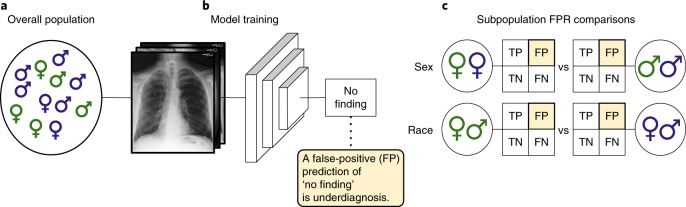
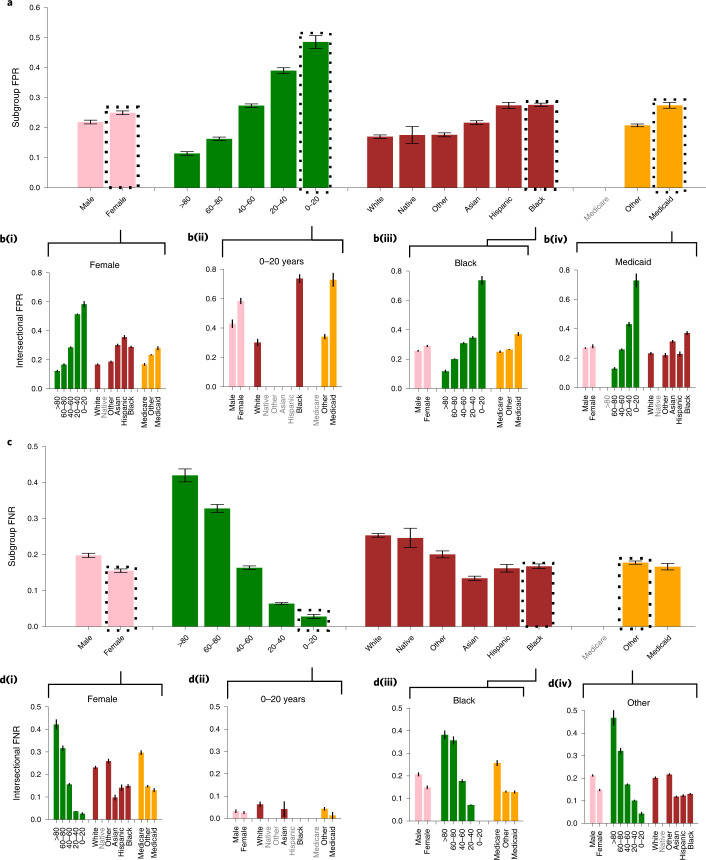
- Underdiagnosis rate, defined as the false-positive rate (FPR) for the “no finding” label, differed across all considered subpopulations. Female patients, patients under 20 years old, Black patients, Hispanic patients, and patients with Medicaid insurance had higher algorithmic underdiagnosis rates in the MIMIC-CXR dataset.
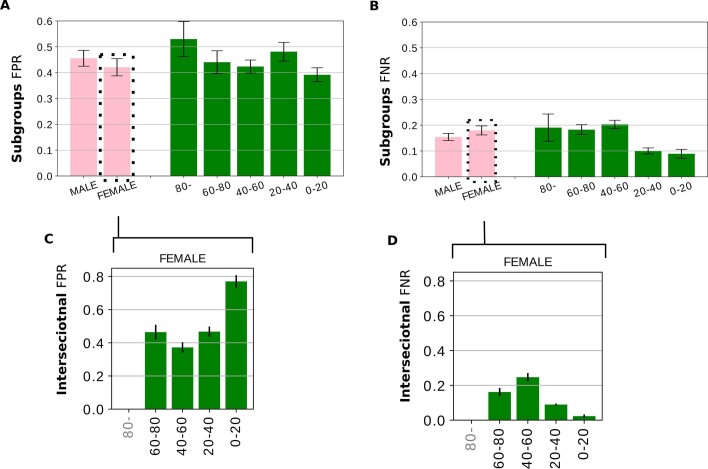
- Intersectional subgroups often had compounded bias. For example, Hispanic female patients had a higher underdiagnosis rate than white female patients, and patients aged 0–20 years who were female, Black, or had Medicaid insurance had the largest underdiagnosis rates.
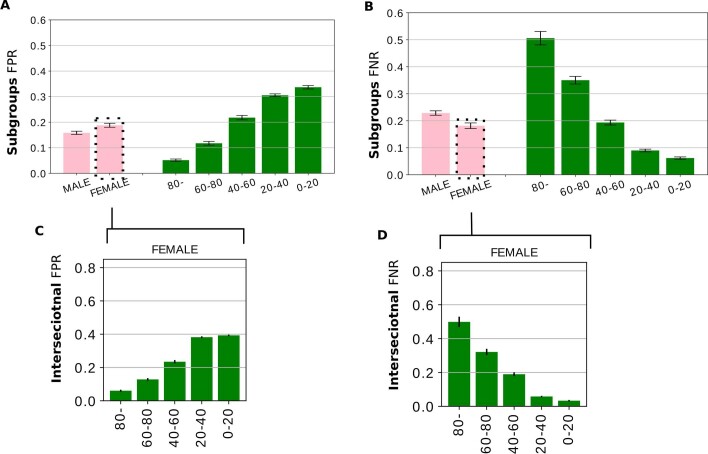
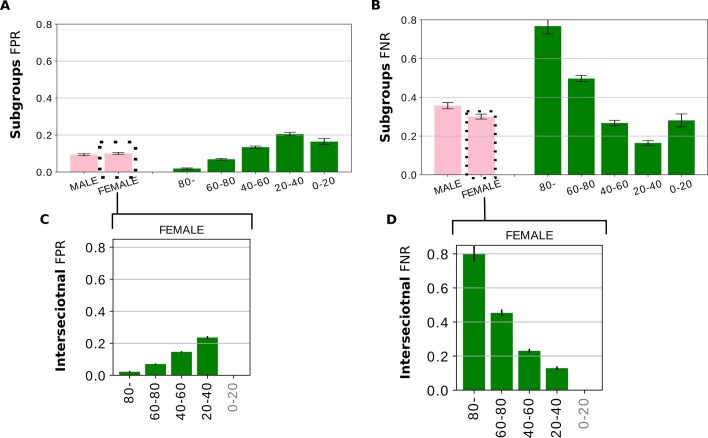
- FPR and false-negative rate (FNR) for “no finding” showed an inverse relationship across under-served subgroups, consistent with selective algorithmic underdiagnosis rather than undirected noise. This pattern held across datasets except for age >80 years and 0–20 years in the NIH dataset, possibly due to small sample sizes or dataset selection bias.
- Dataset sizes and model AUCs: MIMIC-CXR (371,858 images from 65,079 patients; AUC 0.834 ± 0.001), CheXpert (223,648 images from 64,740 patients; AUC 0.805 ± 0.001), ChestX-ray14/NIH (112,120 images from 30,805 patients; AUC 0.835 ± 0.002), and ALL (707,626 images from 129,819 patients; AUC 0.859 ± 0.001).
Methods
- Retrospective analysis of three public chest X-ray datasets—MIMIC-CXR, CheXpert, and ChestX-ray14 (NIH)—plus a multi-source ALL dataset combining them on shared labels. Subgroups included race/ethnicity, socioeconomic status via insurance type, sex, and age, with intersectional identities also examined.
- A 121-layer DenseNet initialized with ImageNet weights was trained on 256 × 256 images to predict diagnostic labels, including the “no finding” label. Train-validation-test splits were fixed, no patient was shared across splits, and results were averaged over five models with different random seeds.
- Fairness metrics were binarized: underdiagnosis rate as FPR for “no finding,” overdiagnosis as FNR for “no finding,” and false discovery rate (FDR) for “no finding.” A single threshold maximizing F1 score was selected for all groups; protected attributes were not used in model training or testing.
Limitations
- The paper states that prediction labels are extracted from clinical records and are therefore not unbiased ground truth; the labels may already contain the same bias the model then amplifies, a form of bias amplification. It also notes that automatic NLP-based labelers have not been audited across subpopulations and could be a large source of bias.
- The paper states that race and ethnicity are partially social constructs with unclear boundaries, and self-reported race/ethnicity may vary by age, socioeconomic level, or acculturation. Insurance type is described as an imperfect proxy for socioeconomic status.
- The paper states that post-hoc threshold adjustments for equal FNR and FPR have flaws: small intersectional groups make accurate thresholds difficult, the number of thresholds grows exponentially with protected attributes, and equalizing metrics may require randomization or worsening performance for some subgroups. The text also makes evident that the NIH dataset may have less diverse samples and small subgroup sizes, and that MIMIC-CXR lacks race/ethnicity and insurance data for around ~100,000 X-rays.
Model-written summary. Check it against the paper before relying on it.
Integrity signals
Registry
Cites
Statistics
Figures
Verification
Claims the paper makes
4 Valid · 1 Not valid · 16 Not checked · 53 Own results and interpretations
The cited sources support only part of this claim — read each source’s verdict below.
In the paper
“We note that some of our observed differences in underdiagnosis have been established in other areas in clinical care, such as underdiagnosis of female patients 9,10 , Black patients 5,8,9 and patients with a low socioeconomic status 36 .”
What the sources say
- Not checked yetcites [9] Mamary, A. J. et al. Race and gender disparities are evident in COPD underdiagnoses across all severities of measured airflow obstruction. Chronic Obstr. Pulm. Dis. 5, 177-184 (2018).
- Not checked yetcites [10] Sun, T. Y., Bear Don't Walk, O. J. IV, Chen, J. L., Reyes Nieva, H. & Elhadad, N. Exploring gender disparities in time to diagnosis. In Machine Learning for Health (ML4H) at NeurIPS 2020 (eds Alsentzer, E. et al.) abstr. https://arxiv. org/abs/2011.06100 (2020).
- Partly supportedcites [5] Obermeyer, Z., Powers, B., Vogeli, C. & Mullainathan, S. Dissecting racial bias in an algorithm used to manage the health of populations. Science 366, 447-453 (2019). sourceExperimental — accuracy not yet measured
Our copy supports only the racial element, and at a different level of specificity: it documents that at a given algorithm risk score Black patients carry significantly more illness burden (26.3% more chronic illnesses at the 97th percentile; more-severe hypertension, diabetes, renal failure and anemia; Health disparities conditional on risk score, pp. 3-4) and that less is spent on them conditional on need (Mechanism of bias, p. 5) — i.e. under-recognition of illness in an algorithmic/cost sense, not clinical underdiagnosis. Nothing in our copy addresses underdiagnosis of female patients (sex/gender appears only in the introduction's examples of ad delivery, facial recognition and hiring algorithms, p. 2, and as the descriptive statistic that the sample was 63% female, p. 2), and socioeconomic status appears only as barriers to accessing care that lower spending (Mechanism of bias, p. 5), not as established underdiagnosis. The female-patient and low-SES parts of the claim are therefore unsupported by this source. (LLM, conf=0.70)
- Partly supportedcites [8] Vyas, D. A., Eisenstein, L. G. & Jones, D. S. Hidden in plain sight: reconsidering the use of race correction in clinical algorithms. N. Engl. J. Med. 383, 874-882 (2020). sourceExperimental — accuracy not yet measured
Vyas et al. (2020) support only the Black-patient strand, and even there at a different level of specificity: the introduction states that 'many of these race-adjusted algorithms guide decisions in ways that may direct more attention or resources to white patients than to members of racial and ethnic minorities,' and the Cardiology section notes the AHA Get with the Guidelines score 'could direct care away from black patients' — i.e., a hedged equity concern about algorithms diverting care/resources, not an established rate of underdiagnosis. Our copy contains nothing on underdiagnosis of female patients (women appear only in Table 1 references on breast-density and bone-density tools) and nothing on underdiagnosis of low-socioeconomic-status patients; the only SES material is the quoted Society of Thoracic Surgeons concern that 'inclusion of SES factors in risk models may adjust away disparities in quality of care' (Assessment). The female-patient and low-SES parts of the attributed claim are therefore unsupported by this source. (LLM, conf=0.78)
- Partly supportedcites [36] Gianfrancesco, M. A., Tamang, S., Yazdany, J. & Schmajuk, G. Potential biases in machine learning algorithms using electronic health record data. JAMA Intern. Med. 178, 1544-1547 (2018). sourceExperimental — accuracy not yet measured
Our copy of Gianfrancesco et al. supports parts of the claim but not all of it: the Misclassification and Measurement Error section states that 'women may be less likely to receive lipid-lowering medications and in-hospital procedures, as well as optimal care at discharge, compared with men' and that patients 'may be differentially incorrectly diagnosed based on sociodemographic factors,' and the Missing Data section states that 'patients with low socioeconomic status may receive fewer diagnostic tests and medications for chronic diseases and have limited access to health care' and 'may only be identified if their disease becomes more severe' — hedged disparities in care/detection for women and low-SES patients, not established underdiagnosis. The part the source does not support is underdiagnosis of Black patients: the only Black/African-ancestry diagnostic-error passage (Sample Size and Underestimation) reports that 'patients with African and unspecified ancestry have been diagnosed with pathogenic genetic variants that were actually benign but misclassified,' i.e. genetic over-diagnosis credited to another study (Manrai et al., N Engl J Med 2016), not underdiagnosis. (LLM, conf=0.75)
boostedstates an association- Asserted: passes — The authors put it forward as true.
- Checkable: passes — It can be checked against evidence.
- Load-bearing: passes — The paper’s conclusions depend on it.
- Based: passes — The paper gives a reason why it holds.
- Rests on an assumption not shown here.
The cited sources support only part of this claim — read each source’s verdict below.
In the paper
“The choice of these subgroups is motivated by the clear history, in both traditional medicine and AI algorithms, of bias for subgroups on these axes 6,8,10,11 .”
What the sources say
- Partly supportedcites [6] Larrazabal, A. J. et al. Gender imbalance in medical imaging datasets produces biased classifiers for computer-aided diagnosis. Proc. Natl Acad. Sci. USA 117, 12592-12594 (2020). sourceExperimental — accuracy not yet measured
The Abstract says AI systems can inherit or amplify gender and racial bias, and Results and Discussion reports lower classifier performance for underrepresented genders. The paper does not establish a history of bias across socioeconomic status or age, or across all four axes in traditional medicine. The supplied passages have no page numbers. (LLM, conf=0.86)
- Partly supportedcites [8] Vyas, D. A., Eisenstein, L. G. & Jones, D. S. Hidden in plain sight: reconsidering the use of race correction in clinical algorithms. N. Engl. J. Med. 383, 874-882 (2020). sourceExperimental — accuracy not yet measured
The opening section describes race-based clinical algorithms that may direct more resources to white patients, and the Assessment section gives an example of racial bias in medical AI. The paper discusses socioeconomic status as relevant to these inequities, but the cited passages do not establish a history of bias across all four named axes: race, socioeconomic status, sex, and age. No page numbers are available in our copy. (LLM, conf=0.86)
- Not checked yetcites [10] Sun, T. Y., Bear Don't Walk, O. J. IV, Chen, J. L., Reyes Nieva, H. & Elhadad, N. Exploring gender disparities in time to diagnosis. In Machine Learning for Health (ML4H) at NeurIPS 2020 (eds Alsentzer, E. et al.) abstr. https://arxiv. org/abs/2011.06100 (2020).
- Not checked yetcites [11] Spencer, C. S., Gaskin, D. J. & Roberts, E. T. The quality of care delivered to patients within the same hospital varies by insurance type. Health Aff. (Milwood) 32, 1731-1739 (2013). source
boostedstates an association- Asserted: passes — The authors put it forward as true.
- Checkable: passes — It can be checked against evidence.
- Load-bearing: passes — The paper’s conclusions depend on it.
- Based: passes — The paper gives a reason why it holds.
- Partly supported
A result the paper reports from its own data — it cites no other source for it, so there is none to check. The quote shows it is in the paper.
In the paper
“The false-negative rate (FNR) for no finding (Fig. 2c) and FPR (Fig. 2a) show an inverse relationship across different under-served subgroups in the CXR dataset.”
plainstates an association- Asserted: passes — The authors put it forward as true.
- Checkable: passes — It can be checked against evidence.
- Load-bearing: passes — The paper’s conclusions depend on it.
- Based: passes — The paper gives a reason why it holds.
- Rests on an assumption not shown here.
A result the paper reports from its own data — it cites no other source for it, so there is none to check. The quote shows it is in the paper.
In the paper
“We observe that patients who belong to two under-served subgroups have a larger underdiagnosis rate.”
plainstates an association- Asserted: passes — The authors put it forward as true.
- Checkable: passes — It can be checked against evidence.
- Load-bearing: passes — The paper’s conclusions depend on it.
- Based: passes — The paper gives a reason why it holds.
- Rests on an assumption not shown here.
A result the paper reports from its own data — it cites no other source for it, so there is none to check. The quote shows it is in the paper.
In the paper
“We observe, across three large-scale datasets and a combined multi-source dataset, which under-served subpopulations are consistently at significant risk of algorithmic underdiagnosis.”
plainstates an association- Asserted: passes — The authors put it forward as true.
- Checkable: passes — It can be checked against evidence.
- Load-bearing: passes — The paper’s conclusions depend on it.
- Based: passes — The paper gives a reason why it holds.
- Rests on an assumption not shown here.
24 more claims
Create a free account to see all 74 claims and to verify the 27 references still open.
- Probably not a substantial claim. 29
- It may state two separate claims as one. 32
Claims other papers make about this one
Each is checked against this paper’s own text: does it say what the citing paper says it does?
The source backs part of the claim, not all of it — or backs it for a different population, condition or comparison.
In the citing paper
“Model trained on less and/or missing data leads to underestimation and underdiagnosis [49,127].”
From Artificial intelligence bias in medical system designs: a systematic review (2023) · cites this paper as [127]
Experimental — accuracy not yet measuredThe source backs part of the claim, not all of it — or backs it for a different population, condition or comparison.
In the citing paper
“The imbalanced data will result in specialized privileges to a specific group in the medical diagnosis [127].”
From Artificial intelligence bias in medical system designs: a systematic review (2023) · cites this paper as [127]
Experimental — accuracy not yet measuredThe source backs part of the claim, not all of it — or backs it for a different population, condition or comparison.
In the citing paper
“The majority of the studies have neglected kinship (more than 95%) and insurance (90%) attributes which are essential to identify socioeconomic status of the patient to prevent the underdiagnosis [127].”
From Artificial intelligence bias in medical system designs: a systematic review (2023) · cites this paper as [127]
Experimental — accuracy not yet measuredThe source backs part of the claim, not all of it — or backs it for a different population, condition or comparison.
In the citing paper
“In imaging, Seyyed-Kalantari et al 59 found that contemporary deep-learning classifiers applied to chest radiographs systematically failed to identify abnormalities in patients from historically marginalized groups including female patients, Black patients, and those of lower socioeconomic status with the most pronounced disparities at the intersections of these categories.”
From Artificial Intelligence in Oncology: Practical Applications Across Clinical Care, Scholarship, and Translation. (2026) · cites this paper as [59]
Experimental — accuracy not yet measuredThe source backs part of the claim, not all of it — or backs it for a different population, condition or comparison.
In the citing paper
“On the other hand, AI systems can also suffer from bias, compounding existing inequities in socioeconomic status, race, ethnicity, religion, gender, disability, or sexual orientation.”
From Bias in AI-based models for medical applications: challenges and mitigation strategies (2023) · cites this paper as [6]
Experimental — accuracy not yet measured
6 more claims about this paper
Create a free account to see every claim other papers make about this one.
Self-check
Percentages, sums and reported differences re-computed from the paper’s own numbers.
Each contradiction between two passages listed here was confirmed by an independent check.
Rated minor: it would not touch a result — a value no result rests on, a p-value that stays on the same side of the significance level, or a conflict that is clerical, resolved elsewhere in the paper, or outside its own findings.
In the paper
§ Dataset collection and inclusion criteria.
“FDR (or, equivalently, positive predictive value (PPV)) is a common metric used to evaluate the performance of classifiers.”
§ Dataset collection and inclusion criteria.
“FDRs i,j = P [ Y = 0|si,j, Ŷ = 1 ](3”
Rated minor: it would not touch a result — a value no result rests on, a p-value that stays on the same side of the significance level, or a conflict that is clerical, resolved elsewhere in the paper, or outside its own findings.
In the paper
“MIMIC-CXR (CXR, 371,858 images from 65,079 patients) 26 , CheXpert (CXP, 223,648 images from 64,740 patients) 27 , ChestX-ray14 (NIH, 112,120 images from 30,805 patients) 28 , and a multi-source combination of all three (ALL, 707,626 images from 129,819 patients) on shared labels.”
Reported 129819 · recomputed 160624
Citations
Cites
ImageNet Large Scale Visual Recognition Challenge
Russakovsky, O., Deng, J., Su, H., Krause, J., Satheesh, S., Ma, S., Huang, Z., Karpathy, A., Khosla, A., Bernstein, M., et al. (2015) · International Journal of Computer Vision · doi:10.1007/s11263-015-0816-y · Cited by 39,380
Goldberger, A. L., Amaral, L. A. N., Glass, L., Hausdorff, J. M., Ivanov, P. C., Mark, R. G., Mietus, J. E., Moody, G. B., Peng, C.-K., & Stanley, H. E. (2000) · Circulation · doi:10.1161/01.cir.101.23.e215 · Cited by 14,809
Dissecting racial bias in an algorithm used to manage the health of populations
Obermeyer, Z., Powers, B., Vogeli, C., & Mullainathan, S. (2019) · Science · doi:10.1126/science.aax2342 · Cited by 7,137 · cited 1×
“We note that some of our observed differences in underdiagnosis have been established in other areas in clinical care, such as under-diagnosis of female patients 9,10 , Black patients 5,8,9 and patients with a low socioeconomic status 36 .”
BackgroundWang, X., Peng, Y., Lu, L., Lu, Z., Bagheri, M., & Summers, R. M. (2017) · 2017 IEEE Conference on Computer Vision and Pattern Recognition (CVPR) · doi:10.1109/cvpr.2017.369 · Cited by 4,616 · cited 5×
“Fourth, despite the fact that we do not have the same disease prevalence between subgroups based on real data 26–28 , and our choice of fairness metrics does not directly involve prevalence between subgroups, we stress that equal underdiagnosis rates between sub-groups of age, sex and…”
BackgroundMethodInfluential(2018) · Cited by 3,510
Dwork, C., Hardt, M., Pitassi, T., Reingold, O., & Zemel, R. (2012) · Proceedings of the 3rd Innovations in Theoretical Computer Science Conference · doi:10.1145/2090236.2090255 · Cited by 3,501
Implementing Machine Learning in Health Care — Addressing Ethical Challenges
Char, D. S., Shah, N. H., & Magnus, D. (2018) · New England Journal of Medicine · doi:10.1056/nejmp1714229 · Cited by 1,857
MIMIC-CXR, a de-identified publicly available database of chest radiographs with free-text reports
Johnson, A. E. W., Pollard, T. J., Berkowitz, S. J., Greenbaum, N. R., Lungren, M. P., Deng, C.-Y., Mark, R. G., & Horng, S. (2019) · Scientific Data · doi:10.1038/s41597-019-0322-0 · Cited by 1,816 · cited 5×
“Fourth, despite the fact that we do not have the same disease prevalence between subgroups based on real data 26–28 , and our choice of fairness metrics does not directly involve prevalence between subgroups, we stress that equal underdiagnosis rates between sub-groups of age, sex and…”
BackgroundMethodInfluentialHidden in Plain Sight — Reconsidering the Use of Race Correction in Clinical Algorithms
Vyas, D. A., Eisenstein, L. G., & Jones, D. S. (2020) · New England Journal of Medicine · doi:10.1056/nejmms2004740 · Cited by 1,731 · cited 2×
“We note that some of our observed differences in underdiagnosis have been established in other areas in clinical care, such as under-diagnosis of female patients 9,10 , Black patients 5,8,9 and patients with a low socioeconomic status 36 .”
BackgroundA New, Evidence-based Estimate of Patient Harms Associated with Hospital Care
James, J. T. (2013) · Journal of Patient Safety · doi:10.1097/pts.0b013e3182948a69 · Cited by 1,399 · cited 1×
“Moreover, developers, practitioners and the clinical staff need to take into account biases such as the underdiagnosis of under-served populations in the AI-based medical decision-making algorithms and its harmful effect 17,18 on patients.”
Background
Research works printed but not linked: 3
- Cohen, J. P., Hashir, M., Brooks, R. & Bertrand, H. On the limits of cross-domain generalization in automated X-ray prediction. Proc. Mach. Learn. Res. 121, 136-155 (2020).
- Hardt, M., Price, E. & Srebro, N. Equality of opportunity in supervised learning. In Advances in Neural Information Processing Systems 29 (NIPS 2016) (eds Lee, D. et al.) 3315-3323.
- Johnson, A. et al. MIMIC-IV (version 0.4). PhysioNet https://doi.org/ 10.13026/a3wn-hq05 (2020). · DOI
Cited by
Items 701–800 of 989
Renardias, J., Carros, F., Randall, D. W., Müller, C., & Wulf, V. (2025) · International Conference on Communities and Technologies (C&T) · doi:10.1145/3742800.3742832
Kane, O., & Wu, A. W. (2025) · Journal of Patient Safety and Risk Management · doi:10.1177/25160435251386506 · Cited by 1
Transgender individuals’ perspectives on teledermatology-based acne research
Gold, S., Delgado, F., Siira, M. R., Alcid, C., Willner, S., Kucirek, D., Owen‐Smith, A. A., Rotemberg, V. M., Operario, D., Escoffery, C., et al. (2025) · Archives of Dermatological Research · doi:10.1007/s00403-025-04402-9
“This is evidenced by underdiagnosis of disease in underserved patient populations, particularly intersectional subpopulations [ 48 – 51 ].”
Zhang, Y., & Wan, X. (2025) · IEEE World Conference on Applied Intelligence and Computing (AIC) · doi:10.1109/aic66080.2025.11211968
“Seyyed-Kalantari et al. [9] studied the performance of intelligent algorithms in chest X-ray diagnosis, especially its application in patient populations in resource-poor areas.”
231 The emerging impact of artificial intelligence
Miller, H. E., & Engemann, K. J. (2025) · De Gruyter eBooks · doi:10.1515/9783111595306-001
Apples-to-Apples: Age-Sex Standardisation of Public Chest X-ray Datasets
Badawy, A., Elhariry, M., Chirrimar, A., & Chohan, A. (2025) · Cureus · doi:10.7759/cureus.97260
“Applying direct standardisation to public radiology datasets can clarify how much of an observed crude gap is explained by demographics alone, and how much remains to be explored in terms of labelling processes, clinical pathways, or image acquisition differences [7].”
Bias in medizinischen KI-Systemen: Entstehung, Risiken und medizinethische Perspektiven
Blatt-Ratzka, C. (2025) · Zeitschrift für medizinische Ethik · doi:10.30965/29498570-20250142
Artificial intelligence in oncological imaging screening
Guo, Z., Xu, M., Zhong, C., Yin, X., Wang, B., & Jin, G. (2025) · International Journal of Surgery · doi:10.1097/js9.0000000000003858
AI in Medical Diagnosis and Prognosis: Current State and Challenges
Jing, W. (2025) · Theoretical and Natural Science · doi:10.54254/2753-8818/2026.au30046
Wu, H. (2025) · IEEE Madhya Pradesh Section Conference (MPCON) · doi:10.1109/mpcon66082.2025.11256770
“Figure 1 shows the improved LSTM framework of this paper: [14].”
Trustworthy assessment of 2D model for lung CT scans
Favali, M., Miskovic, V., Eusebio, A., Trovò, F., Provenzano, L., Guirges, B., Ruggirello, M., Garassino, M. C., Proto, C., Russo, G. L., et al. (2025) · Annual International Conference of the IEEE Engineering in Medicine and Biology Society (EMBC) · doi:10.1109/embc58623.2025.11254399
“Several studies on DL for medical image analysis [15], [16], [17], [18] have highlighted that DL models can exhibit biases against specific subpopulations, demonstrating varying performance across groups defined by protected attributes such as sex, age, and ethnicity.”
The future of algorithmic nondiscrimination compliance in the affordable care act
Cava, W. L., Cohen, I. G., & Aysola, J. (2025) · npj Digital Medicine · doi:10.1038/s41746-025-02224-7
Navigating Ethical and Legal Challenges of Artificial Intelligence in the Healthcare Sector
Qureshi, T., Shah, S. A., Sapre, A. A., & Singh, S. (2025) · IGI Global eBooks · doi:10.4018/979-8-3693-8866-2.ch009
Beyond Accuracy: Evaluating Fairness in Deep Learning Models for Chest X-ray Classification
Silva, L. L. M. D., do Carmo, D. S., & Rittner, L. (2025) · International Symposium on Medical Information Processing and Analysis (SIPAIM) · doi:10.1109/sipaim67325.2025.11283167
Learning from limited representation
Boland, C. T., Goatman, K. A., Tsaftaris, S. A., & Dahdouh, S. (2025) · Elsevier eBooks · doi:10.1016/b978-0-32-395674-1.00019-6
Machine Learning in Public Health and the Prediction-Intervention Gap
Grote, T., & Buchholz, O. (2025) · Synthese Library/Synthese library · doi:10.1007/978-3-032-03083-2_22 · Cited by 2
Get the image: Machine learning for MR image reconstruction
Wang, S., Wu, R., Heckel, R., Jacob, M., & Shimron, E. (2025) · Advances in magnetic resonance technology and applications · doi:10.1016/b978-0-443-14109-6.00007-9
The cause and effect of an MR image: Robustness and generalizability
Feragen, A., Petersen, E., & Ganz, M. (2025) · Advances in magnetic resonance technology and applications · doi:10.1016/b978-0-443-14109-6.00016-x · Cited by 1
Sharma, M., Ganie, K. A., Panwar, P., & Arti (2025) · International Journal of Latest Technology in Engineering Management & Applied Science · doi:10.51583/ijltemas.2025.1412000008
Causally Guided Gaussian Perturbations for Out-of-Distribution Generalization in Medical Imaging
Pei, H., Yang, Y., Liu, K., & Zhang, B. (2025) · International Conference on Digital Image Computing: Techniques and Applications (DICTA) · doi:10.1109/dicta68720.2025.11302435
“This issue is particularly acute in domains such as biomedical imaging [3], where subtle shifts in data distribution are common and often unavoidable [4].”
Ethics for Artificial Intelligence in Medicine
Kenig, N., Vives, A. M., & Echeverría, J. M. (2025) · Springer eBooks · doi:10.1007/978-3-032-07649-6_44
Ethical and Legal Considerations
Pham, T. D., Holmes, S., Chatzopoulou, D., & Coulthard, P. (2026) · Springer eBooks · doi:10.1007/978-3-032-11531-7_13
WIP: Structured AI Tutoring in Engineering Education
Cruz, A., Yatawara, A., Misha, M., & Wang, J. (2025) · IEEE Frontiers in Education Conference (FIE) · doi:10.1109/fie63693.2025.11328293
“Historically, disadvantaged populations have faced algorithmic bias, surveillance, and unequal access to digital resources [13, 14].”
Kaur, D., Shad, R., Kumar, A., Mathur, M., Cho, J., Fong, R., Zakka, C., Phillips, C. M., & Hiesinger, W. (2026) · npj Digital Medicine · doi:10.1038/s41746-025-02330-6
A Brief Survey of Generative AI for Healthcare Applications
Essadik, I., Badiy, M., Tammouch, I., Temghart, A. A., & Amounas, F. (2026) · Lecture notes in networks and systems · doi:10.1007/978-3-032-10895-1_1
Ma, J., Tan, T., Jia, D., & Sun, Y. (2026) · Medical Physics · doi:10.1002/mp.70322
Nguy, E. (2026) · American journal of student research. · doi:10.70251/hyjr2348.41736749
Machine learning and artificial neural networks
Saba, L. (2026) · Elsevier eBooks · doi:10.1016/b978-0-443-44728-0.00018-4
Di, Y., & Cai, N. (2026) · medRxiv · doi:10.64898/2026.02.15.26346336 · Cited by 1
Fairness in Breast Cancer Diagnosis with Deep Learning
Bot, L. M. L., Kwok, S. C., Amankwaa-Frempong, E., & Appiah, K. (2025) · IEEE International Conference on Computer Vision Workshops · doi:10.1109/iccvw69036.2025.00763
“One study analysed underdiagnosis of ethnic minorities in chest X-ray classification models [20].”
AI Agents in Cloud-Based Healthcare Enhancing Patient Care Through Intelligent IT Services
Myeka, P. K. R. (2025) · International Conference on Intelligent Computing, Information and Control Systems (ICOIICS) · doi:10.1109/icoiics67115.2025.11390374
“They also developed a cloud-native microservices-based AI agents to enable modular deployment and dynamic scaling for a compute-intensive healthcare workload [8].”
Large language models in trauma anesthesia education
Corpman, D. W., Lang, E., & Law, T. J. (2026) · Current Opinion in Anaesthesiology · doi:10.1097/aco.0000000000001617
Jiang, J., Liu, X., Wang, W., Deveci, M., & Delen, D. (2026) · Expert Systems with Applications · doi:10.1016/j.eswa.2026.131780
Demidont, A. C. (2026) · PLOS Digital Health · doi:10.64898/2026.02.22.26346836
Singh, D., & Maer, M. N. D. (2026) · IGI Global eBooks · doi:10.4018/979-8-3373-6881-8.ch011 · Cited by 1
Balaji, T., & Veeranan, V. A. G. (2026) · International Journal of Integrative Studies (IJIS) · doi:10.63856/wd8eqk05
Ethical and Regulatory Considerations in AI-Driven Healthcare
Sah, A. K., Kumar, R., Patel, S., Mishra, P. S., Doshi, H., & Mishra, R. (2026) · Advances in computational intelligence and robotics book series · doi:10.4018/979-8-3373-3121-8.ch009
AI/ML Trustworthiness for Medical Predictions – Experimental Results
Karim, M., Pias, T. S., Viswanath, B., & Yao, D. D. (2025) · Annual Computer Security Applications Conference Workshops (ACSAC Workshops) · doi:10.1109/acsacw69556.2025.00032
“In addition, chest X-ray classifiers underdiag-nose underserved subpopulations such as Hispanic female patients at a higher rate [13].”
Ishaq, F., Kalaydjian, A., Machnik, J. V., Malveaux, J. A., Pletcher, S., & Nguyen, N.-A. (2026) · doi:10.2196/preprints.94243
Elmady, O., Islam, A.-U., & Wang, H. H. (2025) · IEEE Annual Congress on Artificial Intelligence of Things (AIoT) · doi:10.1109/aiot66900.2025.00092
“In mental health specifically, Black patients are diagnosed with depression at significantly lower rates than White patients despite similar symptom presentations, men face systematic underdiagnosis, and insurance status creates stark access divides [6-8].”
Impact of Preprocessing Methods on Racial Encoding and Model Robustness in CXR Diagnosis
Sutariya, D., & Petersen, E. (2026) · Informatik aktuell · doi:10.1007/978-3-658-51100-5_29
Artificial Intelligence in Respiratory Care: An Educational ReviewPreprint
Doyle, D. J. (2026) · Preprints.org · doi:10.20944/preprints202603.0857.v1
Literature Review: Racial and Social Bias in Artificial Intelligence for Healthcare
Balde, A. (2026) · University of Michigan Undergraduate Research Journal · doi:10.3998/umurj.9828
AI-Augmented Cytogenetics in Hematologic Malignancies: A Diagnostic Paradigm Shift
Kang, J. (2026) · Current pharmacogenomics and personalized medicine (Online)/Current pharmacogenomics and personalized medicine · doi:10.2174/0118756921438543251212114619
Uzochukwu, B. S. C., Cherima, Y. J., Enebeli, U. U., Hassan, B. O., Okeke, C. C., Uzochukwu, A. C., Omoha, A. R., Uzochukwu, K. A., Eziyi Iche, K. A. L. U., Victor, D., et al. (2026) · medRxiv · doi:10.64898/2026.03.21.26348981
Nair, S. T., Prajitha, P. G., Kaladhar, K., Althaf Umar, K. P., Varma, P. K., & Nambiar, V. (2026) · Elsevier eBooks · doi:10.1016/b978-0-443-40441-2.00012-3
Khadse, S., Sajitha, A., V, & Joshi, N. (2026) · International Journal of Integrative Studies (IJIS) · doi:10.63856/sk3jd948
AHMED, M. S., Hamid, M. A., Monowar, M. M., & Yousuf, M. A. (2026) · Journal of Imaging Informatics in Medicine · doi:10.1007/s10278-026-01914-2
Skin Tone in Hyperspectral Imaging and Its Implications for Fairness in AI
van de Weerd, L. S., van de Berg, N. J., Rijstenberg, L. L., van de Laar, R. L. O., van Doorn, H. C., & van Beekhuizen, H. J. (2026) · Journal of Biophotonics · doi:10.1002/jbio.70254
“Furthermore, there is still a notable imbalance in the distribution of the benefits of AI, as data from several studies have shown that algorithms can perform poorly when applied to subpopulations [3].”
Chaker, S. C., Whitney, H. M., Drukker, K., Tomek, R. M., Li, H., Myers, K. J., & Giger, M. L. (2026) · SPIE Medical Imaging: Imaging Informatics for Healthcare, Research, and Applications · doi:10.1117/12.3084782
Billingsley, F. (2026) · Advances in computational intelligence and robotics book series · doi:10.4018/979-8-3373-5906-9.ch009
Who is leading medical AI? A systematic review and scientometric analysis of chest x-ray researchPreprint
Vásquez-Venegas, C., Chewcharat, A., Kimera, R., Kurtzman, N., Leite, M. G. H. S. J., Woite, N. L., Muppidi, I. J., Muppidi, R. J., Liu, X., Ong, E. P., et al. (2026) · medRxiv · doi:10.64898/2026.04.02.26349884
Toilybayeva, A., Ideguchi, R., & Kudo, T. (2026) · Cureus · doi:10.7759/cureus.106562
“Additionally, Seyed-Kalantari et al. reported that AI models trained on unbalanced chest X-ray datasets tend to underdiagnose female patients and patients from disadvantaged socioeconomic groups [11].”
Trustworthy and Reliable Machine Learning for Healthcare
Liu, B. (2026) · International Symposium on Digital Forensics and Security (ISDFS) · doi:10.1109/isdfs69419.2026.11458953
“Moreover, large-scale and systematic fairness evaluation across demographic subgroups , including age, sex, race, and comorbidities, which is essential to identify and mitigate bias, preventing the amplification of existing health disparities in radiologic AI systems [22].”
Transforming Mental Health Care Through AI Technology
Yashwant, R. P. B., & Wong, E. H. (2026) · Advances in computational intelligence and robotics book series · doi:10.4018/407379
Participatory AI Justice in HCI: A Scoping Review
Lupetti, M. L., Zaga, C., & Cila, N. (2026) · CHI Conference on Human Factors in Computing Systems · doi:10.1145/3772318.3791704 · Cited by 4
“Similarly, research has shown that the use of algorithmic diagnosis in chest radiographs can consistently and selectively underdiagnose underserved patient populations, especially those of intersectional underserved sub-populations, such as Hispanic female patients [93].”
Ashkenazi, M., Neubauer, L., Pérez‐Ortiz, M., Mariconti, E., & Tanczer, L. M. (2026) · Social Science Computer Review · doi:10.1177/08944393261435087
Post-Hoc Fairness Adjustment Via Counterfactual Sensitive Attributes Learning
Xie, S., Wu, B., Zhang, X., WANG, K. F., Huang, E., & Yiu, S. (2026) · IEEE International Conference on Acoustics Speech and Signal Processing · doi:10.1109/icassp55912.2026.11463719
Alsayed, A. R., Al-Darraji, M., Al-Qaiseiah, M., Samara, A., & Al-Bayati, M. (2026) · Technologies · doi:10.3390/technologies14040241
Yang, E., Howell, H. J., Schonfeld, E., Fuller, J., Khan, F., Ayloo, B., Izima, C., Sampath, S. G., Tang, A. J., Rolfe, N. W., et al. (2026) · Artificial Intelligence Surgery · doi:10.20517/ais.2025.98
From neuroinflammation to neural inference: computational psychiatry meets precision medicine
Mansour, G. K., & Hajjar, A. W. (2026) · Schizophrenia · doi:10.1038/s41537-026-00757-8
Shift happens: a fairness-oriented framework for medical classification under hidden bias
To, M. N. N., Kim, D., Harmanani, M., Wilson, P., Fooladgar, F., Sojoudi, S., Jamzad, A., Abdalla, S., Tsang, T. S. M., Luong, C. L., et al. (2026) · International Journal of Computer Assisted Radiology and Surgery · doi:10.1007/s11548-026-03624-0
Guinhouya, B. C., Morgenroth, T., Boudis, F., Apété, G. K., Dossou, G., Gasso, G., & Zitouni, D. (2026) · The Lancet Digital Health · doi:10.1016/j.landig.2026.101005
Fairness at Risk: Where Bias Emerges in Machine Learning
Albuquerque, O. D. P., Fantinato, M., & Peres, S. M. (2026) · Expert Systems · doi:10.1111/exsy.70265 · Cited by 1
“In the context of primary studies addressing intersectional discrimination, research in the healthcare and medicine domain has primarily focused on ML classification Panigutti et al. (2021) and image classification tasks (Seyyed-Kalantari et al. 2021; Y. Yang et al. 2024).”
InfluentialShortKit-ML : an open toolkit for measuring shortcut potential in medical imaging embeddingsPreprint
Cajas, S. A., Marzullo, A., Kapadia, S., Santos, F., Osorio, F. O., Kong, Q., Quarta, A., Kuo, P., Patel, M., Sillery, R. I. R., et al. (2026) · medRxiv · doi:10.64898/2026.04.29.26352053 · Cited by 2
“Studies showing that chest X-ray models can predict patient race from images [22], along with reports of systematic error-rate disparities and subgroup degradation in foundation and vision-language models [24, 48, 55], have made demographic shortcut risk a central concern.”
Artificial Agency and the Alignment Problem
Cecchini, D. (2026) · Advances in neuroethics · doi:10.1007/978-3-032-20117-1_9
Multimodal AI for Chest Disease Diagnosis: Integrating Medical Imaging and Clinical Data
Mishra, V., Gupta, T., Kumar, V., Sharma, S., & Gupta, R. (2026) · International Conference on Advancements and Key Challenges in Green Energy and Computing (AKGEC) · doi:10.1109/akgec68790.2026.11485739
Patel, K., & Beedala, P. (2026) · SSRN Electronic Journal · doi:10.64898/2026.05.01.26352193
Iscoe, M. S., Li, H., Xue, H., Socrates, V., Gilson, A., Huang, T. Y., & Taylor, R. A. (2026) · JMIR AI · doi:10.2196/91148 · Cited by 1
“Nonrepresentative training datasets, errant modeling approaches, and poorly chosen outcomes can all lead to inequitable model performance [3-5].”
Dakhare, N., & Gahane, S. (2026) · Lecture notes in networks and systems · doi:10.1007/978-3-032-19672-9_14
Nord-Bronzyk, A., Ng, B. P. S., Lan, T., Schaefer, G. O., & Takahashi, S. (2026) · Journal of Clinical Medicine · doi:10.3390/jcm15103576
Moola, M., Basu, A., Kishor, M., Latha, P., & Saha, S. (2026) · International Conference on Recent Advances in Electrical, Electronics, Ubiquitous Communication, and Computational Intelligence (RAEEUCCI) · doi:10.1109/raeeucci67649.2026.11504684
“Several studies show that machine learning frameworks trained on pooled datasets can perform differently across demographic groups [14], [15].”
The Advantages of Telehealth in Clinical Medicine
Coleman, W. E., & Li, Y. (2026) · Springer eBooks · doi:10.1007/978-3-032-19116-8_24
Ethical Implementations of Artificial Intelligence in Craniofacial and Facial Plastic Surgery
Allam, O., Kong, V., & Alperovich, M. A. (2026) · Journal of Craniofacial Surgery · doi:10.1097/scs.0000000000012862
Xiang, L., Fang, Y., & Zhanzhan (2026) · BMC Medical Informatics and Decision Making · doi:10.1186/s12911-026-03548-4 · Cited by 1
“The majority of AI models are developed and validated on retrospective, single-center cohorts predominantly from high-income countries, often lacking adequate representation of elderly populations, diverse ethnicities, and varied healthcare settings [18, 19].”
Lei, Y., Xia, T., Wang, Y., Zhou, X., Gao, X., & Ju, S. (2026) · iLiver · doi:10.1016/j.iliver.2026.100240
“119 Anderson proposed the establishment of independent quality assurance labs, drawing on third-party verification models such as Consumer Reports and UL Solutions, to externally verify the safety and effectiveness of AI tools.”
Sivagurunathan, S., & Parthasarathy, S. (2026) · International Journal of Drug Delivery Technology · doi:10.25258/ijddt.16.27s.106
Yan, X., Xu, H.-Y., Liu, J.-W., Yang, Z.-Y., & Zhu, Q. (2026) · World Journal of Clinical Oncology · doi:10.5306/wjco.v17.i5.119864
Putra, B. J., & Rohmiati (2026) · Diabetic Medicine · doi:10.1111/dme.70325
Edem, V. F., Agbla, S. C., Nkereuwem, E., Owusu, S. A., Mohammed, N. I., Sillah, A. K., Atalabi, O. M., Egere, U., Kampmann, B., & Togun, T. O. (2026) · medRxiv · doi:10.64898/2026.05.16.26353382
Wang, R., & Chang, Y. (2026) · Journal of Business Research · doi:10.1016/j.jbusres.2026.116303
Wang, Y., Zhang, S., Chen, L., Zhang, H., Cao, A., & Du, P. (2026) · Frontiers in Medicine · doi:10.3389/fmed.2026.1771274
Self-citationTabatabaee, S., & Khasawneh, M. T. (2026) · IISE Transactions on Healthcare Systems Engineering · doi:10.1080/24725579.2026.2674247
Dor, B. B., & Sonis, S. T. (2026) · Head and Neck Pathology · doi:10.1007/s12105-026-01919-x
Harnessing large language models to summarize landmark surgical studies for resident education
Pettigrew, M. F., Tyler, L. A., Gregory, A. L., Nomellini, V., Bhat, S. G., Murphy, J. T., Purcell, L. N., Butler, D. F., Park, C., Clark, A. T., et al. (2026) · Global Surgical Education - Journal of the Association for Surgical Education · doi:10.1007/s44186-026-00537-z
Jurisdictional gerrymandering: The Authority of Problems without Solutions
Zilberstein, S. (2026) · Social Problems · doi:10.1093/socpro/spag024
Global Reference Bias in Neuroimaging: A Female-Specific Template to Reduce Diagnostic BiasPreprint
Kaliyev, M., Tayir, A., Bolatbek, A., Bimakhan, A., Zholshybek, N., Abdurakhmanova, E. G., Almazan, J. U., Abidi, S. H., & Bolla, S. R. (2026) · Research Square · doi:10.21203/rs.3.rs-9881225/v1
Zeng, X., Wang, J., (1682), J. Z., Dong, Y., (17594), W. W., Jiang, Y., Zhang, Y., & Zhang, H. (2026) · Knowledge-Based Systems · doi:10.1016/j.knosys.2026.116375 · Cited by 1
Self-citationDIGITAL TRANSFORMATION OF NEUROSURGERY: AI, TELEMEDICINE AND VIRTUAL REALITY
Kobylański, R., Levchenko, O., & Nycz, K. (2026) · International Journal of Innovative Technologies in Social Science · doi:10.31435/ijitss.2(50).2026.5799
Wingfield, A. H., & Spencer, T. (2026) · Social Currents · doi:10.1177/23294965261453345
“Other studies indicate that AI diagnostic systems were consistently associated with underdiagnosing vulnerable populations (Seyyed-Kalantari et al. 2021).”
Individually fair representation learning for DINOv2
Dehdarirad, T., Eilertsen, G., Johnson, E., & Hajisharif, S. (2026) · Discover Artificial Intelligence · doi:10.1007/s44163-026-01490-y
“Deep learning models are increasingly deployed in critical domains such as medical image diagnosis [1, 2], finance [3], and facial recognition [4, 5].”
Biswas, M. A., & Laila, A. (2026) · medRxiv · doi:10.64898/2026.06.03.26354879
-, V. A., Himanshu, H., Rani, N., Semwal, A., Singh, S., & Rajput, P. K. (2026) · International Journal of Drug Delivery Technology · doi:10.25258/ijddt.16.49s.40
“…a seminal study showed how AI algorithms approved by the FDA for dermatology had a notably poor performance on images of people with darker skin, while the same was also found concerning AI models in thoracic and abdominal imaging trained using data primarily from North America and Europe [34].”
(2026) · International Research Journal of Modernization in Engineering Technology and Science · doi:10.56726/irjmets99988
-, V. A., ., H., Rani, N., Semwal, A., Singh, S., & Rajput, P. K. (2026) · International Journal of Drug Delivery Technology · doi:10.25258/ijddt.16.47s.100
Sun, Q., Wu, X., Chen, J., Zhang, Y., Zhou, C., & Zhu, Z. (2026) · Frontiers in Medicine · doi:10.3389/fmed.2026.1802570
Ensuring Safe and Ethical Use of LLMs in Healthcare
Kamaladevi, M., & S., R. M. (2026) · Advances in computational intelligence and robotics book series · doi:10.4018/979-8-3373-7862-6.ch010
Introduction to the Opportunities, Risks, and Future Directions of AI in Pulmonary Medicine
Patel, R. K., Mehta, J., Patel, K. R., & Patel, N. R. (2026) · Advances in computational intelligence and robotics book series · doi:10.4018/979-8-3373-7759-9.ch001
Metadata
- Authors
- Seyyed-Kalantari, L., Zhang, H., McDermott, M. B. A., Chen, I. Y., & Ghassemi, M.
- Affiliations
- University of Toronto (CA)
- Massachusetts Institute of Technology (US)
- Vector Institute (CA)
- Corresponding author
- Seyyed-Kalantari, Laleh
- Venue
- Nature Medicine
- Published
- 2021-12
- Volume
- 27
- Issue
- 12
- Pages
- 2176-2182
- ISSN
- 1078-8956 (ISSN-L)
- 1546-170X
- PMC
- PMC8674135
- OpenAlex
- W4200191097
- Cited by
- 928
- References
- 47
- Citations by year
- 2026: 298 · 2025: 239 · 2024: 199 · 2023: 146 · 2022: 42 · 2021: 4
- FWCI
- 27.63
- Type
- journal article
- Language
- en
- Open access
- hybrid
- doi.org
- Licence
- cc-by
- creativecommons.org/licenses/by/4.0 (tdm)
- creativecommons.org/licenses/by/4.0 (vor, 9 d)
- Locations
- Nature Medicine (publishedVersion, cc-by)
- Research Square (acceptedVersion, cc-by)
- PubMed Central (publishedVersion, cc-by)
- PubMed (publishedVersion)
- Funders
- Microsoft Research
- Canadian Institute for Advanced Research
- Natural Sciences and Engineering Research Council of Canada (PDF-516984)
- Topics
- Health Sciences › Medicine › Health Informatics › Artificial Intelligence in Healthcare and Education
- Physical Sciences › Computer Science › Artificial Intelligence › Ethics and Social Impacts of AI
- Health Sciences › Medicine › Radiology, Nuclear Medicine and Imaging › COVID-19 diagnosis using AI
- Keywords
- algorithmic bias, underdiagnosis, chest X-ray classification, artificial intelligence in medical imaging, underserved populations, health disparities, algorithmic fairness, health care access, Black patients, Hispanic patients, female patients, low socioeconomic status
- MeSH terms
- Adolescent, Algorithms, Artificial Intelligence, Child, Child, Preschool, Female, Humans, Infant, Infant, Newborn, Male, Radiography, Thoracic, Vulnerable Populations, Young Adult, Datasets as Topic
About these checks
Registry, retraction, Cites and statistics results are computed, not judged, with one exception: a printed reference that no index lists is read once by a model before it counts as a citation error. Claims are extracted by a model and kept only when their quote appears verbatim in the text; each cited source is then checked, with a model’s help, for whether it says what the claim relies on. Those verdicts can be wrong — read the claim’s quote and the cited source before relying on one.
The claim verdicts this report counts are experimental: their accuracy is not yet measured.
A language model drew the claims from the paper on 2026-10-04, under version 3 of the claim definition (model deepseek-v4.1-flash, prompt extract-v3).
A second model labelled each claim on 2026-10-04 (model jev-1.13-20260917, definition revision gold-guideline-v0.2).
Cited sources are checked with a language model’s help (qwen3.8-omni-flash and gpt-6-sol).
Statistics and arithmetic are recomputed, not judged.
Confidence bands are shown only for fields calibrated on our annotated test set. None is calibrated yet, so no band is shown.
What counts as a claim ›How we measure confidence ›How we check this ›
Are you an author, or do you see a problem with this page? Request a review
Data sources
Bibliographic data: Semantic Scholar, OpenAlex, Crossref.
Contains information from the Semantic Scholar Academic Graph Datasets, made available under the ODC Attribution License (ODC-BY 1.0).
Semantic Scholar’s data is described in: Kinney, R., et al. (2023). The Semantic Scholar Open Data Platform. arXiv:2301.10140.
