

MIMIC-IV, a freely accessible electronic health record dataset
Open accessThe DOI matches its Crossref record; 28 of the 28 references it cites were found in a registry or an index; 15 of the 20 sources its claims cite were checked for support.
Abstract
Digital data collection during routine clinical practice is now ubiquitous within hospitals. The data contains valuable information on the care of patients and their response to treatments, offering exciting opportunities for research. Typically, data are stored within archival systems that are not intended to support research. These systems are often inaccessible to researchers and structured for optimal storage, rather than interpretability and analysis. Here we present MIMIC-IV, a publicly available database sourced from the electronic health record of the Beth Israel Deaconess Medical Center. Information available includes patient measurements, orders, diagnoses, procedures, treatments, and deidentified free-text clinical notes. MIMIC-IV is intended to support a wide array of research studies and educational material, helping to reduce barriers to conducting clinical research.
Overview
CoChat Summary
## TL;DR
MIMIC-IV is a publicly available, deidentified electronic health record database from Beth Israel Deaconess Medical Center designed to support research, education, and technology development. It covers hospital and ICU care from 2008–2019 and adds modular structured data plus free-text clinical notes.
## Key findings
- The database includes patient measurements, orders, diagnoses, procedures, treatments, and deidentified free-text clinical notes, and is available through PhysioNet.
- The clinical cohort includes patients admitted to the emergency department or an ICU between 2008–2019; after exclusions, the authors linked 65,805 of 150,832 unique individuals (43.6%) to Massachusetts state death records.
- The paper reports that 51,022/65,803 (77.5%) of the successful death-record links were exact matches on last name, date of birth, and social security number; 11,634/65,803 (17.7%) were exact last name and date of birth plus approximate first name.
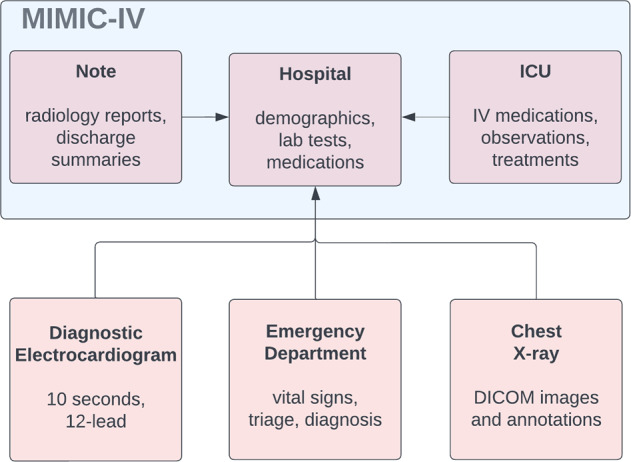
- MIMIC-IV was designed to be backward compatible with MIMIC-III while minimizing processing and organizing data into three modules: hosp, icu, and note.
## Methods
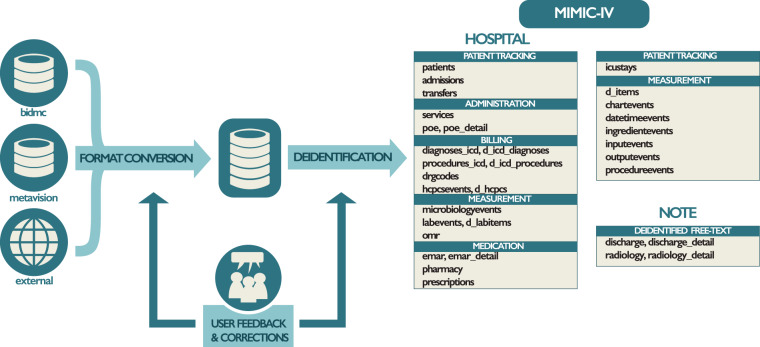
- Collaborative database construction from BIDMC clinical data, transformed and deidentified for release under IRB waiver and data use agreement; the process had three steps: acquisition, transformation, and deidentification.
- Sample/data: all patients admitted to the emergency department or an ICU at BIDMC between 2008–2019, excluding patients younger than 18 at first visit or on a protected list; external coding systems and Massachusetts death records were added.
- Main analysis/workflow: custom SQL scripts to restructure data into relational modules, plus custom linkage algorithms for out-of-hospital mortality and deidentification algorithms for HIPAA identifiers and free text; validation used integrity, consistency, and deidentification checks.
## Limitations
- The paper states that out-of-hospital mortality is only available through linkage to state death records, and deaths are censored at one year from last hospital discharge, so null death dates only indicate survival up to that point.
- The text makes evident that some data are incomplete or unevenly available across modules and time periods (for example, eMAR was deployed hospital-wide only by 2016, and the note module contains only discharge summaries and radiology reports); this is an evident coverage limitation from the text.
- The paper notes that clinical data are “sporadic and noisy,” reflecting routine care rather than research collection; this is a general data-quality limitation stated in the background.
Model-written summary. Check it against the paper before relying on it.
Integrity signals
Registry
Cites
Statistics
Figures
Verification
Claims the paper makes
13 Valid · 3 Not valid · 3 Not checked · 110 Own results and interpretations
Every source the paper cites for this claim was checked and supports it.
In the paper
“Finally, we combined two published algorithms for removing PHI from free-text17,18.”
§ MIMIC-IV, a freely accessible electronic health record dataset > Methods > Deidentification
What the sources say
- Supportedcites [17] Neamatullah I Automated de-identification of free-text medical records BMC medical informatics and decision making 2008 8 1 17 10.1186/1472-6947-8-32 18652655 PMC2526997 source
The Methods sections describe this paper's published algorithm for identifying and removing PHI from free-text medical records. The citing authors' statement that they combined two algorithms describes their own method; this citation identifies one of the algorithms. (LLM, conf=0.92)
- Supportedcites [18] Johnson, A. E. W., Bulgarelli, L. & Pollard, T. J. Deidentification of free-text medical records using pre-trained bidirectional transformers. In Proceedings of the ACM Conference on Health, Inference, and Learning, 214–221 (2020). PMC8330601 34350426 source
The Introduction (page not available in our copy) presents this paper’s BERT model for deidentifying free-text health records and describes measuring how much PHI it removes. The citation can therefore identify one of the two published algorithms; this source need not establish that the citing authors combined them. (LLM, conf=0.91)
plain- Asserted: passes — The authors put it forward as true.
- Checkable: passes — It can be checked against evidence.
- Load-bearing: passes — The paper’s conclusions depend on it.
- Based: passes — The paper gives a reason why it holds.
- Supported
Every source the paper cites for this claim was checked and supports it.
In the paper
“Due to data quality concerns regarding the Social Security Death Master File (SSDMF)13, we did not attempt to link patients to the SSDMF for determining out-of-hospital mortality.”
§ MIMIC-IV, a freely accessible electronic health record dataset > Methods > Acquisition
What the sources say
- Supportedcites [13] Levin MA Lin H-M Prabhakar G McCormick PJ Egorova NN Alive or dead: Validity of the social security administration death master file after 2011 Health Serv Res 2019 51 24 33 10.1111/1475-6773.13069 PMC6338290 30520023 source
The Discussion states that the Death Master File is no longer a reliable single source for mortality data, including out-of-hospital deaths. The decision not to link patients is the citing authors’ own methodological choice; the citation supports the data-quality concern motivating it. (LLM, conf=0.93)
plainstates a cause- Asserted: passes — The authors put it forward as true.
- Checkable: passes — It can be checked against evidence.
- Load-bearing: passes — The paper’s conclusions depend on it.
- Based: passes — The paper gives a reason why it holds.
- Supported
The cited sources support only part of this claim — read each source’s verdict below.
In the paper
“To support research that spans the periods of MIMIC-III (2002–2008) and MIMIC-IV (2008–2019), we have published the MIMIC-III Clinical Database CareVue subset22.”
§ MIMIC-IV, a freely accessible electronic health record dataset > Data Records > Building on earlier versions of MIMIC
What the sources say
- Partly supportedcites [22] Johnson AEW Pollard TJ Mark RG 2022 R. G. Mimic-iii clinical database carevue subset (version 1.4) PhysioNet 10.13026/8a4q-w170 sourceExperimental — accuracy not yet measured
The Abstract says the subset was provided to simplify combining MIMIC-III with MIMIC-IV, and the publication record identifies the released dataset. However, the Background and Methods give the CareVue period as 2001–2008, not the claim’s 2002–2008; the Background confirms MIMIC-IV’s 2008–2019 period. (LLM, conf=0.84)
plainstates a cause- Asserted: passes — The authors put it forward as true.
- Checkable: passes — It can be checked against evidence.
- Load-bearing: passes — The paper’s conclusions depend on it.
- Based: passes — The paper gives a reason why it holds.
- Partly supported
In the paper
“Access to MIMIC-IV is provided via PhysioNet19.”
§ MIMIC-IV, a freely accessible electronic health record dataset > Data Records
What the sources say
- Not checked — no full text of the sourcecites [19] Goldberger AL Physiobank, physiotoolkit, and physionet: components of a new research resource for complex physiologic signals circulation 2000 101 e215 e220 10.1161/01.CIR.101.23.e215 10851218 source
- Asserted: passes — The authors put it forward as true.
- Checkable: passes — It can be checked against evidence.
- Load-bearing: unclear — It is unclear whether the paper’s conclusions depend on it.
- Based: passes — The paper gives a reason why it holds.
A result the paper states — it cites no source for it, so there is none to check. The quote shows it is in the paper.
In the paper
“the d_icd_diagnoses and d_icd_procedures tables contain all codes which were valid at any point during the 2008–2019 time period.”
§ MIMIC-IV, a freely accessible electronic health record dataset > Data Records > Hospital module (hosp)
plain- Asserted: passes — The authors put it forward as true.
- Checkable: passes — It can be checked against evidence.
- Load-bearing: unclear — It is unclear whether the paper’s conclusions depend on it.
- Based: passes — The paper gives a reason why it holds.
29 more claims
Create a free account to see all 129 claims and every source verdict.
- Probably not a substantial claim. 84
- It may state two separate claims as one. 30
Claims other papers make about this one
Each is checked against this paper’s own text: does it say what the citing paper says it does?
The source backs part of the claim, not all of it — or backs it for a different population, condition or comparison.
In the citing paper
“We conducted a study using the publicly available MIMIC-IV dataset, which comprises 431,231 unique hospital admissions from 299,712 patients admitted to an ICU or the ED of the Beth Israel Deaconess Medical Center in Boston, Massachusetts27.”
From DRG-LLaMA : tuning LLaMA model to predict diagnosis-related group for hospitalized patients (2024) · cites this paper as [27]
Experimental — accuracy not yet measuredThe source backs part of the claim, not all of it — or backs it for a different population, condition or comparison.
In the citing paper
“For instance, the MIMIC-IV [148] includes a limited range of modalities, including clinical notes, medical images (chest x-ray Digital Imaging and Communications in Medicine [DICM] images), and time series (diagnostic electrocardiogram and patient records), making it a valuable but constrained resource for training medical M-LLMs.”
From Multimodal Large Language Models in Health Care: Applications, Challenges, and Future Outlook. (2024) · cites this paper as [148]
Experimental — accuracy not yet measuredThe source backs part of the claim, not all of it — or backs it for a different population, condition or comparison.
In the citing paper
“Existing multimodal medical data sets available for public use [84,85,148] are often relatively small in scale and demand the consolidation of numerous resources.”
From Multimodal Large Language Models in Health Care: Applications, Challenges, and Future Outlook. (2024) · cites this paper as [148]
Experimental — accuracy not yet measuredThe source backs part of the claim, not all of it — or backs it for a different population, condition or comparison.
In the citing paper
“- MIMIC-IV: A comprehensive, de-identified EHR dataset supporting tasks such as summarization, question answering, and document retrieval [17].”
From Retrieval-Augmented Generation (RAG) in Healthcare: A Comprehensive Review (2025) · cites this paper as [17]
Experimental — accuracy not yet measuredThe cited source says what the claim attributes to it.
In the citing paper
“In order to build agents that are grounded in medically relevant situations, we use a random sample of diagnostic questions from the US Medical Licensing Exam (USMLE), from deidentified electronic health records (MIMIC-IV)16, and from the New England Journal of Medicine (NEJM) case challenges.”
From AgentClinic: a multimodal benchmark for tool-using clinical AI agents (2026) · cites this paper as [16]
4 more claims about this paper
Create a free account to see every claim other papers make about this one.
Citations
Cites
Goldberger, A. L., Amaral, L. A. N., Glass, L., Hausdorff, J. M., Ivanov, P. C., Mark, R. G., Mietus, J. E., Moody, G. B., Peng, C.-K., & Stanley, H. E. (2000) · Circulation · doi:10.1161/01.cir.101.23.e215 · Cited by 14,809
Self-citationMIMIC-III, a freely accessible critical care database
Johnson, A. E. W., Pollard, T. J., Shen, L., Lehman, L.-W. H., Feng, M., Ghassemi, M., Moody, B., Szolovits, P., Anthony Celi, L., & Mark, R. G. (2016) · Scientific Data · doi:10.1038/sdata.2016.35 · Cited by 8,141 · cited 1×
“More recently, MIMIC-III was published in 2015 and significantly expanded MIMIC-II, containing data for over 40,000 patients 3 .”
MethodSelf-citationPollard, T. J., Johnson, A. E. W., Raffa, J. D., Celi, L. A., Mark, R. G., & Badawi, O. (2018) · Scientific Data · doi:10.1038/sdata.2018.178 · Cited by 1,993 · cited 2×
“0 comprises of 200,859 stays at ICUs and step-down units across 208 hospitals in the continental United States 4 .”
BackgroundSelf-citationSaeed, M., Villarroel, M., Reisner, A. T., Clifford, G., Lehman, L.-W., Moody, G., Heldt, T., Kyaw, T. H., Moody, B., & Mark, R. G. (2011) · Critical Care Medicine · doi:10.1097/ccm.0b013e31820a92c6 · Cited by 1,162
Self-citationBest Practices for Scientific Computing
Wilson, G., Aruliah, D. A., Brown, C. T., Chue Hong, N. P., Davis, M., Guy, R. T., Haddock, S. H. D., Huff, K. D., Mitchell, I. M., Plumbley, M. D., et al. (2014) · PLoS Biology · doi:10.1371/journal.pbio.1001745 · Cited by 723 · cited 1×
“The creation of MIMIC-IV followed best practices in scientific computing 23 .”
MethodJohnson, A., Bulgarelli, L., Pollard, T., Gow, B., Moody, B., Horng, S., Celi, L. A., & Mark, R. (2024) · PhysioNet · doi:10.13026/07hj-2a80 · Cited by 524
Self-citationJohnson, A., Bulgarelli, L., Pollard, T., Horng, S., Celi, L. A., & Mark, R. (2023) · PhysioNet · doi:10.13026/s6n6-xd98 · Cited by 524
Self-citationEarly prediction of circulatory failure in the intensive care unit using machine learning
Hyland, S. L., Faltys, M., Hüser, M., Lyu, X., Gumbsch, T., Esteban, C., Bock, C., Horn, M., Moor, M., Rieck, B., et al. (2020) · Nature Medicine · doi:10.1038/s41591-020-0789-4 · Cited by 477 · cited 1×
“The HiRID database contains high-resolution data for almost 34,000 admissions between 2008–2016 at Bern University Hospital in Switzerland 6,7 .”
BackgroundThe MIMIC Code Repository: enabling reproducibility in critical care research
Johnson, A. E. W., Stone, D. J., Celi, L. A., & Pollard, T. J. (2018) · Journal of the American Medical Informatics Association · doi:10.1093/jamia/ocx084 · Cited by 442 · cited 1×
“The MIMIC Code Repository was originally created for MIMIC-III to enable researchers to share and reuse code 24 .”
MethodSelf-citationAutomated de-identification of free-text medical records
Neamatullah, I., Douglass, M. M., Lehman, L.-W. H., Reisner, A., Villarroel, M., Long, W. J., Szolovits, P., Moody, G. B., Mark, R. G., & Clifford, G. D. (2008) · BMC Medical Informatics and Decision Making · doi:10.1186/1472-6947-8-32 · Cited by 413
Self-citation
Cited by
Items 1,301–1,400 of 3,269
Xie, S., & Sasmita, B. R. (2025) · Journal of General Internal Medicine · doi:10.1007/s11606-025-09643-y · Cited by 2
Tang, S., Zhang, Z., Cheng, Y., Zhang, L., Wang, Q., & Wang, C. (2025) · PLoS ONE · doi:10.1371/journal.pone.0325006 · Cited by 4
“Records from MIMIC-IV include over 190,000 patients treated at the Beth Israel Deaconess Medical Center from 2008 to 2019 [1], while eICU-CRD contains data on more than 200,000 ICU patients from over 200 medical centers recorded between 2014 and 2015 [2].”
Yang, D., Zhang, W., Cao, Y. J., et al. (2025) · BMC Nephrology · doi:10.1186/s12882-025-04282-1 · Cited by 2
Raheja, A., & Belani, K. G. (2025) · Anesthesiology Clinics · doi:10.1016/j.anclin.2025.05.011 · Cited by 5
Yang, Y., Zhang, J., Wang, H., Zhang, Y., & Zhang, J. (2025) · BMJ Open · doi:10.1136/bmjopen-2025-101395 · Cited by 3
Wei, J., Lin, F., Jin, T., Qian, Y., Wang, S., Feng, D., Lv, X., & He, W. (2025) · Journal Of Big Data · doi:10.1186/s40537-025-01234-2 · Cited by 5
Liao, Y., Yang, Q., Li, D., et al. (2025) · Clinics · doi:10.1016/j.clinsp.2025.100725 · Cited by 3
Tong, X., Gu, J., Lyu, C., Zhao, Y., Rui, Y., & Guo, M. (2025) · Scientific Reports · doi:10.1038/s41598-025-14028-6 · Cited by 2
“In this study, data from the MIMIC-IV (version 3.1) were used 11 .”
InfluentialNong, F., Zhu, W., & Jiang, Y. J. (2025) · BMC Neurology · doi:10.1186/s12883-025-04342-x · Cited by 3
“The patients’ information of our study was obtained from the MIMIC-IV (version 2.2), which is a publicly accessible and comprehensive critical care database maintained by the Computational Physiology Laboratory at the Massachusetts Institute of Technology (MIT) [21].”
InfluentialJin, J., Yu, L., Cheung, K., Deng, Z., Zhou, Q., & Liu, Y. (2025) · Scientific Reports · doi:10.1038/s41598-025-13341-4 · Cited by 3
“This retrospective observational study relied on data from the Medical Information Mart for Intensive Care-IV (MIMIC-IV) dataset 16,17 .”
Soley, N., Bentil, M., Shah, J., Rouhizadeh, M., & Taylor, C. O. (2025) · Scientific Reports · doi:10.1038/s41598-025-13542-x · Cited by 4
“The study utilized discharge notes from two publicly available critical care databases: MIMIC-III 36 for model training and internal testing, and MIMIC-IV 37 for model external evaluation.”
IntelliCare: Improving healthcare analysis with patient-level knowledge from large language models
Yu, Z., Jin, Y., Xu, Y., Zhang, X., & Wang, Y. (2025) · Knowledge-Based Systems · doi:10.1016/j.knosys.2025.114191 · Cited by 4
Machine Learning and Explainable AI for Predicting Intubation Needs in an Intensive Care Unit
Saykat, M. T. H., Emon, M. A., Al-Imran, M., & Haque, M. E. (2025) · International Conference on Big Data Analytics and Practices (IBDAP) · doi:10.1109/ibdap65587.2025.11145861 · Cited by 3
“This research employed the MIMIC-IV dataset, provided by PhysioNet [8].”
Sinha, S., Bharti, Kumari, K., Kumar, A. A., & Mishra, N. (2025) · International Conference for Emerging Technology (INCET) · doi:10.1109/incet64471.2025.11139921 · Cited by 5
“Datasets: o EHRs: 12,000 ICU patients from MIMIC-IV [6] (Sepsis-3 incidence: 18%). o Chest X-rays: 15,000 images from CheXpert [21], timestamp-aligned with EHRs. o Clinical Notes: 8,000 radiology reports from NIH Clinical Center [17].”
Hölzer, H. T., Niklas, C., Tenckhoff, S., Feißt, M., Hölle, T., Dugas, M., Zental, N., Kumar, S., Schaack, D., Schuster, L. C., et al. (2025) · BMJ Open · doi:10.1136/bmjopen-2024-098589 · Cited by 3
Lv, Y., Lu, Z., He, M., et al. (2025) · Frontiers in Surgery · doi:10.3389/fsurg.2025.1579429 · Cited by 2
Wang, Q., Wang, B., Chen, B., Li, Q., Zhao, Y., Dong, T., Wang, Y., & Zhang, P. (2025) · Journal of Clinical Medicine · doi:10.3390/jcm14207163 · Cited by 7
“2 contained the de-identified clinical information of 299,712 patients from ICU or emergency department at the Beth Israel Deaconess Medical Center (BIDMC) between 2008 and 2019 [18].”
Liang, Z., Hu, C., Zhou, Y., et al. (2025) · BMJ Open · doi:10.1136/bmjopen-2025-099781 · Cited by 2
Ramamoorthy, S., Rani, P., Matthews, G., et al. (2025) · IEEE Journal of Biomedical and Health Informatics · doi:10.1109/jbhi.2025.3609068 · Cited by 2
“The data collected by the Medical Information Mart for Intensive Care IV (MIMIC-IV) version 2.2 database [15], [16] follows recognised ethical guidelines and meets both institutional and federal compliance requirements.”
InfluentialFine-Tuning LLaMA2 for Summarizing Discharge Notes: Evaluating the Role of Highlighted Information
Dehkordi, M. K. H., Perl, Y., Deek, F. P., & Liu, H. (2025) · Big Data and Cognitive Computing · doi:10.3390/bdcc10010004 · Cited by 6
Guo, J., Xiong, F., Sun, B., et al. (2025) · International Journal of Medical Informatics · doi:10.1016/j.ijmedinf.2025.106240 · Cited by 2
Bogacsovics, G., Harangi, B., Beregi-Kovács, M., Kupás, D., Lakatos, R., Serban, N., Tiba, A., & Tóth, J. A. (2024) · IEEE World Symposium on Applied Machine Intelligence and Informatics (SAMI) · doi:10.1109/sami60510.2024.10432795 · Cited by 2
“One area, where huge amounts of textual data are generated, is the clinical trials involving to image data, the diagnosis and the opinions m po i u m on A of the clinicians are also recorded in the form of a clinical report [2].”
BackgroundUpper gastrointestinal haemorrhage patients' survival: A causal inference and prediction study
Deng, F., Cao, Y., & Zhao, S. (2024) · European Journal of Clinical Investigation · doi:10.1111/eci.14180 · Cited by 2
Guan, C., Gong, A., Zhao, Y., et al. (2024) · Clinical and Translational Medicine · doi:10.1002/ctm2.70081 · Cited by 2
MOVER: Medical Informatics Operating Room Vitals and Events RepositoryPreprint
Samad, M., Rinehart, J. B., Angel, M., Kanomata, Y., Baldi, P., & Cannesson, M. P. (2023) · medRxiv · doi:10.1101/2023.03.03.23286777 · Cited by 2
Wang, S., Xiao, Q. F., Lin, Q., et al. (2023) · medRxiv · doi:10.1101/2023.04.17.23288709 · Cited by 2
Edges are all you need: Potential of Medical Time Series Analysis with Graph Neural Networks.Preprint
Walke, D., Steinbach, D., Gibb, S., Kaiser, T., Saake, G., Ahrens, P. C., Broneske, D., & Heyer, R. (2023) · Research Square · doi:10.21203/rs.3.rs-3573549/v1 · Cited by 2
Graph-Based Patient Representation for Multimodal Clinical Data: Addressing Data HeterogeneityPreprint
Ghanvatkar, S., & Rajan, V. (2023) · medRxiv · doi:10.1101/2023.12.07.23299673 · Cited by 8
“We use the publicly available EHR dataset, MIMIC-IV [Johnson et al., 2023b], containing deintendified clinical data from Beth Israel Deaconess Medical Center (BIDMC).”
MethodHu, Q., Li, X., Zou, D., et al. (2024) · Research Square · doi:10.21203/rs.3.rs-4081881/v1 · Cited by 2
Liliopoulos, S. G., Dejaco, A., Dimakopoulos, V. S., & Gkouzionis, I. (2024) · medRxiv · doi:10.1101/2024.02.22.24303211 · Cited by 3
Li, X., Cheng, H., Tang, Y., Tan, S., Bai, Z., Li, T., Luo, M., Wang, Y., & Jun, L. (2024) · Research Square · doi:10.21203/rs.3.rs-4368526/v1 · Cited by 2
“This retrospective observational study used data from the Medical Information Mart for Intensive Care IV (MIMIC-IV) database 18,19 .”
MethodCarbonati, T., Eslami, P., Waks, J. W., Fiorina, L., Chaudhari, A., Henry, C., Johnson, A. E. W., Pollard, T., Gow, B. J., Mark, R. G., et al. (2024) · medRxiv · doi:10.1101/2024.05.31.24308304 · Cited by 4
Self-citationRashidi, P., Contreras, M., Silva, B., Shickel, B., Davidson, A., Ozrazgat‐Baslanti, T., Ren, Y., Guan, Z., Balch, J. A., Zhang, J., et al. (2024) · Research Square · doi:10.21203/rs.3.rs-4790824/v1 · Cited by 9
“…hospitals not used in the development phase consisting of the remaining 143 hospitals from eICU and data from the Medical Information Mart for Intensive Care (MIMIC)-IV [22], and temporally validated on data from a period not used in the development phase consisting of UFH data between 2018-2019.”
MethodPeer Review of “Towards Evaluating the Diagnostic Ability of LLMs (Preprint)”
Saderi, D., Mahmoud, R. S. G., Bender, G., et al. (2024) · JMIRx Med · doi:10.2196/69830 · Cited by 2
Jangda, M., Patel, J., Gill, J., McCarthy, P., Desman, J., Gupta, R. R., Patel, D., Kavi, N., Bakare, S., Klang, E., et al. (2025) · medRxiv · doi:10.1101/2025.01.06.25320067 · Cited by 2
Yang, G., Shi, Q., & Xu, Y. (2025) · Pancreatology · doi:10.1016/j.pan.2025.02.002 · Cited by 2
Kadhim, A., Green, Z., Nazari, I., Baker, J., George, M., Heinson, A., Stammers, M., Kipps, C., Beattie, R. M., Ashton, J., et al. (2025) · medRxiv · doi:10.1101/2025.03.07.25323569 · Cited by 1
“An additional set of imaging reports (n = 30) was also obtained through MIMIC-IV, a publicly available database sourced from the EHRs of the Beth Israel Deaconess Medical Center [25].”
Pham, M.-K., Mai, T. T., Dao, T. T. P., Tran, M., Crane, M., & Bezbradica, M. (2025) · doi:10.36227/techrxiv.175021755.55836808/v1 · Cited by 3
Fine-Tuning LLaMA2 for Summarizing Discharge Notes: Evaluating the Role of Highlighted InformationPreprint
Dehkordi, M. K. H., Perl, Y., Deek, F. P., et al. (2025) · Research Square · doi:10.21203/rs.3.rs-7181141/v1 · Cited by 2
Kinoshita, T., Umemura, Y., Watanabe, M., Uchida, K., Nishimoto, Y., Katayama, S., Inoue, Y., Kurosawa, H., Igarashi, Y., Kodate, A., et al. (2025) · medRxiv · doi:10.1101/2025.09.12.25335671 · Cited by 3
Clinical Agents Don’t CarePreprint
Klang, E., Glicksberg, B. S., Gorenshtein, A., Gavin, N. P., Freeman, R., Stump, L. S., Charney, A. W., Ting, D. S. W., Omar, M., & Nadkarni, G. N. (2025) · medRxiv · doi:10.1101/2025.10.17.25338226 · Cited by 2
Peng, D., & Zhai, H. (2025) · Therapeutic Advances in Gastroenterology · doi:10.1177/17562848251342864 · Cited by 2
“11,12 The reporting of this study conforms to the Strengthening the Reporting of Observational Studies in Epidemiology (STROBE) statement.”
Popoff, B., Delange, B., Nicolas, J., Le Gall, A., Dahamna, B., Cuggia, M., Clavier, T., & Bouzillé, G. (2025) · Scientific Reports · doi:10.1038/s41598-025-26774-8 · Cited by 2
MuST: Multimodal Spatiotemporal Graph-Transformer for Hospital Readmission Prediction
Miao, Y., & Yu, L. (2023) · Lecture Notes in Computer Science · doi:10.1007/978-3-031-47425-5_25 · Cited by 1
Xing, Z., Xu, Y., Wu, Y., et al. (2023) · European journal of medical research · doi:10.1186/s40001-023-01515-7 · Cited by 1
Exploring the impact of OSA on short-term survival in patients with AECOPD admitted to the ICU
Liu, L., Chen, Y., He, G., Lin, B., Zhu, Z., Wei, R., & Xu, Y. (2024) · PLoS ONE · doi:10.1371/journal.pone.0301646 · Cited by 2
“Data for our research was taken from the Medical Information Mart for Intensive Care Data-base IV (MIMIC-IV, Version 2.0) [20], which was compiled between 2008 and 2019 and is available to the public.”
MethodInfluential„Data-driven-Intensivmedizin“: Mangel an umfassenden Datensätzen
Hardenberg, J.-H. (2024) · Medizinische Klinik - Intensivmedizin und Notfallmedizin · doi:10.1007/s00063-024-01141-z · Cited by 1
Hou, W., Zhu, Y., Lai, X., & Yang, Y. (2024) · Internal and Emergency Medicine · doi:10.1007/s11739-024-03631-6 · Cited by 2
“Therefore, this study used an extensive database, the Medical Information Mart for Intensive Care IV (MIMIC-IV) database [22], to explore the relationship between pneumonia and intestinal infection in ICU patients, and the effect of intestinal infection on the prognosis of pneumonia patients.”
Wang, P., Lü, M., Huang, Y., Sun, L., & Han, Z. (2024) · Journal of Thoracic Disease · doi:10.21037/jtd-24-24 · Cited by 1
“…Medical Center (BIDMC, Boston, MA, USA) and the Massachusetts Institute of Technology (MIT, Cambridge, MA, USA) with institutional review board approval; information was obtained for 299,712 patients admitted to various intensive care units (ICUs) at BIDMC in Boston, MA from 2008 to 2019 (14).”
Chen, G., Zhou, T., Xu, J., Hu, Q., Jiang, J., & Xu, W. (2024) · Western Journal of Emergency Medicine · doi:10.5811/westjem.18589 · Cited by 5
“23 The data, collected during routine clinical care at BIDMC, were de-identi fi ed, transformed, and made accessible to researchers who have completed requisite training in human research ethics and entered into a data use agreement.”
MethodFirdaus, F., Nurmaini, S., Tutuko, B., Rachmatullah, M. N., Islami, A., Darmawahyuni, A., Sapitri, A. I., Ais’sy, W. R., Karim, M. I., Fachrurrozi, M., et al. (2024) · Franklin Open · doi:10.1016/j.fraope.2024.100151 · Cited by 2
Peng, D., & Zhai, H. (2024) · BMC Gastroenterology · doi:10.1186/s12876-024-03380-y · Cited by 1
“This study was a retrospective observational study of patients using the multi-center Medical Information Mart for Intensive Care database (MIMIC-IV 2.2) [8, 9].”
MethodInfluentialGuellil, I., Andres, S., Guthrie, B., Anand, A., Zhang, H., Hasan, A., Wu, H., & Alex, B. (2024) · Lecture notes in computer science · doi:10.1007/978-3-031-70242-6_20 · Cited by 3
Belhadj, S. A., Park, S., Seth, A., Dar, H., & Kooi, T. (2024) · Lecture notes in computer science · doi:10.1007/978-3-031-72787-0_6 · Cited by 3
Zhong, L., Zhong, Y., Liao, Y., & Zhou, Y. (2024) · BMC Cardiovascular Disorders · doi:10.1186/s12872-024-04271-6 · Cited by 2
“The database has received approval from the Institutional Review Board (IRB) at the Beth Israel Deacon-ess Medical Centre (BIDMC) and the Massachusetts Institute of Technology (MIT) [23].”
MethodKEIM: Knowledge Graph Empowered Interpretable Model for Diagnosis Prediction
Luo, Z., Zhang, C., Wang, H., Shi, J., & Zhang, M. (2024) · Lecture notes in computer science · doi:10.1007/978-981-97-5562-2_20 · Cited by 1
Subphenotypic features of patients with sepsis and ARDS: a multicenter cohort study
Li, N., Fang, D., Ge, F., Zhang, L., Liu, Y., Jin, H., Shen, H., Xie, K., & Gao, Y. (2024) · Frontiers in Medicine · doi:10.3389/fmed.2024.1476512 · Cited by 2
Thiboud, P.-E., Wargnier-Dauchelle, V., Lefort, M., Duchateau, N., & Sdika, M. (2025) · IEEE International Symposium on Biomedical Imaging (ISBI) · doi:10.1109/isbi60581.2025.10980887 · Cited by 2
“Our method was evaluated on a dataset of 171,945 patients (with 80-10-10 train/valid/test splits) extracted from MIMIC-IV [13] with both Intensive Care Unit (ICU) and Emergency Department (ED) [14] patients.”
Acute Pancreatitis Mortality Prediction with Federated Learning
Vieira, P., Maia, E., & Praça, I. (2024) · Lecture notes in computer science · doi:10.1007/978-3-031-73500-4_9 · Cited by 1
Zhou, M. (2024) · International Conference on Intelligent Computing in Data Sciences (ICDS) · doi:10.1109/icds62089.2024.10756474 · Cited by 1
“A notable example is the Medical Information Mart for Intensive Care (MIMIC)-III/IV database [10][11][12], managed by the MIT Laboratory for Computational Physiology.”
Liao, Y., Wang, Y., Li, D., & Qiu, X. (2024) · PLoS ONE · doi:10.1371/journal.pone.0314902 · Cited by 1
A Modified Deep Residual-Convolutional Neural Network for Accurate Imputation of Missing Data
Firdaus, F., Islami, A., Darmawahyuni, A., Sapitri, A. I., Rachmatullah, M. N., Tutuko, B., Arum, A. W., Karim, M. I., Yultrien, Y., Wandya, R. N. S., et al. (2025) · Computers, materials & continua/Computers, materials & continua (Print) · doi:10.32604/cmc.2024.055906 · Cited by 1
“Vital signs and pertinent data taken from the MIMIC-IV database were used in our investigation [31,32].”
Temporal Gaussian Copula For Clinical Multivariate Time Series Data Imputation
Su, Y., Qiao, H., Wu, D., Chen, Y., & Chen, L. (2024) · IEEE International Conference on Bioinformatics and Biomedicine (BIBM) · doi:10.1109/bibm62325.2024.10821963 · Cited by 5
“The experiments are conducted on three public real-world healthcare datasets, including Medical Information Mart for Intensive Care (MIMIC) [10], PhysioNet 2012 Mortality Prediction Challenge (PhysioNet2012) [11] and PhysioNet in Cardiology Challenge 2019 (PhysioNet2019) [12].”
Haddad, G., Maslove, D. M., Mbuagbaw, L. C. E., Belley‐Côté, E. P., & Rochwerg, B. N. (2025) · Critical Care Explorations · doi:10.1097/cce.0000000000001210 · Cited by 3
“MIMIC-IV is a freely accessible database of patients admitted to critical care units between 2008 and 2019 at the Beth Israel Deaconess Medical Center (BIDMC) in Boston, Massachusetts (25).”
Yang, C., Cao, H., Chen, S., et al. (2025) · Pancreas · doi:10.1097/mpa.0000000000002475 · Cited by 1
AI-Driven Diagnosis and Treatment Recommendation in Healthcare: A Hybrid Deep Learning Framework
Polisetty, S. M. (2025) · International Journal of Scientific Research in Computer Science Engineering and Information Technology · doi:10.32628/cseit251112256 · Cited by 3
Li, D., Li, X., Wen, B., Li, B., Wang, Y., Zong, Y., & Lyu, J. (2025) · Clinical and Applied Thrombosis/Hemostasis · doi:10.1177/10760296251321314 · Cited by 3
Liao, K., Elibol, A., Gao, Z., Meng, L., & Chong, N. Y. (2025) · Applied Intelligence · doi:10.1007/s10489-025-06391-8 · Cited by 1
Patient outcomes after interhospital transfer: the impact of early intensive care unit upgrade
Baig, S. H., Lee, J. D., & Yoo, E. J. (2025) · Hospital Practice · doi:10.1080/21548331.2025.2470107 · Cited by 1
“The MIMIC-IV critical care database, jointly maintained by Beth Israel Deaconess Medical Center (BIDMC) and the Massachusetts Institute of Technology, encompasses deidentified contemporary patient data for adults ≥18 years of age admitted to BIDMC from 2008–2019 [24].”
Liu, H., Lu, H., & Zhang, X. (2025) · Annals of Surgical Treatment and Research · doi:10.4174/astr.2025.108.3.158 · Cited by 1
“2.0) is a publicly available archival system established by the Massachusetts Institute of Technology (Cambridge, MA, USA) which contains detailed clinical data for patients treated at Beth Israel Deaconess Medical Center (Boston, MA, USA) between 2008 and 2019 [11].”
InfluentialMuhetaer, G., Sun, C., Ma, Q., Zhang, Y., Zhang, J., & Ning, Y. (2025) · Nursing in Critical Care · doi:10.1111/nicc.13304 · Cited by 1
Tang, X., Wu, Y., Zhang, X., Zhang, K., Xie, Y., Chao, Y., He, R., & Zhang, P. (2025) · Heart Rhythm O2 · doi:10.1016/j.hroo.2025.03.006 · Cited by 2
Song, X., & Zhu, L. (2025) · Frontiers in Neurology · doi:10.3389/fneur.2025.1551427 · Cited by 1
A Meta-learning-based Domain-invariant Method for Cuff-less Blood Pressure Estimation
Guo, J., Fan, F., Liu, R., Jin, Y., Zhang, W., Chen, Y., & Gu, Y. (2024) · IEEE Smart World Congress (SWC) · doi:10.1109/swc62898.2024.00081 · Cited by 1
“MIMIC IV , an update and expansion of MIMIC-III, contains medical data from tens of thousands of ICU patients between 2001 and 2019 [26].”
CLEAR: Addressing Representation Contamination in Multimodal Healthcare Analytics
Su, G., Zheng, K., Zhao, T., & Yin, J. (2025) · ACM SIGKDD Conference on Knowledge Discovery and Data Mining (KDD) · doi:10.1145/3690624.3709164 · Cited by 3
“1, we select two example patient cohorts and plot their probability density functions of representative medical features, all corroborated by clinical data sourced from the publicly available Medical Information Mart for Intensive Care IV (MIMIC-IV) database [23].”
Zeng, X. R., Liu, Y., Shuai, P., He, P., & Liu, X. (2025) · Frontiers in Cardiovascular Medicine · doi:10.3389/fcvm.2025.1572709 · Cited by 1
Park, S., Kim, S., & Rim, D. (2025) · Ewha Medical Journal · doi:10.12771/emj.2025.00332 · Cited by 1
“The data used in this study were obtained from PhysioNet, specifically from the MIMIC-IV project [7].”
Prognostic value of admission respiratory rate in patients with acute myocardial infarction
Sasmita, B. R., Xie, S., Xie, L., Chen, J., Shen, J., Li, X., Liu, G., Yang, Y., Chen, Y., Luo, S., et al. (2025) · BMC Cardiovascular Disorders · doi:10.1186/s12872-025-04729-1 · Cited by 4
“The present study utilized a publicly and freely accessible clinical database that contains critical care data of 73,181 patients of Beth Israel Deaconess Medical Centre in Boston from 2008 to 2019 [18].”
Antidepressants and antibiotic resistance in urine cultures: a cohort study
Sears, I., Davis, M., Gibas, K. M., et al. (2025) · Antimicrobial Stewardship & Healthcare Epidemiology · doi:10.1017/ash.2025.73 · Cited by 1
Semisupervised D‐Learning for Optimal Individualized Treatment Regimes
Li, X., Zhang, S., & Zhou, Y. (2025) · Stat · doi:10.1002/sta4.70063 · Cited by 2
“…database, a comprehensive collection of de-identified health-related information from patients admitted to the emergency department or intensive care units (ICUs) at the Beth Israel Deaconess Medical Center (BIDMC) in Boston, MA, between 2008 and 2022 (Johnson et al. 2023; Johnson et al. 2024).”
Yue, S., Hou, X., Wang, Y., Xu, Z., Li, X., Wang, J., Ye, S., & Wu, J. (2025) · Frontiers in Medicine · doi:10.3389/fmed.2025.1534706 · Cited by 2
Wang, D., Liu, A., Liang, X., et al. (2025) · Nursing in Critical Care · doi:10.1111/nicc.70059 · Cited by 1
Mean 24-hour end-tidal carbon dioxide following diagnosis predicts mortality in patients with sepsis
Wang, J., Weng, L., Xu, J., et al. (2025) · World Journal of Emergency Medicine · doi:10.5847/wjem.j.1920-8642.2025.067 · Cited by 1
Sui, D., Gu, L., Zhang, C., Yang, K., Li, X., Ma, L., Wang, L., & Tang, W. (2025) · Bioengineering · doi:10.3390/bioengineering12060578 · Cited by 2
Zhu, W., Wen, D., Duan, L., Fan, C., & Jiang, Y. J. (2025) · Frontiers in Neurology · doi:10.3389/fneur.2025.1526169 · Cited by 2
“This database comprises ∼ 73,000 detailed records of intensive care unit (ICU) stays at Beth Israel Deaconess Medical Center (18).”
Li, S., Dong, F., Li, R., & Li, W. (2025) · Neurocomputing · doi:10.1016/j.neucom.2025.130519 · Cited by 2
Wang, W., Chen, B., Wang, Q., & Rong, J. (2025) · European Journal of Trauma and Emergency Surgery · doi:10.1007/s00068-025-02878-8 · Cited by 1
Huang, Y., Zhang, C., Li, M., et al. (2025) · Archives of Medical Science · doi:10.5114/aoms/204369 · Cited by 1
“In the MIMIC-IV database, mortality status is captured through two complementary sources: in-hospital death is recorded directly in the hospital information system, while post-discharge mortality is obtained via linkage to the Social Security Death Index [17].”
Hong, L., Wang, J., Feng, T., Fan, H., Shen, X., Chen, W., Tao, H., Yao, W., Zou, J., & Yang, M. (2025) · Journal of Evidence-Based Medicine · doi:10.1111/jebm.70042 · Cited by 2
Li, Y., Zhao, C., Ma, X., Pei, Y., Liu, W., & Gao, L. (2025) · PLoS ONE · doi:10.1371/journal.pone.0323939 · Cited by 2
LEGN: A large language model-guided event graph network for intraoperative hypotension prediction
Zhu, Z., Zhao, Q. Y., Ge, Y., Li, J., Wang, S., & Yang, J. (2025) · Expert Systems with Applications · doi:10.1016/j.eswa.2025.128677 · Cited by 1
Jin, Y., Feng, C., Jiang, H., Ren, B., Zhang, Y., Zhang, Y., Lang, J., Feng, J., & Guo, P. (2025) · Scientific Reports · doi:10.1038/s41598-025-07118-y · Cited by 3
Hao, Z., Ziqian, Z., Hang, C., et al. (2025) · Frontiers in Neurology · doi:10.3389/fneur.2025.1594680 · Cited by 1
Fan, X.-F., Xu, S., Fu, S., He, X., Fang, J.-K., Gao, W., & Guo, N. (2025) · BMC Gastroenterology · doi:10.1186/s12876-025-04113-5 · Cited by 1
“MIMIC-IV provides de-identified comprehensive clinical data of patients admitted to the Beth Israel Deaconess Medical Center in Boston, Massachusetts, from 2008 to 2022 [8].”
Healthcare Outcome Data Analytics through Electronic Health Records (EHR) and LLMs
Marripudugala, M. (2025) · International Conferences on Information Science and System · doi:10.1109/iciss63372.2025.11076450 · Cited by 1
Wu, T., Zhuang, R.-Y., Wu, Y., Wang, X.-L., Qu, H.-P., Dong, D., Lu, Y., & Wu, J. (2025) · Scientific Reports · doi:10.1038/s41598-025-11313-2 · Cited by 1
“2 https://doi.org/10.13026/6mm1-ek67), a large US-based critical care database 51 .”
InfluentialChen, X.-H., Li, Z., Wei, X., & Li, Y. (2025) · Frontiers in Nutrition · doi:10.3389/fnut.2025.1505404 · Cited by 3
Li, Z.-A., Wang, H., Zhang, X., & Hu, L. (2025) · Frontiers in Neurology · doi:10.3389/fneur.2025.1554809 · Cited by 1
Xu, D., Li, J., Wang, Z., Li, J., Zhao, Q., Zhao, Q., Xie, F., Li, T., Chen, J., Wang, X., et al. (2025) · Frontiers in Pharmacology · doi:10.3389/fphar.2025.1537994 · Cited by 2
“This study utilized the MIMIC-IV database (version 2.2) (Johnson et al., 2023), a public resource comprising data from 2008 to 2019 on patients admitted to the intensive care unit (ICU) at the Beth Israel Deaconess Medical Center in Boston, Massachusetts.”
InfluentialGuo, Y., Yang, Y., Zhu, J., et al. (2025) · Scientific Reports · doi:10.1038/s41598-025-11630-6 · Cited by 1
Metadata
- Authors
- Johnson, A. E. W., Bulgarelli, L., Shen, L., Gayles, A., Shammout, A., Horng, S., Pollard, T. J., Hao, S., Moody, B., Gow, B., Lehman, L.-W. H., Celi, L. A., & Mark, R. G.
- Affiliations
- Hospital for Sick Children (CA)
- Massachusetts Institute of Technology (US)
- Beth Israel Deaconess Medical Center (US)
- Corresponding author
- Johnson, Alistair E. W.
- ORCID
- Venue
- Scientific Data
- Published
- 2023-01-03
- Volume
- 10
- Issue
- 1
- Pages
- 1-1
- ISSN
- 2052-4463 (ISSN-L)
- PMC
- PMC9810617
- OpenAlex
- W4313439128
- Semantic Scholar
- 5425de16356015c2f26d2a50684c6c46d6998f51
- Cited by
- 3,401
- References
- 25
- Citations by year
- 2026: 1421 · 2025: 1175 · 2024: 649 · 2023: 154
- Type
- data paper
- Language
- en
- Update notices
- Open access
- gold
- doi.org
- Licence
- cc-by
- creativecommons.org/licenses/by/4.0 (tdm)
- creativecommons.org/licenses/by/4.0 (vor)
- Locations
- Scientific Data (publishedVersion, cc-by)
- PubMed Central (publishedVersion, cc-by)
- PubMed (publishedVersion)
- DOAJ (DOAJ: Directory of Open Access Journals) (submittedVersion, cc-by-sa)
- Funders
- U.S. Department of Health & Human Services | National Institutes of Health (NIH-R01-EB017205)
- Topics
- Physical Sciences › Computer Science › Artificial Intelligence › Machine Learning in Healthcare
- Health Sciences › Health Professions › Health Information Management › Electronic Health Records Systems
- Health Sciences › Health Professions › Health Information Management › Medical Coding and Health Information
- Keywords
- MIMIC-IV, electronic health records, clinical research data, hospital patient data, open data access, Beth Israel Deaconess Medical Center
- MeSH terms
- Hospitals, Humans, Databases, Factual, Electronic Health Records
About these checks
Registry, retraction, Cites and statistics results are computed, not judged, with one exception: a printed reference that no index lists is read once by a model before it counts as a citation error. Claims are extracted by a model and kept only when their quote appears verbatim in the text; each cited source is then checked, with a model’s help, for whether it says what the claim relies on. Those verdicts can be wrong — read the claim’s quote and the cited source before relying on one.
The claim verdicts this report counts are experimental: their accuracy is not yet measured.
A language model drew the claims from the paper on 2026-10-02, under version 3 of the claim definition (model deepseek-v4.1-flash, prompt extract-v3).
A second model labelled each claim on 2026-10-02 (model jev-1.13-20260917, definition revision gold-guideline-v0.2).
Cited sources are checked with a language model’s help (gpt-6-sol).
Statistics and arithmetic are recomputed, not judged.
Confidence bands are shown only for fields calibrated on our annotated test set. None is calibrated yet, so no band is shown.
What counts as a claim ›How we measure confidence ›How we check this ›
Are you an author, or do you see a problem with this page? Request a review
Data sources
Bibliographic data: Semantic Scholar, OpenAlex, Crossref.
Contains information from the Semantic Scholar Academic Graph Datasets, made available under the ODC Attribution License (ODC-BY 1.0).
Semantic Scholar’s data is described in: Kinney, R., et al. (2023). The Semantic Scholar Open Data Platform. arXiv:2301.10140.
