

MIMIC-IV, a freely accessible electronic health record dataset
Open accessThe DOI matches its Crossref record; 28 of the 28 references it cites were found in a registry or an index; 15 of the 20 sources its claims cite were checked for support.
Abstract
Digital data collection during routine clinical practice is now ubiquitous within hospitals. The data contains valuable information on the care of patients and their response to treatments, offering exciting opportunities for research. Typically, data are stored within archival systems that are not intended to support research. These systems are often inaccessible to researchers and structured for optimal storage, rather than interpretability and analysis. Here we present MIMIC-IV, a publicly available database sourced from the electronic health record of the Beth Israel Deaconess Medical Center. Information available includes patient measurements, orders, diagnoses, procedures, treatments, and deidentified free-text clinical notes. MIMIC-IV is intended to support a wide array of research studies and educational material, helping to reduce barriers to conducting clinical research.
Overview
CoChat Summary
## TL;DR
MIMIC-IV is a publicly available, deidentified electronic health record database from Beth Israel Deaconess Medical Center designed to support research, education, and technology development. It covers hospital and ICU care from 2008–2019 and adds modular structured data plus free-text clinical notes.
## Key findings
- The database includes patient measurements, orders, diagnoses, procedures, treatments, and deidentified free-text clinical notes, and is available through PhysioNet.
- The clinical cohort includes patients admitted to the emergency department or an ICU between 2008–2019; after exclusions, the authors linked 65,805 of 150,832 unique individuals (43.6%) to Massachusetts state death records.
- The paper reports that 51,022/65,803 (77.5%) of the successful death-record links were exact matches on last name, date of birth, and social security number; 11,634/65,803 (17.7%) were exact last name and date of birth plus approximate first name.
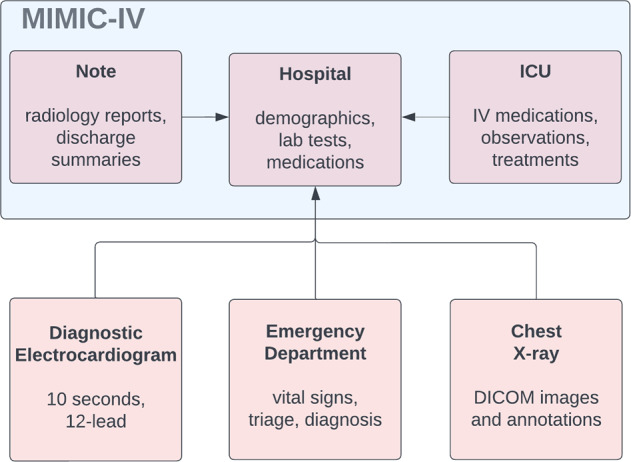
- MIMIC-IV was designed to be backward compatible with MIMIC-III while minimizing processing and organizing data into three modules: hosp, icu, and note.
## Methods
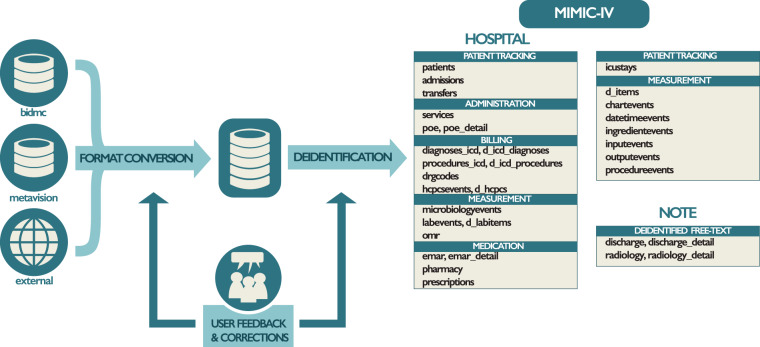
- Collaborative database construction from BIDMC clinical data, transformed and deidentified for release under IRB waiver and data use agreement; the process had three steps: acquisition, transformation, and deidentification.
- Sample/data: all patients admitted to the emergency department or an ICU at BIDMC between 2008–2019, excluding patients younger than 18 at first visit or on a protected list; external coding systems and Massachusetts death records were added.
- Main analysis/workflow: custom SQL scripts to restructure data into relational modules, plus custom linkage algorithms for out-of-hospital mortality and deidentification algorithms for HIPAA identifiers and free text; validation used integrity, consistency, and deidentification checks.
## Limitations
- The paper states that out-of-hospital mortality is only available through linkage to state death records, and deaths are censored at one year from last hospital discharge, so null death dates only indicate survival up to that point.
- The text makes evident that some data are incomplete or unevenly available across modules and time periods (for example, eMAR was deployed hospital-wide only by 2016, and the note module contains only discharge summaries and radiology reports); this is an evident coverage limitation from the text.
- The paper notes that clinical data are “sporadic and noisy,” reflecting routine care rather than research collection; this is a general data-quality limitation stated in the background.
Model-written summary. Check it against the paper before relying on it.
Integrity signals
Registry
Cites
Statistics
Figures
Verification
Claims the paper makes
13 Valid · 3 Not valid · 3 Not checked · 110 Own results and interpretations
Every source the paper cites for this claim was checked and supports it.
In the paper
“Finally, we combined two published algorithms for removing PHI from free-text17,18.”
§ MIMIC-IV, a freely accessible electronic health record dataset > Methods > Deidentification
What the sources say
- Supportedcites [17] Neamatullah I Automated de-identification of free-text medical records BMC medical informatics and decision making 2008 8 1 17 10.1186/1472-6947-8-32 18652655 PMC2526997 source
The Methods sections describe this paper's published algorithm for identifying and removing PHI from free-text medical records. The citing authors' statement that they combined two algorithms describes their own method; this citation identifies one of the algorithms. (LLM, conf=0.92)
- Supportedcites [18] Johnson, A. E. W., Bulgarelli, L. & Pollard, T. J. Deidentification of free-text medical records using pre-trained bidirectional transformers. In Proceedings of the ACM Conference on Health, Inference, and Learning, 214–221 (2020). PMC8330601 34350426 source
The Introduction (page not available in our copy) presents this paper’s BERT model for deidentifying free-text health records and describes measuring how much PHI it removes. The citation can therefore identify one of the two published algorithms; this source need not establish that the citing authors combined them. (LLM, conf=0.91)
plain- Asserted: passes — The authors put it forward as true.
- Checkable: passes — It can be checked against evidence.
- Load-bearing: passes — The paper’s conclusions depend on it.
- Based: passes — The paper gives a reason why it holds.
- Supported
Every source the paper cites for this claim was checked and supports it.
In the paper
“Due to data quality concerns regarding the Social Security Death Master File (SSDMF)13, we did not attempt to link patients to the SSDMF for determining out-of-hospital mortality.”
§ MIMIC-IV, a freely accessible electronic health record dataset > Methods > Acquisition
What the sources say
- Supportedcites [13] Levin MA Lin H-M Prabhakar G McCormick PJ Egorova NN Alive or dead: Validity of the social security administration death master file after 2011 Health Serv Res 2019 51 24 33 10.1111/1475-6773.13069 PMC6338290 30520023 source
The Discussion states that the Death Master File is no longer a reliable single source for mortality data, including out-of-hospital deaths. The decision not to link patients is the citing authors’ own methodological choice; the citation supports the data-quality concern motivating it. (LLM, conf=0.93)
plainstates a cause- Asserted: passes — The authors put it forward as true.
- Checkable: passes — It can be checked against evidence.
- Load-bearing: passes — The paper’s conclusions depend on it.
- Based: passes — The paper gives a reason why it holds.
- Supported
The cited sources support only part of this claim — read each source’s verdict below.
In the paper
“To support research that spans the periods of MIMIC-III (2002–2008) and MIMIC-IV (2008–2019), we have published the MIMIC-III Clinical Database CareVue subset22.”
§ MIMIC-IV, a freely accessible electronic health record dataset > Data Records > Building on earlier versions of MIMIC
What the sources say
- Partly supportedcites [22] Johnson AEW Pollard TJ Mark RG 2022 R. G. Mimic-iii clinical database carevue subset (version 1.4) PhysioNet 10.13026/8a4q-w170 sourceExperimental — accuracy not yet measured
The Abstract says the subset was provided to simplify combining MIMIC-III with MIMIC-IV, and the publication record identifies the released dataset. However, the Background and Methods give the CareVue period as 2001–2008, not the claim’s 2002–2008; the Background confirms MIMIC-IV’s 2008–2019 period. (LLM, conf=0.84)
plainstates a cause- Asserted: passes — The authors put it forward as true.
- Checkable: passes — It can be checked against evidence.
- Load-bearing: passes — The paper’s conclusions depend on it.
- Based: passes — The paper gives a reason why it holds.
- Partly supported
In the paper
“Access to MIMIC-IV is provided via PhysioNet19.”
§ MIMIC-IV, a freely accessible electronic health record dataset > Data Records
What the sources say
- Not checked — no full text of the sourcecites [19] Goldberger AL Physiobank, physiotoolkit, and physionet: components of a new research resource for complex physiologic signals circulation 2000 101 e215 e220 10.1161/01.CIR.101.23.e215 10851218 source
- Asserted: passes — The authors put it forward as true.
- Checkable: passes — It can be checked against evidence.
- Load-bearing: unclear — It is unclear whether the paper’s conclusions depend on it.
- Based: passes — The paper gives a reason why it holds.
A result the paper states — it cites no source for it, so there is none to check. The quote shows it is in the paper.
In the paper
“the d_icd_diagnoses and d_icd_procedures tables contain all codes which were valid at any point during the 2008–2019 time period.”
§ MIMIC-IV, a freely accessible electronic health record dataset > Data Records > Hospital module (hosp)
plain- Asserted: passes — The authors put it forward as true.
- Checkable: passes — It can be checked against evidence.
- Load-bearing: unclear — It is unclear whether the paper’s conclusions depend on it.
- Based: passes — The paper gives a reason why it holds.
29 more claims
Create a free account to see all 129 claims and every source verdict.
- Probably not a substantial claim. 84
- It may state two separate claims as one. 30
Claims other papers make about this one
Each is checked against this paper’s own text: does it say what the citing paper says it does?
The source backs part of the claim, not all of it — or backs it for a different population, condition or comparison.
In the citing paper
“We conducted a study using the publicly available MIMIC-IV dataset, which comprises 431,231 unique hospital admissions from 299,712 patients admitted to an ICU or the ED of the Beth Israel Deaconess Medical Center in Boston, Massachusetts27.”
From DRG-LLaMA : tuning LLaMA model to predict diagnosis-related group for hospitalized patients (2024) · cites this paper as [27]
Experimental — accuracy not yet measuredThe source backs part of the claim, not all of it — or backs it for a different population, condition or comparison.
In the citing paper
“For instance, the MIMIC-IV [148] includes a limited range of modalities, including clinical notes, medical images (chest x-ray Digital Imaging and Communications in Medicine [DICM] images), and time series (diagnostic electrocardiogram and patient records), making it a valuable but constrained resource for training medical M-LLMs.”
From Multimodal Large Language Models in Health Care: Applications, Challenges, and Future Outlook. (2024) · cites this paper as [148]
Experimental — accuracy not yet measuredThe source backs part of the claim, not all of it — or backs it for a different population, condition or comparison.
In the citing paper
“Existing multimodal medical data sets available for public use [84,85,148] are often relatively small in scale and demand the consolidation of numerous resources.”
From Multimodal Large Language Models in Health Care: Applications, Challenges, and Future Outlook. (2024) · cites this paper as [148]
Experimental — accuracy not yet measuredThe source backs part of the claim, not all of it — or backs it for a different population, condition or comparison.
In the citing paper
“- MIMIC-IV: A comprehensive, de-identified EHR dataset supporting tasks such as summarization, question answering, and document retrieval [17].”
From Retrieval-Augmented Generation (RAG) in Healthcare: A Comprehensive Review (2025) · cites this paper as [17]
Experimental — accuracy not yet measuredThe cited source says what the claim attributes to it.
In the citing paper
“In order to build agents that are grounded in medically relevant situations, we use a random sample of diagnostic questions from the US Medical Licensing Exam (USMLE), from deidentified electronic health records (MIMIC-IV)16, and from the New England Journal of Medicine (NEJM) case challenges.”
From AgentClinic: a multimodal benchmark for tool-using clinical AI agents (2026) · cites this paper as [16]
4 more claims about this paper
Create a free account to see every claim other papers make about this one.
Citations
Cites
Goldberger, A. L., Amaral, L. A. N., Glass, L., Hausdorff, J. M., Ivanov, P. C., Mark, R. G., Mietus, J. E., Moody, G. B., Peng, C.-K., & Stanley, H. E. (2000) · Circulation · doi:10.1161/01.cir.101.23.e215 · Cited by 14,809
Self-citationMIMIC-III, a freely accessible critical care database
Johnson, A. E. W., Pollard, T. J., Shen, L., Lehman, L.-W. H., Feng, M., Ghassemi, M., Moody, B., Szolovits, P., Anthony Celi, L., & Mark, R. G. (2016) · Scientific Data · doi:10.1038/sdata.2016.35 · Cited by 8,141 · cited 1×
“More recently, MIMIC-III was published in 2015 and significantly expanded MIMIC-II, containing data for over 40,000 patients 3 .”
MethodSelf-citationPollard, T. J., Johnson, A. E. W., Raffa, J. D., Celi, L. A., Mark, R. G., & Badawi, O. (2018) · Scientific Data · doi:10.1038/sdata.2018.178 · Cited by 1,993 · cited 2×
“0 comprises of 200,859 stays at ICUs and step-down units across 208 hospitals in the continental United States 4 .”
BackgroundSelf-citationSaeed, M., Villarroel, M., Reisner, A. T., Clifford, G., Lehman, L.-W., Moody, G., Heldt, T., Kyaw, T. H., Moody, B., & Mark, R. G. (2011) · Critical Care Medicine · doi:10.1097/ccm.0b013e31820a92c6 · Cited by 1,162
Self-citationBest Practices for Scientific Computing
Wilson, G., Aruliah, D. A., Brown, C. T., Chue Hong, N. P., Davis, M., Guy, R. T., Haddock, S. H. D., Huff, K. D., Mitchell, I. M., Plumbley, M. D., et al. (2014) · PLoS Biology · doi:10.1371/journal.pbio.1001745 · Cited by 723 · cited 1×
“The creation of MIMIC-IV followed best practices in scientific computing 23 .”
MethodJohnson, A., Bulgarelli, L., Pollard, T., Gow, B., Moody, B., Horng, S., Celi, L. A., & Mark, R. (2024) · PhysioNet · doi:10.13026/07hj-2a80 · Cited by 524
Self-citationJohnson, A., Bulgarelli, L., Pollard, T., Horng, S., Celi, L. A., & Mark, R. (2023) · PhysioNet · doi:10.13026/s6n6-xd98 · Cited by 524
Self-citationEarly prediction of circulatory failure in the intensive care unit using machine learning
Hyland, S. L., Faltys, M., Hüser, M., Lyu, X., Gumbsch, T., Esteban, C., Bock, C., Horn, M., Moor, M., Rieck, B., et al. (2020) · Nature Medicine · doi:10.1038/s41591-020-0789-4 · Cited by 477 · cited 1×
“The HiRID database contains high-resolution data for almost 34,000 admissions between 2008–2016 at Bern University Hospital in Switzerland 6,7 .”
BackgroundThe MIMIC Code Repository: enabling reproducibility in critical care research
Johnson, A. E. W., Stone, D. J., Celi, L. A., & Pollard, T. J. (2018) · Journal of the American Medical Informatics Association · doi:10.1093/jamia/ocx084 · Cited by 442 · cited 1×
“The MIMIC Code Repository was originally created for MIMIC-III to enable researchers to share and reuse code 24 .”
MethodSelf-citationAutomated de-identification of free-text medical records
Neamatullah, I., Douglass, M. M., Lehman, L.-W. H., Reisner, A., Villarroel, M., Long, W. J., Szolovits, P., Moody, G. B., Mark, R. G., & Clifford, G. D. (2008) · BMC Medical Informatics and Decision Making · doi:10.1186/1472-6947-8-32 · Cited by 413
Self-citation
Cited by
Items 1,501–1,600 of 3,269
Wang, J., Wang, J., Li, H., et al. (2025) · Journal of Neurotrauma · doi:10.1177/08977151251406254 · Cited by 1
“16 The MIMIC-IV database provides detailed ICU records from Beth Israel Deaconess Medical Center (Boston, MA), 17 with data access approved under certi fi cation ID 62674475.”
Gong, S., Ding, X., Zhang, H., et al. (2025) · Hemodynamics · doi:10.1097/hd9.0000000000000009 · Cited by 1
Hourani, A., Sürmeli, A. D., & Devarapalli, S. K. (2025) · Journal of Clinical Medicine · doi:10.3390/jcm15010244 · Cited by 3
“The analysis was performed on the de-identified Medical Information Mart for Intensive Care IV (MIMIC-IV) database, which integrates https://doi.org/10.3390/jcm15010244 information from intensive care units and affiliated hospital wards within Beth Israel Deaconess Medical Centre (2008–2019) [19].”
InfluentialZhang, F., & Hu, W. (2026) · BMC Gastroenterology · doi:10.1186/s12876-025-04521-7 · Cited by 1
Chen, K., Liao, G., Yang, X., & Xu, J. (2026) · Scientific Reports · doi:10.1038/s41598-025-34820-8 · Cited by 1
“He obtained the necessary certification to access and use the MIMIC-IV database 18,19 .”
Peng, H., Tang, X. W., Chen, L., Yang, Q., Cai, J., Xie, T., & Xu, D. (2026) · Frontiers in Pharmacology · doi:10.3389/fphar.2025.1715023 · Cited by 2
Kim, S., Lee, D. S. U., Kim, Y., Yoon, H., & Lee, H. (2026) · Journal of Biomedical Informatics · doi:10.1016/j.jbi.2026.104982 · Cited by 2
Extracting geriatric syndromes from electronic health records: a scoping review
Squires, C., Duignan, A., Peterson, A., Kilgour, A. H. M., Russ, T. C., Cox, S. R., & Shenkin, S. D. (2026) · European Geriatric Medicine · doi:10.1007/s41999-025-01388-5 · Cited by 1
Secure distributed multiple imputation enables missing data inference for private data proprietors
Smajlović, H., Lian, Y., Long, Q., Numanagić, I., & Jiang, X. (2026) · npj Digital Medicine · doi:10.1038/s41746-025-02271-0 · Cited by 2
Artificial Intelligence in Clinical Trials: From Protocol Design to Pharmacovigilance
Schulman, A., Fernández‐Torras, A., Gadiya, Y., Saeed, K., Mestres, J., & Tanoli, Z. (2026) · Springer eBooks · doi:10.1007/978-3-031-98022-0_24 · Cited by 2
Ramachandran, S. (2026) · International Journal of Information Technology · doi:10.1007/s41870-025-03091-x · Cited by 1
Hou, J., Hou, Y., Yu, C., chen, R., & Wang, J. (2026) · BMC Cardiovascular Disorders · doi:10.1186/s12872-025-05458-1 · Cited by 3
Huang, L., Xiao, D., Yan, L., Liao, J., Yang, M., & He, F. (2026) · Frontiers in Immunology · doi:10.3389/fimmu.2025.1693888 · Cited by 2
“2) is a large, publicly available single-center intensive care database that contains detailed information on inpatients receiving care at Boston ’ s Beth Israel Deaconess Medical Center during the period 2008 – 2019 (24).”
Prediction hospital mortality for critical illness lung cancer patients with pneumonia
Xu, C., Li, J., Huang, Z., Yao, L., Liu, H., Deng, F., Zhu, C., & Jiang, Q. (2026) · BMC Infectious Diseases · doi:10.1186/s12879-025-12484-z · Cited by 2
“0) is a large, freely accessible critical care database developed by the MIT Laboratory for Computational Physiology in collaboration with the Beth Israel Deaconess Medical Center [19].”
Xu, Y., Fan, S., & Jiang, H. (2026) · Decision Support Systems · doi:10.1016/j.dss.2025.114592 · Cited by 2
Sreenivasan, M., Madhavendranath, S., & Chacko, A. M. (2026) · Biomedical Physics & Engineering Express · doi:10.1088/2057-1976/ae38de · Cited by 3
TS-GraphNet: Fusing ECG, PPG, and EHR via Temporal-Spatial Graphs for Cardiogenic Shock Prediction
Odeh, V. A., Xiaoling, Z., Uko, K., Olotu, O. F., Ojochogwu, A. D., & Jackson, T. (2025) · International Conference on Information Communication and Signal Processing (ICICSP) · doi:10.1109/icicsp66564.2025.11338350 · Cited by 1
“2 database, a publicly available critical care repository containing high-resolution physiological waveforms and electronic health records (EHRs) from 73,181 intensive care unit (ICU) admissions at Beth Israel Deaconess Medical Center between 2008 and 2019 [16].”
Lyons, P. G., Buell, K. G., Connell, K. A., Christensen, M. A., Hochberg, C. H., Jain, S., Parker, W. F., Chhikara, K., Rojas, J. C., Blebea, C., et al. (2026) · Annals of the American Thoracic Society · doi:10.1093/annalsats/aaoaf067 · Cited by 4
Zhou, Y., Zheng, X., Zheng, Y., & Yang, Z. (2026) · Journal of Clinical Medicine · doi:10.3390/jcm15020884 · Cited by 1
“The Medical Information Mart for Intensive Care (MIMIC-IV) database provides an opportunity to address these knowledge gaps [18].”
Tian, X., Wei, D., Meng, S., Chen, C., Jin, S., & Wang, R. (2026) · BMC Infectious Diseases · doi:10.1186/s12879-026-12682-3 · Cited by 1
“This retrospective clinical cohort study utilized data from the Medical Information Mart for Intensive Care IV (MIMIC-IV), a publicly available critical care data-base [17].”
Yang, H., Zhang, Y., Zhang, J., Che, K., & Xing, L. (2025) · IEEE International Conference on Bioinformatics and Biomedicine (BIBM) · doi:10.1109/bibm66473.2025.11356251 · Cited by 1
“Table I presents the performance comparison between the proposed model and baseline methods on the MIMIC-III [13] and MIMIC-IV [14] datasets.”
DMAP: A Deep-Model Driven Multi-Agent Framework for Reliable Diagnosis Prediction
Yu, W., Ma, G., Lv, H., Lin, Z., Chen, X., & Tan, Y. (2025) · IEEE International Conference on Bioinformatics and Biomedicine (BIBM) · doi:10.1109/bibm66473.2025.11356738 · Cited by 1
“MIMIC-IV [2]: An updated collection covering 190,000+ patients and 450,000+ admissions (2008–2019) at Beth Israel Deaconess Medical Center, featuring enhanced data quality, finer temporal granularity, and broader modality coverage.”
Zhu, J., Feng, X., Shen, Y., Ning, G., Fang, L., & Pan, Q. (2025) · IEEE International Conference on Bioinformatics and Biomedicine (BIBM) · doi:10.1109/bibm66473.2025.11356691 · Cited by 2
“Electronic Health Records (EHRs) contain comprehensive patient information including diagnoses, treatments, laboratory results, and clinical outcomes [1], [2].”
Zhou, T., Liu, H., Qin, F., et al. (2026) · International Journal of Surgery · doi:10.1097/js9.0000000000004773 · Cited by 1
“1 is a freely accessible database that encompasses over 65 366 ICU admissions at the Beth Israel Deaconess Medical Center in Boston, Massachusetts, from 2008 to 2022 [ 16 ] .”
Dai, M., Yuan, B., & Tan, Y. (2026) · BMC Infectious Diseases · doi:10.1186/s12879-026-12665-4 · Cited by 3
Wu, H., Jiang, L., Qiu, L., et al. (2026) · International Journal of Infectious Diseases · doi:10.1016/j.ijid.2026.108458 · Cited by 1
Niu, J.-D., Yang, J., He, Z.-Y., & Wang, T. (2026) · Journal of Affective Disorders · doi:10.1016/j.jad.2026.121332 · Cited by 1
Li, Y., Huang, H., & Shuai, B. (2026) · PLoS ONE · doi:10.1371/journal.pone.0340371 · Cited by 1
Chandrasekaran, M. (2025) · International Conference on Computing, Management and Telecommunications · doi:10.1109/commantel68363.2025.11368546 · Cited by 3
“MIMIC-IV: 34,000 ICU stays [13] with integrated vitals, labs, demographics, and notes segmented into 1-hour intervals.”
Lei, C., Jia, L., Xu, Y., et al. (2026) · Diagnostics · doi:10.3390/diagnostics16030489 · Cited by 1
Zhang, M., Zhang, J., Gao, D., & Liu, W. (2026) · Expert Systems with Applications · doi:10.1016/j.eswa.2026.131458 · Cited by 1
Derakhshan, M., Ghomshei, M., & Ansarian, H. R. (2026) · Clinical and Experimental Nephrology · doi:10.1007/s10157-026-02824-x · Cited by 1
Huang, Y., Ao, T., Hu, M., & Zhen, P. (2026) · Digital Health · doi:10.1177/20552076261421140 · Cited by 1
“18 The database includes a variety of details on 94,458 admissions of critically ill patients admitted to Beth Israel Deaconess Medical Center in Boston during 2008 to 2022.”
Predictive Value of SAPS II for 28-Day All-Cause Mortality in AECOPD Patients Admitted to the ICU
Yao, S., Xu, Y., Liu, J., et al. (2026) · International Journal of COPD · doi:10.2147/copd.s583782 · Cited by 1
Xu, Z., Yang, Q., Peng, D., Jiang, Y., Su, Y., Wu, B., Chen, Z., Huang, J., & Liu, X. (2026) · Frontiers in Medicine · doi:10.3389/fmed.2026.1759988 · Cited by 2
Duan, J., Shi, Y., Du, Y., Li, D., Duan, B., & Wang, G. (2026) · Journal of Intensive Care · doi:10.1186/s40560-026-00861-y · Cited by 3
“This data-base is a publicly available, de-identified dataset and encompasses comprehensive records of patients admitted to the emergency department or intensive care unit at the Beth Israel Deaconess Medical Center in Boston, MA from 2008 to 2022 [17, 18].”
Hou, W., Liu, X., Li, L., & Fu, C. (2026) · Neurocomputing · doi:10.1016/j.neucom.2026.132989 · Cited by 1
Chicco, D., Melzi, S., Gasparini, F., & Jurman, G. (2026) · PeerJ Computer Science · doi:10.7717/peerj-cs.3424 · Cited by 2
Xu, C., Ding, K., Zhou, X., Xu, Z., Chen, B., & Wang, H. (2026) · Science Progress · doi:10.1177/00368504261424390 · Cited by 1
Li, Y., Cheng, L., Zhou, H., Yu, H., Liu, Z., & Zhang, Q. (2026) · Journal of Global Health · doi:10.7189/jogh.16.04048 · Cited by 3
“The Institutional Review Board at Beth Israel Deaconess Medical Center waived informed consent and permitted the sharing of research resources because all the data were deidentified [ 25 ].”
Duranteau, O., & Popoff, B. (2026) · Current Opinion in Anaesthesiology · doi:10.1097/aco.0000000000001625 · Cited by 2
Yan, J., Abudurexiti, A., Yibubula, G., et al. (2026) · Mediators of Inflammation · doi:10.1155/mi/6750509 · Cited by 1
Bienzeisler, J., Hertwig, M., Heidemeyer, H., Alhaskir, M., Majeed, R. W., Kombeiz, A., Hoy, W., Hüning, S., Göttgens, F., Unterkofler, J., et al. (2026) · BMJ Open · doi:10.1136/bmjopen-2025-114590 · Cited by 1
Zuo, P., Zhu, H., Sun, C., et al. (2026) · PLoS ONE · doi:10.1371/journal.pone.0342664 · Cited by 1
“…records—spanning demographics, vital signs, laboratory measurements, procedures, and outcomes— from individuals managed in the ICUs at Beth Israel Deaconess Medical Center, a tertiary academic hospital recognized for state-of-the-art infrastructure and rigorous quality standards [16].”
Wang, C., Lv, L., Ma, R., & Dong, H. (2026) · Scientific Reports · doi:10.1038/s41598-026-40380-2 · Cited by 1
“One prior study suggested a U‑shaped relationship 22 , but it included only 487 geriatric ward patients, whose disease severity likely differs from our critically ill cohort 20 .”
Lv, S., Lv, Q., & Luo, D. (2026) · Molecular and Cellular Biochemistry · doi:10.1007/s11010-026-05502-4 · Cited by 1
Chen, S., Ye, X., Guo, L., Ma, X., Li, Y., Wu, L., Zhang, T., Jiang, P., Gao, H., & Liang, T. (2026) · BMC Infectious Diseases · doi:10.1186/s12879-026-12569-3 · Cited by 1
Duan, Y., Sui, W., Cai, Z., et al. (2026) · Scientific Reports · doi:10.1038/s41598-026-41107-z · Cited by 1
“The data were derived from patients admitted to the intensive care units at Beth Israel Deaconess Medical Center (Boston, MA, USA) between 2008 and 2019 11 .”
EchoNet-Quality: Denoising Echocardiograms via Deep Generative Modeling of Ultrasound Noise
Choi, D., Vukadinovic, M., He, B. D., Binder, C., Sahashi, Y., & Ouyang, D. (2025) · IEEE International Conference on Computer Vision Workshops · doi:10.1109/iccvw69036.2025.00107 · Cited by 1
“For the downstream denoising task, we ask expert physicians to identify 1,626 noisy images from the CSMC test set for internal evaluation and 1,651 noisy images from the publicly available MIMIC-IV-ECHO [4, 6, 9, 10] dataset for external evaluation.”
Explainable AI for mortality prediction: a comparative study using the MIMIC-III dataset
Shafiabady, N., Akume, D., Haghighat, M., Din, F. U., Sattarshetty, K., Karim, A., Zhou, J. J., & Alsharaydeh, E. (2026) · BMJ Health & Care Informatics · doi:10.1136/bmjhci-2024-101406 · Cited by 4
Han, J., & Kim, H. J. (2026) · Journal of Korean Neurosurgical Society · doi:10.3340/jkns.2025.0186 · Cited by 1
Chen, H., Ke, D., Zheng, X., et al. (2026) · PLoS ONE · doi:10.1371/journal.pone.0342994 · Cited by 1
Chen, S., Liu, R., Zhang, Y., Wang, Y. N., Luan, H., Zeng, X., & Yuan, H. (2026) · Diagnostics · doi:10.3390/diagnostics16050665 · Cited by 1
Biswas, S. K., Baig, M. M. A., Amiry, A. A., Ponder, W. N., Umar, M., McDonald, E., Srivastava, Y., Memon, A. M., & Becker, C. W. (2026) · International Journal of Infectious Diseases · doi:10.1016/j.ijid.2026.108501 · Cited by 3
Han, Y., Mao, R., 熊成悦, Wang, Y., Li, L., & Wang, H. (2026) · Frontiers in Endocrinology · doi:10.3389/fendo.2026.1699647 · Cited by 1
Advances in principles and technologies of non-mechanical blood pressure monitoring
Zheng, Z., Hao, H., Huang, Y., Lyu, R., Ma, H., Zhang, Y., Liu, J., Shao, C., & Zhou, A. (2026) · npj Cardiovascular Health · doi:10.1038/s44325-025-00102-5 · Cited by 3
He, S., Wang, Y., Li, H., Zheng, W., & Yang, S. (2026) · European journal of medical research · doi:10.1186/s40001-026-04106-4 · Cited by 1
Chen, H., Zhou, Y., Li, R., Illa, A. M., Cleveland, A. D., & Ding, J. (2026) · Journal of Biomedical Informatics · doi:10.1016/j.jbi.2026.105005 · Cited by 7
Hwang, S., Heo, S., Hong, S., Jung, K.-H., Cha, W. C., & Yoo, J. (2026) · Scientific Reports · doi:10.1038/s41598-026-42378-2 · Cited by 2
Lu, J., Yu, C., Li, H., Li, Q., Gao, Y., Wang, W., & Wang, L. (2026) · BMC Gastroenterology · doi:10.1186/s12876-026-04709-5 · Cited by 1
“2) database [20], containing de-identified electronic health records from Beth Israel Deaconess Medical Center (2008–2019), and the eICU Collaborative Research Database (v1.”
Artificial Intelligence in Point-of-Care Ultrasound
Wu, D., Arntfield, R. T., & Millington, S. J. (2026) · Journal of Intensive Care Medicine · doi:10.1177/08850666261427329 · Cited by 1
Wang, L., Guo, X., Chen, Y., Li, S., Zhao, L., Feng, Z., & Lu, L. P. (2026) · International Journal of Antimicrobial Agents · doi:10.1016/j.ijantimicag.2026.107767 · Cited by 2
An Agentic AI system for disease diagnosis with explanations
Dhiman, S., Thukral, A., & Bedi, P. (2026) · Informatics and Health · doi:10.1016/j.infoh.2026.01.001 · Cited by 6
Exploring Membership Inference Vulnerabilities in Clinical Large Language Models
Nemecek, A., Yun, Z., Rahmani, Z., Harel, Y., Chaudhary, V., Sharif, M., & Ayday, E. (2025) · IEEE International Conference on Trust, Privacy and Security in Intelligent Systems and Applications (TPS-ISA) · doi:10.1109/tps-isa67132.2025.00061 · Cited by 2
“All experiments use de-identified records derived from the publicly available MIMIC-IV dataset [33]; no protected health information (PHI) was accessed, and no institutional review board (IRB) approval was required.”
Khan, S. I., Rahman, M., Hossain, E., Rahman, M. S., Ashik, A. A. M., & Islam, S. (2026) · International Conference on Mobile Computing and Sustainable Informatics (ICMCSI) · doi:10.1109/icmcsi67283.2026.11412435 · Cited by 1
Zhang, C., Xiao, J., Gao, X., Guo, C., Feng, N., Zhang, Y., & Han, T. (2026) · Scientific Reports · doi:10.1038/s41598-026-43197-1 · Cited by 1
“…Medical Center (BIDMC) in Boston, Massachusetts, this openly available, de-identified repository provides extensive patient demographics, laboratory results, medication histories, and comprehensive clinical documentation, serving as a vital asset for detailed healthcare investigations 15 .”
Guo, C., Dou, J., Guo, F.-S., Li, D., Han, T., & Wei, J. J. (2026) · Journal of Human Hypertension · doi:10.1038/s41371-026-01127-8 · Cited by 3
Identifying and timing patient outcomes in clinician notes using large language models
Abdullahi, T., Hamzeh, A., Sears, I., Abadi, N., Singh, R., Eickhoff, C., & Abbasi, A. (2026) · Artificial Intelligence in Medicine · doi:10.1016/j.artmed.2026.103408 · Cited by 2
He, Y., Zhao, Q., & Cai, Q. (2026) · Scientific Reports · doi:10.1038/s41598-026-43526-4 · Cited by 1
“…Review Board authorisation for database access was obtained from the Institutional Review Board of the Massachusetts Institute of Technology (Cambridge, MA; IRB No. 0403000206) and the Beth Israel Deaconess Medical Center Institutional Review Board (Boston, MA; IRB No. 2001-P-001699/14) 26 .”
Liu, M., Long, Q., & Choi, I. (2025) · IEEE ... International Conference on Data Mining workshops · doi:10.1109/icdmw69685.2025.00381 · Cited by 1
“We use the Medical Information Mart for Intensive Care IV (MIMIC-IV) database, which contains anonymized health data for patients admitted to the emergency department or critical care units of the Beth Israel Deaconess Medical Center in Boston, Massachusetts [13].”
Xiang, H., Chen, X., Wang, L., et al. (2026) · Frontiers in Neurology · doi:10.3389/fneur.2026.1753639 · Cited by 1
“…conducted a retrospective cohort study using data from the MIMIC-IV (version 3.1) database, a large, high-quality clinical dataset containing comprehensive information on patients admitted to the intensive care units (ICUs) of Beth Israel Deaconess Medical Center (BIDMC) between 2008 and 2022 (19).”
InfluentialZhang, F., Wei, L., Liu, Y., Yang, G., Zhao, X., & Zhang, R. (2026) · PLoS ONE · doi:10.1371/journal.pone.0344767 · Cited by 1
Wei, M., Zhong, Y., Lin, X., & Zhang, B. (2026) · Scientific Reports · doi:10.1038/s41598-026-42882-5 · Cited by 2
“For the purpose of this retrospective analysis, data were sourced from the publicly available Medical Information Mart for Intensive Care databases—MIMIC-IV (version 3.1) and MIMIC-III (version 1.4)—which are specifically curated to support clinical research 11,12 .”
InfluentialLi, W., Li, Y., Wang, Y., Cui, J., & Yu, X. (2026) · Frontiers in Medicine · doi:10.3389/fmed.2026.1775636 · Cited by 1
Wang, Z., Hu, Y., Hu, Q., & Bai, D. (2026) · IEEE Transactions on Consumer Electronics · doi:10.1109/tce.2026.3673947 · Cited by 1
“ThrombXAI will be evaluated on MIMIC-IV Waveform Database (mimic4wdb) where ICU patients of Beth Israel Deaconess Medical Center are employed with the use of waveform data obtained through high-impact physiology [24], [25].”
Mu, S., Sun, Q., & Zhang, S. (2026) · Information Processing & Management · doi:10.1016/j.ipm.2026.104739 · Cited by 1
Zhang, X., Xu, Q., Chenxi, Y., Wang, H., Zhizun, M., Hu, M., Cheng, C., Bian, Y., & Li, S. (2026) · Lipids in Health and Disease · doi:10.1186/s12944-026-02919-0 · Cited by 1
Shuai, Y., Liu, Y., Yang, X., Chen, Z., Wan, Q., Zhao, J., & Wang, X. (2026) · Health Information Science and Systems · doi:10.1007/s13755-026-00443-0 · Cited by 3
“The dataset comprises information on vital signs, laboratory test results, therapeutic procedures, diagnostic outcomes, and medication records [12].”
John, A., Alhajj, R., & Rokne, J. G. (2026) · Network Modeling Analysis in Health Informatics and Bioinformatics · doi:10.1007/s13721-026-00763-x · Cited by 1
Chu, J., Chen, M., Guo, J., Ye, Q., Gu, Z., Xu, K., & Liu, S. (2026) · Scientific Reports · doi:10.1038/s41598-026-43822-z · Cited by 3
“The MIMIC-IV database integrated comprehensive clinical information from patients in the intensive care unit (ICU) of the Beth Israel Deaconess Medical Center in Boston, Massachusetts, USA, from between 2008 and 2022 27 .”
Dominić, I., S, M. K. H., Nandakumar, R. G., & Regunathan, R. (2025) · International Conference on Signal Processing, Computation, Electronics, Power and Telecommunication (IConSCEPT) · doi:10.1109/iconscept66142.2025.11436852 · Cited by 1
“We plan to validate it next on real clinical data from the MIMIC-III/IV datasets [19].”
Do, D.-K., Rockenschaub, P., Boie, S. D., Kumpf, O., Volk, H., Balzer, F., von Dincklage, F., & Lichtner, G. (2026) · Journal of Medical Internet Research · doi:10.2196/72083 · Cited by 7
Chou, R., Wu, C.-H., Chang, C., et al. (2026) · Mayo Clinic Proceedings · doi:10.1016/j.mayocp.2026.03.020 · Cited by 1
Zaki, H. A., Brea, A., Parvataneni, K., et al. (2026) · CardioVascular and Interventional Radiology · doi:10.1007/s00270-026-04428-0 · Cited by 1
Wan, J., Zou, Y., Kuang, M., et al. (2026) · Critical Care · doi:10.1186/s13054-026-05976-0 · Cited by 1
“3, Figures S17–19).”
Hu, Y., Zhang, L., & Yin, J. (2026) · Scientific Reports · doi:10.1038/s41598-026-43991-x · Cited by 1
Zhang, P., Zhang, X., Wang, J., et al. (2026) · Medicine · doi:10.1097/md.0000000000048224 · Cited by 1
“[9] A total of 6152 CABG patients were randomly assigned in a 7:3 ratio to a training cohort (n = 4306) for nomogram model development and a validation cohort (n = 1846) for internal validation of the model’s performance (Fig.”
Zhang, R. Y., Long, F., Wu, J., Xu, W., Ruoming, T., Li, L., Long, Y., Su, L., & Qu, H. (2026) · Intensive and Critical Care Nursing · doi:10.1016/j.iccn.2026.104413 · Cited by 3
RetractedA Quantum Edge Federated Graph Transformer for Generative and Causal Digital Twin Healthcare
Narne, N. S. R., & Kancharla, G. (2026) · Engineering, Technology & Applied Science Research · doi:10.48084/etasr.16010 · Cited by 1
“This study utilizes fully de-identified datasets, including MIMIC-IV [36], eICU [37], CheXpert [38], and UK Biobank [39], in accordance with HIPAA/GDPR guidelines.”
InfluentialPKFAR: psychiatry knowledge-fused augmented reasoning with large language models
Wang, R., Yu, C., Dong, Q., Qiu, J., Wen, T., Zhang, W., & Qin, K. (2026) · Health Information Science and Systems · doi:10.1007/s13755-026-00447-w · Cited by 4
Feng, Y., Liu, L., Ren, Y., Li, Z., Liu, Y., Jiang, L., Liu, Y., He, J., & Shao, Y. (2026) · Frontiers in Neurology · doi:10.3389/fneur.2026.1797958 · Cited by 1
Lim, Y., Jeon, B., Park, S.-A., Lee, J., Choi, S. W., Jeong, C. W., Ryu, H. G., Lee, H. Y., & Yang, H.-L. (2026) · npj Digital Medicine · doi:10.1038/s41746-026-02611-8 · Cited by 9
“We leveraged three ICU databases for the experiments: MIMIC-III 36 , MIMIC-IV 37 ,andSNUH(thetertiaryinstitutionaldataset).”
Ali, H., & Akhtar, M. T. (2026) · Symmetry · doi:10.3390/sym18040677 · Cited by 2
Li, Y., Luo, W., Zhang, Q., Bai, F., Wei, J., Ling, T. A. N. G., Deng, Y., Zuo, D., Peng, T., Li, H., et al. (2026) · BMC Infectious Diseases · doi:10.1186/s12879-026-13279-6 · Cited by 1
Lightweight large language models for early sepsis prediction via a semantic abstraction rule engine
Yang, Y., Yi, B., & Chen, Y. (2026) · Scientific Reports · doi:10.1038/s41598-026-49672-z · Cited by 2
“For validation on the MIMIC-IV database, we replicated the preprocessing and label assignment conventions established by the PhysioNet/CinC 2019 Challenge.”
InfluentialHyper-Geri: Multimodal Hypergraph Learning Fusing Vitals and EHR for Geriatric Healthcare
Li, D., & Lian, S. (2025) · International Conference on Artificial Intelligence, Electrical and Electronic Engineering (AI3E) · doi:10.1109/ai3e69313.2025.00055 · Cited by 1
“Next, we use the MIMIC-IV dataset [1] to verify our multi-task module for geriatric risk prediction and medication advice.”
Schwinn, J., Sheikhalishahi, S., Morhart, M., Soto‐Rey, I., Simon, P., Kaspar, M., & Hinske, L. C. (2026) · Digital Health · doi:10.1177/20552076261428383 · Cited by 1
Jonkers, J., Rouzé, A., Verhaeghe, J., Biesen, W. V., Waele, J. D., Duchateau, L., Wallendael, G. V., Hoste, E. A. J., & Hoecke, S. V. (2026) · Critical Care · doi:10.1186/s13054-026-06017-6 · Cited by 1
“1) database [15], a publicly available critical care resource containing de-identified records from a single center in Boston, USA.”
Nguyen, T. L., Duong, H. T., Nguyen, T. B. Y., Le, Q. D., Huynh, P. N. A., Ho, V. H., Tran, C. D., Pham, P. H., Dinh, T. N. H., & Duong, V. P. (2026) · Journal of Intensive Care Medicine · doi:10.1177/08850666261450937 · Cited by 2
Metadata
- Authors
- Johnson, A. E. W., Bulgarelli, L., Shen, L., Gayles, A., Shammout, A., Horng, S., Pollard, T. J., Hao, S., Moody, B., Gow, B., Lehman, L.-W. H., Celi, L. A., & Mark, R. G.
- Affiliations
- Hospital for Sick Children (CA)
- Massachusetts Institute of Technology (US)
- Beth Israel Deaconess Medical Center (US)
- Corresponding author
- Johnson, Alistair E. W.
- ORCID
- Venue
- Scientific Data
- Published
- 2023-01-03
- Volume
- 10
- Issue
- 1
- Pages
- 1-1
- ISSN
- 2052-4463 (ISSN-L)
- PMC
- PMC9810617
- OpenAlex
- W4313439128
- Semantic Scholar
- 5425de16356015c2f26d2a50684c6c46d6998f51
- Cited by
- 3,401
- References
- 25
- Citations by year
- 2026: 1421 · 2025: 1175 · 2024: 649 · 2023: 154
- Type
- data paper
- Language
- en
- Update notices
- Open access
- gold
- doi.org
- Licence
- cc-by
- creativecommons.org/licenses/by/4.0 (tdm)
- creativecommons.org/licenses/by/4.0 (vor)
- Locations
- Scientific Data (publishedVersion, cc-by)
- PubMed Central (publishedVersion, cc-by)
- PubMed (publishedVersion)
- DOAJ (DOAJ: Directory of Open Access Journals) (submittedVersion, cc-by-sa)
- Funders
- U.S. Department of Health & Human Services | National Institutes of Health (NIH-R01-EB017205)
- Topics
- Physical Sciences › Computer Science › Artificial Intelligence › Machine Learning in Healthcare
- Health Sciences › Health Professions › Health Information Management › Electronic Health Records Systems
- Health Sciences › Health Professions › Health Information Management › Medical Coding and Health Information
- Keywords
- MIMIC-IV, electronic health records, clinical research data, hospital patient data, open data access, Beth Israel Deaconess Medical Center
- MeSH terms
- Hospitals, Humans, Databases, Factual, Electronic Health Records
About these checks
Registry, retraction, Cites and statistics results are computed, not judged, with one exception: a printed reference that no index lists is read once by a model before it counts as a citation error. Claims are extracted by a model and kept only when their quote appears verbatim in the text; each cited source is then checked, with a model’s help, for whether it says what the claim relies on. Those verdicts can be wrong — read the claim’s quote and the cited source before relying on one.
The claim verdicts this report counts are experimental: their accuracy is not yet measured.
A language model drew the claims from the paper on 2026-10-02, under version 3 of the claim definition (model deepseek-v4.1-flash, prompt extract-v3).
A second model labelled each claim on 2026-10-02 (model jev-1.13-20260917, definition revision gold-guideline-v0.2).
Cited sources are checked with a language model’s help (gpt-6-sol).
Statistics and arithmetic are recomputed, not judged.
Confidence bands are shown only for fields calibrated on our annotated test set. None is calibrated yet, so no band is shown.
What counts as a claim ›How we measure confidence ›How we check this ›
Are you an author, or do you see a problem with this page? Request a review
Data sources
Bibliographic data: Semantic Scholar, OpenAlex, Crossref.
Contains information from the Semantic Scholar Academic Graph Datasets, made available under the ODC Attribution License (ODC-BY 1.0).
Semantic Scholar’s data is described in: Kinney, R., et al. (2023). The Semantic Scholar Open Data Platform. arXiv:2301.10140.
