

MIMIC-IV, a freely accessible electronic health record dataset
Open accessThe DOI matches its Crossref record; 28 of the 28 references it cites were found in a registry or an index; 15 of the 20 sources its claims cite were checked for support.
Abstract
Digital data collection during routine clinical practice is now ubiquitous within hospitals. The data contains valuable information on the care of patients and their response to treatments, offering exciting opportunities for research. Typically, data are stored within archival systems that are not intended to support research. These systems are often inaccessible to researchers and structured for optimal storage, rather than interpretability and analysis. Here we present MIMIC-IV, a publicly available database sourced from the electronic health record of the Beth Israel Deaconess Medical Center. Information available includes patient measurements, orders, diagnoses, procedures, treatments, and deidentified free-text clinical notes. MIMIC-IV is intended to support a wide array of research studies and educational material, helping to reduce barriers to conducting clinical research.
Overview
CoChat Summary
## TL;DR
MIMIC-IV is a publicly available, deidentified electronic health record database from Beth Israel Deaconess Medical Center designed to support research, education, and technology development. It covers hospital and ICU care from 2008–2019 and adds modular structured data plus free-text clinical notes.
## Key findings
- The database includes patient measurements, orders, diagnoses, procedures, treatments, and deidentified free-text clinical notes, and is available through PhysioNet.
- The clinical cohort includes patients admitted to the emergency department or an ICU between 2008–2019; after exclusions, the authors linked 65,805 of 150,832 unique individuals (43.6%) to Massachusetts state death records.
- The paper reports that 51,022/65,803 (77.5%) of the successful death-record links were exact matches on last name, date of birth, and social security number; 11,634/65,803 (17.7%) were exact last name and date of birth plus approximate first name.
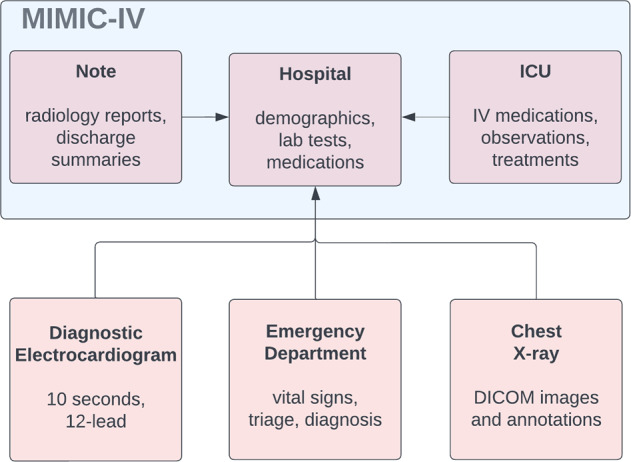
- MIMIC-IV was designed to be backward compatible with MIMIC-III while minimizing processing and organizing data into three modules: hosp, icu, and note.
## Methods
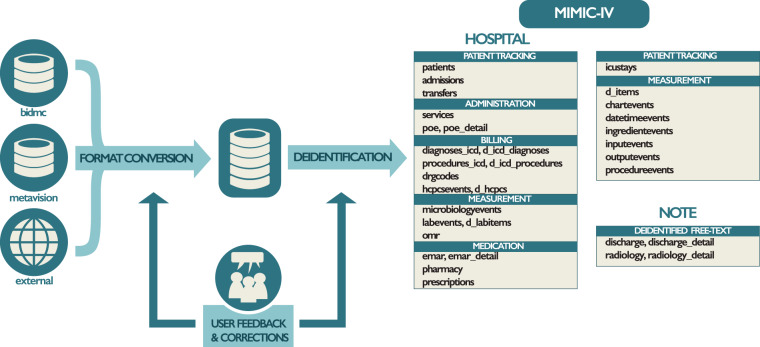
- Collaborative database construction from BIDMC clinical data, transformed and deidentified for release under IRB waiver and data use agreement; the process had three steps: acquisition, transformation, and deidentification.
- Sample/data: all patients admitted to the emergency department or an ICU at BIDMC between 2008–2019, excluding patients younger than 18 at first visit or on a protected list; external coding systems and Massachusetts death records were added.
- Main analysis/workflow: custom SQL scripts to restructure data into relational modules, plus custom linkage algorithms for out-of-hospital mortality and deidentification algorithms for HIPAA identifiers and free text; validation used integrity, consistency, and deidentification checks.
## Limitations
- The paper states that out-of-hospital mortality is only available through linkage to state death records, and deaths are censored at one year from last hospital discharge, so null death dates only indicate survival up to that point.
- The text makes evident that some data are incomplete or unevenly available across modules and time periods (for example, eMAR was deployed hospital-wide only by 2016, and the note module contains only discharge summaries and radiology reports); this is an evident coverage limitation from the text.
- The paper notes that clinical data are “sporadic and noisy,” reflecting routine care rather than research collection; this is a general data-quality limitation stated in the background.
Model-written summary. Check it against the paper before relying on it.
Integrity signals
Registry
Cites
Statistics
Figures
Verification
Claims the paper makes
13 Valid · 3 Not valid · 3 Not checked · 110 Own results and interpretations
Every source the paper cites for this claim was checked and supports it.
In the paper
“Finally, we combined two published algorithms for removing PHI from free-text17,18.”
§ MIMIC-IV, a freely accessible electronic health record dataset > Methods > Deidentification
What the sources say
- Supportedcites [17] Neamatullah I Automated de-identification of free-text medical records BMC medical informatics and decision making 2008 8 1 17 10.1186/1472-6947-8-32 18652655 PMC2526997 source
The Methods sections describe this paper's published algorithm for identifying and removing PHI from free-text medical records. The citing authors' statement that they combined two algorithms describes their own method; this citation identifies one of the algorithms. (LLM, conf=0.92)
- Supportedcites [18] Johnson, A. E. W., Bulgarelli, L. & Pollard, T. J. Deidentification of free-text medical records using pre-trained bidirectional transformers. In Proceedings of the ACM Conference on Health, Inference, and Learning, 214–221 (2020). PMC8330601 34350426 source
The Introduction (page not available in our copy) presents this paper’s BERT model for deidentifying free-text health records and describes measuring how much PHI it removes. The citation can therefore identify one of the two published algorithms; this source need not establish that the citing authors combined them. (LLM, conf=0.91)
plain- Asserted: passes — The authors put it forward as true.
- Checkable: passes — It can be checked against evidence.
- Load-bearing: passes — The paper’s conclusions depend on it.
- Based: passes — The paper gives a reason why it holds.
- Supported
Every source the paper cites for this claim was checked and supports it.
In the paper
“Due to data quality concerns regarding the Social Security Death Master File (SSDMF)13, we did not attempt to link patients to the SSDMF for determining out-of-hospital mortality.”
§ MIMIC-IV, a freely accessible electronic health record dataset > Methods > Acquisition
What the sources say
- Supportedcites [13] Levin MA Lin H-M Prabhakar G McCormick PJ Egorova NN Alive or dead: Validity of the social security administration death master file after 2011 Health Serv Res 2019 51 24 33 10.1111/1475-6773.13069 PMC6338290 30520023 source
The Discussion states that the Death Master File is no longer a reliable single source for mortality data, including out-of-hospital deaths. The decision not to link patients is the citing authors’ own methodological choice; the citation supports the data-quality concern motivating it. (LLM, conf=0.93)
plainstates a cause- Asserted: passes — The authors put it forward as true.
- Checkable: passes — It can be checked against evidence.
- Load-bearing: passes — The paper’s conclusions depend on it.
- Based: passes — The paper gives a reason why it holds.
- Supported
The cited sources support only part of this claim — read each source’s verdict below.
In the paper
“To support research that spans the periods of MIMIC-III (2002–2008) and MIMIC-IV (2008–2019), we have published the MIMIC-III Clinical Database CareVue subset22.”
§ MIMIC-IV, a freely accessible electronic health record dataset > Data Records > Building on earlier versions of MIMIC
What the sources say
- Partly supportedcites [22] Johnson AEW Pollard TJ Mark RG 2022 R. G. Mimic-iii clinical database carevue subset (version 1.4) PhysioNet 10.13026/8a4q-w170 sourceExperimental — accuracy not yet measured
The Abstract says the subset was provided to simplify combining MIMIC-III with MIMIC-IV, and the publication record identifies the released dataset. However, the Background and Methods give the CareVue period as 2001–2008, not the claim’s 2002–2008; the Background confirms MIMIC-IV’s 2008–2019 period. (LLM, conf=0.84)
plainstates a cause- Asserted: passes — The authors put it forward as true.
- Checkable: passes — It can be checked against evidence.
- Load-bearing: passes — The paper’s conclusions depend on it.
- Based: passes — The paper gives a reason why it holds.
- Partly supported
In the paper
“Access to MIMIC-IV is provided via PhysioNet19.”
§ MIMIC-IV, a freely accessible electronic health record dataset > Data Records
What the sources say
- Not checked — no full text of the sourcecites [19] Goldberger AL Physiobank, physiotoolkit, and physionet: components of a new research resource for complex physiologic signals circulation 2000 101 e215 e220 10.1161/01.CIR.101.23.e215 10851218 source
- Asserted: passes — The authors put it forward as true.
- Checkable: passes — It can be checked against evidence.
- Load-bearing: unclear — It is unclear whether the paper’s conclusions depend on it.
- Based: passes — The paper gives a reason why it holds.
A result the paper states — it cites no source for it, so there is none to check. The quote shows it is in the paper.
In the paper
“the d_icd_diagnoses and d_icd_procedures tables contain all codes which were valid at any point during the 2008–2019 time period.”
§ MIMIC-IV, a freely accessible electronic health record dataset > Data Records > Hospital module (hosp)
plain- Asserted: passes — The authors put it forward as true.
- Checkable: passes — It can be checked against evidence.
- Load-bearing: unclear — It is unclear whether the paper’s conclusions depend on it.
- Based: passes — The paper gives a reason why it holds.
29 more claims
Create a free account to see all 129 claims and every source verdict.
- Probably not a substantial claim. 84
- It may state two separate claims as one. 30
Claims other papers make about this one
Each is checked against this paper’s own text: does it say what the citing paper says it does?
The source backs part of the claim, not all of it — or backs it for a different population, condition or comparison.
In the citing paper
“We conducted a study using the publicly available MIMIC-IV dataset, which comprises 431,231 unique hospital admissions from 299,712 patients admitted to an ICU or the ED of the Beth Israel Deaconess Medical Center in Boston, Massachusetts27.”
From DRG-LLaMA : tuning LLaMA model to predict diagnosis-related group for hospitalized patients (2024) · cites this paper as [27]
Experimental — accuracy not yet measuredThe source backs part of the claim, not all of it — or backs it for a different population, condition or comparison.
In the citing paper
“For instance, the MIMIC-IV [148] includes a limited range of modalities, including clinical notes, medical images (chest x-ray Digital Imaging and Communications in Medicine [DICM] images), and time series (diagnostic electrocardiogram and patient records), making it a valuable but constrained resource for training medical M-LLMs.”
From Multimodal Large Language Models in Health Care: Applications, Challenges, and Future Outlook. (2024) · cites this paper as [148]
Experimental — accuracy not yet measuredThe source backs part of the claim, not all of it — or backs it for a different population, condition or comparison.
In the citing paper
“Existing multimodal medical data sets available for public use [84,85,148] are often relatively small in scale and demand the consolidation of numerous resources.”
From Multimodal Large Language Models in Health Care: Applications, Challenges, and Future Outlook. (2024) · cites this paper as [148]
Experimental — accuracy not yet measuredThe source backs part of the claim, not all of it — or backs it for a different population, condition or comparison.
In the citing paper
“- MIMIC-IV: A comprehensive, de-identified EHR dataset supporting tasks such as summarization, question answering, and document retrieval [17].”
From Retrieval-Augmented Generation (RAG) in Healthcare: A Comprehensive Review (2025) · cites this paper as [17]
Experimental — accuracy not yet measuredThe cited source says what the claim attributes to it.
In the citing paper
“In order to build agents that are grounded in medically relevant situations, we use a random sample of diagnostic questions from the US Medical Licensing Exam (USMLE), from deidentified electronic health records (MIMIC-IV)16, and from the New England Journal of Medicine (NEJM) case challenges.”
From AgentClinic: a multimodal benchmark for tool-using clinical AI agents (2026) · cites this paper as [16]
4 more claims about this paper
Create a free account to see every claim other papers make about this one.
Citations
Cites
Goldberger, A. L., Amaral, L. A. N., Glass, L., Hausdorff, J. M., Ivanov, P. C., Mark, R. G., Mietus, J. E., Moody, G. B., Peng, C.-K., & Stanley, H. E. (2000) · Circulation · doi:10.1161/01.cir.101.23.e215 · Cited by 14,809
Self-citationMIMIC-III, a freely accessible critical care database
Johnson, A. E. W., Pollard, T. J., Shen, L., Lehman, L.-W. H., Feng, M., Ghassemi, M., Moody, B., Szolovits, P., Anthony Celi, L., & Mark, R. G. (2016) · Scientific Data · doi:10.1038/sdata.2016.35 · Cited by 8,141 · cited 1×
“More recently, MIMIC-III was published in 2015 and significantly expanded MIMIC-II, containing data for over 40,000 patients 3 .”
MethodSelf-citationPollard, T. J., Johnson, A. E. W., Raffa, J. D., Celi, L. A., Mark, R. G., & Badawi, O. (2018) · Scientific Data · doi:10.1038/sdata.2018.178 · Cited by 1,993 · cited 2×
“0 comprises of 200,859 stays at ICUs and step-down units across 208 hospitals in the continental United States 4 .”
BackgroundSelf-citationSaeed, M., Villarroel, M., Reisner, A. T., Clifford, G., Lehman, L.-W., Moody, G., Heldt, T., Kyaw, T. H., Moody, B., & Mark, R. G. (2011) · Critical Care Medicine · doi:10.1097/ccm.0b013e31820a92c6 · Cited by 1,162
Self-citationBest Practices for Scientific Computing
Wilson, G., Aruliah, D. A., Brown, C. T., Chue Hong, N. P., Davis, M., Guy, R. T., Haddock, S. H. D., Huff, K. D., Mitchell, I. M., Plumbley, M. D., et al. (2014) · PLoS Biology · doi:10.1371/journal.pbio.1001745 · Cited by 723 · cited 1×
“The creation of MIMIC-IV followed best practices in scientific computing 23 .”
MethodJohnson, A., Bulgarelli, L., Pollard, T., Gow, B., Moody, B., Horng, S., Celi, L. A., & Mark, R. (2024) · PhysioNet · doi:10.13026/07hj-2a80 · Cited by 524
Self-citationJohnson, A., Bulgarelli, L., Pollard, T., Horng, S., Celi, L. A., & Mark, R. (2023) · PhysioNet · doi:10.13026/s6n6-xd98 · Cited by 524
Self-citationEarly prediction of circulatory failure in the intensive care unit using machine learning
Hyland, S. L., Faltys, M., Hüser, M., Lyu, X., Gumbsch, T., Esteban, C., Bock, C., Horn, M., Moor, M., Rieck, B., et al. (2020) · Nature Medicine · doi:10.1038/s41591-020-0789-4 · Cited by 477 · cited 1×
“The HiRID database contains high-resolution data for almost 34,000 admissions between 2008–2016 at Bern University Hospital in Switzerland 6,7 .”
BackgroundThe MIMIC Code Repository: enabling reproducibility in critical care research
Johnson, A. E. W., Stone, D. J., Celi, L. A., & Pollard, T. J. (2018) · Journal of the American Medical Informatics Association · doi:10.1093/jamia/ocx084 · Cited by 442 · cited 1×
“The MIMIC Code Repository was originally created for MIMIC-III to enable researchers to share and reuse code 24 .”
MethodSelf-citationAutomated de-identification of free-text medical records
Neamatullah, I., Douglass, M. M., Lehman, L.-W. H., Reisner, A., Villarroel, M., Long, W. J., Szolovits, P., Moody, G. B., Mark, R. G., & Clifford, G. D. (2008) · BMC Medical Informatics and Decision Making · doi:10.1186/1472-6947-8-32 · Cited by 413
Self-citation
Cited by
Items 1,801–1,900 of 3,269
Algorithmic Bias in Lung Protective Tidal Volume FormulasPreprint
Sarma, A. A., Sullivan, K. M., Baugh, A. D., Bhakta, N. R., & Calfee, C. S. (2024) · SSRN Electronic Journal · doi:10.2139/ssrn.4898478
Utilizing ETL Processes to Enhance Healthcare Education: Migrating MIMIC-IV to OpenEMR
Kasula, M. S. K., Sudalagunta, S. H., Sunchu, K., et al. (2024) · IEEE International Symposium on Computer-Based Medical Systems (CBMS) · doi:10.1109/cbms61543.2024.00039
“Such datasets are invaluable for advancing medical research and improving healthcare education by offering a granular view of patient care dynamics [2].”
BackgroundMethodInfluentialA symptom-based community-weighted similarity approach for inpatient health condition monitoring
Ponciano, J. R., Cazzolato, M. T., Gutierrez, M. A., et al. (2024) · IEEE International Symposium on Computer-Based Medical Systems (CBMS) · doi:10.1109/cbms61543.2024.00050
“2 clinical database [10], [22].”
MethodHan, X., Qi, B., Yuan, W., et al. (2024) · Research Square · doi:10.21203/rs.3.rs-4658981/v1
Introducing AIDx, The Physician's AI CopilotPreprint
Alwakeel, A. (2024) · Research Square · doi:10.21203/rs.3.rs-4698218/v1
Li, Y., Zhu, Y. S., Fu, L., Luo, L., & She, Y. (2024) · American Heart Journal Plus Cardiology Research and Practice · doi:10.1016/j.ahjo.2024.100432
“MIMIC-IV underwent data acquisition, preparation, and deidentification processes to ensure data usability and patient privacy (17).”
MethodENCoDE – a skin tone and clinical dataset from a prospective trial on acute care patientsPreprint
Hao, S., de Matos, J. C. R. G., Dempsey, K., Alwakeel, M., Houghtaling, J., Hong, C., Gichoya, J. W., Kibbe, W. A., Pencina, M. J., Cox, C. E., et al. (2024) · medRxiv · doi:10.1101/2024.08.07.24311623
Self-citationA simple nomogram for predicting the 90-day mortality of community-acquired pneumonia in the ICU
Sheng, Y., Dai, H., Shi, Q., et al. (2024) · The American Journal of the Medical Sciences · doi:10.1016/j.amjms.2024.08.016
Chang, Y., Rao, S., Zhou, T., et al. (2024) · Research Square · doi:10.21203/rs.3.rs-4767381/v1
Zhang, Y., Bai, X., Chen, B., & Wan, Q. (2024) · Research Square · doi:10.21203/rs.3.rs-4952719/v1
Fill in the Blank, MIMIC the Procedure: Tracking Patient Record for Medical Data Reconstruction
Lee, S., Seo, D., & Ko, T. (2024) · Studies in health technology and informatics · doi:10.3233/shti240726
Cheng, H., Xu, X., Tang, Y., Yang, X., Ling, Y., Tan, S., Wang, Z., Ming, W., & Lyu, J. (2024) · Clinical Nursing Research · doi:10.1177/10547738241273164
“The study used the comprehensive, publicly available Medical Information Mart for Intensive Care IV (MIMIC-IV) database, version 2.0 (A. Johnson et al., 2023).”
InfluentialLiao, J., Wang, M., Xie, H., et al. (2024) · Research Square · doi:10.21203/rs.3.rs-4810903/v1
Huang, Y., Chen, S., Wang, Y., Ou, X., Yan, H., Gan, X., & Wei, Z. (2024) · Interactive Journal of Medical Research · doi:10.2196/54891 · Cited by 3
“…of patient information and the creation of the research resource were reviewed by the Institutional Review Board at Beth Israel Deaconess Medical Center, which granted a waiver of informed consent and approved the data-sharing initiative [14], this study was not subject to specific ethical review.”
Li, S., Huang, S., Feng, Y., et al. (2024) · Research Square · doi:10.21203/rs.3.rs-4900379/v1
Extraction of patient subpopulations using transformer-encoded vectors
Holmes, B., Raymer, M. L., & Banerjee, T. (2024) · IEEE National Aerospace and Electronics Conference (NAECON) · doi:10.1109/naecon61878.2024.10670637
“…patient groups using a clinical metathesaurus (MedCAT) to screen patient notes for particular clinically relevant terms from either the publicly available MIMIC-IV database [10] or from medical notes collected by a Kaggle competition, originally available from MTSAMPLES.com [23].”
MethodA multiscale approach for biomedical machine learning
(2024) · Nature Machine Intelligence · doi:10.1038/s42256-024-00907-6
Unveiling AI-ECG using Generative Counterfactual XAI FrameworkPreprint
Jang, J.-H., Jo, Y., Kang, S., Son, J. M., Lee, H. S., Kwon, J., & Lee, M. S. (2024) · medRxiv · doi:10.1101/2024.09.29.24314144 · Cited by 1
Jiang, Z., Wang, Y., Xie, T., Liu, F., Wan, R., Xu, J., Zhou, Z., Zhou, L., & Liu, Y. (2024) · Research Square · doi:10.21203/rs.3.rs-4882108/v1
Lü, M., wang, P., Xiong, R., et al. (2024) · Research Square · doi:10.21203/rs.3.rs-4868967/v1
Yang, C.-H., Huang, J.-L., Tsai, L., Taniar, D., & Pai, T. (2024) · Bioengineering · doi:10.3390/bioengineering11101020
“The MIMIC-IV database (Medical Information Mart for Intensive Care IV (MIMIC-IV database used in this study contains the inpatient medical records of Beth Israel Deaconess Medical Center (BIDMC) in the United States from 2008 to 2019 [31].”
MethodPredicting 30-Day and 1-Year Mortality in Heart Failure with Preserved Ejection Fraction (HFpEF)Preprint
Shin, I., Bhatt, N. R., Alashi, A., et al. (2024) · medRxiv · doi:10.1101/2024.10.15.24315524
“We used the MIMIC-IV dataset 20,21”
Chen, Y., Lu, L., Liu, B., Deng, X.-M., Zheng, Y., Zeng, Y., Wang, K., Guo, X., Zhou, T., Ye, W., et al. (2024) · Research Square · doi:10.21203/rs.3.rs-5032021/v1
Li, J. Z., & Yan, H. (2024) · Surgical Infections · doi:10.1089/sur.2024.089
Guo, R., Tong, J., Wang, L., Yang, B. R., Ma, L., Cao, Y., & Zhao, W. (2024) · Medicina Intensiva (English Edition) · doi:10.1016/j.medine.2024.10.005
Zhang, Z., Ji, M., Zhao, Q., Jiang, L., Fan, S., & Zuo, H. (2024) · International Journal of Cardiology Cardiovascular Risk and Prevention · doi:10.1016/j.ijcrp.2024.200347
Mayntz, S. P. (2024) · Cardiology · doi:10.1159/000542319
Li, Y., Deng, Y. L., Gao, G., Liu, W., & Wu, L. L. (2024) · Research Square · doi:10.21203/rs.3.rs-5331299/v1
A Reinforcement Learning Approach for Predicting the Onset of Septic Shock Patients with Unfair Bias
Zhang, S., Wang, Z., Zhang, Y., & Liu, S. (2024) · International Conference on Biomedical Engineering and Applications (ICBEA) · doi:10.1109/icbea62825.2024.00041 · Cited by 1
“In this study, we developed and validated our model based on data from the MIMIC-IV [15].”
MethodMANet: A Multiview Attention Network for Automatic ICD Coding
Shen, H., Wang, H., Shangguan, G., & Liu, D. (2024) · Lecture notes in computer science · doi:10.1007/978-981-97-9440-9_10 · Cited by 1
GHOSTS: Validated generation of synthetic hospital time seriesPreprint
Zhumagambetov, R., Giesa, N., Boie, S. D., et al. (2024) · medRxiv · doi:10.1101/2024.10.29.24316332
Vecchio, N. (2024) · Cardiology · doi:10.1159/000541861 · Cited by 1
Chen, J., Chen, A., Zhang, N., et al. (2024) · Research Square · doi:10.21203/rs.3.rs-5280519/v1
Harris, C., Pimpalkar, A. S., Aggarwal, A., Yang, J.-Y., Chen, X.-J., Schmidgall, S., Rapuri, S., Greenstein, J. L., Taylor, C. O., & Stevens, R. D. (2024) · medRxiv · doi:10.1101/2024.11.19.24317577 · Cited by 1
“2) 21 , 22 , which includes 299,712 patients across 431,231 admissions to Beth Israel Deaconess Medical Center between 2008 and 2019.”
Research on ICU Sepsis Prognosis Based on Multimodal Fusion Modeling
武, 瑞. (2024) · Modeling and Simulation · doi:10.12677/mos.2024.136583
Yan, Y., Hu, H., & Chen, Z. (2024) · Intensive and Critical Care Nursing · doi:10.1016/j.iccn.2024.103912
Jiang, Z., Xia, J., Lv, S., zhang, G., Fu, Z., & Jiang, L. (2024) · Research Square · doi:10.1101/2024.11.27.24318046
Predicting the physiological effects of multiple drugs using electronic health record
Jeon, J., Hong, E., Kim, J., Lee, S., & Kim, H. U. (2024) · Computers in Biology and Medicine · doi:10.1016/j.compbiomed.2024.109485
Crispin, A. R., Hulu, V. T., Zaldi, M. A. A., & Dharma, A. (2024) · International Conference on Technology Innovation and Its Applications (ICTIIA) · doi:10.1109/ictiia61827.2024.10761270
“It's important to note that the dataset has been appropriately de-identified [6].”
Yao, F., Luo, J., Ming, Y., Zhao, Z., Wang, L., & He, Z. (2024) · Research Square · doi:10.21203/rs.3.rs-5406276/v1
Zhang, Y., Chen, N., Hao, C., Liu, H., Ni, M., & Hu, C. (2024) · Research Square · doi:10.21203/rs.3.rs-5331179/v1
Zhou, C., & Liang, C. (2024) · Journal of Critical Care · doi:10.1016/j.jcrc.2024.155003
Lam, B. D., Struja, T., Li, Y., de Matos, J. C. R. G., Chen, Z., Liu, X., Celi, L. A., Jia, Y., & Raffa, J. D. (2024) · Critical Care Science · doi:10.62675/2965-2774.20240030-pt
Self-citationWu, Y., Chen, J., Liao, M., Deng, X., & Li, Y. (2024) · Research Square · doi:10.21203/rs.3.rs-5401476/v1
Rust, J., Mandel, C., Stich, K., & Autexier, S. (2024) · Annual International Conference of the IEEE Engineering in Medicine and Biology Society (EMBC) · doi:10.1109/embc53108.2024.10782095
“For this purpose, GRU and LSTM-networks are trained on samples over a total of 89 medical features, each one given as 4h long time series taken from the MIMIC-IV database [8].”
Xu, Z., Liu, S., Liu, X., et al. (2024) · Research Square · doi:10.21203/rs.3.rs-5382710/v1
Ji, Y., & Li, L. (2024) · Critical Care · doi:10.1186/s13054-024-05208-3
Qian, Y., & Ma, B. (2024) · medRxiv · doi:10.1101/2024.12.19.24319363
Palmowski, L., Westhus, B., Witowski, A., et al. (2024) · SSRN Electronic Journal · doi:10.2139/ssrn.5068603
Wan, J., Cao, X., & Yang, Y. (2024) · Clinical Rheumatology · doi:10.1007/s10067-024-07280-0
Zhu, Z., Du, J., Kang, N., et al. (2024) · IEEE International Conference on Medical Artificial Intelligence (MedAI) · doi:10.1109/medai62885.2024.00048
“We conduct an external validation using the MIMIC-IV, a available database sourced from the electronic health record of the Beth Israel Deaconess Medical Center [15].”
Alluri, D. S., & Pabon‐Rodriguez, F. M. (2024) · medRxiv · doi:10.1101/2024.12.21.24319488
Treatment Failure in Non-Intubated Acute Respiratory Distress Syndrome: A Retrospective Cohort StudyPreprint
Kim, K. H., Yoon, J. H., Kim, S. C., & Lee, J. M. (2024) · Research Square · doi:10.21203/rs.3.rs-5654990/v1
Dimopoulos, D., Danilatou, V., & Κωστούλας, Θ. (2024) · Hellenic Conference on Artificial Intelligence · doi:10.1145/3688671.3688787 · Cited by 2
Health Analytics and Precision Medicine
Boland, M. R. (2024) · Springer eBooks · doi:10.1007/978-3-031-74383-2_1
Boland, M. R. (2024) · Springer eBooks · doi:10.1007/978-3-031-74383-2_15
Clinical Datasets: Open Access Electronic Health Records Datasets
Boland, M. R. (2024) · Springer eBooks · doi:10.1007/978-3-031-74383-2_8
Red blood cell distribution width-derived indces predicts long-term prognosis in acute heart failurePreprint
Zhang, M., Zhu, J., Mo, D.-G., et al. (2024) · medRxiv · doi:10.1101/2024.12.22.24319514
Anticoagulant Therapy Improves Survival in Non-COVID-19 Pneumonia: A Retrospective Cohort StudyPreprint
Hu, H., Zhu, Y., Hu, R., et al. (2024) · SSRN Electronic Journal · doi:10.2139/ssrn.5076145
Association between autoimmune diseases and all-cause mortality in patients with cardiac arrhythmia
Li, L., Wu, L., Hu, Z., Liu, L., Zhou, L., Zhang, Z., Zhao, M., Xiong, Y., Zhang, Z., Zheng, L., et al. (2024) · Revista Española de Cardiología (English Edition) · doi:10.1016/j.rec.2024.12.008
Contextualized Biomedical Language Processing Enhances ICU Survival PredictionPreprint
Chen, R., Cai, Y. R., Zhang, S. J., Huo, Z., Song, M., Li, W., Yang, D., Hwang, S., Bai, L., & Zhang, X. (2024) · medRxiv · doi:10.1101/2024.12.20.24318979
Yao, X., Yang, J., Zhang, J., et al. (2025) · medRxiv · doi:10.1101/2024.12.31.24319835
Purbasari, I. Y., Bayuseno, A. P., Isnanto, R. R., & Winarni, T. I. (2025) · SSRN Electronic Journal · doi:10.2139/ssrn.5071220
CLEAR-Shock: Contrastive LEARning for Shock
Kwon, J. E., Lee, S. W., Kim, S. J., Han, K. S., Lee, S., Song, J., & Lee, H. K. (2025) · IEEE Journal of Biomedical and Health Informatics · doi:10.1109/jbhi.2025.3527477 · Cited by 1
“We employed two publicly-available databases, the Medical Information Mart for Intensive Care-IV (MIMIC-IV) version 2.2 [26] and the eICU Collaborative Research Database (eICU-CRD) version 2.0 [27] where MIMIC-IV was used for the development of the monitoring system, and the eICU-CRD was used for…”
InfluentialGuo, Y., Wang, F., Ma, S., et al. (2025) · SSRN Electronic Journal · doi:10.2139/ssrn.5087371
Semi-Supervised PARAFAC2 Decomposition for Computational Phenotyping Using Electronic Health Records
Konyar, E., & Gahrooei, M. R. (2025) · IEEE Journal of Biomedical and Health Informatics · doi:10.1109/jbhi.2025.3530271 · Cited by 2
“In this section, we evaluate the performance of the proposed method by applying it to a real-world publicly available MIMIC-IV (Medical Information Mart for Intensive Care IV) dataset [51], [52].”
CRTRE: Causal Rule Generation with Target Trial Emulation Framework
Wang, J.-D., Li, W., Wang, H., Lyu, H., Thirukumaran, C., Mesfin, A., Yu, H., & Luo, J.-B. (2024) · BigData Congress [Services Society] · doi:10.1109/bigdata62323.2024.10825951
“CRTRE demonstrated superior performance, surpassing other state-of-the-art deep-learning-based models such as KEPT [23, 24] and MSMN [25] on both MIMIC-III [26] and MIMIC-IV datasets [27].”
Huang, G., Li, H., Song, F., Zhang, C., Jian, M., Huang, C., Zhang, Y., Hu, B., & Jiang, W. (2025) · Medicina Intensiva · doi:10.1016/j.medine.2025.502143 · Cited by 5
Choudhuri, A., Vu, H. M., Jha, K., et al. (2025) · medRxiv · doi:10.1101/2025.01.18.25320096
Jamal, N. E., Brooks, T. G., Mrčela, A., Genuardi, M. V., FitzGerald, G. A., & Skarke, C. (2025) · medRxiv · doi:10.1101/2025.01.28.25321270
Zhang, C., Liang, W., Ning, M., et al. (2025) · Renal Failure · doi:10.1080/0886022x.2025.2456110
ECG-based intelligent model for coronary heart disease screening
Chen, X., Niu, Y., Fan, J., et al. (2024) · International Conference on Biomedical and Bioinformatics Engineering (ICBBE) · doi:10.1145/3707127.3707139
Potential source of bias in AI models: Lactate measurement in the ICU as a templatePreprint
Hussein, N. S. A., Pradhan, P., Haug, F. W., Moukheiber, D., Moukheiber, L., Moukheiber, M., Moukheiber, S., Weishaupt, L. L., Ellen, J., D’Couto, H. T., et al. (2025) · Research Square · doi:10.21203/rs.3.rs-5836145/v1
“Data was extracted from the publicly available MIMIC-IV database (17).”
Self-citationLIU, Y., LI, F., Cheng, J., et al. (2025) · Journal of Mechanics in Medicine and Biology · doi:10.1142/s0219519425400202
Xinyi, Z., Xiao-yan, G., Zhao, Z., Li, W., Huaiyu, C., Hongyan, L., Jiandong, L., & Mingrui, L. (2025) · medRxiv · doi:10.1101/2025.02.11.25321833
Ma, J., Qin, J., Mao, F., et al. (2025) · medRxiv · doi:10.1101/2025.02.13.25322258
Chen, M., Li, P., Xu, Y., et al. (2025) · SSRN Electronic Journal · doi:10.2139/ssrn.5137567
Huang, X., Liu, S., Xu, Z., Liu, X., Hu, J., Pan, M., Yang, C., Lin, J., & Huang, X. (2025) · Journal of Intensive Care Medicine · doi:10.1177/08850666251319289
Li, R., Ding, Y., & Xue, L. (2025) · BMC Rheumatology · doi:10.1186/s41927-025-00469-z
“The information available in the MIMIC-IV database includes patient measurements, orders, diagnoses, procedures, treatments, and de-identified free-text clinical notes [8].”
Optimal Contract Design for End-of-Life Care Payments
Jiang, M., Chen, Y., Chen, X., Lavaei, J., & Aswani, A. J. (2024) · IEEE Conference on Decision and Control (CDC) · doi:10.1109/cdc56724.2024.10886745 · Cited by 1
“To numerically evaluate our optimal contracts, we first extracted a cohort of 25934 patients from the MIMIC-IV database (Medical Information Mart for Intensive Care, version 4) [18].”
Xie, L., Chen, J., Li, Y., Liu, G., Shen, J., Li, X., Yang, Y., Chen, Y., Luo, S., & Huang, B. (2025) · Frontiers in Pharmacology · doi:10.3389/fphar.2025.1514138
“The data of this study were taken from the American Medical Information Mart for Intensive Care (MIMIC)-IV (version 3.0) database (Johnson et al., 2023), which is a publicly accessible clinical database containing 94,458 ICU stays and clinical outcomes after discharge between 2008 and 2022 at the…”
InfluentialGuo, R., Tong, J., Wang, L., Yang, B. R., Ma, L., Cao, Y., & Zhao, W. (2025) · Medicina Intensiva · doi:10.1016/j.medin.2024.08.010
Li, L., Wu, L., Hu, Z., Liu, L., Zhou, L., Zhang, Z., Zhao, M., Xiong, Y., Zhang, Z., Zheng, L., et al. (2025) · Revista Española de Cardiología · doi:10.1016/j.recesp.2024.12.004
Li, P., Wang, X., & Li, L. (2025) · Drug Healthcare and Patient Safety · doi:10.2147/dhps.s497413
Yao, X., Leng, Y., & Cao, J. (2025) · Frontiers in Cardiovascular Medicine · doi:10.3389/fcvm.2025.1552807
“This retrospective cohort study utilized health-related data from the MIMIC-IV database (version 3.0), a robust resource curated by the Massachusetts Institute of Technology (MIT) Laboratory of Computational Physiology (6).”
InfluentialJakobsen, T. S. T., Cristòbal-Cóppulo, E., Rasmussen, S., & Benros, M. E. (2025) · medRxiv · doi:10.1101/2025.03.07.25323558 · Cited by 3
Multispecies relations shape bird-feeding practices
Aivelo, T., Aulio, M., Enström, J., et al. (2025) · npj Biodiversity · doi:10.1038/s44185-025-00080-y
Prediction Model of Mortality Risk of Sepsis Patients Based on Stacking Algorithm
李, 文. (2025) · Modeling and Simulation · doi:10.12677/mos.2025.143220
Identification of Sepsis Subphenotypes via ICU Data Clustering
Assis, G., Mello, V. F., Ribeiro, H. B., et al. (2024) · doi:10.5753/eniac.2024.245281
Predicting the 30-day readmissions of congestive heart failure patients from diagnosis records
Shao, D., Wang, M., Liang, S., Zhang, G., Wei, J., & Gu, H. (2024) · International Conference on Public Health and Data Science (ICPHDS) · doi:10.1145/3718677.3718709
Naliyatthaliyazchayil, P., Muthyala, R., Gichoya, J. W., & Purkayastha, S. (2025) · doi:10.2196/preprints.74142
Chen, D., Liu, W., Zhang, J., & Zhang, M. (2025) · International Journal of General Systems · doi:10.1080/03081079.2025.2481895
“To develop a personalized recommendation system, we extracted data from the MIMIC-IV dataset, a widely recognized source for clinical research (Johnson et al. 2023).”
Optimized Renal Replacement Therapy Decisions in Intensive Care: A Reinforcement Learning ApproachPreprint
Kapral, L., Bologheanu, R., Azarbeik, M. M., Bilir, A., Weiss, R., Bartos, S., Schaller, S. J., Heitzinger, C., Schaden, E., & Kimberger, O. (2025) · Research Square · doi:10.21203/rs.3.rs-6243566/v1
Chromosome-level genome assembly of Jiaobai (Zizania latifolia, Poceace)
Huang, Y., Li, Y., Wang, L., et al. (2025) · Scientific Data · doi:10.1038/s41597-025-04853-9
Ruffolo, I., Siddiqui, A., Nguyen, B., et al. (2025) · medRxiv · doi:10.1101/2025.03.31.25324979
Augmented Reality-Based Patient Tracking in Autonomous Healthcare Systems
Kakkar, P., Jaggi, A., Vedula, J., Xusinovna, J. M., Umida, S., & Kumari, A. (2025) · International Conference on Advances in Computer Science, Electrical, Electronics, and Communication Technologies (CE2CT) · doi:10.1109/ce2ct64011.2025.10939361 · Cited by 1
Fernández-Narro, D., Ferri, P., Gutiérrez‐Sacristán, A., Garcia-Gomez, J. M., & Sáez, C. (2025) · SSRN Electronic Journal · doi:10.2139/ssrn.5196124
Racial Differences in Temporal Thermometry and Association with Delayed Sepsis Bundle CarePreprint
de Matos, J. C. R. G., Alwakeel, M. I., Hao, S., Martins, I. S., Cardoso, J. S., Gichoya, J. W., Celi, L. A., Lane, A., Krishnamoorthy, V., Bhavani, S. V., et al. (2025) · medRxiv · doi:10.1101/2025.03.31.25324893
Self-citation
Metadata
- Authors
- Johnson, A. E. W., Bulgarelli, L., Shen, L., Gayles, A., Shammout, A., Horng, S., Pollard, T. J., Hao, S., Moody, B., Gow, B., Lehman, L.-W. H., Celi, L. A., & Mark, R. G.
- Affiliations
- Hospital for Sick Children (CA)
- Massachusetts Institute of Technology (US)
- Beth Israel Deaconess Medical Center (US)
- Corresponding author
- Johnson, Alistair E. W.
- ORCID
- Venue
- Scientific Data
- Published
- 2023-01-03
- Volume
- 10
- Issue
- 1
- Pages
- 1-1
- ISSN
- 2052-4463 (ISSN-L)
- PMC
- PMC9810617
- OpenAlex
- W4313439128
- Semantic Scholar
- 5425de16356015c2f26d2a50684c6c46d6998f51
- Cited by
- 3,401
- References
- 25
- Citations by year
- 2026: 1421 · 2025: 1175 · 2024: 649 · 2023: 154
- Type
- data paper
- Language
- en
- Update notices
- Open access
- gold
- doi.org
- Licence
- cc-by
- creativecommons.org/licenses/by/4.0 (tdm)
- creativecommons.org/licenses/by/4.0 (vor)
- Locations
- Scientific Data (publishedVersion, cc-by)
- PubMed Central (publishedVersion, cc-by)
- PubMed (publishedVersion)
- DOAJ (DOAJ: Directory of Open Access Journals) (submittedVersion, cc-by-sa)
- Funders
- U.S. Department of Health & Human Services | National Institutes of Health (NIH-R01-EB017205)
- Topics
- Physical Sciences › Computer Science › Artificial Intelligence › Machine Learning in Healthcare
- Health Sciences › Health Professions › Health Information Management › Electronic Health Records Systems
- Health Sciences › Health Professions › Health Information Management › Medical Coding and Health Information
- Keywords
- MIMIC-IV, electronic health records, clinical research data, hospital patient data, open data access, Beth Israel Deaconess Medical Center
- MeSH terms
- Hospitals, Humans, Databases, Factual, Electronic Health Records
About these checks
Registry, retraction, Cites and statistics results are computed, not judged, with one exception: a printed reference that no index lists is read once by a model before it counts as a citation error. Claims are extracted by a model and kept only when their quote appears verbatim in the text; each cited source is then checked, with a model’s help, for whether it says what the claim relies on. Those verdicts can be wrong — read the claim’s quote and the cited source before relying on one.
The claim verdicts this report counts are experimental: their accuracy is not yet measured.
A language model drew the claims from the paper on 2026-10-02, under version 3 of the claim definition (model deepseek-v4.1-flash, prompt extract-v3).
A second model labelled each claim on 2026-10-02 (model jev-1.13-20260917, definition revision gold-guideline-v0.2).
Cited sources are checked with a language model’s help (gpt-6-sol).
Statistics and arithmetic are recomputed, not judged.
Confidence bands are shown only for fields calibrated on our annotated test set. None is calibrated yet, so no band is shown.
What counts as a claim ›How we measure confidence ›How we check this ›
Are you an author, or do you see a problem with this page? Request a review
Data sources
Bibliographic data: Semantic Scholar, OpenAlex, Crossref.
Contains information from the Semantic Scholar Academic Graph Datasets, made available under the ODC Attribution License (ODC-BY 1.0).
Semantic Scholar’s data is described in: Kinney, R., et al. (2023). The Semantic Scholar Open Data Platform. arXiv:2301.10140.
