

MIMIC-IV, a freely accessible electronic health record dataset
Open accessThe DOI matches its Crossref record; 28 of the 28 references it cites were found in a registry or an index; 15 of the 20 sources its claims cite were checked for support.
Abstract
Digital data collection during routine clinical practice is now ubiquitous within hospitals. The data contains valuable information on the care of patients and their response to treatments, offering exciting opportunities for research. Typically, data are stored within archival systems that are not intended to support research. These systems are often inaccessible to researchers and structured for optimal storage, rather than interpretability and analysis. Here we present MIMIC-IV, a publicly available database sourced from the electronic health record of the Beth Israel Deaconess Medical Center. Information available includes patient measurements, orders, diagnoses, procedures, treatments, and deidentified free-text clinical notes. MIMIC-IV is intended to support a wide array of research studies and educational material, helping to reduce barriers to conducting clinical research.
Overview
CoChat Summary
## TL;DR
MIMIC-IV is a publicly available, deidentified electronic health record database from Beth Israel Deaconess Medical Center designed to support research, education, and technology development. It covers hospital and ICU care from 2008–2019 and adds modular structured data plus free-text clinical notes.
## Key findings
- The database includes patient measurements, orders, diagnoses, procedures, treatments, and deidentified free-text clinical notes, and is available through PhysioNet.
- The clinical cohort includes patients admitted to the emergency department or an ICU between 2008–2019; after exclusions, the authors linked 65,805 of 150,832 unique individuals (43.6%) to Massachusetts state death records.
- The paper reports that 51,022/65,803 (77.5%) of the successful death-record links were exact matches on last name, date of birth, and social security number; 11,634/65,803 (17.7%) were exact last name and date of birth plus approximate first name.
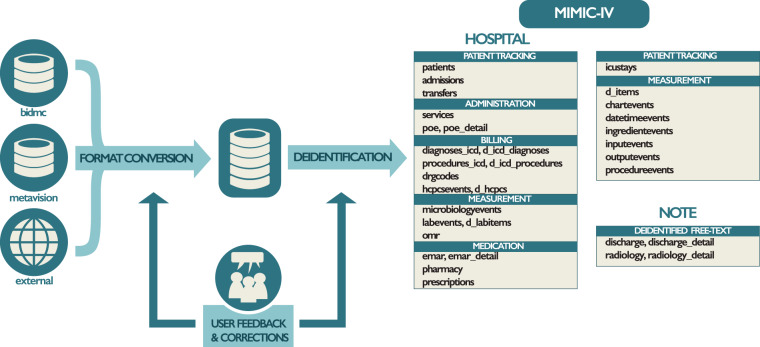
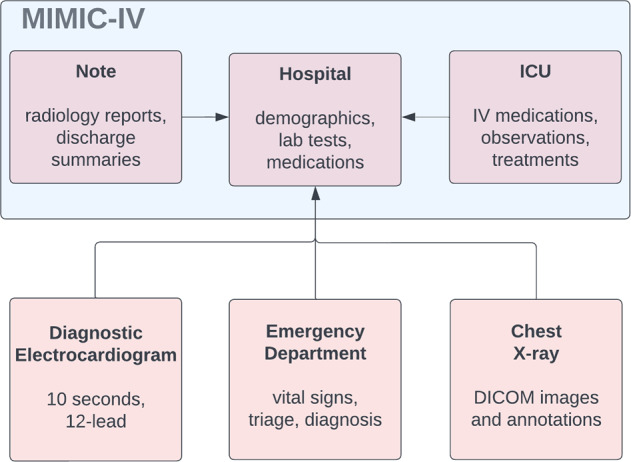
- MIMIC-IV was designed to be backward compatible with MIMIC-III while minimizing processing and organizing data into three modules: hosp, icu, and note.
## Methods
- Collaborative database construction from BIDMC clinical data, transformed and deidentified for release under IRB waiver and data use agreement; the process had three steps: acquisition, transformation, and deidentification.
- Sample/data: all patients admitted to the emergency department or an ICU at BIDMC between 2008–2019, excluding patients younger than 18 at first visit or on a protected list; external coding systems and Massachusetts death records were added.
- Main analysis/workflow: custom SQL scripts to restructure data into relational modules, plus custom linkage algorithms for out-of-hospital mortality and deidentification algorithms for HIPAA identifiers and free text; validation used integrity, consistency, and deidentification checks.
## Limitations
- The paper states that out-of-hospital mortality is only available through linkage to state death records, and deaths are censored at one year from last hospital discharge, so null death dates only indicate survival up to that point.
- The text makes evident that some data are incomplete or unevenly available across modules and time periods (for example, eMAR was deployed hospital-wide only by 2016, and the note module contains only discharge summaries and radiology reports); this is an evident coverage limitation from the text.
- The paper notes that clinical data are “sporadic and noisy,” reflecting routine care rather than research collection; this is a general data-quality limitation stated in the background.
Model-written summary. Check it against the paper before relying on it.
Integrity signals
Registry
Cites
Statistics
Figures
Verification
Claims the paper makes
13 Valid · 3 Not valid · 3 Not checked · 110 Own results and interpretations
Every source the paper cites for this claim was checked and supports it.
In the paper
“Finally, we combined two published algorithms for removing PHI from free-text17,18.”
§ MIMIC-IV, a freely accessible electronic health record dataset > Methods > Deidentification
What the sources say
- Supportedcites [17] Neamatullah I Automated de-identification of free-text medical records BMC medical informatics and decision making 2008 8 1 17 10.1186/1472-6947-8-32 18652655 PMC2526997 source
The Methods sections describe this paper's published algorithm for identifying and removing PHI from free-text medical records. The citing authors' statement that they combined two algorithms describes their own method; this citation identifies one of the algorithms. (LLM, conf=0.92)
- Supportedcites [18] Johnson, A. E. W., Bulgarelli, L. & Pollard, T. J. Deidentification of free-text medical records using pre-trained bidirectional transformers. In Proceedings of the ACM Conference on Health, Inference, and Learning, 214–221 (2020). PMC8330601 34350426 source
The Introduction (page not available in our copy) presents this paper’s BERT model for deidentifying free-text health records and describes measuring how much PHI it removes. The citation can therefore identify one of the two published algorithms; this source need not establish that the citing authors combined them. (LLM, conf=0.91)
plain- Asserted: passes — The authors put it forward as true.
- Checkable: passes — It can be checked against evidence.
- Load-bearing: passes — The paper’s conclusions depend on it.
- Based: passes — The paper gives a reason why it holds.
- Supported
Every source the paper cites for this claim was checked and supports it.
In the paper
“Due to data quality concerns regarding the Social Security Death Master File (SSDMF)13, we did not attempt to link patients to the SSDMF for determining out-of-hospital mortality.”
§ MIMIC-IV, a freely accessible electronic health record dataset > Methods > Acquisition
What the sources say
- Supportedcites [13] Levin MA Lin H-M Prabhakar G McCormick PJ Egorova NN Alive or dead: Validity of the social security administration death master file after 2011 Health Serv Res 2019 51 24 33 10.1111/1475-6773.13069 PMC6338290 30520023 source
The Discussion states that the Death Master File is no longer a reliable single source for mortality data, including out-of-hospital deaths. The decision not to link patients is the citing authors’ own methodological choice; the citation supports the data-quality concern motivating it. (LLM, conf=0.93)
plainstates a cause- Asserted: passes — The authors put it forward as true.
- Checkable: passes — It can be checked against evidence.
- Load-bearing: passes — The paper’s conclusions depend on it.
- Based: passes — The paper gives a reason why it holds.
- Supported
The cited sources support only part of this claim — read each source’s verdict below.
In the paper
“To support research that spans the periods of MIMIC-III (2002–2008) and MIMIC-IV (2008–2019), we have published the MIMIC-III Clinical Database CareVue subset22.”
§ MIMIC-IV, a freely accessible electronic health record dataset > Data Records > Building on earlier versions of MIMIC
What the sources say
- Partly supportedcites [22] Johnson AEW Pollard TJ Mark RG 2022 R. G. Mimic-iii clinical database carevue subset (version 1.4) PhysioNet 10.13026/8a4q-w170 sourceExperimental — accuracy not yet measured
The Abstract says the subset was provided to simplify combining MIMIC-III with MIMIC-IV, and the publication record identifies the released dataset. However, the Background and Methods give the CareVue period as 2001–2008, not the claim’s 2002–2008; the Background confirms MIMIC-IV’s 2008–2019 period. (LLM, conf=0.84)
plainstates a cause- Asserted: passes — The authors put it forward as true.
- Checkable: passes — It can be checked against evidence.
- Load-bearing: passes — The paper’s conclusions depend on it.
- Based: passes — The paper gives a reason why it holds.
- Partly supported
In the paper
“Access to MIMIC-IV is provided via PhysioNet19.”
§ MIMIC-IV, a freely accessible electronic health record dataset > Data Records
What the sources say
- Not checked — no full text of the sourcecites [19] Goldberger AL Physiobank, physiotoolkit, and physionet: components of a new research resource for complex physiologic signals circulation 2000 101 e215 e220 10.1161/01.CIR.101.23.e215 10851218 source
- Asserted: passes — The authors put it forward as true.
- Checkable: passes — It can be checked against evidence.
- Load-bearing: unclear — It is unclear whether the paper’s conclusions depend on it.
- Based: passes — The paper gives a reason why it holds.
A result the paper states — it cites no source for it, so there is none to check. The quote shows it is in the paper.
In the paper
“the d_icd_diagnoses and d_icd_procedures tables contain all codes which were valid at any point during the 2008–2019 time period.”
§ MIMIC-IV, a freely accessible electronic health record dataset > Data Records > Hospital module (hosp)
plain- Asserted: passes — The authors put it forward as true.
- Checkable: passes — It can be checked against evidence.
- Load-bearing: unclear — It is unclear whether the paper’s conclusions depend on it.
- Based: passes — The paper gives a reason why it holds.
29 more claims
Create a free account to see all 129 claims and every source verdict.
- Probably not a substantial claim. 84
- It may state two separate claims as one. 30
Claims other papers make about this one
Each is checked against this paper’s own text: does it say what the citing paper says it does?
The source backs part of the claim, not all of it — or backs it for a different population, condition or comparison.
In the citing paper
“We conducted a study using the publicly available MIMIC-IV dataset, which comprises 431,231 unique hospital admissions from 299,712 patients admitted to an ICU or the ED of the Beth Israel Deaconess Medical Center in Boston, Massachusetts27.”
From DRG-LLaMA : tuning LLaMA model to predict diagnosis-related group for hospitalized patients (2024) · cites this paper as [27]
Experimental — accuracy not yet measuredThe source backs part of the claim, not all of it — or backs it for a different population, condition or comparison.
In the citing paper
“For instance, the MIMIC-IV [148] includes a limited range of modalities, including clinical notes, medical images (chest x-ray Digital Imaging and Communications in Medicine [DICM] images), and time series (diagnostic electrocardiogram and patient records), making it a valuable but constrained resource for training medical M-LLMs.”
From Multimodal Large Language Models in Health Care: Applications, Challenges, and Future Outlook. (2024) · cites this paper as [148]
Experimental — accuracy not yet measuredThe source backs part of the claim, not all of it — or backs it for a different population, condition or comparison.
In the citing paper
“Existing multimodal medical data sets available for public use [84,85,148] are often relatively small in scale and demand the consolidation of numerous resources.”
From Multimodal Large Language Models in Health Care: Applications, Challenges, and Future Outlook. (2024) · cites this paper as [148]
Experimental — accuracy not yet measuredThe source backs part of the claim, not all of it — or backs it for a different population, condition or comparison.
In the citing paper
“- MIMIC-IV: A comprehensive, de-identified EHR dataset supporting tasks such as summarization, question answering, and document retrieval [17].”
From Retrieval-Augmented Generation (RAG) in Healthcare: A Comprehensive Review (2025) · cites this paper as [17]
Experimental — accuracy not yet measuredThe cited source says what the claim attributes to it.
In the citing paper
“In order to build agents that are grounded in medically relevant situations, we use a random sample of diagnostic questions from the US Medical Licensing Exam (USMLE), from deidentified electronic health records (MIMIC-IV)16, and from the New England Journal of Medicine (NEJM) case challenges.”
From AgentClinic: a multimodal benchmark for tool-using clinical AI agents (2026) · cites this paper as [16]
4 more claims about this paper
Create a free account to see every claim other papers make about this one.
Citations
Cites
Goldberger, A. L., Amaral, L. A. N., Glass, L., Hausdorff, J. M., Ivanov, P. C., Mark, R. G., Mietus, J. E., Moody, G. B., Peng, C.-K., & Stanley, H. E. (2000) · Circulation · doi:10.1161/01.cir.101.23.e215 · Cited by 14,809
Self-citationMIMIC-III, a freely accessible critical care database
Johnson, A. E. W., Pollard, T. J., Shen, L., Lehman, L.-W. H., Feng, M., Ghassemi, M., Moody, B., Szolovits, P., Anthony Celi, L., & Mark, R. G. (2016) · Scientific Data · doi:10.1038/sdata.2016.35 · Cited by 8,141 · cited 1×
“More recently, MIMIC-III was published in 2015 and significantly expanded MIMIC-II, containing data for over 40,000 patients 3 .”
MethodSelf-citationPollard, T. J., Johnson, A. E. W., Raffa, J. D., Celi, L. A., Mark, R. G., & Badawi, O. (2018) · Scientific Data · doi:10.1038/sdata.2018.178 · Cited by 1,993 · cited 2×
“0 comprises of 200,859 stays at ICUs and step-down units across 208 hospitals in the continental United States 4 .”
BackgroundSelf-citationSaeed, M., Villarroel, M., Reisner, A. T., Clifford, G., Lehman, L.-W., Moody, G., Heldt, T., Kyaw, T. H., Moody, B., & Mark, R. G. (2011) · Critical Care Medicine · doi:10.1097/ccm.0b013e31820a92c6 · Cited by 1,162
Self-citationBest Practices for Scientific Computing
Wilson, G., Aruliah, D. A., Brown, C. T., Chue Hong, N. P., Davis, M., Guy, R. T., Haddock, S. H. D., Huff, K. D., Mitchell, I. M., Plumbley, M. D., et al. (2014) · PLoS Biology · doi:10.1371/journal.pbio.1001745 · Cited by 723 · cited 1×
“The creation of MIMIC-IV followed best practices in scientific computing 23 .”
MethodJohnson, A., Bulgarelli, L., Pollard, T., Gow, B., Moody, B., Horng, S., Celi, L. A., & Mark, R. (2024) · PhysioNet · doi:10.13026/07hj-2a80 · Cited by 524
Self-citationJohnson, A., Bulgarelli, L., Pollard, T., Horng, S., Celi, L. A., & Mark, R. (2023) · PhysioNet · doi:10.13026/s6n6-xd98 · Cited by 524
Self-citationEarly prediction of circulatory failure in the intensive care unit using machine learning
Hyland, S. L., Faltys, M., Hüser, M., Lyu, X., Gumbsch, T., Esteban, C., Bock, C., Horn, M., Moor, M., Rieck, B., et al. (2020) · Nature Medicine · doi:10.1038/s41591-020-0789-4 · Cited by 477 · cited 1×
“The HiRID database contains high-resolution data for almost 34,000 admissions between 2008–2016 at Bern University Hospital in Switzerland 6,7 .”
BackgroundThe MIMIC Code Repository: enabling reproducibility in critical care research
Johnson, A. E. W., Stone, D. J., Celi, L. A., & Pollard, T. J. (2018) · Journal of the American Medical Informatics Association · doi:10.1093/jamia/ocx084 · Cited by 442 · cited 1×
“The MIMIC Code Repository was originally created for MIMIC-III to enable researchers to share and reuse code 24 .”
MethodSelf-citationAutomated de-identification of free-text medical records
Neamatullah, I., Douglass, M. M., Lehman, L.-W. H., Reisner, A., Villarroel, M., Long, W. J., Szolovits, P., Moody, G. B., Mark, R. G., & Clifford, G. D. (2008) · BMC Medical Informatics and Decision Making · doi:10.1186/1472-6947-8-32 · Cited by 413
Self-citation
Cited by
Items 2,201–2,300 of 3,269
Shi, X., Shi, Y., Fan, L., Yang, J., Chen, H., Ni, K., & Yang, J. (2024) · Figshare · doi:10.6084/m9.figshare.26646721
Morales, S., Wendel-Garcia, P. D., Ibarra-Estrada, M., et al. (2024) · Figshare · doi:10.6084/m9.figshare.26742662
Shi, X., Shi, Y., Fan, L., Yang, J., Chen, H., Ni, K., & Yang, J. (2024) · Figshare · doi:10.6084/m9.figshare.24670253
Shi, X., Shi, Y., Fan, L., Yang, J., Chen, H., Ni, K., & Yang, J. (2024) · Figshare · doi:10.6084/m9.figshare.26646706
Su, Y., Fan, W., Liu, Y., & Hong, K. (2023) · Figshare · doi:10.6084/m9.figshare.23505259
Zhang, G., Shao, F., Yuan, W., Wu, J., Qi, X., Gao, J., Shao, R., Tang, Z., & Wang, T. (2024) · Figshare · doi:10.6084/m9.figshare.26689931
Yang, Y., Liang, S., Liu, J., Man, M., Si, Y., Jia, D., Li, J., Tian, X., & Li, L. (2024) · Figshare · doi:10.6084/m9.figshare.26714620
Liang, S., Tian, X., Gao, F., Man, M., Wang, Q., Li, J., Lihong, L., & Yang, Y. (2024) · Figshare · doi:10.6084/m9.figshare.25341346
Hu, B., Chen, X., Wang, Y., Wei, X., Feng, J., & Hou, L. (2024) · Figshare · doi:10.6084/m9.figshare.26047011
Liang, S., Tian, X., Gao, F., Man, M., Wang, Q., Li, J., Lihong, L., & Yang, Y. (2024) · Figshare · doi:10.6084/m9.figshare.26688152
Song, L., Li, M., Zhang, T., Huang, L., Ying, J., & Ying, L. (2024) · Figshare · doi:10.6084/m9.figshare.25670333
Cheng, H., Song, S., Tang, Y., Yuan, S., Huang, X., Ling, Y., Wang, Z., Tian, X., & Lyu, J. (2024) · Figshare · doi:10.6084/m9.figshare.25052214
Yang, Y., Liang, S., Liu, J., Man, M., Si, Y., Jia, D., Li, J., Tian, X., & Li, L. (2024) · Figshare · doi:10.6084/m9.figshare.25734544
He, H.-M., Zheng, S.-W., Xie, Y.-Y., Wang, Z., Jiao, S.-Q., Yang, F., Li, X.-X., Li, J., & Sun, Y.-H. (2024) · Figshare · doi:10.6084/m9.figshare.25200647
寛之, 小., Xu, J. J., Wu, X., Chen, Z., Zeng, L., Song, X., Zeng, Y., & Yu, F. (2023) · Figshare · doi:10.6084/m9.figshare.23512504
Shi, X., Shi, Y., Fan, L., Yang, J., Chen, H., Ni, K., & Yang, J. (2023) · Figshare · doi:10.6084/m9.figshare.24669983
Hu, W., Chen, H., Ma, C., Sun, Q., Yang, M., Wang, H., Peng, Q., Wang, J., Zhang, C., Huang, W., et al. (2023) · Figshare · doi:10.6084/m9.figshare.23803238
Liang, S., Tian, X., Gao, F., Man, M., Wang, Q., Li, J., Lihong, L., & Yang, Y. (2024) · Figshare · doi:10.6084/m9.figshare.26688155
Morales, S., Wendel-Garcia, P. D., Ibarra-Estrada, M., et al. (2024) · Figshare · doi:10.6084/m9.figshare.26742665
Li, H., Pan, X., Zhang, S., Shen, X., Li, W., Shang, W., Wen, Z., Huang, S., Chen, L., Zhang, X., et al. (2023) · Figshare · doi:10.6084/m9.figshare.24751397
Su, Y., Fan, W., Liu, Y., & Hong, K. (2023) · Figshare · doi:10.6084/m9.figshare.23505256
Liang, S., Tian, X., Gao, F., Man, M., Wang, Q., Li, J., Lihong, L., & Yang, Y. (2024) · Figshare · doi:10.6084/m9.figshare.26688146
Shi, X., Shi, Y., Fan, L., Yang, J., Chen, H., Ni, K., & Yang, J. (2024) · Figshare · doi:10.6084/m9.figshare.26646697
Zhang, G., Shao, F., Yuan, W., Wu, J., Qi, X., Gao, J., Shao, R., Tang, Z., & Wang, T. (2024) · Figshare · doi:10.6084/m9.figshare.26689925
Zhang, C., Yuan-Lu, Tang, F.-Q., Zhang, S.-Q., & Cai, H.-P. (2025) · Biomedical Signal Processing and Control · doi:10.1016/j.bspc.2025.108436
Yu, Z., Ding, Y., Weng, Z., & Liu, X. (2025) · Biomedical Signal Processing and Control · doi:10.1016/j.bspc.2025.108570
Miriyala, G. P., & Sinha, A. K. (2025) · IEEE Access · doi:10.1109/access.2025.3613771
“This work uses PysioBank [38] MIMIC-III Clinical Database Version 1.4 [39], MIMIC-IV Version 3.1 [40] [41], and the eICU Collaborative Research Database Version 2.0 [42] [43] datasets to predict hospital Length of Stay (LOS) for patients diagnosed with coronary artery disease (CAD).”
Influential陈, 远. (2025) · Advances in Clinical Medicine · doi:10.12677/acm.2025.1592697
Bai, Q., Liu, M., & Xu, T. (2025) · Elsevier eBooks · doi:10.1016/b978-0-44-332908-1.00020-9
Babu, T., Nair, R. R., Balusami, B., et al. (2025) · Lecture notes in networks and systems · doi:10.1007/978-3-032-03558-5_24
Clinically informed imputation of medical data using parallel diffusion models
Wang, S., Zhang, X., Jewell, S. L., & Boutelle, M. G. (2025) · Expert Systems with Applications · doi:10.1016/j.eswa.2025.130646
Yu, Z., Ding, Y., Lin, Y., Liu, J., & Liu, X. (2025) · IEEE Sensors Journal · doi:10.1109/jsen.2025.3628949
“Data were obtained from the latest MIMIC-IV version 2.2 database [38], in which data were deidentified and publicly available.”
InfluentialStructGen: Leveraging Structured EHR Prompts and Biomedical BERTs for Chest X-ray Synthesis
Patel, S., Sodhi, K., Gupta, M., & Chu, M.-T. (2025) · 2025 IEEE EMBS International Conference on Biomedical and Health Informatics (BHI) · doi:10.1109/bhi67747.2025.11269518
“This study leverages structured EHR data derived from the MIMIC-IV database [21] and MIMIC-CXR [22], a large-scale, publicly available dataset containing comprehensive clinical information for patients admitted to the intensive care units (ICUs) and their corresponding chest x-rays of the Beth…”
Hilders, P., Lijović, L., Otten, M., Biesheuvel, L. A., Jagesar, A. R., Sigling, O., & Elbers, P. (2026) · Journal of the Intensive Care Society · doi:10.1177/17511437261479649 · Cited by 1
Zhang, Y., Lyu, C., Chang, L., Yang, H., Ji, B., & Wei, L.-Y. (2025) · Digital Health · doi:10.1177/20552076251404518 · Cited by 2
“124 Mapping and converting between different ICD systems will be essential for facilitating knowledge transfer and enabling model reuse across standards, ultimately improving coding accuracy and applicability.”
A perspective on foundation models in intensive care medicine
Harris, C., Schmidgall, S., Rapuri, S., Hwang, K., Moor, M., & Stevens, R. D. (2026) · Artificial Intelligence in Medicine · doi:10.1016/j.artmed.2026.103515 · Cited by 2
Wang, C., Wang, C., Luo, Z., Xu, Q., Li, J., & Zou, K. (2025) · Shock · doi:10.1097/shk.0000000000002757
Hao, Y., Bai, P., Zhou, Y., et al. (2025) · Research Square · doi:10.21203/rs.3.rs-8086659/v1
Zhao, J., Li, Z., Fu, S., Fu, M., Fu, S., & Fu, S. (2025) · European journal of medical research · doi:10.1186/s40001-025-03494-3 · Cited by 1
Li, S., Xie, X., Niu, W., et al. (2025) · BMC Gastroenterology · doi:10.1186/s12876-025-04564-w
“One source of data for this research was the Medical Information Mart for Intensive Care IV version 3.1 (MIMIC-IV 3.1) [21, 22].”
InfluentialWu, S., An, Y., Luo, B., Pan, Q., Huang, W., & Chen, Z. (2025) · Critical Public Health · doi:10.1080/09581596.2025.2606119
Continuously updated estimation of conditional hazard functions
Aurouet, D., & Patilea, V. (2025) · Lifetime Data Analysis · doi:10.1007/s10985-025-09686-7
DeepSelective: Interpretable prognosis prediction via feature selection and compression in EHR data
Zhang, R., Yang, Q., Wang, X., Wang, T., Zhou, Q., Deng, Z., Li, K., Wang, Y., Fan, Y., Zhang, J., et al. (2025) · Pattern Recognition · doi:10.1016/j.patcog.2025.112970 · Cited by 5
Fang, K., Shen, J., Hu, B., Shao, Z., & Li, L. J. (2025) · European journal of medical research · doi:10.1186/s40001-025-03699-6 · Cited by 1
Tang, J., Ding, H., Su, Z., & Zeng, H. (2025) · Clinical and Applied Thrombosis/Hemostasis · doi:10.1177/10760296251326095
Orthopedic Surgery and Artificial Intelligence: The Future Is Already Here
Ro, D. H., Choi, B. S., & Han, H. (2025) · The Journal of the Korean Orthopaedic Association · doi:10.4055/jkoa.2025.60.4.223
Development of AI-Based Services Using the National Unified Terminology System
Rauzina, S., Yadgarova, P. A., & Астанин, П. А. (2025) · Lecture notes in networks and systems · doi:10.1007/978-3-032-13612-1_35
Teng, Y., Li, M., & Yuan, M. (2025) · PLoS ONE · doi:10.1371/journal.pone.0339687
“Access is restricted to investigators who have completed required ethics training and have signed a Data Use Agreement [27].”
A reinforcement learning approach to synthetic data generation
Dice, N. E., Jackson, N. J., Yan, C., Lee, A., & Malin, B. (2026) · Journal of Biomedical Informatics · doi:10.1016/j.jbi.2026.105096 · Cited by 3
Validation of 13,102 ICD-10-CM Codes Using a Large Language Model-Based SystemPreprint
Wang, Y., Song, Y., Siu, R. K., et al. (2025) · medRxiv · doi:10.64898/2025.12.30.25343244
Abbaoui, Y., & Avram, R. (2025) · Canadian Journal of Cardiology · doi:10.1016/j.cjca.2025.12.050
Zhou, Y., Li, Y., Xu, D., et al. (2026) · Heart & Lung · doi:10.1016/j.hrtlng.2025.102718
HHGCN-DrugRec: Hierarchical HyperGraph Convolution Network for Drug Combination Recommendation
Zhang, Z., Liu, H. J., Sun, T., Guo, X., & wu, Z. (2026) · Lecture notes in computer science · doi:10.1007/978-981-95-4155-3_14
From Static to Dynamic: GNNs-Driven Clinical Decision-Making Assistance
Lin, S., Zhuang, Z., Qi, Q., Wang, J., Liao, J., Hao, J., & Sun, H. (2026) · Lecture notes in computer science · doi:10.1007/978-981-95-3830-0_4
Sendhooran, A., & Ashwini, K. (2026) · Lecture notes in networks and systems · doi:10.1007/978-981-96-8895-1_22
Mookerjee, S. (2026) · Biomedical visualization · doi:10.1007/978-3-032-06520-9_1
Xiao, Y., Cao, Y., Guo, J., et al. (2026) · PLoS ONE · doi:10.1371/journal.pone.0339873
Pan, L., Lu, F., Zhang, W., Cheng, B., Wang, J., & Wang, B. (2026) · European journal of medical research · doi:10.1186/s40001-025-03739-1
Li, S., Ye, J., Li, H., Jiang, J., Zheng, Y., & Pei, J. (2026) · Diabetology & Metabolic Syndrome · doi:10.1186/s13098-025-02078-9
“The database was created through a partnership between the Beth Israel Deaconess Medical Center (BIDMC) and the Massachusetts Institute of Technology (MIT), and it included admission records from BIDMC spanning 2008 to 2019 [17].”
Kapkiyai, A., Njuki, S., Ng’ang’a, N., et al. (2025) · World Journal of Public Health · doi:10.11648/j.wjph.20251004.26
A deep learning-based early warning system for renal replacement therapy in the intensive care unitPreprint
Mamandipoor, B., McAuley, J., Krause, M., Schmidt, U. H., Hsu, C. Y., & Gabriel, R. A. (2026) · Research Square · doi:10.21203/rs.3.rs-8419139/v1 · Cited by 1
Piao, Z.-S., Wang, Y.-F., & Cheng, K. (2026) · BMC Neurology · doi:10.1186/s12883-025-04553-2
“…the current study utilized data from the Medical Information Mart for Intensive Care IV (MIMIC-IV) database (version 2.2) to explore the association between early acetaminophen administration and clinical outcomes among individuals admitted to the ICU with a diagnosis of ischemic stroke [11–13].”
InfluentialXu, X., Chang, P., Liu, G., Feng, J., Wen, J., Chen, X., & Zhang, G. (2026) · Biomedical Signal Processing and Control · doi:10.1016/j.bspc.2026.109471
An, S., Yuan, J., Pan, Y., Ye, M., Chen, Z., Li, M., Yan, P., Yao, J., Guan, Y., Lin, Y., et al. (2026) · Cyborg and Bionic Systems · doi:10.34133/cbsystems.0501
“The MIMIC-IV dataset, featuring continuous ECG monitoring, contains data from 38,942 diverse patients [ 20 ].”
Xu, M., Guo, Y., Yan, J., Li, L., & Wang, L. (2026) · PLoS ONE · doi:10.1371/journal.pone.0338579 · Cited by 1
“MIMIC-IV is an open access database that includes data on patients admitted to the ICU at Beth Israel Deaconess Medical Center between 2008 and 2019 [16].”
Wang, Y., He, H., Heng, Z., et al. (2026) · Frontiers in Immunology · doi:10.3389/fimmu.2025.1701491
Zhang, X., Xing, M., Zhang, A., et al. (2026) · Research Square · doi:10.21203/rs.3.rs-8514238/v1
Li, Y., Fan, J., Alaei, K., & Pishgar, M. (2026) · BioMedInformatics · doi:10.3390/biomedinformatics6010004 · Cited by 2
“2, 2008–2019) [ 12], the Medical Information Mart for”
Yang, C., Ma, H., Zeng, X., Yang, J., Xiao, B., Tan, R., Liu, Y., & Zeng, Q. (2026) · Clinical and Applied Thrombosis/Hemostasis · doi:10.1177/10760296251408357 · Cited by 1
“15 The Shapley Additive exPlanations (SHAP) method was employed to identify and interpret the key predictors from a comprehensive set of clinical variables, vital signs, and severity scores .”
Zhang, S., Chen, Y., Xie, K., Xu, N., Liu, T., Liu, J., Han, Q., & Wang, L. (2026) · Clinical and Applied Thrombosis/Hemostasis · doi:10.1177/10760296251415379
AI-Augmented Medical Education: Transforming ICU Mortality * Length of Stay Prediction
Kokate, A., Paraye, T., Manakhari, S. S., & Jadhav, A. P. (2025) · IEEE Frontiers in Education Conference (FIE) · doi:10.1109/fie63693.2025.11328699 · Cited by 1
“As a result, they fall short in equipping medical trainees with real-time decision-making skills necessary in high-stakes ICU settings [2],[3].”
Cross-Modality Bias Auditing and Fairness Evaluation in Generalist Clinical AI Models
Harris, C. G. (2025) · doi:10.1109/aixmhc65380.2025.00062
“…are: (1) a clinician-facing audit pipeline linking interpretability and fairness evaluation; (2) empirical evidence on MIMIC-IV that fairness optimization reduces subgroup disparities with minimal utility loss [7]; and (3) accessible single-column figures supporting transparent model governance.”
Xiong, X.-J., Zhou, M., Hu, P., Ren, Y.-Q., Liu, C., & Mao, Q.-X. (2026) · European Journal of Medical Research · doi:10.1186/s40001-026-03841-y
Wen, J., Liu, G., Chang, P., Hu, P., Liu, B., Jiang, C., Xu, X., Ma, J., & Zhang, G. K. (2026) · Diagnostics · doi:10.3390/diagnostics16020270
“2 [18], spans 2008–2019 and includes detailed temporal and therapeutic information for more than 190,000 patients.”
Ju, J., Lin, S., Chen, J., & Wang, Z. (2026) · Digital Health · doi:10.1177/20552076261415938 · Cited by 3
“21 MIMIC-IV is maintained by Beth Israel Deaconess Medical Center, a large tertiary academic medical center in Boston, Massachusetts, USA, and contains detailed, de-identi fi ed clinical information for ICU admissions occurring between 2008 and 2022.”
Xu, J., Zhang, Y., & Gao, R. (2026) · Frontiers in Pharmacology · doi:10.3389/fphar.2026.1770570 · Cited by 1
Wang, Q., & Zhang, G. (2026) · Scientific Reports · doi:10.1038/s41598-026-36591-2
“2) to conduct a retrospective observational study, executed in full compliance with relevant ethical guidelines and regulatory standards 22”
Wang, J., Zhang, X., Wang, Z.-Y., Wang, Z.-X., Yin, Y., Li, J., Wei, Y., Feng, Q.-L., Hang, X., Wang, Y., et al. (2026) · BMC Gastroenterology · doi:10.1186/s12876-026-04607-w
Cheng, H., Tang, Y., Tan, S., Song, S., Xiong, J.-M., Huang, X., Ling, Y., Wang, Z., Zhou, F., & Lyu, J. (2026) · Journal of the Academy of Nutrition and Dietetics · doi:10.1016/j.jand.2026.156289
Nowroozilarki, Z., Huang, S., Al-Kindi, S. G., & Mortazavi, B. J. (2025) · Wearable and Implantable Body Sensor Networks · doi:10.1109/bsn66969.2025.11337742
“We use a subset of the MIMIC-IV ECG dataset, consisting of 795,517 diagnostic ECG signals paired with rhythm interpretations [20].”
Self-Learning Agentic AI Cloud Platforms for Dynamic Enterprise Process Automation
Kaza, P. R., & Manduva, V. C. (2025) · IEEE International Conference on Cloud Computing Technology and Science · doi:10.1109/cloudcom67567.2025.11331327
Androulakis, I., Goswami, J., Hussaim, S., Jabanputra, A., Kumar, K., NAHASS, T. A., & Sunderram, J. (2026) · doi:10.2196/preprints.90950
Bukhari, S. A. C., Singh, A., Hossain, S., & Wajahat, I. (2025) · IEEE International Conference on e-Health Networking, Applications and Services (Healthcom) · doi:10.1109/healthcom60686.2025.11343128 · Cited by 1
“The advent of comprehensive, time-stamped electronic health record (EHR) datasets, such as the Medical Information Mart for Intensive Care (MIMIC-IV), has revolutionized the application of machine learning (ML) in critical care [3], [4].”
Wang, Z., & Zhao, C. (2026) · Current Problems in Surgery · doi:10.1016/j.cpsurg.2026.101994
Weis, C., Grazioli, F., Visonà, G., Kania, A., Burg, M. F., Horn, M., Golob, J. L., & Schwab, P. (2026) · medRxiv · doi:10.64898/2026.01.23.26344677
Zaki, H. A., Wu, X., & Sohn, J. H. (2026) · Journal of Vascular and Interventional Radiology · doi:10.1016/j.jvir.2026.108553
Xiao, Z., Duan, Y., Yang, Y., Wang, F., Wang, B., & Liu, A. (2026) · Neurosurgical Review · doi:10.1007/s10143-025-04095-8
“The data for this study were obtained from the MIMIC-IV database (version 3.0), which contains clinical information from hospitalized patients at Beth Israel Deaconess Medical Center between 2012 and 2022 [23, 24].”
InfluentialIKDP: Implicit Knowledge Enhanced Disease Prediction via heterogeneous admission sequence graphs
Yang, Z., Lin, Y., He, Y., Hu, J., Wang, R., Zhang, H., & Dong, S. (2026) · Artificial Intelligence in Medicine · doi:10.1016/j.artmed.2026.103365 · Cited by 1
Intensive Care Unit Quality Metrics
Murphy, D. J., Sikora, A. N., Mikkelsen, M. E., & Kannappan, A. (2026) · Critical Care Clinics · doi:10.1016/j.ccc.2025.11.004
Deep Learning Decodes Latent ECG Signatures of Stress CardiomyopathyPreprint
Ryu, J., Harris, C., Zhang, C., Gong, K. D., & Stevens, R. D. (2026) · medRxiv · doi:10.64898/2026.01.21.26344596
Zhuang, Q., Xiao, S., & Zhou, X. (2026) · Advances in Skin & Wound Care · doi:10.1097/asw.0000000000000404
Howard, A., Green, P. L., Zhong, Y., Hughes, D. M., Gerada, A., Maskell, S. R., Velluva, A., Buchan, I. E., & Hope, W. W. (2026) · npj Digital Medicine · doi:10.1038/s41746-026-02369-z · Cited by 2
Multi-task Deep Learning for Predicting ARDS and Mechanical Ventilation in ICU Patients with Sepsis
Zhang, L., Yang, Y., Tian, X., Feng, M., Wang, T., Zhou, Q., Wu, H., Zheng, D., & Duan, Y. (2026) · Lecture notes in electrical engineering · doi:10.1007/978-981-95-3320-6_22
Wang, T., Liu, D., Niu, F., Quan, Z., Liu, H., & Xu, J. (2026) · Shock · doi:10.1097/shk.0000000000002797
“A retrospective cohort study was conducted using two data sources: the publicly available Medical Information Mart for Intensive Care IV (MIMIC-IV) database (version 3.1) and an external validation cohort from a Chinese tertiary oncology center (26).”
InfluentialDocRouter: Path-Controllable Generation for Discharge Summaries via Document-Level Routing
Chen, X., Ge, C., & Shao, Q. (2025) · IEEE International Conference on Bioinformatics and Biomedicine (BIBM) · doi:10.1109/bibm66473.2025.11356182
CafeMed: Causal Attention Fusion Enhanced Medication Recommendation
Ren, K., Ju, C.-Y., & Lee, D.-H. (2025) · IEEE International Conference on Bioinformatics and Biomedicine (BIBM) · doi:10.1109/bibm66473.2025.11356494 · Cited by 1
“A. Experimental Settings 1) Datasets: We evaluate CafeMed on MIMIC-III [26] and MIMIC-IV [27], following standard preprocessing procedures [1].”
Liu, Z., Li, L., Zhang, Y., Xue, S., Zhang, L., Qian, Z., Zhang, S., Lyu, F., & Wu, F. (2026) · iScience · doi:10.1016/j.isci.2026.114821
Tracecoder: Towards Traceable Icd Coding Via Multi-Source Knowledge Integration
Ren, M., Chen, H., Yan, Y., Hu, D., Xu, J. T., & Zeng, X. (2025) · IEEE International Conference on Bioinformatics and Biomedicine (BIBM) · doi:10.1109/bibm66473.2025.11356294
“We evaluate TraceCoder on the MIMIC-III [12] and MIMIC-IV [13] datasets for both ICD-9 and ICD-10 coding, where it achieves state-of-the-art performance.”
Leite, V. C., Pires, M. G., & Bertoni, F. C. (2026) · Lecture notes in computer science · doi:10.1007/978-3-032-15990-8_23
Metadata
- Authors
- Johnson, A. E. W., Bulgarelli, L., Shen, L., Gayles, A., Shammout, A., Horng, S., Pollard, T. J., Hao, S., Moody, B., Gow, B., Lehman, L.-W. H., Celi, L. A., & Mark, R. G.
- Affiliations
- Hospital for Sick Children (CA)
- Massachusetts Institute of Technology (US)
- Beth Israel Deaconess Medical Center (US)
- Corresponding author
- Johnson, Alistair E. W.
- ORCID
- Venue
- Scientific Data
- Published
- 2023-01-03
- Volume
- 10
- Issue
- 1
- Pages
- 1-1
- ISSN
- 2052-4463 (ISSN-L)
- PMC
- PMC9810617
- OpenAlex
- W4313439128
- Semantic Scholar
- 5425de16356015c2f26d2a50684c6c46d6998f51
- Cited by
- 3,401
- References
- 25
- Citations by year
- 2026: 1421 · 2025: 1175 · 2024: 649 · 2023: 154
- Type
- data paper
- Language
- en
- Update notices
- Open access
- gold
- doi.org
- Licence
- cc-by
- creativecommons.org/licenses/by/4.0 (tdm)
- creativecommons.org/licenses/by/4.0 (vor)
- Locations
- Scientific Data (publishedVersion, cc-by)
- PubMed Central (publishedVersion, cc-by)
- PubMed (publishedVersion)
- DOAJ (DOAJ: Directory of Open Access Journals) (submittedVersion, cc-by-sa)
- Funders
- U.S. Department of Health & Human Services | National Institutes of Health (NIH-R01-EB017205)
- Topics
- Physical Sciences › Computer Science › Artificial Intelligence › Machine Learning in Healthcare
- Health Sciences › Health Professions › Health Information Management › Electronic Health Records Systems
- Health Sciences › Health Professions › Health Information Management › Medical Coding and Health Information
- Keywords
- MIMIC-IV, electronic health records, clinical research data, hospital patient data, open data access, Beth Israel Deaconess Medical Center
- MeSH terms
- Hospitals, Humans, Databases, Factual, Electronic Health Records
About these checks
Registry, retraction, Cites and statistics results are computed, not judged, with one exception: a printed reference that no index lists is read once by a model before it counts as a citation error. Claims are extracted by a model and kept only when their quote appears verbatim in the text; each cited source is then checked, with a model’s help, for whether it says what the claim relies on. Those verdicts can be wrong — read the claim’s quote and the cited source before relying on one.
The claim verdicts this report counts are experimental: their accuracy is not yet measured.
A language model drew the claims from the paper on 2026-10-02, under version 3 of the claim definition (model deepseek-v4.1-flash, prompt extract-v3).
A second model labelled each claim on 2026-10-02 (model jev-1.13-20260917, definition revision gold-guideline-v0.2).
Cited sources are checked with a language model’s help (gpt-6-sol).
Statistics and arithmetic are recomputed, not judged.
Confidence bands are shown only for fields calibrated on our annotated test set. None is calibrated yet, so no band is shown.
What counts as a claim ›How we measure confidence ›How we check this ›
Are you an author, or do you see a problem with this page? Request a review
Data sources
Bibliographic data: Semantic Scholar, OpenAlex, Crossref.
Contains information from the Semantic Scholar Academic Graph Datasets, made available under the ODC Attribution License (ODC-BY 1.0).
Semantic Scholar’s data is described in: Kinney, R., et al. (2023). The Semantic Scholar Open Data Platform. arXiv:2301.10140.
