

The DOI matches its Crossref record; 59 of the 59 references it cites were found in a registry or an index.
Nonalcoholic fatty liver disease is associated with dysbiosis independent of body mass index and insulin resistance
Open accessAbstract
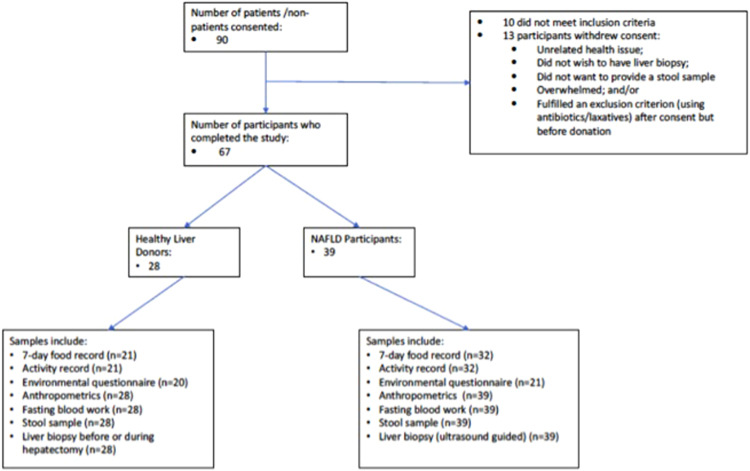
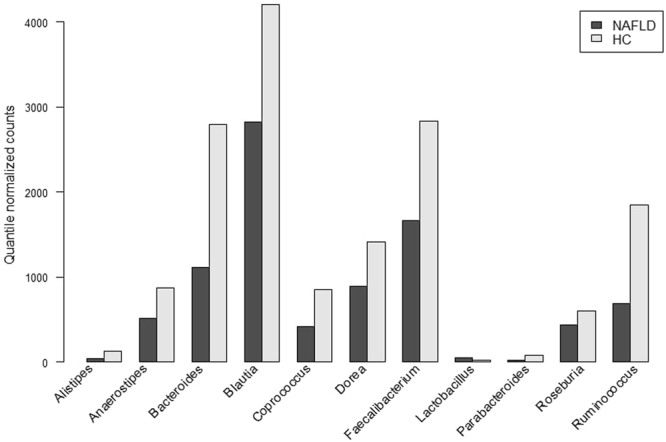
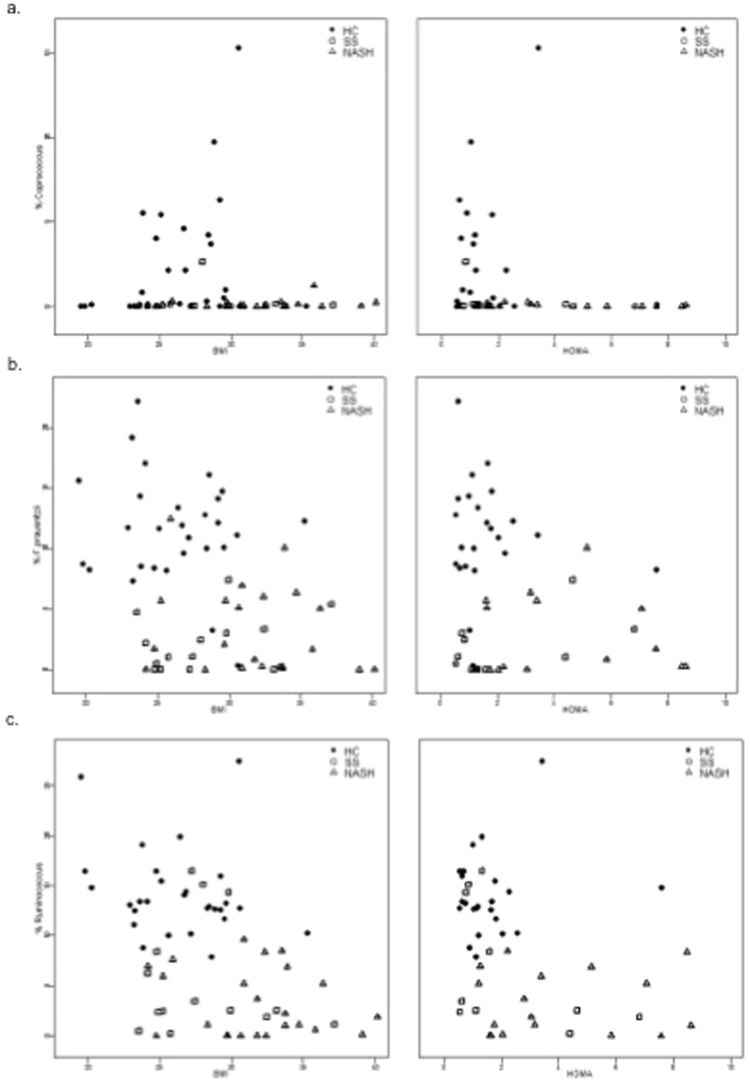
This study aimed to determine if there is an association between dysbiosis and nonalcoholic fatty liver disease (NAFLD) independent of obesity and insulin resistance (IR). This is a prospective cross-sectional study assessing the intestinal microbiome (IM) of 39 adults with biopsy-proven NAFLD (15 simple steatosis [SS]; 24 nonalcoholic steatohepatitis [NASH]) and 28 healthy controls (HC). IM composition (llumina MiSeq Platform) in NAFLD patients compared to HC were identified by two statistical methods (Metastats, Wilcoxon). Selected taxa was validated using quantitative PCR (qPCR). Metabolites in feces and serum were also analyzed. In NAFLD, 8 operational taxonomic units, 6 genera, 6 families and 2 phyla (Bacteroidetes, Firmicutes) were less abundant and; 1 genus ( Lactobacillus ) and 1 family (Lactobacillaceae) were more abundant compared to HC. Lower abundance in both NASH and SS patients compared to HC were confirmed by qPCR for Ruminococcus, Faecalibacterium prausnitzii and Coprococcus . No difference was found between NASH and SS. This lower abundance in NAFLD (NASH+SS) was independent of BMI and IR. NAFLD patients had higher concentrations of fecal propionate and isobutyric acid and serum 2-hydroxybutyrate and L-lactic acid. These findings suggest a potential role for a specific IM community and functional profile in the pathogenesis of NAFLD.
Overview
The claims and statistics of this paper haven’t been checked yet.
Run the check — free, no account needed. It reads the open-access text and checks the sources it cites.
Integrity signals
Registry
Cites
Statistics
Figures
Verification
Claims the paper makes
The claims and statistics of this paper haven’t been checked yet.
Run the check — free, no account needed. It reads the open-access text and checks the sources it cites.
Claims other papers make about this one
Each is checked against this paper’s own text: does it say what the citing paper says it does?
In the citing paper
“Furthermore, diseases linked to dyslipidemia, such as non-alcoholic liver disease and atherosclerosis, are associated with changes in gut microbiota profile.”
From Dietary lipids, gut microbiota and lipid metabolism (2019) · cites this paper as [43]
Self-check
Percentages, sums and reported differences re-computed from the paper’s own numbers.
The self-check needs the paper’s full text.
Citations
Cites
Controlling the False Discovery Rate: A Practical and Powerful Approach to Multiple Testing
Benjamini, Y., & Hochberg, Y. (1995) · Journal of the Royal Statistical Society Series B: Statistical Methodology · doi:10.1111/j.2517-6161.1995.tb02031.x · Cited by 109,482
QIIME allows analysis of high-throughput community sequencing data
Caporaso, J. G., Kuczynski, J., Stombaugh, J., Bittinger, K., Bushman, F. D., Costello, E. K., Fierer, N., Peña, A. G., Goodrich, J. K., Gordon, J. I., et al. (2010) · Nature Methods · doi:10.1038/nmeth.f.303 · Cited by 34,887
The SILVA ribosomal RNA gene database project: improved data processing and web-based tools
Quast, C., Pruesse, E., Yilmaz, P., Gerken, J., Schweer, T., Yarza, P., Peplies, J., & Glöckner, F. O. (2012) · Nucleic Acids Research · doi:10.1093/nar/gks1219 · Cited by 33,055
Matthews, D. R., Hosker, J. P., Rudenski, A. S., Naylor, B. A., Treacher, D. F., & Turner, R. C. (1985) · Diabetologia · doi:10.1007/bf00280883 · Cited by 31,502
Toprak, Ö., Kurt, H., Sarı, Y., Şarkış, C., Us, H., & Kırık, A. (2017) · Kidney & Blood Pressure Research · doi:10.1159/000468530 · Cited by 29,772
Search and clustering orders of magnitude faster than BLAST
Edgar, R. C. (2010) · Bioinformatics · doi:10.1093/bioinformatics/btq461 · Cited by 21,098
Schloss, P. D., Westcott, S. L., Ryabin, T., Hall, J. R., Hartmann, M., Hollister, E. B., Lesniewski, R. A., Oakley, B. B., Parks, D. H., Robinson, C. J., et al. (2009) · Applied and Environmental Microbiology · doi:10.1128/aem.01541-09 · Cited by 19,549
Design and validation of a histological scoring system for nonalcoholic fatty liver disease†
Kleiner, D. E., Brunt, E. M., Van Natta, M., Behling, C., Contos, M. J., Cummings, O. W., Ferrell, L. D., Liu, Y., Torbenson, M. S., Unalp‐Arida, A., et al. (2005) · Hepatology · doi:10.1002/hep.20701 · Cited by 10,791
Ultra-high-throughput microbial community analysis on the Illumina HiSeq and MiSeq platforms
Caporaso, J. G., Lauber, C. L., Walters, W. A., Berg-Lyons, D., Huntley, J., Fierer, N., Owens, S. M., Betley, J., Fraser, L., Bauer, M., et al. (2012) · The ISME Journal · doi:10.1038/ismej.2012.8 · Cited by 8,839
Human gut microbiome viewed across age and geography
Yatsunenko, T., Rey, F. E., Manary, M. J., Trehan, I., Dominguez-Bello, M. G., Contreras, M., Magris, M., Hidalgo, G., Baldassano, R. N., Anokhin, A. P., et al. (2012) · Nature · doi:10.1038/nature11053 · Cited by 7,815
Sokol, H., Pigneur, B., Watterlot, L., Lakhdari, O., Bermúdez-Humarán, L. G., Gratadoux, J.-J., Blugeon, S., Bridonneau, C., Furet, J.-P., Corthier, G., et al. (2008) · Proceedings of the National Academy of Sciences · doi:10.1073/pnas.0804812105 · Cited by 4,413
Pan, X.-R., Li, G.-W., Hu, Y.-H., Wang, J.-X., Yang, W.-Y., An, Z.-X., Hu, Z.-X., Juan-Lin, Xiao, J.-Z., Cao, H.-B., et al. (1997) · Diabetes Care · doi:10.2337/diacare.20.4.537 · Cited by 4,320
Nonalcoholic Steatohepatitis: A Proposal for Grading and Staging The Histological Lesions
Brunt, E. M., Janney, C. G., Di Bisceglie, A. M., Neuschwander-Tetri, B. A., & Bacon, B. R. (1999) · American Journal of Gastroenterology · doi:10.1111/j.1572-0241.1999.01377.x · Cited by 3,907
Differential abundance analysis for microbial marker-gene surveys
Paulson, J. N., Stine, O. C., Bravo, H. C., & Pop, M. (2013) · Nature Methods · doi:10.1038/nmeth.2658 · Cited by 2,471
Microbiota and SCFA in lean and overweight healthy subjects
Schwiertz, A., Taras, D., Schäfer, K., Beijer, S., Bos, N. A., Donus, C., & Hardt, P. D. (2010) · Obesity · doi:10.1038/oby.2009.167 · Cited by 2,457
Nonalcoholic Fatty Liver Disease: From Steatosis to Cirrhosis
Farrell, G. C., & Larter, C. Z. (2006) · Hepatology · doi:10.1002/hep.20973 · Cited by 2,428
PANDAseq: paired-end assembler for Illumina sequences
Masella, A. P., Bartram, A. K., Truszkowski, J. M., Brown, D. G., & Neufeld, J. D. (2012) · BMC Bioinformatics · doi:10.1186/1471-2105-13-31 · Cited by 2,132
Regulation of short-chain fatty acid production
Macfarlane, S., & Macfarlane, G. T. (2003) · Proceedings of the Nutrition Society · doi:10.1079/pns2002207 · Cited by 1,939
Psychogios, N., Hau, D., Peng, J., Guo, A. C., Mandal, R., Bouatra, S., Sinelnikov, I. V., Krishnamurthy, R., Eisner, R., Gautam, B., et al. (2011) · PLoS ONE · doi:10.1371/journal.pone.0016957 · Cited by 1,779
Zhu, L., Baker, S. S., Gill, C., Liu, W., Alkhouri, R., Baker, R. D., & Gill, S. R. (2013) · Hepatology · doi:10.1002/hep.26093 · Cited by 1,708
Bullard, J. H., Purdom, E., Hansen, K. D., & Dudoit, S. (2010) · BMC Bioinformatics · doi:10.1186/1471-2105-11-94 · Cited by 1,680
Statistical Methods for Detecting Differentially Abundant Features in Clinical Metagenomic Samples
White, J. R., Nagarajan, N., & Pop, M. (2009) · PLoS Computational Biology · doi:10.1371/journal.pcbi.1000352 · Cited by 1,599
Odamaki, T., Kato, K., Sugahara, H., Hashikura, N., Takahashi, S., Xiao, J.-Z., Abe, F., & Osawa, R. (2016) · BMC Microbiology · doi:10.1186/s12866-016-0708-5 · Cited by 1,521
Boursier, J., Mueller, O., Barret, M., Machado, M., Fizanne, L., Araujo‐Perez, F., Guy, C. D., Seed, P. C., Rawls, J. F., David, L. A., et al. (2016) · Hepatology · doi:10.1002/hep.28356 · Cited by 1,483
Jumpertz, R., Le, D. S., Turnbaugh, P. J., Trinidad, C., Bogardus, C., Gordon, J. I., & Krakoff, J. (2011) · The American Journal of Clinical Nutrition · doi:10.3945/ajcn.110.010132 · Cited by 1,232
Gut Microbiota and Metabolic Endotoxemia in Young Obese Mexican Subjects
Radilla-Vázquez, R. B., Parra‐Rojas, I., Martínez-Hernández, N. E., Márquez‐Sandoval, F., Illades‐Aguiar, B., & Castro-Alarcón, N. (2016) · Obesity Facts · doi:10.1159/000442479 · Cited by 1,200
Younossi, Z. M., Stepanova, M., Afendy, M., Fang, Y. H., Younossi, Y., Mir, H., & Srishord, M. K. (2011) · Clinical Gastroenterology and Hepatology · doi:10.1016/j.cgh.2011.03.020 · Cited by 1,072
The role of the gut microbiota in NAFLD
Leung, C., Rivera, L., Furness, J. B., & Angus, P. W. (2016) · Nature Reviews Gastroenterology & Hepatology · doi:10.1038/nrgastro.2016.85 · Cited by 1,020
Intestinal microbiota in patients with nonalcoholic fatty liver disease
Mouzaki, M., Comelli, E. M., Arendt, B. M., Bonengel, J., Fung, S. K., Fischer, S. E., McGilvray, I. D., & Allard, J. P. (2013) · Hepatology · doi:10.1002/hep.26319 · Cited by 749
Self-citationDel Chierico, F., Nobili, V., Vernocchi, P., Russo, A., De Stefanis, C., Gnani, D., Furlanello, C., Zandonà, A., Paci, P., Capuani, G., et al. (2017) · Hepatology · doi:10.1002/hep.28572 · Cited by 696
Raman, M., Ahmed, I., Gillevet, P. M., Probert, C. S., Ratcliffe, N. M., Smith, S., Greenwood, R., Sikaroodi, M., Lam, V., Crotty, P., et al. (2013) · Clinical Gastroenterology and Hepatology · doi:10.1016/j.cgh.2013.02.015 · Cited by 672
Jiang, W., Wu, N., Wang, X., Chi, Y., Zhang, Y., Qiu, X., Hu, Y. C., Li, J., & Liu, Y. (2015) · Scientific Reports · doi:10.1038/srep08096 · Cited by 660
Spencer, M. D., Hamp, T. J., Reid, R. W., Fischer, L. M., Zeisel, S. H., & Fodor, A. A. (2011) · Gastroenterology · doi:10.1053/j.gastro.2010.11.049 · Cited by 593
Species divergence and the measurement of microbial diversity
Lozupone, C., & Knight, R. D. (2008) · FEMS Microbiology Reviews · doi:10.1111/j.1574-6976.2008.00111.x · Cited by 558
World Gastroenterology Organisation Global Guidelines
LaBrecque, D. R., Abbas, Z., Anania, F. A., Ferenci, P., Khan, A. G., Goh, K., Hamid, S. S., Va, I., Lizarzábal, M., Peñaranda, M. M., et al. (2014) · Journal of Clinical Gastroenterology · doi:10.1097/mcg.0000000000000116 · Cited by 524
From the metabolic syndrome to NAFLD or vice versa?
Vanni, E., Bugianesi, E., Kotronen, A., Minicis, S. D., Yki‐Järvinen, H., & Svegliati‐Baroni, G. (2010) · Digestive and Liver Disease · doi:10.1016/j.dld.2010.01.016 · Cited by 500
Rotman, Y., Koh, C., Zmuda, J. M., Kleiner, D. E., & Liang, J. T. (2010) · Hepatology · doi:10.1002/hep.23759 · Cited by 479
(Dis)Trust your gut: the gut microbiome in age-related inflammation, health, and disease
Buford, T. W. (2017) · Microbiome · doi:10.1186/s40168-017-0296-0 · Cited by 409
Ferrannini, E., Natali, A., Camastra, S., Nannipieri, M., Mari, A., Adam, K., Milburn, M. V., Kastenmüller, G., Adamski, J., Tuomilehto, J., et al. (2012) · Diabetes · doi:10.2337/db12-0707 · Cited by 353
Wong, V. W., Tse, C., Lam, T. T., Wong, G. L., Chim, A. M., Chu, C. W., Yeung, D. K., Law, P. T. W., Kwan, H. S., Yu, J. Q., et al. (2013) · PLoS ONE · doi:10.1371/journal.pone.0062885 · Cited by 350
Le Gall, G., Noor, S. O., Ridgway, K., Scovell, L., Jamieson, C., Johnson, I. T., Colquhoun, I. J., Kemsley, E. K., & Narbad, A. (2011) · Journal of Proteome Research · doi:10.1021/pr2003598 · Cited by 348
Microbiota-liver axis in hepatic disease
Chassaing, B., Etienne‐Mesmin, L., & Gewirtz, A. T. (2013) · Hepatology · doi:10.1002/hep.26494 · Cited by 333
Microbiome profiling by Illumina sequencing of combinatorial sequence-tagged PCR products
Gloor, G. B., Hummelen, R., Macklaim, J. M., Dickson, R. J., Fernandes, A. D., MacPhee, R., & Reid, G. (2010) · PLoS ONE · doi:10.1371/journal.pone.0015406 · Cited by 330
Utilisation of Mucin Glycans by the Human Gut Symbiont Ruminococcus gnavus Is Strain-Dependent
Crost, E. H., Tailford, L. E., Gall, G. L., Fons, M., Henrissat, B., & Juge, N. (2013) · PLoS ONE · doi:10.1371/journal.pone.0076341 · Cited by 325
Arendt, B. M., Comelli, E. M., Ma, D. W. L., Lou, W., Teterina, A., Kim, T., Fung, S. K., Wong, D. K. H., McGilvray, I., Fischer, S. E., et al. (2015) · Hepatology · doi:10.1002/hep.27695 · Cited by 313
Self-citationMarchesini, G., Petta, S., & Grave, R. D. (2015) · Hepatology · doi:10.1002/hep.28392 · Cited by 306
Shaw, K. A., Bertha, M., Hofmekler, T., Chopra, P., Vatanen, T., Srivatsa, A., Prince, J., Kumar, A., Sauer, C. G., Zwick, M. E., et al. (2016) · Genome Medicine · doi:10.1186/s13073-016-0331-y · Cited by 278
The butyrate story: old wine in new bottles?
Scheppach, W. M., & Weiler, F. (2004) · Current Opinion in Clinical Nutrition & Metabolic Care · doi:10.1097/00075197-200409000-00009 · Cited by 246
The gut microbial community in metabolic syndrome patients is modified by diet
Haro, C., García‐Carpintero, S., Alcala-Diaz, J. F., Gómez-Delgado, F., Delgado‐Lista, J., Pérez‐Martínez, P., Rangel-Zúñiga, O. A., Quintana‐Navarro, G. M., Landa, B. B., Clemente, J. C., et al. (2015) · The Journal of Nutritional Biochemistry · doi:10.1016/j.jnutbio.2015.08.011 · Cited by 222
Systematic review: microbial dysbiosis and nonalcoholic fatty liver disease
Wieland, A. C., Frank, D. N., Harnke, B., & Bambha, K. M. (2015) · Alimentary Pharmacology & Therapeutics · doi:10.1111/apt.13376 · Cited by 211
Su, D., Nie, Y., Zhu, A., Chen, Z., Wu, P., Zhang, L., Luo, M., Sun, Q., Cai, L., Lai, Y.-C., et al. (2016) · Frontiers in Physiology · doi:10.3389/fphys.2016.00498 · Cited by 204
Fecal Acetate Is Inversely Related to Acetate Absorption from the Human Rectum and Distal Colon
Vogt, J. A., & Wolever, T. M. S. (2003) · Journal of Nutrition · doi:10.1093/jn/133.10.3145 · Cited by 154
Insulin resistance in development and progression of nonalcoholic fatty liver disease
Alam, S., Mustafa, G., Alam, M., & Ahmad, N. (2016) · World Journal of Gastrointestinal Pathophysiology · doi:10.4291/wjgp.v7.i2.211 · Cited by 108
Effect of high fat-diet and obesity on gastrointestinal motility.
Mushref, M. A., & Srinivasan, S. (2013) · Europe PMC (PubMed Central) · doi:10.3978/j.issn.2305-5839.2012.11.01 · Cited by 105
Compositional dynamics of the human intestinal microbiota with aging: Implications for health
Lakshminarayanan, B., Stanton, C., O’Toole, P. W., & Ross, R. P. (2014) · The journal of nutrition health & aging · doi:10.1007/s12603-014-0549-6 · Cited by 93
Silva, H. E. D., Arendt, B. M., Noureldin, S. A., Therapondos, G., Guindi, M. M., & Allard, J. P. (2014) · Journal of the Academy of Nutrition and Dietetics · doi:10.1016/j.jand.2014.01.009 · Cited by 86
Self-citationSartor, R. B. (2011) · Mucosal Immunology · doi:10.1038/mi.2010.87 · Cited by 75
Hynönen, U., Rasinkangas, P., Satokari, R. M., Paulin, L. G., de Vos, W. M., Pietilä, T. E., Kant, R., & Palva, A. (2016) · Anaerobe · doi:10.1016/j.anaerobe.2016.03.001 · Cited by 34
Remembering Rhodes’ Detractors
Hughes, H. A. (2016) · The Round Table · doi:10.1080/00358533.2016.1154666 · Cited by 1
Research works printed but not linked: 1
- Doelle, H. W. Bacterial Metabolism. Second edn, 416–419 (Academic Press, Inc., 1975).
Cited by
Sorted by citations
Mechanisms and disease consequences of nonalcoholic fatty liver disease
Loomba, R., Friedman, S. L., & Shulman, G. I. (2021) · Cell · doi:10.1016/j.cell.2021.04.015 · Cited by 2,002
Gut microbial metabolites in obesity, NAFLD and T2DM
Canfora, E. E., Meex, R. C. R., Venema, K., & Blaak, E. E. (2019) · Nature Reviews Endocrinology · doi:10.1038/s41574-019-0156-z · Cited by 1,493
Dietary lipids, gut microbiota and lipid metabolism
Schoeler, M., & Caesar, R. (2019) · Reviews in Endocrine and Metabolic Disorders · doi:10.1007/s11154-019-09512-0 · Cited by 1,163
Short chain fatty acids in human gut and metabolic health
Blaak, E. E., Canfora, E. E., Theis, S., Frost, G., Groen, A. K., Mithieux, G., Nauta, A., Scott, K., Stahl, B., van Harsselaar, J., et al. (2020) · Beneficial Microbes · doi:10.3920/bm2020.0057 · Cited by 1,103
Gut microbiota and human NAFLD: disentangling microbial signatures from metabolic disorders
Aron‐Wisnewsky, J., Vigliotti, C., Witjes, J. J., Le, P. T., Holleboom, A. G., Verheij, J., Nieuwdorp, M., & Clément, K. (2020) · Nature Reviews Gastroenterology & Hepatology · doi:10.1038/s41575-020-0269-9 · Cited by 1,132
Metadata
- Authors
- Da Silva, H. E., Teterina, A., Comelli, E. M., Taibi, A., Arendt, B. M., Fischer, S. E., Lou, W., & Allard, J. P.
- Affiliations
- University Health Network (CA)
- University of Toronto (CA)
- Corresponding author
- Allard, Johane P.
- ORCID
- Venue
- Scientific Reports
- Published
- 2018-01-23
- Volume
- 8
- Issue
- 1
- Pages
- 1466-1466
- ISSN
- 2045-2322 (ISSN-L)
- PMC
- PMC5780381
- OpenAlex
- W2803148575
- Cited by
- 283
- References
- 59
- Citations by year
- 2026: 18 · 2025: 32 · 2024: 31 · 2023: 34 · 2022: 35 · 2021: 60 · 2020: 34 · 2019: 27 · 2018: 10
- FWCI
- 11.64
- Type
- journal article
- Language
- en
- Open access
- gold
- doi.org
- Locations
- Scientific Reports (publishedVersion, cc-by)
- PubMed Central (publishedVersion, cc-by)
- PubMed (publishedVersion)
- DOAJ (DOAJ: Directory of Open Access Journals) (submittedVersion, cc-by-sa)
- Funders
- American College of Gastroenterology
- University of Alberta
- University of Toronto
- Canadian Institutes of Health Research (86922_1, 89705_1)
- Topics
- Life Sciences › Biochemistry, Genetics and Molecular Biology › Molecular Biology › Gut microbiota and health
- Health Sciences › Medicine › Hepatology › Liver Disease Diagnosis and Treatment
- Health Sciences › Medicine › Gastroenterology › Gastrointestinal motility and disorders
- Keywords
- non-alcoholic fatty liver disease, nonalcoholic steatohepatitis, gut microbiota, dysbiosis, obesity, insulin resistance, Bacteroidetes, Firmicutes, Faecalibacterium prausnitzii, Ruminococcus, Coprococcus, Lactobacillus, short-chain fatty acids, propionate, isobutyric acid, 2-hydroxybutyrate, L-lactic acid, gut microbiota metabolites
- MeSH terms
- Gastrointestinal Microbiome, Adult, Aged, Cross-Sectional Studies, Feces, Female, Humans, Insulin Resistance, Male, Middle Aged, Obesity, Prospective Studies, Body Mass Index, Young Adult, Dysbiosis, Non-alcoholic Fatty Liver Disease
About these checks
Registry, retraction, Cites and statistics results are computed, not judged, with one exception: a printed reference that no index lists is read once by a model before it counts as a citation error. Claims are extracted by a model and kept only when their quote appears verbatim in the text; each cited source is then checked, with a model’s help, for whether it says what the claim relies on. Those verdicts can be wrong — read the claim’s quote and the cited source before relying on one.
Statistics and arithmetic are recomputed, not judged.
Confidence bands are shown only for fields calibrated on our annotated test set. None is calibrated yet, so no band is shown.
What counts as a claim ›How we measure confidence ›How we check this ›
Are you an author, or do you see a problem with this page? Request a review
