

Physiological and Behavioral Synchrony Predict Group Cohesion and Performance
Open accessThe DOI matches its Crossref record; 92 of the 92 references it cites were found in a registry or an index; 14 of the 52 sources its claims cite were checked for support.
Abstract
Interpersonal synchrony contributes to social functioning in dyads, but it remains unknown how synchrony shapes group experiences and performance. To this end, we designed a novel group drumming task in which participants matched their drumming to either predictable or unpredictable tempos. Fifty-one three-person groups were randomly assigned to one of two conditions: synchronized or asynchronized drumming. Outcome measures included electrocardiograms and self-reports of group cohesion and synchrony. The drumming task elicited an increase in physiological synchrony between group members (specifically their hearts’ interbeat intervals). We also found that physiological synchronization and behavioral synchronization predicted individuals’ experience of group cohesion. Physiological synchrony also predicted performance in a subsequent group task that involved freely drumming together. The findings suggest that the behavioral and physiological consequences of synchronization contribute to the formation of group bonds and coordination. They also confirm that insights from translational social neuroscience can inform our knowledge of the development of cohesive and efficacious groups.
Overview
CoChat Summary
TL;DR
In a novel group drumming paradigm, physiological synchrony of heart interbeat intervals (IBIs) emerged between group members and, together with behavioral synchronization, predicted group cohesion; IBI synchrony also predicted later coordinated drumming performance. The findings suggest behavioral and physiological synchrony are distinct contributors to group bonding and coordination.
Key findings
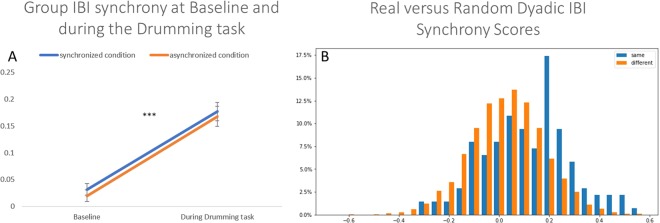
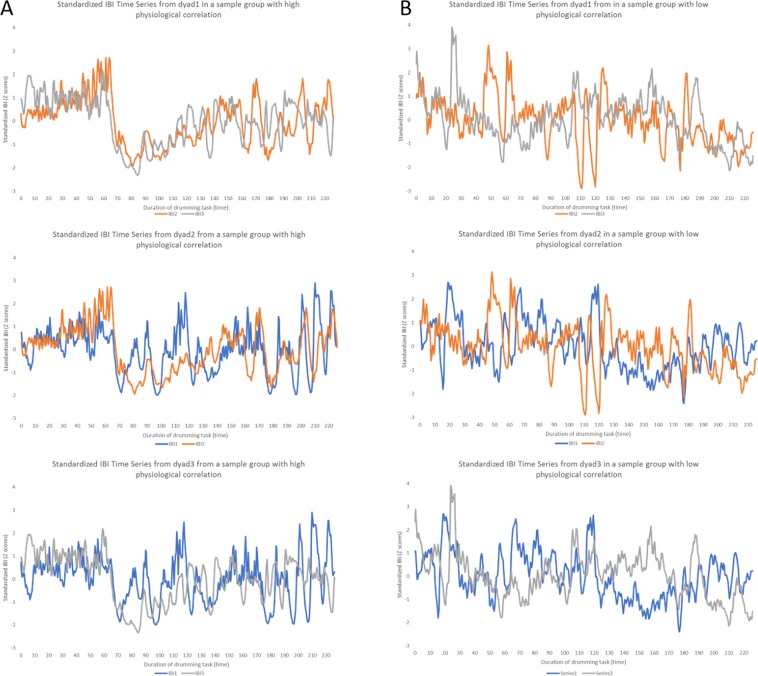
- Group IBI synchrony increased significantly from baseline during the drumming task in all groups, regardless of condition: t(47) = −5.37, p = 0.0001, 95% CI = −0.2–0.09. Real interacting dyads had higher IBI correlations than randomly created dyads (M = 0.142, SD = 0.01 vs. M = 0.0498, SD = 0.002; Kolmogorov-Smirnov Sig. = 4.3 × 10⁻¹⁰).
- Group cohesion was higher in the synchronized than asynchronized drumming condition (M = 4.26, SD = 0.98 vs. M = 3.85, SD = 1.08; t(147) = 2.4, p = 0.016). Perceived synchrony (2.75 vs. 2.45, p = 0.03) and drumming together (439.6 vs. 318.3, p = 0.007) also differed by condition.
- In a linear mixed model predicting group cohesion, both task condition (estimate = −0.46, p = 0.044) and group IBI synchrony (estimate = 1.76, p = 0.020) were significant; prior familiarity and musical knowledge were not.
- IBI synchrony during the drumming task predicted coordinated performance in a later free improvisation task: overall model F(2,44) = 3.99, p = 0.025, explaining 15.4% of variance; IBI synchrony B = 942.71, Beta = 0.31, t = 2.25, p = 0.029. The prior drumming condition did not significantly predict improvisation coordination (p = 0.084).
Methods
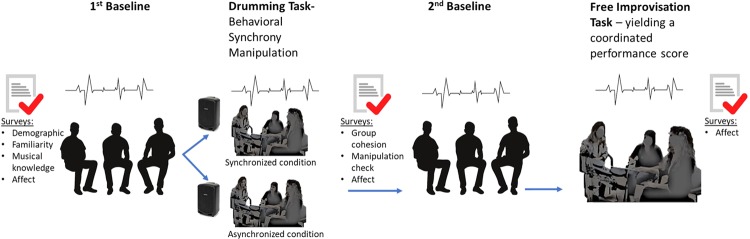
- 153 participants nested in 51 three-person groups were randomly assigned to synchronized or asynchronized drumming; final analyses used 141 participants in 47 groups after exclusions. Participants were undergraduate psychology students at Bar-Ilan University (32 males, 119 females; average age 22.6 years for males, 22.4 years for females).
- ECGs were recorded continuously across a 5-minute baseline, a 4-minute drumming task, a second 5-minute baseline, and a 4-minute free improvisation session. Group cohesion, perceived synchrony, and affect were self-reported; performance was derived from MIDI files as the number of times all three members hit their drums together within a 30-ms window.
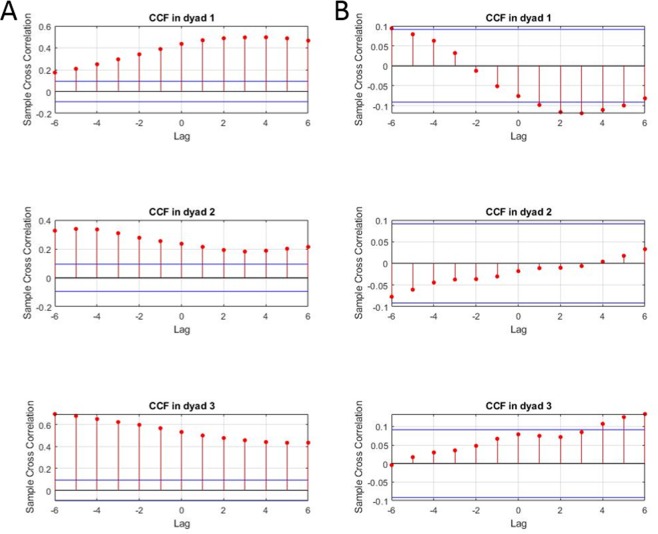
- IBI synchrony was computed using cross-correlation function analyses of dyadic IBI time series, then averaged to the group level. Main analyses included independent-samples t-tests, a linear mixed model predicting group cohesion, and a group-level hierarchical linear regression predicting improvisation coordination.
Limitations
- The paper states that prior familiarity was low and not equally distributed across task conditions; although controlled in analyses, future studies should test groups of strangers. It also states results are primarily relevant to newly formed groups and that gender/gender composition was not controlled.
- The paper states that IBI is influenced by both sympathetic and parasympathetic branches, so the study could not determine their relative balance. It also notes that physiological synchrony was computed dyadically and averaged to the group level, rather than capturing a true group-level biological mechanism.
- The paper states that a mediation model was precluded because the drumming condition was not significantly related to group IBI synchrony.
Model-written summary. Check it against the paper before relying on it.
Integrity signals
Registry
Cites
Statistics
Figures
Verification
Claims the paper makes
11 Valid · 0 Not valid · 22 Not checked · 41 Own results and interpretations
The cited sources support only part of this claim — read each source’s verdict below.
In the paper
“In dyads, it has been shown that increased heart rate synchronization and facial muscle synchronization occur automatically without direct interaction when individuals merely sit side by side and watch movies together58,59.”
§ Physiological and Behavioral Synchrony Predict Group Cohesion and Performance > Discussion
What the sources say
- Partly supportedcites [58] Golland Y Arzouan Y Levit-Binnun N The mere co-presence: Synchronization of autonomic signals and emotional responses across co-present individuals not engaged in direct interaction PLoS One 2015 10 e0125804 26018597 PMC4446307 sourceExperimental — accuracy not yet measured
The Results section (page not supplied) reports enhanced heart-rate synchronization among people who watched emotional movies together, and the Introduction says they sat side by side without directly interacting. The Methods section (page not supplied) lists ECG and electrodermal activity as the analyzed measures, not facial muscle activity, so this source does not support the facial-muscle synchronization part of the claim. (LLM, conf=0.89)
- Supportedcites [59] Golland Y Mevorach D Levit-Binnun N Affiliative zygomatic synchrony in co-present strangers Sci. Rep. 2019 9 3120 30816315 PMC6395718 source
The Methods (Materials and Procedure; page unavailable) say participants sat side by side to watch movies and were asked not to talk. The Results report dyad-specific facial synchrony during both emotional movies and significantly higher heart-rate synchrony in co-viewing dyads during the positive movie; the Discussion characterizes the synchrony as spontaneous and supports automatic processes in the facial response. Heart-rate synchrony during the negative movie was only marginally significant. (LLM, conf=0.91)
plainstates a cause- Asserted: passes — The authors put it forward as true.
- Checkable: passes — It can be checked against evidence.
- Load-bearing: passes — The paper’s conclusions depend on it.
- Based: passes — The paper gives a reason why it holds.
- Partly supported
Every source the paper cites for this claim was checked and supports it.
In the paper
“For example, when people sing in unison, their heartbeats accelerate and decelerate simultaneously38.”
§ Physiological and Behavioral Synchrony Predict Group Cohesion and Performance > Introduction
What the sources say
- Supportedcites [38] Müller V Lindenberger U Cardiac and respiratory patterns synchronize between persons during choir singing PLoS One 2011 6 e24893 21957466 PMC3177845 source
The Results section (page unavailable) reports that heart-rate-variability patterns synchronized between choir members during singing and that synchronization was generally higher when they sang in unison. The claim is a plain-language description of that finding, though the paper describes a general pattern rather than every heartbeat changing at precisely the same instant. (LLM, conf=0.87)
plainstates an association- Asserted: passes — The authors put it forward as true.
- Checkable: passes — It can be checked against evidence.
- Load-bearing: unclear — It is unclear whether the paper’s conclusions depend on it.
- Based: passes — The paper gives a reason why it holds.
- Supported
The cited sources support only part of this claim — read each source’s verdict below.
In the paper
“In a separate study, dyadic-level ANS synchrony has been shown to support larger group-level phenomena, including mass participation in cultural rituals52.”
§ Physiological and Behavioral Synchrony Predict Group Cohesion and Performance > Introduction
What the sources say
- Partly supportedcites [52] Konvalinka I Synchronized arousal between performers and related spectators in a fire-walking ritual Proc. Natl Acad. Sci. 2011 108 8514 8519 21536887 PMC3100954 sourceExperimental — accuracy not yet measured
The paper reports synchronized heart-rate dynamics between fire-walkers and related spectators during a collective ritual (p. 1). But the Discussion (p. 5) says it is unclear whether shared arousal drives the collective experience or emerges from it. The study therefore does not show that dyadic synchrony supports mass participation. (LLM, conf=0.86)
plainstates a cause- Asserted: passes — The authors put it forward as true.
- Checkable: passes — It can be checked against evidence.
- Load-bearing: unclear — It is unclear whether the paper’s conclusions depend on it.
- Based: passes — The paper gives a reason why it holds.
- Partly supported
The cited sources support only part of this claim — read each source’s verdict below.
In the paper
“It is an evolutionary-based mechanism that facilitates social bonding, cohesion and exchange (i.e., it is a “social glue”)1–4.”
§ Physiological and Behavioral Synchrony Predict Group Cohesion and Performance > Introduction
What the sources say
- Partly supportedcites [1] Tarr B Launay J Dunbar RI Silent disco: dancing in synchrony leads to elevated pain thresholds and social closeness Evol. Hum. Behav. 2016 37 343 349 10.1016/j.evolhumbehav.2016.02.004 27540276 PMC4985033 sourceExperimental — accuracy not yet measured
The Introduction (page unavailable) describes synchrony as fostering social bonds, a sense of being on the same team, and prosocial cooperation, while proposing an evolutionary advantage for these effects. But the Discussion (page unavailable) reports that synchronised dancers did not make higher donations than the comparison groups, so the unqualified claim that it facilitates exchange goes beyond this study's findings. (LLM, conf=0.84)
- Not checked — no full text of the sourcecites [2] Miles LK Lumsden J Richardson MJ Macrae CN Do birds of a feather move together? Group membership and behavioral synchrony Exp. brain Res. 2011 211 495 503 21448575 source
- Partly supportedcites [3] Sebanz N Bekkering H Knoblich G Joint action: bodies and minds moving together Trends Cognit. Sci. 2006 10 70 76 16406326 sourceExperimental — accuracy not yet measured
Box 2 ('Minds make bodies synchronize') is the only place our copy links interpersonal synchronization/mimicry to social outcomes: nonconscious mimicry of gestures, postures and mannerisms 'has been shown to enhance the smoothness of interactions and foster liking [61]', with people high in affiliation goal or interdependent self-construal especially prone to mimicking (refs 62-64 on creating affiliation and rapport). That supports the 'facilitates social bonding/cohesion' part of the claim, but the paper never calls synchrony an 'evolutionary-based mechanism', never uses the 'social glue' framing, and says nothing about facilitating social exchange; its evolutionary remarks (Box 3) concern whether language may have evolved from interpersonal coordination demands, not synchrony as bonding glue. So only part of what the citing sentence attributes here is in the source. (LLM, conf=0.72)
- Not checked — no full text of the sourcecites [4] Semin, G. R. & Cacioppo, J. T. Grounding social cognition: Synchronization, entrainment, and coordination. Embodied grounding: Social, cognitive, affective, and neuroscientific approaches, 119–147 (2008). source
plainstates a cause- Asserted: passes — The authors put it forward as true.
- Checkable: passes — It can be checked against evidence.
- Load-bearing: passes — The paper’s conclusions depend on it.
- Based: passes — The paper gives a reason why it holds.
- Partly supported
Every source the paper cites for this claim was checked and supports it.
In the paper
“Since the main physiological measure in the current study was IBI, which is influenced dynamically by both the sympathetic (S) and parasympathetic (P) branches of the ANS76”
§ Physiological and Behavioral Synchrony Predict Group Cohesion and Performance > Discussion
What the sources say
- Supportedcites [76] Berntson GG Norman GJ Hawkley LC Cacioppo JT Cardiac autonomic balance versus cardiac regulatory capacity Psychophysiology 2008 45 643 652 18282204 PMC3767155 source
The Methods describe parasympathetic control of heart-rate variability and sympathetic effects on cardiac chronotropy (heart rate). They also state that both branches contribute to low-frequency heart-rate variability, supporting the paraphrase that interbeat intervals are influenced by both branches. (LLM, conf=0.88)
plainstates a cause- Asserted: passes — The authors put it forward as true.
- Checkable: passes — It can be checked against evidence.
- Load-bearing: passes — The paper’s conclusions depend on it.
- Based: passes — The paper gives a reason why it holds.
- Supported
35 more claims · 1 with their cited sources checked
Create a free account to see all 74 claims and to verify the 7 references still open.
- Probably not a substantial claim. 25
- It may state two separate claims as one. 14
Claims other papers make about this one
Each is checked against this paper’s own text: does it say what the citing paper says it does?
The cited source says what the claim attributes to it.
In the citing paper
“Yet, to date, much of the existing research on IPS has focused on contexts where individuals are explicitly instructed to perform a social task.”
From Interpersonal Synchronization of Autonomic Physiology via Mere Visual Contact (2026) · cites this paper as [31]
Statistics that don’t add up
Each reported p-value recomputed from its test statistic and degrees of freedom, each partial η² from its F, and each ratio, mean difference or B printed with a p checked against its own confidence interval.
Rated minor: it would not touch a result — a value no result rests on, a p-value that stays on the same side of the significance level, or a conflict that is clerical, resolved elsewhere in the paper, or outside its own findings.
In the paper
“t(148) = 1.53, p = 0.12”
§ Physiological and Behavioral Synchrony Predict Group Cohesion and Performance > Method > Participants
Reported p = .12 · recomputed p = .128
Statistics recomputed
Every reported test result, recomputed from its test statistic and degrees of freedom. A result shows as not adding up only once an independent check has confirmed it.
- Doesn’t add upt(148) = 1.53reported p = .12 · recomputed p = .128
“t(148) = 1.53, p = .12”
- Consistentt(47) = -5.37reported p = .0001 · recomputed p < .001
“t(47) = −5.37, p = .0001”
The paper prints p at a floor (such as p < .001)
- ConsistentF(2, 44) = 3.99reported p = .025 · recomputed p = .026
“F(2,44) = 3.99, p = .025”
- Consistentt(147) = 3.9reported p = .0001 · recomputed p < .001
“t(147) = 3.9, p = .0001”
Self-check
Percentages, sums and reported differences re-computed from the paper’s own numbers.
Each contradiction between two passages listed here was confirmed by an independent check.
Rated minor: it would not touch a result — a value no result rests on, a p-value that stays on the same side of the significance level, or a conflict that is clerical, resolved elsewhere in the paper, or outside its own findings.
In the paper
§ Physiological and Behavioral Synchrony Predict Group Cohesion and Performance > Measures > Surveys
“We measured group cohesion with the following 4 items using a 1 to 6 Likert scale:”
§ Physiological and Behavioral Synchrony Predict Group Cohesion and Performance > Measures > Surveys
““If possible, I would be happy to participate in another group experiment with the members of my current work group”; “My group worked together as a team”; “We were cooperative with each other”; and “We knew that we could rely on one another” and “We were supportive”.”
Rated minor: it would not touch a result — a value no result rests on, a p-value that stays on the same side of the significance level, or a conflict that is clerical, resolved elsewhere in the paper, or outside its own findings.
In the paper
§ Physiological and Behavioral Synchrony Predict Group Cohesion and Performance > Method > Participants
“These three items were rated on a Likert scale ranging from 1 to 5 (1 = “not at all”; 5 = “very much so”) and had a mean of 1.90 (SD = 0.93).”
§ Physiological and Behavioral Synchrony Predict Group Cohesion and Performance > Method > Participants
“M = 2.51, SD = 1.12; M = 2.24, SD = 1.07, for the synchronized and asynchronized conditions, respectively”
Rated minor: it would not touch a result — a value no result rests on, a p-value that stays on the same side of the significance level, or a conflict that is clerical, resolved elsewhere in the paper, or outside its own findings.
In the paper
§ Physiological and Behavioral Synchrony Predict Group Cohesion and Performance > Results > IBI synchrony during the drumming task
“t(47) = −5.37, p = 0.0001, 95% CI = −0.2–0.09.”
§ Physiological and Behavioral Synchrony Predict Group Cohesion and Performance > Results > IBI synchrony during the drumming task
“There was a significant increase in IBI synchrony from the baseline in all groups during the drumming task”
Citations
Cites
Development and validation of brief measures of positive and negative affect: The PANAS scales.
Watson, D., Clark, L. A., & Tellegen, A. (1988) · Journal of Personality and Social Psychology · doi:10.1037/0022-3514.54.6.1063 · Cited by 32,433
Heart rate variability: origins, methods, and interpretive caveats
BERNTSON, G. G., THOMAS BIGGER, J., ECKBERG, D. L., GROSSMAN, P., KAUFMANN, P. G., MALIK, M., NAGARAJA, H. N., PORGES, S. W., SAUL, J. P., STONE, P. H., et al. (1997) · Psychophysiology · doi:10.1111/j.1469-8986.1997.tb02140.x · Cited by 3,962
The Analysis of Time Series: An Introduction
Dickey, D. A., & Chatfield, C. (1991) · Technometrics · doi:10.2307/1268794 · Cited by 3,525
Joint action: bodies and minds moving together
SEBANZ, N., BEKKERING, H., & KNOBLICH, G. (2006) · Trends in Cognitive Sciences · doi:10.1016/j.tics.2005.12.009 · Cited by 1,950
Wiltermuth, S. S., & Heath, C. (2009) · Psychological Science · doi:10.1111/j.1467-9280.2008.02253.x · Cited by 1,717
The polyvagal theory: phylogenetic substrates of a social nervous system.
Porges, S. W. (2001) · International Journal of Psychophysiology · doi:10.1016/s0167-8760(01)00162-3 · Cited by 1,582
Dunbar, R. I. M., & Shultz, S. (2007) · Science · doi:10.1126/science.1145463 · Cited by 1,542
Sensorimotor synchronization: A review of the tapping literature
Repp, B. H. (2005) · Psychonomic Bulletin & Review · doi:10.3758/bf03206433 · Cited by 1,462
The relation between group cohesiveness and performance: An integration.
Mullen, B., & Copper, C. (1994) · Psychological Bulletin · doi:10.1037/0033-2909.115.2.210 · Cited by 1,398
It's All in the Timing: Interpersonal Synchrony Increases Affiliation
Hove, M. J., & Risen, J. L. (2009) · Social Cognition · doi:10.1521/soco.2009.27.6.949 · Cited by 1,334
Cohesion and Performance in Groups: A Meta-Analytic Clarification of Construct Relations.
Beal, D. J., Cohen, R. R., Burke, M. J., & McLendon, C. L. (2003) · Journal of Applied Psychology · doi:10.1037/0021-9010.88.6.989 · Cited by 1,321
Sensorimotor synchronization: a review of recent research (2006–2012).
Repp, B. H., & Su, Y.-H. (2013) · Psychonomic Bulletin & Review · doi:10.3758/s13423-012-0371-2 · Cited by 1,204
Methodological Guidelines for Impedance Cardiography
Sherwood(Chair), A., Allen, M. T., Fahrenberg, J., Kelsey, R. M., Lovallo, W. R., & van Doornen, L. J. P. (1990) · Psychophysiology · doi:10.1111/j.1469-8986.1990.tb02171.x · Cited by 1,169
Origins of Human Cooperation and Morality
Tomasello, M., & Vaish, A. (2013) · Annual Review of Psychology · doi:10.1146/annurev-psych-113011-143812 · Cited by 916
Joint music making promotes prosocial behavior in 4-year-old children
Kirschner, S., & Tomasello, M. (2010) · Evolution and Human Behavior · doi:10.1016/j.evolhumbehav.2010.04.004 · Cited by 896
Brain-to-brain synchrony tracks real-world dynamic group interactions in the classroom
Dikker, S., Wan, L., Davidesco, I., Kaggen, L., Oostrik, M., McClintock, J., Rowland, J., Michalareas, G., Van Bavel, J. J., Ding, M., et al. (2017) · Current Biology · doi:10.1016/j.cub.2017.04.002 · Cited by 871
The Neurobiology of Human Attachments
Feldman, R. (2017) · Trends in Cognitive Sciences · doi:10.1016/j.tics.2016.11.007 · Cited by 839
Berntson, G. G., Cacioppo, J. T., & Quigley, K. S. (1991) · Psychological Review · doi:10.1037/0033-295x.98.4.459 · Cited by 819
Oxytocin, vasopressin, and human social behavior
Heinrichs, M., von Dawans, B., & Domes, G. (2009) · Frontiers in Neuroendocrinology · doi:10.1016/j.yfrne.2009.05.005 · Cited by 799
Synchronized arousal between performers and related spectators in a fire-walking ritual
Konvalinka, I., Xygalatas, D., Bulbulia, J., Schjødt, U., Jegindø, E.-M., Wallot, S., Van Orden, G., & Roepstorff, A. (2011) · Proceedings of the National Academy of Sciences · doi:10.1073/pnas.1016955108 · Cited by 632
What Makes Human Cognition Unique? From Individual to Shared to Collective Intentionality
Tomasello, M., & Rakoczy, H. (2003) · Mind & Language · doi:10.1111/1468-0017.00217 · Cited by 579
Interpersonal autonomic physiology: a systematic review of the literature
Palumbo, R. V., Marraccini, M. E., Weyandt, L. L., Wilder-Smith, O., McGee, H. A., Liu, S., & Goodwin, M. S. (2017) · Personality and Social Psychology Review · doi:10.1177/1088868316628405 · Cited by 566
Let’s Dance Together: Synchrony, Shared Intentionality and Cooperation
Reddish, P., Fischer, R., & Bulbulia, J. (2013) · PLoS ONE · doi:10.1371/journal.pone.0071182 · Cited by 556
Infant-mother and infant-father synchrony: The coregulation of positive arousal
Feldman, R. (2003) · Infant Mental Health Journal · doi:10.1002/imhj.10041 · Cited by 536
Group Cohesion and Performance: A Meta-Analysis
Evans, C. R., & Dion, K. L. (1991) · Small Group Research · doi:10.1177/1046496491222002 · Cited by 535
The rhythm of joint action: synchrony promotes cooperative ability.
Valdesolo, P., Ouyang, J., & DeSteno, D. (2010) · Journal of Experimental Social Psychology · doi:10.1016/j.jesp.2010.03.004 · Cited by 521
Mother and infant coordinate heart rhythms through episodes of interaction synchrony
Feldman, R., Magori-Cohen, R., Galili, G., Singer, M., & Louzoun, Y. (2011) · Infant Behavior and Development · doi:10.1016/j.infbeh.2011.06.008 · Cited by 505
Is Music an Evolutionary Adaptation?
HURON, D. (2001) · Annals of the New York Academy of Sciences · doi:10.1111/j.1749-6632.2001.tb05724.x · Cited by 496
Human motor cortex excitability during the perception of others’ action
Fadiga, L., Craighero, L., & Olivier, E. (2005) · Current Opinion in Neurobiology · doi:10.1016/j.conb.2005.03.013 · Cited by 496
Joint drumming: Social context facilitates synchronization in preschool children
Kirschner, S., & Tomasello, M. (2009) · Journal of Experimental Child Psychology · doi:10.1016/j.jecp.2008.07.005 · Cited by 494
Mogan, R., Fischer, R., & Bulbulia, J. A. (2017) · Journal of Experimental Social Psychology · doi:10.1016/j.jesp.2017.03.009 · Cited by 477
Oxytocin and the development of parenting in humans
Gordon, I., Zagoory-Sharon, O., Leckman, J. F., & Feldman, R. (2010) · Biological Psychiatry · doi:10.1016/j.biopsych.2010.02.005 · Cited by 469
Self-citationKeller, P. E., Novembre, G., & Hove, M. J. (2014) · Philosophical Transactions of the Royal Society B: Biological Sciences · doi:10.1098/rstb.2013.0394 · Cited by 466
The phi complex as a neuromarker of human social coordination
Tognoli, E., Lagarde, J., DeGuzman, G. C., & Kelso, J. A. S. (2007) · Proceedings of the National Academy of Sciences · doi:10.1073/pnas.0611453104 · Cited by 437
Berntson, G. G., Cacioppo, J. T., & Quigley, K. S. (1993) · Psychological Bulletin · doi:10.1037/0033-2909.114.2.296 · Cited by 430
A Typology of Family Social Environments
MOOS, R. H., & MOOS, B. S. (1976) · Family Process · doi:10.1111/j.1545-5300.1976.00357.x · Cited by 416
Hemodynamics of Blood Pressure Responses During Active and Passive Coping
Sherwood, A., Dolan, C. A., & Light, K. C. (1990) · Psychophysiology · doi:10.1111/j.1469-8986.1990.tb03189.x · Cited by 414
Interpersonal coordination: Behavior matching and interactional synchrony.
Bernieri, F. J., & Rosenthal, R. (1991) · Cited by 391
Cohn, J. F., & Tronick, E. Z. (1988) · Developmental Psychology · doi:10.1037/0012-1649.24.3.386 · Cited by 364
Leader emergence through interpersonal neural synchronization.
Jiang, J., Chen, C., Dai, B., Shi, G., Ding, G., Liu, L., & Lu, C. (2015) · Proceedings of the National Academy of Sciences · doi:10.1073/pnas.1422930112 · Cited by 341
Silent disco: dancing in synchrony leads to elevated pain thresholds and social closeness
Tarr, B., Launay, J., & Dunbar, R. I. M. (2016) · Evolution and Human Behavior · doi:10.1016/j.evolhumbehav.2016.02.004 · Cited by 341
Group cohesion: From "field of forces" to multidimensional construct.
Dion, K. L. (2000) · Group Dynamics Theory Research and Practice · doi:10.1037//1089-2699.4.1.7 · Cited by 318
Podsakoff, P. M., & MacKenzie, S. B. (1994) · Journal of Applied Psychology · doi:10.1037/0021-9010.79.5.702 · Cited by 306
Intra- and interbrain synchronization and network properties when playing guitar in duets
Sänger, J., Müller, V., & Lindenberger, U. (2012) · Frontiers in Human Neuroscience · doi:10.3389/fnhum.2012.00312 · Cited by 305
Prosocial Consequences of Interpersonal Synchrony: A Meta-Analysis
Rennung, M., & Göritz, A. S. (2016) · Zeitschrift für Psychologie · doi:10.1027/2151-2604/a000252 · Cited by 295
Cardiac autonomic balance versus cardiac regulatory capacity
Berntson, G. G., Norman, G. J., Hawkley, L. C., & Cacioppo, J. T. (2008) · Psychophysiology · doi:10.1111/j.1469-8986.2008.00652.x · Cited by 290
Autonomic space and psychophysiological response
BERNTSON, G. G., CACIOPPO, J. T., QUIGLEY, K. S., & FABRO, V. T. (1994) · Psychophysiology · doi:10.1111/j.1469-8986.1994.tb01024.x · Cited by 289
Herding Brains: A Core Neural Mechanism for Social Alignment
Shamay-Tsoory, S. G., Saporta, N., Marton-Alper, I. Z., & Gvirts, H. Z. (2019) · Trends in Cognitive Sciences · doi:10.1016/j.tics.2019.01.002 · Cited by 289
Cohesion in group psychotherapy.
Burlingame, G. M., Fuhriman, A., & Johnson, J. E. (2001) · Psychotherapy: Theory, Research, Practice, Training · doi:10.1037/0033-3204.38.4.373 · Cited by 263
Cardiac and Respiratory Patterns Synchronize between Persons during Choir Singing
Müller, V., & Lindenberger, U. (2011) · PLoS ONE · doi:10.1371/journal.pone.0024893 · Cited by 256
Kokal, I., Engel, A., Kirschner, S., & Keysers, C. (2011) · PLoS ONE · doi:10.1371/journal.pone.0027272 · Cited by 254
CARTER, C. S., WILLIAMS, J. R., WITT, D. M., & INSEL, T. R. (1992) · Annals of the New York Academy of Sciences · doi:10.1111/j.1749-6632.1992.tb34356.x · Cited by 237
Moreland, R. L. (2010) · Small Group Research · doi:10.1177/1046496409358618 · Cited by 231
Stress Contagion: Physiological Covariation Between Mothers and Infants
Waters, S. F., West, T. V., & Mendes, W. B. (2014) · Psychological Science · doi:10.1177/0956797613518352 · Cited by 231
Atzil, S., Hendler, T., Zagoory-Sharon, O., Winetraub, Y., & Feldman, R. (2012) · Journal of the American Academy of Child & Adolescent Psychiatry · doi:10.1016/j.jaac.2012.06.008 · Cited by 225
The neural basis of primate social communication
Brothers, L. (1990) · Motivation and Emotion · doi:10.1007/bf00991637 · Cited by 216
Meta-Analyses of the Intra- and Interpersonal Outcomes of Interpersonal Coordination
Vicaria, I. M., & Dickens, L. (2016) · Journal of Nonverbal Behavior · doi:10.1007/s10919-016-0238-8 · Cited by 209
What can music tell us about social interaction?
D’Ausilio, A., Novembre, G., Fadiga, L., & Keller, P. E. (2015) · Trends in Cognitive Sciences · doi:10.1016/j.tics.2015.01.005 · Cited by 188
Joint Effects of Group Efficacy and Gender Diversity on Group Cohesion and Performance
Lee, C., & Farh, J. (2004) · Applied Psychology · doi:10.1111/j.1464-0597.2004.00164.x · Cited by 183
From mind perception to mental connection: synchrony as a mechanism for social understanding.
Wheatley, T., Kang, O., Parkinson, C., & Looser, C. E. (2012) · Social and Personality Psychology Compass · doi:10.1111/j.1751-9004.2012.00450.x · Cited by 178
Group Cohesion: A Review and Reevaluation
Evans, N. J., & Jarvis, P. A. (1980) · Small Group Behavior · doi:10.1177/104649648001100401 · Cited by 163
Fairhurst, M. T., Janata, P., & Keller, P. E. (2013) · Cerebral Cortex · doi:10.1093/cercor/bhs243 · Cited by 158
Do birds of a feather move together? Group membership and behavioral synchrony.
Miles, L. K., Lumsden, J., Richardson, M. J., & Neil Macrae, C. (2011) · Experimental Brain Research · doi:10.1007/s00221-011-2641-z · Cited by 154 · cited 1×
“The regression model was significant overall (F(2,44) = 3.”
Golland, Y., Arzouan, Y., & Levit-Binnun, N. (2015) · PLOS ONE · doi:10.1371/journal.pone.0125804 · Cited by 152
Wallot, S., Roepstorff, A., & Mønster, D. (2016) · Frontiers in Psychology · doi:10.3389/fpsyg.2016.01835 · Cited by 140
Who syncs? Social motives and interpersonal coordination
Lumsden, J., Miles, L. K., Richardson, M. J., Smith, C. A., & Macrae, C. N. (2012) · Journal of Experimental Social Psychology · doi:10.1016/j.jesp.2011.12.007 · Cited by 136
Physiological evidence of interpersonal dynamics in a cooperative production task
Mønster, D., Håkonsson, D. D., Eskildsen, J. K., & Wallot, S. (2016) · Physiology & Behavior · doi:10.1016/j.physbeh.2016.01.004 · Cited by 134
On the origins of background emotions: From affect synchrony to symbolic expression.
Feldman, R. (2007) · Emotion · doi:10.1037/1528-3542.7.3.601 · Cited by 125
Physiological compliance and team performance
Elkins, A. N., Muth, E. R., Hoover, A. W., Walker, A. D., Carpenter, T. L., & Switzer, F. S. (2009) · Applied Ergonomics · doi:10.1016/j.apergo.2009.02.002 · Cited by 115
Grounding Social Cognition: Synchronization, Coordination, and Co-Regulation
Semin, G. R., & Cacioppo, J. T. (2008) · Embodied Grounding · doi:10.1017/cbo9780511805837.006 · Cited by 114
Integrative Physiology: Homeostasis, Allostasis, and the Orchestration of Systemic Physiology
Berntson, G. G., & Cacioppo, J. T. (2009) · Handbook of Psychophysiology · doi:10.1017/cbo9780511546396.019 · Cited by 112
On Measuring and Modeling Physiological Synchrony in Dyads
Helm, J. L., Miller, J. G., Kahle, S., Troxel, N. R., & Hastings, P. D. (2018) · Multivariate Behavioral Research · doi:10.1080/00273171.2018.1459292 · Cited by 112
Social Neuroscience and its Relationship to Social Psychology
Cacioppo, J. T., Berntson, G. G., & Decety, J. (2010) · Social Cognition · doi:10.1521/soco.2010.28.6.675 · Cited by 108
Embodied Grounding: Social, Cognitive, Affective, and Neuroscientific Approaches
Semin, G. R., & Smith, E. R. (2008) · Cambridge University Press eBooks · doi:10.1017/cbo9780511805837 · Cited by 102
Physiological dynamics of stress contagion
Dimitroff, S. J., Kardan, O., Necka, E. A., Decety, J., Berman, M. G., & Norman, G. J. (2017) · Scientific Reports · doi:10.1038/s41598-017-05811-1 · Cited by 97
Synchrony and destructive obedience
Wiltermuth, S. (2012) · Social Influence · doi:10.1080/15534510.2012.658653 · Cited by 96
Herd Those Sheep: Emergent Multiagent Coordination and Behavioral-Mode Switching
Nalepka, P., Kallen, R. W., Chemero, A., Saltzman, E., & Richardson, M. J. (2017) · Psychological Science · doi:10.1177/0956797617692107 · Cited by 87
Synchronous activity boosts compliance with requests to aggress
Wiltermuth, S. S. (2012) · Journal of Experimental Social Psychology · doi:10.1016/j.jesp.2011.10.007 · Cited by 81
Social psychophysiological compliance in a four-person research team
Henning, R. A., Armstead, A. G., & Ferris, J. K. (2009) · Applied Ergonomics · doi:10.1016/j.apergo.2009.04.009 · Cited by 69
Ulmer-Yaniv, A., Avitsur, R., Kanat-Maymon, Y., Schneiderman, I., Zagoory-Sharon, O., & Feldman, R. (2016) · Brain, Behavior, and Immunity · doi:10.1016/j.bbi.2016.02.017 · Cited by 68
String quartets as self-managed teams: An interdisciplinary perspective
Gilboa, A., & Tal‐Shmotkin, M. (2010) · Psychology of Music · doi:10.1177/0305735610377593 · Cited by 62
Self-citationMaking music in a group: synchronization and shared experience
Overy, K. (2012) · Annals of the New York Academy of Sciences · doi:10.1111/j.1749-6632.2012.06530.x · Cited by 54
The relationship between small music ensemble experience and empathy skill: A survey study
Cho, E. (2019) · Psychology of Music · doi:10.1177/0305735619887226 · Cited by 50
Dynamics of social coordination: The synchronization of internal states in close relationships
Vallacher, R. R., Nowak, A., & Zochowski, M. (2005) · Interaction Studies. Social Behaviour and Communication in Biological and Artificial Systems · doi:10.1075/is.6.1.04val · Cited by 45
Functional dissociation of brain rhythms in social coordination
Naeem, M., Prasad, G., Watson, D. R., & Kelso, J. A. S. (2012) · Clinical Neurophysiology · doi:10.1016/j.clinph.2012.02.065 · Cited by 45
Affiliative zygomatic synchrony in co-present strangers
Golland, Y., Mevorach, D., & Levit-Binnun, N. (2019) · Scientific Reports · doi:10.1038/s41598-019-40060-4 · Cited by 42
The Theory and Practice of Group Psychotherapy:
Yalom, I. D., & Crouch, E. C. (1990) · British Journal of Psychiatry · doi:10.1192/s0007125000062723 · Cited by 32
Lodahl, T. M., & Porter, L. W. (1961) · Journal of Applied Psychology · doi:10.1037/h0043379 · Cited by 24
Music therapy and group work : sound company
Davies, A., & Richards, E. (2002) · Cited by 10
From Attachment to Groups: Tapping Into the Neurobiology of Our Interconnectedness
Gordon, I., Leckman, J. F., & Berg, D. N. (2014) · Journal of the American Academy of Child & Adolescent Psychiatry · doi:10.1016/j.jaac.2013.10.012 · Cited by 10
Self-citationDo behaviors of string quartet ensembles represent self‐managed teams?
Tal‐Shmotkin, M., & Gilboa, A. (2013) · Team Performance Management · doi:10.1108/13527591311312097 · Cited by 10
Self-citationGilboa, A., & Salman, B. (2019) · Nordic Journal of Music Therapy · doi:10.1080/08098131.2018.1533572 · Cited by 8
Self-citation
Research works printed but not linked: 2
- Bednar RL Lawlis GF Empirical research in group psychotherapy Handb. psychotherapy Behav. change 1971 812 838
- Cartwright D The nature of group cohesiveness Group. dynamics: Res. theory 1968 91 109
Cited by
Dance on the Brain: Enhancing Intra- and Inter-Brain Synchrony
Basso, J. C., Satyal, M. K., & Rugh, R. (2021) · Frontiers in Human Neuroscience · doi:10.3389/fnhum.2020.584312 · Cited by 217
Conscious processing of narrative stimuli synchronizes heart rate between individuals
Pérez, P., Madsen, J., Banellis, L., Türker, B., Raimondo, F., Perlbarg, V., Valente, M., Niérat, M.-C., Puybasset, L., Naccache, L., et al. (2021) · Cell Reports · doi:10.1016/j.celrep.2021.109692 · Cited by 139
Felice, S. D., Hamilton, A. F. D. C., Ponari, M., & Vigliocco, G. (2022) · Philosophical Transactions of the Royal Society B Biological Sciences · doi:10.1098/rstb.2021.0357 · Cited by 229
The social neuroscience of music: Understanding the social brain through human song.
Greenberg, D. M., Decety, J., & Gordon, I. (2021) · American Psychologist · doi:10.1037/amp0000819 · Cited by 108
Self-citationCognitive processing of a common stimulus synchronizes brains, hearts, and eyes
Madsen, J., & Parra, L. C. (2022) · PNAS Nexus · doi:10.1093/pnasnexus/pgac020 · Cited by 91
Metadata
- Authors
- Gordon, I., Gilboa, A., Cohen, S., Milstein, N., Haimovich, N., Pinhasi, S., & Siegman, S.
- Affiliations
- Bar-Ilan University (IL)
- Ruppin Academic Center (IL)
- Corresponding author
- Gordon, Ilanit
- Venue
- Scientific Reports
- Published
- 2020-05-21
- Volume
- 10
- Issue
- 1
- Pages
- 8484-8484
- ISSN
- 2045-2322 (ISSN-L)
- PMC
- PMC7242382
- OpenAlex
- W3026067404
- Cited by
- 146
- References
- 92
- Citations by year
- 2026: 33 · 2025: 25 · 2024: 25 · 2023: 22 · 2022: 19 · 2021: 21 · 2020: 1
- FWCI
- 17.21
- Type
- journal article
- Language
- en
- Open access
- gold
- doi.org
- Licence
- cc-by
- creativecommons.org/licenses/by/4.0 (tdm)
- creativecommons.org/licenses/by/4.0 (vor)
- Locations
- Scientific Reports (publishedVersion, cc-by)
- PubMed Central (publishedVersion, cc-by)
- PubMed (publishedVersion)
- Funders
- Israel Science Foundation (2096/15, 1726/15)
- Funding provided by Negotiation and Team Resources under the NTR-INGroup research grant program
- Topics
- Social Sciences › Psychology › Social Psychology › Action Observation and Synchronization
- Life Sciences › Neuroscience › Cognitive Neuroscience › Neuroscience and Music Perception
- Social Sciences › Psychology › Social Psychology › Team Dynamics and Performance
- Keywords
- interpersonal synchrony, group cohesion, physiological synchrony, heart rate, RR interval, group performance, social coordination, group bonding, social neuroscience
- MeSH terms
- Adult, Cooperative Behavior, Female, Group Processes, Humans, Interpersonal Relations, Male, Motor Activity, Music, Problem Solving, Social Behavior, Task Performance and Analysis, Young Adult
About these checks
Registry, retraction, Cites and statistics results are computed, not judged, with one exception: a printed reference that no index lists is read once by a model before it counts as a citation error. Claims are extracted by a model and kept only when their quote appears verbatim in the text; each cited source is then checked, with a model’s help, for whether it says what the claim relies on. Those verdicts can be wrong — read the claim’s quote and the cited source before relying on one.
The claim verdicts this report counts are experimental: their accuracy is not yet measured.
A language model drew the claims from the paper on 2026-10-10, under version 3 of the claim definition (model deepseek-v4.1-flash, prompt extract-v3).
A second model labelled each claim on 2026-10-10 (model jev-1.13-20260917, definition revision gold-guideline-v0.2).
Cited sources are checked with a language model’s help (gpt-6-sol and qwen3.8-omni-flash).
Statistics and arithmetic are recomputed, not judged.
Confidence bands are shown only for fields calibrated on our annotated test set. None is calibrated yet, so no band is shown.
What counts as a claim ›How we measure confidence ›How we check this ›
Are you an author, or do you see a problem with this page? Request a review
Data sources
Bibliographic data: Semantic Scholar, OpenAlex, Crossref.
Contains information from the Semantic Scholar Academic Graph Datasets, made available under the ODC Attribution License (ODC-BY 1.0).
Semantic Scholar’s data is described in: Kinney, R., et al. (2023). The Semantic Scholar Open Data Platform. arXiv:2301.10140.
