

Representation of edges, head direction, and swimming kinematics in the brain of freely-navigating fish
Open accessPublished version of a preprint
The DOI matches its Crossref record; 74 of the 74 references it cites were found in a registry or an index.
Abstract
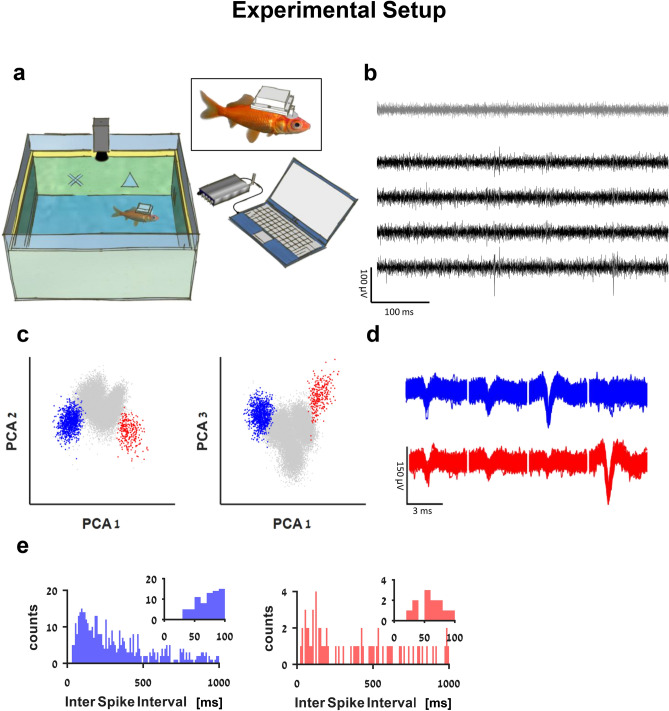
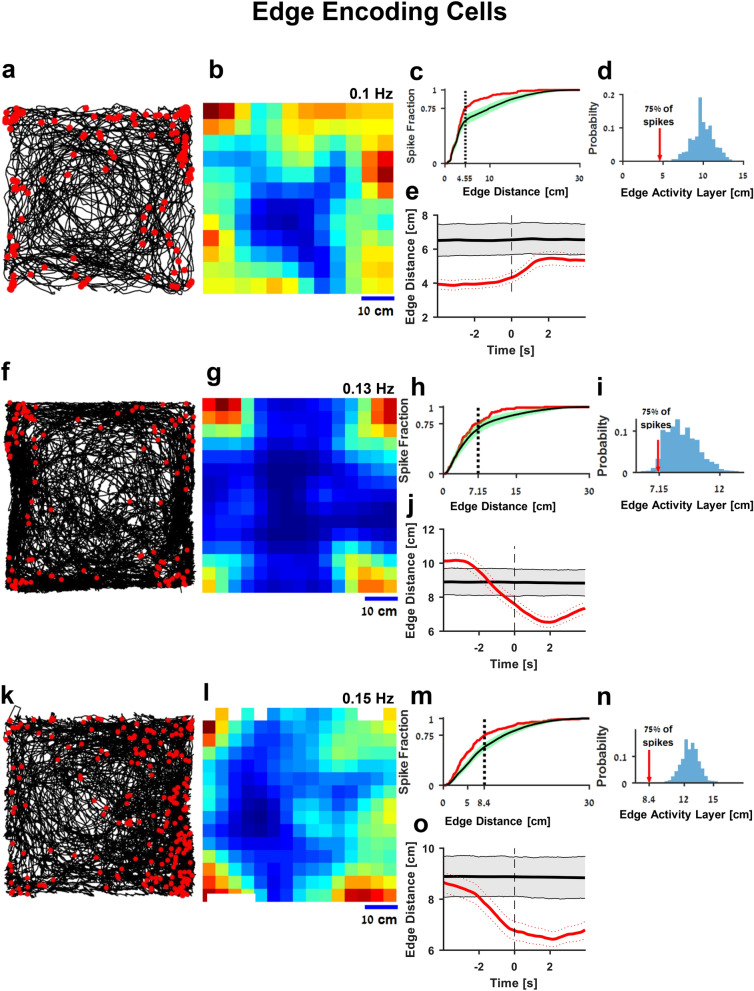
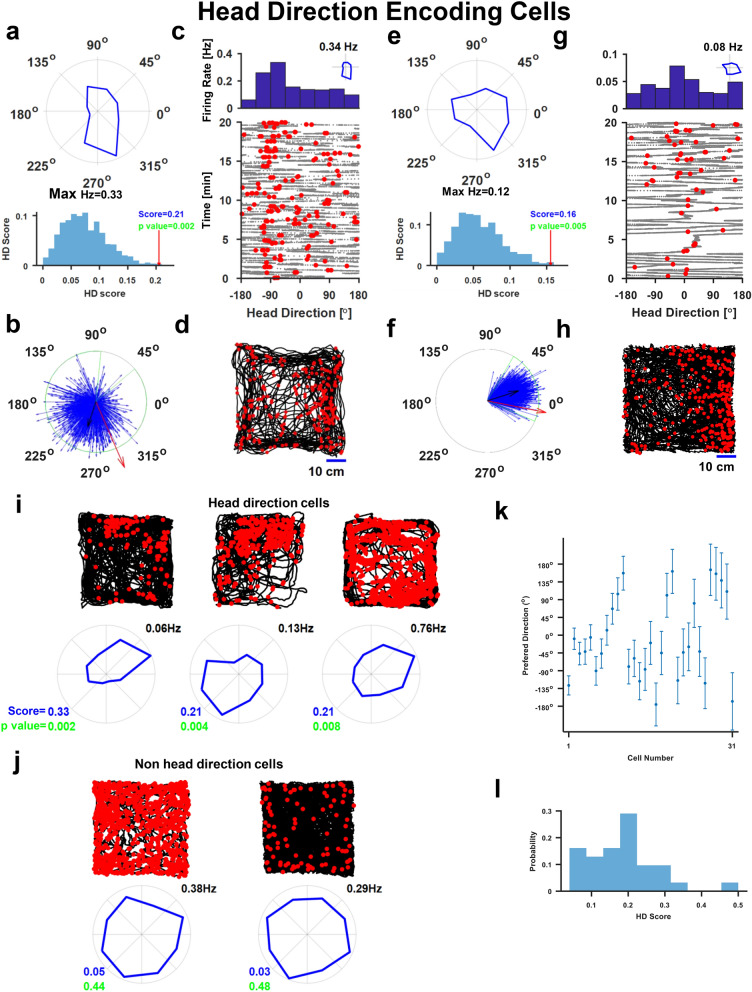
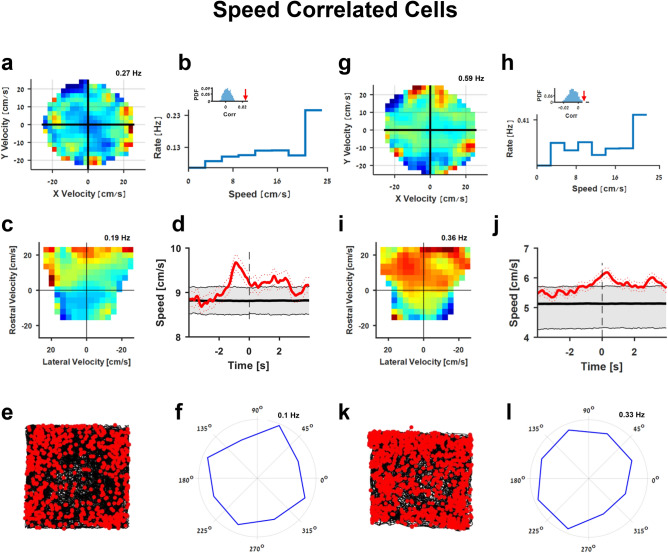
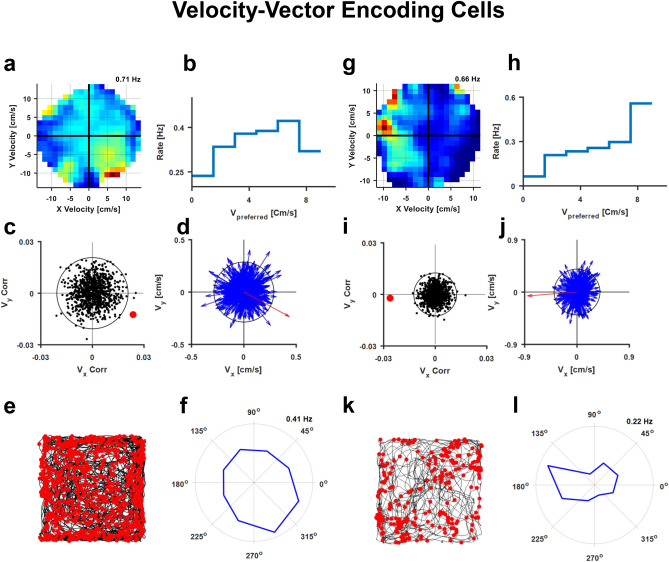
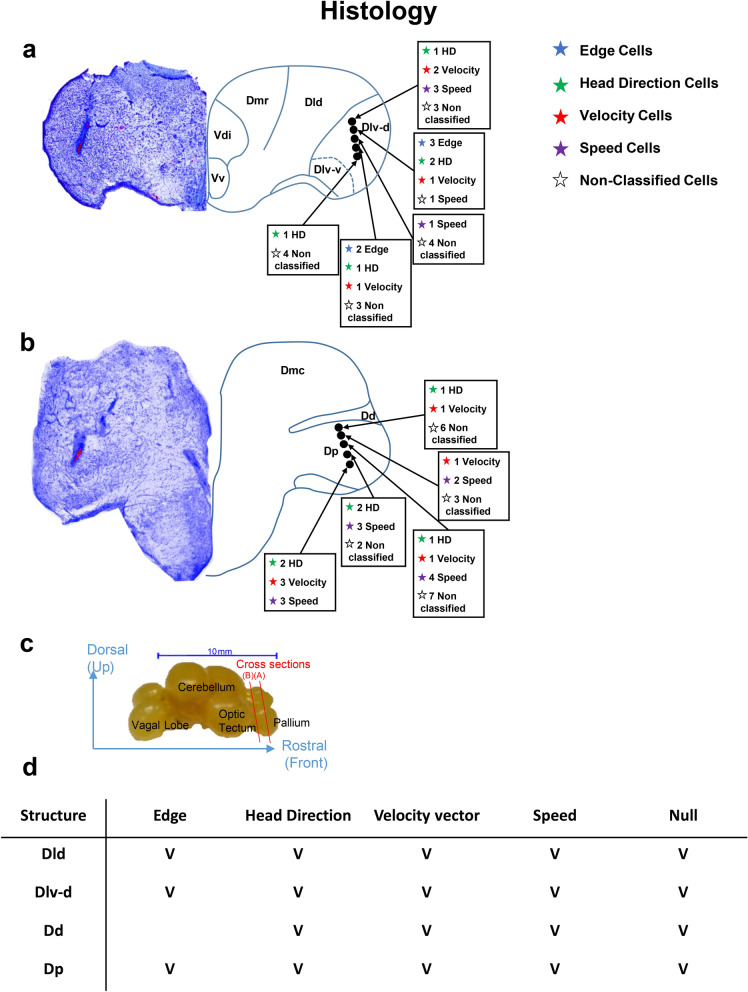
Like most animals, the survival of fish depends on navigation in space. This capacity has been documented in behavioral studies that have revealed navigation strategies. However, little is known about how freely swimming fish represent space and locomotion in the brain to enable successful navigation. Using a wireless neural recording system, we measured the activity of single neurons in the goldfish lateral pallium, a brain region known to be involved in spatial memory and navigation, while the fish swam freely in a two-dimensional water tank. We found that cells in the lateral pallium of the goldfish encode the edges of the environment, the fish head direction, the fish swimming speed, and the fish swimming velocity-vector. This study sheds light on how information related to navigation is represented in the brain of fish and addresses the fundamental question of the neural basis of navigation in this group of vertebrates.
Overview
The claims and statistics of this paper haven’t been checked yet.
Free: it reads the open-access text and checks the first 5 claims that cite a source we can check. Create a free account to check every claim.
Integrity signals
Registry
Cites
Statistics
Figures
Verification
Claims the paper makes
The claims and statistics of this paper haven’t been checked yet.
Free: it reads the open-access text and checks the first 5 claims that cite a source we can check. Create a free account to check every claim.
Claims other papers make about this one
Each is checked against this paper’s own text: does it say what the citing paper says it does?
The source backs part of the claim, not all of it — or backs it for a different population, condition or comparison.
In the citing paper
“More generally, there are many vectorial codes in mammalian navigation systems1,2, including some in body-centric coordinates34,35, and others in world-centric coordinates34,36–38.”
From Transforming representations of movement from body- to world-centric space (2022) · cites this paper as [34]
Experimental — accuracy not yet measuredThe cited source says what the claim attributes to it.
In the citing paper
“cells fundamental to spatial cognition in mammals—for example, place cells (PCs)5,6—have yet to be established in any fish species”
From A population code for spatial representation in the zebrafish telencephalon (2024) · cites this paper as [21]
The cited source says what the claim attributes to it.
In the citing paper
“A growing number of experimental studies using well-controlled behavioral procedures combined with brain lesion, neural activity recording, and neuro-morphofunctional techniques have provided evidence on the critical role of the teleost fish hippocampal pallium in spatial cognition [28,112,157,180,181,182,183,184,185,186].”
From Spatial Cognition in Teleost Fish: Strategies and Mechanisms (2021) · cites this paper as [186]
The cited source says what the claim attributes to it.
In the citing paper
“In a more comprehensive study, Vinepinsky et al. [186] likewise showed the presence of cells with navigation-related activity in the dorsolateral telencephalon of free-swimming goldfish, for example, “border cells”, that increase their firing rate when the fish approaches the environmental boundaries, and “velocity cells”, whose activity correlate with the fish swimming direction and speed.”
From Spatial Cognition in Teleost Fish: Strategies and Mechanisms (2021) · cites this paper as [186]
In the citing paper
“Thus, much of the “compass input” that we refer to in our study as originating from EPG neurons is probably due to the combined action of EPG neurons (which constitute the primary computational map of the compass system) and Δ7 neurons”
From Transforming representations of movement from body- to world-centric space (2022) · cites this paper as [34]
Self-check
Percentages, sums and reported differences re-computed from the paper’s own numbers.
The self-check needs the paper’s full text.
Citations
Cites
The hippocampus as a spatial map. Preliminary evidence from unit activity in the freely-moving rat
O'Keefe, J., & Dostrovsky, J. (1971) · Brain Research · doi:10.1016/0006-8993(71)90358-1 · Cited by 6,151
Microstructure of a spatial map in the entorhinal cortex
Hafting, T., Fyhn, M., Molden, S., Moser, M.-B., & Moser, E. I. (2005) · Nature · doi:10.1038/nature03721 · Cited by 4,068
Tau-mediated neurodegeneration in Alzheimer’s disease and related disorders
Ballatore, C., Lee, V. M.-Y., & Trojanowski, J. Q. (2007) · Nature Reviews Neuroscience · doi:10.1038/nrn2194 · Cited by 2,174
Path integration and the neural basis of the 'cognitive map'
McNaughton, B. L., Battaglia, F. P., Jensen, O., Moser, E. I., & Moser, M.-B. (2006) · Nature Reviews Neuroscience · doi:10.1038/nrn1932 · Cited by 2,024
Place Cells, Grid Cells, and the Brain's Spatial Representation System
Moser, E. I., Kropff, E., & Moser, M.-B. (2008) · Annual Review of Neuroscience · doi:10.1146/annurev.neuro.31.061307.090723 · Cited by 1,934
Memory, navigation and theta rhythm in the hippocampal-entorhinal system
Buzsáki, G., & Moser, E. I. (2013) · Nature Neuroscience · doi:10.1038/nn.3304 · Cited by 1,847
Taube, J., Muller, R., & Ranck, J. (1990) · The Journal of Neuroscience · doi:10.1523/jneurosci.10-02-00420.1990 · Cited by 1,809
A review of methods for spike sorting: the detection and classification of neural action potentials
Lewicki, M. S. (1998) · Network Computation in Neural Systems · doi:10.1088/0954-898x/9/4/001 · Cited by 1,370
Representation of Geometric Borders in the Entorhinal Cortex
Solstad, T., Boccara, C. N., Kropff, E., Moser, M.-B., & Moser, E. I. (2008) · Science · doi:10.1126/science.1166466 · Cited by 1,213
Taube, J., Muller, R., & Ranck, J. (1990) · The Journal of Neuroscience · doi:10.1523/jneurosci.10-02-00436.1990 · Cited by 882
Cited by
Neural representations of space in the hippocampus of a food-caching bird
Payne, H. L., Lynch, G. F., & Aronov, D. (2021) · Science · doi:10.1126/science.abg2009 · Cited by 163
Transforming representations of movement from body- to world-centric space
Lu, J., Behbahani, A. H., Hamburg, L., Westeinde, E. A., Dawson, P. M., Lyu, C., Maimon, G., Dickinson, M. H., Druckmann, S., & Wilson, R. I. (2022) · Nature · doi:10.1038/s41586-021-04191-x · Cited by 152
Flight-Induced Compass Representation in the Monarch Butterfly Heading Network
Beetz, M. J., Kraus, C., Franzke, M., Dreyer, D., Strube-Bloss, M. F., Rößler, W., Warrant, E. J., Merlin, C., & el Jundi, B. (2021) · Current Biology · doi:10.1016/j.cub.2021.11.009 · Cited by 80
Fish‐Wearable Data Snooping Platform for Underwater Energy Harvesting and Fish Behavior Monitoring
Wang, X., Shi, Y., Yang, P., Tao, X., Li, S., Lei, R., Liu, Z., Wang, Z. L., & Chen, X. (2022) · Small · doi:10.1002/smll.202107232 · Cited by 73
Fotowat, H., Lee, C., Jun, J. J., & Maler, L. (2019) · eLife · doi:10.7554/elife.44119 · Cited by 69
Directional tuning in the hippocampal formation of birds
Ben-Yishay, E., Krivoruchko, K., Ron, S., Ulanovsky, N., Derdikman, D., & Gutfreund, Y. (2021) · Current Biology · doi:10.1016/j.cub.2021.04.029 · Cited by 63
Fujiwara, T., Brotas, M., & Chiappe, M. E. (2022) · Neuron · doi:10.1016/j.neuron.2022.04.008 · Cited by 59
Spatial Cognition in Teleost Fish: Strategies and Mechanisms
Rodríguez, F., Quintero, B., Amores, L., Madrid, D., Salas-Peña, C., & Salas, C. (2021) · Animals · doi:10.3390/ani11082271 · Cited by 59
A brainstem integrator for self-location memory and positional homeostasis in zebrafish
Yang, E., Zwart, M., James, B., Rubinov, M., Wei, Z., Narayan, S., Vladimirov, N., Mensh, B. D., Fitzgerald, J. E., & Ahrens, M. B. (2022) · Cell · doi:10.1016/j.cell.2022.11.022 · Cited by 72
Neural representation of goal direction in the monarch butterfly brain
Beetz, M. J., Kraus, C., & el Jundi, B. (2023) · Nature Communications · doi:10.1038/s41467-023-41526-w · Cited by 65
From fish out of water to new insights on navigation mechanisms in animals
Givon, S., Samina, M., Ben-Shahar, O., & Segev, R. (2022) · Behavioural Brain Research · doi:10.1016/j.bbr.2021.113711 · Cited by 38
Self-citationA population code for spatial representation in the zebrafish telencephalon
Yang, C., Mammen, L., Kim, B., Li, M., Robson, D. N., & Li, J. M. (2024) · Nature · doi:10.1038/s41586-024-07867-2 · Cited by 38
Tibi, M., Hayun, S. B., Hochgerner, H., Lin, Z., Givon, S., Ophir, O., Shay, T., Mueller, T., Segev, R., & Zeisel, A. (2023) · Science Advances · doi:10.1126/sciadv.adh7693 · Cited by 41
“This is reflected by contradicting observations in electric fish ( 48 ) and goldfish ( 16 , 17 , 20 ), where lesion studies and recordings of space-encoding cells linked all Dl , Dm , and even more central telencephalon to spatial cognition.”
BackgroundResultInfluentialSelf-citationNonlocal spatiotemporal representation in the hippocampus of freely flying bats
Dotson, N. M., & Yartsev, M. M. (2021) · Science · doi:10.1126/science.abg1278 · Cited by 44
Boundary vector cells in the goldfish central telencephalon encode spatial information
Cohen, L., Vinepinsky, E., Donchin, O., & Segev, R. (2023) · PLOS Biology · doi:10.1371/journal.pbio.3001747 · Cited by 37
“the fish’s head direction, speed, and velocity [14].”
BackgroundInfluentialSelf-citationOngoing habenular activity is driven by forebrain networks and modulated by olfactory stimuli
Bartoszek, E. M., Ostenrath, A. M., Jetti, S. K., Serneels, B., Mutlu, A. K., Chau, K. T. P., & Yaksi, E. (2021) · Current Biology · doi:10.1016/j.cub.2021.08.021 · Cited by 33
Anneser, L., Satou, C., Hotz, H.-R., & Friedrich, R. W. (2023) · Current Biology · doi:10.1016/j.cub.2023.12.003 · Cited by 43
“Recordings in behaving goldfish revealed putative speed cells, border cells, and head direction cells, 62,63 and whole-brain imaging in freely swimming zebrafish larvae has recently revealed place cells.”
BackgroundHead direction cells in a migratory bird prefer north
TAKAHASHI, S. Y., Hombe, T., Matsumoto, S., Ide, K., & Yoda, K. (2022) · Science Advances · doi:10.1126/sciadv.abl6848 · Cited by 37
“Role of geolocation in HD cell orientation Evidence on HD cells in the brain of mammals (10), fish (8), insects (9), and birds (14) suggests that the preferred directions of HD cells cover all directions and are uniformly distributed.”
BackgroundCortical Integration of Vestibular and Visual Cues for Navigation, Visual Processing, and Perception
Keshavarzi, S., Vélez‐Fort, M., & Margrie, T. W. (2023) · Annual Review of Neuroscience · doi:10.1146/annurev-neuro-120722-100503 · Cited by 42
“…in the rodent’s brain – as well as in other animals including insects (Green et al. 2017, Seelig & Jayaraman 2015, Turner-Evans et al. 2017), fish (Vinepinsky et al. 2020), birds (Ben-Yishay et al. 2021), bats (Finkelstein et al. 2015) and primates (Baumann & Mattingley 2010, Robertson et al.…”
Visually guided and context-dependent spatial navigation in the translucent fish Danionella cerebrum
Lee, T. J., & Briggman, K. L. (2023) · Current Biology · doi:10.1016/j.cub.2023.11.030 · Cited by 29
Hulse, B. K., Stanoev, A., Turner‐Evans, D. B., Seelig, J. D., & Jayaraman, V. (2023) · bioRxiv (Cold Spring Harbor Laboratory) · doi:10.1101/2023.09.25.559373 · Cited by 25
Soft, wireless and subdermally implantable recording and neuromodulation tools
Cai, L., & Gutruf, P. (2021) · Journal of Neural Engineering · doi:10.1088/1741-2552/abe805 · Cited by 24
“[28] Vinepinsky E, Cohen L, Perchik S, Ben-Shahar O,”
Wireless light energy harvesting and communication in a waterproof GaN optoelectronic system
Gao, X., Liu, P., Yin, Q., Wang, H., Fu, J., Hu, F., Jiang, Y. H., Zhu, H., & Wang, Y. (2022) · Communications Engineering · doi:10.1038/s44172-022-00016-5 · Cited by 22
An entorhinal-like region in food-caching birds
Applegate, M. C., Gutnichenko, K. S., Mackevicius, E. L., & Aronov, D. (2023) · Current Biology · doi:10.1016/j.cub.2023.05.031 · Cited by 25
Distance estimation in the goldfish ( Carassius auratus )
Sibeaux, A., Karlsson, C., Newport, C., & de Perera, T. B. (2022) · Proceedings of the Royal Society B Biological Sciences · doi:10.1098/rspb.2022.1220 · Cited by 19
“…likely to constitute the basic building blocks of fish navigation systems were recently discovered in the goldfish lateral pallium; head direction cells, edge detection neurons and speed correlated cells were recorded when individuals freely navigate in their environment (Vinepinsky et al., 2020).”
BackgroundMethodInfluentialFriesen, C. N., Maclaine, K. D., & Hofmann, H. A. (2022) · Hormones and Behavior · doi:10.1016/j.yhbeh.2022.105241 · Cited by 16
Five Breakthroughs: A First Approximation of Brain Evolution From Early Bilaterians to Humans
Bennett, M. S. (2021) · Frontiers in Neuroanatomy · doi:10.3389/fnana.2021.693346 · Cited by 20
Chen, I.-H., Georgopoulou, D. G., Ebbesson, L. O. E., Voskakis, D., Lal, P., & Papandroulakis, N. (2023) · Frontiers in Marine Science · doi:10.3389/fmars.2023.1168953 · Cited by 15
“Pseudo-random interval shuffling A pseudo-random baseline for the time was created by the pseudo-random interval shuffling (PIS) procedure, which is similar to the inter-spike interval (ISI) shuffling procedure (Vinepinsky et al., 2020) to dismantle information (i.”
MethodToward Naturalistic Neuroscience of Navigation: Opportunities in Coral Reef Fish
Givon, S., Pickholtz, R., Pickholtz, E. Y., Ben‐Shahar, O., Kiflawi, M., & Segev, R. (2022) · Frontiers in Neural Circuits · doi:10.3389/fncir.2022.895381 · Cited by 13
“Recent studies have described a wireless electrophysiological system capable of recording the activity of single neurons in the brain of small free-swimming fish (Vinepinsky et al., 2017, 2020; Cohen et al., 2019).”
BackgroundInfluentialSelf-citationBennett, M. S. (2021) · Frontiers in Psychology · doi:10.3389/fpsyg.2021.685853 · Cited by 14
Wireless logging of extracellular neuronal activity in the telencephalon of free-swimming salmonids
Takahashi, S., Hombe, T., Takahashi, R., Ide, K., Okamoto, S., Yoda, K., Kitagawa, T., & Makiguchi, Y. (2021) · Animal Biotelemetry · doi:10.1186/s40317-021-00232-4 · Cited by 13
“For example, the trout brain is located 3–4 cm from the head surface, whereas the goldfish brain lies only a few millimeters underneath [9].”
BackgroundInfluentialTaking a shortcut: what mechanisms do fish use?
Sibeaux, A., Newport, C., Green, J. P., Karlsson, C., Engelmann, J., & de Perera, T. B. (2024) · Communications Biology · doi:10.1038/s42003-024-06179-5 · Cited by 11
Towards a unified vision on animal navigation
Menti, G. M., Meda, N., Zordan, M. A., & Megighian, A. (2022) · European Journal of Neuroscience · doi:10.1111/ejn.15881 · Cited by 14
Ide, K., & TAKAHASHI, S. Y. (2022) · Micromachines · doi:10.3390/mi13091529 · Cited by 13
“This study has allowed them to detect cells that respond to head direction, swimming speed, and the edge of the water tank from the telencephalon [30] (Figure 3).”
BackgroundLateral and medial telencephalic pallium lesions impair spatial memory in goldfish
Givon, S., Altsuler-Nagar, R., Oring, N., Vinepinsky, E., & Segev, R. (2023) · Brain Research Bulletin · doi:10.1016/j.brainresbull.2023.110802 · Cited by 8
“Electrophysiological studies of the functional properties of the lateral pallium that have identified localization neurons such as boundary vector cells, edge cells, speed, and velocity cells (Cohen et al., 2019, 2023; Vinepinsky et al., 2017; Vinepinsky et al., 2020) provide additional support.”
Self-citationNeural mechanisms for spatial cognition across vertebrates
Vinepinsky, E., & Segev, R. (2023) · Molecular Psychology Brain Behavior and Society · doi:10.12688/molpsychol.17503.1 · Cited by 8
Self-citationHas the hippocampus really forgotten about space?
Fiedler, J., Leonibus, E. D., & Treves, A. (2021) · Current Opinion in Neurobiology · doi:10.1016/j.conb.2021.11.009 · Cited by 50
Recent advances in neurotechnology-based biohybrid robots
Chen, G., Dang, D., Zhang, C., Qin, L., Yan, T., Wang, W., & Liang, W. (2024) · Soft Matter · doi:10.1039/d4sm00768a · Cited by 9
Plastic landmark anchoring in zebrafish compass neurons
Tanaka, R., & Portugues, R. (2026) · Nature · doi:10.1038/s41586-025-09888-x · Cited by 14
“By contrast, the observations of HD cells in the tel-eost forebrain are limited 41 , and overall, the homology of mammalian thalamocortical connections in fish is questioned 42,43 .”
Neural representation of goal direction in the monarch butterfly brainPreprint
Beetz, M. J., Kraus, C. M., & el Jundi, B. (2022) · bioRxiv (Cold Spring Harbor Laboratory) · doi:10.1101/2022.10.15.512348 · Cited by 7
Pose Analysis in Free-Swimming Adult Zebrafish, Danio rerio: “Fishy” Origins of Movement Design
Kanwal, J. S., Sanghera, B. S., Dabbi, R., & Glasgow, E. F. (2024) · Brain Behavior and Evolution · doi:10.1159/000543081 · Cited by 5
Lavian, H., Prat, O., Petrucco, L., Štih, V., & Portugues, R. (2025) · Nature Communications · doi:10.1038/s41467-025-66084-1 · Cited by 17
“In many animals, the heading direction signal is tethered to the outside world and can be updated by shifting a landmark to a new position 3,21 .”
The archerfish uses motor adaptation in shooting to correct for changing physical conditions
Volotsky, S., Donchin, O., & Segev, R. (2024) · eLife · doi:10.7554/elife.92909 · Cited by 8
Self-citationTrinh, A.-T., Clarke, S. E., Harvey-Girard, E., & Maler, L. (2019) · doi:10.1101/571414 · Cited by 6
A population code for spatial representation in the larval zebrafish telencephalonPreprint
Yang, C., Mammen, L. C. C., Kim, B., Li, M., Robson, D. N., & Li, J. (2023) · bioRxiv (Cold Spring Harbor Laboratory) · doi:10.1101/2023.11.12.566708 · Cited by 6
A Spiking Neural Network Model of Rodent Head Direction Calibrated With Landmark Free Learning
Stentiford, R., Knowles, T. C., & Pearson, M. J. (2022) · Frontiers in Neurorobotics · doi:10.3389/fnbot.2022.867019 · Cited by 8
A brainstem integrator for self-localization and positional homeostasisPreprint
Yang, E., Zwart, M., Rubinov, M., James, B., Wei, Z., Narayan, S., Vladimirov, N., Mensh, B. D., Fitzgerald, J. E., & Ahrens, M. B. (2021) · bioRxiv (Cold Spring Harbor Laboratory) · doi:10.1101/2021.11.26.468907 · Cited by 5
“…by neural representations of space in what is called a ‘cognitive map’ 3–6 , arising from diverse brain regions including mammalian hippocampus 6–9 , entorhinal cortex 10,11 , hippocampus’ homologue in fish 12–14 , central complex of Drosophila melanogaster 15,16 , and retrosplenial cortex 17 .”
BackgroundGómez, A., Rodríguez-Expósito, B., Ocaña, F. M., Salas, C., & Rodríguez, F. (2022) · Brain Structure and Function · doi:10.1007/s00429-022-02553-3 · Cited by 4
“This result adds to previous findings that demonstrated the critical involvement of the teleost fish hippocampal pallium in map-like spatial memory (Rodríguez et al. 2002; Broglio et al. 2010; Durán et al. 2010; Uceda et al. 2015; Ocaña et al. 2017; Vinepinsky et al. 2020), suggesting that this telencephalic structure…”
ResultGoldfish as an Experimental Model
Ota, K. G. (2021) · Springer eBooks · doi:10.1007/978-981-16-0850-6_2 · Cited by 8
Emergence of the Hippocampus as a Vector for Goal-Directed Spatial Navigation
Takahashi, S., Sawatani, F., & Ide, K. (2024) · Advances in neurobiology · doi:10.1007/978-3-031-69188-1_2 · Cited by 3
Behavioral strategies and neural mechanisms underlying short-range navigation in teleost fish
Sibeaux, A., de Perera, T. B., Mueller, T., & Segev, R. (2025) · Current Opinion in Behavioral Sciences · doi:10.1016/j.cobeha.2025.101588 · Cited by 4
Self-citationFrom Machinery to Biology: A Review on Mapless Autonomous Underwater Navigation
Zhu, W., & Cui, W. (2025) · Journal of Marine Science and Engineering · doi:10.3390/jmse13112202 · Cited by 5
A perspective on neuroethology: what the past teaches us about the future of neuroethology
Beetz, M. J. (2024) · Journal of Comparative Physiology A · doi:10.1007/s00359-024-01695-5 · Cited by 8
“To find the evolutionary origin of place cells, scientists look for place cells in diverse species including fish (Vinepinsky et al. 2017, 2020) and more recently birds (Ben-Yishay et al. 2021; Payne et al. 2021; Agarwal et al. 2023).”
BackgroundAxial encoding schematics of neural representations of 3D space in freely navigating goldfishPreprint
Cohen, L., Vinepinsky, E., Donchin, O., & Segev, R. (2022) · bioRxiv (Cold Spring Harbor Laboratory) · doi:10.1101/2022.07.07.499255 · Cited by 3
“This encoding scheme differs from the 199 local encoding of mammalian place and grid cells, which was also shown to be present 200 in 3D environments in rats (21) and bats (26).”
BackgroundMethodSelf-citationYoung, R. L., Weitekamp, C. A., Triki, Z., Su, Y., Bshary, R., & Hofmann, H. A. (2022) · doi:10.32942/osf.io/4p638 · Cited by 3
Mechanisms for plastic landmark anchoring in zebrafish compass neuronsPreprint
Tanaka, R., & Portugues, R. (2024) · bioRxiv (Cold Spring Harbor Laboratory) · doi:10.1101/2024.12.13.628331 · Cited by 3
“…between the retrosplenial cortex and PoS [46, 47], which [48]. isthenpropagatedbacktothesubcorticalareasthroughfeedbackprojections Incontrast,theobservations ofHDcellsintheteleostforebrainarelimited[49],and overallthehomologyofmammalianthalamo-cortical connectionsinfishisquestioned[50,51].”
Mapping spatial memory in teleosts: a new Frontier in neural logging techniques
TAKAHASHI, S. Y., Sawatani, F., Ide, K., ABE, T. K., Kitagawa, T., & Makiguchi, Y. (2024) · Frontiers in Physiology · doi:10.3389/fphys.2024.1499058 · Cited by 4
Object identity representation occurs early in the archerfish visual system
Volotsky, S., & Segev, R. (2025) · Scientific Reports · doi:10.1038/s41598-025-88660-7 · Cited by 2
Self-citationThe visual challenges of short-range navigation in teleost fish
Newport, C., & de Perera, T. B. (2026) · Journal of Experimental Biology · doi:10.1242/jeb.250888 · Cited by 2
The neural substrate of navigation using hydrostatic cues in goldfish
Givon, S., Altsuler-Nagar, R., & Segev, R. (2025) · Royal Society Open Science · doi:10.1098/rsos.241869 · Cited by 2
Self-citationRelational Memory Functions of the Hippocampal Pallium in Teleost Fish
Gómez, A., Ocaña, F. M., Puntas, T. D. Á., Rodríguez, F., & Salas, C. (2022) · Cambridge University Press eBooks · doi:10.1017/9781108768450.012 · Cited by 3
Gibbs, B. J., Strother, J. A., & Liao, J. C. (2023) · Journal of Neuroscience Methods · doi:10.1016/j.jneumeth.2023.109850 · Cited by 3
Neural and sensory basis of homing behavior in the invasive cane toad, Rhinella marinaPreprint
Shaykevich, D. A., Pareja-Mejía, D., Golde, C. L., Pašukonis, A., & O’Connell, L. A. (2024) · bioRxiv (Cold Spring Harbor Laboratory) · doi:10.1101/2024.06.25.600658 · Cited by 2
Kononov, R., Tiselko, V. S., Maslennikov, O. V., & Nekorkin, V. I. (2025) · Frontiers in Network Physiology · doi:10.3389/fnetp.2025.1693772 · Cited by 1
A multi-ring shifter network computes head direction in zebrafish
Mei, S., Lavian, H., Wu, Y. K., Stemmler, M., Portugues, R., & Herz, A. V. M. (2026) · Current Biology · doi:10.1016/j.cub.2026.05.054 · Cited by 2
Bergendahl, I. A., DePasquale, C., & Salvanes, A. G. V. (2022) · Elsevier eBooks · doi:10.1016/b978-0-323-90801-6.00011-2 · Cited by 1
Active Control of Sensing Through Movements in Active Electrolocation
Engelmann, J., & Lucks, V. (2020) · Elsevier eBooks · doi:10.1016/b978-0-12-809324-5.24212-0
Trinh, A. (2021) · uO Research (University of Ottawa) · doi:10.20381/ruor-26756
Evolution of Learning Processes
Krause, M. A., Hollis, K. L., & Papini, M. R. (2022) · Cambridge University Press eBooks · doi:10.1017/9781108768450.003
Molecular Logic of Neuromodulatory Systems in the Zebrafish TelencephalonPreprint
Anneser, L., Satou, C., Hotz, H.-R., & Friedrich, R. W. (2023) · bioRxiv (Cold Spring Harbor Laboratory) · doi:10.1101/2023.10.04.560846
The archerfish uses motor adaptation in shooting to correct for changing physical conditionsPreprint
Volotsky, S., Donchin, O., & Segev, R. (2023) · bioRxiv (Cold Spring Harbor Laboratory) · doi:10.1101/2023.10.03.560658
“…to note that although it has been demonstrated that other fish species possess orientation and spatial memory (Rodriguez et al. 1994,Cohen et al. 2023,Givon et al. 2022,Lee et al. 2012,Givon et al. 2023,Vinepinsky et al. 2020), there is a lack of such information regarding archerfish specifically.”
BackgroundSelf-citationRepresentation of bulk water flow in the goldfish (Carassius auratus) midbrain
Susteren, G. E. V., & Mogdans, J. (2024) · Journal of Comparative Physiology A · doi:10.1007/s00359-024-01715-4
Advances in neural information detection sensors for spatial cognition research: A review
Wang, M., Lv, S., Wang, Y., Xu, Z., Jiao, P., Liu, Y., Zhang, S., Wu, Y., Wang, M., Luo, J., et al. (2024) · Sensors and Actuators Reports · doi:10.1016/j.snr.2024.100274
Bridging biology and robotics: advancing submersible technology from robotic to live-fish models
Shao, X., Yang, J., Sawan, M., & Cui, W. (2025) · Academia Engineering · doi:10.20935/acadeng7721 · Cited by 3
Trinh, A., Ostenrath, A. M., del Castillo, I., Kraus, S., Cachin, F., Serneels, B., Kawakami, K., & Yaksi, E. (2025) · bioRxiv (Cold Spring Harbor Laboratory) · doi:10.1101/2025.09.15.675867
Vector coordinate transformation in the Drosophila navigation systemPreprint
Gorko, B., & Kim, S. S. (2025) · bioRxiv (Cold Spring Harbor Laboratory) · doi:10.64898/2025.12.20.695733
Barbasch, T. A., Dan, U., Marquez, C., Ciura, J., Maciejewski, M. F., Kusakabe, M., Yamamoto, N., Kanbe, H., Kitano, J., & Bell, A. M. (2026) · bioRxiv (Cold Spring Harbor Laboratory) · doi:10.64898/2026.01.02.697386 · Cited by 2
Adult Zebrafish Engage in Path Integration-like Behavior When Exploring a Novel EnvironmentPreprint
Sanghera, B. S., Shraybman, P., & Kanwal, J. S. (2026) · bioRxiv (Cold Spring Harbor Laboratory) · doi:10.64898/2025.12.31.697215
“Recent studies in goldfish show that neurons in the lateral pallium encode swim-related parameters such as head direction, swimming speed, and a swim velocity ‑ vector (Vinepinsky et al., 2020).”
InfluentialWhat Are the Contributions of Modeling to Bridging the Gaps between Methods and across Species?
Bičanski, A. (2026) · Springer eBooks · doi:10.1007/978-3-032-20563-6_5
Cohen, L., Cohen-Duwek, H., & Tsur, E. E. (2026) · iScience · doi:10.1016/j.isci.2026.115824
“1,20 Therefore, to allow for a biologically plausible neural design, we used the population sizes, firing rates, and tuning curves observed in the goldfish to model an SNN, composed of BVC, HP cells, and kinematical cells (speed, HD, and velocity).”
Self-citationHead direction and the evolutionary origins of spatial representation
Sayre, M. E., Narendra, A., Heinze, S., & Barron, A. B. (2026) · Trends in Neurosciences · doi:10.1016/j.tins.2026.04.001 · Cited by 3
Young, R. L., Weitekamp, C. A., Triki, Z., Su, Y., Beman, A. G., Petershack, M. A., Bshary, R., & Hofmann, H. A. (2026) · Proceedings of the Royal Society B Biological Sciences · doi:10.1098/rspb.2026.0722 · Cited by 3
On a novel design for potential next-generation submersibles
Shao, X., & Cui, W. (2026) · Ships and Offshore Structures · doi:10.1080/17445302.2026.2681721
Yokoi, S., Mochizuki-Koike, R., Yamashiro, K., Nakagawa, S., Ikegaya, Y., & Matsumoto, N. (2026) · Scientific Reports · doi:10.1038/s41598-026-51830-2
Deep conservation of head direction circuits in bees, ants and fliesPreprint
Sayre, M. E., Gillet, V., Ceberg, N., Badalamente, G. S., Pinzon-Rodriguez, A., Griggs, N., Capdevila, L. S., Roberts, R. J. V., Gunnarsson, E. S., Szadaj, F., et al. (2026) · bioRxiv (Cold Spring Harbor Laboratory) · doi:10.64898/2026.07.26.740564 · Cited by 1
“This is neurally implemented by head direction cells, which were initially discovered in rats 12 , but have since been found in evolutionarily distant animals, including other mammals 13,14 , birds 15 , fish 16,17 , and insects 18–22 .”
Metadata
- Authors
- Vinepinsky, E., Cohen, L., Perchik, S., Ben-Shahar, O., Donchin, O., & Segev, R.
- Affiliations
- Ben-Gurion University of the Negev (IL)
- Corresponding author
- Segev, Ronen
- Venue
- Scientific Reports
- Published
- 2020-09-08
- Volume
- 10
- Issue
- 1
- Pages
- 14762-14762
- ISSN
- 2045-2322 (ISSN-L)
- PMC
- PMC7479115
- OpenAlex
- W3083821052
- Semantic Scholar
- 056eb1863ea22f52ef5c71467fb81a712e32f02c
- Cited by
- 87
- References
- 71
- Citations by year
- 2026: 12 · 2025: 9 · 2024: 12 · 2023: 16 · 2022: 18 · 2021: 17 · 2020: 1
- FWCI
- 6.94
- Type
- journal article
- Language
- en
- Open access
- gold
- doi.org
- Licence
- cc-by
- creativecommons.org/licenses/by/4.0 (tdm)
- creativecommons.org/licenses/by/4.0 (vor)
- Locations
- Scientific Reports (publishedVersion, cc-by)
- bioRxiv (Cold Spring Harbor Laboratory) (acceptedVersion)
- PubMed Central (publishedVersion, cc-by)
- PubMed (publishedVersion)
- Funders
- Israel Science Foundation (281/15)
- Leona M. and Harry B. Helmsley Charitable Trust
- Frankel center, Ben Gurion University of the Negev
- Human Frontier Science Program (RGP0016/2019)
- Topics
- Life Sciences › Neuroscience › Cognitive Neuroscience › Memory and Neural Mechanisms
- Social Sciences › Psychology › Experimental and Cognitive Psychology › Spatial Cognition and Navigation
- Physical Sciences › Environmental Science › Nature and Landscape Conservation › Fish biology, ecology, and behavior
- Keywords
- fish navigation, goldfish, head direction, swimming kinematics, edge representation, spatial memory, single-unit recording, velocity vectors
- MeSH terms
- Animals, Behavior, Animal, Biomechanical Phenomena, Brain, Goldfish, Head, Locomotion, Neurons, Spatial Behavior, Swimming
About these checks
Registry, retraction, Cites and statistics results are computed, not judged, with one exception: a printed reference that no index lists is read once by a model before it counts as a citation error. Claims are extracted by a model and kept only when their quote appears verbatim in the text; each cited source is then checked, with a model’s help, for whether it says what the claim relies on. Those verdicts can be wrong — read the claim’s quote and the cited source before relying on one.
Statistics and arithmetic are recomputed, not judged.
Confidence bands are shown only for fields calibrated on our annotated test set. None is calibrated yet, so no band is shown.
What counts as a claim ›How we measure confidence ›How we check this ›
Are you an author, or do you see a problem with this page? Request a review
Data sources
Bibliographic data: Semantic Scholar, OpenAlex, Crossref.
Contains information from the Semantic Scholar Academic Graph Datasets, made available under the ODC Attribution License (ODC-BY 1.0).
Semantic Scholar’s data is described in: Kinney, R., et al. (2023). The Semantic Scholar Open Data Platform. arXiv:2301.10140.
