

Long-term cancer survival prediction using multimodal deep learning
Open accessPublished version of a preprint
The DOI matches its Crossref record; 59 of the 60 references it cites were found in a registry or an index.
Abstract
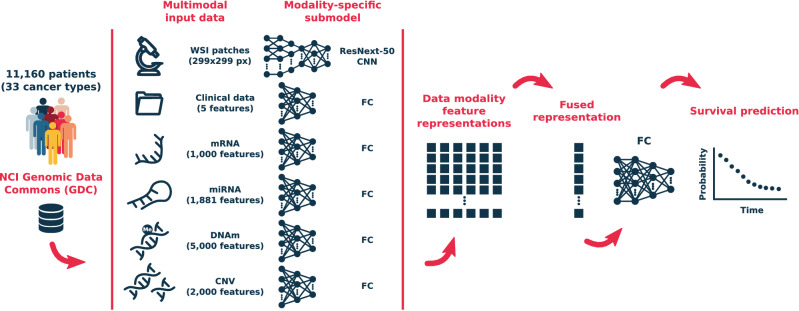
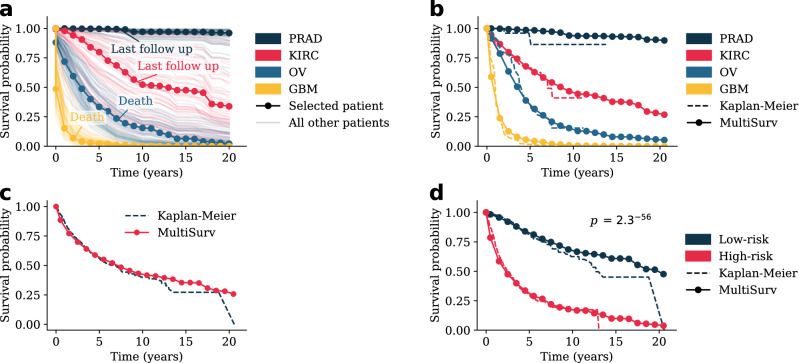
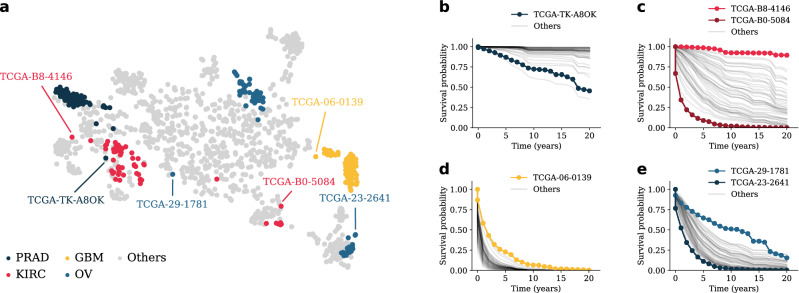
The age of precision medicine demands powerful computational techniques to handle high-dimensional patient data. We present MultiSurv, a multimodal deep learning method for long-term pan-cancer survival prediction. MultiSurv uses dedicated submodels to establish feature representations of clinical, imaging, and different high-dimensional omics data modalities. A data fusion layer aggregates the multimodal representations, and a prediction submodel generates conditional survival probabilities for follow-up time intervals spanning several decades. MultiSurv is the first non-linear and non-proportional survival prediction method that leverages multimodal data. In addition, MultiSurv can handle missing data, including single values and complete data modalities. MultiSurv was applied to data from 33 different cancer types and yields accurate pan-cancer patient survival curves. A quantitative comparison with previous methods showed that Multisurv achieves the best results according to different time-dependent metrics. We also generated visualizations of the learned multimodal representation of MultiSurv, which revealed insights on cancer characteristics and heterogeneity.
Overview
The claims and statistics of this paper haven’t been checked yet.
Free: it reads the open-access text and checks the first 5 claims that cite a source we can check. Create a free account to check every claim.
Integrity signals
Registry
Cites
Statistics
Figures
Verification
Claims the paper makes
The claims and statistics of this paper haven’t been checked yet.
Free: it reads the open-access text and checks the first 5 claims that cite a source we can check. Create a free account to check every claim.
Claims other papers make about this one
Each is checked against this paper’s own text: does it say what the citing paper says it does?
The source backs part of the claim, not all of it — or backs it for a different population, condition or comparison.
In the citing paper
“Vale-Silva et al. [74] compared these methods, although they did not find large differences in performance for predicting long-term cancer survival.”
From Multimodal deep learning for biomedical data fusion: a review (2022) · cites this paper as [74]
Experimental — accuracy not yet measuredThe source backs part of the claim, not all of it — or backs it for a different population, condition or comparison.
In the citing paper
“Lastly, Vale-Silva and Rohr (2021) presented a multimodal deep learning method for longterm pan-cancer survival prediction that was applied to data from 33 different cancer types, the highest number of organs of the category.”
From Navigating the landscape of multimodal AI in medicine: A scoping review on technical challenges and clinical applications (2025) · cites this paper as Vale-Silva and Rohr, 2021
Experimental — accuracy not yet measuredThe check wasn’t confident either way, so it gives no verdict — never disputed.
In the citing paper
“In addition to element-wise aggregation, attention-based fusion methods can be applied in order to weight different latent features by their importance [74, 79, 81].”
From Multimodal deep learning for biomedical data fusion: a review (2022) · cites this paper as [74]
Experimental — accuracy not yet measured
Self-check
Percentages, sums and reported differences re-computed from the paper’s own numbers.
The self-check needs the paper’s full text.
Citations
Cites
Adam: A Method for Stochastic Optimization
Kingma, D. P., & Ba, J. (2014) · arXiv · doi:10.48550/arxiv.1412.6980 · Cited by 98,946
LeCun, Y., Bengio, Y., & Hinton, G. (2015) · Nature · doi:10.1038/nature14539 · Cited by 84,126
Bray, F., Ferlay, J., Soerjomataram, I., Siegel, R. L., Torre, L. A., & Jemal, A. (2018) · CA: A Cancer Journal for Clinicians · doi:10.3322/caac.21492 · Cited by 84,109
Scikit-learn: Machine Learning in Python
Pedregosa, F., Varoquaux, G., Gramfort, A., Michel, V., Thirion, B., Grisel, O., Blondel, M., Müller, A., Nothman, J., Louppe, G., et al. (2012) · arXiv · doi:10.48550/arxiv.1201.0490 · Cited by 71,016
Regression Models and Life-Tables
Cox, D. R. (1972) · Journal of the Royal Statistical Society Series B: Statistical Methodology · doi:10.1111/j.2517-6161.1972.tb00899.x · Cited by 39,793
ImageNet Large Scale Visual Recognition Challenge
Russakovsky, O., Deng, J., Su, H., Krause, J., Satheesh, S., Ma, S., Huang, Z., Karpathy, A., Khosla, A., Bernstein, M., et al. (2015) · International Journal of Computer Vision · doi:10.1007/s11263-015-0816-y · Cited by 39,380
SciPy 1.0: fundamental algorithms for scientific computing in Python
Virtanen, P., Gommers, R., Oliphant, T. E., Haberland, M., Reddy, T., Cournapeau, D., Burovski, E., Peterson, P., Weckesser, W., Bright, J., et al. (2020) · Nature Methods · doi:10.1038/s41592-019-0686-2 · Cited by 38,430
(2008) · Journal of Machine Learning Research · Cited by 33,051
PyTorch: An Imperative Style, High-Performance Deep Learning Library
Paszke, A., Gross, S., Massa, F., Lerer, A., Bradbury, J., Chanan, G., Killeen, T., Lin, Z., Gimelshein, N., Antiga, L., et al. (2019) · arXiv · doi:10.48550/arxiv.1912.01703 · Cited by 31,473
Regression Models and Life-Tables
Cox, D. R. (1992) · Springer Series in Statistics · doi:10.1007/978-1-4612-4380-9_37 · Cited by 26,297
Advances in neural information processing systems 7
(1996) · Computers & Mathematics with Applications · doi:10.1016/s0898-1221(96)90463-0 · Cited by 14,281
Aggregated Residual Transformations for Deep Neural Networks
Xie, S., Girshick, R., Dollar, P., Tu, Z., & He, K. (2017) · 2017 IEEE Conference on Computer Vision and Pattern Recognition (CVPR) · doi:10.1109/cvpr.2017.634 · Cited by 12,465
Data Structures for Statistical Computing in Python
McKinney, W. (2010) · Proceedings of the Python in Science Conference · doi:10.25080/majora-92bf1922-00a · Cited by 11,032
SciPy 1.0: fundamental algorithms for scientific computing in Python
Virtanen, P., Gommers, R., Oliphant, T. E., Haberland, M., Reddy, T., Cournapeau, D., Burovski, E., Peterson, P., Weckesser, W., Bright, J., et al. (2019) · Apollo - University of Cambridge Repository · doi:10.17863/cam.64134 · Cited by 10,460
The cancer genome atlas pan-cancer analysis project
The Cancer Genome Atlas Research Network, Weinstein, J. N., Collisson, E. A., Mills, G. B., Shaw, K. R. M., Ozenberger, B. A., Ellrott, K., Shmulevich, I., Sander, C., & Stuart, J. M. (2013) · Nature Genetics · doi:10.1038/ng.2764 · Cited by 9,092
NWChem: A comprehensive and scalable open-source solution for large scale molecular simulations
Valiev, M., Bylaska, E. J., Govind, N., Kowalski, K., Straatsma, T. P., Van Dam, H. J. J., Wang, D., Nieplocha, J., Apra, E., Windus, T. L., et al. (2010) · Computer Physics Communications · doi:10.1016/j.cpc.2010.04.018 · Cited by 5,779
A guide to deep learning in healthcare
Esteva, A., Robicquet, A., Ramsundar, B., Kuleshov, V., DePristo, M., Chou, K., Cui, C., Corrado, G., Thrun, S., & Dean, J. (2019) · Nature Medicine · doi:10.1038/s41591-018-0316-z · Cited by 5,312
Multimodal Machine Learning: A Survey and Taxonomy
Baltrusaitis, T., Ahuja, C., & Morency, L.-P. (2019) · IEEE Transactions on Pattern Analysis and Machine Intelligence · doi:10.1109/tpami.2018.2798607 · Cited by 5,018
Evaluating the Yield of Medical Tests
Harrell, F. E. (1982) · JAMA: The Journal of the American Medical Association · doi:10.1001/jama.1982.03320430047030 · Cited by 3,490
Ishwaran, H., Kogalur, U. B., Blackstone, E. H., & Lauer, M. S. (2008) · The Annals of Applied Statistics · doi:10.1214/08-aoas169 · Cited by 2,714
Cyclical Learning Rates for Training Neural Networks
Smith, L. N. (2017) · 2017 IEEE Winter Conference on Applications of Computer Vision (WACV) · doi:10.1109/wacv.2017.58 · Cited by 2,670
Katzman, J. L., Shaham, U., Cloninger, A., Bates, J., Jiang, T., & Kluger, Y. (2018) · BMC Medical Research Methodology · doi:10.1186/s12874-018-0482-1 · Cited by 1,995
Toward a Shared Vision for Cancer Genomic Data
Grossman, R. L., Heath, A. P., Ferretti, V., Varmus, H. E., Lowy, D. R., Kibbe, W. A., & Staudt, L. M. (2016) · New England Journal of Medicine · doi:10.1056/nejmp1607591 · Cited by 1,680
García-Alonso, C. R., Pérez-Naranjo, L. M., & Fernández-Caballero, J. C. (2014) · Annals of Operations Research · doi:10.1007/s10479-011-0841-3 · Cited by 1,353
Ishwaran, H., Kogalur, U. B., Blackstone, E. H., & Lauer, M. S. (2008) · Cited by 1,310
Predicting cancer outcomes from histology and genomics using convolutional networks
Mobadersany, P., Yousefi, S., Amgad, M., Gutman, D. A., Barnholtz-Sloan, J. S., Velázquez Vega, J. E., Brat, D. J., & Cooper, L. A. D. (2018) · Proceedings of the National Academy of Sciences · doi:10.1073/pnas.1717139115 · Cited by 1,084
Deep Multimodal Representation Learning: A Survey
Guo, W., Wang, J., & Wang, S. (2019) · IEEE Access · doi:10.1109/access.2019.2916887 · Cited by 535
Gerds, T. A., & Schumacher, M. (2006) · Biometrical Journal · doi:10.1002/bimj.200610301 · Cited by 519
The Need for Multi-Omics Biomarker Signatures in Precision Medicine
Olivier, M., Asmis, R., Hawkins, G. A., Howard, T. D., & Cox, L. A. (2019) · International Journal of Molecular Sciences · doi:10.3390/ijms20194781 · Cited by 499
A neural network model for survival data
Faraggi, D., & Simon, R. (1995) · Statistics in Medicine · doi:10.1002/sim.4780140108 · Cited by 465
Artificial intelligence as the next step towards precision pathology
Acs, B., Rantalainen, M., & Hartman, J. (2020) · Journal of Internal Medicine · doi:10.1111/joim.13030 · Cited by 450
Deep learning with multimodal representation for pancancer prognosis prediction
Cheerla, A., & Gevaert, O. (2019) · Bioinformatics · doi:10.1093/bioinformatics/btz342 · Cited by 421
Cox-nnet: An artificial neural network method for prognosis prediction of high-throughput omics data
Ching, T., Zhu, X., & Garmire, L. X. (2018) · PLOS Computational Biology · doi:10.1371/journal.pcbi.1006076 · Cited by 400
Time-to-Event Prediction with Neural Networks and Cox Regression
Kvamme, H., Borgan, Ø., & Scheel, I. (2019) · Journal of Machine Learning Research · Cited by 381
The Application of Deep Learning in Cancer Prognosis Prediction
Zhu, W., Xie, L., Han, J., & Guo, X. (2020) · Cancers · doi:10.3390/cancers12030603 · Cited by 380
A time‐dependent discrimination index for survival data
Antolini, L., Boracchi, P., & Biganzoli, E. (2005) · Statistics in Medicine · doi:10.1002/sim.2427 · Cited by 339
Cancer Survival: An Overview of Measures, Uses, and Interpretation
Mariotto, A. B., Noone, A.-M., Howlader, N., Cho, H., Keel, G. E., Garshell, J., Woloshin, S., & Schwartz, L. M. (2014) · JNCI Monographs · doi:10.1093/jncimonographs/lgu024 · Cited by 295
Lee, C., Yoon, J., & Schaar, M. V. D. (2020) · IEEE Transactions on Biomedical Engineering · doi:10.1109/tbme.2019.2909027 · Cited by 294
WSISA: Making Survival Prediction from Whole Slide Histopathological Images
Zhu, X., Yao, J., Zhu, F., & Huang, J. (2017) · 2017 IEEE Conference on Computer Vision and Pattern Recognition (CVPR) · doi:10.1109/cvpr.2017.725 · Cited by 292
SALMON: survival analysis learning with multi-omics neural networks on breast cancer
Huang, Z., Zhan, X., Xiang, S., Johnson, T. S., Helm, B., Yu, C. Y., Zhang, J., Salama, P., Rizkalla, M., Han, Z., et al. (2019) · Frontiers in Genetics · doi:10.3389/fgene.2019.00166 · Cited by 262
A call for deep-learning healthcare
Norgeot, B., Glicksberg, B. S., & Butte, A. J. (2019) · Nature Medicine · doi:10.1038/s41591-018-0320-3 · Cited by 252
Deep Neural Networks for Survival Analysis Based on a Multi-Task FrameworkPreprint
Fotso, S. (2018) · arXiv (Cornell University) · doi:10.48550/arxiv.1801.05512 · Cited by 241
Predicting clinical outcomes from large scale cancer genomic profiles with deep survival models
Yousefi, S., Amrollahi, F., Amgad, M., Dong, C., Lewis, J. E., Song, C., Gutman, D. A., Halani, S. H., Velazquez Vega, J. E., Brat, D. J., et al. (2017) · Scientific Reports · doi:10.1038/s41598-017-11817-6 · Cited by 233
A scalable discrete-time survival model for neural networks
Gensheimer, M. F., & Narasimhan, B. (2019) · PeerJ · doi:10.7717/peerj.6257 · Cited by 229
Statistical primer: multivariable regression considerations and pitfalls†
Grant, S. W., Hickey, G. L., & Head, S. J. (2019) · European Journal of Cardio-Thoracic Surgery · doi:10.1093/ejcts/ezy403 · Cited by 225
Prognostic Tools in Patients With Advanced Cancer: A Systematic Review
Simmons, C. P. L., McMillan, D. C., McWilliams, K., Sande, T. A., Fearon, K. C., Tuck, S., Fallon, M. T., & Laird, B. J. (2017) · Journal of Pain and Symptom Management · doi:10.1016/j.jpainsymman.2016.12.330 · Cited by 219
Time-to-Event Prediction with Neural Networks and Cox Regression
Kvamme, H., Borgan, Ø., & Scheel, I. (2019) · arXiv (Cornell University) · doi:10.48550/arxiv.1907.00825 · Cited by 212
Prognostication in advanced cancer: update and directions for future research
Hui, D., Paiva, C. E., Del Fabbro, E. G., Steer, C., Naberhuis, J., van de Wetering, M., Fernández-Ortega, P., Morita, T., Suh, S.-Y., Bruera, E., et al. (2019) · Supportive Care in Cancer · doi:10.1007/s00520-019-04727-y · Cited by 187
CamDavidsonPilon/lifelines: 0.15.3
Davidson-Pilon, C., Kalderstam, J., Kuhn, B., Zivich, P., Fiore-Gartland, A., Moneda, L., Parij, A., Stark, K., Anton, S., Besson, L., et al. (2018) · Zenodo (CERN European Organization for Nuclear Research) · doi:10.5281/zenodo.805993 · Cited by 167
The accuracy of clinicians' predictions of survival in advanced cancer: a review.
Cheon, S., Agarwal, A., Popovic, M. M., Milakovic, M., Lam, M., Fu, W. W., DiGiovanni, J., Lam, H., Lechner, B., Pulenzas, N., et al. (2016) · PubMed · doi:10.3978/j.issn.2224-5820.2015.08.04 · Cited by 155
Deep Learning to Assess Long-term Mortality From Chest Radiographs
Lu, M. T., Ivanov, A., Mayrhofer, T., Hosny, A., Aerts, H. J. W. L., & Hoffmann, U. (2019) · JAMA Network Open · doi:10.1001/jamanetworkopen.2019.7416 · Cited by 140
Park, S., & Hendry, D. J. (2015) · American Journal of Political Science · doi:10.1111/ajps.12176 · Cited by 101
Mukherjee, P., Zhou, M., Lee, E., Schicht, A., Balagurunathan, Y., Napel, S., Gillies, R., Wong, S., Thieme, A., Leung, A., et al. (2020) · Nature Machine Intelligence · doi:10.1038/s42256-020-0173-6 · Cited by 100
Zhang, L., Dong, D., Zhang, W., Hao, X., Fang, M., Wang, S., Li, W., Liu, Z., Wang, R., Zhou, J., et al. (2020) · Radiotherapy and Oncology · doi:10.1016/j.radonc.2020.06.010 · Cited by 91
Deep Neural Networks for Survival Analysis Using Pseudo Values
Zhao, L., & Feng, D. (2020) · IEEE Journal of Biomedical and Health Informatics · doi:10.1109/jbhi.2020.2980204 · Cited by 80
On the use of artificial neural networks for the analysis of survival data
Brown, S., Branford, A. J., & Moran, W. (1997) · IEEE Transactions on Neural Networks · doi:10.1109/72.623209 · Cited by 61
Zhong, L.-Z., Fang, X.-L., Dong, D., Peng, H., Fang, M.-J., Huang, C.-L., He, B.-X., Lin, L., Ma, J., Tang, L.-L., et al. (2020) · Radiotherapy and Oncology · doi:10.1016/j.radonc.2020.06.050 · Cited by 57
Pan-Cancer Prognosis Prediction Using Multimodal Deep Learning
Silva, L. A. V., & Rohr, K. (2020) · IEEE International Symposium on Biomedical Imaging (ISBI) · doi:10.1109/isbi45749.2020.9098665 · Cited by 44
Self-citationCamDavidsonPilon/lifelines: v0.23.8
Davidson-Pilon, C., Kalderstam, J., Zivich, P. N., et al. (2020) · Zenodo (CERN European Organization for Nuclear Research) · doi:10.5281/zenodo.3620921 · Cited by 1
Research works printed but not linked: 1
- Oliphant TE A Guide to NumPy 2006 Trelgol Publishing
Cited by
Artificial intelligence for multimodal data integration in oncology
Lipkova, J., Chen, R. J., Chen, B., Lu, M. Y., Barbieri, M., Shao, D., Vaidya, A. J., Chen, C., Zhuang, L., Williamson, D. F. K., et al. (2022) · Cancer Cell · doi:10.1016/j.ccell.2022.09.012 · Cited by 777
Multimodal deep learning for biomedical data fusion: a review
Stahlschmidt, S. R., Ulfenborg, B., & Synnergren, J. (2022) · Briefings in Bioinformatics · doi:10.1093/bib/bbab569 · Cited by 766
Pan-cancer integrative histology-genomic analysis via multimodal deep learning
Chen, R. J., Lu, M. Y., Williamson, D. F. K., Chen, T. Y., Lipkova, J., Noor, Z., Shaban, M., Shady, M., Williams, M., Joo, B., et al. (2022) · Cancer Cell · doi:10.1016/j.ccell.2022.07.004 · Cited by 660
Shaik, T., Tao, X., Li, L., Xie, H., & Velásquez, J. D. (2024) · Information Fusion · doi:10.1016/j.inffus.2023.102040 · Cited by 196
Shaban, A., & Yousefi, S. (2024) · Springer Optimization and Its Applications · doi:10.1007/978-3-031-53092-0_10 · Cited by 189
Metadata
- Authors
- Vale-Silva, L. A., & Rohr, K.
- Affiliations
- Heidelberg University (DE)
- Corresponding author
- Vale-Silva, Luís A.
- ORCID
- Vale-Silva, Luís A.
- Venue
- Scientific Reports
- Published
- 2021-06-29
- Volume
- 11
- Issue
- 1
- Pages
- 13505-13505
- ISSN
- 2045-2322 (ISSN-L)
- PMC
- PMC8242026
- OpenAlex
- W3176016422
- Cited by
- 268
- References
- 60
- Citations by year
- 2026: 47 · 2025: 78 · 2024: 67 · 2023: 43 · 2022: 26 · 2021: 7
- FWCI
- 12.63
- Type
- journal article
- Language
- en
- Open access
- gold
- doi.org
- Licence
- cc-by
- creativecommons.org/licenses/by/4.0 (tdm)
- creativecommons.org/licenses/by/4.0 (vor)
- Locations
- Scientific Reports (publishedVersion, cc-by)
- medRxiv (acceptedVersion, cc-by-nc)
- PubMed Central (publishedVersion, cc-by)
- PubMed (publishedVersion)
- DOAJ (DOAJ: Directory of Open Access Journals) (submittedVersion, cc-by-sa)
- Funders
- Chica and Heinz Schaller Foundation (Personal fellowship to L.A.V.S.)
- Ruprecht-Karls-Universität Heidelberg
- Topics
- Physical Sciences › Computer Science › Artificial Intelligence › Machine Learning in Healthcare
- Health Sciences › Medicine › Radiology, Nuclear Medicine and Imaging › Radiomics and Machine Learning in Medical Imaging
- Physical Sciences › Computer Science › Artificial Intelligence › AI in cancer detection
- Keywords
- cancer survival prediction, pan-cancer, multimodal deep learning, non-proportional hazards, conditional survival probability, data fusion, missing data, tumor heterogeneity
- MeSH terms
- Cancer Survivors, Deep Learning, Humans, Models, Biological, Neoplasms, Predictive Value of Tests, Survival Rate, Databases, Factual
About these checks
Registry, retraction, Cites and statistics results are computed, not judged, with one exception: a printed reference that no index lists is read once by a model before it counts as a citation error. Claims are extracted by a model and kept only when their quote appears verbatim in the text; each cited source is then checked, with a model’s help, for whether it says what the claim relies on. Those verdicts can be wrong — read the claim’s quote and the cited source before relying on one.
Statistics and arithmetic are recomputed, not judged.
Confidence bands are shown only for fields calibrated on our annotated test set. None is calibrated yet, so no band is shown.
What counts as a claim ›How we measure confidence ›How we check this ›
Are you an author, or do you see a problem with this page? Request a review
Data sources
Bibliographic data: Semantic Scholar, OpenAlex, Crossref.
Contains information from the Semantic Scholar Academic Graph Datasets, made available under the ODC Attribution License (ODC-BY 1.0).
Semantic Scholar’s data is described in: Kinney, R., et al. (2023). The Semantic Scholar Open Data Platform. arXiv:2301.10140.
