

The DOI matches its Crossref record; 49 of the 57 references it cites were found in a registry or an index.
Evaluation of domain generalization and adaptation on improving model robustness to temporal dataset shift in clinical medicine
Open accessPublished version of a preprint
Abstract
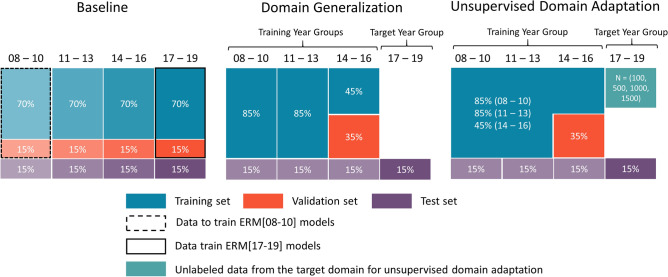
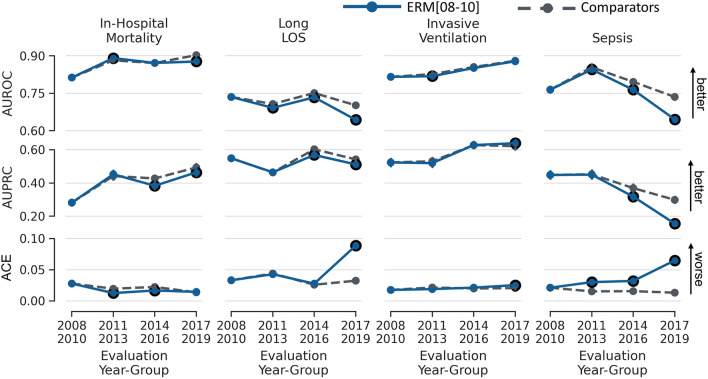
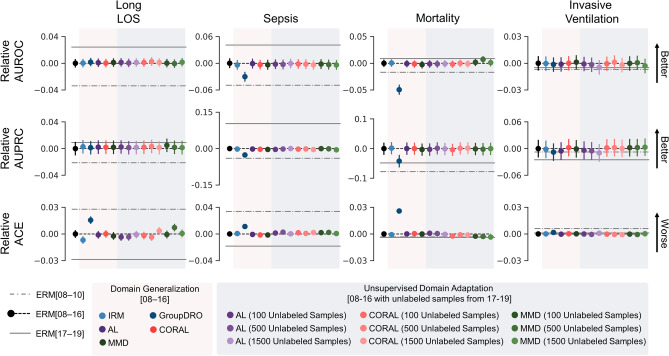
Temporal dataset shift associated with changes in healthcare over time is a barrier to deploying machine learning-based clinical decision support systems. Algorithms that learn robust models by estimating invariant properties across time periods for domain generalization (DG) and unsupervised domain adaptation (UDA) might be suitable to proactively mitigate dataset shift. The objective was to characterize the impact of temporal dataset shift on clinical prediction models and benchmark DG and UDA algorithms on improving model robustness. In this cohort study, intensive care unit patients from the MIMIC-IV database were categorized by year groups (2008–2010, 2011–2013, 2014–2016 and 2017–2019). Tasks were predicting mortality, long length of stay, sepsis and invasive ventilation. Feedforward neural networks were used as prediction models. The baseline experiment trained models using empirical risk minimization (ERM) on 2008–2010 (ERM[08–10]) and evaluated them on subsequent year groups. DG experiment trained models using algorithms that estimated invariant properties using 2008–2016 and evaluated them on 2017–2019. UDA experiment leveraged unlabelled samples from 2017 to 2019 for unsupervised distribution matching. DG and UDA models were compared to ERM[08–16] models trained using 2008–2016. Main performance measures were area-under-the-receiver-operating-characteristic curve (AUROC), area-under-the-precision-recall curve and absolute calibration error. Threshold-based metrics including false-positives and false-negatives were used to assess the clinical impact of temporal dataset shift and its mitigation strategies. In the baseline experiments, dataset shift was most evident for sepsis prediction (maximum AUROC drop, 0.090; 95% confidence interval (CI), 0.080–0.101). Considering a scenario of 100 consecutively admitted patients showed that ERM[08–10] applied to 2017–2019 was associated with one additional false-negative among 11 patients with sepsis, when compared to the model applied to 2008–2010. When compared with ERM[08–16], DG and UDA experiments failed to produce more robust models (range of AUROC difference, − 0.003 to 0.050). In conclusion, DG and UDA failed to produce more robust models compared to ERM in the setting of temporal dataset shift. Alternate approaches are required to preserve model performance over time in clinical medicine.
Overview
The claims and statistics of this paper haven’t been checked yet.
Run the check — free, no account needed. It reads the open-access text and checks the sources it cites.
Integrity signals
Registry
Cites
Statistics
Figures
Verification
Claims the paper makes
The claims and statistics of this paper haven’t been checked yet.
Run the check — free, no account needed. It reads the open-access text and checks the sources it cites.
Claims other papers make about this one
Each is checked against this paper’s own text: does it say what the citing paper says it does?
The cited source says what the claim attributes to it.
In the citing paper
“When it comes to the concrete behaviour change of the DL algorithm, most of the DL papers in the literature corpus investigate the robustness of a model, i.e. the stable behaviour of a model when facing erroneous or a limited amount of inputs. Only few records investigate generalisability119,144,145 or distribution shift139,192, a model’s capability of coping with new, unseen data.”
From The METRIC-framework for assessing data quality for trustworthy AI in medicine: A systematic review (2024) · cites this paper as [192]
Self-check
Percentages, sums and reported differences re-computed from the paper’s own numbers.
The self-check needs the paper’s full text.
Citations
Cites
PyTorch: An Imperative Style, High-Performance Deep Learning Library
Paszke, A., Gross, S., Massa, F., Lerer, A., Bradbury, J., Chanan, G., Killeen, T., Lin, Z., Gimelshein, N., Antiga, L., et al. (2019) · arXiv · doi:10.48550/arxiv.1912.01703 · Cited by 31,473
The third international consensus definitions for sepsis and septic shock (Sepsis-3).
Singer, M., Deutschman, C. S., Seymour, C. W., Shankar-Hari, M., Annane, D., Bauer, M., Bellomo, R., Bernard, G. R., Chiche, J.-D., Coopersmith, C. M., et al. (2016) · JAMA · doi:10.1001/jama.2016.0287 · Cited by 28,250 · cited 1×
“Sepsis corresponded to the development of sepsis according to the Sepsis-3 criteria 14 within 7 days from the prediction time.”
MethodGoldberger, A. L., Amaral, L. A. N., Glass, L., Hausdorff, J. M., Ivanov, P. C., Mark, R. G., Mietus, J. E., Moody, G. B., Peng, C.-K., & Stanley, H. E. (2000) · Circulation · doi:10.1161/01.cir.101.23.e215 · Cited by 14,809
Scikit-learn: Machine Learning in Python
(2011) · Journal of Machine Learning Research · doi:10.5555/1953048.2078195 · Cited by 8,539
Domain-Adversarial Training of Neural Networks
Ganin, Y., Ustinova, E., Ajakan, H., Germain, P., Larochelle, H., Laviolette, F., Marchand, M., & Lempitsky, V. (2017) · Advances in Computer Vision and Pattern Recognition · doi:10.1007/978-3-319-58347-1_10 · Cited by 8,318
Domain Adaptation via Transfer Component Analysis
Pan, S. J., Tsang, I. W.-H., Kwok, J. T.-Y., & Yang, Q. (2010) · IEEE Transactions on Neural Networks · doi:10.1109/tnn.2010.2091281 · Cited by 4,809 · cited 1×
“…the target environment 43 , data augmentation including the use of adversarial examples 44 , similarities between the source and target environments 45,46 , and semi-supervised learning that alternatively generate pseudo labels and incorporate them into re-training the model 47,48 have all…”
BackgroundDeep CORAL: Correlation Alignment for Deep Domain Adaptation
Sun, B., & Saenko, K. (2016) · Lecture Notes in Computer Science · doi:10.1007/978-3-319-49409-8_35 · Cited by 3,757
On the Opportunities and Risks of Foundation Models
Bommasani, R., Hudson, D. A., Adeli, E., Altman, R., Arora, S., von Arx, S., Bernstein, M. S., Bohg, J., Bosselut, A., Brunskill, E., et al. (2021) · arXiv · doi:10.48550/arxiv.2108.07258 · Cited by 2,676 · cited 1×
“For instance, models adapted from foundation models pre-trained on diverse datasets have displayed impressive performance gains in addition to robustness to various types of dataset shifts 42 .”
MethodScalable and accurate deep learning with electronic health records
Rajkomar, A., Oren, E., Chen, K., Dai, A. M., Hajaj, N., Hardt, M., Liu, P. J., Liu, X., Marcus, J., Sun, M., et al. (2018) · npj Digital Medicine · doi:10.1038/s41746-018-0029-1 · Cited by 2,648
Self-citationKhot, P. P., & Satav, S. (2015) · doi:10.21275/v4i11.nov151644 · Cited by 2,449
Implementing Machine Learning in Health Care — Addressing Ethical Challenges
Char, D. S., Shah, N. H., & Magnus, D. (2018) · New England Journal of Medicine · doi:10.1056/nejmp1714229 · Cited by 1,857 · cited 1×
“…these investigations should translate model degradation, typically measured as change in AUROC, into change in clinically relevant performance measures 29 or utility in allocation of resources 30 , and place its impact in the context of clinical decision making and downstream processes 31–34 .”
MethodSelf-citationUnsupervised Domain Adaptation for Semantic Segmentation via Class-Balanced Self-training
Zou, Y., Yu, Z., Vijaya Kumar, B. V. K., & Wang, J. (2018) · Lecture Notes in Computer Science · doi:10.1007/978-3-030-01219-9_18 · Cited by 1,464
Domain Generalization: A Survey
Zhou, K., Liu, Z., Qiao, Y., Xiang, T., & Loy, C. C. (2022) · IEEE Transactions on Pattern Analysis and Machine Intelligence · doi:10.1109/tpami.2022.3195549 · Cited by 1,315
Domain Generalization with Adversarial Feature Learning
Li, H., Pan, S. J., Wang, S., & Kot, A. C. (2018) · IEEE Computer Society Conference on Computer Vision and Pattern Recognition/Proceedings - IEEE Computer Society Conference on Computer Vision and Pattern Recognition/Proceedings · doi:10.1109/cvpr.2018.00566 · Cited by 1,291 · cited 5×
“LOS: length of stay; ERM: empirical risk minimization; IRM: invariant risk minimization; AL: adversarial learning; GroupDRO: group distributionally robust optimization; CORAL: correlation alignment; MMD: maximum mean discrepancy; AUROC: area under the receiver operating characteristics curve; AUPRC: area under the pre…”
BackgroundInfluentialSagawa, S., Koh, P. W., Hashimoto, T., & Liang, P. (2019) · arXiv (Cornell University) · doi:10.48550/arxiv.1911.08731 · Cited by 1,178
A unifying view on dataset shift in classification
Moreno-Torres, J. G., Raeder, T., Alaiz-Rodríguez, R., Chawla, N. V., & Herrera, F. (2012) · Pattern Recognition · doi:10.1016/j.patcog.2011.06.019 · Cited by 1,029
A survey of unsupervised deep domain adaptation
Wilson, G., & Cook, D. J. (2020) · ACM Transactions on Intelligent Systems and Technology · doi:10.1145/3400066 · Cited by 987
Arjovsky, M., Bottou, L., Gulrajani, I., & Lopez-Paz, D. (2019) · arXiv · doi:10.48550/arxiv.1907.02893 · Cited by 927 · cited 5×
“LOS: length of stay; ERM: empirical risk minimization; IRM: invariant risk minimization; AL: adversarial learning; GroupDRO: group distributionally robust optimization; CORAL: correlation alignment; MMD: maximum mean discrepancy; AUROC: area under the receiver operating characteristics curve; AUPRC: area under the pre…”
BackgroundInfluentialBassi, S. (2009) · Chapman & Hall/CRC mathematical and computational biology series · doi:10.1201/9781584889304.axd · Cited by 613
WILDS: A Benchmark of in-the-Wild Distribution Shifts
Koh, P. W., Sagawa, S., Marklund, H., Xie, S. M., Zhang, M., Balsubramani, A., Hu, W., Yasunaga, M., Phillips, R. L., Gao, I., et al. (2020) · arXiv · doi:10.48550/arxiv.2012.07421 · Cited by 518 · cited 1×
“Our findings align with recent empirical evaluations of DG algorithms demonstrating that they do not outperform ERM under distribution shift across data sources in real-world clinical datasets 35,36 as well as non-clinical datasets 37 .”
ResultIn Search of Lost Domain Generalization
Gulrajani, I., & Lopez-Paz, D. (2020) · arXiv · doi:10.48550/arxiv.2007.01434 · Cited by 440 · cited 1×
“Our findings align with recent empirical evaluations of DG algorithms demonstrating that they do not outperform ERM under distribution shift across data sources in real-world clinical datasets 35,36 as well as non-clinical datasets 37 .”
ResultAustin, P. C., & Steyerberg, E. W. (2019) · Statistics in Medicine · doi:10.1002/sim.8281 · Cited by 311
Making Machine Learning Models Clinically Useful
Shah, N. H., Milstein, A., & Bagley, P. (2019) · JAMA · doi:10.1001/jama.2019.10306 · Cited by 294
Self-citationThe Risks of Invariant Risk MinimizationPreprint
Rosenfeld, E., Ravikumar, P., & Risteski, A. (2020) · arXiv (Cornell University) · doi:10.48550/arxiv.2010.05761 · Cited by 214 · cited 1×
“The reasons underlying the failure of DG algorithms are topics of active research, with several recent works offering theory to explain why models derived with IRM and groupDRO are typically not more robust than ERM in practice 38,39 .”
BackgroundDeveloping a delivery science for artificial intelligence in healthcare
Li, R., Asch, S. M., & Shah, N. H. (2020) · npj Digital Medicine · doi:10.1038/s41746-020-00318-y · Cited by 206
Self-citationReps, J. M., Schuemie, M. J., Suchard, M. A., Ryan, P. B., & Rijnbeek, P. R. (2018) · Journal of the American Medical Informatics Association · doi:10.1093/jamia/ocy032 · Cited by 205
Domain Adaptation with Auxiliary Target Domain-Oriented Classifier
Liang, J., Hu, D., & Feng, J. (2021) · IEEE Computer Society Conference on Computer Vision and Pattern Recognition/Proceedings - IEEE Computer Society Conference on Computer Vision and Pattern Recognition/Proceedings · doi:10.1109/cvpr46437.2021.01636 · Cited by 192 · cited 1×
“…augmentation including the use of adversarial examples 44 , similarities between the source and target environments 45,46 , and semi-supervised learning that alternatively generate pseudo labels and incorporate them into re-training the model 47,48 have all demonstrated success in various domains.”
BackgroundManz, C. R., Parikh, R. B., Small, D. S., Evans, C. N., Chivers, C., Regli, S. H., Hanson, C. W., Bekelman, J. E., Rareshide, C. A. L., O’Connor, N. R., et al. (2020) · JAMA Oncology · doi:10.1001/jamaoncol.2020.4759 · Cited by 177
Bridging the implementation gap of machine learning in healthcare
Seneviratne, M. G., Shah, N. H., & Chu, L. (2020) · BMJ Innovations · doi:10.1136/bmjinnov-2019-000359 · Cited by 173 · cited 1×
“updated; (2) ERM[8–10] in 2017–2019, illustrating the actual performance of the earlier model on patients, or the impact of temporal dataset shift; (3) ERM[8–16] in 2017–2019, illustrating the ERM comparators for DG and UDA models; (4) models trained using a representative approach from DG or UDA; and (5) ERM[17–19] i…”
MethodSelf-citationAn empirical characterization of fair machine learning for clinical risk prediction
Pfohl, S. R., Foryciarz, A., & Shah, N. H. (2021) · Journal of Biomedical Informatics · doi:10.1016/j.jbi.2020.103621 · Cited by 164
Self-citationChe, Z., Cheng, Y., Zhai, S., Sun, Z., & Liu, Y. (2017) · 2017 IEEE International Conference on Data Mining (ICDM) · doi:10.1109/icdm.2017.93 · Cited by 162 · cited 1×
“…adaptation methods that leverage distinct latent domains in the target environment 43 , data augmentation including the use of adversarial examples 44 , similarities between the source and target environments 45,46 , and semi-supervised learning that alternatively generate pseudo labels and…”
MethodDetection of calibration drift in clinical prediction models to inform model updating
Davis, S. E., Greevy, R. A., Lasko, T. A., Walsh, C. G., & Matheny, M. E. (2020) · Journal of Biomedical Informatics · doi:10.1016/j.jbi.2020.103611 · Cited by 160
A nonparametric updating method to correct clinical prediction model drift
Davis, S. E., Greevy, R., Fonnesbeck, C., Lasko, T., Walsh, C. G., & Matheny, M. E. (2019) · J. Am. Medical Informatics Assoc. · doi:10.1093/jamia/ocz127 · Cited by 112
Guo, L. L., Pfohl, S. R., Fries, J., Posada, J., Fleming, S. L., Aftandilian, C., Shah, N., & Sung, L. (2021) · Applied Clinical Informatics · doi:10.1055/s-0041-1735184 · Cited by 96 · cited 1×
“The heterogeneity of impact by temporal dataset shift as characterized by our baseline experiment echoes the mixed results in model deterioration across several studies that made predictions of clinical outcomes in various populations 5 .”
ResultSelf-citationPreventing Failures Due to Dataset Shift: Learning Predictive Models That TransportPreprint
Subbaswamy, A., Schulam, P., & Saria, S. (2018) · arXiv (Cornell University) · doi:10.48550/arxiv.1812.04597 · Cited by 93
Domain Adaptation with Asymmetrically-Relaxed Distribution AlignmentPreprint
Wu, Y., Winston, E., Kaushik, D., & Lipton, Z. C. (2019) · arXiv (Cornell University) · doi:10.48550/arxiv.1903.01689 · Cited by 91 · cited 1×
“Furthermore, other work has demonstrated that UDA objectives based on distribution matching, such as AL, CORAL, and MMD, failed to improve generalization to the target domain under shifts in the outcome rate or in the association between the outcome and features 40,41 .”
ResultNestor, B., McDermott, M. B. A., Boag, W., Berner, G., Naumann, T., Hughes, M. C., Goldenberg, A., & Ghassemi, M. (2019) · arXiv (Cornell University) · doi:10.48550/arxiv.1908.00690 · Cited by 89
Ferrari, V., Hebert, M., Sminchisescu, C., & Weiss, Y. (2018) · Lecture Notes in Computer Science · doi:10.1007/978-3-030-01231-1 · Cited by 84
Creating Fair Models of Atherosclerotic Cardiovascular Disease Risk
Pfohl, S. R., Marafino, B. J., Coulet, A., Rodriguez, F., Palaniappan, L., & Shah, N. (2018) · AAAI/ACM Conference on AI, Ethics, and Society · doi:10.1145/3306618.3314278 · Cited by 79
Self-citationThe number needed to benefit: estimating the value of predictive analytics in healthcare
Liu, V. X., Bates, D. W., Wiens, J., & Shah, N. H. (2019) · Journal of the American Medical Informatics Association · doi:10.1093/jamia/ocz088 · Cited by 63
Self-citationGeometric Knowledge Embedding for unsupervised domain adaptation
Wu, H., Yan, Y., Ye, Y., Ng, M. K., & Wu, Q. (2019) · Knowledge-Based Systems · doi:10.1016/j.knosys.2019.105155 · Cited by 58
An empirical framework for domain generalization in clinical settings
Zhang, H., Dullerud, N., Seyyed-Kalantari, L., Morris, Q., Joshi, S. D., & Ghassemi, M. (2021) · ACM Conference on Health, Inference, and Learning (CHIL) · doi:10.1145/3450439.3451878 · Cited by 50
Barriers to Achieving Economies of Scale in Analysis of EHR Data: A Cautionary Tale
Sendak, M. P., Balu, S., & Schulman, K. A. (2017) · Applied Clinical Informatics · doi:10.4338/aci-2017-03-cr-0046 · Cited by 45
Estimate the hidden deployment cost of predictive models to improve patient care
Morse, K., Bagley, S. C., & Shah, N. H. (2020) · Nature Medicine · doi:10.1038/s41591-019-0651-8 · Cited by 37
Self-citationMethods for updating a risk prediction model for cardiac surgery: a statistical primer
Siregar, S., Nieboer, D., Versteegh, M. I. M., Steyerberg, E. W., & Takkenberg, J. J. M. (2018) · Interactive Cardiovascular and Thoracic Surgery · doi:10.1093/icvts/ivy338 · Cited by 35
An Online Learning Approach to Interpolation and Extrapolation in Domain GeneralizationPreprint
Rosenfeld, E., Ravikumar, P., & Risteski, A. (2021) · arXiv (Cornell University) · doi:10.48550/arxiv.2102.13128 · Cited by 18
Improving Hospital Readmission Prediction using Individualized Utility Analysis
Ko, M., Chen, E., Agrawal, A., Rajpurkar, P., Avati, A., Ng, A., Basu, S., & Shah, N. H. (2020) · medRxiv · doi:10.1101/2020.07.26.20156943 · Cited by 14 · cited 1×
“…these investigations should translate model degradation, typically measured as change in AUROC, into change in clinically relevant performance measures 29 or utility in allocation of resources 30 , and place its impact in the context of clinical decision making and downstream processes 31–34 .”
MethodSelf-citationDiscovering and incorporating latent target-domains for domain adaptation
Li, H., Li, W., & Wang, S. (2020) · Pattern Recognition · doi:10.1016/j.patcog.2020.107536 · Cited by 8 · cited 1×
“Domain adaptation methods that leverage distinct latent domains in the target environment 43 , data augmentation including the use of adversarial examples 44 , similarities between the source and target environments 45,46 , and semi-supervised learning that alternatively generate pseudo labels and…”
Chowdhury, A. S., & Bhandarkar, S. (2011) · doi:10.1007/978-0-85729-296-4_3 · Cited by 7
Research works printed but not linked: 3
- Varnik, V. Principles of risk minimization for learning theory. In Advances in Neural Information Processing Systems Vol. 4 (eds Moody, J. E. et al.) 831–838 (NeurIPS, 1991).
- Efron, B. & Tibshirani, R. An Introduction to the Bootstrap (Chapman & Hall, 1993). · DOI · Paper page
- Zhao, H., Combes, R. T. D., Zhang, K. & Gordon, G. On learning invariant representations for domain adaptation. In 36th International Conference on Machine Learning, ICML 2019 7523–7532 (PMLR, 2019).
Cited by
Sorted by citations
Algorithmic fairness in artificial intelligence for medicine and healthcare
Chen, R. J., Wang, J. J., Williamson, D. F. K., Chen, T. Y., Lipkova, J., Lu, M. Y., Sahai, S., & Mahmood, F. (2023) · Nature Biomedical Engineering · doi:10.1038/s41551-023-01056-8 · Cited by 750
“…dataset shift occurs when there is a mismatch between the distributions of the training and test datasets during algorithm development, (that is, P train ( X ) ≠ P test ( X ) and P train ( Y ) ≠ P test ( Y ) ), and may lead to disparate performance at the subgroup level 86,107,119,122,123 .”
BackgroundThe METRIC-framework for assessing data quality for trustworthy AI in medicine: A systematic review
Schwabe, D., Becker, K., Seyferth, M., Klaß, A., & Schaeffter, T. (2024) · npj Digital Medicine · doi:10.1038/s41746-024-01196-4 · Cited by 169
“3), which is based on our literature corpus 57, 74 – 192 .”
BackgroundWild-Time: A Benchmark of in-the-Wild Distribution Shift over Time
Yao, H., Choi, C., Cao, B.-C., Lee, Y., Koh, P. W., & Finn, C. (2022) · Neural Information Processing Systems · doi:10.48550/arxiv.2211.14238 · Cited by 150
“, 2021), and sepsis prediction (Guo et al., 2022) (see detailed comparison in Appendix A).”
BackgroundSujon, K. M., Hassan, R., Towshi, Z. T., Othman, M. A., Samad, M. A., & Choi, K. (2024) · IEEE Access · doi:10.1109/access.2024.3462434 · Cited by 143
“Various normalization methods with varying algorithms including NN were also tested in studies [17], [18], and [19] and improved forecasting accuracy was obtained in these studies.”
MethodEHR foundation models improve robustness in the presence of temporal distribution shift
Guo, L., Steinberg, E., Fleming, S. L., Posada, J., Lemmon, J., Pfohl, S. R., Shah, N. H., Fries, J., & Sung, L. (2023) · Scientific Reports · doi:10.1038/s41598-023-30820-8 · Cited by 65
Self-citation
Metadata
- Authors
- Guo, L. L., Pfohl, S. R., Fries, J., Johnson, A. E. W., Posada, J., Aftandilian, C., Shah, N., & Sung, L.
- Affiliations
- Hospital for Sick Children (CA)
- Stanford University (US)
- Corresponding author
- Sung, Lillian
- ORCID
- Venue
- Scientific Reports
- Published
- 2022-02-17
- Volume
- 12
- Issue
- 1
- Pages
- 2726-2726
- ISSN
- 2045-2322 (ISSN-L)
- PMC
- PMC8854561
- OpenAlex
- W4221077687
- Cited by
- 103
- References
- 57
- Citations by year
- 2026: 34 · 2025: 29 · 2024: 15 · 2023: 15 · 2022: 9
- FWCI
- 5.59
- Type
- journal article
- Language
- en
- Open access
- gold
- doi.org
- Locations
- Scientific Reports (publishedVersion, cc-by)
- medRxiv (acceptedVersion, cc-by)
- PubMed Central (publishedVersion, cc-by)
- PubMed (publishedVersion)
- DOAJ (DOAJ: Directory of Open Access Journals) (submittedVersion, cc-by-sa)
- Topics
- Physical Sciences › Computer Science › Artificial Intelligence › Machine Learning in Healthcare
- Physical Sciences › Computer Science › Artificial Intelligence › Domain Adaptation and Few-Shot Learning
- Health Sciences › Medicine › Critical Care and Intensive Care Medicine › Sepsis Diagnosis and Treatment
- Keywords
- domain generalization, unsupervised domain adaptation, model robustness, clinical prediction model, intensive care unit patients, MIMIC-IV, sepsis prediction, mortality prediction, length of stay prediction, empirical risk minimization, clinical decision support systems, model calibration, feedforward neural networks
- MeSH terms
- Aged, Aged, 80 and over, Female, Humans, Intensive Care Units, Length of Stay, Male, Middle Aged, Models, Biological, Databases, Factual, Neural Networks, Computer, Sepsis
About these checks
Registry, retraction, Cites and statistics results are computed, not judged, with one exception: a printed reference that no index lists is read once by a model before it counts as a citation error. Claims are extracted by a model and kept only when their quote appears verbatim in the text; each cited source is then checked, with a model’s help, for whether it says what the claim relies on. Those verdicts can be wrong — read the claim’s quote and the cited source before relying on one.
Statistics and arithmetic are recomputed, not judged.
Confidence bands are shown only for fields calibrated on our annotated test set. None is calibrated yet, so no band is shown.
What counts as a claim ›How we measure confidence ›How we check this ›
Are you an author, or do you see a problem with this page? Request a review
