

The DOI matches its Crossref record; 56 of the 56 references it cites were found in a registry or an index.
Federated learning for multi-center imaging diagnostics: a simulation study in cardiovascular disease
Open accessAbstract
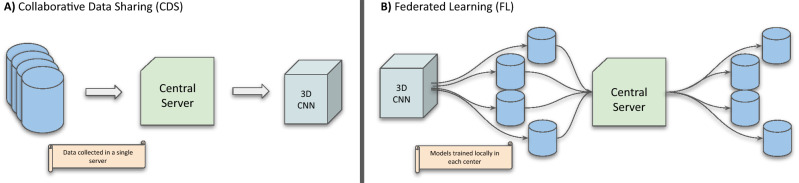
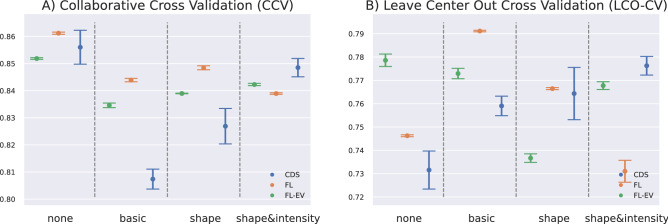
Deep learning models can enable accurate and efficient disease diagnosis, but have thus far been hampered by the data scarcity present in the medical world. Automated diagnosis studies have been constrained by underpowered single-center datasets, and although some results have shown promise, their generalizability to other institutions remains questionable as the data heterogeneity between institutions is not taken into account. By allowing models to be trained in a distributed manner that preserves patients’ privacy, federated learning promises to alleviate these issues, by enabling diligent multi-center studies. We present the first simulated federated learning study on the modality of cardiovascular magnetic resonance and use four centers derived from subsets of the M&M and ACDC datasets, focusing on the diagnosis of hypertrophic cardiomyopathy. We adapt a 3D-CNN network pretrained on action recognition and explore two different ways of incorporating shape prior information to the model, and four different data augmentation set-ups, systematically analyzing their impact on the different collaborative learning choices. We show that despite the small size of data (180 subjects derived from four centers), the privacy preserving federated learning achieves promising results that are competitive with traditional centralized learning. We further find that federatively trained models exhibit increased robustness and are more sensitive to domain shift effects.
Overview
The claims and statistics of this paper haven’t been checked yet.
Run the check — free, no account needed. It reads the open-access text and checks the sources it cites.
Integrity signals
Registry
Cites
Statistics
Figures


Verification
Claims the paper makes
The claims and statistics of this paper haven’t been checked yet.
Run the check — free, no account needed. It reads the open-access text and checks the sources it cites.
Claims other papers make about this one
Each is checked against this paper’s own text: does it say what the citing paper says it does?
In the citing paper
“Linardos et al. [26] considered FL for Diagnosing Hypertrophic Cardiomyopathy (HCM), whether the subjects are suffering from HMC or normal.”
From A systematic review on federated learning in medical image analysis (2023) · cites this paper as [26]
In the citing paper
“In addition, Li et al. [20] and Linardos et al. [26] both used MRI images for their models, brain and heart MRI data consequently.”
From A systematic review on federated learning in medical image analysis (2023) · cites this paper as [26]
In the citing paper
“Our results show only four papers (we did not find sufficient explanation from [26] and [21]) considered non-IID type along with IID data and the rest 13 did not talk about the content.”
From A systematic review on federated learning in medical image analysis (2023) · cites this paper as [26]
In the citing paper
“Residual Network (ResNet) is also a commonly used algorithm that can be constructed by different numbers of layers, e.g., ResNet18 ( [23], [26], [27], [29]), ResNet50 ( [18], [24]), ResNet101 ( [24]).”
From A systematic review on federated learning in medical image analysis (2023) · cites this paper as [26]
In the citing paper
“In [26], Linardos et al. considered AUC, the highest score achieved by the FL model was 89%.”
From A systematic review on federated learning in medical image analysis (2023) · cites this paper as [26]
In the citing paper
“Number of data samples is very”
From A systematic review on federated learning in medical image analysis (2023) · cites this paper as [26]
In the citing paper
“Deep learning based FL model for car-”
From A systematic review on federated learning in medical image analysis (2023) · cites this paper as [26]
In the citing paper
“provided source code online.”
From A systematic review on federated learning in medical image analysis (2023) · cites this paper as [26]
Self-check
Percentages, sums and reported differences re-computed from the paper’s own numbers.
The self-check needs the paper’s full text.
Citations
Cites
The Elements of Statistical Learning
Hastie, T., Tibshirani, R., & Friedman, J. (2009) · Springer Series in Statistics · doi:10.1007/978-0-387-84858-7 · Cited by 25,970
Boyd, S. (2010) · now publishers, Inc. eBooks · doi:10.1561/9781601984616 · Cited by 12,917
N4ITK: Improved N3 Bias Correction
Tustison, N. J., Avants, B., Cook, P. A., Zheng, Y., Egan, A., Yushkevich, P. A., & Gee, J. C. (2010) · IEEE Transactions on Medical Imaging · doi:10.1109/tmi.2010.2046908 · Cited by 6,413
The Kinetics Human Action Video DatasetPreprint
Kay, W., Carreira, J., Simonyan, K., Zhang, B., Hillier, C., Vijayanarasimhan, S., Viola, F., Green, T., Back, T., Natsev, P., et al. (2017) · arXiv (Cornell University) · doi:10.48550/arxiv.1705.06950 · Cited by 5,004
A Closer Look at Spatiotemporal Convolutions for Action Recognition
Tran, D., Wang, H., Torresani, L., Ray, J., LeCun, Y., & Paluri, M. (2018) · IEEE Computer Society Conference on Computer Vision and Pattern Recognition/Proceedings - IEEE Computer Society Conference on Computer Vision and Pattern Recognition/Proceedings · doi:10.1109/cvpr.2018.00675 · Cited by 3,672
Bernard, O., Lalande, A., Zotti, C., Cervenansky, F., Yang, X., Heng, P.-A., Cetin, I., Lekadir, K., Camara, O., Gonzalez Ballester, M. A., et al. (2018) · IEEE Transactions on Medical Imaging · doi:10.1109/tmi.2018.2837502 · Cited by 2,431
Self-citationCan Spatiotemporal 3D CNNs Retrace the History of 2D CNNs and ImageNet?
Hara, K., Kataoka, H., & Satoh, Y. (2018) · IEEE Computer Society Conference on Computer Vision and Pattern Recognition/Proceedings - IEEE Computer Society Conference on Computer Vision and Pattern Recognition/Proceedings · doi:10.1109/cvpr.2018.00685 · Cited by 2,346
Hypertrophic Cardiomyopathy: Genetics, Pathogenesis, Clinical Manifestations, Diagnosis, and Therapy
Marian, A. J., & Braunwald, E. (2017) · Circulation Research · doi:10.1161/circresaha.117.311059 · Cited by 1,403
Zhou, S. K., Greenspan, H. K., Davatzikos, C. A., Duncan, J. S., van Ginneken, B., Madabhushi, A., Prince, J. L., Rueckert, D., & Summers, R. M. (2021) · Proceedings of the IEEE · doi:10.1109/jproc.2021.3054390 · Cited by 1,373
European Society of Cardiology: Cardiovascular Disease Statistics 2017
Timmis, A., Petersen, S. E., Belle, E. V., Townsend, N. P., Conrad, N., Kapłon‐Cieślicka, A., Kazakiewicz, D., Kavousi, M., Cvijić, M., Ignatiuk, B., et al. (2017) · European Heart Journal · doi:10.1093/eurheartj/ehag345 · Cited by 1,001
New variants of a method of MRI scale standardization
Nyúl, L. G., Udupa, J. K., & Zhang, X. (2000) · IEEE Transactions on Medical Imaging · doi:10.1109/42.836373 · Cited by 958
Averaging Weights Leads to Wider Optima and Better GeneralizationPreprint
Izmailov, P., Podoprikhin, D. A., Garipov, T., Vetrov, D., & Wilson, A. G. (2018) · arXiv (Cornell University) · doi:10.48550/arxiv.1803.05407 · Cited by 818
Pérez‐García, F., Sparks, R. E., & Sebastien Ourselin, A. (2021) · Computer Methods and Programs in Biomedicine · doi:10.1016/j.cmpb.2021.106236 · Cited by 672
Privacy-Preserving Federated Brain Tumour Segmentation
Li, W., Milletarì, F., Xu, D., Rieke, N., Hancox, J., Zhu, W., Baust, M., Cheng, Y., Ourselin, S., Cardoso, M. J., et al. (2019) · Lecture Notes in Computer Science · doi:10.1007/978-3-030-32692-0_16 · Cited by 578
End-to-end privacy preserving deep learning on multi-institutional medical imaging
Kaissis, G., Ziller, A., Passerat-Palmbach, J., Ryffel, T., Usynin, D., Trask, A., Lima, I., Mancuso, J., Jungmann, F., Steinborn, M.-M., et al. (2021) · Nature Machine Intelligence · doi:10.1038/s42256-021-00337-8 · Cited by 513
Multi-Centre, Multi-Vendor and Multi-Disease Cardiac Segmentation: The M&Ms Challenge
Campello, V. M., Gkontra, P., Izquierdo, C., Martin-Isla, C., Sojoudi, A., Full, P. M., Maier-Hein, K., Zhang, Y., He, Z., Ma, J., et al. (2021) · IEEE Transactions on Medical Imaging · doi:10.1109/tmi.2021.3090082 · Cited by 481
Self-citationLi, X., Gu, Y., Dvornek, N., Staib, L. H., Ventola, P., & Duncan, J. S. (2020) · Medical Image Analysis · doi:10.1016/j.media.2020.101765 · Cited by 480
Causality matters in medical imaging
Castro, D. C., Walker, I., & Glocker, B. (2020) · Nature Communications · doi:10.1038/s41467-020-17478-w · Cited by 364
Collaborative Federated Learning for Healthcare: Multi-Modal COVID-19 Diagnosis at the Edge
Qayyum, A., Ahmad, K., Ahsan, M. A., Al-Fuqaha, A., & Qadir, J. (2022) · IEEE Open Journal of the Computer Society · doi:10.1109/ojcs.2022.3206407 · Cited by 345
Dynamic-Fusion-Based Federated Learning for COVID-19 Detection
Zhang, W., Zhou, T., Lu, Q., Wang, X., Zhu, C., Sun, H., Wang, Z., Lo, S. K., & Wang, F.-Y. (2021) · IEEE Internet of Things Journal · doi:10.1109/jiot.2021.3056185 · Cited by 329
Geske, J. B., Ommen, S. R., & Gersh, B. J. (2018) · JACC Heart Failure · doi:10.1016/j.jchf.2018.02.010 · Cited by 319
Isensee, F., Jaeger, P. F., Full, P. M., Ivo Wolf, A., Engelhardt, S., & Maier-Hein, K. H. (2018) · Lecture notes in computer science · doi:10.1007/978-3-319-75541-0_13 · Cited by 313
Machine learning in cardiovascular magnetic resonance: basic concepts and applications
Leiner, T., Rueckert, D., Suinesiaputra, A., Baeßler, B., Nezafat, R., Išgum, I., & Young, A. A. (2019) · Journal of Cardiovascular Magnetic Resonance · doi:10.1186/s12968-019-0575-y · Cited by 289
Causality matters in medical imaging
Castro, D. C., Walker, I. D., & Glocker, B. (2020) · RePEc: Research Papers in Economics · Cited by 288
Yang, D., Xu, Z., Li, W., Myronenko, A., Roth, H. R., Harmon, S., Xu, S., Turkbey, B., Turkbey, E., Wang, X., et al. (2021) · Medical Image Analysis · doi:10.1016/j.media.2021.101992 · Cited by 279
Loss Surfaces, Mode Connectivity, and Fast Ensembling of DNNs
Garipov, T., Izmailov, P., Podoprikhin, D., Vetrov, D., & Wilson, A. G. (2018) · arXiv · doi:10.48550/arxiv.1802.10026 · Cited by 252
Image-Based Cardiac Diagnosis With Machine Learning: A Review
Martín-Isla, C., Campello, V. M., Izquierdo, C., Raisi‐Estabragh, Z., Baeßler, B., Petersen, S. E., & Lekadir, K. (2020) · Frontiers in Cardiovascular Medicine · doi:10.3389/fcvm.2020.00001 · Cited by 250
Self-citationFederated learning improves site performance in multicenter deep learning without data sharing
Sarma, K. V., Harmon, S., Sanford, T., Roth, H. R., Xu, Z., Tetreault, J., Xu, D., Flores, M. G., Raman, A. G., Kulkarni, R., et al. (2021) · Journal of the American Medical Informatics Association · doi:10.1093/jamia/ocaa341 · Cited by 242 · cited 1×
“Privacy preserving federated learning systems for medical image analysis have been mainly explored in the context of segmentation for brain 5–8 , prostate 9 and COVID-19 affected regions 10–12 .”
BackgroundAn Exploration of 2D and 3D Deep Learning Techniques for Cardiac MR Image Segmentation
Baumgartner, C. F., Koch, L. M., Pollefeys, M., & Ender Konukoglu, A. (2018) · Lecture notes in computer science · doi:10.1007/978-3-319-75541-0_12 · Cited by 234
Deep Learning for Diagnosis of Chronic Myocardial Infarction on Nonenhanced Cardiac Cine MRI
Zhang, N., Yang, G., Gao, Z., Xu, C., Zhang, Y., Shi, R., Keegan, J., Xu, L., Zhang, H., Fan, Z., et al. (2019) · Radiology · doi:10.1148/radiol.2019182304 · Cited by 233
BrainTorrent: A Peer-to-Peer Environment for Decentralized Federated Learning
Roy, A. G., Siddiqui, S., Pölsterl, S., Navab, N., & Wachinger, C. (2019) · arXiv · doi:10.48550/arxiv.1905.06731 · Cited by 212
Federated Learning for Breast Density Classification: A Real-World Implementation
Roth, H. R., Chang, K., Singh, P., Neumark, N., Li, W., Gupta, V., Gupta, S., Qu, L., Ihsani, A., Bizzo, B. C., et al. (2020) · Lecture Notes in Computer Science · doi:10.1007/978-3-030-60548-3_18 · Cited by 202
Díaz, O., Kushibar, K., Osuala, R. O., Linardos, A., Garrucho, L., Igual, L., Radeva, P. I., Prior, F., Gkontra, P., & Lekadir, K. (2021) · Physica Medica · doi:10.1016/j.ejmp.2021.02.007 · Cited by 159
Self-citationAutomatic Segmentation and Disease Classification Using Cardiac Cine MR Images
Wolterink, J. M., Leiner, T., Viergever, M. A., & Išgum, I. (2018) · Lecture notes in computer science · doi:10.1007/978-3-319-75541-0_11 · Cited by 144
2D-3D Fully Convolutional Neural Networks for Cardiac MR Segmentation
Patravali, J., Jain, S., & Chilamkurthy, S. (2018) · Lecture notes in computer science · doi:10.1007/978-3-319-75541-0_14 · Cited by 130
Deist, T., Jochems, A., van Soest, J., Nalbantov, G., Oberije, C., Walsh, S., Eble, M., Bulens, P., Coucke, P., Dries, W., et al. (2017) · Clinical and Translational Radiation Oncology · doi:10.1016/j.ctro.2016.12.004 · Cited by 125
Self-citationKhened, M., Alex, V., & Krishnamurthi, G. (2018) · Lecture notes in computer science · doi:10.1007/978-3-319-75541-0_15 · Cited by 124
GridNet with Automatic Shape Prior Registration for Automatic MRI Cardiac Segmentation
Zotti, C., Luo, Z., Humbert, O., Lalande, A., & Jodoin, P. (2018) · Lecture notes in computer science · doi:10.1007/978-3-319-75541-0_8 · Cited by 116
Zerka, F., Urovi, V., Vaidyanathan, A., Barakat, S., Leijenaar, R. T. H., Walsh, S., Gabrani-Juma, H., Miraglio, B., Woodruff, H. C., Dumontier, M., et al. (2020) · IEEE Access · doi:10.1109/access.2020.3029445 · Cited by 89
Self-citationAutomatic Segmentation of LV and RV in Cardiac MRI
Jang, Y., Hong, Y., Ha, S., Kim, S., & Chang, H. (2018) · Lecture notes in computer science · doi:10.1007/978-3-319-75541-0_17 · Cited by 83
Multi-Centre, Multi-Vendor and Multi-Disease Cardiac Segmentation: The M&Ms Challenge
Campello, V. M., Gkontra, P., Izquierdo, C., Martín-Isla, C., Sojoudi, A., Full, P. M., Maier-Hein, K. H., Zhang, Y., He, Z., Ma, J., et al. (2021) · Zurich Open Repository and Archive (University of Zurich) · doi:10.5167/uzh-214495 · Cited by 81
Self-citationLambin, P., Zindler, J. D., Vanneste, B. G. L., Voorde, L. V. D., Jacobs, M., Eekers, D. B. P., Peerlings, J., Reymen, B. J. T., Larue, R. T. H. M., Deist, T. M., et al. (2015) · Acta Oncologica · doi:10.3109/0284186x.2015.1062136 · Cited by 78
Self-citationClass-Balanced Deep Neural Network for Automatic Ventricular Structure Segmentation
Yang, X., Bian, C., Yu, L., Ni, D., & Heng, P. (2018) · Lecture notes in computer science · doi:10.1007/978-3-319-75541-0_16 · Cited by 64
3D Deep Learning on Medical Images: A Review
SINGH, S. P., Wang, L., Gupta, S., Goli, H., Padmanabhan, P., & Gulyás, B. Z. (2020) · Sensors · doi:10.3390/s20185097 · Cited by 60
Blockchain-Federated-Learning and Deep Learning Models for COVID-19 Detection Using CT Imaging
Kumar, R., Khan, A. A., Kumar, J., Zakria, Golilarz, N. A., Zhang, S., Ting, Y., Zheng, C., & Wang, W. (2021) · IEEE Sensors Journal · doi:10.1109/jsen.2021.3076767 · Cited by 57
Harmonizing Diffusion MRI Data Across Multiple Sites and Scanners
Mirzaalian, H., de Pierrefeu, A., Savadjiev, P., Pasternak, O., Sylvain Bouix, A., Kubicki, M. R., Westin, C., Shenton, M. E., & Yogesh Rathi, A. (2015) · Lecture notes in computer science · doi:10.1007/978-3-319-24553-9_2 · Cited by 56
A Radiomics Approach to Computer-Aided Diagnosis with Cardiac Cine-MRI
Cetin, I., Sanroma, G., Petersen, S. E., Napel, S. A., Cámara, Ó., Ballester, M.-A. G., & Lekadir, K. (2018) · Lecture notes in computer science · doi:10.1007/978-3-319-75541-0_9 · Cited by 55
Self-citationAutomatic Multi-Atlas Segmentation of Myocardium with SVF-Net
Rohé, M.-M., Maxime Sermesant, B., & Pennec, X. (2018) · Lecture notes in computer science · doi:10.1007/978-3-319-75541-0_18 · Cited by 52
Kushibar, K., Valverde, S., González-Villà, S., Bernal, J., Cabezas, M., Oliver, A., & Lladó, X. (2019) · Scientific Reports · doi:10.1038/s41598-019-43299-z · Cited by 51
Self-citationNyholm, T., Jonsson, J. H., Söderström, K., Bergström, P., Carlberg, A., Frykholm, G. J., Behrens, C. F., Geertsen, P. F., Trepiakas, R., Hanvey, S., et al. (2013) · Radiation Oncology · doi:10.1186/1748-717x-8-126 · Cited by 46
Experiments of Federated Learning for COVID-19 Chest X-ray ImagesPreprint
Liu, B., Yan, B., Zhou, Y., Yang, Y., & Zhang, Y. (2020) · arXiv (Cornell University) · doi:10.48550/arxiv.2007.05592 · Cited by 45
A Novel Left Ventricular Volumes Prediction Method Based on Deep Learning Network in Cardiac MRI
Luo, G., Sun, G., Wang, K., Dong, S., & Zhang, H. (2016) · Computing in cardiology · doi:10.22489/cinc.2016.028-224 · Cited by 39
Residual Convolutional Neural Network for Cardiac Image Segmentation and Heart Disease Diagnosis
Liu, T., Tian, Y., Zhao, S., Huang, X., & Wang, Q. (2020) · IEEE Access · doi:10.1109/access.2020.2991424 · Cited by 36
Multi-Centre, Multi-Vendor & Multi-Disease Cardiac Image Segmentation Challenge
Campello, V. M., Rodríguez-Palomares, J. F., Guala, A., Marakas, M., Friedrich, M. G., & Lekadir, K. (2020) · Zenodo (CERN European Organization for Nuclear Research) · doi:10.5281/zenodo.3715889 · Cited by 14
Self-citationThe need for multicentre cardiovascular clinical trials in Asia
Kwong, J. S., & Yu, C. (2013) · Nature Reviews Cardiology · doi:10.1038/nrcardio.2013.49 · Cited by 5
Collaborative Federated Learning For Healthcare: Multi-Modal COVID-19 Diagnosis at the EdgePreprint
Qayyum, A., Ahmad, K., Ahsan, M. A., et al. (2021) · arXiv (Cornell University) · doi:10.48550/arxiv.2101.07511 · Cited by 3
Research works printed but not linked: 3
- McMahan, B., Moore, E., Ramage, D., Hampson, S. & y Arcas, B. A. Communication-efficient learning of deep networks from decentralized data. In Artificial Intelligence and Statistics, 1273–1282 (PMLR, 2017).
- Bakas, S. et al. Identifying the best machine learning algorithms for brain tumor segmentation, progression assessment, and overall survival prediction in the brats challenge. arXiv preprint arXiv:1811.02629 (2018). · arXiv
- Glorot, X. & Bengio, Y. Understanding the difficulty of training deep feedforward neural networks. In Proceedings of the thirteenth international conference on artificial intelligence and statistics (2010).
Cited by
Sorted by citations
Lekadir, K., Frangi, A. F., Porras, A. R., Glocker, B., Cintas, C., Langlotz, C. P., Weicken, E., Asselbergs, F. W., Prior, F., Collins, G. S., et al. (2025) · BMJ · doi:10.1136/bmj-2024-081554 · Cited by 957
Self-citationFederated learning for medical image analysis: A survey
Guan, H., Yap, P.-T., Bozoki, A., & Liu, M. (2024) · Pattern Recognition · doi:10.1016/j.patcog.2024.110424 · Cited by 518
Data augmentation for medical imaging: A systematic literature review
Garcea, F., Serra, A., Lamberti, F., & Morra, L. (2022) · Computers in Biology and Medicine · doi:10.1016/j.compbiomed.2022.106391 · Cited by 451
Federated learning enables big data for rare cancer boundary detection
Pati, S., Baid, U., Edwards, B., Sheller, M., Wang, S.-H., Reina, G. A., Foley, P., Gruzdev, A., Karkada, D., Davatzikos, C., et al. (2022) · Nature Communications · doi:10.1038/s41467-022-33407-5 · Cited by 394
Review on security of federated learning and its application in healthcare
Li, H., Li, C., Wang, J., Yang, A., Ma, Z., Zhang, Z., & Hua, D. (2023) · Future Generation Computer Systems · doi:10.1016/j.future.2023.02.021 · Cited by 202
Metadata
- Authors
- Linardos, A., Kushibar, K., Walsh, S., Gkontra, P., & Lekadir, K.
- Affiliations
- Universitat de Barcelona (ES)
- Corresponding author
- Linardos, Akis
- Venue
- Scientific Reports
- Published
- 2022-03-03
- Volume
- 12
- Issue
- 1
- Pages
- 3551-3551
- ISSN
- 2045-2322 (ISSN-L)
- PMC
- PMC8894335
- OpenAlex
- W4214841549
- Cited by
- 130
- References
- 53
- Citations by year
- 2026: 40 · 2025: 39 · 2024: 25 · 2023: 19 · 2022: 7
- FWCI
- 7.40
- Type
- journal article
- Language
- en
- Open access
- gold
- doi.org
- Locations
- Scientific Reports (publishedVersion, cc-by)
- PubMed Central (publishedVersion, cc-by)
- PubMed (publishedVersion)
- Dipòsit Digital de la Universitat de Barcelona (Universitat de Barcelona) (submittedVersion, cc-by)
- DOAJ (DOAJ: Directory of Open Access Journals) (submittedVersion, cc-by-sa)
- Funders
- European Union’s Horizon 2020 research and innovation programme (952103)
- Topics
- Physical Sciences › Computer Science › Artificial Intelligence › Privacy-Preserving Technologies in Data
- Health Sciences › Medicine › Health Informatics › Artificial Intelligence in Healthcare and Education
- Physical Sciences › Computer Science › Artificial Intelligence › Domain Adaptation and Few-Shot Learning
- Keywords
- federated learning, cardiovascular magnetic resonance, hypertrophic cardiomyopathy, data heterogeneity, privacy-preserving machine learning, 3D convolutional neural networks, data augmentation, domain shift, model generalization, ACDC dataset
- MeSH terms
- Cardiovascular Diseases, Computer Simulation, Confidentiality, Humans, Magnetic Resonance Imaging, Privacy
About these checks
Registry, retraction, Cites and statistics results are computed, not judged, with one exception: a printed reference that no index lists is read once by a model before it counts as a citation error. Claims are extracted by a model and kept only when their quote appears verbatim in the text; each cited source is then checked, with a model’s help, for whether it says what the claim relies on. Those verdicts can be wrong — read the claim’s quote and the cited source before relying on one.
Statistics and arithmetic are recomputed, not judged.
Confidence bands are shown only for fields calibrated on our annotated test set. None is calibrated yet, so no band is shown.
What counts as a claim ›How we measure confidence ›How we check this ›
Are you an author, or do you see a problem with this page? Request a review
