

Decoding episodic autobiographical memory in naturalistic virtual reality
Open accessThe DOI matches its Crossref record; 149 of the 149 references it cites were found in a registry or an index.
Abstract
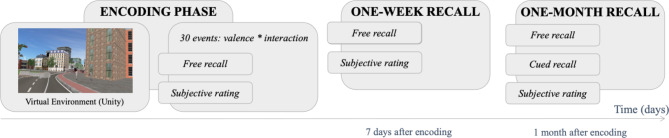
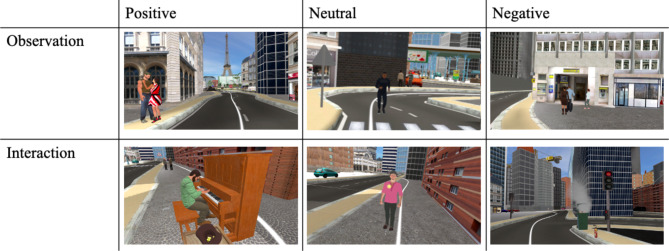
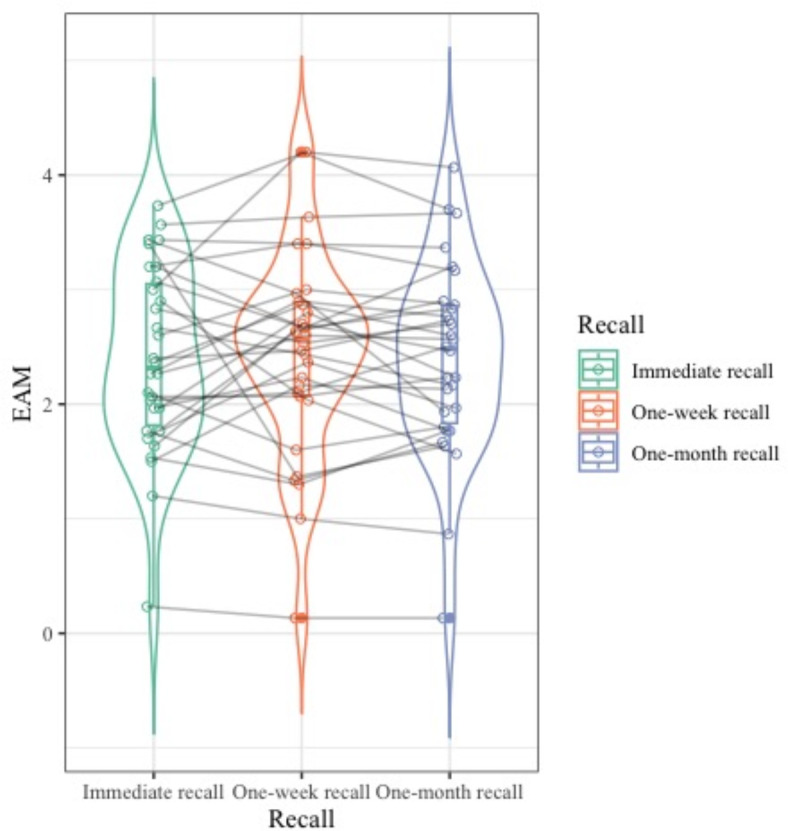
Episodic autobiographical memory (EAM) is a long-term memory system of personally experienced events with their context – what, where, when – and subjective elements, e.g., emotions, thoughts, or self-reference. EAM formation has rarely been studied in a controlled, real-life-like paradigm, and there is no predictive model of long-term retrieval from self-rated subjective experience at encoding. The present longitudinal study, with three surprise free recall memory tests immediately, one-week and one-month after encoding, investigated incidental encoding of EAM in an immersive virtual environment where 30 participants either interacted with or observed specific events of varying emotional valences with simultaneous physiological recordings. The predictive analyses highlight the temporal dynamics of the predictors of EAM from subjective ratings at encoding: common characteristics related to sense of remembering and infrequency of real-life encounter of the event were identified over time, but different variables become relevant at different time points, such as the emotion and mental imagery or prospective aspects. This dynamic and time-dependent role of memory predictors challenges traditional views of a uniform influence of encoding factors over time. Current evidence for the multiphasic nature of memory formation points to the role of different mechanisms at play during encoding but also consolidation and subsequent retrieval.
Overview
The claims and statistics of this paper haven’t been checked yet.
Free: it reads the open-access text and checks the first 5 claims that cite a source we can check. Create a free account to check every claim.
Integrity signals
Registry
Cites
Statistics
Figures


Verification
Claims the paper makes
The claims and statistics of this paper haven’t been checked yet.
Free: it reads the open-access text and checks the first 5 claims that cite a source we can check. Create a free account to check every claim.
Claims other papers make about this one
Each is checked against this paper’s own text: does it say what the citing paper says it does?
The cited source says what the claim attributes to it.
In the citing paper
“XR enables conditions that are simultaneously controlled and ecologically validthat is, realistic enough to resemble the settings in which memories actually formthrough embodied, first-person enactment in space and time (Lenormand et al., 2024;Penaud et al., 2023).”
From Mediating memory through immersive technologies and artificial intelligence: revisiting individual and collectively co-created pasts and futures (2026) · cites this paper as Lenormand et al., 2024
Self-check
Percentages, sums and reported differences re-computed from the paper’s own numbers.
The self-check needs the paper’s full text.
Citations
Cites
lmerTest Package: Tests in Linear Mixed Effects Models
Kuznetsova, A., Brockhoff, P. B., & Christensen, R. H. B. (2017) · Journal of Statistical Software · doi:10.18637/jss.v082.i13 · Cited by 24,346
Russell, J. A. (1980) · Journal of Personality and Social Psychology · doi:10.1037/h0077714 · Cited by 16,334
Simulator Sickness Questionnaire: An Enhanced Method for Quantifying Simulator Sickness
Kennedy, R. S., Lane, N. E., Berbaum, K. S., & Lilienthal, M. G. (1993) · The International Journal of Aviation Psychology · doi:10.1207/s15327108ijap0303_3 · Cited by 5,457
Tulving, E. (1985) · Canadian Psychology / Psychologie canadienne · doi:10.1037/h0080017 · Cited by 4,638
The construction of autobiographical memories in the self-memory system
Conway, M. A., & Pleydell-Pearce, C. W. (2000) · Psychological Review · doi:10.1037/0033-295x.107.2.261 · Cited by 4,089
State-Trait Anxiety Inventory for Adults
Spielberger, C. D. (2012) · PsycTESTS Dataset · doi:10.1037/t06496-000 · Cited by 3,479 · cited 1×
“Exclusion criteria were signs of depression (score > 15 on the Beck Depression Inventory 97 ), high travel sickness (score > 7 on the Simulator Sickness Questionnaire 98 ), and anxiety (score > 65 on the State-Trait Anxiety Inventory-Form Y 99 ).”
Looking at pictures: Affective, facial, visceral, and behavioral reactions
LANG, P. J., GREENWALD, M. K., BRADLEY, M. M., & HAMM, A. O. (1993) · Psychophysiology · doi:10.1111/j.1469-8986.1993.tb03352.x · Cited by 3,190 · cited 1×
“Furthermore, the EDA amplitude is enhanced for emotional pictures compared with neutral ones 75 and changes in the EDA famously correlate with the emotional intensity 76,77 .”
POSNER, J., RUSSELL, J. A., & PETERSON, B. S. (2005) · Development and Psychopathology · doi:10.1017/s0954579405050340 · Cited by 2,602
Emotion and motivation I: Defensive and appetitive reactions in picture processing.
Bradley, M. M., Codispoti, M., Cuthbert, B. N., & Lang, P. J. (2001) · Emotion · doi:10.1037/1528-3542.1.3.276 · Cited by 2,224 · cited 1×
“Furthermore, the EDA amplitude is enhanced for emotional pictures compared with neutral ones 75 and changes in the EDA famously correlate with the emotional intensity 76,77 .”
Conway, M. A. (2005) · Journal of Memory and Language · doi:10.1016/j.jml.2005.08.005 · Cited by 2,155
Memory consolidation, retrograde amnesia and the hippocampal complex
Nadel, L., & Moscovitch, M. (1997) · Current Opinion in Neurobiology · doi:10.1016/s0959-4388(97)80010-4 · Cited by 1,924
Self-reference and the encoding of personal information.
Rogers, T. B., Kuiper, N. A., & Kirker, W. S. (1977) · Journal of Personality and Social Psychology · doi:10.1037//0022-3514.35.9.677 · Cited by 1,868
From presence to consciousness through virtual reality.
Sanchez-Vives, M. V., & Slater, M. (2005) · Nature reviews. Neuroscience · doi:10.1038/nrn1651 · Cited by 1,831
Hippocampal sharp wave-ripple: A cognitive biomarker for episodic memory and planning
Buzsáki, G. (2015) · Hippocampus · doi:10.1002/hipo.22488 · Cited by 1,759
Brown, R., & Kulik, J. (1977) · Cognition · doi:10.1016/0010-0277(77)90018-x · Cited by 1,373
The self-reference effect in memory: A meta-analysis
Symons, C. S., & Johnson, B. T. (1997) · Psychological Bulletin · doi:10.1037/0033-2909.121.3.371 · Cited by 1,361 · cited 1×
“Similarly, the implication of the self in events, especially through the self-reference effect 78–80 , has a positive influence on memory: self-related stimuli tend to be better remembered than other-related ones (see for instance, for a recent study, Moses-Payne, et al. 9 ), and that effect is…”
missMDA: A Package for Handling Missing Values in Multivariate Data Analysis
Josse, J., & Husson, F. (2016) · Journal of Statistical Software · doi:10.18637/jss.v070.i01 · Cited by 1,344
Mechanisms of systems memory consolidation during sleep
Klinzing, J. G., Niethard, N., & Born, J. (2019) · Nature Neuroscience · doi:10.1038/s41593-019-0467-3 · Cited by 1,176 · cited 1×
“For instance, during consolidation, sleep has been found to improve spatial memory 121 , and EM 117 in young adults, notably through hippocampal replay 122 .”
Priming effects in word-fragment completion are independent of recognition memory.
Tulving, E., Schacter, D. L., & Stark, H. A. (1982) · Journal of Experimental Psychology Learning Memory and Cognition · doi:10.1037//0278-7393.8.4.336 · Cited by 1,062
Arousal-Biased Competition in Perception and Memory
Mather, M., & Sutherland, M. R. (2011) · Perspectives on Psychological Science · doi:10.1177/1745691611400234 · Cited by 926
Moscovitch, M., Rosenbaum, R. S., Gilboa, A., Addis, D. R., Westmacott, R., Grady, C., McAndrews, M. P., Levine, B., Black, S., Winocur, G., et al. (2005) · Journal of Anatomy · doi:10.1111/j.1469-7580.2005.00421.x · Cited by 893 · cited 3×
“Interestingly, the improvement in the spatial component at one week highlights its central role in consolidation 119,120 .”
Remembering the Details: Effects of Emotion
Kensinger, E. A. (2009) · Emotion Review · doi:10.1177/1754073908100432 · Cited by 876
How schema and novelty augment memory formation
van Kesteren, M. T. R., Ruiter, D. J., Fernández, G., & Henson, R. N. (2012) · Trends in Neurosciences · doi:10.1016/j.tins.2012.02.001 · Cited by 860 · cited 2×
“In this study, saliency of the events was thus an important factor during encoding to predict the memory status at both a week and a month, in line with a consistent body of literature (see for instance Rubin and Kozin 31 ; arousal-biased competition theory, Mather and Sutherland 133 ; and the SLIMM model for incongru…”
Parsons, T. D. (2015) · Frontiers in Human Neuroscience · doi:10.3389/fnhum.2015.00660 · Cited by 837
The human imagination: the cognitive neuroscience of visual mental imagery
Pearson, J. (2019) · Nature Reviews Neuroscience · doi:10.1038/s41583-019-0202-9 · Cited by 820 · cited 1×
“Mental images also played an important role, reflecting their general importance in cognition 137 and the importance of mental scene construction in autobiographical memory 138,139 , of the quality of the mental image of the event (remembering) at the heart of EAM.”
One hundred years of forgetting: A quantitative description of retention.
Rubin, D. C., & Wenzel, A. E. (1996) · Psychological Review · doi:10.1037//0033-295x.103.4.734 · Cited by 814
The identity function of autobiographical memory: Time is on our side
Wilson, A., & Ross, M. (2003) · Memory · doi:10.1080/741938210 · Cited by 651
The Restless Engram: Consolidations Never End
Dudai, Y. (2012) · Annual Review of Neuroscience · doi:10.1146/annurev-neuro-062111-150500 · Cited by 644 · cited 1×
“Interestingly, the improvement in the spatial component at one week highlights its central role in consolidation 119,120 .”
Sensory–perceptual episodic memory and its context: autobiographical memory
Conway, M. A. (2001) · Philosophical Transactions of the Royal Society of London. Series B: Biological Sciences · doi:10.1098/rstb.2001.0940 · Cited by 641
Naturalistic Stimuli in Neuroscience: Critically Acclaimed
Sonkusare, S., Breakspear, M., & Guo, C. (2019) · Trends in Cognitive Sciences · doi:10.1016/j.tics.2019.05.004 · Cited by 611
The whats and whens of sleep-dependent memory consolidation
Diekelmann, S., Wilhelm, I., & Born, J. (2009) · Sleep Medicine Reviews · doi:10.1016/j.smrv.2008.08.002 · Cited by 566
Memory Transformation and Systems Consolidation
Winocur, G., & Moscovitch, M. (2011) · Journal of the International Neuropsychological Society · doi:10.1017/s1355617711000683 · Cited by 557 · cited 1×
“This temporal emergence of various predictors and the absence of a significant decline in EAM scores over one month support both the multiple-trace theory of memory consolidation 119,146 and the trace-transformation theory 147–150 .”
Emotional Intensity Predicts Autobiographical Memory Experience
Talarico, J. M., LaBar, K. S., & Rubin, D. C. (2004) · Memory & Cognition · doi:10.3758/bf03196886 · Cited by 556
Emotion and autobiographical memory
Holland, A. C., & Kensinger, E. A. (2010) · Physics of Life Reviews · doi:10.1016/j.plrev.2010.01.006 · Cited by 540
Conway, M. A. (2009) · Neuropsychologia · doi:10.1016/j.neuropsychologia.2009.02.003 · Cited by 519 · cited 1×
“The involvement of the self and emotion in the encoding process are two well-established elements that determine the formation of a long-lasting trace in autobiographical memory 114,115 (see for instance the case of flashbulb or vivid memories: Conway, et al. 32 , Talarico and Rubin 116 ).”
Basic emotions are associated with distinct patterns of cardiorespiratory activity
Rainville, P., Bechara, A., Naqvi, N., & Damasio, A. R. (2006) · International Journal of Psychophysiology · doi:10.1016/j.ijpsycho.2005.10.024 · Cited by 502
A temporoparietal and prefrontal network for retrieving the spatial context of lifelike events
Burgess, N., Maguire, E. A., Spiers, H. J., & O'Keefe, J. (2001) · NeuroImage · doi:10.1006/nimg.2001.0806 · Cited by 502
Human replay spontaneously reorganizes experience
Liu, Y., Dolan, R. J., Kurth-Nelson, Z., & Behrens, T. E. J. (2019) · Cell · doi:10.1016/j.cell.2019.06.012 · Cited by 497
Autobiographical memory and sense of self.
Prebble, S. C., Addis, D. R., & Tippett, L. J. (2013) · Psychological Bulletin · doi:10.1037/a0030146 · Cited by 466 · cited 2×
“…in the precuneus and the medial prefrontal cortex co-vary respectively with the ‘I’ and ‘Me’ dimensions of the self 90 , i.e., the experiencing self as the moment-to-moment awareness of being, and the conceptual self which encompasses one’s identity, personal traits, and self-knowledge 5 .”
Marín-Morales, J., Higuera-Trujillo, J. L., Greco, A., Guixeres, J., Llinares, C., Scilingo, E. P., Alcañiz, M., & Valenza, G. (2018) · Scientific Reports · doi:10.1038/s41598-018-32063-4 · Cited by 411
Is virtual reality emotionally arousing? Investigating five emotion inducing virtual park scenarios
Felnhofer, A., Kothgassner, O. D., Schmidt, M., Heinzle, A.-K., Beutl, L., Hlavacs, H., & Kryspin-Exner, I. (2015) · International Journal of Human-Computer Studies · doi:10.1016/j.ijhcs.2015.05.004 · Cited by 383
How arousal modulates memory: disentangling the effects of attention and retention
Sharot, T., & Phelps, E. A. (2004) · Cognitive, Affective, & Behavioral Neuroscience · doi:10.3758/cabn.4.3.294 · Cited by 375 · cited 1×
“Such paradigms may involve other factors of interest, such as the emotional intensity or valence or a self-reference versus other-reference encoding (see for instance McKenzie and Humphreys 6 , Sharot and Phelps 7 , Pereira, et al. 8 , Moses-Payne, et al 9 .).”
The hippocampus and related neocortical structures in memory transformation
Sekeres, M. J., Winocur, G., & Moscovitch, M. (2018) · Neuroscience Letters · doi:10.1016/j.neulet.2018.05.006 · Cited by 370
Visual evoked potentials, heart rate responses and memory to emotional pictorial stimuli
Palomba, D., Angrilli, A., & Mini, A. (1997) · International Journal of Psychophysiology · doi:10.1016/s0167-8760(97)00751-4 · Cited by 369
Episodic and semantic remote autobiographical memory in ageing
Piolino, P., Desgranges, B., Benali, K., & Eustache, F. (2002) · Memory · doi:10.1080/09658210143000353 · Cited by 351
Self-citationRubin, D. C., & Kozin, M. (1984) · Cognition · doi:10.1016/0010-0277(84)90037-4 · Cited by 331
Experiences of Remembering, Knowing, and Guessing
Gardiner, J. M., Ramponi, C., & Richardson-Klavehn, A. (1998) · Consciousness and Cognition · doi:10.1006/ccog.1997.0321 · Cited by 330
Piolino, P., Desgranges, B., & Eustache, F. (2009) · Neuropsychologia · doi:10.1016/j.neuropsychologia.2009.01.020 · Cited by 328
Self-citationThe slow forgetting of emotional episodic memories: an emotional binding account
Yonelinas, A. P., & Ritchey, M. (2015) · Trends in Cognitive Sciences · doi:10.1016/j.tics.2015.02.009 · Cited by 325
The formation of flashbulb memories
Conway, M. A., Anderson, S. J., Larsen, S. F., Donnelly, C. M., McDaniel, M. A., McClelland, A. G. R., Rawles, R. E., & Logie, R. H. (1994) · Memory & Cognition · doi:10.3758/bf03200860 · Cited by 319 · cited 3×
“To complete this exploration, virtual but highly self-related events could be considered: for instance, memories with flashbulb-like characteristics 32,159,160 , that is, important, highly emotional, generally collective and often surprising events of which the context of encoding is subsequently…”
Autobiographical memory, autonoetic consciousness, and self-perspective in aging.
Piolino, P., Desgranges, B., Clarys, D., Guillery-Girard, B., Taconnat, L., Isingrini, M., & Eustache, F. (2006) · Psychology and Aging · doi:10.1037/0882-7974.21.3.510 · Cited by 300
Self-citationReal-Life Neuroscience: An Ecological Approach to Brain and Behavior Research
Shamay-Tsoory, S. G., & Mendelsohn, A. (2019) · Perspectives on Psychological Science · doi:10.1177/1745691619856350 · Cited by 290
On the retention function for autobiographical memory
Rubin, D. C. (1982) · Journal of Verbal Learning and Verbal Behavior · doi:10.1016/s0022-5371(82)90423-6 · Cited by 280 · cited 4×
“In this study, saliency of the events was thus an important factor during encoding to predict the memory status at both a week and a month, in line with a consistent body of literature (see for instance Rubin and Kozin 31 ; arousal-biased competition theory, Mather and Sutherland 133 ; and the SLIMM model for incongru…”
InfluentialLevine, B., Turner, G. R., Tisserand, D., Hevenor, S. J., Graham, S. J., & McIntosh, A. R. (2004) · Journal of Cognitive Neuroscience · doi:10.1162/0898929042568587 · Cited by 270
Robin, J., & Moscovitch, M. (2017) · Current Opinion in Behavioral Sciences · doi:10.1016/j.cobeha.2017.07.016 · Cited by 266
Virtual Reality: Concepts and Technologies
(2011) · CRC Press eBooks · doi:10.1201/b11612 · Cited by 265
Sharot, T., & Yonelinas, A. P. (2008) · Cognition · doi:10.1016/j.cognition.2007.03.002 · Cited by 242
Accuracies and inaccuracies in autobiographical memories
Barclay, C. R., & Wellman, H. M. (1986) · Journal of Memory and Language · doi:10.1016/0749-596x(86)90023-9 · Cited by 220
Kourtesis, P., Collina, S., Doumas, L. A. A., & MacPherson, S. E. (2019) · Frontiers in Human Neuroscience · doi:10.3389/fnhum.2019.00417 · Cited by 215
Remote Memory and the Hippocampus: A Constructive Critique
Barry, D. N., & Maguire, E. A. (2019) · Trends in Cognitive Sciences · doi:10.1016/j.tics.2018.11.005 · Cited by 208
Neural responses to heartbeats in the default network encode the self in spontaneous thoughts
Babo-Rebelo, M., Richter, C. G., & Tallon-Baudry, C. (2016) · The Journal of Neuroscience · doi:10.1523/jneurosci.0262-16.2016 · Cited by 207
Viard, A., Piolino, P., Desgranges, B., Chetelat, G., Lebreton, K., Landeau, B., Young, A., De La Sayette, V., & Eustache, F. (2007) · Cerebral Cortex · doi:10.1093/cercor/bhl153 · Cited by 194
Self-citationOwning an Overweight or Underweight Body: Distinguishing the Physical, Experienced and Virtual Body
Piryankova, I. V., Wong, H. Y., Linkenauger, S. A., Stinson, C., Longo, M. R., Bülthoff, H. H., & Mohler, B. J. (2014) · PLoS ONE · doi:10.1371/journal.pone.0103428 · Cited by 184
Klein, S. B., Loftus, J., & Burton, H. A. (1989) · Journal of Personality and Social Psychology · doi:10.1037//0022-3514.56.6.853 · Cited by 177
Virtual reality in episodic memory research: A review
Smith, S. A. (2019) · Psychonomic Bulletin & Review · doi:10.3758/s13423-019-01605-w · Cited by 176
Re-experiencing old memories via hippocampus: a PET study of autobiographical memory
Piolino, P., Giffard-Quillon, G., Desgranges, B., Chételat, G., Baron, J., & Eustache, F. (2004) · NeuroImage · doi:10.1016/j.neuroimage.2004.02.025 · Cited by 169
Self-citationAge effect on components of episodic memory and feature binding: A virtual reality study.
Plancher, G., Gyselinck, V., Nicolas, S., & Piolino, P. (2010) · Neuropsychology · doi:10.1037/a0018680 · Cited by 160
Self-citationStudies of the long-term recency effect: Support for a contextually guided retrieval hypothesis.
Glenberg, A. M., Bradley, M. M., Kraus, T. A., & Renzaglia, G. J. (1983) · Journal of Experimental Psychology Learning Memory and Cognition · doi:10.1037/0278-7393.9.2.231 · Cited by 152
The Self-Memory System Revisited: Past, Present, and Future
Conway, M. A., Justice, L. V., & D’Argembeau, A. (2019) · doi:10.1093/oso/9780198784845.003.0003 · Cited by 146
Virtual reality: A new method to investigate cognitive load during navigation
Armougum, A., Orriols, E., Gaston-Bellegarde, A., Marle, C. J.-L., & Piolino, P. (2019) · Journal of Environmental Psychology · doi:10.1016/j.jenvp.2019.101338 · Cited by 144
Self-citationThe Truth Is Out There: Accuracy in Recall of Verifiable Real-World Events
Diamond, N. B., Armson, M. J., & Levine, B. (2020) · Psychological Science · doi:10.1177/0956797620954812 · Cited by 143
Marín‐Morales, J., Higuera-Trujillo, J. L., Greco, A., Guixeres, J., Llinares, C., Gentili, C., Scilingo, E. P., Alcañíz, M., & Valenza, G. (2019) · PLoS ONE · doi:10.1371/journal.pone.0223881 · Cited by 139
Martinelli, P., Anssens, A., Sperduti, M., & Piolino, P. (2013) · Neuropsychology · doi:10.1037/a0030453 · Cited by 135
Self-citationA retrieved context model of the emotional modulation of memory.
Talmi, D., Lohnas, L. J., & Daw, N. D. (2019) · Psychological Review · doi:10.1037/rev0000132 · Cited by 129
Self as Object: Emerging Trends in Self Research
Sui, J., & Gu, X. (2017) · Trends in Neurosciences · doi:10.1016/j.tins.2017.09.002 · Cited by 128
“Being there” and remembering it: Presence improves memory encoding
Makowski, D., Sperduti, M., Nicolas, S., & Piolino, P. (2017) · Consciousness and Cognition · doi:10.1016/j.concog.2017.06.015 · Cited by 120
Self-citationSt. Jacques, P. L., & Schacter, D. L. (2013) · Psychological Science · doi:10.1177/0956797612457377 · Cited by 119
Hebscher, M., Levine, B., & Gilboa, A. (2018) · Neuropsychologia · doi:10.1016/j.neuropsychologia.2017.03.029 · Cited by 112
The Neural Dynamics of Novel Scene Imagery
Barry, D. N., Barnes, G. R., Clark, I. A., & Maguire, E. A. (2019) · Journal of Neuroscience · doi:10.1523/jneurosci.2497-18.2019 · Cited by 111
Effects of emotion on associative recognition: Valence and retention interval matter.
Pierce, B. H., & Kensinger, E. A. (2011) · Emotion · doi:10.1037/a0021287 · Cited by 110
The influence of action on episodic memory: A virtual reality study
Plancher, G., Barra, J., Orriols, E., & Piolino, P. (2013) · Quarterly Journal of Experimental Psychology · doi:10.1080/17470218.2012.722657 · Cited by 108
Self-citationEffects of aging on slow-wave sleep dynamics and human spatial navigational memory consolidation
Varga, A. W., Ducca, E. L., Kishi, A., Fischer, E., Parekh, A., Koushyk, V., Yau, P. L., Gumb, T., Leibert, D. P., Wohlleber, M. E., et al. (2016) · Neurobiology of Aging · doi:10.1016/j.neurobiolaging.2016.03.008 · Cited by 108
Hirst, W., & Phelps, E. A. (2016) · Current Directions in Psychological Science · doi:10.1177/0963721415622487 · Cited by 105
The Use of Virtual Reality for Episodic Memory Assessment: Effects of Active Navigation
Sauzéon, H., Arvind Pala, P., Larrue, F., Wallet, G., Déjos, M., Zheng, X., Guitton, P., & N’Kaoua, B. (2012) · Experimental Psychology · doi:10.1027/1618-3169/a000131 · Cited by 98
Straube, B. (2012) · Behavioral and Brain Functions · doi:10.1186/1744-9081-8-35 · Cited by 96
Effects of Enactment in Episodic Memory: A Pilot Virtual Reality Study with Young and Elderly Adults
Jebara, N., Orriols, E., Zaoui, M., Berthoz, A., & Piolino, P. (2014) · Frontiers in Aging Neuroscience · doi:10.3389/fnagi.2014.00338 · Cited by 94
Self-citationKalenzaga, S., Bugaïska, A., & Clarys, D. (2012) · Alzheimer Disease & Associated Disorders · doi:10.1097/wad.0b013e318257dc31 · Cited by 92
Rest boosts the long-term retention of spatial associative and temporal order information
Craig, M., Dewar, M., Sala, S. D., & Wolbers, T. (2015) · Hippocampus · doi:10.1002/hipo.22424 · Cited by 91
Immersion, presence, and episodic memory in virtual reality environments
Smith, S. A., & Mulligan, N. W. (2021) · Memory · doi:10.1080/09658211.2021.1953535 · Cited by 90
Themes, events, and episodes in autobiographical memory
Burt, C. D. B., Kemp, S. P. T., & Conway, M. A. (2003) · Memory & Cognition · doi:10.3758/bf03194390 · Cited by 86
Svoboda, E., & Levine, B. (2009) · The Journal of Neuroscience · doi:10.1523/jneurosci.3452-08.2009 · Cited by 83
Virtual Enactment Effect on Memory in Young and Aged Populations: A Systematic Review
Tuena, C., Serino, S., Dutriaux, L., Riva, G., & Piolino, P. (2019) · Journal of Clinical Medicine · doi:10.3390/jcm8050620 · Cited by 78
Self-citationNew Trends in Episodic Memory Assessment: Immersive 360° Ecological Videos
Serino, S., & Repetto, C. (2018) · Frontiers in Psychology · doi:10.3389/fpsyg.2018.01878 · Cited by 73
Keil, A., Smith, J. C., Wangelin, B. C., Sabatinelli, D., Bradley, M. M., & Lang, P. J. (2008) · Psychophysiology · doi:10.1111/j.1469-8986.2008.00667.x · Cited by 72
Scenes enable a sense of reliving: Implications for autobiographical memory
Rubin, D. C., Deffler, S. A., & Umanath, S. (2019) · Cognition · doi:10.1016/j.cognition.2018.10.024 · Cited by 70
Zlomuzica, A., Preusser, F., Totzeck, C., Dere, E., & Margraf, J. (2015) · Behavioural Brain Research · doi:10.1016/j.bbr.2015.09.037 · Cited by 66
Kisker, J., Gruber, T., & Schöne, B. (2021) · Psychological Research · doi:10.1007/s00426-020-01417-x · Cited by 65
The double-edged sword of memory retrieval
Roediger, H. L., III, & Abel, M. (2022) · Nature Reviews Psychology · doi:10.1038/s44159-022-00115-2 · Cited by 64
Stability in autobiographical memories
Rubin, D., Schrauf, R., & Greenberg, D. (2004) · Memory · doi:10.1080/09658210344000512 · Cited by 62
La Corte, V., Sperduti, M., Abichou, K., & Piolino, P. (2019) · Frontiers in Psychology · doi:10.3389/fpsyg.2019.00173 · Cited by 61
Self-citationAbercrombie, H. C., Chambers, A. S., Greischar, L., & Monticelli, R. M. (2008) · Neurobiology of Learning and Memory · doi:10.1016/j.nlm.2008.08.001 · Cited by 60
Lalanne, J., Rozenberg, J., Grolleau, P., & Piolino, P. (2013) · Current Alzheimer Research · doi:10.2174/15672050113106660175 · Cited by 58
Self-citationA New Perspective on Visual Perspective in Memory
St. Jacques, P. L. (2019) · Current Directions in Psychological Science · doi:10.1177/0963721419850158 · Cited by 57
Emotional cue effects on accessing and elaborating upon autobiographical memories
Sheldon, S., Williams, K., Harrington, S., & Otto, A. R. (2020) · Cognition · doi:10.1016/j.cognition.2020.104217 · Cited by 56
Bodily Reactions to Emotional Words Referring to Own versus Other People’s Emotions
Weis, P. P., & Herbert, C. (2017) · Frontiers in Psychology · doi:10.3389/fpsyg.2017.01277 · Cited by 51
Shared Mechanisms May Support Mnemonic Benefits from Self-Referencing and Emotion
Gutchess, A. H., & Kensinger, E. A. (2018) · Trends in Cognitive Sciences · doi:10.1016/j.tics.2018.05.001 · Cited by 51
Finley, J. R., Brewer, W. F., & Benjamin, A. S. (2011) · Memory · doi:10.1080/09658211.2010.532807 · Cited by 50
St. Jacques, P. L., Montgomery, D., & Schacter, D. L. (2015) · Memory · doi:10.1080/09658211.2014.933241 · Cited by 49
Rubin, D. C., Berntsen, D., Deffler, S. A., & Brodar, K. E. (2018) · Memory & Cognition · doi:10.3758/s13421-018-0850-4 · Cited by 43
Readiness to remember: predicting variability in episodic memory
Madore, K. P., & Wagner, A. D. (2022) · Trends in Cognitive Sciences · doi:10.1016/j.tics.2022.05.006 · Cited by 42
Moses-Payne, M. E., Chierchia, G., & Blakemore, S. (2021) · Cognitive Development · doi:10.1016/j.cogdev.2021.101128 · Cited by 40
Long-term modulation of cardiac activity induced by inhibitory control over emotional memories
Legrand, N., Etard, O., Vandevelde, A., Pierre, M., Viader, F., Clochon, P., Doidy, F., Peschanski, D., Eustache, F., & Gagnepain, P. (2020) · Scientific Reports · doi:10.1038/s41598-020-71858-2 · Cited by 39
Phenomenological characteristics of emotional memories in younger and older adults
Mickley, K. R., & Kensinger, E. A. (2009) · Memory · doi:10.1080/09658210902939363 · Cited by 38
Mair, A., Poirier, M., & Conway, M. A. (2017) · Consciousness and Cognition · doi:10.1016/j.concog.2017.02.008 · Cited by 38 · cited 1×
“…an age-related deficit 18 , both young and older adults benefit from the presentation of sequential cues from the events during recognition 16,17 As for reactivation-and rehearsal-induced plasticity, a coherent reactivation with one’s experience improves subsequent recognition 11 , with a…”
van Helvoort, D. H. J., Stobbe, E., Benning, R., Otgaar, H., & van de Ven, V. G. (2020) · Memory & Cognition · doi:10.3758/s13421-020-01024-6 · Cited by 37
Whose emotion is it? Perspective matters to understand brain-body interactions in emotions
Engelen, T., Buot, A., Grèzes, J., & Tallon‐Baudry, C. (2023) · NeuroImage · doi:10.1016/j.neuroimage.2023.119867 · Cited by 36
Quo vadis ‘episodic memory’? – Past, present, and perspective
Staniloiu, A., Kordon, A., & Markowitsch, H. J. (2020) · Neuropsychologia · doi:10.1016/j.neuropsychologia.2020.107362 · Cited by 35
Bainbridge, W. A., & Baker, C. I. (2022) · Nature Communications · doi:10.1038/s41467-022-34075-1 · Cited by 35
Depression and memory in major depressive disorder
(1991) · The Journal of Neuropsychiatry and Clinical Neurosciences · doi:10.1176/jnp.3.1.78 · Cited by 34
Picard, L., Abram, M., Orriols, É., & Piolino, P. (2016) · International Journal of Behavioral Development · doi:10.1177/0165025415616198 · Cited by 34
Self-citationAbichou, K., Corte, V. L., Hubert, N., Orriols, É., Gaston‐Bellegarde, A., Nicolas, S., & Piolino, P. (2019) · Frontiers in Aging Neuroscience · doi:10.3389/fnagi.2019.00058 · Cited by 33
Self-citationLenormand, D., & Piolino, P. (2021) · Neuroscience & Biobehavioral Reviews · doi:10.1016/j.neubiorev.2021.12.022 · Cited by 32
Self-citationMemory for staged events: Supporting older and younger adults’ memory with SenseCam
Mair, A., Poirier, M., & Conway, M. A. (2018) · Quarterly Journal of Experimental Psychology · doi:10.1177/1747021818765038 · Cited by 30
Penaud, S., Yeh, D., Gaston-Bellegarde, A., & Piolino, P. (2023) · Scientific Reports · doi:10.1038/s41598-023-43823-2 · Cited by 29
Self-citationOrdinary memory processes shape Flashbulb memories of extraordinary events
Talarico, J. M., & Rubin, D. C. (2017) · Psychology Press eBooks · doi:10.4324/9781315623481-5 · Cited by 28
Penaud, S., Jebara, N., Zaoui, M., Orriols, E., Berthoz, A., & Piolino, P. (2022) · Journal of Environmental Psychology · doi:10.1016/j.jenvp.2022.101801 · Cited by 25
Self-citationThe benefits of mind wandering on a naturalistic prospective memory task
Girardeau, J.-C., Ledru, R., Gaston‐Bellegarde, A., Blondé, P., Sperduti, M., & Piolino, P. (2023) · Scientific Reports · doi:10.1038/s41598-023-37996-z · Cited by 23
Self-citationHow virtual embodiment affects episodic memory functioning: A proof-of-concept study
Tuena, C., Serino, S., Gaston‐Bellegarde, A., Orriols, É., Makowski, D., Riva, G., & Piolino, P. (2017) · BOA (University of Milano-Bicocca) · Cited by 22
Self-citationEmotional metacognition: stimulus valence modulates cardiac arousal and metamemory
Legrand, N., Engen, S. S., Correa, C. M. C., Mathiasen, N. K., Nikolova, N., Fardo, F., & Allen, M. (2021) · Cognition and Emotion · doi:10.1080/02699931.2020.1859993 · Cited by 19
Personal Memories and Bodily-Cues Influence Our Sense of Self
Bréchet, L. (2022) · Frontiers in Psychology · doi:10.3389/fpsyg.2022.855450 · Cited by 19
La cognition au cœur de la dépression
Polosan, M., Lemogne, C., Jardri, R., & Fossati, P. (2016) · L Encéphale · doi:10.1016/s0013-7006(16)30014-8 · Cited by 18
Pereira, D. R., Sampaio, A., & Pinheiro, A. P. (2019) · Frontiers in Psychology · doi:10.3389/fpsyg.2019.01326 · Cited by 18
Age-related decline in item but not spatiotemporal associative memory for a real-world event.
Diamond, N. B., Romero, K., Jeyakumar, N., & Levine, B. (2018) · Psychology and Aging · doi:10.1037/pag0000303 · Cited by 17
The nature of recollection across months and years and after medial temporal lobe damage
Heyworth, N. C., & Squire, L. R. (2019) · Proceedings of the National Academy of Sciences · doi:10.1073/pnas.1820765116 · Cited by 16
Recency effects in direct and indirect memory tasks
McKenzie, W. A., & Humphreys, M. S. (1991) · Memory & Cognition · doi:10.3758/bf03197135 · Cited by 15
Bobon, D. P., Lapierre, Y. D., & Lottin, T. (1981) · Progress in Neuro-Psychopharmacology · doi:10.1016/0364-7722(81)90038-2 · Cited by 15
Comparisons among several methods for handling missing data in principal component analysis (PCA)
Loisel, S., & Takane, Y. (2018) · Advances in Data Analysis and Classification · doi:10.1007/s11634-018-0310-9 · Cited by 15
Representational dynamics of memories for real-life events
Jeunehomme, O., Heinen, R. M., Stawarczyk, D., Axmacher, N., & D’Argembeau, A. (2022) · iScience · doi:10.1016/j.isci.2022.105391 · Cited by 15
Rey, L., Desoche, C., Saive, A.-L., Thévenet, M., Garcia, S., Tillmann, B., & Plailly, J. (2023) · Memory · doi:10.1080/09658211.2023.2208793 · Cited by 15
Memory for spatio-temporal contextual details during the retrieval of naturalistic episodes
Foudil, S.-A., Plèche, C., & Macaluso, E. (2021) · Scientific Reports · doi:10.1038/s41598-021-93960-9 · Cited by 14
Malta, L. S., Giosan, C., Szkodny, L. E., Altemus, M. M., Rizzo, A., Silbersweig, D., & Difede, J. (2020) · Memory · doi:10.1080/09658211.2020.1770289 · Cited by 12
Making memorable choices: Cognitive control and the self-choice effect in memory
Baldwin, C. L., Garrison, K., Baumeister, R. F., & Schmeichel, B. J. (2021) · Self and Identity · doi:10.1080/15298868.2021.1888787 · Cited by 12
Lenormand, D., Fauvel, B., & Piolino, P. (2024) · Frontiers in Psychology · doi:10.3389/fpsyg.2024.1355343 · Cited by 12
Self-citationA statistical approach for segregating cognitive task stages from multivariate fMRI BOLD time series
Demanuele, C., Bähner, F., Plichta, M. M., Kirsch, P., Tost, H., Meyer‐Lindenberg, A., & Durstewitz, D. (2015) · Frontiers in Human Neuroscience · doi:10.3389/fnhum.2015.00537 · Cited by 10
Bögge, L., COLÁS-BLANCO, I., Ferragu, J., Gaston‐Bellegarde, A., Corte, V. L., & Piolino, P. (2024) · Psychophysiology · doi:10.1111/psyp.14588 · Cited by 9
Self-citationParker, A., & Dagnall, N. (2018) · Memory · doi:10.1080/09658211.2018.1495236 · Cited by 6
A behavioural and ERP investigation of the wearable camera photo review in autobiographical memory
Khachatoorian, N., Loveday, C., Dima, D., Mair, A., Illingworth, S., Conway, M. A., & Haenschel, C. (2021) · Memory · doi:10.1080/09658211.2021.1880601 · Cited by 6
The effects of age on objective and subjective recollection after visiting a virtual apartment
Billet, M., D’Argembeau, A., Meulemans, T., & Willems, S. J. (2023) · Aging Neuropsychology and Cognition · doi:10.1080/13825585.2023.2168607 · Cited by 6
Neuropsychologie clinique et technologies
Piolino, P. (2022) · De Boeck Supérieur eBooks · doi:10.3917/dbu.aubin.2022.01.0243 · Cited by 3
Self-citation
Research works printed but not linked: 5
- Plancher, G. & Piolino, P. In the Role of Technology in Clinical Neuropsychology 237–262 (Oxford University Press, 2017).
- Allen, P. A., Kaut, K. P. & Lord, R. R. in Handbook of Behavioral Neuroscience Vol. 18 (eds Ekrem Dere, Alexander Easton, Lynn Nadel, & Joseph P. Huston) 115–132 (Elsevier, 2008).
- Beck, A. T., Steer, R. A. & Brown, G. K. Beck depression inventory-II. San Antonio. 78, 490–498 (1996).
- Cermak, L. S. In In Neuropsychology of Memory. (eds Squire, L. R. & Butters, N.) (Guilford Press, 1984).
- Glenberg, A. M., Bradley, M. M., Kraus, T. A. & Renzaglia G. J. 231–255American Psychological Association, (1983). · doi:10.1037//0278-7393.9.2.231
Cited by
Toward embodied, ecological cognition with ambulatory virtual reality
Hill, P. F., & Ekstrom, A. D. (2026) · Trends in Cognitive Sciences · doi:10.1016/j.tics.2026.01.007 · Cited by 2
Yeh, D., Mam-Lam-Fook, C., Penaud, S., Santos, M. D., Martínez, G., Bourgin, J., Lucarini, V., Orriols, É., Berthoz, A., Krebs, M., et al. (2025) · Journal of Environmental Psychology · doi:10.1016/j.jenvp.2025.102712 · Cited by 1
Self-citationvan Berlo, Z. M. C., Belleman, R. G., van der Kaaij, J., Lehmann, B. A., Gielen, A. T. S., & Meijers, M. H. C. (2025) · Environmental Communication · doi:10.1080/17524032.2025.2584171 · Cited by 1
Episodic-autobiographical memory and functional amnesia
Markowitsch, H. J., & Staniloiu, A. (2025) · Translational Neuroscience · doi:10.1515/tnsci-2025-0387 · Cited by 1
Kapur, A., & Sora-Domenjó, C. (2026) · Frontiers in Human Dynamics · doi:10.3389/fhumd.2026.1891875
Metadata
- Authors
- Lenormand, D., Mentec, I., Gaston-Bellegarde, A., Orriols, E., & Piolino, P.
- Affiliations
- Université Paris Cité (FR)
- Université Libre de Bruxelles (BE)
- Corresponding author
- Lenormand, Diane
- Venue
- Scientific Reports
- Published
- 2024-10-27
- Volume
- 14
- Issue
- 1
- Pages
- 25639-25639
- ISSN
- 2045-2322 (ISSN-L)
- PMC
- PMC11514229
- OpenAlex
- W4403844194
- Semantic Scholar
- faa3ebcb07c47a1449bb1dc15d0ac8b8abc30634
- Cited by
- 12
- References
- 149
- Citations by year
- 2026: 7 · 2025: 5
- FWCI
- 2.92
- Type
- journal article
- Language
- en
- Open access
- gold
- doi.org
- Licence
- cc-by
- creativecommons.org/licenses/by/4.0 (tdm)
- creativecommons.org/licenses/by/4.0 (vor)
- Locations
- Scientific Reports (publishedVersion, cc-by)
- PubMed Central (publishedVersion, cc-by)
- PubMed (publishedVersion)
- Dépôt institutionnel de l'Université libre de Bruxelles (Université Libre de Bruxelles) (submittedVersion, other-oa)
- HAL (submittedVersion)
- DOAJ (DOAJ: Directory of Open Access Journals) (submittedVersion)
- Funders
- Fondation de l’École Polytechnique (AMX)
- Agence Nationale de la Recherche (ANR-17-CE36-0009-01)
- Topics
- Life Sciences › Neuroscience › Cognitive Neuroscience › Memory Processes and Influences
- Life Sciences › Neuroscience › Cognitive Neuroscience › Memory and Neural Mechanisms
- Social Sciences › Psychology › Developmental and Educational Psychology › Identity, Memory, and Therapy
- Keywords
- episodic autobiographical memory, memory encoding, memory consolidation, memory retrieval, virtual reality, emotional valence, mental imagery
- MeSH terms
- Virtual Reality, Adult, Emotions, Female, Humans, Longitudinal Studies, Male, Mental Recall, Young Adult, Memory, Episodic
About these checks
Registry, retraction, Cites and statistics results are computed, not judged, with one exception: a printed reference that no index lists is read once by a model before it counts as a citation error. Claims are extracted by a model and kept only when their quote appears verbatim in the text; each cited source is then checked, with a model’s help, for whether it says what the claim relies on. Those verdicts can be wrong — read the claim’s quote and the cited source before relying on one.
Statistics and arithmetic are recomputed, not judged.
Confidence bands are shown only for fields calibrated on our annotated test set. None is calibrated yet, so no band is shown.
What counts as a claim ›How we measure confidence ›How we check this ›
Are you an author, or do you see a problem with this page? Request a review
Data sources
Bibliographic data: Semantic Scholar, OpenAlex, Crossref.
Contains information from the Semantic Scholar Academic Graph Datasets, made available under the ODC Attribution License (ODC-BY 1.0).
Semantic Scholar’s data is described in: Kinney, R., et al. (2023). The Semantic Scholar Open Data Platform. arXiv:2301.10140.
