

Comparing the precision of two digital PCR applications for copy number comparisons in protists
Open accessThe DOI matches its Crossref record; 89 of the 89 references it cites were found in a registry or an index; 4 of the 44 sources its claims cite were checked for support.
Abstract
Microorganisms play key roles in ecosystem functioning, making reliable methods for assessing their dynamics essential. Advances in molecular technologies now enable their quantification in environmental samples based on DNA marker genes. Among these, digital PCR has emerged as a powerful tool for detecting and quantifying organisms based on their gene copies, with numerous platforms that are currently available. However, these platforms differ in their underlying technologies, and comparative studies that evaluate the performance and reproducibility remain limited. Here we compared different platform parameters across the QX200 digital droplet PCR from Bio-Rad and the QIAcuity One nanoplate-based digital PCR from QIAGEN. We used synthetic oligonucleotides and DNA extracted from varying cell numbers of the ciliate Paramecium tetraurelia and additionally tested the impact of two restriction enzymes on gene copy number quantification. Both platforms demonstrated similar detection and quantification limits and yielded high precision across most analyses. We found a general tendency of higher precision using the HaeIII restriction enzyme instead of EcoRI, especially for the QX200 system. Gene copy number estimates from ciliate DNA were reproducible between platforms and showed a linear trend for an increasing number of cells for both platforms. These findings highlight the importance of cross-platform evaluations to ensure robust and reproducible gene copy number analysis in unicellular eukaryotes and support a potential broader application of digital PCR in environmental monitoring studies.
Overview
CoChat Summary
TL;DR
This study compared the QX200 droplet digital PCR and QIAcuity One nanoplate digital PCR for gene copy number quantification using synthetic oligonucleotides and DNA from the ciliate *Paramecium tetraurelia*. Both platforms showed similar dynamic range and high precision, with HaeIII generally improving precision and reproducible but systematically different copy number estimates between platforms.
Key findings
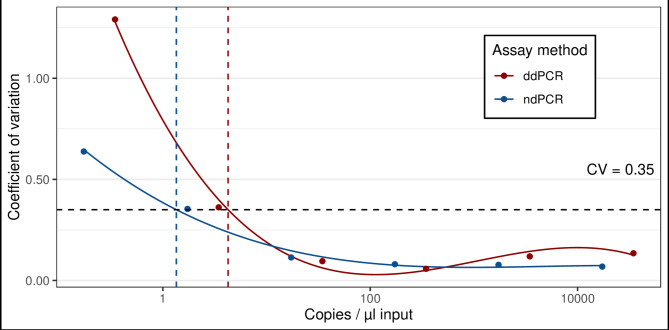
- LOD was ca. 0.39 copies/µL input for ndPCR (15.60 copies/reaction for 40 µL) and ca. 0.17 copies/µL for ddPCR (3.31 copies/reaction for 20 µL); LOQ was 1.35 copies/µL (54 copies/reaction) for ndPCR and 4.26 copies/µL (85.2 copies/reaction) for ddPCR. Above LOQ, CVs ranged from 7–11% for ndPCR and 6–13% for ddPCR.
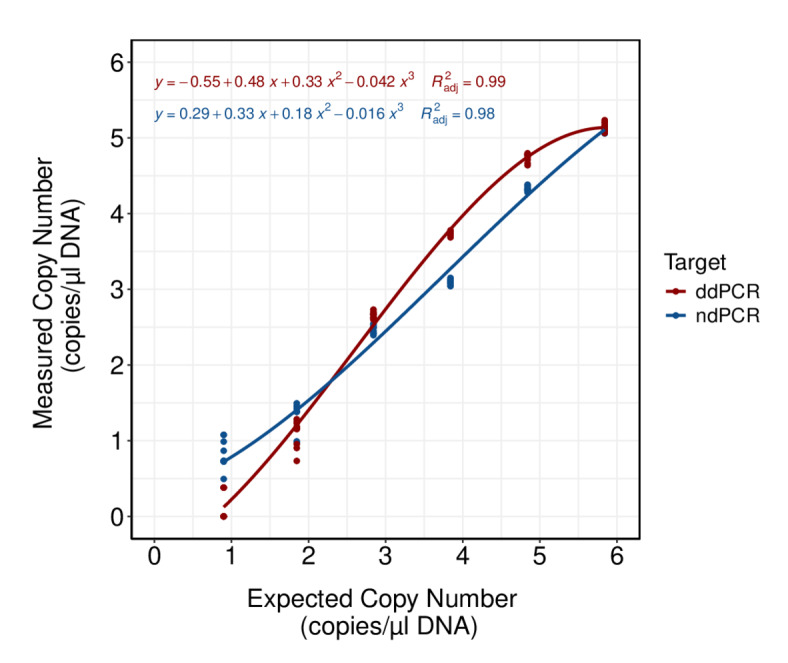
- Synthetic oligonucleotide accuracy showed good model fit (ndPCR R²adj = 0.98; ddPCR R²adj = 0.99), but measured gene copy numbers were consistently lower than expected for both platforms, with discrepancies exceeding 50% of expected concentration for some dilution levels.
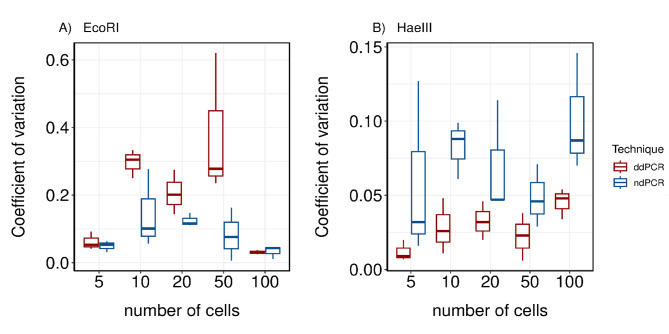
- HaeIII generally gave higher precision than EcoRI, especially for ddPCR: ddPCR CVs were 2.5–62.1% with EcoRI and all below 5% with HaeIII; ndPCR CVs were 0.6–27.7% with EcoRI and 1.6–14.6% with HaeIII.
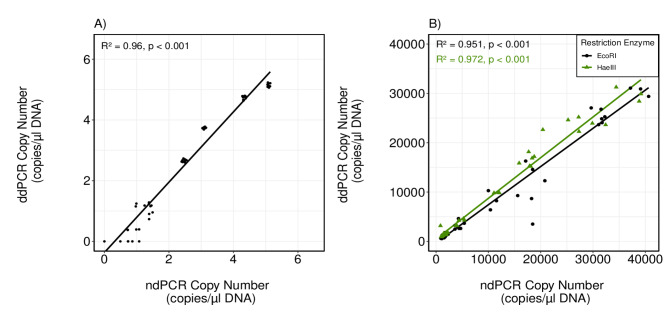
- For *P. tetraurelia* DNA from 5–100 cells, ndPCR gave significantly higher mean estimated gene copy numbers than ddPCR for both EcoRI (Wilcoxon W = 1015, p < 0.001) and HaeIII (W = 943, p < 0.001); average copy number increased with cell number (R² = 0.92–0.95), except 5 cells averaged higher than 10 cells. Reproducibility between platforms was R² = 0.96 for synthetic oligonucleotides, R² = 0.97 for HaeIII and R² = 0.95 for EcoRI with ciliate DNA; CCC was 0.96 (95% CI 0.94–0.98) for HaeIII and 0.92 (95% CI 0.88–0.95) for EcoRI.
Methods
- Cross-platform comparison of QIAcuity One nanoplate dPCR (24-well nanoplates with 26,000 partitions, 40 µL reactions) and QX200 droplet dPCR (up to 20,000 droplets, 20 µL reactions), both using EvaGreen and PAC-F/R primers amplifying a 237 bp LSU rRNA fragment.
- Samples were synthetic oligonucleotides and DNA extracted from *P. tetraurelia* stock 51 cells (5–100 cells; some samples from a previous study, with additional 10–20 cell extractions); dilution series had 11 levels at 1:10 with 10 replicates, and ciliate DNA samples were run in triplicate, with EcoRI or HaeIII restriction enzymes.
- Analyses in R v4.3.1 included LOD/LOQ estimation (95% detection; CV ≤ 35% for LOQ), linear regression with AIC model selection, paired t-tests or Wilcoxon signed-rank tests, Concordance Correlation Coefficient, Bland-Altman analysis (weighted when needed), and coefficient of variation.
Limitations
- The paper states that LOD and LOQ estimates refer to optimal samples without non-target DNA or co-extracted substances, and it is unsure how they would be affected by environmental samples, extraction efficiencies, or inhibition such as humic acids; it also notes that a 1:10 dilution series limited resolution compared with a 1:5 series.
- The paper states that accuracy discrepancies were inconclusive and could stem from inaccurate DNA starting concentrations, degraded or damaged synthetic oligonucleotides, or partition misclassification (type II error), though misclassification was considered minor.
- Evident from the text: the study used only one ciliate species (*P. tetraurelia*), two platforms, two restriction enzymes, and no environmental samples; low cell concentrations (5 vs. 10 cells) were not reliably differentiated, biological replicate CVs reached 44%, and platform-specific features such as maximum template input volume and cost were not addressed.
Model-written summary. Check it against the paper before relying on it.
Integrity signals
Registry
Cites
Statistics
Figures
Verification
Claims the paper makes
2 Valid · 0 Not valid · 14 Not checked · 86 Own results and interpretations
The sources with a verdict support this claim; the rest weren’t checked yet, have no full text we could read, or their verdicts aren’t rated yet.
In the paper
“Since we applied the same assay and samples for both platforms, these differences most likely arise from general technical differences, causing a certain degree of measurement uncertainty that can influence the precision of estimates especially at the lower range of copy number concentrations42,53,54.”
§ Comparing the precision of two digital PCR applications for copy number comparisons in protists > Discussion
What the sources say
- Supportedcites [42] Whale, A. S. et al. Comparison of microfluidic digital PCR and conventional quantitative PCR for measuring copy number variation. Nucleic Acids Res. 40, e82–e82 (2012). 22373922 PMC3367212 source
Whale et al. (2012) run the identical HER2:RNase P assay on the same spiked gDNA samples on both platforms and report that with equal replication dPCR resolved a ratio of 1.17 while qPCR required 1.27 (RESULTS, 'Limit of detection for analysing copy number variations'). The DISCUSSION attributes this inter-platform gap to general technical differences: qPCR technical variability is high between and within laboratories while dPCR is notably less variable, and 'the binary nature of dPCR means that the precision is more independent of variation in assay amplification'. The precision-at-low-copy-number qualifier is also carried by the paper: the Abstract states dPCR precision depends directly on replicate number and template concentration, and the DISCUSSION notes that below the optimum λr more chambers are needed, with Weaver's model failing because real λr values (0.18, 0.37) fell below the assumed 0.6. (LLM, conf=0.82)
- Not checked yetcites [53] Emslie, K. R. et al. Droplet volume variability and impact on digital Pcr copy number concentration measurements. Anal. Chem. 91, 4124–4131 (2019). 30775910 source
Checked before — its earlier verdict is held back until a new check runs.
- Supportedcites [54] Pinheiro, L. B. et al. Evaluation of a droplet digital polymerase chain reaction format for DNA copy number quantification. Anal. Chem. 84, 1003–1011 (2012). 22122760 PMC3260738 source
The Dynamic Range section (Results and Discussion) states that relative uncertainty is not constant across the dynamic range and that the stochastic sampling effect grows as copy number concentration decreases, giving 30% relative expanded uncertainty at 37 copies per 20 µL versus 4.6–6.0% at 2 200–33 000 copies — directly supporting 'influence the precision of estimates especially at the lower range of copy number concentrations'. The 'Accuracy of ddPCR by Comparison with Independent cdPCR Measurement System' section and Table 1/Figure 4 attribute format-to-format differences in uncertainty to general technical factors (partition volume uncertainty and number of partitions analysed: 3.2–4.2% for 20 000-ddPCR vs 13–15% for 765-cdPCR), supporting the claim that platform differences arise from measurement uncertainty rather than assay/sample differences. The LOD/LOQ framing itself is the citing paper's comparison, not something this source is asked to substantiate. (LLM, conf=0.85)
hedgedstates a possible cause- Asserted: passes — The authors put it forward as true.
- Checkable: passes — It can be checked against evidence.
- Load-bearing: passes — The paper’s conclusions depend on it.
- Based: passes — The paper gives a reason why it holds.
- Supported
The cited sources support only part of this claim — read each source’s verdict below.
In the paper
“This measurement uncertainty could be due to pipetting errors or variations in droplet or partition volume, which have a strong influence on platform sensitivity53,55,56.”
§ Comparing the precision of two digital PCR applications for copy number comparisons in protists > Discussion
What the sources say
- Not checked — no full text of the sourcecites [53] Emslie, K. R. et al. Droplet volume variability and impact on digital Pcr copy number concentration measurements. Anal. Chem. 91, 4124–4131 (2019). 30775910 source
- Partly supportedcites [55] Jacobs, B. K. M., Goetghebeur, E. & Clement, L. Impact of variance components on reliability Ofl absolute quantification using digital PCR. BMC Bioinform. 15, 1–13 (2014). PMC4261249 25147026 sourceExperimental — accuracy not yet measured
Jacobs et al. (2014) do support the first half: pipette error and between-replicate variation in partition/droplet volume are modelled as sources of technical variation that raise uncertainty of concentration estimates (Methods > Data-generating model; Results > 'Pipette error leads to underestimation of the variation'; Abstract > Results). The attached consequence is not what the paper says: it characterises the effect of unequal partition volume as small ('the influence of unequal partition size is limited', max ~2.5% relative bias at high concentration, Results > 'Unequal partition size leads to downward bias'), reserving 'strong influence' on detection/sensitivity for false negatives from inhibition and the fluorescence threshold (Background > dPCR Workflow; Conclusions). So the 'strong influence on platform sensitivity' part attributed to this source is unsupported. (LLM, conf=0.72)
- Partly supportedcites [56] Majumdar, N., Wessel, T. & Marks, J. Digital PCR modeling for maximal sensitivity, dynamic range and measurement precision. PLoS One. 10, e0118833 (2015). 25806524 PMC4373789 sourceExperimental — accuracy not yet measured
Our copy supports the uncertainty sources: 'Other sources of noise contributing factors include (but are not limited to) pipette errors, chemistry interaction, optical or system noise...' (Practical Effects on Digital PCR Capabilities > Impact of False Reaction Calls), and the 'Impact of Volume Variability' section (with Fig 8) shows partition-volume variation degrades measurement precision, shifting peak precision toward lower concentrations. However, the paper frames that effect on precision, not on sensitivity: it states the lowest detectable concentration is 'almost exclusively dependent upon the total sample volume interrogated' (Sensitivity Dependence on Interrogated Volume, Fig 4), and volume variation is said to impact higher concentrations most. So the added clause that pipetting/droplet-volume variation 'have a strong influence on platform sensitivity' is not what this source states. (LLM, conf=0.75)
hedgedstates a possible cause- Asserted: passes — The authors put it forward as true.
- Checkable: passes — It can be checked against evidence.
- Load-bearing: passes — The paper’s conclusions depend on it.
- Based: passes — The paper gives a reason why it holds.
A result the paper reports from its own data — it cites no other source for it, so there is none to check. The quote shows it is in the paper.
In the paper
“Precision estimates using DNA originating from P. tetraurelia showed differences depending on the choice of restriction enzyme (Fig. 3).”
§ Comparing the precision of two digital PCR applications for copy number comparisons in protists > Results > Accuracy and precision
plainstates an association- Asserted: passes — The authors put it forward as true.
- Checkable: passes — It can be checked against evidence.
- Load-bearing: passes — The paper’s conclusions depend on it.
- Based: passes — The paper gives a reason why it holds.
A result the paper reports from its own data — it cites no other source for it, so there is none to check. The quote shows it is in the paper.
In the paper
“Both platforms demonstrated similar detection and quantification limits and yielded high precision across most analyses.”
§ Comparing the precision of two digital PCR applications for copy number comparisons in protists > Abstract
boosted- Asserted: passes — The authors put it forward as true.
- Checkable: passes — It can be checked against evidence.
- Load-bearing: passes — The paper’s conclusions depend on it.
- Based: passes — The paper gives a reason why it holds.
A result the paper reports from its own data — it cites no other source for it, so there is none to check. The quote shows it is in the paper.
In the paper
“For ndPCR the LOQ was determined at 1.35 copies/µL input (54 copies/reaction)”
§ Comparing the precision of two digital PCR applications for copy number comparisons in protists > Results > Limit of detection (LOD) and limit of quantification (LOQ)
plain- Asserted: passes — The authors put it forward as true.
- Checkable: passes — It can be checked against evidence.
- Load-bearing: passes — The paper’s conclusions depend on it.
- Based: passes — The paper gives a reason why it holds.
42 more claims
Create a free account to see all 102 claims and to verify the 39 references still open.
- It may state two separate claims as one. 41
- Probably not a substantial claim. 18
Self-check
Percentages, sums and reported differences re-computed from the paper’s own numbers.
Each contradiction between two passages listed here was confirmed by an independent check.
Rated minor: it would not touch a result — a value no result rests on, a p-value that stays on the same side of the significance level, or a conflict that is clerical, resolved elsewhere in the paper, or outside its own findings.
In the paper
§ Comparing the precision of two digital PCR applications for copy number comparisons in protists > Results > Limit of detection (LOD) and limit of quantification (LOQ)
“For the other dilution levels, DNA measurements were not possible due to the limits of the fluorometer and were therefore not compared.”
§ Comparing the precision of two digital PCR applications for copy number comparisons in protists > Materials and methods > Data analysis
“Since the linear range only covers concentrations between 0.2 and 400 ng only the first two dilution levels could reliably be quantified.”
Rated minor: it would not touch a result — a value no result rests on, a p-value that stays on the same side of the significance level, or a conflict that is clerical, resolved elsewhere in the paper, or outside its own findings.
In the paper
§ Comparing the precision of two digital PCR applications for copy number comparisons in protists > Discussion
“We compared the 4-cutter restriction enzyme HaeIII with the 5-cutter restriction enzyme EcoRI.”
§ Comparing the precision of two digital PCR applications for copy number comparisons in protists > Materials and methods > Molecular analysis
“We selected two restriction enzymes from New England Biolabs (NEB, Frankfurt am Main, Germany), one 6-cutter restriction enzyme (EcoRI) and one 4-cutter restriction enzyme (HaeIII), that were suggested for the QIAcuity EvaGreen dPCR assay.”
Citations
Cites
Wickham, H., Averick, M., Bryan, J., Chang, W., McGowan, L., François, R., Grolemund, G., Hayes, A., Henry, L., Hester, J., et al. (2019) · Journal of Open Source Software · doi:10.21105/joss.01686 · Cited by 22,138
Ror2 signaling regulates Golgi structure and transport through IFT20 for tumor invasiveness
Nishita, M., Park, S.-Y., Nishio, T., Kamizaki, K., Wang, Z., Tamada, K., Takumi, T., Hashimoto, R., Otani, H., Pazour, G. J., et al. (2017) · Scientific Reports · doi:10.1038/s41598-016-0028-x · Cited by 15,947
Santos, A. G., da Rocha, G. O., & de Andrade, J. B. (2019) · Scientific Reports · doi:10.1038/s41598-018-37186-2 · Cited by 8,495
The Influence of Functional Diversity and Composition on Ecosystem Processes
Tilman, D., Knops, J., Wedin, D., Reich, P., Ritchie, M., & Siemann, E. (1997) · Science · doi:10.1126/science.277.5330.1300 · Cited by 3,199
High-throughput droplet digital PCR system for absolute quantitation of DNA copy number
Hindson, B. J., Ness, K. D., Masquelier, D. A., Belgrader, P., Heredia, N. J., Makarewicz, A. J., Bright, I. J., Lucero, M. Y., Hiddessen, A. L., Legler, T. C., et al. (2011) · Analytical Chemistry · doi:10.1021/ac202028g · Cited by 2,792
Vogelstein, B., & Kinzler, K. W. (1999) · Proceedings of the National Academy of Sciences · doi:10.1073/pnas.96.16.9236 · Cited by 1,770
Absolute quantification by droplet digital PCR versus analog real-time PCR
Hindson, C. M., Chevillet, J. R., Briggs, H. A., Gallichotte, E. N., Ruf, I. K., Hindson, B. J., Vessella, R. L., & Tewari, M. (2013) · Nature Methods · doi:10.1038/nmeth.2633 · Cited by 1,488
Evaluation of a Droplet Digital Polymerase Chain Reaction Format for DNA Copy Number Quantification
Pinheiro, L. B., Coleman, V. A., Hindson, C. M., Herrmann, J., Hindson, B. J., Bhat, S., & Emslie, K. R. (2012) · Analytical Chemistry · doi:10.1021/ac202578x · Cited by 1,055
ggplot2: Create Elegant Data Visualisations Using the Grammar of Graphics
Wickham, H., Chang, W., Henry, L., Pedersen, T. L., Takahashi, K., Wilke, C., Woo, K., Yutani, H., Dunnington, D., & van den Brand, T. (2007) · CRAN: Contributed Packages · doi:10.32614/cran.package.ggplot2 · Cited by 862
Quantitation of targets for PCR by use of limiting dilution.
Sykes, P. J., Neoh, S. H., Brisco, M. J., Hughes, E., Condon, J. C., & Morley, A. A. (1992) · PubMed · Cited by 753
DescTools: Tools for Descriptive Statistics
Signorell, A. (2014) · CRAN: Contributed Packages · doi:10.32614/cran.package.desctools · Cited by 690
Quan, P.-L., Sauzade, M., & Brouzes, E. (2018) · Sensors · doi:10.3390/s18041271 · Cited by 664
Taylor, S. C., Laperriere, G., & Germain, H. (2017) · Scientific Reports · doi:10.1038/s41598-017-02217-x · Cited by 638
Reporting the limits of detection and quantification for environmental DNA assays
Klymus, K. E., Merkes, C. M., Allison, M. J., Goldberg, C. S., Helbing, C. C., Hunter, M. E., Jackson, C. A., Lance, R. F., Mangan, A. M., Monroe, E. M., et al. (2020) · Environmental DNA · doi:10.1002/edn3.29 · Cited by 582
Forootan, A., Sjöback, R., Björkman, J., Sjögreen, B., Linz, L., & Kubista, M. (2017) · Biomolecular Detection and Quantification · doi:10.1016/j.bdq.2017.04.001 · Cited by 578
The dMIQE Group, Whale, A. S., De Spiegelaere, W., Trypsteen, W., Nour, A. A., Bae, Y.-K., Benes, V., Burke, D., Cleveland, M., Corbisier, P., et al. (2020) · Clinical Chemistry · doi:10.1093/clinchem/hvaa125 · Cited by 516
Microorganisms and ocean global change
Hutchins, D. A., & Fu, F. (2017) · Nature Microbiology · doi:10.1038/nmicrobiol.2017.58 · Cited by 499
Whale, A. S., Huggett, J. F., Cowen, S., Speirs, V., Shaw, J., Ellison, S., Foy, C. A., & Scott, D. J. (2012) · Nucleic Acids Research · doi:10.1093/nar/gks203 · Cited by 453
Gong, J., Dong, J., Liu, X., & Massana, R. (2013) · Protist · doi:10.1016/j.protis.2012.11.006 · Cited by 283
Galluzzi, L., Penna, A., Bertozzini, E., Vila, M., Garcés, E., & Magnani, M. (2004) · Applied and Environmental Microbiology · doi:10.1128/aem.70.2.1199-1206.2004 · Cited by 282
Godhe, A., Asplund, M. E., Härnström, K., Saravanan, V., Tyagi, A., & Karunasagar, I. (2008) · Applied and Environmental Microbiology · doi:10.1128/aem.01298-08 · Cited by 259
Borchardt, M. A., Boehm, A. B., Salit, M., Spencer, S. K., Wigginton, K. R., & Noble, R. T. (2021) · Environmental Science & Technology · doi:10.1021/acs.est.1c01767 · Cited by 254
Mao, F., Leung, W.-Y., & Xin, X. (2007) · BMC Biotechnology · doi:10.1186/1472-6750-7-76 · Cited by 249
Doi, H., Takahara, T., Minamoto, T., Matsuhashi, S., Uchii, K., & Yamanaka, H. (2015) · Environmental Science & Technology · doi:10.1021/acs.est.5b00253 · Cited by 248
Weaver, S., Dube, S., Mir, A., Qin, J., Sun, G., Ramakrishnan, R., Jones, R. C., & Livak, K. J. (2010) · Methods · doi:10.1016/j.ymeth.2010.01.003 · Cited by 220 · cited 1×
“As shown elsewhere 56,69,74 DNA input concentrations strongly influence the precision and reliability of gene copy numbers and negatively affect the agreement between different platforms.”
knitr: A Comprehensive Tool for Reproducible Research in R
Xie, Y. (2018) · Implementing Reproducible Research · doi:10.1201/9781315373461-1 · Cited by 218
Wood, S. A., Pochon, X., Laroche, O., von Ammon, U., Adamson, J., & Zaiko, A. (2019) · Molecular Ecology Resources · doi:10.1111/1755-0998.13055 · Cited by 216
Multiplexed Target Detection Using DNA-Binding Dye Chemistry in Droplet Digital PCR
McDermott, G. P., Do, D., Litterst, C. M., Maar, D., Hindson, C. M., Steenblock, E. R., Legler, T. C., Jouvenot, Y., Marrs, S. H., Bemis, A., et al. (2013) · Analytical Chemistry · doi:10.1021/ac403061n · Cited by 190
Cao, Y., Raith, M. R., & Griffith, J. F. (2015) · Water Research · doi:10.1016/j.watres.2014.12.008 · Cited by 190
Internalization of novel non-viral vector TAT-streptavidin into human cells
Rinne, J., Albarran, B., Jylhävä, J., Ihalainen, T. O., Kankaanpää, P., Hytönen, V. P., Stayton, P. S., Kulomaa, M. S., & Vihinen-Ranta, M. (2007) · BMC Biotechnology · doi:10.1186/1472-6750-7-1 · Cited by 190
Hunter, M. E., Dorazio, R. M., Butterfield, J. S. S., Meigs‐Friend, G., Nico, L. G., & Ferrante, J. A. (2016) · Molecular Ecology Resources · doi:10.1111/1755-0998.12619 · Cited by 188
Dong, L., Meng, Y., Sui, Z., Wang, J., Wu, L., & Fu, B. (2015) · Scientific Reports · doi:10.1038/srep13174 · Cited by 170
Measuring Digital PCR Quality: Performance Parameters and Their Optimization
Lievens, A., Jacchia, S., Kagkli, D. M., Cristian, S., & Querci, M. (2016) · PLoS ONE · doi:10.1371/journal.pone.0153317 · Cited by 153
Digital polymerase chain reaction technology – recent advances and future perspectives
Sreejith, K. R., Ooi, C. H., Jin, J., Dao, D. V., & Nguyen, N. (2018) · Lab on a Chip · doi:10.1039/c8lc00990b · Cited by 144
Functional ecology of aquatic phagotrophic protists – Concepts, limitations, and perspectives
Weisse, T., Anderson, R. J., Arndt, H., Calbet, A., Hansen, P. J., & Montagnes, D. J. S. (2016) · European Journal of Protistology · doi:10.1016/j.ejop.2016.03.003 · Cited by 141
Application of digital PCR for public health-related water quality monitoring
Tiwari, A., Ahmed, W., Oikarinen, S., Sherchan, S. P., Heikinheimo, A., Jiang, G., Simpson, S. L., Greaves, J., & Bivins, A. W. (2022) · The Science of The Total Environment · doi:10.1016/j.scitotenv.2022.155663 · Cited by 138
Reliable eDNA detection and quantification of the European weather loach ( Misgurnus fossilis )
Brys, R., Halfmaerten, D., Neyrinck, S., Mauvisseau, Q., Auwerx, J., Sweet, M. J., & Mergeay, J. (2020) · Journal of Fish Biology · doi:10.1111/jfb.14315 · Cited by 133
Self-citationDoes Intraspecific Variation in rDNA Copy Number Affect Analysis of Microbial Communities?
Lavrinienko, A., Jernfors, T., Koskimäki, J. J., Pirttilä, A. M., & Watts, P. C. (2021) · Trends in Microbiology · doi:10.1016/j.tim.2020.05.019 · Cited by 133
Mauvisseau, Q., Burian, A., Gibson, C., Brys, R., Ramsey, A., & Sweet, M. J. (2019) · Scientific Reports · doi:10.1038/s41598-018-37001-y · Cited by 124
Self-citationMauvisseau, Q., Davy‐Bowker, J., Bulling, M. T., Brys, R., Neyrinck, S., Troth, C. R., & Sweet, M. J. (2019) · Scientific Reports · doi:10.1038/s41598-019-50571-9 · Cited by 124
Self-citationMartin, J. L., Santi, I., Pitta, P., John, U., & Gypens, N. (2022) · Metabarcoding and Metagenomics · doi:10.3897/mbmg.6.85794 · Cited by 122
Digital PCR Modeling for Maximal Sensitivity, Dynamic Range and Measurement Precision
Majumdar, N., Wessel, T., & Marks, J. (2015) · PLOS ONE · doi:10.1371/journal.pone.0118833 · Cited by 119
Bonk, F., Popp, D., Harms, H., & Centler, F. (2018) · Journal of Microbiological Methods · doi:10.1016/j.mimet.2018.09.015 · Cited by 118
Current commercial dPCR platforms: technology and market review
Tan, L. L., Loganathan, N., Agarwalla, S., Yang, C., Yuan, W., Zeng, J., Wu, R., Wang, W. T., & Duraiswamy, S. (2022) · Critical Reviews in Biotechnology · doi:10.1080/07388551.2022.2037503 · Cited by 114
Current practice in plankton metabarcoding: optimization and error management
Santoferrara, L. F. (2019) · Journal of Plankton Research · doi:10.1093/plankt/fbz041 · Cited by 104
Highly Reproducible Absolute Quantification of Mycobacterium tuberculosis Complex by Digital PCR
Devonshire, A. S., Honeyborne, I., Gutteridge, A., Whale, A. S., Nixon, G., Wilson, P., Jones, G., McHugh, T. D., Foy, C. A., & Huggett, J. F. (2015) · Analytical Chemistry · doi:10.1021/ac5041617 · Cited by 103
ddPCR surpasses classical qPCR technology in quantitating bacteria and fungi in the environment
Wang, D., Wang, S., Du, X., He, Q., Liu, Y., Wang, Z., Feng, K., Li, Y., & Deng, Y. (2022) · Molecular Ecology Resources · doi:10.1111/1755-0998.13644 · Cited by 89
Comparison among the Quantification of Bacterial Pathogens by qPCR, dPCR, and Cultural Methods
Ricchi, M., Bertasio, C., Boniotti, M. B., Vicari, N., Russo, S., Tilola, M., Bellotti, M. A., & Bertasi, B. (2017) · Frontiers in Microbiology · doi:10.3389/fmicb.2017.01174 · Cited by 88
Digital PCR as an Emerging Tool for Monitoring of Microbial Biodegradation
Cao, Y., Miao, Y., Dong, G., Chen, B., & Zhang, B. (2020) · Molecules · doi:10.3390/molecules25030706 · Cited by 88
Wang, Y., Wang, C., Jiang, Y., Katz, L. A., Gao, F., & Yan, Y. (2019) · Science China Life Sciences · doi:10.1007/s11427-018-9422-5 · Cited by 80
Tools for Descriptive Statistics [R package DescTools version 0.99.40]
Signorell, A. (2021) · Cited by 79
Pitsch, G., Bruni, E. P., Forster, D., Qu, Z., Sonntag, B., Stoeck, T., & Posch, T. (2019) · Frontiers in Microbiology · doi:10.3389/fmicb.2019.00248 · Cited by 71
Self-citationQuantifying the Detection Sensitivity and Precision of qPCR and ddPCR Mechanisms for eDNA Samples
Guri, G., Ray, J. L., Shelton, A. O., Kelly, R. P., Præbel, K., Allan, E. A., Yoccoz, N. G., Johansen, T., Wangensteen, O. S., Hanebrekke, T., et al. (2024) · Ecology and Evolution · doi:10.1002/ece3.70678 · Cited by 66
Everts, T., Halfmaerten, D., Neyrinck, S., Regge, N. D., Jacquemyn, H., & Brys, R. (2021) · Scientific Reports · doi:10.1038/s41598-021-90771-w · Cited by 62
Yarimizu, K., Sildever, S., Hamamoto, Y., Tazawa, S., Oikawa, H., Yamaguchi, H., Basti, L., Mardones, J. I., Paredes-Mella, J., & Nagai, S. (2021) · Harmful Algae · doi:10.1016/j.hal.2021.102008 · Cited by 58
Impact of variance components on reliability of absolute quantification using digital PCR
Jacobs, B. K., Goetghebeur, E., & Clement, L. (2014) · BMC Bioinformatics · doi:10.1186/1471-2105-15-283 · Cited by 57
Droplet Volume Variability and Impact on Digital PCR Copy Number Concentration Measurements
Emslie, K. R., H. McLaughlin, J. L., Griffiths, K., Forbes-Smith, M., Pinheiro, L. B., & Burke, D. G. (2019) · Analytical Chemistry · doi:10.1021/acs.analchem.8b05828 · Cited by 50
Ruvindy, R., Barua, A., Bolch, C. J. S., Sarowar, C., Savela, H., & Murray, S. A. (2023) · ISME Communications · doi:10.1038/s43705-023-00274-0 · Cited by 48
Peel, N., Dicks, L. V., Heavens, D., Percival‐Alwyn, L., Cooper, C., Clark, M. D., Davies, R. G., Leggett, R. M., & Yu, D. W. (2019) · Methods in Ecology and Evolution · doi:10.1111/2041-210x.13265 · Cited by 47
Lee, H.-G., Kim, H. M., Min, J., Park, C., Jeong, H. J., Lee, K., & Kim, K. Y. (2019) · Harmful Algae · doi:10.1016/j.hal.2019.101726 · Cited by 47
Vautier, M., Chardon, C., Goulon, C., Guillard, J., & Domaizon, I. (2022) · Fisheries Research · doi:10.1016/j.fishres.2023.106708 · Cited by 47
Cao, Y., Sivaganesan, M., Kinzelman, J. L., Blackwood, A. D., Noble, R. T., Haugland, R. A., Griffith, J. F., & Weisberg, S. B. (2012) · Water Research · doi:10.1016/j.watres.2012.09.056 · Cited by 45
Brys, R., Halfmaerten, D., Everts, T., Driessche, C. V., & Neyrinck, S. (2023) · Environmental DNA · doi:10.1002/edn3.420 · Cited by 41
Crucitta, S., Ruglioni, M., Novi, C., Manganiello, M., Arici, R., Petrini, I., Pardini, E., Cucchiara, F., Marmorino, F., Cremolini, C., et al. (2023) · Clinica Chimica Acta · doi:10.1016/j.cca.2023.117239 · Cited by 40
Absolute quantification of priority bacteria in aquaculture using digital PCR
Netzer, R., Ribičić, D., Aas, M., Cavé, L., & Dhawan, T. (2021) · Journal of Microbiological Methods · doi:10.1016/j.mimet.2021.106171 · Cited by 37
Evaluating Digital PCR for the Quantification of Human Genomic DNA: Accessible Amplifiable Targets
Kline, M. C., Romsos, E. L., & Duewer, D. L. (2016) · Analytical Chemistry · doi:10.1021/acs.analchem.5b03692 · Cited by 36
Picard, M., Pochon, X., Atalah, J., Pearman, J. K., Rees, A., Howarth, J., Moy, C. M., Vandergoes, M. J., Hawes, I., Khan, S., et al. (2022) · Scientific Reports · doi:10.1038/s41598-022-14216-8 · Cited by 34
Wang, Y., Jiang, Y., Liu, Y., Li, Y., Katz, L. A., Gao, F., & Yan, Y. (2020) · Microorganisms · doi:10.3390/microorganisms8030316 · Cited by 32
Lee, H.-G., Kim, H. M., Min, J., Kim, K., Park, M. G., Jeong, H. J., & Kim, K. Y. (2017) · ALGAE · doi:10.4490/algae.2017.32.9.10 · Cited by 30
Liu, X., & Gong, J. (2012) · Microbes and Environments · doi:10.1264/jsme2.me12056 · Cited by 29
Tsang, H. H., Domingos, J. A., Westaway, J. A. F., Kam, M. H. Y., Huerlimann, R., & Gomes, G. B. (2021) · Diversity · doi:10.3390/d13080350 · Cited by 27
Jikumaru, A., Ishii, S., Fukudome, T., Kawahara, Y., Iguchi, A., Masago, Y., Nukazawa, K., & Suzuki, Y. (2020) · Journal of Bioscience and Bioengineering · doi:10.1016/j.jbiosc.2020.02.004 · Cited by 22
Maes, S. M., Desmet, S., Brys, R., Sys, K., Ruttink, T., Maes, S., Hostens, K., Vansteenbrugge, L., & Derycke, S. (2023) · Environmental DNA · doi:10.1002/edn3.426 · Cited by 22
Quality control of digital PCR assays and platforms
Vynck, M., Vandesompele, J., & Thas, O. (2017) · Analytical and Bioanalytical Chemistry · doi:10.1007/s00216-017-0538-9 · Cited by 21
Wagemaker, C. A. M., Mommer, L., Visser, E. J. W., Weigelt, A., van Gurp, T. P., Postuma, M., Smit‐Tiekstra, A. E., & de Kroon, H. (2020) · Molecular Ecology Resources · doi:10.1111/1755-0998.13278 · Cited by 21
Baudry, T., Laffitte, M., Noizat, C., Delaunay, C., Ricou, G., Vasselon, V., & Grandjean, F. (2023) · Environmental DNA · doi:10.1002/edn3.435 · Cited by 20
Stelzer, M., Ord, J., Neyrinck, S., Steiner, J., Hartikainen, H., Brys, R., & Schmidt‐Posthaus, H. (2023) · Environmental DNA · doi:10.1002/edn3.501 · Cited by 16
Gosselin-Théberge, M., Taboada, E. N., & Guy, R. A. (2016) · Journal of Microbiological Methods · doi:10.1016/j.mimet.2016.07.025 · Cited by 15
Hu, G., Huang, K. Q., Zhou, W., Wang, R., Zhao, W., Zou, H., Li, W., Wu, S., Li, M., & Wang, G. (2023) · Journal of Fish Diseases · doi:10.1111/jfd.13749 · Cited by 15
Morin, F., Panova, M., Schweizer, M., Wiechmann, M., Eliassen, N., Sundberg, P., Cluzel‐Burgalat, L., & Asteman, I. P. (2023) · Environmental Microbiology · doi:10.1111/1462-2920.16458 · Cited by 13
Geay, M. L., Mayers, K. M. J., Küttim, M., Lauga, B., & Jassey, V. E. J. (2024) · Environmental Microbiology · doi:10.1111/1462-2920.16666 · Cited by 12
Rosing, F., Meier, M., Schroeder, L., Laban, S., Hoffmann, T., Kaufmann, A., Siefer, O., Wuerdemann, N., Klußmann, J. P., Rieckmann, T., et al. (2024) · Microbiology Spectrum · doi:10.1128/spectrum.00024-24 · Cited by 9
McKinlay, A., Fultz, D., Wang, F., & Pikaard, C. S. (2021) · Frontiers in Plant Science · doi:10.3389/fpls.2021.656049 · Cited by 8
Bagdonaitė, L., Leder, E. H., Lifjeld, J. T., Johnsen, A., & Mauvisseau, Q. (2025) · PeerJ · doi:10.7717/peerj.19278 · Cited by 8
Self-citationDroplet digital PCR as a tool for investigating dynamics of cryptic symbionts
Hiillos, A., Thonig, A., & Knott, K. E. (2021) · Ecology and Evolution · doi:10.1002/ece3.8372 · Cited by 7
Using digital PCR to predict ciliate abundance from ribosomal RNA gene copy numbers
Gross, M., Dunthorn, M., Mauvisseau, Q., & Stoeck, T. (2024) · Environmental Microbiology · doi:10.1111/1462-2920.16619 · Cited by 7
Self-citationGenotyping by sequencing for estimating relative abundances of diatom taxa in mock communities
Çiftçi, O., Wagemaker, C. A. M., Mertens, A., van Bodegom, P. M., Pirovano, W., & Gravendeel, B. (2023) · BMC Ecology and Evolution · doi:10.1186/s12862-023-02104-2 · Cited by 2
Vautier, M., Chardon, C., Goulon, C., Guillard, J., & Domaizon, I. (2022) · bioRxiv (Cold Spring Harbor Laboratory) · doi:10.1101/2022.05.05.490723 · Cited by 1
Peel, N., Dicks, L. V., Heavens, D., Percival-Alwyn, L., Cooper, C., Clark, M. D., Davies, R. G., Leggett, R. M., & Yu, D. W. (2019) · doi:10.1101/551960
Research works printed but not linked: 3
- Brys, R. et al. Reliable eDNA detection and quantification of the European weather loach (Misgurnus fossilis). J. Fish Biol. 98, 399–414 (2020). 32154579 · DOI
- Wickham, H., Pedersen, T. L. & Seidel, D. Scales: Scale functions for visualization, version 1.3. 0 [R package]. Preprint at (2023).
- Fox, J. et al. Package ‘car’. Vienna: R Foundation Stat. Comput. 16, 333 (2012).
Cited by
Clerkin, T. J., Smith, S., Zhu, K., Blackwood, A. D., Gallard-Gongora, J. F., Capone, D., Brown, J. D., & Noble, R. T. (2026) · Applied and Environmental Microbiology · doi:10.1128/aem.00083-26 · Cited by 3
Gross, M. R., Koll, U., Sonntag, B., & Stoeck, T. (2026) · Molecular Ecology Resources · doi:10.1111/1755-0998.70177 · Cited by 1
Self-citationMestanza, M., Trujillo, P. A. R., Hernández-Amasifuen, Á. D., Eriksson, D., Rio, A. H. D., Condori‐Apfata, J. A., & Guerrero‐Abad, J. C. (2026) · Plants · doi:10.3390/plants15071033
GC-rich regions affect amplification efficiency of neighboring amplicons in qPCR and digital PCR
Wang, X., Kruchkow, J., Rodríguez-Vargas, A., Wenzel, S., & Richer, S. M. (2026) · Scientific Reports · doi:10.1038/s41598-026-55452-6
Dalaya, A., Orbach, M. J., & Mehl, H. L. (2026) · Plant Health Progress · doi:10.1094/php-04-26-0087-rs
Metadata
- Authors
- Gross, M., Stoeck, T., Mauvisseau, Q., Schrøder-Nielsen, A., & Dunthorn, M.
- Affiliations
- Rheinland-Pfälzische Technische Universität Kaiserslautern-Landau (DE)
- University of Oslo (NO)
- Corresponding author
- Gross, Megan
- Venue
- Scientific Reports
- Published
- 2025-07-25
- Volume
- 15
- Issue
- 1
- Pages
- 27095-27095
- ISSN
- 2045-2322 (ISSN-L)
- PMC
- PMC12297429
- OpenAlex
- W4412707545
- Cited by
- 6
- References
- 87
- Citations by year
- 2026: 6
- FWCI
- 1.20
- Type
- journal article
- Language
- en
- Open access
- gold
- doi.org
- Licence
- cc-by
- creativecommons.org/licenses/by/4.0 (tdm)
- creativecommons.org/licenses/by/4.0 (vor)
- Locations
- Scientific Reports (publishedVersion, cc-by)
- PubMed Central (publishedVersion, cc-by)
- PubMed (publishedVersion)
- DOAJ (DOAJ: Directory of Open Access Journals) (submittedVersion, cc-by-sa)
- Funders
- Rheinland-Pfälzische Technische Universität Kaiserslautern-Landau
- Topics
- Life Sciences › Biochemistry, Genetics and Molecular Biology › Molecular Biology › Molecular Biology Techniques and Applications
- Life Sciences › Biochemistry, Genetics and Molecular Biology › Molecular Biology › bioluminescence and chemiluminescence research
- Physical Sciences › Environmental Science › Ecology › Environmental DNA in Biodiversity Studies
- Keywords
- digital PCR, gene copy number quantification, protists, ciliates, Paramecium tetraurelia, cross-platform comparison, restriction enzymes, HaeIII, EcoRI, environmental monitoring, precision and reproducibility
- MeSH terms
- Reproducibility of Results, DNA, Protozoan, Polymerase Chain Reaction, Gene Dosage, DNA Copy Number Variations
About these checks
Registry, retraction, Cites and statistics results are computed, not judged, with one exception: a printed reference that no index lists is read once by a model before it counts as a citation error. Claims are extracted by a model and kept only when their quote appears verbatim in the text; each cited source is then checked, with a model’s help, for whether it says what the claim relies on. Those verdicts can be wrong — read the claim’s quote and the cited source before relying on one.
The claim verdicts this report counts are experimental: their accuracy is not yet measured.
A language model drew the claims from the paper on 2026-11-18, under version 3 of the claim definition (model deepseek-v4.1-flash, prompt extract-v3).
A second model labelled each claim on 2026-11-18 (model jev-1.13-20260917, definition revision gold-guideline-v0.2).
Cited sources are checked with a language model’s help (qwen3.8-omni-flash).
Statistics and arithmetic are recomputed, not judged.
Confidence bands are shown only for fields calibrated on our annotated test set. None is calibrated yet, so no band is shown.
What counts as a claim ›How we measure confidence ›How we check this ›
Are you an author, or do you see a problem with this page? Request a review
Data sources
Bibliographic data: Semantic Scholar, OpenAlex, Crossref.
Contains information from the Semantic Scholar Academic Graph Datasets, made available under the ODC Attribution License (ODC-BY 1.0).
Semantic Scholar’s data is described in: Kinney, R., et al. (2023). The Semantic Scholar Open Data Platform. arXiv:2301.10140.
