

Scalable and accurate deep learning with electronic health records
Open accessThe DOI matches its Crossref record; 75 of the 75 references it cites were found in a registry or an index; 8 of the 19 sources its claims cite were checked for support.
Abstract
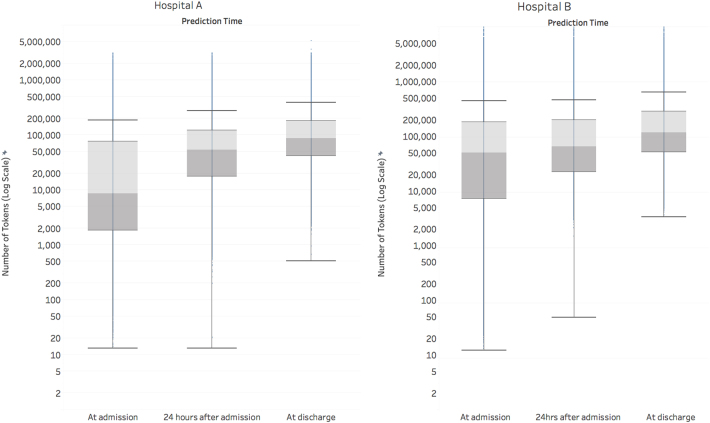
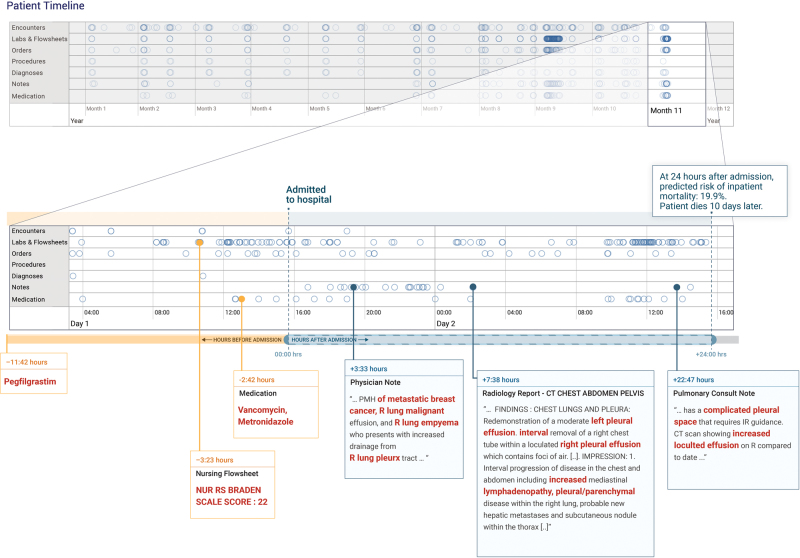
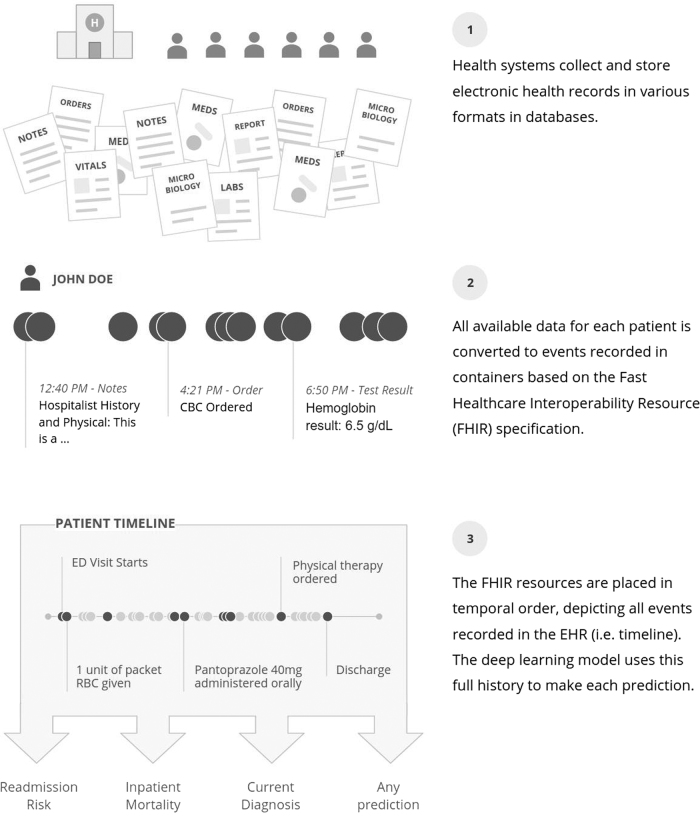
Predictive modeling with electronic health record (EHR) data is anticipated to drive personalized medicine and improve healthcare quality. Constructing predictive statistical models typically requires extraction of curated predictor variables from normalized EHR data, a labor-intensive process that discards the vast majority of information in each patient's record. We propose a representation of patients' entire raw EHR records based on the Fast Healthcare Interoperability Resources (FHIR) format. We demonstrate that deep learning methods using this representation are capable of accurately predicting multiple medical events from multiple centers without site-specific data harmonization. We validated our approach using de-identified EHR data from two US academic medical centers with 216,221 adult patients hospitalized for at least 24 h. In the sequential format we propose, this volume of EHR data unrolled into a total of 46,864,534,945 data points, including clinical notes. Deep learning models achieved high accuracy for tasks such as predicting: in-hospital mortality (area under the receiver operator curve [AUROC] across sites 0.93-0.94), 30-day unplanned readmission (AUROC 0.75-0.76), prolonged length of stay (AUROC 0.85-0.86), and all of a patient's final discharge diagnoses (frequency-weighted AUROC 0.90). These models outperformed traditional, clinically-used predictive models in all cases. We believe that this approach can be used to create accurate and scalable predictions for a variety of clinical scenarios. In a case study of a particular prediction, we demonstrate that neural networks can be used to identify relevant information from the patient's chart.
Overview
CoChat Summary
## TL;DR
This retrospective study shows that a single deep learning pipeline using raw EHR data in FHIR format can predict multiple outcomes across two academic hospitals without site-specific feature harmonization. The models outperformed traditional baselines for inpatient mortality, 30-day readmission, long length of stay, and discharge diagnosis prediction.
## Key findings
- The study included 216,221 hospitalizations from 114,003 unique patients; in-hospital death occurred in 2.3% (4,930/216,221), unplanned 30-day readmission in 12.9% (27,918/216,221), and long length of stay in 23.9%.
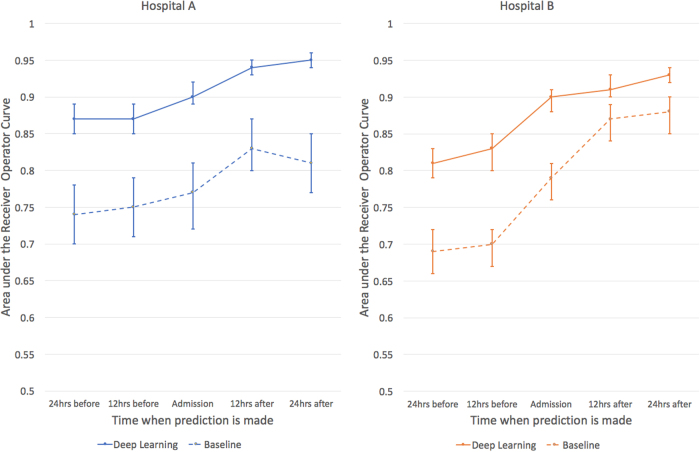
- For inpatient mortality at 24 h after admission, AUROC was 0.95 at Hospital A and 0.93 at Hospital B, versus 0.85 and 0.86 for the augmented Early Warning Score baseline.
- For 30-day readmission at discharge, AUROC was 0.77 at Hospital A and 0.76 at Hospital B, versus 0.70 and 0.68 for the modified HOSPITAL baseline; for long length of stay at 24 h, AUROC was 0.86 and 0.85, versus 0.76 and 0.74 for the modified Liu baseline.
- For predicting all discharge diagnoses (14,025 ICD-9 codes), weighted AUROC was 0.87/0.86 at admission and 0.90 at discharge for both hospitals; micro-F1 at discharge was 0.41 (Hospital A) and 0.40 (Hospital B).
## Methods
- Design: Retrospective study comparing deep learning models to traditional predictive models across two hospitals, with separate results reported for each site.
- Data/sample: De-identified EHR data from UCSF (2012–2016) and UCM (2009–2016), including adults 18+ with hospitalizations of 24 h or longer; UCM also included free-text notes.
- Analysis: Raw EHR data were converted into time-ordered FHIR-based token sequences and used to train three model types (LSTM, attention-based TANN, and boosted time-based decision stumps), with outputs ensembled; data were split 80/10/10 into development/validation/test sets and evaluated using AUROC, calibration curves, work-up-to-detection ratio, and micro-F1.
## Limitations
- The authors state it is a retrospective study, with “all of the usual limitations.”
- They state that prospective trials are needed to show that accurate predictions improve care.
- They note their approach does not harmonize data between sites, limiting transfer to new sites/cohorts; they also say the methods are computationally intensive and require specialized expertise.
- Evident from the text: the study’s diagnosis task is restricted to ICD-9 codes, and the authors caution that AUROC differences between hospitals, especially regarding notes, cannot be attributed solely to notes because the cohorts differed.
Model-written summary. Check it against the paper before relying on it.
Integrity signals
Registry
Cites
Statistics
Figures
Verification
Claims the paper makes
7 Valid · 0 Not valid · 6 Not checked · 33 Own results and interpretations
The cited sources support only part of this claim — read each source’s verdict below.
In the paper
“We are not aware of a study that predicts as many ICD codes as this study, but our micro-F1 score exceeds that shown on the smaller MIMIC-III dataset when predicting fewer diagnoses (0.40 vs 0.28).68”
§ Scalable and accurate deep learning with electronic health records > Discussion
What the sources say
- Partly supportedcites [68] Perotte A Diagnosis code assignment: models and evaluation metrics J. Am. Med. Inform. Assoc. 2014 21 231 237 10.1136/amiajnl-2013-002159 24296907 PMC3932472 sourceExperimental — accuracy not yet measured
The Results > Prediction models section reports a 27.6% F-measure for the flat SVM, consistent with the cited 0.28 after rounding. But Materials and methods > Datasets identifies the dataset as MIMIC II, not MIMIC-III; the Results also report a higher 39.5% F-measure for this paper’s hierarchy-based model. No page numbers are available in our copy. (LLM, conf=0.89)
hedged- Asserted: passes — The authors put it forward as true.
- Checkable: passes — It can be checked against evidence.
- Load-bearing: passes — The paper’s conclusions depend on it.
- Based: passes — The paper gives a reason why it holds.
- Rests on an assumption not shown here.
- Partly supported
The cited sources support only part of this claim — read each source’s verdict below.
In the paper
“A major challenge in using more of the data available for each patient has been the lack of standards and semantic interoperability of health data from multiple sites.25”
§ Scalable and accurate deep learning with electronic health records > Introduction > Related work
What the sources say
- Partly supportedcites [25] Sun H Semantic processing of EHR data for clinical research J. Biomed. Inform. 2015 58 247 259 10.1016/j.jbi.2015.10.009 26515501 sourceExperimental — accuracy not yet measured
The Introduction (p.1) and Conclusion (Section 5) of our copy clearly support the semantic-interoperability half of the claim: 'the semantic interoperability between different standards remains a challenge', and 'there is no single standard that could serve as the interoperability hub for all the existing clinical data sources and clinical applications', with the Abstract framing the whole paper as responding to 'a growing need to semantically process and integrate clinical data from different sources for clinical research' (multi-site sources are illustrated in Section 4.1.1: a German hospital Oracle database and an Italian regional IHE QED registry). However, the claim's 'lack of standards' is not what this paper says: the Introduction states that standards such as HL7, openEHR and ISO 13606 HAVE been developed to tackle storage and exchange of clinical data, and the residual problem is interoperability AMONG them plus the absence of one unifying hub standard, not an absence of standards. The claim also generalises the source's specific concern (secondary use/reuse of EHR data for clinical research applications) to 'using more of the data available for each patient'. (LLM, conf=0.70)
plainstates a cause- Asserted: passes — The authors put it forward as true.
- Checkable: passes — It can be checked against evidence.
- Load-bearing: passes — The paper’s conclusions depend on it.
- Based: passes — The paper gives a reason why it holds.
- Partly supported
Every source the paper cites for this claim was checked and supports it.
In the paper
“In the current study, we caution that the differences in AUROC across the two hospitals (one with and one without notes) cannot be ascribed to the presence or absence of notes given the difference in cohorts.45”
§ Scalable and accurate deep learning with electronic health records > Discussion
What the sources say
- Supportedcites [45] Walsh C Hripcsak G The effects of data sources, cohort selection, and outcome definition on a predictive model of risk of thirty-day hospital readmissions J. Biomed. Inform. 2014 52 418 426 10.1016/j.jbi.2014.08.006 25182868 PMC4261028 source
The Discussion states that cohort selection affects discriminatory performance and that comparing performance across studies requires the cohorts to be the same. This supports the citing authors’ caution against attributing their two hospitals’ AUROC difference to the presence or absence of notes when the cohorts also differ; the two-hospital comparison is their own study, not a result attributed to this source. (LLM, conf=0.90)
plain- Asserted: passes — The authors put it forward as true.
- Checkable: passes — It can be checked against evidence.
- Load-bearing: passes — The paper’s conclusions depend on it.
- Based: passes — The paper gives a reason why it holds.
- Supported
A result the paper reports from its own data — it cites no other source for it, so there is none to check. The quote shows it is in the paper.
In the paper
“For classifying all diagnosis codes, the weighted AUROCs at admission were 0.87 for Hospital A and 0.86 for Hospital B.”
§ Scalable and accurate deep learning with electronic health records > Results > Inferring discharge diagnoses
plain- Asserted: passes — The authors put it forward as true.
- Checkable: passes — It can be checked against evidence.
- Load-bearing: passes — The paper’s conclusions depend on it.
- Based: passes — The paper gives a reason why it holds.
- Rests on 2 assumptions not shown here.
A result the paper reports from its own data — it cites no other source for it, so there is none to check. The quote shows it is in the paper.
In the paper
“For predicting long length of stay, the AUROCs at 24 h after admission were 0.86 (95% CI 0.86–0.87) for Hospital A and 0.85 (95% CI 0.84–0.86) for Hospital B.”
§ Scalable and accurate deep learning with electronic health records > Results > Long length of stay
plain- Asserted: passes — The authors put it forward as true.
- Checkable: passes — It can be checked against evidence.
- Load-bearing: passes — The paper’s conclusions depend on it.
- Based: passes — The paper gives a reason why it holds.
- Rests on an assumption not shown here.
18 more claims
Create a free account to see all 46 claims and to verify the 2 references still open.
- It may state two separate claims as one. 16
- Probably not a substantial claim. 10
Claims other papers make about this one
Each is checked against this paper’s own text: does it say what the citing paper says it does?
The source backs part of the claim, not all of it — or backs it for a different population, condition or comparison.
In the citing paper
“The most important difference is that the study included co-morbidities, which have been proven to enable better predictions of disease progression trends and treatment outcomes.25,26”
From Development and validation of a screening tool for sepsis without laboratory results in the emergency department: a machine learning study (2025) · cites this paper as [26]
Experimental — accuracy not yet measuredThe source backs part of the claim, not all of it — or backs it for a different population, condition or comparison.
In the citing paper
“For both structured codes and unstructured notes, standardized vocabularies including FHIR [6] and UMLS CUIs [62,63] are introduced to transfer raw tokens into unique phrases to reduce the sparsity of the input data.”
From Deep representation learning of patient data from Electronic Health Records (EHR): A systematic review (2021) · cites this paper as [6]
Experimental — accuracy not yet measuredThe source backs part of the claim, not all of it — or backs it for a different population, condition or comparison.
In the citing paper
“Some FEMRs have tackled this problem by combining unstructured EHR data (i.e., text) with structured EMR data to boost performance on specific phenotyping and prediction tasks69,70.”
From The shaky foundations of large language models and foundation models for electronic health records (2023) · cites this paper as [69]
Experimental — accuracy not yet measuredThe cited source says what the claim attributes to it.
In the citing paper
“To improve performance and provide a degree of interpretability to the model, an attention mechanism is adopted in 13 studies [6,14,27,31,43,57,64,72,76–78,80,88].”
From Deep representation learning of patient data from Electronic Health Records (EHR): A systematic review (2021) · cites this paper as [6]
The cited source says what the claim attributes to it.
In the citing paper
“Advances in artificial intelligence (AI) are driving a revolution across science, enabling exciting new results across chemistry,80–82 biology,83,84 and medicine.85–88”
From Artificial Intelligence and Early Detection of Pancreatic Cancer: 2020 Summative Review (2021) · cites this paper as [85]
8 more claims about this paper
Create a free account to see every claim other papers make about this one.
Citations
Cites
Hochreiter, S., & Schmidhuber, J. (1997) · Neural Computation · doi:10.1162/neco.1997.9.8.1735 · Cited by 102,318 · cited 9×
“Patient records vary significantly in length and density of data-points (e.g. vital sign measurements in an intensive care unit vs outpatient clinic), so we formulated three deep learning neural-network model architectures that take advantage of such data in different ways: one based on recurrent neural networks (LSTM)…”
MethodInfluentialLeCun, Y., Bengio, Y., & Hinton, G. (2015) · Nature · doi:10.1038/nature14539 · Cited by 84,126
Scikit-learn: Machine Learning in Python
Pedregosa, F., Varoquaux, G., Gramfort, A., Michel, V., Thirion, B., Grisel, O., Blondel, M., Müller, A., Nothman, J., Louppe, G., et al. (2012) · arXiv · doi:10.48550/arxiv.1201.0490 · Cited by 71,016
APACHE II: A severity of disease classification system
KNAUS, W. A., DRAPER, E. A., WAGNER, D. P., & ZIMMERMAN, J. E. (1985) · Critical Care Medicine · doi:10.1097/00003246-198510000-00009 · Cited by 13,664
Representation Learning: A Review and New Perspectives
Bengio, Y., Courville, A., & Vincent, P. (2013) · IEEE Transactions on Pattern Analysis and Machine Intelligence · doi:10.1109/tpami.2013.50 · Cited by 13,001 · cited 1×
“Our central insight is that rather than explicitly harmonizing EHR data, mapping it into a highly curated set of structured predictors variables and then feeding those variables into a statistical model, we can instead learn to simultaneously harmonize inputs and predict medical events through direct feature learning…”
BackgroundMIMIC-III, a freely accessible critical care database
Johnson, A. E. W., Pollard, T. J., Shen, L., Lehman, L.-W. H., Feng, M., Ghassemi, M., Moody, B., Szolovits, P., Anthony Celi, L., & Mark, R. G. (2016) · Scientific Data · doi:10.1038/sdata.2016.35 · Cited by 8,141 · cited 1×
“ecord, which includes clinical free-text notes as well as large amounts of structured and semi-structured data. Because of the availability of Medical Information Mart for Intensive Care (MIMIC) data [48], many prior studies also have focused on ICU patients from a single center [92, 41]; other single-center studies h…”
MethodGulshan, V., Peng, L., Coram, M., Stumpe, M. C., Wu, D., Narayanaswamy, A., Venugopalan, S., Widner, K., Madams, T., Cuadros, J., et al. (2016) · JAMA · doi:10.1001/jama.2016.17216 · Cited by 7,697 · cited 1×
“Deep learning emerged as the preferred machine learning approach in machine perception problems ranging from computer vision to speech recognition, but has more recently proven useful in natural language processing, sequence prediction, and mixed modality data settings([36, 16, 21, 56]).”
BackgroundMandell, L. A., Wunderink, R. G., Anzueto, A., Bartlett, J. G., Campbell, G. D., Dean, N. C., Dowell, S. F., File, T. M., Musher, D. M., Niederman, M. S., et al. (2007) · Clinical Infectious Diseases · doi:10.1086/511159 · Cited by 6,202 · cited 1×
“of only 27 variables, rely on traditional generalized linear models, and are built using data at a single center. In clinical practice, simpler models are most commonly deployed, such as the CURB-65 [68, 60], which is a 5-factor model, or single-parameter warning scores [20, 45]. A major challenge in using more of the…”
MethodAPACHE II: a severity of disease classification system.
Knaus, W. A., Draper, E. S., Wagner, D. P., & Zimmerman, J. E. (1985) · PubMed · Cited by 6,034
Predicting the future - big data, machine learning, and clinical medicine
Obermeyer, Z., & Emanuel, E. J. (2016) · New England Journal of Medicine · doi:10.1056/nejmp1606181 · Cited by 3,652 · cited 1×
“In our case study, the model identified elements of the patient’s history and radiology findings to render its prediction, which are critical data-points that a clinician would also use [41].”
Method
Research works printed but not linked: 5
- Wu, Y. et al. Google’s neural machine translation system: bridging the gap between human and machine translation. arXiv [cs.CL] (2016).
- Aczon, M. et al. Dynamic mortality risk predictions in pediatric critical care using recurrent neural networks. arXiv [stat.ML] (2017).
- Suresh, H. et al. Clinical intervention prediction and understanding using deep networks. arXiv [cs.LG] (PMLR, Los Angeles, CA, USA, 2017).
- Razavian, N., Marcus, J. & Sontag, D. Multi-task prediction of disease onsets from longitudinal laboratory tests. In Proceedings of the 1st Machine Learning for Healthcare Conference, (eds F. Doshi-Velez, J. Fackler, D. Kale and B. Wallace, J. Wiens) Vol. 56, pp 73–100 (PMLR, Los Angeles, CA, 2016).
- Bahdanau, D., Cho, K. & Bengio, Y. Neural machine translation by jointly learning to align and translate. arXiv [cs.CL] (2014).
Cited by
Items 1,901–2,000 of 2,601
Wakefield, C., & Frasch, M. G. (2022) · medRxiv · doi:10.1101/2022.02.23.22271437
“Introduction The promise of machine learning (ML) to predict patient outcomes based on diverse data from electronic medical records (EMRs) is only beginning to be realized.(1,2)”
BackgroundAcute coronary syndrome risk prediction by ensemble‐MLPs
Li, W., Bai, L., Li, Y., Zhang, Y., Wang, J., & Peng, Y. (2022) · Electronics Letters · doi:10.1049/ell2.12499
Self-citationWang, Y.-J., Chen, M., Huang, Y. C., et al. (2021) · doi:10.2196/preprints.27437
Quality & safety in the literature: May 2021
González, J. J., Houchens, N., & Gupta, A. B. (2021) · BMJ Quality & Safety · doi:10.1136/bmjqs-2021-013322 · Cited by 1
Browning, S. D., Lee, S., Belay, E. D., DeCuir, J., Godfred‐Cato, S., Patel, P., Schwartz, N. G., & Wong, K. K. (2022) · medRxiv · doi:10.1101/2022.04.13.22273835
“Indeed, time-aware models have previously achieved some of the best performance on EMR prediction tasks [1], likely because of the rich health information preserved by intact patient-level time courses.”
BackgroundMethodResultInfluentialA Novel Classification of Cancer Based on Tumor RNA-Sequence (RNA-Seq) Gene Expression
Koparde, S. A. (2022) · Algorithms for intelligent systems · doi:10.1007/978-981-16-9650-3_43
HPEMed: Heterogeneous Network Pair Embedding for Medical Diagnosis
Li, M., Zhang, J., Chen, L., Fu, Y., & Zhou, C. (2022) · Communications in computer and information science · doi:10.1007/978-981-19-4549-6_28
Proyecciones de la ciencia de datos en la cirugía cardíaca
Mora, J. (2022) · Revista Médica Clínica Las Condes · doi:10.1016/j.rmclc.2022.05.007 · Cited by 4
Placido, D., Thorsen‐Meyer, H., Kaas‐Hansen, B. S., Reguant, R., & Brunak, S. (2022) · medRxiv · doi:10.1101/2022.08.30.22279381
Text Feature Extraction and Representation of Chinese Mental Verbs Based on Deep Learning
Wang, Y., & Chuan, T. B. (2022) · Scientific Programming · doi:10.1155/2022/7496054
“Deep learning models have been widely applied in articial intelligence and other elds and also have obvious application prospects in face recognition [1], information security [2], molecular microscopy [3], retinopathy monitoring [4], and other elds.”
BackgroundAfshar, M., Adelaine, S., Resnik, F., Mundt, M. P., Long, J., Leaf, M. A., Ampian, T., Wills, G. J., Schnapp, B. H., Chao, M., et al. (2022) · medRxiv · doi:10.1101/2022.12.04.22282990
iBiopsy® for Precision Medicine
Brag, J., Auffret, M., Ramos, C., Liu, Y., & Baudot, P. (2018) · European Medical Journal · doi:10.33590/emj/10310309
The role of innovative telehealth system in revolutionizing healthcare
Sharma, V. L., Kumawat, T. K., Garg, R., Bhatt, A., Kandwani, N., Dubey, G., & Biyani, M. (2023) · Elsevier eBooks · doi:10.1016/b978-0-323-98381-5.00015-5
Future Developments and Assimilation of AI in Radiology
Agarwal, A., & Murray, T. E. (2023) · AI in Clinical Medicine · doi:10.1002/9781119790686.ch35
(2023) · Oxford University Press eBooks · doi:10.1093/med/9780197556269.002.0014
Artificial Autonomy or Relational Intelligence: How Relationality Matters in Health Monitoring
Ho, A. (2023) · Oxford University Press eBooks · doi:10.1093/med/9780197556269.003.0002
Artificial Doctoring: The Case of Direct-to-Consumer Health Monitoring
Ho, A. (2023) · Oxford University Press eBooks · doi:10.1093/med/9780197556269.003.0004
(2023) · Oxford University Press eBooks · doi:10.1093/med/9780197556269.002.0003
(2023) · Oxford University Press eBooks · doi:10.1093/med/9780197556269.002.0005
(2023) · Oxford University Press eBooks · doi:10.1093/med/9780197556269.002.0007
Ho, A. (2023) · Oxford University Press eBooks · doi:10.1093/med/9780197556269.003.0006
Independent Living With(out) Privacy: Artificial Intelligence Home Health Monitoring
Ho, A. (2023) · Oxford University Press eBooks · doi:10.1093/med/9780197556269.003.0003
Adaptive Scaling for U-Net in Time Series Classification
Cheng, W., & Suganthan, P. N. (2023) · Lecture notes in computer science · doi:10.1007/978-3-031-30105-6_26
Integrative data analysis and automated deep learning technique for ovary cancer detection
Acharya, S., Ghosh, D., Swapnarekha, H., Mishra, M., & Nayak, S. R. (2023) · Elsevier eBooks · doi:10.1016/b978-0-323-85240-1.00007-9
Mode Connections For Clinical Incremental Learning: Lessons From The COVID-19 PandemicPreprint
Thakur, A., Wang, C., Ceritli, T., Clifton, D. A., & Eyre, D. W. (2023) · medRxiv · doi:10.1101/2023.05.05.23289583 · Cited by 1
“Healthcare is poised to undergo a revolution as deep learning is set to provide improved diagnostics (Liu et al., 2019), personalised medicine (Wilkinson et al., 2020), efficient critical care (Sun et al., 2019) and effective management of critical resources (Rajkomar et al., 2018).”
BackgroundResearch Trends of Medical Big Data: A Bibliometric Analysis (Preprint)Preprint
Wang, Y. J., Xu, L., Dong, J., Li, Y., Lai, S., Peng, Y.-H., Jiang, Z., & Hao, L. (2023) · doi:10.2196/preprints.48846
Prognosis and Diagnosis of Cancer Using Robotic Process Automation
Sreekrishna, M., & Jacob, T. P. (2023) · EAI/Springer Innovations in Communication and Computing · doi:10.1007/978-3-031-27700-9_21
Patel, S. K., Fung, M., Butalia, S., & Anderson, T. J. (2023) · medRxiv · doi:10.1101/2023.07.20.23292978
“Emerging technologies like the Patient Activation Measure and artificial intelligence could aid in predicting avoidable hospitalizations, allowing physicians to allocate more resources to preventative care.(38,39) Additionally, specialized chest pain clinics could provide a multidisciplinary approach to patient care,…”
BackgroundAmico, B., Combi, C., & D, Y. S. M. (2023) · Springer eBooks · doi:10.1007/978-3-031-24628-9_27
High Accuracy Automated Differential Diagnosis using Machine Learning
Cherian, A. M., Tonasalli, N., Gupta, D., Joseph, J., & Kingsly, S. (2023) · International Conference on Inventive Research in Computing Applications (ICIRCA) · doi:10.1109/icirca57980.2023.10220703
Impact of Artificial Intelligence on Medical Science Post Covid 19 Pandemic
Aryaman, Y., & Tyagi, A. K. (2023) · Wiley eBooks · doi:10.1002/9781394166954.ch13
Multi-Way Adaptive Time Aware Lstm for Irregularly Collected Sequential Icu DataPreprint
Cissoko, M. B. H., Castelain, V., & Lachiche, N. (2023) · SSRN Electronic Journal · doi:10.2139/ssrn.4567952
Deep neural networks for time series classification
Cheng, W. (2023) · DR-NTU (Nanyang Technological University) · doi:10.32657/10356/170362
Prabakaran, B. S., & Shafique, M. (2023) · Springer eBooks · doi:10.1007/978-3-031-40677-5_2
Kioskli, K., Papastergiou, S., & Fotis, T. G. (2023) · Journal of Engineering Research and Sciences · doi:10.55708/js0209001
“This approach ensures compliance with privacy regulations and promotes responsible use of AI technologies in healthcare [21].”
BackgroundArtificial intelligence and deep learning in molecular testing
Levy, J., & Vaickus, L. J. (2023) · Elsevier eBooks · doi:10.1016/b978-0-12-822824-1.00002-x
Debiasing patient embeddings for clinical applications
Brock, L. (2023) · Digital Repository Service (Northeastern University) · doi:10.17760/d20560778
Lupus Nephritis Subtype Classification with only Slide Level labelsPreprint
Sharma, A., Chauhan, E., Uppin, M. S., Rajasekhar, L., Jawahar, C. V., & Vinod, P. K. U. (2023) · medRxiv · doi:10.1101/2023.12.03.23299357 · Cited by 1
“Deep learning has recently emerged as a powerful tool in medical AI and healthcare, revolutionizing various aspects of medicine, from diagnosis and treatment to drug discovery and patient monitoring [2].”
BackgroundA survey on deep learning for medical healthcare: Techniques and applications
Archana, K., & Kaur, A. (2023) · AIP conference proceedings · doi:10.1063/5.0179980
Han, S., Kim, Y. B., No, J. H., Suh, D. H., Kim, K., & Ahn, S. (2023) · JMIR Medical Informatics · doi:10.2196/45377 · Cited by 1
MD, R. M. R. (2024) · Wiley eBooks · doi:10.1002/9781394240197.ch10
Razmi, R. M. (2024) · Wiley eBooks · doi:10.1002/9781394240197.ch7
Multi-Source Graph Synthesis (MUGS) for Pediatric Knowledge Graphs from Electronic Health RecordsPreprint
Li, M., Li, X., Pan, K., Geva, A., Yang, D. Y., Sweet, S. M., Bonzel, C.-L., Panickan, V. A., Xiong, X., Mandl, K. D., et al. (2024) · medRxiv · doi:10.1101/2024.01.14.24301302
A Coronavirus Cohort Case Study - Dataset Trends using Machine Learning Methods
Kim, E., Isozaki, I., Tripathi, S., et al. (2023) · IEEE International Conference on Bioinformatics and Biomedicine (BIBM) · doi:10.1109/bibm58861.2023.10385496
“With the increasing availability of electronic health records and the vast amounts of health-related data generated every day, AI has emerged as a powerful tool to help researchers and healthcare professionals better understand and treat a wide range of diseases [2].”
BackgroundTime Series Prediction Models for Assisting the Diagnosis and Treatment of Gouty Arthritis
Chen, T., Qiu, W., Zhu, F., Zhu, H., Li, S., Wang, M., & Hao, T. (2024) · Communications in computer and information science · doi:10.1007/978-981-99-9864-7_26
Automatic Prediction of Multiple Associated Diseases Using a Dual-Attention Neural Network Model
Ren, Y., Wang, Z., & Tong, W. (2024) · Communications in computer and information science · doi:10.1007/978-981-99-9864-7_24
Smart HealthCare Consultation Using Machine Learning
(2024) · International Research Journal of Modernization in Engineering Technology and Science · doi:10.56726/irjmets49833
Li, H., Yao, H., Gao, Y., Luo, H., Cai, C., Zhou, Z., Yuan, M., & Jiang, W. (2024) · Research Square · doi:10.21203/rs.3.rs-3897715/v1
A System Approach to Detect Medical Errors in Operational Data in Hospitals
Aldoihi, S. A., Alblalaihid, K. S., Alzemaia, F. A., Almoajel, A. M., Hammami, O., & Alwablely, S. (2023) · IEEE/ACS International Conference on Computer Systems and Applications (AICCSA) · doi:10.1109/aiccsa59173.2023.10479263
“For example, Rajkomar et al.[15] proposed a deep learning model to predict in-hospital mortality, readmission, and other outcomes using electronic health records.”
BackgroundINTEGRATING ARTIFICIAL INTELLIGENCE AND HEALTHCARE : DIAGNOSTICS AND TREATMENT OUTCOME
(2024) · International Research Journal of Modernization in Engineering Technology and Science · doi:10.56726/irjmets51742
Jiang, X., & Wang, B. (2024) · doi:10.2196/preprints.58812
Young Minds, Rare Finds, and the Path to Publish Case Reports
Pashine, A. A., Naqvi, W. M., & Arora, S. P. (2024) · European Journal of Therapeutics · doi:10.58600/eurjther2138 · Cited by 1
Predictive Model of Electronic Medical Record for Diabetic Nephropathy
Palaur, S., Mahapatra, R. K., Rout, N. K., Patnaik, A. P., Dash, S. R., & Barra, P. (2024) · International Conference on Advancements in Smart, Secure and Intelligent Computing (ASSIC) · doi:10.1109/assic60049.2024.10507894
“They have taken 216,221 inpatients, of whom 114,003 are in specific categories, and got 2.3% of in-hospital deaths, 12.9% of readmissions, which were unplanned, and a long duration of hospitalization of 23.9% [19].”
BackgroundInfluentialLiu, G., Ye, J., & Wang, B. (2024) · Lecture notes in computer science · doi:10.1007/978-981-97-2238-9_24
Use of Artificial Intelligence in Early Warning Score in Critical ill Patients: Scoping Review
Ismail, S., Wardah, Z., & Wibowo, A. (2023) · JURNAL INFO KESEHATAN · doi:10.31965/infokes.vol21.iss4.1105 · Cited by 1
“Deep learning is a type of machine learning that can recognize intricate patterns in data and produce outcomes based only on the data input, without the need for explicit predictors (Rajkomar et al., 2018).”
BackgroundKumar, B., Evin, M., Byeon, H., Sivaprakash, M., Sheeba, P. M., & Sunil, J. (2024) · IEEE International Conference on Intelligent Techniques in Control, Optimization and Signal Processing (INCOS) · doi:10.1109/incos59338.2024.10527505
Yang, H.-J., Do, T.-C., Kim, S.-H., Kho, B., & Park, J.-K. (2024) · SSRN Electronic Journal · doi:10.2139/ssrn.4847060
Artificial Intelligence and Machine Learning in Restoring and Strengthening HealthCare
Gangwar, H., & Arora, A. (2024) · Springer eBooks · doi:10.1007/978-981-97-2596-0_7
Personalized Federated Learning with Multiple Classifier AggregationPreprint
Zheng, S., Zhu, Q., Lin, Q., et al. (2024) · SSRN Electronic Journal · doi:10.2139/ssrn.4865278
Villatoro, K. C., Estrada, C. M. C., Juárez‐Ramírez, R., & Solís, A. C. (2023) · International Conference in Software Engineering Research and Innovation (CONISOFT) · doi:10.1109/conisoft58849.2023.00041
“Also, in many real-world applications ranging from electronic health records [14] and human activity recognition [15] to acoustic scene classification [16] and cyber-security [17].”
BackgroundMachine learning-based techniques for computer-aided diagnosis
Lakshminarayana, M., Dhananjay, B., Hiremath, B. V., Narayanappa, C. K., Neelapu, B. C., & Sivaraman, J. (2024) · Advances in computers · doi:10.1016/bs.adcom.2024.06.002
Li, K., Kim, M. S., Yang, S., et al. (2024) · SSRN Electronic Journal · doi:10.2139/ssrn.4887272
Unveiling the Transformative Landscape: A Bibliometric Exploration of AI Integration in Healthcare
Chandel, A., Gopal, K., Pahuja, A., & Nayyar, V. (2024) · Advances in marketing, customer relationship management, and e-services book series · doi:10.4018/979-8-3693-6660-8.ch014
Saranya Jothi, C., Kavitha, J., Roselinkiruba, R., Shalini, A., Saral, G. B., & Surya, E. (2024) · Advances in computer and electrical engineering book series · doi:10.4018/979-8-3693-5613-5.ch006
Automatic Text Summarization for Medical Dataset-An Analysis
Agilandeeswari, L., Dagar, A., Deepthi, A., et al. (2024) · Lecture notes in networks and systems · doi:10.1007/978-3-031-64813-7_35
An introduction to the application of deep learning in the biomedical field
Ruisong, W. A. N. G., Shengnan, W. A. N. G., & Tieliu, S. H. I. (2024) · Scientia Sinica Vitae · doi:10.1360/ssv-2023-0297 · Cited by 1
Evolution of Generative AI in Healthcare
Thakur, N. (2024) · Advances in medical technologies and clinical practice book series · doi:10.4018/979-8-3693-3731-8.ch002 · Cited by 1
Suresh, N. V., Sridhar, J., Selvakumar, A., & Catherine, S. (2024) · Advances in healthcare information systems and administration book series · doi:10.4018/979-8-3693-7452-8.ch001 · Cited by 40
Machine Intelligence in Pancreatic Cancer
Yee, N. S., Ma, F., & Georgakopoulos‐Soares, I. (2023) · Springer eBooks · doi:10.1007/978-3-030-80962-1_317-1 · Cited by 1
Elankeerthana, R., Abirami, T., Jayadharshini, P., Prasath, V. U. S., Ragupathi, P., & Surandhar, G. (2024) · International Conference on Trends in Quantum Computing and Emerging Business Technologies (TQCEBT) · doi:10.1109/tqcebt59414.2024.10545223
“A survey of the literature on scalable and precise deep learning methods employing electronic health records (EHRs) was published by Rajkomar et al. (2018).”
BackgroundBARToM: a Transformer-based approach for multimodal electronic health records transformation
Li, R., & Kawakami, E. (2024) · International Conference on Medical and Health Informatics (ICMHI) · doi:10.1145/3673971.3673999
“In [3], researchers developed an unsupervised framework based on deep learning to derive disease subtypes from heterogeneous EHRs; [4] provided a sequentially formatted representation of patients’ entire raw EHR records which can be successfully applied to deep learning models for multiple medical…”
Extraction of patient subpopulations using transformer-encoded vectors
Holmes, B., Raymer, M. L., & Banerjee, T. (2024) · IEEE National Aerospace and Electronics Conference (NAECON) · doi:10.1109/naecon61878.2024.10670637
Prakash, S., Coleman, J., & Steinfeldt, J. (2024) · medRxiv · doi:10.1101/2024.09.17.24313797
Euteneier, A. (2024) · Erfolgskonzepte Praxis- & Krankenhaus-Management · doi:10.1007/978-3-662-67565-6_32
Euteneier, A. (2024) · Erfolgskonzepte Praxis- & Krankenhaus-Management · doi:10.1007/978-3-662-67565-6_25
A new ballgame: Sabercaremetrics and the future of clinical performance measurement
Liu, X., & Auerbach, A. D. (2024) · Journal of Hospital Medicine · doi:10.1002/jhm.13518
Self-citationAbatal, A., Еlachhab, A., & Billah, M. E. K. (2024) · Studies in computational intelligence · doi:10.1007/978-3-031-65038-3_27
Applications of Artificial Intelligence in predicting drug responses for Type 2 Diabetes (Preprint)Preprint
Garg, S., Kitchen, R. R., Gupta, R., & Pearson, E. R. (2024) · doi:10.2196/preprints.66831
FedGKD: personalized federated learning through grouping and distillation
Li, T., Lin, S. Y., Zhao, P., Li, Z., & Wang, J. (2024) · International Conference on Control, Robotics and Intelligent System (CCRIS) · doi:10.1117/12.3050605 · Cited by 1
“In recent years, with the rapid development of the Internet, artificial intelligence has become prevalent in all areas of people’s lives, especially in the areas of intelligent medical treatment 1 and web applications.”
Intelligent Decision Support in Personal Health: Personalized Health Coaching in Type 2 Diabetes
Mamykina, L., Mitchell, E. G., Desai, P. M., & Albers, D. J. (2024) · Cognitive informatics in biomedicine and healthcare · doi:10.1007/978-3-031-69947-4_17 · Cited by 1
Wang, S., & Boutelle, M. G. (2026) · Computer Methods and Programs in Biomedicine · doi:10.1016/j.cmpb.2026.109461
Pchelkin, A., Muzaleva, O. V., & Ахминеева, А. Х. (2024) · Russian Journal for Personalized Medicine · doi:10.18705/2782-3806-2024-4-5-384-389
Parmar, M. Y., Khare, S., Brahmbhatt, H., & Chaure, M. (2024) · BENTHAM SCIENCE PUBLISHERS eBooks · doi:10.2174/9789815305753124010008
Artificial Intelligence-Driven Tacrolimus Dosing: Improving Precision in Transplant Care (Preprint)Preprint
Huo, M., Perez, S. A., Awdishu, L., Kerr, J., Xie, P., Khan, A., Mekeel, K. L., & Nemati, S. (2024) · doi:10.2196/preprints.67302
Chaturvedi, A., Tiwari, R. V., Agrawal, S., & Kamble, S. (2024) · Advances in finance, accounting, and economics book series · doi:10.4018/979-8-3693-7580-8.ch019
Kulinkumar, P. R., Yasin, F. B., Singh, O. P., Abdulla, F. A., Balaganapathy, M., & Madhanagopal, J. (2024) · Journal of Back and Musculoskeletal Rehabilitation · doi:10.3233/bmr-240142
“Recent ML research has shown the superior performance of certain algorithms over logistic regression in healthcare applications [35].”
Transforming Healthcare Data Engineering: Driving Scalable, Accurate, and Impactful Decision-Making
Hallur, J. (2022) · International Journal of Scientific Research in Science Engineering and Technology · doi:10.32628/ijsrset221199
Liu, Y.-X., Zhang, Z., Mi, J., et al. (2024) · SSRN Electronic Journal · doi:10.2139/ssrn.5050197
Onishi, M., Takeshita, Y., Masuda, H., Katsuhisa, M., Saizen, Y., Ikuta, K., Kasamatsu, M., Fujii, M., Moriki, Y., Koujiya, E., et al. (2024) · Research Square · doi:10.21203/rs.3.rs-5399207/v1
Scalability of real-time data delivery from electronic health records
Kirilov, N. (2024) · Health and Technology · doi:10.1007/s12553-024-00932-w
“Rajkomar A. et al. identify the creation of datasets from the EHRs to be used for predictive modelling techniques as profoundly limiting scalability [22].”
Mishra, R., Satpathy, R., & Pati, B. (2024) · Odisha International Conference on Electrical Power Engineering, Communication and Computing Technology (ODICON) · doi:10.1109/odicon62106.2024.10797581
“This shift emphasizes the importance of data management in sectors like healthcare, where AI and machine learning have significantly improved diagnostic accuracy and treatment efficiency [13 & 20].”
Graph-Driven Multimodal Information Model for Robust Feature Fusion
Dai, J., Li, X., Xing, R., & Zheng, L. (2024) · IEEE International Conference on Bioinformatics and Biomedicine (BIBM) · doi:10.1109/bibm62325.2024.10822672 · Cited by 1
WT-LSTM for Intensive Care Unit Length-of-Stay Prediction with Real-Time Signal (Preprint)Preprint
Jiang, Y., Li, Q., & Zhang, W. (2025) · doi:10.2196/preprints.71247
The Impact of Artificial Intelligence on Personalized Nutrition and Healthcare Management
Lonkar, S., Sayyad, S. A., & Shastrakar, P. (2024) · DMIHER International Conference on Artificial Intelligence in Healthcare, Education and Industry (IDICAIHEI) · doi:10.1109/idicaiei61867.2024.10842769
Performance Analysis of CNN Model for Disease Prediction on Spark and Hadoop
Singh, M., Khantwal, S., Rawat, S., et al. (2024) · International Conference on Technological Advancements in Computational Sciences (ICTACS) · doi:10.1109/ictacs62700.2024.10841067
Assessing Knowledge and Representation of Artificial Intelligence in Solid Organ TransplantationPreprint
Liaigre, L., Lombardo, D., Chaumais, M., Degano, B., Bedouch, P., & Chanoine, S. (2025) · SSRN Electronic Journal · doi:10.2139/ssrn.5091947
Knowledge graph-based reasoning in medical healthcare scenarios for IoT applications
Liu, J., Liang, Z., Mu, C., Zhang, L., & Atkins, A. S. (2025) · Elsevier eBooks · doi:10.1016/b978-0-443-36370-2.00026-8
Mondal, P., Banerjee, P., & Majhi, V. (2025) · Elsevier eBooks · doi:10.1016/b978-0-443-13816-4.00003-6 · Cited by 1
InfEHR: Resolving Clinical Uncertainty through Deep Geometric Learning on Electronic Health RecordsPreprint
Kauffman, J., Holmes, E., Vaid, A., Charney, A. W., Kovatch, P., Lampert, J., Sakhuja, A., Žitnik, M., Glicksberg, B. S., Hofer, I. S., et al. (2025) · medRxiv · doi:10.1101/2025.01.31.25321471
Metadata
- Authors
- Rajkomar, A., Oren, E., Chen, K., Dai, A. M., Hajaj, N., Hardt, M., Liu, P. J., Liu, X., Marcus, J., Sun, M., Sundberg, P., Yee, H., Zhang, K., Zhang, Y., Flores, G., Duggan, G. E., Irvine, J., Le, Q., Litsch, K., Mossin, A., Tansuwan, J., Wang, D., Wexler, J., Wilson, J., Ludwig, D., Volchenboum, S. L., Chou, K., Pearson, M., Madabushi, S., Shah, N. H., Butte, A. J., Howell, M. D., Cui, C., Corrado, G. S., & Dean, J.
- Affiliations
- Google (United States) (US)
- University of California, San Francisco (US)
- University of Chicago (US)
- Stanford University (US)
- Corresponding author
- Rajkomar, Alvin
- Venue
- npj Digital Medicine
- Published
- 2018-05-08
- Volume
- 1
- Issue
- 1
- Pages
- 18-18
- ISSN
- 2398-6352 (ISSN-L)
- PMC
- PMC6550175
- OpenAlex
- W2784499877
- Cited by
- 2,648
- References
- 72
- Citations by year
- 2026: 494 · 2025: 457 · 2024: 370 · 2023: 280 · 2022: 228 · 2021: 304 · 2020: 275 · 2019: 186 · 2018: 54
- FWCI
- 115.37
- Type
- journal article
- Language
- en
- Open access
- gold
- doi.org
- Licence
- cc-by
- creativecommons.org/licenses/by/4.0 (tdm)
- creativecommons.org/licenses/by/4.0 (vor)
- Locations
- npj Digital Medicine (publishedVersion, cc-by)
- arXiv (Cornell University) (publishedVersion)
- Europe PMC (PubMed Central) (publishedVersion, cc-by)
- PubMed Central (publishedVersion, cc-by)
- PubMed (publishedVersion)
- DOAJ (DOAJ: Directory of Open Access Journals) (submittedVersion, cc-by-sa)
- eScholarship (California Digital Library) (submittedVersion, cc-by)
- arXiv (Cornell University)
- Topics
- Physical Sciences › Computer Science › Artificial Intelligence › Machine Learning in Healthcare
- Health Sciences › Health Professions › Health Information Management › Electronic Health Records Systems
- Health Sciences › Health Professions › Health Information Management › Artificial Intelligence in Healthcare
- Keywords
- electronic health records, FHIR, deep learning, in-hospital mortality prediction, unplanned hospital readmission, length of hospital stay, hospital discharge diagnoses, clinical notes, data harmonization
About these checks
Registry, retraction, Cites and statistics results are computed, not judged, with one exception: a printed reference that no index lists is read once by a model before it counts as a citation error. Claims are extracted by a model and kept only when their quote appears verbatim in the text; each cited source is then checked, with a model’s help, for whether it says what the claim relies on. Those verdicts can be wrong — read the claim’s quote and the cited source before relying on one.
The claim verdicts this report counts are experimental: their accuracy is not yet measured.
A language model drew the claims from the paper on 2026-10-10, under version 3 of the claim definition (model deepseek-v4.1-flash, prompt extract-v3).
A second model labelled each claim on 2026-10-10 (model jev-1.13-20260917, definition revision gold-guideline-v0.2).
Cited sources are checked with a language model’s help (gpt-6-sol and qwen3.8-omni-flash).
Statistics and arithmetic are recomputed, not judged.
Confidence bands are shown only for fields calibrated on our annotated test set. None is calibrated yet, so no band is shown.
What counts as a claim ›How we measure confidence ›How we check this ›
Are you an author, or do you see a problem with this page? Request a review
Data sources
Bibliographic data: Semantic Scholar, OpenAlex, Crossref.
Contains information from the Semantic Scholar Academic Graph Datasets, made available under the ODC Attribution License (ODC-BY 1.0).
Semantic Scholar’s data is described in: Kinney, R., et al. (2023). The Semantic Scholar Open Data Platform. arXiv:2301.10140.
