

Scalable and accurate deep learning with electronic health records
Open accessThe DOI matches its Crossref record; 75 of the 75 references it cites were found in a registry or an index; 8 of the 19 sources its claims cite were checked for support.
Abstract
Predictive modeling with electronic health record (EHR) data is anticipated to drive personalized medicine and improve healthcare quality. Constructing predictive statistical models typically requires extraction of curated predictor variables from normalized EHR data, a labor-intensive process that discards the vast majority of information in each patient's record. We propose a representation of patients' entire raw EHR records based on the Fast Healthcare Interoperability Resources (FHIR) format. We demonstrate that deep learning methods using this representation are capable of accurately predicting multiple medical events from multiple centers without site-specific data harmonization. We validated our approach using de-identified EHR data from two US academic medical centers with 216,221 adult patients hospitalized for at least 24 h. In the sequential format we propose, this volume of EHR data unrolled into a total of 46,864,534,945 data points, including clinical notes. Deep learning models achieved high accuracy for tasks such as predicting: in-hospital mortality (area under the receiver operator curve [AUROC] across sites 0.93-0.94), 30-day unplanned readmission (AUROC 0.75-0.76), prolonged length of stay (AUROC 0.85-0.86), and all of a patient's final discharge diagnoses (frequency-weighted AUROC 0.90). These models outperformed traditional, clinically-used predictive models in all cases. We believe that this approach can be used to create accurate and scalable predictions for a variety of clinical scenarios. In a case study of a particular prediction, we demonstrate that neural networks can be used to identify relevant information from the patient's chart.
Overview
CoChat Summary
## TL;DR
This retrospective study shows that a single deep learning pipeline using raw EHR data in FHIR format can predict multiple outcomes across two academic hospitals without site-specific feature harmonization. The models outperformed traditional baselines for inpatient mortality, 30-day readmission, long length of stay, and discharge diagnosis prediction.
## Key findings
- The study included 216,221 hospitalizations from 114,003 unique patients; in-hospital death occurred in 2.3% (4,930/216,221), unplanned 30-day readmission in 12.9% (27,918/216,221), and long length of stay in 23.9%.
- For inpatient mortality at 24 h after admission, AUROC was 0.95 at Hospital A and 0.93 at Hospital B, versus 0.85 and 0.86 for the augmented Early Warning Score baseline.
- For 30-day readmission at discharge, AUROC was 0.77 at Hospital A and 0.76 at Hospital B, versus 0.70 and 0.68 for the modified HOSPITAL baseline; for long length of stay at 24 h, AUROC was 0.86 and 0.85, versus 0.76 and 0.74 for the modified Liu baseline.
- For predicting all discharge diagnoses (14,025 ICD-9 codes), weighted AUROC was 0.87/0.86 at admission and 0.90 at discharge for both hospitals; micro-F1 at discharge was 0.41 (Hospital A) and 0.40 (Hospital B).
## Methods
- Design: Retrospective study comparing deep learning models to traditional predictive models across two hospitals, with separate results reported for each site.
- Data/sample: De-identified EHR data from UCSF (2012–2016) and UCM (2009–2016), including adults 18+ with hospitalizations of 24 h or longer; UCM also included free-text notes.
- Analysis: Raw EHR data were converted into time-ordered FHIR-based token sequences and used to train three model types (LSTM, attention-based TANN, and boosted time-based decision stumps), with outputs ensembled; data were split 80/10/10 into development/validation/test sets and evaluated using AUROC, calibration curves, work-up-to-detection ratio, and micro-F1.
## Limitations
- The authors state it is a retrospective study, with “all of the usual limitations.”
- They state that prospective trials are needed to show that accurate predictions improve care.
- They note their approach does not harmonize data between sites, limiting transfer to new sites/cohorts; they also say the methods are computationally intensive and require specialized expertise.
- Evident from the text: the study’s diagnosis task is restricted to ICD-9 codes, and the authors caution that AUROC differences between hospitals, especially regarding notes, cannot be attributed solely to notes because the cohorts differed.
Model-written summary. Check it against the paper before relying on it.
Integrity signals
Registry
Cites
Statistics
Figures
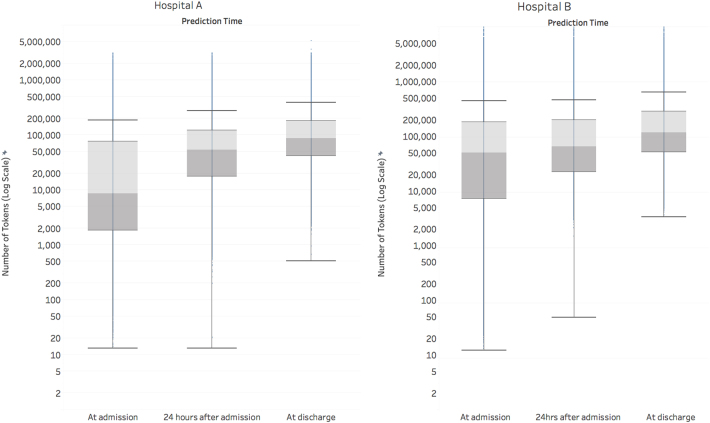
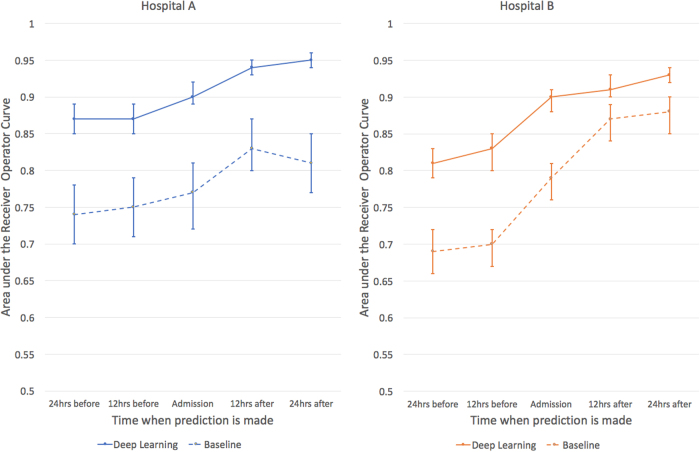
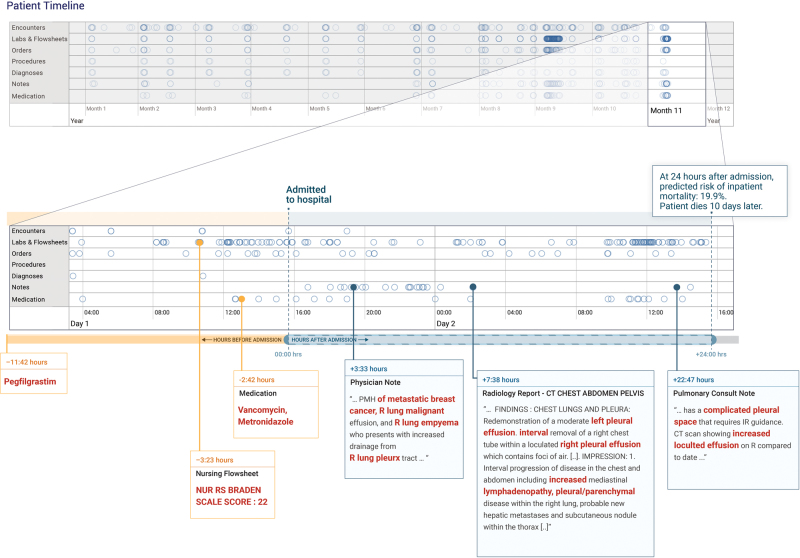
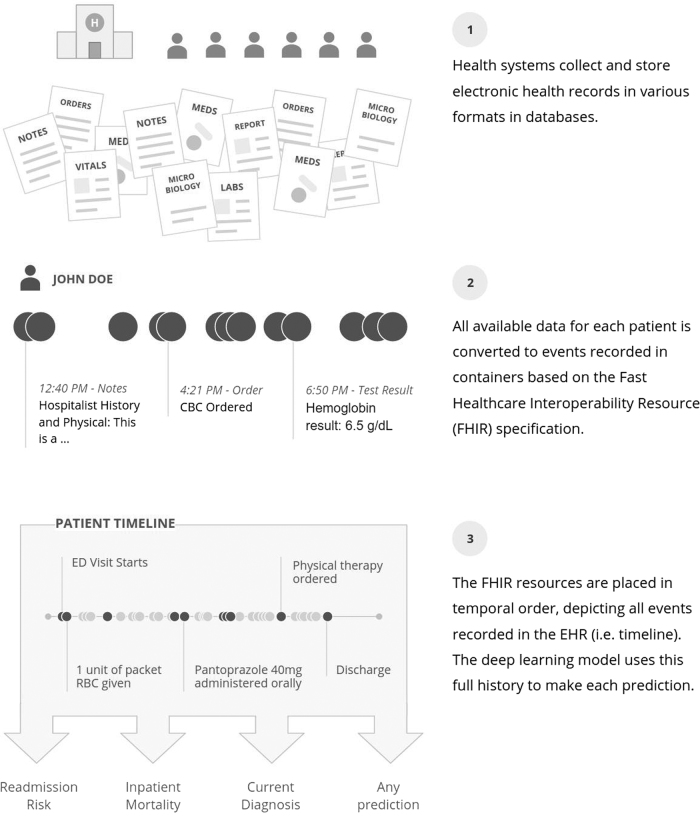
Verification
Claims the paper makes
7 Valid · 0 Not valid · 6 Not checked · 33 Own results and interpretations
The cited sources support only part of this claim — read each source’s verdict below.
In the paper
“We are not aware of a study that predicts as many ICD codes as this study, but our micro-F1 score exceeds that shown on the smaller MIMIC-III dataset when predicting fewer diagnoses (0.40 vs 0.28).68”
§ Scalable and accurate deep learning with electronic health records > Discussion
What the sources say
- Partly supportedcites [68] Perotte A Diagnosis code assignment: models and evaluation metrics J. Am. Med. Inform. Assoc. 2014 21 231 237 10.1136/amiajnl-2013-002159 24296907 PMC3932472 sourceExperimental — accuracy not yet measured
The Results > Prediction models section reports a 27.6% F-measure for the flat SVM, consistent with the cited 0.28 after rounding. But Materials and methods > Datasets identifies the dataset as MIMIC II, not MIMIC-III; the Results also report a higher 39.5% F-measure for this paper’s hierarchy-based model. No page numbers are available in our copy. (LLM, conf=0.89)
hedged- Asserted: passes — The authors put it forward as true.
- Checkable: passes — It can be checked against evidence.
- Load-bearing: passes — The paper’s conclusions depend on it.
- Based: passes — The paper gives a reason why it holds.
- Rests on an assumption not shown here.
- Partly supported
The cited sources support only part of this claim — read each source’s verdict below.
In the paper
“A major challenge in using more of the data available for each patient has been the lack of standards and semantic interoperability of health data from multiple sites.25”
§ Scalable and accurate deep learning with electronic health records > Introduction > Related work
What the sources say
- Partly supportedcites [25] Sun H Semantic processing of EHR data for clinical research J. Biomed. Inform. 2015 58 247 259 10.1016/j.jbi.2015.10.009 26515501 sourceExperimental — accuracy not yet measured
The Introduction (p.1) and Conclusion (Section 5) of our copy clearly support the semantic-interoperability half of the claim: 'the semantic interoperability between different standards remains a challenge', and 'there is no single standard that could serve as the interoperability hub for all the existing clinical data sources and clinical applications', with the Abstract framing the whole paper as responding to 'a growing need to semantically process and integrate clinical data from different sources for clinical research' (multi-site sources are illustrated in Section 4.1.1: a German hospital Oracle database and an Italian regional IHE QED registry). However, the claim's 'lack of standards' is not what this paper says: the Introduction states that standards such as HL7, openEHR and ISO 13606 HAVE been developed to tackle storage and exchange of clinical data, and the residual problem is interoperability AMONG them plus the absence of one unifying hub standard, not an absence of standards. The claim also generalises the source's specific concern (secondary use/reuse of EHR data for clinical research applications) to 'using more of the data available for each patient'. (LLM, conf=0.70)
plainstates a cause- Asserted: passes — The authors put it forward as true.
- Checkable: passes — It can be checked against evidence.
- Load-bearing: passes — The paper’s conclusions depend on it.
- Based: passes — The paper gives a reason why it holds.
- Partly supported
Every source the paper cites for this claim was checked and supports it.
In the paper
“In the current study, we caution that the differences in AUROC across the two hospitals (one with and one without notes) cannot be ascribed to the presence or absence of notes given the difference in cohorts.45”
§ Scalable and accurate deep learning with electronic health records > Discussion
What the sources say
- Supportedcites [45] Walsh C Hripcsak G The effects of data sources, cohort selection, and outcome definition on a predictive model of risk of thirty-day hospital readmissions J. Biomed. Inform. 2014 52 418 426 10.1016/j.jbi.2014.08.006 25182868 PMC4261028 source
The Discussion states that cohort selection affects discriminatory performance and that comparing performance across studies requires the cohorts to be the same. This supports the citing authors’ caution against attributing their two hospitals’ AUROC difference to the presence or absence of notes when the cohorts also differ; the two-hospital comparison is their own study, not a result attributed to this source. (LLM, conf=0.90)
plain- Asserted: passes — The authors put it forward as true.
- Checkable: passes — It can be checked against evidence.
- Load-bearing: passes — The paper’s conclusions depend on it.
- Based: passes — The paper gives a reason why it holds.
- Supported
A result the paper reports from its own data — it cites no other source for it, so there is none to check. The quote shows it is in the paper.
In the paper
“For classifying all diagnosis codes, the weighted AUROCs at admission were 0.87 for Hospital A and 0.86 for Hospital B.”
§ Scalable and accurate deep learning with electronic health records > Results > Inferring discharge diagnoses
plain- Asserted: passes — The authors put it forward as true.
- Checkable: passes — It can be checked against evidence.
- Load-bearing: passes — The paper’s conclusions depend on it.
- Based: passes — The paper gives a reason why it holds.
- Rests on 2 assumptions not shown here.
A result the paper reports from its own data — it cites no other source for it, so there is none to check. The quote shows it is in the paper.
In the paper
“For predicting long length of stay, the AUROCs at 24 h after admission were 0.86 (95% CI 0.86–0.87) for Hospital A and 0.85 (95% CI 0.84–0.86) for Hospital B.”
§ Scalable and accurate deep learning with electronic health records > Results > Long length of stay
plain- Asserted: passes — The authors put it forward as true.
- Checkable: passes — It can be checked against evidence.
- Load-bearing: passes — The paper’s conclusions depend on it.
- Based: passes — The paper gives a reason why it holds.
- Rests on an assumption not shown here.
18 more claims
Create a free account to see all 46 claims and to verify the 2 references still open.
- It may state two separate claims as one. 16
- Probably not a substantial claim. 10
Claims other papers make about this one
Each is checked against this paper’s own text: does it say what the citing paper says it does?
The source backs part of the claim, not all of it — or backs it for a different population, condition or comparison.
In the citing paper
“The most important difference is that the study included co-morbidities, which have been proven to enable better predictions of disease progression trends and treatment outcomes.25,26”
From Development and validation of a screening tool for sepsis without laboratory results in the emergency department: a machine learning study (2025) · cites this paper as [26]
Experimental — accuracy not yet measuredThe source backs part of the claim, not all of it — or backs it for a different population, condition or comparison.
In the citing paper
“For both structured codes and unstructured notes, standardized vocabularies including FHIR [6] and UMLS CUIs [62,63] are introduced to transfer raw tokens into unique phrases to reduce the sparsity of the input data.”
From Deep representation learning of patient data from Electronic Health Records (EHR): A systematic review (2021) · cites this paper as [6]
Experimental — accuracy not yet measuredThe source backs part of the claim, not all of it — or backs it for a different population, condition or comparison.
In the citing paper
“Some FEMRs have tackled this problem by combining unstructured EHR data (i.e., text) with structured EMR data to boost performance on specific phenotyping and prediction tasks69,70.”
From The shaky foundations of large language models and foundation models for electronic health records (2023) · cites this paper as [69]
Experimental — accuracy not yet measuredThe cited source says what the claim attributes to it.
In the citing paper
“To improve performance and provide a degree of interpretability to the model, an attention mechanism is adopted in 13 studies [6,14,27,31,43,57,64,72,76–78,80,88].”
From Deep representation learning of patient data from Electronic Health Records (EHR): A systematic review (2021) · cites this paper as [6]
The cited source says what the claim attributes to it.
In the citing paper
“Advances in artificial intelligence (AI) are driving a revolution across science, enabling exciting new results across chemistry,80–82 biology,83,84 and medicine.85–88”
From Artificial Intelligence and Early Detection of Pancreatic Cancer: 2020 Summative Review (2021) · cites this paper as [85]
8 more claims about this paper
Create a free account to see every claim other papers make about this one.
Citations
Cites
Hochreiter, S., & Schmidhuber, J. (1997) · Neural Computation · doi:10.1162/neco.1997.9.8.1735 · Cited by 102,318 · cited 9×
“Patient records vary significantly in length and density of data-points (e.g. vital sign measurements in an intensive care unit vs outpatient clinic), so we formulated three deep learning neural-network model architectures that take advantage of such data in different ways: one based on recurrent neural networks (LSTM)…”
MethodInfluentialLeCun, Y., Bengio, Y., & Hinton, G. (2015) · Nature · doi:10.1038/nature14539 · Cited by 84,126
Scikit-learn: Machine Learning in Python
Pedregosa, F., Varoquaux, G., Gramfort, A., Michel, V., Thirion, B., Grisel, O., Blondel, M., Müller, A., Nothman, J., Louppe, G., et al. (2012) · arXiv · doi:10.48550/arxiv.1201.0490 · Cited by 71,016
APACHE II: A severity of disease classification system
KNAUS, W. A., DRAPER, E. A., WAGNER, D. P., & ZIMMERMAN, J. E. (1985) · Critical Care Medicine · doi:10.1097/00003246-198510000-00009 · Cited by 13,664
Representation Learning: A Review and New Perspectives
Bengio, Y., Courville, A., & Vincent, P. (2013) · IEEE Transactions on Pattern Analysis and Machine Intelligence · doi:10.1109/tpami.2013.50 · Cited by 13,001 · cited 1×
“Our central insight is that rather than explicitly harmonizing EHR data, mapping it into a highly curated set of structured predictors variables and then feeding those variables into a statistical model, we can instead learn to simultaneously harmonize inputs and predict medical events through direct feature learning…”
BackgroundMIMIC-III, a freely accessible critical care database
Johnson, A. E. W., Pollard, T. J., Shen, L., Lehman, L.-W. H., Feng, M., Ghassemi, M., Moody, B., Szolovits, P., Anthony Celi, L., & Mark, R. G. (2016) · Scientific Data · doi:10.1038/sdata.2016.35 · Cited by 8,141 · cited 1×
“ecord, which includes clinical free-text notes as well as large amounts of structured and semi-structured data. Because of the availability of Medical Information Mart for Intensive Care (MIMIC) data [48], many prior studies also have focused on ICU patients from a single center [92, 41]; other single-center studies h…”
MethodGulshan, V., Peng, L., Coram, M., Stumpe, M. C., Wu, D., Narayanaswamy, A., Venugopalan, S., Widner, K., Madams, T., Cuadros, J., et al. (2016) · JAMA · doi:10.1001/jama.2016.17216 · Cited by 7,697 · cited 1×
“Deep learning emerged as the preferred machine learning approach in machine perception problems ranging from computer vision to speech recognition, but has more recently proven useful in natural language processing, sequence prediction, and mixed modality data settings([36, 16, 21, 56]).”
BackgroundMandell, L. A., Wunderink, R. G., Anzueto, A., Bartlett, J. G., Campbell, G. D., Dean, N. C., Dowell, S. F., File, T. M., Musher, D. M., Niederman, M. S., et al. (2007) · Clinical Infectious Diseases · doi:10.1086/511159 · Cited by 6,202 · cited 1×
“of only 27 variables, rely on traditional generalized linear models, and are built using data at a single center. In clinical practice, simpler models are most commonly deployed, such as the CURB-65 [68, 60], which is a 5-factor model, or single-parameter warning scores [20, 45]. A major challenge in using more of the…”
MethodAPACHE II: a severity of disease classification system.
Knaus, W. A., Draper, E. S., Wagner, D. P., & Zimmerman, J. E. (1985) · PubMed · Cited by 6,034
Predicting the future - big data, machine learning, and clinical medicine
Obermeyer, Z., & Emanuel, E. J. (2016) · New England Journal of Medicine · doi:10.1056/nejmp1606181 · Cited by 3,652 · cited 1×
“In our case study, the model identified elements of the patient’s history and radiology findings to render its prediction, which are critical data-points that a clinician would also use [41].”
Method
Research works printed but not linked: 5
- Wu, Y. et al. Google’s neural machine translation system: bridging the gap between human and machine translation. arXiv [cs.CL] (2016).
- Aczon, M. et al. Dynamic mortality risk predictions in pediatric critical care using recurrent neural networks. arXiv [stat.ML] (2017).
- Suresh, H. et al. Clinical intervention prediction and understanding using deep networks. arXiv [cs.LG] (PMLR, Los Angeles, CA, USA, 2017).
- Razavian, N., Marcus, J. & Sontag, D. Multi-task prediction of disease onsets from longitudinal laboratory tests. In Proceedings of the 1st Machine Learning for Healthcare Conference, (eds F. Doshi-Velez, J. Fackler, D. Kale and B. Wallace, J. Wiens) Vol. 56, pp 73–100 (PMLR, Los Angeles, CA, 2016).
- Bahdanau, D., Cho, K. & Bengio, Y. Neural machine translation by jointly learning to align and translate. arXiv [cs.CL] (2014).
Cited by
Items 2,201–2,300 of 2,601
Nandi, S., Patil, K., Datta, K. V., & M., J. (2026) · IEEE Access · doi:10.1109/access.2026.3665268
Curriculum Learning in Medical Image Analysis
Meghatria, R., Gaceb, D., & Touazi, F. (2025) · doi:10.1109/aiia68273.2025.11383658
“High-quality annotated datasets are scarce due to the cost and expertise required for labeling [2].”
Momenzadeh, M., & Oshaghi, A. (2026) · BMC Medical Informatics and Decision Making · doi:10.1186/s12911-026-03396-2 · Cited by 4
“The proliferation of electronic health records (EHRs) and digital healthcare technologies has created unprecedented opportunities for medical artificial intelligence research and clinical decision support systems [1].”
Joshi, S., Dahiya, S., Saifi, A., & Jena, A. (2025) · International Conference on Advancement in Electronics & Communication Engineering (AECE) · doi:10.1109/aece67531.2025.11386744
Integrating Nursing Process Data Into Machine Learning Models to Predict Healthcare Costs (Preprint)Preprint
González‐Chordá, V. M., & Orts‐Cortés, M. I. (2026) · doi:10.2196/preprints.93638
Blockchain-Enabled Predictive Analysis of Medical Images Using Hybrid Deep Learning
Kumar, G., Choudhary, S., Goel, B., Kumar, D., & Subhash (2025) · International Conference on Advancement in Electronics & Communication Engineering (AECE) · doi:10.1109/aece67531.2025.11386695
A Hybrid DPSO Approach for Automated Anemia Detection Through Palm Imaging
Kumar, G., Choudhary, S., Goel, B., Kumar, D., & Subhash (2025) · International Conference on Advancement in Electronics & Communication Engineering (AECE) · doi:10.1109/aece67531.2025.11386701
“For example, the average count of RBC is less than healthy RBC in a person leads to Iron Deficiency Anemia (IDA) [8].”
Wang, Z., Zhang, R., Liu, P. X., Zheng, M., & Wang, L. (2026) · Biomedical Signal Processing and Control · doi:10.1016/j.bspc.2026.109888
Self-citationExplaining Autism Detection by Deep Learning Through Eye Gaze Patterns and Integrated Gradients
Colonnese, F., Luzio, F. D., Colella, S., & Panella, M. (2026) · Smart innovation, systems and technologies · doi:10.1007/978-981-95-4076-1_5
Model for AI-Enhanced Disease Diagnosis and Prognosis
Ambad, R. S., Jha, R. K., Jha, R. K., & Kondhalkar, A. A. (2025) · DMIHER International Conference on Artificial Intelligence in Healthcare, Education and Industry (IDICAIHEI) · doi:10.1109/idicaihei65991.2025.11379110
“This supports the work of Rajkomar et al., who demonstrated the use of deep learning on EHRs for mortality and readmission predictions (17).”
SmartHomeoAssist: AI-Based Diagnosis and Decision Support for Homeopathy
Shiddewar, V., Burbure, S., Gourshettiwar, P., et al. (2025) · doi:10.1109/idicaihei65991.2025.11379866
Boosting Clinical Outcome Prediction with Context-Aware Feature Imputation and Disentanglement
Gong, L., Zhang, A., & Jha, K. (2025) · Proceedings · doi:10.1109/icdm65498.2025.00132
“For example, studies [4]–[8] proposed neural network-based approaches to leverage structured information (e.g., static baseline information, lab test values, historical diagnoses, etc.) from EHRs for accurate disease diagnosis prediction.”
Kumar, S., Amrin, M. S., Varshitha, M. S., Nandini, M., Nitheesha, K., & Sravani, M. (2025) · International Conference on Artificial Intelligence for Innovations in Healthcare Industries (ICAIIHI) · doi:10.1109/icaiihi67124.2025.11403099
“This collaborative dance between human know-how and AI smarts leads to more accurate diagnoses and boosts the clinician's confidence in their final decisions [8], [9].”
G.Palanikumar, Jayalakshmi, D., Sevanthi, P., et al. (2025) · International Conference on Artificial Intelligence for Innovations in Healthcare Industries (ICAIIHI) · doi:10.1109/icaiihi67124.2025.11403335
“…and medical text data to identify adverse drug reactions to boost up pharmacovigilance [16] Rajkomar et al. Machine learning models developed based on EHR data could predict patient deterioration, mortality, and prolonged hospital stays, thus providing useful decision support to clinicians [17].”
Enhancing Remote Healthcare Through Contactless Interaction
Žagar, M., Klapan, I., Majhen, Z., et al. (2025) · doi:10.1109/icamac67779.2025.11398669
“For example, convolutional neural networks (CNNs) have been used to identify diabetic retinopathy from retinal scans with over 90% accuracy [7].”
Bhogal, H., Chandra, A., Bhradwaj, A., Verma, A., Singh, A. K., & Patre, P. (2025) · International Conference on Artificial Intelligence for Innovations in Healthcare Industries (ICAIIHI) · doi:10.1109/icaiihi67124.2025.11403584 · Cited by 1
“The new achievements of the Natural Language Processing (NLP), speech recognition, and computer vision have helped the machines to make the human speech visible, analyze the medical pictures, and provide the clinical decision as close to the truth as possible [5]-[7].”
Sharma, Y., Thompson, C. H., Mangoni, A. A., Horwood, C., & Woodman, R. J. (2026) · Computers · doi:10.3390/computers15030138 · Cited by 1
AI in predicting ICD-10 codes and prescriptions medicine for heart failure patients
Noviyani, R., Wijayakusuma, I. G. N. L., Sari, I. A. Y. P., Antara, I. M. P. S., Yowani, S. C., & Widhiartini, I. A. A. (2026) · AIP conference proceedings · doi:10.1063/5.0317732
Sharma, V., Chawla, G. K., Kukreti, S., Ahuja, K., & Singh, S. (2026) · Exploration of Medicine · doi:10.37349/emed.2026.1001383 · Cited by 3
Integration of IoT in Healthcare Using Advanced Deep Learning Algorithms: A Research Survey
D, V. R. R., & Lakshminarayanan, R. (2025) · Modern Electronics Devices and Intelligent Communication Systems (MEDCOM) · doi:10.1109/medcom67532.2025.11405322
McOwiti, A., Neaimeh, Y., Gu, J., et al. (2026) · medRxiv · doi:10.64898/2026.02.23.26346757
Korucuk, N., Kömür, A. İ., İbze, S., Karaman, C., Gündüz, E. S., & Karaman, O. (2026) · Electrochimica Acta · doi:10.1016/j.electacta.2026.148581
AI-Driven Symptom-Based Disease Prediction for Efficient Healthcare Diagnosis
Budhraja, H., Gupta, M., Bhardwaj, N., & Agarwal, L. (2025) · International Conference on Modeling, Simulation & Intelligent Computing (MoSICom) · doi:10.1109/mosicom67153.2025.11398223 · Cited by 1
“In this project, various libraries used for data processing and model building were utilized, which are required to perform efficient and effective analysis and prediction [1], [4]- [6].”
Machine Learning-Enabled Real-Time Parameter Estimation and Control in Emergency Ventilator Systems
Chamarthy, S. S., & Sasidharan, P. (2025) · International Conference of Advances in Engineering and Computing Technologies for Sustainable Development (AECTSD) · doi:10.1109/aectsd65988.2025.11411267
“ML has the ability to create prediction and decision support models, identify useful patterns and rules from large amounts of clinical data, and offer more accurate and scientific treatment suggestions [7].”
Early Prediction of Chronic Kidney Diseases Using Machine Learning
Sudha, K., Srirengeshwar, C., Shreemitha, K., et al. (2025) · doi:10.1109/icinvents64613.2025.11401561
A Mobile Application Approach to Deep Learning for Symptom-Based Disease Detection From User Textual
Garidzira, T. C., & Matobobo, C. (2025) · International Multidisciplinary Information Technology and Engineering Conference (IMITEC) · doi:10.1109/imitec67386.2025.11410504
“According to recognized best practices for creating reliable medical classification models, the distribution is consistent across training and testing sets [24].”
Anne, D., & Sharma, S. (2025) · Global AI Summit - International Conference on Artificial Intelligence and Emerging Technology (AI Summit) · doi:10.1109/aisummit66170.2025.11411111
“Rajkomar et al. [14] and Shickel et al. [15] applied deep neural networks to heterogeneous clinical data, including time series, free-text notes, and imaging.”
Lee, J., Hwang, S., & Lee, K.-H. (2026) · JMIR Medical Informatics · doi:10.2196/83487
Shan, J., Bao, X., Bao, X. Y., et al. (2026) · Journal of Hospital Infection · doi:10.1016/j.jhin.2026.02.013
First‑Day Glycemic Exposure and 28‑Day Mortality in the ICU: A Multicenter Cohort StudyPreprint
Odera, J. O., Achic, B. G. B., Cha, J., Montgomery, A. H., Ojwang, A. A., Masenga, S. K., Odera, E. O., Osazuwa-Peters, N., Yalamanchi, A., Han, D., et al. (2026) · Research Square · doi:10.21203/rs.3.rs-9032328/v1
“30,31 Strati�ed summaries suggested that the glycemia–survival gradient is context-dependent: it appeared steeper at higher exposure among older adults and in sepsis/organ-failure admissions, whereas some lower-acuity indications showed �atter gradients until exposure was markedly elevated.”
Liu, W., Wang, J., Ksibi, A., & Yin, N. (2026) · IEEE Transactions on Consumer Electronics · doi:10.1109/tce.2026.3672115
“Most existing CCDT implementations, while innovative, are built predominantly on either continuous sensor data or on episodic clinical data from EHRs [9], [20], but rarely on a deeply integrated fusion of both.”
Khaledian, N., & Falahati, S. (2026) · Progress in Artificial Intelligence · doi:10.1007/s13748-026-00437-9
Improving Emergency Triage Accuracy with Gradient Boosting Algorithms and NLP-Derived Features
Angel, S. E., Tirado, F., & López-Cortés, X. A. (2025) · International Conference of the Chilean Computer Science Society (SCCC) · doi:10.1109/sccc67219.2025.11420704
“Recent studies have shown that the use of free text can improve patient stratification in emergency settings [6], [7]; however, no research has been identified that applies this methodology using real data from a highly complex emergency department in Chile.”
Early Sepsis Prediction using Explainable Machine Learning on Vital Sign Data
Kalaivani, P., R, S. S. M., Trisha, S., & K, S. S. (2026) · International Conference on Electronics and Renewable Systems (ICEARS) · doi:10.1109/icears67481.2026.11416658
“Wider scopes on machine learning in healthcare and EHR-delivered modeling have also demonstrated the success of the both classic and ensemble models to provide clinical decision support [9], [13], [14].”
Moudden, I. E., Bittner, M. L., & Dodani, S. (2026) · Research Square · doi:10.64898/2026.03.08.26347901
Zablah, I., Molina, Y., & Loureiro, A. G. (2026) · Journal of Biomedical Informatics · doi:10.1016/j.jbi.2026.105016
A Clinical Feature Engineering and Imbalance-Aware Framework for Hospital Readmission Prediction
Jadav, V., & Ruparel, R. (2025) · International Conference on Computer and Applications (ICCA) · doi:10.1109/icca66035.2025.11430924
Khokhar, P. B., Gravino, C., Palomba, F., Yayilgan, S. Y., & Shaikh, S. (2026) · International Conference on Advancements in Computational Sciences (ICACS) · doi:10.1109/icacs69208.2026.11433135
Patel, S. Y., & Basu, S. (2026) · BMJ Open · doi:10.1136/bmjopen-2025-111343 · Cited by 1
“7–10 While recent studies show that incorporating social and structural context can improve prediction and enable earlier detection of risk, 11–14 no large-scale studies have systematically decomposed risk attribution between patient and system factors or evaluated the implications of system…”
Hastane Operasyon Yönetiminde Dijital İkiz Yazılım Seçimi
Erce, M. İ., Ağırman, S. R., & Pınarbaşı, M. (2026) · International Journal of Advances in Engineering and Pure Sciences · doi:10.7240/jeps.1755977
Kandru, A. K., Santhoshkumar, S. P., Ramajayam, N., et al. (2025) · doi:10.1109/acoit66109.2025.11437265
“Alvin Rajkomar et al. (2018) proposed the predictive healthcare has demonstrated great promise when deep learning is applied to raw EHR data that is formatted in the FHIR.”
Adaptive Speech Transcription for Medical Environments using Deep Neural Networks
Sushma, P., Khokher, B., M, S. K., S, V. K. G., Somesh, & Madhu, M. (2025) · International Conference on Artificial Intelligence and Quantum Computation-Based Sensor Application (ICAIQSA) · doi:10.1109/icaiqsa67794.2025.11440560
Boyce, L., & Prybutok, V. R. (2026) · Healthcare · doi:10.3390/healthcare14060806 · Cited by 3
Robust Predictive Modeling Under Unseen Data Distribution Shifts: A Methodological Commentary
Duan, H., Yang, Y., Abbasi, A. F., & Tam, K. Y. (2026) · Information Systems Research · doi:10.1287/isre.2022.0537 · Cited by 5
“LSTM is suitable for sequential data modeling, and it has been used to effectively model time series data for healthcare outcome predictions, including mortality prediction (Choi et al. 2016, Rajkomar et al. 2018).”
Zou, H., Jiang, C., Qi, X., Miranda, O., Xie, T., Courcoulas, A. P., & Wang, L. (2026) · Journal of Affective Disorders Reports · doi:10.1016/j.jadr.2026.101061
“Machine learning (ML), particularly its subfield DL, has shown promising potential in healthcare by leveraging large-scale EHR for predictive modeling (Esteva et al., 2019; Briganti and Le Moine, 2020; Rajkomar et al., 2018).”
Lyu, C., Zhang, X., Cheng, J., Liu, W., Ye, X., Xu, K., Li, Q., & Yin, X.-C. (2026) · IEEE Transactions on Dependable and Secure Computing · doi:10.1109/tdsc.2026.3677485 · Cited by 1
“Federated learning (FL) [1], [2], as a popular privacy-preserving machine learning framework, supports applications in healthcare, finance, and large-scale personalized AI services [3], [4], where direct data sharing is infeasible due to privacy regulations like the EU GDPR [5].”
Digital tools in traditional medicine: A bibliometric review of global trends (1995–2025)
Gajarmal, A. A., Mahesh, S., & Baheti, S. R. (2026) · International Journal of Ayurveda Research · doi:10.4103/ijar.ijar_282_25
Nizam, S., Lee, K. H., & Khowala, A. (2026) · International Conference on Consumer Electronics · doi:10.1109/icce67443.2026.11449694
“Additionally, cloud processing introduces variable latency that conflicts with the real-time requirements of clinical documentation [5].”
Phiri, J., Zimba, A., Njovu, C., & Lumpa, M. (2026) · Research Square · doi:10.21203/rs.3.rs-9227225/v1
Gupta, S. (2026) · Elsevier eBooks · doi:10.1016/b978-0-443-45252-9.00013-x · Cited by 4
Jin, H., Haghi, M., Kudrot, N. T., Alaei, K., & Pishgar, M. (2026) · BioMedInformatics · doi:10.3390/biomedinformatics6020016
“Rajkomar et al. predicted hospital readmissions using electronic health records (EHRs) using an ANN model [12].”
AI for multilingual, human-centered personalization, and public health
Mishra, A. K., Dudhagara, C. R., Rahul, M., & Shaina (2026) · Elsevier eBooks · doi:10.1016/b978-0-443-45252-9.00004-9
Saha, S., Singh, M. K., Obhrai, S., & Astuti, Y. (2026) · Elsevier eBooks · doi:10.1016/b978-0-443-45252-9.00020-7
Lan, L., Huang, S., Chen, Y., Lu, S., & Luo, J. (2026) · BMC Medical Informatics and Decision Making · doi:10.1186/s12911-026-03448-7 · Cited by 1
Megatrends and equity gaps in global digital health: A bibliometric review (2010–2025)
Borromeo, A. S., Manaloto, A. M., & Vicedo, R. V. (2026) · Health Policy · doi:10.1016/j.healthpol.2026.105621 · Cited by 2
Damani, S., Hinton, B., Hunt, T. S., Lawrence, N., Miller, K., Rice, M., Peterson, K., McLaughlin, S., & Ryu, A. J. (2026) · JAMIA Open · doi:10.1093/jamiaopen/ooag027 · Cited by 2
“25,26 Our focus is on applying these tools within a clinical workflow to reduce the burden of manual review and better organize unstructured documentation.”
Frutuoso, J., Pina, A. F., Maria, A. R., Pereira, M., Neves, B. D., Donato, H., & Carneiro, A. V. (2026) · Acta Médica Portuguesa · doi:10.20344/amp.24483
Ghasemi, H., Hashempour, A., Ghorbani, S., Savardashtaki, A., & Motamedifar, M. (2026) · Current HIV Research · doi:10.2174/011570162x434867260224081329
Heart disease detection using machine learning
Dave, V., Vashisth, A., Gayathri, V. M., et al. (2026) · AIP conference proceedings · doi:10.1063/5.0322563
Research on machine learning-based clinical prediction models: a bibliometric analysis
Li, Q., Zeng, M., Liang, D., Zheng, X., Zhang, X., & Martín-Payo, R. (2026) · Frontiers in Oncology · doi:10.3389/fonc.2026.1786176
“Rajkomar A introduced deep learning frameworks for electronic health records (24), showcasing the power of machine learning to capture complex clinical patterns.”
Machine learning triumphs in differentiating fungal and bacterial infections
Peng, X., Chen, L., Zhao, X., Zhu, W., & Hu, X. (2026) · BMC Infectious Diseases · doi:10.1186/s12879-026-13005-2
“It has been noted that machine learning can enhance disease prediction models’ accuracy [21].”
Big data-driven optimization in transportation and communication networks
Chen, L. (2018) · theses.fr (ABES) · doi:10.70675/d6ac56a3z8a8az411dzbad9za489677137e5
Dual knowledge-guided data augmentation for robust clinical prediction models
Moon, S., Park, P. G., Choi, N.-Y., Kim, J., Lim, S.-H., Lee, J. H., Park, M., Baek, H., Cho, M., Lee, K., et al. (2026) · Scientific Reports · doi:10.1038/s41598-026-46459-0
Neural Transfer Learning for Domain Adaptation in Natural Language Processing
Meftah, S. (2021) · theses.fr (ABES) · doi:10.70675/9111562bzfa37z4fd8zae6bz2e8ae8d5d403 · Cited by 2
Transparent approach based on deep learning and multiagent argumentation for hypertension management
Sendi, N. (2020) · theses.fr (ABES) · doi:10.70675/287e3bf5z984az4b7azbffaz0e578f463977
AI-Driven IoT Wearable Devices for Remote Patient Monitoring
Arzu, G. E., Fayaz, M., Khan, A., et al. (2026) · Lecture notes on data engineering and communications technologies · doi:10.1007/978-3-032-13102-7_12
Green artificial intelligence to automate medical diagnosis with low energy consumption
Henao, J. A. G. (2021) · theses.fr (ABES) · doi:10.70675/c9683e60z640az42a7zaf83ze2c47909d110 · Cited by 3
Othman, M. A. (2026) · Digital Health · doi:10.1177/20552076261428362
“6,15,16 Traditional machine learning approaches rely on centralized data collection, raising concerns over privacy, security, and regulatory compliance, especially in the context of health-care data governed by strict regulations like the Health Insurance Portability and Accountability Act of 1996…”
Bouchabou, D. (2022) · theses.fr (ABES) · doi:10.70675/cdb4ca39z9dcbz4ff2z985ezfeb97c80760d · Cited by 2
Towards Robust Deep Learning Methods for Time Series Data and their Applications
Kosma, C. (2023) · theses.fr (ABES) · doi:10.70675/dd69d4f4ze1efz446czb4dfz2eb82ce78aca
Modeling Patient Care Trajectories with Transformer Hawkes Processes
Pandey, S., & Chandola, V. (2026) · IEEE International Conference on Healthcare Informatics (ICHI) · doi:10.1109/ichi69079.2026.00132
“Modeling patient trajectories from electronic health records (EHRs) has been an active area of research [4], [5], [7], motivated by applications such as readmission prediction [8], risk stratification [9], and disease progression modeling [10].”
Machine-learning-based predictive maintenance for lithium-ion batteries in electric vehicles
Jorge, I. (2023) · theses.fr (ABES) · doi:10.70675/0c919879z7f18z49a1z88e9z40b21afc8345 · Cited by 3
An LSTM-Assisted Markov Model for Predicting Cancer Stage Transitions: A Simulation Study
Anas, A., Kinafa, A. U., & Shelleng, A. U. (2026) · UMYU Scientifica · doi:10.56919/usci.2651.019
Data-Driven Intelligence in Electronic Health Records (EHRs)
Kundu, S., Bir, R., & Dey, K. (2026) · Springer optimization and its applications · doi:10.1007/978-3-032-15092-9_7
Cardaña, D., Dasig, D. D., & Maglangit, D. J. C. (2026) · Lecture notes in networks and systems · doi:10.1007/978-3-032-18846-5_8
Nurses as guardians of time: the hidden clinical value of continuous care in geriatrics
Yang, Y., Wang, H., Li, E., Zheng, Y., Chen, Y., & Wu, X. (2026) · Frontiers in Public Health · doi:10.3389/fpubh.2026.1799845 · Cited by 2
“This perspective aligns with the broader shift in clinical informatics toward longitudinal modeling using electronic health records and time-series data to forecast outcomes such as mortality, disability, and care needs over extended horizons (81).”
Chen, J., Zhang, W.-H., Bai, Y., Hu, L.-T., He, Y.-Y., Li, J.-J., Zhang, N., Su, N., Liu, Z., & Zhu, H. (2026) · Frontiers in Neuroscience · doi:10.3389/fnins.2026.1812374
“Traditional linear models struggle to model these complex relationships effectively, while DNNs excel at capturing intricate, non-linear relationships in high-dimensional data (Rajkomar et al., 2018; Rasmy et al., 2021; Klug et al., 2024).”
Federated Learning Applications in Healthcare Informatics: A Comprehensive Review
Howlader, S. M. R. K., Liu, L., Chen, X., Wu, H., Yuan, B., & Bhattacharjee, A. (2026) · ACM Computing Surveys · doi:10.1145/3809485 · Cited by 5
“…these intelligent ML applications, including predictive diagnostics [3, 74], medical imaging analysis [11, 75], Electronic Health Records (EHRs) analysis [38, 158], personalised medicine [96, 168], clinical decision support systems [126, 178], telemedicine [42, 68], and drug discovery [149, 184].”
Huang, J.-L., Yang, C.-H., & Pai, T. (2026) · doi:10.2196/preprints.95929
AI and biomedical engineering in chronic disease diagnosis: A multimodal perspective
Singh, V., & Das, A. B. (2026) · Elsevier eBooks · doi:10.1016/b978-0-443-33263-0.00011-5
The Role of Artificial Intelligence for Drug Repurposing in Alzheimer’s Disease
Guntupalli, S., Bykova, M., Martin, W., & Cheng, F. (2026) · Topics in medicinal chemistry · doi:10.1007/7355_2026_191
DETER: Directed Event-Trajectory GNNs on MIMIC-III for Medium-Term Readmission Forecasting
Srivastava, E., & Kumar, S. (2026) · Lecture notes in computer science · doi:10.1007/978-3-032-18480-1_20
Comparative Forecasting and Misclassification Analysis Using Health Survey Data
Traka, E., Papageorgiou, G., Mantzavinis, G. D., & Tjortjis, C. (2026) · AI · doi:10.3390/ai7040148 · Cited by 3
Jafaripakzad, M., Acuna, J. A., Dombrowski, K. E., & Zayas-Castro, J. L. (2026) · Digital Health · doi:10.1177/20552076261443021
“Rajkomar et al. 19 applied RNNs across six disease groups, achieving 85–86% AUC, these results are hospital-specific with using the data obtained within 24 hours of admission.”
Merdović, N., Bećirović, F., Spahić, L., Gusinac, I., Softić, A., Kovačević, Ž., Pokvić, L. G., & Dlakić, V. (2026) · World Congress on Medical Physics and Biomedical Engineering, September 7 - 12, 2009, Munich, Germany · doi:10.1007/978-3-032-06531-5_9
Alsayed, A. R., Al-Darraji, M., Al-Qaiseiah, M., Samara, A., & Al-Bayati, M. (2026) · Technologies · doi:10.3390/technologies14040241
FedCycle: An Improved Federated Learning Framework for Assessment Across Modalities and Domains
Dündar, B., Sezer, E. A., Okay, F. Y., & Özdemir, S. (2026) · Electronics · doi:10.3390/electronics15081752 · Cited by 1
A Deep Learning-Based Method for the Categorization of Different Skin Diseases
De, M., Chhetri, R. L., Konar, M., Joardar, A. N., Jain, A., Lodh, E., & Chowdhury, T. (2026) · Lecture notes in networks and systems · doi:10.1007/978-3-032-20253-6_4
Zhang, T. (2026) · Frontiers in Public Health · doi:10.3389/fpubh.2026.1754585
“However, despite this theoretical potential, the literature reveals a significant knowledge gap in the systematic application of modern ML techniques specifically engineered to integrate a comprehensive set of SDOH with rich clinical data for readmission prediction (28).”
Personalized Health Risk Prediction Using Machine Learning
Revathy, J. S., Dhiraj, J. A. L., Nithersan, N., Prabhu, B. V. D., & Sudharsan, S. (2026) · International Conference on Advancing Sustainable Solutions through Technologies (ICASST) · doi:10.1109/icasst68917.2026.11484226
“Rajkomar et al. [11] illustrated that deep learning models trained on raw electronic health records can achieve high performance across multiple clinical prediction tasks.”
Gu, H., Shi, X., & Zhang, J. (2026) · Research Square · doi:10.21203/rs.3.rs-9507966/v1
Sona, G., Anitha, D., & Narmatha, B. (2026) · Journal of Innovative Image Processing · doi:10.36548/jiip.2026.2.005
“Using one-dimensional CNN models allows reaching AUROC scores of 0.85-0.88, with even higher performance from the CNN-LSTM combination that achieves an accuracy of 94% and AUROC of 0.91 [17], [18].”
InfluentialFan, Y., Han, S., Le, W., Wu, X., Chen, C., Jia, Z., Lv, X., & Chen, C. (2026) · Spectrochimica Acta Part A Molecular and Biomolecular Spectroscopy · doi:10.1016/j.saa.2026.127969 · Cited by 1
Nepolian, V., & Bharanidharan, N. (2026) · PLoS ONE · doi:10.1371/journal.pone.0348194 · Cited by 1
“This makes them particularly helpful for healthcare tasks like patient monitoring, disease progression modelling, and diagnostic prediction [14].”
Kulinich, A. A. (2025) · Pattern Recognition and Image Analysis · doi:10.1134/s1054661825701160
Byeon, H., Mitta, N. R., Dunka, V. K., Nallamala, S. K., Tamta, V. P., & Soni, M. (2026) · Contemporary Computing Innovations Conference (CCIC) · doi:10.1109/ccic68129.2026.11486096
RetractedQin, X., Yang, H., & Yuan, Y. (2026) · International Conference on Big Data, Communication Technology and Computer Applications (BDCTA) · doi:10.1145/3801359.3801418
“Brighter yellow represents higher attention, and visits 1, 2, 4, and 5 stand out as the most influential for predicting clinical risk.”
A Symptom-Driven Approach for Disease Prediction and Specialist Recommendation
Komarolu, J., Ponguru, A., Methukumelli, G., et al. (2026) · doi:10.1109/icmlas67792.2026.11483896
“Rajkomar et al. [20] highlighted the importance of scalable and accurate machine learning systems in real-world healthcare environments.”
Metadata
- Authors
- Rajkomar, A., Oren, E., Chen, K., Dai, A. M., Hajaj, N., Hardt, M., Liu, P. J., Liu, X., Marcus, J., Sun, M., Sundberg, P., Yee, H., Zhang, K., Zhang, Y., Flores, G., Duggan, G. E., Irvine, J., Le, Q., Litsch, K., Mossin, A., Tansuwan, J., Wang, D., Wexler, J., Wilson, J., Ludwig, D., Volchenboum, S. L., Chou, K., Pearson, M., Madabushi, S., Shah, N. H., Butte, A. J., Howell, M. D., Cui, C., Corrado, G. S., & Dean, J.
- Affiliations
- Google (United States) (US)
- University of California, San Francisco (US)
- University of Chicago (US)
- Stanford University (US)
- Corresponding author
- Rajkomar, Alvin
- Venue
- npj Digital Medicine
- Published
- 2018-05-08
- Volume
- 1
- Issue
- 1
- Pages
- 18-18
- ISSN
- 2398-6352 (ISSN-L)
- PMC
- PMC6550175
- OpenAlex
- W2784499877
- Cited by
- 2,648
- References
- 72
- Citations by year
- 2026: 494 · 2025: 457 · 2024: 370 · 2023: 280 · 2022: 228 · 2021: 304 · 2020: 275 · 2019: 186 · 2018: 54
- FWCI
- 115.37
- Type
- journal article
- Language
- en
- Open access
- gold
- doi.org
- Licence
- cc-by
- creativecommons.org/licenses/by/4.0 (tdm)
- creativecommons.org/licenses/by/4.0 (vor)
- Locations
- npj Digital Medicine (publishedVersion, cc-by)
- arXiv (Cornell University) (publishedVersion)
- Europe PMC (PubMed Central) (publishedVersion, cc-by)
- PubMed Central (publishedVersion, cc-by)
- PubMed (publishedVersion)
- DOAJ (DOAJ: Directory of Open Access Journals) (submittedVersion, cc-by-sa)
- eScholarship (California Digital Library) (submittedVersion, cc-by)
- arXiv (Cornell University)
- Topics
- Physical Sciences › Computer Science › Artificial Intelligence › Machine Learning in Healthcare
- Health Sciences › Health Professions › Health Information Management › Electronic Health Records Systems
- Health Sciences › Health Professions › Health Information Management › Artificial Intelligence in Healthcare
- Keywords
- electronic health records, FHIR, deep learning, in-hospital mortality prediction, unplanned hospital readmission, length of hospital stay, hospital discharge diagnoses, clinical notes, data harmonization
About these checks
Registry, retraction, Cites and statistics results are computed, not judged, with one exception: a printed reference that no index lists is read once by a model before it counts as a citation error. Claims are extracted by a model and kept only when their quote appears verbatim in the text; each cited source is then checked, with a model’s help, for whether it says what the claim relies on. Those verdicts can be wrong — read the claim’s quote and the cited source before relying on one.
The claim verdicts this report counts are experimental: their accuracy is not yet measured.
A language model drew the claims from the paper on 2026-10-10, under version 3 of the claim definition (model deepseek-v4.1-flash, prompt extract-v3).
A second model labelled each claim on 2026-10-10 (model jev-1.13-20260917, definition revision gold-guideline-v0.2).
Cited sources are checked with a language model’s help (gpt-6-sol and qwen3.8-omni-flash).
Statistics and arithmetic are recomputed, not judged.
Confidence bands are shown only for fields calibrated on our annotated test set. None is calibrated yet, so no band is shown.
What counts as a claim ›How we measure confidence ›How we check this ›
Are you an author, or do you see a problem with this page? Request a review
Data sources
Bibliographic data: Semantic Scholar, OpenAlex, Crossref.
Contains information from the Semantic Scholar Academic Graph Datasets, made available under the ODC Attribution License (ODC-BY 1.0).
Semantic Scholar’s data is described in: Kinney, R., et al. (2023). The Semantic Scholar Open Data Platform. arXiv:2301.10140.
