

Why digital medicine depends on interoperability
Open accessThe DOI matches its Crossref record; 33 of the 33 references it cites were found in a registry or an index.
Abstract
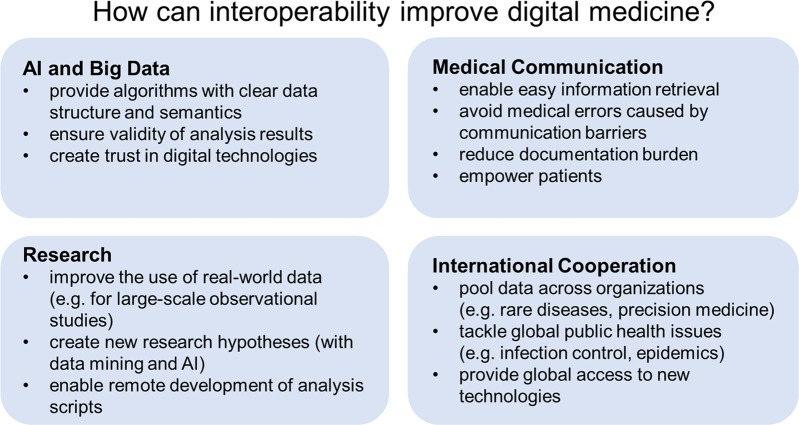
Digital data are anticipated to transform medicine. However, most of today’s medical data lack interoperability: hidden in isolated databases, incompatible systems and proprietary software, the data are difficult to exchange, analyze, and interpret. This slows down medical progress, as technologies that rely on these data – artificial intelligence, big data or mobile applications – cannot be used to their full potential. In this article, we argue that interoperability is a prerequisite for the digital innovations envisioned for future medicine. We focus on four areas where interoperable data and IT systems are particularly important: (1) artificial intelligence and big data; (2) medical communication; (3) research; and (4) international cooperation. We discuss how interoperability can facilitate digital transformation in these areas to improve the health and well-being of patients worldwide.
Overview
The claims and statistics of this paper haven’t been checked yet.
Free: it reads the open-access text and checks the first 5 claims that cite a source we can check. Create a free account to check every claim.
Integrity signals
Registry
Cites
Statistics
Figures
Verification
Claims the paper makes
The claims and statistics of this paper haven’t been checked yet.
Free: it reads the open-access text and checks the first 5 claims that cite a source we can check. Create a free account to check every claim.
Claims other papers make about this one
Each is checked against this paper’s own text: does it say what the citing paper says it does?
The source backs part of the claim, not all of it — or backs it for a different population, condition or comparison.
In the citing paper
“However, it has been shown that interoperability can be implemented successfully for large data-dependent systems, such as with the World Wide Web, and there is increasing awareness of the importance of interoperability within digital health15–17.”
From Machine intelligence in healthcare—perspectives on trustworthiness, explainability, usability, and transparency (2020) · cites this paper as [17]
Experimental — accuracy not yet measuredThe cited source says what the claim attributes to it.
In the citing paper
“However, it has been shown that interoperability can be implemented successfully for large data-dependent systems, such as with the World Wide Web, and there is increasing awareness of the importance of interoperability within digital health15–17.”
From Machine intelligence in healthcare—perspectives on trustworthiness, explainability, usability, and transparency (2020) · cites this paper as [17]
Self-check
Percentages, sums and reported differences re-computed from the paper’s own numbers.
The self-check needs the paper’s full text.
Citations
Cites
Dermatologist-level classification of skin cancer with deep neural networks
Esteva, A., Kuprel, B., Novoa, R. A., Ko, J., Swetter, S. M., Blau, H. M., & Thrun, S. (2017) · Nature · doi:10.1038/nature21056 · Cited by 14,362
Gulshan, V., Peng, L., Coram, M., Stumpe, M. C., Wu, D., Narayanaswamy, A., Venugopalan, S., Widner, K., Madams, T., Cuadros, J., et al. (2016) · JAMA · doi:10.1001/jama.2016.17216 · Cited by 7,697
Artificial intelligence in healthcare: past, present and future
Jiang, F., Jiang, Y., Zhi, H., Dong, Y., Li, H., Ma, S., Wang, Y., Dong, Q., Shen, H., & Wang, Y. (2017) · Stroke and Vascular Neurology · doi:10.1136/svn-2017-000101 · Cited by 4,837
Rajkomar, A., Dean, J., & Kohane, I. (2019) · New England Journal of Medicine · doi:10.1056/nejmra1814259 · Cited by 4,579
Predicting the future - big data, machine learning, and clinical medicine
Obermeyer, Z., & Emanuel, E. J. (2016) · New England Journal of Medicine · doi:10.1056/nejmp1606181 · Cited by 3,652
Updating the accounts: global mortality of the 1918–1920 "Spanish" influenza pandemic.
Johnson, N. P. A. S., & Mueller, J. (2002) · Bulletin of the History of Medicine · doi:10.1353/bhm.2002.0022 · Cited by 1,980
Mining electronic health records: towards better research applications and clinical care
Jensen, P. B., Jensen, L. J., & Brunak, S. (2012) · Nature Reviews Genetics · doi:10.1038/nrg3208 · Cited by 1,680
The Inevitable Application of Big Data to Health Care
Murdoch, T. B., & Detsky, A. S. (2013) · JAMA · doi:10.1001/jama.2013.393 · Cited by 1,664
A Systematic Review of Healthcare Applications for Smartphones
Mosa, A. S. M., Yoo, I., & Sheets, L. (2012) · BMC Medical Informatics and Decision Making · doi:10.1186/1472-6947-12-67 · Cited by 1,184
The human phenotype ontology: a tool for annotating and analyzing human hereditary disease
Robinson, P. N., Köhler, S., Bauer, S., Seelow, D., Horn, D., & Mundlos, S. (2008) · The American Journal of Human Genetics · doi:10.1016/j.ajhg.2008.09.017 · Cited by 1,034 · cited 1×
“It can be complemented by more domain-specific terminologies such as, for example, Logical Observation Identifiers Names and Codes (LOINC) for laboratory observations,(22) the Identification of Medicinal Products (IDMP) for medicines,(23) the nomenclature of the HUGO Gene Nomenclature Committee (HGNC) for genes(24) or…”
Background
Research works printed but not linked: 1
- Beale, T. Archetypes: constraint-based domain models for future-proof information systems. in Eleventh OOPSLA Workshop on Behavioral Semantics. (2002).
Cited by
Items 201–300 of 627
Seong, D., Jung, S., Bae, S., Chung, J., Son, D., & Yi, B.-K. (2021) · Journal of Medical Internet Research · doi:10.2196/26261 · Cited by 11
“To improve interoperability as part of precision medicine, health care stakeholders encourage the use of application programming interfaces (APIs) and app-based ecosystems such as SMART on FHIR, CDS Hooks, and SMART Markers [22-26].”
Hu, Z., Hu, R., Yau, O., Teng, M. Y., Wang, P., Hu, G., & Singla, R. (2022) · JMIR Medical Informatics · doi:10.2196/34304 · Cited by 11
“Medical AI applications have become increasingly relevant at an accelerated rate, though the lag in technological literacy of health care professionals for AI technology exceeds the expected social and cognitive lag of adapting new technology [26].”
BackgroundDesmet, K., Bracke, P., Deproost, E., Goossens, P. J. J., Vandewalle, J., Vercruysse, L., Beeckman, D., Hecke, A. V., Kinnaer, L., & Verhaeghe, S. T. L. (2023) · Journal of Psychiatric and Mental Health Nursing · doi:10.1111/jpm.12951 · Cited by 11
Raju, K. V., Rehana, S., Seethamraju, S. M., & Nori, L. P. (2024) · Brazilian Journal of Pharmaceutical Sciences · doi:10.1590/s2175-97902024e23980 · Cited by 11
FDA launches health care at home initiative to drive equity in digital medical care
Brückner, S., Brightwell, C., & Gilbert, S. (2024) · npj Digital Medicine · doi:10.1038/s41746-024-01198-2 · Cited by 11
G protein-coupled receptor digital twins for precision and personalized medicine
Boeringer, T., Pardo, M., Craig, C. J., & Maudsley, S. R. (2025) · Computational and Structural Biotechnology Journal · doi:10.1016/j.csbj.2025.11.042 · Cited by 10
“Ethical integration requires FAIR, FHIR, and OMOP standards to ensure interoperability and equity [87,88].”
InfluentialKarapetian, N., Stichele, R. V., & Quintana, Y. (2022) · International Journal of Medical Informatics · doi:10.1016/j.ijmedinf.2022.104826 · Cited by 10
“…database to support greater interoperability of prescription information, enable improved global health surveillance to assess pandemic risks, enable transnational medical trials studying multiple patient populations, and maximize interoperability of medical data related to rare diseases [1], [2].”
BackgroundShear, K., Horgas, A. L., & Lucero, R. J. (2023) · CIN Computers Informatics Nursing · doi:10.1097/cin.0000000000001033 · Cited by 10
Digital Transformation in Measuring Social Determinants of Health: A Systematic Review
Liu, C., Wang, W. Y. C., & Khan, G. F. (2023) · Journal of Organizational and End User Computing · doi:10.4018/joeuc.328530 · Cited by 11
“This requires a shared technical, legal, and organizational framework, which is a prerequisite for digital tools and data-driven technologies to realize their potential in public health (Lehne et al., 2019).”
BackgroundFullaondo, A., Erreguerena, I., & de Manuel, E. (2024) · BMC Health Services Research · doi:10.1186/s12913-024-10810-w · Cited by 10
“If the potential of health data is to be maximised, data sources must be mandatorily interoperable, a prerequisite for most innovations envisaged in future medicine [101].”
BackgroundMascarenhas, M., Spindler, L., Manzione, T. D. S., Ribeiro, T., Fathallah, N., Martins, M., Cardoso, P., Mendes, F., Fernandes, J., Ferreira, J. P. S., et al. (2024) · Cancers · doi:10.3390/cancers16101909 · Cited by 10
“…challenges concerns the lack of interoperability between different diagnostic systems, therefore restricting the access of patients to medical care and clinical information, as well as limiting the access to high-quality real-world data for clinical and translational investigation [22,23].”
BackgroundInfluentialSalgado, E., Heidepriem, R., Danhier, R. D., Rinaldi, E., Ravi, V., Poncette, A.-S., Dahlhaus, I., Fürstenau, D., Balzer, F., Thun, S., et al. (2025) · JMIR Medical Informatics · doi:10.2196/64099 · Cited by 10
“As described by Lehne et al [44], noninteroperable systems lead to undesired outcomes, such as redundant data storage, manual data maintenance, data discrepancies, difficulty in drug tracking, billing problems, inefficiency, and resource waste due to the high costs and time demands on trained…”
Self-citationGersch, M. (2021) · Vahlen eBooks · doi:10.15358/9783800665631 · Cited by 10
Carter, B. J., Jafry, M. Z., Siddiqi, A. D., Rogova, A., Liaw, W. R., & Reitzel, L. R. (2023) · Elsevier eBooks · doi:10.1016/b978-0-12-824010-6.00016-2 · Cited by 10
Farook, T. H., Haq, T. M., Ramees, L., & Dudley, J. (2024) · Medical & Biological Engineering & Computing · doi:10.1007/s11517-024-03047-6 · Cited by 10
“Although digital images of biomedical signals are commonly stored in hospital and dental practices, accessing archived signal outputs years later can be challenging due to proprietary software limitations [24].”
BackgroundSwire, P. (2020) · SSRN Electronic Journal · doi:10.2139/ssrn.3689171 · Cited by 10
TermX: The semantic interoperability, knowledge management and sharing platform
Bossenko, I., Piho, G., Ivanova, M., & Ross, P. (2024) · SoftwareX · doi:10.1016/j.softx.2024.101839 · Cited by 10
Marcus, E. R., Tartak, J. A. C., Halasz, H., Chen, D., Lee, J., & He, S. (2024) · PLoS ONE · doi:10.1371/journal.pone.0304865 · Cited by 9
A Vision for VenomsBase: An Integrated Knowledgebase for the Study of Venoms and Their Applications
Castoe, T. A., Daly, M., Jungo, F., Kirchhoff, K. N., Koludarov, I., Mackessy, S. P., Macrander, J., Mehr, S., Modica, M. V., Sanchez, E. E., et al. (2025) · Integrative Organismal Biology · doi:10.1093/iob/obaf026 · Cited by 9
Bottacin, W. E., de Souza, T. T., Melchiors, A. C., & Reis, W. C. T. (2025) · International Journal of Clinical Pharmacy · doi:10.1007/s11096-025-01906-2 · Cited by 10
From Electronic Health Records to AI: A Review of Health Informatics Advancements
Javeedullah, M. (2025) · Global Journal of Agricultural and Biological Sciences · doi:10.70445/gjabs.1.2.2025.1-20 · Cited by 9
Role for artificial intelligence in respiratory diseases—chronic obstructive pulmonary disease
Carlin, C. M., Taylor, A., van Loon, I., Mcdowell, G., Burns, S., McGinness, P., & Lowe, D. J. (2021) · Journal of Hospital Management and Health Policy · doi:10.21037/jhmhp-20-119 · Cited by 9
“The required data to train, validate and monitor AI model performance is in silos, and data control requirements are challenging to overcome (72,73).”
BackgroundJordan, M., Liddicoat, J., & Liddell, K. (2021) · Journal of Law and the Biosciences · doi:10.1093/jlb/lsab018 · Cited by 9
Hummel, P., Braun, M., Bischoff, S., Samhammer, D., Seitz, K., Fasching, P. A., & Dabrock, P. (2024) · AI & Society · doi:10.1007/s00146-023-01825-8 · Cited by 10
“Both points suggest that system-wide, unified approaches on issues ranging from IT standards (Lehne et al. 2019) to continuous societal debate, systemic oversight, and governance at the conceptual, regulatory, and policy levels (Vayena and Blasimme 2018).”
Clinical Research in Neonates: Redesigning the Informed Consent Process in the Digital Era
Sutter, E. D., Coopmans, B., Vanendert, F., Dooms, M. M., Allegaert, K., Borry, P., & Huys, I. (2021) · Frontiers in Pediatrics · doi:10.3389/fped.2021.724431 · Cited by 9
“Interoperability allows two or more systems to electronically exchange data, and is considered essential for digital innovations for future medicine (38).”
BackgroundSchepers, J., Fleck, J., & Schaaf, J. (2022) · Bundesgesundheitsblatt - Gesundheitsforschung - Gesundheitsschutz · doi:10.1007/s00103-022-03606-y · Cited by 9
“Die zentralen Arbeitshypothesen von CORD-MI hierzu lauten, dass die einrichtungsübergreifende Nutzung von KI die semantische und syntaktische Interoperabilität der Datenbestände voraussetzt [28] und dass durch die einheitliche, genaue Beschreibung der Patientenmerkmale in den Routinedaten der positive Vorhersagewert (…”
BackgroundSelf-citationLichtner, G., Haese, T., Brose, S., Röhrig, L., Lysyakova, L., Rudolph, S., Uebe, M., Saß, J., Bartschke, A., Hillus, D., et al. (2023) · JMIR Medical Informatics · doi:10.2196/45496 · Cited by 9
“To enable research across different health care providers, institutions, or even countries, interoperability between medical data systems is essential [1].”
Self-citationXu, J., Ni, H., Zhan, H., Yu, H., Lu, Z., Zhang, J., Meng, H., Hang, L., Lin, M. T., Xu, X., et al. (2025) · BMC Medicine · doi:10.1186/s12916-025-04012-2 · Cited by 8
“Based on timely bidirectional communication between doctors and patients through software, the DTx method effectively transcends geographical and time barriers [68].”
Graefe, A. S. L., Rehburg, F., Alkarkoukly, S., Daniš, D., Grönke, A., Hübner, M. R., Bartschke, A., Debertshäuser, T., Klopfenstein, S. A. I., Saß, J., et al. (2025) · npj Genomic Medicine · doi:10.1038/s41525-025-00534-z · Cited by 8
“This combination of structural standardisation (JSON) and semantic modeling (RDF) ensuresbothsyntacticandsemanticconsistencyatalevelofprecisioncriticalforresearch-gradehealthdata 6,35 .”
Self-citationAn enterprise framework for blockchain interoperability
Mafike, S. S., & Mawela, T. (2026) · Electronic Markets · doi:10.1007/s12525-025-00869-6 · Cited by 8
“Other scholars classify interoperability into four levels: technical, syntactic, semantic, and organisational (business/enterprise) interoperability (Lehne et al., 2019) (Rezaei et al., 2014).”
Nanyonga, S., Blanshard, P., Crevola, L. M., & Simeon‐Dubach, D. (2026) · Frontiers in Public Health · doi:10.3389/fpubh.2026.1710904 · Cited by 8
“One of the biggest issues in this setting is lack of interoperability (37, 40), which is even more challenging in LMICs where often multiple non-interoperable digital health systems are used (41, 42).”
Precision cardiovascular medicine with big data and AI
Xu, Q., Li, Y., Zhu, M., Cai, Y., Cheng, X., Wan, M., Ju, J., Xu, Y., Li, Y., & Liu, Y. (2026) · npj Digital Medicine · doi:10.1038/s41746-026-02538-0 · Cited by 8
“terminological harmonization, uni fi ed data formats, and semantic interoperability 44 .”
International Clinical Research Data Ecosystem: From Data Standardization to Federated Analysis
Rinaldi, E., Dellacasa, C. M., Puskaric, M., Osmo, T., Górska, A., & Stellmach, C. (2023) · Studies in health technology and informatics · doi:10.3233/shti230757 · Cited by 8
Rigas, E. S., Kostomanolakis, S., Kyriakoulakos, N., Kounalakis, D., Petrakis, I. E., Berler, A., Boumpaki, A., Karanikas, H., Kelepouris, A., Bamidis, P. D., et al. (2023) · Frontiers in Digital Health · doi:10.3389/fdgth.2023.1275711 · Cited by 8
“Nevertheless, the lack of interoperability is a persistent barrier to the deployment of digital health services (4, 5).”
BackgroundDigitale Gesundheitsversorgung. Anforderungen an eine erfolgreiche Transformation
Steidle, O., Rego, K., & Petzold, T. (2024) · Das Gesundheitswesen · doi:10.1055/a-2184-5572 · Cited by 8
“Diese Voraussetzungen umfassen grund-legende Möglichkeiten zur Speicherung, Sicherung und Kommunikation von Daten und münden vor allem in technischer, semantischer, syntaktischer und organisatorischer Interoperabili-tät [18, 19].”
BackgroundOehm, J. B., Riepenhausen, S., Storck, M., Dugas, M., Pryss, R. C., & Varghese, J. (2024) · Journal of Medical Internet Research · doi:10.2196/47846 · Cited by 8
Ferrante, M., Esposito, L. E., & Stoeckel, L. E. (2024) · Frontiers in Psychiatry · doi:10.3389/fpsyt.2024.1433438 · Cited by 8
Sareban, M., Treff, G., Smeddinck, J. D., Hussein, R., & Niebauer, J. (2025) · Digital Health · doi:10.1177/20552076241299062 · Cited by 8
Bojnordi, A. J. J., Nezhad, M. Z., Bagheri, R., Bazrafshan, M., & Sohrabi, B. (2025) · Discover Health Systems · doi:10.1007/s44250-025-00204-y · Cited by 8
Ediae, G. U., White‐Brown, A. M., Chisholm, C., Terekhov, I., Seymour, J., Guo, J., Mitsakakis, N., Sawyer, S. L., & Boycott, K. M. (2025) · Genetics in Medicine · doi:10.1016/j.gim.2025.101570 · Cited by 8
Sharma, V., Augustine, T., Ainsworth, J. D., & van der Veer, S. N. (2022) · International Journal of Medical Informatics · doi:10.1016/j.ijmedinf.2022.104800 · Cited by 8
Wiedermann, C. J. (2023) · Journal of Personalized Medicine · doi:10.3390/jpm13060972 · Cited by 8
“Digitalization enables better data management, interoperability, and application of artificial intelligence and machine learning algorithms [34,35].”
BackgroundPelino, S. D., Lamarche, L., Carr, T., Datta, J., Gaber, J., Oliver, D., Gallagher, J., Dragos, S. M., Price, D. J., & Mangin, D. A. (2022) · JMIR Formative Research · doi:10.2196/34899 · Cited by 8
“In the adoption of ICT, the concept of interoperability, specifically between external software and EMRs, will likely always need to be considered and is often seen as the end goal for any new health-related technology [28].”
BackgroundSharma, V., Eleftheriou, I., van der Veer, S. N., Brass, A., Augustine, T., & Ainsworth, J. D. (2022) · Journal of Medical Internet Research · doi:10.2196/31825 · Cited by 8
“In other clinical areas, access to data across organizational boundaries continues to be a significant challenge [19].”
BackgroundChen, W., Whitney, H. M., Kahaki, S., Meyer, C. G., Li, H., Sá, R. C., Lauderdale, D. S., Napel, S. A., Gersing, K. R., Grossman, R. L., et al. (2025) · Scientific Data · doi:10.1038/s41597-025-05678-2 · Cited by 8
Thissen, A., Salgado-Baez, E., Fürstenau, D., Delucchi Danhier, R., Meske, C., Kuss, P., Angermair, S., Spies, C., & Balzer, F. (2025) · Journal of Medical Internet Research · doi:10.2196/49254 · Cited by 7
“During digital transformation, clinics should avoid noninteroperable solutions to prevent future issues [71,72].”
Privacy-Preserving Healthcare Data Interactions: A Multi-Agent Approach Using LLMs
Maio, C. D., Fenza, G., Furno, D., Grauso, T., & Loia, V. (2025) · Journal of Communications Software and Systems · doi:10.24138/jcomss-2024-0119 · Cited by 7
“These Text-to-FHIR and FHIR-to-Text meth-ods improve data interoperability and enable seamless exchange between healthcare systems [2], [3], [14].”
Spaho, R. S., Uhrenfeldt, L., Fotis, T. G., Bjerkan, J., & Kymre, I. G. (2024) · International Journal of Qualitative Studies on Health and Well-Being · doi:10.1080/17482631.2024.2374733 · Cited by 7
“…and available to all HCPs, this ensures patient safety, prevents medical errors, avoids the unnecessary repeating of examinations, and lessens the documentation burden while improving patient symptom management and communication between HCPs and patients (Lehne et al., 2019; May et al., 2022).”
Lee, J. J., Zepeda, A., Arbour, G., Isaac, K. V., Ng, R. T., & Nichol, A. (2024) · JCO Clinical Cancer Informatics · doi:10.1200/cci.24.00107 · Cited by 7
Palm, J., Saleh, K., Scherag, A., & Ammon, D. (2025) · JMIR Medical Informatics · doi:10.2196/68171 · Cited by 7
“To facilitate multicenter biomedical research projects based on secondary use of EHR data with the newly established DIC [14], the contents of the EHR in the German university hospitals had to be made accessible gradually.”
The Scope and Functions of Health Information Management in e-Health
Nair, D. P. (2022) · ECS Transactions · doi:10.1149/10701.9939ecst · Cited by 7
Integrated electronic health record tools to access real-world data in oncology research
Casagni, M., Llewellyn, N. M., Kokolus, M. C., Chan, M., Dingwell, R., Chow, S. L.-M., Campbell, N., Elrahi, C., Piantadosi, S., & Quina, A. (2024) · JAMIA Open · doi:10.1093/jamiaopen/ooae144 · Cited by 7
Muzoora, M. R., Schaarschmidt, M., Krefting, D., Oehm, J., Riepenhausen, S., & Thun, S. (2021) · Studies in health technology and informatics · doi:10.3233/shti210820 · Cited by 7
“Although many of them address similar or at least overlapping aspects, due to diverse data models and formats, data items cannot be jointly analysed to increase evidence [1].”
BackgroundSelf-citationSultan, L. R., Cary, T. W., Al‐Hasani, M., Karmacharya, M. B., Venkatesh, S. S., Assenmacher, C., Radaelli, E., & Sehgal, C. M. (2022) · AI · doi:10.3390/ai3030043 · Cited by 7
“These data silos prevent relevant data from being shared even between departments within the same institution due to the interoperability issues of the current institutional enterprise systems [7].”
European regulation of digital respiratory healthcare
Gilbert, S. (2023) · European Respiratory Society eBooks · doi:10.1183/2312508x.10000923 · Cited by 7
Sutter, E. D., Geerts, D., Yskout, K., Verreydt, S., Borry, P., Barbier, L., & Huys, I. (2023) · Journal of Medical Internet Research · doi:10.2196/46306 · Cited by 6
“To this end, it is key that an eIC application can be integrated into existing IT systems to enable seamless communication across these systems [40].”
The Necessity of Interoperability to Uncover the Full Potential of Digital Health Devices
Schwab, J. D., Werle, S. D., Hühne, R., Spohn, H., Kaisers, U. X., & Kestler, H. A. (2023) · JMIR Medical Informatics · doi:10.2196/49301 · Cited by 6
“Unfortunately, what seems obvious at first glance is far from reality [12].”
BackgroundCaptive markets and medical artificial intelligence
Lee, Y. M., Stretton, B., Tan, S., Gupta, A. K., Kovoor, J. G., Bacchi, S., Lim, W., & Chan, W. O. (2024) · Journal of Medical Imaging and Radiation Oncology · doi:10.1111/1754-9485.13648 · Cited by 6
“A lack of interoperability 7 (e.g. a lack of ability to swap between AI providers due to inability to exchange information) can similarly lead to a captive market.”
BackgroundThe Impact of Artificial Intelligence on Diagnostic Medicine
Wheatley, M. (2024) · Premier Journal of Artificial Intelligence · doi:10.70389/pjai.100007 · Cited by 6
Schönfelder, A., Eberlein-Gonska, M., Hülsken-Giesler, M., Jovy-Klein, F., Kather, J. N., Kohoutek, E., Lennefer, T., Liebert, E., Lipprandt, M., Mathias, R., et al. (2026) · Journal of Medical Internet Research · doi:10.2196/80754 · Cited by 6
“This role provides the essential technical infrastructure and ensures secure, seamless integration with existing systems, like EHR d platforms or laboratory systems, requiring technical, syntactic, IT Specialists semantic, and organizational interoperability [15,90].”
Digital Health for Australia: Bridging the Rural, Regional, and Remote Health Gap
Mahmood, S., Huda, M. M., Ahmed, K. Y., Thapa, S., Astawesegn, F. H., Anyasodor, A. E., Moni, M. A., Shiddiky, M. J. A., Mondal, U. K., Aychiluhm, S. B., et al. (2025) · Interactive Journal of Medical Research · doi:10.2196/67460 · Cited by 6
“The health sector is one of the least mature industries in terms of AI implementation both in Australia and internationally [23,24].”
Murgia, Y., Gazzarata, R., Ciampi, M., Sicuranza, M., Cirillo, F., Esposito, C., Maggi, N., Balestra, G., Sacchi, L., & Giacomini, M. L. (2025) · Frontiers in Medicine · doi:10.3389/fmed.2025.1644719 · Cited by 6
“There have been eorts to digitalize healthcare data and improve their interoperability among dierent HIS and organizations due to the increasing reliance on digital technologies in medical practice (51, 52).”
Reinshagen, J., Seashore-Ludlow, B. A., Gadiya, Y., Gustavsson, A., Tanoli, Z., Aittokallio, T. A., Huchting, J., Jenmalm-Jensen, A., Gribbon, P. M., Zaliani, A., et al. (2025) · Database · doi:10.1093/database/baaf081 · Cited by 6
“Despite these benefits, challenges such as data heterogeneity, ethical concerns, technical barriers, and varied regional regulations persist [ 29 ].”
Wei, Q., Xu, G., & Liu, Y. (2026) · AI & Society · doi:10.1007/s00146-026-02879-0 · Cited by 7
“…cover critical components such as patient identification, clinical coding, medication information, service scheduling, and electronic prescriptions, requiring AI systems to access data through secure and standardized interfaces to prevent data silos and unauthorized access (Lehne et al. 2019).”
AI ‐Driven Epidemiology: The Next Frontier in Precision Public Health
Prema, S. S., Ganapathy, D., & Shanmugamprema, D. (2026) · Wiley Interdisciplinary Reviews Data Mining and Knowledge Discovery · doi:10.1002/widm.70077 · Cited by 7
Digital and AI-Empowered Health Elements: An Integrated Pathway to Advancing Health
Li, P., Zhou, Y., li, Y., Dong, E., & Zhang, L. (2026) · Health Data Science · doi:10.34133/hds.0468 · Cited by 6
“Technological elements capture digital access, data availability and interoperability, algorithmic systems, and digital literacy, all of which shape how individuals and populations engage with health systems [ 30 – 32 ].”
Transforming healthcare through digital twin technology: Current evidence and emerging opportunities
David-Olawade, A. C., Abanishe, R. B., Ogunbona, M. A., Makanjuola, B. D., Oluwadairo, E. D., & Olasilola, R. (2026) · Intelligent Hospital · doi:10.1016/j.inhs.2026.100077 · Cited by 7
Xu, Y., & Zhu, L. (2023) · Frontiers in Public Health · doi:10.3389/fpubh.2022.1079232 · Cited by 6
“Equation (4), (5), (6) are substituted into Equation (7), we can obtain,”
BackgroundAn Interoperable Microservices Architecture for Healthcare Data Exchange
Alencar, A., Bezerra, M. M., Valadares, D. C. G., Santos, D. F. S., & Perkusich, Â. (2023) · Lecture notes in networks and systems · doi:10.1007/978-3-031-28694-0_18 · Cited by 6
Stellmach, C., Hopff, S. M., Jaenisch, T., de Miranda, S. M. N., Rinaldi, E., & The NAPKON, L. (2024) · Journal of Medical Internet Research · doi:10.2196/50049 · Cited by 6
“Although there are several levels of interoperability [14], the focus of this study in the context of health care data was on semantic (use of standard terminologies and classifications) and syntactic (implementation of a standard exchange format) interoperability.”
BackgroundKruse, J., Wiedekopf, J., Kock-Schoppenhauer, A.-K., Essenwanger, A., Ingenerf, J., & Ulrich, H. (2024) · JMIR Medical Informatics · doi:10.2196/57569 · Cited by 6
“However, the lack of interoperability of health care systems is a significant, long-lasting problem [1].”
BackgroundSelf-citationDelange, B., Popoff, B., Séité, T., Lamer, A., & Parrot, A. (2025) · International Journal of Medical Informatics · doi:10.1016/j.ijmedinf.2025.105876 · Cited by 6
Görtz, M., Byczkowski, M., Rath, M., Schütz, V., Reimold, P., Gasch, C., Simpfendörfer, T., März, K., Seitel, A., Nolden, M., et al. (2021) · JMIR Medical Informatics · doi:10.2196/27743 · Cited by 6
“…innovations into commercial solutions are affected by two main challenges: because of proprietary systems, access to medical devices and their data is difficult [3], and there are high barriers to the transfer of research results into clinical practice, particularly a successful market entry [4].”
BackgroundTuzii, J. (2022) · International Journal of Risk & Safety in Medicine · doi:10.3233/jrs-227011 · Cited by 6
“…for the solution of public health emergencies such as the one experienced through model abstraction and clinical data set correlation systems, thus quickly identifying research or intervention perspectives and enabling multiple teams to conduct different research in parallel at global level [18].”
Evaluating Interoperability in German Critical Incident Reporting Systems
Tetzlaff, L., Purohit, A.-M., Spallek, J., Holmberg, C., & Schräder, T. (2023) · Studies in health technology and informatics · doi:10.3233/shti230722 · Cited by 6
Mapping of Data-Sharing Repositories for Paediatric Clinical Research—A Rapid Review
Felisi, M., Bonifazi, F., Toma, M., Pansieri, C., Leary, R., Hedley, V., Cornet, R., Reggiardo, G., Landi, A., D’Ercole, A., et al. (2024) · Data · doi:10.3390/data9040059 · Cited by 6
Artificial Intelligence Applications to Improve Risk Prediction Tools in Electrophysiology
Kowlgi, G. N., Ezzeddine, F. M., & Kapa, S. (2020) · Current Cardiovascular Risk Reports · doi:10.1007/s12170-020-00649-1 · Cited by 6
Towards Human-Guided, Data-Centric LLM Co-PilotsPreprint
Saveliev, E., Liu, J., Seedat, N., Boyd, A., & van der Schaar, M. (2025) · arXiv (Cornell University) · doi:10.48550/arxiv.2501.10321 · Cited by 6
Gilani, K., Verket, M., Peters, C., Dumontier, M., Rocca, H.-P. B.-L., & Urovi, V. (2025) · Computers in Biology and Medicine · doi:10.1016/j.compbiomed.2025.110745 · Cited by 5
Amer, M., Gittins, R., Millana, A. M., Scheibein, F., Ferri, M., Tofighi, B., Sullivan, F., Handley, M., Ghosh, M., Baldacchino, A., et al. (2025) · Journal of Medical Internet Research · doi:10.2196/58723 · Cited by 5
“The lack of data interoperability limits effective AI model generation, training, and deployment [94].”
Kiendrébéogo, J. A., Tapsoba, C., Sory, O., Kaboré, I., Kafando, Y., Tiendrébéogo, S., Zombré, D., Kaboré, R., Konsebo, N., Nacanabo, R., et al. (2024) · Oxford Open Digital Health · doi:10.1093/oodh/oqae013 · Cited by 5
Lobuteva, A. V., Lobuteva, L., Zakharova, O. V., Gribova, Y., Nesterova, N., Avertseva, I. N., & Karpova, M. (2024) · BMC Health Services Research · doi:10.1186/s12913-024-11966-1 · Cited by 5
Nichols, J. H., Assad, R. S., Becker, J., Dabla, P. K., Gammie, A. J., Gouget, B., Heydlauf, M., Homšak, E., Korita, I., Kotani, K., et al. (2024) · PubMed Central · Cited by 5
Genomics on FHIR – a feasibility study to support a National Strategy for Genomic Medicine
Haffer, N., Stellmach, C., Saß, J., Muzoora, M. R., Graefe, A. S. L., Thun, S., & Vorisek, C. N. (2025) · npj Genomic Medicine · doi:10.1038/s41525-025-00516-1 · Cited by 5
“Thisintegratedapproachmayfacilitatemorecompre-hensiveanalysesandfosterdeeperdiagnosticcapabilitiesandpersonalized therapeuticdiscovery 6,7 .”
Self-citationClinical Decision Support Systems in Generalist Practice
Bain, A. P., Ngai, D., & Bernard, P. A. (2025) · Medical Clinics of North America · doi:10.1016/j.mcna.2025.07.004 · Cited by 5
Navigating the Digital Health Ecosystem: A Review of Key Guidelines, Frameworks, and Tools
Dörner, R. (2024) · Publication server of the Robert Koch Institute (Robert Kock Institute) · doi:10.25646/12926 · Cited by 5
Ettadili, H., & Darvishmohammadi, T. (2025) · SN Comprehensive Clinical Medicine · doi:10.1007/s42399-025-02218-2 · Cited by 5
“Interoperability, therefore, is a prerequisite for digital transformation and global cooperation in medicine [52 ].”
Esmaeilzadeh, P., & Maddah, M. (2026) · Health Systems · doi:10.1080/20476965.2026.2637433 · Cited by 5
Abbasi, M., Váz, P., da Silva, J. F. M., Cardoso, F., Sá, F., & Martins, P. (2026) · Data · doi:10.3390/data11030054 · Cited by 5
Overview of Existing Tools for Extracting Health and Fitness Data from mHealth Apps
Khaled, M., Sareban, M., Kreuzthaler, M., Schulz, S., & Hussein, R. (2022) · Studies in health technology and informatics · doi:10.3233/shti220657 · Cited by 5
Lech, S., Gellert, P. R., Spang, R. P., Voigt‐Antons, J., Huscher, D., O’Sullivan, J. L., & Schuster, J. (2023) · International Journal of Geriatric Psychiatry · doi:10.1002/gps.6035 · Cited by 5
“53 Second, the COVID ‐ 19 pandemic occurred during the intervention period, which led to massive problems for the recruitment and implementation of the study.”
BackgroundWen, Y., Choo, V. Y., Eil, J. H., Thun, S., dos Santos, D. P., Käst, J., Sigle, S., Prokosch, H., Ovelgönne, D. L., Borys, K., et al. (2025) · Journal of Medical Internet Research · doi:10.2196/68750 · Cited by 5
“Data interoperability, the ability of disparate information technology systems and software applications to communicate, exchange, and interpret shared data, is at the heart of creating a seamlessly integrated health care ecosystem [1].”
Self-citationde Gorostegui, A., Zanin, M., Martín-Gonzalo, J.-A., López-López, J., Gómez‐Andrés, D., Kiernan, D., & Rausell, E. (2025) · Sensors · doi:10.3390/s25134235 · Cited by 5
Creative Visualisation Opportunities Workshops: A Case Study in Population Health
Elshehaly, M., Sohal, K., Lawton, T., Bryant, M., & Mon-Williams, M. A. (2022) · IEEE Evaluation and Beyond - Methodological Approaches for Visualization (BELIV) · doi:10.1109/beliv57783.2022.00006 · Cited by 5
“While data and systems integration offer great opportunities to support digital innovations that improve the health and well being of a population [22], integration relies on storage and communication standards that are not always upheld by proprietary medical software [27].”
BackgroundDigital Maturity Assessment Model Development for Health Sector
Erdal, B., İhtiyar, B., Mıstıkoğlu, E. T., Gül, S., & Temur, G. T. (2021) · Lecture notes in mechanical engineering · doi:10.1007/978-3-030-90421-0_11 · Cited by 5
Arcobelli, V. A., Moscato, S., Marfoglia, A., Nardini, F., Randi, P., Davalli, A., Carbonaro, A., Palumbo, P., Chiari, L., & Mellone, S. (2023) · IEEE EMBS Special Topic Conference on Data Science and Engineering in Healthcare, Medicine and Biology · doi:10.1109/ieeeconf58974.2023.10404816 · Cited by 5
“To address this issue, standardization plays a crucial role in achieving data harmonization, improving the availability, safety [2], [3] and correctness of the information.”
BackgroundStrategy to Adopt and Deploy HL7 FHIR Standard for Healthcare Interoperability in Korea
Bae, S., Kim, I. K., & Yi, B.-K. (2021) · Healthcare Informatics Research · doi:10.4258/hir.2021.27.3.173 · Cited by 5
Bocci, M. G., Barbaro, M. R., Bellini, V., Napoli, C., Darhour, L. J., & Bignami, E. G. (2024) · Journal of Anesthesia Analgesia and Critical Care · doi:10.1186/s44158-024-00180-4 · Cited by 5
“Data integration and interoperability are essential for digital transformation [11].”
BackgroundAmer, M., Gittins, R., Millana, A. M., Scheibein, F., Ferri, M., Tofighi, B., Sullivan, F., Handley, M., Ghosh, M., Baldacchino, A., et al. (2024) · doi:10.2196/preprints.58723 · Cited by 5
Automation and Workflow Efficiency in Clinical Settings
Farrukh, N., Chandawarkar, A. R., Vundavalli, S., & Taxter, A. J. (2025) · Medical Clinics of North America · doi:10.1016/j.mcna.2025.07.001 · Cited by 4
Metadata
- Authors
- Lehne, M., Sass, J., Essenwanger, A., Schepers, J., & Thun, S.
- Affiliations
- Berlin Institute of Health at Charité - Universitätsmedizin Berlin (DE)
- Hochschule Niederrhein (DE)
- Corresponding author
- Lehne, Moritz
- Venue
- npj Digital Medicine
- Published
- 2019-08-20
- Volume
- 2
- Issue
- 1
- Pages
- 79-79
- ISSN
- 2398-6352 (ISSN-L)
- PMC
- PMC6702215
- OpenAlex
- W2969628488
- Cited by
- 501
- References
- 33
- Citations by year
- 2026: 89 · 2025: 91 · 2024: 115 · 2023: 62 · 2022: 57 · 2021: 59 · 2020: 26 · 2019: 1
- FWCI
- 6.76
- Type
- journal article
- Language
- en
- Open access
- gold
- doi.org
- Licence
- cc-by
- creativecommons.org/licenses/by/4.0 (tdm)
- creativecommons.org/licenses/by/4.0 (vor)
- Locations
- npj Digital Medicine (publishedVersion, cc-by)
- PubMed Central (publishedVersion, cc-by)
- PubMed (publishedVersion)
- DOAJ (DOAJ: Directory of Open Access Journals) (submittedVersion)
- Refubium (Universitätsbibliothek der Freien Universität Berlin) (submittedVersion, cc-by)
- Universitätsbibliothek der FU Berlin Hochschulschriftenstelle u. Dokumentenserver (cc-by)
- Funders
- Deutsche Forschungsgemeinschaft
- Charité – Universitätsmedizin Berlin
- Topics
- Health Sciences › Health Professions › Health Information Management › Electronic Health Records Systems
- Health Sciences › Medicine › Health Informatics › Artificial Intelligence in Healthcare and Education
- Health Sciences › Medicine › Public Health, Environmental and Occupational Health › Technology and Human Factors in Education and Health
- Keywords
- interoperability, health data sharing, digital health, artificial intelligence, big data, medical communication, health research, international health cooperation, digital transformation of medicine, health information systems
About these checks
Registry, retraction, Cites and statistics results are computed, not judged, with one exception: a printed reference that no index lists is read once by a model before it counts as a citation error. Claims are extracted by a model and kept only when their quote appears verbatim in the text; each cited source is then checked, with a model’s help, for whether it says what the claim relies on. Those verdicts can be wrong — read the claim’s quote and the cited source before relying on one.
Statistics and arithmetic are recomputed, not judged.
Confidence bands are shown only for fields calibrated on our annotated test set. None is calibrated yet, so no band is shown.
What counts as a claim ›How we measure confidence ›How we check this ›
Are you an author, or do you see a problem with this page? Request a review
Data sources
Bibliographic data: Semantic Scholar, OpenAlex, Crossref.
Contains information from the Semantic Scholar Academic Graph Datasets, made available under the ODC Attribution License (ODC-BY 1.0).
Semantic Scholar’s data is described in: Kinney, R., et al. (2023). The Semantic Scholar Open Data Platform. arXiv:2301.10140.
