

Why digital medicine depends on interoperability
Open accessThe DOI matches its Crossref record; 33 of the 33 references it cites were found in a registry or an index.
Abstract
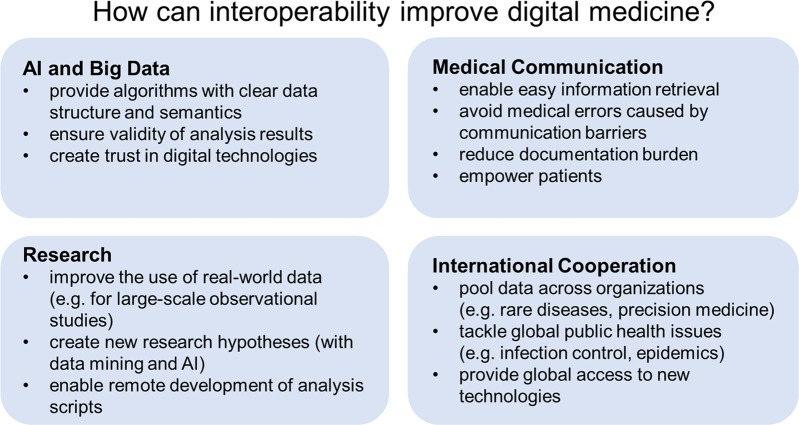
Digital data are anticipated to transform medicine. However, most of today’s medical data lack interoperability: hidden in isolated databases, incompatible systems and proprietary software, the data are difficult to exchange, analyze, and interpret. This slows down medical progress, as technologies that rely on these data – artificial intelligence, big data or mobile applications – cannot be used to their full potential. In this article, we argue that interoperability is a prerequisite for the digital innovations envisioned for future medicine. We focus on four areas where interoperable data and IT systems are particularly important: (1) artificial intelligence and big data; (2) medical communication; (3) research; and (4) international cooperation. We discuss how interoperability can facilitate digital transformation in these areas to improve the health and well-being of patients worldwide.
Overview
The claims and statistics of this paper haven’t been checked yet.
Free: it reads the open-access text and checks the first 5 claims that cite a source we can check. Create a free account to check every claim.
Integrity signals
Registry
Cites
Statistics
Figures
Verification
Claims the paper makes
The claims and statistics of this paper haven’t been checked yet.
Free: it reads the open-access text and checks the first 5 claims that cite a source we can check. Create a free account to check every claim.
Claims other papers make about this one
Each is checked against this paper’s own text: does it say what the citing paper says it does?
The source backs part of the claim, not all of it — or backs it for a different population, condition or comparison.
In the citing paper
“However, it has been shown that interoperability can be implemented successfully for large data-dependent systems, such as with the World Wide Web, and there is increasing awareness of the importance of interoperability within digital health15–17.”
From Machine intelligence in healthcare—perspectives on trustworthiness, explainability, usability, and transparency (2020) · cites this paper as [17]
Experimental — accuracy not yet measuredThe cited source says what the claim attributes to it.
In the citing paper
“However, it has been shown that interoperability can be implemented successfully for large data-dependent systems, such as with the World Wide Web, and there is increasing awareness of the importance of interoperability within digital health15–17.”
From Machine intelligence in healthcare—perspectives on trustworthiness, explainability, usability, and transparency (2020) · cites this paper as [17]
Self-check
Percentages, sums and reported differences re-computed from the paper’s own numbers.
The self-check needs the paper’s full text.
Citations
Cites
Dermatologist-level classification of skin cancer with deep neural networks
Esteva, A., Kuprel, B., Novoa, R. A., Ko, J., Swetter, S. M., Blau, H. M., & Thrun, S. (2017) · Nature · doi:10.1038/nature21056 · Cited by 14,362
Gulshan, V., Peng, L., Coram, M., Stumpe, M. C., Wu, D., Narayanaswamy, A., Venugopalan, S., Widner, K., Madams, T., Cuadros, J., et al. (2016) · JAMA · doi:10.1001/jama.2016.17216 · Cited by 7,697
Artificial intelligence in healthcare: past, present and future
Jiang, F., Jiang, Y., Zhi, H., Dong, Y., Li, H., Ma, S., Wang, Y., Dong, Q., Shen, H., & Wang, Y. (2017) · Stroke and Vascular Neurology · doi:10.1136/svn-2017-000101 · Cited by 4,837
Rajkomar, A., Dean, J., & Kohane, I. (2019) · New England Journal of Medicine · doi:10.1056/nejmra1814259 · Cited by 4,579
Predicting the future - big data, machine learning, and clinical medicine
Obermeyer, Z., & Emanuel, E. J. (2016) · New England Journal of Medicine · doi:10.1056/nejmp1606181 · Cited by 3,652
Updating the accounts: global mortality of the 1918–1920 "Spanish" influenza pandemic.
Johnson, N. P. A. S., & Mueller, J. (2002) · Bulletin of the History of Medicine · doi:10.1353/bhm.2002.0022 · Cited by 1,980
Mining electronic health records: towards better research applications and clinical care
Jensen, P. B., Jensen, L. J., & Brunak, S. (2012) · Nature Reviews Genetics · doi:10.1038/nrg3208 · Cited by 1,680
The Inevitable Application of Big Data to Health Care
Murdoch, T. B., & Detsky, A. S. (2013) · JAMA · doi:10.1001/jama.2013.393 · Cited by 1,664
A Systematic Review of Healthcare Applications for Smartphones
Mosa, A. S. M., Yoo, I., & Sheets, L. (2012) · BMC Medical Informatics and Decision Making · doi:10.1186/1472-6947-12-67 · Cited by 1,184
The human phenotype ontology: a tool for annotating and analyzing human hereditary disease
Robinson, P. N., Köhler, S., Bauer, S., Seelow, D., Horn, D., & Mundlos, S. (2008) · The American Journal of Human Genetics · doi:10.1016/j.ajhg.2008.09.017 · Cited by 1,034 · cited 1×
“It can be complemented by more domain-specific terminologies such as, for example, Logical Observation Identifiers Names and Codes (LOINC) for laboratory observations,(22) the Identification of Medicinal Products (IDMP) for medicines,(23) the nomenclature of the HUGO Gene Nomenclature Committee (HGNC) for genes(24) or…”
Background
Research works printed but not linked: 1
- Beale, T. Archetypes: constraint-based domain models for future-proof information systems. in Eleventh OOPSLA Workshop on Behavioral Semantics. (2002).
Cited by
Items 301–400 of 627
Witt, C. M., Murphy, C., Graca, S., Angell, C., Gale, M. K., Lam, C. S., Napadow, V., Izawa, R., Woo, S., Zick, S. M., et al. (2025) · Journal of Integrative and Complementary Medicine · doi:10.1177/27683605251389440 · Cited by 4
Contract management and network management in public-private eHealth partnerships
Callens, C., & Klijn, E. (2024) · Edward Elgar Publishing eBooks · doi:10.4337/9781803923895.00019 · Cited by 4
A review of distributed ledger technologies application in medical systems interoperability
Bundi, D. G., Mutua, S., & Karume, S. (2024) · African Journal of Science Technology and Social Sciences · doi:10.58506/ajstss.v2i2.203 · Cited by 4
Reimagining Multidisciplinary Teams: Challenges and Opportunities for LLMs in Cancer MDTs
Paulo, S., Neto, I., Figueiredo, N., Lopes, D. S., & Nicolau, H. (2025) · Proc. ACM Hum. Comput. Interact. · doi:10.1145/3711055 · Cited by 4
“Moreover, one of digital health’s main challenges has been the lack of medical data interoperability [40].”
Wermund, A. M., Thalheim, T., Medek, A., Schmidt, F., Peschel, T., Strübing, A., Neumann, D., Scherag, A., Loeffler, M., Kesselmeier, M., et al. (2025) · PLOS Digital Health · doi:10.1371/journal.pdig.0000892 · Cited by 4
Exponential Technologies and Future Scenarios
Marino, N., Cacciamani, G. E., & Veneziano, D. (2021) · Springer eBooks · doi:10.1007/978-3-030-63948-8_16 · Cited by 4
Systematic Review of the Literature on Data Governance in healthcare institutions
Riveros, H. P., López, D. Y. O., Rueda, I. Y. A., & Zambrano, L. (2023) · International Conference on Industrial Engineering and Operations Management (IEOM) · doi:10.46254/sa04.20230030 · Cited by 4
Alhur, A. A., Alhur, A. A., Alghamdi, S. J. H., Asiri, Z. I., Alzamil, S. K. S., Alfateih, S., Fataih, S. S. M. A., Alfahad, A. H., Alzmanan, S. M. M., Alghamdi, M. M. F., et al. (2023) · Journal of Population Therapeutics and Clinical Pharmacology · doi:10.53555//jptcp.v30i19.4744 · Cited by 4
Haffer, N., & Thun, S. (2024) · Studies in health technology and informatics · doi:10.3233/shti240688 · Cited by 4
Self-citationAlajlan, A. A. M., Alanazi, . A. A., Fahad, A. I. A. A., Alnughaymishi, A. A. S., & Harbi, S. H. A. (2024) · International Journal of Health Sciences · doi:10.53730/ijhs.v8ns1.15424 · Cited by 4
“…has shown that utilizing EHRs in emergency departments results in notable enhancements in documentation precision and patient safety, especially by minimizing medication errors and guaranteeing that essential patient information is consistently accessible to healthcare professionals [6,22,25,26].”
Fadahunsi, K. P., Wark, P. A., Mastellos, N., Neves, A. L., Gallagher, J., Majeed, A., & Car, J. (2025) · JMIR Medical Informatics · doi:10.2196/58125 · Cited by 4
“Seamless health information exchange between multiple platforms improves quality of clinical information [42].”
Artificial Intelligence in Digital Therapeutics for Optimized Healthcare
Mirza, M., Jabeen, H., & Fatima, A. (2025) · Journal of Pharma Insights and Research. · doi:10.69613/g5mbda64 · Cited by 5
“Enhanced interoperability will enable more effective data sharing between different healthcare providers and platforms, improving coordination of care and treatment outcomes [76].”
Toner, T. M., Pancholi, R., Miller, P., Forster, T., Coleman, H. G., & Overton, I. M. (2022) · GigaScience · doi:10.1093/gigascience/giad030 · Cited by 4
Web-based Prototype for Graphical Exploration of FHIR® Questionnaire Responses.
Frei, J., Auer, F., Netzband, S., Ignatenko, Y., & Krämer, F. (2023) · PubMed Central · Cited by 4
Ciortuz, G., Wiedekopf, J., & Fudickar, S. (2024) · Springer eBooks · doi:10.1007/978-3-658-43236-2_31 · Cited by 4
Towards an extensible ontology for streaming sensor data for clinical trials
Lyons, R., Low, G. R., Congdon, C. B., Ceruolo, M., Ballesteros, M. M., Cambria, S., & DePetrillo, P. (2021) · ACM International Conference on Bioinformatics, Computational Biology, and Health Informatics (ACM-BCB) · doi:10.1145/3459930.3469562 · Cited by 4
“, [11], the notion of interoperable data and systems is essential for modern digital medicine, based on needs of big-data analytics, as well as other concerns.”
BackgroundPrivacy and Security Challenges in the Era of the COVID-19 Pandemic
Sharma, V., Saharan, R., Wilson, K., Sharma, D., Beniwal, S., & Dora, C. P. (2022) · Advances in medical technologies and clinical practice book series · doi:10.4018/978-1-6684-5741-2.ch017 · Cited by 4
Mwangi, C., Mudogo, C. M., & Maghanga, C. (2022) · Journal of intellectual property and information technology law · doi:10.52907/jipit.v2i1.209 · Cited by 4
Reproducible Transport of Information
Orthuber, W. (2021) · Studies in health technology and informatics · doi:10.3233/shti210109 · Cited by 4
“This is not reproducible from a global viewpoint and led to today's split into countless databases and data silos, despite decades of considerable efforts [7][8][9][10][11] to achieve interoperability and standardization by providing specialized vocabularies, codes, and formats such as XML, JSON, Turtle.”
BackgroundSeedat, N., Tozzi, C., Ardiaca, A. H., van der Schaar, M., Weatherall, J., & Taylor, A. J. (2024) · arXiv (Cornell University) · doi:10.48550/arxiv.2411.13163 · Cited by 4
“…(MedDRA) 12 , which ensure consistent encoding and interpretation of data across studies, enabling diverse datasets to 'speak the same language' 6,7 However, even with standard coding systems, clinical trials — often considered the gold standard of clinical data — are not immune to coding…”
Application of digital health products in community-dwelling older adults: A scoping review
Guo, Y., Peng, R., Zhang, C., Li, X., Du, Y., Chen, Y., Lu, Y., Li, Z., & Feng, H. (2025) · Geriatric Nursing · doi:10.1016/j.gerinurse.2025.103420 · Cited by 3
Islami, S. A., Harisi, R., & Fikri, A. M. (2025) · Golden Ratio of Law and Social Policy Review · doi:10.52970/grlspr.v5i1.1695 · Cited by 3
Blasco, A. P., Alberich, L. C., de Marco, A., Pons, C. S., Radoszynski, I. M., Martínez, R., Segrelles-Quilis, D., Blanquer, I., & Martí-Bonmatí, L. (2025) · Open Research Europe · doi:10.12688/openreseurope.21016.3 · Cited by 3
Overcoming technical barriers in healthcare with blockchain: A systematic review
Costa, D. B., Coelho, P. J., Zdravevski, E., Albuquerque, C., Pires, I. M., & Gouveia, A. J. (2026) · Informatics in Medicine Unlocked · doi:10.1016/j.imu.2026.101741 · Cited by 3
Implementation and Evaluation of Virtual Care in Canadian Health Care Systems: A Scoping Review
Yang, B., Leader, J. S., Bowes, B., Aiyer, H. P., Dunn, H., Adams, S., O’Connell, M. E., McIntyre, L. J., Dani, H., Johnson, R., et al. (2026) · Telemedicine Journal and e-Health · doi:10.1177/15305627261425160 · Cited by 3
“It may improve access by making it more convenient to receive care for rural and remote dwellers, 238 the immuno-compromised, 239 and those who are incarcerated.”
Report on the 2025 DICOM WSI Connectathon
Clunie, D., Napora, B., Groth, J., Zerbe, N., Mustafa Yousif, M. D., Shelar, G., Sárga, T., Borman, S., Cheng, C., Plewa, P., et al. (2026) · Journal of Pathology Informatics · doi:10.1016/j.jpi.2026.100657 · Cited by 3
“7 For the purposes of this report, we consider as being addressed: • technical interoperability of basic data exchange, by standard communication protocols, such as Digital Imaging and Communications in Medicine (DICOM) protocols for the transport of and access to, images and associated…”
Wu, S., Wan, Z., Peng, L., Zhang, Q., Wu, X., & Lin, X. (2026) · Frontiers in Public Health · doi:10.3389/fpubh.2026.1820440 · Cited by 3
“They can help address inefficiency, resource shortages, and uneven distribution in the healthcare system, thereby offering more personalized and convenient services, which is especially relevant for chronic disease management among older adults (15).”
Exploring the global mosaic of medicinal plant databases: unveiling nature’s pharmacopoeia
Jiang, Y., Jia, X., & Yang, Z. (2026) · Natural Products and Bioprospecting · doi:10.1007/s13659-026-00614-2 · Cited by 3
“Moving forward, the establishment of inter-operability standards will be paramount to facilitate comparisons across databases [116], allowing researchers to integrate complementary data sources to address increasingly complex research questions.”
Navigating AI and machine learning in cancer research: an end-to-end translational framework
Saha, S., Ali, M. S., Tengli, A. K., Prasad, S. R., Mallikarjunaswamy, P., Pillappan, R., & Javarappa, K. K. (2026) · Journal of Translational Medicine · doi:10.1186/s12967-026-08503-5 · Cited by 3
“Firstly, data standardization and interoperability should be enhanced with the help of FHIR and a unified national health data architecture to enable smooth integration between different healthcare centres [87, 88].”
Digitalization is Fueling a Revolution in Precision Oncology
Cuendet, M. A., & Michielin, O. A. (2020) · Elsevier eBooks · doi:10.1016/b978-0-12-801238-3.11704-0 · Cited by 3
Limitaciones y desafíos de la inteligencia artificial en salud
Gabilondo, I. (2026) · Kranion · doi:10.24875/kranion.m23000052 · Cited by 3
Lamrani, M., Moghadas, M., Kalia, Y. N., & Santer, V. (2024) · Springer eBooks · doi:10.1007/978-981-99-8122-9_19 · Cited by 3
Dental loop signals: Image-to-signal processing for mandibular electromyography
Farook, T. H., Haq, T. M., & Dudley, J. (2024) · Software Impacts · doi:10.1016/j.simpa.2024.100631 · Cited by 3
A Study of Digital Transformation in Healthcare & Its Trends
Chakraborty, R. (2023) · International Journal of Science and Research (IJSR) · doi:10.21275/sr23812143349 · Cited by 3
Chakilam, P. K. (2025) · European Modern Studies Journal · doi:10.59573/emsj.9(4).2025.63 · Cited by 3
Big Data in Dental Research and Oral Healthcare
Joda, T. (2021) · MDPI eBooks · doi:10.3390/books978-3-0365-0457-5 · Cited by 3
Gulbransen-Diaz, N., Yoo, S., & Wang, A. P. (2023) · International Journal of Environmental Research and Public Health · doi:10.3390/ijerph20021164 · Cited by 3
“The potential of these technologies remain unleveraged due to legacy information technology system issues such as interoperability, differing data formats that might prohibit ease of data sharing for rapid monitoring, followup and communications [23,28].”
BackgroundArtificial intelligence in cancer research and precision medicine
Corti, C., Cobanaj, M., Criscitiello, C., & Curigliano, G. (2024) · Elsevier eBooks · doi:10.1016/b978-0-443-13671-9.00005-3 · Cited by 4
Skouw‐Rasmussen, N., & Savini, L. (2023) · The Journal of Haemophilia Practice · doi:10.2478/jhp-2023-0013 · Cited by 3
Interoperability in the Context of Integrated Care
Piera-Jiménez, J., Leslie, H., Dunscombe, R., & Pontes, C. (2024) · Springer eBooks · doi:10.1007/978-3-031-25376-8_101-1 · Cited by 3
Almeida, F. L. (2021) · Frontiers in Health Informatics · doi:10.30699/fhi.v10i1.270 · Cited by 3
“It is seen as a factor that can blur the distinction between traditional health care provision and self-administration [7].”
BackgroundMachine Learning-based Approaches to Integrate Heterogeneous Data for Biological Knowledge Transfer
Park, Y. (2024) · eDiss (Georg-August-Universität Göttingen) · doi:10.53846/goediss-10534 · Cited by 3
Classifying Interoperability Problems in Cyber-Physical Systems: Empirical Cases From OpenWrt
Cardoso, J. L. F. P., Grogan, P. T., & Pennock, M. J. (2024) · IEEE Systems Journal · doi:10.1109/jsyst.2024.3426541 · Cited by 2
“Applications,suchasindustrialmanufacturingandIndustry 4.0,integratedclinicalenvironments,anddeploymentofrobot swarmsdemonstratetheneedfortheworkpresentedinthenext sections[8],[9],[10],[11],[12],[13],[14],[15],[16].”
InfluentialDigital Twin Using Clinical Personal Knowledge Graphs: Toward Precision Medicine
Lee, J. X., & Song, Y.-T. (2025) · International Conference on Ubiquitous Information Management and Communication (IMCOM) · doi:10.1109/imcom64595.2025.10857482 · Cited by 2
Banbury Forum Consensus Statement on the Path Forward for Digital Mental Health Treatment
Mohr, D. C., Azocar, F., Bertagnolli, A., Choudhury, T., Chrisp, P., Frank, R. G., Harbin, H. T., Histon, T., Kaysen, D. L., Nebeker, C., et al. (2025) · FOCUS The Journal of Lifelong Learning in Psychiatry · doi:10.1176/appi.focus.25023021 · Cited by 2
Blasco, A. P., Alberich, L. C., de Marco, A., Pons, C. S., Radoszynski, I. M., Martínez, R. M., Segrelles, J. D., Blanquer, I., & Martí‐Bonmatí, L. (2025) · Open Research Europe · doi:10.12688/openreseurope.21016.1 · Cited by 2
Poenaru, E., Dugăeşescu, M., Poenaru, C., Andrei-Bitere, I., Băicoianu-Nițescu, L.-C., Constantin, T. V., Zugravu, A., Bitel, B., Constantin, M. M., & Stoleru, S. (2025) · Data · doi:10.3390/data10110187 · Cited by 2
Rahim, S. H., Davoody, N., & Bonacina, S. (2026) · JMIR Human Factors · doi:10.2196/82691 · Cited by 2
“To enable the exchange of patient information between EHR and EDR systems, interoperability is required [11].”
Ackermann, L. J., Giger, O.-F., Principe, M., Brändle, M., Jovanova, M., & Kowatsch, T. (2026) · BMC Medical Informatics and Decision Making · doi:10.1186/s12911-026-03492-3 · Cited by 2
“Moreover, the lack of interoperability leads to additional costs, as data often has to be entered or reconciled manually [39, 40].”
Rekulapalli, K., Nilagiri, H., & Vakkanthula, M. (2026) · Health Systems · doi:10.1080/20476965.2026.2728621 · Cited by 2
Heaslip, V., Shannon, M., Janes, G., Phillips, N., Hamilton, C., Reid, J., Oxholm, R., Lüdemann, B., Gentil, J., & Langins, M. (2024) · BMJ Leader · doi:10.1136/leader-2024-000990 · Cited by 2
“28 However, we argue that technology to support nursing and midwifery is poorly configured and largely under-resourced.”
BackgroundHoffmann, F. R., Becker, K., & Götz, O. (2024) · Springer eBooks · doi:10.1007/978-3-658-43860-9_25 · Cited by 2
Graefe, A. S. L., Rehburg, F., Hübner, M. R., Thun, S., & Beyan, O. (2024) · Studies in health technology and informatics · doi:10.3233/shti240672 · Cited by 2
Self-citationComparative Analysis of Clinical Terminology Servers: A Quest for an Improved Solution
Ivanova, M., Bossenko, I., Piho, G., & Ross, P. (2024) · Lecture notes in business information processing · doi:10.1007/978-3-031-76368-7_8 · Cited by 2
Islam, N., Osman, A. R., & Godfrey, L. (2025) · JMA Journal · doi:10.31662/jmaj.2025-0175 · Cited by 2
Artificial Intelligence Alongside Physicians in Canada: Reality and Risks
Sachar, S., Dakessian, M., Beitari, S., & Badrinarayanan, S. (2020) · Journal of Science Policy & Governance · doi:10.38126/jspg170119 · Cited by 2
“For digital interoperability (the ability to exchange data across health systems)(Lehne et al 2019) to succeed, a comprehensive framework on privacy policies is required (Brady 2020).”
BackgroundUnderstanding Standards, Regulations, and Guidelines
Hren, M. (2021) · Wiley eBooks · doi:10.1002/9783527825042.ch8 · Cited by 2
Registries of rare diseases: current knowledge and future perspectives
Gelain, E., Tesi, M., Mazzariol, M., & Vaglio, A. (2022) · Internal and Emergency Medicine · doi:10.1007/s11739-022-03151-1 · Cited by 2
Safety always: the challenges of cloud computing in medical practice and ophthalmology
Pietris, J., Bacchi, S., Tan, Y., Kovoor, J. G., Gupta, A. K., & Chan, W. O. (2022) · Eye · doi:10.1038/s41433-022-02372-0 · Cited by 2
“Patient data are accessed more ef fi ciently than traditional single-site systems, allowing accelerated clinical care processes in emergent situations, ultimately creating a system able to deliver more care to more people more ef fi ciently [10, 11].”
BackgroundBeyond Barriers: Innovative Collaboration for Enhancing Malaysia's Healthcare Future
(2024) · Journal of International Business and Management · doi:10.37227/jibm-2024-07-6541 · Cited by 2
“Exacerbated by COVID-19 pandemic, according to Lehne et al (2019), previous suboptimal conditions for healthcare data-driven technologies were burdened with data silos and incompatible issues, rendering outdated technologies virtually useless at the time of crisis.”
In the Nexus of Transformation: Innovations, Challenges and the Future of Digital Oncology
Khan, M., & Hindocha, S. (2025) · Clinical Oncology · doi:10.1016/j.clon.2025.103763 · Cited by 2
“This depends on interoperability at a technical, syntactic, semantic and organisational level [18].”
Interoperability Maturity Model: Orchestrator Tool for Platform Ecosystems
Stegemann, L. (2025) · Lecture notes in information systems and organisation · doi:10.1007/978-3-031-80125-9_36 · Cited by 2
Digital Twin Technology for Precision Medicine
Tripathi, S., & Chumnanvej, S. (2025) · IGI Global eBooks · doi:10.4018/979-8-3373-0659-9.ch006 · Cited by 2
Enabling Decentralized Clinical Insights: Federated Learning in Smart Healthcare Systems
Gupta, S., Gupta, P., Goel, L., & Jain, S. (2025) · Advances in computational intelligence and robotics book series · doi:10.4018/979-8-3373-3306-9.ch006 · Cited by 2
Barriers and Solutions to Efficient Health Care AI Implementation
Schafer, K. M., Franklin, J., Perlis, R. H., & Walsh, C. G. (2025) · JAMA Network Open · doi:10.1001/jamanetworkopen.2025.44086 · Cited by 2
Im, E., Kang, S., & Kim, H. (2026) · International Journal of Medical Informatics · doi:10.1016/j.ijmedinf.2026.106322 · Cited by 2
How can digital dentistry affect geriatric patient’s treatment?
Abdulrahim, R., & Bayındır, F. (2020) · International Journal of Applied Dental Sciences · doi:10.22271/oral.2020.v6.i4g.1097 · Cited by 2
“[18, 19] 19, 20 ] For”
BackgroundAnwendungsgebiete medizinischer Apps in der HNO‑Heilkunde
Taeger, J., Müller-Graff, F. T., Hagen, R., & Rak, K. (2021) · HNO · doi:10.1007/s00106-021-01038-9 · Cited by 2
Dennis, A. F., White, P., & Zayas‐Cabán, T. (2021) · Applied Clinical Informatics · doi:10.1055/s-0041-1731677 · Cited by 2
The Building Blocks of Information Are Selections – Let’s Define Them Globally!
Orthuber, W. (2021) · Studies in health technology and informatics · doi:10.3233/shti210576 · Cited by 2
“We need a viable long-term solution to interoperability problems [1] and data silos.”
Der GECCO Datensatz für die COVID-19-Forschung
Thun, S., Stellmach, C., Saß, J., & Bartschke, A. (2022) · Springer eBooks · doi:10.1007/978-3-658-36226-3_36 · Cited by 2
Self-citationTermX—Bridging the Gap: Implementing CTS2 and FHIR Compatible Terminology Server
Ivanova, M., Bossenko, I., & Piho, G. (2024) · Lecture notes in networks and systems · doi:10.1007/978-981-97-4581-4_20 · Cited by 2
Adopting Semantic Interoperability for Improved HealthcarePreprint
Gupta, D., Malik, S., & Rana, A. (2022) · SSRN Electronic Journal · doi:10.2139/ssrn.4119132 · Cited by 2
Adopting Semantic Interoperability for Improved HealthcarePreprint
Gupta, D., Malik, S., & Rana, A. (2022) · SSRN Electronic Journal · doi:10.2139/ssrn.4096399 · Cited by 2
de Paula, D. F. O., Sasso, A. M., Coester, J., & Boettinger, E. (2023) · arXiv (Cornell University) · doi:10.48550/arxiv.2311.05434 · Cited by 2
“Our work reinforces a previous study that advocate digital medicine to be dependent on interoperability to drive innovation (Lehne et al. 2019).”
ResultBhattacharya, N., & Kumar, P. (2024) · Research Square · doi:10.21203/rs.3.rs-4310669/v1 · Cited by 2
Promoting the Integration of FHIR into an existing Health Information System
Freitas, I. C. D. (2024) · Portuguese National Funding Agency for Science, Research and Technology (RCAAP Project by FCT) · doi:10.34626/5jec-h767 · Cited by 2
Managing Interoperability of Digital Health Platform Ecosystems
Stegemann, L. (2024) · Refubium (Universitätsbibliothek der Freien Universität Berlin) · doi:10.17169/refubium-43934 · Cited by 2
FHIR para troca de dados de bem-estar, colecionados por sensores usados em atividades quotidianas
Antão, F. M. A. (2021) · Portuguese National Funding Agency for Science, Research and Technology (RCAAP Project by FCT) · Cited by 2
Global Adoption of openEHR Clinical Data Repositories: A Vendor and Community SurveyPreprint
Kohler, S., Meyer-Eschenbach, F., Vegas, X. M., Frey, N., Marschollek, M., & Eils, R. (2026) · medRxiv · doi:10.64898/2026.08.27.26361529 · Cited by 2
Integrating remote blood pressure monitoring into NHS primary care: a human factors perspective
Micocci, M., Butt, O., Zhou, S., El-Osta, A., Buckle, P., & Hanna, G. B. (2026) · Frontiers in Digital Health · doi:10.3389/fdgth.2026.1697787 · Cited by 1
ÖZKAYA, M., YILMAZ, M., & Asil, E. (2023) · Turkiye Klinikleri Journal of Health Sciences · doi:10.5336/healthsci.2023-98623 · Cited by 1
In Silico and Biophysical Techniques in Anticancer Drug Discovery Research
Ghazi, A., & Yap, B. K. (2024) · Interdisciplinary cancer research · doi:10.1007/16833_2024_235 · Cited by 1
Interoperabilität: Technologien der Anti-Fragmentierung im Zeitalter der Digitalisierung
Haffer, N., & Thun, S. (2024) · Springer eBooks · doi:10.1007/978-3-658-43860-9_41 · Cited by 1
Self-citationWasmann, J.-W. A. (2025) · Radboud University Press eBooks · doi:10.54195/9789493296657 · Cited by 1
Pengembangan Aplikasi Pendataan Komplain Warga Berbasis Android (Studi Kasus : Desa Babadan, Bantul)
Pratama, K. Y., & Wibowo, A. P. (2023) · Rekayasa · doi:10.21107/rekayasa.v16i3.19989 · Cited by 1
“Interoperabilitas ( interoperability ) dapat diartikan sebagai kemampuan dua atau lebih sistem yang berbeda untuk dapat bertukar informasi dan dapat mengelola informasi tersebut (Lehne et al., 2019).”
Demonstration of Interoperability Between MIDRC and N3C: A COVID-19 Severity Prediction Use Case
Whitney, H. M., Baccile, R., Li, H., Drukker, K., Meyer, C. G., Gruszauskas, N. P., Chen, W., Lauderdale, D. S., Napel, S. A., Kahaki, S., et al. (2025) · Journal of Imaging Informatics in Medicine · doi:10.1007/s10278-025-01605-4 · Cited by 1
“Interoperability between data resources can be particularly high impact for medicine [4, 5] and is part of the FAIR [6] principles for data (Findability, Accessibility, Interoperability, and Reusability).”
Addressing challenges with implementing essential digital tools
Jonnagaddala, J., & Liaw, S. (2025) · Elsevier eBooks · doi:10.1016/b978-0-323-95260-6.00011-3 · Cited by 1
GIBBONS, K. S., Marsney, R. E. L., Goodwin, A., Reddy, R., Gilholm, P., Pilcher, D., & Gelbart, B. (2025) · Critical Care and Resuscitation · doi:10.1016/j.ccrj.2025.100133 · Cited by 1
“48 Investment in data-sharing frameworks that enable secure, national initiatives promoting common data structures, and governance models could facilitate seamless data integration, unlocking AI-driven predictive analytics, real-time benchmarking, and precision medicine applications.”
Axiomatic model of medical information systems integration based on systemic homeoretics principles
Евдокимов, В. Г., & Навроцкий, А. А. (2024) · Репозиторий БГУИР (BSUIR Repository) · Cited by 1
Teletherapy in mental health care : the perspective of patients, professionals and carers
Vandewiele, H., Vrancken, B., Debyser, B., Desmet, K., & Verhaeghe, S. (2024) · Ghent University Academic Bibliography (Ghent University) · Cited by 1
Achieving Interoperability in Healthcare Organizations Through Enterprise Tools
Mishra, G., Khan, S., & Kormiltsõn, A. (2026) · Wiley eBooks · doi:10.1002/9781394261833.ch7 · Cited by 1
Schreiweis, B., Kinast, B., Ulrich, H., Bronsch, T., Kock-Schoppenhauer, A.-K., & Bergh, B. (2026) · JMIR Medical Informatics · doi:10.2196/83608 · Cited by 1
“Additionally, the coexistence of multiple interoperability standards adds to the complexity of data integration and management [8,9].”
Physicians’ expectations of the use of conversational agents in healthcare: a qualitative study
Wutz, M., Söling, S., & Köberlein-Neu, J. (2026) · BMC Health Services Research · doi:10.1186/s12913-026-14321-8 · Cited by 1
From science to service–overcoming clinical implementation barriers to population genomic screening
Sharma, V., McDermott, J. H., & Newman, W. G. (2026) · European Journal of Human Genetics · doi:10.1038/s41431-026-02082-1 · Cited by 1
Aqtam, I. F., Shouli, M. M., & Alkorom, S. M. M. (2026) · Journal of Nursing Management · doi:10.1155/jonm/2678581 · Cited by 1
Ricardo, L. D. S., & Cruz-Correa, R. (2026) · International Journal of Medical Informatics · doi:10.1016/j.ijmedinf.2026.106465 · Cited by 1
AI–microbial hybrid biosensors: the next generation of intelligent detection systems
Soor, T. A. H., Mustafa, A. M., Abdulkarim, M. M., & Abdullah, H. O. (2026) · Future Microbiology · doi:10.1080/17460913.2026.2678101 · Cited by 1
Young, C. F., & MacLeod, J. (2026) · International Journal of Obesity · doi:10.1038/s41366-026-02119-x · Cited by 1
“For AI systems to deliver timely recommendations during patient care, such as during visits, medication ordering, or test result review, they must establish two-way data exchange with EHRs using standardized interoperability protocols [56].”
Sutiawan, S., Markam, H., & Mutiara, R. (2026) · International Journal of Economics, Management and Accounting · doi:10.61132/ijema.v3i2.1247 · Cited by 1
“In the healthcare context, interoperability is a critical factor in providing timely and relevant information (Benson & Grieve, 2016), while also reducing documentation duplication and administrative burden (Lehne et al., 2019).”
Metadata
- Authors
- Lehne, M., Sass, J., Essenwanger, A., Schepers, J., & Thun, S.
- Affiliations
- Berlin Institute of Health at Charité - Universitätsmedizin Berlin (DE)
- Hochschule Niederrhein (DE)
- Corresponding author
- Lehne, Moritz
- Venue
- npj Digital Medicine
- Published
- 2019-08-20
- Volume
- 2
- Issue
- 1
- Pages
- 79-79
- ISSN
- 2398-6352 (ISSN-L)
- PMC
- PMC6702215
- OpenAlex
- W2969628488
- Cited by
- 501
- References
- 33
- Citations by year
- 2026: 89 · 2025: 91 · 2024: 115 · 2023: 62 · 2022: 57 · 2021: 59 · 2020: 26 · 2019: 1
- FWCI
- 6.76
- Type
- journal article
- Language
- en
- Open access
- gold
- doi.org
- Licence
- cc-by
- creativecommons.org/licenses/by/4.0 (tdm)
- creativecommons.org/licenses/by/4.0 (vor)
- Locations
- npj Digital Medicine (publishedVersion, cc-by)
- PubMed Central (publishedVersion, cc-by)
- PubMed (publishedVersion)
- DOAJ (DOAJ: Directory of Open Access Journals) (submittedVersion)
- Refubium (Universitätsbibliothek der Freien Universität Berlin) (submittedVersion, cc-by)
- Universitätsbibliothek der FU Berlin Hochschulschriftenstelle u. Dokumentenserver (cc-by)
- Funders
- Deutsche Forschungsgemeinschaft
- Charité – Universitätsmedizin Berlin
- Topics
- Health Sciences › Health Professions › Health Information Management › Electronic Health Records Systems
- Health Sciences › Medicine › Health Informatics › Artificial Intelligence in Healthcare and Education
- Health Sciences › Medicine › Public Health, Environmental and Occupational Health › Technology and Human Factors in Education and Health
- Keywords
- interoperability, health data sharing, digital health, artificial intelligence, big data, medical communication, health research, international health cooperation, digital transformation of medicine, health information systems
About these checks
Registry, retraction, Cites and statistics results are computed, not judged, with one exception: a printed reference that no index lists is read once by a model before it counts as a citation error. Claims are extracted by a model and kept only when their quote appears verbatim in the text; each cited source is then checked, with a model’s help, for whether it says what the claim relies on. Those verdicts can be wrong — read the claim’s quote and the cited source before relying on one.
Statistics and arithmetic are recomputed, not judged.
Confidence bands are shown only for fields calibrated on our annotated test set. None is calibrated yet, so no band is shown.
What counts as a claim ›How we measure confidence ›How we check this ›
Are you an author, or do you see a problem with this page? Request a review
Data sources
Bibliographic data: Semantic Scholar, OpenAlex, Crossref.
Contains information from the Semantic Scholar Academic Graph Datasets, made available under the ODC Attribution License (ODC-BY 1.0).
Semantic Scholar’s data is described in: Kinney, R., et al. (2023). The Semantic Scholar Open Data Platform. arXiv:2301.10140.
