

Why digital medicine depends on interoperability
Open accessThe DOI matches its Crossref record; 33 of the 33 references it cites were found in a registry or an index.
Abstract
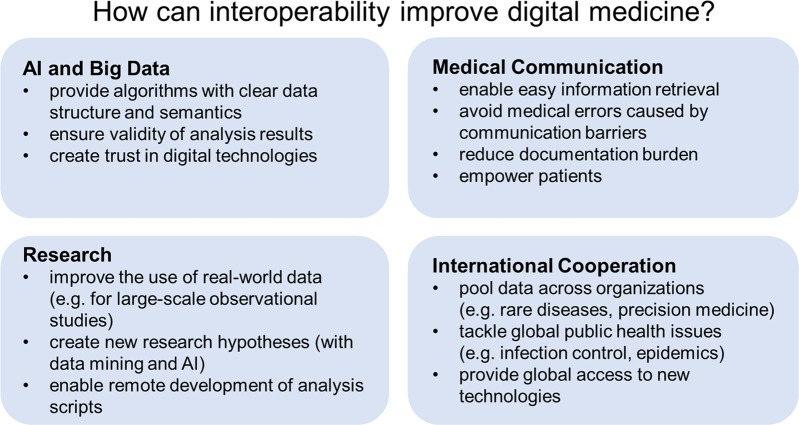
Digital data are anticipated to transform medicine. However, most of today’s medical data lack interoperability: hidden in isolated databases, incompatible systems and proprietary software, the data are difficult to exchange, analyze, and interpret. This slows down medical progress, as technologies that rely on these data – artificial intelligence, big data or mobile applications – cannot be used to their full potential. In this article, we argue that interoperability is a prerequisite for the digital innovations envisioned for future medicine. We focus on four areas where interoperable data and IT systems are particularly important: (1) artificial intelligence and big data; (2) medical communication; (3) research; and (4) international cooperation. We discuss how interoperability can facilitate digital transformation in these areas to improve the health and well-being of patients worldwide.
Overview
The claims and statistics of this paper haven’t been checked yet.
Free: it reads the open-access text and checks the first 5 claims that cite a source we can check. Create a free account to check every claim.
Integrity signals
Registry
Cites
Statistics
Figures
Verification
Claims the paper makes
The claims and statistics of this paper haven’t been checked yet.
Free: it reads the open-access text and checks the first 5 claims that cite a source we can check. Create a free account to check every claim.
Claims other papers make about this one
Each is checked against this paper’s own text: does it say what the citing paper says it does?
The source backs part of the claim, not all of it — or backs it for a different population, condition or comparison.
In the citing paper
“However, it has been shown that interoperability can be implemented successfully for large data-dependent systems, such as with the World Wide Web, and there is increasing awareness of the importance of interoperability within digital health15–17.”
From Machine intelligence in healthcare—perspectives on trustworthiness, explainability, usability, and transparency (2020) · cites this paper as [17]
Experimental — accuracy not yet measuredThe cited source says what the claim attributes to it.
In the citing paper
“However, it has been shown that interoperability can be implemented successfully for large data-dependent systems, such as with the World Wide Web, and there is increasing awareness of the importance of interoperability within digital health15–17.”
From Machine intelligence in healthcare—perspectives on trustworthiness, explainability, usability, and transparency (2020) · cites this paper as [17]
Self-check
Percentages, sums and reported differences re-computed from the paper’s own numbers.
The self-check needs the paper’s full text.
Citations
Cites
Dermatologist-level classification of skin cancer with deep neural networks
Esteva, A., Kuprel, B., Novoa, R. A., Ko, J., Swetter, S. M., Blau, H. M., & Thrun, S. (2017) · Nature · doi:10.1038/nature21056 · Cited by 14,362
Gulshan, V., Peng, L., Coram, M., Stumpe, M. C., Wu, D., Narayanaswamy, A., Venugopalan, S., Widner, K., Madams, T., Cuadros, J., et al. (2016) · JAMA · doi:10.1001/jama.2016.17216 · Cited by 7,697
Artificial intelligence in healthcare: past, present and future
Jiang, F., Jiang, Y., Zhi, H., Dong, Y., Li, H., Ma, S., Wang, Y., Dong, Q., Shen, H., & Wang, Y. (2017) · Stroke and Vascular Neurology · doi:10.1136/svn-2017-000101 · Cited by 4,837
Rajkomar, A., Dean, J., & Kohane, I. (2019) · New England Journal of Medicine · doi:10.1056/nejmra1814259 · Cited by 4,579
Predicting the future - big data, machine learning, and clinical medicine
Obermeyer, Z., & Emanuel, E. J. (2016) · New England Journal of Medicine · doi:10.1056/nejmp1606181 · Cited by 3,652
Updating the accounts: global mortality of the 1918–1920 "Spanish" influenza pandemic.
Johnson, N. P. A. S., & Mueller, J. (2002) · Bulletin of the History of Medicine · doi:10.1353/bhm.2002.0022 · Cited by 1,980
Mining electronic health records: towards better research applications and clinical care
Jensen, P. B., Jensen, L. J., & Brunak, S. (2012) · Nature Reviews Genetics · doi:10.1038/nrg3208 · Cited by 1,680
The Inevitable Application of Big Data to Health Care
Murdoch, T. B., & Detsky, A. S. (2013) · JAMA · doi:10.1001/jama.2013.393 · Cited by 1,664
A Systematic Review of Healthcare Applications for Smartphones
Mosa, A. S. M., Yoo, I., & Sheets, L. (2012) · BMC Medical Informatics and Decision Making · doi:10.1186/1472-6947-12-67 · Cited by 1,184
The human phenotype ontology: a tool for annotating and analyzing human hereditary disease
Robinson, P. N., Köhler, S., Bauer, S., Seelow, D., Horn, D., & Mundlos, S. (2008) · The American Journal of Human Genetics · doi:10.1016/j.ajhg.2008.09.017 · Cited by 1,034 · cited 1×
“It can be complemented by more domain-specific terminologies such as, for example, Logical Observation Identifiers Names and Codes (LOINC) for laboratory observations,(22) the Identification of Medicinal Products (IDMP) for medicines,(23) the nomenclature of the HUGO Gene Nomenclature Committee (HGNC) for genes(24) or…”
Background
Research works printed but not linked: 1
- Beale, T. Archetypes: constraint-based domain models for future-proof information systems. in Eleventh OOPSLA Workshop on Behavioral Semantics. (2002).
Cited by
Items 601–627 of 627
Beem, V. R. (2026) · International Journal of Engineering Science and Information Technology · doi:10.52088/ijesty.v6i2.2023
“…Rule established binding requirements for machine-readable access to patient data across payer organizations, creating a compliance obligation that has accelerated FHIR adoption across the industry [6][7], a trend reinforced by the dependence of digital medicine on interoperable data exchange [8].”
Flores, D. T., Luis-Cabezón, N. D., Gurumeta, A. A., Couto, U. G., & Gómez‐Ríos, M. Á. (2026) · Perioperative Care and Operating Room Management · doi:10.1016/j.pcorm.2026.100758
Maschewski, J., & Richter, K. (n.d.) · AIS Electronic Library (AISeL)
Ke, S. (2026) · International Conference on Big Data and Intelligent Medicine (BDIMed) · doi:10.1145/3816325.3843671
Султанов, Р. (2026) · CyberLeninK (CyberLeninka) · doi:10.5281/zenodo.23805608
Rahimi, A. (2026) · Journal of Health Research and Development · doi:10.66224/jhrd.4.4.8
Mimary, P. (2026) · INTERNATIONAL BLEST SCIENTIFIC · doi:10.65671/62frrm88
Garg, K. R., Kabra, G., Pandey, K. K., Mishra, V., & Kaushal, A. K. (2026) · International Journal of Innovation Science · doi:10.1108/ijis-02-2026-0098
CIGP: Centralized Governance of Distributed Healthcare Integration Engine Environments
Sundaram, S. K. (2026) · Critique Open Research & Review · doi:10.55640/corr-v04i05-06
Ying, L. (2026) · Frontiers in Public Health · doi:10.3389/fpubh.2026.1978109
Ammon, D. (2026) · Springer eBooks · doi:10.1007/978-3-662-72748-5_6
AI-Integrated Biosensors for Clinical Practice: Opportunities and Hurdles in Precision Diagnostics
Han, Y., Kim, D. H., & Pack, S. P. (2026) · Journal of Sensor and Actuator Networks · doi:10.3390/jsan15060086
Interopérabilité et éthique des données de santé : enjeux et défis de Mon Espace Santé
François-Talpaert, C., Bourgeois, A., Popoff, B., Audibert, G., Engrand, N., Gakuba, C., & Gall, A. L. (2026) · Anesthésie & Réanimation · doi:10.1016/j.anrea.2026.04.004
Morais, B., SOARES, M. I. D. S., Santos, S. B., Brito, M. E. Q. D., Brito, S. K. O., & Neto, B. R. D. S. (2026) · doi:10.68564/conexao.2026.002.06
An Interoperable Framework for Cancer Diagnosis Support Using Federated Learning
Morland, R., Jiwan, R., O'Connor, D., Dewan, M. A. A., & Wen, D. (2026) · IEEE Smart World Congress (SWC) · doi:10.1109/swc69865.2026.11764088
Onukpousi, G., Obidiagha, D. I., & Efeobare, P. (2026) · British Journal of Contemporary Research · doi:10.67693/bjcr-5xjvasmr
Giesa, N., Haufe, S., Menk, M., Weiß, B., Spies, C. D., Piper, S. K., Balzer, F., & Boie, S. D. (2024) · doi:10.1371/journal.pdig.0000414.r003
Sutter, E. D., Coopmans, B., Vanendert, F., Dooms, M., Allegaert, K., Borry, P., & Huys, I. (2021) · doi:10.3389/fped.2021.724431.s001
Peteranaba, S. F., Osinem, H. E., Eribenne, F., & Soyege, S. (2021) · International Journal of Science Technology & Society · doi:10.18091/ijsts.5.1-2.108
Le, J., Wu, T., & Qin, S. (2026) · Frontiers in Digital Health · doi:10.3389/fdgth.2026.1987514
SISTEMAS INFORMATIZADOS NA SEGURANÇA DO PACIENTE EM HOSPITAIS
Oliveira, K. A., Junior, A. A. C., & Gomes, R. D. S. P. (2026) · Aposta · doi:10.23900/ra.v24i124.066
TECHNOLOGIES FOR ENSURING INTEROPERABILITY AND DATA INTEGRATION IN MEDICAL INFORMATION SYSTEMS
Toxirova, F. O., Z., E. G., S.Sh., A., Vohidov, D. M., & Xusenov, S. N. (n.d.) · CyberLeninK (CyberLeninka)
Kalashnikova, T., Geerlinks, A. V., Graefe, A. S. L., Mattinson, T., Huska, H., Grunebaum, E., Suresh, S., Ritchie, B. C., Cowan, J., Rubin, T. S., et al. (2026) · Research Square · doi:10.21203/rs.3.rs-11614542/v1
Self-citation
Metadata
- Authors
- Lehne, M., Sass, J., Essenwanger, A., Schepers, J., & Thun, S.
- Affiliations
- Berlin Institute of Health at Charité - Universitätsmedizin Berlin (DE)
- Hochschule Niederrhein (DE)
- Corresponding author
- Lehne, Moritz
- Venue
- npj Digital Medicine
- Published
- 2019-08-20
- Volume
- 2
- Issue
- 1
- Pages
- 79-79
- ISSN
- 2398-6352 (ISSN-L)
- PMC
- PMC6702215
- OpenAlex
- W2969628488
- Cited by
- 501
- References
- 33
- Citations by year
- 2026: 89 · 2025: 91 · 2024: 115 · 2023: 62 · 2022: 57 · 2021: 59 · 2020: 26 · 2019: 1
- FWCI
- 6.76
- Type
- journal article
- Language
- en
- Open access
- gold
- doi.org
- Licence
- cc-by
- creativecommons.org/licenses/by/4.0 (tdm)
- creativecommons.org/licenses/by/4.0 (vor)
- Locations
- npj Digital Medicine (publishedVersion, cc-by)
- PubMed Central (publishedVersion, cc-by)
- PubMed (publishedVersion)
- DOAJ (DOAJ: Directory of Open Access Journals) (submittedVersion)
- Refubium (Universitätsbibliothek der Freien Universität Berlin) (submittedVersion, cc-by)
- Universitätsbibliothek der FU Berlin Hochschulschriftenstelle u. Dokumentenserver (cc-by)
- Funders
- Deutsche Forschungsgemeinschaft
- Charité – Universitätsmedizin Berlin
- Topics
- Health Sciences › Health Professions › Health Information Management › Electronic Health Records Systems
- Health Sciences › Medicine › Health Informatics › Artificial Intelligence in Healthcare and Education
- Health Sciences › Medicine › Public Health, Environmental and Occupational Health › Technology and Human Factors in Education and Health
- Keywords
- interoperability, health data sharing, digital health, artificial intelligence, big data, medical communication, health research, international health cooperation, digital transformation of medicine, health information systems
About these checks
Registry, retraction, Cites and statistics results are computed, not judged, with one exception: a printed reference that no index lists is read once by a model before it counts as a citation error. Claims are extracted by a model and kept only when their quote appears verbatim in the text; each cited source is then checked, with a model’s help, for whether it says what the claim relies on. Those verdicts can be wrong — read the claim’s quote and the cited source before relying on one.
Statistics and arithmetic are recomputed, not judged.
Confidence bands are shown only for fields calibrated on our annotated test set. None is calibrated yet, so no band is shown.
What counts as a claim ›How we measure confidence ›How we check this ›
Are you an author, or do you see a problem with this page? Request a review
Data sources
Bibliographic data: Semantic Scholar, OpenAlex, Crossref.
Contains information from the Semantic Scholar Academic Graph Datasets, made available under the ODC Attribution License (ODC-BY 1.0).
Semantic Scholar’s data is described in: Kinney, R., et al. (2023). The Semantic Scholar Open Data Platform. arXiv:2301.10140.
