

Why digital medicine depends on interoperability
Open accessThe DOI matches its Crossref record; 33 of the 33 references it cites were found in a registry or an index.
Abstract
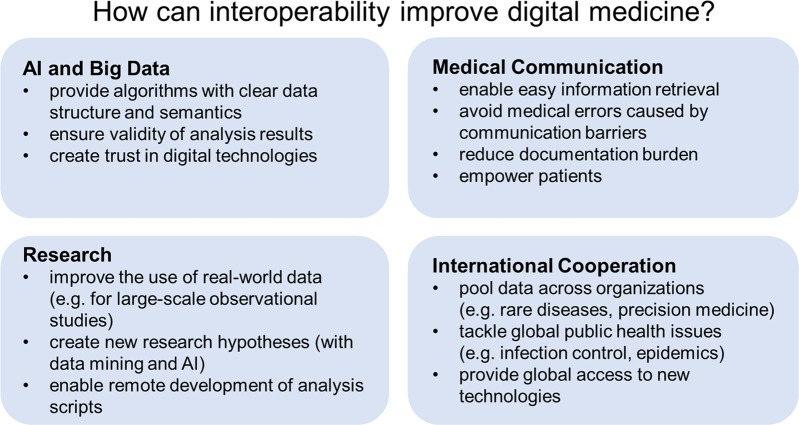
Digital data are anticipated to transform medicine. However, most of today’s medical data lack interoperability: hidden in isolated databases, incompatible systems and proprietary software, the data are difficult to exchange, analyze, and interpret. This slows down medical progress, as technologies that rely on these data – artificial intelligence, big data or mobile applications – cannot be used to their full potential. In this article, we argue that interoperability is a prerequisite for the digital innovations envisioned for future medicine. We focus on four areas where interoperable data and IT systems are particularly important: (1) artificial intelligence and big data; (2) medical communication; (3) research; and (4) international cooperation. We discuss how interoperability can facilitate digital transformation in these areas to improve the health and well-being of patients worldwide.
Overview
The claims and statistics of this paper haven’t been checked yet.
Free: it reads the open-access text and checks the first 5 claims that cite a source we can check. Create a free account to check every claim.
Integrity signals
Registry
Cites
Statistics
Figures
Verification
Claims the paper makes
The claims and statistics of this paper haven’t been checked yet.
Free: it reads the open-access text and checks the first 5 claims that cite a source we can check. Create a free account to check every claim.
Claims other papers make about this one
Each is checked against this paper’s own text: does it say what the citing paper says it does?
The source backs part of the claim, not all of it — or backs it for a different population, condition or comparison.
In the citing paper
“However, it has been shown that interoperability can be implemented successfully for large data-dependent systems, such as with the World Wide Web, and there is increasing awareness of the importance of interoperability within digital health15–17.”
From Machine intelligence in healthcare—perspectives on trustworthiness, explainability, usability, and transparency (2020) · cites this paper as [17]
Experimental — accuracy not yet measuredThe cited source says what the claim attributes to it.
In the citing paper
“However, it has been shown that interoperability can be implemented successfully for large data-dependent systems, such as with the World Wide Web, and there is increasing awareness of the importance of interoperability within digital health15–17.”
From Machine intelligence in healthcare—perspectives on trustworthiness, explainability, usability, and transparency (2020) · cites this paper as [17]
Self-check
Percentages, sums and reported differences re-computed from the paper’s own numbers.
The self-check needs the paper’s full text.
Citations
Cites
Dermatologist-level classification of skin cancer with deep neural networks
Esteva, A., Kuprel, B., Novoa, R. A., Ko, J., Swetter, S. M., Blau, H. M., & Thrun, S. (2017) · Nature · doi:10.1038/nature21056 · Cited by 14,362
Gulshan, V., Peng, L., Coram, M., Stumpe, M. C., Wu, D., Narayanaswamy, A., Venugopalan, S., Widner, K., Madams, T., Cuadros, J., et al. (2016) · JAMA · doi:10.1001/jama.2016.17216 · Cited by 7,697
Artificial intelligence in healthcare: past, present and future
Jiang, F., Jiang, Y., Zhi, H., Dong, Y., Li, H., Ma, S., Wang, Y., Dong, Q., Shen, H., & Wang, Y. (2017) · Stroke and Vascular Neurology · doi:10.1136/svn-2017-000101 · Cited by 4,837
Rajkomar, A., Dean, J., & Kohane, I. (2019) · New England Journal of Medicine · doi:10.1056/nejmra1814259 · Cited by 4,579
Predicting the future - big data, machine learning, and clinical medicine
Obermeyer, Z., & Emanuel, E. J. (2016) · New England Journal of Medicine · doi:10.1056/nejmp1606181 · Cited by 3,652
Updating the accounts: global mortality of the 1918–1920 "Spanish" influenza pandemic.
Johnson, N. P. A. S., & Mueller, J. (2002) · Bulletin of the History of Medicine · doi:10.1353/bhm.2002.0022 · Cited by 1,980
Mining electronic health records: towards better research applications and clinical care
Jensen, P. B., Jensen, L. J., & Brunak, S. (2012) · Nature Reviews Genetics · doi:10.1038/nrg3208 · Cited by 1,680
The Inevitable Application of Big Data to Health Care
Murdoch, T. B., & Detsky, A. S. (2013) · JAMA · doi:10.1001/jama.2013.393 · Cited by 1,664
A Systematic Review of Healthcare Applications for Smartphones
Mosa, A. S. M., Yoo, I., & Sheets, L. (2012) · BMC Medical Informatics and Decision Making · doi:10.1186/1472-6947-12-67 · Cited by 1,184
The human phenotype ontology: a tool for annotating and analyzing human hereditary disease
Robinson, P. N., Köhler, S., Bauer, S., Seelow, D., Horn, D., & Mundlos, S. (2008) · The American Journal of Human Genetics · doi:10.1016/j.ajhg.2008.09.017 · Cited by 1,034 · cited 1×
“It can be complemented by more domain-specific terminologies such as, for example, Logical Observation Identifiers Names and Codes (LOINC) for laboratory observations,(22) the Identification of Medicinal Products (IDMP) for medicines,(23) the nomenclature of the HUGO Gene Nomenclature Committee (HGNC) for genes(24) or…”
Background
Research works printed but not linked: 1
- Beale, T. Archetypes: constraint-based domain models for future-proof information systems. in Eleventh OOPSLA Workshop on Behavioral Semantics. (2002).
Cited by
Items 101–200 of 627
Verhoest, K., Hammerschmid, G., Rykkja, L. H., & Klijn, E.-H. (2024) · Edward Elgar Publishing eBooks · doi:10.4337/9781803923895 · Cited by 36
Revolutionizing Oncology: A Comprehensive Review of Digital Health Applications
Borkar, S., Chakole, S. V., Prasad, R., & Bansod, S. (2024) · Cureus · doi:10.7759/cureus.59203 · Cited by 32
“By standardizing data formats, communication protocols, and data-sharing practices, these mandates enable patients and healthcare providers to access and exchange health information efficiently and securely, ultimately leading to more integrated and patient-centered care [47].”
Rosenau, L., Majeed, R. W., Ingenerf, J., Kiel, A., Kroll, B., Köhler, T., Prokosch, H., & Gruendner, J. (2022) · JMIR Medical Informatics · doi:10.2196/35789 · Cited by 31
“Due to different protocols, proprietary solutions, and missing terminology, there is a lack of standardization to promote interoperability and data reuse [1].”
Wood, W. A., Marks, P. W., Plovnick, R. M., Hewitt, K., Neuberg, D. S., Walters, S., Dolan, B. K., Tucker, E. A., Abrams, C. S., Thompson, A. A., et al. (2021) · Blood Advances · doi:10.1182/bloodadvances.2021005902 · Cited by 30
Dentistry and Interoperability
Rajkumar, N. M. R., Muzoora, M. R., & Thun, S. (2022) · Journal of Dental Research · doi:10.1177/00220345221100175 · Cited by 30
“They are dependent on an expanding amount of health data, and these technologies need maximum input from various sources for a comprehensive analysis (Lehne et al. 2019).”
BackgroundInfluentialSelf-citationA nationwide digital maturity assessment of hospitals – Results from the German DigitalRadar
Geißler, A., Hollenbach, J., Haring, M., Amelung, V. E., Thun, S., & Haering, A. (2024) · Health Policy and Technology · doi:10.1016/j.hlpt.2024.100904 · Cited by 29
Self-citationLee, A. R., Kim, I. K., & Lee, E. (2021) · Healthcare · doi:10.3390/healthcare9010067 · Cited by 29
Converge or Collide? Making Sense of a Plethora of Open Data Standards in Health Care
Tsafnat, G., Dunscombe, R., Gabriel, D. L., Grieve, G., & Reich, C. (2024) · Journal of Medical Internet Research · doi:10.2196/55779 · Cited by 29
“Paradoxically, interoperability efforts have been fractured and inconsistent, resulting in many incompatible interoperability standards, despite widespread acknowledgment that fewer standards would provide better interoperability [2,3].”
Pharmacogenomics in the UK National Health Service: Progress towards implementation
McDermott, J. H., Tsakiroglou, M., Newman, W. G., & Pirmohamed, M. (2025) · British Journal of Clinical Pharmacology · doi:10.1002/bcp.70109 · Cited by 27
“27,28 To achieve this type of semantic interoperability, clinical concepts need to be converted into technical arte-facts that use international standards for health data, such as openEHR, fast healthcare interoperability resources (FHIR) and SNOMED-CT.”
Lombardo, G., Couvert, C., Kose, M., Begum, A., Spiertz, C., Worrell, C., Hasselbaink, D. M., Didden, E., Sforzini, L., Todorovic, M., et al. (2023) · Journal of Biomedical Informatics · doi:10.1016/j.jbi.2023.104553 · Cited by 27
Welzel, C., Cotte, F., Wekenborg, M., Vasey, B., McCulloch, P. G., & Gilbert, S. (2023) · Journal of Medical Internet Research · doi:10.2196/50158 · Cited by 27
“A contributory factor to HCP technostress is poor interoperability between DHTs, that is, the ability of 2 or more tools to exchange and use information [20,21].”
Zayas‐Cabán, T., Chaney, K., Rogers, C. C., Denny, J. C., & White, P. (2021) · Journal of the American Medical Informatics Association · doi:10.1093/jamia/ocab032 · Cited by 26
“40 Resources are also needed to access, process, and store data, including but not limited to cloud-based data warehouses, hardware and software, elastic computing power, and encryption capabilities.”
BackgroundArtificial intelligence in primary care: frameworks, challenges, and guardrails
Allen, L. N., Lin, J., Segal, B., Ndlovu, K., Bilardi, D., & Pettigrew, L. M. (2025) · The Lancet Primary Care · doi:10.1016/j.lanprc.2025.100079 · Cited by 25
Rinty, M. R., Prodhan, U. K., & Rahman, M. M. (2021) · Array · doi:10.1016/j.array.2021.100114 · Cited by 25
Impact of primary to secondary care data sharing on care quality in NHS England hospitals
Zhang, J., Ashrafian, H., Delaney, B. C., & Darzi, A. W. (2023) · npj Digital Medicine · doi:10.1038/s41746-023-00891-y · Cited by 25
Tozzi, A. E., Fabozzi, F., Eckley, M., Croci, I., Dell’Anna, V. A., Colantonio, E., & Mastronuzzi, A. (2022) · Frontiers in Oncology · doi:10.3389/fonc.2022.905770 · Cited by 27
“Although technical solutions for the development of AI applications are largely available, AI algorithms require large amounts of data from interoperable datasets for a widespread application of AI that achieves a high accuracy (9).”
BackgroundLareyre, F., Behrendt, C., Chaudhuri, A., Ayache, N., Delingette, H., & Raffort, J. (2022) · Angiology · doi:10.1177/00033197221113146 · Cited by 25
“25 In addition to administrative, ethical, and technical aspects, international multicenter collaboration raises the question of data ownership.”
BackgroundPatient-Generated Health Data (PGHD) Interoperability: An Integrative Perspective
Hussein, R., Crutzen, R., Gutenberg, J., Kulnik, S. T., Sareban, M., & Niebauer, J. (2021) · Studies in Health Technology and Informatics · doi:10.3233/shti210154 · Cited by 24
The Digital Platform and Its Emerging Role in Decentralized Clinical Trials
Copland, R. R., Hanke, S., Rogers, A., Mpaltadoros, L., Lazarou, I., Zeltsi, A., Nikolopoulos, S., MacDonald, T. M., & Mackenzie, I. S. (2024) · Journal of Medical Internet Research · doi:10.2196/47882 · Cited by 24
Kinast, B., Ulrich, H., Bergh, B., & Schreiweis, B. (2022) · Journal of Medical Internet Research · doi:10.2196/41344 · Cited by 24
Semantic interoperability for an AI-based applications platform for smart hospitals using HL7 FHIR
Rigas, E. S., Lagakis, P., Karadimas, M., Logaras, E., Latsou, D., Hatzikou, M., Poulakidas, A., Billis, A. S., & Bamidis, P. D. (2024) · Journal of Systems and Software · doi:10.1016/j.jss.2024.112093 · Cited by 24
Pascoe, J. L., Lu, L., Moore, M. M., Blezek, D. J., Ovalle, A. E., Linderbaum, J. A., Callstrom, M. R., & Williamson, E. E. (2024) · Mayo Clinic Proceedings Digital Health · doi:10.1016/j.mcpdig.2024.10.004 · Cited by 24
“28 Electronic health record vendors are currently adding AI to their platforms, which may relieve some of these costs for health care institutions in the future.”
Application of Modular Architectures in the Medical Domain - a Scoping Review
Bathelt, F., Lorenz, S. J., Weidner, J., Sedlmayr, M., & Reinecke, I. (2025) · Journal of Medical Systems · doi:10.1007/s10916-025-02158-3 · Cited by 24
“According to Lehne et al. [7] interoperability is a fundamental requirement for digital (intersectoral) medicine as well as international cooperation and research.”
Integrating Health Informatics into Modern Healthcare Systems: A Comprehensive Review
Javeedullah, M. (2025) · Global journal of universal studies. · doi:10.70445/gjus.2.1.2025.1-21 · Cited by 24
Artificial Intelligence in Diagnostic Medical Image Processing for Advanced Healthcare Applications
Kalita, A. J., Boruah, A., Das, T., Mazumder, N., Jaiswal, S. K., Zhuo, G., Gogoi, A., Kakoty, N. M., & Kao, F. (2024) · Biological and medical physics, biomedical engineering · doi:10.1007/978-981-97-5345-1_1 · Cited by 24
Advancing governance for digital transformation in health: insights from Georgia’s experience
Gotsadze, G., Zoidze, A., Gabunia, T., & Chin, B. (2024) · BMJ Global Health · doi:10.1136/bmjgh-2024-015589 · Cited by 24
“10 15 Thus, the challenges for developing digital health systems of the future are numerous, but their weak governance lies at the nexus of these challenges.”
Implementing FAIR principles in data management systems: A multi-case study in precision farming
Krisnawijaya, N. N. K., Tekinerdoğan, B., Catal, C., van der Tol, P. P. J., & Herdiyeni, Y. (2024) · Computers and Electronics in Agriculture · doi:10.1016/j.compag.2024.109855 · Cited by 23
Data-Driven Nurse Staffing in the Neonatal Intensive Care Unit
Feldman, K., & Rohan, A. (2022) · MCN The American Journal of Maternal/Child Nursing · doi:10.1097/nmc.0000000000000839 · Cited by 24
Mabillard, V., Demartines, N., & Joliat, G. (2021) · International Journal of Health Policy and Management · doi:10.34172/ijhpm.2020.263 · Cited by 23
The Digital Neurologic Examination
Cohen, A. B., & Nahed, B. V. (2021) · Digital Biomarkers · doi:10.1159/000515577 · Cited by 22
“Further, the interoperability and usability of such technologies also varies widely and remains an important obstacle to wide-spread use and impact [6].”
BackgroundChallenges of Machine Learning and AI (What Is Next?), Responsible and Ethical AI
Gkontra, P., Quaglio, G., Garmendia, A. T., & Lekadir, K. (2023) · Springer eBooks · doi:10.1007/978-3-031-36678-9_17 · Cited by 22
Hegselmann, S., Storck, M., Geßner, S., Neuhaus, P., Varghese, J., Bruland, P., Meidt, A., Mertens, C., Riepenhausen, S., Baier, S., et al. (2021) · BMC Medical Informatics and Decision Making · doi:10.1186/s12911-021-01524-8 · Cited by 22
“This variety often leads to incompatible data elements that impede data integration between different institutions [2].”
BackgroundOviedo, la formación de la ciudad burguesa, 1850-1950
Fernández, S. T. (1988) · Dialnet (Universidad de la Rioja) · Cited by 22
Bressan, T., Valdivia-Gago, A., Silvera-Ccallo, R., Llanos‐Cuentas, A., Camara, D. F. C., Padilla-Huamantinco, P. G., Vilcarromero, S., Miranda, J. J., & Zavaleta-Cortijo, C. (2022) · International Journal for Equity in Health · doi:10.1186/s12939-022-01773-7 · Cited by 21
“Further challenges and factors will continue to rise with digital health technologies, such as improving interoperability to enhance communication and expand databases [12, 13] and the question of who will equitably fund digital technology in response to increased demand due to the increased accessibility and reduced…”
BackgroundPrediction of Seizure Recurrence. A Note of Caution
Bosl, W. J., Leviton, A., & Loddenkemper, T. (2021) · Frontiers in Neurology · doi:10.3389/fneur.2021.675728 · Cited by 20
“disparate databases to be aggregated (166).”
Towards precision medicine based on a continuous deep learning optimization and ensemble approach
Li, J., Jin, L., Wang, Z., Peng, Q., Wang, Y., Luo, J., Zhou, J., Cao, Y., Zhang, Y., Zhang, M., et al. (2023) · npj Digital Medicine · doi:10.1038/s41746-023-00759-1 · Cited by 19
“Lehne 41 argues that interoperability is a prerequisite for the digital innovations envisioned for future medicine, and multi-agency data sharing and exchange enables data interoperability.”
BackgroundDatensouveränität: Governance-Ansätze für den Gesundheitsbereich
Hummel, P., Braun, M., Augsberg, S., von Ulmenstein, U. F., & Dabrock, P. (2021) · Essentials · doi:10.1007/978-3-658-33755-1 · Cited by 19
Ten Topics to Get Started in Medical Informatics Research
Wolfien, M., Ahmadi, N., Fitzer, K., Grummt, S., Heine, K.-L., Jung, I.-C., Krefting, D., Kühn, A., Peng, Y., Reinecke, I., et al. (2023) · Journal of Medical Internet Research · doi:10.2196/45948 · Cited by 19
How Interoperability Can Enable Artificial Intelligence in Clinical Applications
Rehburg, F., Graefe, A. S. L., Hübner, M. R., & Thun, S. (2024) · Studies in health technology and informatics · doi:10.3233/shti240485 · Cited by 18
Self-citationGraefe, A. S. L., Hübner, M. R., Rehburg, F., Sander, S., Klopfenstein, S. A. I., Alkarkoukly, S., Grönke, A., Weyersberg, A., Daniš, D., Zschüntzsch, J., et al. (2025) · Scientific Data · doi:10.1038/s41597-025-04558-z · Cited by 18
Self-citationHornback, A. M., Shi, W., Giuste, F., Zhu, Y., Carpenter, A. M., Hilton, C., Bijanki, V. N., Stahl, H., Gottesman, G. S., Purnell, C. A., et al. (2022) · ACM International Conference on Bioinformatics, Computational Biology, and Health Informatics (ACM-BCB) · doi:10.1145/3535508.3545565 · Cited by 17
“Furthermore, due to a lack of data interoperability, the majority of existing clinical data is difficult to exchange, analyze, and interpret because it is hidden in isolated databases, incompatible systems, and proprietary software [12].”
BackgroundDeveloping a professional-practice-model-based nursing organizational informatics competency model
Chen, Y., Cai, Z., Lin, B., Yan, L., Zheng, W., Kuo, M.-C., Hübner, U., & Chang, P. (2022) · International Journal of Medical Informatics · doi:10.1016/j.ijmedinf.2022.104840 · Cited by 17
Stellmach, C., Saß, J., Auber, B., Boeker, M., Wienker, T. F., Heidel, A. J., Benary, M., Schumacher, S., Ossowski, S., Klauschen, F., et al. (2023) · Journal of the American Medical Informatics Association · doi:10.1093/jamia/ocad061 · Cited by 17
“…real-world data from various systems across institutional borders which can serve to support research (including big data analytics using artificial intelligence-based methods) 7 and regulatory decision-making (eg, in the context of drug approvals and or postmarket surveillance of medical devices).”
Self-citationTowards a framework for interoperability and reproducibility of predictive models
Rahrooh, A., Garlid, A. O., Bartlett, K., Coons, W. R., Petousis, P., Hsu, W. W. Y., & Bui, A. A. T. (2023) · Journal of Biomedical Informatics · doi:10.1016/j.jbi.2023.104551 · Cited by 18
Costa, T., Tiago, M. T. B., Martins, F., & Tiago, F. (2024) · Health Information Management Journal · doi:10.1177/18333583241277952 · Cited by 17
“According to the IEEE Standard Computer Dictionary, interoperability is “the ability of two or more systems or components to exchange information and to use the information that has been exchanged” (Lehne et al., 2019).”
Zarekar, M., Al-Shehabi, H., Dörner, R., Weishaar, H. B., Lennemann, T., Bcheraoui, C. E., & Bernasconi, A. R. (2024) · EBioMedicine · doi:10.1016/j.ebiom.2024.105520 · Cited by 17
Zhang, H., Cao, Y., Jiang, H., Zhou, Q., Yang, Q., & Cheng, L. (2025) · Clinical and Translational Allergy · doi:10.1002/clt2.70020 · Cited by 17
“47 To address the issue of interoperability in digital medicine, both technical and organizational solutions are required to ensure seam-less data exchange and utilization across different systems and institutions.”
Developing a standardized framework for evaluating health apps using natural language processing
Herpertz, J., Dwyer, B., Taylor, J., Opel, N., & Torous, J. B. (2025) · Scientific Reports · doi:10.1038/s41598-025-96369-w · Cited by 17
MAP: evaluation and multi-agent enhancement of large language models for inpatient pathways
Chen, Z., Peng, Z., Liang, X., Wang, C., Liang, P., Zeng, L., Ju, M., & Yuan, Y. (2026) · npj Health Systems · doi:10.1038/s44401-026-00085-0 · Cited by 18
“This type of structural divergence is a persistent challenge frequently highlighted in cross-institutional EHR interoperability studies 61 .”
Towards the Representation of Genomic Data in HL7 FHIR and OMOP CDM
Peng, Y., Nassirian, A., Ahmadi, N., Sedlmayr, M., & Bathelt, F. (2021) · Studies in health technology and informatics · doi:10.3233/shti210545 · Cited by 17
“The digitally stored data however needs to be interoperable between different databases or systems, which is not yet realized for most of the medical data [1].”
BackgroundWilliams, R. D., Reps, J., Kors, J. A., Ryan, P. B., Steyerberg, E. W., Verhamme, K. M. C., & Rijnbeek, P. R. (2022) · Drug Safety · doi:10.1007/s40264-022-01161-8 · Cited by 16
“A major issue preventing the external validation of models is the lack of interoperability of healthcare databases [3].”
BackgroundNeeraja, R., & Anbarasi, L. J. (2025) · Artificial Intelligence Review · doi:10.1007/s10462-025-11135-8 · Cited by 16
Transforming towards AI-augmented Healthcare: Experiences of physicians in Sweden
Ismail, M., Barth, H., Holmén, M., Petersson, L., & Irgang, L. (2025) · Technovation · doi:10.1016/j.technovation.2025.103333 · Cited by 17
Brady, A., & Naikar, N. (2022) · Ergonomics · doi:10.1080/00140139.2021.2005823 · Cited by 17
“Lehne et al. (2019) Pradhan, Tiderko, and Ota (2017) Controllability Although limiting artificial intelligence means that machines will not be able to outperform humans— potentially constraining performance in some domains—it would ensure that humans retain the power to make final decisions in…”
BackgroundBaelen, F. V., Regge, M. D., Larivière, B., Verleye, K., Schelfout, S., & Eeckloo, K. (2022) · JMIR mhealth and uhealth · doi:10.2196/33772 · Cited by 16
“Indeed, health care technologies that lack interoperability (the ability to exchange data with other systems or applications) have been described as information silos [33,34]; the same holds for mobile apps, including mHealth apps, which are not compatible with other systems such as electronic patient records [25,35].”
BackgroundInfluentialA novel tool for standardizing clinical data in a semantically rich model
Freedman, H. T., Williams, H., Miller, M. A., Birtwell, D. L., Mowery, D. L., & Stoeckert, C. J. (2020) · Journal of Biomedical Informatics · doi:10.1016/j.yjbinx.2020.100086 · Cited by 16
Chen, J., Lin, M. C., Yiu, G. C., Thorne, C., Kulasa, K. M., Stewart, J. M., Nudleman, E., Freeby, M., Han, M. A., & Baxter, S. L. (2023) · Telemedicine Journal and e-Health · doi:10.1089/tmj.2022.0489 · Cited by 15
“37 A previous study has shown that clinician trust in AI remains a significant barrier, 38 although in our study, institutional representatives were largely neutral.”
Pradita, R., & Fitriana, S. M. (2024) · Jurnal Ilmiah Perekam dan Informasi Kesehatan Imelda (JIPIKI) · doi:10.52943/jipiki.v9i1.1334 · Cited by 15
Leandro, G. D. S., Moro, C. M. C., Cruz-Correia, R. J., & Santos, E. A. P. (2024) · International Journal of Medical Informatics · doi:10.1016/j.ijmedinf.2024.105525 · Cited by 15
Rodrigues, P. L. F., de Menezes, É. L. C., Scherer, M. D. D. A., Júnior, J. P. B., & Prado, N. M. D. B. L. (2025) · Trabalho Educação e Saúde · doi:10.1590/1981-7746-ojs3078 · Cited by 15
Srivastava, R., Bhat, L., Prasad, S., Deshpande, S., Das, B., & Jadhav, K. S. (2025) · The Journal of Applied Laboratory Medicine · doi:10.1093/jalm/jfaf034 · Cited by 15
Augmented Reality and Virtual Reality in Exergaming
Λαμπρόπουλος, Γ., Anastasiadis, T., & Garzón, J. (2025) · Future Internet · doi:10.3390/fi17080332 · Cited by 15
Open Data’s Role in Social Innovation Initiatives to Fight COVID-19
Almeida, F. L. (2021) · Central European Management Journal · doi:10.7206/cemj.2658-0845.51 · Cited by 15
Digital Orthopedics: The Future Developments of Orthopedic Surgery
Li, Z. (2023) · Journal of Personalized Medicine · doi:10.3390/jpm13020292 · Cited by 15
Keogh, A., Argent, R., Doherty, C., Duignan, C., Fennelly, O., Purcell, C., Johnston, W., & Caulfield, B. (2024) · Sensors · doi:10.3390/s24123780 · Cited by 14
Leivaditis, V., & Sepetis, A. K. (2025) · International Journal of Innovation Management · doi:10.1142/s1363919625400092 · Cited by 15
Data interoperability for a systems approach to developmental conditions
Molerus, F., Lynch, C. O., & Bruining, H. (2025) · Neuroscience & Biobehavioral Reviews · doi:10.1016/j.neubiorev.2025.106245 · Cited by 14
“Arguably, the largest barrier for applying AI and big data to medicine is, not a lack of algorithms, but a lack of suitable data for developing AI and big data applications (Lehne et al., 2019b).”
A Fully Self‐Powered Digital Wearable System for the Auxiliary Treatment of Plantar Fasciitis
Hou, J., Hong, Y., Liu, S., Pan, Q., Zhang, J., Xu, Q. M. X. D., Nie, Q., Wang, Z., Xin, L., Wang, Y., et al. (2026) · Advanced Science · doi:10.1002/advs.202521682 · Cited by 14
Kouri, A., & Gupta, S. (2023) · CHEST Pulmonary · doi:10.1016/j.chpulm.2023.100002 · Cited by 14
“72 Given that information sharing from patient to provider is an integral function in many asthma mHealth interventions, interoperability with current provider-facing digital systems must be a priority in asthma mHealth design.”
What’s next in hospital digitization? A Delphi-based scenario study
Köbe, P., & Bohnet-Joschko, S. (2023) · European Journal of Futures Research · doi:10.1186/s40309-023-00222-0 · Cited by 15
“For instance, cybersecurity and the availability of inter-operable interfaces are fundamental components necessary to fully harness the potential of data utilization and facilitate seamless data exchange and networking among healthcare stakeholders [96].”
BackgroundSadegh‐Zadeh, S., & Bagheri, M. (2024) · Open Journal of Clinical and Medical Images · doi:10.52768/2833-2725/1188 · Cited by 14
“Standardization ensures that data collected from various sources are structured in a consistent and uniform manner, while interoperability enables seamless data exchange and integration between different systems and healthcare pro - viders [53,54].”
BackgroundIncorporating digital platforms into nutritional care in chronic kidney disease
Dawson, J., Lambert, K., Campbell, K. L., & Kelly, J. T. (2021) · Seminars in Dialysis · doi:10.1111/sdi.12998 · Cited by 14
“71 For example, ensuring dietary intake data or clinical observations can be easily transmitted to clinicians or into an electronic medical record, will promote uptake, and enable these platforms to be more easily integrated into usual care practices.”
Digital Oral Medicine for the Elderly
Besimo, C., Zitzmann, N. U., & Joda, T. (2020) · International Journal of Environmental Research and Public Health · doi:10.3390/ijerph17072171 · Cited by 14
“Here, intelligent tools are needed that enable compatible, rapid, and secure interdisciplinary data exchange on a patient-by-patient basis to support individually tailored decision-making based on algorithms [17].”
BackgroundMedical Data Engineering – Theory and Practice
Kock-Schoppenhauer, A.-K., Schreiweis, B., Ulrich, H., Reimer, N., Wiedekopf, J., Kinast, B., Busch, H. S., Bergh, B., & Ingenerf, J. (2021) · Communications in computer and information science · doi:10.1007/978-3-030-87657-9_21 · Cited by 13
Siderius, L., Perera, S. D., Gelander, L., Jankauskaitė, L., Katz, M., Valiulis, A., Hadjipanayis, A., Reali, L., & Grossman, Z. (2023) · Frontiers in Pediatrics · doi:10.3389/fped.2023.1264829 · Cited by 13
“Using semantically interoperable health records bene fi ts patients and providers equally (24).”
BackgroundSynthetic Data Digital Twins and Data Trusts Control for Privacy in Health Data Sharing
Lomotey, R. K., Kumi, S., Ray, M., & Deters, R. (2024) · ACM Workshop on Secure and Trustworthy Cyber-Physical Systems (SaT-CPS) · doi:10.1145/3643650.3658605 · Cited by 13
“Sharing these patient data has benefits such as improved coordination of treatment plans, reduced risk of misdiagnosis, minimization of medical errors, and improved patient safety [10][11].”
BackgroundMaio, C. D., Fenza, G., Furno, D., Grauso, T., & Loia, V. (2024) · International Conference on Software, Telecommunications and Computer Networks (SoftCOM) · doi:10.23919/softcom62040.2024.10721684 · Cited by 13
Design specifications for biomedical virtual twins in engineered adoptive cellular immunotherapies
Weirauch, U., Kreuz, M., Birkenbihl, C., Alb, M., Quaranta, M., Calzone, L., Orozco-Ruiz, S., Binder, S., Fischer, L., Clavreul, S., et al. (2025) · npj Digital Medicine · doi:10.1038/s41746-025-01809-6 · Cited by 14
“Consequently, interoperability across all four levels — technical, syntactic, semantic, and organizational — is essential 82 but is often not seamlessly addressed by model developers 83 .”
Digital Medicine Community Perspectives and Challenges: Survey Study
Bent, B., Sim, I., & Dunn, J. (2021) · JMIR mhealth and uhealth · doi:10.2196/24570 · Cited by 13
“…standards, best practices, and oversight methodology are still under development [7]; sensors and devices used in digital medicine are constantly evolving and are often not validated [8]; and a lack of interoperability discourages adoption of digital medicine into medical practice [9-11].”
Anterior Segment and Others in Teleophthalmology: Past, Present, and Future
Cui, T., Yun, D., Wu, X., & Lin, H. (2021) · Asia-Pacific Journal of Ophthalmology · doi:10.1097/apo.0000000000000396 · Cited by 13
Bhagavan, S., Gharibi, M., & Rao, P. R. (2021) · IEEE International Conference on Big Data (BigData) · doi:10.1109/bigdata52589.2021.9671789 · Cited by 13
“Personal patient data is protected information and AI and machine learning algorithms have to work around that This slows down medical progress, as technologies that rely on these data — artificial intelligence, big data, or mobile applications — cannot be used to their full potential [8].”
BackgroundThe Role of Informatics in Advancing Emergency Medicine: A Comprehensive Review
Alhur, A. (2024) · Cureus · doi:10.7759/cureus.63979 · Cited by 13
“Studies have demonstrated that the use of EHRs in EDs leads to significant improvements in documentation accuracy and patient safety, particularly by reducing medication errors and ensuring that critical patient information is always available to healthcare providers [6,22,25,26].”
BackgroundAchieving a Quintuple Aim for Telehealth in Pediatrics
Cahan, E. M., Mittal, V., Shah, N. R., & Israni, S. T. (2020) · Pediatric Clinics of North America · doi:10.1016/j.pcl.2020.04.015 · Cited by 13
A Preliminary Implementation of HL7 FHIR to Achieve Interoperability in Indonesia's Local EHR
Hidayat, I. F., & Hermanto, B. R. (2020) · doi:10.1109/ict49546.2020.9239534 · Cited by 13
Garcia-Gomez, J. M., Blanes-Selva, V., Cenzano, J. C. D. B., Cebolla‐Cornejo, J., & Doñate-Martínez, A. (2023) · arXiv (Cornell University) · doi:10.48550/arxiv.2309.10424 · Cited by 13
“Furthermore, the formats and clinical information vary significantly between clinical centres as well as between EU member states[45], with a clear need to follow data standards and ensure semantic interoperability across the EU healthcare space[46].”
Digitalstrategie und Strategieentwicklung im Krankenhaus
Henke, V., Hülsken, G., Beß, A., & Henkel, A. G. (2022) · Springer eBooks · doi:10.1007/978-3-658-36226-3_5 · Cited by 12
Federated systems for automated infection surveillance: a perspective
van Rooden, S. M., van der Werff, S. D., van Mourik, M. S. M., Lomholt, F. K., Møller, K. L., Valk, S. J., Ribeiro, C. D. S., Wong, A., Haitjema, S., Behnke, M., et al. (2024) · Antimicrobial Resistance and Infection Control · doi:10.1186/s13756-024-01464-8 · Cited by 12
“As a result, information in healthcare facilities is often fragmented, collected in separate systems that do not interoperate (i.e. interact) and stored in different, in many cases proprietary, formats [36, 37].”
BackgroundBioRAGent: natural language biomedical querying with retrieval-augmented multiagent systems
Bi, M., Bao, Z., Xie, D., Xie, X., Yang, C., Wang, T., Wang, Y., & Peng, J. (2025) · Briefings in Bioinformatics · doi:10.1093/bib/bbaf539 · Cited by 12
“More-over, inconsistencies in data standards and limited interoperability across databases further hinder seamless data integration, making information retrieval a complex task [7, 8].”
Towards adaptive technology in routine mental health care
Lamo, Y., Mukhiya, S. K., Rabbi, F., Aminifar, A., Lillehaug, S.-I., Tørresen, J., Pham, M. H., Côté‐Allard, U., Noori, F. M., Guribye, F., et al. (2022) · Digital Health · doi:10.1177/20552076221128678 · Cited by 12
“53,54 We can achieve interoperability by following established standards such as HL7 FHIR, which supports Representational State Transfer (REST) architecture and SOA for seamless information exchange.”
BackgroundMethodUse of Computation Ecosystems to Analyze the Kidney-Heart Crosstalk
Wu, Z., Lohmöller, J., Kuhl, C. K., Wehrle, K., & Jankowski, J. (2023) · Circulation Research · doi:10.1161/circresaha.123.321765 · Cited by 12
“177 In federated scenarios, data ecosystems contributed to solving the challenges of modeling, such as data access Omics data are high in volume and information content but are mainly associative and lack a causative link to disease outcome and progression.”
BackgroundJoshi, H. (2024) · IARJSET · doi:10.17148/iarjset.2021.8116 · Cited by 12
“The article will discuss both the benefits and challenges of implementing interoperability solutions in healthcare settings [3-4].”
High-tech medical care in the practice of Russian healthcare
Prisyazhnaya, N. V., Sadykova, M. F., Golikova, N. S., & Borisova, P. M. (2024) · Medical Technologies Assessment and Choice · doi:10.17116/medtech20244603170 · Cited by 12
The Connected Care for Canadians Act : an important step toward interoperability of health data
Sabawy, D. E., Feldman, J., & Pinto, A. D. (2024) · Canadian Medical Association Journal · doi:10.1503/cmaj.241123 · Cited by 12
Stegemann, L., & Gersch, M. (2021) · Hawaii International Conference on System Sciences (HICSS) · doi:10.24251/hicss.2021.746 · Cited by 12
“by TK with its partner IBM Watson require more stringent interoperability requirements and semantic standards than less extensive services [21].”
BackgroundInfluentialCraig, A., Beek, K., Godinho, M., Ansari, S., Jonnagaddala, J., Linhart, C., Hall, J., & Liaw, T. (2022) · UNSWorks (University of New South Wales, Sydney, Australia) · doi:10.26190/unsworks/28338 · Cited by 12
Giesa, N., Haufe, S., Menk, M., Weiß, B., Spies, C., Piper, S. K., Balzer, F., & Boie, S. D. (2024) · PLOS Digital Health · doi:10.1371/journal.pdig.0000414 · Cited by 11
Digital Transformation: A Challenge for the Romanian Health System
Rotaru, N.-P., & Edelhauser, E. (2024) · Systems · doi:10.3390/systems12090366 · Cited by 11
Al-Jebrni, A. H., Jiang, Z., Qin, Y., Qiu, Y., Jiang, N., Li, G., Zheng, Y., Wong, T. Y., Kim, S., Jung, Y., et al. (2026) · Computational Visual Media · doi:10.26599/cvm.2026.9450530 · Cited by 11
Metadata
- Authors
- Lehne, M., Sass, J., Essenwanger, A., Schepers, J., & Thun, S.
- Affiliations
- Berlin Institute of Health at Charité - Universitätsmedizin Berlin (DE)
- Hochschule Niederrhein (DE)
- Corresponding author
- Lehne, Moritz
- Venue
- npj Digital Medicine
- Published
- 2019-08-20
- Volume
- 2
- Issue
- 1
- Pages
- 79-79
- ISSN
- 2398-6352 (ISSN-L)
- PMC
- PMC6702215
- OpenAlex
- W2969628488
- Cited by
- 501
- References
- 33
- Citations by year
- 2026: 89 · 2025: 91 · 2024: 115 · 2023: 62 · 2022: 57 · 2021: 59 · 2020: 26 · 2019: 1
- FWCI
- 6.76
- Type
- journal article
- Language
- en
- Open access
- gold
- doi.org
- Licence
- cc-by
- creativecommons.org/licenses/by/4.0 (tdm)
- creativecommons.org/licenses/by/4.0 (vor)
- Locations
- npj Digital Medicine (publishedVersion, cc-by)
- PubMed Central (publishedVersion, cc-by)
- PubMed (publishedVersion)
- DOAJ (DOAJ: Directory of Open Access Journals) (submittedVersion)
- Refubium (Universitätsbibliothek der Freien Universität Berlin) (submittedVersion, cc-by)
- Universitätsbibliothek der FU Berlin Hochschulschriftenstelle u. Dokumentenserver (cc-by)
- Funders
- Deutsche Forschungsgemeinschaft
- Charité – Universitätsmedizin Berlin
- Topics
- Health Sciences › Health Professions › Health Information Management › Electronic Health Records Systems
- Health Sciences › Medicine › Health Informatics › Artificial Intelligence in Healthcare and Education
- Health Sciences › Medicine › Public Health, Environmental and Occupational Health › Technology and Human Factors in Education and Health
- Keywords
- interoperability, health data sharing, digital health, artificial intelligence, big data, medical communication, health research, international health cooperation, digital transformation of medicine, health information systems
About these checks
Registry, retraction, Cites and statistics results are computed, not judged, with one exception: a printed reference that no index lists is read once by a model before it counts as a citation error. Claims are extracted by a model and kept only when their quote appears verbatim in the text; each cited source is then checked, with a model’s help, for whether it says what the claim relies on. Those verdicts can be wrong — read the claim’s quote and the cited source before relying on one.
Statistics and arithmetic are recomputed, not judged.
Confidence bands are shown only for fields calibrated on our annotated test set. None is calibrated yet, so no band is shown.
What counts as a claim ›How we measure confidence ›How we check this ›
Are you an author, or do you see a problem with this page? Request a review
Data sources
Bibliographic data: Semantic Scholar, OpenAlex, Crossref.
Contains information from the Semantic Scholar Academic Graph Datasets, made available under the ODC Attribution License (ODC-BY 1.0).
Semantic Scholar’s data is described in: Kinney, R., et al. (2023). The Semantic Scholar Open Data Platform. arXiv:2301.10140.
