

Why digital medicine depends on interoperability
Open accessThe DOI matches its Crossref record; 33 of the 33 references it cites were found in a registry or an index.
Abstract
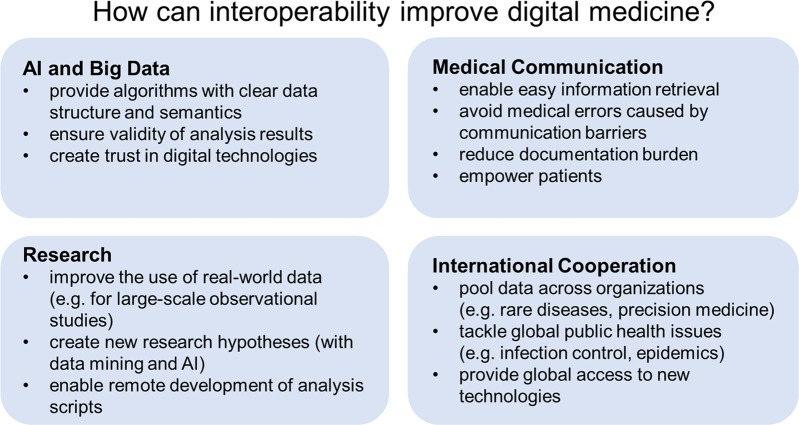
Digital data are anticipated to transform medicine. However, most of today’s medical data lack interoperability: hidden in isolated databases, incompatible systems and proprietary software, the data are difficult to exchange, analyze, and interpret. This slows down medical progress, as technologies that rely on these data – artificial intelligence, big data or mobile applications – cannot be used to their full potential. In this article, we argue that interoperability is a prerequisite for the digital innovations envisioned for future medicine. We focus on four areas where interoperable data and IT systems are particularly important: (1) artificial intelligence and big data; (2) medical communication; (3) research; and (4) international cooperation. We discuss how interoperability can facilitate digital transformation in these areas to improve the health and well-being of patients worldwide.
Overview
The claims and statistics of this paper haven’t been checked yet.
Free: it reads the open-access text and checks the first 5 claims that cite a source we can check. Create a free account to check every claim.
Integrity signals
Registry
Cites
Statistics
Figures
Verification
Claims the paper makes
The claims and statistics of this paper haven’t been checked yet.
Free: it reads the open-access text and checks the first 5 claims that cite a source we can check. Create a free account to check every claim.
Claims other papers make about this one
Each is checked against this paper’s own text: does it say what the citing paper says it does?
The source backs part of the claim, not all of it — or backs it for a different population, condition or comparison.
In the citing paper
“However, it has been shown that interoperability can be implemented successfully for large data-dependent systems, such as with the World Wide Web, and there is increasing awareness of the importance of interoperability within digital health15–17.”
From Machine intelligence in healthcare—perspectives on trustworthiness, explainability, usability, and transparency (2020) · cites this paper as [17]
Experimental — accuracy not yet measuredThe cited source says what the claim attributes to it.
In the citing paper
“However, it has been shown that interoperability can be implemented successfully for large data-dependent systems, such as with the World Wide Web, and there is increasing awareness of the importance of interoperability within digital health15–17.”
From Machine intelligence in healthcare—perspectives on trustworthiness, explainability, usability, and transparency (2020) · cites this paper as [17]
Self-check
Percentages, sums and reported differences re-computed from the paper’s own numbers.
The self-check needs the paper’s full text.
Citations
Cites
Dermatologist-level classification of skin cancer with deep neural networks
Esteva, A., Kuprel, B., Novoa, R. A., Ko, J., Swetter, S. M., Blau, H. M., & Thrun, S. (2017) · Nature · doi:10.1038/nature21056 · Cited by 14,362
Gulshan, V., Peng, L., Coram, M., Stumpe, M. C., Wu, D., Narayanaswamy, A., Venugopalan, S., Widner, K., Madams, T., Cuadros, J., et al. (2016) · JAMA · doi:10.1001/jama.2016.17216 · Cited by 7,697
Artificial intelligence in healthcare: past, present and future
Jiang, F., Jiang, Y., Zhi, H., Dong, Y., Li, H., Ma, S., Wang, Y., Dong, Q., Shen, H., & Wang, Y. (2017) · Stroke and Vascular Neurology · doi:10.1136/svn-2017-000101 · Cited by 4,837
Rajkomar, A., Dean, J., & Kohane, I. (2019) · New England Journal of Medicine · doi:10.1056/nejmra1814259 · Cited by 4,579
Predicting the future - big data, machine learning, and clinical medicine
Obermeyer, Z., & Emanuel, E. J. (2016) · New England Journal of Medicine · doi:10.1056/nejmp1606181 · Cited by 3,652
Updating the accounts: global mortality of the 1918–1920 "Spanish" influenza pandemic.
Johnson, N. P. A. S., & Mueller, J. (2002) · Bulletin of the History of Medicine · doi:10.1353/bhm.2002.0022 · Cited by 1,980
Mining electronic health records: towards better research applications and clinical care
Jensen, P. B., Jensen, L. J., & Brunak, S. (2012) · Nature Reviews Genetics · doi:10.1038/nrg3208 · Cited by 1,680
The Inevitable Application of Big Data to Health Care
Murdoch, T. B., & Detsky, A. S. (2013) · JAMA · doi:10.1001/jama.2013.393 · Cited by 1,664
A Systematic Review of Healthcare Applications for Smartphones
Mosa, A. S. M., Yoo, I., & Sheets, L. (2012) · BMC Medical Informatics and Decision Making · doi:10.1186/1472-6947-12-67 · Cited by 1,184
The human phenotype ontology: a tool for annotating and analyzing human hereditary disease
Robinson, P. N., Köhler, S., Bauer, S., Seelow, D., Horn, D., & Mundlos, S. (2008) · The American Journal of Human Genetics · doi:10.1016/j.ajhg.2008.09.017 · Cited by 1,034 · cited 1×
“It can be complemented by more domain-specific terminologies such as, for example, Logical Observation Identifiers Names and Codes (LOINC) for laboratory observations,(22) the Identification of Medicinal Products (IDMP) for medicines,(23) the nomenclature of the HUGO Gene Nomenclature Committee (HGNC) for genes(24) or…”
Background
Research works printed but not linked: 1
- Beale, T. Archetypes: constraint-based domain models for future-proof information systems. in Eleventh OOPSLA Workshop on Behavioral Semantics. (2002).
Cited by
Items 401–500 of 627
Practical considerations for pathologists when selecting digital pathology systems: an ESDIP guide
Montezuma, D., L’Imperio, V., Ameisen, D., Carvalho, R., Boor, P., Oliveira, S. P., Khalili, N., Zlobec, I., Zerbe, N., & Temprana‐Salvador, J. (2026) · The Journal of Pathology · doi:10.1002/path.70103 · Cited by 1
Jiménez, E. G., & Díaz, J. D. M. (2026) · Healthcare · doi:10.3390/healthcare14152339 · Cited by 1
“The absence of reported integration with hospital information systems in the reviewed corpus indicates the field has not yet crossed the threshold from research tool to clinical instrument [43,58].”
InfluentialDoes System Choice Matter? Influence of Hospital Information Systems on Digital Maturity
Backes, J., Geißler, A., Subelack, J., & Kuklinski, D. (2026) · Journal of Medical Systems · doi:10.1007/s10916-026-02450-w · Cited by 1
“Lehne et al. [32 ] argue that fragmented systems hinder large-scale data processing and efficient information retrieval, and impede reductions in documen - tation burden and patient participation.”
Atma, A., & Muklason, A. (2026) · Jurnal Impresi Indonesia · doi:10.58344/jii.v5i8.8024 · Cited by 1
“Secara global, standar HL7 FHIR (Fast Healthcare Interoperability Resources) telah menjadi standar de facto untuk pertukaran data kesehatan digital, dan Indonesia melalui SATUSEHAT telah menetapkan FHIR sebagai platform layanan interoperabilitas data kesehatan nasional (Lehne et al., 2019).”
Lee, S., Woo, Y., & Lee, S.-J. (2026) · Healthcare · doi:10.3390/healthcare14183011 · Cited by 1
“Achieving this kind of shared, exchangeable representation depends on interoperability, the capacity of different information systems to exchange data and to use the information that has been exchanged [7].”
Interoperability in Healthcare: A Primer and New Frontiers
Ionescu, A., Carbone, P., Meijer, S., Koutras, C., Freire, J., Hose, K., & Raghothama, J. (2026) · Proceedings of the VLDB Endowment · doi:10.14778/3827998.3828149 · Cited by 1
Chen, J., & Wang, F. (2026) · Oral and Maxillofacial Surgery Clinics of North America · doi:10.1016/j.coms.2026.09.008 · Cited by 1
Ferreira, J. C., Esperança, M., Freitas, D., Botas, J., Mataloto, B. M., Correia, R., & Dias, M. (2026) · Sensors · doi:10.3390/s26206658 · Cited by 1
Ali, H., Cao, Z., & Gao, F. (2026) · Journal of the Franklin Institute · doi:10.1016/j.jfranklin.2026.109173 · Cited by 1
An interoperable and reusable research environment for digital medicine
Kohler, S., Meyer-Eschenbach, F., Schüßler, L., Meixner, M., Kärcher, F., Kling, A., Schubert, V., Büschenfelde, D. M. Z., Marschollek, M., & Eils, R. (2026) · Frontiers in Digital Health · doi:10.3389/fdgth.2026.1943167 · Cited by 1
“Vendor-specific EHR systems and proprietary data formats frequently prevent access to clinical data that would otherwise be valuable for secondary use (9, 22, 23).”
Purwaningrum, D., Kurniawan, B., Pramesona, B. A., Suwandi, J. F., & Suharmanto, S. (2026) · Jurnal Manajemen Kesehatan Yayasan RS Dr Soetomo · doi:10.29241/jmk.v12i2.2625 · Cited by 1
Intelligent Decision Support During Hospitalization in a Pandemic: Methodology and Process Model
Smirnov, A. V., Teslya, N., Shilov, N. G., & Moll, E. (2021) · Conference of Open Innovations Association (FRUCT) · doi:10.23919/fruct50888.2021.9347654 · Cited by 1
Prévost, A. L. D., Trencart, M., Gaillard, V., Bouzillé, G., Besson, R., Sharma, D., Puech, P., & Chazard, E. (2021) · Studies in health technology and informatics · doi:10.3233/shti210193 · Cited by 1
“Interoperability is also a crucial point when dealing with health data [7].”
BackgroundPrévost, A. L. D., Bentegeac, R., Dequesnes, A., Billiau, A., Baudelet, E., Legleye, R., Hubaut, M. A., Cassagnou, M., Puech, P., Besson, R., et al. (2022) · Studies in health technology and informatics · doi:10.3233/shti220063 · Cited by 1
Challenges and Opportunities of Secondary Use of health Data in Developing Countries
Joshua, K. O., & Bisallah, H. I. (2023) · KIU journal of science engineering and technology · doi:10.59568/kjset-2023-2-1-22 · Cited by 1
“It is now feasible to discover patient-specific characteristics, predict unique reactions to medicines, and adapt treatment regimens by evaluating varied datasets such as genetic information, clinical records, and treatment results (Lehne et al, 2019) 6.”
BackgroundOptimizing the Management of Medical Information Technology: Best Practices and Innovations
(2022) · International Journal of Bio-Medical Informatics and e-Health · doi:10.30534/ijbmieh/2022/191062022 · Cited by 1
Mettertron – Bridging Metadata Repositories and Terminology Servers
Schladetzky, J., Kock-Schoppenhauer, A.-K., Drenkhahn, C., Ingenerf, J., & Wiedekopf, J. (2023) · Studies in health technology and informatics · doi:10.3233/shti230721 · Cited by 1
Sitompul, T., Warnars, H. L. H. S., Meyliana, M., Hidayanto, A. N., & Prabowo, H. (2023) · International Conference on Information Management and Technology (ICIMTech) · doi:10.1109/icimtech59029.2023.10278050 · Cited by 1
“After all, to achieve interoperability within a system, It is essential to ensure that several considerations are met; Interoperability involves various aspects such as technical, syntactic, semantic, and organizational [10].”
BackgroundWas ist Gendermedizin und warum brauchen wir sie?
Regitz‐Zagrosek, V. (2023) · Springer eBooks · doi:10.1007/978-3-662-67090-3_1 · Cited by 1
The design and management of public-private eHealth partnerships
Callens, C., Verhoest, K., Klijn, E., Brogaard, L., Lember, V., Pina, V., & Doninck, D. V. (2024) · Edward Elgar Publishing eBooks · doi:10.4337/9781803923895.00018 · Cited by 1
Health Data Management im Krankenhaus umsetzen
Salgado, E., Näher, A., Friedrich, M. E., Kremser, G., Braune, K., & Balzer, F. (2024) · Springer eBooks · doi:10.1007/978-3-658-43236-2_34 · Cited by 1
Rahman, N., Ibrahim, A., Verma, R. S., Schwartz, R. P., Clarke, D. E., Gibson, D., Vocci, F. J., Casanova, B., & Pagano, A. (2024) · Journal of Drug Issues · doi:10.1177/00220426241243284 · Cited by 1
“Lack of interoperability was also cited as a barrier in previous research on MBC implementation in medical settings (Amini et al., 2021; van Egdom et al., 2019) and has been an ongoing concern in digital medicine more generally (Lehne et al., 2019).”
Przestrzelski, C., Jakob, A., Jakob, C., & Hoffmann, F. R. (2024) · Frontiers in Digital Health · doi:10.3389/fdgth.2024.1249454 · Cited by 1
Alshammari, B. M. (2024) · Journal of Computer Science · doi:10.3844/jcssp.2024.465.486 · Cited by 1
“It has been identified that many healthcare systems lack interoperability including storing data in isolated databases, systems’ incompatibility, and difficulty in exchanging data Lehne et al. (2019).”
BackgroundHübner, M. R., Nyoungui, E. F., Gazzerro, E., Hassoun, L., Zschüntzsch, J., Krefting, D., Schepers, J., & Röttger, R. (2024) · Studies in health technology and informatics · doi:10.3233/shti240677 · Cited by 1
Self-citationChabiera, P. J., Holtz, S., Köhler, S. M., Deutsch, K., Oftring, Z. S., Lawin, D., Vogelmeier, C. F., Dauletbaev, N., Niekrenz, L., Dreher, M., et al. (2024) · Zeitschrift für Allgemeinmedizin · doi:10.1007/s44266-024-00292-8 · Cited by 1
“Dies wird auch international emp-fohlen [7, 9, 14, 24].”
Strategies for unlocking EMR Interoperability: A Narrative Review
Kansiime, E. P., Odoyo, C. O., & Ondulo, J. M. (2024) · Journal of research and academic writing. · doi:10.58721/jraw.v1i2.779 · Cited by 1
A REVIEW ON THE ROLE OF ARTIFICIAL INTELLIGENCE IN MEDICINE AND CLINICAL SCIENCES
Akhter, E., Siddiq, A., & Baig, S. G. (2024) · International Journal of Pharmacy & Integrated Health Sciences · doi:10.56536/ijpihs.v5i2.135 · Cited by 1
Transformative AI in Biomedicine Analysis: Applications, Challenges, and Future Directions
Tiwari, N. K. (2024) · Advances in information security, privacy, and ethics book series · doi:10.4018/979-8-3693-9311-6.ch006 · Cited by 1
Chaturvedi, A., & Kaur, J. (2023) · Journal of Artificial Intelligence Machine Learning and Data Science · doi:10.51219/jaimld/akhil-chaturvedi/334 · Cited by 1
Role of digital dentistry in prevention and diagnosis- a systematic review
Gupta, B., Gupta, S., Bedia, A. S., Aljabri, M. Y., Khan, S. S., & Elamin, N. M. H. (2025) · Bangladesh Journal of Medical Science · doi:10.3329/bjms.v24i10.79196 · Cited by 1
“Several areas of dentistry have embraced the digital workflow, such as treatment planning, design, ©The Ibn Sina Trust S 166 prototyping, implant surgery, and the creation of personalised prostheses and devices through the use of additive and subtractive CAD/CAM technologies [33].”
Hamed, O. A. E., Wasfy, N. F., Saleh, R., & Rizk, M. H. (2025) · Education for Health · doi:10.62694/efh.2025.204 · Cited by 1
Serag-Bolos, E. S., Olson, K., Tritsch, A. J., Miranda, A. C., Ditwiler, R. E., Schocken, D. M., Marsh, J., Coughlin, E. C., Reiner, C. C., Casanova, J., et al. (2025) · JACCP JOURNAL OF THE AMERICAN COLLEGE OF CLINICAL PHARMACY · doi:10.1002/jac5.70081 · Cited by 1
Fasasi, G. O. (2020) · International Journal of Multidisciplinary Research and Growth Evaluation · doi:10.54660/.ijmrge.2020.1.3.316-326 · Cited by 1
Schreiweis, B., Kinast, B., Ulrich, H., Pinto, S. P., & Bergh, B. (2024) · Research Square · doi:10.21203/rs.3.rs-3951188/v1 · Cited by 1
Nadeem, N., Rashid, Z., Zafar, S. B., & Yousaf, M. Z. (2024) · doi:10.2196/preprints.63885 · Cited by 1
Rosenau, L., Gruendner, J., Behrend, P., Triefenbach, L., Kurscheidt, M., Majeed, R. W., Prokosch, H., & Ingenerf, J. (2024) · Research Square · doi:10.21203/rs.3.rs-4977169/v1 · Cited by 1
Telemedicine in Intensive Care – Examining a Use Case in light of the Findings of a Scoping Review
Guinemer, C. (2024) · Refubium (Universitätsbibliothek der Freien Universität Berlin) · doi:10.17169/refubium-42189 · Cited by 1
Use of digital media for remote instruction in exercise sciences education and research
Rigamonti, L. (2023) · publish.UP (University of Potsdam) · doi:10.25932/publishup-58364 · Cited by 1
Philipp, P. (2023) · Repository KITopen (Karlsruhe Institute of Technology) · doi:10.5445/ksp/1000156884 · Cited by 1
Interoperability between health information systems in the hospital context
Fernandes, J. G. (2020) · Repositório do ISCTE-IUL · Cited by 1
Adoption of free and open source software in the Angolan public sector
Silva, D. G. (2024) · Repositório do ISCTE-IUL · Cited by 1
Pérez Llorca, R. A. (2022) · LA Referencia (Red Federada de Repositorios Institucionales de Publicaciones Científicas) · Cited by 1
Abirami, S. K., & Karpagam, G. R. (2026) · Research Square · doi:10.21203/rs.3.rs-8561779/v1 · Cited by 1
A Novel end-to-end Digital Health System Using Deep Learning-based ECG AnalysisPreprint
Kontou, A., Miroshnikova, N., Matheou, C., Sophocleous, S., Tsekouras, N., Malialis, K., & Kolios, P. (2026) · arXiv (Cornell University) · doi:10.48550/arxiv.2603.16891 · Cited by 1
FAIR and bias-free network modules for mechanism-based disease redefinitions
Hassan, A. (2021) · Research Publications (Maastricht University) · doi:10.26481/dis.20210707ah
AI in nuclear medicine – what, why and how?
Rogasch, J. M. M., & Penzkofer, T. (2021) · Nuklearmedizin - NuclearMedicine · doi:10.1055/a-1542-6231
“Automation of data retrieval processes based on interoperable data and established communication standards would be helpful [17, 22].”
BackgroundSingh, A., & Madaan, G. (2022) · Wiley eBooks · doi:10.1002/9781119865247.ch2
Implementation of a Hybrid Information System in an Intelligent Health Gateway
Eya’a, G. L. M., & Hanoune, M. (2022) · Lecture notes in networks and systems · doi:10.1007/978-981-19-7660-5_13
Rodriguez‐Watson, C., Sheils, N. E., Louder, A. M., Eldridge, E. H., Lin, N. D., Pollock, B. D., Gatz, J. L., Grannis, S. J., Vashisht, R., Ghauri, K., et al. (2023) · PLoS ONE · doi:10.1371/journal.pone.0281365
“Some of the tests received an emergency use authorization (EUA).”
BackgroundWu, X., Shi, X., Hu, W., Ma, H., Liao, W., & Gao, Y. (2023) · Intelligent Surgery · doi:10.1016/j.isurg.2023.02.003
Kaminska, M. E., & Franke, R. (2023) · Canadian Family Physician · doi:10.46747/cfp.6903215
Supporting Clinical Care: SOFA on FHIR.
Gatrio, M., Sasso, A. M., Saß, J., Böttinger, E., Edelman, J. A., & Landgraf, P. (2023) · PubMed Central
Big data in cardiovascular population health research
Sun, L. Y. (2023) · Elsevier eBooks · doi:10.1016/b978-0-323-90534-3.00011-1
Managing the Future of Healthcare: The Importance of Health Information Management
Almeida, F. N., Dias, A. D. S., & Silva, P. H. P. D. (2023) · Springer eBooks · doi:10.1007/978-3-031-38743-2_6
Petzold, T., Böhland, B., Schuster, A., & von Dercks, N. (2024) · Springer eBooks · doi:10.1007/978-3-658-43236-2_3
Chen, J. (2024) · San José State University ScholarWorks (San Jose State University) · doi:10.31979/etd.skpv-st58
A Narrative Review of the Frameworks, Challenges, and Applications of Interoperability in E -Health
Moshiri, F., & Asosheh, A. (2023) · Journal of Health and Biomedical Informatics · doi:10.34172/jhbmi.2023.24
“Covering provider”: an effort to streamline clinical communication chaos
Joshi, M. M., Gokhale, A., Ma, S. P., Pendrey, A., Wozniak, L., Moturu, A., Schwartz, N. U., Wilson, A., Darmawan, K. F., Phillips, B. N., et al. (2024) · JAMIA Open · doi:10.1093/jamiaopen/ooae057
Kozera, J. S., Pikala, M., & Burzyńska, M. (2024) · Journal of Health Study and Medicine · doi:10.2478/jhsm-2024-0003
The Role of Source Systems Strengthening in the Effective Interoperability of Digital Health Systems
Binamungu, L. P. (2024) · IFIP advances in information and communication technology · doi:10.1007/978-3-031-66986-6_23
Fast Healthcare Interoperability Resource Genomics and Polygenic Risk Scores
Heale, B. S. E. (2024) · Advances in Molecular Pathology · doi:10.1016/j.yamp.2024.07.008
How informatics is shaping the future of emergency medicine: An in-depth analysis-review article
Alghamdi, A. S., Almuhaylib, A. M., Alwaked, M. H., Alrashidi, A. A., Alrasheed, B. B., Alsarimi, F. A. H., Alanazi, A. A., Alanazi, M. M., & Alumtairi, A. Z. (2024) · International Journal of Health Sciences · doi:10.53730/ijhs.v8ns1.15153
IRP., :. I. R. P. (. I. A. R. F. D. T. P. W. O. D. A. F. I. W. A. T. E. T. R. O. L. I. P. W. (2024) · Colorectal Disease · doi:10.1111/codi.17124
Estratégias de modelagem e combinação de variáveis para o estudo da COVID-19 e suas comorbidades
Silva, J. C. S. E. (2024) · Digital Library of Theses and Dissertations (Universidade de São Paulo) · doi:10.11606/t.9.2024.tde-11112024-114814
Exploring the Interoperability for Information Exchange Between Acute and Post-Acute Care Settings
Gottumukkala, M., El-Gayar, O., & Noteboom, C. (2025) · Hawaii International Conference on System Sciences (HICSS) · doi:10.24251/hicss.2025.415
Kiwanuka, A., & Nabukenya, J. (2025) · Health Informatics Journal · doi:10.1177/14604582251320287
“89 This points to further research on nomenclatures and ontologies of medical information 90 to understand the naming and classifying systems for health procedures and conditions, as well as the structured vocabulary, concepts and their relationships.”
Sabawy, D. E., Feldman, J., & Pinto, A. D. (2025) · Canadian Medical Association Journal · doi:10.1503/cmaj.241123-f
Mkayula, N. (2024) · Trends in Telemedicine & E-health · doi:10.31031/tteh.2024.05.000601
Social Determinants of Health: Expanding our Understanding of Digital Maturity
Scheuer, A., Haffer, N., Kirchberger, V., & Thun, S. (2025) · Springer eBooks · doi:10.1007/978-3-031-80704-6_17
Self-citationOkemwa, J., Owoche, P. O., & Mbuguah, S. M. (2025) · Global Journal of Engineering and Technology Advances · doi:10.30574/gjeta.2025.23.3.0190
Jordano, J. O., Fausone, M., Cauley, M. R., Rubenstein, M. D., Swanson, T., Sopko, K., & Ward, M. J. (2025) · Military Medicine · doi:10.1093/milmed/usaf288
Advancing Healthcare: Data Mining and Digital Tech in Diagnostics and Care
Alzumaya, A., Alhazmi, K., & Emara, A.-H. M. (2025) · Lecture notes on data engineering and communications technologies · doi:10.1007/978-3-031-91351-8_13
Wearable Technologies for Chronic Disease Management: Innovations and Applications in Healthcare
Chatterjee, S. (2025) · Innovative Journal of Medical and Healthcare Research. · doi:10.61808/ijmhr25
Integration of Data into Commercial HEDIS Systems
-, S. H. (2025) · International Journal of Multidisciplinary Research and Growth Evaluation · doi:10.54660/.ijmrge.2025.6.3.2012-2021
Why Is SNOMED CT® Important to Healthcare?
Bird, L. (2025) · Health information technology standards · doi:10.1007/978-3-031-97788-6_2
DICOM: What it is and why it matters
Allan, B. D., Lum, F., Khawaja, A. P., Rosenberg, E. D., Hovanesian, J. A., & ASCRS, F. A. O. B. O. T. E. A. T. (2025) · Journal of Cataract & Refractive Surgery · doi:10.1097/j.jcrs.0000000000001725
Pappalardo, C., D’Ambrosio, F., & Calabrò, G. E. (2025) · Data science, machine intelligence, and law · doi:10.1007/978-3-031-99709-9_8
A arte de envelhecer com dignidade: desafios e perspectivas
Lyrio, A. C. D. O., de Souza, A. P. B., Teodoro, C. R., de Souza, C. H. M., de Almeida, C. V. F., Fernandes, C. R. D. A., Mello, C. S. F., Bernardo, D. Q., Sousa, D. D. N., Pontes-Ribeiro, D. H., et al. (2025) · Expert Editora eBooks · doi:10.29327/5661967
A Blockchain-Based Framework for Secure Data Sharing in Healthcare
Bhimavarapu, U. (2025) · IGI Global eBooks · doi:10.4018/979-8-3373-1225-5.ch005
Awad, N. S. H., Alghamdi, R. I. S., Atiahallah, A. A., Bukhari, B. A., Alalyani, A. G., Alyami, E. D., & Alamri, F. A. (2024) · Saudi Journal of Medicine and Public Health · doi:10.64483/20251155
Strukturerte og standardiserte data gir bedre sykepleiedokumentasjon
Laukvik, L. B., Brandal, A., & Fossum, M. (2025) · Sykepleien Forskning · doi:10.4220/sykepleiens.2025.101775
Impact of AI in Patient Engagement: Smart Revolution in Health Sector
Jenefa, L., & Jayakumar, M. (2025) · IGI Global eBooks · doi:10.4018/979-8-3373-1514-0.ch001
Ethical and regulatory dimensions of AI in TNBC management
Minocha, N., Kadiri, S. K., Tiwari, P. K., & Yadav, D. (2025) · Elsevier eBooks · doi:10.1016/b978-0-443-33565-5.00006-2
Interoperability in the Context of Integrated Care
Piera-Jiménez, J., Leslie, H., Dunscombe, R., & Pontes, C. (2025) · Springer eBooks · doi:10.1007/978-3-031-96286-8_101
Software Engineer, S. C., & Maddali, V. S. (2025) · The American Journal of Engineering And Technology · doi:10.37547/tajet/volume07issue10-15
AI and Wearable Technology in Physiotherapy for Oncology Patients
Yadav, T., Gudur, A. K., & Vibha, V. Y. A. S. (2025) · Wiley eBooks · doi:10.1002/9781394423552.ch11
Alahmad, W. Z., Ramady, Y. E., Sidheeq, M. A., Alahmari, M. M. M., Šurdilović, D., Khalifa, A. R., Sadek, S. A., Abdelmagyd, H., & Farag, D. (2025) · The Open Dentistry Journal · doi:10.2174/0118742106424854251029044535
Tome, M., Laurent, X., Georgiev, K., Tolladay, J., Collins, S., Hedgecott, D., Bozhilova, L. V., Hirst, J. E., Impey, L. W. M., & Georgieva, A. (2026) · JMIR Human Factors · doi:10.2196/87589
Enabling connected care: Mapping aged care clinical concepts to snomed ct
McRae, J., Engstrom, T., Austin, J. A., Hargrave, M., Loi, K., Varghese, P. N., Sullivan, C. M., Gray, L., & Dendere, R. (2025) · International Journal of Medical Informatics · doi:10.1016/j.ijmedinf.2025.106211
Tuzii, J. (2023) · AMS Dottorato Institutional Doctoral Theses Repository (University of Bologna) · doi:10.48676/unibo/amsdottorato/11002
Hegselmann, S., Storck, M., Geßner, S., Neuhaus, P., Varghese, J., Bruland, P., Meidt, A., Mertens, C. A. K., Riepenhausen, S., Baier, S., et al. (2021) · Figshare · doi:10.6084/m9.figshare.14608927
Hegselmann, S., Storck, M., Geßner, S., Neuhaus, P., Varghese, J., Bruland, P., Meidt, A., Mertens, C. A. K., Riepenhausen, S., Baier, S., et al. (2021) · Figshare · doi:10.6084/m9.figshare.14608936
Li, E., Lounsbury, O., Clarke, J., Ashrafian, H., Darzi, A. W., & Neves, A. L. (2024) · Figshare · doi:10.6084/m9.figshare.26610177
Stellmach, C. (2025) · Refubium (Universitätsbibliothek der Freien Universität Berlin) · doi:10.17169/refubium-45839
Hegselmann, S., Storck, M., Geßner, S., Neuhaus, P., Varghese, J., Bruland, P., Meidt, A., Mertens, C. A. K., Riepenhausen, S., Baier, S., et al. (2021) · Figshare · doi:10.6084/m9.figshare.14608933
Hegselmann, S., Storck, M., Geßner, S., Neuhaus, P., Varghese, J., Bruland, P., Meidt, A., Mertens, C. A. K., Riepenhausen, S., Baier, S., et al. (2021) · Figshare · doi:10.6084/m9.figshare.14608942
Hegselmann, S., Storck, M., Geßner, S., Neuhaus, P., Varghese, J., Bruland, P., Meidt, A., Mertens, C. A. K., Riepenhausen, S., Baier, S., et al. (2021) · Figshare · doi:10.6084/m9.figshare.14608939
Metadata
- Authors
- Lehne, M., Sass, J., Essenwanger, A., Schepers, J., & Thun, S.
- Affiliations
- Berlin Institute of Health at Charité - Universitätsmedizin Berlin (DE)
- Hochschule Niederrhein (DE)
- Corresponding author
- Lehne, Moritz
- Venue
- npj Digital Medicine
- Published
- 2019-08-20
- Volume
- 2
- Issue
- 1
- Pages
- 79-79
- ISSN
- 2398-6352 (ISSN-L)
- PMC
- PMC6702215
- OpenAlex
- W2969628488
- Cited by
- 501
- References
- 33
- Citations by year
- 2026: 89 · 2025: 91 · 2024: 115 · 2023: 62 · 2022: 57 · 2021: 59 · 2020: 26 · 2019: 1
- FWCI
- 6.76
- Type
- journal article
- Language
- en
- Open access
- gold
- doi.org
- Licence
- cc-by
- creativecommons.org/licenses/by/4.0 (tdm)
- creativecommons.org/licenses/by/4.0 (vor)
- Locations
- npj Digital Medicine (publishedVersion, cc-by)
- PubMed Central (publishedVersion, cc-by)
- PubMed (publishedVersion)
- DOAJ (DOAJ: Directory of Open Access Journals) (submittedVersion)
- Refubium (Universitätsbibliothek der Freien Universität Berlin) (submittedVersion, cc-by)
- Universitätsbibliothek der FU Berlin Hochschulschriftenstelle u. Dokumentenserver (cc-by)
- Funders
- Deutsche Forschungsgemeinschaft
- Charité – Universitätsmedizin Berlin
- Topics
- Health Sciences › Health Professions › Health Information Management › Electronic Health Records Systems
- Health Sciences › Medicine › Health Informatics › Artificial Intelligence in Healthcare and Education
- Health Sciences › Medicine › Public Health, Environmental and Occupational Health › Technology and Human Factors in Education and Health
- Keywords
- interoperability, health data sharing, digital health, artificial intelligence, big data, medical communication, health research, international health cooperation, digital transformation of medicine, health information systems
About these checks
Registry, retraction, Cites and statistics results are computed, not judged, with one exception: a printed reference that no index lists is read once by a model before it counts as a citation error. Claims are extracted by a model and kept only when their quote appears verbatim in the text; each cited source is then checked, with a model’s help, for whether it says what the claim relies on. Those verdicts can be wrong — read the claim’s quote and the cited source before relying on one.
Statistics and arithmetic are recomputed, not judged.
Confidence bands are shown only for fields calibrated on our annotated test set. None is calibrated yet, so no band is shown.
What counts as a claim ›How we measure confidence ›How we check this ›
Are you an author, or do you see a problem with this page? Request a review
Data sources
Bibliographic data: Semantic Scholar, OpenAlex, Crossref.
Contains information from the Semantic Scholar Academic Graph Datasets, made available under the ODC Attribution License (ODC-BY 1.0).
Semantic Scholar’s data is described in: Kinney, R., et al. (2023). The Semantic Scholar Open Data Platform. arXiv:2301.10140.
